4.2. Nominal Operating Case
Utilizing the motor parameter values introduced in
Table 2 and a 100 s horizon, three controllers are evaluated: a standard PID controller, a learning-based optimal controller (OPT), and the Hybrid controller. All the adopted settings of the proposed controllers are listed in
Table 3.
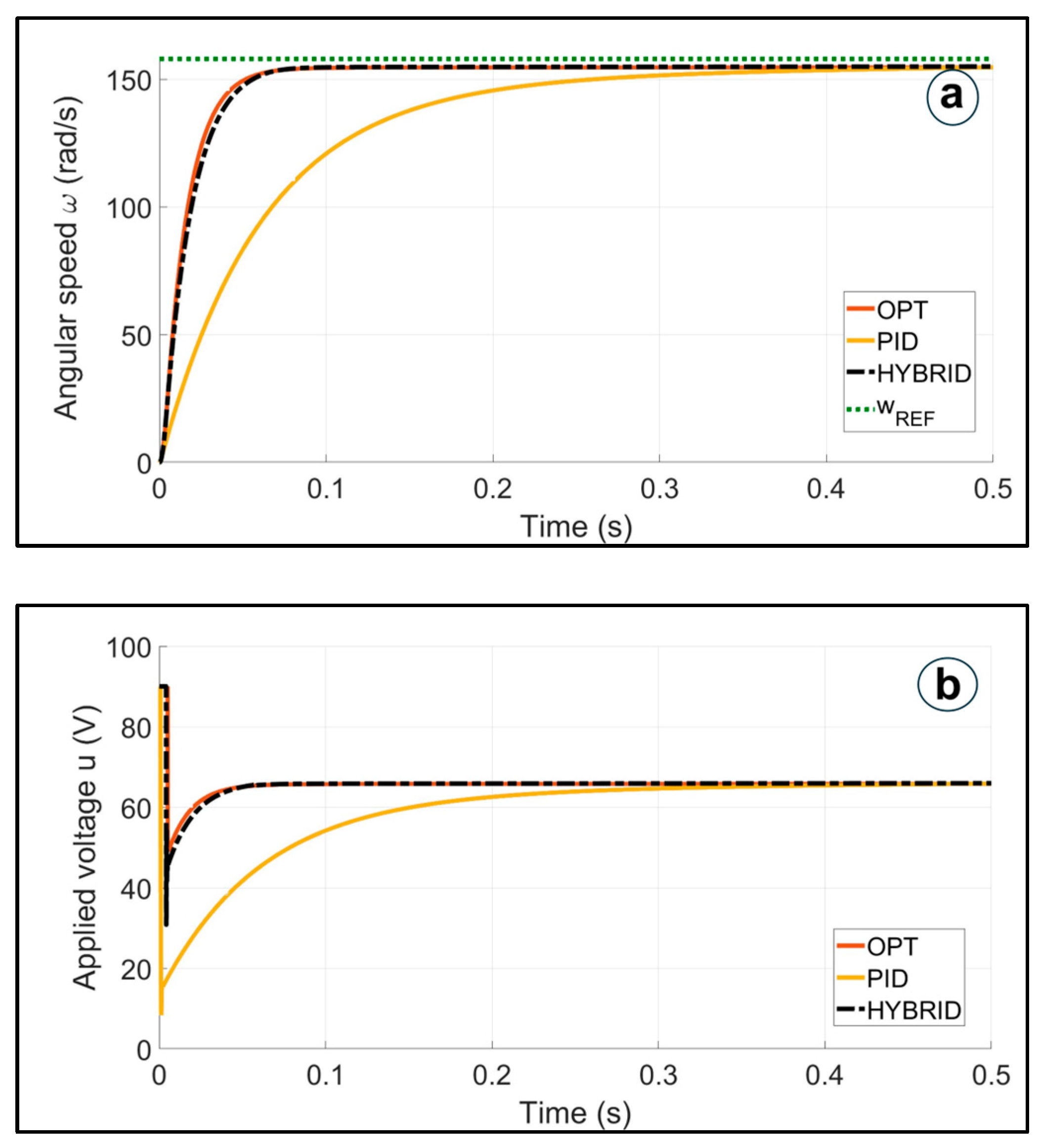
In the nominal operating case, all experiments are conducted using the nominal DC motor parameter values, without introducing parameter variations or external disturbances. Figure 5 displays the angular speed response and control voltage input trajectories, where
Table 3 reports the corresponding step response performance, error, and effort/cost summaries.
To better illustrate the comparative trends among the controllers, the nominal performance metrics are presented in a normalized form.
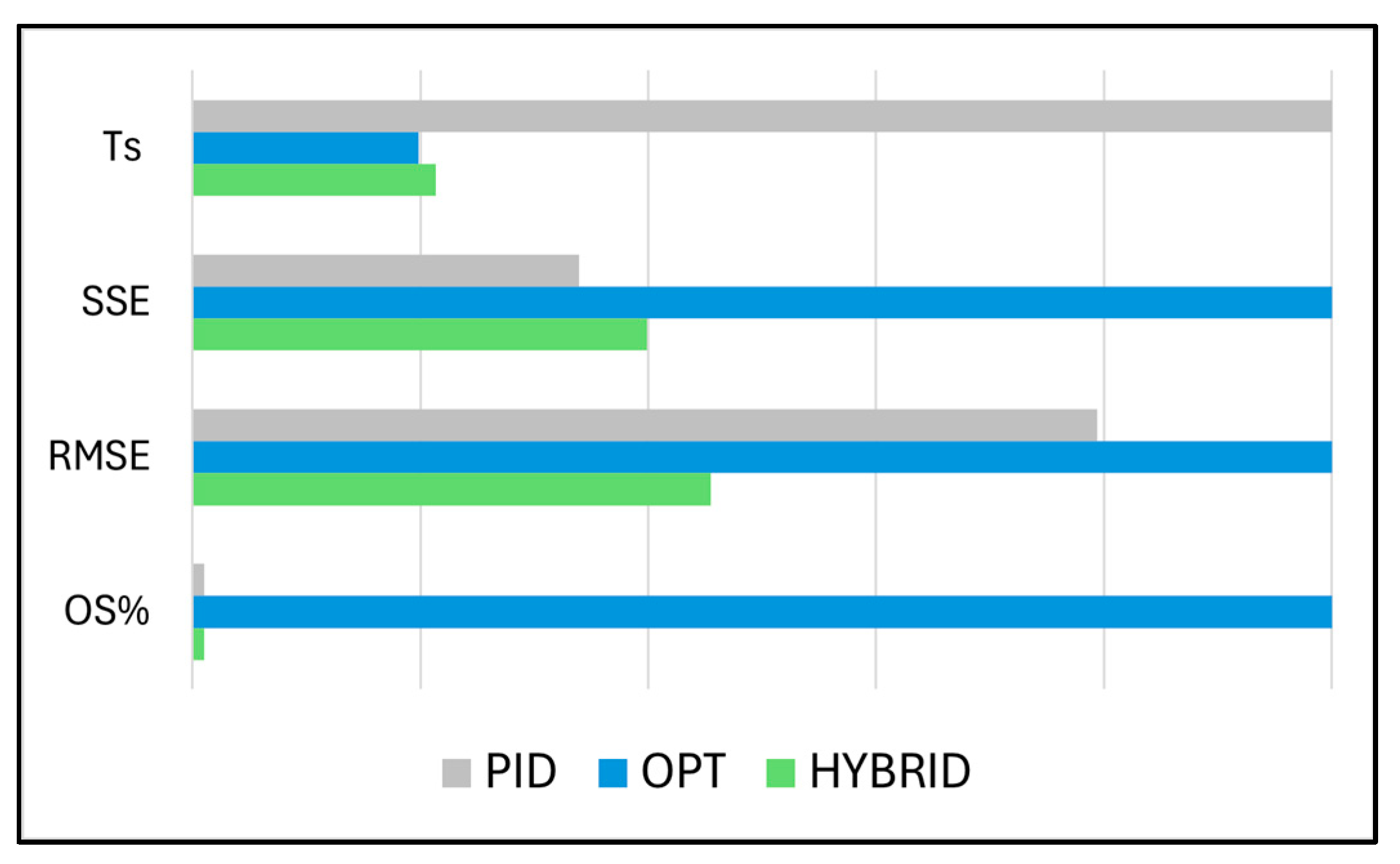
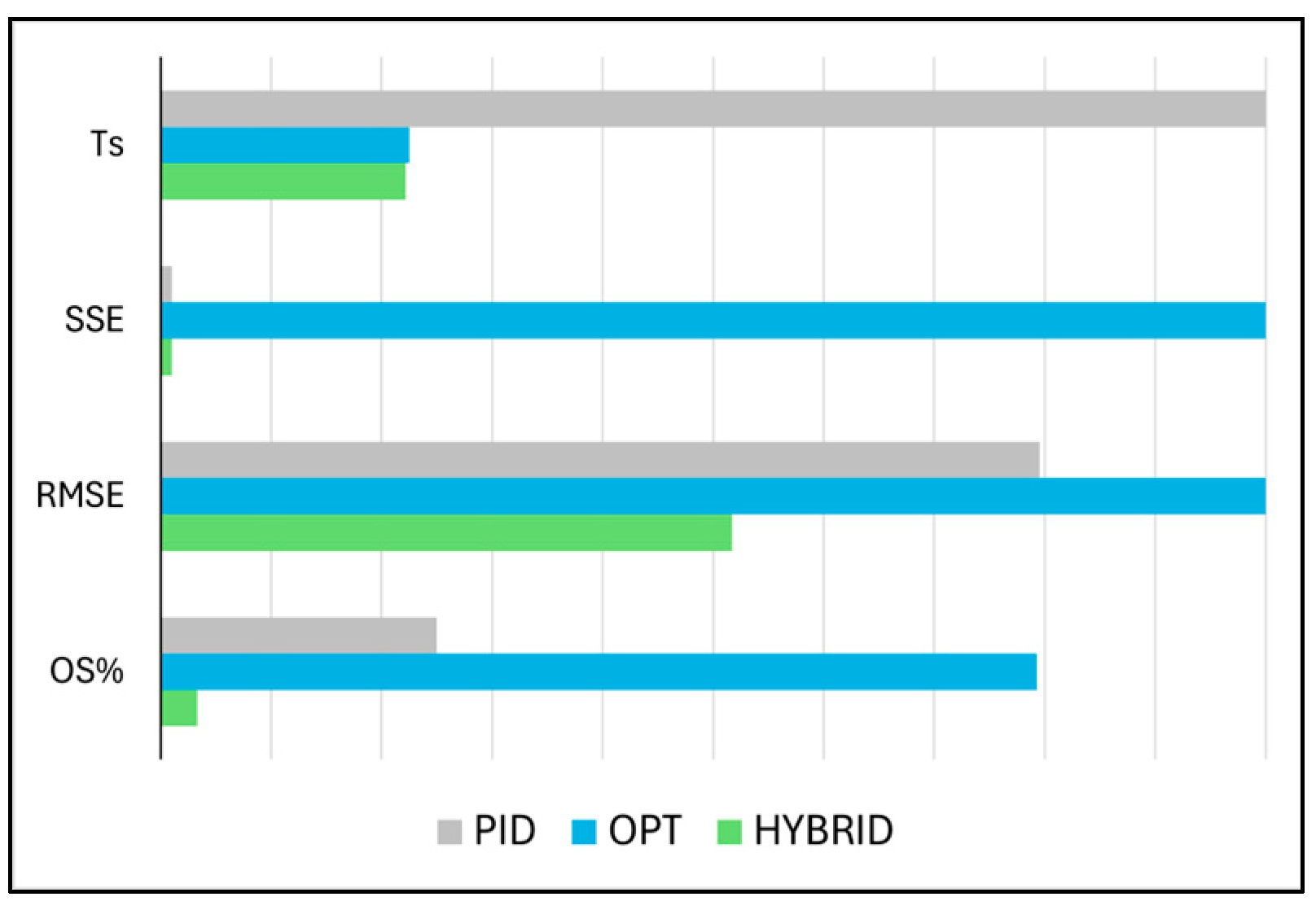
Figure 4 illustrates a normalized comparison of the nominal performance metrics for the three controllers. The metrics are normalized with respect to the worst value among the controllers to highlight the relative performance differences, where lower normalized values correspond to better performance.
Figure 5a and
Table 4 show that under nominal conditions, all controllers achieve stable tracking but exhibit different trade-offs among transient speed, error accumulation, and control effort. The OPT controller provides the fastest transient response, reducing rise and settling times by approximately 80% relative to PID; however, this acceleration is accompanied by noticeable peaking and a nonzero steady-state offset. The Hybrid controller preserves nearly the same transient speed (~75–80% improvement relative to PID) while effectively eliminating overshoot and offset.
In terms of error metrics, the Hybrid controller reduces RMSE and L2 by more than 40% relative to PID and by approximately 55% relative to OPT. Notably, the accumulated L1 error decreases by nearly 96% compared to the OPT controller, demonstrating that overshoot suppression significantly reduces total error accumulation over the time horizon.
The voltage trajectories in
Figure 5b further illustrate the actuation behavior of the controllers. Both OPT and Hybrid apply a higher initial control input than PID, enabling faster acceleration during the early transient phase. The PID controller increases the control input more gradually. All controllers converge to nearly identical steady-state voltage levels, indicating comparable steady-state energy requirements.
Overall, the nominal results reveal a structured trade-off among the controllers: the OPT controller prioritizes transient speed and effort efficiency at the expense of increased overshoot and a nonzero steady-state error, the PID controller ensures conservative offset-free behavior with slower dynamics, and the Hybrid controller provides a balanced compromise between rapid convergence and accurate, overshoot-free steady-state tracking, with only a marginal increase in actuation effort.
In conventional industrial practice, PID controllers are typically implemented with actuator saturation handling and anti-windup compensation. To ensure an industry-aligned and fair baseline comparison, a back-calculation anti-windup scheme was incorporated in both the standalone PID controller and the PID component of the Hybrid structure. The activation ratio of the anti-windup correction term remained below 0.05% of the total simulation time for the PID controller and 0% for the Hybrid controller. This indicates that actuator saturation and integrator windup were not governing factors under the evaluated nominal conditions and therefore did not materially influence the reported performance trends.
Having established the comparative performance under nominal conditions, the following section examines robustness under variations in both motor parameters and controller design parameters.
4.3. Robustness Sensitivity Analysis
To provide a comprehensive robustness assessment, two complementary sensitivity studies were conducted. The first examines robustness with respect to variations in the motor parameters, reflecting physical uncertainties and operating condition changes. The second investigates sensitivity to controller parameter variations, evaluating tuning robustness and performance stability under gain variations.
This dual analysis framework enables clear separation between physical-system uncertainty effects and controller-design sensitivity, ensuring a balanced and systematic robustness evaluation of all proposed control structures.
4.3.1. Sensitivity to Motor Parameter Variations (Model Robustness)
To evaluate robustness to motor parameter variations, system performance was assessed under nine stress scenarios listed in
Table 5, representing thermal variations, mechanical loading, electrical perturbations, and combined non-ideal effects. For each scenario, the controllers were re-simulated over a 100 s horizon. Metrics were computed exactly as in the nominal case, allowing direct comparison.
The stress scenarios are categorized into three groups: mild thermal and electrical variations, mechanical load and inertia variations, and severe disturbance conditions. Each group represents a distinct source of plant uncertainty and enables evaluation of different aspects of robustness.
Table 6 summarizes the maximum (worst-case) values of settling time (Ts), tracking error metrics (RMSE, L1, L2), overshoot (OS%), and steady-state error (SSE) observed within each scenario group. These values represent the most demanding operating condition encountered by each controller in the corresponding category and therefore provide a conservative robustness comparison. Detailed numerical results are provided in
Appendix A (
Table A1,
Table A2,
Table A3,
Table A4,
Table A5,
Table A6,
Table A7,
Table A8 and
Table A9).
- A.
Mild Thermal and Electrical Variations
Under mild operating variations—including Cold, Hot, Worn Brushes, and Supply Droop—the responses remain closely aligned with nominal behavior. Across this group, the Hybrid controller preserves overshoot-free tracking and negligible steady-state error.
Relative to PID, the Hybrid controller reduces RMSE by approximately 40–43%, while achieving roughly 52–55% lower RMSE compared to OPT. These reductions remain stable across all mild variations, indicating limited sensitivity to moderate thermal and electrical perturbations. Control effort changes remain small (typically below 10%), confirming that improved regulation accuracy is not achieved at the expense of excessive actuation.
The OPT controller retains its characteristic overshoot and nonzero steady-state error across this group, whereas PID maintains conservative but slower dynamics. Overall, the nominal trade-off structure persists under realistic environmental and aging effects.
- B.
Mechanical Load and Inertia Variations
Mechanical stress scenarios (Heavy Load and Aggressive Heavy Inertia) introduce substantial increases in inertia, directly affecting acceleration dynamics. Under Aggressive Heavy Inertia, inertia increased by up to 100%, and all controllers exhibited increased tracking error due to slower dynamic response.
Relative to nominal operation, the Hybrid controller shows approximately 27% increases in RMSE and L2, the OPT controller about 6–7%, and PID about 2–3%. Despite the larger relative deviation observed for Hybrid, it continues to maintain the lowest absolute RMSE and L2 values under this condition.
Accumulated L1 error remains nearly unchanged (<1% deviation) for both Hybrid and PID, indicating stable error accumulation characteristics even under severe inertial variation. The OPT controller maintains its characteristic overshoot and nonzero steady-state error.
Although increased inertia leads to longer transient times, all controllers partially compensate through increased actuation during the transient phase, without inducing instability and preserving steady-state regulation.
These results indicate that inertia amplification increases transient tracking error for all controllers. However, the absolute performance ordering among the controllers remains preserved under mechanical stress.
- C.
Severe Electrical Disturbance: Supply Sag Pulse
The Aggressive Supply Sag Pulse scenario represents a short-duration voltage disturbance that directly limits actuation capability. This scenario results in the largest increase in accumulated tracking error among the investigated cases.
Relative to nominal conditions, the accumulated error L1 increases by approximately 110% for Hybrid and 158% for PID. In contrast, OPT exhibits only modest relative variation in L1 (~3%), as its nominal accumulated error is already substantially higher. For RMSE, deviations reach approximately 30% for Hybrid and 17% for PID, while OPT shows moderate deviation (~6%). Despite disturbance-induced amplification of tracking error, the Hybrid controller continues to achieve the lowest absolute RMSE and L2 values among the compared strategies.
The reduced available actuation voltage during the sag interval affects transient tracking for all controllers; however, no instability or sustained steady-state drift is observed. The relative performance ordering among controllers remains preserved under this disturbance condition.
- D.
Aggressive Combined Stress
The Aggressive Combined scenario introduces simultaneous mechanical and electrical perturbations, including inertia increase (up to 50%), friction increase (up to 80%), electrical parameter shifts, supply reduction, and actuator non-idealities. Despite these substantial parameter deviations, performance degradation remains bounded.
Relative to nominal conditions, RMSE increases by approximately 20% for Hybrid, 9% for OPT, and 3–4% for PID. Even under this worst-case configuration, the Hybrid controller maintains the lowest absolute RMSE and L2 among the compared strategies. No instability, divergence, or sustained steady-state drift is observed.
Under the combined perturbations, transient dynamics become slower and more irregular due to the simultaneous reduction in actuation voltage and increase in mechanical loading. Nevertheless, the controllers adjust their transient input levels, resulting in moderate control-effort variation while maintaining bounded RMSE growth relative to the magnitude of the parameter deviations.
Importantly, although plant parameters deviate by up to 80% in friction and 50% in inertia within this scenario, the corresponding RMSE increase remains below approximately 30% for all controllers.
Across all investigated motor-parameter scenarios, a consistent performance ordering is observed. Although the magnitude of degradation varies with perturbation severity, the relative ranking among controllers in terms of absolute RMSE and L2 remains preserved. The Hybrid controller maintains the lowest RMSE and L2 values across all investigated scenarios. PID generally exhibits intermediate RMSE and L2 levels, whereas OPT consistently exhibits the largest accumulated L1 error and a persistent nonzero steady-state error (SSE ≈ 3.3–3.5), in contrast to the negligible SSE maintained by PID and Hybrid.
Under severe mechanical perturbations, rise and settling times increase for all controllers, leading to higher relative RMSE deviations. In the worst-case inertia scenario, RMSE increases by approximately 27–30% for Hybrid, while remaining lower for PID and OPT in relative terms. However, despite this larger relative deviation, the absolute RMSE and L2 values of Hybrid remain below those of PID and OPT.
To better visualize the overall robustness trends across the disturbance scenarios summarized in
Table 6, the worst-case metrics were first normalized with respect to the largest value among the controllers and then averaged across the scenario categories.
Figure 6 presents the average normalized worst-case performance metrics derived from
Table 6. Each metric was first normalized using the largest value among the controllers as the reference normalizing value, after which the normalized values were averaged across the scenario categories. Lower normalized values, therefore, indicate improved overall performance. As observed, the Hybrid controller maintains consistently lower normalized error values while preserving transient performance comparable to that of the optimal controller.
Overall, motor-parameter perturbations affect all controllers to varying degrees; however, the comparative ordering in RMSE, L1, L2, and SSE remains structurally unchanged across scenarios.
4.3.2. Sensitivity to Controller Parameter Variations (Design Robustness)
To evaluate design robustness, a bounded controller-parameter sensitivity study was conducted under nominal operating conditions. Controller design parameters were varied within predefined ranges while maintaining fixed plant dynamics, enabling isolation of tuning-related sensitivity from physical-system uncertainty. The quantitative results of the controller-parameter sensitivity analysis are summarized in
Table 7, where the maximum observed deviations in RMSE, overshoot, and control effort are reported for each tested variation.
- A.
Optimal Controller Sensitivity
For the OPT controller, sensitivity to the cost-weighting matrices and , as well as the learning rate , was evaluated.
Variations in produced moderate performance changes, with a maximum RMSE deviation of approximately 4.3%. Sensitivity to the learning rate was minimal (maximum RMSE deviation of 0.47%), with negligible variation in overshoot and control effort.
In contrast, the controller exhibited pronounced sensitivity to the control-weight parameter , where RMSE deviation reached approximately 16–17%. Increasing reduces the admissible control amplitude due to stronger penalization of actuation energy, resulting in higher tracking error. This reflects the inherent balance between error minimization and effort penalization embedded in the optimal cost formulation. Although overshoot also varied under changes in , closed-loop stability was preserved in all tested cases.
- B.
Hybrid Controller Sensitivity
For the Hybrid controller, sensitivity was evaluated with respect to learning rate , feature scaling factors, hybrid mixing bounds , scheduling reference , gating threshold , and the cost-weighting matrices and .
Across all tested variations, the maximum RMSE deviation remained below 1.6%, overshoot remained effectively zero, and control effort exhibited negligible variation. Even variations in and , which directly influence the optimal component, produced only limited performance changes.
Notably, sensitivity to learning rate and feature scaling parameters was extremely low (<0.05% deviation), indicating minimal dependence on precise tuning.
- C.
Structural Comparison and Design Robustness
A clear structural contrast emerges between the two approaches. The OPT controller demonstrates classical cost-weight sensitivity—particularly with respect to —leading to measurable variation in both tracking accuracy and actuation effort. In contrast, the Hybrid architecture exhibits uniformly bounded performance variation and nearly invariant control effort across all tested parameters.
This bounded sensitivity indicates that the PID backbone governs primary actuation behavior, while the optimal correction remains regulated through the gating mechanism, limiting parameter-induced amplification.
Overall, both controllers maintain stable operation under moderate parameter variations. However, the Hybrid design demonstrates reduced tuning sensitivity and more consistent performance across design choices, supporting practical implementability without delicate retuning.
4.3.3. Robustness Evaluation Under Measurement Noise
To evaluate controller robustness under realistic measurement uncertainty, zero-mean Gaussian noise was injected into the measured angular speed. The noisy measurement was defined as
where
,
, and
is a unit-variance Gaussian process. This formulation maintains disturbance magnitude proportional to the operating speed while preserving physical units (rad/s).
All simulations were conducted over a 100 s horizon using the same discrete-time motor model, controller parameters, and actuator constraints adopted in the nominal and robustness analyses. The same noise realization was applied to both controllers to ensure a fair paired comparison.
To mitigate high-frequency measurement fluctuations, the measured speed signal was processed through a first-order low-pass filter with an identical cutoff frequency for both OPT and Hybrid controllers. In the Hybrid controller, derivative action was implemented using filtered speed differentiation.
This framework assesses whether the proposed controllers maintain stable and reliable performance under realistic sensing disturbances, extending the evaluation beyond ideal noise-free conditions.
Table 8 reports the quantitative performance metrics of the OPT and Hybrid controllers under increasing measurement noise levels (0%, 1%, and 2%). The table presents RMSE, L2 error, steady-state error (SSE), total control effort, and limiter activation percentage to provide a comprehensive robustness comparison.
Under noise-free sensing, the Hybrid controller achieves approximately a 55% reduction in RMSE relative to OPT while eliminating the steady-state offset inherent to the optimal controller. This behavior is consistent with the nominal-case results, confirming that the structural advantage of the Hybrid architecture remains preserved under measurement disturbance evaluation.
As measurement noise increases to 1% and 2%, both controllers exhibit mild stochastic variation in performance metrics. However, the relative performance ordering remains unchanged. The Hybrid controller consistently maintains substantially lower tracking error and near-zero steady-state deviation, whereas the OPT controller retains its structural steady-state bias across all disturbance levels.
Since the noise standard deviation at 2% (~3.16 rad/s) is comparable to the nominal steady-state offset of OPT (~3.3 rad/s), any noise-induced bias would be expected to noticeably alter the steady-state value. However, the OPT offset remains nearly unchanged across all noise levels, demonstrating that the bias is intrinsically embedded in the controller architecture rather than arising from measurement disturbance.
In contrast, the Hybrid controller maintains near-zero steady-state error even when the disturbance magnitude approaches the scale of the OPT bias. This reinforces the inherent offset-rejection capability of the hybrid architecture.
No instability amplification, oscillatory growth, or excessive control effort increase is observed throughout the simulation horizon. Actuator limiter activation remains negligible in all cases (<0.02%), indicating that performance differences reflect controller architecture rather than saturation effects.
The bounded performance variation observed under increasing measurement noise is consistent with the structure of the controlled motor system. Since the disturbance affects the measured speed signal rather than the motor dynamics directly, its influence is moderated by the measurement filtering stage before entering the control law. High-frequency noise components are therefore attenuated, preventing derivative amplification and excessive control oscillation.
Importantly, the comparative performance ordering observed in the nominal evaluation, motor-parameter robustness analysis, and controller-design sensitivity study remains preserved under stochastic measurement disturbances. This cross-scenario consistency indicates that the observed controller hierarchy is not dependent on a specific type of variation, but reflects fundamental architectural characteristics.
Overall, the noise robustness analysis confirms that the comparative performance ordering among the controllers remains preserved under measurement disturbances. The Hybrid controller maintains bounded error growth and offset-free regulation despite stochastic sensing perturbations.
Taken together, the nominal, robustness, and measurement-noise analyses reveal consistent performance trends among the evaluated controllers. These trends can be interpreted by examining the structural characteristics of the corresponding control strategies.
The optimal controller derives its control action directly from the cost-minimization framework, which penalizes state deviations aggressively and therefore produces stronger corrective actions during transient phases. As reflected in
Figure 5 and
Table 4, this behavior reduces the settling time by approximately 75–80% relative to the PID, confirming the fast transient convergence of the optimal policy. However, the aggressive transient control action may also introduce noticeable overshoot. In addition, because the optimal formulation does not explicitly incorporate integral regulation, small steady-state offsets may appear under certain disturbances.
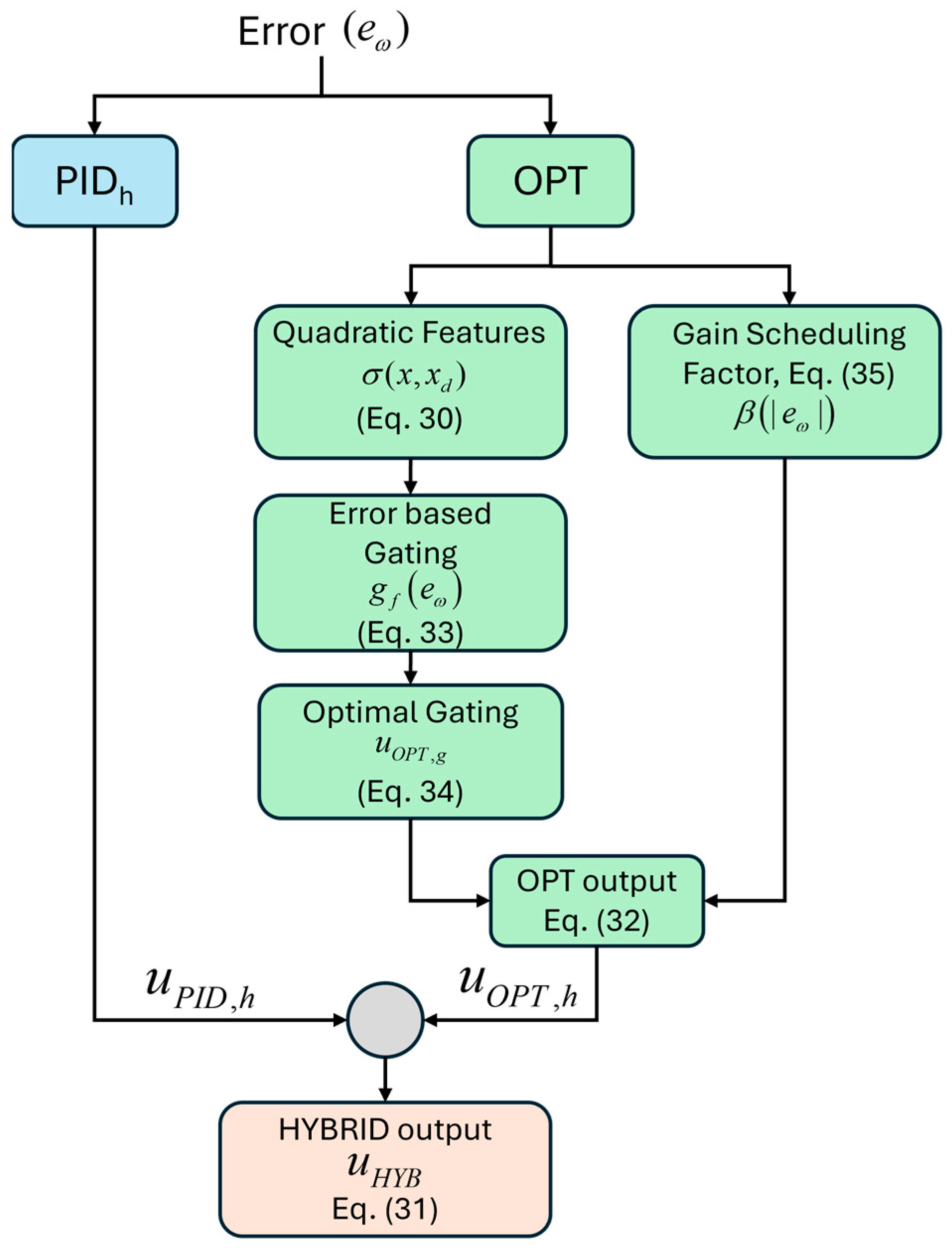
The Hybrid controller mitigates these limitations by combining the optimal correction with the integral regulation inherent in the PID structure. The error-dependent gating mechanism allows the optimal component to dominate during large deviations, accelerating the transient response, while the PID component stabilizes the steady-state behavior and suppresses excessive transient peaking. This structural cooperation enables the Hybrid controller to preserve nearly the same transient speed as the optimal controller while simultaneously eliminating overshoot and steady-state offset. Consequently, tracking errors (RMSE and L2) are consistently reduced across the evaluated scenarios.
This behavior reflects the classical control trade-off between transient speed and regulation quality: aggressive optimal actions accelerate convergence but may introduce overshoot, whereas the hybrid structure moderates this behavior to achieve a more balanced response between fast transient dynamics and accurate steady-state regulation. This effect is consistent with the inherent dynamics of DC motor systems, where aggressive transient actuation accelerates speed convergence but may induce transient peaking due to the electromechanical coupling between torque generation and rotor inertia.
These observations are consistent with trends reported in recent studies on learning-based control systems. Reinforcement learning controllers can achieve rapid transient responses but may exhibit non-vanishing steady-state errors due to policy approximation and finite training data. To mitigate this effect, additional integral compensation or hybrid feedback structures are often introduced to improve steady-state regulation [
33].
Despite these encouraging results, several limitations should be acknowledged. First, the present evaluation is conducted entirely within a simulation framework, and hardware-specific effects such as sensor quantization, computational delay, and actuator nonlinearities were not experimentally validated. Second, the HDP policy relies on a predefined feature structure consisting of five basis functions, which may limit approximation capability in highly nonlinear operating regimes. Finally, the policy-learning procedure is performed offline over a bounded operating region, and extrapolation of the learned policy beyond this region cannot be guaranteed. Future work will therefore focus on experimental validation and on extending the proposed approach to broader operating conditions and more complex electromechanical systems.
These findings highlight the practical advantage of the proposed Hybrid architecture, which combines the fast transient response of learning-based optimal control with the steady-state regulation capability of classical PID feedback.



 ,
,