1. Introduction
Active-suspension systems generate active control forces through servo actuators, which can effectively suppress body vibration, improve ride comfort while ensuring driving safety, and have become an important development direction in modern vehicle technology [
1,
2]. Hydraulic servo actuators are widely used in active-suspension systems of engineering vehicles and precision equipment due to their advantages of large output force, fast response speed, high stiffness, and strong anti-interference ability, making them the core executive component [
3,
4]. With the continuous improvement of the requirements for suspension ride comfort and stability in vehicle engineering, the control accuracy and operating-condition adaptability of hydraulic servo actuators are facing more severe challenges.
Under long-term complex service conditions, suspension servo actuators are prone to various compound-progressive degradation faults due to factors such as hydraulic oil contamination, mechanical wear, and load fluctuation. Although such faults do not directly lead to complete system failure, they continuously deteriorate the dynamic response characteristics of the actuator and significantly reduce the overall control performance of the active suspension [
5]. Typical degradation faults include internal leakage of hydraulic cylinders and controller time delay. Internal leakage faults occur in the internal sealing pairs of hydraulic cylinders, characterized by strong concealment and progressive development, which are difficult to accurately monitor and model through conventional sensors [
6]; time-delay faults are closely related to controller hardware performance, data transmission efficiency, and algorithm complexity, and they are also difficult to describe with accurate mathematical models [
7]. Therefore, model-dependent control methods, such as Linear Quadratic Regulator (LQR) [
8,
9,
10,
11] and Model Predictive Control (MPC) [
12,
13], show obvious limitations in dealing with the above faults. On the one hand, the problem of model mismatch is prominent, leading to a decline in control accuracy; on the other hand, these methods have weak adaptability to system time delay, and fixed parameters have difficulty meeting the control requirements under different time-delay conditions, which seriously restricts their application in practical engineering [
14].
Model-free adaptive control (MFAC) does not rely on the accurate mathematical model of the controlled object and can construct the control law only using the input–output data of the system, providing a new idea for solving control problems under complex faults [
15,
16]. MFAC updates the control input by estimating the “pseudo-partial derivative” online and has the characteristics of simple structure, low computational complexity, and strong robustness, showing good potential in nonlinear system control [
17,
18]. However, traditional MFAC still has shortcomings in handling time-delay systems and degradation faults [
19]. Firstly, MFAC adopts an explicit time-delay compensation mechanism, which often increases computational complexity and has a limited compensation effect; secondly, the control law design insufficiently considers the dynamic characteristics of tracking errors, thereby affecting the dynamic response performance of the system [
20]; thirdly, its error adjustment mechanism is relatively single, and, under compound-degradation fault conditions, the tracking and suppression capability for time-varying errors is limited, and the control parameters have difficulty maintaining optimal performance under different fault modes.
In recent years, the development of intelligent optimization algorithms has provided a new approach for control parameter tuning [
21,
22]. The common algorithms include particle swarm optimization (PSO) [
23,
24,
25], the Firefly Algorithm (FA) [
26], the Whale Optimization Algorithm (WOA) [
27], the Beetle Antennae Search (BAS) algorithm [
28], etc. Among them, the PSO algorithm is widely used in control parameter optimization due to its advantages of a simple structure, fast convergence speed, and convenient parameter adjustment. However, the traditional PSO algorithm has problems such as fixed inertia weight and inflexible boundary constraint handling, and it is prone to falling into local optimum in high-dimensional parameter optimization, thereby limiting the performance improvement of the control algorithm. Therefore, it is necessary to design effective improvement strategies to enhance its global search capability and convergence stability. In addition, the impact of the selection of objective functions in the optimization process on the final control effect needs to be clarified further.
To address the aforementioned research gaps in the control of suspension servo actuators under hydraulic cylinder internal leakage and controller time-delay compound faults, this paper carries out targeted research and proposes an integrated control and optimization framework, with the specific original contributions of this work being fourfold:
(1) A high-fidelity simulation model for fault analysis is established: the discrete state equation of the servo valve-controlled hydraulic cylinder system is derived, and a co-simulation model of the suspension servo actuator system with internal leakage and time-delay faults is built based on Simulink and AMESim, which accurately reflects the dynamic characteristics of hydraulic actuators under compound-progressive degradation faults and provides a reliable test platform for control strategy verification.
(2) An improved particle swarm optimization (IPSO) algorithm is proposed for high-precision parameter tuning: a dynamic inertia weight adjustment strategy and a particle out-of-bounds random reflection mechanism are introduced to overcome the local optimum problem and inflexible boundary handling of traditional PSO, which significantly improves the global search capability and convergence stability of the algorithm and makes it a more suitable optimization tool for nonlinear hydraulic systems under complex fault conditions.
(3) A differential term-based model-free adaptive control (DE-MFAC) strategy is designed: the time-delay term is converted from explicit compensation to implicit handling in the MFAC control law to reduce its direct impact on control accuracy, and a tracking error differential term and dynamic weight factor are integrated into the MFAC performance criterion function, which effectively breaks the limitations of traditional MFAC in time-delay compensation and dynamic error response and enhances the controller’s adaptability to compound-degradation faults.
(4) An IPSO-optimized DE-MFAC collaborative control framework is constructed: the proposed IPSO algorithm is used to dynamically optimize the parameters of the DE-MFAC controller for different severity levels of internal leakage and time-delay compound faults, and the optimization effects of IPSO under different objective functions are compared and analyzed to clarify the matching principle of objective functions and suspension engineering requirements. This framework realizes fault-adaptive parameter tuning for suspension servo actuators, solving the key problem that the fixed control parameters in the existing research cannot maintain optimal performance under varying fault modes.
The remainder of this paper is organized as follows.
Section 2 elaborates on the mathematical modeling of the suspension servo actuator system, including the derivation of the servo valve-controlled hydraulic cylinder model and the establishment of internal leakage and time-delay fault models.
Section 3 details the design principles of the DE-MFAC controller and IPSO algorithm and presents the overall structure of the IPSO-optimized DE-MFAC control strategy.
Section 4 verifies the effectiveness of the proposed control strategy through co-simulation based on Simulink2023b and AMESim2021, with a comparative analysis of control performance under different fault severities and optimization methods.
Section 5 conducts an in-depth discussion on the simulation results, clarifies the evaluation criteria for control performance, verifies the realization of the proposed research novelty, and further points out the limitations of the current work and the key directions of future research.
Section 6 summarizes the main conclusions of this study and highlights the engineering application value of the proposed IPSO-DE-MFAC framework.
2. Mathematical Model of Suspension Servo Actuator
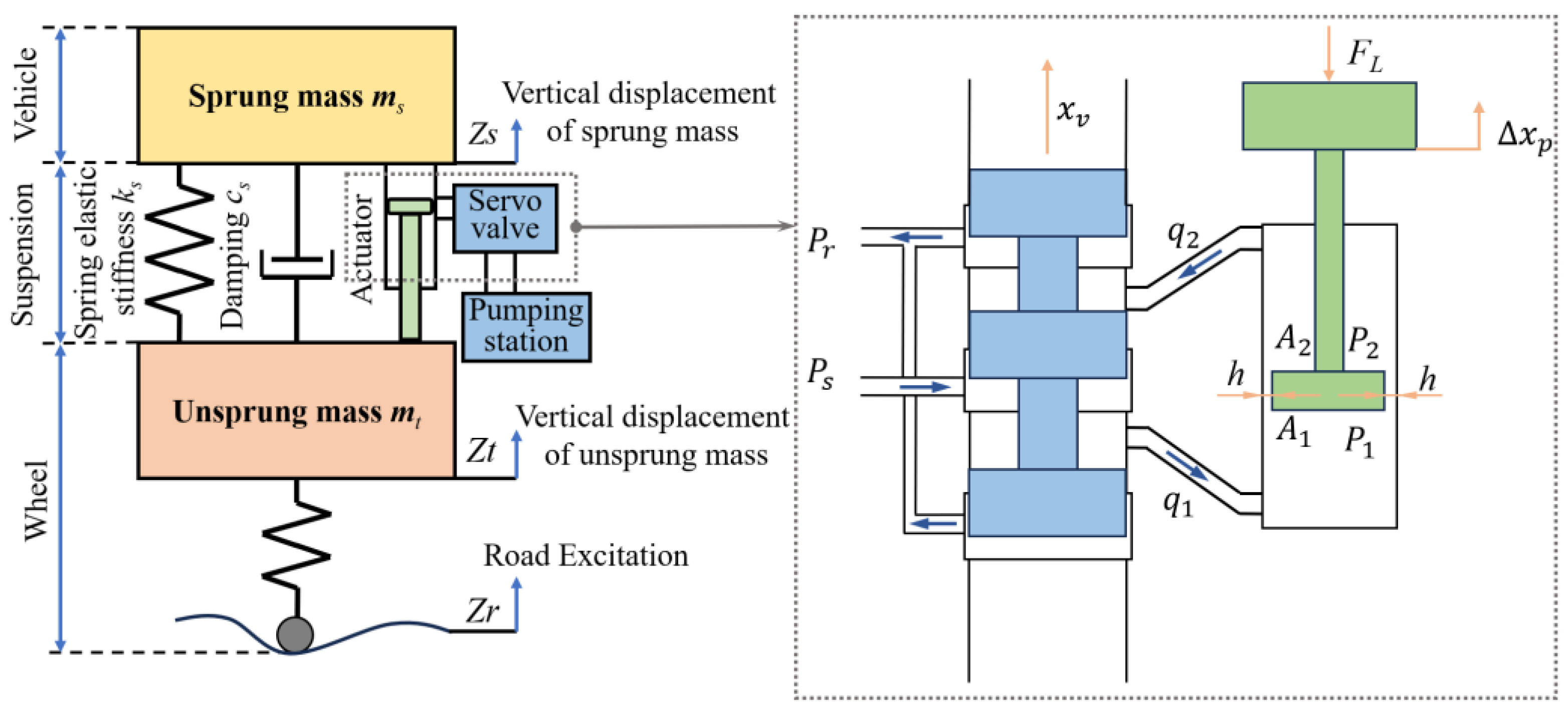
Figure 1 depicts the layout of a quarter-vehicle active-suspension configuration. Generally, this actuator is composed of a three-position four-way servo valve coupled with an asymmetric hydraulic cylinder, and its basic operational principle is illustrated in the graphical plot included in
Figure 1. In the course of operation, the servo valve obtains electrical control commands, which bring about a corresponding displacement of the valve core. This displacement, in turn, diverts hydraulic oil into the rod chamber and rodless chamber of the hydraulic cylinder, respectively. Through modulating the fluid pressure within these two chambers, the required pressure difference is created, thereby driving the piston rod of the hydraulic cylinder to execute axial linear motion. This actuation principle facilitates precise regulation of the piston’s position, ultimately achieving the output motion of the actuator. In this suspension system, the hydraulic actuator is arranged between the sprung mass and the unsprung mass, and its actuation output is used to weaken the vibration transmission of road excitation
to the sprung mass. This structural design ensures that the vertical displacement difference between the sprung mass
and the unsprung mass
remains consistent with the piston displacement change of the hydraulic actuator.
The second-order kinematic relationship between the movement distance of the servo valve spool and the electrical signal is as follows:
where
represents the movement displacement of the valve core;
represents the input electrical signal to control the movement displacement of the valve core;
is the gain;
is the fixed frequency of servo valve in normal working state;
is the damping ratio that exists in normal working conditions.
The inlet and outlet flow of the valve can be calculated using the following formula:
where
denotes the system supply pressure, and
stands for the system return pressure;
and
indicate the pressures in the rodless chamber and rod chamber, respectively;
represents the flow coefficient of the servo valve;
denotes the area gradient of the servo valve spool;
stands for the density of the hydraulic oil.
The flow rates of the rod chamber
and rodless chamber
of the hydraulic cylinder are, respectively, as follows:
where
,
, respectively, denote the effective areas of the hydraulic cylinder’s rodless chamber and rod chamber;
signifies the change in the hydraulic cylinder’s piston displacement
represents the internal leakage coefficient between the piston and cylinder body inside the hydraulic cylinder;
, where
is the diameter of the piston,
is the height of the single-sided gap when the piston is concentric with the cylinder body,
is the dynamic viscosity of the hydraulic oil, and
is the length of the gap seal;
represents the leakage of hydraulic oil between the hydraulic rod and the cylinder block, which is equivalent to the leakage of hydraulic oil to the outside of the cylinder block;
is the effective bulk modulus. The volume change of the two chambers of the hydraulic cylinder can be calculated by the following formula:
where
and
denote the initial buffer volume for two chamber designs. The suspension servo actuator transmits force between the wheels of the vehicle, and the following relationship can be obtained:
where
is the combined mass of the vehicle body and the piston,
is the viscous damping coefficient,
is the friction force,
is the gravitational acceleration, and
is the external load force. In the suspension model of a quarter of the vehicle, the external load force
acting on the actuator can be equivalent to a combination of spring force, damping force of the damper, and external load capacity, as shown below:
State variables include hydraulic cylinder piston displacement
, piston movement speed
, rodless chamber pressure
, rod chamber pressure
, servo valve spool displacement
, servo valve spool speed
, sta
, c
, and
. The state-space equation is expressed as
where state matrix
, input matrix
, constant term vector
, output matrix
. Among which,
.
The control objective of the system is to determine the appropriate input electrical control signal for the three position four-way connection valve such that the error
between the output and the desired signal converges to zero as
gradually increases for the desired trajectory
. Furthermore, since controllers are typically implemented as discrete-time models in practical engineering applications, selecting
as the sampling period and discretizing Equation (9) yields state vector
, control input
, and system output
:
where
,
, .
3. Optimization Control Strategy of IPSO Algorithm and DE-MFAC Controller
To address the control performance degradation of servo actuators caused by compound faults such as internal leakage and time delay, this paper proposes a collaborative control framework integrating the DE-MFAC and IPSO algorithms. First, aiming at the limitations of the MFAC in time-delay handling and dynamic performance optimization, the DE-MFAC control strategy is constructed; by implicitly processing the time-delay term and introducing the tracking error differential term and dynamic weight factor, the control performance is optimized. Second, to improve the parameter-tuning effect, the traditional PSO algorithm is modified by introducing the dynamic inertia weight and boundary random reflection mechanism so as to enhance its global optimization capability.
3.1. Dynamic Linearization Method for Time-Delay Suspension Actuator Systems
While Equation (10) identifies the system as a standard SISO nonlinear system, the presence of a time delay in the control signal necessitates its representation as the following:
where
and
represent the input and output of the electro-hydraulic servo actuation system at time
, respectively, and
is the system time-delay constant. This implies that the electro-hydraulic servo actuation system exhibits an input time delay
, meaning the control signal
at time
acts on the servo valve at time
after being regulated by the control actuator. As a result, the control signal received by the electro-hydraulic servo actuation system lags behind the control output, thereby affecting system stability.
It is assumed that the control and output signals of the ASEHSA system satisfy the following two reasonable conditions:
Assumption 1.
Except at certain finite time instants, the nonlinear system function has continuous partial derivatives with respect to the input signal .
Assumption 2.
Except at certain finite time instants, the system satisfies the generalized Lipschitz condition. For any , , , the inequality holds is a constant. Based on the physical characteristics of suspension servo actuator systems and related hydraulic components in practical engineering, it can be inferred that the output of the actuator is inherently limited. This is mainly attributed to the following factors: in actual systems, the input electrical control signal size of the servo valve is limited within a certain range, the system supply pressure is subject to rated constraints, and both the maximum elongation and load-bearing capacity of the hydraulic cylinder are restricted by structural design. Thus, the entire suspension servo actuation system is a typical constrained system, which satisfies the applicable conditions of the traditional model-free adaptive control algorithm.
Note 1: The reasonableness of the two preceding assumptions for the ASEHSA system is twofold. First, Assumption 1 is a standard premise in the controller design for typical nonlinear systems. Second, Assumption 2, concerning the boundedness of input and output, is grounded in practical engineering realities. The input signal of a servo valve is generally an electrical signal that is physically constrained, which in turn limits the spool displacement and inherently bounds the actuation output of the hydraulic cylinder. Given these valid assumptions, the following lemma can be established [
29]:
Theorem 1.
For a nonlinear system that meets Assumptions 1 and 2, and under the condition that , there exists a time-varying parameter referred to as the pseudo-partial derivative (PPD) denoted by , allowing the nonlinear system to be transformed into the following Compact-Form Dynamic Linearization (CFDL) data model:
The introduction of a system delay factor can express the dynamic linearization equation as
where
is bounded for all
.
In order to solve or conceal the time delay in the controlled system in the dynamic linearization equation, assuming the system has a maximum time delay, which can be observed or calculated by calibrating the time axis of the data in actual experiments, a time-delay predictor for discrete systems can be introduced and incorporated into dynamic linearization equations with time-delay parameters. Furthermore, the original nonlinear system with input delay is equivalently transformed into a dynamic linearized system with implicit delay elements. Therefore, defining
as the predicted state at time
based on the measurement of time delay
, we obtain
where
is the predictor for the next time step of
. The predicted state
can then be expressed as
Further, merge Equations (13)–(15) together:
Observing Equation (16), it can be observed that the equivalent dynamic linearization equation no longer contains time-delay parameters, or the time-delay parameters are hidden. Therefore, model-free controller design can be based on the equivalent dynamic linearization system, which is equivalent to designing a controller with time-delay compensation capability.
3.2. Basic Model-Free Adaptive Controller
The traditional MFAC controller is obtained using the following performance indicator functions:
The tracking error is defined as
, and
is the desired output signal. By incorporating Equation (15) into the performance criterion 16, calculating its partial derivative with respect to
, and equating the result to zero, the following control law is derived:
where
is the step weight factor of the next control signal calculated by regulation;
is a weight compensation factor that prevents the denominator from being zero.
is a real-time variable parameter used in the control process to calculate the change in control quantity for the next time step. Due to its time-varying characteristics, its exact value is difficult to calculate. Therefore, the following pseudo-partial derivative function is proposed to estimate the time-varying parameter:
where
is the estimated value of
, the time-varying parameter;
is also a safety factor that prevents the denominator from being zero. Based on the optimization condition
, we have
Due to the deviation between the estimated and actual values of time-varying parameters, and to increase the accuracy of the estimated values and tracking accuracy, a normalization algorithm is set up:
where
represents the step factor of the time-varying parameter change calculated for the next time step,
is a minimal constant used for resetting, and
denotes the initial value of
. Equations (18)–(21) establish the conventional CFDL-MFAC control framework, creating a closed-loop system that achieves dynamic linearization and adaptive control without relying on an explicit plant mathematical model.
3.3. Dynamic Error Model-Free Adaptive Controller
The traditional MFAC controller only considers the difference between the expected value and the output signal and fails to effectively incorporate short-term fluctuations in the signal value received by the controller into the control algorithm, resulting in a volatile control signal within a short period and making it difficult to quickly restore stability [
30].
To overcome this challenge, by introducing dynamic differentiation of the error between the desired signal and the output signal, DE-MFAC enables its control signal to produce a larger amplitude of variation when dealing with degraded faults, thereby achieving faster control response. This key feature alleviates the inherent trade-offs of traditional MFAC and significantly improves the flexibility of the controller. The improved control performance criterion function is given by
where
serves as a weighting coefficient to modulate the impact of tracking error variation rate. When
, the control performance criterion Equation (22) becomes equivalent to the conventional criterion Equation (17). Following analogous derivation steps as in traditional MFAC by substituting Equation (16) into criterion Equation (22) and solving the partial derivative with respect to
set to zero, the DE-MFAC control law is derived as
Note 2: The DE-MFAC method depends solely on the real-time input–output (I/O) data of the controlled system, with no requirement for any dynamic modeling information. Moreover, through dynamic linearization and data-driven equivalent strategy, it accomplishes adaptive regulation of nonlinear systems. For a more detailed derivation, please refer to Ref. [
19].
3.4. Improved Particle Swarm Optimization Algorithm (IPSO)
The PSO algorithm is a highly effective iterative optimization method that swiftly searches for parameter combinations yielding near-optimal controller performance through the minimization of a predesigned objective function. In the process of controller parameter calibration, the objective function functions as an assessment benchmark for control performance; consequently, its formulation exerts a direct impact on both the efficiency of parameter optimization and the practical feasibility of the outcomes [
31]. However, when tackling optimization problems associated with complex structural characteristics, the standard PSO algorithm often has difficulty achieving a balance between global exploration and local exploitation, leading to suboptimal convergence efficiency and a propensity to become trapped in local optimal solutions. To improve the algorithm’s optimization capability, targeted algorithmic modifications are required to mitigate these drawbacks.
3.4.1. Integral Optimization Objective Function
In the iterative optimization process of controller parameters, the objective function is used as an indicator to evaluate the control performance, such as response accuracy and stability of the controlled system. An excellent and stable objective function should reflect the various control performance of the system as comprehensively and accurately as possible. In order to meet the requirements of position tracking and dynamic response of suspension servo actuators, both absolute error integral (IAE) and absolute cubic error integral (IACE) can be used as objective functions to optimize controller parameters through IPSO or PSO algorithms, respectively:
IAE is defined as the temporal accumulation of the absolute error between the system output and the desired signal. IAE comprehensively considers the error accumulation throughout the entire control process of the controlled system and thus evaluates the magnitude of the error and the time weight occupied by the error comprehensively. However, this integrated approach to total error accumulation often falls short in addressing local details, such as the suppression of local overshoot, which may not align with practical control requirements.
IACE is defined as the temporal accumulation of the cube of the absolute error between the system output and the desired signal. Both IACE and IAE share computational simplicity as their expressions do not involve differential operations and have low computational complexity. This facilitates rapid evaluation of particle fitness during the iterative process of the PSO algorithm, thereby enhancing optimization efficiency.
3.4.2. Traditional PSO Algorithm
Within a D-dimensional target search space, a population of
n particles is defined. The position of the
i-th particle is denoted as
and its velocity as
. Each particle stores its own historical best position, known as the personal best
and has access to the swarm’s overall historical best position, known as the global best
. The velocity and position of each particle are updated according to the following equations:
where
represents the velocity of the
-th particle in the
-dimension after
iterations, and
represents the corresponding position;
is the weight of the particle velocity from the previous iteration;
and
are learning factor that is often taken as 2; and
,
are random numbers in [0, 1].
The implementation of the PSO algorithm requires setting bounds for particle velocity and position. When a particle’s velocity or position exceeds these bounds, it is constrained to the corresponding boundary value. The particle’s position is then evaluated using the objective function to update the individual best position, the global best position, and the global best fitness value. Iterate through Equations (25) and (26) until all iterations are completed or the set termination criteria are met.
3.4.3. Improvement Strategies for PSO
Within the framework of the conventional particle swarm optimization (PSO) algorithm, the inertia weight
is often assigned a fixed value. Research conducted by Shi Y has demonstrated that this inertia weight exerts a pivotal influence on balancing the global exploration and local exploitation capacities of particles. A relatively larger inertia weight strengthens the algorithm’s global exploration capability, enabling particles to probe into new search regions; in contrast, a smaller value promotes in-depth local exploitation, allowing for more precise refinement within localized search domains [
32,
33]. To better balance the global and local search abilities of the particles, this study introduces the following dynamic adjustment strategy for the inertia weight:
where
denotes the maximum iterations,
the current iteration, and
,
the upper and lower bounds of the inertia weight. The proposed adjustment strategy progresses through three sequential stages: during the initial phase (
),
is fixed at
to promote global exploration. In the transitional phase (
), it nonlinearly decreases to
to shift the focus towards local exploitation. Finally, in the last phase (
), it remains at
to intensify local search and enable high-precision convergence near the optimum. During the iterative cycle of the PSO algorithm, particles may exceed the predefined constraint limits in one or more dimensions. This tends to diminish population diversity in the early iterative stages, impede the convergence process, and may even confine the search to local optima or boundary solutions [
34]. When a particle exceeds a constraint in any dimension, it is randomly reflected back into the feasible search space. This mechanism helps to maintain swarm diversity and mitigates the risk of convergence to boundary optima. The definition of particle boundary violation handling method is as follows:
where
and
represent the upper and lower bounds of the
-th dimension for each particle, respectively, and
denotes a random number uniformly distributed in the interval [0, 1].
3.5. IPSO with Multiple Coefficients in DE-MFAC
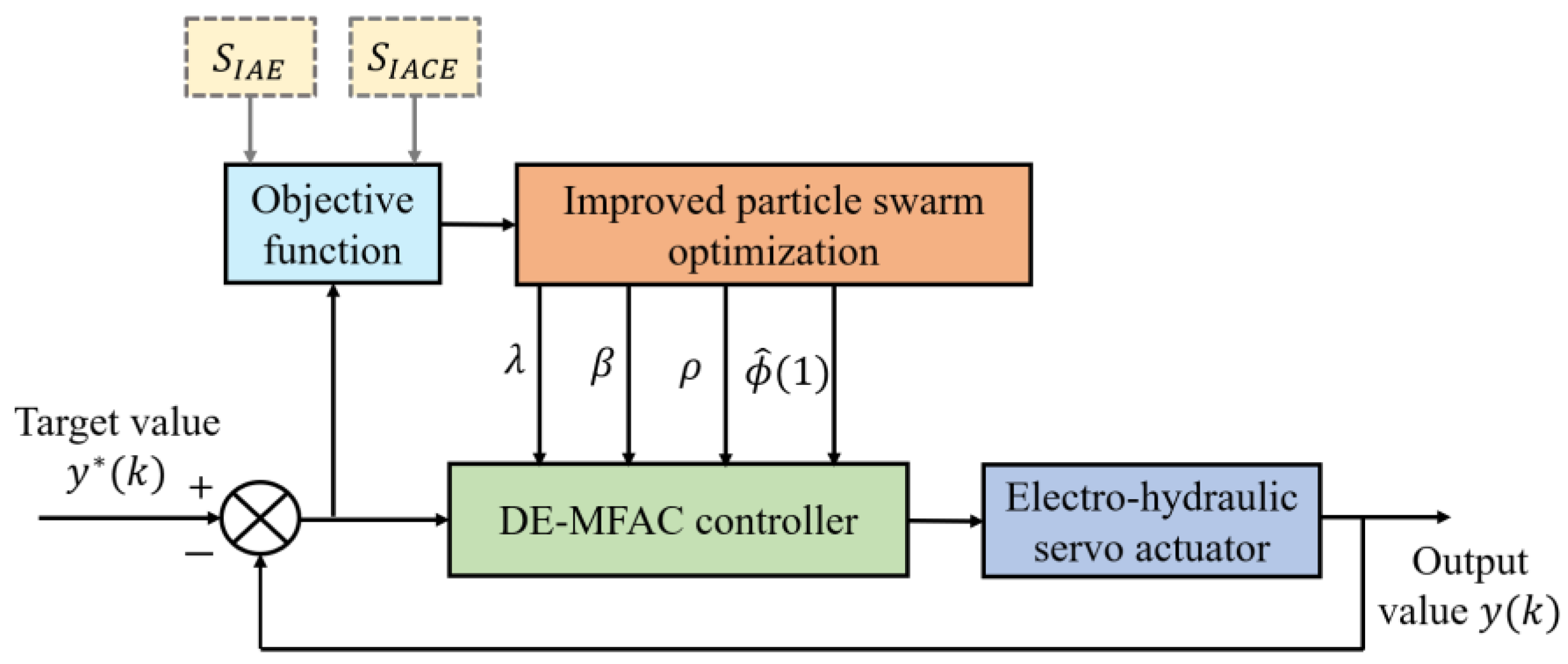
Figure 2 depicts the parameter optimization framework for the DE-MFAC controller within an electro-hydraulic servo actuator, utilizing the improved particle swarm optimization (IPSO) algorithm. In this scheme, the tracking error between the desired output
and the actual output
, defined as
, is fed into the objective function. The IPSO algorithm iteratively searches for the controller parameter combination that minimizes this objective function, thereby identifying the optimal parameters for enhanced system performance.
To establish a methodical and efficient optimization, a systematic sensitivity analysis of the controller parameters was performed prior to the iterative search. Across the feasible ranges of the tunable parameters, , , , , and values were uniformly sampled. Employing a one-at-a-time variation method, where a single parameter was altered while others remained fixed, the influence of each parameter on system performance was quantitatively evaluated using the IAE or IACE as the performance metric. This analysis identified , , , and as the parameters exerting a significantly greater impact on the system output compared to and . Among which and . Consequently, to balance optimization efficacy with computational cost, these four key parameters were selected as the optimization variables for the IPSO process.
The primary procedures for optimizing the DE-MFAC controller via the IPSO algorithm are as follows:
Step 1: Algorithm and Search Space Configuration
A 4-dimensional target search space is constructed using the coefficients , , , and . The position of the i-th particle is denoted as and its velocity as . The four dimensions correspond to , , , , respectively, with the position constraints set as follows: , , , . The velocity constraints are uniformly set to the range . Set the swarm size to , the maximum number of iterations to , the maximum and minimum inertia weights to . The parameter search space is determined through multiple experiments to ensure coverage of potential optimal values while avoiding unreasonable areas, thereby improving optimization efficiency and reliability of results.
Step 2: Fitness Function Definition
The fitness of each particle, which evaluates the quality of its position, is defined directly by the objective function, here the or criterion.
Step 3: Swarm Initialization
The initial positions and velocities of all particles are randomly assigned within their respective bounds. The fitness value for each particle is then computed. Based on these initial evaluations, each particle’s personal best position and the swarm’s global best position are established.
Step 4: Iterative Search and Update
In each iteration , the inertia weight is first calculated using Equation (27). Subsequently, the velocity and position of every particle are updated via Equations (25) and (26). Any particle violating the position or velocity constraints is handled according to the boundary strategy in Equation (28). Following the updates, the fitness of all particles is re-evaluated, and the and positions are refreshed accordingly.
Step 5: Termination and Output
Iterate step 4 until the iteration count M reaches the set value. Finally, obtain the optimal particle position and output its dimensional data to complete the algorithm.
4. Analysis of Simulation Results
Based on the co-simulation platform of Simulink and AMESim, a servo actuator model incorporating internal leakage and time-delay faults is established, and this section carries out simulation verification and analysis of the proposed method. By comparing with the conventional MFAC, the position-tracking accuracy, response speed, and overshoot-suppression capability of the IPSO optimized DE-MFAC under various compound-fault conditions are demonstrated. Furthermore, the overshoot-suppression effect of the IACE function, as well as its applicability in engineering scenarios with strict dynamic performance requirements, is analyzed. Meanwhile, the effectiveness of the IPSO algorithm in optimizing control parameters is verified, which provides technical reference for extending the service life of the actuator.
4.1. Co-Simulation Modeling of the Suspension Actuator System
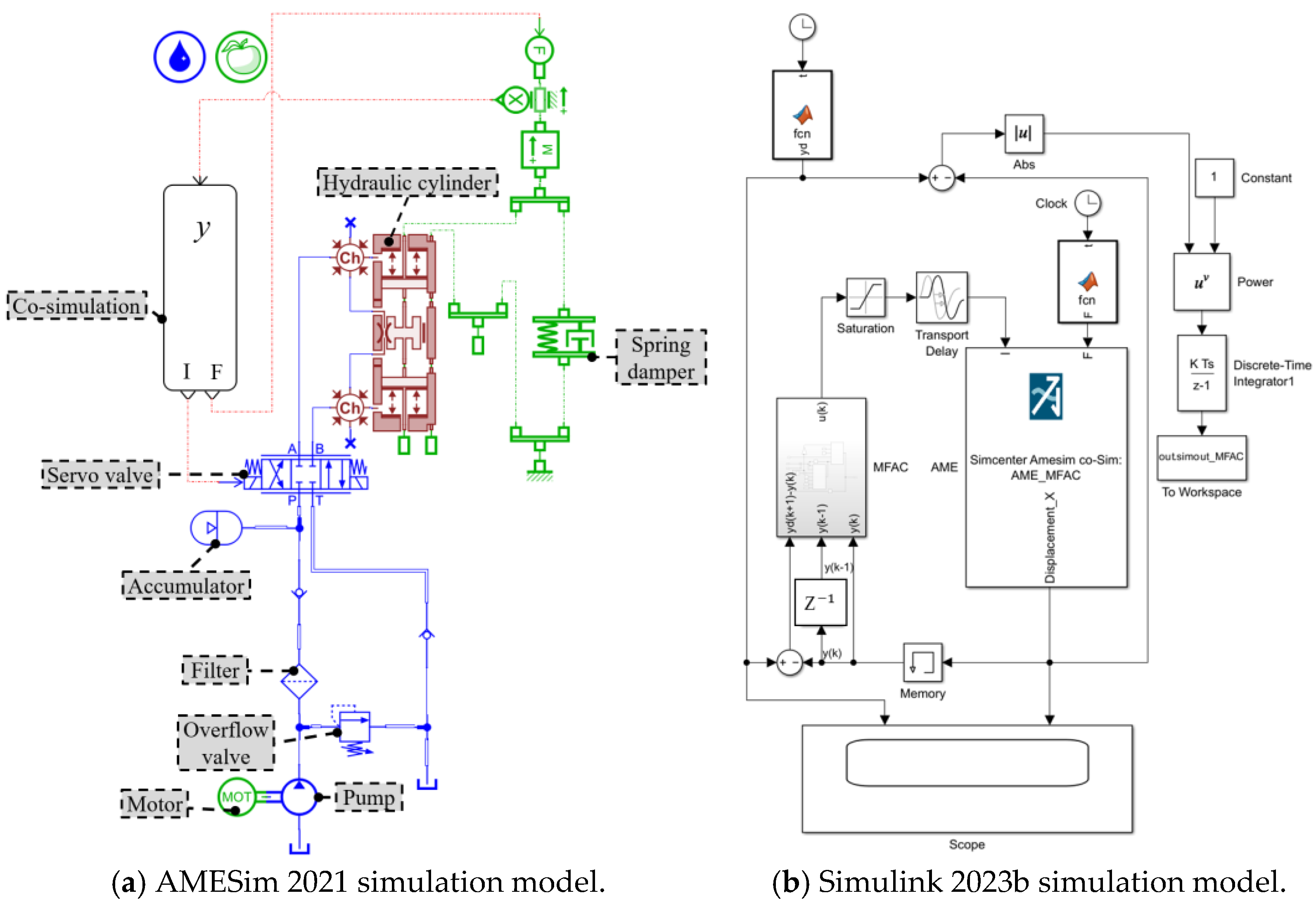
The structure of the co-simulation model is shown in
Figure 3. The controller is implemented in Simulink 2023b with a discrete solver at a sampling time of 0.0001 s, while the servo actuation system is modeled in AMESim 2021; the corresponding parameters are detailed in
Table 1. The actual vehicle has a mass of approximately 2000 kg. Considering that the vehicle is supported by four suspension systems, the sprung mass is set to
. In addition, considering the influence of the vehicle’s load-bearing support force and additional wheel forces on the force of the suspension system, these forces are uniformly equivalent to an external constant load force applied to the suspension actuator. According to the vehicle’s design load limit, the value of the external load force is approximately determined to be
. In the spring damper, the spring stiffness
, and the damping value is
. Under fault-free conditions, the internal leakage clearance of the hydraulic cylinder is
, and the time delay is
. In order to more accurately compare the performance of the DE-MFAC controller and eliminate the randomness of adjusting single signal waveform parameters, square wave, triangular wave, and sine wave signals are used here to form the desired output signal
:
4.2. The Impact of Objective Function on Simulation Results
It is evident from the optimization process of the PSO algorithm that the selection of the objective function plays a decisive role in guiding the final optimization results. Among them, the Integral Absolute Error function (
) and the Integral Absolute Cube Error function (
), as two core objective functions, exert a particularly noteworthy influence on the optimization outcome and warrant in-depth discussion.
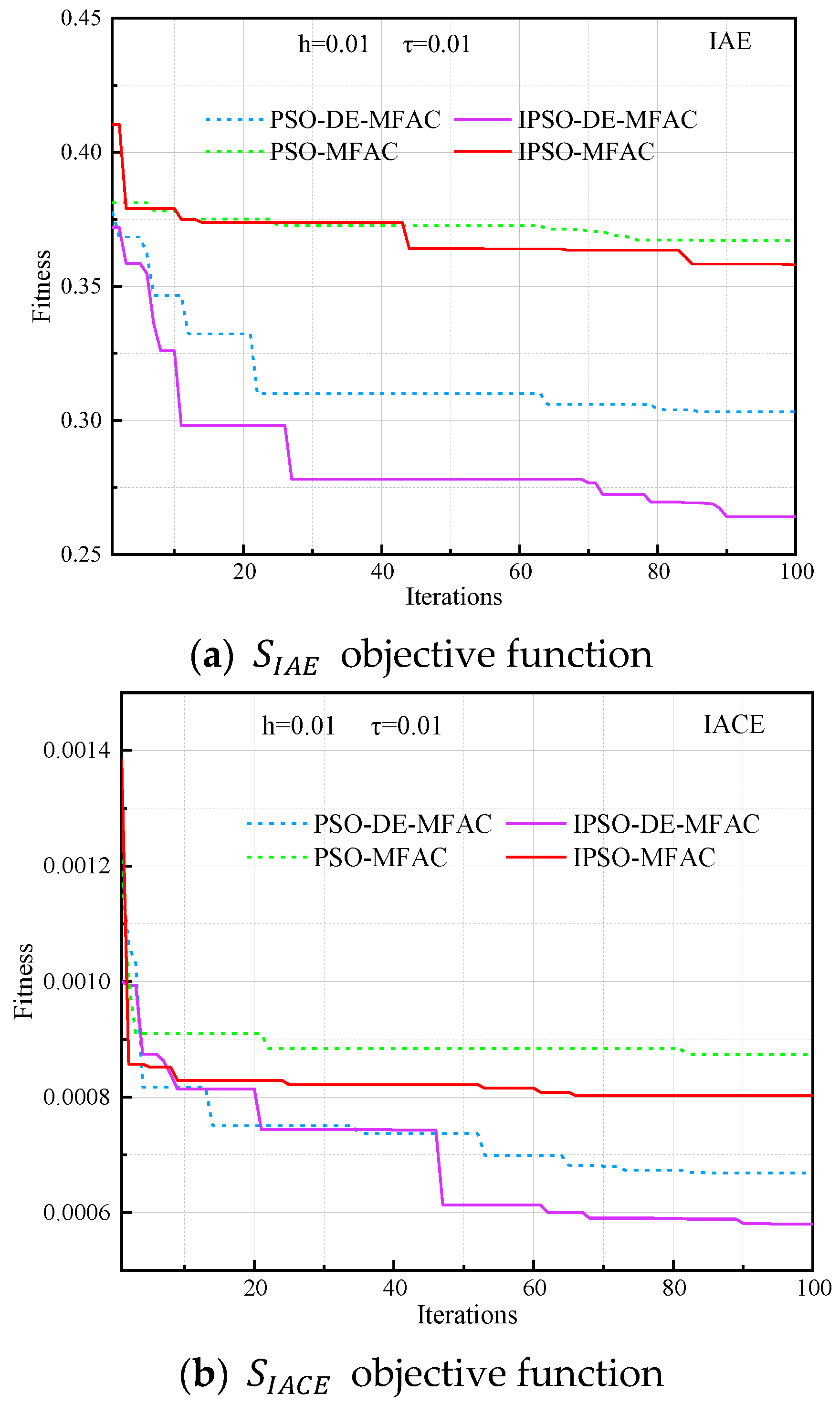
Figure 4 illustrates the variation in fitness values during the optimization process using PSO and IPSO algorithms under fault-free system conditions, with these two objective functions applied separately. This study also conducted corresponding optimization and comparative analyses on the traditional MFAC controller.
The minimum fitness values are shown in
Table 2. The results show that, under both objective functions, the minimum fitness values obtained through IPSO are significantly lower than those from PSO, indicating that the IPSO algorithm possesses superior optimization capability. Furthermore, under the same optimization algorithm, the minimum fitness value of DE-MFAC is notably lower than that of MFAC, and this trend remains consistent across both objective functions, thereby validating the superior control performance of the DE-MFAC controller.
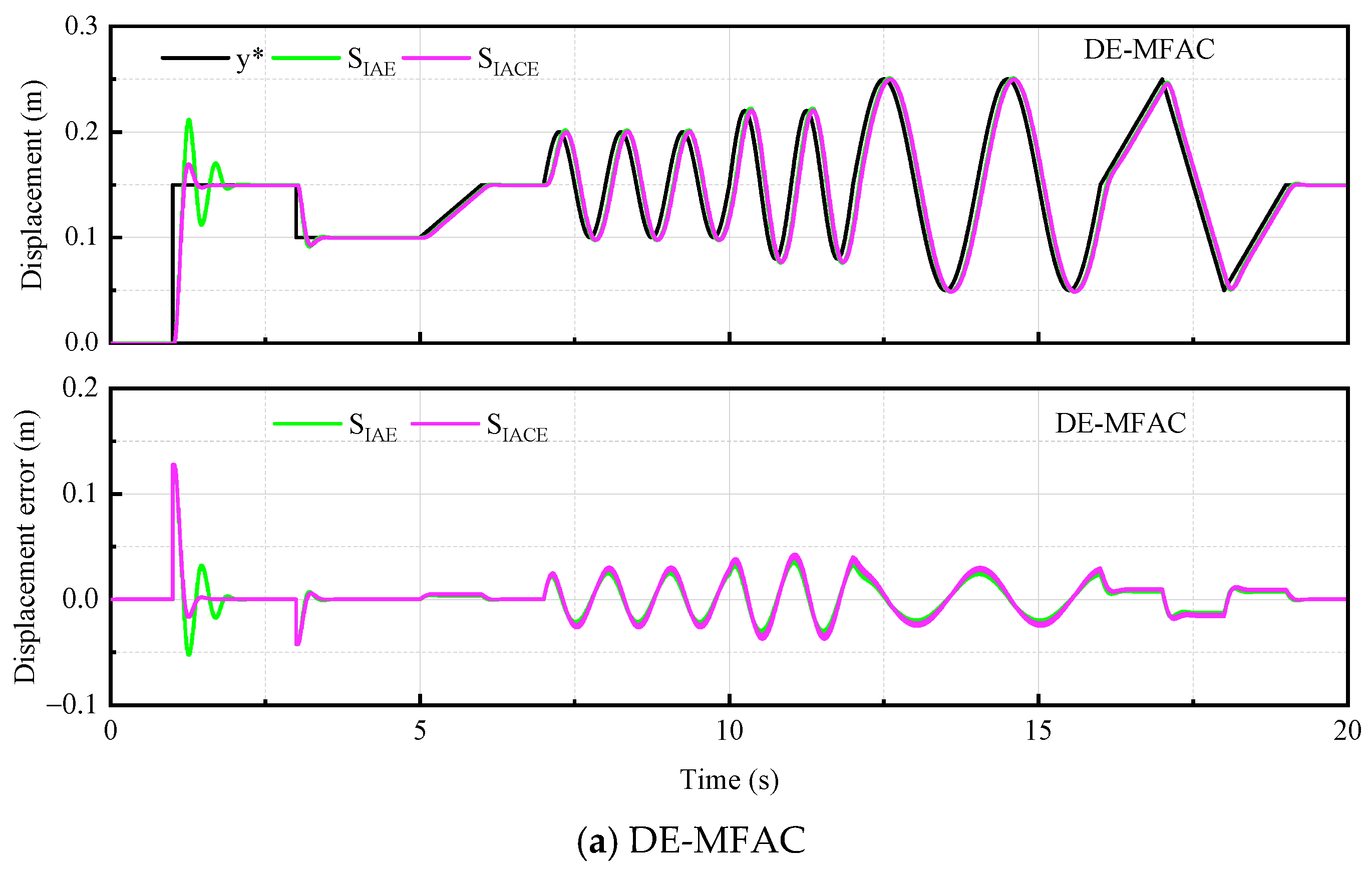
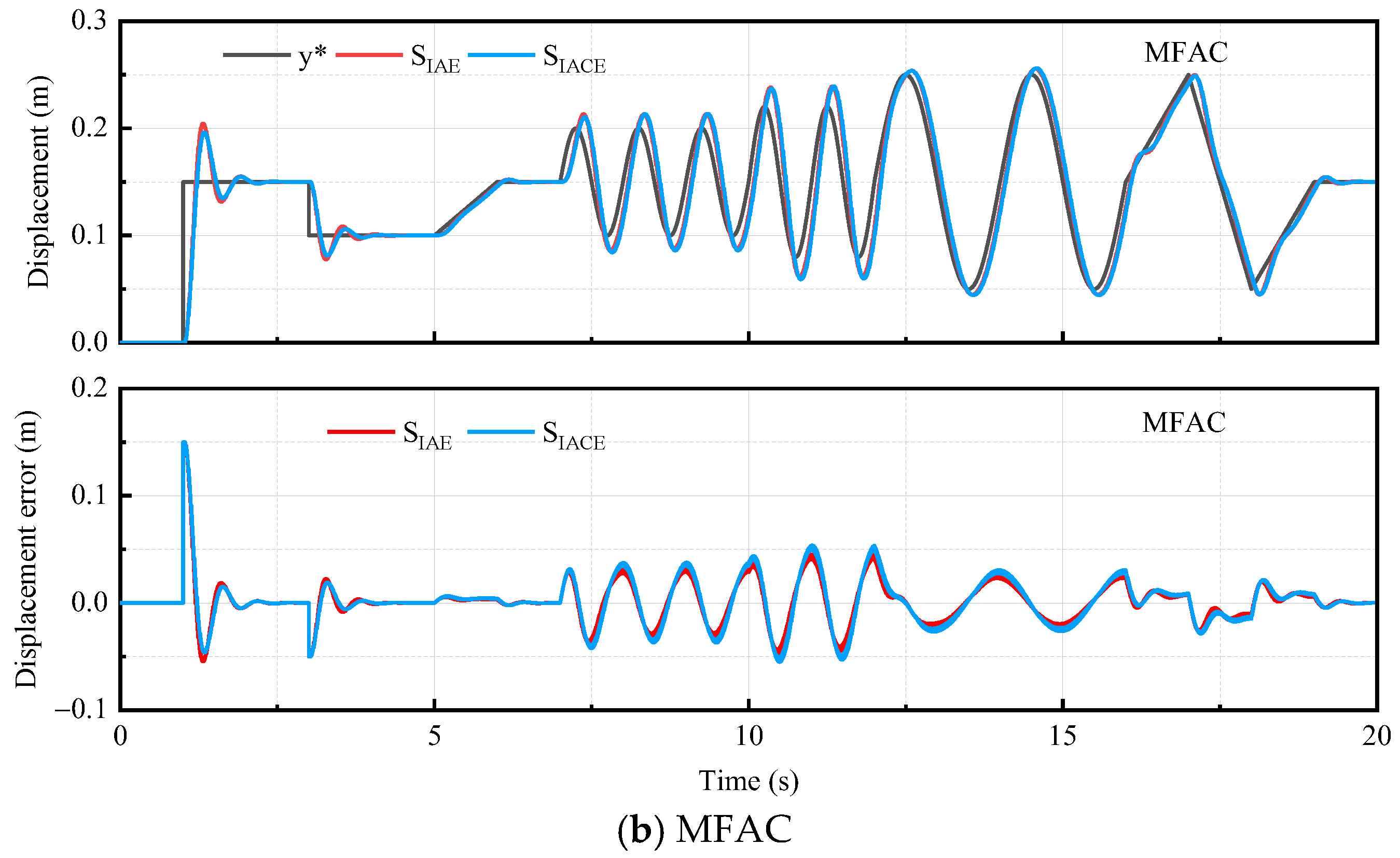
Figure 5 presents the position-tracking simulation results of DE-MFAC and MFAC controllers optimized by IPSO under different fitness functions. Comparing their tracking curves with respect to the desired signal reveals that DE-MFAC not only achieves higher tracking accuracy and smaller errors but also reproduces the desired signal more faithfully than MFAC, further demonstrating the outstanding dynamic performance and reliability of DE-MFAC. This advantage is primarily attributed to the introduction of the dynamic error differential term, which enhances the controller’s dynamic adjustment capability and design flexibility, effectively balances the system settling time and overshoot, and thus improves the overall control performance.
For the same controller, the choice of objective function directly affects the optimization results.
Figure 5a compares the position-tracking curves of the DE-MFAC controller with respect to the desired signal after optimization by the IPSO algorithm under the
and
objective functions, respectively. It can be observed that, when
is used as the objective function, the dynamic response performance of the DE-MFAC controller for sinusoidal and triangular waves is slightly better than that under the
objective function. Conversely, when
is adopted as the objective function, the overshoot and settling time of the DE-MFAC controller during square-wave tracking are significantly superior to the results obtained with the
objective function. The same pattern holds true for the MFAC controller in optimization experiments, as shown in
Figure 5b.
The underlying reason for these differences lies in the mathematical characteristics of the two objective functions. is the integral of the absolute cube of the error between the desired and output signals; its cubic amplification effect makes it more sensitive to larger deviations. In contrast, is the integral of the absolute error, whose result emphasizes the overall cumulative deviation throughout the control process. Therefore, when the IPSO algorithm adopts as the objective function, the optimization process places a greater emphasis on suppressing overshoot. However, within the entire control cycle, the duration of overshoot in square-wave tracking is relatively short. As a result, in the final calculation of the objective function, the deviations of the sinusoidal and triangular waves still occupy a considerable proportion, which explains why the dynamic responses of the controller to sinusoidal and triangular waves do not show significant differences under the two objective functions.
In practical control scenarios of suspension servo actuators, controlling overshoot and settling time during square-wave signal tracking is often a core requirement. How to minimize overshoot while maintaining good dynamic response performance constitutes a key objective in controller design. Hence, the
objective function demonstrates greater practical value in real control systems.
Table 3 further provides the specific optimized control parameters of the DE-MFAC and MFAC controllers when the IPSO algorithm adopts
as the objective function under fault-free system conditions.
4.3. Performance Optimization of DE-MFAC Controller Under Degraded Faults
Although the degradation faults of the suspension servo actuator do not directly cause structural damage or complete failure, they significantly degrade its control accuracy, dynamic response speed, and operational stability. Ultimately, this results in actuation performance that fails to meet the vibration damping requirements of the suspension system. From an engineering application perspective, targeted optimization of controller parameters can effectively mitigate the negative impacts caused by degradation faults, thereby indirectly extending the effective service life of the suspension servo actuator.
In this study, using
as the objective function, the IPSO algorithm is employed to optimize the control parameters of the DE-MFAC controller under various degradation fault conditions.
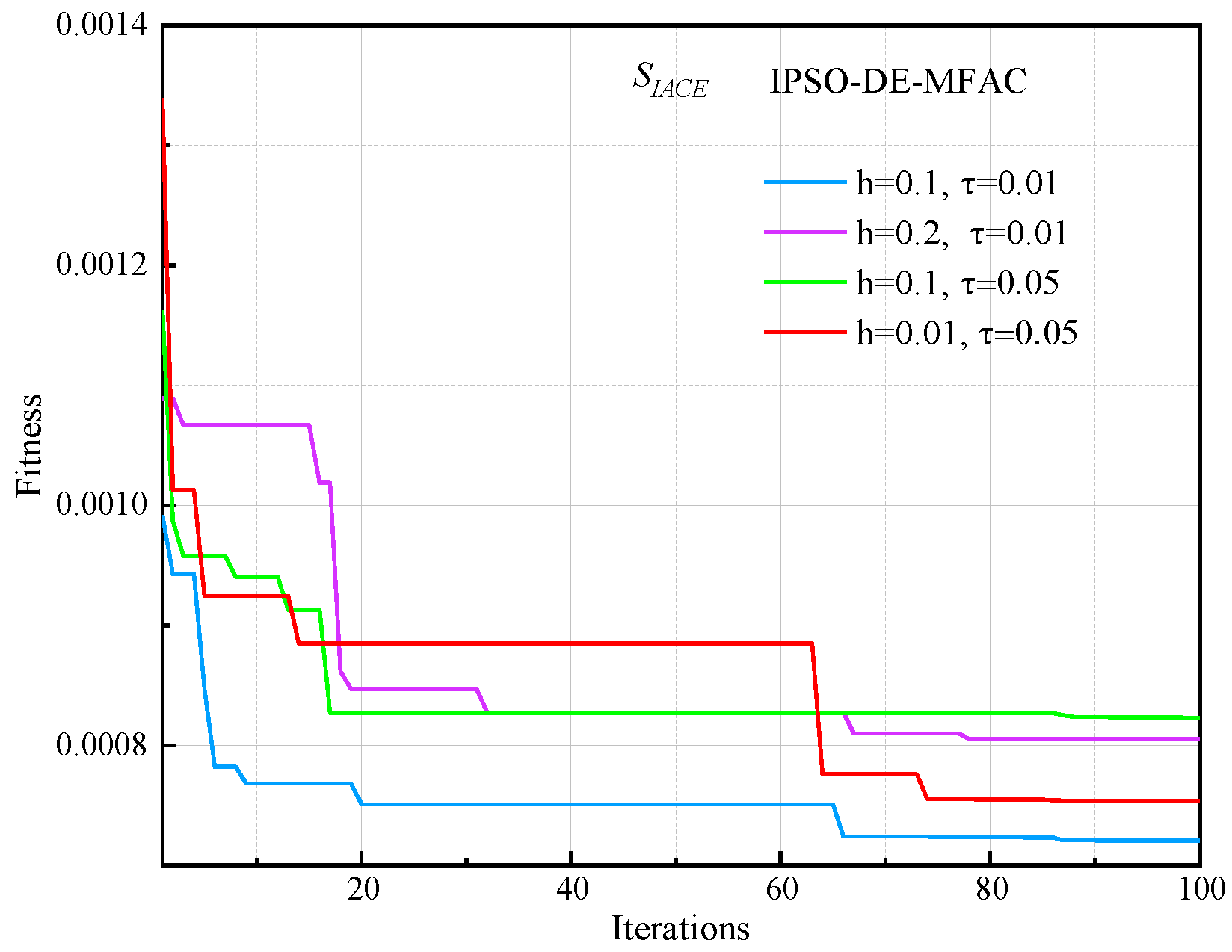
Figure 6 presents the curves of fitness value variation during each optimization process. The minimum fitness values are shown in
Table 4. The trend observed from these curves shows that, across all types of degradation fault scenarios, the fitness value exhibits a monotonically decreasing trend as the iteration count increases. This result directly verifies the effectiveness and reliability of the IPSO algorithm in optimizing the DE-MFAC controller parameters under fault conditions.
To investigate the impact of degradation faults on system control performance in depth, this study reuses the DE-MFAC controller parameters tuned under the fault-free condition (listed in
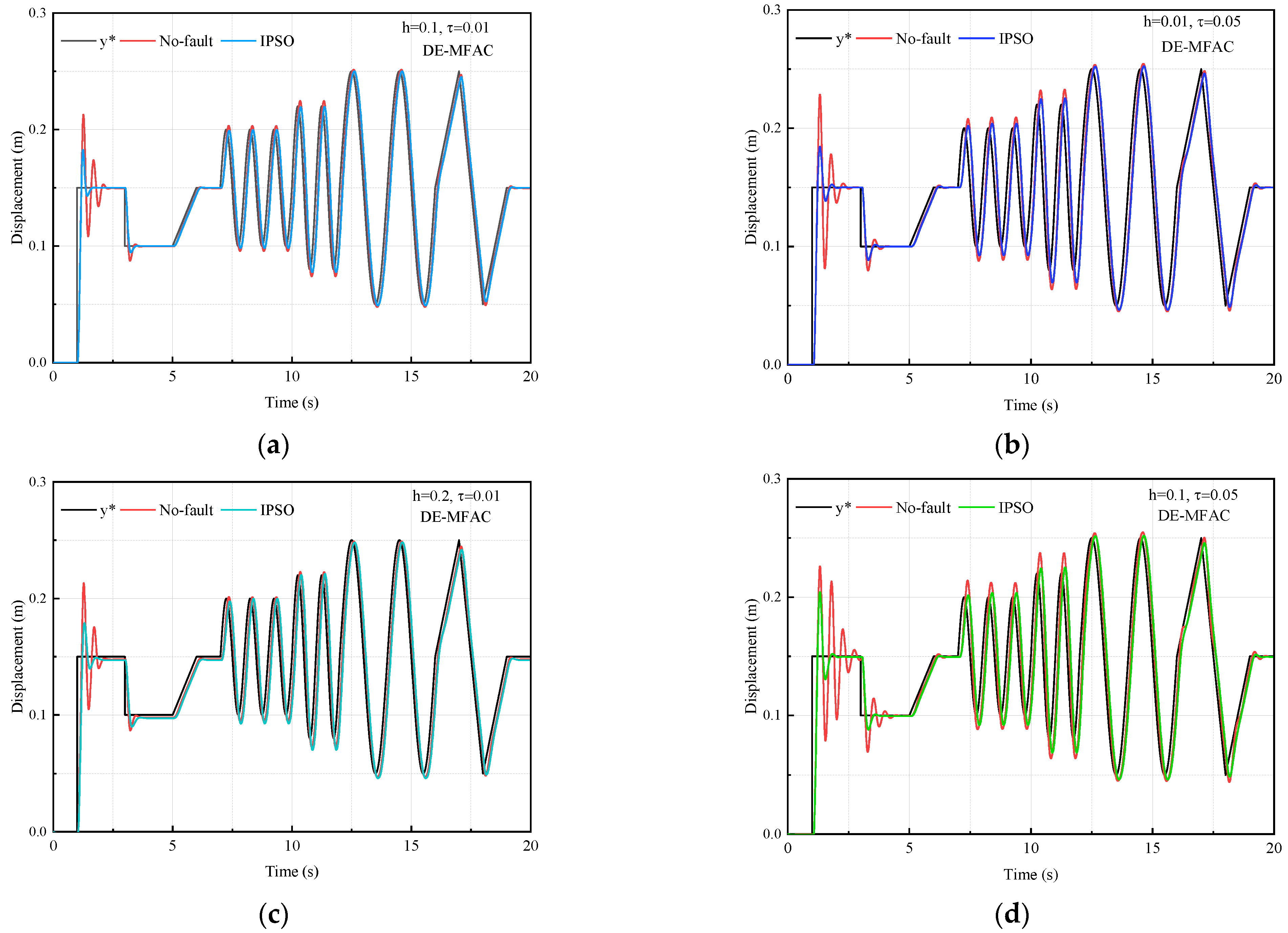
Table 3) and conducts comparative simulations when the system experiences degradation faults. The results are shown in
Figure 7. The simulation curves reveal that, under fault conditions, the position output trajectory of the suspension servo actuator deviates significantly from the desired trajectory, making precise reproduction difficult. During the square-wave input phase, the position output exhibits noticeable oscillation. Particularly, when the internal leakage clearance is
mm and the time delay is
s, this oscillation persists without attenuation even towards the end of the square-wave plateau phase. During the sinusoidal input phase, the position output also shows pronounced distortion. Thus, while the DE-MFAC controller parameters tuned under fault-free conditions can roughly reproduce the desired signal in fault scenarios, both the reproduction accuracy and dynamic tracking performance are substantially degraded.
Figure 7 also displays the position-tracking trajectory of the DE-MFAC controller under degradation faults after optimization by the IPSO algorithm. A comparison with the simulation results using the fault-free parameters clearly shows that the optimized controller can significantly suppress oscillations in the position output trajectory while substantially improving trajectory reproduction accuracy and dynamic tracking response speed. This pattern holds consistently across various degradation fault scenarios, fully demonstrating that the IPSO algorithm can effectively optimize the parameter configuration of the DE-MFAC controller tailored to different levels of degradation faults, thereby restoring and enhancing the control performance.
In
Figure 7c, when the internal leakage clearance is
mm, the position output of the suspension servo actuator consistently fails to stabilize at the desired value during the constant phase of the desired signal. The core reason is that an excessively large internal leakage clearance exceeds the controllable range of the suspension servo actuator through optimization. Therefore, by monitoring the deviation between the position output trajectory and the stable value of the desired signal, it is possible to assess the severity of the internal leakage fault in the suspension servo actuator. This assessment can subsequently provide a basis for deciding whether the actuator should remain in service.
5. Discussion
The simulation results from the preceding section fully validate the performance of the proposed IPSO-optimized DE-MFAC framework under both normal operating conditions and compound-fault scenarios. This section analyzes and discusses these results in detail, clarifies the adopted evaluation criteria, and elaborates on the contributions, novelty, and distinguishing features of this work relative to the existing research.
As demonstrated in the simulation results, the IACE function, due to its cubic amplification of errors, places a significantly higher penalty on large deviations compared to the IAE function. For active-suspension servo actuators, excessive overshoot can induce tire-road contact loss or even structural damage to the actuator system. Thus, the IACE criterion is deemed to be a more appropriate evaluation metric for engineering applications prioritizing safety and stability. It ensures that the optimization process prioritizes suppressing large transient errors, thereby meeting the stringent dynamic performance requirements of active-suspension servo actuators.
The simulation results also confirm that the IPSO algorithm outperforms standard PSO in terms of optimization capability. By incorporating improved strategies, IPSO achieves lower fitness values and faster convergence rates, addressing the parameter-tuning precision problem that is common in complex control environments. This represents a significant improvement over traditional heuristic methods.
The novelty of the IPSO-DE-MFAC framework lies in overcoming two key limitations of existing control methods for suspension servo actuators. First, integrating a dynamic error differential term into the traditional MFAC scheme overcomes the inherent settling time-overshoot trade-off plaguing conventional model-free control strategies. This modification boosts the controller’s dynamic adjustment performance, allowing it to accommodate the rapid signal fluctuations typical of suspension systems. Second, the integration of IPSO and the IACE criterion enables fault-adaptive parameter optimization for the controller. In contrast to fixed-parameter controllers that degrade significantly under fault conditions, IPSO dynamically optimizes DE-MFAC parameters according to real-time fault severity, while the IACE criterion prioritizes overshoot suppression—a core requirement for engineering scenarios with stringent dynamic performance constraints. This integration yields a holistic solution combining controller improvement, algorithm optimization, and objective function customization rather than the isolated upgrading of individual control components adopted in prior work.
The comparison between DE-MFAC and conventional MFAC highlights the importance of the proposed control structure. The dynamic error differential term in DE-MFAC addresses the trade-off between response speed and overshoot in traditional MFAC, providing enhanced control performance. When optimized with IPSO, DE-MFAC demonstrates superior robustness against system nonlinearities and parameter variations.
Although the optimized DE-MFAC controller effectively mitigates the effects of internal leakage and time delay, there are cases where the fault severity exceeds the controller’s compensation capacity. For example, when the internal leakage clearance becomes too large, the system’s response may still significantly deviate from the desired trajectory, indicating limits to performance improvements through parameter optimization alone. Additionally, the study is limited to internal leakage and time-delay faults; other common faults are not considered. Future research could focus on integrating fault detection and diagnosis systems that predict and compensate for extreme faults before they significantly affect system performance.
6. Conclusions
Aiming at the performance degradation of suspension servo actuators caused by the compound faults of internal leakage and time delay in hydraulic cylinders, this study proposes a collaborative control framework that integrates the tracking error differential term-based model-free adaptive control (DE-MFAC) with an improved particle swarm optimization (IPSO) algorithm. This framework effectively overcomes the dependence of traditional methods on precise system mathematical models, significantly suppresses the impact of unmodeled dynamics and compound faults, and thereby enhances the dynamic performance, control accuracy, and robustness of the controller under complex degradation conditions.
Firstly, the optimization effects of the IPSO algorithm under two objective functions—the Integral Absolute Error (IAE) and the Integral Absolute Cube Error (IACE)—were compared and analyzed. The research shows that the IACE function is more sensitive to large tracking deviations, and its optimization process tends to prioritize suppressing system overshoot, making it more suitable for practical control scenarios with strict requirements on overshoot and settling time. In contrast, the IAE function focuses more on reflecting the cumulative error of the control process. Therefore, selecting an appropriate objective function according to specific performance requirements is key to achieving the expected optimization results.
Furthermore, the study confirms that, after the occurrence of compound internal leakage and time-delay faults, continuing to use controller parameters tuned under fault-free conditions leads to significant degradation in tracking performance, response oscillations, and signal distortion. After optimizing the DE-MFAC controller parameters using the IPSO algorithm, both the position-tracking accuracy and dynamic response performance of the system are effectively restored and improved. This result provides a feasible technical approach for mitigating performance degradation and extending the service life of the actuator through adaptive parameter adjustment.
In summary, the proposed control optimization method combining DE-MFAC and IPSO provides an effective and reliable solution for achieving high-performance control of suspension servo actuators under compound-fault conditions that are difficult to model precisely.




 ,
,