Article

A Study on the Efficiency Matching of Energy-Weighted Regions in IPMSM Through Loading Ratio and Stator-Rotor Diameter Ratio Adjustment

1
Department of Electronics and Electrical Engineering, Dankook University, Yongin 16890, Republic of Korea
2
Department of Faculty of Engineering, Yokohama National University, Yokohama 240-8501, Japan
3
Department of Electrical Control Engineering, Cheongju University, Cheongju 28503, Republic of Korea
*
Author to whom correspondence should be addressed.
Actuators 2026, 15(2), 123; https://doi.org/10.3390/act15020123
Submission received: 4 January 2026 / Revised: 5 February 2026 / Accepted: 11 February 2026 / Published: 15 February 2026
(This article belongs to the Section High Torque/Power Density Actuators)

Abstract

This study proposes an electromagnetic design strategy to improve the energy efficiency of electric-vehicle (EV) traction motors by defining an operating region with high energy contribution using Urban Dynamometer Driving Schedule (UDDS) data and targeting efficiency improvement within that region. For distributed-winding (DW) and concentrated-winding (CW) IPMSM models, the stator-to-rotor diameter ratio varied, and the resulting change in the loading ratio was used as an indicator to evaluate loss and efficiency variations in the energy-weighted region of the efficiency map via two-dimensional finite element analysis (2D FEA). The results show that the losses within the weighted region decreased by up to 16.64% compared with the reference model, and the UDDS-cycle-based overall energy efficiency improved by up to 0.423%. These findings demonstrate that combining electromagnetic geometric design with driving-cycle data can serve as a practical metric for improving EV energy efficiency.

1. Introduction

With the rapid growth of the EV market, the importance of high-efficiency traction motor technologies for extending driving range and improving energy efficiency has increased [1]. In an EV powertrain, the efficiency characteristics of the motor directly affect energy consumption under real driving conditions; in particular, for driving cycles with a high frequency of low-speed and medium-torque operation—such as urban driving—improving efficiency in specific operating regions becomes more meaningful from the perspective of overall energy efficiency [2,3,4]. However, many prior studies have primarily evaluated performance at a single rated operating point, which limits their ability to reflect efficiency characteristics across the diverse operating points that occur frequently during real-world driving [5,6,7]. To address this limitation, recent studies have integrated driving-cycle-based operating-point distributions into the design stage to improve weighted-average efficiency [8,9,10]. Even under identical geometric constraints, the location and shape of high-efficiency regions can vary depending on the winding type and the allocation of magnetic and electric loading; therefore, matching the high-efficiency region to a target driving cycle is an important factor in improving energy efficiency [11,12,13].
The stator-to-rotor diameter ratio, λ s r , is a key design variable that alters leakage flux and flux-density distributions, thereby influencing the loss composition and efficiency distribution within the energy-weighted region of a driving cycle [14,15]. Accordingly, a systematic analysis of loss variations with respect to λ s r and a validation of the resulting efficiency improvement in the weighted region are required [16,17]. In this study, an energy-weighted region Ω , where the energy distribution is concentrated, is defined based on actual UDDS driving-cycle data, and a design strategy aimed at improving efficiency within this region is proposed [18]. The parameter λ s r is varied as the primary design variable, and the loading ratio—changing accordingly—is evaluated as a dependent indicator to comparatively analyze the electromagnetic characteristics of DW and CW models. In addition, the impact of the proposed strategy on the overall, cycle-based energy efficiency is quantitatively verified [19].

2. Material and Methods

2.1. Model Specifications

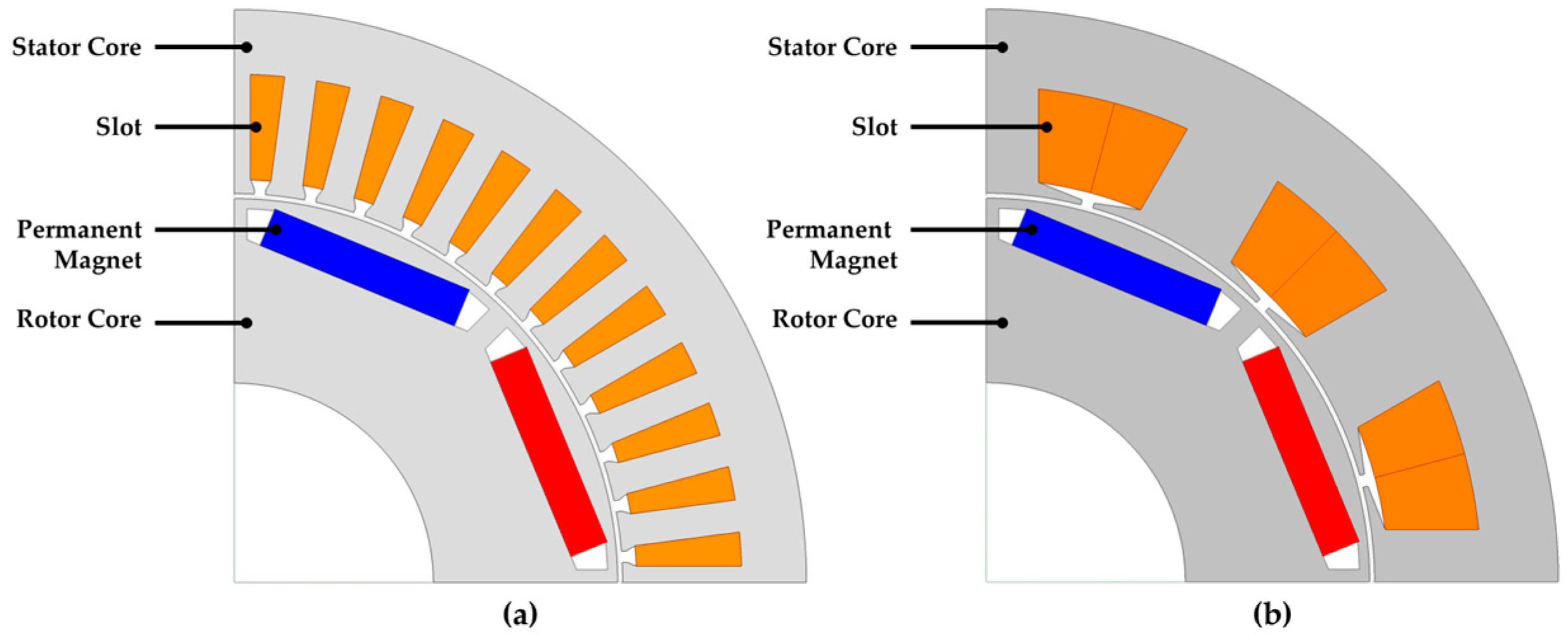
Figure 1 presents the baseline geometries of the DW and CW models. The baseline models were established under identical geometric constraints to isolate and analyze the influence of winding topology alone on the loss distribution and the resulting efficiency-map characteristics. The two models were designed with the same number of pole pairs p , while only the number of slots was varied so that the slots per pole per phase q , defined by (1), can represent distributed and concentrated winding configurations, respectively.
q = Q 2 p m
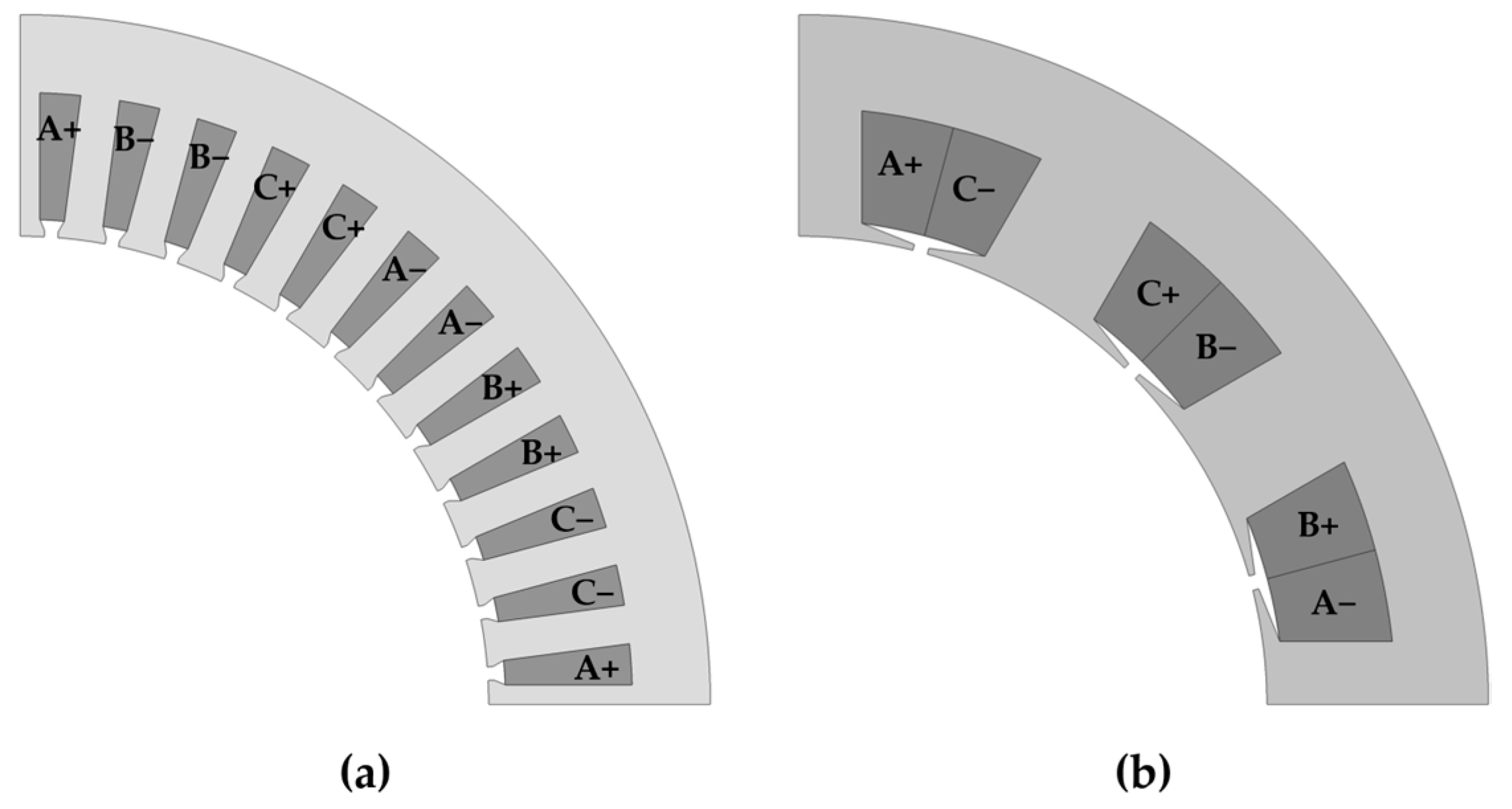
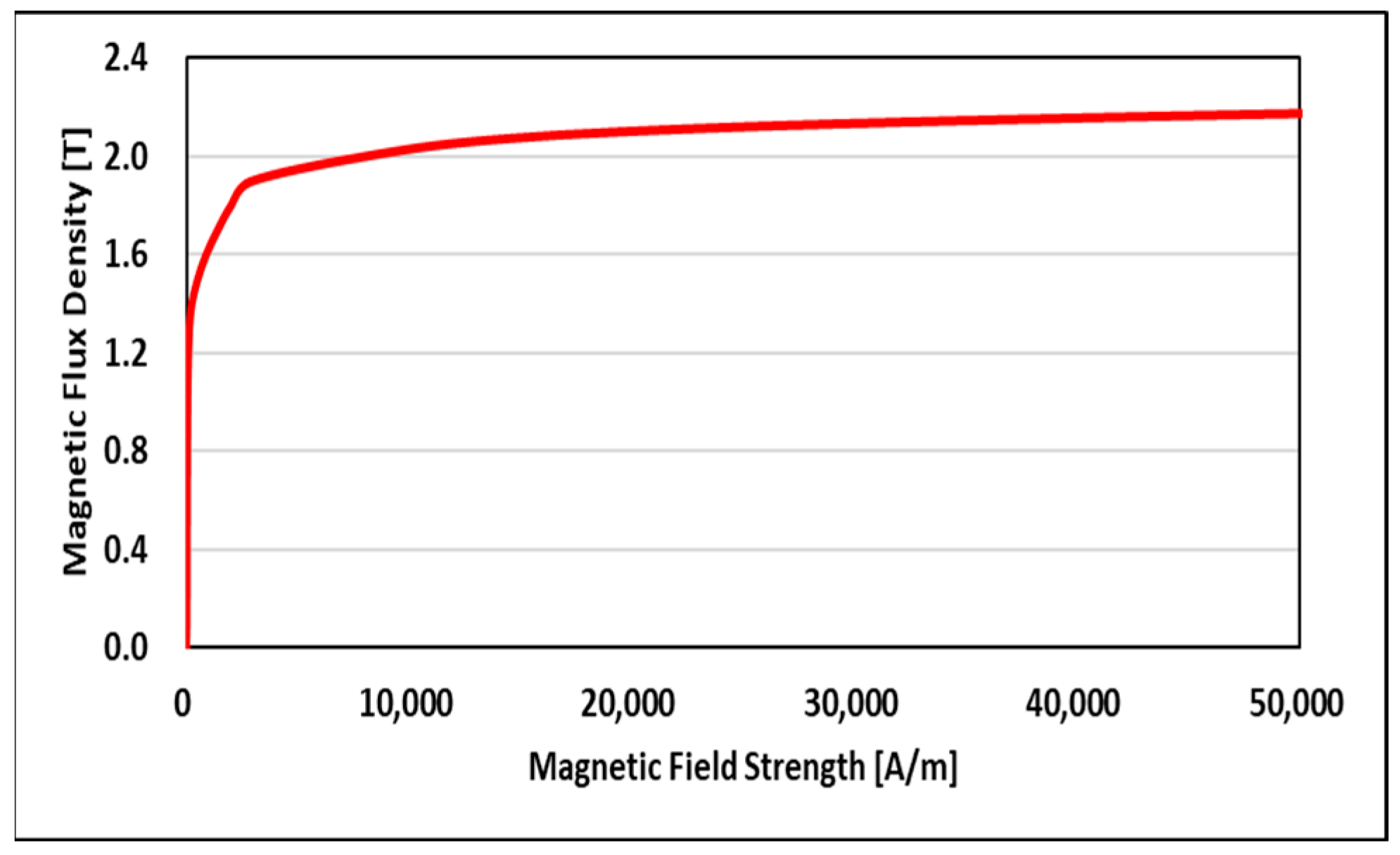
Here, Q denotes the total number of slots and m denotes the number of phases. In this study, the DW model corresponds to a representative distributed-winding configuration with q = 2 , whereas the CW model corresponds to a representative non-overlapping concentrated-winding configuration with q = 0.5 . In addition, the differences in winding layout and phase allocation are illustrated in Figure 2. The air-gap length g was set to 1 mm considering manufacturing tolerances and potential eccentricity, and the rationale for selecting g is provided in (A1) of Appendix A.1. Table 1 summarizes the basic geometric specifications and applied materials for both models. The B–H curve of the 35PN230 steel used for the core is provided in Appendix A.2, and Table 2 summarizes the analysis conditions and reference performance.

2.2. Design Procedure

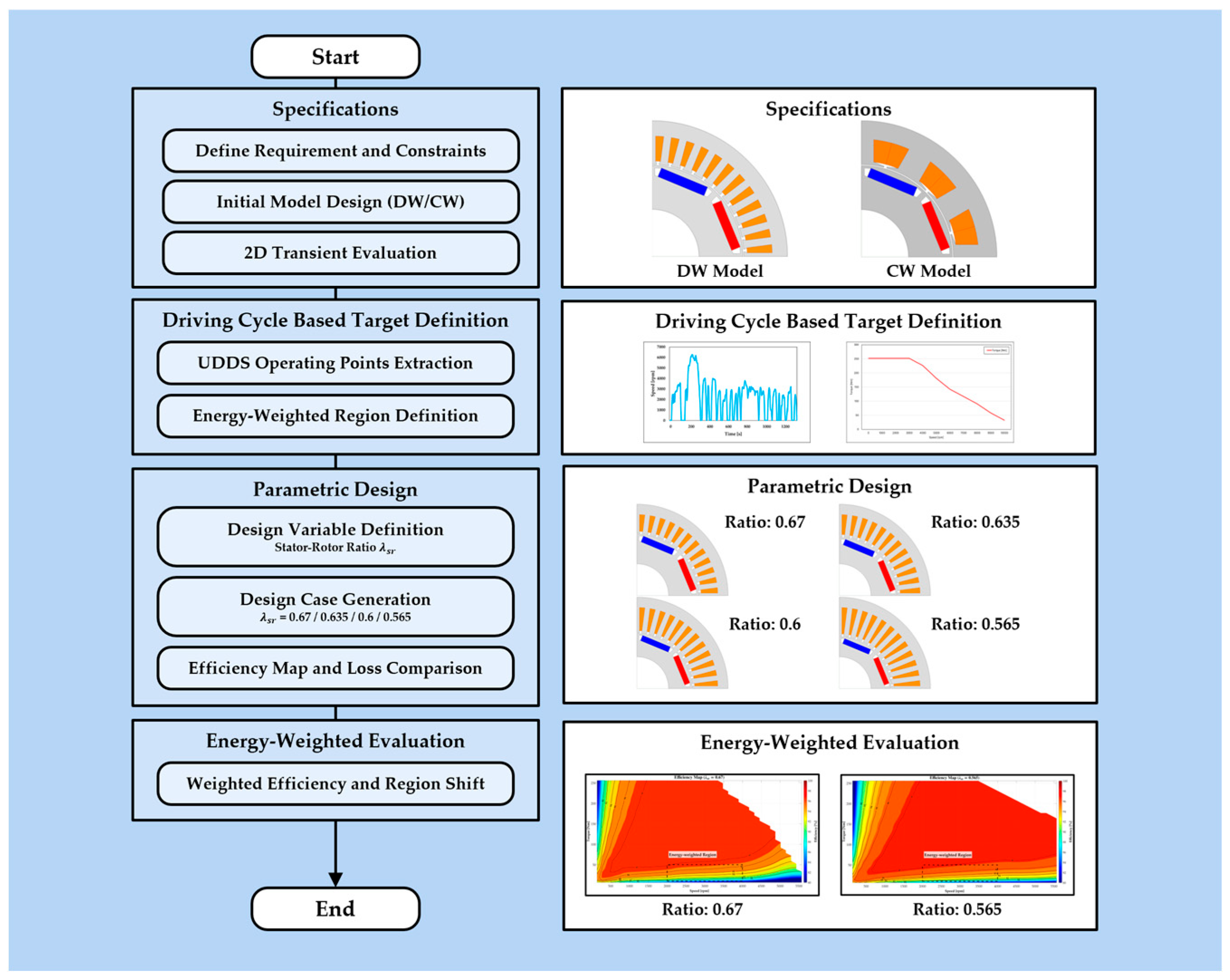
This section summarizes the analysis and evaluation methodology following the design procedure illustrated in Figure 3. The overall workflow consists of: (i) establishing the baseline models; (ii) calculating efficiency and loss components via finite element analysis; (iii) clarifying the analysis scope and limitations; (iv) defining the UDDS-cycle-based energy-weighted operating region Ω ; and (v) comparing the design cases and deriving dependent performance indicators. First, the DW and CW baseline models were established under identical geometric constraints, and their efficiency and loss components were obtained using ANSYS Maxwell-based 2D transient finite element analysis in Ansys Electronics Desktop (Maxwell), 2025 R2 (Ansys, Inc., Canonsburg, PA, USA).
The efficiency map in this study was constructed based on the electromagnetic efficiency obtained from 2D transient FEA, and the considered loss components were limited to electromagnetic losses, i.e., copper loss and core loss. Mechanical losses and inverter losses were excluded from the evaluation because they can vary significantly depending on control conditions and operating environment, thereby introducing unnecessary uncertainty into the model-to-model comparison. Regarding meshing, the air-gap region and adjacent boundaries exhibit steep flux variations, making torque prediction relatively sensitive to mesh density. Therefore, a finer mesh was applied in these regions than in other parts of the model. A mesh-sensitivity study was performed at the reference operating point, confirming that key outputs, including average torque, were sufficiently converged with respect to the mesh settings. Next, speed–torque operating points were extracted from the UDDS driving cycle, and the region where cumulative energy consumption is concentrated was defined as the energy-weighted region Ω . The stator-to-rotor diameter ratio λ s r was then selected as the design variable, and four design cases ( λ s r = 0.67 , 0.635 , 0.60 , and 0.565 ) were configured and compared under identical conditions. In addition, the loading ratio adjusted according to λ s r was treated as a dependent indicator, and its influence on the weighted-average efficiency and loss reduction within Ω was quantitatively evaluated.
Meanwhile, because this study relies on cross-sectional 2D transient FEA, it cannot explicitly capture three-dimensional effects such as axial leakage flux, end-winding effects, three-dimensional thermal distribution and cooling conditions along the stack direction, high-frequency components introduced by inverter PWM, and manufacturing tolerances. These factors can affect both the absolute values and the detailed spatial shape of the efficiency map. Therefore, in this study, all analysis conditions were kept identical across models, and only the relative trends in loss distribution and efficiency distribution with respect to the design-variable variation were compared and evaluated.

2.3. Driving Cycle-Based Target Definition

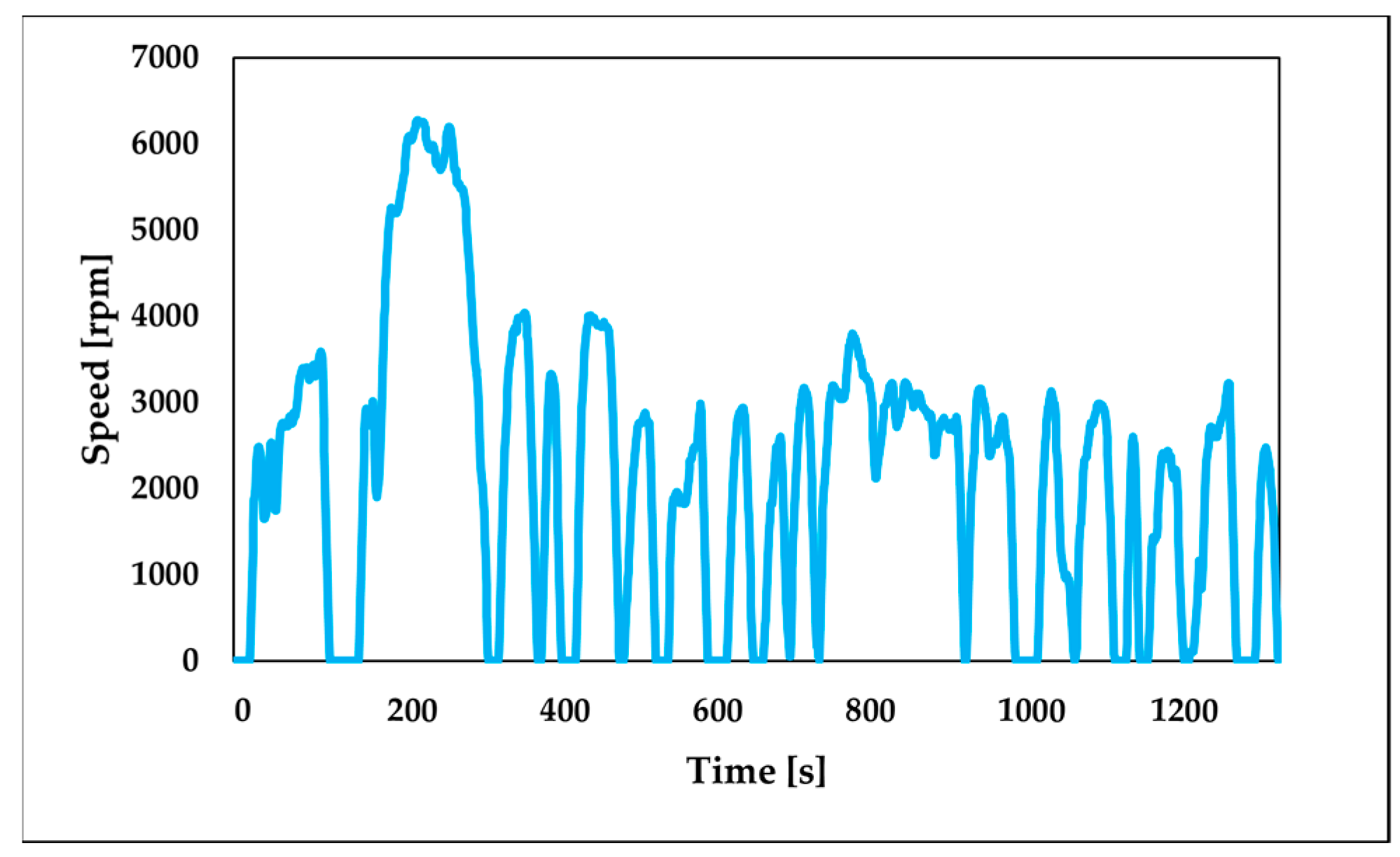
In this study, to define an energy-weighted operating region of the traction motor based on a real-vehicle driving cycle, the UDDS speed–time data in Figure 4 and the vehicle parameters in Table 3 were used to determine the motor operating point ( n m [ k ] ,   T m [ k ] ) and the motor mechanical output power P m [ k ] at each discrete time sample k . The UDDS speed data v U D D S [ k ] (mph) were converted into the vehicle speed v [ k ] (m/s) through unit conversion, as expressed in (2).
v [ k ] = 1609.344 3600   v U D D S [ k ]
The motor angular speed ω m [ k ] and rotational speed n m [ k ] were calculated from vehicle speed by applying the gear ratio G and the effective tire radius r t , as given in (3).
ω m [ k ] = G r t   v [ k ] ,          n m [ k ] = 2 π 60   ω m [ k ]
The longitudinal tractive force demand F [ k ] was modeled as the sum of rolling resistance, aerodynamic drag, and the inertial term. The vehicle acceleration a [ k ] was obtained by numerically differentiating v [ k ] , and F [ k ] was defined as in (4).
F [ k ] = m g C r r + 1 2 ρ C d A v [ k ] 2 + m a [ k ]
The wheel torque T ω [ k ] was defined as the product of the tractive force demand and the effective tire radius r t , as given in (5). The motor torque T m [ k ] was then computed by accounting for the gear ratio and drivetrain efficiency η d , as expressed in (6).
T ω [ k ] = F [ k ]   r t
T m [ k ] = T ω [ k ] G η d
The motor mechanical output power P m [ k ] was defined as the product of the motor torque and angular speed, as given in (7).
P m [ k ] = T m [ k ]   ω m [ k ]
Subsequently, the energy in the motoring region was accumulated and used to calculate energy weighting. With the sample time interval Δ t [ k ] = t [ k ] t [ k 1 ] , the total motoring energy E m , + [ k ] is given in (8) and was calculated as 5,399,354.79 J.
E m , + [ k ] = max ( P m [ k ] , 0 ) Δ t [ k ]
To align with the efficiency map, the ( n m ,   T m ) plane was discretized into a speed–torque grid, and E m , + [ k ] was accumulated in each grid cell. The speed interval was set to Δ n = 500   rpm and the torque interval to ΔT = 10 Nm, and the grid indices (i,j) of each sample were defined as in (9).
i = T m [ k ] Δ T ,    j = n m [ k ] Δ n
Finally, a 4 × 4 bin search was performed on the energy grid to define the region with the maximum accumulated energy as the energy-weighted region Ω , and the result is presented in (10). The accumulated energy in Ω was calculated as 2,118,759.55 J, and the energy share γ was obtained as 39.23 % using (11). Accordingly, it was confirmed that approximately 39.23 % of the UDDS-cycle-based motoring energy is concentrated within Ω .
Ω = [ 2000 ,   4000 ]   r p m × [ 10 ,   50 ]   N m
γ = E Ω E + , t o t a l   %
To generate the efficiency maps, the maximum achievable operating speed for each design case was calculated under the voltage constraint. As a result, the maximum speed in all design cases exceeded the upper speed limit of Ω (4000 rpm). For the DW model, the maximum speeds for λ s r = 0.67 ,   0.635 ,   0.60 , and 0.565 are 5570 rpm, 6709 rpm, 8481 rpm, and 10,000 rpm, respectively. For the CW model, the maximum speeds in the same order are 7974 rpm, 9873 rpm, 10,000 rpm, and 10,000 rpm, respectively. Therefore, even when the voltage limit is considered, the maximum achievable speed sufficiently exceeds the upper speed bound of Ω for all design cases, indicating that the efficiency and loss comparisons within Ω are conducted under conditions where the influence of the maximum-speed constraint is limited.

3. Parametric Design

3.1. Design Variable Definition

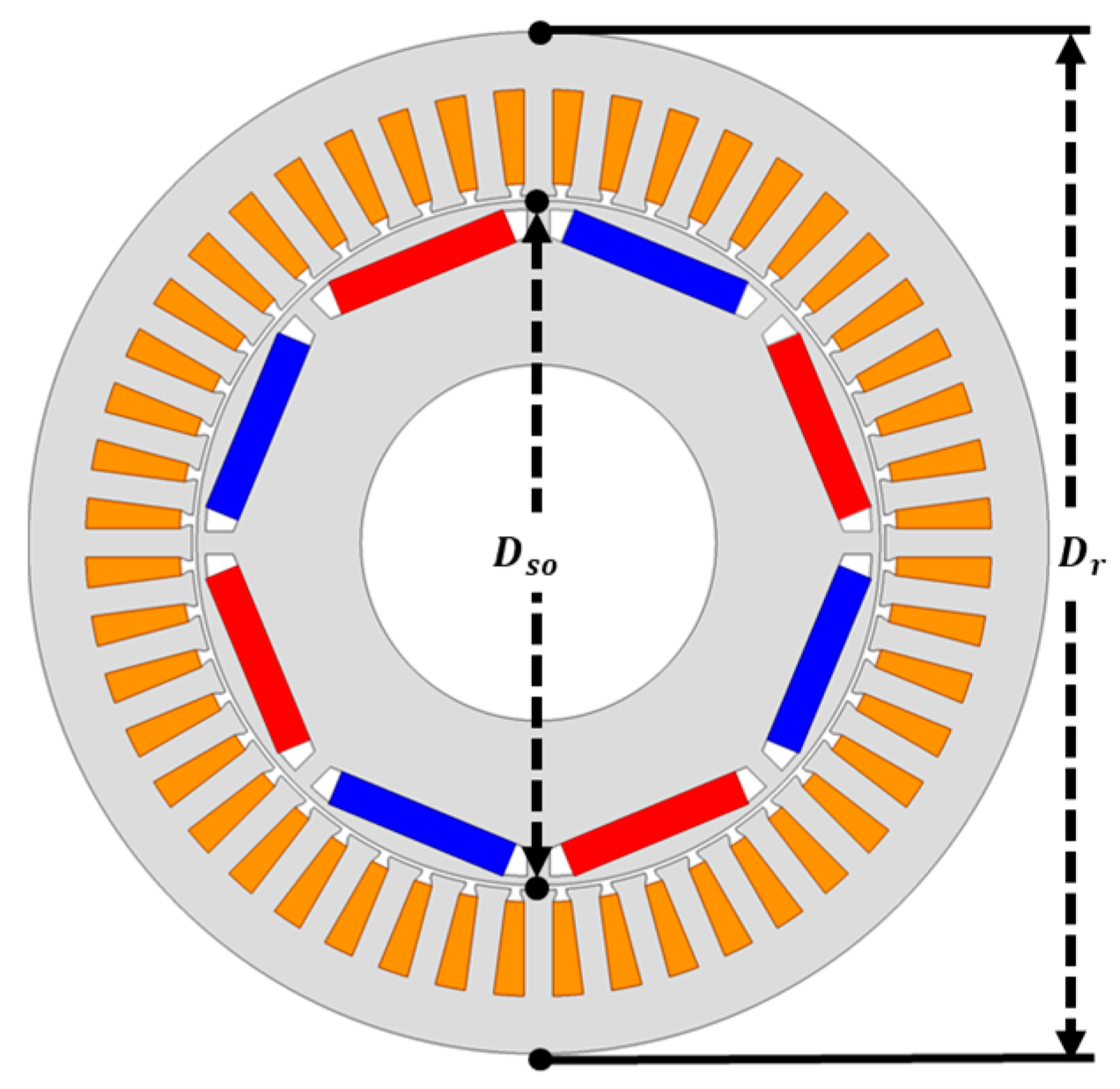
In this study, the stator-to-rotor diameter ratio λ s r was defined as the key design variable. λ s r is the rotor outer diameter D r normalized by the stator outer diameter D s o , as given in (12). The definitions of D r and D s o are illustrated in Figure 5. Because λ s r determines the radial space allocation between the rotor region and the stator region, it is an important design variable from the perspective of the split ratio. When λ s r changes, the torque-producing radius changes, and the air-gap flux path, yoke thickness, and effective slot area can vary simultaneously. As a result, the saturation distribution and leakage flux change, and the relative contributions of copper loss and iron loss, as well as the location of the high-efficiency region on the efficiency map, may shift. Therefore, λ s r was selected as a control factor in this study to compare the resulting changes in loss distribution between the DW and CW models.
λ s r = D r D s o

3.2. Design Case Generation

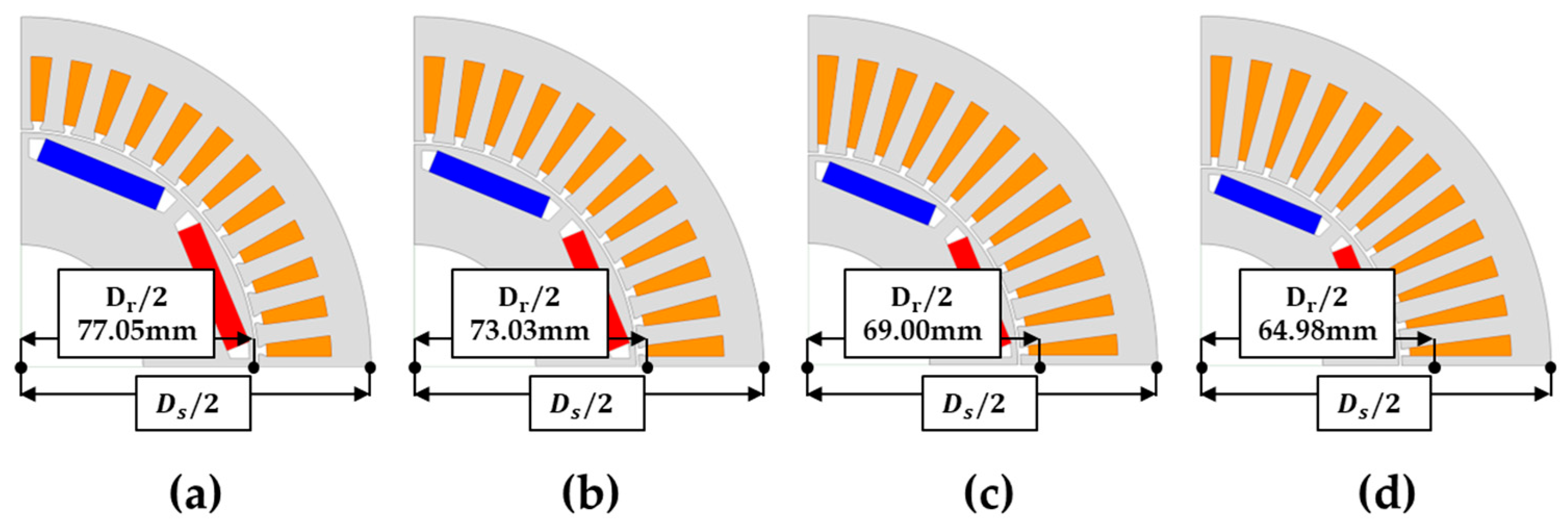
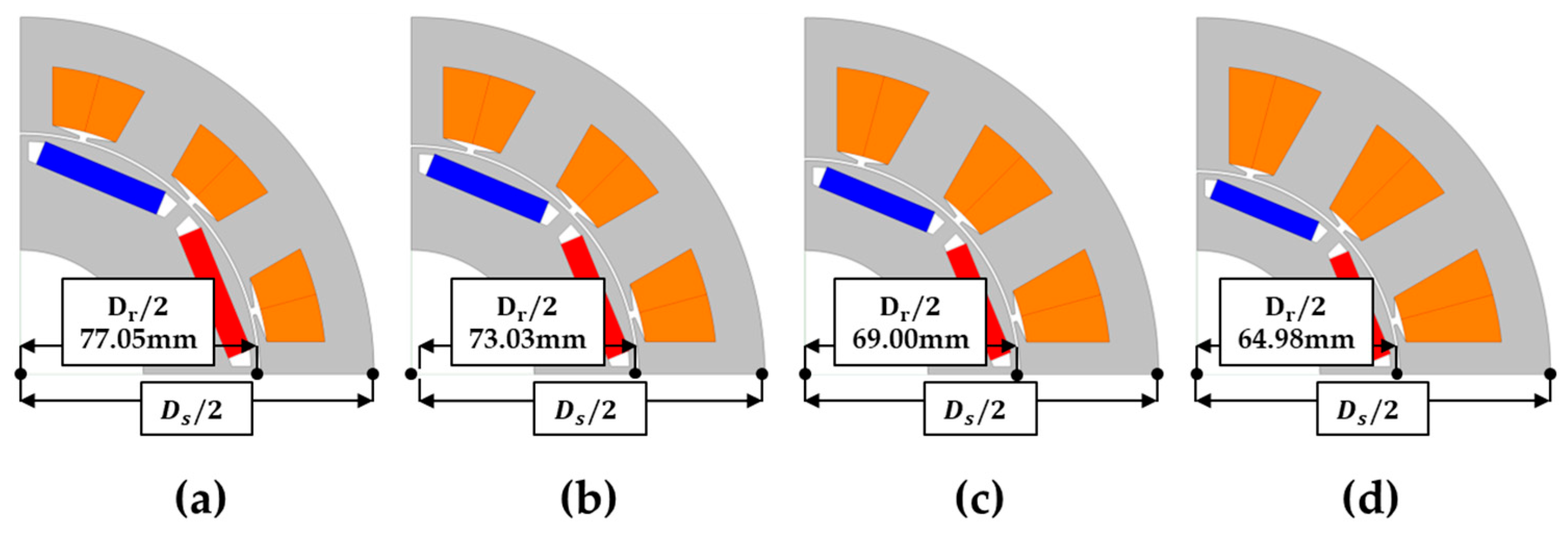
In this section, design cases were generated by reconfiguring the geometric parameters of the DW and CW models according to variations in λ s r . All cases were formulated by varying only λ s r while keeping the inverter voltage/current limits and the reference operating-point conditions identical. The baseline model was defined with an initial design value of λ s r = 0.67 . As λ s r decreases, the reduction in rotor outer diameter D r alters the available mechanical air-gap margin, and the change in slot area affects winding feasibility and the slot fill factor. In addition, because the pole-arc ratio was fixed at 0.7, the permanent-magnet dimensions and volume vary geometrically as dependent quantities with D r . The resulting geometric changes are illustrated in Figure 6 and Figure 7, and the corresponding variations in key design parameters are summarized in Table 4 and Table 5. Consequently, changes in the stator region influence winding constraints and copper-loss characteristics, whereas changes in the rotor region modify the air-gap/back-yoke flux distribution and saturation behavior. The lower bound of λ s r was determined within the range that simultaneously satisfies these constraints, and the minimum feasible level was selected as λ s r = 0.565 . Finally, four levels, λ s r = 0.67 ,   0.635 ,   0.60 , and 0.565 , were adopted to ensure consistent trend comparisons under identical conditions.
Meanwhile, in both models, a reduction in D r can change the torque-producing radius, the air-gap flux level, and the saturation distribution, potentially leading to a decrease in output. To prevent this, the number of turns and the current were adjusted to satisfy the target torque at the reference operating point. The turn number was determined with target-torque achievement as the primary criterion, while simultaneously satisfying the inverter voltage/current limits and winding feasibility constraints. In this process, variations in the RMS current I r m s and the phase resistance R p h directly affect the copper loss P c u , as defined in (13). In addition, the target-torque constraint can be described by the electromagnetic torque equation, which is given in (14).
However, the analysis results indicated that, under the same operating conditions, the variation trend of stator tooth flux density differed depending on the winding configuration. In the DW model, the flux is distributed over a larger number of slots, which results in a relatively narrower tooth width; consequently, the tooth flux density was formed higher than that of the CW model under the same conditions. Nevertheless, as λ s r decreased, the reduction in air-gap flux associated with the decreased rotor diameter outweighed the flux increase due to the higher current required to meet the target torque, leading to an overall decreasing trend in tooth flux density. In contrast, in the CW model, the winding is concentrated in a smaller number of slots, causing the flux to be concentrated in a limited region. When a decrease in λ s r was accompanied by an increase in tooth width, the tooth flux density was maintained even in the operating range where the air-gap flux density decreased, and in some cases, an increasing trend was observed. As a result, even for the same λ s r variation, the DW and CW models exhibited different changes in tooth/yoke saturation sensitivity and flux distribution. In particular, the CW model can show relatively higher saturation sensitivity than the DW model due to localized flux concentration.
P c u = 3 I r m s 2 R p h   W
T = 3 2 p ( ψ f i q + ( L d L q ) i d i q )   N m

3.3. Efficiency Map and Loss Comparison

In this section, the loading ratio was introduced as a design index to quantitatively analyze the effect of λ s r variation on electromagnetic characteristics. The loading ratio is defined as the ratio of the electric loading a c to the magnetic loading B avg , as given in (15). Here, the electric loading a c denotes the number of ampere conductors per unit circumferential length on the stator inner-diameter surface, and it is calculated as in (16) from the constant m , the equivalent series turns per phase N p h , the RMS phase current I a , and the air-gap diameter D g . The magnetic loading B avg represents the average air-gap flux density.
L o a d i n g   r a t i o = a c B a v g   [ % ]
a c = 2 m   N p h   I a π   D g
Table 6 and Table 7 summarize the loading-ratio analysis results of the DW and CW models with respect to variations in λ s r . For both models, as λ s r decreases, a c increases while B avg decreases, resulting in an overall increasing trend in the loading ratio. This indicates that, under the same outer-dimension constraints, changing the radial allocation between the rotor and stator regions alters the torque-producing radius and the main flux path, and the current demand required to satisfy the target torque is reconfigured accordingly; these coupled effects are reflected in the combined behavior of the electric and magnetic loadings.
The comparison results of losses and efficiency within Ω are summarized in Table 8 and Table 9. The analysis indicates that, in all models, stator core loss accounts for the largest share of the total losses. In particular, the DW model achieved an efficiency of 93.87% at λ s r = 0.565 , whereas the CW model exhibited a higher efficiency of 94.51% under the same condition. This result suggests that the CW model maintains relatively lower stator core loss than the DW model while enabling a more effective allocation between electric and magnetic loadings.
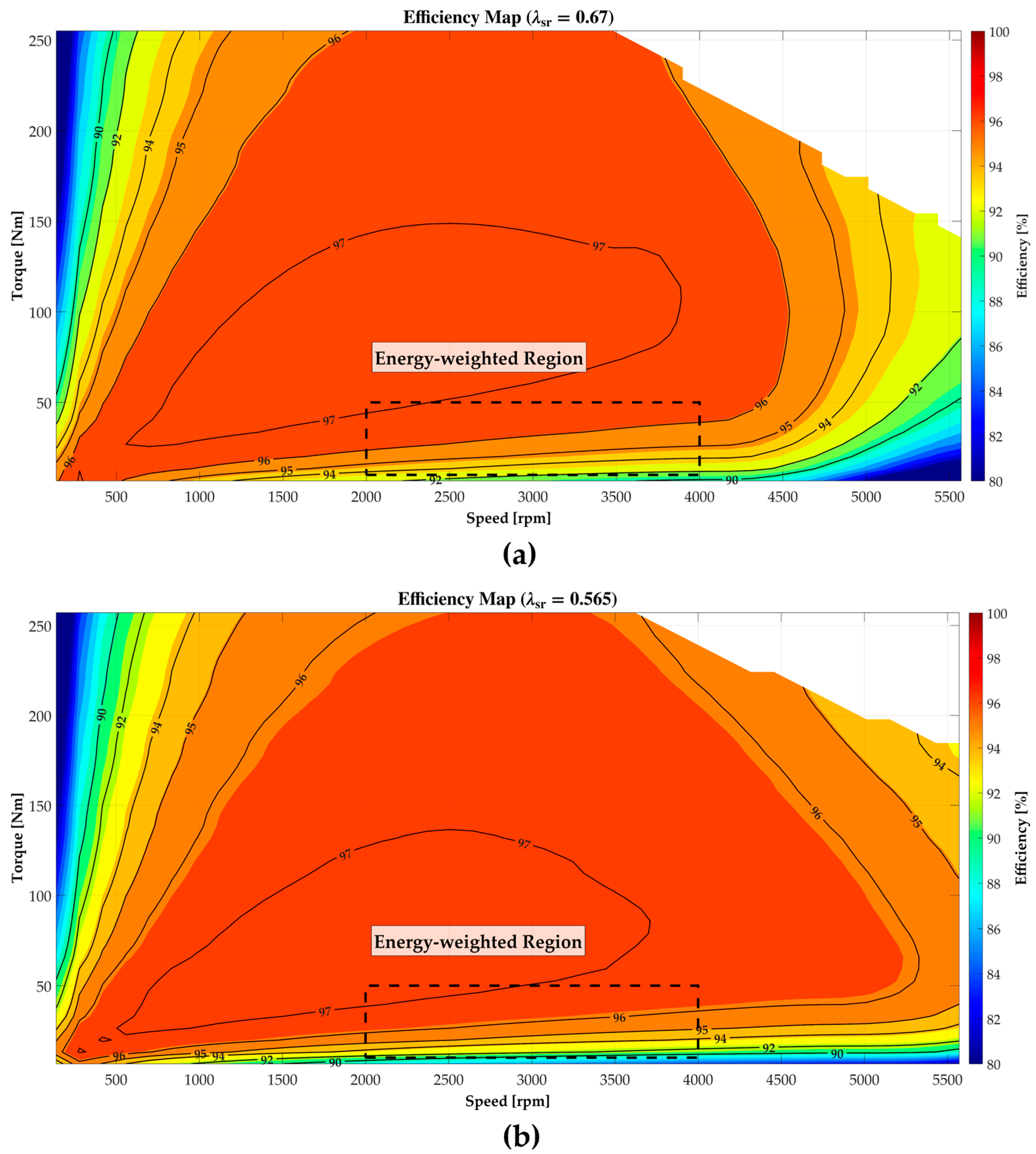
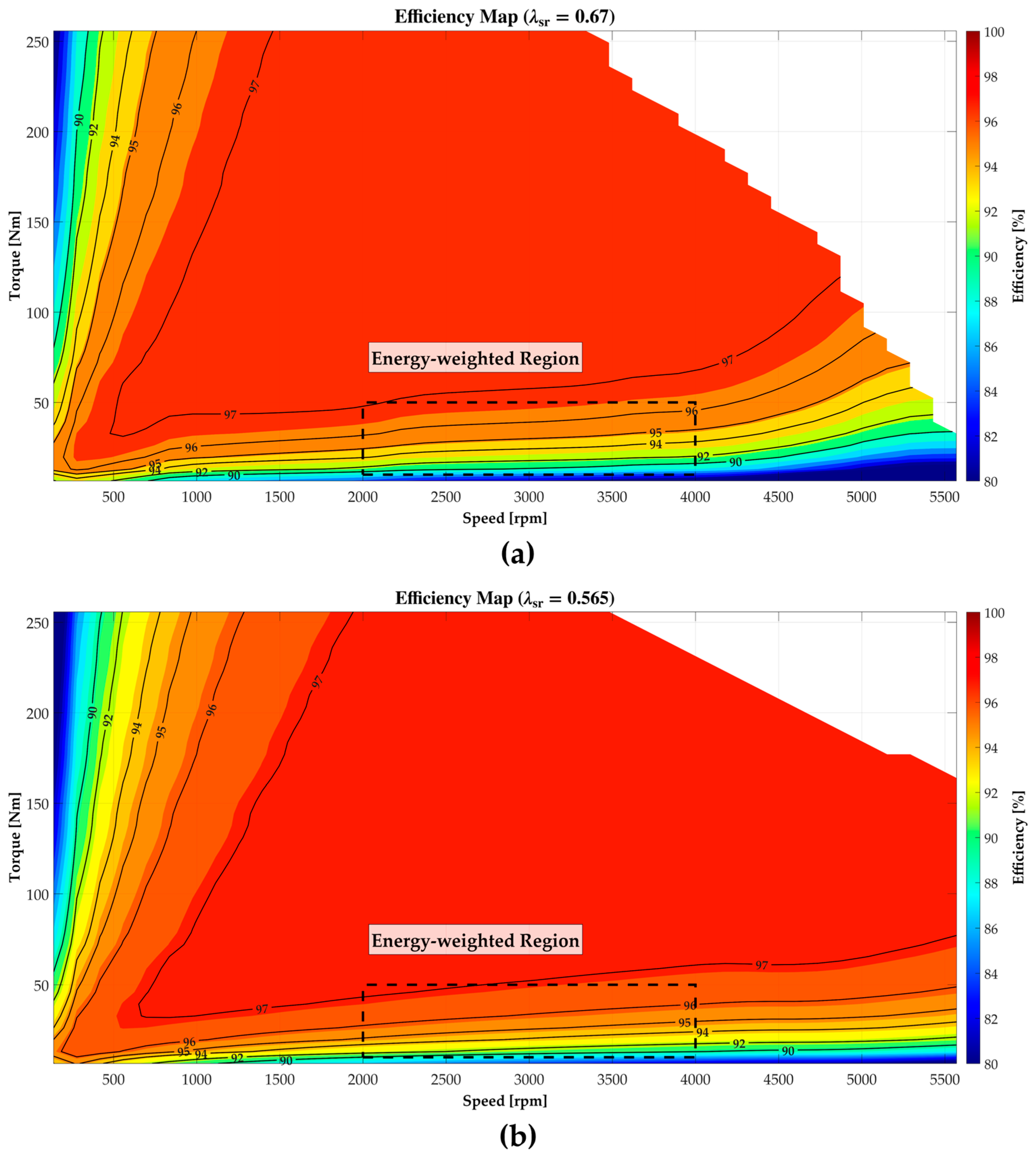
The efficiency-map-based comparison results are shown in Figure 8 and Figure 9. For both models, compared with the reference model at λ s r = 0.67 , the optimal model at λ s r = 0.565 exhibits an expanded high-efficiency region exceeding 97% within Ω . This trend can be interpreted as a consequence of the λ s r -driven redistribution of electric and magnetic loadings and the associated changes in the loss composition, which are reflected in the efficiency distribution.

4. Energy-Weighted Evaluation

Weighted Efficiency and Region Shift

In this section, the UDDS-cycle-based energy-consumption reduction rate was calculated to quantitatively evaluate how design modifications that consider driving conditions affect the vehicle-level energy efficiency. The electrical energy reduction rate before and after the design change within the energy-weighted region can be expressed by the ratio of efficiencies, as given in (17). By combining this term with the cycle-level energy share γ , the overall system energy-reduction metric in (18) was derived. In this study, γ = 39.23 % (i.e., γ = 0.3923 in dimensionless form); therefore, the dimensionless value γ = 0.3923 was used in the calculation of (18).
Δ E e l e c , Ω E e l e c , Ω ( 0.67 ) = 1 η Ω ( 0.67 ) η Ω ( 0.565 )    [ % ]
Δ E e l e c E e l e c γ ( 1 η Ω ( 0.67 ) η Ω ( 0.565 ) )    [ % ]
Based on the above formulation, the energy-consumption reduction effect for each model was calculated by substituting the efficiency values within Ω reported in Table 8 and Table 9. For the DW model, η Ω ( 0.67 ) = 92.95 % and η Ω ( 0.565 ) = 93.67 % yield an energy-consumption reduction within Ω of approximately 0.769 % , as given in (19). When weighted by γ = 39.23 % (i.e., γ = 0.3923 in dimensionless form), the total UDDS-cycle energy-consumption reduction is estimated to be approximately 0.302 % , as shown in (20).
( Δ E e l e c , Ω E e l e c , Ω ) D W = 1 0.9295 0.9367   0.769    [ % ]
( Δ E e l e c E e l e c ) D W   0.3923 × 0.00769   0.302    [ % ]
Using the same procedure for the CW model with η Ω ( 0.67 ) = 93.49 % and η Ω ( 0.565 ) = 94.51 % , the energy-consumption reduction within Ω is calculated as approximately 1.079 % as in (21). When weighted by the energy share γ = 39.23 % ( γ = 0.3923 ) , the cycle-level energy-consumption reduction is approximately 0.423 % as in (22). Although the absolute improvement over the entire cycle may appear small, this result is obtained under a high-efficiency operating regime where the Ω -region efficiency is already in the 93–95 % range, leaving limited room for further gains. Therefore, the reported value represents the cycle-equivalent energy reduction obtained by weighting the Ω -region efficiency improvement by the UDDS energy share γ , quantitatively demonstrating that a marginal enhancement in the efficiency map within Ω can translate into measurable energy savings under practical driving conditions.
( Δ E e l e c , Ω E e l e c , Ω ) C W = 1 0.9349 0.9451   1.079    [ % ]
( Δ E e l e c E e l e c ) C W   0.3923 × 0.01079   0.423    [ % ]

5. Discussion

This study derives an energy-weighted region Ω , where the accumulated energy is concentrated, from the UDDS driving cycle, and quantitatively evaluates the performance changes after adjusting design variables with the goal of improving efficiency within that region. In particular, λ s r was selected as the key design variable, and by comparing—around Ω —the redistribution of the loading ratio and the changes in loss components that are reconfigured as λ s r varies, we demonstrated that a design strategy that aligns the high-efficiency region with the energy-weighted region can be translated into reduced energy consumption from a driving-cycle perspective. In addition, by confirming that, for all design cases, the maximum achievable operating speed under the voltage constraint exceeds the upper speed limit of Ω , we ensured the consistency of the comparison conditions such that the comparison within Ω is not distorted by the maximum-speed constraint.
Moreover, because the efficiency within Ω is already located in a high-efficiency range of 93–95%, the additional improvement margin may be limited, and therefore the improvement rate on a full-cycle basis may appear small. However, the improvement reported in this study is interpreted by weighting with the energy share γ concentrated in Ω , and it shows that a marginal improvement in the efficiency map can be linked to a quantitative energy reduction from a driving-cycle perspective. In other words, these results suggest that a target-region-based design framework that reflects the distribution of frequently occurring operating points in real driving can complement the limitations of conventional single-rated-point-centered evaluations.
Meanwhile, since this study is based on 2D transient finite-element analysis and efficiency-map-based calculations, it does not directly account for all factors in a real driving environment, such as three-dimensional effects including end-winding and axial leakage flux, high-frequency losses due to inverter PWM, mechanical losses, thermal/cooling conditions, and manufacturing tolerances. Therefore, the absolute values of efficiency and losses presented in this study should be interpreted not as system-level performance but as comparative results that examine relative trends due to variations in λ s r and differences in winding structure under identical analysis and constraint conditions. In addition, because this study treats λ s r as a single independent variable and fixes some conditions such as the pole-arc ratio to isolate trends, further verification is required in practical designs from a simultaneous-optimization perspective for coupled variables such as magnet volume, pole-arc ratio, and winding specifications. Furthermore, geometric modifications should be accompanied by an engineering feasibility assessment considering constraints related to manufacturing processes, assembly tolerances, and cost. Nevertheless, this study systematically demonstrates—within the scope of 2D analysis—that defining the target region Ω based on driving data and matching design variables to the loss-dominant factors in that region can lead to a shift and expansion of the high-efficiency area on the efficiency map and to reduced energy consumption from a driving-cycle perspective.

6. Conclusions

This paper proposes a target-region-based design framework that reflects the energy share within a real driving cycle and quantitatively evaluates how design modifications affect a UDDS-cycle-based energy-efficiency metric. Using UDDS driving data, the distribution of speed–torque operating points was analyzed to define an energy-weighted region Ω that concentrates 39.23% of the total motoring energy. With the objective of improving efficiency in Ω , the stator–rotor diameter ratio λ s r was adjusted, and the resulting changes in losses and efficiency characteristics within the energy-weighted region were comparatively analyzed.
The results show that the total motor loss within Ω decreases by up to 16.64% relative to the baseline model. When weighted by the energy share γ of Ω and translated to a full-cycle perspective, the resulting UDDS-cycle-level improvement is evaluated as 0.302% for the DW model and 0.423% for the CW model. These findings indicate that, rather than simply maximizing the absolute efficiency value, aligning the high-efficiency region of the efficiency map with a driving-cycle-derived energy-weighted region can lead to a reduction in energy consumption from a cycle perspective.
Furthermore, by quantifying how electromagnetic geometric variations affect loss components and efficiency distributions with a focus on the energy-weighted region, this study presents an evaluation procedure and design metrics that connect design outcomes to performance indicators based on driving conditions.

Author Contributions

Conceptualization and design, H.-J.L. and S.-J.S. (including study concept, critical revision, and final approval); methodology development and data curation, S.-J.S. (including experimental/simulation design, parameter management, data handling, and preparation of the initial manuscript); software development and resource provision, S.-J.S. and K.A. (including FE model implementation, post-processing scripts, and computational resources); validation and overall research oversight, H.-J.L. (ensuring model verification, consistency of results, and full accountability for the technical content); formal analysis and investigation, S.-J.S. and D.-W.L. (performing electromagnetic/thermal analysis, interpretation, and figure preparation); original draft preparation, S.-J.S. (responsible for drafting the manuscript before internal review); writing—review and editing, K.A., D.-W.L. and H.-J.L. (providing in-depth revisions and approving the final version); visualization, S.-J.S. (developing plots, tables, and graphical illustrations); supervision and project management, H.-J.L. (coordinating the research activities and endorsing submission). All authors have read and agreed to the published version of the manuscript.

Funding

This research was supported in part by the Human Resource Development Program for Industrial Innovation (GLOBAL) through the Korea Institute for Advancement of Technology (KIAT) (RS-2024-00435841) and in part by the Materials and Components Technology Development Program through the Korea Evaluation Institute of Industrial Technology (KEIT) (RS-2024-00432477), both funded by Ministry of Trade, Industry and Energy (MOTIE).

Institutional Review Board Statement

Not applicable.

Informed Consent Statement

Not applicable.

Data Availability Statement

The original contributions presented in the study are included in the article; further inquiries can be directed to the corresponding author.

Conflicts of Interest

The authors declare no conflicts of interest.

Appendix A

Appendix A.1

In this study, the mechanical air-gap length g is a key design variable that governs the air-gap flux density B g . Under magnetic-circuit conditions where the air-gap reluctance is dominant, an increase in g is directly associated with a decrease in B g . Therefore, the air-gap length should be determined to satisfy the target B g level and the required performance, while simultaneously accounting for mechanical margins including manufacturing tolerances and assembly errors. To this end, the air-gap flux density B g was approximated using a simplified magnetic-circuit model that includes the permanent magnet and the air gap, as follows.
B g k σ p m B r 1 + μ r , p m k c   g l p m   S p m S g
Because increasing g in Equation (A1) enlarges the denominator term, B g exhibits a decreasing trend. Therefore, to maintain the target air-gap flux density while ensuring manufacturability and mechanical robustness, the air-gap length was set to g = 1 mm. This air-gap length was applied identically to all design cases so that the electromagnetic performance comparison with respect to the winding topology and λ s r variation would not be confounded by changes in the air-gap condition. Here, B g denotes the air-gap flux density, k σ p m the permanent-magnet leakage factor, B r the remanent flux density of the permanent magnet, μ r , p m the relative permeability of the permanent magnet, k c the Carter factor, l p m the magnet thickness along the magnetization direction, S p m the effective cross-sectional area of the permanent magnet, and S g the effective cross-sectional area of the air gap.

Appendix A.2

Figure A1 shows the B-H curve of the 35PN230 electrical steel. This curve was used as the magnetic material property input for the core in the ANSYS Maxwell 2D transient simulations.
Figure A1. B-H curve of 35PN230.
Actuators 15 00123 g0a1

References

  1. Kim, J.; Lee, S. Design Optimization of Permanent Magnet Synchronous Motors for Electric Vehicles Based on Driving Cycles. Energies 2023, 16, 1234. [Google Scholar]
  2. Wang, X.; Zhang, Y. Efficiency Map Optimization of EV Traction Motors Considering Urban Driving Schedules. IEEE Trans. Ind. Electron. 2022, 69, 4567–4578. [Google Scholar]
  3. Chen, H.; Liu, G. Energy-Weighted Efficiency Improvement for Interior Permanent Magnet Motors. J. Electr. Eng. Technol. 2021, 16, 890–901. [Google Scholar]
  4. Smith, A.; Brown, T. Driving Cycle-Based Multi-Objective Optimization for Automotive Electric Drives. Appl. Sci. 2024, 14, 567. [Google Scholar]
  5. Park, D.; Choi, M. Impact of Stator-Rotor Diameter Ratio on the Efficiency Characteristics of EV Motors. IEEE Access 2022, 10, 34210–34222. [Google Scholar]
  6. Lee, H.; Jung, K. Loss Reduction Strategy for Concentrated Winding Motors in Urban Driving Scenarios. Energies 2023, 16, 2345. [Google Scholar]
  7. Zhao, L.; Sun, X. Comparative Analysis of DW and CW Models for Electric Vehicle Applications. World Electr. Veh. J. 2021, 12, 88. [Google Scholar]
  8. Carraro, E.; Morandin, M.; Bianchi, N. Traction PMASR Motor Optimization According to a Given Driving Cycle. IEEE Trans. Ind. Appl. 2016, 52, 209–216. [Google Scholar] [CrossRef]
  9. Lazari, P.; Wang, J.; Chen, L. A Computationally Efficient Design Technique for Electric-Vehicle Traction Machines. IEEE Trans. Ind. Appl. 2014, 50, 3203–3213. [Google Scholar] [CrossRef]
  10. Zhang, L.; Wei, H. Numerical Integration Methods for Accurate Energy Consumption Calculation in EVs. Energies 2024, 17, 102. [Google Scholar]
  11. Garcia, P.; Rodriguez, F. Thermal and Electromagnetic Co-Optimization of Automotive Motors. IEEE Trans. Transp. Electrif. 2021, 7, 1560–1572. [Google Scholar]
  12. Thompson, R.; White, S. Influence of Winding Layout on the Efficiency Map of PM Motors. J. Magn. Magn. Mater. 2022, 540, 168450. [Google Scholar]
  13. Sun, X.; Shi, Z.; Cai, Y.; Lei, G.; Guo, Y.; Zhu, J. Driving-Cycle-Oriented Design Optimization of a Permanent Magnet Hub Motor Drive System for a Four-Wheel-Drive Electric Vehicle. IEEE Trans. Transp. Electr. 2020, 6, 1115–1125. [Google Scholar] [CrossRef]
  14. Zhou, Q.; Li, J. Sensitivity Analysis of Design Variables in Driving Cycle-Based Motor Optimization. IEEE Trans. Energy Convers. 2020, 35, 2100–2110. [Google Scholar]
  15. Yang, K.; Wu, Z. Geometry-Driven Loss Prediction Models for Axial Flux Motors. IEEE Trans. Ind. Appl. 2022, 58, 3344–3355. [Google Scholar]
  16. Martinez, E.; Lopez, G. Development of Efficient Driving Cycle Targeting Algorithms for EVs. Sustainability 2021, 13, 7890. [Google Scholar]
  17. Choi, Y.; Han, S. Evaluation of Power Consumption in Real-World Driving Conditions. Int. J. Automot. Technol. 2023, 24, 115–125. [Google Scholar]
  18. Kang, S.; Yoon, D. Energy Density Maximization for Next-Generation EV Traction Systems. Electronics 2024, 13, 432. [Google Scholar]
  19. Brown, L.; Davis, R. Quantitative Verification of Drive Cycle Efficiency in Electric Propulsion. Energies 2022, 15, 4567. [Google Scholar]
Figure 1. Initial model. (a) DW model (b) CW model.
Actuators 15 00123 g001
Figure 2. Winding layout. (a) DW model (b) CW model.
Actuators 15 00123 g002
Figure 3. Design procedure.
Actuators 15 00123 g003
Figure 4. UDDS cycle.
Actuators 15 00123 g004
Figure 5. Design variable.
Actuators 15 00123 g005
Figure 6. DW parametric design. (a) λ s r = 0.67, (b) λ s r = 0.635, (c) λ s r = 0.6, (d) λ s r = 0.565.
Actuators 15 00123 g006
Figure 7. CW parametric design. (a) λ s r = 0.67, (b) λ s r = 0.635, (c) λ s r = 0.6, (d) λ s r = 0.565.
Actuators 15 00123 g007
Figure 8. DW efficiency map. (a) λ s r = 0.67 (b) λ s r = 0.565.
Actuators 15 00123 g008
Figure 9. CW efficiency map. (a) λ s r = 0.67 (b) λ s r = 0.565.
Actuators 15 00123 g009
Table 1. Specifications of the motor.
ParametersDW ModelCW ModelUnit
Poles/slots8/488/12-
Number of phases33-
Stator diameter230230mm
Rotor diameter154.1154.1mm
Airgap length11mm
Teeth thickness6.521mm
Slot area115.5243.8mm2
Turns per phase1022-
Number of layers12-
Parallel paths44-
Conductor diameter2.42.4mm
Pole arc ratio0.70.7-
Stator/rotor core material35PN23035PN230-
Permanent magnet materialN38N38-
Table 2. Electrical specifications and performance.
ParametersDW ModelCW ModelUnit
ConditionsReference speed30003000rpm
Coil temperature100100°C
Current limit180180Arms
Voltage limit565565Vpeak
Target torque259259Nm
ResultsInput current132149Arms
Phase resistance0.0200.021
Current density7.38.2Arms/mm2
Slot fill factor39.240.8%
Copper loss8361079W
B-EMF562542Vpeak
Stator teeth flux density1.741.33Tmax
Stator yoke flux density1.551.17Tmax
Table 3. Vehicle parameters.
ParametersValueUnit
Vehicle mass1500kg
Air density1.225kg/m3
Gravitational acceleration9.8m/s2
Rolling resistance coefficient0.011-
Drag area (CdA)0.62m2
Road grade0rad
Tire effective radius0.31m
Overall gear ratio8-
Driveline efficiency95%
Table 4. DW parameters.
Parameters λ s r = 0.67 λ s r = 0.635 λ s r = 0.6 λ s r = 0.565Unit
Slot area115130144155mm2
End-coil length240235230225mm
Turns10101011-
Input current132140149144Arms
Phase resistance0.0200.0190.0180.020 Ω
Current density7.37.37.37.3Arms/mm2
Slot fill factor39.236.635.434.8%
Torque261261261261Nm
Airgap flux density0.670.650.640.63Tavg
Stator teeth flux density1.741.641.531.44Tmax
Stator yoke flux density1.551.481.421.37Tmax
Table 5. CW parameters.
Parameters λ s r = 0.67 λ s r = 0.635 λ s r = 0.6 λ s r = 0.565Unit
Slot area243284321353mm2
End-coil length172170169167mm
Turns22222222-
Input current149148156165Arms
Phase resistance0.0210.0210.0200.018 Ω
Current density8.28.28.28.2Arms/mm2
Slot fill factor40.835.032.631.3%
Torque259259259259Nm
Airgap flux density0.640.630.630.63Tavg
Stator teeth flux density1.331.381.421.48Tmax
Stator yoke flux density1.171.151.131.09Tmax
Table 6. Loading ratio analysis results for the DW model.
Parameters λ s r = 0.67 λ s r = 0.635 λ s r = 0.6 λ s r = 0.565Unit
Loading ratio48,49055,27563,46172,750-
a c 32,50836,36540,94546,204A/m
B a v g 0.670.650.640.63T
Table 7. Loading ratio analysis results for the CW model.
Parameters λ s r  = 0.67 λ s r  = 0.635 λ s r  = 0.6 λ s r  = 0.565Unit
Loading ratio62,97066,12774,53083,360-
a c 40,36442,28847,15552,942A/m
B a v g 0.640.640.630.63T
Table 8. Loss and efficiency analysis for DW model.
Parameters λ s r = 0.67 λ s r = 0.635 λ s r = 0.6 λ s r = 0.565Unit
Efficiency92.9593.4493.5693.87%
Total loss505.59484.10460.45435.14W
Stator iron loss468.75414.33420.36394.14W
Rotor iron loss11.4210.459.267.65W
Copper loss25.4259.3330.8333.36W
Table 9. Loss and efficiency analysis for CW model.
Parameters λ s r = 0.67 λ s r = 0.635 λ s r = 0.6 λ s r = 0.565Unit
Efficiency93.4993.9294.2294.51%
Total loss486.45450.29427.60405.51W
Stator iron loss394.37377.80358.20335.75W
Rotor iron loss31.0218.9814.0413.37W
Copper loss61.0653.5255.3756.39W
Disclaimer/Publisher’s Note: The statements, opinions and data contained in all publications are solely those of the individual author(s) and contributor(s) and not of MDPI and/or the editor(s). MDPI and/or the editor(s) disclaim responsibility for any injury to people or property resulting from any ideas, methods, instructions or products referred to in the content.