Article

Design, Performance Testing, and Experimental Validation of Modular Soft Robots Based on Thin-Film Actuators


1
School of Mechanical and Electrical Engineering, Soochow University, Suzhou 215021, China
2
Jiangsu Provincial Key Laboratory of Advanced Robotics, Soochow University, Suzhou 215021, China
*
Author to whom correspondence should be addressed.
These authors contributed equally to this work.
Actuators 2025, 14(9), 418; https://doi.org/10.3390/act14090418
Submission received: 23 July 2025 / Revised: 18 August 2025 / Accepted: 20 August 2025 / Published: 27 August 2025
(This article belongs to the Section Actuators for Robotics)

Abstract

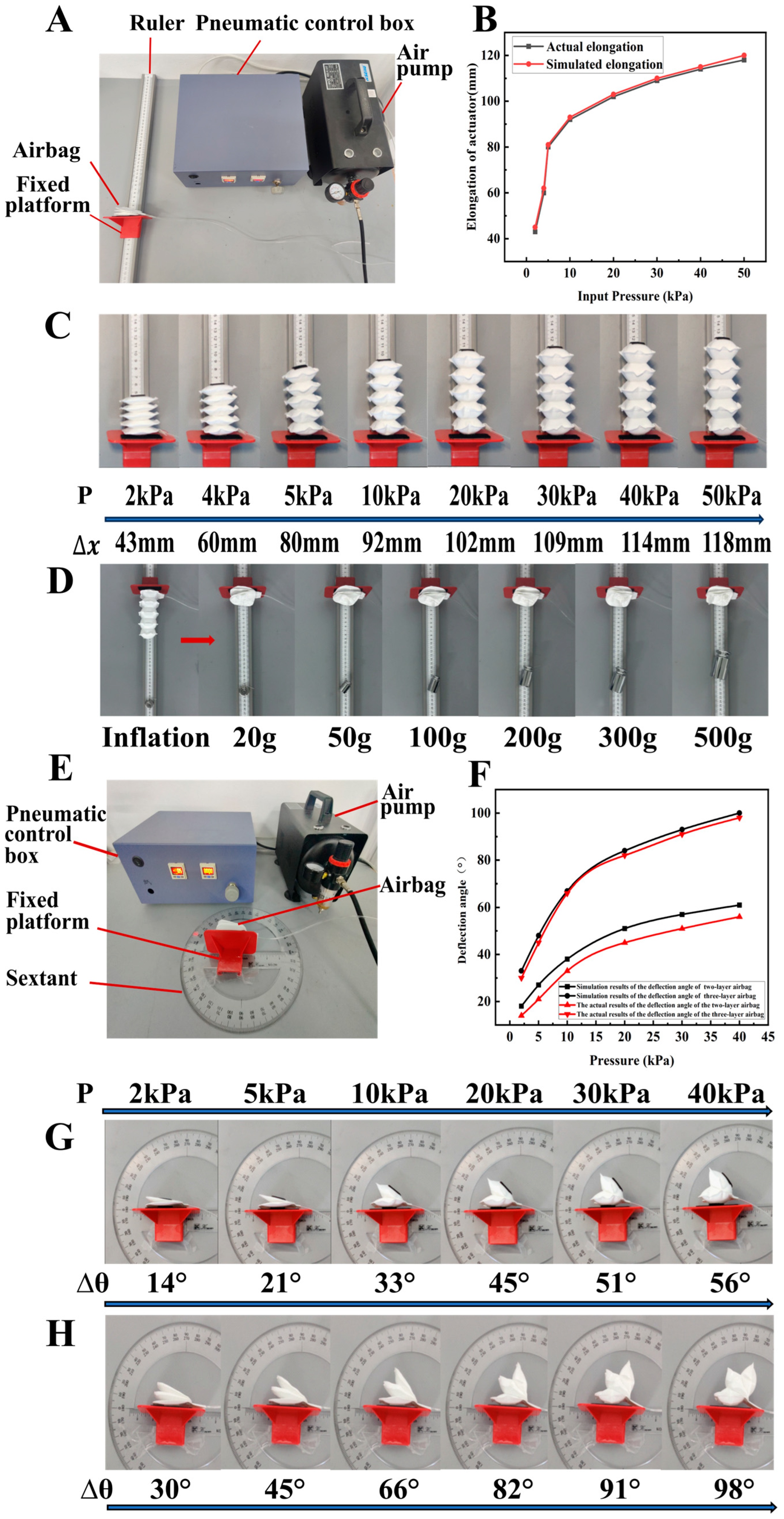
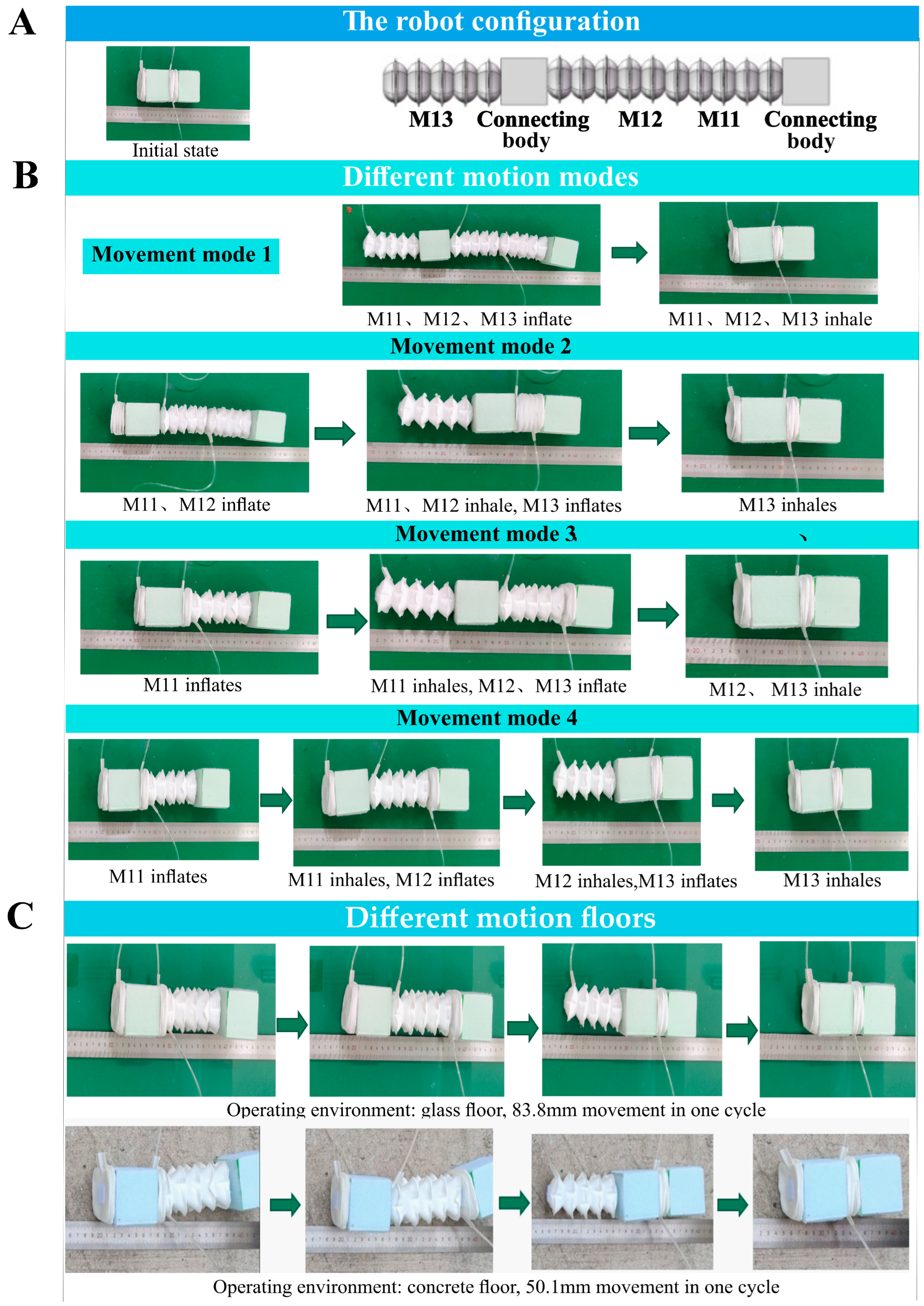
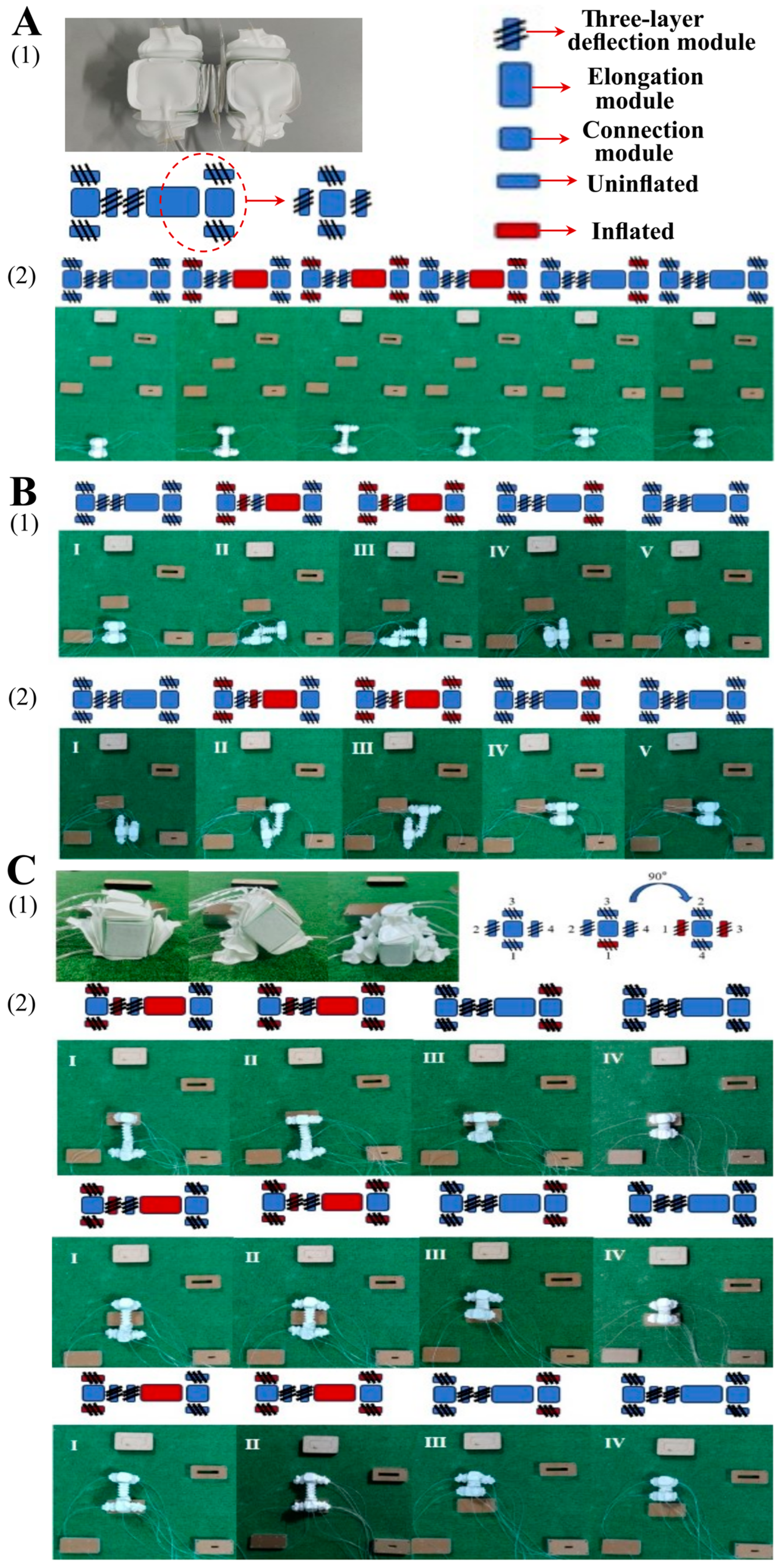
Currently, soft robots face challenges such as low motion efficiency, susceptibility to damage in traditional silicone materials, and difficulty in achieving reproducible manufacturing. To address these issues, we integrate flexible film materials with modular design principles and apply them to soft robotics. Based on the concept of modularity, this study simplifies and decomposes the robot’s motion into three fundamental modules: a thin-film elongation actuator module, a thin-film deflection actuator module, and a connection module. Inspired by the Miura-fold origami technique and traditional lantern contraction, the elongation actuator is designed to produce axial extension of varying lengths under different air pressures. The deflection actuator is modeled after the head expansion mechanism of the pelican eel, enabling deflection movement. The connection module integrates the elongation and deflection modules into a unified structure. The research results show that the elongation actuator achieves an extension length of 118 mm under 50 kPa and can pull a 500 g load during horizontal contraction. The two-layer deflection actuator achieves a deflection angle of 56° at 40 kPa, while the three-layer version reaches 98°. For further demonstration, we subsequently conducted peristaltic soft robot experiments and obstacle avoidance experiments. This study holds significant potential for the development of next-generation multifunctional soft robots.
Keywords: soft robots; thin-film actuators; film materials; modular design soft robots; thin-film actuators; film materials; modular design