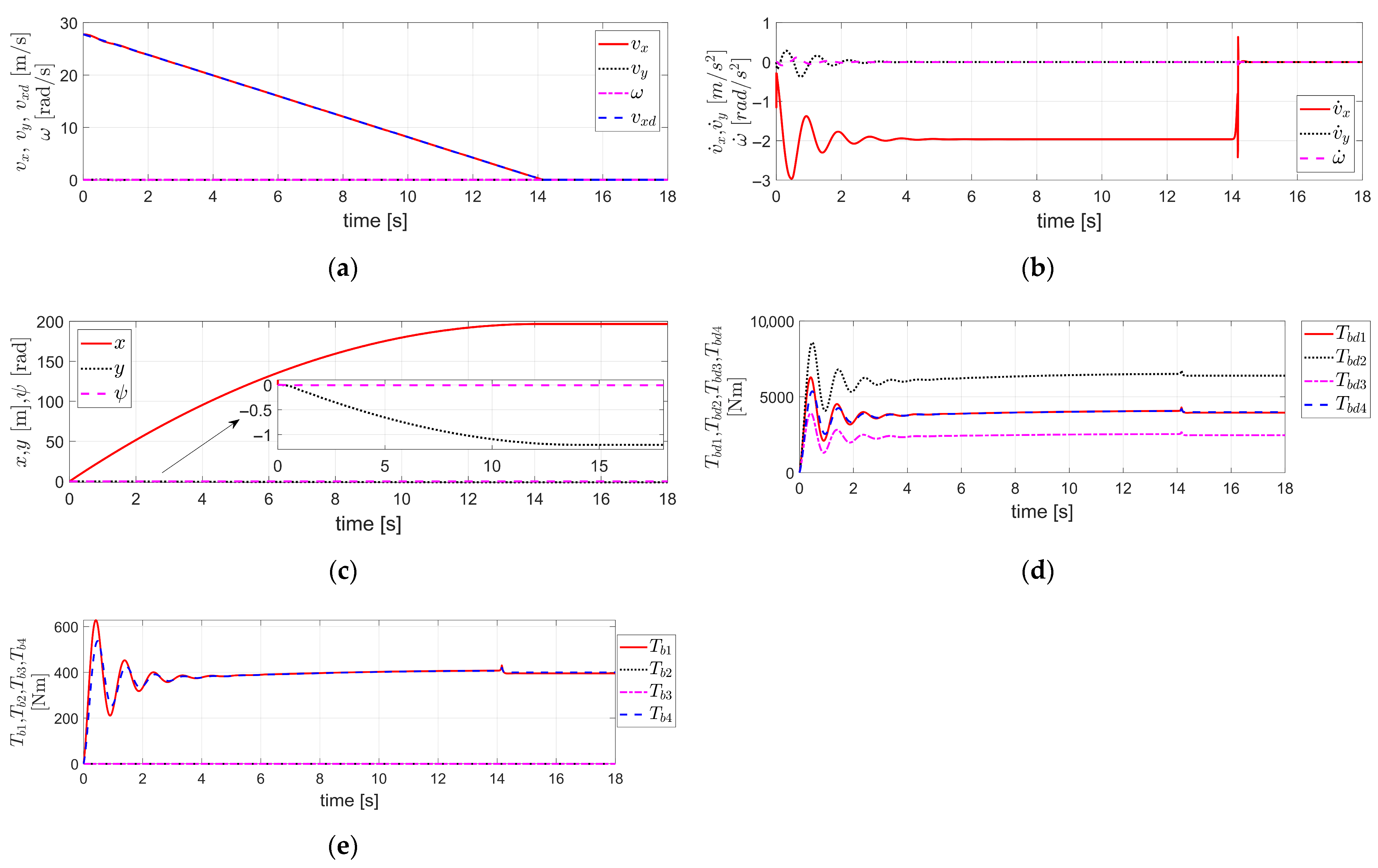
4.1. Simulation of the FTRC of Four-Wheel Independent EMB Actuators Using TDC Proposed in Section 3 Applied to the Vehicle Dynamics in Section 2
The control target considered in this section is based on the vehicle dynamics and parameters described in
Section 2, including
,
,
,
,
,
,
,
, the effective radius for all wheels
, and the rotational moment of inertia for all wheels
.
In addition, the TDC applied to the FTRC of four-wheel independent EMB actuators, as described in Equation (13), employs a control sampling time of 1 ms. The
of
was selected as shown in
Figure 2a, and
was set to 0. The
of
was chosen as −0.5 g (=−4.905 m/s
2, g = 9.81 m/s
2) and
was also set to 0.
was selected, and
in Equation (14) was determined by applying the aforementioned vehicle dynamics parameters,
, and the selected values of
, assuming a fault-free condition for the brake actuator; i.e.,
and
.
By applying the control as described above, a simulation was conducted under the condition that the initial vehicle velocity is 100 km/h (=27.78 m/s), and no actuator fault occurs; that is,
and
. The corresponding simulation results are shown in
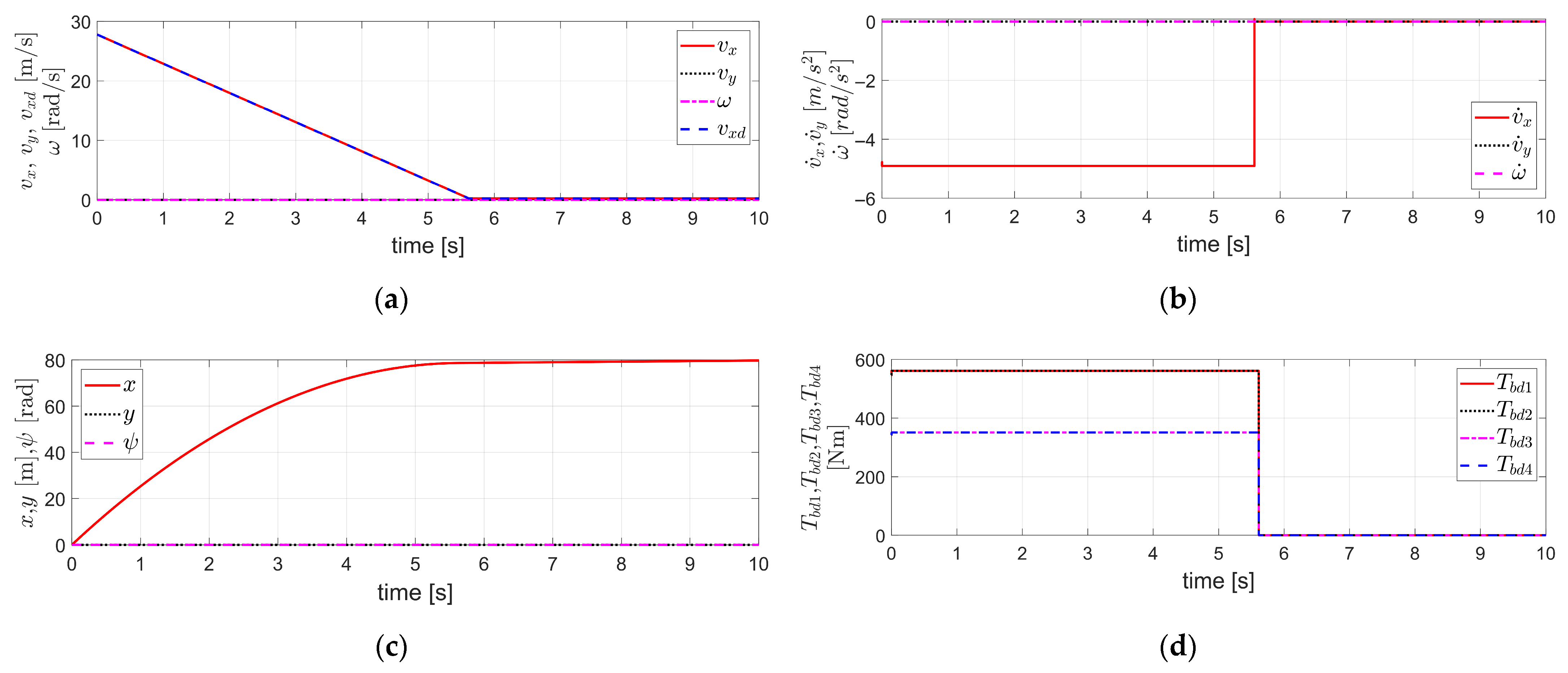
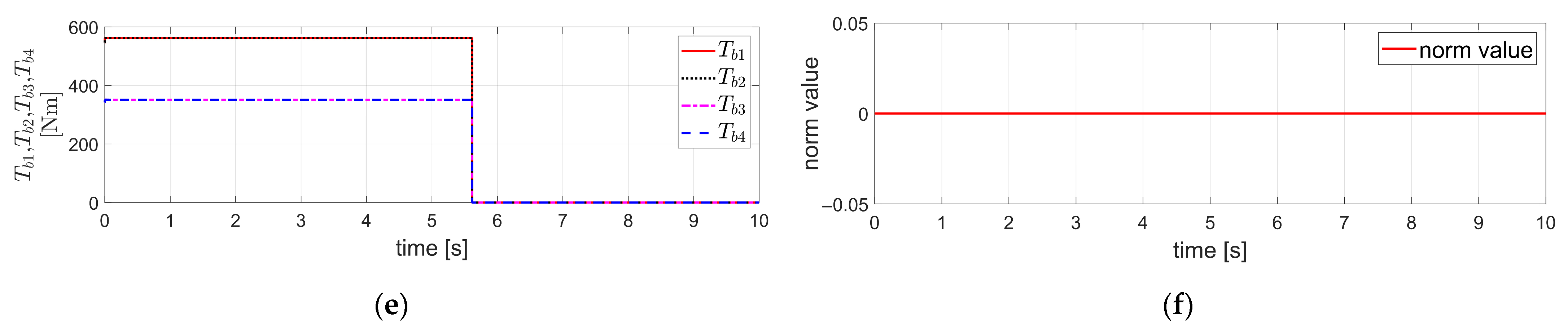
Figure 2.
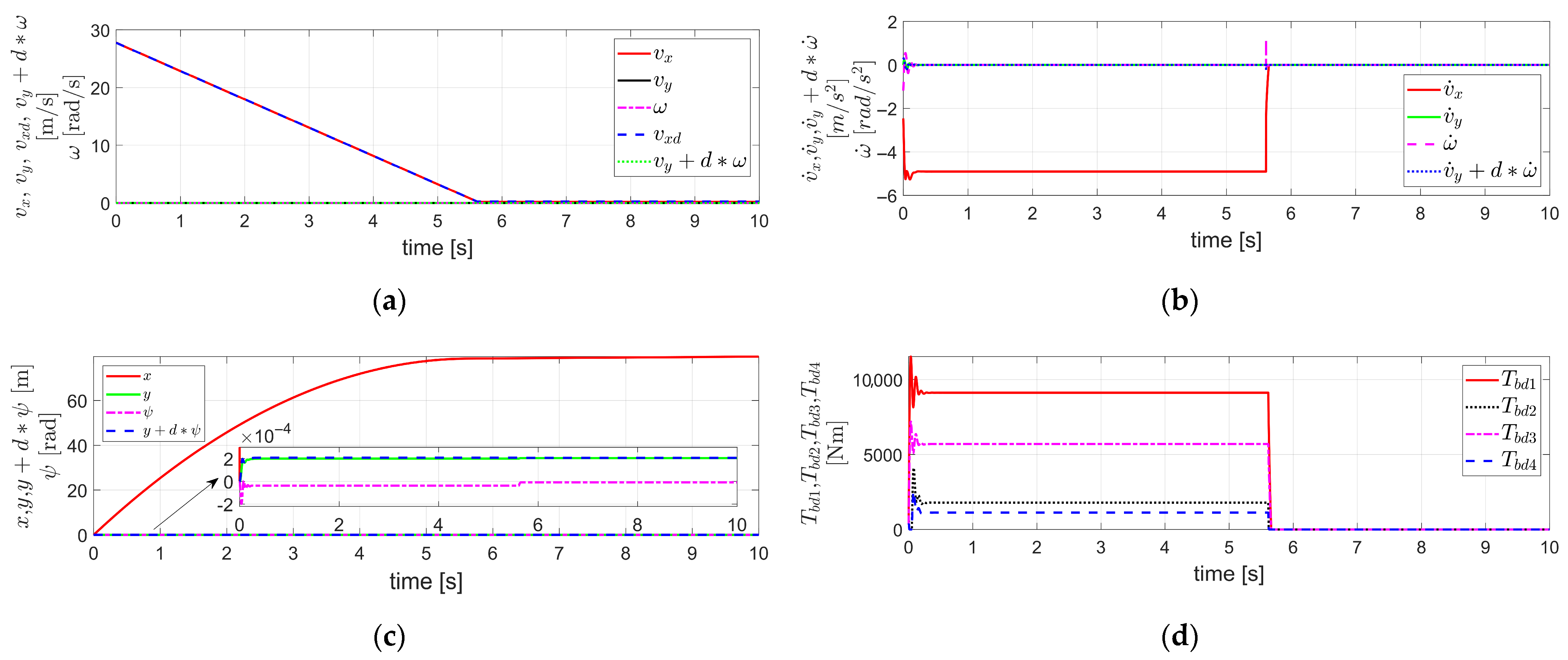
Figure 2a shows the velocity components
. Here,
is set to decrease from the initial value of 27.78 m/s to a final value of 0.25 m/s. The final velocity is not set to 0 m/s in order to avoid division by
, as
appears in the denominator in the model described in
Section 2. As shown in
Figure 2a,
closely follows
, and
tracks
well. Furthermore,
remains stable and maintains a value close to zero, consistent with the internal dynamics stabilizability analysis for
described in Equation (16).
Figure 2b shows the acceleration components
. It can be observed that
closely follows
and
also tracks
well. In addition,
remains nearly zero.
Figure 2c illustrates
, the longitudinal displacement, the lateral displacement, and the yaw angle, respectively. Here,
represents the braking distance, and it can be observed that both
and
remain close to zero. It can be seen that the
in
Figure 2d is identical to
in
Figure 2e. This corresponds to the case without any brake actuator faults, as mentioned earlier, where
and
.
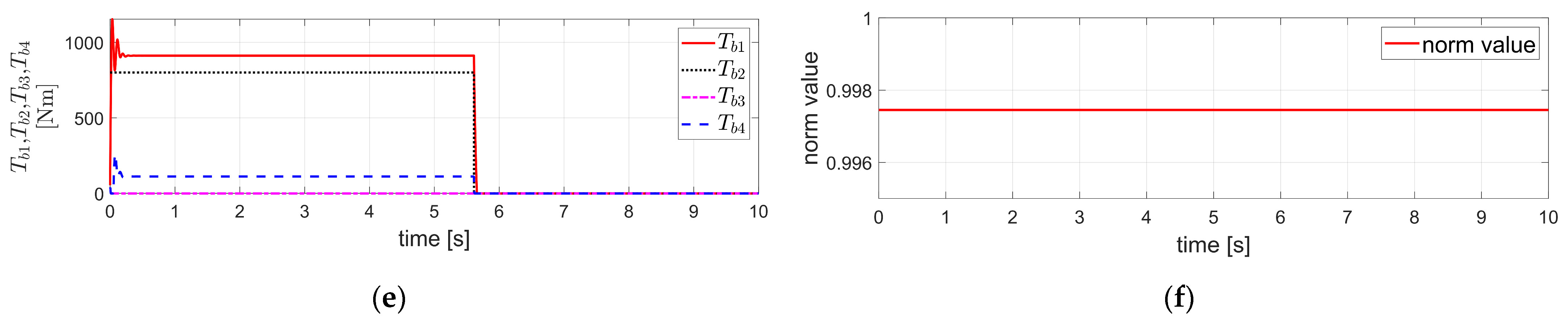
Figure 2f shows the value of Equation (15), which remains at zero in this case. This indicates that the value of Equation (15) becomes zero due to the
of
in Equation (14) applied to the
of
in Equation (12). Thus, by applying the TDC of Equation (13) to the external dynamics described in Equation (12), the resulting control system for the external dynamics is stable. Furthermore, the internal dynamics with respect to
was shown to be stable based on the internal dynamics stabilizability analysis for
described in Equation (16), which is also confirmed by the simulation results presented in
Figure 2. Therefore, it can be confirmed that the overall vehicle system, including both internal and external dynamics, is stable, which is also validated by the simulation results shown in
Figure 2.
Figure 3 presents the simulation results obtained by applying the same vehicle dynamics and parameters used in the simulation of
Figure 2, with the parameters, control gains, and desired values of the TDC in Equation (13) including the
in Equation (14) selected identically to those in
Figure 2.
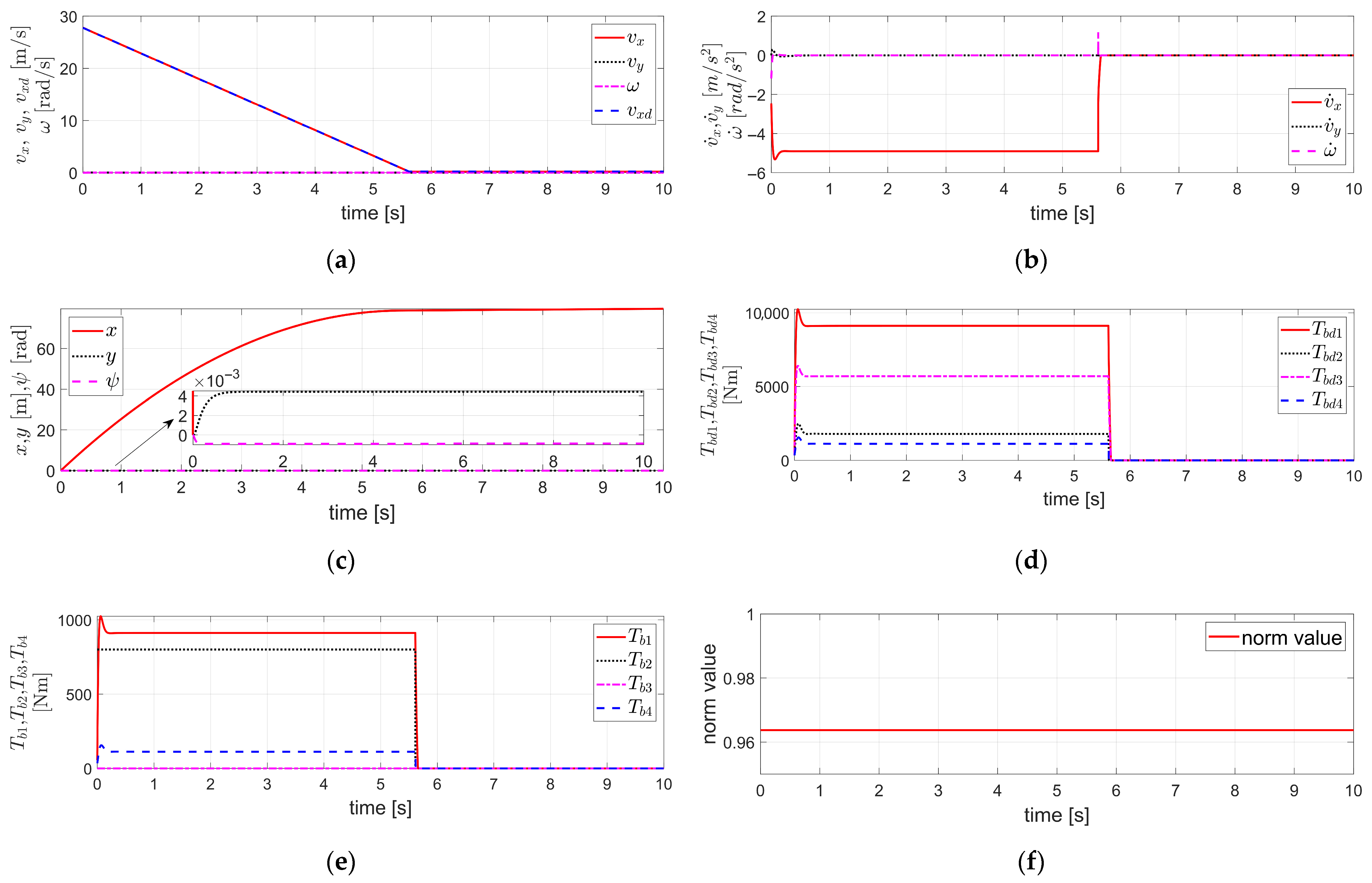
Figure 3 shows the simulation results for the case where the initial vehicle velocity is 100 km/h (=27.78 m/s), and the
is −0.5 g, as in the case of
Figure 2. However, in this case, a severe fault is assumed in the brake actuators, with
.
Even in the case of a severe fault as described above,
Figure 3a shows that
closely tracks the
, and
closely follows
. In addition,
remains stable and maintains a value close to zero, consistent with the internal dynamics stabilizability analysis for
described in Equation (16). In other words, the results are similar to those of the fault-free case shown in
Figure 2a. The acceleration components in
Figure 3b exhibit slight overshoot tendencies at the beginning and end of deceleration. However,
successfully tracks
, and
follows
well. Similarly,
shows slight overshoot behavior at the beginning and end of deceleration, but otherwise maintains a value close to zero. In
Figure 3c, the lateral displacement
reaches a maximum of approximately 4.5 × 10
−3 m, and the yaw angle
reaches a negative peak of about 1 × 10
−3 rad. This indicates that, despite the presence of a severe fault, the variations in displacement compared to the fault-free case shown in
Figure 2c are minimal, and the system exhibits a stable response.
Figure 3d,e show
and
, respectively. As observed in the figures, a certain amount of overshoot occurs initially. The relationship between these two values is determined by
, which represents the severity of the brake actuator fault, as mentioned earlier.
Figure 3f shows the value of Equation (15), which is close to 1 in this case. However, since Equation (15) is still satisfied, the TDC described in Equation (13), when applied to the external dynamics of Equation (12), ensures the stability of the control system for the external dynamics. This stability is also verified by the response of
in
Figure 3. Furthermore, the internal dynamics with respect to
was shown to be stable based on the internal dynamics stabilizability analysis for
described in Equation (16), which is also confirmed by the simulation results presented in
Figure 3. Therefore, in this case as well, it can be confirmed that the overall vehicle system, including both the internal and external vehicle dynamics, remains stable, which is also verified by the simulation results shown in
Figure 3.
The simulation results in
Figure 3 correspond to the case where the brake actuator fault is severe; i.e.,
. Nevertheless, the TDC of Equation (13) was applied without modification, using the control gain
of
in Equation (14), which had been selected under the fault-free condition assumed in
Figure 2; i.e.,
and
. In other words, the control gain
, which was originally designed under the assumption of a fault-free condition, was applied without incorporating any fault-related information such as that obtained through FDD. Nevertheless, as can be observed from the simulation results in
Figure 3, the overall vehicle system, including both internal and external dynamics, was confirmed to remain stable. This confirms the robustness of the TDC applied to FTC of four-wheel independent EMB actuators, even under severe actuator faults.
Furthermore, the simulation results in
Figure 3 show that, even in the case of a severe fault in the brake actuators with asymmetric fault levels between the left and right sides of the vehicle, the proposed FTRC of four-wheel independent EMB actuators using TDC, without employing any steering control, was able to ensure both lateral and yaw stability. In addition, the lateral and yaw displacements remained bounded within limited magnitudes, thereby ensuring safety.
In
Figure 3c, it was observed that the lateral displacement
reached a maximum of 4.5 × 10
−3 m. In this case, the lateral displacement
is extremely small and certainly not large enough to raise concerns about lane departure. However, in order to investigate whether the lateral displacement can be further reduced, we aim to apply the method proposed in
Section 3.2, which uses TDC with relative weighting to the lateral velocity and yaw rate. This provides an effective approach to prevent lane departure by applying such a method in situations where lane departure is of concern.
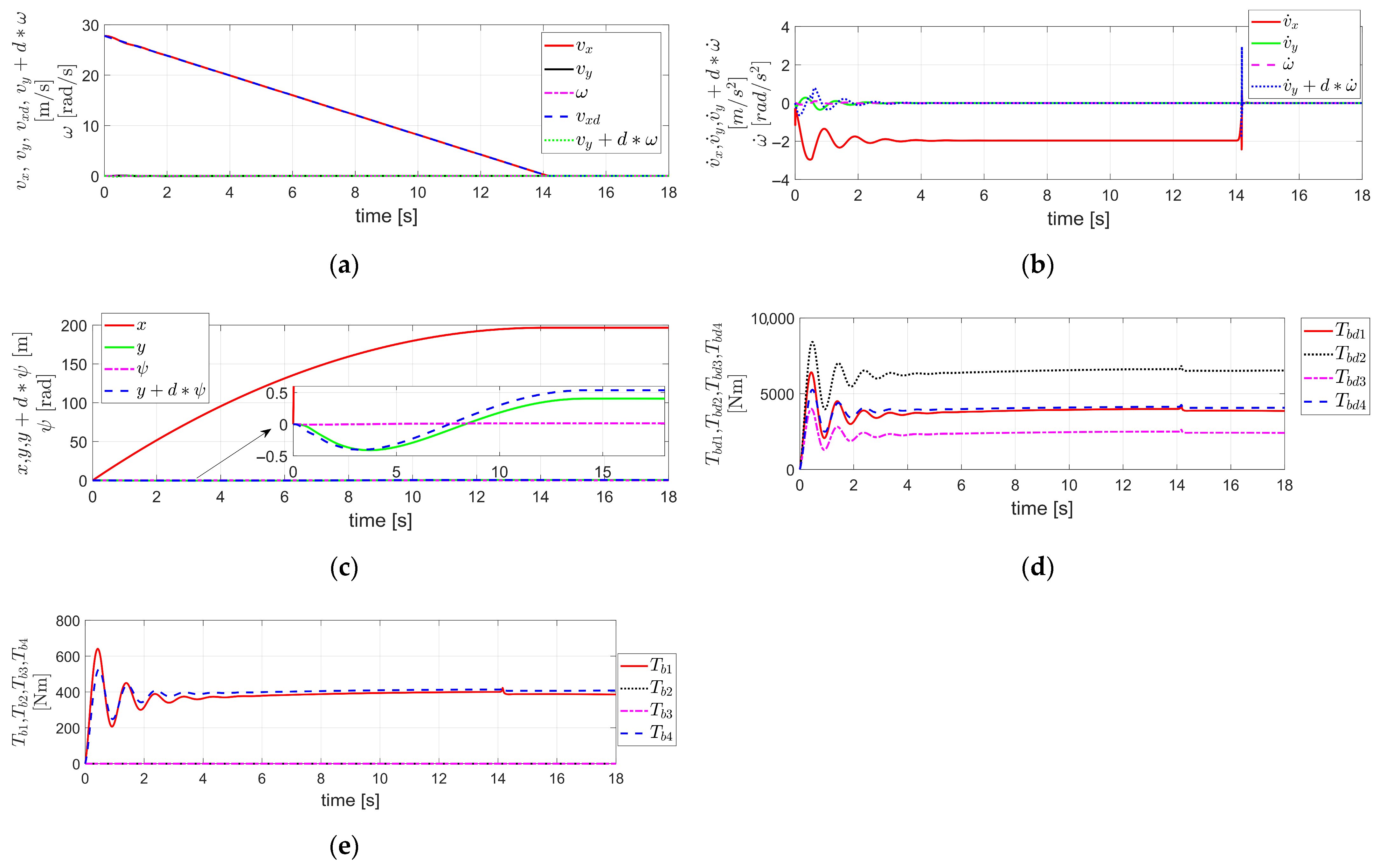
Figure 4 illustrates the case in which the control target has the same vehicle dynamics and parameter values as in
Figure 3, including the same initial velocity, desired deceleration, and degree of fault in the brake actuators.
In
Figure 4, the time delay
applied in the TDC presented in Equation (20) of
Section 3.2—i.e., the control sampling time—is 1 ms. The
of
is shown in
Figure 4a, and both
and
are zeros. The
of
is set to −0.5 g, and both
and
are zeros. Furthermore,
, and the vehicle dynamics parameters,
, and
of
were applied as in
Figure 2 and
Figure 3. In addition, the relative weighting
applied to the lateral velocity and yaw rate was selected to satisfy the internal dynamics stability condition for the lateral velocity
—i.e., either Equation (25) or (26)—and
was tuned to minimize the lateral displacement
. This always satisfies the condition in Equation (26). In other words, when
reaches its minimum value of zero, the condition
is satisfied.
As a result, the simulation results in
Figure 4 show that the maximum lateral displacement, which was 4.5 × 10
−3 m in
Figure 3c, is significantly reduced to 2.1 × 10
−4 m in
Figure 4c, demonstrating a reduction by more than 20 times. This confirms that the application of the method described in
Section 3.2, which uses TDC with relative weighting to the lateral velocity and yaw rate, effectively reduces the lateral displacement. Likewise, as mentioned earlier, this method can be utilized as an effective approach to prevent lane departure in situations where such a risk is of concern.
As shown in
Figure 4a,
successfully tracks
, and the internal dynamics of
remains stable as the relative weighting
was selected to satisfy the stability condition of Equation (26). Furthermore, by controlling
to follow the desired value
, it is confirmed that
also maintains stable value. Except for an overshoot at the initial stage of deceleration, it is confirmed that both
and
remain close to zero. In
Figure 4b, a significant overshoot is observed at the initial stage of deceleration, however, excluding the overshoot region,
closely follows the desired value
. Additionally, it is confirmed that both
and
remain nearly zero throughout the rest of the response.
Figure 4d,e show
and
, respectively. As observed in the figures, a significant overshoot occurs during the initial stage of deceleration. The relationship between these two values is determined by the degree of brake actuator fault,
, as previously mentioned.
Figure 4f shows the value of Equation (22), which is approximately close to 1 in this case. However, since Equation (22) is satisfied, the TDC in Equation (20), when applied to the external dynamics described in Equation (18), ensures the stability of the control system for the external dynamics. In addition, as mentioned earlier, the parameter
was selected to satisfy the stability condition of the internal dynamics for the lateral velocity
, as expressed in Equation (26). Therefore, even in this case, it can be confirmed that the overall vehicle system, including both the internal and external dynamics, is stable, as also verified from the simulation results in
Figure 4.
As in the simulation of
Figure 3, the simulation results in
Figure 4 also correspond to the case where the degree of the brake actuator fault is significant—i.e.,
—and the control gain
, which had been selected under the fault-free condition assumed in
Figure 2, is directly applied to Equation (21) without any modification. In other words, the control gain
used in the TDC of Equation (20) is not the one selected based on fault information obtained through FDD, but rather the gain
, which was originally designed under the assumption of a fault-free condition, without applying FDD. Nevertheless, as can be observed from the simulation results in
Figure 4, the overall vehicle system, including both internal and external dynamics, was confirmed to remain stable. This indicates that the TDC in Equation (20) exhibits the robust control characteristics against faults. However, the control gain matrix
of the TDC in Equation (20) must be designed not only for
, but also with careful selection of the relative weighting
. As mentioned earlier, the relative weighting
was selected to satisfy the stability condition of the internal dynamics for the lateral velocity
given in Equation (26), and
was tuned such that the lateral displacement
is minimized. In this case, the tuning process for selecting the relative weighting
was conducted under the simulation conditions of
Figure 4 and the severity of the brake actuator fault. Therefore, in this case, it is necessary to identify the severity of the brake actuator fault
through FDD. Although this approach requires the burden of identifying the severity of the brake actuator fault via FDD, it enables a reduction in lateral displacement and ultimately provides the capability to prevent lane departure.
Furthermore, the simulation results in
Figure 4 confirm that, even in the case of a severe fault in the brake actuators with asymmetric fault levels between the left and right sides of the vehicle, lateral and yaw stability can be achieved solely through the FTRC of four-wheel independent EMB actuators using the TDC in Equation (20), without applying any steering control. In addition, it is verified that the lateral displacement is significantly reduced compared to the results shown in
Figure 3.
4.2. Simulation of the FTRC of Four-Wheel Independent EMB Actuators Using TDC Proposed in Section 3 Applied to 14 DOF Vehicle Dynamics Using Vehicle Dynamics Blockset in MATLAB/Simulink
In this section, the control target is 14 DOF Vehicle Dynamics using Vehicle Dynamics Blockset (VDBS) [
21] in MATLAB/Simulink R2024b, which is based on a real vehicle and incorporates the Magic Formula tire model.
The vehicle dynamics parameters applied are the same as those used in
Section 4.1, including
,
,
,
,
,
, the effective radius for all wheels
, and the rotational moment of inertia for all wheels
.
In addition, the TDC applied to the FTRC of four-wheel independent EMB actuators, as described in Equation (13), employs a control sampling time of 0.1 ms. The
of
was selected as shown in
Figure 5a, and
was set to 0. The
of
was chosen as −0.2 g and
was also set to 0.
was selected, and
in Equation (14) was determined by applying the aforementioned vehicle dynamics parameters,
, and the tuned values of
, under the assumption of a fault-free condition for the brake actuator; i.e.,
and
. Here,
were selected through tuning because the 14 DOF Vehicle Dynamics model using VDBS used as the control target in this section is not well known. In other words, for the complex 14 DOF vehicle dynamics model, the control gain
of
in the TDC of Equation (13), defined in Equation (14), must be selected through tuning. This is because it must reflect not only the estimated value of the fault level
for four-wheel independent EMB actuators, but also the estimated parameters representing the unmodeled characteristics of the 14 DOF vehicle dynamics. Therefore, tuning is required to appropriately determine
.
By applying the above conditions, the simulation results for the case where the initial vehicle velocity is 100 km/h (=27.78 m/s) and there is no fault in the brake actuators—i.e.,
and
—are shown in
Figure 5.
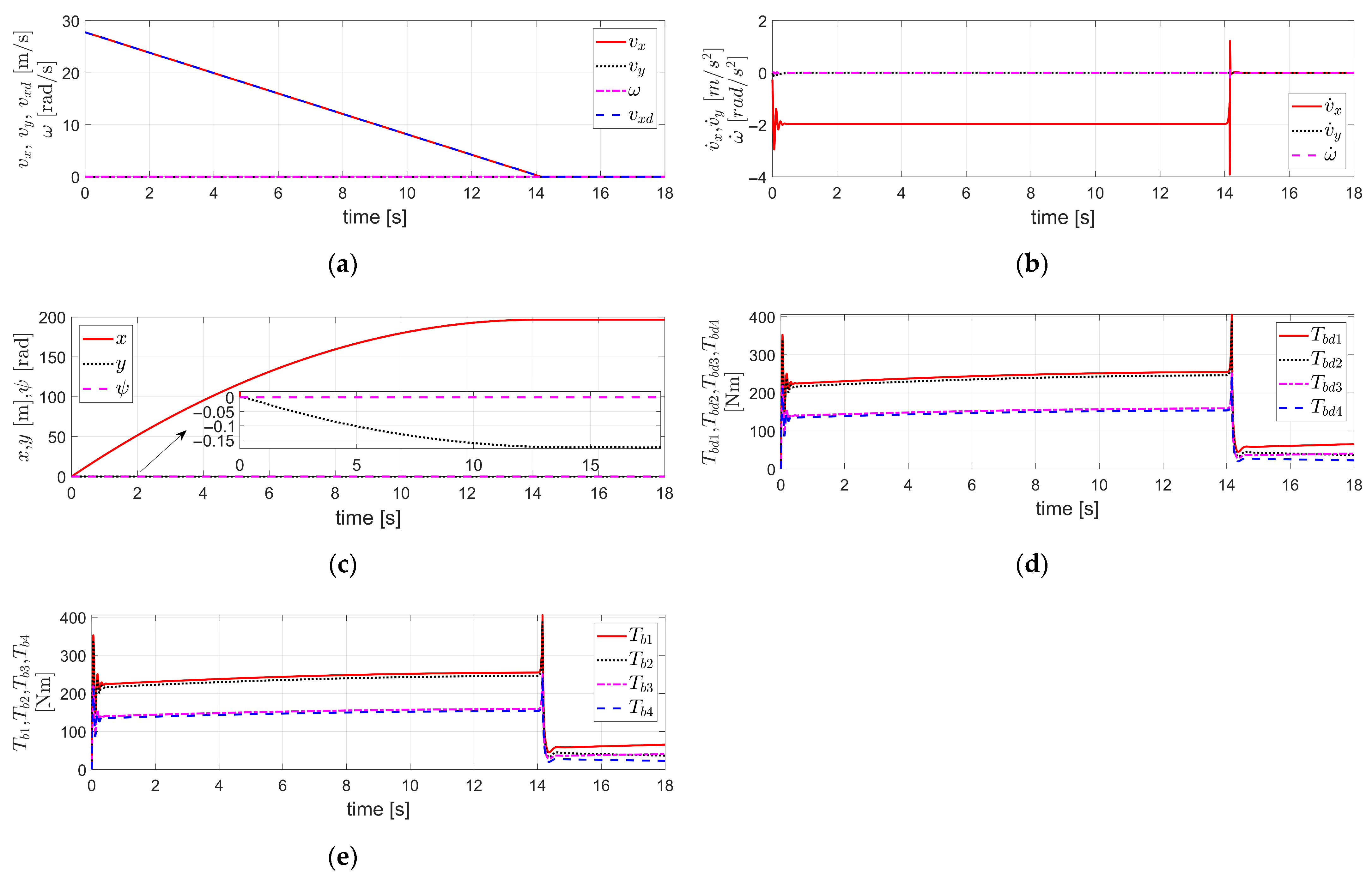
Figure 5a illustrates the velocity components,
. As shown in
Figure 5a,
closely follows
, and
also tracks
well. Furthermore,
remains stable and maintains a value close to zero.
Figure 5b illustrates the acceleration components,
. Although significant overshoot is observed during the initial and final phases of deceleration,
closely follows
, and
also tracks
relatively well. Additionally,
remains close to zero throughout the simulation.
Figure 5c illustrates the longitudinal displacement
, lateral displacement
, and yaw angle
. The variable
represents the braking distance, while
remains nearly zero. The variable
exhibits a stable response, being bounded within a negative maximum value of approximately 0.18 m.
Figure 5d shows
, and
Figure 5e shows
. As mentioned above, this corresponds to the case without any fault in the brake actuators; i.e.,
and
. In this case,
and
have identical values.
Figure 5d,e show that both
and
exhibit significant overshoot behavior at the beginning and end of deceleration. The reason they maintain nonzero steady-state values even after braking has completed is presumed to be due to the continued compensation control for the unmodeled uncertainties and external disturbances of the 14 DOF vehicle dynamics. Unlike
Figure 2,
Figure 3 and
Figure 4,
Figure 5 does not present the results corresponding to the stability condition of Equation (15). This is because the mathematical model equations of the Matlab/Simulink VDBS 14 DOF vehicle dynamics used as the control target in this section are not well known. Consequently, when attempting to represent the system in the form of the external dynamics described by Equation (12) or Equation (18), it is difficult to identify the specific mathematical expressions for each term in Equation (12) or Equation (18). Therefore, the matrix
in Equation (12) or the matrix
in Equation (18) cannot be clearly determined. Therefore, the results related to the stability conditions of Equation (15) could not be presented in
Figure 5.
As mentioned earlier, the reason for selecting the control gain
of
in Equation (14) through tuning is also due to the fact that the VDBS 14 DOF vehicle dynamics model is not well known, as explained here. Therefore, as in
Section 4.1, it is not possible to mathematically verify the stability of the internal and external dynamics in this case. Instead, the stability must be confirmed based on the control results applied to the VDBS 14 DOF vehicle dynamics.
From
Figure 5, it can be observed that the variables of interest (i.e.,
,
, and
) and the control inputs (i.e.,
, and
) remain stable and bounded.
The Matlab/Simulink VDBS 14 DOF vehicle dynamics model consists of 6 DOF for the vehicle body, 4 DOF for the rotational motion of each of the four wheels (one per wheel), and 4 DOF for the vertical motion of each of the four wheels (one per wheel). The 6 DOF for the vehicle body consist of 3 translational DOF (longitudinal, lateral, and vertical motions) and 3 rotational DOF (roll, pitch, and yaw motions).
In
Figure 5, the variables related to the 3 DOF of the vehicle body (longitudinal and lateral translational motions and yaw rotational motion) among the 14 DOF of the vehicle were examined, along with the brake actuator control inputs, and it was confirmed that all of them are stable and remain within bounded values.
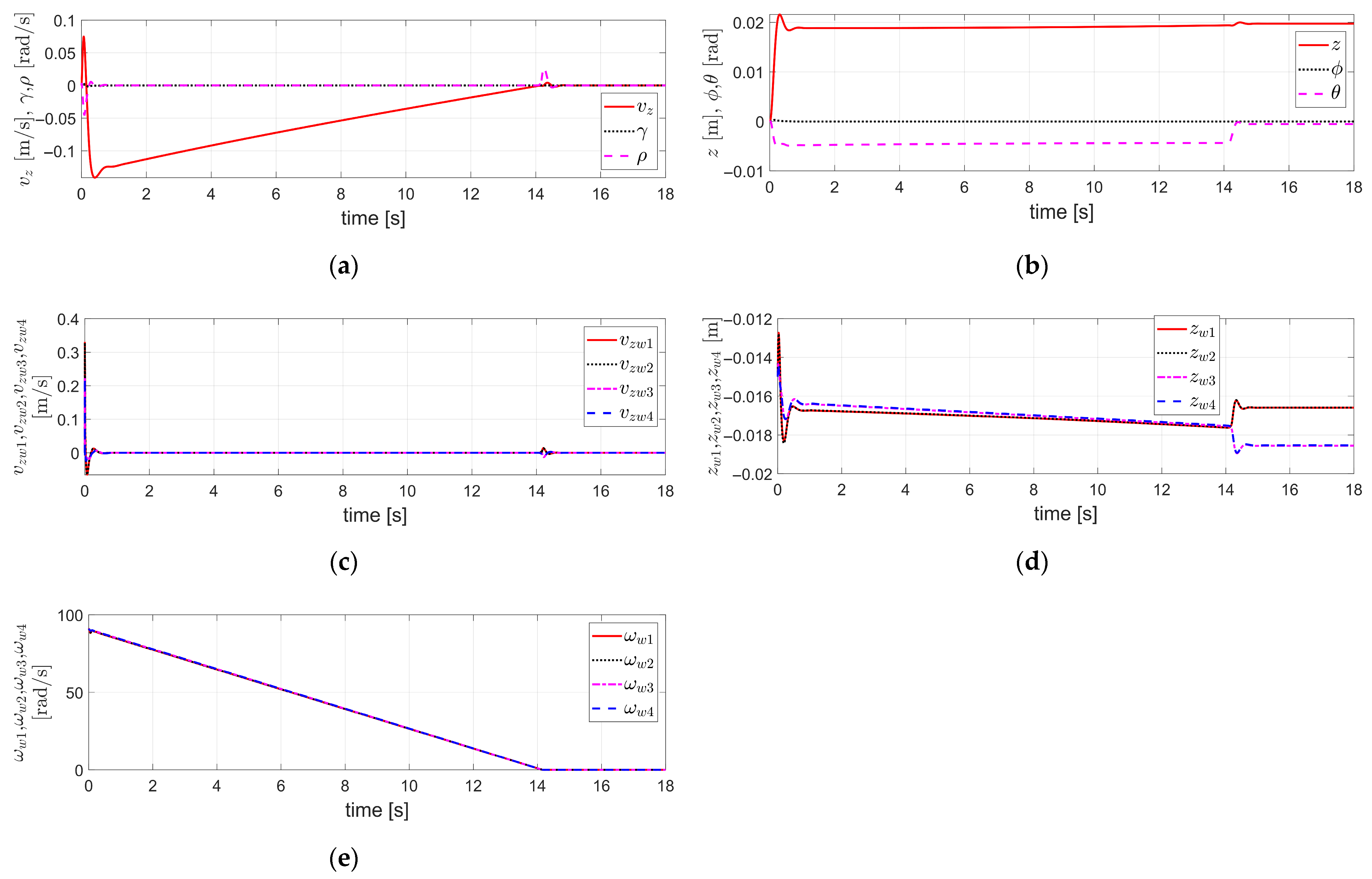
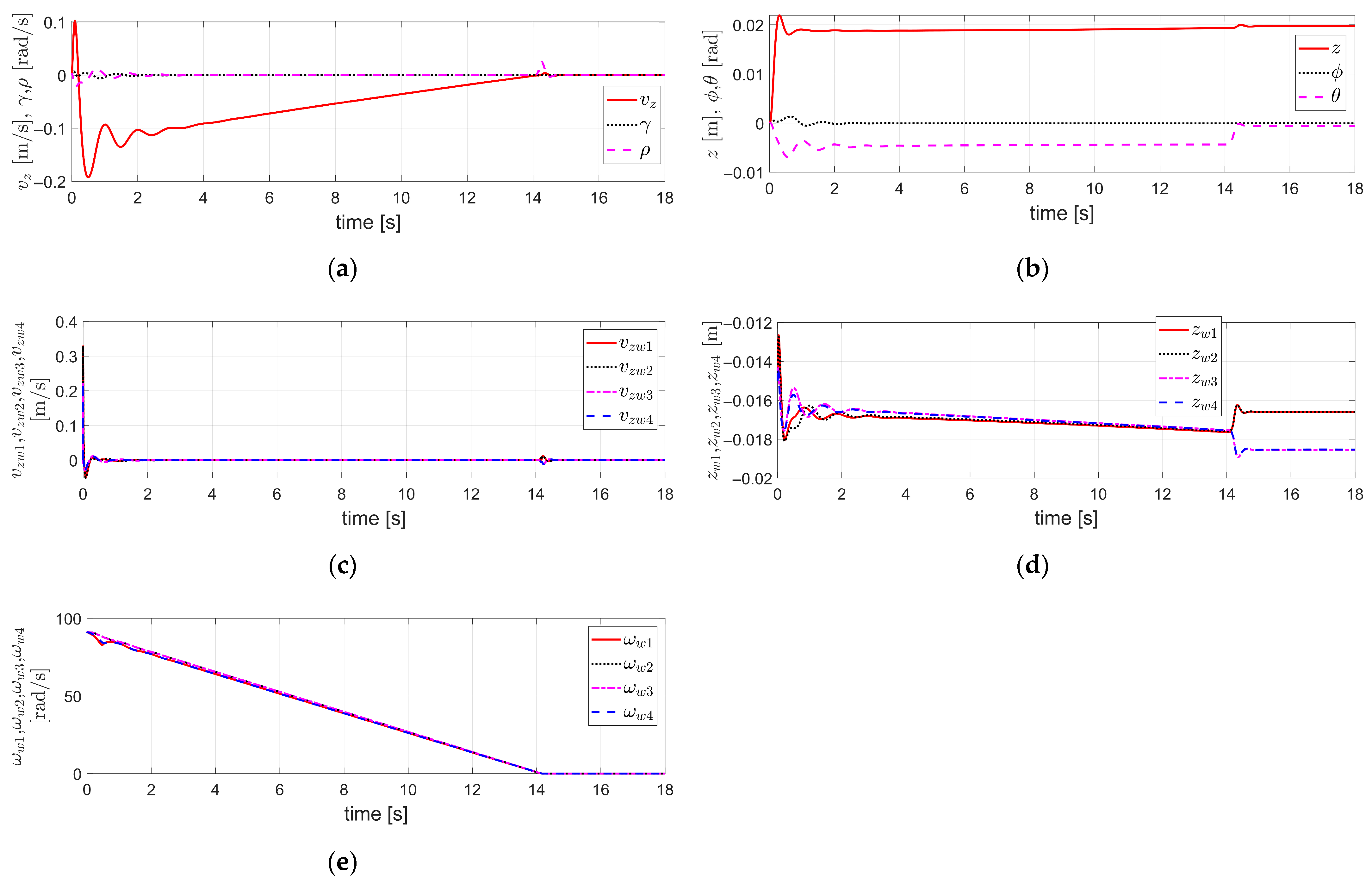
Figure 6 presents the simulation results of the remaining variables among the 14 DOF of the vehicle, excluding the vehicle body’s 3 DOF variables covered in
Figure 5.
Figure 6a shows the vertical translational velocity
of the vehicle body, the roll angular velocity
, and the pitch angular velocity
, all of which exhibit stable responses.
Figure 6b shows the vertical displacement
of the vehicle body, the roll angle
, and the pitch angle
, all of which exhibit stable responses with bounded values.
Figure 6c shows the vertical velocities
of each of the four wheels, all of which exhibit stable responses.
Figure 6d shows the vertical displacements
of each of the four wheels, all of which exhibit stable responses and have bounded values.
Figure 6e shows the rotational angular velocities
of each of the four wheels, all of which exhibit stable responses.
Therefore,
Figure 6a,b illustrate the variables associated with the vehicle body’s 3 DOF, including vertical translational motion, and rotational motions in the roll and pitch directions, showing stable and bounded responses.
Figure 6c,d represent the variables related to the 1 DOF vertical translational motion of each of the four wheels, also exhibiting stable and bounded responses.
Figure 6e shows the variables related to the 1 DOF rotational motion of each of the four wheels, also representing stable responses.
Therefore,
Figure 6 presents the simulation results for the remaining 11 DOF, excluding the 3 DOF of the vehicle body addressed in
Figure 5. These include the other 3 DOF of the vehicle body (vertical translation, roll, and pitch), a total of 4 DOF corresponding to the vertical translational motion of the four individual wheels, and a total of 4 DOF corresponding to the rotational motion of the four individual wheels. All corresponding variables exhibit stable and bounded responses.
Therefore, it can be confirmed that all the variables associated with the full 14 DOF of the vehicle, comprising the 3 DOF of the vehicle body in
Figure 5 and the remaining 11 DOF in
Figure 6, as well as the brake actuator control inputs in
Figure 5, remain stable and within bounded values. This indicates that the overall vehicle control system is stable.
Figure 7 shows the simulation results for the case of a severe fault in the brake actuator; i.e.,
. The other simulation conditions are the same as those in the simulation shown in
Figure 5.
Also in this case, the control gain
selected through tuning under the assumption of a fault-free condition, as in
Figure 5, was applied.
As shown, even in the case of a severe fault, when the control gain
selected through tuning under the assumption of a fault-free condition is applied as-is,
Figure 7a demonstrates that
tracks
relatively well despite slight deviations during the initial deceleration phase. Similarly,
also follows
with minor errors in the early deceleration period. Moreover,
also remains stable and maintains a value close to zero. In
Figure 7b, the acceleration components
exhibit oscillations in the initial deceleration phase and overshoots in the final deceleration phase. However, in other periods,
closely follows
,
effectively tracks
, and
maintains a value close to zero.
Figure 7c illustrates the longitudinal displacement
, lateral displacement
, and yaw angle
, respectively. The
represents the braking distance, while
remains close to zero. As observed,
is bounded within a maximum magnitude of 1.2 m, which indicates a stable response. However, since the magnitude is relatively large, there exists a potential risk of lane departure. Therefore, the lateral displacement
should be re-adjusted and controlled to remain within a range that prevents lane departure.
Figure 7d,e show
and
, respectively. As observed in the figures, significant oscillations occur during the initial deceleration phase, and the relationship between these two values is determined by
, which represents the severity of the brake actuator fault, as mentioned earlier.
Also, as mentioned in the simulation results of
Figure 5, in the simulation results of
Figure 7,
and
retain nonzero steady-state values even after the braking phase is completed. This is presumed to be due to the continued compensation control for the unmodeled uncertainties and external disturbances of the 14 DOF vehicle dynamics.
Therefore, as in
Section 4.1, it is not possible to mathematically verify the stability of the internal and external dynamics in this case either. Instead, it is necessary to confirm the stability based on the control results applied to the VDBS 14 DOF vehicle dynamics.
Similarly to
Figure 5,
Figure 7 examines the variables related to the 3 DOF of the vehicle body (longitudinal and lateral translational motions and yaw rotational motion) among the 14 DOF vehicle dynamics, as well as the control inputs of the brake actuators. It is confirmed that all of them maintain stable and bounded responses.
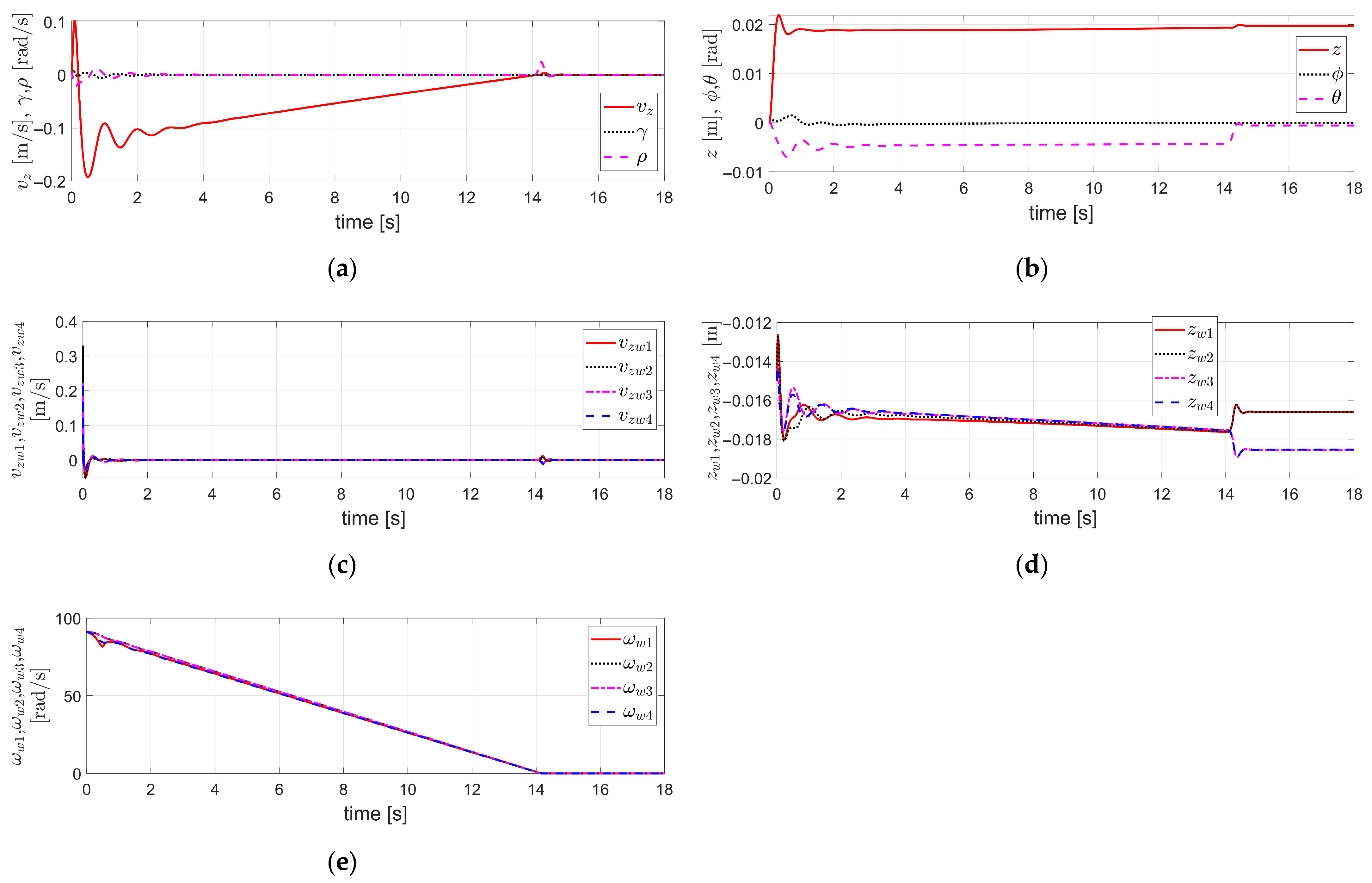
Figure 8 presents the simulation results of the remaining variables among the 14 DOF of the vehicle, excluding the vehicle body’s 3 DOF variables covered in
Figure 7.
Figure 8a shows the vertical translational velocity
of the vehicle body, the roll angular velocity
, and the pitch angular velocity
, all of which exhibit stable responses.
Figure 8b shows the vertical displacement
of the vehicle body, the roll angle
, and the pitch angle
, all of which exhibit stable responses with bounded values.
Figure 8c shows the vertical velocities
of each of the four wheels, all of which exhibit stable responses.
Figure 8d shows the vertical displacements
of each of the four wheels, all of which exhibit stable responses and have bounded values.
Figure 8e shows the rotational angular velocities
of each of the four wheels, all of which exhibit stable responses.
Therefore,
Figure 8a,b illustrate the variables associated with the vehicle body’s 3 DOF, including vertical translational motion, and rotational motions in the roll and pitch directions, showing stable and bounded responses.
Figure 8c,d represent the variables related to the 1 DOF vertical translational motion of each of the four wheels, also exhibiting stable and bounded responses.
Figure 8e shows the variables related to the 1 DOF rotational motion of each of the four wheels, also representing stable responses.
Therefore,
Figure 8 presents the simulation results for the remaining 11 DOF, excluding the 3 DOF of the vehicle body addressed in
Figure 7. These include the other 3 DOF of the vehicle body (vertical translation, roll, and pitch), a total of 4 DOF corresponding to the vertical translational motion of the four individual wheels, and a total of 4 DOF corresponding to the rotational motion of the four individual wheels. All corresponding variables exhibit stable and bounded responses.
Therefore, it can be confirmed that all the variables associated with the full 14 DOF of the vehicle, comprising the 3 DOF of the vehicle body in
Figure 7 and the remaining 11 DOF in
Figure 8, as well as the brake actuator control inputs in
Figure 7, remain stable and within bounded values. This indicates that the overall vehicle control system is stable.
However, as previously mentioned, the lateral displacement should be re-adjusted and controlled to remain within a range that prevents lane departure.
The simulation results in
Figure 7 and
Figure 8 correspond to the case where the brake actuator fault is severe; i.e.,
. Nevertheless, the control gain
, which was selected through tuning under the assumption of no fault—i.e.,
and
, as in
Figure 5 and
Figure 6—is applied directly to Equation (14) without modification. In other words, this is a case where the control gain
, selected through tuning under the assumption of no fault, was directly applied to the TDC of Equation (13) without incorporating any fault information obtained through FDD. Nevertheless, as can be observed from the simulation results in
Figure 7 and
Figure 8, the overall vehicle control system is confirmed to be stable. This confirms the robustness of the TDC applied to FTC of four-wheel independent EMB actuators, even under severe actuator faults.
Furthermore, the simulation results in
Figure 7 show that, even in the case of a severe fault in the brake actuators with asymmetric fault levels between the left and right sides of the vehicle, the proposed FTRC of four-wheel independent EMB actuators using TDC, without employing any steering control, was able to ensure both lateral and yaw stability.
In the simulation results of
Figure 7, it was stated that the lateral displacement
should be re-adjusted and controlled to remain within a range that prevents lane departure. Therefore, to reduce the lateral displacement
, the method introduced in
Section 3.2 is applied, which incorporates TDC with relative weighting to the lateral velocity and yaw rate.
Figure 9 presents the simulation results obtained by applying the method described in Equation (20), which incorporates TDC with relative weighting to the lateral velocity and yaw rate. The simulation in
Figure 9 uses the same conditions as in
Figure 7, except that the control method in Equation (20) from
Section 3.2 is applied instead of the method in Equation (13) from
Section 3.1.
The time delay
applied in the TDC presented in Equation (20)—i.e., the control sampling time—is 0.1 ms. The
of
is shown in
Figure 9a, and both
and
are zeros. The
of
is set to −0.2 g, and both
and
are zeros. In addition,
and the control gains
of
were selected through tuning under the assumption of a fault-free condition, as in
Figure 5,
Figure 6,
Figure 7 and
Figure 8.
The degree of brake actuator fault considered in
Figure 9 is the same as in
Figure 7 and
Figure 8; i.e.,
.
The relative weighting factor
for the lateral velocity and yaw rate in Equation (20) was determined through tuning, considering the simulation conditions of
Figure 9 and the severity of the brake actuator fault.
As a result, the simulation results shown in
Figure 9 are similar to those in
Figure 7. However, as illustrated in
Figure 9c, the lateral displacement
remains within
, which is significantly reduced compared to that in
Figure 7, and exhibits nearly symmetrical deviation in both positive and negative directions. Thus, assuming the vehicle is tracking the center of the lane, the control method described in
Section 3.2, which incorporates TDC with relative weighting to the lateral velocity and yaw rate of Equation (20), can be said to contribute to preventing lane departure under the brake actuator fault condition described above.
As in
Figure 5 and
Figure 7,
Figure 9 also does not present the results related to the stability condition of Equation (22), unlike
Figure 2,
Figure 3 and
Figure 4. The reason is the same as explained previously in
Figure 5. Therefore, as in
Section 4.1, it is not possible to mathematically verify the stability of the internal and external dynamics in this case either. Instead, it is necessary to confirm the stability based on the control results applied to the VDBS 14 DOF vehicle dynamics.
Similarly to
Figure 5 and
Figure 7,
Figure 9 examines the variables related to the 3 DOF of the vehicle body (longitudinal and lateral translational motions and yaw rotational motion) among the 14 DOF vehicle dynamics, as well as the control inputs of the brake actuators. It is confirmed that all of them maintain stable and bounded responses.
Figure 10 presents the simulation results of the remaining variables among the 14 DOF of the vehicle, excluding the vehicle body’s 3 DOF variables covered in
Figure 9.
Figure 10a shows the vertical translational velocity
of the vehicle body, the roll angular velocity
, and the pitch angular velocity
, all of which exhibit stable responses.
Figure 10b shows the vertical displacement
of the vehicle body, the roll angle
, and the pitch angle
, all of which exhibit stable responses with bounded values.
Figure 10c shows the vertical velocities
of each of the four wheels, all of which exhibit stable responses.
Figure 10d shows the vertical displacements
of each of the four wheels, all of which exhibit stable responses and have bounded values.
Figure 10e shows the rotational angular velocities
of each of the four wheels, all of which exhibit stable responses.
Therefore,
Figure 10a,b illustrate the variables associated with the vehicle body’s 3 DOF, including vertical translational motion, and rotational motions in the roll and pitch directions, showing stable and bounded responses.
Figure 10c,d represent the variables related to the 1 DOF vertical translational motion of each of the four wheels, also exhibiting stable and bounded responses.
Figure 10e shows the variables related to the 1 DOF rotational motion of each of the four wheels, also representing stable responses.
Therefore,
Figure 10 presents the simulation results for the remaining 11 DOF, excluding the 3 DOF of the vehicle body addressed in
Figure 9. These include the other 3 DOF of the vehicle body (vertical translation, roll, and pitch), a total of 4 DOF corresponding to the vertical translational motion of the four individual wheels, and a total of 4 DOF corresponding to the rotational motion of the four individual wheels. All corresponding variables exhibit stable and bounded responses.
Therefore, it can be confirmed that all the variables associated with the full 14 DOF of the vehicle, comprising the 3 DOF of the vehicle body in
Figure 9 and the remaining 11 DOF in
Figure 10, as well as the brake actuator control inputs in
Figure 9, remain stable and within bounded values. This indicates that the overall vehicle control system is stable.
As in the simulations of
Figure 7 and
Figure 8, the simulation results in
Figure 9 and
Figure 10 also correspond to the case where the brake actuator fault is severe; i.e.,
. Nevertheless, the control gain
, which was selected through tuning under the assumption of no fault—i.e.,
and
, as in
Figure 5 and
Figure 6—is applied directly to Equation (21) without modification. In other words, the control gain
used in the TDC of Equation (20) is not the one selected based on fault information obtained through FDD, but rather the gain
, which was selected through tuning under the assumption of no fault, without applying FDD. Nevertheless, as can be observed from the simulation results in
Figure 9 and
Figure 10, the overall vehicle control system is confirmed to be stable. This indicates that the TDC in Equation (20) exhibits the robust control characteristics against faults.
However, the control gain matrix
of the TDC in Equation (20) must be designed not only for
, but also with careful selection of the relative weighting
. As mentioned earlier, the relative weighting
was determined through tuning based on the simulation conditions in
Figure 9 and the severity of the brake actuator fault. Therefore, in this case, it is necessary to identify the severity of the brake actuator fault
through FDD. Although this approach requires the burden of identifying the severity of the brake actuator fault via FDD, it enables a reduction in lateral displacement and ultimately provides the capability to prevent lane departure.
Furthermore, the simulation results in
Figure 9 confirm that, even in the case of a severe fault in the brake actuators with asymmetric fault levels between the left and right sides of the vehicle, lateral and yaw stability can be achieved solely through the FTRC of four-wheel independent EMB actuators using the TDC in Equation (20), without applying any steering control. In addition, it is observed that this method prevents lane departure, which was likely to occur under the conditions of the simulation in
Figure 7.
Table A2 in
Appendix A presents the results of the simulation in this section, summarizing the maximum absolute error values of the safety-related states—namely, the lateral displacement and yaw angle—which have errors from the desired steady-state values.