
Fault Tolerant Control of Integrated Autonomous Wheel Module Vehicle Subject to Independent Steering Actuator Degradation



Abstract
1. Introduction
1.1. Related Work and Motivation
1.2. Contributions and Paper Organization
- (i)
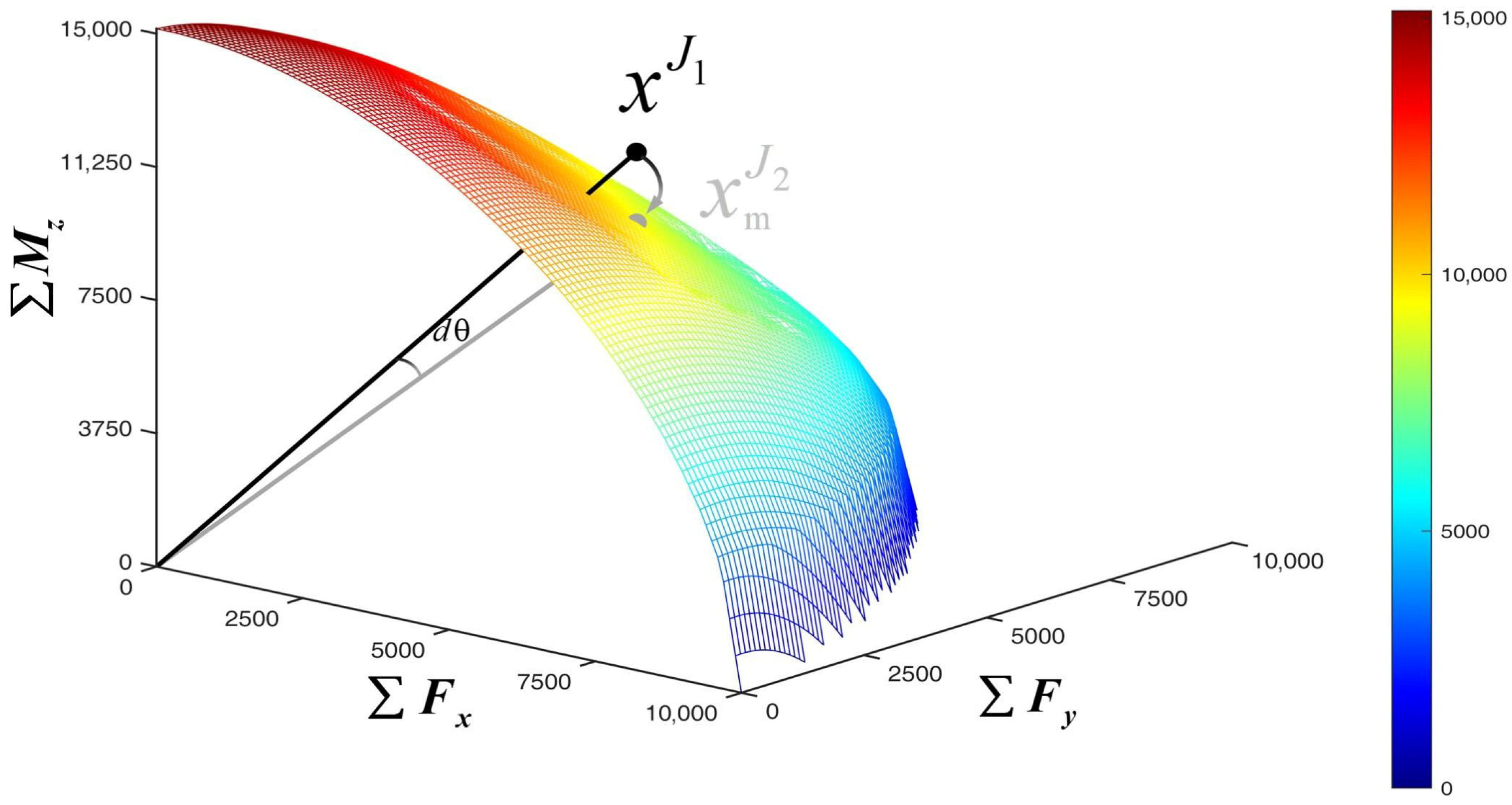
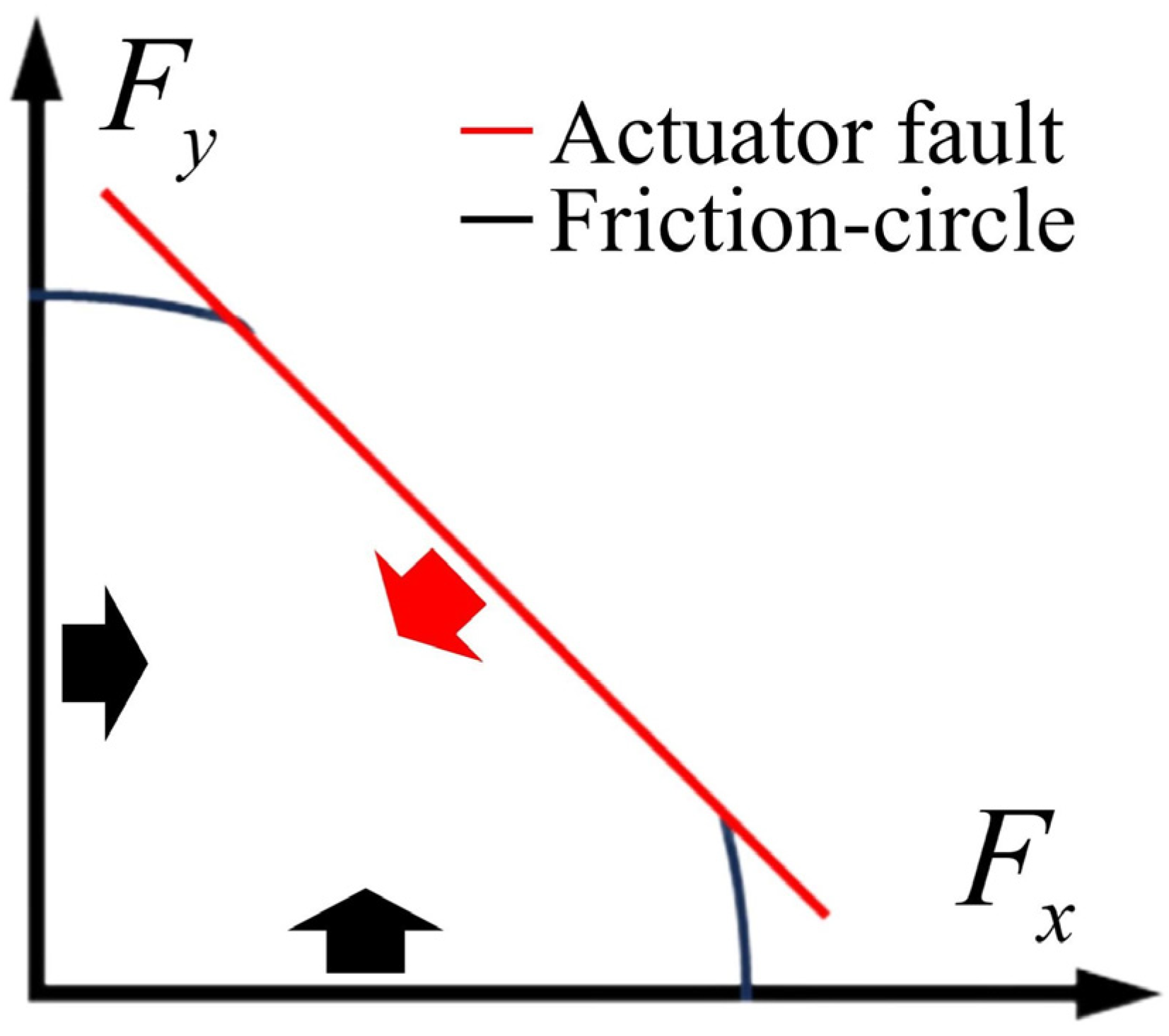
- A fault-inclusive steering dynamics model is developed and analyzed by explicitly incorporating steering motor torque degradation coefficients into the independent steering system. This model establishes a quantitative mapping from the degradation coefficients to the contraction of the corresponding tire-force feasible domain.
- (ii)
- A tire-force allocation method is proposed based on the contracted feasible domain. Within each control cycle, the demand generalized force is initially solved under one-dimensional generalized force/torque boundary constraints. Subsequently, boundary optimization is performed to obtain the boundary values along the direction of the current demand generalized force vector, thereby correcting the demand generalized force, eliminating infeasibility or abrupt switching problems that occur in conventional tire-force distribution.
- (iii)
- An adaptive target weighting scheme is proposed, involving the steering fault factor into the weighting component of the tire force distribution objective function, which enables management using the same optimization objective function before and after faults occur. Ultimately, the SQP algorithm is employed to solve this optimization problem, yielding the target tire forces.
2. System Structure and Related Models
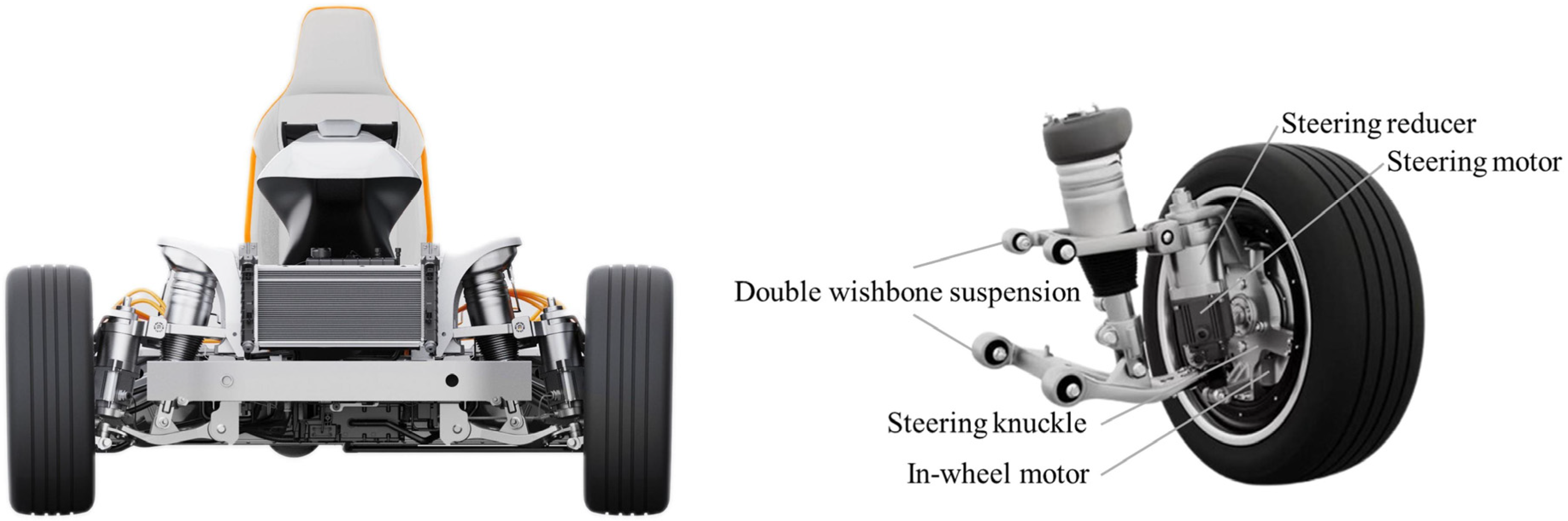
2.1. Structure of the Vehicle
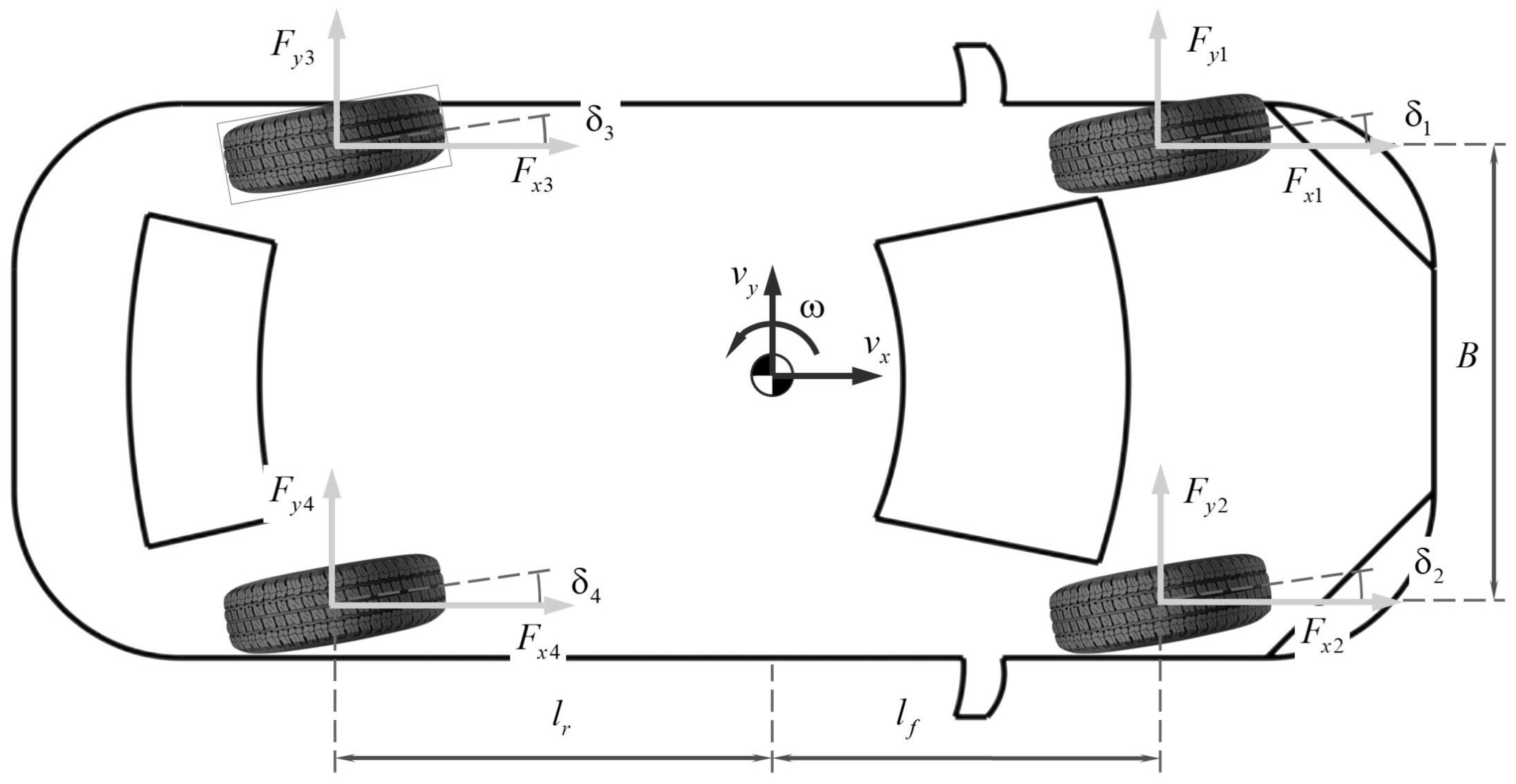
2.2. Vehicle Dynamics Model
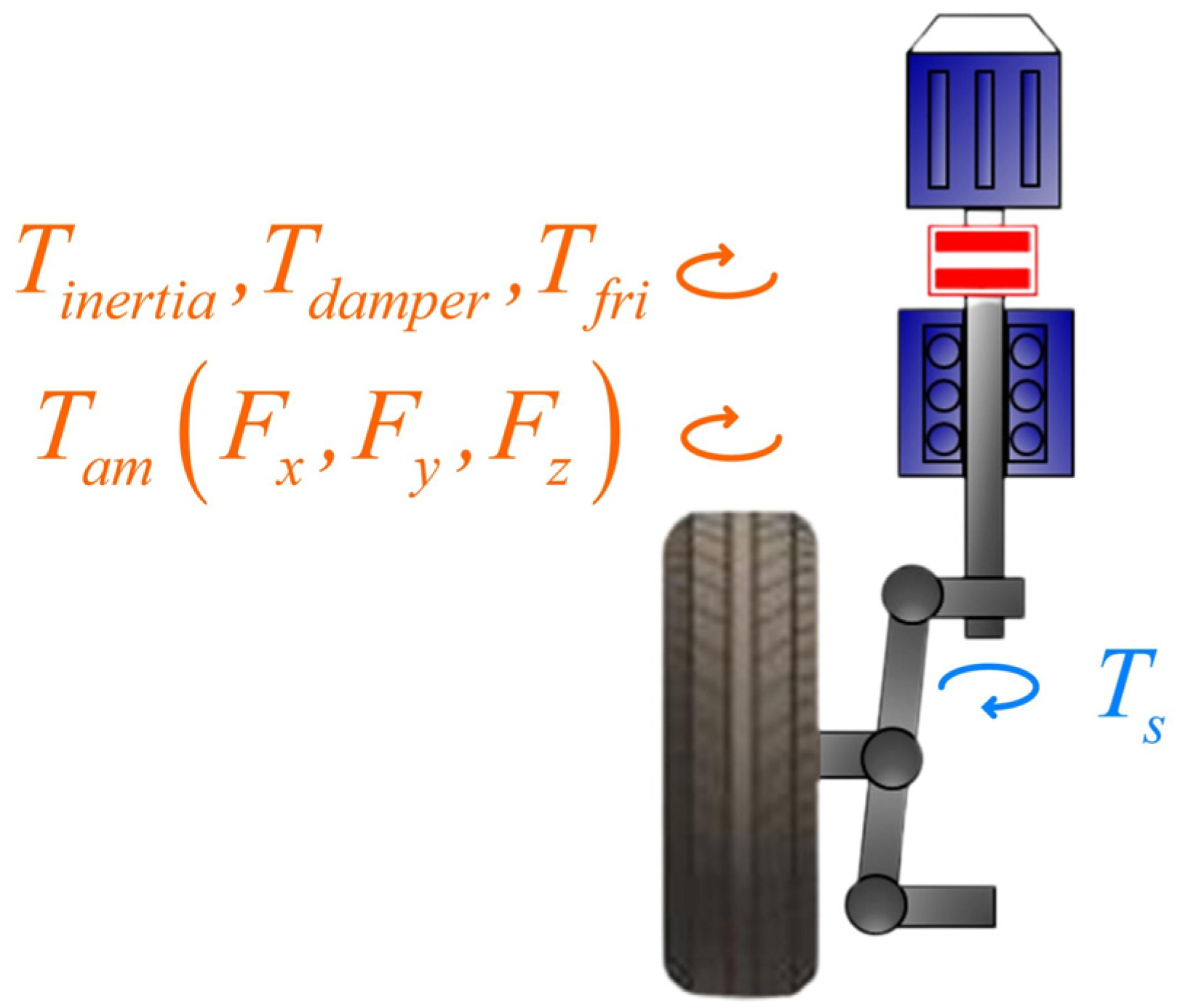
2.3. Independent Steering System Model
2.4. Mapping Model of ISS Degradation to the Tire Force Feasible Region
- (i)
- To facilitate controller design, the actuator degradation coefficient is mapped to the steady-state boundary of the feasible tire-force domain. Furthermore, since the road-wheel steering motion is predominantly confined to low-frequency motions, the inertia and viscous damping torques associated with the steering rate are neglected.
- (ii)
- Existing tests indicate that the friction moment around the kingpin does not exceed 5 Nm [37], which is significantly smaller than the tire force aligning torque or tire elastic aligning torque. Thus, it is neglected in subsequent analyses.
- (iii)
- Considering the small magnitude of lateral translating deformation of the carcass caused by tire sidewall deflection [38], this effect is also neglected.
- (iv)
- To avoid boundary contraction errors due to model uncertainty, the decay of the pneumatic trail with the tire lateral deflection angle [38] is ignored, and the pneumatic trail at zero lateral sideslip angle is directly used.
2.5. Coordinate System Transformation
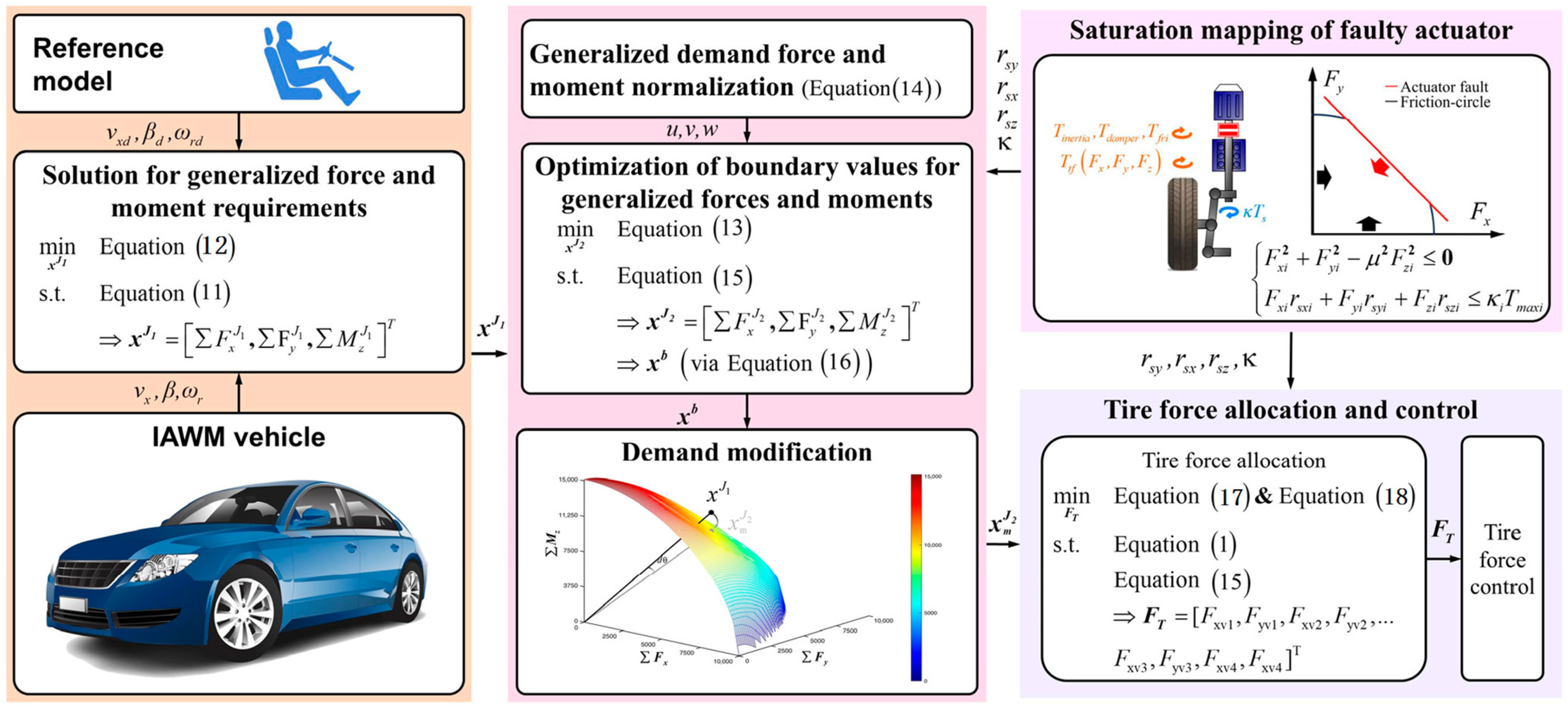
3. Integrated Chassis Fault Tolerant Motion Controller Design
3.1. Generalized Force/Moment Generator
3.2. Tire Force Allocation and Control
4. Simulation Results and Analysis
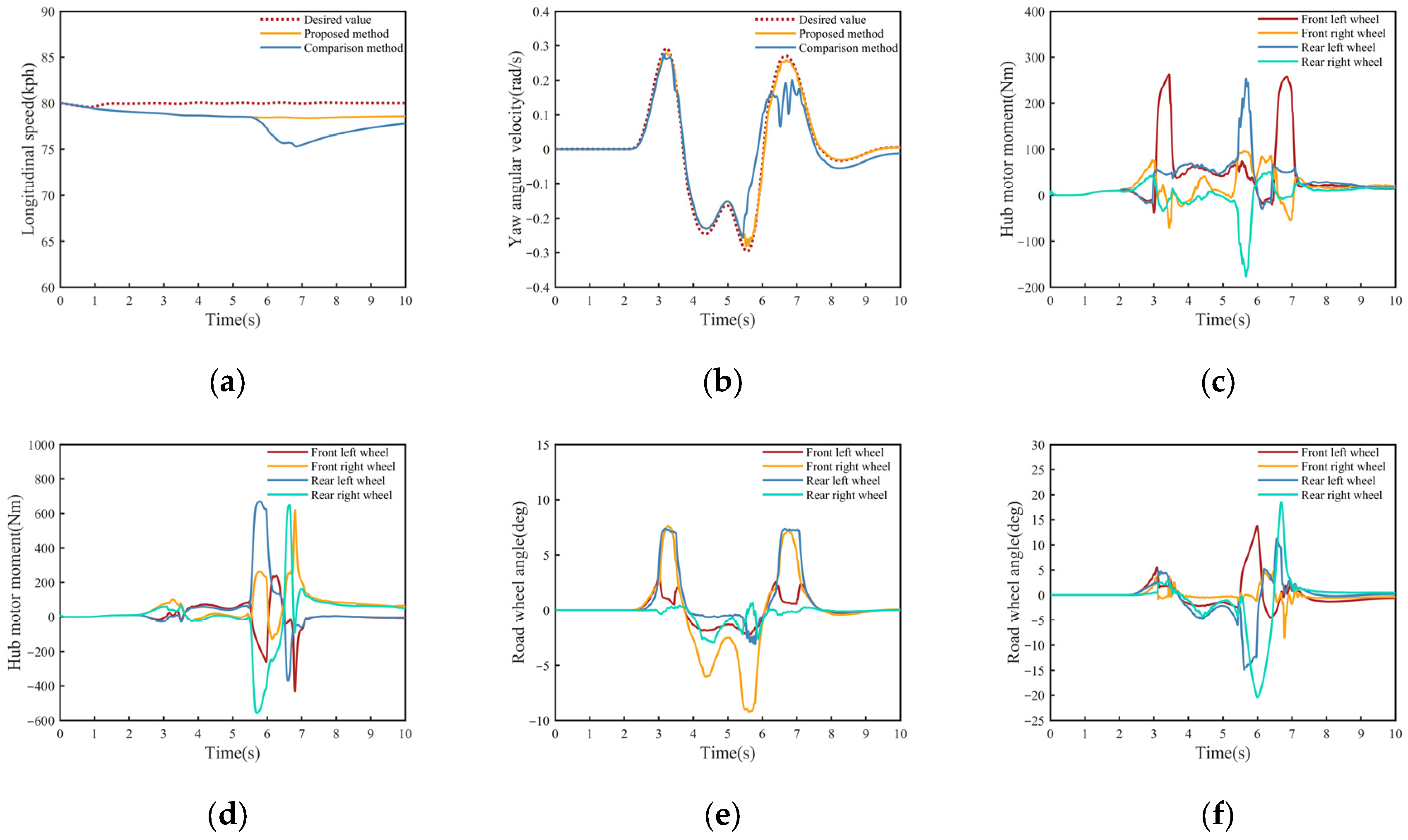
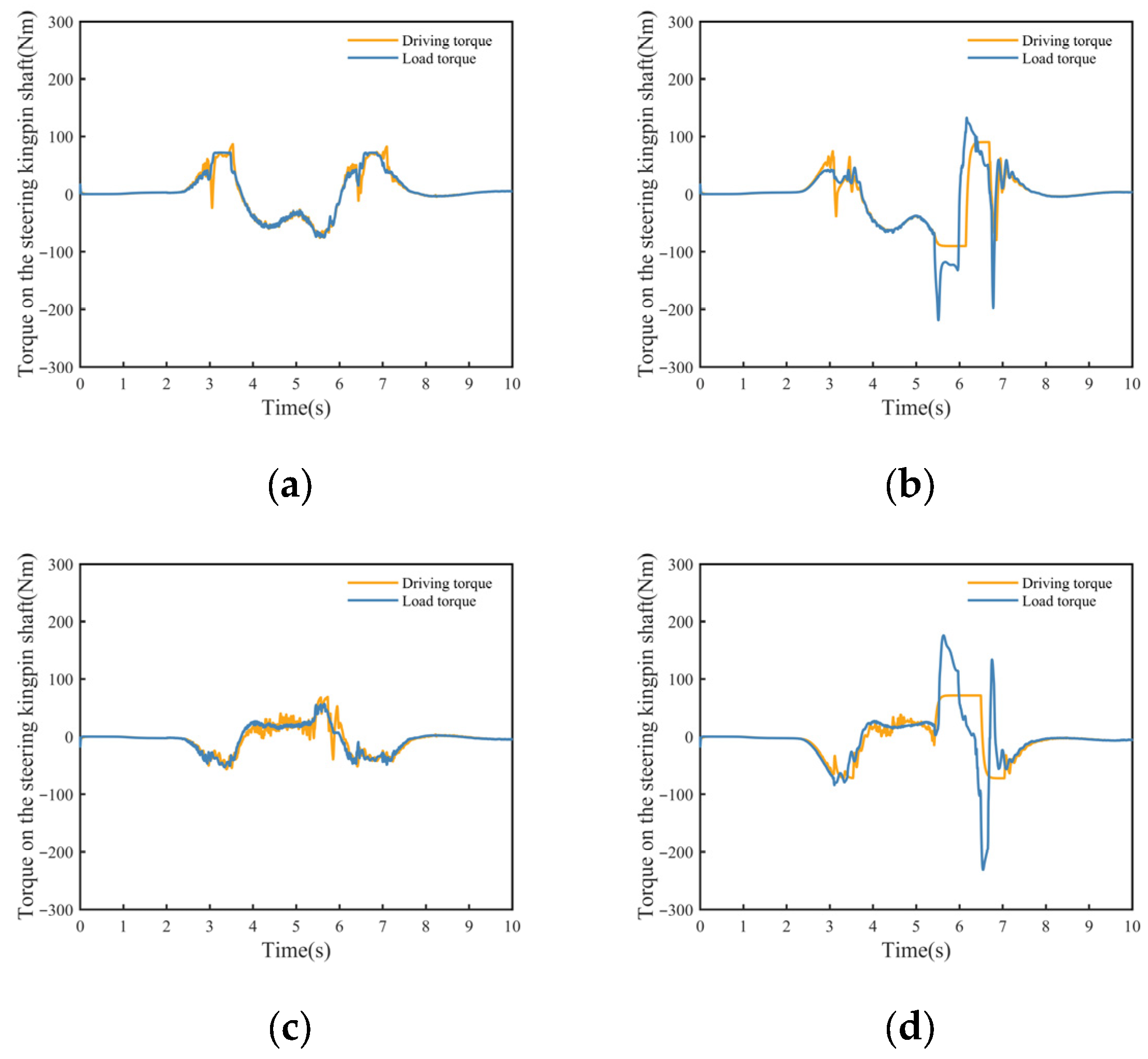
4.1. Diagonal Steer Wheel FTC Under High-Friction Road Conditions
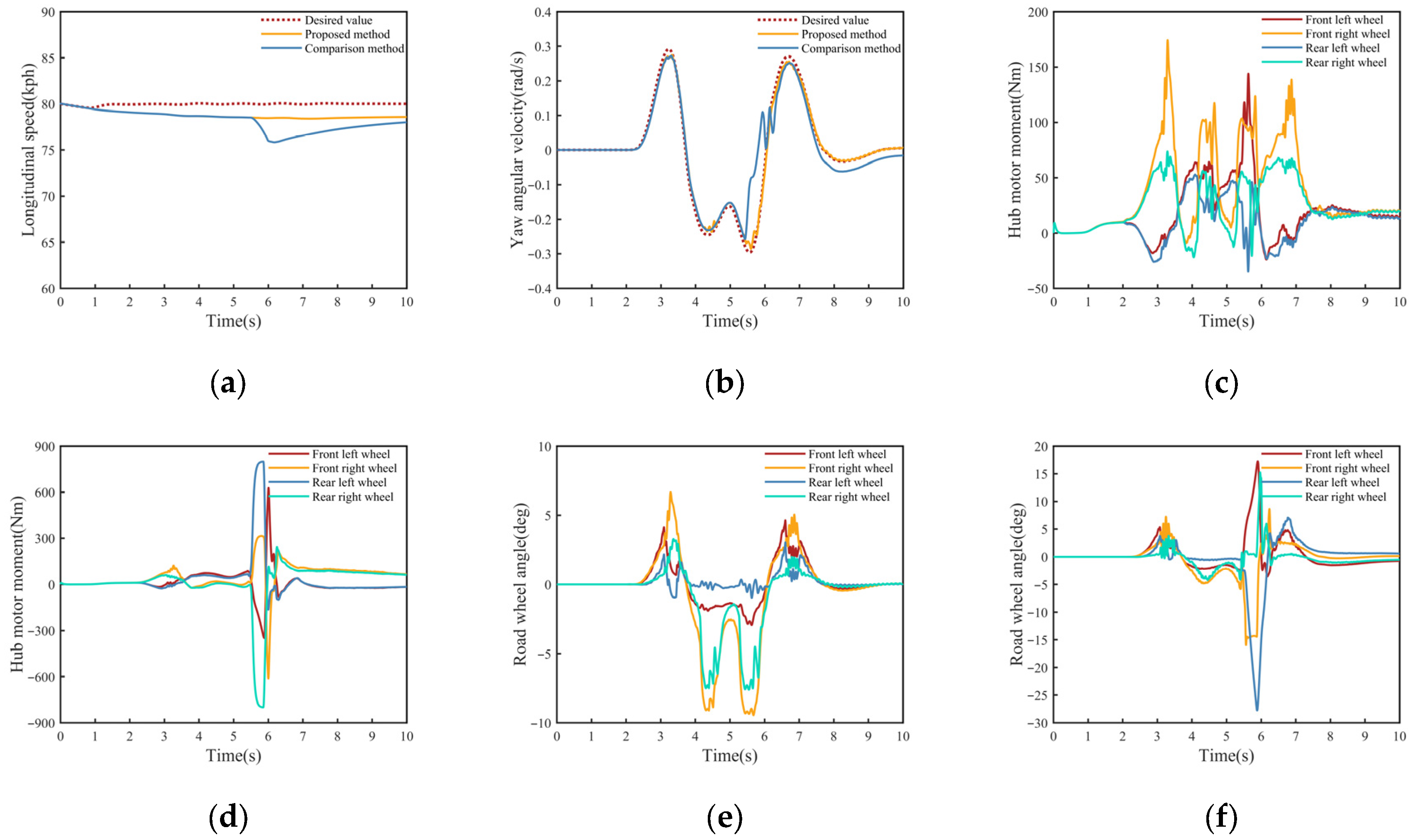
4.2. Unilateral Steer Wheel FTC Under High-Friction Road Conditions
4.3. Unilateral Steer Wheel FTC Under Split-Friction Road Conditions
5. Conclusions
Author Contributions
Funding
Institutional Review Board Statement
Informed Consent Statement
Data Availability Statement
Conflicts of Interest
Abbreviations
| DCS | Distributed Chassis System |
| MPC | Model Predictive Controller |
| SQP | Sequential Quadratic Programming |
| FTC | Fault-tolerant Control |
| IAWM | Integrated Autonomous Wheel Module |
| ISS | Independent Steering System |
| LCM | Lane Change Maneuver |
References
- Zhang, Q.; Wang, J.; Zhang, Y.; Zhang, R.; Jin, L.; Yin, G. Key Technologies and Research Progress of Brake-by-Wire System for Intelligent Electric Vehicles. J. Mech. Eng. 2024, 60, 339–365. [Google Scholar] [CrossRef]
- Tian, M.; Zhang, Q.; Tian, D.; Jin, L.; Li, J.; Xiao, F. Pre-Stability Control for In-Wheel-Motor-Driven Electric Vehicles with Dynamic State Prediction. IEEE Trans. Intell. Veh. 2024, 9, 4541–4554. [Google Scholar] [CrossRef]
- Liang, J.; Feng, J.; Fang, Z.; Lu, Y.; Yin, G.; Mao, X.; Wu, J.; Wang, F. An Energy-Oriented Torque-Vector Control Framework for Distributed Drive Electric Vehicles. IEEE Trans. Transport. Electrific. 2023, 9, 4014–4031. [Google Scholar] [CrossRef]
- Liang, J.; Wang, F.; Feng, J.; Zhao, M.; Fang, R.; Pi, D.; Yin, G. A Hierarchical Control of Independently Driven Electric Vehicles Considering Handling Stability and Energy Conservation. IEEE Trans. Intell. Veh. 2024, 9, 738–751. [Google Scholar] [CrossRef]
- Zhang, Z.; Zhao, W.; Wang, C.; Li, L. Stability Control of In-Wheel Motor Electric Vehicles under Extreme Conditions. Trans. Inst. Meas. Control 2019, 41, 2838–2850. [Google Scholar] [CrossRef]
- Crosato, L.; Tian, K.; Shum, H.P.H.; Ho, E.S.L.; Wang, Y.; Wei, C. Social Interaction-aware Dynamical Models and Decision-making for Autonomous Vehicles. Adv. Intell. Syst. 2024, 6, 2300575. [Google Scholar] [CrossRef]
- Hu, W.; Deng, Z.; Yang, Y.; Zhang, P.; Cao, K.; Chu, D.; Zhang, B.; Cao, D. Socially Game-Theoretic Lane-Change for Autonomous Heavy Vehicle Based on Asymmetric Driving Aggressiveness. IEEE Trans. Veh. Technol. 2025, 74, 17005–17018. [Google Scholar] [CrossRef]
- Taghavifar, H.; Wei, C.; Taghavifar, L. Socially Intelligent Reinforcement Learning for Optimal Automated Vehicle Control in Traffic Scenarios. IEEE Trans. Autom. Sci. Eng. 2025, 22, 129–140. [Google Scholar] [CrossRef]
- Wang, Y.; Xu, L.; Zhang, F.; Dong, H.; Liu, Y.; Yin, G. An Adaptive Fault-Tolerant EKF for Vehicle State Estimation with Partial Missing Measurements. IEEE/ASME Trans. Mechatron. 2021, 26, 1318–1327. [Google Scholar] [CrossRef]
- Lu, Y.; Liang, J.; Yin, G.; Feng, J.; Wang, F.; Xu, L. Torque Vector Compensation Strategy with Adaptive Model Predictive Control Considering Steering Actuator Fault. In Proceedings of the 2022 6th CAA International Conference on Vehicular Control and Intelligence (CVCI), Nanjing, China, 28–30 October 2022; pp. 1–6. [Google Scholar]
- Nor Shah, M.B.; Husain, A.R.; Aysan, H.; Punnekkat, S.; Dobrin, R.; Bender, F.A. Error Handling Algorithm and Probabilistic Analysis under Fault for CAN-Based Steer-by-Wire System. IEEE Trans. Ind. Informat. 2016, 12, 1017–1034. [Google Scholar] [CrossRef]
- Yan, Y.; Du, C.; Wang, Y.; Pi, D. Intelligent Vehicle Driving Decisions and Longitudinal–Lateral Trajectory Planning Considering Road Surface State Mutation. Actuators 2025, 14, 431. [Google Scholar] [CrossRef]
- Wiseman, Y. Camera That Takes Pictures of Aircraft and Ground Vehicle Tires Can Save Lives. J. Electron. Imaging 2013, 22, 41104. [Google Scholar] [CrossRef]
- Zhang, Y.; Ni, J.; Tian, H.; Wu, W.; Hu, J. Integrated Robust Dynamics Control of All-Wheel-Independently-Actuated Unmanned Ground Vehicle in Diagonal Steering. Mech. Syst. Signal Process. 2022, 164, 108263. [Google Scholar] [CrossRef]
- Jin, L.; Qiu, N.; Tian, D.; Zhang, Q.; Teng, F.; Jin, B.; Xiao, F. MPC-Based Path Tracking Strategy for 4WID&4WIS Vehicles Using B-Spline Approximation and State-Dependent Reference. Control Eng. Pract. 2025, 165, 106546. [Google Scholar] [CrossRef]
- Fekih, A.; Devariste, D. A Fault-Tolerant Steering Control Design for Automatic Path Tracking in Autonomous Vehicles. In Proceedings of the 2013 American Control Conference, Washington, DC, USA, 17–19 June 2013; pp. 5146–5151. [Google Scholar]
- Huang, C.; Naghdy, F.; Du, H. Delta Operator-Based Model Predictive Control with Fault Compensation for Steer-by-Wire Systems. IEEE Trans. Syst. Man Cybern. Syst. 2020, 50, 2257–2272. [Google Scholar] [CrossRef]
- Guo, J.; Luo, Y.; Li, K. Robust H∞ Fault-Tolerant Lateral Control of Four-Wheel-Steering Autonomous Vehicles. Int. J. Automot. Technol. 2020, 21, 993–1000. [Google Scholar] [CrossRef]
- Cao, X.; Tian, Y.; Ji, X.; Qiu, B. Fault-Tolerant Controller Design for Path Following of the Autonomous Vehicle under the Faults in Braking Actuators. IEEE Trans. Transport. Electrific. 2021, 7, 2530–2540. [Google Scholar] [CrossRef]
- Polyakov, A. Nonlinear Feedback Design for Fixed-Time Stabilization of Linear Control Systems. IEEE Trans. Autom. Control 2012, 57, 2106–2110. [Google Scholar] [CrossRef]
- Ning, B.; Han, Q.-L. Prescribed Finite-Time Consensus Tracking for Multiagent Systems with Nonholonomic Chained-Form Dynamics. IEEE Trans. Autom. Control 2019, 64, 1686–1693. [Google Scholar] [CrossRef]
- Tong, Y.; Li, C.; Wang, G.; Jing, H. Integrated Path-Following and Fault-Tolerant Control for Four-Wheel Independent-Driving Electric Vehicles. Automot. Innov. 2022, 5, 311–323. [Google Scholar] [CrossRef]
- Zhao, J.; Wang, X.; Liang, Z.; Li, W.; Wang, X.; Wong, P.K. Adaptive Event-Based Robust Passive Fault Tolerant Control for Nonlinear Lateral Stability of Autonomous Electric Vehicles with Asynchronous Constraints. ISA Trans. 2022, 127, 310–323. [Google Scholar] [CrossRef] [PubMed]
- Li, B.; Du, H.; Li, W. Fault-tolerant control of electric vehicles with in-wheel motors using actuator-grouping sliding mode controllers. Mech. Syst. Signal Process. 2016, 72–73, 462–485. [Google Scholar] [CrossRef]
- Hu, C.; Qin, Y.; Cao, H.; Song, X.; Jiang, K.; Rath, J.J.; Wei, C. Lane keeping of autonomous vehicles based on differential steering with adaptive multivariable super-twisting control. Mech. Syst. Signal Process. 2019, 125, 330–346. [Google Scholar] [CrossRef]
- Khelladi, F.; Boudali, M.; Orjuela, R.; Cassaro, M.; Basset, M.; Roos, C. An Emergency Hierarchical Guidance Control Strategy for Autonomous Vehicles. IEEE Trans. Intell. Transp. Syst. 2022, 23, 4319–4330. [Google Scholar] [CrossRef]
- Chen, T.; Cai, Y.; Chen, L.; Xu, X.; Sun, X. Trajectory tracking control of steer-by-wire autonomous ground vehicle considering the complete failure of vehicle steering motor. Simul. Modell. Pract. Theory 2021, 109, 102235. [Google Scholar] [CrossRef]
- Wu, X.; Wei, C.; Tian, H.; Wang, W.; Jiang, C. Fault-Tolerant Control for Path-Following of Independently Actuated Autonomous Vehicles Using Tube-Based Model Predictive Control. IEEE Trans. Intell. Transp. Syst. 2022, 23, 20282–20297. [Google Scholar] [CrossRef]
- Zhao, H.; Xie, H.; Gao, B.; Lu, X.; Chen, H. A Centralized Fault Prevention Method for Vehicle Longitudinal-Lateral-Vertical Control Considering Motor Thermal Protection. IEEE Trans. Ind. Inform. 2025, 21, 6979–6989. [Google Scholar] [CrossRef]
- Zong, C.; Liu, C.; Zheng, H.; Liu, J. Fault Tolerant Control against Actuator Failures of 4WID/4WIS Electric Vehicles; SAE International: Warrendale, PA, USA, 2013. [Google Scholar]
- Oh, S.C.; Song, T.J.; Kim, M.J.; Oh, K.S. Adaptive Model Predictive Fault-Tolerant Control for Four-Wheel Independent Steering Vehicles with Sensitivity Estimation. Int. J. Automot. Technol. 2023, 24, 829–850. [Google Scholar] [CrossRef]
- Li, H.; Zhang, N.; Wu, G.; Li, Z.; Ding, H.; Jiang, C. Active Fault-Tolerant Control of a Four-Wheel Independent Steering System Based on the Multi-Agent Approach. Electronics 2024, 13, 748. [Google Scholar] [CrossRef]
- Ao, D.; Li, J.; Zhang, L.; Hong, J. Advanced Post-impact Safety and Stability Control for Electric Vehicles. IET Intell. Transp. Syst. 2022, 16, 1753–1767. [Google Scholar] [CrossRef]
- Wang, J.; Wang, Q.; Jin, L. Modeling and Simulation Studies on Differential Drive Assisted Steering for EV with Four-Wheel-Independent-Drive. In Proceedings of the 2008 IEEE Vehicle Power and Propulsion Conference, Harbin, China, 3–5 September 2008; pp. 1–7. [Google Scholar]
- Wada, N.; Fujii, K.; Saeki, M. Reconfigurable Fault-Tolerant Controller Synthesis for a Steer-by-Wire Vehicle Using Independently Driven Wheels. Veh. Syst. Dyn. 2013, 51, 1438–1465. [Google Scholar] [CrossRef]
- Huang, C.; Naghdy, F.; Du, H.; Huang, H. Fault Tolerant Steer-by-Wire Systems: An Overview. Annu. Rev. Control 2019, 47, 98–111. [Google Scholar] [CrossRef]
- Ma, B.; Yang, Y.; Liu, Y.; Ji, X.; Zheng, H. Analysis of Vehicle Static Steering Torque Based on Tire–Road Contact Patch Sliding Model and Variable Transmission Ratio. Adv. Mech. Eng. 2016, 8, 1687814016668765. [Google Scholar] [CrossRef]
- Pacejka, H. Tire and Vehicle Dynamics, 3rd ed.; Elsevier: London, UK, 2012. [Google Scholar]
- Wang, L. Model Predictive Control System Design and Implementation Using MATLAB; Advances in Industrial Control; Springer: London, UK, 2009. [Google Scholar]
- Ono, E.; Hattori, Y.; Muragishi, Y.; Koibuchi, K. Vehicle Dynamics Integrated Control for Four-Wheel-Distributed Steering and Four-Wheel-Distributed Traction/Braking Systems. Veh. Syst. Dyn. 2006, 44, 139–151. [Google Scholar] [CrossRef]
- Quirynen, R.; Cairano, S.D. Sequential Quadratic Programming Algorithm for Real-Time Mixed-Integer Nonlinear MPC. In Proceedings of the 2021 60th IEEE Conference on Decision and Control (CDC), Online, 14 December 2021; IEEE: Austin, TX, USA, 2021; pp. 993–999. [Google Scholar]
- Dugoff, H.; Fancher, P.S.; Segel, L. An Analysis of Tire Traction Properties and Their Influence on Vehicle Dynamic Performance; SAE Transactions: Warrendale, PA, USA, 1970; p. 700377. [Google Scholar]
- Lu, A.; Tian, G. Unified Fault-Tolerant Control and Adaptive Velocity Planning for 4WID-4WIS Vehicles under Multi-Fault Scenarios. Actuators 2024, 13, 407–424. [Google Scholar] [CrossRef]





| Parameters | Unit | Values |
|---|---|---|
| Vehicle mass | kg | 1323 |
| Acceleration of gravity | m/s2 | 9.8 |
| Moment of inertia of vehicle yaw | kg · m2 | 1771 |
| Wheel track | m | 1.48 |
| Wheelbase | m | 2.60 |
| Distance from center of mass to front axle | m | 1.06 |
| Height of the center of gravity | m | 0.51 |
| Rotational Inertia of the steer kingpin | kg · m2 | 0.82 |
| The diameter of the front and rear wheels | m | 0.596 |
| Q | - | diag([1 × 10⁴, 4 × 10⁴, 6 × 10⁴]) 1 |
| R | - | diag([5 × 10⁻⁵, 1 × 10⁻⁵, 1 × 10⁻⁵]) 1 |
| Method Type | Corresponding Description |
|---|---|
| Comparison method | Standard tire optimization allocation that does not consider fault information |
| Proposed method | Tire forces allocation that uses fault information to update the vehicle force/torque limits and the tire force limits |
Disclaimer/Publisher’s Note: The statements, opinions and data contained in all publications are solely those of the individual author(s) and contributor(s) and not of MDPI and/or the editor(s). MDPI and/or the editor(s) disclaim responsibility for any injury to people or property resulting from any ideas, methods, instructions or products referred to in the content. |
© 2025 by the authors. Licensee MDPI, Basel, Switzerland. This article is an open access article distributed under the terms and conditions of the Creative Commons Attribution (CC BY) license (https://creativecommons.org/licenses/by/4.0/).
Share and Cite
Jin, L.; Jin, B.; Huang, Y.; Zhang, Q.; Yi, H.; Li, R. Fault Tolerant Control of Integrated Autonomous Wheel Module Vehicle Subject to Independent Steering Actuator Degradation. Actuators 2025, 14, 603. https://doi.org/10.3390/act14120603
Jin L, Jin B, Huang Y, Zhang Q, Yi H, Li R. Fault Tolerant Control of Integrated Autonomous Wheel Module Vehicle Subject to Independent Steering Actuator Degradation. Actuators. 2025; 14(12):603. https://doi.org/10.3390/act14120603
Chicago/Turabian StyleJin, Liqiang, Bohao Jin, Yan Huang, Qixiang Zhang, Haixia Yi, and Ronghua Li. 2025. "Fault Tolerant Control of Integrated Autonomous Wheel Module Vehicle Subject to Independent Steering Actuator Degradation" Actuators 14, no. 12: 603. https://doi.org/10.3390/act14120603
APA StyleJin, L., Jin, B., Huang, Y., Zhang, Q., Yi, H., & Li, R. (2025). Fault Tolerant Control of Integrated Autonomous Wheel Module Vehicle Subject to Independent Steering Actuator Degradation. Actuators, 14(12), 603. https://doi.org/10.3390/act14120603