
Article

Design of Static Output Feedback Active Suspension Controllers with Quarter-Car Model for Motion Sickness Mitigation


Department of Mechanical and Automotive Engineering, Seoul National University of Science and Technology, Nowon-gu, Seoul 01811, Republic of Korea
Actuators 2025, 14(11), 539; https://doi.org/10.3390/act14110539
Submission received: 17 September 2025 / Revised: 27 October 2025 / Accepted: 5 November 2025 / Published: 6 November 2025
(This article belongs to the Section Actuators for Surface Vehicles)

Abstract

This paper presents a method to design a static output feedback active suspension controller with a quarter-car model for motion sickness mitigation. To mitigate motion sickness in a vehicle, it has been known that the vertical acceleration and pitch rate of a sprung mass should be reduced over the frequency range from 0.8 to 8 Hz. For this purpose, a half-car model has been used with linear quadratic optimal control for controller design because it can describe the pitch motion of a sprung mass. However, a controller design procedure with the half-car model is relatively more complex than the quarter-car one. To cope with this problem, a quarter-car model is used for controller design in this paper. The half-car model consists of two quarter-car models. Based on this fact, a controller designed with a quarter-car model can be applied to the front and rear suspensions in the half-car one. To avoid the full-state feedback in a real vehicle, a static output feedback structure is selected. To find the gains of the controllers for the quarter-car models in the front and rear suspensions, linear quadratic optimal control and a simulation-based optimization method are applied. To validate the proposed method, the controllers designed with the quarter-car and half-car models are simulated on a vehicle simulation package. From the simulation results, it is shown that the static output feedback active suspension controller designed with the quarter-car model is quite effective for motion sickness mitigation.

1. Introduction

In the field of suspension control, multiple performance indices such as ride comfort and road holding must be simultaneously addressed, while also satisfying practical constraints including suspension travel limits, actuator saturation, and energy consumption [1,2,3]. Among these, ride comfort has generally been recognized as the most critical factor influencing passenger experience [3,4,5]. As reported in the literature, ride comfort is typically evaluated by the vertical acceleration (az) of a sprung mass (SPM) [1]. Motivated by this, a significant body of research has focused on the development of suspension control strategies aimed at attenuating az of an SPM [3,4,5].
A recently emerging objective in suspension control is the mitigation of motion sickness (MS), which has become particularly relevant in the context of electrification and autonomous driving. Two primary factors have been identified as critical sources of MS. First, in electric vehicles, the high traction torque can induce abrupt changes in longitudinal acceleration and the consequent pitch motion of an SPM [6,7,8]. Second, autonomous driving shifts passengers from active driving tasks to passive, non-driving roles, thereby increasing the likelihood of visual–vestibular conflict, a well-established cause of motion sickness [9,10,11,12,13,14,15,16,17]. Recent studies indicate that mitigating MS requires attenuation of the combined stimuli of az and ωy of an SPM within the frequency range of 0.8–8 Hz [18,19].
Several studies have proposed fuzzy-PID control-, model predictive control (MPC)-, and linear quadratic optimal control (LQOC)-based strategies for mitigating motion sickness through suspension controllers [20,21,22,23,24,25]. Among these approaches, static output feedback (SOF) has been employed instead of full-state feedback, with active suspension systems serving as the actuation mechanism [21,22,23,24]. The LQOC framework is typically formulated using a half-car state-space representation in conjunction with a linear quadratic objective function (LQOF). While such methods have demonstrated promising performance in terms of enhancing ride comfort and alleviating motion sickness, the controller design process for a half-car model is relatively complex. This complexity arises from the fact that the half-car model has eight state variables and two control inputs, in contrast to the quarter-car model, which involves only four state variables and a single control input. As a result, the quarter-car formulation offers a more tractable controller design framework, albeit with reduced system representation fidelity.
Since the half-car model can be regarded as a combination of two quarter-car subsystems, controllers designed on the basis of the quarter-car model can be extended to half-car configurations [26,27]. Building on this fact, the present study introduces a methodology in which an active suspension controller is first developed using a quarter-car model and subsequently applied to a half-car system. For the quarter-car design stage, a linear quadratic optimal control (LQOC) framework is adopted, as it provides a systematic means of optimizing ride comfort and motion sickness indices.
However, when nonlinear suspension components such as springs and dampers are explicitly considered, the derivation of a linear state-space model becomes infeasible, making direct application of LQOC impractical. To address this limitation, a simulation-based optimization method (SBOM) is employed, which is implemented on a high-fidelity vehicle dynamics simulation platform [21,22]. This dual approach allows the proposed framework to exploit the tractability of the quarter-car model for controller synthesis while accommodating nonlinearities through SBOM, thereby ensuring both methodological rigor and practical applicability.
In this study, two distinct sets of sensor outputs for SOF control are proposed. Using the state-space representation and LQOF derived from the quarter-car model, two SOF controllers corresponding to the proposed sensor configurations are initially designed. These sensor outputs, defined within the quarter-car formulation, are subsequently mapped onto the state variables of the half-car model [26,27]. From this half-car representation, both the state-space model and the associated LQOF are constructed, enabling the design of two additional SOF controllers through LQOC and SBOM.
To validate the effectiveness of the proposed controllers, numerical simulations are performed using a vehicle dynamics software environment. The results demonstrate that controllers synthesized from the quarter-car model retain their effectiveness when extended to the half-car system, achieving significant improvements in ride comfort while concurrently mitigating motion sickness. These findings highlight the practical utility of adopting quarter-car-based controller design as a foundation for scalable suspension control strategies in more complex vehicle models.
The main contributions of this study can be summarized as follows:
  • Novel sensor output configurations for SOF control: Two distinct sets of sensor outputs are proposed for the quarter-car model, from which two static output feedback (SOF) controllers are designed. These sensor outputs are subsequently mapped to state variables in the half-car model, enabling the extension of quarter-car-based control strategies to more complex vehicle configurations. Using the state-space formulation and LQOF derived from the half-car model, two SOF controllers are further developed through LQOC and SBOM.
  • Validation through simulation: The performance of the proposed controllers is evaluated using CarSim 8. The simulation results confirm that the SOF controllers designed within the quarter-car framework can be directly applied to the half-car system. Furthermore, the responses demonstrate that these controllers effectively enhance ride comfort while mitigating motion sickness, thereby validating the practical utility of the proposed control architecture.
Through these contributions, the present work establishes a scalable and computationally efficient framework for suspension control, bridging the simplicity of quarter-car-based controller design with the fidelity and applicability required for real vehicles.
The structure of this paper is organized to clearly present the development and validation of the proposed suspension control framework. In Section 2, SOF controllers are designed with the state-space models for the quarter-car and half-car models. Two sets of sensor outputs are defined for those models. It is also presented how to apply the controller designed with the quarter-car model to the half-car one. To optimize the SOF controllers for a vehicle with nonlinear elements, SBOM is presented in Section 3. In Section 4, simulation with the SOF controllers is performed, and the simulation responses are analyzed and discussed. The conclusions are presented in Section 5.

2. Design of SOF Controllers with Linear Quadratic Optimal Control

In this section, the state-space formulations of a 2-DOF quarter-car model and a 4-DOF half-car model are systematically derived following the established methodologies reported in previous studies [21,23,26,27,28,29]. These formulations provide the analytical foundation for the subsequent development of SOF controllers. To distinguish between controller designs, the subscripts q and h are hereafter used to denote the controllers constructed using the quarter-car and half-car models, respectively.

2.1. Design of LQR with Quarter-Car Model

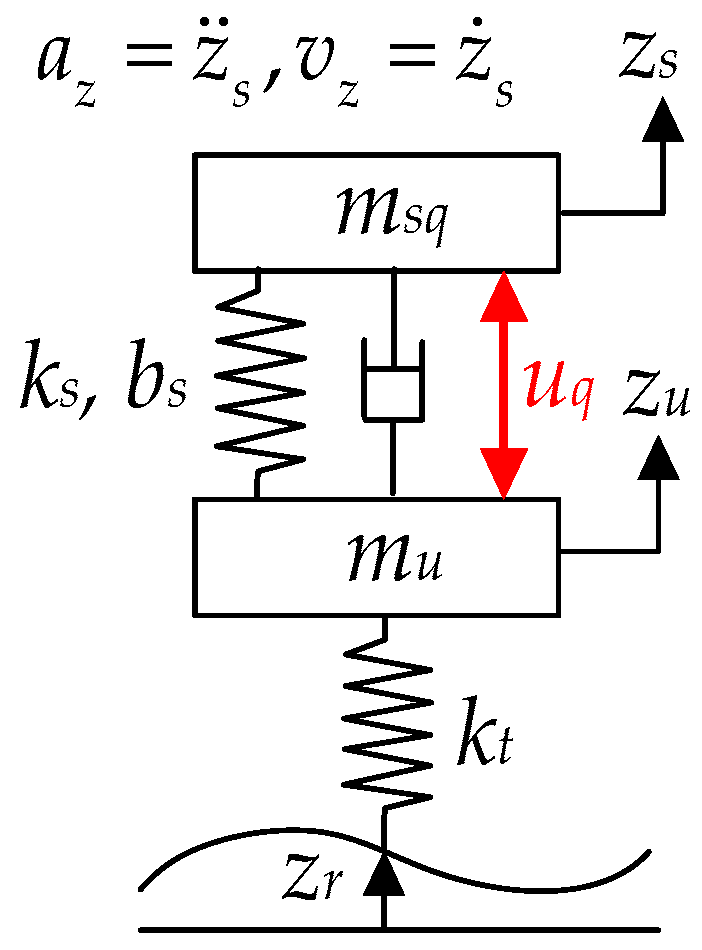
Figure 1 illustrates the 2-DOF quarter-car model, which captures the vertical dynamics of the sprung and unsprung masses. In this configuration, the control input uq, generated by the active suspension actuator, is applied between the SPM, msq, and the unsprung mass (USPM), mu. The external disturbance is represented by the road profile, zr.
The force acting on the suspension system is first expressed as (1), which characterizes the interaction between msq and mu through the suspension elements. Subsequently, the governing equations of vertical motion for both the SPM and USPM are formulated, as given in (2). By combining (1) and (2) and reformulating them into a compact vector–matrix representation, the state-space model in (3) is obtained.
f q = k s ( z s z u ) b s ( z ˙ s z ˙ u ) + u q
m s q z ¨ s = f q m u z ¨ u = f q k t z u z r
m s q 0 0 m u z ¨ s z ¨ u = k s k s k s k s k t z s z u + b s b s b s b s z ˙ s z ˙ u + 1 1 u q + 0 k t z r
To facilitate a more compact and tractable representation of the system dynamics, new vectors and matrices are introduced as shown in (4) and (5) [23,24,25,26]. By incorporating these definitions, the dynamic formulation in (3) can be reformulated into the matrix form expressed in (6). Subsequently, the state vector of the quarter-car model is explicitly defined in (7), which provides the basis for a systematic state-space representation of the system. With additional matrices defined in (8), the complete state-space equation for the quarter-car model is derived and presented in (9).
z q = z s z u T
M q m s q 0 0 m u , K q k s k s k s k s k t , B q b s b s b s b s , U q 1 1 , L q 0 k t
M q z ¨ q = K q z q + B q z ˙ q + U q u q + L q z r
x q z q z ˙ q = z s z u z ˙ s z ˙ u T
A q 0 2 × 2 I 2 × 2 M q 1 K q M q 1 B q , B 1 q 0 2 × 1 M q 1 L q , B 2 q 0 2 × 1 M q 1 U q
x ˙ q = A q x q + B 1 q z r + B 2 q u q
The linear quadratic objective function (LQOF) for suspension control is formulated as shown in (10). The weighting parameters are selected according to Bryson’s rule, i.e., ρi = 1/ξi2, in which each weight, ρi, is set as the inverse of the square of the corresponding maximum allowable value (MAV) [30]. This provides a systematic means of normalizing performance indices with respect to their physical limits. To emphasize ride comfort, the weight ρ1 associated with az is assigned relatively high values, while the remaining weights are held constant. Conversely, when prioritizing road holding and cornering stability, the weight ρ3 corresponding to tire deflection is increased. It is well-established that ride comfort and road holding represent inherently conflicting objectives.
J q = 0 ρ 1 z ¨ s 2 + ρ 2 z s z u 2 + ρ 3 z u 2 + ρ 4 u q 2 d t
The vector of regulated outputs, zq, is defined in (11) as a function of the state vector xq and the control input uq. Based on this definition, the corresponding weighting matrices in Jq are obtained as shown in (12). Substituting these matrices into the original LQOF (10) allows it to be reformulated in the compact vector–matrix form given in (13). Within this framework, the linear quadratic regulator (LQR) is introduced as a full-state feedback controller that minimizes Jq, as expressed in (14). The optimal feedback gain Kq can be systematically derived from the algebraic Riccati equation for a given set of weighting matrices, Qq, Nq, and Rq, defined in (12).
z q C q x q + D q u q = ρ 1 A q , 3 ρ 2 ρ 2 0 0 0 0 ρ 3 0 0 0 0 0 x q + 0 0 0 ρ 4 u q
Q q C q T C q , N q C q T D q , R q D q T D q
J q = 0 z q T z q d t = 0 x q u q T Q q N q N q T R q x q u q d t
u q = K q x q

2.2. Design of Static Output Feedback Controller with Quarter-Car Model

While LQR provides an optimal full-state feedback solution for active suspension control, its practical implementation is hindered by the difficulty of measuring all state variables in real vehicles. For instance, in the quarter-car model, key states such as the vertical displacement of the SPM and the suspension stroke are not readily measurable with conventional sensors. To overcome this limitation, this study adopts an SOF structure in place of full-state feedback [21,22,23,24].
With the definition of the state vector in (7), two sets of sensor outputs for the quarter-car model, denoted as yq1 and yq2, are introduced in (15) [26,27]. Specifically, yq1 consists of the suspension stroke and its rate, whereas yq2 consists of the vertical velocity of the SPM and the suspension stroke rate. For clarity, these two sensor output configurations, yq1 and yq2, are hereafter referred to as output set 1 (OS1) and output set 2 (OS2), respectively. Based on these sensor outputs, the SOF controllers for the quarter-car model are defined as in (16). In this formulation, the feedback gain vectors, Kq1 and Kq2, contain two elements, reflecting the reduced sensing requirements relative to the full-state feedback gain Kq, which has four elements. By substituting the definitions of yq1 and yq2 from (15) into (16), the corresponding control inputs, uq1 and uq2, are obtained, as expressed in (17). Let us denote the controllers, Kq1 and Kq2 minimizing Jq as LQSOFQ1 and LQSOFQ2, respectively. Those represent two distinct realizations of a quarter-car SOF control that rely solely on practically measurable sensor signals.
y q 1 z s z u z ˙ s z ˙ u =   1     1     0     0   0 0 1 1 x q = C q 1 x q y q 1 z ˙ s z ˙ s z ˙ u =   0     0     1     0   0 0 1 1 x q = C q 2 x q
u s q 1 = K q 1 y q 1 u s q 2 = K q 2 y q 2
u s q 1 = K q 1 y q 1 = K q 1 C q 1 x q u s q 2 = K q 2 y q 2 = K q 2 C q 2 x q
The objective of LQ SOF control is to determine the gain vectors, Kq1 and Kq2, that minimize the LQOF defined in (10). This task can be formulated as an optimization problem, as expressed in (18). To compute the optimal gains, the heuristic optimization routine fminsearch() in MATLAB 2024a is employed.
min K q i J f s = 1 2 trace P s , P s = P s T > 0 s . t . max Re A q + B 2 q K q i C q < 0 A q + B 2 q K q i C q T P s + P s A q + B 2 q K q i C q + Q q + C q T K q i T N q T + N q K q i C q + C q T K q i T R q K q i C q = 0 , i = 1 , 2

2.3. Derivation of State-Space Equation for Half-Car Model

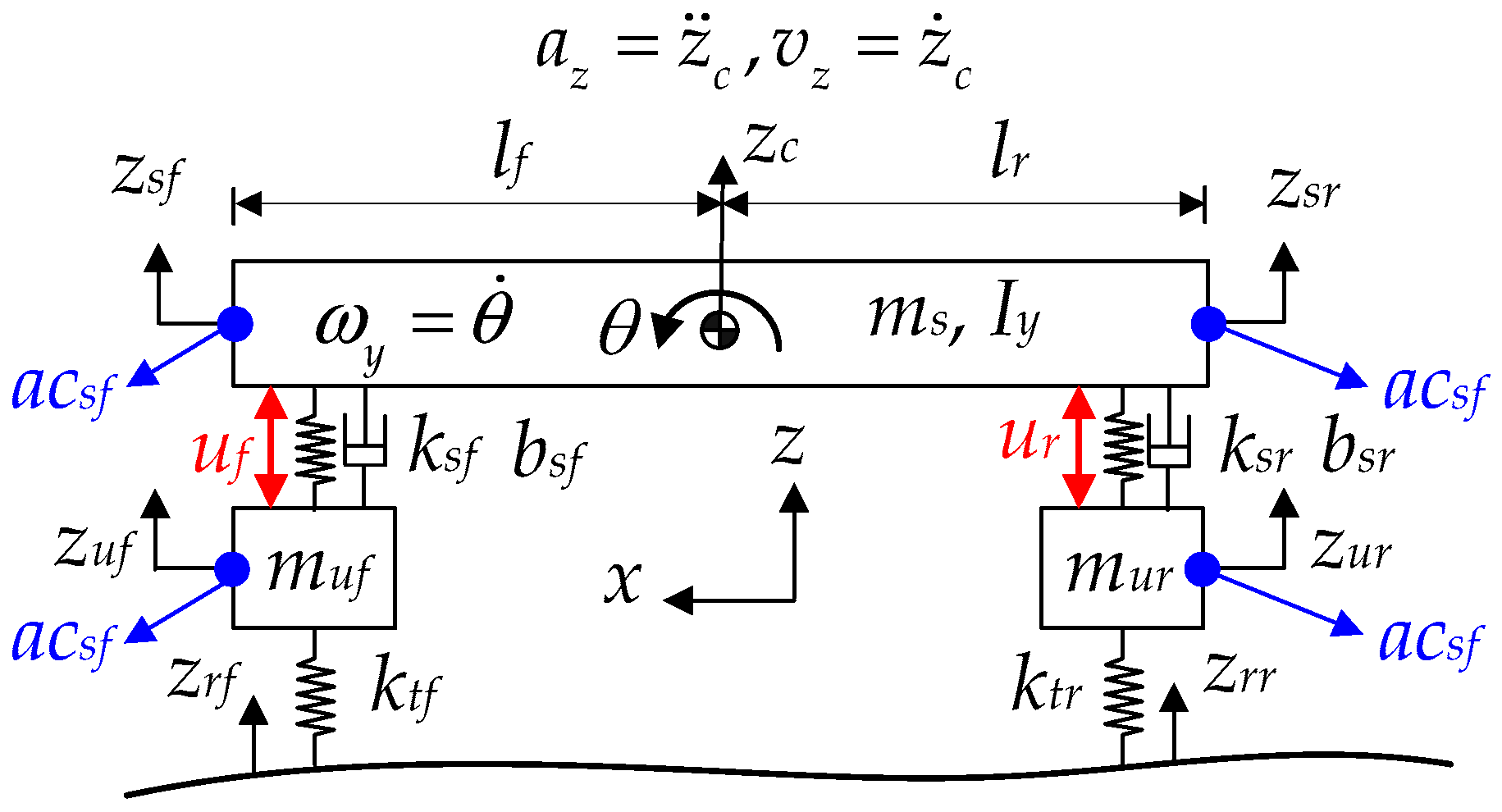
Figure 2 depicts the 4-DOF half-car model, which captures the coupled vertical and pitch motions of the vehicle body. The model consists of the front/rear suspension subsystems, where uf and ur represent the control inputs, i.e., the vertical control forces generated by the active actuators located in the front/rear suspensions. The variables zsf and zsr denote the vertical displacements of the front/rear corners of the SPM, respectively. As shown in Figure 2, the accelerometers acsf, acsr, acuf, and acur are mounted at the front/rear corners of the SPM and at the front/rear wheel centers, respectively, to provide measurable signals for controller implementation. This sensor configuration is particularly important, as it enables the translation of theoretical controller design into a practical feedback structure relying on physically accessible measurements.
In Figure 2, the suspension forces acting on the front/rear assemblies are expressed in (19). By combining these force definitions with the geometric relationships shown in Figure 2, the equations of motion for the SPM, ms, and the USPMs, muf and mur, are derived as (20). To simplify the kinematic relations, the small-angle approximation (sinθθ) is applied, allowing the vertical displacements of the front/rear corners of the SPM, zsf and zsr, to be represented as (21) in terms of the vehicle’s center displacement, zc, and pitch angle, θ, of the SPM. For a compact representation, new vectors and a matrix are introduced in (22). Specifically, the state vector xh, disturbance vector wh, and control input vector uh are defined, comprising eight state variables, two external disturbances, and two control inputs, respectively. With these definitions, the dynamic equations in (20) are transformed into the state-space representation shown in (23). The detailed derivation procedure parallels that of the quarter-car formulation in (9), and the mathematical steps can be found in previously published works [21,23].
f f = k s f z s f z u f b s f z ˙ s f z ˙ u f + u f f r = k s r z s r z u r b s r z ˙ s r z ˙ u r + u r
m s z ¨ c = f f + f r I y θ ¨ = a f f + b f f m u f z ¨ u f = f f k t f ( z u f z r f ) m u r z ¨ u r = f r k t r ( z u r z r r )
z s f = z c l f sin θ z c l f θ z s r = z c + l r sin θ z c + l r θ
p z c θ , z s z s f z s r , z u z u f z u r , z h p z u , x h z h z ˙ h , w h = z r z r f z r u , u h u f u r
x ˙ h = A h x h + B h 1 w h + B h 2 u h
The LQOF for the half-car model is formulated in (24), where the weighting factors ζ are assigned according to Bryson’s rule, i.e., ζi = 1/χi2 [30]. With the definitions of vectors introduced in (22), the regulated output vector is defined in (25). Substituting these into (24) yields the half-car LQOF expressed in (26). The corresponding LQR is then obtained in (27) from the state-space model in (23) and the LQOF in (26).
A key distinction from the quarter-car formulation in (10) is that the half-car model explicitly accounts for the pitch motion of the SPM, which is incorporated into (24). This capability is particularly critical for suspension control strategies aimed at mitigating motion sickness, since pitch–heave interactions are known to strongly influence passenger discomfort. For this reason, the half-car model provides a more appropriate foundation for controller synthesis when the design objective extends beyond conventional ride comfort and road holding to include motion sickness mitigation [21,22,23,24].
J h = 0 ζ 1 z ¨ c 2 + ζ 2 θ ¨ 2 + ζ 3 θ ˙ 2 + ζ 4 θ 2 + ζ 5 i = f , r z s i z u i 2 + ζ 6 i = f , r z u i 2 + ζ 7 i = f , r u i 2 d t
z h C h x h + D h u h
J h = 0 z h T z h d t = 0 x h u h T C h T C h C h T D h D h T C h D h T D h x h u h d t = 0 x h u h T Q h N h N h T R h x h u h d t
u h = K h x h
The half-car model consists of two quarter-car models. With the variables given in Figure 2, new vectors are defined as (28). In (28), xhf and xhr are equivalent to the state vector, xq, of the quarter-car model, as given in (7). Based on this fact, front/rear controllers in the half-car model can be separately designed by the method described in Section 2.2.
The half-car model can be regarded as a composition of two quarter-car subsystems. Using the variables defined in Figure 2, new vectors are introduced in (28). In this formulation, xhf and xhr correspond directly to the state vector xq of the quarter-car model, as previously defined in (7).
z h f z s f z u f , z h r z s r z u r , x h f z h f z ˙ h f , x h r z h r z ˙ h r
This structural equivalence indicates that the front/rear suspensions in the half-car configuration can be treated as two independent quarter-car models. Leveraging this property, the present study designs front/rear controllers for the half-car model by applying the methodology outlined in Section 2.2. This modular design approach provides two key advantages:
  • It simplifies controller synthesis by reusing quarter-car formulations, thereby reducing computational complexity.
  • It enables systematic extension of quarter-car-based strategies to the half-car domain while maintaining consistency across different model scales.
As such, this framework highlights a central contribution of the study—demonstrating how quarter-car control design principles can be effectively scaled and integrated to address the coupled dynamics of more realistic vehicle models.

2.4. How to Use LQSOF for Quarter-Car Model as a Controller for Half-Car One

The LQSOFQ1 and LQSOF2 can be directly applied to the half-car model because it consists of two quarter-car models. The sensor outputs of the quarter-car model given (15) in can be represented as (29) for the front/rear suspension in the half-car model. In (29), yh1 and yh2 correspond to yq1 and yq2 of (15). If LQSOFQ1 and LQSOFQ2 are applied to the half-car model, it can be represented as (30). In (30), k1 and k2 are the gains of Kq1 or Kq2 as given in (16). As shown in (30), LQSOFQ1 and LQSOF2 are applied to the front/rear suspension. If LQSOFQs in the front/rear suspensions have different gain elements from each other, this can be represented as the second equation in (30).
Since the half-car model can be regarded as a composition of two quarter-car subsystems, the controllers LQSOFQ1 and LQSOFQ2 can be directly extended to this configuration. The sensor outputs defined for the quarter-car model in (15) are reformulated for the front/rear suspensions of the half-car model, as expressed in (29). In this representation, yh1 and yh2 correspond to yq1 and yq2 of (15). When the quarter-car controllers LQSOFQ1 and LQSOFQ2 are applied to the half-car model, the resulting control laws are expressed in (30), where k1 and k2 denote the feedback gains associated with Kq1 or Kq2 defined in (16).
As illustrated in (30), the quarter-car SOF controllers are allocated to the front/rear suspensions of the half-car system. Furthermore, if the controllers for the front/rear suspensions adopt distinct gain elements, this generalized case can be expressed by the second formulation in (30).
y h 1 z s f z u f z ˙ s f z ˙ u f z s r z u r z ˙ s r z ˙ u r = 1 l f 1 0 0 0 0 0 0 0 0 0 1 l f 1 0 1 l r 0 1 0 0 0 0 0 0 0 0 1 l r 0 1 x h = C h 1 x h y h 2 z ˙ s f z ˙ s f z ˙ u f z ˙ s r z ˙ s r z ˙ u r = 0 0 0 0 1 l f 0 0 0 0 0 0 1 l f 1 0 0 0 0 0 1 l r 0 0 0 0 0 0 1 l r 0 1 x h = C h 2 x h
u s h i 1 = K h i 1 y h i = k 1 k 2 0 0 0 0 k 1 k 2 y h i = K h i 1 C h i x h = S h i 1 x h , i = 1 , 2 u s h i 2 = K h i 2 y h i = k 1 k 2 0 0 0 0 k 3 k 4 y h i = K h i 2 C h i x h = S h i 2 x h , i = 1 , 2
To determine the gain matrices Kh11, Kh12, Kh21, and Kh22 that minimize the LQOF Jh, the control synthesis problem is formulated as the optimization problem given in (31). This formulation enables the direct computation of feedback gains under the half-car configuration, where both the vertical and pitch motions are explicitly considered. To solve the optimization problem and obtain the optimal gain matrices, the built-in heuristic optimization routine fminsearch() in MATLAB is employed. In this setting, the feedback gains, Kh11, Kh12, Kh21 and Kh22 minimizing Jh, are referred to as LQSOFH11, LQSOFH12, LQSOFH21, and LQSOFH22, respectively.
min K h i j J q s = 1 2 trace P h , P h = P h T > 0 s . t . max Re A h + B h 2 S h i j < 0 A h + B h 2 S h i j T P h + P h A h + B h 2 S h i j + Q h + S h i j T N h T + N h S h i j + S h i T R h S h i j = 0 , i , j = 1 , 2
By casting the problem in this manner, the present study bridges the gap between theoretical formulations and practical computation. Unlike analytical LQR-based solutions that require full-state feedback, the proposed optimization-based procedure provides a flexible means of tuning static output feedback controllers using measurable signals, thereby enhancing both the implementability and the effectiveness of active suspension systems in mitigating ride discomfort and motion sickness.

2.5. Sensor Signal Processing for SOF Controllers

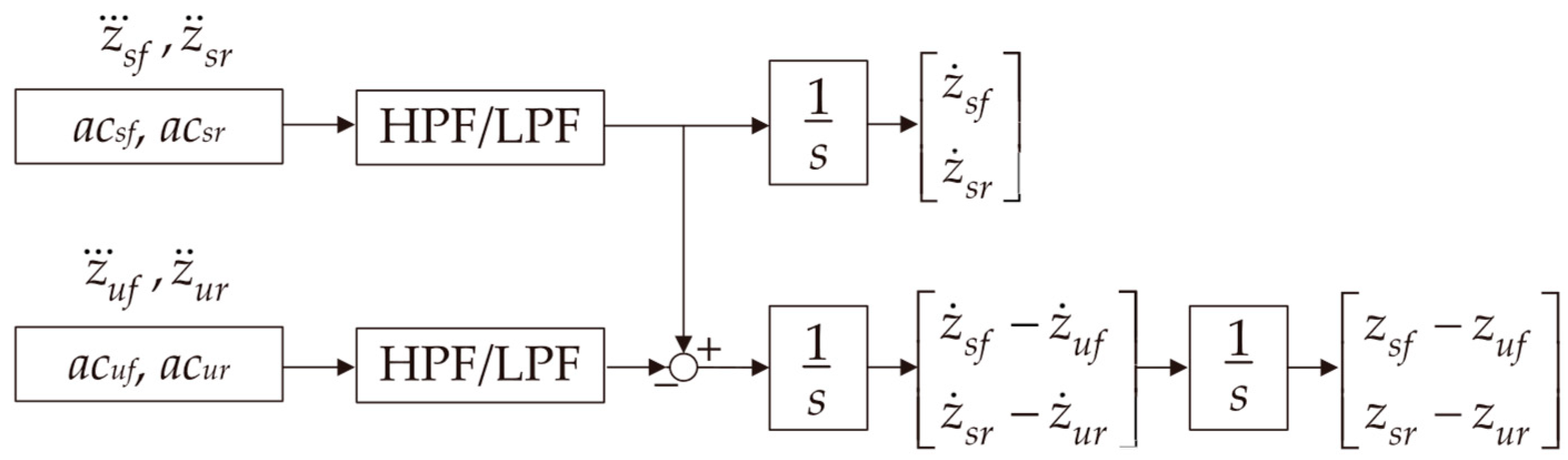
In this paper, the SOF controllers, uSH1 and uSH2, use the signals as given in (29). Those signals are calculated from the accelerometer signals measured at acsf, acsr, acuf, and acur, as shown in Figure 2 [21,22,23,24]. As shown in Figure 2, the accelerometers, acsf and acsr, are installed on the front/rear corners of the SPM, and acuf and acur are installed on the centers of the front/rear wheels. Figure 3 shows the calculation procedure for the sensor outputs given in (29). The accelerometer signals measured with acsf, acsr, acuf, and acur are filtered through high-pass and low-pass filters (HPF and LPF) in order to reduce DC offsets and sensor noises, respectively. Then, the filtered signals pass through the integrator, 1/s. As a result, the signals needed for LQSOFH11, LQSOFH12, LQSOFH21, and LQSOFH22 are obtained. The HPF and LPF can be found in the reference [22].
In this study, the SOF controllers, ush11, ush12, ush21, and ush22, are implemented using the sensor outputs of yh1 and yh2, defined in (29). These signals are derived from accelerometer measurements obtained at acsf, acsr, acuf, and acur, as illustrated in Figure 2 [21,22,23,24]. Specifically, acsf and acsr are mounted at the front/rear corners of the SPM, while acuf and acur are located at the centers of the front/rear wheels, respectively.
The procedure for generating the sensor outputs is summarized in Figure 3. The raw accelerometer signals are first processed through high-pass and low-pass filters (HPF and LPF) to suppress DC offsets and high-frequency noise, respectively. The filtered signals are then integrated to obtain the physical quantities required for controller operation. As a result, the measurable outputs necessary for the LQSOFH11, LQSOFH12, LQSOFH21, and LQSOFH22 are produced. Details of the HPF and LPF design can be found in [22].
This signal-processing pipeline ensures that the proposed SOF controllers rely only on practically measurable and noise-conditioned signals, thereby bridging the gap between theoretical control design and real-world vehicle implementation. By grounding the controller inputs in realistic sensor architectures, the study contributes to enhancing both the feasibility and the robustness of active suspension control for ride comfort and motion sickness mitigation.

3. Design of SOF Controllers with Simulation-Based Optimization Method

The linear controllers—LQRQ, LQSOFQ, LQRH, LQSOFH11, LQSOFH12, LQSOFH21, and LQSOFH22—can be systematically designed using the linear state-space equations derived from the quarter-car and half-car models with linear spring and damper. In practice, however, the spring and damper elements in a vehicle suspension system exhibit nonlinear characteristics that cannot be captured within a purely linear framework. When such nonlinearities are incorporated into the half-car model, the direct application of LQOC becomes infeasible, as the underlying state-space formulation is no longer valid. To address this limitation, the present study adopts a simulation-based optimization method (SBOM) for the design of SOF controllers in nonlinear suspension models [21,22].
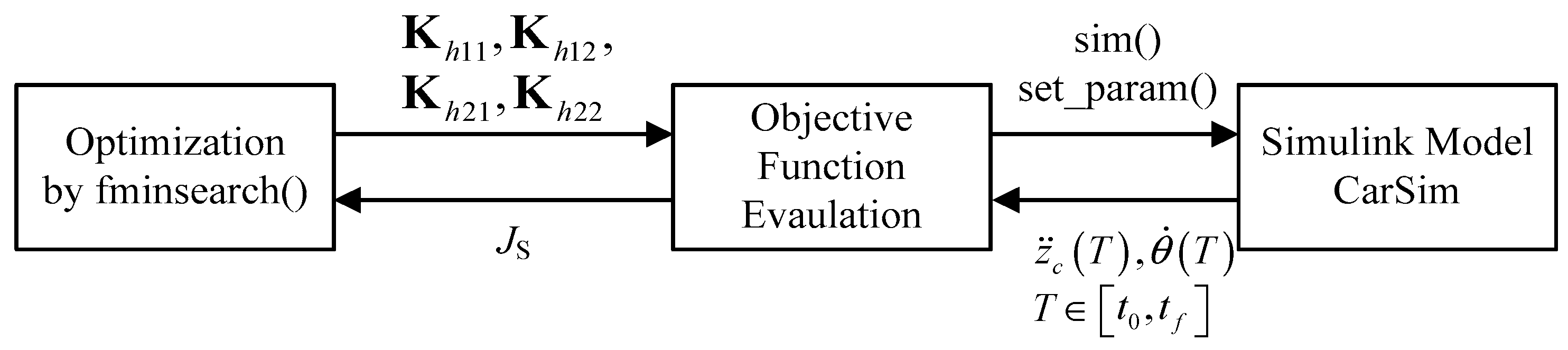
For the simulation-based optimization, Simulink models were developed and coupled with the high-fidelity vehicle dynamics package CarSim, based on the formulation in (30). Within this framework, the optimization task involves identifying the gain elements of Kh11 and Kh21 (two parameters) or Kh12 and Kh22 (four parameters) that minimize Jh. To ensure that the control design explicitly addresses ride comfort and motion sickness mitigation, the objective function of the SBOM, Js, is defined in (32), where it combines az and ωy over the simulation horizon. In this formulation, R2D represents the conversion constant from radians to degrees, while α is introduced as a tuning parameter to balance the relative contributions of az and ωy in the performance index. In this study, α is set to 0.3. This value is selected through the trial-and-error method. If α is larger than 0.3, az is not reduced. On the contrary, if α is less than 0.3, ωy is not reduced. This choice reflects the need to weigh pitch-related effects more prominently, as they are strongly correlated with motion sickness in autonomous and electrified vehicles.
J S = max a z T + α R 2 D max ω y T , T t 0 , t f
For each candidate gain matrix among Kh11, Kh12, Kh21, and Kh22, closed-loop simulations are performed using the Simulink model coupled with CarSim. From these simulations, the corresponding objective value Js is computed, which quantifies the performance of the suspension controller in terms of ride comfort and motion sickness mitigation. To carry out the optimization process, the MATLAB built-in function fminsearch() is employed, iteratively updating the gain parameters until convergence to an optimal solution is achieved. The overall procedure of the SBOM is illustrated in Figure 4. The SOF controllers, Kh11, Kh12, Kh21, and Kh22, obtained through SBOM for JS are referred to as SBOMH11, SBOMH12, SBOMH21, and SBOMH22, respectively, throughout the remainder of this paper.
By embedding the optimization process directly within a co-simulation framework, the proposed methodology demonstrates how SOF controllers can be systematically tuned for nonlinear half-car models. This approach highlights a key contribution of the study—namely, that advanced suspension controllers can be synthesized under realistic operating conditions without relying solely on analytical derivations, thereby enhancing both the practical feasibility and robustness of active suspension control strategies.
For the simulation-based optimization (SBOM), the road excitation profile must be carefully selected to ensure sufficient stimulation of the vehicle dynamics. In this study, a large half-sine bump (LHSB) is adopted as the input profile. The LHSB, defined by a single sine bump of 0.1 m in height and 3.6 m in width, conforms to the Korean road standard and provides a realistic yet challenging disturbance condition. Importantly, the LHSB generates significant vertical and pitch motions of the SPM within the frequency band of 0.8–8 Hz, which is known to be critical for motion sickness induction.
During the SBOM simulations, the vehicle speed is fixed at 10 m/s to ensure that the excitation falls squarely within this frequency range. This setup guarantees that both ride comfort and motion sickness mitigation objectives are effectively evaluated under representative operating conditions. By selecting the LHSB profile, the present study strengthens the practical relevance of the optimization framework and ensures that the derived controllers are validated against disturbances capable of eliciting passenger discomfort in real-world scenarios.

4. Simulation and Discussion

In this section, the designed controllers—LQSOFQ1, LQSOFH11, LQSOFH12, SBOMH11, and SBOMH12 with OS1, together with LQSOFQ2, LQSOFH21, LQSOFH22, SBOMH21, and SBOMH22 with OS2—are evaluated under various road excitation conditions. The simulations are conducted using a vehicle dynamics environment to assess the controllers’ performance across representative operating scenarios. The results are compared to highlight the relative effectiveness of each controller configuration in enhancing ride comfort and mitigating motion sickness.

4.1. Simulation Condition

The parameters of the quarter-car and half-car models employed in this study are summarized in Table 1, which are referenced from the E-class sedan dataset provided in CarSim [31]. The weighting factors for the LQOFs, Jq and Jh, were determined using the maximum allowable values (MAVs) listed in Table 2. Consistent with Bryson’s rule, these MAVs were used to normalize the performance indices according to their physical constraints. As indicated in Table 2, the MAV for az, ξ1, or χ1 was set to a lower threshold in order to emphasize ride comfort improvement. For the half-car model, the MAV for ωy, χ3, was also reduced, reflecting its critical role in motion sickness mitigation. Furthermore, the actuator bandwidth was limited to 10 Hz, ensuring that the designed controllers remain implementable under realistic actuation constraints.
For the simulation of the proposed SOF controllers in CarSim, three representative road disturbances were employed to evaluate performance under diverse operating conditions. The first was the large half-sine bump (LHSB), with a height of 0.1 m and a width of 3.6 m, selected to induce vertical and pitch motions of the SPM. The second was the sine-wave road profile, characterized by a wavelength of 12.2 m and an amplitude of 0.05 m, which represents continuous periodic excitation. The third was the bound sweep sine bump (BSSB), designed to excite a broad frequency spectrum and thereby assess controller robustness across varying dynamic ranges. For these scenarios, the vehicle speeds were set to 10 m/s for the LHSB, 20 m/s for the sine-wave road, and 10 m/s for the BSSB, respectively.

4.2. Frequency Response Analysis with the SOF Controllers

Let us denote the SOF controllers, LQSOFQ1, LQSOFH11, LQSOFH12, SBOMH11, SBOMH12, designed with OS1, as OSC1, and LQSOFQ2, LQSOFH21, LQSOFH22, SBOMH21 and SBOMH22 designed with OS2 as OSC2. With the parameters and the weights given in Table 1 and Table 2, the gain matrices of the SOF controllers were calculated and are given in Table 3 and Table 4 for OSC1 and OSC2, respectively.
When calculating KSOh21 and KSOh22 by SBOM, the first elements of those gain matrices were limited to 80,000 because there will be chattering in responses if the first element is over 80,000. As shown in Table 3, there are few differences between Kq1 and Kh11 and Kh12. As a result, those controllers can give nearly the same performance. For KSOh11 and KSOh12, there was a large difference between the third elements of the second row. This generated the difference in performance. As shown in Table 4, Kh21 and Kh22 are nearly identical to one another. This also holds for KSOh21 and KSOh22, except that the second term is different. Moreover, there were slight differences between Kq1 and Kh21 and Kh22. This outcome is a natural consequence of the controller design process, as the structures of the controllers are nearly identical and the half-car model exhibits inherent front/rear and left–right symmetries with respect to the SPM. Owing to these structural symmetries, the resulting controllers are expected to yield equivalent performance characteristics.
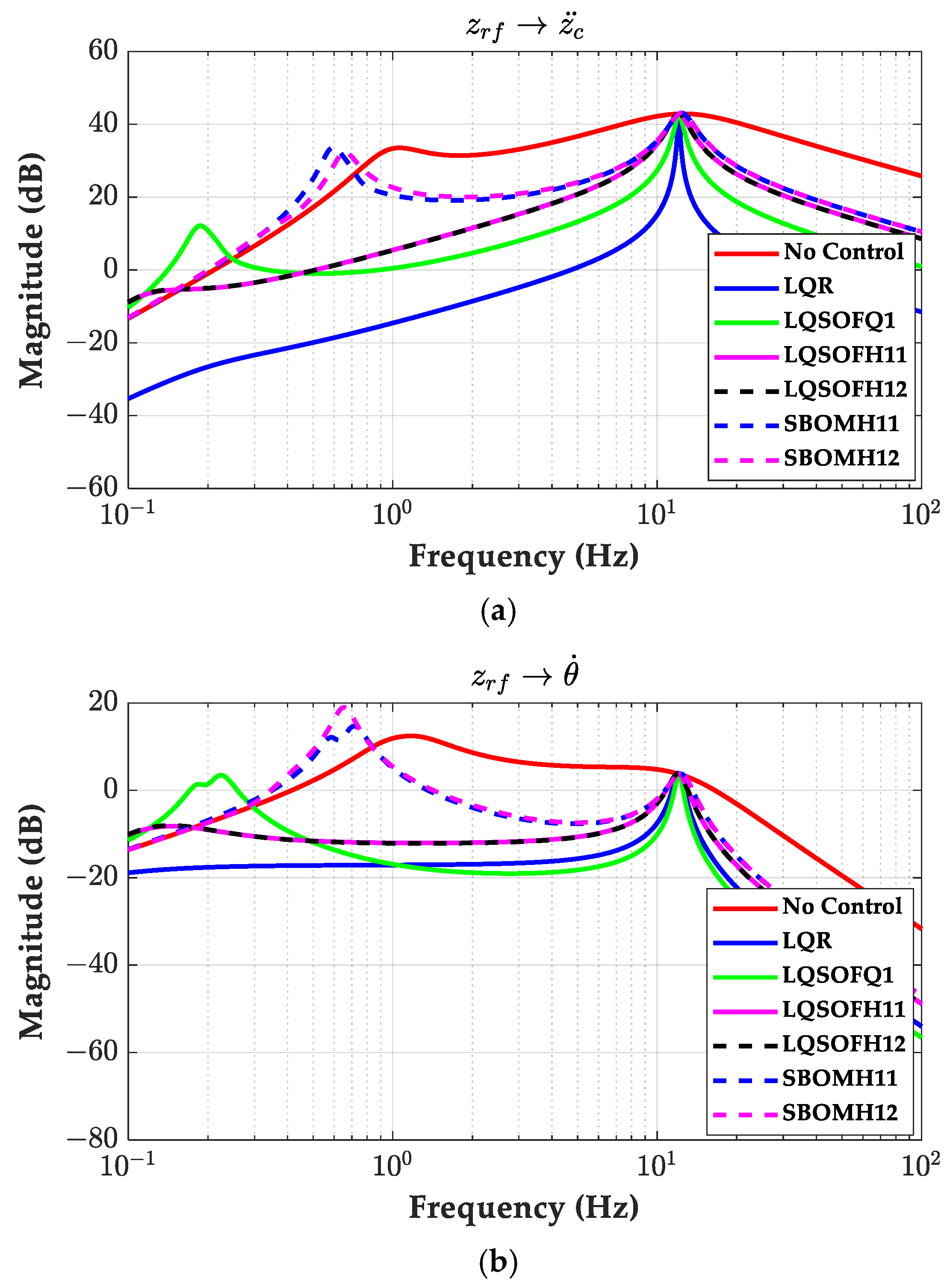
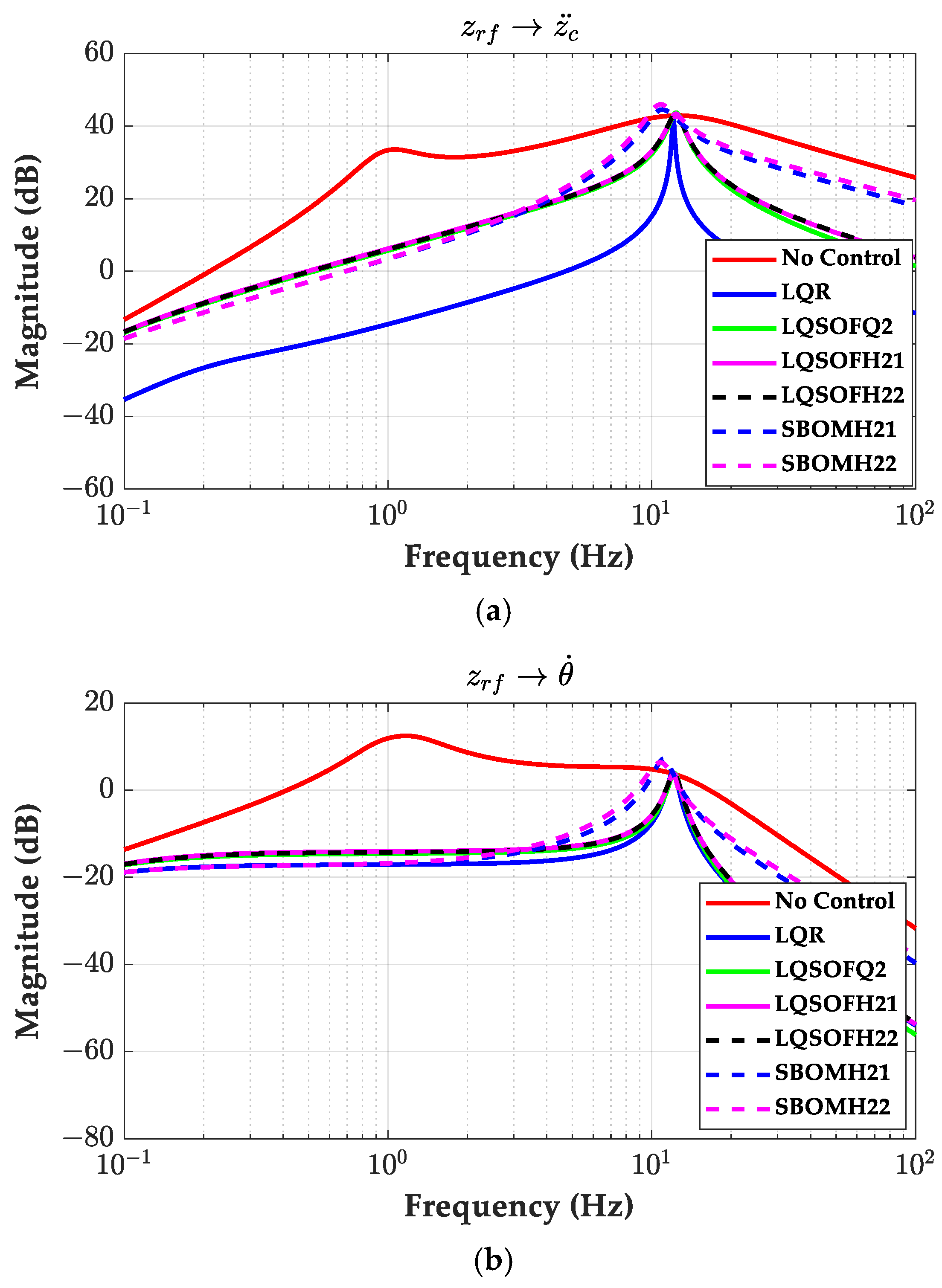
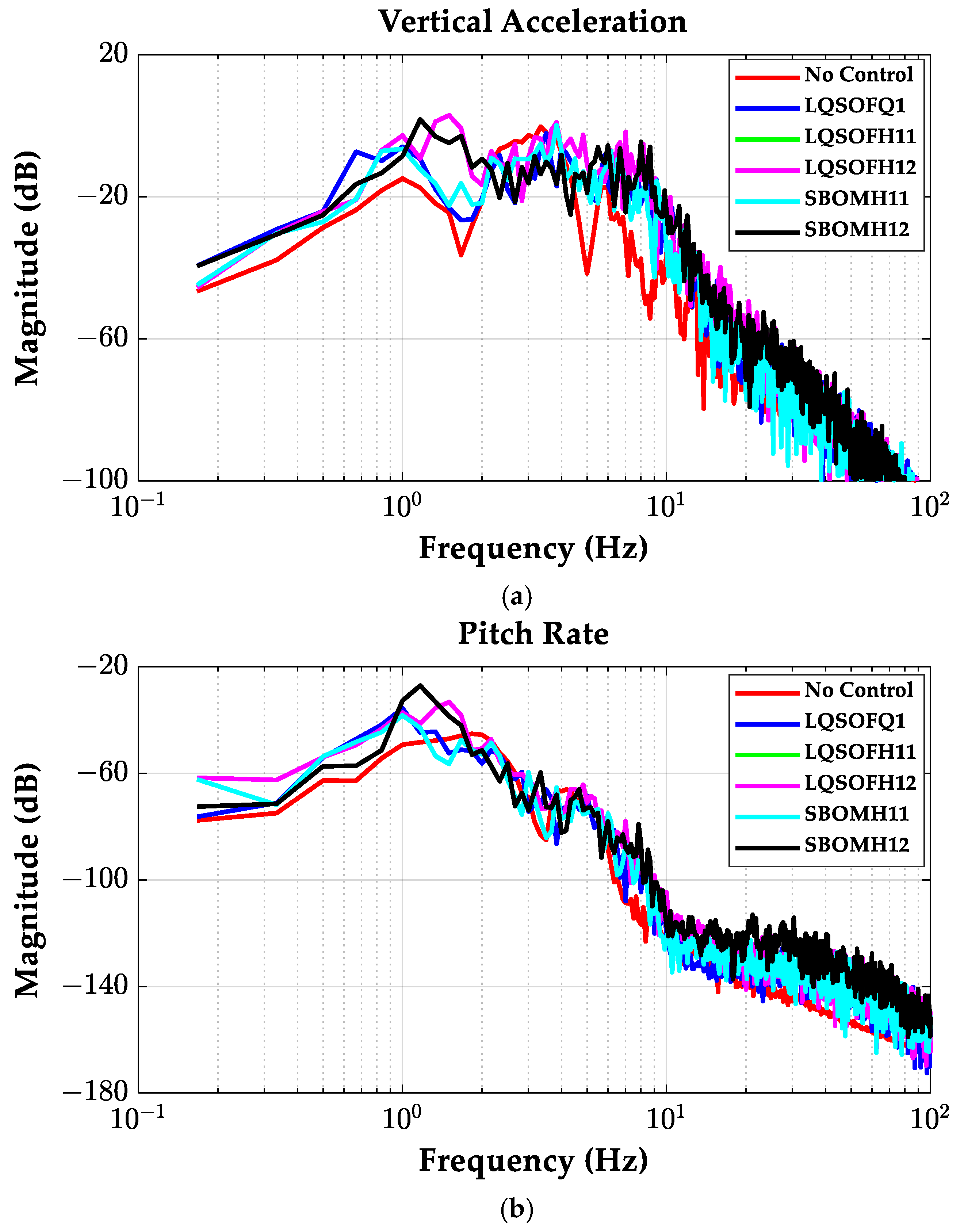
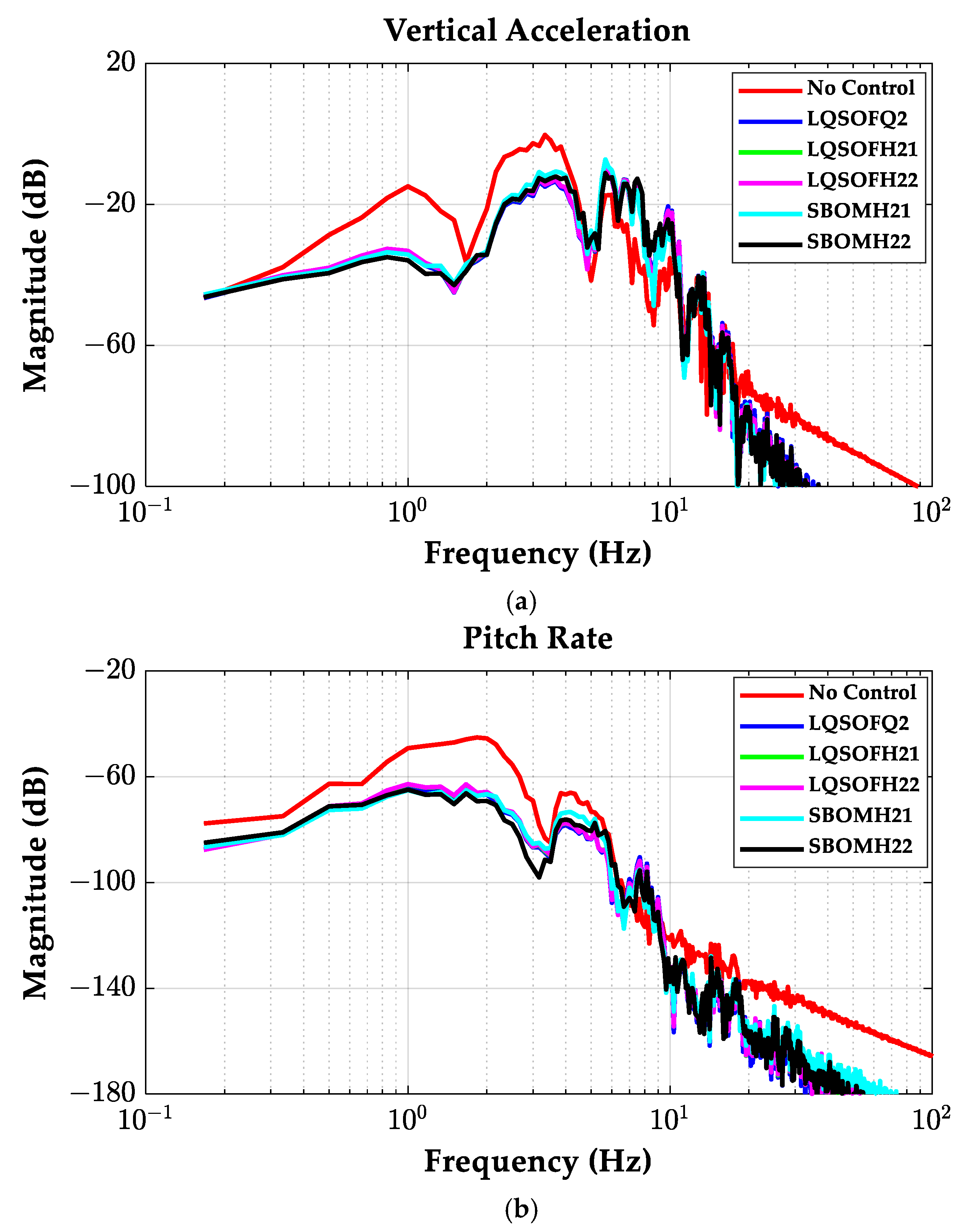
With the gain matrices given in Table 3 and Table 4 and the state-space equation, (23), the frequency response plots were drawn with OSC1 and OSC2 as given in Figure 5 and Figure 6, respectively. As shown in Figure 5, the controllers LQSOFQ1, SBOMH11, and SBOMH12 exhibited performance characteristics distinct from those of LQSOFH11 and LQSOFH12. Notably, SBOMH11 and SBOMH12 performed worse than LQSOFQ1 in terms of the evaluated ride comfort and motion sickness indices. In contrast, the results in Figure 6 indicate only minor differences among the SOF controllers with respect to az and ωy of the SPM. Specifically, all the controllers were able to attenuate the SPM responses effectively below 7 Hz, the frequency band most relevant to ride comfort and motion sickness. From these findings, it can be inferred that LQSOFQ2, LQSOFH2, SBOMH21, and SBOMH22 provide broadly equivalent performance levels.

4.3. Simulation on CarSim

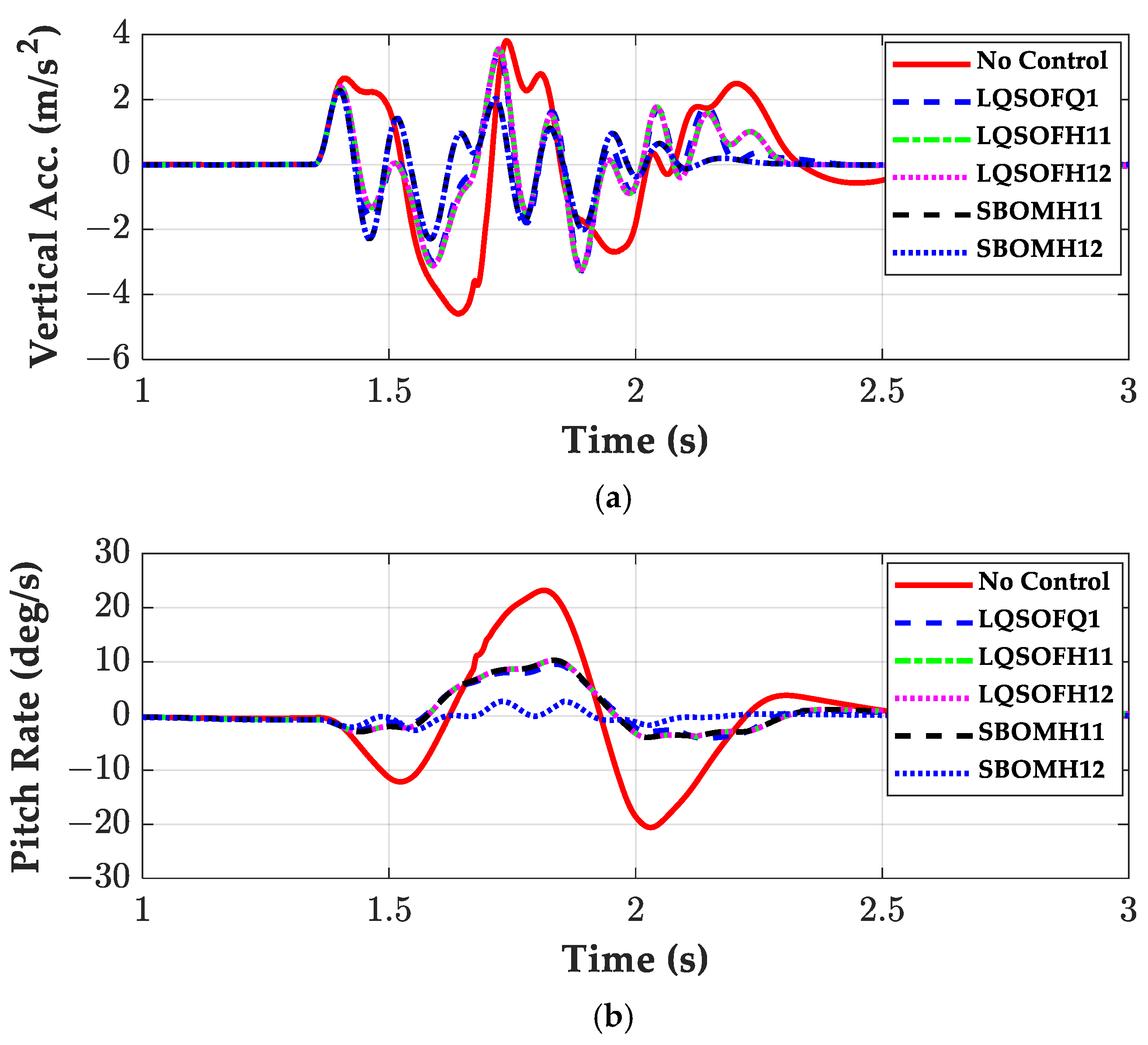
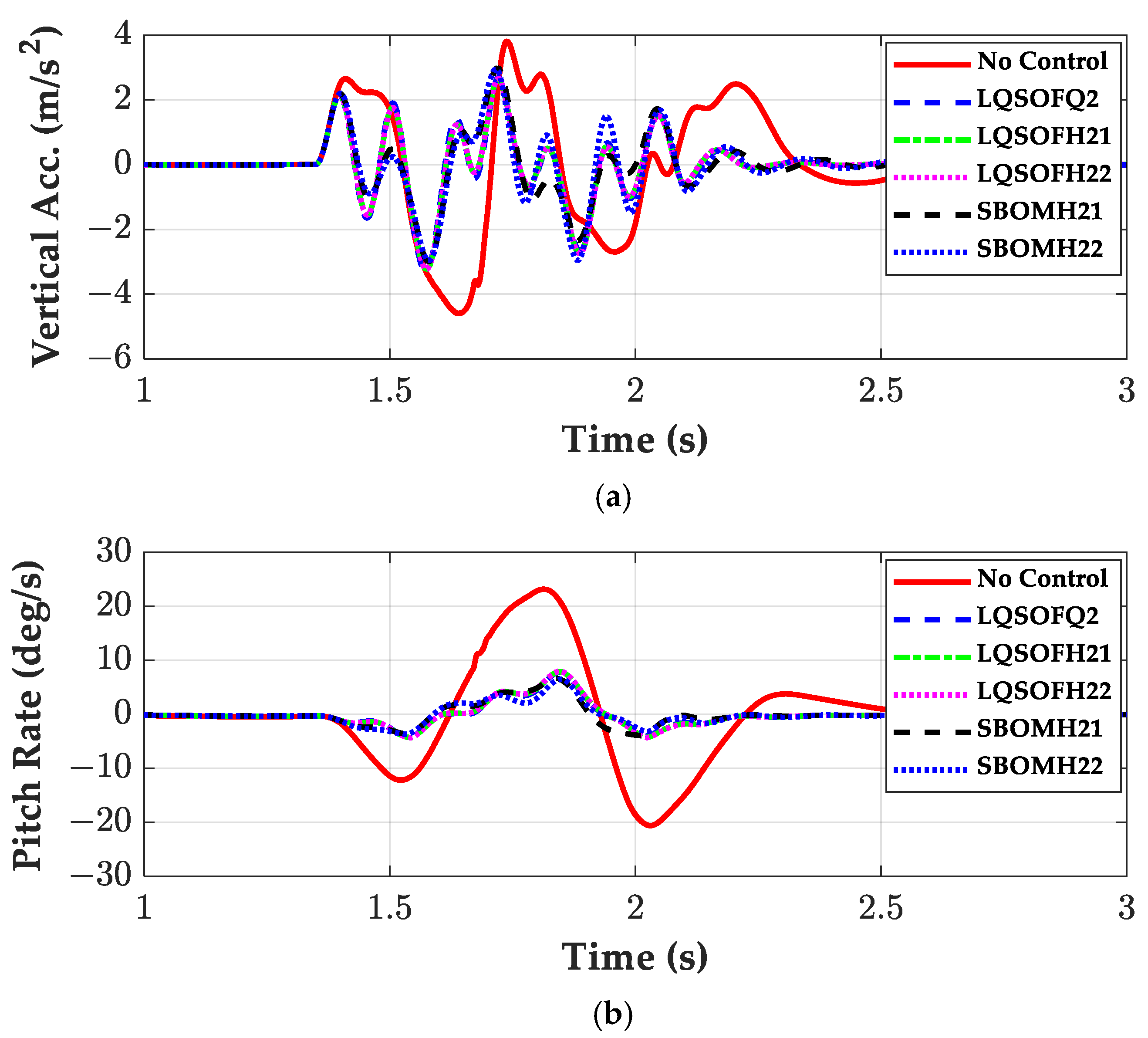
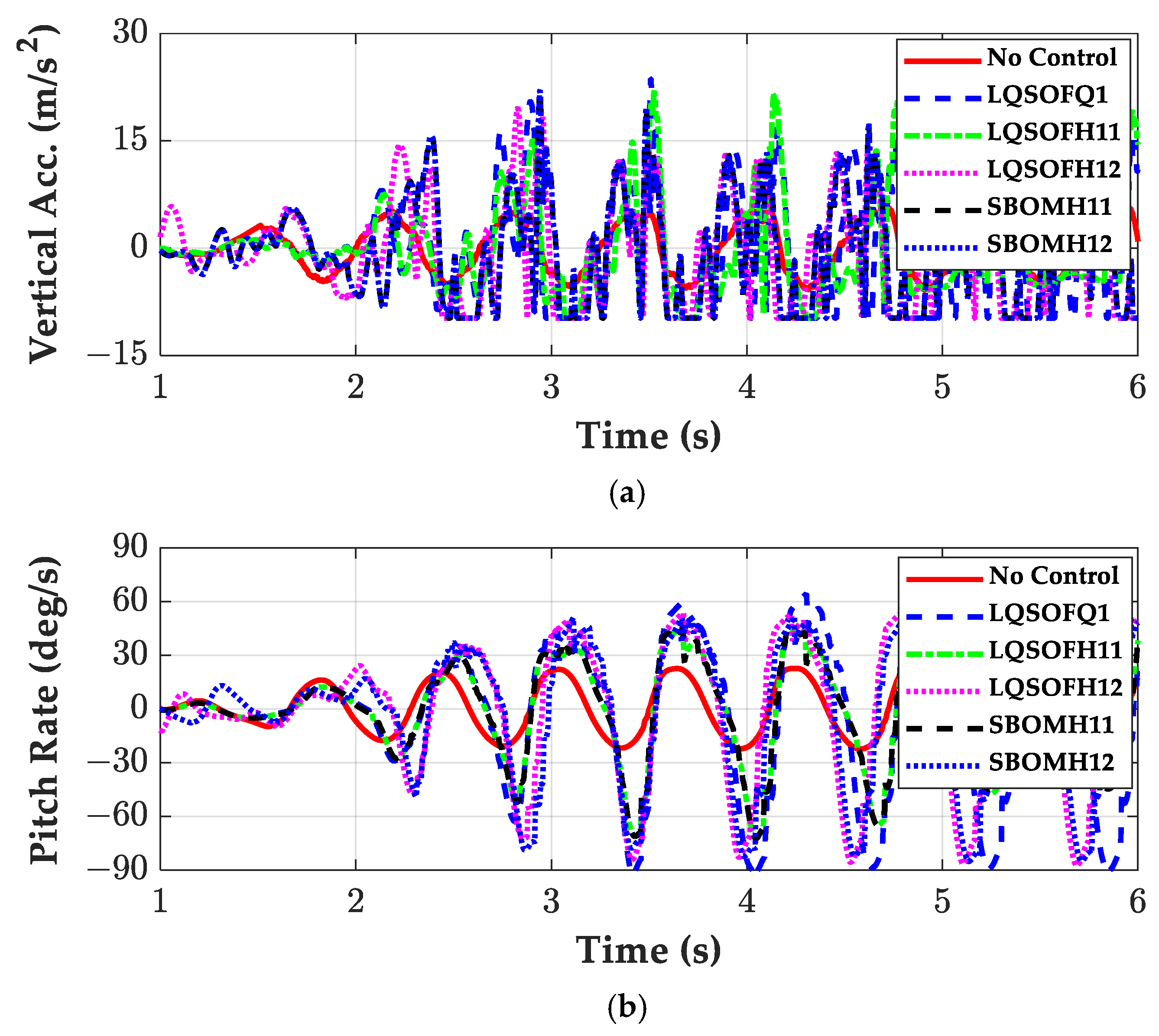
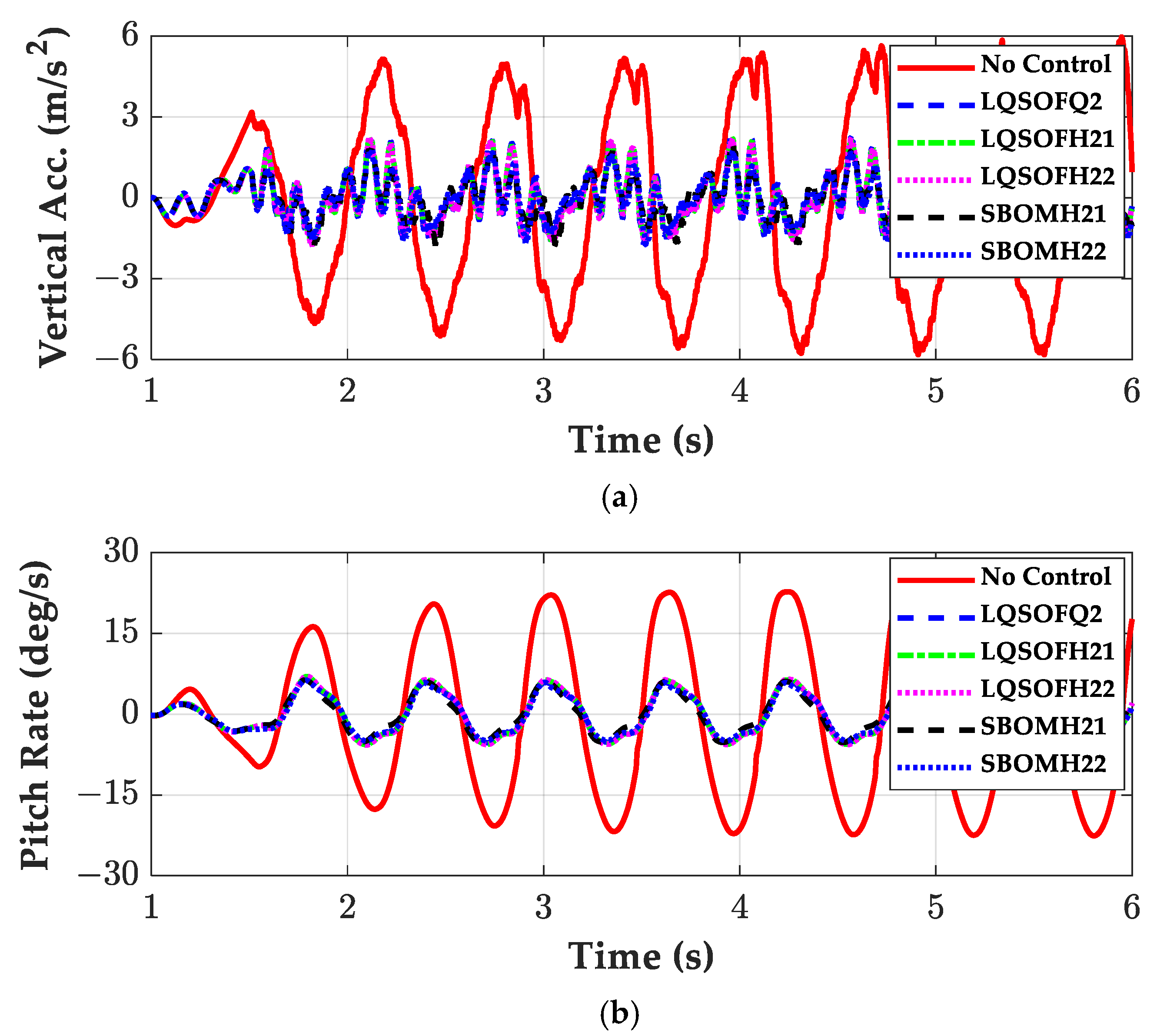
The first simulation study was conducted using the SOF controllers under the LHSB profile in CarSim, with the vehicle speed set to 10 m/s. This simulation scenario was specifically designed to examine the transient response of the controllers under a sharp bump input that excites both heave and pitch dynamics. Figure 7 and Figure 8 present the simulation results for OSC1 and OSC2, respectively, while Table 5 provides a quantitative summary of the outcomes. In Table 5, the values in parentheses indicate the percentage reduction relative to the uncontrolled baseline case.
As shown in Figure 6 and Table 5, the SOF controllers in OSC1 exhibited nearly identical performance in reducing az and ωy, with the exception of SBOMH12. Among the SOF controllers in OSC1, SBOMH12 achieved the best overall performance in terms of ride comfort and motion sickness mitigation. Similarly, as illustrated in Figure 7 and Table 5, the SOF controllers in OSC2 showed almost indistinguishable performance with respect to SPM az and ωy reduction. Furthermore, the results in Table 5 clearly indicate that OSC2 outperformed OSC1 in both comfort and motion sickness indices. The comparative analysis also reveals that the controllers designed using LQOC with the linear quarter-car and half-car models—namely LQSOFQ1, LQSOFH11, and LQSOFH12 in OSC1, and LQSOFQ2, LQSOFH21, and LQSOFH22 in OSC2—exhibited nearly equivalent performance within each group. Notably, the controllers designed by SBOM consistently provided slightly better performance than those designed using LQOC, reflecting the advantages of SBOM in handling nonlinearities and enhancing robustness.
The second set of simulations was conducted using the SOF controllers on the sine-wave road (SWR) profile implemented in CarSim, with the vehicle speed fixed at 20 m/s. This simulation scenario is particularly relevant as the SWR profile excites the suspension at a narrow frequency band, thereby allowing direct evaluation of the controllers’ ability to attenuate steady-state oscillations associated with az and ωy. Figure 9 and Figure 10 present the time-domain responses of the SOF controllers in OSC1 and OSC2, respectively, under this periodic road excitation. A quantitative summary of the corresponding performance metrics is provided in Table 6.
As shown in Figure 9 and Table 6, the SOF controllers in OSC1 exhibited very poor performance with respect to both ride comfort and motion sickness. In particular, az and ωy were significantly amplified, which can be attributed to the reliance on suspension stroke as a feedback signal in OSC1. By contrast, as shown in Figure 10 and Table 6, the SOF controllers in OSC2 achieved notable improvements in both comfort and motion sickness indices. The critical difference between OSC1 and OSC2, as defined in (15) and (29), lies in the inclusion or exclusion of suspension stroke as a feedback variable.
This distinction explains the observed trends: the OSC1 controllers demonstrated satisfactory performance on transient inputs such as the LHSB, but performed poorly under periodic excitations such as the SWR, whereas the OSC2 controllers maintained good performance across both the LHSB and SWR disturbances. These results lead to an important conclusion—namely, that suspension stroke should not be used as a feedback signal for active suspension control when the objective includes ride comfort and motion sickness mitigation.
Furthermore, as indicated in Table 6, the performance differences among the SOF controllers in OSC2 were negligible. The controllers designed using SBOM in CarSim showed slightly better results than those designed with LQOC, highlighting the robustness advantages of SBOM. Nevertheless, considering the complexity of the design process, the LQSOFQ controller is preferable, as it can be synthesized more efficiently using the quarter-car model with LQOC, compared to the more computationally demanding SBOMH21 and SBOMH22.
Collectively, these findings underscore the dual contribution of this study: first, clarifying the limitations of stroke-based feedback in suspension control; and second, demonstrating that quarter-car-based SOF designs can provide a practical balance between performance and design simplicity, thereby supporting their applicability for real-world active suspension systems. Due to its simplicity, it can be confirmed that the proposed method is distinguished, especially when compared with fuzzy-PID control or MPC in the literature [20,25].
The third set of simulations was conducted using the SOF controllers under the BSSB excitation in CarSim. Figure 11 and Figure 12 illustrate the frequency response characteristics of the SOF controllers in OSC1 and OSC2, respectively. As shown in Figure 11, the SOF controllers in OSC1 again demonstrated poor performance, consistent with the deficiencies observed in the sine-wave road simulations (Figure 9). In contrast, the SOF controllers in OSC2 exhibited strong performance, in line with the results presented in Figure 10.
In particular, az and ωy were substantially reduced by the SOF controllers in OSC2 in the frequency range below 4 Hz. Since this band is strongly associated with ride comfort degradation and motion sickness induction, the observed reduction provides compelling evidence that the OS2-based SOF controllers proposed in this study are well suited to practical applications.
These findings further reinforce a central contribution of the present work: by identifying the limitations of stroke-based feedback (OSC1) and demonstrating the robustness of velocity- and stroke-rate-based feedback (OSC2) under broadband excitations, the study establishes a clear guideline for sensor output selection in active suspension control. This ensures that the proposed controllers effectively address both ride comfort and motion sickness mitigation in realistic driving environments.

5. Conclusions

This paper proposes a methodology for designing SOF controllers based on the quarter-car model and extending them to the half-car configuration for the dual objectives of ride comfort enhancement and motion sickness mitigation. Two alternative sensor output sets are introduced for both the quarter-car and half-car models: the first set (OS1) comprises the suspension stroke and its rate, while the second set (OS2) consists of the vertical acceleration of the sprung mass and the suspension stroke rate. Using these outputs, two SOF controllers are synthesized via LQOC for the quarter-car model. In addition, two further SOF controllers for the half-car model are developed, utilizing both LQOC and SBOM to address the nonlinearities inherent in suspension dynamics. To evaluate their effectiveness, comparative simulations are conducted in the MATLAB/Simulink 2024a environment coupled with CarSim.
From the simulation results, the following key findings are obtained:
  • The SOF controller designed via LQOC with OS2 demonstrated strong performance in terms of both ride comfort and motion sickness mitigation. In contrast, the SOF controllers designed with OS1 exhibited poor performance, particularly under sinusoidal road excitations, and are, therefore, unsuitable for real-world implementation.
  • The SOF controllers designed with the quarter-car model could be directly extended to real vehicles without requiring higher-degree-of-freedom models. This result highlights the practicality of the quarter-car model as a computationally efficient yet sufficiently accurate framework for active suspension control design. Owing to its simplicity, the method is amenable to real-time implementation on a full-scale vehicle.
The limitation of the proposed method is simulation-only validation. To overcome this limitation, as a natural extension of the above findings, future work will focus on experimental validation of the proposed SOF controllers using a small-scale quarter-car test bench, thereby bridging the gap between simulation-based design and physical implementation.

Funding

This work was supported by the Ministry of Education through the National Research Foundation of Korea (NRF) under the Basic Science Research Program (RS-2019-NR040071).

Institutional Review Board Statement

Not applicable.

Informed Consent Statement

Not applicable.

Data Availability Statement

The original contributions presented in this study are included in the article. Further inquiries can be directed to the corresponding author.

Conflicts of Interest

The author declares no conflicts of interest.

Abbreviations

The following abbreviations and nomenclature are used in this manuscript:
LQOFLinear quadratic objective function
LQRLinear quadratic regulator
SBOMSimulation-based optimization method
SOFStatic output feedback
SPMSprung mass
USPMUnsprung mass
lf, lrdistances from center of gravity of a sprung mass to front/rear corners (m)
acsf, acsraccelerometers installed on the front/rear corners of the sprung mass
acuf, acuraccelerometers installed on the wheel centers of front/rear tires.
azvertical acceleration of a sprung mass at C.G. (m/s2)
bsdamping coefficient of a damper in the quarter-car model (N·s/m)
bsf, bsrdamping coefficient of a damper at front/rear suspensions in the half-car model (N·s/m)
fqsuspension force in the quarter-model (N)
ff, frsuspension forces at front/rear suspensions in the half-model (N)
Iypitch moment of inertia (kg·m2)
Jq, JhLQ objective functions on the quarter-car and half-car model
JSobjective function of the SBOM
ksstiffness of a spring in the quarter-car model (N/m)
ksf, ksrstiffness of a spring at front/rear suspensions in the half-car model (N/m)
ktstiffness of a tire in the quarter-car model (N/m)
ktf, ktrstiffness of front/rear tires in the half-car model (N/m)
msqsprung mass of the quarter-car model (kg)
mssprung mass of the half-car models (kg)
muunsprung mass in the quarter-car model (kg)
muf, murunsprung masses under front/rear suspensions in the half-car model (kg)
uqforces generated by an actuator at suspension in the quarter-model (N)
uf, urforces generated by an actuator at suspensions in the half-car model (N)
vzvertical velocity of a sprung mass (m/s)
zcvertical displacement at center of gravity of a sprung mass (m)
zrroad elevation acting on a tire in the quarter-car model (m)
zrf, zrrroad elevation acting on front/rear tires in the half-car model (m)
zsvertical displacement of a sprung mass in the quarter-car model (m)
zsf, zsrvertical displacement of front/rear corners of a sprung mass (m)
zuvertical displacement of wheel center in the quarter-car model (m)
zuf, zurvertical displacement of front/rear wheel centers in the half-car model (m)
ξi, χimaximum allowable value (MAV) of weight in LQOFs, Jq and Jh
ωypitch rate of a sprung mass (rad/s)
ρi, ζiweights in LQOFs, Jq and Jh
θpitch angle of a sprung mass (rad)

References

  1. Hrovat, D. Survey of advanced suspension developments and related optimal control applications. Automatica 1997, 33, 1781–1817. [Google Scholar] [CrossRef]
  2. Cao, D.; Song, X.; Ahmadian, M. Editors’ perspectives: Road vehicle suspension design, dynamics, and control. Veh. Syst. Dyn. 2011, 49, 3–28. [Google Scholar] [CrossRef]
  3. Poussot-Vassal, C.; Spelta, C.; Sename, O.; Savaresi, S.M.; Dugard, L. Survey and performance evaluation on some automotive semi-active suspension control methods: A comparative study on a single-corner model. Annu. Rev. Control 2012, 36, 148–160. [Google Scholar] [CrossRef]
  4. Tseng, H.E.; Hrovat, D. State of the art survey: Active and semi-active suspension control. Veh. Syst. Dyn. 2015, 53, 1034–1062. [Google Scholar] [CrossRef]
  5. Theunissen, J.; Tota, A.; Gruber, P.; Dhaens, M.; Sorniotti, A. Preview-based techniques for vehicle suspension control: A state-of-the-art review. Annu. Rev. Control 2021, 51, 206–235. [Google Scholar] [CrossRef]
  6. Tang, Q.; Xiang, H.; Cheng, J.; Xiao, X.; Yu, W.; Zhang, S.; Tang, B.; Ghu, G. Study on evaluation method of motion sickness in electric vehicles. In Proceedings of the 2024 8th CAA International Conference on Vehicular Control and Intelligence, CVCI 2024, Chongqing, China, 25–27 October 2024. [Google Scholar]
  7. Shi, Z.; He, L.; Wang, M.; Bian, Y.; Cui, S.; Chen, P. Ideal comfort ellipses and comfort dynamics model for mitigating motion sickness in battery electric vehicle. Veh. Syst. Dyn. 2025; online first. [Google Scholar]
  8. Deng, Z.; Yuan, K.; Xiao, X. Investigative examination of motion sickness indicators for electric vehicles. Proc. Inst. Mech. Eng. Part. D J. Automob. Eng. 2025; online first. [Google Scholar]
  9. Dam, A.; Jeon, M. A review of motion sickness in automated vehicles. In Proceedings of the AutomotiveUI ‘21: 13th International Conference on Automotive User Interfaces and Interactive Vehicular Applications, Leeds, UK, 9–14 September 2021; pp. 39–48. [Google Scholar]
  10. Asua, E.; Gutiérrez-Zaballa, J.; Mata-Carballeira, O.; Ruiz, J.A.; del Campo, I. Analysis of the motion sickness and the lack of comfort in car passengers. Appl. Sci. 2022, 12, 3717. [Google Scholar] [CrossRef]
  11. Kirst, L.; Ernst, B.; Kern, A.; Steinhauser, M. The Problem of motion sickness and its implications for automated driving. In User Experience Design in the Era of Automated Driving. Studies in Computational Intelligence; Riener, A., Jeon, M., Alvarez, I., Eds.; Springer: Cham, Switzerland, 2022; p. 980. [Google Scholar]
  12. Irmak, T.; Pool, D.M.; de Winkel, K.N.; Happee, R. Validating models of sensory conflict and perception for motion sickness prediction. Biol. Cybern. 2023, 117, 185–209. [Google Scholar] [CrossRef] [PubMed]
  13. Pereira, E.; Macedo, H.; Lisboa, I.C.; Sousa, E.; Machado, D.; Silva, E.; Coelho, V.; Arezes, P.; Costa, N. Motion sickness countermeasures for autonomous driving: Trends and future directions. Transp. Eng. 2024, 15, 100220. [Google Scholar] [CrossRef]
  14. Xie, W.; He, D.; Wu, G. Inducers of motion sickness in vehicles: A systematic review of experimental evidence and meta-analysis. Transp. Res. Part. F Traffic Psychol. Behav. 2023, 99, 167–188. [Google Scholar] [CrossRef]
  15. Diels, C.; Ye, Y.; Bos, J.; Maeda, S. Motion sickness in automated vehicles: Principal research questions and the need for common protocols. SAE Intl. J. CAV 2022, 5, 121–134. [Google Scholar] [CrossRef]
  16. Zhang, Y.; Zhao, H.; Hu, C.; Tian, Y.; Li, Y.; Jiao, X. Mitigation of motion sickness and optimization of motion comfort in autonomous vehicles: Systematic survey. IEEE Trans. Intell. Trans. Sys. 2024, 25, 21737–21756. [Google Scholar] [CrossRef]
  17. Li, D.; Yu, T.; Tang, B. A review of carsickness mitigation: Navigating challenges and exploiting opportunities in the era of intelligent vehicles. Proc. Inst. Mech. Eng. Part. D J. Automob. Eng. 2025, 239, 4574–4594. [Google Scholar] [CrossRef]
  18. Ekchian, J.; Graves, W.; Anderson, Z.; Giovanardi, M.; Godwin, O.; Kaplan, J.; Ventura, J.; Lackner, J.R.; DiZio, P. A High-Bandwidth Active Suspension for Motion Sickness Mitigation in Autonomous Vehicles; SAE Technical Paper 2016-01-1555; SAE International: Warrendale, PA, USA, 2016. [Google Scholar]
  19. DiZio, P.; Ekchian, J.; Kaplan, J.; Ventura, J.; Graves, W.; Giovanardi, M.; Anderson, Z.; Lackner, J.R. An active suspension system for mitigating motion sickness and enabling reading in a car. Aerosp. Med. Hum. Perform. 2018, 89, 822–829. [Google Scholar] [CrossRef]
  20. Wu, X.; Pan, Y.; Wang, G.; Hou, L. Pitch motion suppression of electric vehicle active suspensions based on multibody dynamics. Mech. Mach. Theory 2024, 198, 105667. [Google Scholar] [CrossRef]
  21. Jeong, Y.; Yim, S. Design of active suspension controller for ride comfort enhancement and motion sickness mitigation. Machines 2024, 12, 254. [Google Scholar] [CrossRef]
  22. Kim, J.; Yim, S. Design of static output feedback suspension controllers for ride comfort improvement and motion sickness reduction. Processes 2024, 12, 968. [Google Scholar] [CrossRef]
  23. Kim, J.; Yim, S. Design of a suspension controller with an adaptive feedforward algorithm for ride comfort enhancement and motion sickness mitigation. Actuators 2024, 13, 315. [Google Scholar] [CrossRef]
  24. Kim, J.; Yim, S. Design of a suspension controller with human body model for ride comfort improvement and motion sickness mitigation. Actuators 2024, 13, 520. [Google Scholar] [CrossRef]
  25. Zhou, F.; Zhao, D.; Zhong, Y.; Wang, P.; Jiang, J.; Wang, Z.; Fu, Z. Motion sickness suppression strategy based on dynamic coordination control of active suspension and ACC. Machines 2025, 13, 650. [Google Scholar] [CrossRef]
  26. Park, M.; Yim, S. Design of static output feedback and structured controllers for active suspension with quarter-car model. Energies 2021, 14, 8231. [Google Scholar] [CrossRef]
  27. Jeong, Y.; Sohn, Y.; Chang, S.; Yim, S. Design of static output feedback controllers for an active suspension system. IEEE Access 2022, 10, 26948–26964. [Google Scholar] [CrossRef]
  28. Lu, J.; DePoyster, M. Multiobjective optimal suspension control to achieve integrated ride and handling performance. IEEE Trans. Control Syst. Technol. 2002, 10, 807–821. [Google Scholar]
  29. Jung, Y.H.; Choi, J.W.; Seo, Y.B. Overlapping decentralized EA control design for an active suspension system of a full car model. In Proceedings of the 39th SICE Annual Conference, Iizuka, Japan, 28 July 2000; pp. 85–90. [Google Scholar]
  30. Bryson, A.E., Jr.; Ho, Y. Applied Optimal Control; Hemisphere: New York, NY, USA, 1975. [Google Scholar]
  31. Mechanical Simulation Corporation. CarSim Data Manual, version 8; Mechanical Simulation Corporation: Ann Arbor, MI, USA, 2009. [Google Scholar]
Figure 1. 2-DOF quarter-car model.
Actuators 14 00539 g001
Figure 2. 4-DOF half-car model.
Actuators 14 00539 g002
Figure 3. Block diagram of sensor signal processing for SOF controllers.
Actuators 14 00539 g003
Figure 4. Block diagram of SBOM.
Actuators 14 00539 g004
Figure 5. Frequency responses of OSC1 designed with LQOC and SBOM: (a) az; (b) ωy.
Actuators 14 00539 g005
Figure 6. Frequency responses of OSC2 designed with LQOC and SBOM: (a) az; (b) ωy.
Actuators 14 00539 g006
Figure 7. Simulation results of the SOF controllers in OSC1 on LHSB: (a) az; (b) ωy.
Actuators 14 00539 g007
Figure 8. Simulation results of the SOF controllers in OSC2 on LHSB: (a) az; (b) ωy.
Actuators 14 00539 g008
Figure 9. Simulation results of the SOF controllers in OSC1 on SWR in CarSim: (a) az; (b) ωy.
Actuators 14 00539 g009
Figure 10. Simulation results of the SOF controllers in OSC2 on SWR in CarSim: (a) az; (b) ωy.
Actuators 14 00539 g010
Figure 11. Frequency responses of the SOF controllers in OSC1 simulated on BSSB in CarSim: (a) az; (b) ωy.
Actuators 14 00539 g011
Figure 12. Frequency responses of the SOF controllers in OSC2 simulated on BSSB in CarSim: (a) az; (b) ωy.
Actuators 14 00539 g012
Table 1. Parameters and values of the quarter-car and half-car models.
ParameterValueParameterValue
ms1623 kgmu40 kg
Iy2765 kg·m2kt, ktf, ktr230,000 N/m
lf1.40 mlr1.65 m
ks, ksf, ksr34,000 N/mbs, bsf, bsr3500 Ns·/m
msqms/4
Table 2. MAVs in LQ cost functions.
MAVValueMAVValueMAVValueMAVValue
ξ10.5 m/s2ξ20.1 mξ30.1 mξ45000 N
χ10.1 m/s2χ230.0 deg/s2χ31.0 deg/sχ45.0 deg
χ50.1 mχ60.1 mχ710,000 N
Table 3. Gain matrices of the SOF controllers in OSC1 designed by LQOC and SBOM.
ControllerGain MatrixControllerGain Matrix
Kq1
LQSOFQ1
32,859 3302
Kh11
LQSOFH11
33,571 3018 0 0 0 0 33,571 3018 Kh12
LQSOFH12
33,571 3018 0 0 0 0 33,577 3014
KSOh11
SBOMH11
21,829 4094 0 0 0 0 21,829 4094 KSOh12
SBOMH12
20,511 4097 0 0 0 0 30,666 4417
Table 4. Gain matrices of the SOF controllers in OSC2 designed by LQOC and SBOM.
ControllerGain MatrixControllerGain Matrix
Kq2
LQSOFQ2
60,040 3297
Kh21
LQSOFH21
56,512 3228 0 0 0 0 56,512 3228 Kh22
LQSOFH22
56,512 3229 0 0 0 0 55,360 3237
KSOh21
SBOMH21
80,000 2066 0 0 0 0 80,000 2066 KSOh22
SBOMH22
80,000 1769 0 0 0 0 80,000 3563
Table 5. Maximum absolute az and ωy calculated from the simulation results given in Figure 7 and Figure 8.
ControllerMax |az| (m/s2)Max |ωy| (deg/s)
No Control4.623.2
OSC1LQSOFQ13.4 (26%)9.6 (59%)
LQSOFH113.6 (22%)10.3 (56%)
LQSOFH123.6 (22%)10.3 (56%)
SBOMH113.6 (22%)10.3 (56%)
SBOMH122.3 (50%)2.7 (88%)
OSC2LQSOFQ23.3 (28%)7.8 (66%)
LQSOFH213.2 (30%)7.9 (66%)
LQSOFH223.2 (30%)8.0 (66%)
SBOMH213.0 (35%)6.7 (71%)
SBOMH223.0 (35%)6.5 (72%)
Table 6. Maximum absolute az and ωy calculated from the simulation results given in Figure 9 and Figure 10.
ControllerMax |az| (m/s2)Max |ωy| (deg/s)
No Control6.123.1
LQSOFQ123.6 (−287%)91.8 (−297%)
LQSOFH1121.9 (−259%)72.3 (−213%)
LQSOFH1219.6 (−221%)89.0 (−285%)
SBOMH1121.9 (−259%)72.3 (−213%)
SBOMH1222.0 (−261%)88.0 (−281%)
LQSOFQ22.3 (62%)6.0 (74%)
LQSOFH212.2 (64%)6.4 (72%)
LQSOFH222.2 (64%)6.5 (72%)
SBOMH211.9 (69%)6.1 (74%)
SBOMH221.8 (70%)6.0 (74%)
Disclaimer/Publisher’s Note: The statements, opinions and data contained in all publications are solely those of the individual author(s) and contributor(s) and not of MDPI and/or the editor(s). MDPI and/or the editor(s) disclaim responsibility for any injury to people or property resulting from any ideas, methods, instructions or products referred to in the content.