1. Introduction
In recent years, growing concerns about the climate and the environment, coupled with a continuous increase in electricity demand, have driven the integration of more renewable energy-based distributed generation (DG) units into the power system [
1].
A microgrid integrates local DG units, energy storage systems (ESSs), and loads to form a self-sufficient energy system, which can be classified into AC microgrids, DC microgrids, and hybrid AC/DC microgrids. AC microgrids are equipped with mature control and protection systems, but they face issues such as conversion efficiency, reactive power, synchronization, and harmonics. The hybrid AC/DC microgrid combines the advantages of both AC and DC microgrids [
2], but typically features a complex architecture and still has the aforementioned issues of AC microgrids. Due to the simple architecture and the avoidance of AC microgrid-related issues, DC microgrids are drawing increasing attention [
3]. In DC microgrids, power electronic converters operate as CPLs if precisely regulated. Although CPLs are widely prevalent in microgrids, their negative impedance feature can result in an underdamped or unstable oscillation. Therefore, a passive damping strategy is proposed by installing new hardware (e.g., resistor or capacitor) [
4]. However, hardware addition is often difficult and costly in practice. By virtually adding components such as a capacitor or resistor to change the control loop [
5], the active damping method is proposed. However, the active method only ensures small-signal stability, which motivates us to explore methods such as fuzzy control to obtain large-signal stability.
Due to the spatially distributed feature of microgrid components such as batteries and loads, network communication plays an increasing role in data transmission, which has advantages such as high flexibility and low cost. However, network-induced attacks, also called cyber attacks, pose a serious threat to microgrid safety [
6]. For example, a DoS attack jams the communication network and data transmission becomes impossible, while an FDI attack generates fake data packets by injecting false data [
7]. Thus, microgrid security control is attracting increasing attention. For example, for DC microgrids including nonlinear CPLs under time-constrained DoS attacks, the work in [
8] presents a fuzzy switched control strategy and obtains exponential stability criteria by constructing time-varying Lyapunov functions. For DC microgrids with asynchronous DoS attacks, the work in [
9] designs a security transmission scheme to update the control input in a timely manner and proposes a secure predictive controller for voltage control. For microgrids affected by random gain fluctuation and semi-aperiodic DoS attacks, the work in [
10] designs an intermittent non-fragile estimator using partial measure information, and obtains stochastic stability criteria. For DC charging stations with CPLs, uncertainties, and DoS attacks, the work in [
11] proposes a primary controller to guarantee stable voltage and presents a distributed consensus control method to ensure accurate current sharing. For DC microgrids containing distributed generation units (DGUs) subject to asynchronous DoS attacks, the work in [
12] presents a prediction-based data security transmission method to compensate for attack-induced dropouts and designs a distributed predictive security controller to stabilize bus voltage. For DC microgrids with unknown input-based FDI attacks, the work in [
13] studies the destructiveness and stealthiness of the attack from the attacker’s perspective and then designs an observer-based attack detector with plug-and-play performance. For FDI attacks affecting actuators in DC microgrids, the work in [
14] proposes detection and mitigation strategies, where the estimate of actuator input is constructed by a linear functional observer when attacks are active, and a dynamic signature function is used to detect attacks. For DC microgrids subject to constant and bounded FDI attacks on local current sensors and communication networks, to guarantee voltage regulation and current sharing, the work in [
15] presents a resilient distributed control method. To mitigate the impact of FDI attacks in DC microgrid clusters, using local microgrid information, the work in [
16] provides a resilient cooperative control scheme based on Lyapunov theory, which can achieve power sharing and voltage regulation, and is robust to control parameters and modeling uncertainties. For DC microgrids with FDI attacks in communication and actuator channels, the work in [
17] designs a dynamic, resilient consensus controller to ensure restoration of average voltage and proportional current sharing. From the adversary’s perspective, for DC microgrids using distributed secondary control, the work in [
18] studies the optimal deployment of a zero-trace stealthy attack to maximize the state convergence error. For phase-locked loop (PLL) cyber attacks on inverter-dominated microgrids, the work in [
19] shows that preemptive adjustment of lower droop gains in grid-forming inverters can mitigate the impacts caused by PLL attacks. Besides, phasor measurement units (PMUs) and phasor data concentrators (PDCs) can provide real-time high-precision synchronized data for the detection and mitigation of attacks [
20,
21], which provides an interesting future research direction that contributes to improving microgrid resilience. The works above propose some interesting security control methods assuming that the system resources are sufficient. However, in practice, system resources (e.g., node energy and network bandwidth) are often limited, which should be considered when designing the control strategy.
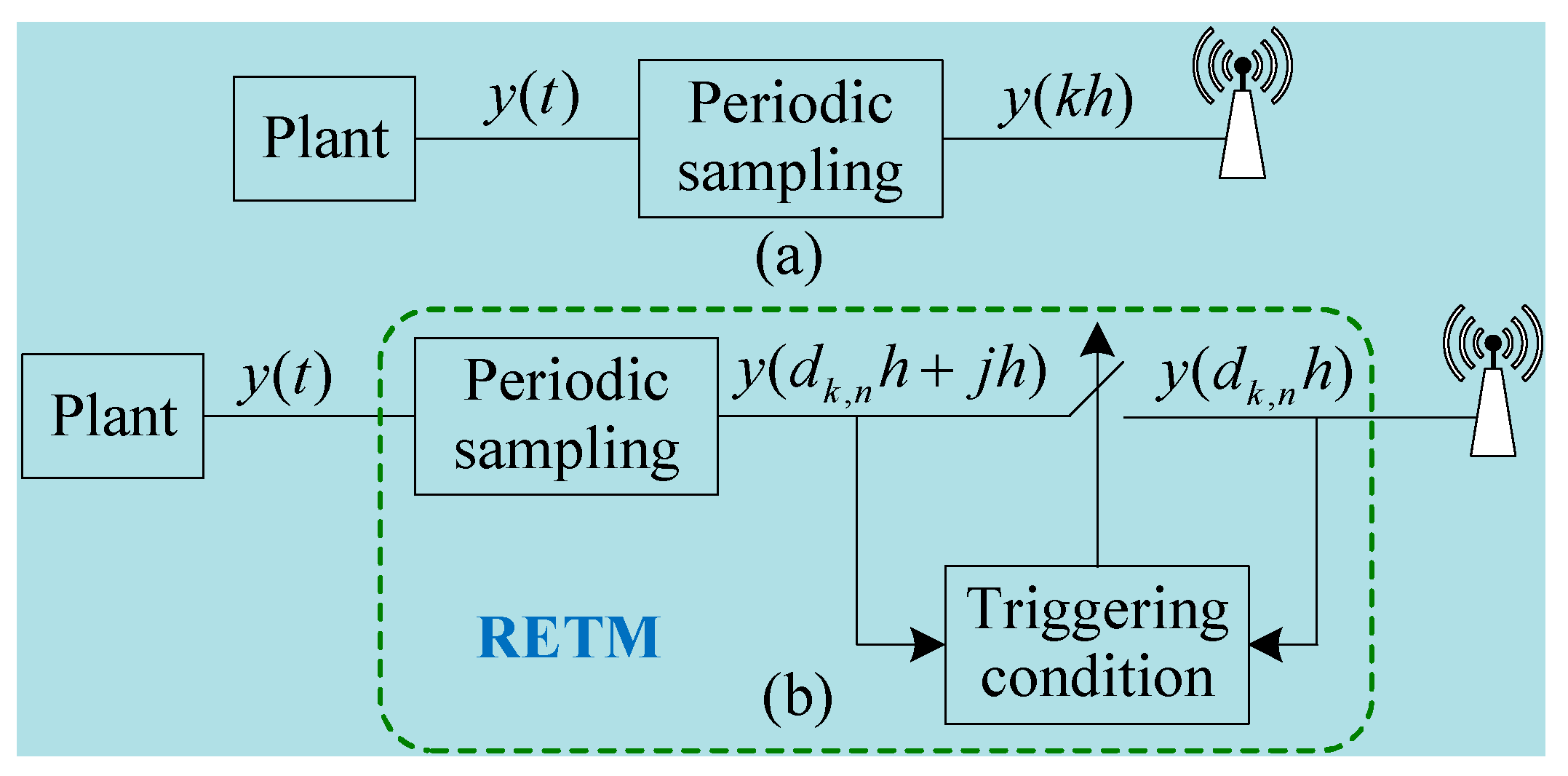
To save the aforementioned limited system resources, unlike the classical periodic sampling control method, an event-triggered control (ETC) method is designed, which executes control tasks only when the triggering conditions are met [
22,
23]. Due to the ETC’s advantage in consuming less system resources, it has been introduced in microgrid control. For example, to guarantee desired voltage and current performance in DC microgrids containing DGU, the work in [
24] proposes a distributed secondary control method with a memory-based event-triggered mechanism and quantization. For DC microgrids with DGUs and communication networks subject to random packet losses, the work in [
25] proposes a distributed ETC consensus protocol, which ensures current sharing and exhibits robustness to random dropouts. For DC microgrids containing DGU, a fixed-time distributed event-driven secondary control strategy is designed [
26], which can ensure the required current sharing and voltage regulation within a fixed time. For DC microgrids with imperfect voltage sources, the work [
27] designs an event-triggered distributed sliding mode controller to achieve power sharing and voltage regulation with low steady-state error and high convergence rate. To guarantee satisfactory power and voltage/frequency performance in hybrid microgrids with DGUs, the work in [
28] presents a distributed model-free adaptive ETC method, and the asymptotic stability is analyzed using discrete Lyapunov theory. To ensure current sharing of the DC microgrid, the work in [
29] presents a distributed event-driven differential delay method with adaptive droop coefficient regulation. For DC microgrids containing ESS, the work in [
30] provides a secondary distributed control method by introducing a voltage-related factor to ensure bus voltage regulation, desired current sharing, and faster state-of-charge balancing, and proposes a consensus-based event-driven observer to ensure accurate average consensus using less communication resources. To improve reliability and efficiency of islanded DC microgrids containing ESS and renewable energy sources (RESs), the work [
31] presents a distributed event-driven secondary control method, where maximum power algorithms and a fuzzy logic controller are designed to align the ESS power flow with the RES instantaneous power. The work in [
32] presents a control strategy with multi-time scales for electric–hydrogen DC microgrids, where the control layer at the system level generates reference signals to ensure low-carbon operation and optimal power management, and local event-triggered sliding mode controllers drive converters to track optimal points. The works above present some ETC methods for microgrids, assuming that there exist no cyber attacks. However, in the presence of cyber attacks, especially hybrid attacks, these ETC methods are usually no longer effective. In addition, most of the above works adopt the state-feedback control strategy assuming that system states are measurable. However, system states are often unmeasurable in practice, making these methods ineffective.
To handle the aforementioned issues, this paper investigates output-based event-driven dissipative fuzzy control of DC microgrids with nonlinear CPLs, considering effects of hybrid attacks, RETM, and noises.
The main contributions are as follows. Firstly, using information on cyber attacks and measurement output of a microgrid’s fuzzy model, an RETM is designed which effectively reduces the consumption of limited network bandwidth and actively avoids attack-induced dropouts as well as Zeno behavior. Secondly, by designing an EDDOFDF controller with mismatching premises, a closed-loop switched fuzzy system model is established which contains parameters of system components and affects factors such as hybrid attacks. Thirdly, using the piecewise Lyapunov theory, considering both output-feedback and state-feedback scenarios, sufficient conditions for exponential stability in mean square satisfying dissipative performance are achieved, which provide a unified framework to study the quantitative impacts of system components and the influencing factors on system performance. Furthermore, using linear matrix inequality (LMI) technology to handle the nonlinear terms in stability criteria, design methods for the EDDOFDF controller as well as the state feedback controller are presented.
Notations. denotes column matrix while refers to the diagonal matrix. , , and indicate the maximum function, minimum function, and minimum eigenvalue, respectively. marks the mathematical expectation of the random variable. marks the Euclidean norm. I is identity matrix, and * marks the symmetric element in the symmetric matrix.
4. Controller Design
Lemma 1 ([
39])
. Given a full-column-rank matrix , its singular value decomposition can be expressed as with unitary matrices , , and diagonal matrix containing nonzero singular values of B in descending order. Then, holds for symmetric matrices and , where , . Theorem 3. For hybrid-attack parameters , , , H, RETM parameter δ, sampling period h, dissipative parameters , scalars , , , and which ensure , if there are symmetric matrices , matrices , , and positive definite matrices , satisfyingwherewith ,
, , ,
, , , ,
, ,
, , ,
, , ,
, , ,
, , ,
then the DC microgrid system (14) under hybrid attacks, RETM, noises and premise mismatching is mean-square exponentially stable in mean square with strictly -dissipative performance. In addition, gain matrices of the EDDOFDF controller (13) are obtained as Proof. Define matrices
where
,
,
.
Defining
,
, using
to pre- and post-multiply
and
in Theorem 2, we have
where
,
,
,
.
Using Lemma 1 to handle the coupled term
, one has
Using Lemma 2 in [
34] to handle the coupled terms
and
, one has
Using (
69)–(
72),
and
in Theorem 3 can be derived. □
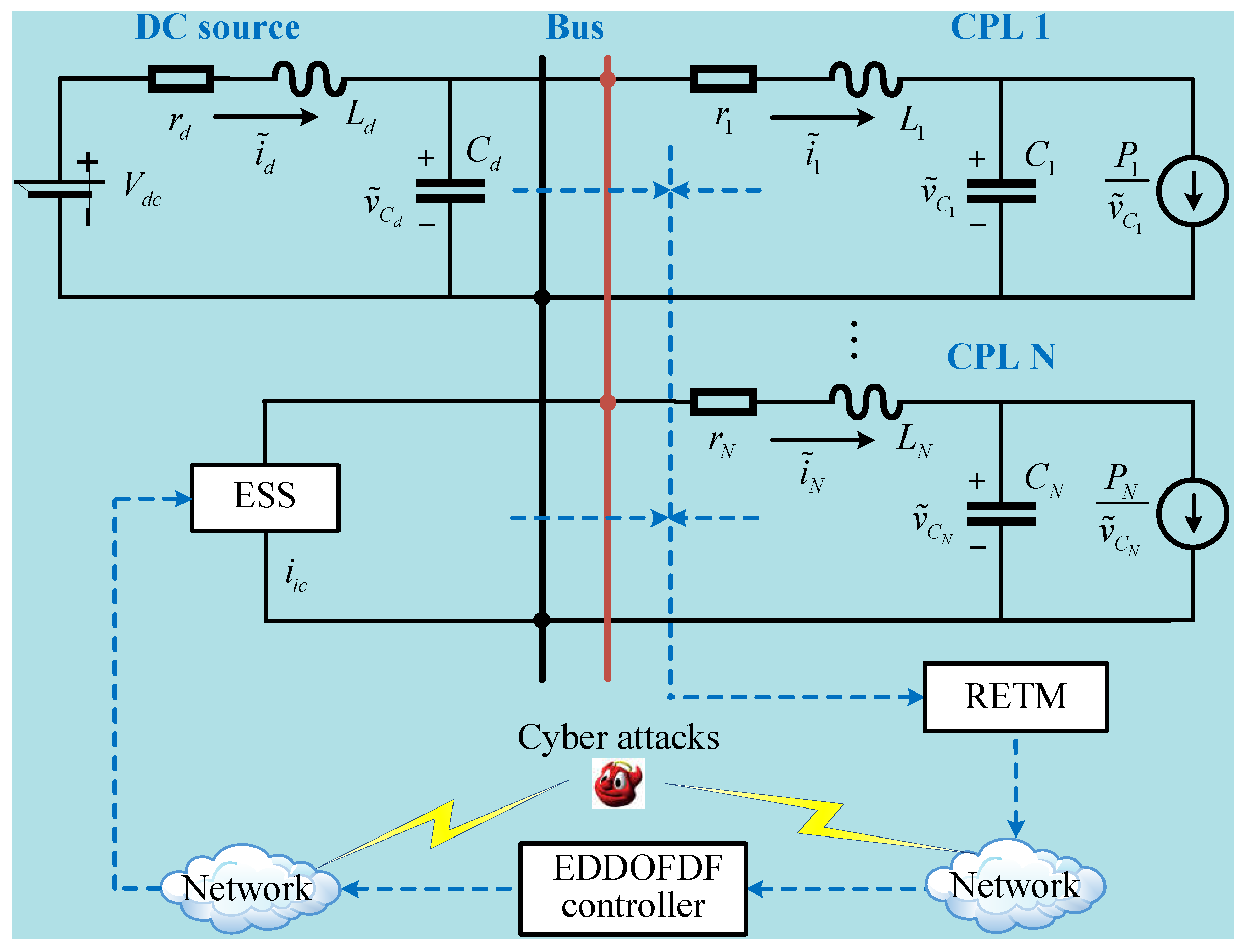
Remark 5. As shown in Figure 1, unlike the droop control, the DC source operates in constant voltage mode, and this article focuses on designing the EDDOFDF controller (13) to ensure system stability by taking into account the impacts of factors such as hybrid attacks, RETM, and noise. In addition, small-signal stability analysis, especially with low droop gain, is insufficient to ensure the microgrid’s resilient operation, because it does not account for the dynamic, nonlinear, and often unpredictable nature of cyber attacks [19]. Thus, the fuzzy controller (13) is designed with the objective of stabilizing the microgrid in the large signal sense. Using LMI technology to handle the coupling terms in Corollary 1, sufficient conditions are obtained for designing the state feedback controller (
51) as follows.
Corollary 2. For hybrid-attack parameters , , , H, RETM parameter δ, sampling period h, dissipative parameters , scalars , , , and which ensure , if there are symmetric matrices , matrices , and positive definite matrices , satisfying (20) andwherewith ,
, ,
, , , ,
, ,
,
, , , ,
, , ,
then the microgrid system (52) under hybrid attacks, RETM, noises, and premise mismatching is exponentially stable in mean square and strictly -dissipative, and parameters of the controller (51) are derived as . Proof. Similar to the proof of Theorem 3, using to handle the coupled terms in Corollary 1, Corollary 2 can be obtained. □
5. Case Study
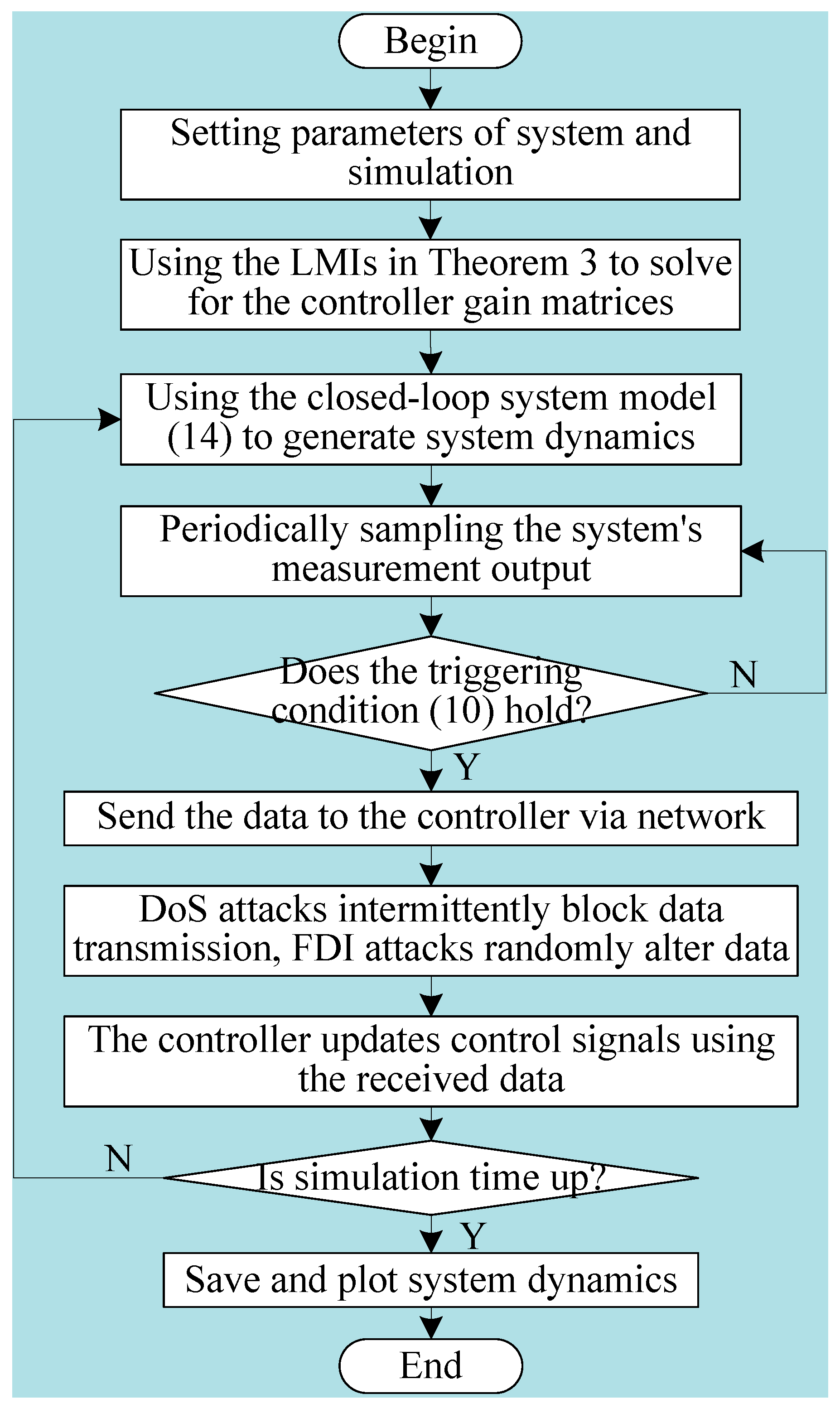
Using the MATLAB R2021a M-files, the simulation programs are developed, which mainly include an LMI solving program and a main program for system operation. As shown in
Figure 3, using the LMI solving program based on Theorem 3, the gain matrices (
) of the EDDOFDF controller (
13) can be obtained. In the main program for system operation, the closed-loop system model (
14) generates system dynamics, the event-triggered condition (
10) determines data transmission, impacts of DoS and FDI attacks are taken into account, control signals are updated with received data, the system model (
14) is refined by introducing updated control signals, and this cycle iterates until simulation time is up.
Use the DC microgrid in
Figure 1 with one CPL (i.e.,
) for example. The CPL subsystem’s parameters include
,
,
, constant load power
, and steady-state voltage
V. The DC source subsystem’s parameters contain
,
mH,
, and constant voltage source
V. System parameters are presented as follows: DoS attack parameters
FDI attack parameters
, DETM parameters
, noise signal
, dissipative parameters
, premise-related parameters
, sampling period
, gain matrices
,
,
, and scalars
,
.
Using Theorem 3, parameters of the EDDOFDF controller (
13) and RETM (
10) are simultaneously obtained as
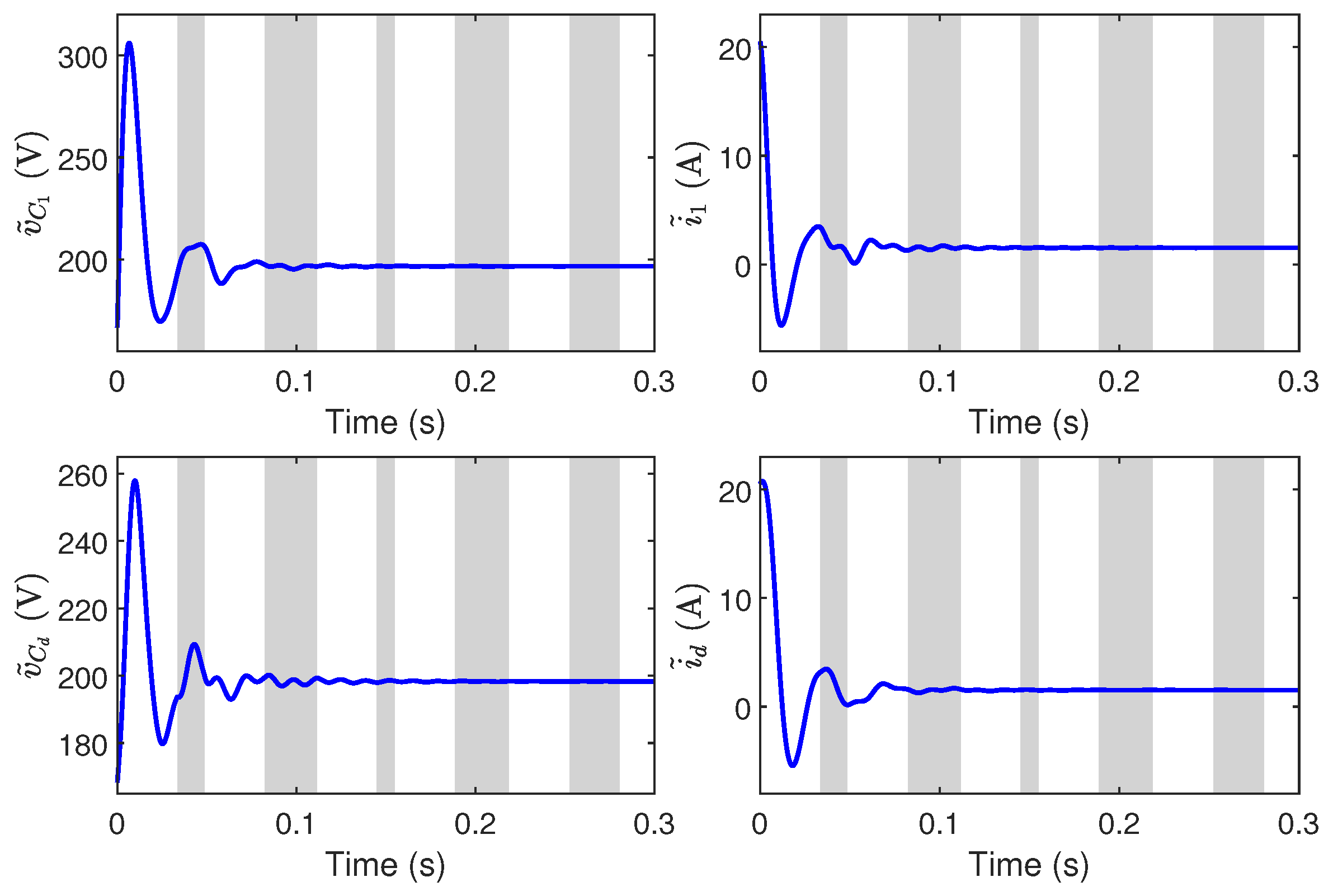
Figure 4 shows the state response of the microgrid, where the gray bands indicate active intervals of DoS attacks and the white bands denote sleeping intervals of DoS attacks. As shown in
Figure 4, under the action of the designed EDDOFDF controller, the microgrid system can reach the equilibrium state. Namely, although the microgrid system is simultaneously affected by hybrid attacks, RETM, and noise, the designed controller can still stabilize it. For example, the voltage
finally reaches its equilibrium point
V. The control input (i.e., injection current
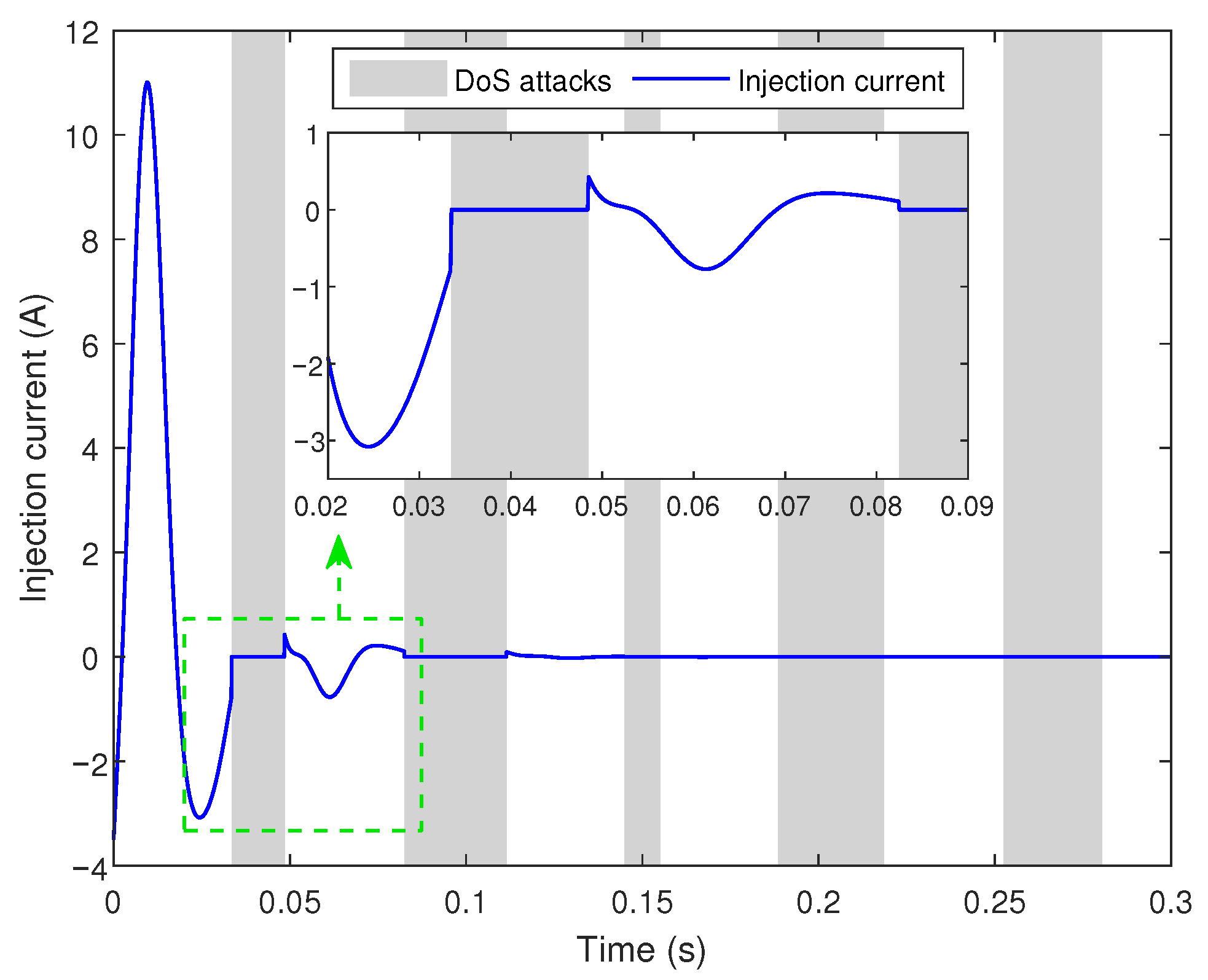
) of the microgrid system is shown in
Figure 5. During active intervals of DoS attacks, control signals are blocked, and thus the injection current becomes zero. During sleeping intervals of DoS attacks, control signals can successfully arrive at the microgrid, and thus the injection current works well.
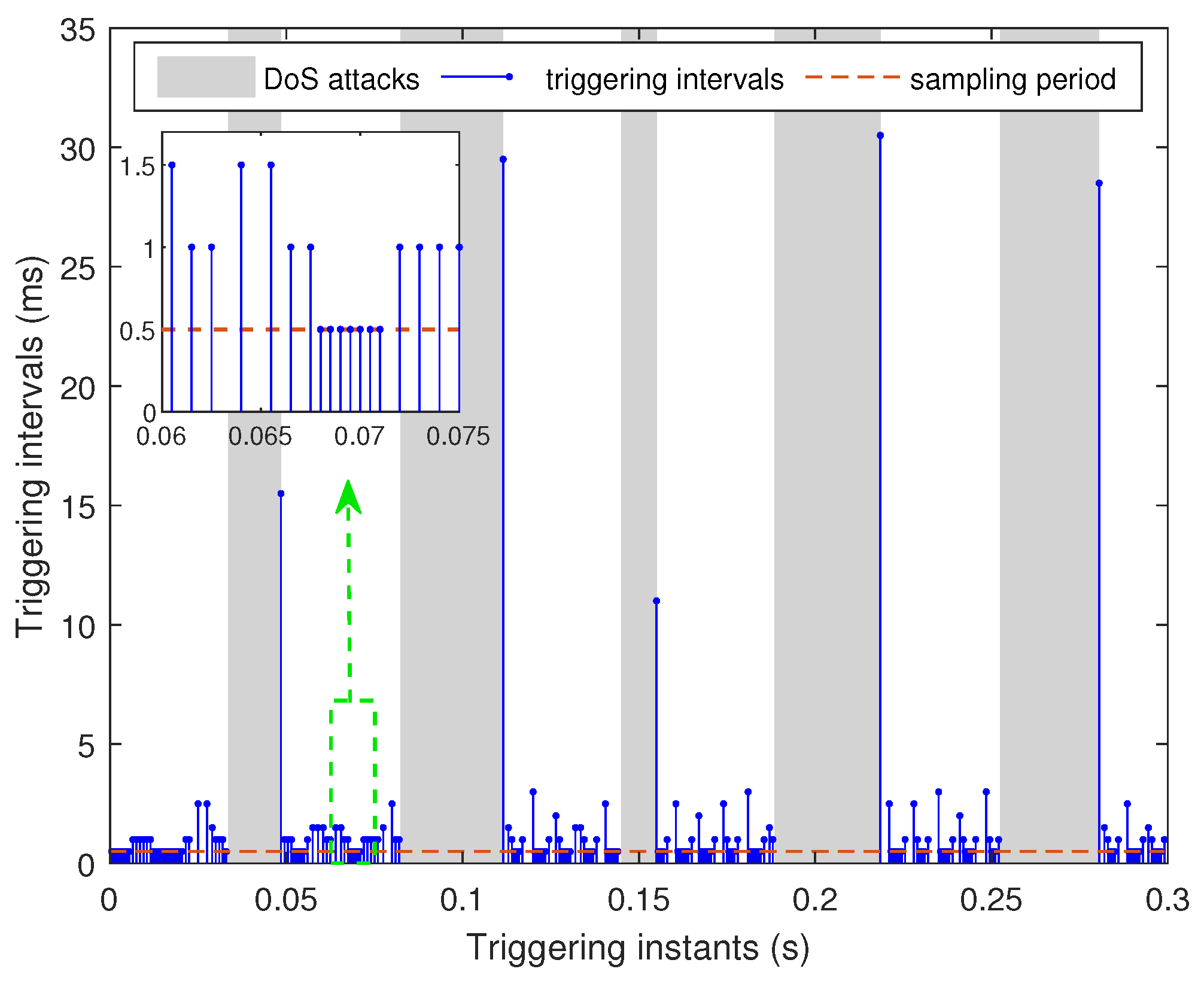
The triggering performance of the RETM is shown in
Figure 6. During sleeping intervals of DoS attacks, the triggering rate of the RETM is
, saving
of communication resources. At the beginning of each attack-sleeping interval (e.g.,
s,
s,
s,
s,
s), an event is triggered immediately to transmit sampled data, which helps compensate for the damage caused by the just-ending attack-active interval. As shown in the detail view, the triggering intervals of the RETM are no less than the sampling period
ms, and thus Zeno behavior is excluded. During active intervals of DoS attacks, the RETM does not trigger (i.e., no data is transmitted), which excludes the attack-induced dropout phenomenon.
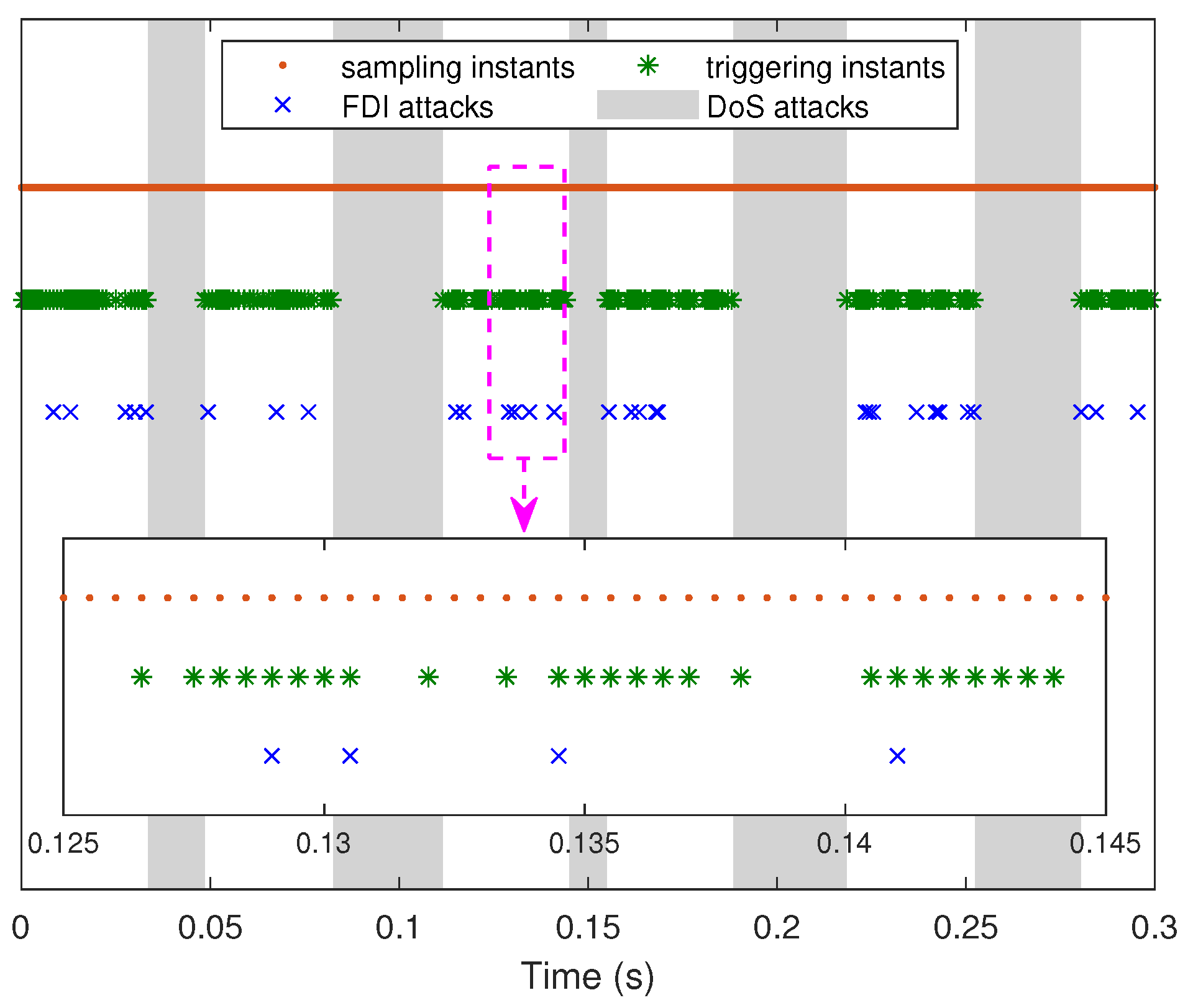
The activation time of DoS/FDI attacks is shown in
Figure 7. Using the sampling period
ms, measurement output of the microgrid is first periodically sampled. Among these periodically sampled data, the RETM releases 230 data packets during sleeping intervals of DoS attacks. Among the data released by the RETM, 30 data packets are maliciously tampered with by FDI attacks, which implies that the attack rate is
. Although the microgrid is affected by factors including DoS/FDI attacks, RETM, and noise, the proposed control strategy can still achieve satisfactory control performance while utilizing fewer communication resources.
6. Conclusions
The paper proposes an EDDOFDF control strategy for DC microgrids with nonlinear CPLs, taking effects of DoS and FDI attacks, RETM, and noises into consideration. First, using information of attacks and measurement output of the microgrid’s fuzzy model, an RETM is proposed to reduce unnecessary consumption of limited resources such as network bandwidth, which naturally excludes Zeno behavior and attack-induced packet dropouts. Second, considering the effects of hybrid attacks, RETM, and noise, and designing an EDDOFDF controller with mismatching premises, a unified closed-loop switched fuzzy system model is established. Third, by employing piecewise Lyapunov theory, exponential stability criteria in mean square with guaranteed dissipative performance are obtained, which present a platform to study the affecting factors’ quantitative impacts on system stability. Further, using LMI techniques to handle the coupled terms in stability criteria, sufficient conditions are obtained for designing the EDDOFDF controller, as well as the state-feedback switched fuzzy controller. The example shows that even if the microgrid is affected by many factors such as hybrid attacks, RETM, and noise, the designed EDDOFDF controller can still achieve satisfactory control performance. Meanwhile, the proposed RETM effectively reduces the data transmission rate to , which also excludes attack-induced dropouts and Zeno behavior phenomenon. Future research directions could focus on designing a resilient controller for hybrid AC/DC microgrids subject to complex attacks, developing artificial intelligence-based methods for detecting and mitigating cyber attacks in microgrids, and practically implementing microgrid control strategies using advanced devices such as PMUs, PDCs, and RTDS.