

Ivermectin Treatment Response in Onchocerca Volvulus Infected Persons with Epilepsy: A Three-Country Short Cohort Study

 , , , and
Abstract
1. Introduction
2. Materials and Methods
2.1. Study Participants and Study Sites
2.2. Aketi Health Zone, DRC
2.3. Logo Health Zone, DRC
2.4. Maridi, South Sudan
2.5. Mahenge, Tanzania
2.5.1. Participant Data
2.5.2. Skin Snip Testing
2.5.3. Ivermectin Treatment
2.5.4. Data Processing
2.5.5. Statistical Analysis
3. Results
3.1. Effects of Ivermectin Treatment on the Mf Density of Participants
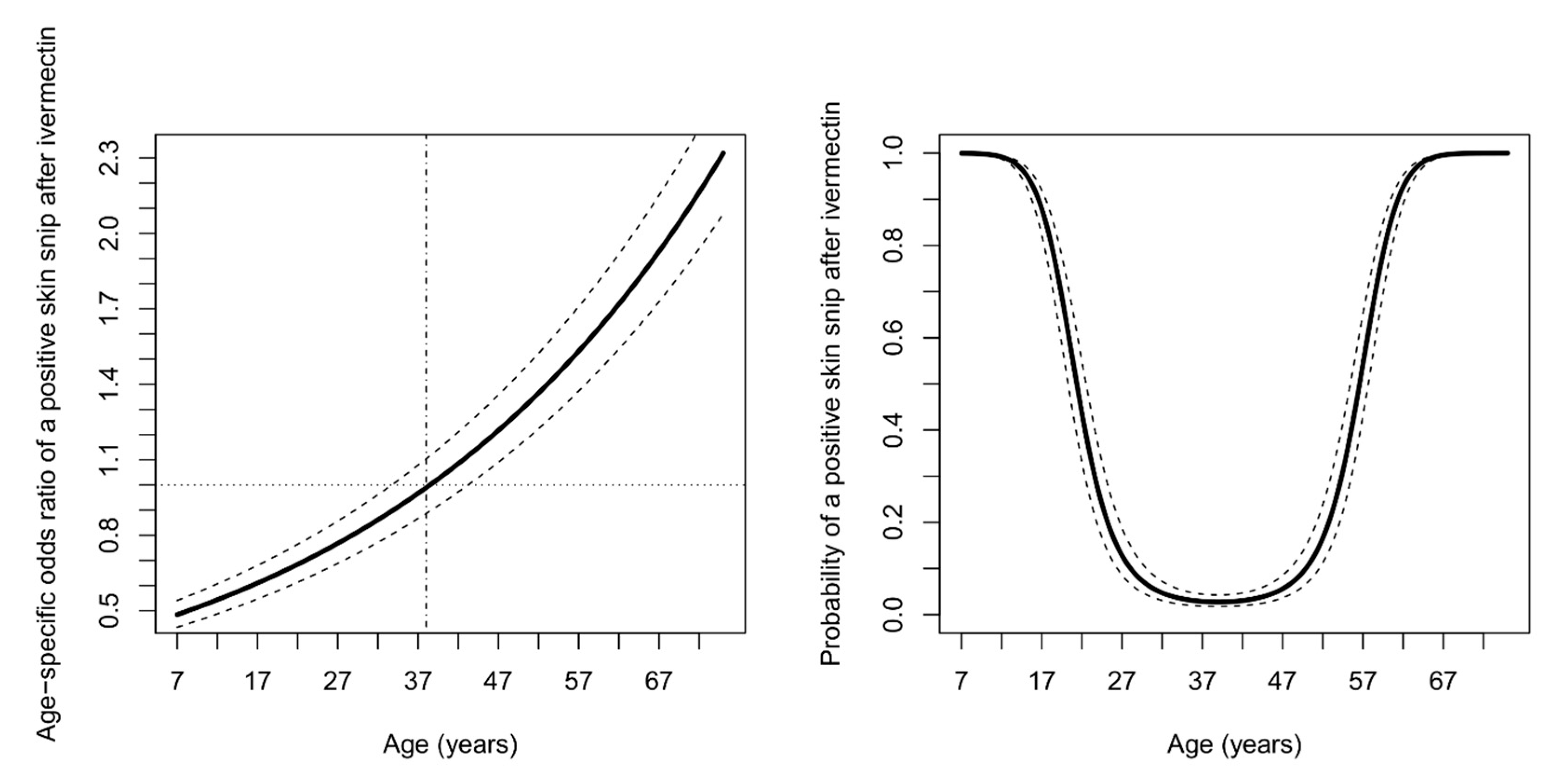
3.2. Host Factors Associated with Post-Ivermectin Mf Density Values Given a Post-Ivermectin Positive Skin Snip Test
4. Discussions
Author Contributions
Funding
Acknowledgments
Conflicts of Interest
Ethics approval and consent to participate
Appendix A

| Model | −2 LL | AIC | Pearson Chi-Square | Ranking |
|---|---|---|---|---|
| Poisson | 4907.6 | 8732.6 | 8566.8 | 5 |
| Negative Binomial | 4270.8 | 1467.6 | 536.4 | 3 |
| Poisson Hurdle | 5115.7 | 5157.7 | 1320.2 | 4 |
| ZINB | 1432.4 | 1472.4 | 465.7 | 2 |
| ZIP | 6303.1 | 5961.7 | 2200.8 | 6 |
| Negative Binomial Hurdle | 1408.8 | 1448.8 | 343.7 | 1 |
References
- NTD Modelling Consortium Onchocerciasis Group. The World Health Organization 2030 goals for onchocerciasis: Insights and perspectives from mathematical modelling: NTD Modelling Consortium Onchocerciasis Group. Gates Open Res. 2019, 3, 1545. [Google Scholar] [CrossRef]
- Colebunders, R.; Nelson Siewe, F.J.; Hotterbeekx, A. Onchocerciasis-Associated Epilepsy, an Additional Reason for Strengthening Onchocerciasis Elimination Programs. Trends Parasitol. 2018, 34, 208–216. [Google Scholar] [CrossRef] [PubMed]
- Basáñez, M.G.; Pion, S.D.S.; Boakes, E.; Filipe, J.A.; Churcher, T.S.; Boussinesq, M. Effect of single-dose ivermectin on Onchocerca volvulus: A systematic review and meta-analysis. Lancet Infect. Dis. 2008, 8, 310–322. [Google Scholar] [CrossRef]
- Osei-Atweneboana, M.Y.; Awadzi, K.; Attah, S.K.; Boakye, D.A.; Gyapong, J.O.; Prichard, R.K. Phenotypic evidence of emerging ivermectin resistance in Onchocerca volvulus. PLoS Negl. Trop. Dis. 2011, 5, e998. [Google Scholar] [CrossRef]
- Remme, J.H. Research for control: The onchocerciasis experience. Trop. Med. Int. Health 2004, 9, 243–254. [Google Scholar] [CrossRef]
- WHO. Onchocerciasis and Its Control; Technical Report Series No.852; World Health Organisation: Geneva, Switzerland, 1995. [Google Scholar]
- Tekle, A.H.; Zoure, H.G.; Noma, M.; Boussinesq, M.; Coffeng, L.E.; Stolk, W.A.; Remme, J.H. Progress towards onchocerciasis elimination in the participating countries of the African Programme for Onchocerciasis Control: Epidemiological evaluation results. Infect. Dis. Poverty 2016, 5, 66. [Google Scholar] [CrossRef]
- Osei-Atweneboana, M.Y.; Eng, J.K.; Boakye, D.A.; Gyapong, J.O.; Prichard, R.K. Prevalence and intensity of Onchocerca volvulus infection and efficacy of ivermectin in endemic communities in Ghana: A two-phase epidemiological study. Lancet 2007, 369, 2021–2029. [Google Scholar] [CrossRef]
- Siewe Fodjo, J.N.; Tatah, G.; Tabah, E.N.; Ngarka, L.; Nfor, L.N.; Chokote, S.E.; Mengnjo, M.K.; Dema, F.; Sitouok, A.T.; Nkoro, G.; et al. Epidemiology of onchocerciasis-associated epilepsy in the Mbam and Sanaga river valleys of Cameroon: Impact of more than 13 years of ivermectin. Infect. Dis. Poverty 2018, 7, 114. [Google Scholar] [CrossRef]
- Mukendi, D.; Tepage, F.; Akonda, I.; Siewe, J.N.F.; Rotsaert, A.; Ndibmun, C.N.; Laudisoit, A.; Couvreur, S.; Kabutako, B.; Menon, S.; et al. High prevalence of epilepsy in an onchocerciasis endemic health zone in the Democratic Republic of the Congo, despite 14 years of community-directed treatment with ivermectin: A mixed-method assessment. Int. J. Infect. Dis. 2019, 79, 187–194. [Google Scholar] [CrossRef]
- Mmbando, B.P.; Suykerbuyk, P.; Mnacho, M.; Kakorozya, A.; Matuja, W.; Hendy, A.; Greter, H.; Makunde, W.H.; Colebunders, R. High prevalence of epilepsy in two rural onchocerciasis endemic villages in the Mahenge area, Tanzania, after 20 years of community directed treatment with ivermectin. Infect. Dis. Poverty 2018, 7, 64. [Google Scholar] [CrossRef]
- Colebunders, R.; Cater, J.Y.; Olore, P.C.; Puok, K.; Bhattacharyya, S.; Menon, S.; Abd-Elfarag, G.; Ojok, M.; Ensoy-Musoro, C.; Lako, R.; et al. High prevalence of onchocerciasis-associated epilepsy in villages in Maridi County, Republic of South Sudan: A community-based survey. Seizure 2018, 63, 93–101. [Google Scholar] [CrossRef] [PubMed]
- Lenaerts, E.; Mandro, M.; Mukendi, D.; Suykerbuyk, P.; Dolo, H.; Wonya’Rossi, D.; Ngave, F.; Ensoy-Musoro, C.; Laudisoit, A.; Hotterbeekx, A.; et al. High prevalence of epilepsy in onchocerciasis endemic health areas in Democratic Republic of the Congo. Infect. Dis. Poverty 2018, 7, 68. [Google Scholar] [CrossRef] [PubMed]
- Doyle, S.R.; Bourguinat, C.; Nana-Djeunga, H.C.; Kengne-Ouafo, J.A.; Pion, S.D.S.; Bopda, J.; Kamgno, J.; Wanji, S.; Che, H.; Kuesel, A.C.; et al. Genome-wide analysis of ivermectin response by Onchocerca volvulus reveals that genetic drift and soft selective sweeps contribute to loss of drug sensitivity. PLoS Negl. Trop. Dis. 2017, 11, e0005816. [Google Scholar] [CrossRef] [PubMed]
- Mandro, M.; Siewe Fodjo, J.N.; Dusabimana, A.; Mukendi, D.; Haesendonckx, S.; Lokonda, R.; Nakato, S.; Nyisi, F.; Abhafule, G.; Wonya’rossi, D.; et al. Single versus Multiple Dose Ivermectin Regimen in Onchocerciasis-Infected Persons with Epilepsy Treated with Phenobarbital: A Randomized Clinical Trial in the Democratic Republic of Congo. Pathogens 2020, 9, 205. [Google Scholar] [CrossRef] [PubMed]
- Levick, B.; Laudisoit, A.; Tepage, F.; Ensoy-Musoro, C.; Mandro, M.; Bonareri Osoro, C.; Suykerbuyk, P.; Kashama, J.M.; Komba, M.; Tagoto, A.; et al. High prevalence of epilepsy in onchocerciasis endemic regions in the Democratic Republic of the Congo. PLoS Negl. Trop. Dis. 2017, 11, e0005732. [Google Scholar] [CrossRef]
- Fodjo, J.N.S.; Mandro, M.; Mukendi, D.; Tepage, F.; Menon, S.; Nakato, S.; Nyisi, F.; Abhafule, G.; Wonya’rossi, D.; Anyolito, A. Onchocerciasis-associated epilepsy in the Democratic Republic of Congo: Clinical description and relationship with microfilarial density. PLoS Negl. Trop. Dis. 2019, 13, e0007300. [Google Scholar] [CrossRef]
- Abd-Elfarag, G.; Carter, J.Y.; Raimon, S.; Sebit, W.; Suliman, A.; Fodjo, J.N.S.; Olore, P.C.; Biel, K.P.; Ojok, M.; Logora, M.Y. Persons with onchocerciasis-associated epilepsy and nodding seizures have a more severe form of epilepsy with more cognitive impairment and higher levels of Onchocerca volvulus infection. Epileptic Disord. 2020, 22, 301–308. [Google Scholar] [CrossRef] [PubMed]
- Boyd, E. The Growth of Surface Area o! the Human Body, 3rd ed.; University of Minnesota Press: Minneapolis, MN, USA, 1935. [Google Scholar]
- Sharkey, I.; Boddy, A.V.; Wallace, H.; Mycroft, J.; Hollis, R.; Picton, S.; Chemotherapy Standardisation group of the United Kingdom Children’s Cancer Study Group. Body surface area estimation in children using weight alone: Application in paediatric oncology. Br. J. Cancer 2001, 85, 23–28. [Google Scholar] [CrossRef]
- Heaf, J.G. The origin of the 1 x 73-m2 body surface area normalization: Problems and implications. Clin. Physiol. Funct. Imaging 2007, 27, 135–137. [Google Scholar] [CrossRef]
- Hu, M.C.; Pavlicova, M.; Nunes, E.V. Zero-inflated and hurdle models of count data with extra zeros: Examples from an HIV-risk reduction intervention trial. Am. J. Drug Alcohol Abus. 2011, 37, 367–375. [Google Scholar] [CrossRef]
- Ding, J.; Tarokh, V.; Yang, Y. Model selection techniques: An overview. IEEE Signal Process. Mag. 2018, 35, 16–34. [Google Scholar] [CrossRef]
- Opoku, N.O.; Bakajika, D.K.; Kanza, E.M.; Howard, H.; Mambandu, G.L.; Nyathirombo, A.; Nigo, M.M.; Kasonia, K.; Masembe, S.L.; Mumbere, M.; et al. Single dose moxidectin versus ivermectin for Onchocerca volvulus infection in Ghana, Liberia, and the Democratic Republic of the Congo: A randomised, controlled, double-blind phase 3 trial. Lancet 2018, 392, 1207–1216. [Google Scholar] [CrossRef]
- Prichard, R.; Ménez, C.; Lespine, A. Moxidectin and the avermectins: Consanguinity but not identity. Int. J. Parasitol. Drugs Drug Resist. 2012, 2, 134–153. [Google Scholar] [CrossRef]
- Pion, S.D.; Grout, L.; Kamgno, J.; Nana-Djeunga, H.; Boussinesq, M. Individual host factors associated with Onchocerca volvulus microfilarial densities 15, 80 and 180 days after a first dose of ivermectin. Acta Trop. 2011, 120 (Suppl 1), S91–S99. [Google Scholar] [CrossRef]
- Churcher, T.S.; Pion, S.D.; Osei-Atweneboana, M.Y.; Prichard, R.K.; Awadzi, K.; Boussinesq, M.; Collins, R.C.; Whitworth, J.A.; Basanez, M.G. Identifying sub-optimal responses to ivermectin in the treatment of River Blindness. Proc. Natl. Acad. Sci. USA 2009, 106, 16716–16721. [Google Scholar] [CrossRef]
- Burnham, G. Onchocerciasis. Lancet 1998, 351, 1341–1346. [Google Scholar] [CrossRef]
- Pion, S.D.; Nana-Djeunga, H.C.; Kamgno, J.; Tendongfor, N.; Wanji, S.; Njiokou, F.; Prichard, R.K.; Boussinesq, M. Dynamics of Onchocerca volvulus microfilarial densities after ivermectin treatment in an ivermectin-naive and a multiply treated population from Cameroon. PLoS Negl. Trop. Dis. 2013, 7, e2084. [Google Scholar] [CrossRef] [PubMed]
- Kaplan, R.M. Drug resistance in nematodes of veterinary importance: A status report. Trends Parasitol. 2004, 20, 477–481. [Google Scholar] [CrossRef] [PubMed]
- Sutherland, I.A.; Leathwick, D.M. Anthelmintic resistance in nematode parasites of cattle: A global issue? Trends Parasitol. 2011, 27, 176–181. [Google Scholar] [CrossRef] [PubMed]
- Wolstenholme, A.J.; Fairweather, I.; Prichard, R.; von Samson-Himmelstjerna, G.; Sangster, N.C. Drug resistance in veterinary helminths. Trends Parasitol. 2004, 20, 469–476. [Google Scholar] [CrossRef]
| Characteristic | South Sudan | DRC | Tanzania | |
|---|---|---|---|---|
| Maridi | Logo | Aketi | Mahenge | |
| Years of CDTI | 1 | 0 | 14 | 21 |
| Number of months since last CDTI | 12 | NA | 12 | 5 |
| Number of months between pre-treatment skin snip (followed by ivermectin administration) and post-treatment skin snip | 5 | 4 | 3 | 3 |
| Participant Characteristic | South Sudan | DRC | Tanzania | |
|---|---|---|---|---|
| Maridi (n = 102) | Logo (n = 136) | Aketi (n = 74) | Mahenge (n = 17) | |
| Age (years), Median (IQR) | 16.5 (14.0–18.0) | 22.0 (17.0–30.5) | 17.0 (15.0–20.0) | 35.0 (25.0–45.0) |
| Male gender: n (%) | 53 (50) | 69 (49) | 40 (49) | 11 (46) |
| Weight (kg), Median (IQR) | 38.0 (30.0–48.0) | 45.0 (38.5–50.0) | 37.5 (43.5–54.5) | 45.0 (40.0–51.0) |
| Height (cm), Median (IQR) | 158.0 (154.5–162.0) | 154.0 (147.0–160.0) | 154.0 (138.0–156.0) | 154.0 (146.0–160.0) |
| Pre-ivermectin mf density per skin snip, Median (IQR) | 22.7 (12.0–44.5) | 28.0 (7–93.0) | 9.4 (3.0–52.5) | 2 (2.0–20.6) |
| Pre-ivermectin mf density, GM (SE) | 15.0 (1.1) | 24.7 (3.2) | 12.9 (2.1) | 5.7 (1.6) |
| Maridi (n = 102) | Logo (n = 136) | Aketi (n = 74) | Mahenge (n = 17) | |
|---|---|---|---|---|
| Months post-ivermectin intake: n | 5 | 4 | 3 | 3 |
| Positive skin snip: n (%) | 82 (80) | 66 (48) | 18 (24) | 9 (53) |
| <80% decrease in individual mf density: n (%) | 52 (51) | 38 (28) | 8 (11) | 7 (41) |
| Overall Mf per skin snip, Median (IQR) | 4.5 (1.0–17.5) | 0.0 (0.0–9.0) | 0.0 (0.0–0.5) | 0.5 (0.0–1.0) |
| Mf per skin snip of PWE with post-ivermectin positive skin snip; Median (IQR) | 5.0 (1.5–19.0) | 10.5 (2.5–38.0) | 2.0 (0.5–5.5) | 1 (0.5–1.0) |
| Post-ivermectin GM mf density per skin snip, GM (SE) | 4.7 (0.6) | 3.4 (0.5) | 1.4 (0.2) | 1.6 (0.3) |
| Overall percentage reduction in GM mf density per skin snip (%) | 69 | 86 | 89 | 72 |
| Post-Ivermectin O. volvulus Mf Density | Probability of Positive Skin Snip after Ivermectin Treatment | |||||||
|---|---|---|---|---|---|---|---|---|
| Factors | Coeff | 95% CI | p-Value | Coeff | 95% CI | p-Value | ||
| Female gender | −0.312 | −0.946 | 0.323 | 0.336 | −2.518 | −4.913 | −0.124 | 0.039 |
| Male gender (reference) | ||||||||
| Age (years) | 0.012 | −0.041 | 0.064 | 0.661 | −0.391 | −0.656 | −0.125 | 0.004 |
| Age*age (years) | −0.001 | −0.003 | 0.001 | 0.349 | 0.012 | 0.003 | 0.020 | 0.007 |
| Height in cm | −0.007 | −0.055 | 0.041 | 0.773 | 0.091 | −0.010 | 0.192 | 0.076 |
| Number of previous CDTI rounds in site | −0.216 | −0.515 | 0.083 | 0.157 | −0.591 | −1.252 | 0.069 | 0.079 |
| >1 year since last ivermectin dose | 0.455 | −0.476 | 1.386 | 0.338 | −2.020 | −4.137 | 0.097 | 0.062 |
| <1 year since last ivermectin dose (reference) | ||||||||
| Follow-up skin snip at month 3 | 2.734 | −1.823 | 7.290 | 0.240 | ||||
| Follow-up skin snip at month 4 | 0.533 | −0.384 | 1.450 | 0.255 | ||||
| Follow-up skin snip at month 5 (reference) | ||||||||
| Pre-ivermectin microfilarial density # | 0.337 | 0.064 | 0.611 | 0.016 | 1.187 | 0.161 | 2.213 | 0.023 |
| Factors | Coeff | 95% CI | p-Value | |
|---|---|---|---|---|
| Female gender | −0.058 | −0.568 | 0.453 | 0.825 |
| Male gender (reference) | ||||
| Age (years) | −0.097 | −0.192 | −0.002 | 0.044 |
| Age*age (years) | 0.001 | 0.001 | 0.003 | 0.045 |
| Height in cm | −0.019 | −0.048 | 0.010 | 0.207 |
| Number of previous CDTI rounds in site | 0.282 | 0.080 | 0.484 | 0.006 |
| Follow-up skin snip at month 3 | −6.943 | −10.064 | −3.822 | <0.001 |
| Follow-up skin snip at month 4 | −1.101 | −1.850 | −0.351 | 0.004 |
| Follow-up skin snip at month 5 (reference) | ||||
| Pre-ivermectin microfilarial density # | 0.202 | 0.012 | 0.392 | 0.037 |
© 2020 by the authors. Licensee MDPI, Basel, Switzerland. This article is an open access article distributed under the terms and conditions of the Creative Commons Attribution (CC BY) license (http://creativecommons.org/licenses/by/4.0/).
Share and Cite
Dusabimana, A.; Bhwana, D.; Raimon, S.; Mmbando, B.P.; Hotterbeekx, A.; Tepage, F.; Mandro, M.; Siewe Fodjo, J.N.; Abrams, S.; Colebunders, R. Ivermectin Treatment Response in Onchocerca Volvulus Infected Persons with Epilepsy: A Three-Country Short Cohort Study. Pathogens 2020, 9, 617. https://doi.org/10.3390/pathogens9080617
Dusabimana A, Bhwana D, Raimon S, Mmbando BP, Hotterbeekx A, Tepage F, Mandro M, Siewe Fodjo JN, Abrams S, Colebunders R. Ivermectin Treatment Response in Onchocerca Volvulus Infected Persons with Epilepsy: A Three-Country Short Cohort Study. Pathogens. 2020; 9(8):617. https://doi.org/10.3390/pathogens9080617
Chicago/Turabian StyleDusabimana, Alfred, Dan Bhwana, Stephen Raimon, Bruno P. Mmbando, An Hotterbeekx, Floribert Tepage, Michel Mandro, Joseph N. Siewe Fodjo, Steven Abrams, and Robert Colebunders. 2020. "Ivermectin Treatment Response in Onchocerca Volvulus Infected Persons with Epilepsy: A Three-Country Short Cohort Study" Pathogens 9, no. 8: 617. https://doi.org/10.3390/pathogens9080617
APA StyleDusabimana, A., Bhwana, D., Raimon, S., Mmbando, B. P., Hotterbeekx, A., Tepage, F., Mandro, M., Siewe Fodjo, J. N., Abrams, S., & Colebunders, R. (2020). Ivermectin Treatment Response in Onchocerca Volvulus Infected Persons with Epilepsy: A Three-Country Short Cohort Study. Pathogens, 9(8), 617. https://doi.org/10.3390/pathogens9080617

