Short Communication

Detection of Porcine Circovirus 3 in Wildlife Species in Spain


1
Department of Swine Diseases, National Veterinary Research Institute, 24-100 Puławy, Poland
2
IRTA, Centre de Recerca en Sanitat Animal (CReSA, IRTA-UAB), Campus de la Universitat, Autònoma de Barcelona, 08193 Bellaterra, Spain
3
OIE Collaborating Centre for the Research and Control of Emerging and Re-emerging Swine Diseases in Europe (IRTA-CReSA), Bellaterra, 08193 Barcelona, Spain
4
Wildlife Conservation Medicine Research Group (WildCoM), Departament de Medicina i Cirurgia, Facultat de Veterinària, Universitat Autònoma de Barcelona, 08193 Barcelona, Spain
5
Research and Conservation Department, Zoo de Barcelona, 08003 Barcelona, Spain
6
UAB, Centre de Recerca en Sanitat Animal (CReSA, IRTA-UAB), Campus de la Universitat, Autònoma de Barcelona (UAB), 08193 Bellaterra, Spain
7
Departament de Sanitat i Anatomia Animals, Facultat de Veterinària, Universitat Autònoma de Barcelona (UAB), 08193 Bellaterra, Spain
*
Author to whom correspondence should be addressed.
Pathogens 2020, 9(5), 341; https://doi.org/10.3390/pathogens9050341

Submission received: 13 March 2020 / Revised: 22 April 2020 / Accepted: 29 April 2020 / Published: 1 May 2020
(This article belongs to the Special Issue Porcine Circovirus Infections)

Abstract

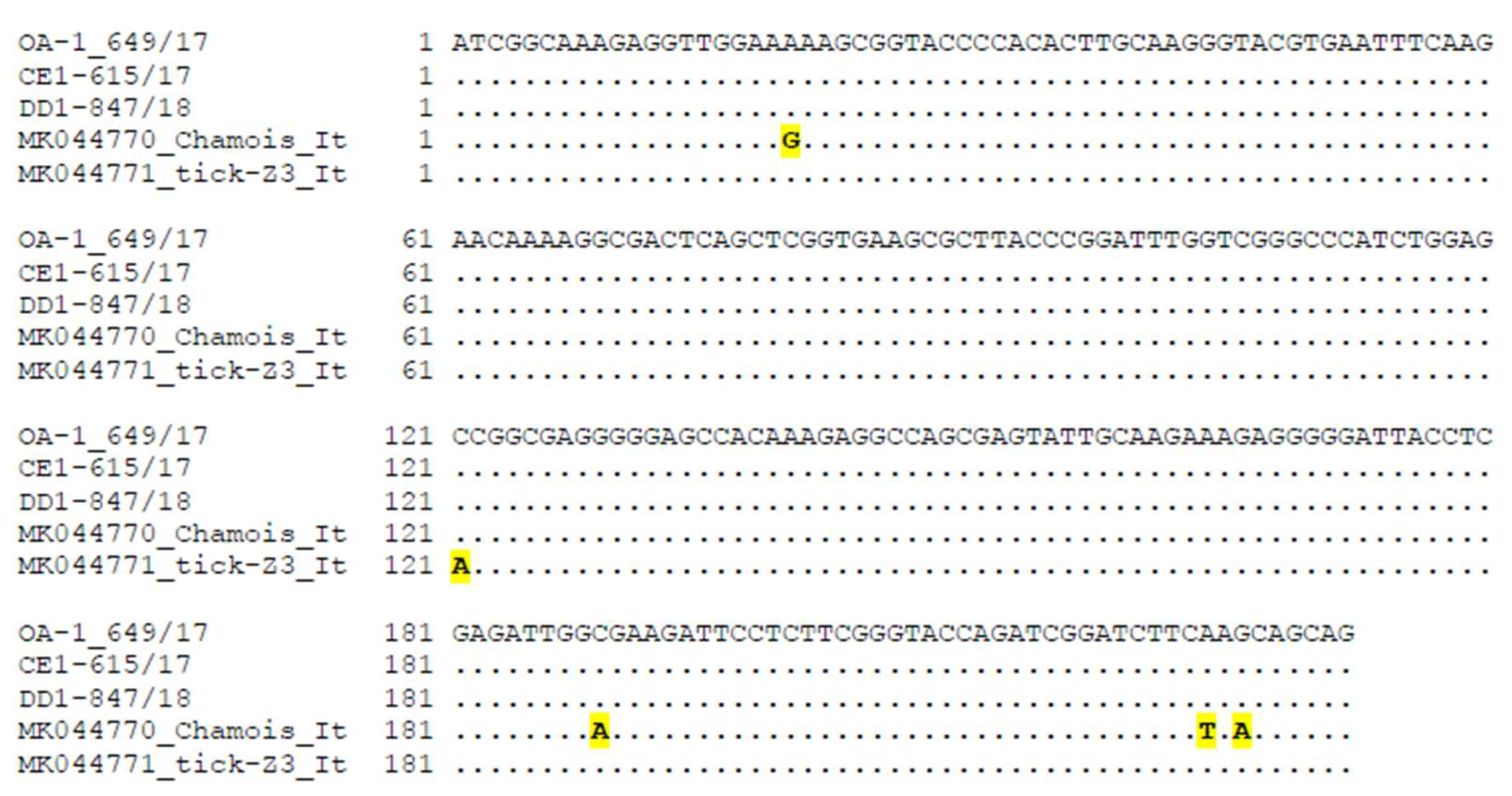
Porcine circovirus 3 (PCV-3) is the third member of the family Circoviridae, genus Circovirus, able to infect swine. A high prevalence of viral DNA has been recorded in wild boars. Recently, PCV-3 DNA was identified in Italian wild ruminants. Based on these previous results, this study assessed the frequency of PCV-3 DNA detection in free-ranging ruminants and Lagomorpha species in Spain. In addition, the genetic characterization of the PCV-3 PCR-positive samples was performed. A total of 801 serum samples, including red deer (Cervus elaphus, [CE]; n = 108), roe deer (Capreolus capreolus, [CC]; n = 87), Pyrenean chamois (Rupicapra pyrenaica, [RP]; n = 133), Iberian ibex (Capra pyrenaica, [CP]; n = 92), mouflon (Ovis aries, [OA]; n = 91), fallow deer (Dama dama, [DD]; n = 104), European rabbit (Oryctolagus cuniculus, [OC]; n = 101), and European hare (Lepus europaeus, [LE]; n = 85) from Catalonia (northeast Spain) were tested by conventional polymerase chain reaction (PCR) and, when positive, sequenced. Overall, PCV-3 DNA was found in three out of 801 analyzed sera (0.37%) corresponding to one red deer (1/108, 0.9%), one mouflon (1/91, 1.1%), and one fallow deer (1/104, 0.96%). None of the samples collected from Lagomorpha species resulted PCR positive. The partial genome sequences detected in positive samples displayed high identity with some PCV-3 sequences detected in wild boars and domestic pigs (99.7% and 100%, respectively). In conclusion, the present study indicated that free-ranging ruminant and Lagomorpha species are not relevant in the epidemiology of PCV-3 in Spain.
Keywords: molecular epidemiology; porcine circovirus 3 (PCV-3); Spain; wildlife species molecular epidemiology; porcine circovirus 3 (PCV-3); Spain; wildlife species