Article

Bovine Brucellosis in Dairy Herds in Mali and Niger, 2024: Apparent Seroprevalence and Epidemiological Factors

1
Vector-Borne Diseases and Biodiversity Unit (UMaVeB), International Research and Development Centre on Livestock in Sub-Humid Areas (CIRDES), Bobo-Dioulasso BP 454, Burkina Faso
2
Laboratoire Central Vétérinaire (LCV), Bamako BP 2295, Mali
3
Laboratoire Central de l’élevage (LABOCEL), Niamey BP 485, Niger
4
Faculté d’Agronomie (FA), Université Abdou Moumouni (UAM), Niamey BP 10896, Niger
5
Sciensano, Belgian Institute for Health, 1050 Brussels, Belgium
6
Belgian Agency for International Cooperation (Enabel), Niamey BP 12 987, Niger
7
Research Unit in Epidemiology, Risk Analysis and Biosecurity Applied to Veterinary Sciences (UREAR-ULiege), Fundamental and Applied Research for Animals & Health (FARAH) Center, Faculty of Veterinary Medicine, University of Liege, 4000 Liege, Belgium
*
Authors to whom correspondence should be addressed.
Pathogens 2026, 15(7), 764; https://doi.org/10.3390/pathogens15070764
Submission received: 7 June 2026 / Revised: 14 July 2026 / Accepted: 19 July 2026 / Published: 21 July 2026

Abstract

As part of the PRISMA project, which promotes research and innovation for productive, resilient, and healthy agro-pastoral systems in West Africa, a cross-sectional survey was conducted to assess the apparent seroprevalence and investigate epidemiological factors associated with bovine brucellosis in dairy herds. The survey was carried out in Mali (Bamako, Koulikoro, Mopti, and Sikasso regions) and Niger (Tahoua, Dosso, and Tillabéry regions). A total of 1230 animals from 82 herds were tested, including 645 animals from 43 herds in Mali and 585 animals from 39 herds in Niger. At the herd level, apparent seroprevalence was significantly higher in Mali than in Niger (37.21% vs. 15.38%). Within each country, animal-level seroprevalence varied across region, with the highest levels observed in Bamako (11.11%) and Mopti (7.62%) in Mali, and Dosso (6.67%) in Niger. High within-herd prevalence (>20%) was identified in only one herd per country. The higher overall herd-level seroprevalence in Mali was primarily driven by a greater number of herds with low (≤10%) within-herd seroprevalence. Univariate risk factor analysis at the animal level identified a borderline trend toward higher odds of seropositivity in crossbred cattle than other breeds (OR = 1.95, 95% CI: 1.00–3.81, p = 0.0503). In addition, a classification tree analysis highlighted seven exploratory signals of the positive herd status. These included four animal/management-level factors—herd region, environmental disposal of aborted placentas, the number of lactating cows (as a proxy for animal density), and reported herd abortions—as well as three human-level signals within the household: a history of miscarriage, experiencing heavy night sweats, and suffering from undulant fever. In conclusion, this survey provides new insights into bovine brucellosis and its epidemiology in dairy herds in Mali and Niger, confirming established high-prevalence areas such as Bamako and identifying new zones of concern, such as Mopti and Dosso. Our findings underscore that bovine brucellosis remains an important public health and economic threat in both countries. Given that the identified positive regions are hubs for milk production and consumption, these data may support health authorities in implementing targeted surveillance, control, and prevention strategies under a One Health approach.

1. Introduction

Brucellosis is a major bacterial zoonotic disease that severely impacts both human health and livestock productivity globally [1,2,3]. Recent conservative estimates indicate a global annual incidence of 1.6–2.1 million new human cases, with the highest burdens reported in Asia and Africa. However, when risk is assessed at the regional level by integrating incidence data with populations at risk, Africa emerges as the continent facing the greatest overall threat, particularly within equatorial zones of East and West Africa [4]. Considerable efforts have been dedicated to advancing the understanding of brucellosis across the continent. A recent systematic review and meta-analysis of brucellosis seroprevalence estimated a pooled livestock and human seroprevalence of 6.20% (95% confidence interval—[CI]: 4.90–7.83) for West Africa [5]. Yet, due to strict study inclusion criteria, this estimate relied on a single human study from Togo and livestock data from a restricted subset of West African countries—specifically Benin (n = 1), Burkina Faso (n = 1), Ghana (n = 2), Guinea (n = 2), Côte d’Ivoire (n = 2), Niger (n = 1), and Togo (n = 1)—while data from Mali were completely lacking. These findings highlight two critical gaps: first, human brucellosis data remain critically scarce in West Africa, despite the disease being recognized as a leading cause of non-malarial febrile illnesses across Africa [6]; second, comprehensive epidemiological data on livestock brucellosis remain fragmentary and are not systematically collected across temporal and geographical scales, including in Mali and Niger [5]. In these two countries, logistical challenges, political instability, and resource constraints further hamper routine surveillance efforts.
In Mali and Niger, agro-pastoral systems are vital to food security and rural livelihoods, particularly driven by the production of bovine milk and dairy derivatives. The cattle sector contributes substantially to national gross domestic products (GDPs) and represents a cornerstone of livestock production within the Economic Community of West African States (ECOWAS/CEDEAO). Beyond their economic significance, cattle constitute one of the primary reservoirs driving human brucellosis. Human infection may occur through direct contact with infected animals, aborted materials, or contaminated fluids; however, the consumption of raw milk and unpasteurized dairy products remains the predominant transmission pathway in endemic areas. This route is highly relevant in Niger, where raw milk consumption is widespread and bovine brucellosis persists as a deeply entrenched issue in rural communities [7]. Furthermore, structural vulnerabilities, such as the limited implementation of farm-level biosecurity measures, continue to exacerbate transmission risks at the human–animal interface [8].
Despite the existence of national epidemiological surveillance networks for priority animal diseases (EPIVET-Mali and RESEPI-Niger) [9], sparse epidemiological data and large-scale structured surveys on bovine brucellosis remain unavailable for both countries. In Mali, bovine brucellosis prevalence is predominantly documented through passive surveillance data or isolated, localized studies. For instance, historical prevalence was estimated at only 0.27% in Moorish Zebu cattle within the Nara Circle [10], contrasting sharply with an apparent prevalence of 22.08% reported in the intensive dairy basins of the Bamako district [11]. In addition, cattle passive surveillance data collected throughout the country between 2007 and 2013 highlighted fluctuating prevalence estimates ranging from a minimum of 5.17% (2009) to a maximum of 19.77% (2013) [12]. In humans, one study conducted on 150 febrile patients at a clinic in the Mopti region between June and August 2007, identified high seropositive rates for brucellosis against agglutination of Wright antigen of Brucella melitensis (58%) and B. abortus (49%), identifying housewives, traders, butchers and consumption of raw milk as risk factors [13]. Another cross-sectional study in Mopti determined a seroprevalence of 7.43% by BrucellaCAPT and 6.02% by PCR, with B. abortus identified as the predominant species in PCR-positive samples [14]. In Niger, brucellosis is known to span all livestock production systems and is endemic in cattle, posing a continuous spillover risk to human populations [7,15,16]. The few existing studies have concentrated heavily on the regions of Niamey, Tillabéri, and Zinder [7], reporting apparent seroprevalence of 2.0% (95% CI: 1.1–2.9%), 1.8% (95% CI: 1.2–2.5%), and 4.6% (95% CI: 3.1–6.2%) across urban, peri-urban and rural production frameworks, respectively. No published data on human brucellosis are currently available for Niger. Consequently, substantial portions of both countries remain epidemiologically undercharacterized, with limited baseline data available.
To address these data gaps, the present cross-sectional survey was conducted under the auspices of the European Union-supported PRISMA project, which aims to foster research and innovation for productive, resilient and healthy agro-pastoral systems in West Africa (specifically targeting Mali, Niger, and Burkina Faso) [17]. This study aimed to estimate the apparent seroprevalence of bovine brucellosis in dairy herds across Mali and Niger and to identify key herd- and animal-level risk factors associated with seropositivity. Given the socioeconomic importance of dairy production and localized milk consumption, this survey deliberately targeted major dairy basins characterized by intensive livestock activity and high human–animal interactions. The resulting data provide a critical, updated epidemiological baseline for Mali and a more comprehensive, multi-regional overview of the disease situation in Niger. Ultimately, these findings are intended to equip national veterinary and public health authorities with the evidence needed to reinforce targeted surveillance, control and prevention strategies against bovine brucellosis under a unified One Health approach.

2. Materials and Methods

2.1. Cattle Population in Mali and Niger

Mali possesses one of the largest livestock populations in West Africa. Its cattle herd, estimated at over 14 million, represents a major component of the national livestock sector, with the highest cattle densities concentrated in the Mopti region, a key agro-pastoral hub. Similarly, Niger hosts a cattle population exceeding 20 million head, including nearly 4 million milking cows, which are predominantly managed within traditional agro-pastoral systems.

2.2. Study Area and Sample Size Calculation

The data analyzed in this survey were generated as part of a comprehensive sero-epidemiological survey conducted between June and September 2024 under the auspices of the PRISMA project. The research targeted dairy cattle farms across four regions in Mali (Bamako, Koulikoro, Mopti, and Sikasso) spanning 43 locations, and three regions in Niger (Tahoua, Dosso, and Tillabéry) covering 39 locations. These regions were selected based on local milk consumption patterns and their status as primary dairy production basins within each country (Figure 1).
The survey followed a multistage probabilistic sampling design adapted to local operational constraints. Within each region, sampling locations (villages) were selected to maximize spatial coverage while accounting for field accessibility and security considerations. Within each selected location, one herd was randomly chosen, and 15 animals were randomly sampled from that herd. Because only one herd was sampled per village, each location corresponds directly to an individual herd. The epidemiological survey unit (herd) was defined as a group of sedentary, lactating cows managed collectively, owned by a single household, and maintained at the same geographic site. The target sample size was determined based on the estimated population of lactating females in each country and region (Table 1), an expected brucellosis seroprevalence of 10% derived from baseline literature [7], an allowable error margin of 1.75%, and a 95% CI. The overarching study design was developed by a multidisciplinary team of epidemiologists and formally approved during methodological workshops in 2022. These workshops involved leading One Health stakeholders representing the human public health, veterinary medicine, epidemiology, and diagnostic laboratory sectors of both nations.

2.3. Rose Bengal Testing (RBT)

Whole-blood samples were collected in the field using serum separator tubes, allowed to clot at ambient temperature, and transported under cold chain conditions to national laboratories. Upon arrival, tubes were centrifuged at 3000 rpm, and the supernatant serum was aliquoted and stored at −20 °C until diagnostic processing. Serum samples were evaluated using the Pourquier Rose Bengale Ag kit (IDEXX Laboratories, Saint-Denis, France), which utilizes a standardized suspension of inactivated B. abortus (strain Weybridge 99), following the manufacturer’s protocols and World Organization for Animal Health (WOAH) guidelines [18]. Briefly, 50 µL of antigen and 50 µL of test serum were dispensed side by side to the same well of a 24-well round-bottom glass plate. A specialized multi-pronged plastic comb was used to mix the antigen and serum simultaneously across wells. The plate was rocked continuously to observe agglutination over a strict 4 min incubation window, after which positive or negative reactions were immediately recorded. All diagnostic runs were performed alongside concurrent reference positive (serum from B. abortus-experimentally infected cattle [19]) and negative controls (fetal bovine serum; GE Healthcare, Machelen, Belgium). Reagent batches were certified by the European Reference laboratory for Brucellosis [20], procured via Belgium, and distributed directly to the respective local diagnostic facilities. Under field conditions, the reported diagnostic sensitivity of the RBT ranges from 80% to 90%, with a specificity between 95% and 98% in cattle [21].

2.4. Determination of Apparent Seroprevalence

Apparent seroprevalence at both the animal and herd levels was calculated as the proportion of positive test results relative to the total number of samples evaluated. Associated 95% CIs were calculated using the Wilson score method [22]. An individual animal was classified as seropositive if visible macroscopic agglutination was observed during the RBT. A herd was defined as seropositive if at least one animal within that herd tested positive.

2.5. Epidemiological Questionnaire Survey

A standardized epidemiological questionnaire was administered to collect information on animal characteristics, herd management practices, and household-level human behaviors and symptoms in order to identify potential risk factors associated with disease transmission (the complete list of variables is provided in Table A1). Data were collected through face-to-face interviews conducted in the local language by trained veterinarians and recorded electronically in real time using handheld tablets.

2.6. Statistical Analysis and Spatial Mapping

Statistical analyses were performed using Epitool [22], R version 4.2.3 [23] and STATA SE version 14.2 (StataCorp, College Station, TX, USA). Apparent animal- and herd-level seroprevalences, alongside within-herd seroprevalence, were compared across countries and regions using Pearson’s Chi-squared tests. Cohen’s Kappa coefficient was used to quantify inter-rater agreement for categorical parameter while adjusting for chance agreement [24]. Confidence intervals were calculated according to the Wilson efficient-score method, corrected for continuity. Kappa values were interpreted according to standard benchmarks: <0.2, slight agreement; 0.2–0.4, fair agreement; 0.4–0.6, moderate agreement; 0.6–0.8, substantial agreement; and >0.8, almost perfect agreement.
Univariate analyses exploring associations between potential risk factors and brucellosis seropositivity were performed at multiple spatial levels (combined countries, individual country level, region level, and pooled selected regions) for both animal and herd data. The serological outcome variable was treated as a binary variable (positive vs. negative). Animal-level models evaluated four categorical variables: sex, age group, breed, and species. Herd-level models assessed eighteen variables (Table A1), of which sixteen were binary. The household sanitary conditions variable was stratified into three tiers (1 = Good; 2 = Moderate; 3 = Poor), and the total number of lactating females within the herd was categorized into four intervals (1 = <10; 2 = 10–19; 3 = 20–29; 4 = 30–39).
Variables demonstrating marginal or strong associations in the univariate screening (p ≤ 0.10) were advanced into multivariable logistic regression models. At the individual animal level, the multivariable model adjusted for breed category (crossbred vs. other breeds) and country of origin. At the herd level, the multivariable framework incorporated placenta disposal practices and the presence of animal assembly areas. Adjusted odds ratios (aOR) were calculated to quantify risks while controlling for confounding effects. Statistical significance was defined at p < 0.05, whereas p-values between 0.05 and 0.10 were considered indicative of a statistical trend.
Classification tree analysis (CTA) was subsequently implemented to resolve direct and indirect explanatory pathways influencing herd brucellosis status. Classification and regression tree (CART) modeling is a non-parametric machine learning technique based on recursive binary partitioning. This approach systematically splits a population into increasingly homogeneous subgroups relative to the target dependent variable (for architectural details, see [25]). The CART analysis carries out cross-validation, growing optimum trees on data sub-groups, then calculating the error rates based on the parts of the complete dataset not used. The CART analysis divides all the data into ten almost equal parts selected at random, with each part containing a similar distribution of data from the populations under consideration (namely notification or non-notification of abortions by the farmer). The analysis then uses the first nine datasets (9/10) to construct the largest possible tree and uses the last part of the data (1/10) to estimate the error rate of the selected tree. The process is repeated using different combinations of the nine remaining data subsets and a different data subset to test the resulting tree. This process is repeated until each 1/10 data subset has been used to test a tree developed using the remaining nine dataset subsets (9/10). The results of the ten mini-tests are then combined to calculate the error rates for each possible size of tree. These error rates are then applied to prune the tree that was developed using all the data. The outcome of this complex process is a set of relatively reliable independent estimates of the accuracy of the clinical decision tree prediction. For each node in a tree generated by CART, the main separator is the variable that best divides the node, thereby maximizing the purity of the resulting nodes. To test the diagnostic power of the final decision tree generated, a receiver operating characteristic (ROC) was employed both for the original dataset used to construct the tree (training data) and for the dataset used to test the performance of the decision tree (test data) [25].
Spatial maps were generated using QGIS software (version 3.44, [26]) using publicly available boundaries [27].

2.7. Ethical Requirements

The study protocols and field instruments were formally vetted and approved by respective institutional review board: the Ethics Committee of the University of Sciences, Techniques and Technologies of Bamako (USTTB) in Mali and the National Ethics Committee for Health Research (CNERS) of Niger. Following institutional reviews, protocols were refined, and final written ethical clearances were issued in August and June 2023 under reference numbers 2023/190/CE/USTTB and 35/2023/CNERS, respectively.

3. Results

3.1. RBT Training and Test Performance Validation

Prior to launching the survey, the diagnostic proficiency for RBT at the two participating national laboratories (LCV-Mali and LABOCELL-Niger) was evaluated via an interlaboratory comparison using a standardized panel of blinded reference sera. The initial baseline assessment revealed discrepancies in diagnostic performance between laboratories. While the first laboratory demonstrated perfect concordance with the reference standard (κ = 1.00), the second laboratory exhibited significantly lower diagnostic agreement (κ = 0.444). To address these technical shortcomings, two capacity-building training interventions were implemented: an intensive on-site workshop in Niamey (April 2023) and a follow-up interactive online session (June 2023). These sessions focused on harmonizing procedural methodologies, standardizing diagnostic reading criteria using certified reference standards, and validating technical performance through joint evaluation by analysts from the Belgian Brucellosis Reference Centre and local laboratory staff. Following these interventions, a repeat proficiency panel confirmed that the second laboratory achieved perfect diagnostic alignment with the expected reference outcomes (κ = 1.0; Table A2).
Subsequently, a method validation comparison between the standardized RBT and an indirect enzyme-linked immunosorbent assay (ELISA) was performed on a representative serum subset (n = 407) (Table A3). Given the almost perfect agreement observed between the two diagnostic modalities (κ = 0.883; p < 0.05), coupled with the superior cost-effectiveness and field-level operational feasibility of the agglutination platform in low- and middle-income settings, RBT was selected as the sole diagnostic framework for full dataset analysis.

3.2. Apparent Animal- and Herd-Level Seroprevalence and Mapping of Bovine Brucellosis in Mali and Niger

A total of 1230 animals from 82 herds were tested across Mali and Niger. Overall, apparent animal-level seroprevalence was higher in Mali than in Niger; however, this cross-border divergence achieved statistical significance only when aggregated at the herd level (37.21% vs. 15.38%, p = 0.048) (Table A4).
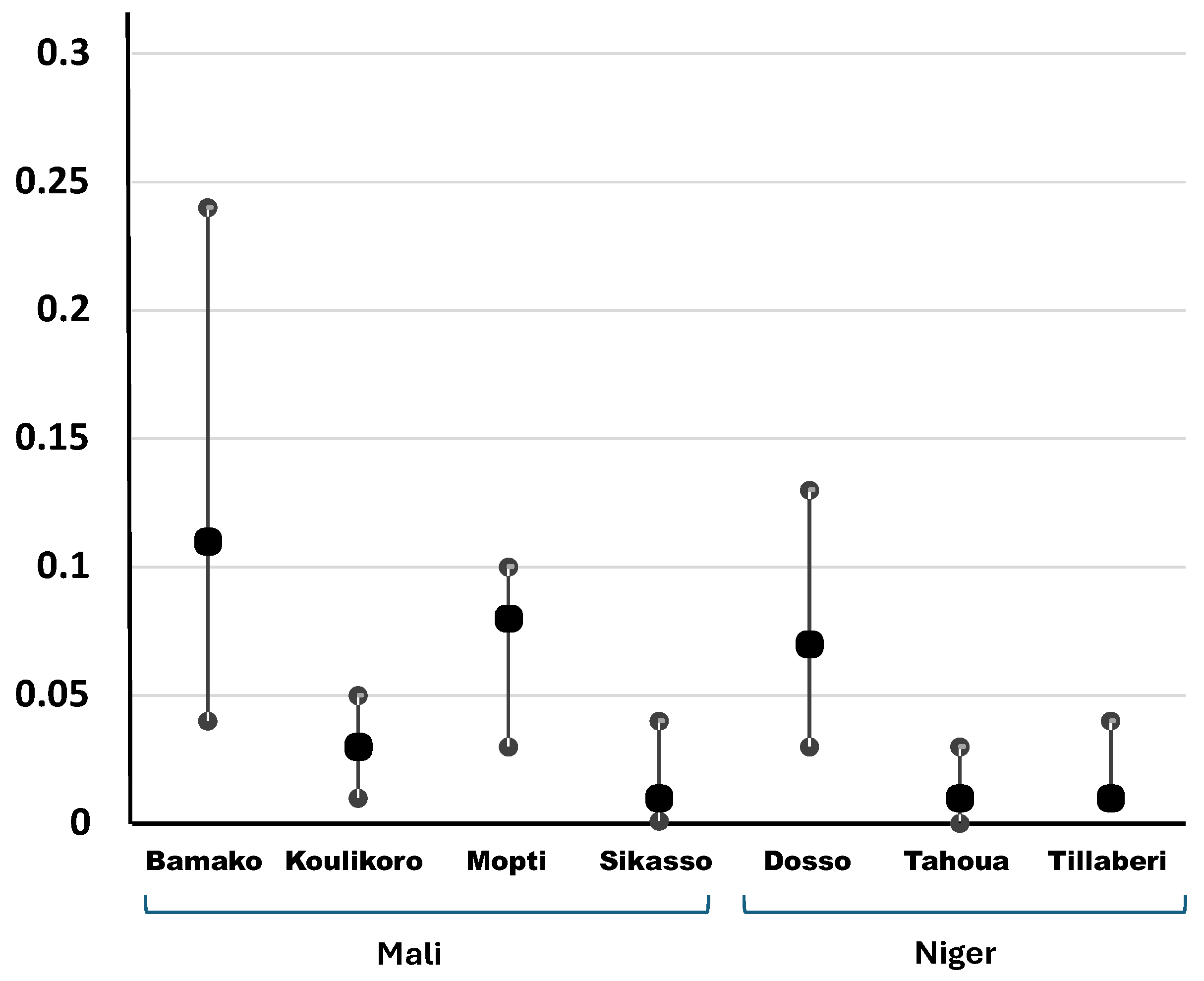
Substantial intra-country variations in apparent seroprevalence were observed across administrative zones. In Mali, where 645 animals from 43 herds were evaluated, apparent animal-level seroprevalence varied significantly by region (p = 0.0017), whereas herd-level variations did not reach statistical significance. The highest animal-level seroprevalence was clustered in Bamako district (11.11%; 5/45; 95% CI: 4.84–23.5%), followed by Mopti (7.62%; 8/105; 95% CI: 3.91–14.32%), Koulikoro (2.73%; 9/330; 95% CI: 1.44–5.10%), and Sikasso (1.21%; 2/165; 95% CI: 0.33–4.31%) (Table A4 and Figure 2).
Similarly, in Niger, where 585 animals across 39 herds were tested, apparent animal-level seroprevalence differed significantly by region (p = 0.0008) but remained statistically uniform at the herd level. The highest animal seroprevalence was detected in the Dosso region (6.67%; 8/120; 95% CI: 4.00–13.64%), followed by Tillabéry (1.48%; 4/270; 95% CI: 0.58–3.75%) and Tahoua (0.51%; 1/195; 95% CI: 0.09–2.85%) (Table A4 and Figure 2).
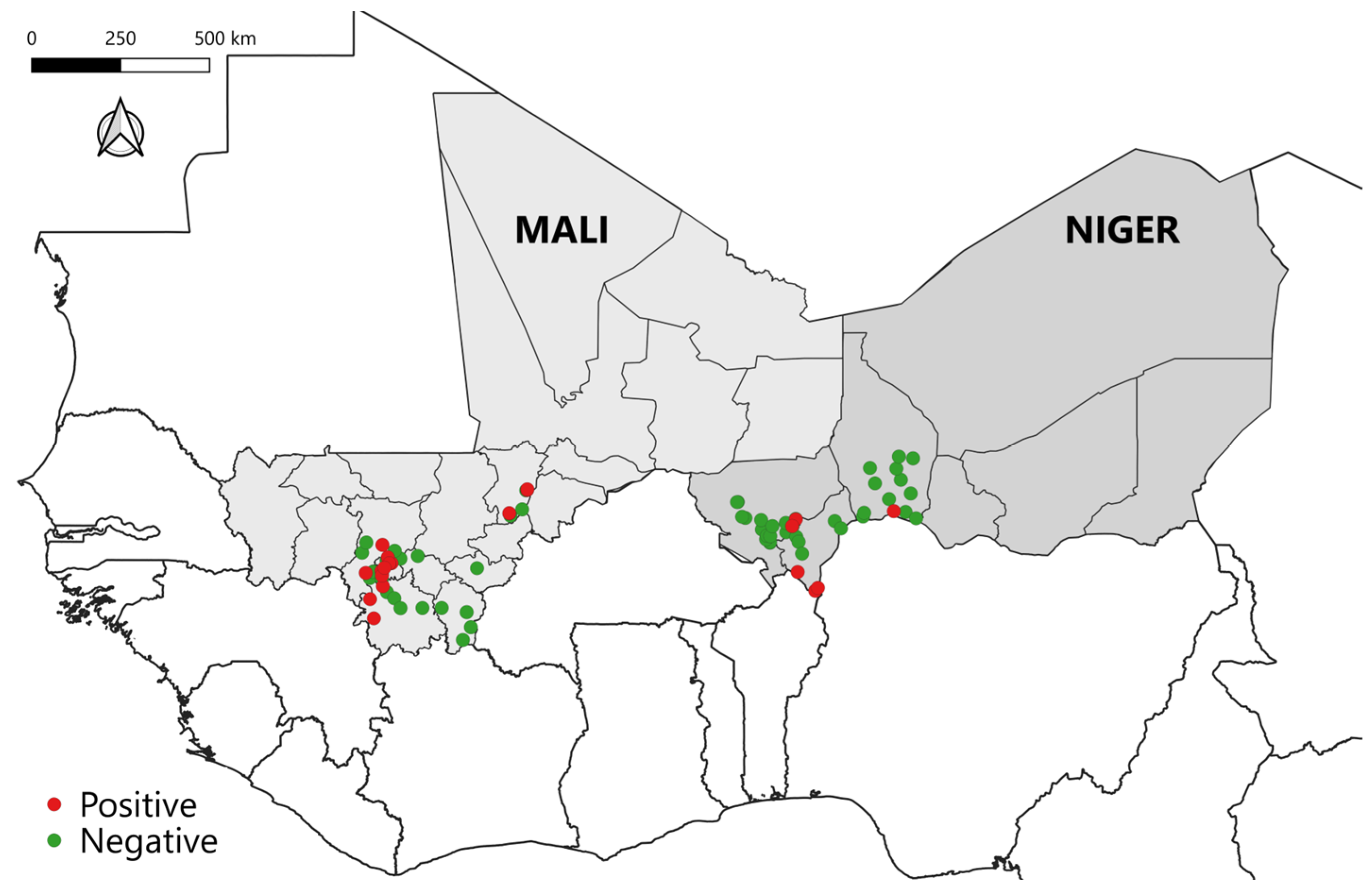
The geographical distribution of positive and negative herds highlights regional differences in herd infection status (Figure 3).
Stratification of within-herd seroprevalence profiles highlighted distinct transmission dynamics between the two study populations (Table 2). Among the seropositive cohorts in Mali, eleven herds exhibited low (≤10%) within-herd seroprevalence, four showed moderate seroprevalence, and a single herd displayed high within-herd seroprevalence (>20%), with the highest within-herd focus localized in Horokinde (Mopti region). In Niger, two herds displayed low within-herd seroprevalence, three were classified as moderate, and one herd exhibited a high seroprevalence profile, with the latter pinpointed in Gaya (Dosso region).
Cumulatively, Bamako and Mopti in Mali, alongside Dosso in Niger, presented the highest apparent seroprevalence values, identifying them as hotspots of increased Brucella circulation within the local dairy value chain. The elevated overall herd-level seroprevalence recorded in Mali relative to Niger was statistically driven by a significantly higher proportion of herds with low within-herd seroprevalence (p < 0.05).

3.3. Exploratory Epidemiological Signals of Herd Brucellosis

Risk factor analyses were performed using pooled data from both countries at the animal level, whereas herd-level analyses were conducted at different spatial levels (pooled datasets, country specific, and isolated regional levels) (Table A5).
Univariate logistic regression models identified a borderline trend toward higher odds of seropositivity in crossbred cattle compared to local indigenous breeds (OR = 1.95, 95% CI: 1.00–3.81, p = 0.0503). The same association was observed for the category Bos taurus indicus × Bos taurus taurus, which corresponds to the same group of crossbred animals and therefore should not be interpreted as independent findings. However, this indicator requires cautious interpretation due to its marginal significance and wide confidence interval. Age classifications and sex showed no statistical association with seropositivity. At the herd level, traditional management practices—specifically open-air carcass dumping and poor placenta disposal—demonstrated weak, non-significant positive associations with herd seropositivity.
In the final multivariable logistic regression analysis, which adjusted for all baseline parameters displaying univariable significance or trends (p ≤ 0.10), crossbred cattle retained an independent trend toward higher odds of animal-level seropositivity (aOR = 1.73). At the herd level, the environmental disposal of placentas remained tied to higher odds of herd-level positivity (aOR = 2.55), whereas the utilization of dedicated animal assembly areas correlated with lower odds (aOR = 0.32). However, upon multivariable adjustment, none of these specific indices maintained independent statistical significance (p > 0.05).
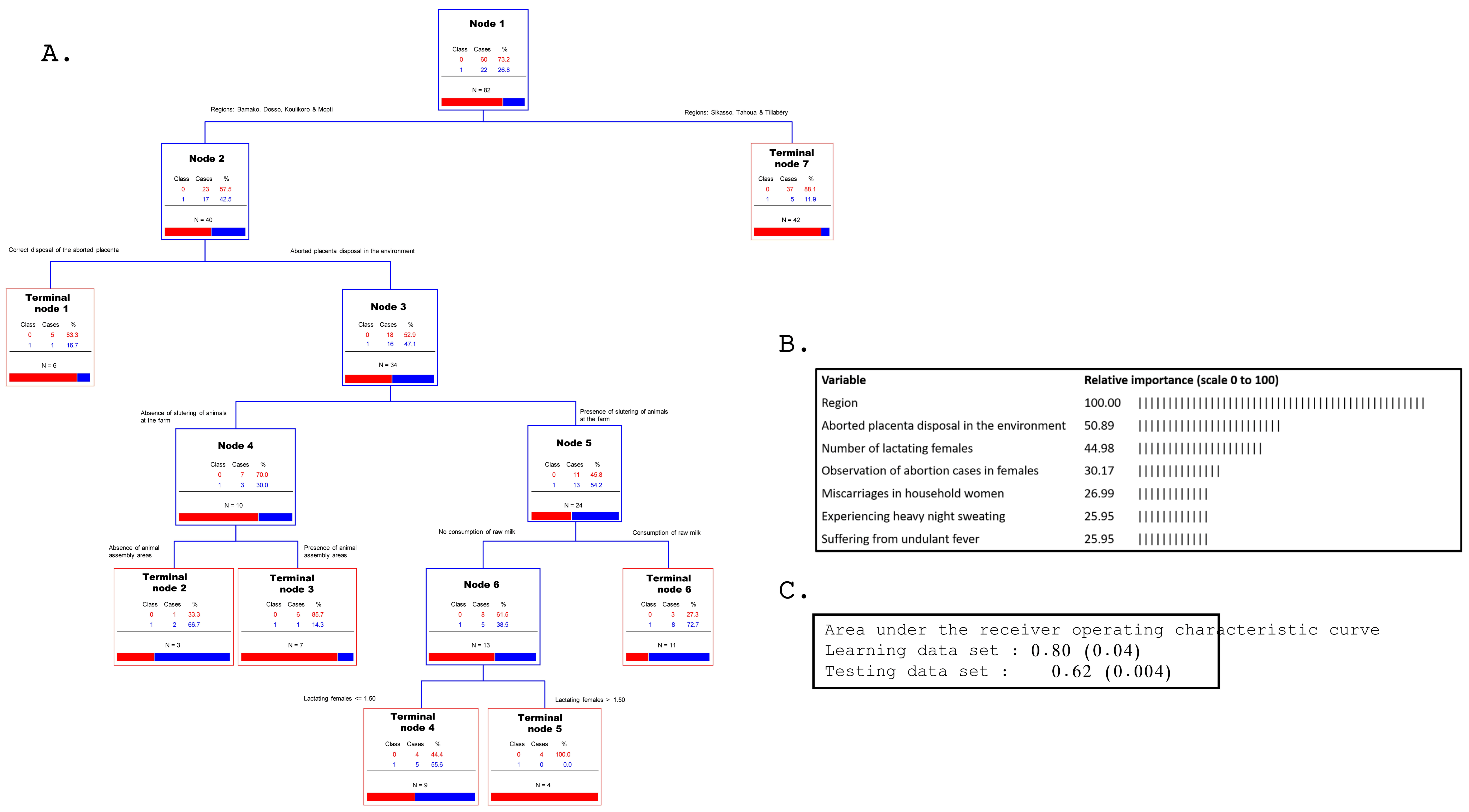
To uncover non-linear, hierarchical relationships influencing herd-level status, a non-parametric CTA was deployed (Figure 4). The primary operational split identified by the CTA was the administrative region (relative importance [RI] = 100; considering a scale from 0 to 100). This was followed hierarchically by the environmental disposal of aborted placentas (RI = 50.89), the total number of lactating cows (RI = 44.98) and a documented history of clinical abortions in female animals (RI = 30.17).
The tree structure also selected three human compartment variables within the livestock-owning households as parallel exploratory signals: a history of spontaneous miscarriages in household women (RI = 26.99), reported patterns of heavy night sweats (RI = 25.95), and clinical episodes of undulant fever (RI = 25.95). The final predictive tree architecture achieved an area under the receiver operating characteristic curve (AUC-ROC) of 0.80 for the internal training data array and an AUC-ROC of 0.62 for the cross-validation testing dataset.

4. Discussion

This survey provides an updated overview of the epidemiological situation of bovine brucellosis in selected high-consumption, major dairy production basins of Mali and Niger. Our findings confirm the endemic presence of bovine brucellosis in both countries and reveal notable spatial variation in animal prevalence at the regional level, pointing to heterogeneous transmission dynamics.

4.1. Apparent Prevalence at Herd and Animal Level, and Within-Herd Prevalence

In Mali, the highest apparent animal seroprevalence was detected in the Bamako region, reaching 11.11%. This finding aligns with the historically high levels of seropositivity reported in the area. Notably, data from routine analyses conducted at LCV between 1989 and 1990 using indirect ELISA (iELISA) reported an individual seropositivity rate of 19.7% in cattle from the Bamako district [28] and 23.3% in 1994 [12]. The high animal-level prevalence observed in our survey correlated with a substantial herd-level prevalence of 66.67%. Bamako—alongside Lomé (Togo), Bujumbura (Burundi), and Bamenda (Cameroon)—has previously been identified among the zones with the highest herd seroprevalence levels in dairy cattle milk across West and Central Africa, marking it as an area of elevated risk for human brucellosis [16]. Furthermore, microbiological quality assessments of cattle milk in Bamako using iELISA and milk ring test have documented brucellosis seroprevalence levels up to 30% [29], reinforcing the hypothesis of sustained pathogen circulation in this region.
Although the exact drivers of this high seroprevalence were not explicitly identified in this survey, several structural factors likely contribute to transmission. Bamako serves as a primary livestock hub at both national and transboundary levels, particularly for trade with neighboring coastal countries. The influx of cattle, predominantly from the Ségou and Mopti regions, routinely exceeds the outflow from Bamako—especially during the rainy season and major religious festivals [30]. This intensified animal movement may increase opportunities for herd mixing and contacts between animals of unknown health status [31]. Furthermore, the proliferation of specialized, semi-intensive livestock production systems in and around expanding urban centers creates conditions favorable to pathogen persistence, primarily through closer and more frequent animal contacts [32].
The second region of high seroprevalence in Mali was Mopti, where apparent animal seroprevalence reached 7.62%. These values are consistent with animal and herd prevalence data from 1991 [28], despite methodological differences between the two studies. In contrast, the 1991 survey reported much higher animal seroprevalence levels in the Koulikoro and Sikasso regions (43% and 26%, respectively) which were not replicated in our findings. These discrepancies may stem from temporal shifts in disease circulation or reflect broader changes in livestock distribution. Over recent decades, a gradual relocation of livestock from central regions toward southern zones and neighboring countries like Côte d’Ivoire is documented [33]. This shift, driven by climate change, mounting pressure on grazing lands, and dwindling natural resources, may explain the lower prevalence captured in our study for these areas.
In Niger, the highest apparent animal seroprevalence was observed in the Dosso region, though it remained relatively low at 6.67%. Recent cross-sectional estimates of bovine brucellosis in Niger, obtained via iELISA in the urban community of Niamey, its surroundings, and the communities of Balleyara and Torodi, reported apparent animal seroprevalence ranging from 1.8% to 4.6% across urban, peri-urban, and rural settings [7]. These findings are consistent with the modest seroprevalence observed in our study, though our estimates for Dosso were slightly higher.
Historical surveillance in Niger highlights significant temporal fluctuations in disease data. For instance, average seroprevalence levels reached up to 30% in 1980–1981 [34], whereas country-wide passive surveillance effort in 1989 using the RBT on approximately 3000 serum samples yielded a drastically lower prevalence of around 1.4% [35]. These stark variations between studies likely reflect temporal fluctuations in pathogen circulation alongside differences in sampling designs, diagnostic methodologies, and target populations. The comparatively elevated seroprevalence in Dosso may be attributed to its strategic position as a commercial crossroads. Dosso intersects major trade routes linking Nigeria and Niger—particularly for the importation of specific cattle breeds—as well as corridors connecting Niger to southern nations such as Côte d’Ivoire and Burkina Faso [36]. Such intensive cross-border movements may facilitate contact between disparate herds of unknown health status, prompting the introduction and propagation of the disease.
Within-herd prevalence was generally low across most herds in both nations, with only one herd per country exceeding 20% prevalence. Discrepancies between the two countries were primarily driven by the distribution of herds with low-level within-herd seropositivity. Similar epidemiological patterns have been documented in other African contexts, where brucellosis frequently persists at low within-herd prevalence in commercial and agro-pastoral framework compared to more extensive pastoral systems [37]. The higher frequency of low within-herd seroprevalence observed in Mali as compared to Niger points to a pattern of persistent, endemic infection characterized by low-level Brucella circulation that avoids generating widespread, acute outbreaks [38,39,40]. Conversely, in settings like Mali and Niger, where livestock vaccination programs are absent, low-level prevalence can also signal the early stages of pathogen introduction into naïve herds [40]. Regardless of the underlying mechanism, even a small cohort of infected animals can sustain the pathogen within a population through shedding during reproductive events. This may contribute to the persistence of infection and represent a continuing public health concern, particularly in traditional dairy chains where raw milk consumption remains a tradition.

4.2. Epidemiological Factors and Exploratory Signals of Bovine Brucellosis

Univariate analysis identified few potential risk or protective factors. At the animal level, crossbred cattle exhibited a borderline trend toward higher odds of seropositivity compared to indigenous breeds (OR = 1.95, p = 0.0503). However, this finding must be interpreted with caution due to its wide confidence interval and the borderline statistical significance. Nevertheless, this trend mirrors prior literature indicating that breed type can influence brucellosis, with crossbred cattle often showing higher seroprevalence than native breeds due to variances in husbandry and management [41]. Rather than reflecting true genetic susceptibility, this increased risk is likely management-driven, as crossbred animals are predominantly utilized in semi-intensive or peri-urban dairy systems characterized by higher stocking densities. Our survey did not detect significant associations between seropositivity and age or sex, despite these being well-established risk factors in the broader literature [42,43,44,45]. Generally, female and older animals display higher seroprevalence due to prolonged exposure windows and the cumulative probability of infection over time.
At the herd level, practices such as disposing of placenta and carcasses in open areas were documented but did not emerge as statistically significant risk factors. While inadequate disposal of reproductive waste has been widely flagged as a primary driver of transmission in East and West Africa due to environmental contamination [46], its statistical impact was not confirmed in this specific dataset.
Conversely, the classification tree analysis highlighted region as the primary exploratory signal of herd brucellosis status, underscoring the role of geographical heterogeneity, particularly in Mali. In high-prevalence regions, the disposal of aborted placentas in the open environment acted as a possible discriminator. This aligns with biological expectations, as aborted materials may contain high concentrations of Brucella and serve as major sources of environmental contamination and herd reinfection.
The next two exploratory signals of herd status were the number of lactating females and the occurrence of herd abortions. A larger cohort of lactating females typically characterizes intensive dairy operations, where increased animal density and animal-to-animal contact may facilitate transmission. Similarly, the history of abortions is a highly plausible clinical indicator, given that abortion is the hallmark clinical manifestation of bovine brucellosis. The reduction in AUC from the training to the testing dataset points to some degree of overfitting. Therefore, this classification tree analysis should primarily be considered an exploratory tool for highlighting epidemiological signals. Finally, the model selected human-related variables, including histories of miscarriages among household women and clinical signs compatible with human brucellosis. These findings should be regarded as exploratory signals, as dedicated public health and serological investigations were not conducted among household members in this study. However, they support the close epidemiological links between livestock and farming households, reinforcing the necessity of tackling brucellosis through a unified One Health framework.

4.3. Limitation of the Study

Some limitations should be considered when interpreting this study’s results:
  • Target population bias: The survey was restricted exclusively to sedentary lactating cows. Consequently, the data do not fully mirror the broader cattle sector, as non-lactating cows, bulls, and young stock were excluded, which may have skewed overall herd-level prevalence estimates. However, this narrow focus was intentional, as the dairy sector represents the primary pathway for zoonotic transmission via the consumption of raw milk and unpasteurized dairy products common in Sub-Saharan Africa [47,48].
  • Selection bias: The fixed sampling quota per herd, alongside logistically challenging field conditions, accessibility issues, and security constraints, may have introduced selection bias during herd recruitment, potentially leaving certain remote areas or herds underrepresented.
  • Diagnostic constraints: Diagnosis relied on the Rose Bengal Test without systematic confirmatory testing. However, the RBT remains an exceptionally cost-effective, highly field-applicable tool in low- and middle-income countries. It has demonstrated robust diagnostic sensitivity and specificity in African cattle sera [49,50], making it a suitable testing option for resource constrained laboratory settings. To minimize diagnostic error, extensive training and harmonization protocols were executed prior to fieldwork, and parallel ELISA testing was conducted on a subset of samples. Given the nearly perfect agreement observed between the two methods, RBT was deemed reliable for the full analysis. Furthermore, because brucellosis vaccination is not practiced in either Mali or Niger, false positives stemming from vaccine-induced cross-reactivity can be confidently ruled out.
  • Study Design: The cross-sectional nature of this survey precludes the establishment of temporal relationships or definitive causal associations between exposure variables and seropositivity. Identified risk factors must therefore be viewed strictly as statistical associations rather than causal determinants. This is particularly true for the borderline association between crossbred animals and seropositivity (OR = 1.95, p = 0.0503), where the wide confidence interval and threshold p-value signify a degree of statistical instability.

5. Conclusions

This survey provides critical, updated data on the epidemiological landscape of bovine brucellosis within the dairy sector of Mali and Niger. Collectively, these findings advance our understanding of disease distribution and offer a baseline to support national authorities and stakeholders in refining surveillance, control, and prevention frameworks. The sustained circulation of bovine brucellosis in major dairy basins highlights the urgent need to integrate animal and human surveillance under a unified One Health strategy particularly where raw milk production and consumption are culturally and economically vital.
To build upon these insights, future research should employ larger sample sizes, integrate concurrent household sampling, and prioritize the collection of viable specimens for the isolation and molecular characterization of circulating Brucella strains. Identifying the specific species and genotypes active at the animal–human interface will contribute to understanding the transmission dynamics and pave the way for targeted, cross-sectoral intervention strategies. Ultimately, controlling brucellosis in these regions requires moving beyond isolated livestock interventions toward a coordinated One Health approach that simultaneously protects animal health, secures rural livelihoods, and mitigates zoonotic risk to human populations.

Author Contributions

Conceptualization, A.S.B., C.S., K.I., M.O. and M.M.; methodology, A.S.B., C.S., K.I., M.O. and M.M.; software, A.S.B., C.S. and M.M.; validation, A.S.B., C.S. and M.M.; formal analysis, A.S.B., C.S. and M.M.; investigation, A.S.B., C.T., H.G., D.D., Z.B., M.M.A.M., R.B.N. and M.M.; resources, A.S.B., C.S., and M.M.; data curation, A.S.B., C.S. and M.M.; writing—original draft preparation, M.M.; writing—review and editing, A.S.B., C.S. and M.M.; visualization, A.S.B., C.S. and M.M.; supervision, A.S.B., K.I., M.O., C.S. and M.M.; project administration, K.I. and M.O.; funding acquisition, K.I. and M.O. All authors have read and agreed to the published version of the manuscript.

Funding

This survey is part of the PRISMA project, “Research and Innovation for Productive, Resilient and Healthy Agro Pastoral Systems in West Africa”, funded by the European Union and co funded by AECID. The project (grant number FOOD/2021/425-850) is implemented by LuxDev, AECID and Enabel, with Enabel providing overall leadership and coordination of the consortium. The publication of this article contributes to Result 2 of Specific Objective 4, which aims to strengthen communication, capacity-building, and knowledge sharing at the national, regional, and international levels.

Institutional Review Board Statement

The survey and the animal study protocol was approved by the Ethics Committee of the University of Sciences, Techniques and Technologies of Bamako (USTTB) in Mali (2023/190/CE/USTTB, 3 August 2023) and the National Ethics Committee for Health Research (CNERS) of Niger (35/2023/CNERS, 6 June 2023).

Informed Consent Statement

Informed consent was obtained from all subjects involved in the study.

Data Availability Statement

The raw data supporting the conclusions of this article will be made available by the authors on request.

Acknowledgments

We would like to express our gratitude to the farmers who participated in this survey and to the enumerators for their work in administering the questionnaires.

Conflicts of Interest

The authors declare no conflicts of interest. The funders had no role in the design of the study; in the collection, analyses, or interpretation of data; in the writing of the manuscript; or in the decision to publish the results.

Abbreviations

The following abbreviations are used in this manuscript:
CARTClassification and Regression Tree
CNERSNational Ethics Committee for Health Research
CTAClassification Tree Analysis
ECOWAS/CEDEAOWest African Economic Community
ELISAEnzyme-Linked ImmunoSorbent Assay
EUEuropean Union
GDPGross Domestic Product
LABOCELLCentral Livestock Laboratory
LCVCentral Veterinary Laboratory
LVKKayes Veterinary Laboratory
PRISMAResearch and Innovation for Productive, Resilient and Healthy Agro-Pastoral Systems in West Africa
QGISQuantum Geographic Information System
RBTRose Bengal Test
RESEPIEpidemiological Surveillance Network for Priority Animal Diseases
USTTBUniversity of Sciences, Techniques and Technologies of Bamako
WOAHWorld Organisation for Animal Health

Appendix A

Appendix A.1

Table A1. List of documented research data collected during the epidemiological survey. Animal, herd, and human-level variables collected through the questionnaire, with their definitions and possible responses.
TypeLevelVariablePossible Responses
AnimalAnimalSexMale; Female
AnimalAnimalAge group1 = 15–25; 2 = 26–36; 3 = 37–47; 4 = 48–58; 5 = 59–70; 6 = 71–81; 7 = 82–92
AnimalAnimalBreedCrossbred (Zebu × Taurine), Local breeds (Maure Zebu, Peuhl Zebu or N’Dama), Zebu, Goudali, Azawak, Djelli, Holstein, Mbororo, Kouri, White Fulani.
AnimalAnimalSpeciesBos taurus indicus, Bos taurus taurus, Bos taurus taurus X Bos taurus indicus
Herd managementHerdPresence of animal assembly areasYes; No
Herd managementHerdHousehold sanitary conditions1 = Good; 2 = Moderate; 3 = Poor
Herd managementHerdNumber of lactating females present in the herd1 = <10; 2 = 10–19; 3 = 20–29; 4 = 30–39
Herd managementHerdWashing hand before milkingYes; No
Herd managementHerdWashing of equipment before milkingYes; No
Herd managementHerdWashing hand after milkingYes; No
Herd managementHerdWashing of equipment after milkingYes; No
Herd managementHerdDisposal of carcasses1 = In the open environment; 0 = Other
Herd managementHerdDisposal of aborted fetuses1 = In the open environment; 0 = Other
Herd managementHerdDisposal of placenta in case of abortion1 = In the open environment; 0 = Other
Herd managementHerdSlaughtering of animals at the farmYes; No
AnimalHerdObservation of abortion cases in females of the herdYes; No
AnimalHerdObservation of testicular problems in males (e.g., pain, swelling)?Yes; No
AnimalHerdObservation of animals with swelling of the joints (hygromas)?Yes; No
Human factorHerdMilk consumption1 = Fresh unboiled milk; 0 = Other
Human factorHerdObservation of miscarriages in women of the family surroundings?Yes; No
Human factorHerdSuffering from chronic fever (prolonged or undulating) that does not respond to treatmentYes; No
Human factorHerdExperiencing heavy night sweatingYes; No

Appendix A.2

Table A2. Improvement in the reliability of laboratory procedures and RBT interpretation following personnel training prior to data collection.
LaboratoryTraining StageObservationsQualitative Agreement (κ) (95% CI)p-Value
Laboratory 1Before training101.00 (0.66–1.00)p < 0.01
Laboratory 2Before training100.444 (−0.07–0.96)n.s.
Laboratory 2After training631.00 (0.93–1.00)p < 0.0001

Appendix A.3

Table A3. Comparison between RBT and ELISA results on a subset of sera.
RBT PositiveRBT NegativeTotal
ELISA positive16016
ELISA negative4387391
Total20387407

Appendix A.4

Table A4. Apparent seroprevalence of brucellosis at the animal and herd level in Mali and Niger. Animal- and herd-level apparent seroprevalence are stratified by country and region, and expressed as percentile with corresponding 95% confidence intervals. p-values < 0.05 indicate statistically significant differences between countries and regions.
CountryRegionAnimal TestedAnimal
Seroprevalence % (n)
(95% CI)
p-ValueHerds TestedHerd
Seroprevalence % (n)
(95% CI)
p-Value
MaliBamako4511.11 (5)
(4.84–23.5)
0.0017366.67 (2)
(20.77–93.85)
0.2597
Koulikoro3302.73 (9)
(1.44–5.10)
2236.36 (8)
(19.73–57.05)
Mopti1057.62 (8)
(3.91–14.32)
757.14 (4)
(25.05–84.18)
Sikasso1651.21 (2)
(0.33–4.31)
1118.18 (2)
(5.14–47.7)
Subtotal 6453.72 (24)
(2.51–5.48)
4337.21 (16)
(24.38–52.14)
NigerDosso1206.67 (8)
(4.00–13.64)
0.0008837.50 (3)
(13.68–69.43)
0.1459
Tahoua1950.51 (1)
(0.09–2.85)
137.69 (1)
(1.37–33.31)
Tillabéry2701.48 (4)
(0.58–3.75)
1811.11 (2)
(3.1–32.8)
Subtotal 5852.22 (13)
(1.3–3.76)
3915.38 (6)
(7.25–29.73)
Mali vs.
Niger
1230 0.170882 0.0479

Appendix A.5

Table A5. Risk factors for bovine brucellosis at the animal and herd levels in Mali and Niger: results of univariate analyses. Animal-level results are based on individual animals, while herd-level results are based on herd management practices. Underlined p-values indicate a statistical trend (0.05 ≤ p < 0.10). OR = Odds Ratio, CI = Confidence Interval (95%), y-years.
LevelVariable DescriptionCategoryCountry/RegionUnivariate Logistic Regression
OR95% CIp-Value
AnimalBreedDjelliMali + Niger0.850.35–2.050.7126
AnimalBreedLocalMali + Niger1.050.52–2.110.8975
AnimalBreedMBororoMali + Niger1.230.43–3.540.7007
AnimalBreedCrossbred (metisse)Mali + Niger1.951–3.810.0503
AnimalSpeciesBos taurus indicusMali + Niger0.50.24–1.040.0653
AnimalSpeciesB. taurus indicus × B. taurus taurusMali + Niger1.951–3.810.0503
AnimalSpeciesMixteMali + Niger1.050.52–2.110.8975
AnimalAge1–5 yMali + Niger0.770.4–1.480.4346
AnimalAge6–10 yMali + Niger1.390.72–2.680.3216
AnimalAge11–15 yMali + Niger0.660.09–4.930.6879
AnimalSexFemaleMali + Niger1.520.71–3.250.2831
AnimalSexMaleMali + Niger0.660.31–1.410.2831
HerdPresence of animal assembly areasYes vs. NoMali + Niger0.240.05–1.160.075
HerdPlacenta disposalLitter vs. OtherMali + Niger3.00.90–9.960.073
HerdCadaver disposalLitter vs. OtherMali + Niger2.30.60–8.840.224
HerdRaw milk consumptionRaw vs. OtherMali + Niger1.140.38–3.390.81
HerdPresence of animal assembly areasYes vs. NoMali0.240.04–1.500.127
HerdCadaver disposalLitter vs. OtherMali0.580.03–9.910.705
HerdRaw milk consumptionRaw vs. OtherMali2.420.68–8.640.172
HerdPlacenta disposalLitter vs. OtherNiger1.150.18–7.330.882
HerdCadaver disposalLitter vs. OtherNiger1.670.27–10.390.584
HerdPlacenta disposalLitter vs. OtherDosso8.000.31–206.380.210
HerdCadaver disposalLitter vs. OtherDosso3.000.15–59.890.472
HerdPlacenta disposalLitter vs. OtherBamako + Mopti + Dosso6.40.55–74.890.139
HerdCadaver disposalLitter vs. OtherBamako + Mopti + Dosso4.00.33–48.660.277
HerdRaw milk consumptionRaw vs. OtherBamako + Mopti + Dosso1.00.14–7.101.0

References

  1. Franco, M.P.; Mulder, M.; Gilman, R.H.; Smits, H.L. Human Brucellosis. Lancet Infect. Dis. 2007, 7, 775–786. [Google Scholar] [CrossRef] [Scilit] [PubMed]
  2. Mcdermott, J.J.; Grace, D.; Zinsstag, J. Economics of Brucellosis Impact and Control in Low-Income Countries. Rev. Sci. Tech. OIE 2013, 32, 249–261. [Google Scholar] [CrossRef] [Scilit] [PubMed]
  3. Rehman, S.; Ullah, S.; Kholik, K.; Munawaroh, M.; Sukri, A.; Malik, M.I.U.; Pradana, M.; Berliana, E.G.; Haddar, M.A.; Dharmawibawa, I.D.; et al. A Detailed Review of Bovine Brucellosis. Open Vet. J. 2025, 15, 1520–1535. [Google Scholar] [CrossRef] [Scilit] [PubMed]
  4. Laine, C.G.; Johnson, V.E.; Scott, H.M.; Arenas-Gamboa, A.M. Global Estimate of Human Brucellosis Incidence. Emerg. Infect. Dis. 2023, 29, 1789. [Google Scholar] [CrossRef] [Scilit] [PubMed]
  5. Wagaba, D.; Gizamba, J.M.; Mugisha, L. Seroprevalence of Brucellosis in Humans and Livestock in Sub-Saharan Africa: A Systematic Review and Meta-Analysis. Syst. Rev. 2025, 15, 58. [Google Scholar] [CrossRef] [Scilit] [PubMed]
  6. Wainaina, M.; Vey da Silva, D.A.; Dohoo, I.; Mayer-Scholl, A.; Roesel, K.; Hofreuter, D.; Roesler, U.; Lindahl, J.; Bett, B.; Al Dahouk, S. A Systematic Review and Meta-Analysis of the Aetiological Agents of Non-Malarial Febrile Illnesses in Africa. PLoS Negl. Trop. Dis. 2022, 16, e0010144. [Google Scholar] [CrossRef] [Scilit] [PubMed]
  7. Boukary, A.R.; Saegerman, C.; Abatih, E.; Fretin, D.; Alambédji Bada, R.; De Deken, R.; Harouna, H.A.; Yenikoye, A.; Thys, E. Seroprevalence and Potential Risk Factors for Brucella Spp. Infection in Traditional Cattle, Sheep and Goats Reared in Urban, Periurban and Rural Areas of Niger. PLoS ONE 2013, 8, e83175. [Google Scholar] [CrossRef] [Scilit] [PubMed]
  8. Dada, C.O.G.; Laine, C.G.; Guela, G.K.; Gontao, P.; Garcia-Gonzalez, D.; Mouiche, M.M.M.; Wade, A.; Arenas-Gamboa, A.M. Knowledge, Attitudes, and Practices among Livestock Owners, Traders, and Slaughterhouse Inspectors in Cameroon Reveals Marginal Understanding of Livestock and Human Brucellosis. Front. Vet. Sci. 2025, 12, 1677520. [Google Scholar] [CrossRef] [Scilit] [PubMed]
  9. Baum, S.; Machalaba, C.; Laudisoit, A.; Suu-Ire, R.; Karesh, W.B. One Health et Systèmes Vétérinaires en Afrique. Faire le Point Sur la Couverture Actuelle, les Besoins et les Opportunités Pour Répondre Aux Menaces Actuelles et Changeantes et Optimiser la Collaboration; EcoHealth Alliance: New York, NY, USA, 2022. [Google Scholar]
  10. Koné, Y.S.; Dakouo, M.; Bayahaga, J.M.; Coulibaly, K.W.; Diarra, S.; Sow, I.; Sidibé, S. Prévalence de la tuberculose et de la brucellose chez les animaux sélectionnés du projet d’appui au développement de l’élevage du Zébu maure (PRODEZEM) dans le cercle de Nara. J. Interv. Epidemiol. Public Health 2021, 4, 10. [Google Scholar] [CrossRef]
  11. Traore, O.; Sidibe, S.; Fane, A.; Coulibaly, K.; Kone, Y.S.; Kone, M.; Dackouo, D. Enquete sero-epidemiologique sur la brucellose chez les bovins laitiers en zone peri-urbaine du district de Bamako. Rev. Malienne Sci. Technol. 2020, 1, 76–85. [Google Scholar]
  12. Oyetola, W.D.; Diallo, K.; Kreppel, K.; Kone, P.S.; Schelling, E.; Bonfoh, B.; Bada Alambedji, R. Factors Influencing the Transborder Transmission of Brucellosis in Cattle Between Côte d’Ivoire and Mali: Evidence From Literature and Current Key Stakeholders. Front. Vet. Sci. 2021, 8, 630580. [Google Scholar] [CrossRef] [Scilit] [PubMed]
  13. Dao, S.; Traore, M.; Sangho, A.; Dantoume, K.; Oumar, A.A.; Maiga, M.; Bougoudogo, F. Séroprévalence de la brucellose humaine à Mopti, Mali. Rev. Tunis. D’Infect. 2009, 2, 24–26. [Google Scholar]
  14. Mama dite Dialla, S. Séroprévalence de la Brucellose Humaine Dans la Zone Peri-Urbaine de la Région de Mopti; Université des Sciences, des Techniques et des Technologies de Bamako: Bamako, Mali, 2011. [Google Scholar]
  15. Adamou, H.H. Contribution à L’étude Épidémiologique de La Brucellose Dans Les Élevages Laitiers Urbains et Périurbains de Niamey, Niger. Doctoral Thesis, Ecole Inter-États des Sciences et de Médecine Vétérinaire, Dakar, Senegal, 2008. [Google Scholar]
  16. Musallam, I.; Ndour, A.P.; Yempabou, D.; Ngong, C.-A.C.; Dzousse, M.F.; Mouiche-Mouliom, M.-M.; Feussom, J.M.K.; Ntirandekura, J.B.; Ntakirutimana, D.; Fane, A.; et al. Brucellosis in Dairy Herds: A Public Health Concern in the Milk Supply Chains of West and Central Africa. Acta Trop. 2019, 197, 105042. [Google Scholar] [CrossRef] [Scilit] [PubMed]
  17. Projet de Recherche et Innovation Pour Des Systèmes Agro-Pastoraux. Available online: https://open.enabel.be/en/NER/2410/p/projet-de-recherche-et-innovation-pour-des-systemes-agro-pastoraux-productifs-resilients-et-sains-en-afrique-de-l-ouest.html (accessed on 17 February 2026).
  18. Brucellosis (Infection with B. abortus, B. melitensis and B. suis). In WOAH Terrestrial Manual Brucellosis; World Organisation for Animal Health: Paris, France, 2022; Chapter 3.1.4; Available online: https://www.woah.org/en/disease/brucellosis/ (accessed on 20 June 2026).
  19. Godfroid, J.; Saegerman, C.; Wellemans, V.; Walravens, K.; Letesson, J.-J.; Tibor, A.; Mc Millan, A.; Spencer, S.; Sanna, M.; Bakker, D.; et al. How to Substantiate Eradication of Bovine Brucellosis When Aspecific Serological Reactions Occur in the Course of Brucellosis Testing. Vet. Microbiol. 2002, 90, 461–477. [Google Scholar] [CrossRef] [Scilit] [PubMed]
  20. Approved Antigens and Kit Batches|EURL. Available online: https://sitesv2.anses.fr/en/minisite/lrue-brucellose/approved-antigens-and-kit-batches (accessed on 25 May 2026).
  21. Pfukenyi, D.M.; Meletis, E.; Modise, B.; Ndengu, M.; Kadzviti, F.W.; Dipuo, K.; Moesi, K.; Kostoulas, P.; Matope, G. Evaluation of the Sensitivity and Specificity of the Lateral Flow Assay, Rose Bengal Test and the Complement Fixation Test for the Diagnosis of Brucellosis in Cattle Using Bayesian Latent Class Analysis. Prev. Vet. Med. 2020, 181, 105075. [Google Scholar] [CrossRef] [Scilit] [PubMed]
  22. Sergeant, ESG Epitools—Home. Available online: https://epitools.ausvet.com.au/ (accessed on 18 February 2026).
  23. R Core Team. R: A Language and Environment for Statistical Computing; R Core Team: Vienna, Austria, 2023. [Google Scholar]
  24. Evans, D.C. Dyadic Data Analysis. David A. Kenny, Deborah A. Kashy, William L. Cook. J. Anthropol. Res. 2008, 64, 127–128. [Google Scholar] [CrossRef] [Scilit]
  25. Djellata, N.; Yahimi, A.; Hanzen, C.; Saegerman, C. Survey of the prevalence of bovine abortions and notification and management practices by veterinary practitioners in Algeria. Rev. Sci. Tech. 2020, 39, 947–968. [Google Scholar] [CrossRef] [Scilit] [PubMed]
  26. QGIS Association. QGIS Geographic Information System; QGIS.Org: Grüt, Switzerland, 2026. [Google Scholar] [CrossRef]
  27. Humanitarian Data Exchange|Find & Use Crisis Data|HDX. Available online: https://data.humdata.org/ (accessed on 20 June 2026).
  28. Tounkara, K.; Maiga, S.; Traoré, A.; Seck, B.M. Epidémiologie de la brucellose bovine au Mali: Enquête sérologique et isolement des premières souches de Brucella abortus. Rev. Sci. Tech. Off. Int. Epizoot. 1994, 13, 777–786. [Google Scholar] [CrossRef] [Scilit]
  29. Bonfoh, B.; Fané, A.; Steinmann, P.; Hetzel, M.; Traoré, A.N.; Traoré, M.; Simbé, C.F.; Alfaroukh, I.O.; Nicolet, J.; Akakpo, J.A.; et al. Qualité Microbiologique Du Lait et Des Produits Laitiers Vendus Au Mali et Leurs Implications En Santé Publique. Etudes Rech. Sahéliennes 2003, 8, 19–27. [Google Scholar]
  30. Amprako, L.; Karg, H.; Roessler, R.; Provost, J.; Akoto-Danso, E.K.; Sidibe, S.; Buerkert, A. Vehicular Livestock Mobility in West Africa: Seasonal Traffic Flows of Cattle, Sheep, and Goats across Bamako. Sustainability 2021, 13, 171. [Google Scholar] [CrossRef] [Scilit]
  31. Ducrotoy, M.J.; Bertu, W.J.; Ocholi, R.A.; Gusi, A.M.; Bryssinckx, W.; Welburn, S.; Moriyón, I. Brucellosis as an Emerging Threat in Developing Economies: Lessons from Nigeria. PLoS Negl. Trop. Dis. 2014, 8, e3008. [Google Scholar] [CrossRef] [Scilit] [PubMed]
  32. Roessler, R.; Mpouam, S.E.; Muchemwa, T.; Schlecht, E. Emerging Development Pathways of Urban Livestock Production in Rapidly Growing West Africa Cities. Sustainability 2016, 8, 1199. [Google Scholar] [CrossRef] [Scilit]
  33. A Territorial Foresight of Sikasso Region (Mali). 2021. Available online: https://agritrop.cirad.fr/602187/7/Sikasso%20in%202040%20GIZ%20Final%20report.pdf (accessed on 20 June 2026).
  34. Akakpo, A.J.; Saley, M.; Bornarel, P.; Sarradin, P. Epidémiologie de la brucellose bovine en Afrique tropicale. II. Analyse sérologique et identification des deux premières souches de Brucella abortus biotype 3 au Niger. Rev. D’élev. Méd. Vét. Des. Pays Trop. 1986, 39, 175–179. [Google Scholar] [CrossRef]
  35. Bloch, N.; Diallo, I. Enquête sérologique et allergologique sur les bovins au Niger. Rev. Elev. Med. Vet. Pays Trop. 1991, 44, 117–122. [Google Scholar] [CrossRef] [Scilit]
  36. Analysis of the Functioning of the Livestock Market Chain in the Dosso Region of Niger. Available online: https://ijisr.issr-journals.org/abstract.php?article=IJISR-24-167-12 (accessed on 23 February 2026).
  37. Mai, H.M.; Irons, P.C.; Kabir, J.; Thompson, P.N. A Large Seroprevalence Survey of Brucellosis in Cattle Herds under Diverse Production Systems in Northern Nigeria. BMC Vet. Res. 2012, 8, 144. [Google Scholar] [CrossRef] [Scilit] [PubMed]
  38. Alexander, K.A.; Blackburn, J.K.; Vandewalle, M.E.; Pesapane, R.; Baipoledi, E.K.; Elzer, P.H. Buffalo, Bush Meat, and the Zoonotic Threat of Brucellosis in Botswana. PLoS ONE 2012, 7, e32842. [Google Scholar] [CrossRef] [Scilit] [PubMed]
  39. El-Diasty, M.; Wareth, G.; Melzer, F.; Mustafa, S.; Sprague, L.D.; Neubauer, H. Isolation of Brucella abortus and Brucella melitensis from Seronegative Cows Is a Serious Impediment in Brucellosis Control. Vet. Sci. 2018, 5, 28. [Google Scholar] [CrossRef] [Scilit] [PubMed]
  40. Racloz, V.; Schelling, E.; Chitnis, N.; Roth, F.; Zinsstag, J. Persistence of Brucellosis in Pastoral Systems. Rev. Sci. Tech. 2013, 32, 61–70. [Google Scholar] [CrossRef] [Scilit] [PubMed]
  41. Ndazigaruye, G.; Mushonga, B.; Kandiwa, E.; Samkange, A.; Segwagwe, B.E. Prevalence and Risk Factors for Brucellosis Seropositivity in Cattle in Nyagatare District, Eastern Province, Rwanda. J. S. Afr. Vet. Assoc. 2018, 89, e1–e8. [Google Scholar] [CrossRef] [Scilit] [PubMed]
  42. Robi, D.T.; Urge, B.; Bogale, A.; Aleme, M.; Temteme, S. Herd and Animal Level Seroprevalence and Associated Risk Factors of Bovine Brucellosis in Different Agro-Ecologies of Southwest Ethiopia. Heliyon 2023, 9, e16852. [Google Scholar] [CrossRef] [Scilit] [PubMed]
  43. Awah-Ndukum, J.; Mouiche, M.M.M.; Bayang, H.N.; Ngwa, V.N.; Assana, E.; Feussom, K.J.M.; Manchang, T.K.; Zoli, P.A. Seroprevalence and Associated Risk Factors of Brucellosis among Indigenous Cattle in the Adamawa and North Regions of Cameroon. Vet. Med. Int. 2018, 2018, 3468596. [Google Scholar] [CrossRef] [Scilit] [PubMed]
  44. Lita, E.P.; Ochi, E.B.; Misinzo, G.; Van Heerden, H.; Katani, R.; Godfroid, J.; Mathew, C. Seroprevalence and Risk Factors of Brucellosis in Pastoralists and Their Livestock in Central Equatoria State, South Sudan. PLoS Negl. Trop. Dis. 2024, 18, e0012144. [Google Scholar] [CrossRef] [Scilit] [PubMed]
  45. Kairu-Wanyoike, S.; Nyamwaya, D.; Wainaina, M.; Lindahl, J.; Ontiri, E.; Bukachi, S.; Njeru, I.; Karanja, J.; Sang, R.; Grace, D.; et al. Positive Association between Brucella Spp. Seroprevalences in Livestock and Humans from a Cross-Sectional Study in Garissa and Tana River Counties, Kenya. PLoS Negl. Trop. Dis. 2019, 13, e0007506. [Google Scholar] [CrossRef] [Scilit] [PubMed]
  46. Chitupila, G.Y.; Komba, E.V.G.; Mtui-Malamsha, N.J. Epidemiological Study of Bovine Brucellosis in Indigenous Cattle Population in Kibondo and Kakonko Districts, Western Tanzania. Livest. Res. Rural Dev. 2015, 27, 118. [Google Scholar]
  47. Chengat Prakashbabu, B.; Cardwell, J.M.; Craighead, L.; Ndour, A.P.N.; Yempabou, D.; Ba, E.; Bada-Alambedji, R.; Akakpo, A.J.; Guitian, J. “We Never Boil Our Milk, It Will Cause Sore Udders and Mastitis in Our Cows”- Consumption Practices, Knowledge and Milk Safety Awareness in Senegal. BMC Public Health 2020, 20, 742. [Google Scholar] [CrossRef] [Scilit] [PubMed]
  48. Sow, I. Evaluation du Risque de Brucellose Lié à la Consommation du Lait Frais Dans la Commune Rurale de Cinzana; Université de Bamako: Bamalo, Mali, 2011. [Google Scholar]
  49. Gusi, A.M.; Bertu, W.J.; Jesús de Miguel, M.; Dieste-Pérez, L.; Smits, H.L.; Ocholi, R.A.; Blasco, J.M.; Moriyón, I.; Muñoz, P.M. Comparative Performance of Lateral Flow Immunochromatography, iELISA and Rose Bengal Tests for the Diagnosis of Cattle, Sheep, Goat and Swine Brucellosis. PLoS Negl. Trop. Dis. 2019, 13, e0007509. [Google Scholar] [CrossRef] [Scilit] [PubMed]
  50. Chisi, S.L.; Marageni, Y.; Naidoo, P.; Zulu, G.; Akol, G.W.; Van Heerden, H. An Evaluation of Serological Tests in the Diagnosis of Bovine Brucellosis in Naturally Infected Cattle in KwaZulu-Natal Province in South Africa. J. S. Afr. Vet. Assoc. 2017, 88, e1–e7. [Google Scholar] [CrossRef] [Scilit] [PubMed]
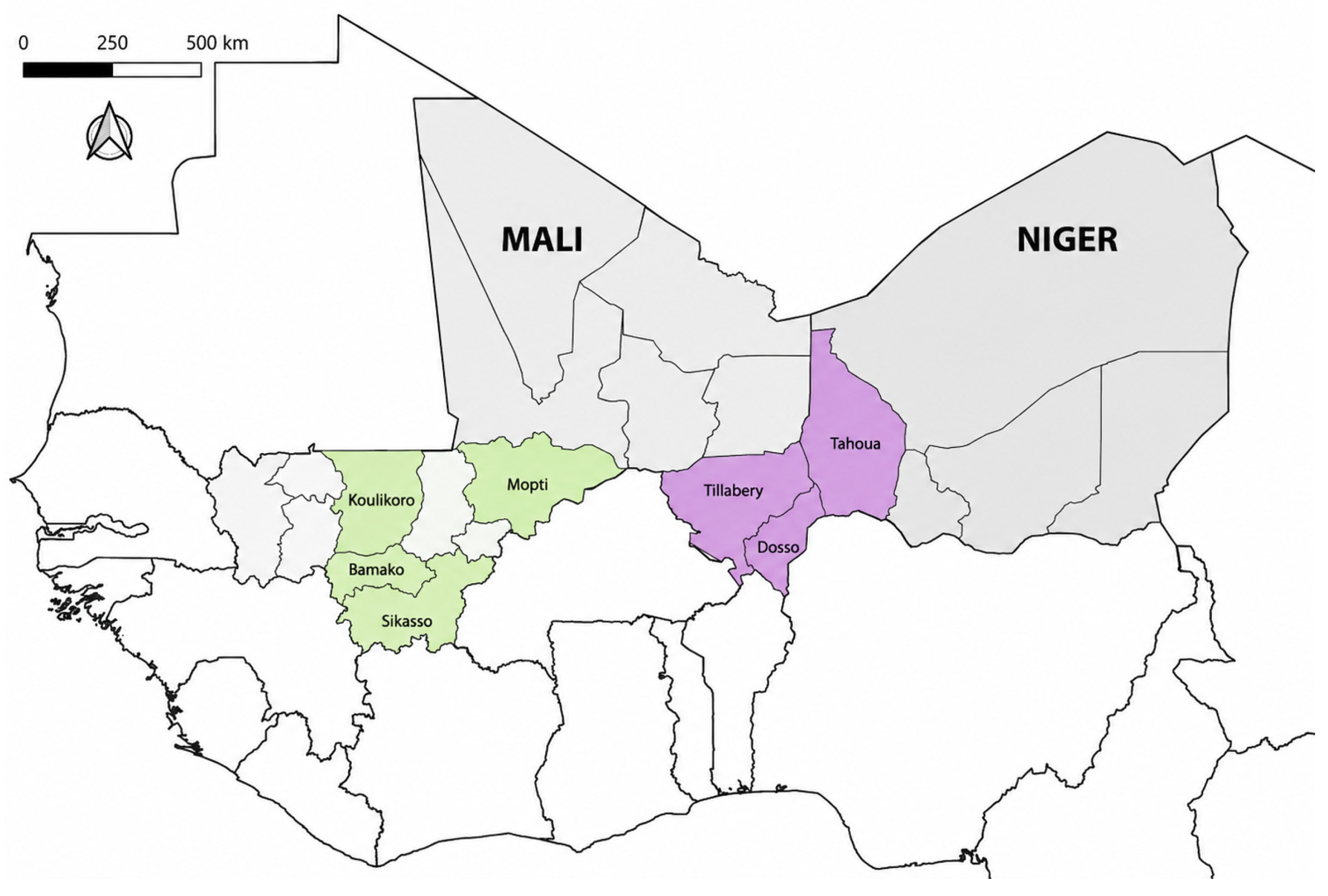
Figure 1. Mapping of the study area of this survey. The highlighted regions correspond to the dairy production basins selected for sampling. In Mali, the surveyed regions included Bamako, Koulikoro, Mopti, and Sikasso, while in Niger the surveyed regions included Tahoua, Dosso, and Tillabéry.
Pathogens 15 00764 g001
Figure 2. Apparent animal prevalence with 95% confidence interval of brucellosis in different regions of Mali and Niger.
Pathogens 15 00764 g002
Figure 3. The geographic distribution of herds included in the cross-sectional survey in Mali and Niger. Green and red dots represent seronegative and seropositive herds, respectively.
Pathogens 15 00764 g003
Figure 4. Classification tree analysis (CTA) of predictive factors linked to binary herd-level brucellosis status. (A) Classification tree; (B) relative importance rankings of selected exploratory signals; (C) receiver operating characteristic (ROC) validation curves displaying area under the curve (AUC) values alongside their corresponding standard error [e.g., AUC (SE)] for both the internal training and evaluation test datasets. Class 0 indicates seronegative herds status (red), and Class 1 represents confirmed seropositive herds status (blue). Node metrics display raw herd counts and total group percentages.
Pathogens 15 00764 g004
Table 1. The estimated number of cattle and lactating cows in the survey region of Mali and Niger.
CountryRegionNumber of CattleNumber of Lactating Cows
MaliKoulikoro1,617,000291,192
Sikasso1,796,300323,480
Mopti3,155,500568,247
Bamako37,4006735
Sub-total6,606,2001,189,654
NigerDosso1,984,437264,921
Tahoua3,838,052512,378
Tillabéry3,526,844560,768
Sub-total9,349,3331,338,067
Total15,955,5332,527,721
Table 2. Within-herd seroprevalence of bovine brucellosis stratified by country and administrative region. Within-herd seroprevalence are categorized into four distinct tiers: null (0%), low (>0–10%), moderate (>10–20%), and high (>20%).
0%>0–10%>10–20%>20%
MaliBamako1020
Koulikoro14710
Mopti3211
Sikasso9200
Subtotal271141
NigerDosso5111
Tahoua12100
Tillabéry16020
Subtotal33231
Disclaimer/Publisher’s Note: The statements, opinions and data contained in all publications are solely those of the individual author(s) and contributor(s) and not of MDPI and/or the editor(s). MDPI and/or the editor(s) disclaim responsibility for any injury to people or property resulting from any ideas, methods, instructions or products referred to in the content.