Reassessing Regional Tick-Borne Encephalitis Endemicity in Poland Through Seroprevalence Analysis in Blood Donors, 2021–2022

 , , , and
Abstract
1. Introduction
2. Materials and Methods
2.1. Selection of Voivodeships
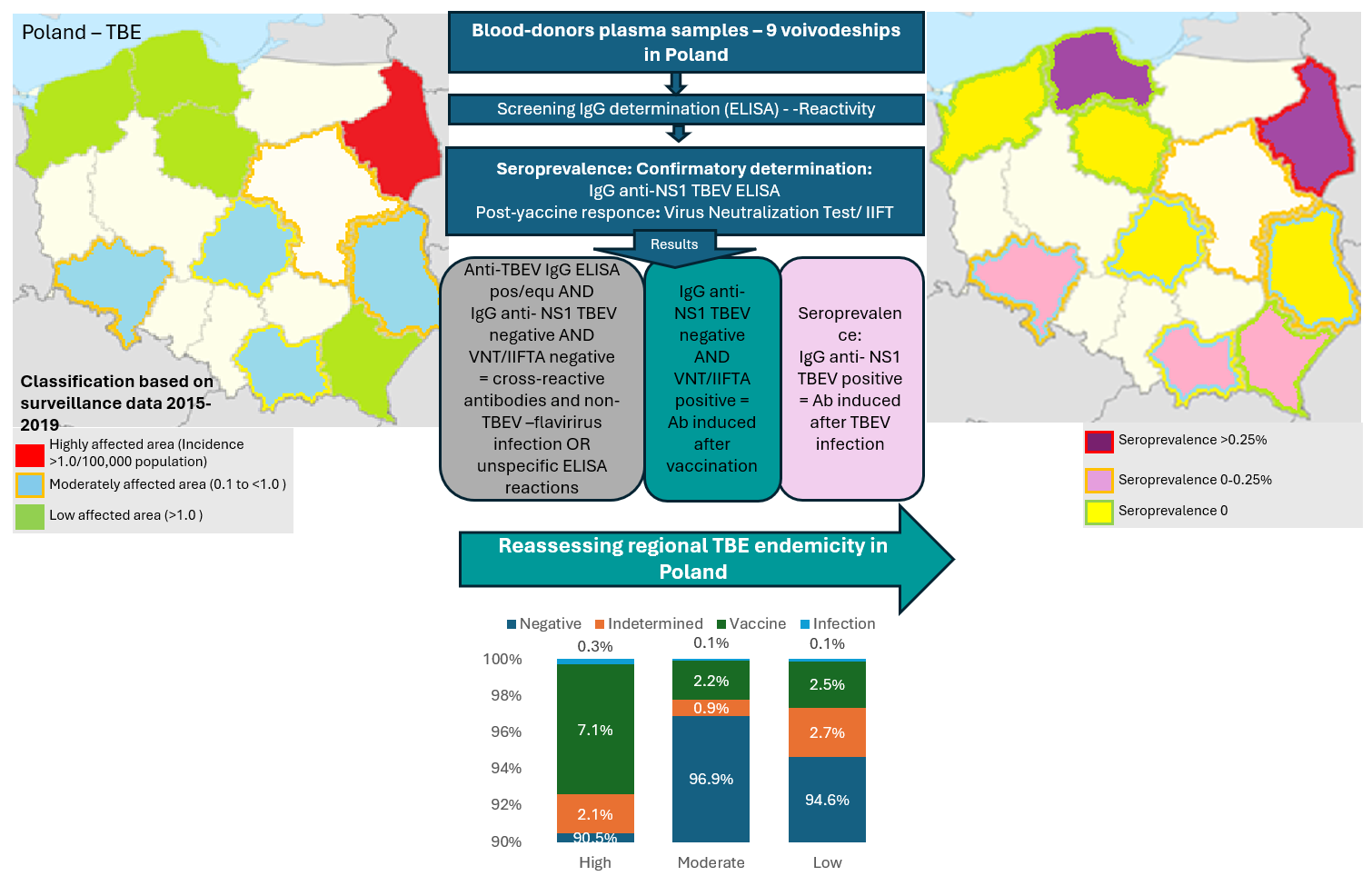
- Highly affected: Podlaskie, (>5.0 per 100,000 population);
- Moderately affected: Dolnośląskie, Łódzkie, Mazowieckie, Lubelskie, Opolskie, Małopolskie, and Świętokrzyskie. In these regions, with a 5-year TBE incidence ranging from 0.1 to <1.0 per 100,000 population, TBE cases were reported annually, and the virus was sporadically detected in environmental studies [7]. One possible explanation was the presence of smaller administrative units within these voivodeships with higher local incidence despite an overall voivodeship-level incidence above 1 per 100,000.
- Low affected: Zachodniopomorskie, Pomorskie, Kujawsko-Pomorskie, Lubuskie, Podkarpackie, Śląskie, and Wielkopolskie. In these regions, only sporadic TBE cases were reported, with a mean 5-year incidence below 0.1 per 100,000 population; many of these cases are likely associated with travel to more highly affected areas.

2.2. Study Population and Design
2.3. Sample Size Calculation
- Highly affected areas: expected seroprevalence of 4%, with an acceptable confidence interval width of 3% (e.g., 2.5–5.5%), resulting in an estimated sample size of 688.
- Moderately and low-affected areas: expected seroprevalence of 1.5%, with an acceptable confidence interval width of 1% (e.g., 1.0–2.0%), resulting in an estimated sample size of 2346.
2.4. Screening Assays
2.5. Confirmatory Assays
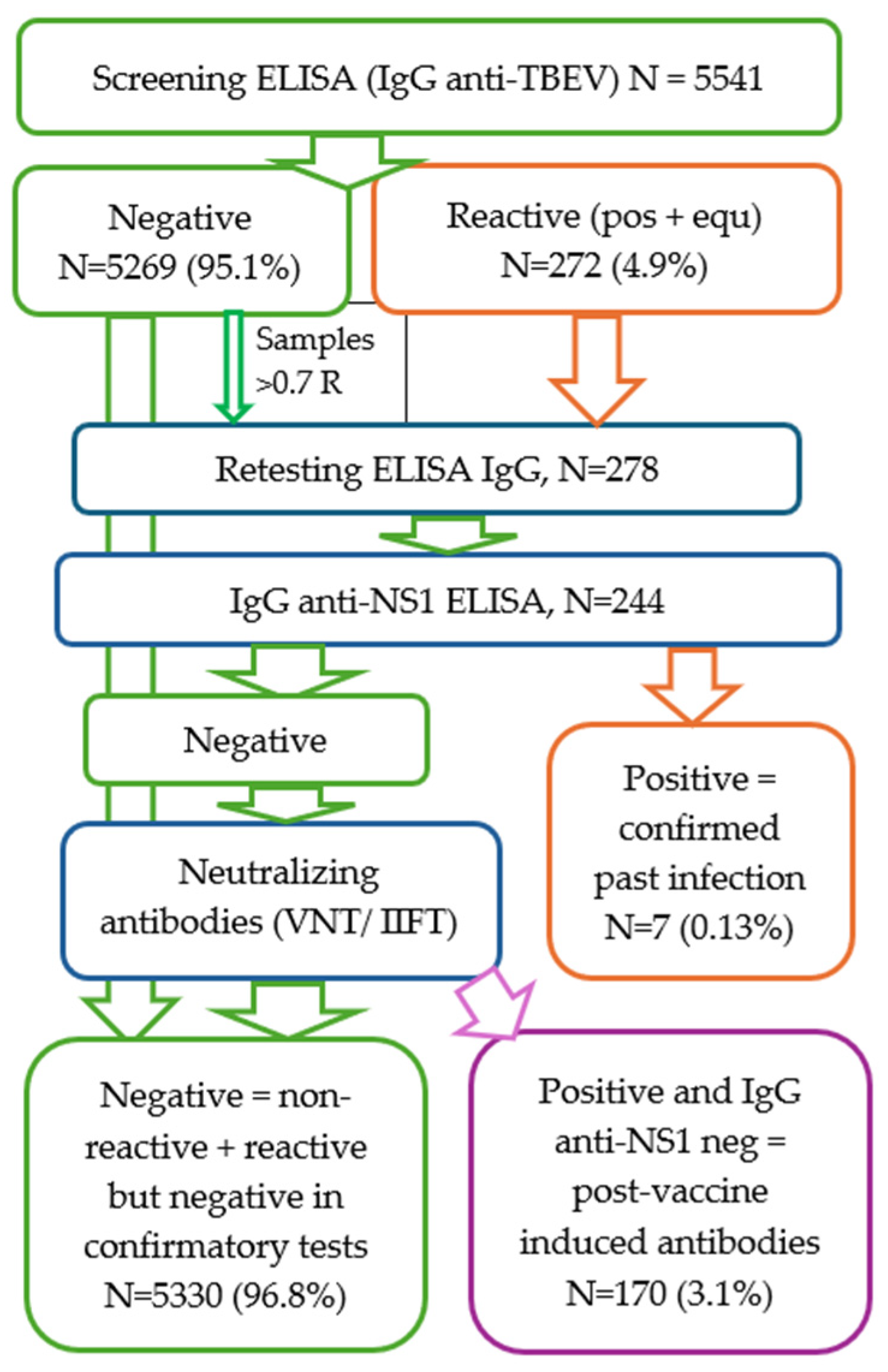
- Detection of anti-NS1 TBEV IgG by an in-house ELISA performed according to published protocols [27,28]. As NS1 is a non-structural protein expressed only during viral replication, the presence of anti-NS1 antibodies indicates natural TBEV infection. This ELISA assay has demonstrated a sensitivity of >94% and a specificity of >93% in broadly cross-reacting sera from patients with vaccinations against flaviviral diseases and single or multiple flavivirus infections, respectively [27].
2.6. Statistical Analysis
3. Results
3.1. Determination of TBEV Seroprevalence
3.2. Vaccination-Induced Antibody Prevalence
3.3. Results by Region Classification
4. Discussion
5. Conclusions
Author Contributions
Funding
Institutional Review Board Statement
Informed Consent Statement
Data Availability Statement
Conflicts of Interest
Abbreviations
| TBEV | Tick-borne encephalitis virus |
| TBE | Tick-borne encephalitis |
| VNT | virus neutralization testing |
| WHO | World Health Organization |
| RBTCs | Regional Blood Transfusion Centers |
| IIF | indirect immunofluorescence |
| ELISAs | enzyme-linked immunosorbent assays |
| IIFT | Indirect immunofluorescence test |
Appendix A

| Voivodship | Women | Men | Place of Living | |||
|---|---|---|---|---|---|---|
| ≤40 y.o. | >40 y.o. | ≤40 y.o. | >40 y.o. | Rural | Urban | |
| Dolnośląskie | 150 | 128 | 164 | 163 | 131 | 474 |
| Kujawsko-pomorskie | 49 | 82 | 273 | 196 | 214 | 386 |
| Lubelskie | 159 | 112 | 155 | 174 | 290 | 310 |
| Łódzkie | 170 | 123 | 174 | 133 | 271 | 329 |
| Małopolskie | 159 | 148 | 152 | 150 | 338 | 271 |
| Podkarpackie | 201 | 110 | 111 | 202 | 363 | 261 |
| Podlaskie | 173 | 130 | 211 | 189 | 161 | 542 |
| Pomorskie | 101 | 75 | 198 | 226 | 253 | 347 |
| Zachodniopomorskie | 150 | 150 | 150 | 150 | 148 | 452 |
| Voivodeship | Our Classification Based on the Average TBE Incidence in 2015–2019 | Average Incidence in 2017–2022 | Underestimation (Fold) [Ratio Surv/Hosp 2017/2022] |
|---|---|---|---|
| Dolnośląskie | Moderately affected | 0.88 | 0 [1.02] |
| Kujawsko-pomorskie | Less affected | 0.04 | 2 [0.5] |
| Lubelskie | Moderately | 0.71 | 1.1 [0.88] |
| Łódzkie | Moderately | 0.34 | 1.22 [0.83] |
| Małopolskie | Moderately | 0.55 | 1.25 [0.8] |
| Podkarpackie | Less affected | 0.12 | 5.56 [0.18] |
| Podlaskie | Highly affected | 8.24 | 1.41 [0.71] |
| Pomorskie | Less affected | 0.07 | 2.56 [0.39] |
| Zachodniopomorskie | Moderately | 0.14 | 1.22 [0.82] |
| Poland | 0.68 | 1.32 [0.76] |
| Voivodeship | Classification Based on 5-Years TBE Incidence/ 100,000 Popul | Reactivity % (N/N) | Seropositivity % (N/N) |
|---|---|---|---|
| Dolnośląskie | Moderately affect | 2.0% (12/605) | 1.6% (11/603) |
| Kujawsko-pomorskie | Less affected | 8.2% (49/600) | 2.5% (15/589) |
| Lubelskie | Moderately affect | 4.2% (25/600) | 3.2% (19/597) |
| Łódzkie | Moderately affect | 2.0% (12/600) | 1.7% (16/605) |
| Małopolskie | Moderately affect | 4.3% (26/609) | 2.6% (16/605) |
| Podkarpackie | Less affected | 3.5% (22/624) | 2.1% (13/619) |
| Podlaskie | Highly affected | 9.5% (67/703) | 7.7% (54/698) |
| Pomorskie | Less affected | 4.5% (27/600) | 3.0% (18/598) |
| Zachodnio-pomorskie | Less affected | 5.3% (32/600) | 3.5% (21/599) |
| In total | 4.9% (272/5541) | 3.2% (177/5507) | |
References
- Mrozowska-Nyckowska, K.; Zbrzeźniak, J.; Paradowska-Stankiewicz, I. Meningitis and encephalitis in Poland in 2021. Prz. Epidemiol. 2023, 77, 387–402. [Google Scholar] [CrossRef] [PubMed]
- Nagańska, A.; Garbacz-Łagożna, E.; Kowalski, J.; Cholewińska-Szymańska, G.; Chylak-Nowosielska, A.; Antosiewicz, M.; Szymański, R. The thick-borne encephalitis caused by alimentary transmission—Case series report. Prz. Epidemiol. 2023, 77, 41–52. [Google Scholar] [CrossRef] [PubMed]
- Król, M.E.; Borawski, B.; Nowicka-Ciełuszecka, A.; Tarasiuk, J.; Zajkowska, J. Outbreak of alimentary tick-borne encephalitis in Podlaskie voivodeship, Poland. Prz. Epidemiol. 2019, 73, 239–248. [Google Scholar] [CrossRef] [PubMed]
- Lipowski, D.; Popiel, M.; Perlejewski, K.; Nakamura, S.; Bukowska-Osko, I.; Rzadkiewicz, E.; Dzieciatkowski, T.; Milecka, A.; Wenski, W.; Ciszek, M.; et al. Cluster of Fatal Tick-borne Encephalitis Virus Infection in Organ Transplant Setting. J. Infect. Dis. 2017, 215, 896–901. [Google Scholar] [CrossRef] [PubMed]
- Wahlberg, P.; Saikku, P.; Brummer-Korvenkontio, M. Tick-borne viral encephalitis in Finland. The clinical features of Kumlinge disease during 1959–1987. J. Intern. Med. 1989, 225, 173–177. [Google Scholar] [CrossRef] [PubMed]
- Mathys, S.; Gültekin, N.; Stanga, Z.; Ülgür, I.; Schlagenhauf, P. Seroprevalence of tick-borne infections in blood donors in Europe: A systematic review. New Microbes New Infect. 2025, 65, 101597. [Google Scholar] [CrossRef] [PubMed]
- Pancer, K. TBE in Poland. Chapter 13. In The TBE Book, 9th ed.; Dobler, G., Erber, W., Bröker, M., Chitimia-Dobler, L., Schmitt, H.J., Eds.; Global Health Press: Singapore, 2026; Chapter 13. [Google Scholar] [CrossRef]
- Stefanoff, P.; Pfeffer, M.; Hellenbrand, W.; Rogalska, J.; Rühe, F.; Makówka, A.; Michalik, J.; Wodecka, B.; Rymaszewska, A.; Kiewra, D.; et al. Virus detection in questing ticks is not a sensitive indicator for risk assessment of tick-borne encephalitis in humans. Zoonoses Public Health 2013, 60, 215–226. [Google Scholar] [CrossRef] [PubMed]
- Stefanoff, P.; Zielicka-Hardy, A.; Hlebowicz, M.; Konior, R.; Lipowski, D.; Szenborn, L.; Siennicka, J.; Orlikova, H. TBE enhanced surveillance working group. New endemic foci of tick-borne encephalitis (TBE) identified in districts where testing for TBE was not available before 2009 in Poland. Parasites Vectors 2013, 6, 180. [Google Scholar] [CrossRef] [PubMed]
- Stefanoff, P.; Rubikowska, B.; Bratkowski, J.; Ustrnul, Z.; Vanwambeke, S.O.; Rosinska, M. A Predictive Model Has Identified Tick-Borne Encephalitis High-Risk Areas in Regions Where No Cases Were Reported Previously, Poland, 1999–2012. Int. J. Environ. Res. Public Health 2018, 15, 677. [Google Scholar] [CrossRef] [PubMed]
- Kunze, M.; Banović, P.; Bogovič, P.; Briciu, V.; Čivljak, R.; Dobler, G.; Hristea, A.; Kerlik, J.; Kuivanen, S.; Kynčl, J.; et al. Recommendations to Improve Tick-Borne Encephalitis Surveillance and Vaccine Uptake in Europe. Microorganisms 2022, 10, 1283. [Google Scholar] [CrossRef] [PubMed]
- Zielicka-Hardy, A.; Rosińska, M.; Kondrusik, M.; Hlebowicz, M.; Konior, R.; Stefanoff, P. Predictors for diagnosis of tick-borne encephalitis infection in Poland, 2009–2010. Infect. Dis. 2015, 47, 604–610. [Google Scholar] [CrossRef] [PubMed]
- Zajkowska, J.; Waluk, E.; Świerzbińska, R.; Dunaj, J.; Zajkowska, O.; Wawrzuta, D.; Niścigorska-Olsen, J.; Matukiewicz, M.; Oczko-Grzesik, B.; Veltze, D. The impact of serological testing implementation on tick-borne encephalitis detection in Poland. PLoS ONE 2025, 20, e0323022. [Google Scholar] [CrossRef] [PubMed]
- Caputo, M.; Stumpe, V.; Rübsamen, N.; Mikolajczyk, R.T.; Karch, A. Implementation of preventive measures against tick-borne infections in a non-endemic area for tick-borne encephalitis-Results from a population-based survey in Lower Saxony, Germany. Ticks Tick-Borne Dis. 2019, 10, 614–620. [Google Scholar] [CrossRef] [PubMed]
- Zavadska, D.; Anca, I.; André, F.; Bakir, M.; Chlibek, R.; Cižman, M.; Ivaskeviciene, I.; Mangarov, A.; Mészner, Z.; Pokorn, M.; et al. Recommendations for tick-borne encephalitis vaccination from the Central European Vaccination Awareness Group (CEVAG). Hum. Vaccines Immunother. 2013, 9, 362–374. [Google Scholar] [CrossRef] [PubMed]
- Hertzell, K.B.; Pauksens, K.; Rombo, L.; Knight, A.; Vene, S.; Askling, H.H. Tick-borne encephalitis (TBE) vaccine to medically immunosuppressed patients with rheumatoid arthritis: A prospective, open-label, multi-centre study. Vaccine 2016, 34, 650–655. [Google Scholar] [CrossRef] [PubMed]
- World Health Organization (WHO). Tick-Borne Encephalitis. Immunization Offers the Most Effective Protection. Available online: https://www.who.int/teams/immunization-vaccines-and-biologicals/diseases/tick-borne-encephalitis (accessed on 10 February 2026).
- Paradowska-Stankiewicz, I.; Zbrzeźniak, J. Kleszczowe Zapalenie Mózgu w Polsce i na Świecie. Ocena Sytuacji Epidemiologicznej KZM w Polsce w Latach 2015–2019 w Oparciu o Dane Pochodzące z Nadzoru Epidemiologicznego [Tick-Borne Encephalitis in Poland and Worldwide. Assessment of the Epidemiological Situation of TBE in Poland in 2015–2019 Based on Epidemiological Surveillance Data]; National Institute of Public Health NIH—National Research Institute: Warsaw, Poland, 2021. Available online: https://www.pzh.gov.pl/wp-content/uploads/2021/03/KleszczoweZapalenieMozgu-raport-PZH_2021.pdf (accessed on 10 February 2026).
- Czarkowski, M.P.; Kosyra, M.; Szmulik-Misiurek, K.; Zbrzeźniak, J. Vaccinations in Poland in 2022; National Institute of Public Health NIH—National Research Institute: Warsaw, Poland, 2023. Available online: https://wwwold.pzh.gov.pl/oldpage/epimeld/2022/Sz_2022.pdf (accessed on 10 May 2026).
- National Institute of Public Health NIH—National Research Institute. Program Szczepień Ochronnych Dzieci i Młodzieży w 2026 Roku [Protective Vaccination Program for Children and Adolescents in 2026]. Szczepienia.info. 2026. Available online: https://szczepienia.pzh.gov.pl/kalendarz-szczepien-2026-2/ (accessed on 10 February 2026).
- Act of 26 June 1974—Labour Code (Consolidated Text: Journal of Laws 2023, Item 1465, as Amended). Republic of Poland. Available online: https://isap.sejm.gov.pl/ (accessed on 10 February 2026).
- Paradowska-Stankiewicz, I.; Pancer, K.; Poznańska, A.; Hordowicz, M.; Skibicka, M.; Słowiński, M.; Motak, G.; Falkiewicz, B. Tick-borne encephalitis epidemiology and surveillance in Poland, and comparison with selected European countries before and during the COVID-19 pandemic, 2008 to 2020. Eurosurveillance 2023, 28, 2200452. [Google Scholar] [CrossRef] [PubMed]
- Paradowska-Stankiewicz, I.; Piotrowska, A. Meningitis and encephalitis in Poland in 2015. Prz. Epidemiol. 2017, 71, 493–500. [Google Scholar]
- Bojkiewicz, E.; Toczylowski, K.; Grygorczuk, S.; Zelazowska-Rutkowska, B.; Dunaj, J.; Zebrowska, A.; Czupryna, P.; Moniuszko-Malinowska, A.; Sulik, A. The Prevalence of Asymptomatic Infections with Tick-Borne Encephalitis Virus and Attitude towards Tick-Borne Encephalitis Vaccine in the Endemic Area of Northeastern Poland. Vaccines 2022, 10, 1294. [Google Scholar] [CrossRef] [PubMed]
- Stefanoff, P.; Siennicka, J.; Kaba, J.; Nowicki, M.; Ferenczi, E.; Gut, W. Identification of new endemic tick-borne encephalitis foci in Poland—A pilot seroprevalence study in selected regions. Int. J. Med. Microbiol. 2008, 298, 102–107. [Google Scholar] [CrossRef]
- Reusken, C.; Boonstra, M.; Rugebregt, S.; Scherbeijn, S.; Chandler, F.; Avšič-Županc, T.; Vapalahti, O.; Koopmans, M.; GeurtsvanKessel, C.H. An evaluation of serological methods to diagnose tick-borne encephalitis from serum and cerebrospinal fluid. J. Clin. Virol. 2019, 120, 78–83. [Google Scholar] [CrossRef] [PubMed]
- Girl, P.; Bestehorn-Willmann, M.; Zange, S.; Borde, J.P.; Dobler, G.; von Buttlar, H. Tick-Borne Encephalitis Virus Nonstructural Protein 1 IgG Enzyme-Linked Immunosorbent Assay for Differentiating Infection versus Vaccination Antibody Responses. J. Clin. Microbiol. 2020, 58, e01783-19. [Google Scholar] [CrossRef] [PubMed]
- Dobler, G.; Euringer, K.; Kaier, K.; Borde, J.P. Serological Protection Rates against TBEV Infection in Blood Donors from a Highly Endemic Region in Southern Germany. Vaccines 2023, 11, 522. [Google Scholar] [CrossRef] [PubMed]
- R Core Team. R: A Language and Environment for Statistical Computing; R Foundation for Statistical Computing: Vienna, Austria, 2023; Available online: https://www.R-project.org/ (accessed on 8 March 2026).
- Kelly, P.H.; Kwark, R.; Marick, H.M.; Davis, J.; Stark, J.H.; Madhava, H.; Dobler, G.; Moïsi, J.C. Different environmental factors predict the occurrence of tick-borne encephalitis virus (TBEV) and reveal new potential risk areas across Europe via geospatial models. Int. J. Health Geogr. 2025, 24, 3. [Google Scholar] [CrossRef] [PubMed]
- Coroian, M.; Mihalca, A.D.; Dobler, G.; Euringer, K.; Girl, P.; Borșan, S.D.; Kalmár, Z.; Tincuța Briciu, V.; Flonta, M.; Topan, A.; et al. Seroprevalence Rates against West Nile, Usutu, and Tick-Borne Encephalitis Viruses in Blood-Donors from North-Western Romania. Int. J. Environ. Res. Public Health 2022, 19, 8182. [Google Scholar] [CrossRef] [PubMed]
- Panciu, A.M.; Cheran, C.A.; Militaru, E.D.; Rîciu, C.D.; Hristea, A. Serosurvey of Tick-Borne Encephalitis Virus Infection in Romania. Pathogens 2024, 13, 231. [Google Scholar] [CrossRef] [PubMed]
- Fafangel, M.; Cassini, A.; Colzani, E.; Klavs, I.; Grgič Vitek, M.; Učakar, V.; Muehlen, M.; Vudrag, M.; Kraigher, A. Estimating the annual burden of tick-borne encephalitis to inform vaccination policy, Slovenia, 2009 to 2013. Eurosurveillance 2017, 22, 30509. [Google Scholar] [CrossRef] [PubMed]
- Castagna, A.; Schiavon, S.; Mengozzi, G.; Baldovin, T.; Nozza, S.; Canetti, D.; Cocchio, S.; Montuori, E.A.; Iantomasi, R.; Baldo, V. Tick-borne encephalitis seroprevalence in northern Italy: A cross-sectional study on a randomly selected population. IJID Reg. 2024, 12, 100404. [Google Scholar] [CrossRef] [PubMed]
- Kriz, B.; Hubalek, Z.; Marek, M.; Daniel, M.; Strakova, P.; Betasova, L. Results of the Screening of Tick-Borne Encephalitis Virus Antibodies in Human Sera from Eight Districts Collected Two Decades Apart. Vector-Borne Zoonotic Dis. 2015, 15, 489–493. [Google Scholar] [CrossRef] [PubMed]
- Banović, P.; Obregón, D.; Mijatović, D.; Simin, V.; Stankov, S.; Budakov-Obradović, Z.; Bujandrić, N.; Grujić, J.; Sević, S.; Turkulov, V.; et al. Tick-Borne Encephalitis Virus Seropositivity among Tick Infested Individuals in Serbia. Pathogens 2021, 10, 301. [Google Scholar] [CrossRef] [PubMed]
- Euringer, K.; Girl, P.; Kaier, K.; Peilstöcker, J.; Schmidt, M.; Müller-Steinhardt, M.; Rauscher, B.; Bressau, E.; Kern, W.V.; Dobler, G.; et al. Tick-borne encephalitis virus IgG antibody surveillance: Vaccination- and infection-induced seroprevalences, south-western Germany, 2021. Eurosurveillance 2023, 28, 2200408. [Google Scholar] [CrossRef] [PubMed]
- Albinsson, B.; Hoffman, T.; Kolstad, L.; Bergström, T.; Bogdanovic, G.; Heydecke, A.; Hägg, M.; Kjerstadius, T.; Lindroth, Y.; Petersson, A.; et al. Seroprevalence of tick-borne encephalitis virus and vaccination coverage of tick-borne encephalitis, Sweden, 2018 to 2019. Eurosurveillance 2024, 29, 2300221. [Google Scholar] [CrossRef] [PubMed]
- Ackermann-Gäumann, R.; Eyer, C.; Vock, M.; Gowland, P.; Tinguely, C.; Leib, S.L.; Bori, M.; Buser, A.; Fontana, S.; Thierbach, J.; et al. Prevalence of anti-tick-borne encephalitis virus (TBEV) antibodies in Swiss blood donors in 2014–2015. Blood Transfus. 2023, 21, 100–109. [Google Scholar] [CrossRef] [PubMed]
- Hansen, M.F.; Gynthersen, R.M.M.; Ocias, L.F.; Sørensen, C.A.; Jensen, B.A.; Erikstrup, C.; Holm, D.K.; Sækmose, S.G.; Harritshøj, L.H.; Kolstad, L.; et al. A serosurvey examining exposure to Borrelia burgdorferi sensu lato and tick-borne encephalitis virus in Danish blood donors, August 2022. IJID Reg. 2024, 12, 100414. [Google Scholar] [CrossRef] [PubMed]
- Kelly, P.H.; Zhang, P.; Dobler, G.; Halsby, K.; Angulo, F.J.; Pilz, A.; Madhava, H.; Moïsi, J.C. Global Seroprevalence of Tick-Borne Encephalitis Antibodies in Humans, 1956–2022: A Literature Review and Meta-Analysis. Vaccines 2024, 12, 854. [Google Scholar] [CrossRef] [PubMed]
- Girl, P.; Schindler, A.; Martin, S.; Dobler, G.; Borde, J.P. Surveillance of Tick-Borne Encephalitis Virus-Comparison of Vaccination- and Infection-Induced Seroprevalences in Lower Bavaria, Germany. J. Med. Virol. 2025, 97, e70514. [Google Scholar] [CrossRef] [PubMed]
- Costantini, M.; Callegaro, A.; Beran, J.; Berlaimont, V.; Galgani, I. Predicted long-term antibody persistence for a tick-borne encephalitis vaccine: Results from a modeling study beyond 10 years after a booster dose following different primary vaccination schedules. Hum. Vaccines Immunother. 2020, 16, 2274–2279. [Google Scholar] [CrossRef] [PubMed]
- Beran, J.; Lattanzi, M.; Costantini, M.; Pammolli, A.; Galgani, I. Sustained antibody persistence for at least 15 years after a booster vaccination against tick-borne encephalitis following different primary vaccination schedules: Third 5-year follow-up. Vaccine 2023, 41, 3518–3524. [Google Scholar] [CrossRef]
- Freimane, Z.; Dobler, G.; Karelis, G.; Chitimia-Dobler, L.; Savicka, O.; Zavadska, D. Seroprevalence of Tick-Borne Encephalitis Virus in Latvia Using Standard and Subtype-Specific NS1-Based ELISA Assays. Pathogens 2025, 14, 1115. [Google Scholar] [CrossRef] [PubMed]
- Chan, K.R.; Ismail, A.A.; Thergarajan, G.; Raju, C.S.; Yam, H.C.; Rishya, M.; Sekaran, S.D. Serological cross-reactivity among common flaviviruses. Front. Cell. Infect. Microbiol. 2022, 12, 975398. [Google Scholar] [CrossRef] [PubMed]
- Waldeck, M.; Winqvist, N.; Henriksson, G.; Dyrdak, R.; Settergren, B.; Lindgren, P.E. Surveillance of tick-borne encephalitis in emerging risk areas in southern Sweden: A retrospective case finding study. Eur. J. Clin. Microbiol. Infect. Dis. 2023, 42, 13–22. [Google Scholar] [CrossRef] [PubMed]

| Voivodeship | Regional TBE Incidence Classification | N | Confirmed TBEV Infection = Seroprevalence % (n/N) | Exact 95% CI for Seroprevalence | Characteristics of Blood Donors with Confirmed TBEV Infections |
|---|---|---|---|---|---|
| Dolnośląskie | Moderately affected | 603 | 0.17% (1/603) | 0.17% (95% CI: 0.00–0.92%) | M; 47 y.o.; U |
| Kujawsko-pomorskie | Less affected | 589 | 0.00% (0/589) | 0.00% (95% CI: 0.00–0.62%) | 0 |
| Lubelskie | Moderately affected | 597 | 0.00% (0/597) | 0.00% (95% CI: 0.00–0.62%) | 0 |
| Łódzkie | Moderately affected | 599 | 0.00% (0/599) | 0.00% (95% CI: 0.00–0.61%) | 0 |
| Małopolskie | Moderately affected | 605 | 0.17% (1/605) | 0.17% (95% CI: 0.00–0.92%) | F; 24 y.o.; U |
| Podkarpackie | Less affected | 619 | 0.16% (1/619) | 0.16% (95% CI: 0.00–0.90%) | M; 39 y.o.; U |
| Podlaskie | Highly affected | 698 | 0.29% (2/698) | 0.29% (95% CI: 0.03–1.03%) | F; 45 y.o.; U F; 52 y.o.; U |
| Pomorskie | Less affected | 598 | 0.33% (2/598) | 0.33% (95% CI: 0.04–1.20%) | M; 47 y.o.; U M; 48 y.o.; R |
| Zachodniopomorskie | Less affected | 599 | 0.00% (0/599) | 0.00% (95% CI: 0.00–0.61%) | 0 |
| Overall | 5507 | 0.13% (7/5507) | 0.13% (95% CI: 0.05–0.26%) |
| Characterization | % of VACCINATED (N) | Blood-Donors Characteristics -with Post-Vaccination Immunity | |||||||
|---|---|---|---|---|---|---|---|---|---|
| Vodeship | Classification | Tested with Confirmatory Tests (N) | Female | Male | Younger (≤40 y.o.) | Older (>40 y.o.) | Urban | Rural | |
| Dolnośląskie | M | 603 | 1.7% (10) | 4 | 6 | 5 | 5 | 8 | 2 |
| Kujawsko-pomorskie | L | 589 | 2.6% (15) | 3 | 12 | 9 | 6 | 11 | 4 |
| Lubelskie | M | 597 | 3.2% (19) | 6 | 13 | 12 | 7 | 8 | 11 |
| Łódzkie | M | 599 | 1.7% (10) | 0 | 10 | 7 | 3 | 2 | 8 |
| Małopolskie | M | 605 | 2.5% (15) | 3 | 12 | 11 | 4 | 9 | 6 |
| Podkarpackie | L | 619 | 1.9% (12) | 1 | 11 | 2 | 10 | 5 | 7 |
| Podlaskie | H | 698 | 7.4% (52) | 16 | 36 | 19 | 33 | 38 | 14 |
| Pomorskie | L | 598 | 2.8% (17) | 3 | 14 | 11 | 6 | 12 | 5 |
| Zachodnio-pomorskie | L | 599 | 3.3% (20) | 9 | 11 | 13 | 7 | 11 | 9 |
| in total | 5507 | 3.1% (170) | 45/170 (26.5%) | 125/170 (73.5%) | 89/170 (52.4%) | 81/170 (47.6%) | 104/170 (61.2%) | 66/170 (38.8%) | |
| Classification | Reactivity % (N Reactive/N Tested) | p-Value for Reactivity | Seroprevalence % (N/N) | Exact 95% CIfor Seroprevalence | p-Value for Seroprevalence | Post-Vaccine Reactivity % (N/N) | Exact 95% CI for Post-Vaccine Reactivity | p-Value for Post-Vaccine Reactivity |
|---|---|---|---|---|---|---|---|---|
| Highly affected | 9.6% (67/698) | <0.001 | 0.29% (2/698) | 0.29% (0.03–1.03) | 0.354 | 7.4% (52/698) | 7.45% (5.61–9.65) | <0.001 |
| Moderately affected | 3.1% (75/2404) | 0.08% (2/2404) | 0.08% (0.01–0.30) | 2.2% (54/2404) | 2.25% (1.69–2.92) | |||
| Less affected | 5.4% (130/2405) | 0.12% (3/2405) | 0.12% (0.03–0.36) | 2.7% (64/2405) | 2.66% (2.06–3.39) |
Disclaimer/Publisher’s Note: The statements, opinions and data contained in all publications are solely those of the individual author(s) and contributor(s) and not of MDPI and/or the editor(s). MDPI and/or the editor(s) disclaim responsibility for any injury to people or property resulting from any ideas, methods, instructions or products referred to in the content. |
© 2026 by the authors. Licensee MDPI, Basel, Switzerland. This article is an open access article distributed under the terms and conditions of the Creative Commons Attribution (CC BY) license.
Share and Cite
Pancer, K.W.; Rosińska, M.; Dobler, G.; Rabczenko, D.; Kołakowska-Kulesza, A.; Gad, B.; Poznańska, A.; Grabarczyk, P. Reassessing Regional Tick-Borne Encephalitis Endemicity in Poland Through Seroprevalence Analysis in Blood Donors, 2021–2022. Pathogens 2026, 15, 720. https://doi.org/10.3390/pathogens15070720
Pancer KW, Rosińska M, Dobler G, Rabczenko D, Kołakowska-Kulesza A, Gad B, Poznańska A, Grabarczyk P. Reassessing Regional Tick-Borne Encephalitis Endemicity in Poland Through Seroprevalence Analysis in Blood Donors, 2021–2022. Pathogens. 2026; 15(7):720. https://doi.org/10.3390/pathogens15070720
Chicago/Turabian StylePancer, Katarzyna W., Magdalena Rosińska, Gerhard Dobler, Daniel Rabczenko, Agnieszka Kołakowska-Kulesza, Beata Gad, Anna Poznańska, and Piotr Grabarczyk. 2026. "Reassessing Regional Tick-Borne Encephalitis Endemicity in Poland Through Seroprevalence Analysis in Blood Donors, 2021–2022" Pathogens 15, no. 7: 720. https://doi.org/10.3390/pathogens15070720
APA StylePancer, K. W., Rosińska, M., Dobler, G., Rabczenko, D., Kołakowska-Kulesza, A., Gad, B., Poznańska, A., & Grabarczyk, P. (2026). Reassessing Regional Tick-Borne Encephalitis Endemicity in Poland Through Seroprevalence Analysis in Blood Donors, 2021–2022. Pathogens, 15(7), 720. https://doi.org/10.3390/pathogens15070720