Population-Level Uncoupling of Antimicrobial Usage and Resistance in Community-Onset Escherichia coli Bloodstream Infections
 , , , and
Abstract
1. Introduction
2. Methods
2.1. Study Design
2.2. Species Identification
2.3. Antimicrobial Susceptibility Testing
2.4. Antimicrobials Studied
2.5. Analysis
2.6. Antimicrobial Usage Data
3. Results
3.1. Antimicrobial Usage by Age and Sex

3.2. Antimicrobial Resistance and Sex
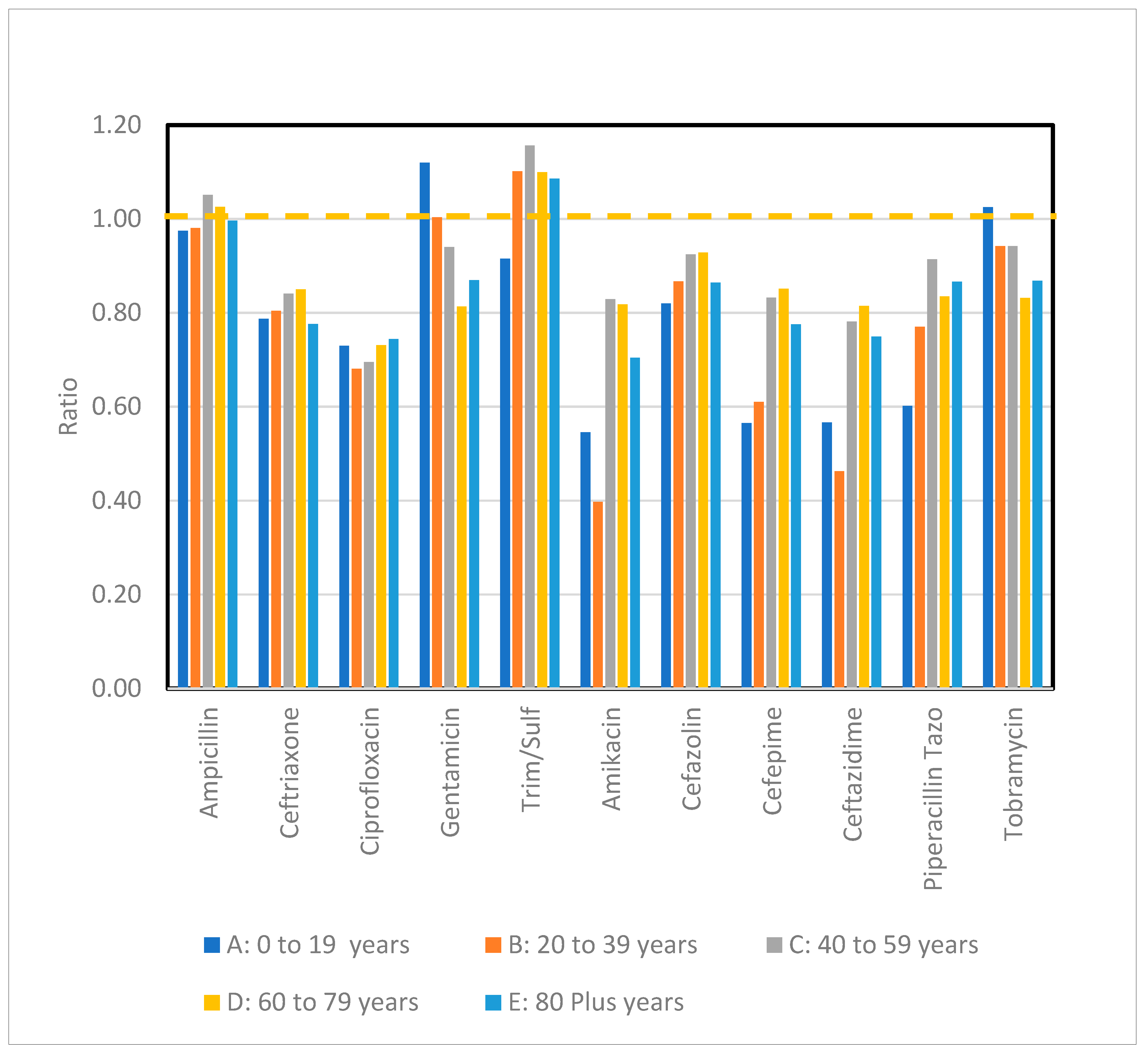

| Drug | Female/Male Resistance Odds Ratio | Lower Confidence Interval | Upper Confidence Interval |
|---|---|---|---|
| Ampicillin | 1.05 | 1.01 | 1.09 |
| Ceftriaxone | 0.81 | 0.77 | 0.86 |
| Ciprofloxacin | 0.70 | 0.66 | 0.74 |
| Gentamicin | 0.88 | 0.82 | 0.94 |
| Meropenem | 1.03 | 0.45 | 2.35 |
| Trimethoprim sulfamethoxazole | 1.16 | 1.12 | 1.21 |
| Amikacin | 0.75 | 0.63 | 0.89 |
| Cefazolin | 0.88 | 0.84 | 0.92 |
| Cefepime | 0.79 | 0.71 | 0.87 |
| Ceftazidime | 0.74 | 0.68 | 0.80 |
| Piperacillin-tazobactam | 0.83 | 0.77 | 0.90 |
| Tobramycin | 0.88 | 0.83 | 0.94 |
| Antimicrobial Panel | Female | Male | Difference | p-Value |
|---|---|---|---|---|
| 5-Drug Panel | 0.60 | 0.64 | –0.04 | <0.001 |
| 6-Drug Panel | 1.13 | 1.16 | –0.03 | 0.007 |
| 12-Drug Panel | 1.57 | 1.66 | –0.09 | <0.001 |
3.3. Mean Drug Resistance, Age and Sex

3.4. Antimicrobial Resistance, Age and Antimicrobial Usage

3.5. Antimicrobial Resistance, Sex, and Antimicrobial Usage by Age Versus Comparative Resistance

4. Discussion
5. Limitations
6. Conclusions
Supplementary Materials
Author Contributions
Funding
Institutional Review Board Statement
Informed Consent Statement
Data Availability Statement
Acknowledgments
Conflicts of Interest
References
- de Kraker, M.E.; Davey, P.G.; Grundmann, H.; BURDEN Study Group. Mortality and hospital stay associated with resistant Staphylococcus aureus and Escherichia coli bacteraemia: Estimating the burden of antibiotic resistance in Europe. PLoS Med. 2011, 8, e1001104. [Google Scholar] [PubMed]
- de Kraker, M.E.; Wolkewitz, M.; Davey, P.G.; Koller, W.; Berger, J.; Nagler, J.; Icket, C.; Kalenic, S.; Horvatic, J.; Seifert, H.; et al. Burden of antimicrobial resistance in European hospitals: Excess mortality and length of hospital stay associated with bloodstream infections due to Escherichia coli resistant to third-generation cephalosporins. J. Antimicrob. Chemother. 2011, 66, 398–407. [Google Scholar] [PubMed]
- Ding, D.; Wang, B.; Zhang, X.; Zhang, J.; Zhang, H.; Liu, X.; Gao, Z.; Yu, Z. The spread of antibiotic resistance to humans and potential protection strategies. Ecotoxicol. Environ. Saf. 2023, 254, 114734. [Google Scholar] [CrossRef] [Scilit] [PubMed]
- Ramirez, J.; Guarner, F.; Bustos Fernandez, L.; Maruy, A.; Sdepanian, V.L.; Cohen, H. Antibiotics as Major Disruptors of Gut Microbiota. Front Cell Infect. Microbiol. 2020, 10, 572912. [Google Scholar] [CrossRef] [Scilit] [PubMed]
- Guthrie, B.; Hernandez-Santiago, V.; Davey, P.G.; Nathwani, D.; Marwick, C.A. Changes in resistance among coliform bacteraemia associated with a primary care antimicrobial stewardship intervention: A population-based interrupted time series study. PLoS Med. 2019, 16, e1002825. [Google Scholar] [CrossRef] [Scilit]
- Hu, Y.; Rubin, J.; Mussio, K.; Riley, L.W. Risk factors for faecal carriage of multidrug resistant Escherichia coli in a college community: A penalised regression model. J. Glob. Antimicrob. Resist. 2021, 26, 166–173. [Google Scholar] [CrossRef] [Scilit] [PubMed]
- Njage, P.M.K.; Becsei, Á.; Marques, A.R.P.; Muchiri, B.W.; Pedersen, J.L.M.; Otani, S.; Avot, B.J.P.; Pruden, A.; Calarco, J.; Harwood, V.; et al. Sociodemographic and Health Factors Are Associated with Antimicrobial Resistance across Eight States in the United States. Environ. Sci. Technol. 2026, 60, 141–156. [Google Scholar]
- Collignon, P.; Beggs, J.J.; Walsh, T.R.; Gandra, S.; Laxminarayan, R. Anthropological and socioeconomic factors contributing to global antimicrobial resistance: A univariate and multivariable analysis. Lancet Planet Health 2018, 2, e398–e405. [Google Scholar] [CrossRef] [Scilit] [PubMed]
- Hendriksen, R.S.; Munk, P.; Njage, P.; van Bunnik, B.; McNally, L.; Lukjancenko, O.; Röder, T.; Nieuwenhuijse, D.; Pedersen, S.K.; Kjeldgaard, J.; et al. Global monitoring of antimicrobial resistance based on metagenomics analyses of urban sewage. Global Sewage Surveillance project consortium. Nat. Commun. 2019, 10, 1124. [Google Scholar] [PubMed]
- Collignon, P.; Beggs, J.J. Socioeconomic Enablers for Contagion: Factors Impelling the Antimicrobial Resistance Epidemic. Antibiotics 2019, 8, 86. [Google Scholar] [CrossRef] [Scilit] [PubMed]
- Worby, C.J.; Sridhar, S.; Turbett, S.E.; Becker, M.V.; Kogut, L.; Sanchez, V.; Bronson, R.A.; Rao, S.R.; Oliver, E.; Walker, A.T.; et al. Gut microbiome perturbation, antibiotic resistance, and Escherichia coli strain dynamics associated with international travel: A metagenomic analysis. Lancet Microbe 2023, 4, e790–e799. [Google Scholar] [CrossRef] [Scilit] [PubMed]
- World Health Organization (WHO). One Health. Available online: https://www.who.int/health-topics/one-health#tab=tab_1 (accessed on 2 June 2026).
- McEwen, S.A.; Collignon, P.J. Antimicrobial Resistance: One Health Perspective. Microbiol. Spectr. 2018, 6, ARBA-0009-2017. [Google Scholar] [CrossRef] [Scilit] [PubMed]
- Asaduzzaman, M.; Rahaman, M.Z.; Afrin, S.; Ara, R.; Mehmood, S.; Boriani, E.; Saif-Ur-Rahman, K.M. Antibiotic prescribing patterns in the community and primary care settings through a gender lens: A systematic review. Public Health 2025, 242, 311–318. [Google Scholar] [CrossRef] [Scilit] [PubMed]
- De Souza, N.; Guthrie, B.; Grant, S.; Lorencatto, F.; Dickson, J.; Herbec, A.; Hughes, C.; Sneddon, J.; Donnan, P.T.; Marwick, C.A. Antibiotic prescribing for care-home residents: A population-based, cross-classified multilevel analysis in Scotland, UK. Age Ageing 2025, 54, afae288. [Google Scholar] [PubMed]
- Salehi, M.; Laitinen, V.; Bhanushali, S.; Bengtsson-Palme, J.; Collignon, P.; Beggs, J.J.; Pärnänen, K.; Lahti, L. Gender differences in global antimicrobial resistance. npj Biofilms Microbiomes 2025, 11, 79. [Google Scholar] [CrossRef] [Scilit] [PubMed]
- Khanal, N.; Cortie, C.H.; Story, C.; Jones, S.; Mansfield, K.J.; Miyakis, S.; Keighley, C. Multidrug resistance in urinary E. coli higher in males compared to females. BMC Urol. 2024, 24, 255. [Google Scholar] [CrossRef] [Scilit] [PubMed]
- Badura, A.; Feierl, G.; Pregartner, G.; Krause, R.; Grisold, A.J. Antibiotic resistance patterns of more than 120 000 clinical Escherichia coli isolates in Southeast Austria, 1998–2013. Clin. Microbiol. Infect. 2015, 21, 569.e1–569.e7. [Google Scholar] [CrossRef] [Scilit] [PubMed]
- Wang, S.; Zhao, S.; Zhou, Y.; Jin, S.; Ye, T.; Pan, X. Antibiotic resistance spectrum of E. coli strains from different samples and age-grouped patients: A 10-year retrospective study. BMJ Open 2023, 13, e067490. [Google Scholar] [CrossRef] [Scilit] [PubMed]
- Waterlow, N.R.; Ashfield, T.; Knight, G.M. Observational study of antibiotic prescribing patterns by age and sex in primary care in England: Why we need to take this variation into account to evaluate antibiotic stewardship and predict AMR variation. JAC Antimicrob. Resist. 2025, 7, dlae210. [Google Scholar] [PubMed]
- Waterlow, N.R.; Cooper, B.S.; Robotham, J.V.; Knight, G.M. Antimicrobial resistance prevalence in bloodstream infection in 29 European countries by age and sex: An observational study. PLoS Med. 2024, 21, e1004301. [Google Scholar] [CrossRef] [Scilit] [PubMed]
- Tomas, A.; Aljadeeah, S. The Overlooked Issue of Outpatient Combination Antibiotic Prescribing in Low- and Middle-Income Countries: An Example from Syria. Antibiotics 2022, 11, 74. [Google Scholar] [CrossRef] [Scilit] [PubMed]
- Zhao, H.; Bian, J.; Han, X.; Zhang, M.; Zhan, S. Outpatient antibiotic use associated with acute upper respiratory infections in China: A nationwide cross-sectional study. Int. J. Antimicrob. Agents 2020, 56, 106193. [Google Scholar] [CrossRef] [Scilit] [PubMed]
- Australian Commission on Safety and Quality in Health Care (ACSQHC). Antimicrobial Use in the Community: 2024. 2025. Available online: https://www.safetyandquality.gov.au/resources/antimicrobial-use-community-2024 (accessed on 22 June 2026).
- Global Antimicrobial Resistance and Use Surveillance System (GLASS). Available online: https://www.who.int/initiatives/glass; https://worldhealthorg.shinyapps.io/glass-dashboard/_w_22c756a06554460b9bf96b3d2f9b310f/#!/amu (accessed on 2 June 2026).
- Bell, J.; Fajardo Lubian, A.; Partridge, S.; Gottlieb, T.; Robson, J.; Iredell, J.; Daley, D.; Coombs, G. Australian Group on Antimicrobial Resistance (AGAR) Australian Gram-negative Surveillance Outcome Program (GnSOP) Bloodstream Infection Annual Report 2024. Commun. Dis. Intell. 2025, 49. [Google Scholar] [CrossRef] [Scilit] [PubMed]
- European Committee on Antimicrobial Susceptibility Testing. Breakpoint Tables for Interpretation of MICs and Zone Diameters. Version 15.0, Valid from 2025-01-01. 2025. Available online: https://www.eucast.org/clinical_breakpoints (accessed on 22 June 2026).
- Supply Data, Australian Government Department of Health and Aged Care. Available online: https://www.pbs.gov.au/info/statistics/dos-and-dop/dos-and-dop (accessed on 22 June 2026).
- Gadzhanova, S.; Roughead, E.; on behalf of the Australian Commission on Safety and Quality in Health Care (ACSQHC). Analysis of 2015–2022 PBS and RPBS Antimicrobial Dispensing Data. 2023. Available online: https://www.safetyandquality.gov.au/publications-and-resources/resource-library/analysis-2015-2022-pbs-and-rpbs-antimicrobial-dispensing-data (accessed on 22 June 2026).
- Judah, G.; Aunger, R.; Schmidt, W.P.; Michie, S.; Granger, S.; Curtis, V. Experimental pretesting of hand-washing interventions in a natural setting. Am. J. Public Health 2009, 99, S405–S411. [Google Scholar] [CrossRef] [Scilit] [PubMed]
- MacKinnon, M.C.; McEwen, S.A.; Pearl, D.L.; Lyytikäinen, O.; Jacobsson, G.; Collignon, P.; Gregson, D.B.; Valiquette, L.; Laupland, K.B. Increasing incidence and antimicrobial resistance in Escherichia coli bloodstream infections: A multinational population-based cohort study. Antimicrob. Resist. Infect. Control. 2021, 10, 131. [Google Scholar] [CrossRef] [Scilit] [PubMed]
- Lee, K.; Raguideau, S.; Sirén, K.; Asnicar, F.; Cumbo, F.; Hildebrand, F.; Segata, N.; Cha, C.J.; Quince, C. Population-level impacts of antibiotic usage on the human gut microbiome. Nat. Commun. 2023, 14, 1191. [Google Scholar] [CrossRef] [Scilit] [PubMed]
Disclaimer/Publisher’s Note: The statements, opinions and data contained in all publications are solely those of the individual author(s) and contributor(s) and not of MDPI and/or the editor(s). MDPI and/or the editor(s) disclaim responsibility for any injury to people or property resulting from any ideas, methods, instructions or products referred to in the content. |
© 2026 by the authors. Licensee MDPI, Basel, Switzerland. This article is an open access article distributed under the terms and conditions of the Creative Commons Attribution (CC BY) license.
Share and Cite
Collignon, P.; Beggs, J.J.; Bell, J.M.; Daley, D.; Roughead, E.; on behalf of the Australian Group on Antimicrobial Resistance. Population-Level Uncoupling of Antimicrobial Usage and Resistance in Community-Onset Escherichia coli Bloodstream Infections. Pathogens 2026, 15, 670. https://doi.org/10.3390/pathogens15070670
Collignon P, Beggs JJ, Bell JM, Daley D, Roughead E, on behalf of the Australian Group on Antimicrobial Resistance. Population-Level Uncoupling of Antimicrobial Usage and Resistance in Community-Onset Escherichia coli Bloodstream Infections. Pathogens. 2026; 15(7):670. https://doi.org/10.3390/pathogens15070670
Chicago/Turabian StyleCollignon, Peter, John J. Beggs, Jan M. Bell, Denise Daley, Elizabeth Roughead, and on behalf of the Australian Group on Antimicrobial Resistance. 2026. "Population-Level Uncoupling of Antimicrobial Usage and Resistance in Community-Onset Escherichia coli Bloodstream Infections" Pathogens 15, no. 7: 670. https://doi.org/10.3390/pathogens15070670
APA StyleCollignon, P., Beggs, J. J., Bell, J. M., Daley, D., Roughead, E., & on behalf of the Australian Group on Antimicrobial Resistance. (2026). Population-Level Uncoupling of Antimicrobial Usage and Resistance in Community-Onset Escherichia coli Bloodstream Infections. Pathogens, 15(7), 670. https://doi.org/10.3390/pathogens15070670