Review

An Overview of the Genetic Diversity and Epidemiological Potential of Yersinia pestis Populations in Natural Plague Foci of Kazakhstan

by
Aigul Abdirassilova
1,*,
Duman Yessimseit
1,2,
Altynai Kassenova
1,
Altyn Rysbekova
1,
Beck Abdeliyev
1,
Zauresh Zhumadilova
1,
Ziyat Abdel
1,
Raikhan Mussagaliyeva
1,
Tatyana Meka-Mechenko
1,
Galiya Sairambekova
1,
Elmira Begimbayeva
1,
Ainur Nurpeisova
3,
Temirkhan Sagidulin
1,
Ayaulym Maksatova
1,
Sanzhar Agzam
1,
Raikhan Nissanova
3,
Vladimir Motin
4 and
Oleg Reva
5,*
1
M. Aikimbayev’s National Scientific Center for Especially Dangerous Infections, 14 Zhakhanger St., Almaty A35P0K3, Kazakhstan
2
Al-Farabi Kazakh National University, 71 al-Farabi Ave., Almaty A15E3B4, Kazakhstan
3
Kazakh Scientific Research Veterinary Institute, 223 Rayymbek Ave., Almaty A20C2E4, Kazakhstan
4
Department of Pathology, The University of Texas Medical Branch, Galveston, TX 77555, USA
5
Centre for Bioinformatics and Computational Biology, Department of Biochemistry, Genetics and Microbiology, University of Pretoria, Pretoria 0002, South Africa
*
Authors to whom correspondence should be addressed.
Pathogens 2026, 15(5), 551; https://doi.org/10.3390/pathogens15050551
Submission received: 29 April 2026 / Revised: 16 May 2026 / Accepted: 18 May 2026 / Published: 20 May 2026

Abstract

This review provides a comprehensive overview of the genetic diversity and epidemiological potential of Yersinia pestis in Kazakhstan’s natural plague foci, emphasizing the link between genotypic variation and outbreak capacity. Integrating historical epidemiological records with contemporary microbiological and genomic data (including PCR, VNTR/MLVA, SNP analysis, and whole-genome sequencing), we evaluate core and accessory genome variations. The data reveal substantial regional heterogeneity. High-risk desert foci (Caspian and Aral regions) are dominated by the Medievalis biovar, including atypical genovariants lacking canonical markers. Conversely, high-mountain foci (Sarydzhaz, Talas) harbor the Antiqua and Talas biovars, primarily linked to enzootic circulation. Notably, the Ili River focus exhibits extreme genomic variability, featuring strains with plesiomorphic traits. Furthermore, the widespread distribution of mobile elements like the cryptic plasmid pCKF suggests significant horizontal transfer contributing to pathogen adaptation. Ultimately, Central Asian plague dynamics are driven by complex evolutionary and ecological interactions. Given climate change and expanding human–wildlife interfaces, continuous genomic and ecological surveillance is essential for the early detection of high-risk Y. pestis genovariants and improving public health preparedness.

1. Introduction

Plague is a dangerous natural focal infection requiring quarantine that is characterized by extremely high transmissibility and mortality. Three major plague pandemics, which occurred in Late Antiquity (the Plague of Justinian, 6th–8th centuries), the Middle Ages (the Black Death, 14th–17th centuries), and the modern era (the Third Plague Pandemic, 19th–20th centuries), claimed hundreds of millions of human lives [1,2,3,4,5,6].
The causative agent of plague, Yersinia pestis, was identified during the third pandemic. It is a Gram-negative, non-motile, non-spore-forming coccobacillus [3]. In nature, it circulates within populations of various rodents (such as gerbils, marmots, ground squirrels, voles, and others) and is transmitted from animal to animal through flea bites [3,7].
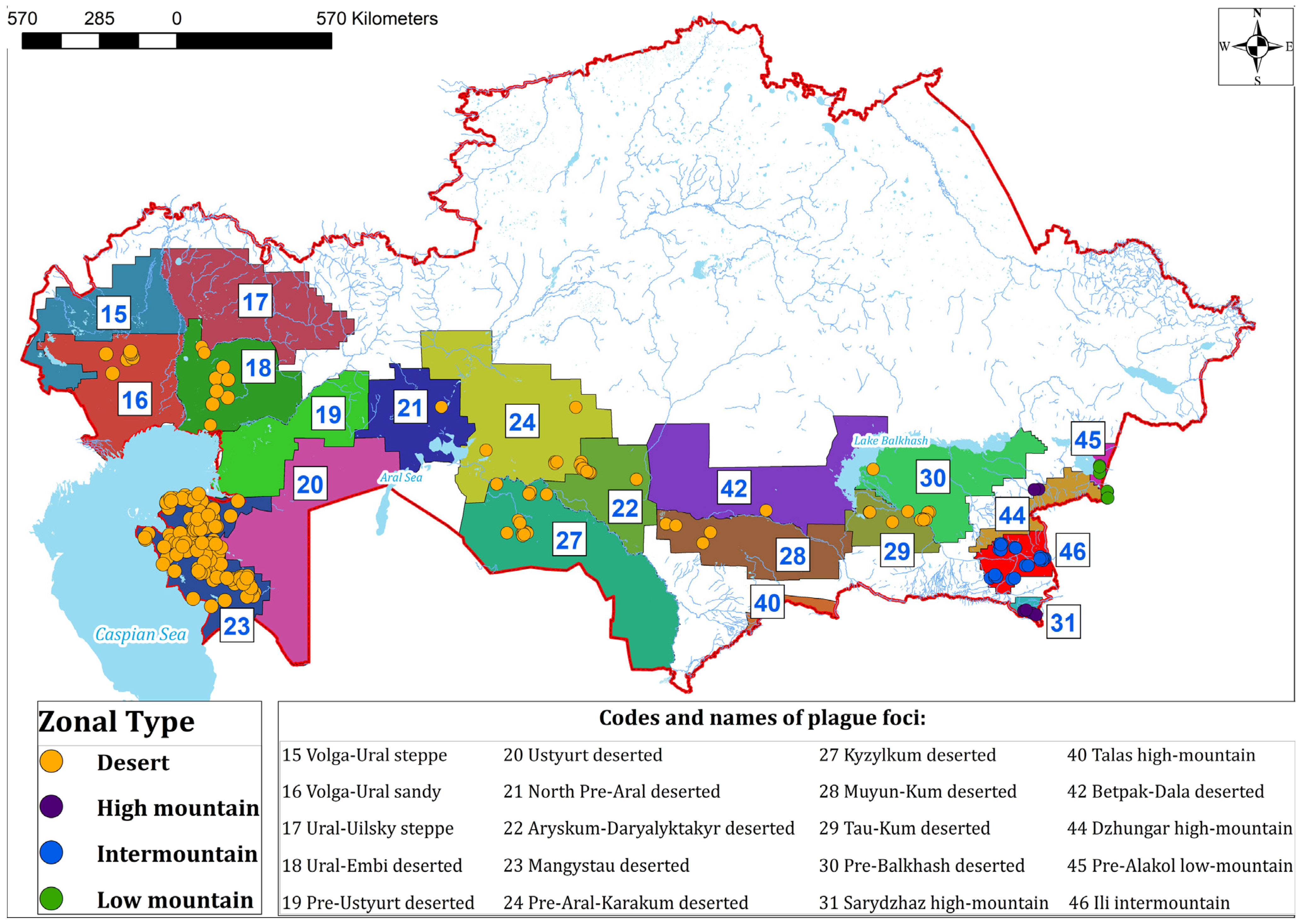
Central Asia represents one of the largest and most historically active plague-endemic regions, with Kazakhstan encompassing extensive natural foci that have exhibited sustained epizootic and episodic epidemic activity over the past century [8,9,10] (Figure 1). Recent studies have revealed substantial genetic heterogeneity within Y. pestis populations in this region, including the presence of atypical genovariants and mobile genetic elements that may influence pathogen fitness, transmission dynamics, and epidemic potential [11,12]. In parallel, environmental and climatic changes, together with increasing human interactions with wildlife, are likely to alter host–vector relationships and modulate the risk of spillover events [13,14].
This review aims to integrate epidemiological, ecological, phenotypic, and genomic data to provide a comprehensive overview of the diversity and population structure of Y. pestis in natural plague foci of Central Asia. The review addresses the hypotheses that (i) distinct Y. pestis lineages differ in their epidemic potential according to their ecological and evolutionary background, (ii) regional genetic heterogeneity is shaped by local host–vector systems and environmental conditions, and (iii) accessory genetic elements, including cryptic plasmids, contribute to pathogen diversification and adaptation. Particular emphasis is placed on the emergence of genetically distinct lineages and the implications of genomic diversity for surveillance and public health preparedness under changing environmental conditions. Ultimately, we highlight that the pronounced regional genomic heterogeneity, combined with environmental shifts, may facilitate the emergence of high-risk genovariants, underscoring the critical need for continuous, integrated genomic surveillance.

2. Regional Epidemiology and Historical Outbreaks

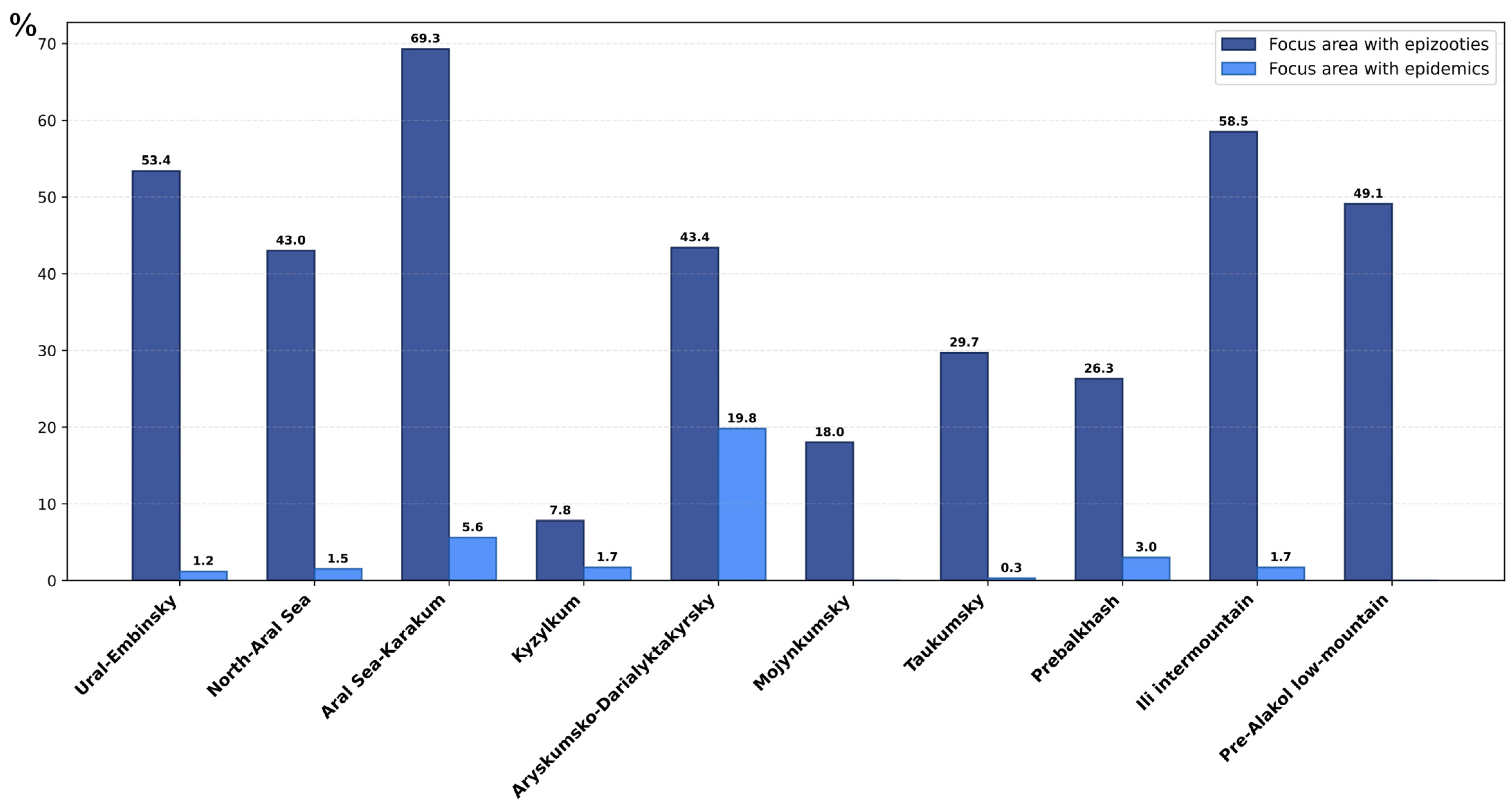
Long-term surveillance of the circulation of the plague pathogen in wild rodent populations has been conducted in natural plague foci of Kazakhstan since the early 20th century. These studies revealed the highest epizootic activity in plague-endemic areas, especially those located near major natural water bodies. These include the basins of the Caspian Sea, including the Ural–Emba focus, and the Aral Sea, including northern Kyzylkum, Arys-Kum, and Daryalyk-Takyr, as well as Lake Alakol and large active plague foci around Lake Balkhash: Taukum, southern Balkhash, and areas along the middle reaches of the Ili River. Areas of epizootics and epidemic outbreaks from 1929 to 2021, estimated as percentages of the total areas of the foci, are shown in Figure 2 [8,9,10].
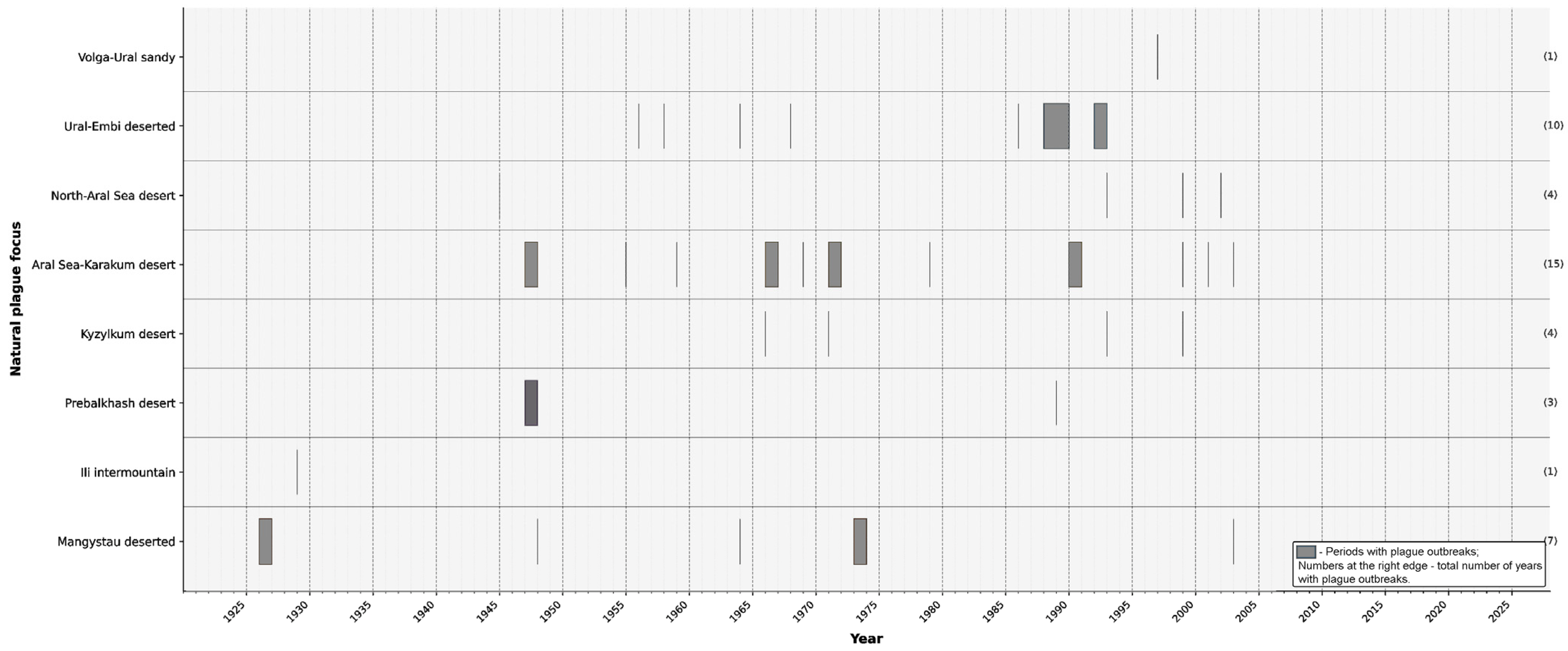
Epidemic plague outbreaks are most frequent in the Caspian region, the Aral region, and the southern Balkhash area (Figure 3).
In the Ural–Emba focus, major outbreaks of infection have been documented since 1904–1905, with the most recent outbreak occurring in 1993. These events took place against a background of continuously ongoing widespread epizootics, the activity of which started to decline only by the mid-1990s.
In the Aral region, human plague outbreaks have been recorded since 1924, and from the 1940s onward they occurred almost every decade up to 2003. The high epidemic activity of this region was largely driven by persistent epizootics in the Aral Karakum area, where most plague outbreaks occurred. In the remaining enzootic territories of the Aral region, including the North Caspian focus and the northern part of the Kyzylkum Desert, the epizootic process was characterized by periodic activity. In this region, plague epidemics were first identified in 1945 following a high-mortality outbreak in desert areas of the Northern Aral region, where it still persists now [8,9,10].
In southern Balkhash and the Ili River valley, epidemic years were recorded far less frequently than in the previously described regions. Two major outbreaks happened in 1929 in the left bank of the middle Ili River, and in 1947–1948 in the southern shore of Lake Balkhash. These outbreaks were clearly anthropogenic in origin. They were characterized by rapid transmission across multiple settlements and exceptionally high mortality rates (95% and >70%, respectively), driven by a high proportion of primary and secondary pneumonic plague cases [8,9,15].
Human infections typically occurred during periods of intensified epizootic activity and were confined to enzootic territories. Over the entire observation period starting from the early 20th century to the present, the Central Asian desert plague focus recorded 2280 human cases, including 2066 fatalities (case-fatality rate: 90.6%). Of these, 37% of cases were registered in Kazakhstan, with a mortality rate of 80.0% [8,9]. According to the publication by Sagiyev et al. (2019) [16], annual vaccination with EV76 NIIEG has been performed since the mid-1930s among residents of plague-enzootic regions. Vaccination campaigns were generally conducted in spring before peak epizootic activity. Plague vaccination is still performed in modern Kazakhstan, although on a smaller and more targeted scale than during the USSR period. Changes in vaccination strategy may potentially influence the phenotypic and genotypic structure of pathogen population [17,18]; however, studies addressing this issue in Y. pestis remain limited. Interactions between the pathogen and its natural rodent hosts may also contribute to shaping population variability. Wild rodent populations inhabiting endemic plague foci often contain animals with detectable anti-Y. pestis antibodies, indicating prior exposure and survival. In addition, experimental and field serological studies conducted in Madagascar and other endemic regions have demonstrated measurable humoral immune responses in wild rodents following natural exposure [19].

3. Bacteriological and Modern Genetic Approaches Used to Study Diversity of Y. pestis Isolates

The study of the phenotypic and genetic diversity of Y. pestis has undergone a substantial transition from classical microbiological characterization to integrative, genome-scale approaches. Conventionally, strain differentiation relied on phenotypic assays, including biochemical profiling, assessment of virulence-associated traits such as fraction I (F1 antigen) production, sensitivity to bacteriophages and pesticin, and evaluation of nutritional requirements. These methods remain important for distinguishing biovars and identifying atypical variants, particularly in field and surveillance settings, although their discriminatory power is limited and often influenced by environmental conditions [4,20].
The introduction of molecular methods has significantly improved resolution in strain typing. Targeted PCR assays have been widely used to detect diagnostic polymorphisms in genes such as rpoB, glpD, napA, araC, ssuA, and rhaS. These approaches provide rapid and specific identification of major biovars and clades, facilitating routine surveillance and outbreak investigations [4,21,22]. However, their ability to resolve fine-scale evolutionary relationships is inherently limited.
To overcome these constraints, multilocus variable-number tandem repeat analysis (MLVA/VNTR typing) has been extensively applied in studies on Y. pestis strains [23,24,25]. By exploiting variation in tandem repeat loci, VNTR-based approaches generate high-resolution genotypic profiles that are particularly useful for epidemiological tracking and investigation of transmission chains. Nevertheless, the relatively high mutation rate of repeat regions compared to the core genome regions can introduce homoplasy, reducing phylogenetic robustness in long-term evolutionary analyses [11].
Single-nucleotide polymorphism (SNP)-based genotyping has provided a more stable framework for reconstructing evolutionary relationships. SNPs represent the most abundant and phylogenetically informative form of genetic variation, enabling robust delineation of major lineages, sublineages, and clades of Y. pestis. In combination with phylogenetic inference methods, SNP analysis has greatly enhanced our understanding of the global spread and diversification of the pathogen. Whole-genome sequencing (WGS) now represents the central approach for studying Y. pestis diversity. WGS provides comprehensive resolution of genetic variation, including SNPs, insertions and deletions, structural rearrangements, and the presence of mobile genetic elements. Comparative genomic analyses based on WGS data have revealed substantial heterogeneity within natural populations, including the existence of atypical genovariants and region-specific adaptations. Importantly, genome-scale data allow for the reconstruction of transmission pathways, identification of evolutionary bottlenecks, and assessment of population structure at an unprecedented resolution [11,12].
In addition to core genome variation, increasing attention has been directed toward the role of mobile genetic elements, including plasmids, transposons, and CRISPR-Cas systems. The analysis of CRISPR spacer arrays provides insight into historical interactions with bacteriophages and other mobile elements, offering an additional layer of resolution for distinguishing closely related strains. Similarly, the detection of accessory elements, such as cryptic plasmids, highlights the importance of horizontal gene transfer in shaping the genetic landscape of Y. pestis populations [26,27].
Recent advances have further expanded the analytical framework through the integration of multi-omics approaches. Transcriptomic, proteomic, metabolomic, and epigenetic studies enable the functional characterization of genetic variation, linking genotype to phenotype under different environmental and host-associated conditions. These approaches provide a systems-level understanding of pathogen adaptation, virulence regulation, and host–vector interactions, complementing static genomic analyses [12,28,29,30].
Finally, modern phylogenomic and population genomic frameworks integrate large-scale datasets using robust computational methods, including parsimony, maximum likelihood, and Bayesian inference. These approaches enable the identification of clonal expansions, reconstruction of evolutionary trajectories, and correlation of genetic variation with ecological and epidemiological factors. Together, they provide a comprehensive toolkit for monitoring the emergence and spread of Y. pestis lineages in natural foci and for informing public health interventions [31].
It can be concluded that the study of Y. pestis diversity has evolved into a multidisciplinary field that combines classical microbiology with advanced genomic and systems biology approaches. This integrative strategy is essential for understanding the evolutionary dynamics of the pathogen, identifying emerging high-risk variants, and improving surveillance in plague-endemic regions.

4. Subspecies and Phenotypic Diversity

In Kazakhstan, plague enzooticity is maintained by two subspecies of Yersinia pestis: Y. pestis subsp. pestis belonging to biovars Antiqua (ANT) and Medievalis (MED) and Y. pestis subsp. central asiatica (Talas biovar, 0.PE4t). Strains belonging to the Talas biovar are confined to the transboundary Talas Mountain plague focus, the majority of which lies within Kyrgyzstan. Although most isolates recovered within Kazakhstan exhibit phenotypic and genotypic characteristics consistent with their respective taxonomic groups, atypical strains deviating from canonical profiles are not uncommon [32,33].
Microbiological and molecular genetic studies of a large number of strains have demonstrated that Y. pestis of the MED circulates in the plague foci of the Caspian and Aral Sea regions [11,34,35].
The strains of the MED biovar bears several mutations common with other ‘modern’ biovars of Y. pestis (e.g., Antiqua (ANT)). These mutations align with established evolutionary trajectories from Yersinia pseudotuberculosis to highly virulent Y. pestis. Key adaptations include a frameshift mutation in the Rcs regulatory pathway and dysregulation of cyclic di-GMP signaling, leading to the activation of the hms locus and biofilm-mediated blockage of the flea foregut. This blockage promotes repeated feeding attempts by infected fleas, substantially enhancing transmission efficiency to mammalian hosts, including humans. Additionally, inactivation of ureD suppresses urease activity and is thought to have undergone strong positive selection, further optimizing flea-borne transmission [36,37,38,39].
Phenotypic diversity between Y. pestis strains isolated from different geographical areas was observed. For example, the strains isolated in the Ural–Emba focus exhibit variability in sensitivity to pesticin 1 and require nutrient supplementation with methionine, cysteine, and threonine for growth in culture media. Strains circulating in the Aral region largely represent typical members of the main subspecies; however, isolates from the Kyzylkum autonomous focus display amino acid auxotrophy, with growth dependent on leucine, arginine, lysine, and cysteine. These populations include F1-deficient strains with reduced virulence in laboratory mice and delayed rhamnose fermentation taking 2 to 13 days. Strains from the Balkhash region and the Ili River valley show pronounced phenotypic heterogeneity. In addition to canonical Central Asian desert focus strains, the Balkhash autonomous focus harbors variants with altered traits, including reduced FI synthesis, resistance to plague bacteriophage, and inability to ferment maltose. Amino acid-dependent strains (arginine and tryptophan auxotrophy) with reduced and host-selective virulence are also observed in this region. Notably, arabinose-negative (Ar–) atypical strains have persisted in this region and have even expanded their geographic range. Within the Ili River intermountain autonomous focus, isolates exhibit heterogeneity in sensitivity to pesticin 1 and bacteriophage L-413C, and occasional strains with weak denitrification activity have been reported [8,10,20].

5. Molecular Typing and Genomic Analysis

In recent previous publications, more than 100 Y. pestis natural isolates have been characterized by phenotype and genotype [11,12]. This work continues and here we present results of a bacteriological analysis and genotyping of 17 new Y. pestis strains representing distinct natural plague foci of Kazakhstan. The on-going study is aimed at identifying potential associations between genotypic variation and the epidemic potential of different genetic variants of the pathogen in Kazakhstan.
The analyzed strains exhibited phenotypic characteristics consistent with Y. pestis, including susceptibility to both species-specific and broad-host-range bacteriophages, confirming their taxonomic identity. VNTR and SNP typing of 17 representative isolates further supported their assignment to the MED biovar, although a subset of the strains contained plasmid pCKF and displayed divergent genotypic profiles at med24 locus (Table 1).
The genetic diversity of the selected strains of Y. pestis isolates has been revealed using PCR-based assays and whole-genome sequencing (WGS). Polymorphisms in the napA, araC, ssuA, and rhaS genes together with transposon insertions and CRISPR-Cas spacer patterns were used.
PCR amplification targeting the variable region of rpoB detected no deletions characteristic of the Orientalis biovar in these isolates, and the primers targeting the variable region of glpD revealed no polymorphism among the strains. The MED-specific primer sets (med24 and ANT/MED) classified the majority of isolates within the MED clade of Y. pestis. Canonical Medievalis strains typically harbor a 24 bp deletion in the region flanked by Med24 primers, distinguishing them from Antiqua and non-mainline lineages (e.g., Talas), which lack this deletion.
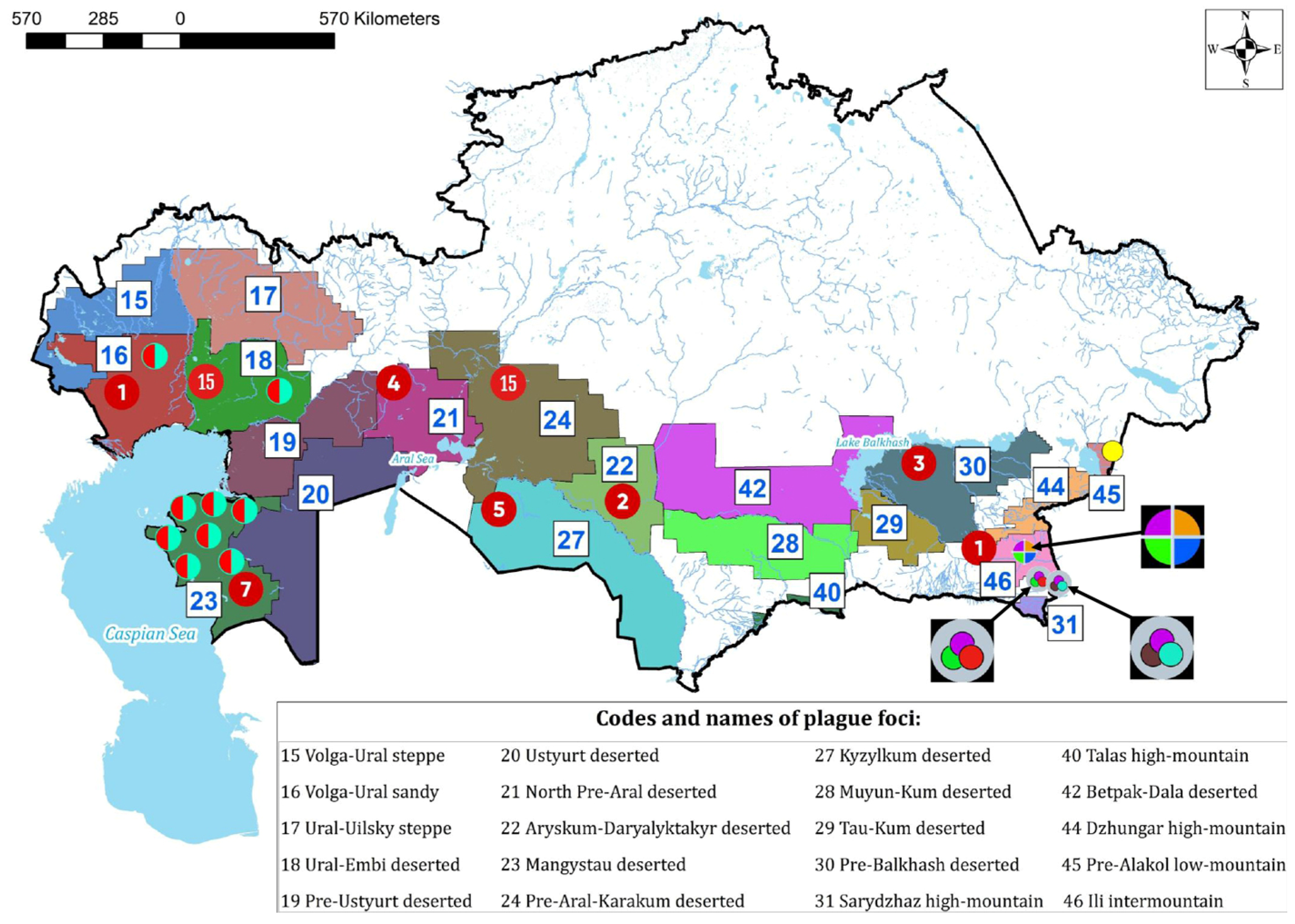
Unexpectedly, isolates from seven Caspian-region foci, although assigned to the MED biovar, lacked the characteristic 24 bp deletion in this locus (Figure 4). The biological significance of this genovariant remains unclear and warrants further investigation. Notably, as explained above, the regions where these strains were identified have historically experienced intense epidemics with high mortality.

6. Genetic Diversity of Y. pestis Isolates from Different Plague Foci of Kazakhstan

6.1. Ili River Focus

The Ili River intermountain plague focus harbors the most genomically diverse population of Y. pestis (Figure 4). Among the 30 analyzed strains, 8 exhibited structural variation in chromosomal sequences, with 3 strains showing alterations across multiple loci. Several isolated strains shared plesiomorphic features resembling Y. pseudotuberculosis isolates. Usually, members of the main “modern” clade of Y. pestis can be distinguished from Y. pseudotuberculosis and ancestral Y. pestis lineages through an analysis of the acetolactate synthase small subunit gene (ilvN) [40,41]. Notably, ilvN sequences from two isolates originating from the Ili River intermountain focus in the southern Balkhash region showed similarity to the Y. pseudotuberculosis reference strain, lacking the 45 bp deletion at the 3′ end of the gene. In contrast, canonical representatives of the main Y. pestis clade harbor a truncated ilvN gene, which is shorter by 45 nucleotides.
Several other marker strains listed below were isolated in this region.
Strain 37_YP92_S3, isolated from Rhombomys opimus on 26 June 2007, lacked the 5′-end deletion in ilvN; at position 671 of rhaS, it carried a G instead of A, consistent with Y. pseudotuberculosis and non-main Y. pestis biovars. It also displayed a distinct napA structure, lacking the G substitution at position 613, implying a functional periplasmic nitrate reductase and denitrification-positive (den+) phenotype. Additionally, its genome contained CRISPR-Cas insertions corresponding to the large genomic island (GI) typical of Y. pseudotuberculosis and ancestral Y. pestis, but with mutations in the target region recognized by the PCR analysis.
Strain 43_YP23_S22 isolated from R. opimus (7 July 2010) similarly lacked the 5′ ilvN deletion and harbored CRISPR-Cas GI insertions analogous to those in Y. pseudotuberculosis and non-main Y. pestis, but without the primer-target mutations observed in 37_YP92_S3. Moreover, it lacked the characteristic 24 bp deletion in the region flanked by Med24 primers, deviating from canonical MED strains.
Strain 19_S74 isolated from Xenopsylla gerbilli (15 June 2022) showed no yeaW deletion in the 2.ANT/2.MED region as in Y. pseudotuberculosis and Y. pestis Antiqua (ANT) strains. It carries the long CRISPR-Cas insert, and uniquely retained intact yapB1 and yapB2 genes, as in Y. pseudotuberculosis. In contrast, canonical Y. pestis strains harbor a fused yapB gene resulting from a deletion spanning the 3′ portion of yapB1 and the 5′ portion of yapB2.
An additional five strains from this focus also lacked the 24 bp deletion in the Med24-flanked region.
It should be noted that the Ili River intermountain focus is characterized by persistent epizootic activity. A representative case involved a man who acquired infection while hunting a wild cat; he developed septicemic and secondary pneumonic plague and died on the third day. The outbreak was clearly anthropogenic in origin [9,15]. The genetic diversity of the Y. pestis population including atypical strains exhibiting plesiomorphic features, together with ongoing climatic changes, may facilitate the emergence of high-risk genovariants. Historically, the region experienced substantial plague morbidity, with only major outbreaks formally documented, including the 1929–1930 Kosagach outbreak in the left-bank Ili Basin [9,15].

6.2. Caspian Region Population Structure

Another region exhibiting pronounced genomic structural variability in Y. pestis populations is the Caspian region, which encompasses four natural plague foci: the Volga–Ural sandy, Ural–Emba, Pre-Ustyurt, and Mangystau autonomous desert foci. The Mangystau focus, defined by a unique ecological landscape and a long history of plague persistence, requires sustained and rigorous epidemiological surveillance to mitigate outbreak risk and ensure public health security [42]. Our data indicate the presence of atypical strains in this region combining carriage of the small plasmid pCKF with the absence of the characteristic 24 bp deletion in the Med24-flanked locus that is a hallmark of these strains. These variants were predominantly associated with the Mangyshlak focus, suggesting localized genetic divergence within the Medievalis lineage [12].
Isolates from the Mangyshlak focus formed a compact, genetically homogeneous cluster, whereas strains from the Volga–Ural, Pre-Ustyurt, and Ural–Emba foci partial overlap, reflecting historical epidemiological connectivity. Notably, the small plasmid pCKF detected in eight isolates spanning all four Caspian foci (Table 1), showed complete identity to pCKF plasmids previously reported in Caucasian strains of biovar MED0 [33,43], consistent with horizontal transfer and/or long-term circulation across geographically separated regions. Despite the sequence identity of pCKF plasmids from the Caucasus and Kazakhstan, their host strains differ substantially, belonging to distinct biovars (MED1 instead of MED0). This suggests that pCKF can circulate independently of the bacterial genomic background across geographically separated regions. These findings, together with the occurrence of atypical strains lacking the Med24 24 bp deletion, highlight the need for continuous genomic surveillance to detect emergent virulent or drug-resistant clones and to clarify the role of pCKF in virulence and environmental persistence [11,12].
Historically, the Caspian region exhibited high epidemic activity against a background of acute epizootics. In the Volga–Ural sandy focus, outbreaks were recorded in 1899, 1904–1907, 1909–1918, 1922–1930, 1932–1933, 1935–1941, 1945–1946, 1951, 1975, and 1997, totaling 38 epidemic years (117 events). Transmission was frequently associated with synanthropic rodents (~15%), including flea-borne infection via Pulex irritans; handling of infected camels accounted for ~10% of outbreaks, with the last such event in the Atyrau Region in 1975. The most recent case in this focus occurred in 1997 during a large-scale epizootic outbreak (1997–1998), and 19 outbreaks were secondary, driven by human-to-human spread [9,44].
Persistent activity in the Ural–Emba focus led to recurrent outbreaks. Thus, between 1938 and 1993, nine epidemic foci with 12 cases were documented, predominantly linked to flea bites; a single camel-associated outbreak occurred in 1958 (4 cases). The last cases were recorded in 1990 (fatal) and 1993 in the Atyrau Region [34,35]. In the Pre-Ustyurt focus (identified in 1957), seven epidemic foci with 11 cases were reported by 1997, which were largely sporadic (1958, 1959, 1961, 1968, 1988), with one cluster in August 1967 (5 cases) associated with the slaughter of an infected camel [4,5,6,34]. In the Mangyshlak focus, 22 outbreaks and 58 cases were recorded between 1926 and 1974, with infection sources including camels (18.2%), game animals (9%), and flea bites (72.8%) [9,45].
As in other plague foci, transmission was predominantly vector-borne via bites of infected fleas. Most human cases occurred among livestock workers and their families, with bubonic plague predominating (63.8%), followed by pneumonic (17.2%) and septicemic forms (15.6%); cutaneous–bubonic cases accounted for 3.4% [45].

6.3. Sarydzhaz and Talas Mountain Foci

Isolates from the Sarydzhaz and Talas Mountain foci, which belonged either to ANT or to Talas biovars, produced longer PCR amplicons with these primers compared to those characteristic of MED isolates [11]. There is no evidence that ANT or Talas strains from the Sarydzhaz and Talas high-mountain foci have been directly associated with documented human epidemic outbreaks. They are primarily linked to enzootic circulation in wildlife reservoirs, with only indirect or uncertain links to human disease.

7. Conclusions

The present review highlights the exceptional complexity of Yersinia pestis populations circulating within the natural plague foci of Kazakhstan, where long-term enzootic persistence is coupled with episodic epidemic manifestations. The integration of historical epidemiological data with modern genomic approaches demonstrates that plague dynamics in Central Asia are driven by a combination of ecological, evolutionary, and anthropogenic factors. Extensive surveillance conducted over more than a century has revealed that the highest epidemic activity is associated with lowland desert foci of the Caspian and Aral regions, whereas mountain foci such as Sarydzhaz and Talas function primarily as reservoirs of ancient lineages with limited epidemic potential [8,9,10,40].
A key finding emerging from recent studies is the pronounced genetic heterogeneity of Y. pestis populations in Kazakhstan, particularly within the Ili River intermountain and Caspian regions. The identification of atypical genovariants, including strains lacking canonical deletions or retaining plesiomorphic features characteristic of Y. pseudotuberculosis, indicates ongoing microevolutionary processes within natural foci. These observations are consistent with the hypothesis that Central Asia represents a major evolutionary reservoir of Y. pestis, where diversification is shaped by an intensive introgression of genetic variants of the pathogen across geographically distant plague foci, creating admixed populations containing 5 to 45% introgressed genomic component [11], as well as by adaptation to specific host–vector systems and environmental conditions [12,35].
The application of modern molecular approaches, including WGS, SNP-based phylogenetics, and analysis of mobile genetic elements, has significantly improved our ability to resolve population structure and trace evolutionary trajectories. In particular, the detection of the small plasmid pCKF across geographically distant foci and distinct genetic backgrounds suggests that horizontal gene transfer plays a previously underappreciated role in shaping the accessory genome of Y. pestis. Although the functional significance of such elements remains unclear, their distribution raises important questions regarding their potential contribution to virulence, environmental persistence, and transmission efficiency [34,43].
At the same time, phenotypic variability observed among isolates, including differences in metabolic requirements, virulence traits, and bacteriophage sensitivity, underscores the importance of integrating classical microbiological methods with genomic analyses. Such combined approaches are essential for the accurate characterization of strains and for linking genotype to epidemiologically relevant phenotypes, particularly in the context of surveillance and outbreak investigation [21,22].
Importantly, the data reviewed here indicate that not all Y. pestis lineages contribute equally to epidemic risk. While strains of the MED biovar dominate in historically active epidemic regions, ANT and Talas lineages circulating in high-mountain foci appear to be largely restricted to enzootic cycles and are not clearly associated with major human outbreaks. This distinction highlights the need to consider lineage-specific ecological and evolutionary characteristics when assessing plague risk [40,41].
Looking forward, the continued expansion of plague foci, now covering approximately 41% of the territory of Kazakhstan, combined with ongoing climate change and increasing human–wildlife interactions, is likely to alter host–vector dynamics and create new conditions for pathogen emergence. These changes may facilitate the appearance of novel genovariants with enhanced epidemic potential, particularly in regions where genetically diverse populations are already present. In this context, continuous genomic surveillance, integrated with ecological monitoring, epidemiological analysis, and public health surveillance, are essential for the early detection of emerging variants and for the development of effective prevention strategies. Future research should focus on elucidating the functional significance of genetic variation, including the role of accessory genome elements, and on understanding how environmental and host-related factors influence the evolution and transmission of Y. pestis. Such multidisciplinary efforts will be critical for improving preparedness and mitigating the risk of future plague outbreaks in Central Asia and beyond.

Author Contributions

Conceptualization, A.A.; data curation, R.M. and S.A.; formal analysis, A.K., Z.A. and G.S.; investigation, B.A. and E.B.; methodology, T.M.-M.; project administration, A.A.; software, A.N., A.M. and O.R.; supervision, Z.Z.; validation, A.R.; visualization, T.S.; writing—original draft preparation, D.Y.; writing—review and editing, R.N., V.M. and O.R. All authors have read and agreed to the published version of the manuscript.

Funding

This research received no external funding.

Institutional Review Board Statement

The study was conducted in accordance with the Declaration of Helsinki, and approved by the Local Ethics Committee of M. Aikimbayev’s National Scientific Center for Especially Dangerous Infections (protocol 3, 5 March 2024).

Informed Consent Statement

Not applicable.

Data Availability Statement

Genome sequences discussed in this review are available through BioProject PRJNA1249055 at NCBI.

Acknowledgments

The authors express their gratitude to the organizers of the International Symposium Yersiniasis 15 for providing the opportunity to present this topic and for supporting its subsequent development into a comprehensive review.

Conflicts of Interest

The authors declare no conflicts of interest.

Abbreviations

The following abbreviations are used in this manuscript:
ANTAntiqua
MEDMedievalis
PCRPolymerase Chain Reaction
SNPSingle-Nucleotide Polymorphism
MLVAMultiple-Locus Variable-Number Tandem Repeat Analysis
VNTRVariable Number of Tandem Repeat
CRISPRClustered Regularly Interspaced Short Palindromic Repeat
WGSWhole-Genome Sequencing

References

  1. Harbeck, M.; Seifert, L.; Hänsch, S.; Wagner, D.M.; Birdsell, D.; Parise, K.L.; Wiechmann, I.; Grupe, G.; Thomas, A.; Keim, P.; et al. Yersinia pestis DNA from Skeletal Remains from the 6th Century AD Reveals Insights into Justinianic Plague. PLoS Pathog. 2013, 9, e1003349. [Google Scholar] [CrossRef] [PubMed]
  2. Wagner, D.M.; Klunk, J.; Harbeck, M.; Devault, A.; Waglechner, N.; Sahl, J.W.; Enk, J.; Birdsell, D.N.; Kuch, M.; Lumibao, C.; et al. Yersinia pestis and the plague of Justinian 541-543 AD: A genomic analysis. Lancet Infect. Dis. 2014, 14, 319–326. [Google Scholar] [CrossRef] [PubMed]
  3. Perry, R.D.; Fetherston, J.D. Yersinia pestis—Etiologic agent of plague. Clin. Microbiol. Rev. 1997, 10, 35–66. [Google Scholar] [CrossRef]
  4. Barbieri, R.; Signoli, M.; Chevé, D.; Costedoat, C.; Tzortzis, S.; Aboudharam, G.; Raoult, D.; Drancourt, M. Yersinia pestis: The Natural History of Plague. Clin. Microbiol. Rev. 2020, 34, e00044-19. [Google Scholar] [CrossRef] [PubMed]
  5. Glatter, K.A.; Finkelman, P. History of the Plague: An Ancient Pandemic for the Age of COVID-19. Am. J. Med. 2021, 134, 176–181. [Google Scholar] [CrossRef]
  6. Bennasar-Figueras, A. The Natural and Clinical History of Plague: From the Ancient Pandemics to Modern Insights. Microorganisms 2024, 12, 146. [Google Scholar] [CrossRef]
  7. Hinnebusch, B.J. The evolution of flea-borne transmission in Yersinia pestis. Curr. Issues Mol. Biol. 2005, 7, 197–212. [Google Scholar] [CrossRef]
  8. Aikimbayev, A.M.; Abdel, Z.Z.; Zhumadilova, Z.B.; Tokmurziyeva, G.Z.; Meka-Mechenko, T.V.; Mussagaliyeva, R.S.; Baitursyn, B.; Umarova, S. Systematization of indicators and standards of epidemiological and epizootiological surveillance by the plague to upgrades preventive (anti-plague) events in the Republic of Kazakhstan. Biosaf. Biotechnol. 2024, 19, 6–30. (In Russian) [Google Scholar] [CrossRef]
  9. Rivkus, Y.Z.; Blummer, A.G. Endemic Plague in the Deserts of Central Asia and Kazakhstan; LAP LAMBERT Academic Publishing: Saarbrucken, Germany, 2014. [Google Scholar]
  10. Popov, N.V.; Eroshenko, G.A.; Karnaukhov, I.G.; Kuznetsov, A.A.; Matrosov, A.N.; Ivanova, A.V.; Oglodin, E.G.; Nikiforov, K.A.; Korzun, V.M.; Verzhutsky, D.B.; et al. Epidemiological Situation on Plague in 2020. Forecast of Episootic Activity of Natural Plague Foci in the Russian Federation and Other CIS Countries for 2021. Probl. Part. Danger. Infect. 2021, 1, 52–62. (In Russian) [Google Scholar] [CrossRef]
  11. Abdirassilova, A.A.; Yessimseit, D.T.; Kassenova, A.K.; Abdeliyev, B.Z.; Zhumadilova, Z.B.; Tokmurziyeva, G.Z.; Kovaleva, G.G.; Abdel, Z.Z.; Meka-Mechenko, T.V.; Umarova, S.K.; et al. Whole genome sequencing of Yersinia pestis isolates from Central Asian natural plague foci revealed the role of adaptation to different hosts and environmental conditions in shaping specific genotypes. PLoS Negl. Trop. Dis. 2025, 19, e0013533. [Google Scholar] [CrossRef]
  12. Abdirassilova, A.A.; Yessimseit, D.T.; Rysbekova, A.K.; Kassenova, A.K.; Abdeliyev, B.Z.; Zhumadilova, Z.B.; Tokmurziyeva, G.Z.; Dikhanbayev, A.S.; Agzam, S.D.; Motin, V.L.; et al. Application of Long-Read Sequencing for Genotyping, Epigenetic Profiling and Surveillance of Yersinia pestis Isolates from Natural Foci and Disease Outbreaks in Central Asia. Vector Borne Zoonotic Dis. 2026, 7, 15303667261427352. [Google Scholar] [CrossRef]
  13. Mills, J.N.; Gage, K.L.; Khan, A.S. Potential influence of climate change on vector-borne and zoonotic diseases: A review and proposed research plan. Environ. Health Perspect. 2010, 118, 1507–1514. [Google Scholar] [CrossRef]
  14. Pfenning-Butterworth, A.; Buckley, L.B.; Drake, J.M.; Farner, J.E.; Farrell, M.J.; Gehman, A.M.; Mordecai, E.A.; Stephens, P.R.; Gittleman, J.L.; Davies, T.J. Interconnecting global threats: Climate change, biodiversity loss, and infectious diseases. Lancet Planet. Health 2024, 8, e270–e283. [Google Scholar] [CrossRef] [PubMed]
  15. Sabilaev, A.S.; Sapozhnikov, V.I.; Dyagilev, S.V.; Tuyakov, M.I.; Makhnin, B.V.; Birulin, P.A. Iliysky intermountain autonomous plague focus. Left-bank area. Report 4. Features of manifestation of factors of epidemic potential. In Proceedings of the International Scientific Conference dedicated to the 20th Anniversary of Independence of the Republic of Kazakhstan, Almaty, Republic of Kazakhstan, 22–23 September 2011; pp. 26–33. [Google Scholar]
  16. Sagiyev, Z.; Berdibekov, A.; Bolger, T.; Merekenova, A.; Ashirova, S.; Nurgozhin, Z.; Dalibayev, Z. Human response to live plague vaccine EV, Almaty region, Kazakhstan, 2014-2015. PLoS ONE 2019, 14, e0218366. [Google Scholar] [CrossRef] [PubMed]
  17. Feng, J.; Deng, Y.; Fu, M.; Hu, X.; Luo, W.; Lu, Z.; Dai, L.; Yang, H.; Zhao, X.; Du, Z.; et al. Construction of a Live-Attenuated Vaccine Strain of Yersinia pestis EV76-B-SHUΔpla and Evaluation of Its Protection Efficacy in a Mouse Model by Aerosolized Intratracheal Inoculation. Front. Cell. Infect. Microbiol. 2020, 10, 473. [Google Scholar] [CrossRef] [PubMed]
  18. Anisimov, A.P.; Vagaiskaya, A.S.; Trunyakova, A.S.; Dentovskaya, S.V. Live Plague Vaccine Development: Past, Present, and Future. Vaccines 2025, 13, 66. [Google Scholar] [CrossRef]
  19. Andrianaivoarimanana, V.; Telfer, S.; Rajerison, M.; Ranjalahy, M.A.; Andriamiarimanana, F.; Rahaingosoamamitiana, C.; Rahalison, L.; Jambou, R. Immune responses to plague infection in wild Rattus rattus, in Madagascar: A role in foci persistence? PLoS ONE 2012, 7, e38630. [Google Scholar] [CrossRef]
  20. Anisimov, A.P.; Lindler, L.E.; Pier, G.B. Intraspecific diversity of Yersinia pestis. Clin. Microbiol. Rev. 2004, 17, 434–464. [Google Scholar] [CrossRef]
  21. Qi, Z.; Cui, Y.; Zhang, Q.; Yang, R. Taxonomy of Yersinia pestis. Adv. Exp. Med. Biol. 2016, 918, 35–78. [Google Scholar] [CrossRef]
  22. Fenollar, F.; Raoult, D. Molecular genetic methods for the diagnosis of fastidious microorganisms. APMIS 2004, 112, 785–807. [Google Scholar] [CrossRef]
  23. Gulati, P.; Varshney, R.K.; Virdi, J.S. Multilocus variable number tandem repeat analysis as a tool to discern genetic relationships among strains of Yersinia enterocolitica biovar 1A. J. Appl. Microbiol. 2009, 107, 875–884. [Google Scholar] [CrossRef]
  24. Lindler, L.E. Typing methods for the plague pathogen, Yersinia pestis. J. AOAC Int. 2009, 92, 1174–1183. [Google Scholar] [CrossRef]
  25. Ziyat, A.; Zhumadilova, Z.; Mussagalieva, R.; Otebay, D.; Abdeliyev, B. Spatial and temporal characterisation of genetic and phenotypic properties of Yersinia pestis in Kazakhstan’s natural plague foci. Environ. Anal. Health Toxicol. 2025, 40, e2025019-0. [Google Scholar] [CrossRef]
  26. Pourcel, C.; Salvignol, G.; Vergnaud, G. CRISPR elements in Yersinia pestis acquire new repeats by preferential uptake of bacteriophage DNA, and provide additional tools for evolutionary studies. Microbiology 2005, 151, 653–663. [Google Scholar] [CrossRef]
  27. Chen, G.; Lyu, Y.; Wang, D.; Zhu, L.; Cao, S.; Pan, C.; Feng, E.; Zhang, W.; Liu, X.; Cui, Y.; et al. Obtaining Specific Sequence Tags for Yersinia pestis and Visually Detecting Them Using the CRISPR-Cas12a System. Pathogens 2021, 10, 562. [Google Scholar] [CrossRef] [PubMed]
  28. Zhang, C.G.; Gonzales, A.D.; Choi, M.W.; Chromy, B.A.; Fitch, J.P.; McCutchen-Maloney, S.L. Subcellular proteomic analysis of host-pathogen interactions using human monocytes exposed to Yersinia pestis and Yersinia pseudotuberculosis. Proteomics 2005, 5, 1877–1888. [Google Scholar] [CrossRef] [PubMed]
  29. Yang, R.; Du, Z.; Han, Y.; Zhou, L.; Song, Y.; Zhou, D.; Cui, Y. Omics strategies for revealing Yersinia pestis virulence. Front. Cell. Infect. Microbiol. 2012, 2, 157. [Google Scholar] [CrossRef] [PubMed]
  30. Han, Y.; Qiu, J.; Guo, Z.; Gao, H.; Song, Y.; Zhou, D.; Yang, R. Comparative transcriptomics in Yersinia pestis: A global view of environmental modulation of gene expression. BMC Microbiol. 2007, 7, 96. [Google Scholar] [CrossRef]
  31. Lê-Bury, P.; Druart, K.; Savin, C.; Lechat, P.; Mas Fiol, G.; Matondo, M.; Bécavin, C.; Dussurget, O.; Pizarro-Cerdá, J. Yersiniomics, a Multi-Omics Interactive Database for Yersinia Species. Microbiol. Spectr. 2023, 11, e0382622. [Google Scholar] [CrossRef]
  32. Onishchenko, G.G.; Fedorov, Y.M.; Kutyrev, V.V.; Popov, N.V.; Kuklev, E.V.; Kuznetsov, A.A.; Matrosov, A.N.; Bezsmertny, V.E.; Novikov, N.L.; Popov, V.P.; et al. Natural Foci of Plague in the Caucasus, Caspian Region, Central Asia, and Siberia; Meditsina Publishers: Moscow, Russia, 2004. [Google Scholar]
  33. Mussagalieva, R.S.; Abdel, Z.Z.; Zhumadilova, Z.B.; Aikimbaev, A.M.; Abdirasilova, A.A.; Issaeva, S.B.; Islamov, R.A.; Baitursin, B.; Abdeliyev, B.Z.; Begimbaeva, E.Z.; et al. Integral research of Yersinia pestis isolates from desert natural plague focuses in the Republic of Kazakhstan (2024): Phenotype, genotype, virulence. Int. Res. J. 2025, 12, 162. [Google Scholar] [CrossRef]
  34. Oglodin, E.G.; Cherkasov, A.V.; Eroshenko, G.A.; Odinkov, G.N.; Shavina, N.Y.; Novichkova, L.A.; Kutyrev, V.V. Analysis of the nucleotide sequence of a cryptic plasmid from Yersinia pestis strains in the Central-Caucasus High Mountain plague focus. Russ. J. Genet. 2015, 51, 642–646. [Google Scholar] [CrossRef]
  35. Eroshenko, G.A.; Popov, N.V.; Al’khova, Z.V.; Kukleva, L.M.; Balykova, A.N.; Chervyakova, N.S.; Naryshkina, E.A.; Kutyrev, V.V. Evolution and circulation of Yersinia pestis in the Northern Caspian and Northern Aral Sea regions in the 20th-21st centuries. PLoS ONE 2021, 16, e0244615. [Google Scholar] [CrossRef]
  36. Guo, X.P.; Yan, H.Q.; Yang, W.; Yin, Z.; Vadyvaloo, V.; Zhou, D.; Sun, Y.C. A frameshift in Yersinia pestis rcsD alters canonical Rcs signalling to preserve flea-mammal plague transmission cycles. eLife 2023, 12, e83946. [Google Scholar] [CrossRef]
  37. Silva-Rohwer, A.R.; Held, K.; Yakhnin, H.; Babitzke, P.; Vadyvaloo, V. CsrA-mediated translational activation of the hmsE mRNA enhances HmsD-dependent c-di-GMP-enabled biofilm production in Yersinia pestis. J. Bacteriol. 2023, 205, e00105-23. [Google Scholar] [CrossRef] [PubMed]
  38. Motin, V.L.; Georgescu, A.M.; Elliott, J.M.; Hu, P.; Worsham, P.L.; Ott, L.L.; Slezak, T.R.; Sokhansanj, B.A.; Regala, W.M.; Brubaker, R.R.; et al. Genetic variability of Yersinia pestis isolates as predicted by PCR-based IS100 genotyping and analysis of structural genes encoding glycerol-3-phosphate dehydrogenase (glpD). J. Bacteriol. 2002, 184, 1019–1027. [Google Scholar] [CrossRef]
  39. Chouikha, I.; Hinnebusch, B.J. Silencing urease: A key evolutionary step that facilitated the adaptation of Yersinia pestis to the flea-borne transmission route. Proc. Natl. Acad. Sci. USA 2014, 111, 18709–18714. [Google Scholar] [CrossRef] [PubMed]
  40. Eroshenko, G.A.; Nosov, N.Y.; Krasnov, Y.M.; Oglodin, Y.G.; Kukleva, L.M.; Guseva, N.P.; Kuznetsov, A.A.; Abdikarimov, S.T.; Dzhaparova, A.K.; Kutyrev, V.V. Yersinia pestis strains of ancient phylogenetic branch 0.ANT are widely spread in the high-mountain plague foci of Kyrgyzstan. PLoS ONE 2017, 12, e0187230. [Google Scholar] [CrossRef]
  41. Eroshenko, G.A.; Kutyrev, V.V. Biochemical and genetic peculiarities and the phylogenetic relationship of the non-main subspecies in the general scheme of the plague agent evolution. Adv. Exp. Med. Biol. 2012, 954, 45–51. [Google Scholar] [CrossRef] [PubMed]
  42. Rametov, N.M.; Steiner, M.; Bizhanova, N.A.; Abdel, Z.Z.; Yessimseit, D.T.; Abdeliyev, B.Z.; Mussagalieva, R.S. Mapping Plague Risk Using Super Species Distribution Models and Forecasts for Rodents in the Zhambyl Region, Kazakhstan. GeoHealth 2023, 7, e2023GH000853. [Google Scholar] [CrossRef]
  43. Kislichkina, A.A.; Mazurina, E.M.; Platonov, M.E.; Skryabin, Y.P.; Sizova, A.A.; Solomentsev, V.I.; Galkina, E.V.; Trunyakova, A.S.; Gapel’chenkova, T.V.; Dentovskaya, S.V.; et al. Complete Genome Assembly of Yersinia pestis subsp. pestis bv. Medievalis SCPM-O-B-6530, a Proline-Dependent Strain Isolated from the Central-Caucasian High-Mountain Plague Focus in Kabardino-Balkar Republic (Russia). Microbiol. Resour. Announc. 2022, 11, e0111521. [Google Scholar] [CrossRef]
  44. Aimakhanov, B.K.; Kunitsa, T.N.; Burdelov, L.A.; Meka-Mechenko, V.G.; Sadovskaya, V.P.; Daniyarova, A.B.; Umbetyarova, L.B.; Dalibaev, Z.S.; Khamzin, T.H.; Saraev, F.A.; et al. Analysis of the epizootological and epidemiological situation regarding plague in the Atyrau region. West Kazakhstan Med. J. 2017, 4, 4–13. [Google Scholar]
  45. Volosivets, S.I. Peculiarities of plague epidemiology in the Mangyshlak autonomous focus. Quarantinable Zoonotic Infect. Kazakhstan 1999, 1, 186–188. [Google Scholar]
Figure 1. Natural plague foci of Kazakhstan and locations of collection of Y. pestis strains deposited in the National Collection of Microorganisms at the M. Aikimbayev’s National Scientific Center for Especially Dangerous Infections, Almaty, Kazakhstan.
Pathogens 15 00551 g001
Figure 2. Plague-endemic regions of the Republic of Kazakhstan with high epizootic and epidemic activity. Dark-blue and light-blue bars represent the areas of epizootics and epidemic outbreaks from 1929 to 2021, respectively, estimated as percentages of the total areas of the foci (after Popov et al. [10]).
Pathogens 15 00551 g002
Figure 3. Chronology of human plague outbreaks in different natural foci of Kazakhstan, 1926–2025. Dark blocks indicate periods during which plague outbreaks were recorded in each focus. Sporadic outbreaks are indicated by vertical lines. Numbers in the right margin represent the total number of outbreak years documented for each focus.
Pathogens 15 00551 g003
Figure 4. Distribution of Yersinia pestis genovariants across plague foci of the Republic of Kazakhstan. The map indicates key genetic and phenotypic features of isolates, including absence of the 24 -bp deletion in the Med24-flanked DNA region (red sectors); presence of the cryptic plasmid pCKF (dark blue sectors); and insertion of CRISPR-Cas elements similar to the large genomic island found in Y. pseudotuberculosis (pink sectors). Additional markers include insertion of a transposase and a large hypothetical gene within the yhfZ locus (yellow sectors); absence of the 5′-end deletion in the ilvN gene (green sectors); a nucleotide substitution (A → G) at position 671 in rhaS characteristic of Y. pseudotuberculosis and non-main Y. pestis (orange sectors); absence of the G → T substitution in the napA gene, indicating a functional periplasmic nitrate reductase (den+ phenotype, light blue sectors); absence of the yeaW deletion in the 2.ANT/2.MED region (turquoise sectors); and retention of both yapB1 and yapB2 genes due to lack of the typical deletion (dark brown sectors). The map further denotes the number of recorded outbreaks (red circles with numbers in the middle) in each focus and identifies strains carrying multiple mutations as sectors of pie diagrams. The diagram summarizes the results of genotyping of Y. pestis strains from the National Collection of Microorganisms (NCMO) at the M. Aikimbayev’s National Scientific Center for Especially Dangerous Infections (NSCEDI) in Almaty, Kazakhstan. Whole-genome sequences of these strains are available through BioProject PRJNA1249055 at NCBI.
Pathogens 15 00551 g004
Table 1. Results of biochemical assays, phage typing, and PCR analysis of 17 recent representative MED isolates.
Isolate IDPhage Susceptibility (Y. pestis)Phage Susceptibility (Y. pseudotuberculosis)GlycerolRhamnoseArabinoseNitrate ReductionglpD (bp)med24 (bp)ANT/MED (bp)pCKF (bp)
14_YP67_VU++++508222397472
15_YP19_VU++++508222397472
13_YP18_MANG++++508222397472
11_YP48_VU++++508222397472
10_YP11_Atyr++++5081983970
12_YP00_VU++++508222397472
9_YP22_Akt++++508222397472
13_YP09_MANG++++508222397472
10_YP48_VU++++5081983970
16_YP04_PKK++++5081983970
27_YP43_PKK++++5081983970
15_YP93_NP++++5081983970
11_YP43_NP++++5081983970
7_YP90_NP++++5081983970
9_YP24_NP++++5081983970
9_YP1_NP++++5081983970
27_YP6_NP++++5081983970
Diagnostic reactions are indicated as positive (+) or negative (−), and the lengths of diagnostic PCR products are shown in base pairs (bp).
Disclaimer/Publisher’s Note: The statements, opinions and data contained in all publications are solely those of the individual author(s) and contributor(s) and not of MDPI and/or the editor(s). MDPI and/or the editor(s) disclaim responsibility for any injury to people or property resulting from any ideas, methods, instructions or products referred to in the content.