Epidemiological Survey and Economic Impact of Ruminant Tuberculosis-like Lesions at Slaughterhouses in Two Areas of Northern Algeria (2019–2024): A One Health Assessment


 ,
,  and
and 
Abstract
1. Introduction
2. Materials and Methods
2.1. Study Area
2.2. Slaughterhouse Postmortem Inspection Procedure
2.3. Intradermal Tuberculin (IDT) Test Diagnosis
2.4. Data Analysis of Human Tuberculosis
2.5. Sample Size Determination
2.6. Prevalence Determination
2.7. Economic Losses Estimation
2.8. Projection of Economic Losses
2.9. Statistical Analysis
3. Results
4. Discussion
5. Conclusions
Author Contributions
Funding
Institutional Review Board Statement
Informed Consent Statement
Data Availability Statement
Conflicts of Interest
Abbreviations
| TB | Tuberculosis |
| MBTC | Mycobacterium tuberculosis complex |
| IDT | Intradermal tuberculin |
| N | Required sample size |
| P | Prevalence |
| D | Desired absolute precision |
| DZD | Algerian Dinar |
| MAS | Mean annual cattle slaughtered in thestudy area |
| PLr | Percentage of livers condemned |
| PLu | Percentage of lungs condemned |
| CLr | Mean cost of a liver |
| CLu | Mean cost of a lung |
| DEL | Direct economic loss due to carcass condemnation |
| NC | Number of condemned carcasses |
| ACW | Average carcass weight |
| ACP | Average carcasses price |
| IEL | Indirect economic losses |
| MAS | Mean annual ruminants slaughtered in thestudy area |
| PCW | Percentage of carcass weight reduction |
| MCM | Mean cost of 1 kg of meat |
| Losst | Total annual economic loss |
References
- Kardjadj, M.; Luka, P.D. Current situation of milk and red meat industry in Algeria. J. Nutr. Food Sci. 2016, 6, 4. [Google Scholar] [CrossRef] [Scilit]
- Wilson, C. Animal tuberculosis. In Clinical Tuberculosis; CRC Press: Boca Raton, FL, USA, 2020; pp. 415–435. [Google Scholar]
- Da Silva Cezar, R.D.; Lucena-Silva, N.; Filho, A.F.B.B.; de Melo Borges, J.; de Oliveira, P.R.F.; Lúcio, É.C.; Arruda-Lima, M.; de Assis Santana, V.L.; Junior, J.W.P. Molecular detection of Mycobacterium bovis in cattle herds of Pernambuco State, Brazil. BMC Vet. Res. 2016, 12, 4–9. [Google Scholar] [CrossRef] [Scilit]
- Thapa, J.; Paudel, S.; Sadaula, A.; Shah, Y.; Maharjan, B.; Kaufman, G. Mycobacterium orygis-associated tuberculosis in free-ranging rhinoceros, Nepal, 2015. Emerg. Infect. Dis. 2016, 22, 570–572. [Google Scholar] [CrossRef] [Scilit]
- Ullah, A.; Hafeez, F.; Taj, R.; Gul, S.; Khan, I.; Faheem, B.; Ahmad, M.; Ullah, R.; Ahmad, A.; Hanif, M.; et al. Comparative study on detection of Mycobacterium bovis infection in bovine tuberculous lesions. Sarhad J. Agric. 2017, 41, 111–125. [Google Scholar] [CrossRef] [Scilit]
- Szacawa, E.; Radulski, Ł.; Weiner, M.; Szulowski, K.; Krajewska-Wędzina, M. Mycobacterium tuberculosis complex infections in animals: A comprehensive review of species distribution and laboratory diagnostic methods. Pathogens 2025, 14, 1004. [Google Scholar] [CrossRef] [Scilit]
- Carneiro, P.A.M.; Pasquatti, T.N.; Lima, D.A.R.; Rodrigues, R.A.; Takatani, H.; Silva, C.B.D.G.; Kaneene, J.B. Milk contamination by Mycobacterium tuberculosis complex and implications for public health in Amazonas, Brazil. J. Food Prot. 2022, 85, 1667–1673. [Google Scholar] [CrossRef] [Scilit] [PubMed]
- Sawyer, J.; Rhodes, S.; Jones, G.J.; Hogarth, P.J.; Vordermeier, H.M. Mycobacterium bovis and its impact on human and animal tuberculosis. J. Med. Microbiol. 2023, 72, 001769. [Google Scholar] [CrossRef] [Scilit]
- Olea-Popelka, F.J.; Muwonge, A.; Perera, A.; Dean, A.S.; Mumford, E.; Erlacher-Vindel, E.; Cosivi, O. Zoonotic tuberculosis in human beings caused by Mycobacterium bovis: A call for action. Lancet Infect. Dis. 2017, 17, e21–e25. [Google Scholar] [CrossRef] [Scilit] [PubMed]
- Vayr, F.; Martin-Blondel, G.; Savall, F.; Soulat, J.M.; Deffontaines, G.; Herin, F. Occupational exposure to Mycobacterium bovis: A systematic review. PLoS Negl. Trop. Dis. 2018, 12, e0006208. [Google Scholar] [CrossRef] [Scilit]
- Hotzel, M.J.; Vandresen, B. Brazilians’ attitudes to meat consumption and production: Present and future challenges to the sustainability of the meat industry. Meat Sci. 2022, 192, 108893. [Google Scholar] [CrossRef] [Scilit]
- Silva, W.C.D.; Camargo, R.N.C.; Silva, É.B.R.; Silva, J.A.R.; Picanço, M.L.R.; Santos, M.R.P.; Lourenço, J.D.B. Economic losses due to condemnation of cattle and buffalo carcasses in northern Brazil. PLoS ONE 2023, 18, e0285224. [Google Scholar] [CrossRef] [Scilit]
- Clemmons, E.A.; Alfson, K.J.; Dutton, J.W. Transboundary animal diseases: An overview of 17 diseases with potential for global spread and serious consequences. Animals 2021, 11, 2039. [Google Scholar] [CrossRef] [Scilit]
- Ukwaja, K.N.; Alobu, I.; Igwenyi, C.; Hopewell, P.C. Patient and household costs associated with tuberculosis care in Nigeria. PLoS ONE 2013, 8, e73134. [Google Scholar] [CrossRef] [Scilit]
- Ayad, A.; Bensid, A.; Benabdelhak, A.C.; Ait-Yahia, F.; Dergal, N.B. First report on tuberculosis based on slaughterhouse data in Bejaia Province, Algeria: A 10-year retrospective survey. Kocatepe Vet. J. 2020, 13, 118–124. [Google Scholar] [CrossRef] [Scilit]
- Damene, H.; Tahir, D.; Diels, M.; Berber, A.; Sahraoui, N.; Rigouts, L. Broad diversity of Mycobacterium tuberculosis complex strains isolated from humans and cattle in Northern Algeria suggests a zoonotic transmission cycle. PLoS Negl. Trop. Dis. 2020, 14, e0008894. [Google Scholar] [CrossRef] [Scilit]
- Djafar, Z.R.; Benazi, N.; Bounab, S.; Sayhi, M.; Diouani, M.F.; Benia, F. Distribution of seroprevalence and risk factors for bovine tuberculosis in East Algeria. Prev. Vet. Med. 2020, 183, 105127. [Google Scholar] [CrossRef] [Scilit] [PubMed]
- Dergal, N.B.; Ghermi, M.; Imre, K.; Morar, A.; Acaroz, U.; Arslan-Acaroz, D.; Ayad, A. Estimated prevalence of tuberculosis in ruminants from slaughterhouses in Constantine Province, Northeastern Algeria. Life 2023, 13, 817. [Google Scholar] [CrossRef] [Scilit] [PubMed]
- Bensid, A. Hygiène et Inspection des Viandes Rouges; Djelfa Info Edition: Djelfa, Algeria, 2018. [Google Scholar]
- Thrusfield, M.; Christley, R. Veterinary Epidemiology, 4th ed.; Wiley Blackwell: Oxford, UK, 2018. [Google Scholar]
- Ogunrinade, A.; Ogunrinade, B.I. Economic importance of bovine fascioliasis in Nigeria. Trop. Anim. Health Prod. 1980, 12, 155–160. [Google Scholar] [CrossRef] [Scilit] [PubMed]
- Kwaghe, A.V.; Ameh, A.J.; Ambali, A.G.; Kudi, A.C.; Kachalla, M.G. Prevalence and economic losses from bovine tuberculosis in Maiduguri, Nigeria. Int. J. Life Sci. 2015, 4, 283–287. [Google Scholar]
- Hyndman, R.J.; Athanasopoulos, G. Forecasting: Principles and Practice, 2nd ed.; OTexts: Melbourne, Australia, 2018. [Google Scholar]
- Goodwin, T.M.; Quiroz, R.; Kohn, R. Dynamic linear regression models for forecasting time series with semi-long memory errors. arXiv 2024, arXiv:2408.09096. [Google Scholar] [CrossRef] [Scilit]
- Thoen, C.O.; LoBue, P.A.; Enarson, D.A.; Kaneene, J.B.; de Kantor, I.N. Tuberculosis: A re-emerging disease in animals and humans. Vet. Ital. 2009, 45, 135–181. [Google Scholar] [PubMed]
- Lombard, J.E.; Patton, E.A.; Gibbons-Burgener, S.N.; Klos, R.F.; Tans-Kersten, J.L.; Carlson, B.W.; Robbe-Austerman, S. Human-to-cattle transmission of Mycobacterium tuberculosis complex in the United States. Front. Vet. Sci. 2021, 8, 691192. [Google Scholar] [CrossRef] [Scilit]
- Chakaya, J.; Khan, M.; Ntoumi, F.; Aklillu, E.; Fatima, R.; Mwaba, P.; Zumla, A. Global Tuberculosis Report2020: Reflections on the global TB burden, treatment and prevention efforts. Int. J. Infect. Dis. 2021, 113, S7–S12. [Google Scholar] [CrossRef] [Scilit] [PubMed]
- Mimoune, N.; Hamiroune, M.; Boukhechem, S.; Mecherouk, C.; Harhoura, K.; Khelef, D.; Kaidi, R. Pathological findings in cattle slaughtered in Northeastern Algeria and associated risk factors. Vet. Sci. 2022, 9, 330. [Google Scholar] [CrossRef] [Scilit] [PubMed]
- Belakehal, F.; Moser, I.; Naim, M.; Zenia, S.; Hamdi, T.M. Tuberculosis lesions of bovine carcasses in Algerian municipal abattoirs and associated risk factors. J. Anim. Health Prod. 2021, 9, 479–486. [Google Scholar] [CrossRef] [Scilit]
- Muñoz-Mendoza, M.; Romero, B.; Del Cerro, A.; Gortázar, C.; García-Marín, J.F.; Menéndez, S.; Balseiro, A. Sheep as a potential source of bovine tuberculosis TB: Epidemiology, pathology and evaluation of diagnostic techniques. Transbound. Emerg. Dis. 2016, 63, 635–646. [Google Scholar] [CrossRef] [Scilit]
- Caswell, J.L.; Williams, K.J. Respiratory system. In Pathology of Domestic Animals, 5th ed.; Jubb, K.V.F., Kennedy, P.C., Palmer, N.C., Eds.; Elsevier Saunders: New York, NY, USA, 2007; pp. 523–655. [Google Scholar]
- Vidal, E.; Grasa, M.; Perálvarez, T.; Martín, M.; Mercader, I.; de Val, B.P. Transmission of tuberculosis caused by Mycobacterium caprae between dairy sheep and goats. Small Rumin. Res. 2018, 158, 22–25. [Google Scholar] [CrossRef] [Scilit]
- Tazerart, F.; Saad, J.; Sahraoui, N.; Yala, D.; Niar, A.; Drancourt, M. Whole genome sequence analysis of Mycobacterium bovis cattle isolates from Algeria. Pathogens 2021, 10, 802. [Google Scholar] [CrossRef] [Scilit]
- Belakehal, F.; Barth, S.A.; Menge, C.; Mossadak, H.T.; Malek, N.; Moser, I. Evaluation of the discriminatory power of spoligotyping and 19-locus mycobacterial interspersed repetitive unit-variable number tandem repeat analysis (MIRU-VNTR) of Mycobacterium bovis strains isolated from cattle in Algeria. PLoS ONE 2022, 17, e0262390. [Google Scholar] [CrossRef] [Scilit] [PubMed]
- Elnaker, Y.F.; ElSharawy, N.T.; Daib, M.S.; ElGedawy, A.A.; Ibrahim, N.A. Conventional and molecular detection of Mycobacterium bovis in Aburden angus cattle and human contact in the new valley governorate, Egypt. Assiut Vet. Med. J. 2018, 64, 179–186. [Google Scholar] [CrossRef] [Scilit]
- Lobna, M.A.S.; Nasr, E.A. Conventional and molecular detection of Mycobacterium bovis in cow milk and its public health hazard. Int. J. Adv. Res. 2015, 3, 693–701. [Google Scholar]
- Aliraqi, O.M.M.; Al-Jammaly, M.; Al-Hankawi, O.; Al-Farwachi, M.I.; Dahl, M.O. Preliminary prevalence and risk factors of Mycobacterium bovis in local and imported breeds of cattle and buffaloes in Mosul City, Iraq. Egypt. J. Vet. Sci. 2020, 51, 83–88. [Google Scholar] [CrossRef] [Scilit]
- Lamine-Khemiri, H.; Martínez, R.; García-Jiménez, W.L.; Benítez-Medina, J.M.; Cortés, M.; Hurtado, I.; Abassi, M.S.; Khazri, I.; Benzarti, M.; Hermoso-de-Mendoza, J. Genotypic characterization by spoligotyping and VNTR typing of Mycobacterium bovis and Mycobacterium caprae isolates from cattle of Tunisia. Trop. Anim. Health Prod. 2014, 46, 305–311. [Google Scholar] [CrossRef] [Scilit]
- Mosavari, N.; Feizabadi, M.M.; Jamshidian, M.; Shahpouri, M.R.S.; Forbes, K.J.; Pajoohi, R.A.; Keshavarz, R.; Taheri, M.M.; Tadayon, K. Molecular genotyping and epidemiology of Mycobacterium bovis strains from cattle in Iran. Vet. Microbiol. 2011, 151, 148–152. [Google Scholar] [CrossRef] [Scilit]
- Tazerart, F.; Saad, J.; Niar, A.; Sahraoui, N.; Drancourt, M. Mycobacterium bovis pulmonary tuberculosis, Algeria. Emerg. Infect. Dis. 2021, 27, 972. [Google Scholar] [CrossRef] [Scilit] [PubMed]
- Barak, S. Incidence of bovine tuberculosis and its public health hazards in a dairy cattle station in Iraq. Al-Anbar J. Vet. Sci. 2012, 5, 23–29. [Google Scholar]
- Abdelsadek, H.A.; Sobhy, H.M.; Mohamed, K.F.; Hekal, S.H.A.; Dapgh, A.N.; Hakim, A.S. Multidrug-resistant strains of Mycobacterium complex species in Egyptian farm animals, veterinarians, and farm and abattoir workers. Vet. World 2020, 13, 2150–2155. [Google Scholar] [CrossRef] [Scilit]
- Bedrossian, N.; Hamze, M.; Rahmo, A.K.; Jurjus, A.; Saliba, J.; Dabboussi, F.; Karam, W. Mycobacterium tuberculosis spoligotypes circulating in the Lebanese population: A retrospective study. East. Mediterr. Health J. 2013, 19, 119–124. Available online: https://iris.who.int/items/57f73d8f-97e2-4ace-b81a-4678d92fb269 (accessed on 5 February 2026). [CrossRef] [Scilit] [PubMed]
- Çavuşoğlu, C.; Yılmaz, F.F. Molecular epidemiology of human Mycobacterium bovis infection in Aegean Region, Turkey. Mikrobiyol. Bul. 2017, 51, 165–170. [Google Scholar] [CrossRef] [Scilit] [PubMed]
- Gordejo, F.R.; Vermeersch, J.P. Towards eradication of bovine tuberculosis in the European Union. Vet. Microbiol. 2006, 112, 101–109. [Google Scholar] [CrossRef] [Scilit]
- Hadef, A.; Righi, S.; Boucheikhchoukh, M.; Bouzid, C.E. Pattern and major reasons of cattle red offal condemnation in the slaughterhouse of the arid region of El Oued, Algeria. Agriculture 2022, 12, 1377. [Google Scholar] [CrossRef] [Scilit]
- Ejeh, E.F.; Markus, I.F.; Ejeh, A.S.; Musa, J.A.; Lawan, F.A.; Ameh, J.A.; Cadmus, S.I.B. Seasonal prevalence of bovine tuberculous lesions in cattle slaughtered in Yola abattoirs. Bangladesh J. Vet. Med. 2013, 11, 113–120. [Google Scholar] [CrossRef] [Scilit]
- Gong, Q.L.; Chen, Y.; Tian, T.; Wen, X.; Li, D.; Song, Y.H.; Zhang, X.X. Prevalence of bovine tuberculosis in dairy cattle in China during 2010–2019: A systematic review and meta-analysis. PLoS Negl. Trop. Dis. 2021, 15, e0009502. [Google Scholar] [CrossRef] [Scilit]
- Rhodes, S.G.; De Leij, F.A.; Dale, J.W. Protozoa as an environmental reservoir of bovine tuberculosis. Trends Microbiol. 2007, 15, 338–339. [Google Scholar] [CrossRef] [Scilit]
- Ghebremariam, M.K.; Michel, A.L.; Vernooij, J.C.M.; Nielen, M.; Rutten, V. Prevalence of bovine tuberculosis in cattle, goats and camels of traditional livestock-raising communities in Eritrea. BMC Vet. Res. 2018, 14, 73. [Google Scholar] [CrossRef] [Scilit]
- Pérez-Morote, R.; Pontones-Rosa, C.; Gortázar-Schmidt, C.; Muñoz-Cardona, Á.I. Economic impact of bovine tuberculosis on livestock farms in South-Western Spain. Animals 2020, 10, 2433. [Google Scholar] [CrossRef] [Scilit]
- Brahma, D.; Narang, D.; Chandra, M.; Filia, G.; Singh, A.; Singh, S.T. Diagnosis of bovine tuberculosis by comparative intradermal tuberculin test, interferon gamma assay and esxB PCR. Open J. Vet. Med. 2019, 9, 55–65. [Google Scholar] [CrossRef]
- Kemal, J.; Sibhat, B.; Abraham, A.; Terefe, Y.; Tulu, K.T.; Welay, K.; Getahun, N. Bovine tuberculosis in eastern Ethiopia: Prevalence, risk factors and public health importance. BMC Infect. Dis. 2019, 19, 39. [Google Scholar] [CrossRef] [Scilit] [PubMed]
- Şentürk, B.; Akçay, A.; Sarıözkan, S. Cost of bovine tuberculosis at public and farm levels in Samsun Province, Turkey. Vet. J. Mehmet Akif Ersoy Univ. 2020, 5, 64–68. [Google Scholar] [CrossRef] [Scilit]
- Homem, V.S.F.; Morais Higa, Z.M.; Neto, J.S.F. Proposed model to study the economic impact of bovine brucellosis and tuberculosis: A case study in Brazil. Semin. Cienc. Agrar. 2016, 37, 3793–3802. [Google Scholar] [CrossRef] [Scilit]
- Elmonir, W.; Ramadan, H. Abattoir-based prevalence, economic losses and veterinarians’ high-risk practices of bovine tuberculosis in Mid-Delta of Egypt. Alex. J. Vet. Sci. 2016, 49, 24–30. [Google Scholar] [CrossRef] [Scilit]
- Atawalna, J.; Gbordzi, M.; Emikpe, B.O.; Anyorigeyah, T. Whole carcass and organ condemnation and associated financial losses in ruminants slaughtered at the Bolgatanga municipal abattoir, Ghana. Int. J. Vet. Sci. 2016, 5, 5–9. [Google Scholar]
- Ejeh, E.F.; Raji, M.A.; Bello, M.; Lawan, F.A.; Francis, M.I.; Kudi, A.C.; Cadmus, S.I.B. Prevalence and direct economic losses from bovine tuberculosis in Makurdi, Nigeria. Vet. Med. Int. 2014, 2014, 904861. [Google Scholar] [CrossRef] [Scilit] [PubMed]



| Species Slaughtered | Cattle | Sheep | Goats | All |
|---|---|---|---|---|
| Slaughtered number | 179,549 | 75,634 | 112,543 | 367,726 |
| Slaughtered percentage (%) | 48.8 | 20.6 | 30.6 | 100 |
| Number with tuberculosis-like lesions | ||||
| Carcass | 289 | 1 | 1 | 291 |
| Lung | 3120 | 3 | 2 | 3125 |
| Liver | 707 | 4 | 1 | 712 |
| Overall prevalence, %(95%CI) | ||||
| Carcass | 0.16 a (0.14–0.18) | 0.001 b (0.00–0.01) | 0.001 b (0.00–0.01) | 0.08 (0.07–0.09) |
| Lung | 1.74 a (1.68–1.80) | 0.004 b (0.00–0.01) | 0.002 b (0.00–0.01) | 0.85 (0.82–0.88) |
| Liver | 0.39 a (0.37–0.42) | 0.005 b (0.00–0.01) | 0.001 b (0.18–0.21) | 0.19 (0.18–0.21) |
| Desired absolute precision (d, 5%) | ||||
| Carcass | 0.0015 | 0.00025 | 0.00018 | 0.0006 |
| Lung | 0.0045 | 0.00048 | 0.00026 | 0.0003 |
| Liver | 0.0018 | 0.0005 | 0.00018 | 0.0008 |
| IDT number * | 24,177 | / | / | 24,177 |
| Number with positive IDT | 278 | / | / | 278 |
| Overall prevalence (%) | 1.15 | / | / | 1.15 |
| Desired absolute precision (d, 5%) | 0.0015 | / | / | 0.0015 |
| Variables | Number of Cases | % | 95% CI |
|---|---|---|---|
| EPTB classification | |||
| Lymph node | 713 | 53.9 | 51.2–56.6 |
| Pleural | 100 | 7.6 | 6.3–9.1 |
| Peritoneal | 156 | 11.8 | 10.2–13.7 |
| Others * | 353 | 26.7 | 24.4–29.2 |
| Patient age 1 | |||
| 15–24 | 203 | 31.5 | 28.1–35.2 |
| 25–45 | 286 | 44.4 | 40.6–48.3 |
| >46 | 155 | 24.1 | 20.9–27.5 |
| Gender 1 | 39.0 | 35.2–42.8 | |
| Male | 247 | 39.0 | 35.2–42.8 |
| Female | 387 | 61.0 | 57.2–64.8 |
| Year 1 | |||
| 2019 | 240 | 18.2 | 16.2–20.3 |
| 2020 | 226 | 17.1 | 15.2–19.2 |
| 2021 | 223 | 16.9 | 14.9–19.0 |
| 2022 | 239 | 18.1 | 16.1–20.2 |
| 2023 | 197 | 14.9 | 13.1–16.9 |
| 2024 | 197 | 14.9 | 13.1–16.9 |
| Variable | Odds Ratio | CI (95%) | p-Value | Interpretation |
|---|---|---|---|---|
| Species | ||||
| Cattle | 1.00 (Ref.) | - | - | Most affected species |
| Sheep | 0.03 | <0.01–0.06 | <0.001 | Negligible risk (Spillover) |
| Goats | 0.02 | <0.01–0.05 | <0.001 | Negligible risk (Spillover) |
| Season | ||||
| Winter | 1.00 (Ref.) | - | - | High-risk season |
| Spring | 0.95 | 0.76–1.18 | 0.583 | Stable vs. Winter |
| Summer | 0.82 | 0.63–1.06 | 0.126 | Reduced risk (Outdoor/UV) |
| Autumn | 1.18 | 0.92-1.5 | 0.058 | High risk (Stabilizing onset) |
| Years | ||||
| 2019 | 0.71 | 0.58–0.87 | <0.001 | Lower initial risk |
| 2020 | 0.89 | 0.72–1.1 | 0.264 | Moderate (COVID-19 impact) |
| 2021 | 1.04 | 0.85–1.26 | 0.673 | High plateau |
| 2022 | 0.98 | 0.8–1.2 | 0.892 | Stable |
| 2023 | 0.85 | 0.68–1.06 | 0.189 | Moderate decrease |
| 2024 | 1.00 (Ref.) | - | - | Recent peak |
| Study area | ||||
| Bejaia | 1.00 (Ref.) | - | - | Hyper-endemic area |
| Jijel | 0.68 | 0.52–0.89 | 0.009 | Significantly lower risk |
| Meteorological variables | ||||
| Temperature (+1 °C) | 0.96 | 0.91–1.01 | 0.073 | Protective trend (heat) |
| Rainfall (+10 mm) | 1.06 | 0.98–1.14 | 0.023 | Aggravating factor |
| Relative humidity | 1.02 | 0.98–1.07 | 0.334 | Effect masked by rainfall |
| Estimation | Cattle | Sheep | Goats | All |
|---|---|---|---|---|
| Organ condemnation with tuberculosis-like lesions (kg) | ||||
| Lung | 10,366 | 5 | 3 | 10,374 |
| Liver | 4056 | 5 | 0 | 4061 |
| Direct economic losses due to organ condemnation caused by tuberculosis-like lesions (Euro) | 2,627,081 | 4185 | 858 | 2,632,124 |
| Carcass condemnation with tuberculosis-like lesions (kg) | 31,739 | 16 | 0 | 31,755 |
| Direct economic losses due to carcass condemnation caused by tuberculosis-like lesions (euros) | 601,512 | 333 | 0 | 601,845 |
| Indirect economic losses due to tuberculosis-like lesions of ruminant (euros) | 10,910,095 | 10,886 | 3269 | 10,924,250 |
| Total economic losses (euros) | 14,138,688 | 15404 | 4127 | 14,158,219 |
| Years | Projection of Economic Losses due to Ruminant Tuberculosis (Euros) | |||
|---|---|---|---|---|
| Cattle | Sheep | Goats | All | |
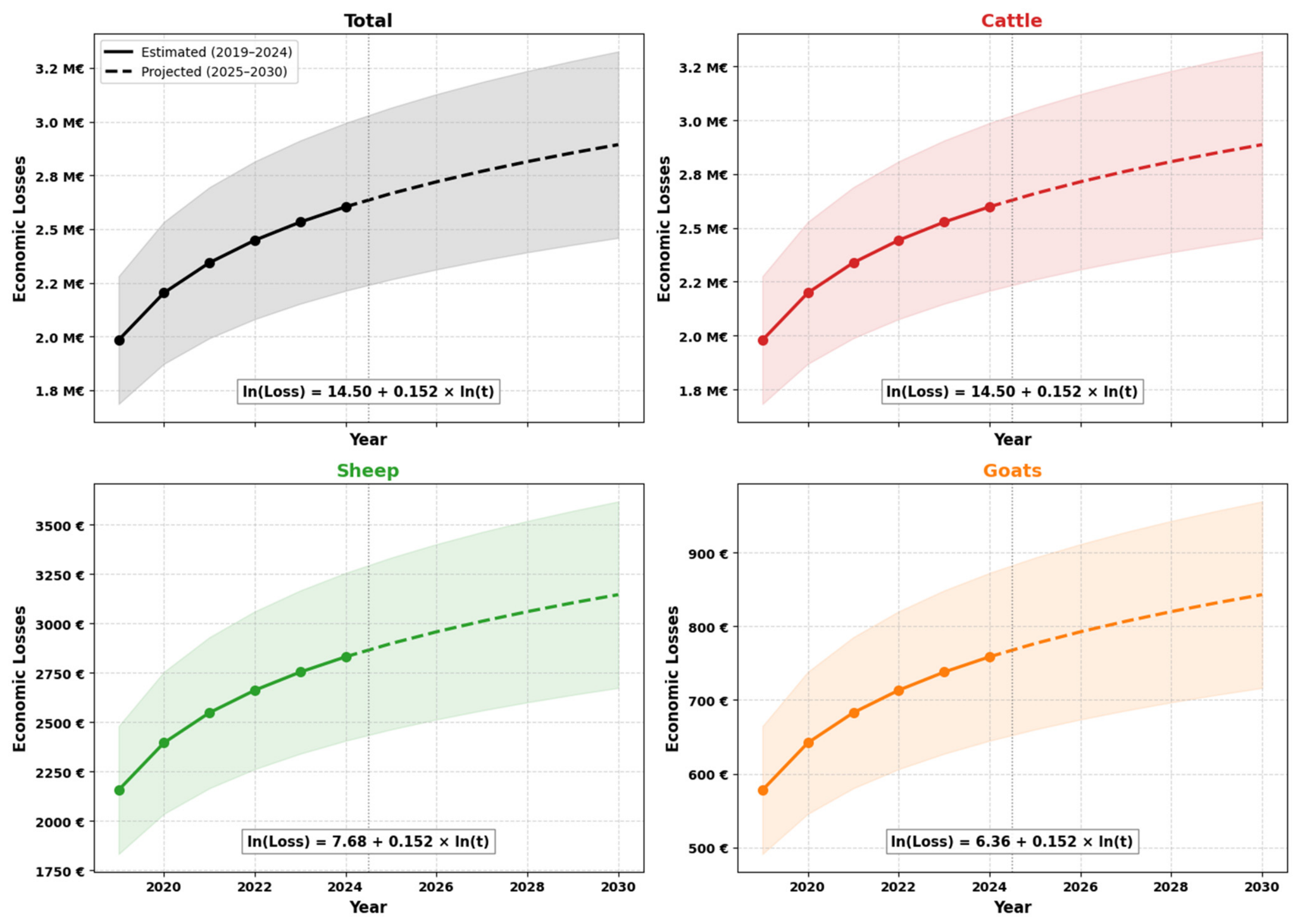
| 2025 | 2,659,697 | 2898 | 776 | 2,663,371 |
| 2026 | 2,714,186 | 2957 | 792 | 2,717,935 |
| 2027 | 2,763,175 | 3010 | 807 | 2,766,992 |
| 2028 | 2,807,745 | 3059 | 820 | 2,811,624 |
| 2029 | 2,848,683 | 3104 | 832 | 2,852,618 |
| 2030 | 2,886,578 | 3145 | 843 | 2,890,565 |
| Total | 16,680,064 | 18,173 | 4869 | 16,703,106 |
Disclaimer/Publisher’s Note: The statements, opinions and data contained in all publications are solely those of the individual author(s) and contributor(s) and not of MDPI and/or the editor(s). MDPI and/or the editor(s) disclaim responsibility for any injury to people or property resulting from any ideas, methods, instructions or products referred to in the content. |
© 2026 by the authors. Licensee MDPI, Basel, Switzerland. This article is an open access article distributed under the terms and conditions of the Creative Commons Attribution (CC BY) license.
Share and Cite
Balla, E.-H.; Besseboua, O.; Dergal, N.B.; Popa, S.A.; Ayad, A. Epidemiological Survey and Economic Impact of Ruminant Tuberculosis-like Lesions at Slaughterhouses in Two Areas of Northern Algeria (2019–2024): A One Health Assessment. Pathogens 2026, 15, 546. https://doi.org/10.3390/pathogens15050546
Balla E-H, Besseboua O, Dergal NB, Popa SA, Ayad A. Epidemiological Survey and Economic Impact of Ruminant Tuberculosis-like Lesions at Slaughterhouses in Two Areas of Northern Algeria (2019–2024): A One Health Assessment. Pathogens. 2026; 15(5):546. https://doi.org/10.3390/pathogens15050546
Chicago/Turabian StyleBalla, El-Hacene, Omar Besseboua, Nadir Boudjlal Dergal, Sebastian Alexandru Popa, and Abdelhanine Ayad. 2026. "Epidemiological Survey and Economic Impact of Ruminant Tuberculosis-like Lesions at Slaughterhouses in Two Areas of Northern Algeria (2019–2024): A One Health Assessment" Pathogens 15, no. 5: 546. https://doi.org/10.3390/pathogens15050546
APA StyleBalla, E.-H., Besseboua, O., Dergal, N. B., Popa, S. A., & Ayad, A. (2026). Epidemiological Survey and Economic Impact of Ruminant Tuberculosis-like Lesions at Slaughterhouses in Two Areas of Northern Algeria (2019–2024): A One Health Assessment. Pathogens, 15(5), 546. https://doi.org/10.3390/pathogens15050546