Article

Clinical Outcome After Surgery for Fracture-Related Infection Is Dependent on Both Microbiology and the Host Inflammatory Response


by
Ruth A. Corrigan
1,
Andrew J. Hotchen
1,2,
Anton A. N. Peterlin
3,4,
Louise K. Jensen
4 and
Martin McNally
1,*
1
The Bone Infection Unit, Nuffield Orthopaedic Centre, Oxford University Hospitals, Oxford OX3 9DU, UK
2
Nuffield Department of Orthopaedics, Rheumatology and Musculoskeletal Medicine, University of Oxford, Oxford OX1 2JD, UK
3
Department of Orthopaedic Surgery, Herlev Hospital, 2730 Herlev, Denmark
4
Department of Veterinary and Animal Sciences, University of Copenhagen, 1165 København, Denmark
*
Author to whom correspondence should be addressed.
Pathogens 2026, 15(5), 532; https://doi.org/10.3390/pathogens15050532

Submission received: 9 April 2026 / Revised: 27 April 2026 / Accepted: 8 May 2026 / Published: 14 May 2026

Abstract

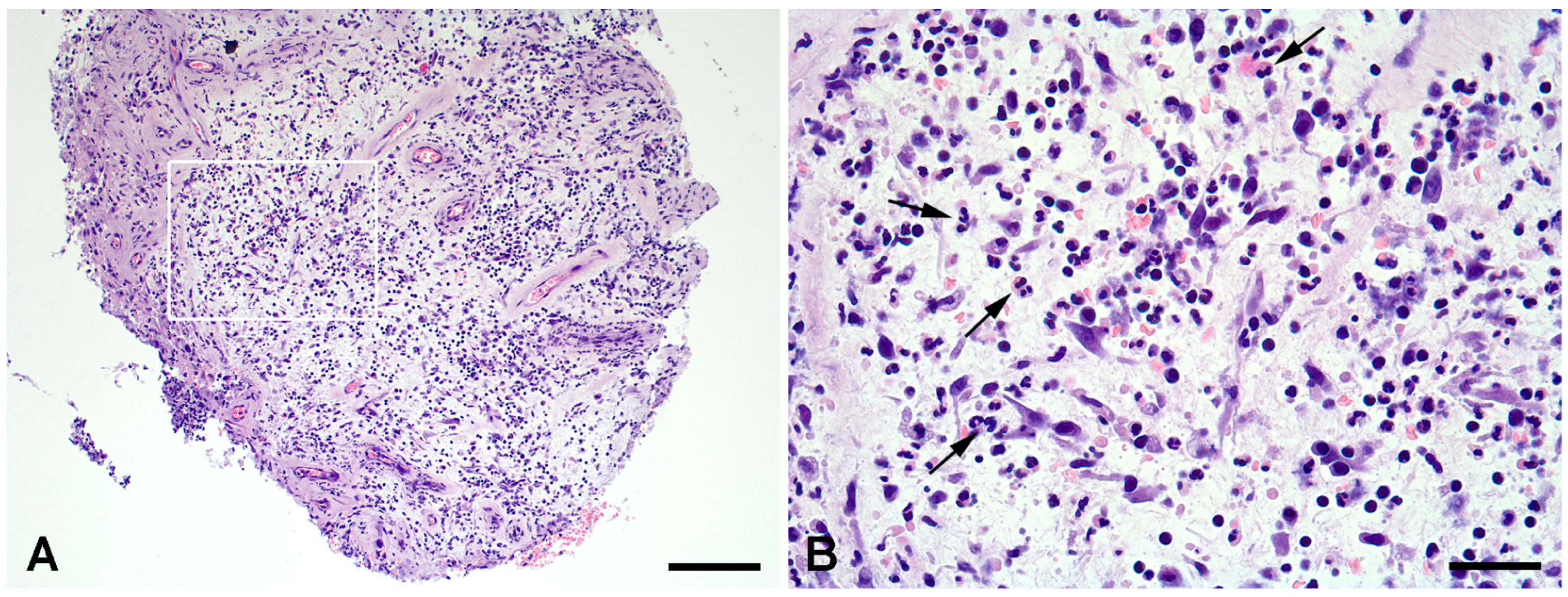
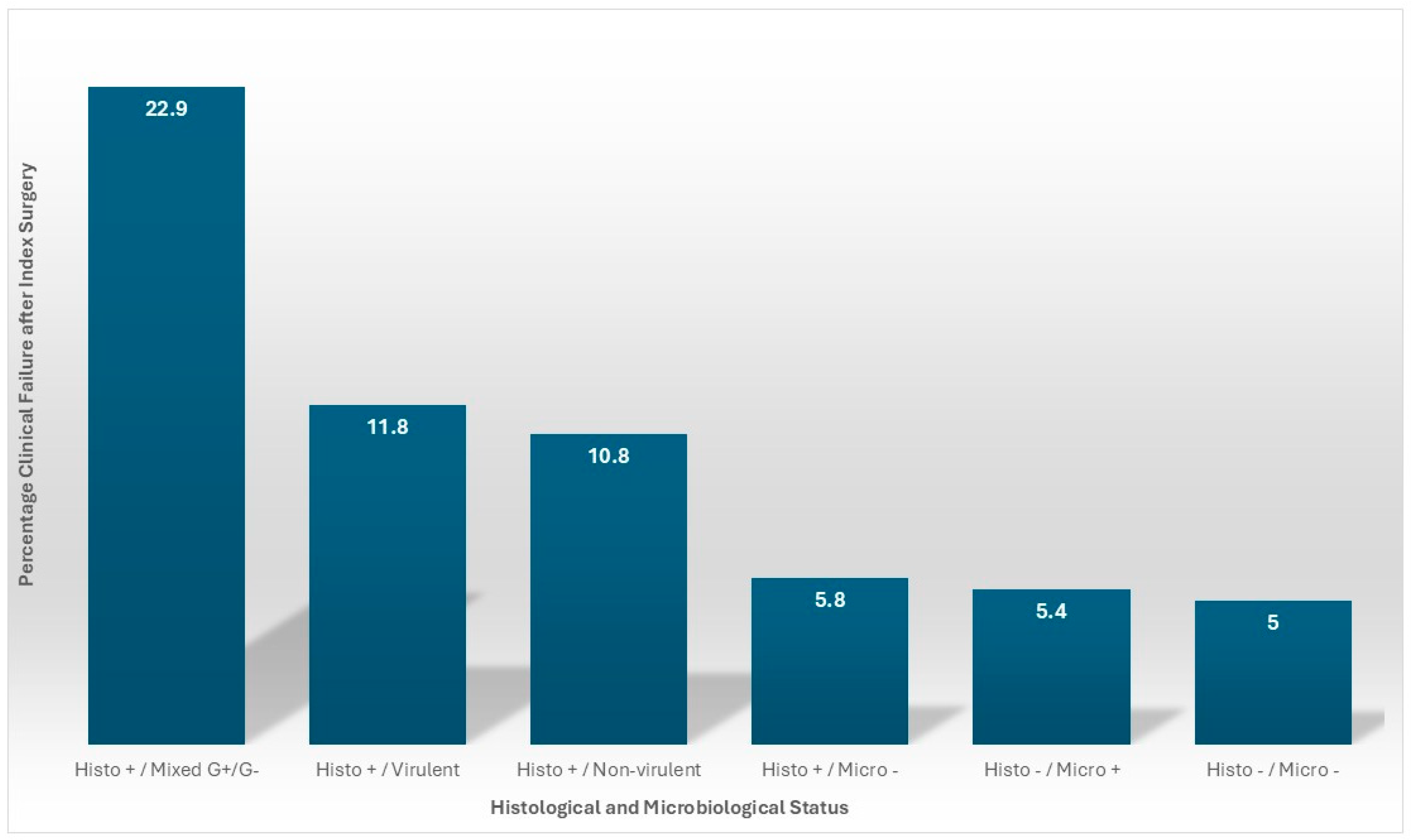
Microbiological culture and histology of deep tissue specimens are independent diagnostic criteria in fracture-related infection (FRI). However, the association between these tests has rarely been investigated, particularly in relation to clinical outcome after treatment. Patients undergoing surgery for International Consensus-confirmed FRI were included. All had ≥5 tissue specimens taken for microbiological culture and 2–3 for histology. The correlation between cultured pathogen, histological positivity (defined as ≥5 polymorphonuclear neutrophils/high power field), and outcome at one year after surgery was explored. FRI was confirmed in 430 patients, predominantly in the tibia (194), femur (111), upper limb (70), and ankle (40). A total of 321 (74.7%) were culture-positive and 334 (77.7%) were histology positive, while 265 (61.6%) were positive for both tests. Staphylococcus aureus was cultured in 169 (42.5%), coagulase-negative Staphylococci (CoNS) in 61 (15.3%), and Gram-negatives in 145 (36.3%) cases. Virulent microorganisms were strongly associated with positive histology (odds ratio 2.72; 95% CI 1.61–4.58) but not with clinical failure (OR 1.08; 0.42–2.75). Isolation of S. aureus was significantly associated with positive histology compared to other microorganisms (OR 2.21; 1.27–3.87). Surgery succeeded in 390 (90.7%) patients. Treatment failure was weakly associated with positive microbiology alone (OR 2.03; 0.83–4.96) or positive histology alone (OR 2.13; 0.81–5.6). Combined positive culture and histology was strongly associated with clinical failure (OR 2.3; 1.06–4.96). There was no difference in outcome between virulent and non-virulent bacteria when histology was positive, but both had higher failure rates compared to patients with negative culture or histology. A pronounced inflammatory response, as seen in histology, is a feature of virulent bacterial FRI. However, the presence of virulent infection alone does not dictate clinical outcome without marked inflammation. This suggests that outcome is at least as much related to the host response as to the bacterium. When the pathological response is prominent, this may lead to tissue necrosis, further bacterial invasion of adjacent tissues, osteolysis and loss of fracture stability, contributing to treatment failure. This deserves further study to understand the mechanisms behind this interplay and clinical outcome.
Keywords: fracture-related infection; FRI; microbiology; histology; clinical outcome; treatment; osteoimmunology; immune response fracture-related infection; FRI; microbiology; histology; clinical outcome; treatment; osteoimmunology; immune response