Article

Molecular Surveillance of Plasmodium vivax and Plasmodium falciparum Drug Resistance Genes in the Republic of Korea: 2022–2025


1
Division of Vectors and Parasitic Diseases, Korea Disease Control and Prevention Agency, 187 Osongsaengmyeong 2-ro, Osong-eup, Heungdeok-gu, Cheongju 28159, Chungcheongbuk-do, Republic of Korea
2
Division of Zoonotic and Vector Borne Disease Control, Korea Disease Control and Prevention Agency, 187 Osongsaengmyeong 2-ro, Osong-eup, Heungdeok-gu, Cheongju 28159, Chungcheongbuk-do, Republic of Korea
3
Division of Laboratory Diagnosis and Analysis, Capital Regional Center for Disease Control and Prevention, Korea Disease Control and Prevention Agency, 131 Yeongjong Haeannam-ro 321beon-gil, Jung-gu, Incheon 22382, Republic of Korea
*
Author to whom correspondence should be addressed.
Pathogens 2026, 15(5), 508; https://doi.org/10.3390/pathogens15050508

Submission received: 2 April 2026 / Revised: 4 May 2026 / Accepted: 6 May 2026 / Published: 8 May 2026
(This article belongs to the Section Parasitic Pathogens)

Abstract

In the Republic of Korea (ROK), chloroquine is the first-line treatment for Plasmodium vivax (P. vivax), and primaquine is also prescribed to prevent relapse. For Plasmodium falciparum (P. falciparum), atovaquone-proguanil, pyronaridine-artesunate, and mefloquine are recommended. This study monitored drug resistance genes in blood samples collected from patients with P. vivax (soldiers, relapsed, and imported) and P. falciparum (soldiers and civilians) between 2022 and 2025. In P. vivax, several Pvmdr-1 mutations showed high prevalence, with S515R, G698S, L845F, M908L, T958M, and F1076L observed in nearly all isolates, while T529 and E1233 mutation showed moderate prevalence. S513R, Y541C, A829V, and S1358 mutation were occasionally identified, all of which were imported or soldiers receiving prophylactic chemotherapy. Significant differences in mutation prevalence were identified among groups (p < 0.05). However, no significant temporal trends were observed. In P. falciparum, the Y184F mutation in Pfmdr-1 was highly prevalent, and A675V mutation in PfK13 was detected only in soldiers. Group comparisons revealed significant differences (p < 0.05), whereas temporal trends were not observed. Because drug resistance gene mutations can be closely linked to treatment, surveillance of drug resistance genes is expected to contribute to malaria eradication in the ROK through providing basic information related to treatment.

1. Introduction

Malaria is a serious disease that poses a significant threat to public health worldwide. It is transmitted from bites by female Anopheles mosquitoes infected with Plasmodium spp. [1]. Five species of malaria are known to infect human: Plasmodium falciparum (P. falciparum), Plasmodium vivax (P. vivax), Plasmodium malariae (P. malariae), Plasmodium ovale (P. ovale), and Plasmodium knowlesi (P. knowlesi) [2]. P. falciparum is primarily prevalent in Africa, with occasional outbreaks of P. malariae and P. ovale. P. vivax is prevalent in Asia and South America, whereas P. knowlesi has only been detected in parts of Malaysia and Indonesia [3]. In the Republic of Korea (ROK), malaria is prevalent only in certain areas (Gangwon-do, northern Gyeonggi-do, and Incheon) bordering the Democratic People’s Republic of Korea (DPRK). Approximately 700 cases of P. vivax infection occur annually and all other malaria cases are imported [4,5]. Additionally, vivax malaria (malaria caused by infection with P. vivax) in the ROK has a long relapse period (up to 2 years) [6].
Chloroquine is used as the first-line treatment for vivax malaria in the ROK, and primaquine is prescribed in combination to prevent relapse. For imported malaria cases, atovaquone-proguanil, pyronaridine-artesunate, and mefloquine are prescribed after confirming epidemiological information, such as the country of origin or travel history of the patient [7]. Chloroquine resistance was first reported in Papua New Guinea [8] and eventually spread worldwide [9,10,11]. The molecular mechanisms underlying chloroquine resistance in vivax malaria are unclear, but it has been reported that high polymorphism of the P. vivax multidrug resistance gene (Pvmdr-1), particularly the Y976F mutation, is associated [12].
P. falciparum multidrug resistance gene (Pfmdr-1) mutations, such as N86Y, Y184F, S1034C, N1042D, and D1246Y mutation, are known to modulate chloroquine resistance [13]. However, this depends on the genetic background of the parasite and drug pressure [14]. Artemisinin resistance in P. falciparum infection is associated with the kelch13 (K13) propeller domain, and mutations, such as Y493H, R539T, I543T, and C580Y, have been reported to be associated with delayed parasitic clearance [15]. Resistance to atovaquone or atovaquone-proguanil hydrochloride combination therapy arises from Y268S/C/N mutations in the cytochrome b gene (cyt-b) [16].
Malaria drug resistance is a critical problem that reduces the effectiveness of treatment and increases mortality and patient burden [17]. It is currently a key obstacle in disease control and eradication efforts, with the spread of resistant strains leading to treatment failure, persistent infections, and increased mortality [18]. To this end, malaria drug resistance gene surveillance is a crucial tool for tracking changes in drug susceptibility and provides useful information for national malaria eradication policy [19]. Furthermore, effective preemptive responses through continuous monitoring are cardinal in preventing treatment failure because of drug resistance mutations [20].
Therefore, we conducted a continuous surveillance of antimalarial drug resistance genes of P. vivax and P. falciparum in the ROK from 2022 to 2025. We also analyzed statistical comparisons across groups and evaluation of temporal trends to provide a more comprehensive understanding of mutation patterns in the ROK. This study aims to provide the foundational evidence necessary to support and accelerate national malaria eradication efforts.

2. Materials and Methods

2.1. Ethics Statement

This study is exempt from IRB (Institutional Review Board) review because personal identification information of the patient was anonymized, and the results obtained through the study are unrelated to the individual genetic characteristics of the patient. (Bioethics and Safety Act Article 36 and Enforcement Rule of Bioethics and Safety Act Article 33(1)).

2.2. Sample Collection and Malaria Diagnosis

Residual specimens of blood samples were collected from patients with malaria who requested a diagnosis from the Division of Vectors and Parasitic Diseases at the KDCA. Malaria was confirmed by microscopic examination of stained blood slides and nested polymerase chain reaction (nested-PCR) [21,22]. Resource samples obtained from malaria case notifications from local public healthcare centers and hospitals (military and civilians) nationwide were also used in this study. A total of 260 Plasmodium vivax cases (186 soldiers, 69 relapse cases, and 5 imported cases) and 76 Plasmodium falciparum cases (27 soldiers and 49 civilians) were included in the analysis.
Herein, we selected patients with vivax malaria in the ROK who were considered at high risk of drug resistance. The patients were divided into three groups: soldiers receiving prophylactic chemotherapy, patients with relapse vivax malaria, and imported cases of vivax malaria. Soldiers who relapsed were classified separately because these groups were defined as high-risk based on their potential exposure to antimalarial drugs and the associated selective pressure for drug-resistant parasites, including repeated drug exposure (soldiers receiving chemoprophylaxis), possible incomplete parasite clearance (relapse cases), and prior treatment in endemic regions (imported cases). For falciparum malaria (malaria caused by infection with P. falciparum), patients were divided into two groups: soldiers with a history of overseas deployment of the armed forces and civilians with a history of overseas travel.
For P. vivax relapse, blood samples were collected during both the first and second episodes. Relapse was confirmed by epidemiological data and molecular confirmation of identical subtypes of four genes (apical membrane antigen 1—N1, N2, N3, and N4 subtype, circumsporozoite protein—K1, K2, K3, and K4 subtype, duffy binding protein—T1, T2, T3, and T4 subtype, and merozoite surface protein—recombinant, Sal-a, Sla-b, Sal-c, Sal-R, B-1, B-2, and B-recombinant subtype).

2.3. Drug Resistance Gene Amplification

DNA was extracted from 200 µL of blood samples using a QIAamp DNA blood mini kit (Qiagen, Valencia, CA, USA) according to the manufacturer’s protocol (Available online: https://www.qiagen.com/us/resources/kithandbook/hb-0329-007-hb-qiaamp-dna-mini-blood-mini-0725-ww, accessed on 20 April 2026). DNA amplification was performed using AccuPower PCR PreMix (Bioneer, Daejeon, Korea). Primers for amplifying Pvmdr-1 [12,23,24,25], Pfmdr-1 [26,27], PfK13 [28,29,30], and Pfcyt-b [31,32] sequences were obtained from previous studies or created in-house. The primers used are listed in Table 1 and the PCR cycling conditions are listed in Table 2.

2.4. Sequence Analysis

The size of the amplified PCR products was confirmed using a QiAxcel capillary electrophoresis system (Qiagen, Valencia, CA, USA). Sanger sequencing was performed to analyze the DNA sequences using a commercial sequencing service (SolGent—Daejeon, Republic of Korea). The confirmed DNA sequences were converted to amino acids using Expasy (https://web.expasy.org/translate/, accessed on 21 March 2025) and aligned using the BioEdit 7.2 software (Tom Hall, North Carolina State University, Raleigh, NC, USA) to identify mutations.

2.5. Statistical Analysis

Statistical analyses were performed to evaluate differences in mutation prevalence across groups and over time. Mutation frequencies were expressed as proportions, and comparisons between groups (soldier, relapse, and imported cases) were conducted using the chi-square test or Fisher’s exact test when expected counts were less than five. To assess temporal trends, logistic regression analysis was performed with year treated as an ordinal variable to evaluate changes in mutation prevalence from 2022 to 2025. All statistical tests were two-tailed, and a p-value of <0.05 was considered statistically significant. Statistical analyses were performed using R software version 4.4.1.

3. Results

3.1. Polymorphism of the Pvmdr-1 Gene

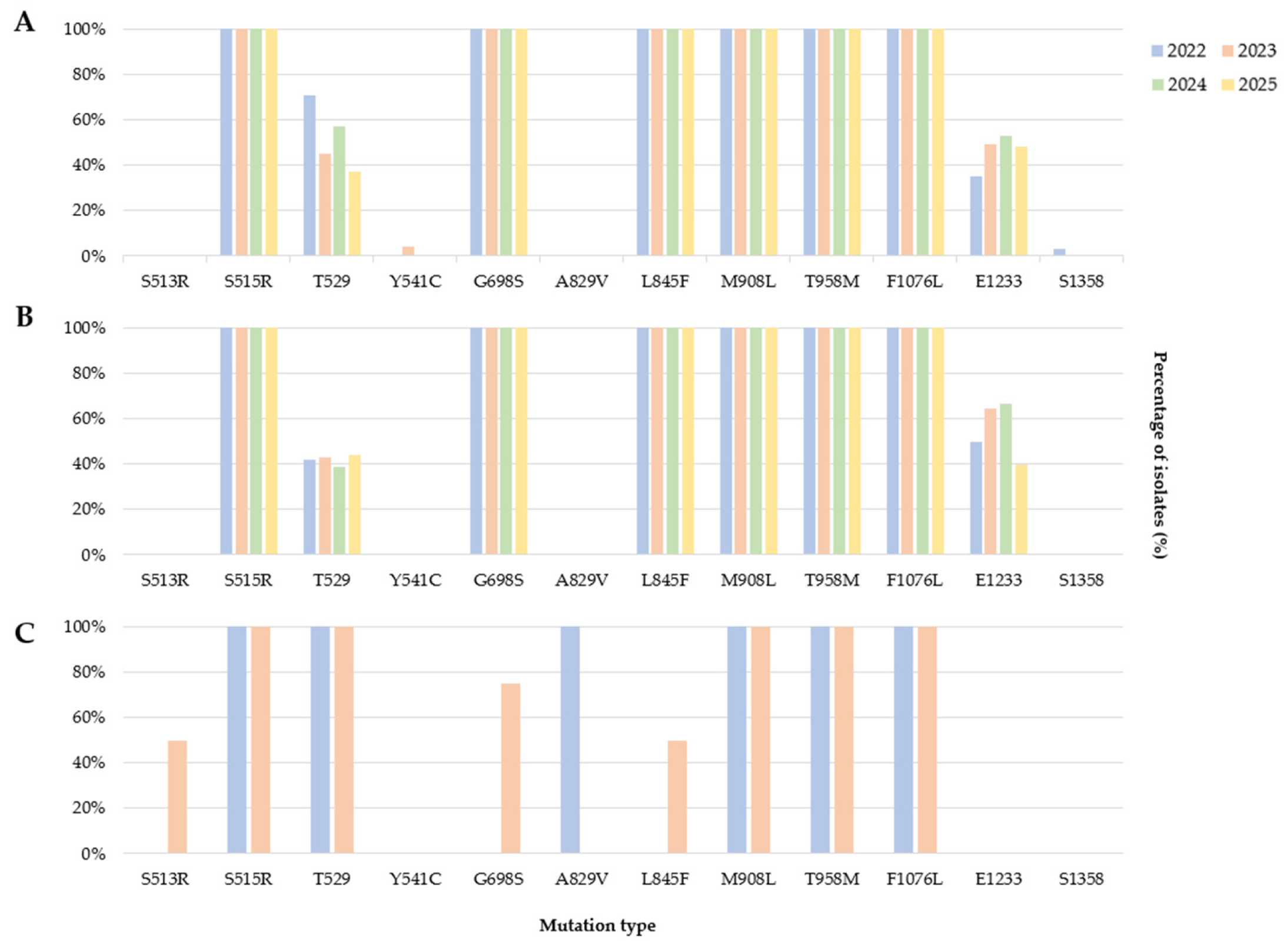
A total of 260 vivax malaria samples were analyzed (47 in 2022, 67 in 2023, 94 in 2024, and 52 in 2025) (Table 3) and divided into three groups: soldiers, relapsed patients, and imported cases. In the military personnel and relapsed patient groups, six mutations (S515R, G698S, L845F, M908L, T958M, and F1076L) were identified in 100% of cases each year, while T529 and E1233 mutations were detected in approximately 50% of cases (Figure 1). This confirms that sextuple mutations are predominantly found in high-risk patients in the ROK, such as soldiers receiving preventive chemotherapy or patients who have relapsed for whom treatment is not expected to be effective. T529 and E1233 mutation were detected in approximately half of patients harboring octuple mutations. Interestingly, as Y541C and S1358 mutations were rarely detected only in military patients, they appear to be related to prophylactic chemotherapy [24,25]. Regarding imported cases, five mutations, S515R, T529, M908L, T958M, and F1076L, were confirmed in 100% of the cases, and G698S and L845F mutations were confirmed in approximately 50% of the cases. S513R and A829V mutations were ascertained only in imported cases and therefore appear to be mutations that have not yet been established in the ROK. Moreover, other mutations have not yet been confirmed.

3.2. Polymorphism of Pfmdr-1, PfK13, and Pfcyt-b Genes

All cases of falciparum malaria identified in the ROK were imported, and drug resistance was influenced by the country of origin of the patient’s infection. This study analyzed 76 falciparum malaria samples (5 in 2022, 30 in 2023, 19 in 2024, and 22 in 2025) (Table 4).
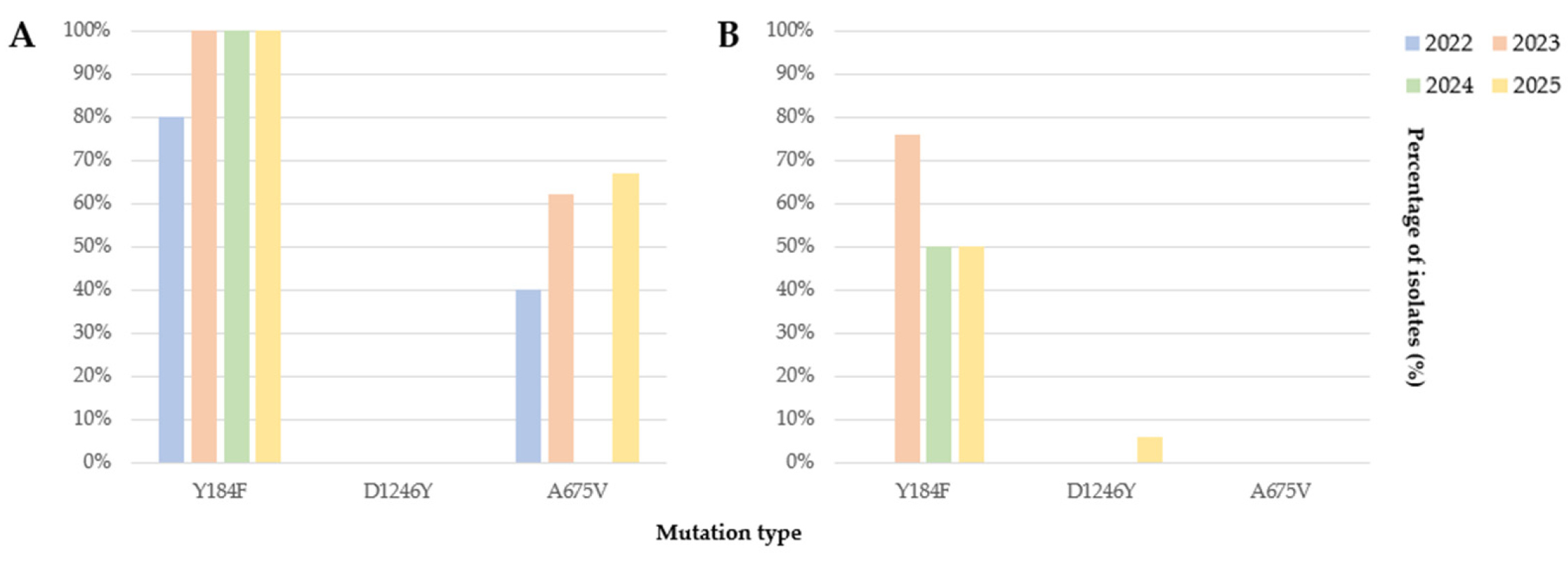
Mutations targeted for surveillance included 7 in Pfmdr-1, 14 in PfK13, and 3 in Pfcyt-b (Table 1). However, only Y184F and D1246Y mutations in Pfmdr-1 and A675V mutation in PfK13 were identified. According to patient epidemiological data, all soldiers infected with falciparum malaria had been deployed to South Sudan, and civilian patients had a history of visiting Africa. The Y184F mutation was identified in both the soldier and civilian groups, with a higher rate in soldiers. The soldier group showed the Y184F mutation in 100% of cases each year, except in 2022, while the civilian group showed the mutation in 50–76% of cases each year (Figure 2). This confirms that the Y184F mutation is spread throughout Africa, including South Sudan. The D1246Y mutation was first revealed in 2025 in travelers who visited Rwanda, highlighting the importance of domestic surveillance of imported falciparum malaria drug resistance genes. The Y184F mutation was identified in both soldiers and civilians, whereas the A675V mutation was found only in soldiers who had been deployed to South Sudan. The A675V mutation was only detected in soldiers, with an annual prevalence range of 0–67%. Continued surveillance is therefore crucial because of high annual variations in prevalence.

3.3. Statistical Analysis of the Pvmdr-1, Pfmdr-1, PfK13, and Pfcyt-b Genes

A total of 12 mutations of Pvmdr-1 were included in the comparative analysis after excluding mutations with no observed occurrences (Table 5). Significant differences in mutation prevalence were observed for six mutations: S513R, T529, G698S, A829V, L845F, and E1233 (p < 0.05). No significant differences were identified for the remaining mutations. Temporal trends in Pvmdr-1 mutation prevalence were evaluated using logistic regression. No statistically significant changes in mutation prevalence were observed over the study period. Although the E1233 mutation showed a marginal increasing trend, this did not reach statistical significance (p = 0.08).
In case of P. falciparum, significant differences were observed for the Y184F and A675V mutations (p < 0.05) in group comparisons (Table 6). The Y184F mutation was more prevalent in soldiers than civilians, whereas the A675V mutation was detected exclusively in soldiers. No significant difference was observed for the D1246Y mutation. Temporal trend analysis using logistic regression showed no statistically significant changes in mutation prevalence over the study period. Although year-to-year fluctuations were observed for Y184F and A675V, these did not demonstrate consistent temporal trends. The D1246Y mutation remained rare throughout the study period.

4. Discussion

In the ROK, malaria was eradicated in the 1970s but resurged in the region near the Demilitarized Zone (DMZ) bordering the DPRK in 1993 [33]. Approximately 500–600 cases have been reported in recent years, posing a significant public health problem. Malaria eradication in the ROK remains challenging for several reasons. First, the DPRK is a permanent reservoir [34]. Although human movement across borders is restricted by the DMZ, mosquitoes can freely move back and forth. Genetic analysis has suggested that P. vivax in the ROK and DPRK is essentially similar [35]. This indicates that the Korean malarial strain is a transboundary strain. According to World Health Organization (WHO) standards, the continuous cross-border influx of malaria makes it difficult for a single country to achieve eradication [36]. Although border malaria is an issue that requires a coordinated effort between two or more countries, cooperation between the ROK and the DPRK is difficult for political reasons, posing a momentous challenge for malaria eradication in the former. Second, malaria in the ROK has an extremely long latent period [6]. Many strains harbor hypnozoites that can induce long incubation periods of 8–12 months or more, making epidemiological tracking difficult [33]. Patients with hypnozoites are more likely to relapse and are predicted to contribute largely to vivax malaria transmission [37].
Treatment of vivax malaria in the ROK involves a combination of chloroquine (25 mg base/kg), which eliminates blood-stage parasites, and primaquine (3.5 mg base/kg), which eliminates hypnozoites [38]. Although it has been used for more than 30 years, chloroquine is still effective in the ROK [39]. However, the long-term use of the drug and prophylactic chemotherapy administered to soldiers increases the risk of drug resistance. In Southeast Asia, resistance commonly occurs within 10–15 years of chloroquine use. However, the actual rate of resistance varies depending on factors, such as the intensity of drug use, transmission intensity, and parasite population size. Therefore, continuous surveillance is necessary [40]. Research on malarial drug resistance in the DPRK and northeastern China is very limited; however, chloroquine-resistant strains are highly likely to exist in these regions [41]. Malaria in the ROK is closely linked to the malaria epidemic in the DPRK. Therefore, detecting chloroquine-resistant parasite strains at the genetic level is warranted before they cross borders and become entrenched. Furthermore, the WHO suggests that genetic surveillance of drug resistance is crucial in advancing the elimination stage of malaria [36]. Therefore, ongoing genetic surveillance of Pvmdr-1 is needed in the ROK. As a government agency controlling malaria diagnosis, the KDCA collects specimens representing approximately 80% of the annual malaria cases. Surveillance of antimalarial drug resistance genes is conducted for soldier, relapse, and imported cases, as part of efforts toward malaria elimination.
From 2022 to 2025, analysis of Pvmdr-1 in patients with vivax malaria classified as high-risk groups subject to drug resistance surveillance, including soldiers, relapsed patients, and imported patients, revealed the presence of six mutations (S515R, G698S, L845F, M908L, T958M, and F1076L) in 97–100% of cases (Figure 1). Furthermore, two mutations (T529 and E1233) were identified in approximately 50% of the cases, confirming that the mutations were endemic in the ROK. The absence of the Y976F mutation in pvmdr-1, a marker associated with chloroquine resistance, may indicate a low prevalence of this specific resistance-associated mutation in the study population. The Y976F mutation, which is highly associated with reduced chloroquine susceptibility, was not found; however, the F1076L mutation, a secondary requirement for Y976F mutation acquisition [42], was detected in 100% of the annual cases. From a two-step mutational trajectory perspective, the Y976F mutation is rarely observed alone and tends to be observed together with the F1076L mutation or appear after the F1076L mutation [43]. This suggests that the Y976F mutation could emerge in the ROK, underscoring the importance of ongoing genetic surveillance. To track the Y976F mutation, a more robust plan will be implemented for the aforementioned high-risk patients, including drug resistance monitoring on a quarterly basis.
The S513R and A829V mutations were revealed only in patients with imported vivax malaria (Table 3). The S513R mutation was also detected in patients from India and Pakistan, a finding epidemiologically consistent with data showing a high incidence in South Asia [44]. The A829V mutation was identified in a patient from Pakistan. This rare mutation is likely a lineage-associated polymorphism rather than a direct cause of resistance [45]. In contrast, the Y541C and S1358 mutations were identified only in soldiers who served in the DMZ (Table 3), which is consistent with previous research [24,25]. Our findings suggest that these mutations reflect a chemoprophylaxis-driven selective sweep in soldiers in the ROK.
All P. falciparum isolates ascertained in the ROK were imported. Most patients were epidemiologically confirmed to have a history of travel in Africa. Atovaquone-proguanil, pyronaridine-artesunate, and mefloquine are recommended as primary treatments, while artesunate is used intravenously for the treatment of severe falciparum malaria [38]. Therefore, various P. falciparum drug resistance genes, such as Pfmdr-1 (chloroquine and mefloquine), PfK13 (pyronaridine-artesunate), and Pfcyt-b (atovaquone-proguanil), were investigated from 2022 to 2025 in all patients who had traveled, with only the Y184F and D1246Y mutations of Pfmdr-1 and the A675V mutation of PfK13 identified (Table 4).
The most common mutation found in imported cases of P. falciparum malaria was the Y184F mutation in Pfmdr-1, with a high prevalence of 58–87% annually (Figure 2). This mutation is frequently reported worldwide, and the results are consistent with previous studies [31,46,47,48]. Although it may not be a strong resistance marker on its own, it should be closely monitored, as it can interact with other mutations and exert an impact. Notably, the D1246Y mutation was first detected in a patient with a history of travel to Rwanda in 2025. Although the D1246Y mutation occurs with high frequency in South America, it has rarely been identified in Africa [49,50]. It has also been reported in Rwanda, where it persists at a low rate without being completely eliminated [51]. Although the D1246Y mutation does not confer strong resistance, it warrants attention because it reflects drug selection pressure in artemisinin-based combination therapies, which can influence treatment failure.
The A675V mutation in PfK13 is recognized by the WHO as being associated with delays in artemisinin treatment. This mutation has been reported at low frequencies in several African countries, including Uganda, Rwanda, Nigeria, and Kenya [52,53]. Although not yet widely established as a dominant resistance mutation, its increasing detection in certain regions suggests a potential emerging marker of artemisinin resistance, highlighting the need for continued molecular surveillance. A notable finding regarding the A675V mutations ascertained in the ROK-imported cases was that all patients were soldiers who had been deployed to South Sudan. This mutation is reported at low levels in Africa and has not been revealed in South Sudan to date [54,55], highlighting the need to monitor deployed soldiers for treatment failure or delays.
This study evaluated mutation patterns associated with antimalarial drug resistance in both P. vivax and P. falciparum, focusing on differences across population groups and temporal trends over a four-year period. In both species, differences in mutation prevalence were observed across groups, suggesting potential variation in parasite populations or exposure history. However, no significant temporal trends were identified for either species over the study period, indicating that the overall mutation profiles remained relatively stable from 2022 to 2025. Although minor year-to-year fluctuations were observed, these were not consistent and are likely attributable to random variation or differences in sample composition. This study has several limitations. First, the number of imported P. vivax cases was small, which may have influenced the statistical significance of group comparisons and potentially exaggerated observed differences. Second, the overall sample size for P. falciparum, particularly in certain years, was limited, reducing the statistical power to detect subtle temporal trends. In conclusion, this study demonstrates that while group-specific differences in mutation prevalence exist in both P. vivax and P. falciparum, the overall mutation patterns remained stable over time. The results of this study highlight the importance of continued molecular surveillance to monitor potential shifts in antimalarial resistance and to better understand the epidemiological dynamics of malaria infections. These findings also have broader implications beyond the ROK. Continuous monitoring of antimalarial drug resistance markers provides essential information for detecting changes in parasite populations and supporting timely public health responses. Such surveillance efforts contribute to strengthening malaria control strategies and may support global efforts toward malaria elimination.
The overall proportion of drug resistance genes for vivax and falciparum malaria in the ROK has not changed significantly over the investigated period; however, a small number of mutations were identified intermittently. However, it should be noted that the presence of molecular markers does not necessarily indicate phenotypic resistance or treatment failure, and further studies are required to confirm their clinical significance. This study was conducted in high-risk groups rather than in all patients during the investigation period. Therefore, it should be noted that this study does not represent the entire population of malaria patients in the ROK. Although chloroquine is still known to be susceptible to vivax malaria in the ROK, continued monitoring is necessary due to climate change, an influx of overseas workers, and increased travel. Monitoring drug resistance is important for malaria control because the emergence of drug resistance can lead to increased treatment delays or failure, potentially creating a new source of infection. Furthermore, the association between the mutations (S513R and A829V) detected only in soldiers and chemoprophylaxis needs to be investigated. As P. falciparum malaria occurs exclusively through overseas travel, drug resistance mutations are also influenced by the countries visited. Although no cases of treatment failure exist to date, careful attention is needed because of its high mortality rate. Additionally, for soldiers deployed in South Sudan, identifying cases of delayed onset or treatment delays owing to chemoprophylaxis is warranted. Collaboration with the military is essential for developing treatment strategies that consider drug-resistant mutations of P. falciparum malaria and for selecting more effective preventive drugs.
In summary, this study provides updated data on antimalarial drug resistance mutations in the ROK, including statistical comparisons across groups and temporal trend analyses. These findings support ongoing surveillance efforts for malaria control and elimination. The KDCA plans to continue monitoring drug resistance to generate basic data for malaria eradication. Furthermore, follow-up studies are needed to comprehensively analyze various factors known to influence drug activity and metabolism, such as P. vivax chloroquine resistance transporter-o [56] and cytochrome P450, family 2, subfamily D, polypeptide 6 [57,58].

5. Conclusions

This study provides an updated overview of antimalarial drug resistance markers in P. vivax and P. falciparum in the ROK from 2022 to 2025. Several mutations were consistently observed, while others were detected only sporadically or not at all, indicating distinct patterns of mutations prevalence within the study population. These finding highlight the importance of continuous molecular surveillance to monitor changes in parasite populations and to support evidence-based malaria control strategies. Such efforts will be essential for guiding effective treatment policies and advancing malaria elimination in the ROK.

Author Contributions

Conceptualization: H.-I.L.; Data Curation and Writing—Original Draft Preparation: H.J.; Data analysis: H.J.; Funding Acquisition: H.-I.L.; Investigation: H.-I.S., H.J., B.K. and E.P.; Methodology: H.-I.S. and H.J.; Visualization: H.J.; Writing—Review and Editing: H.-I.S., M.-R.L., J.-W.J. and H.-I.L. All authors have read and agreed to the published version of the manuscript.

Funding

This research was funded by the Korea Disease Control and Prevention Agency (Grant No. 6300-6332-305).

Institutional Review Board Statement

This study is exempt from IRB (Bioethics and Safety Act Article 36 and Enforcement Rule of Bioethics and Safety Act Article 33(1)).

Informed Consent Statement

Not applicable (this study utilized anonymized residual specimens after diagnosis).

Data Availability Statement

The original contributions presented in this study are included in the article. Further inquiries can be directed to the corresponding author.

Acknowledgments

We are grateful to the local public health centers, military hospitals, and civilian medical institutions for their assistance in collecting malaria sample.

Conflicts of Interest

The authors declare no conflicts of interest.

Abbreviations

The following abbreviations are used in this manuscript:
DMZDemilitarized Zone
DPRKDemocratic People’s Republic of Korea
KDCAKorea Disease Control and Prevention Agency
PCRPolymerase chain reaction
ROKRepublic of Korea
WHOWorld Health Organization

References

  1. Caputo, A.; Garavelli, P.L. Climate, environment and transmission of malaria. Infez. Med. 2016, 2, 93–104. [Google Scholar]
  2. Milner, D.A. Malaria pathogenesis. Cold Spring Harb. Perspect. Med. 2018, 8, a025569. [Google Scholar] [CrossRef]
  3. World Health Organization. World Malaria Report 2025: Addressing the Threat of Antimalarial Drug Resistance; World Health Organization: Geneva, Switzerland, 2025; Available online: https://www.who.int/teams/global-malaria-programme/reports/world-malaria-report-2025 (accessed on 20 April 2026).
  4. Ree, H.I. Unstable vivax malaria in Korea. Korean J. Parasitol. 2000, 38, 119–138. [Google Scholar] [CrossRef]
  5. Seong, H.; Suh, J.; Choi, J.Y.; Lee, J.; Yeom, J.S. Development of a Plasmodium vivax malaria model for evaluating the effects of control strategies on the malaria burden in Democratic People’s Republic of Korea. Front. Public Health 2024, 12, 1423004. [Google Scholar] [CrossRef] [PubMed]
  6. Kim, S.-J.; Kim, S.-H.; Jo, S.-N.; Gwack, J.; Youn, S.-K.; Jang, J.-Y. The long and short incubation periods of Plasmodium vivax malaria in Korea: The characteristics and relating factors. Infect. Chemother. 2013, 45, 184–193. [Google Scholar] [CrossRef]
  7. Lee, S.Y.; Lee, S.D.; Oh, S.K.; Park, S.; Lee, J.Y.; Kim, J. Introduction to the Second Malaria Re-elimination Action Plan (2024–2028) Toward Malaria Elimination by 2030. Public Health Wkly. Rep. 2024, 17, 962–979. [Google Scholar] [CrossRef]
  8. Rieckmann, K.H.; Davis, D.R.; Hutton, D.C. Plasmodium vivax resistance to chloroquine? Lancet 1989, 2, 1183–1184. [Google Scholar] [CrossRef]
  9. Ding, H.; Dong, Y.; Deng, Y.; Xu, Y.; Liu, Y.; Wu, J.; Chen, M.; Zhang, C.; Liu, L.; Lin, Y. Molecular surveillance of chloroquine resistance in Plasmodium vivax isolates from malaria cases in Yunnan Province of China using pvcrt-o gene polymorphisms. Malar. J. 2023, 22, 338. [Google Scholar] [CrossRef]
  10. Gonçalves, L.A.; Cravo, P.; Ferreira, M.U. Emerging Plasmodium vivax resistance to chloroquine in South America: An overview. Mem. Inst. Oswaldo Cruz 2014, 109, 534–539. [Google Scholar] [CrossRef]
  11. Kaur, D.; Sinha, S.; Sehgal, R. Global scenario of Plasmodium vivax occurrence and resistance pattern. J. Basic Microbiol. 2022, 62, 1417–1428. [Google Scholar] [CrossRef]
  12. Rungsihirunrat, K.; Muhamad, P.; Chaijaroenkul, W.; Kuesap, J.; Na-Bangchang, K. Plasmodium vivax drug resistance genes; Pvmdr1 and Pvcrt-o polymorphisms in relation to chloroquine sensitivity from a malaria endemic area of Thailand. Korean J. Parasitol. 2015, 53, 43–49. [Google Scholar] [CrossRef] [PubMed]
  13. Igwe, M.C.; Ogbuabor, O.A.; Obeagu, E.I. Evolutionary biology of antimalarial drug resistance: Understanding of the evolutionary dynamics. Medicine 2025, 104, e41878. [Google Scholar] [CrossRef]
  14. Sidhu, A.B.S.; Uhlemann, A.C.; Valderramos, S.G.; Valderramos, J.C.; Krishna, S.; Fidock, D.A. Decreasing pfmdr1 copy number in Plasmodium falciparum malaria heightens susceptibility to mefloquine, lumefantrine, halofantrine, quinine, and artemisinin. J. Infect. Dis. 2006, 194, 528–535. [Google Scholar] [CrossRef]
  15. Ariey, F.; Witkowski, B.; Amaratunga, C.; Beghain, J.; Langlois, A.C.; Khim, N.; Kim, S.; Duru, V.; Bouchier, C.; Ma, L.; et al. A molecular marker of artemisinin-resistant Plasmodium falciparum malaria. Nature 2014, 505, 50–55. [Google Scholar] [CrossRef]
  16. Happi, C.T.; Gbotosho, G.O.; Folarin, O.A.; Milner, D.; Sarr, O.; Sowunmi, A.; Kyle, D.E.; Milhous, W.K.; Wirth, D.F.; Oduola, A.M.J. Confirmation of emergence of mutations associated with atovaquone-Proguanil resistance in unexposed Plasmodium falciparum isolates from Africa. Malar. J. 2006, 5, 82. [Google Scholar] [CrossRef]
  17. Ippolito, M.M.; Moser, K.A.; Kabuya, J.B.B.; Cunningham, C.; Juliano, J.J. Antimalarial drug resistance and implications for the WHO global technical strategy. Curr. Epidemiol. Rep. 2021, 8, 46–62. [Google Scholar] [CrossRef] [PubMed]
  18. White, N.J. Antimalarial drug resistance. J. Clin. Investig. 2004, 113, 1084–1092. [Google Scholar] [CrossRef]
  19. Wamae, K.; Magudha, J.; Asiimwe, E.; Kimani, K.; Kandie, R.; Keitany, K.; Snow, R.W.; Ochola-Oyier, L.I. A scoping review of antimalarial drug resistance markers in Kenya (1987–2022): Toward a National Surveillance Framework and Data Repository. Malar. J. 2025, 24, 413. [Google Scholar] [CrossRef]
  20. Nsanzabana, C. Time to scale up molecular surveillance for anti-malarial drug resistance in sub-Saharan Africa. Malar. J. 2021, 20, 401. [Google Scholar] [CrossRef]
  21. World Health Organization. Malaria Microscopy Quality Assurance Manual, 2nd ed.; World Health Organization: Geneva, Switzerland, 2016; Available online: https://www.who.int/publications/i/item/9789241549394 (accessed on 20 April 2026).
  22. World Health Organization. WHO Guidelines for Malaria; World Health Organization: Geneva, Switzerland, 2025; Available online: https://www.who.int/publications/i/item/guidelines-for-malaria (accessed on 20 April 2026).
  23. Barnadas, C.; Ratsimbasoa, A.; Tichit, M.; Bouchier, C.; Jahevitra, M.; Picot, S.; Ménard, D. Plasmodium vivax resistance to chloroquine in Madagascar: Clinical efficacy and polymorphisms in pvmdr1 and pvcrt-o genes. Antimicrob. Agents Chemother. 2008, 52, 4233–4240. [Google Scholar] [CrossRef] [PubMed]
  24. Bong, J.-J.; Lee, W.; Lee, C.H.; Park, Q.; Noh, K.T. Single nucleotide polymorphism analysis of pvmdr-1 in Plasmodium vivax isolated from military personnel of Republic of Korea in 2016 and 2017. Malar. J. 2022, 21, 205. [Google Scholar] [CrossRef]
  25. Chung, D.-I.; Jeong, S.; Dinzouna-Boutamba, S.-D.; Yang, H.-W.; Yeo, S.-G.; Hong, Y.; Goo, Y.-K. Evaluation of single nucleotide polymorphisms of pvmdr1 and microsatellite genotype in Plasmodium vivax isolates from Republic of Korea military personnel. Malar. J. 2015, 14, 336. [Google Scholar] [CrossRef]
  26. Griffing, S.; Syphard, L.; Sridaran, S.; McCollum, A.M.; Mixson-Hayden, T.; Vinayak, S.; Villegas, L.; Barnwell, J.W.; Escalante, A.A.; Udhayakumar, V. pfmdr1 amplification and fixation of pfcrt chloroquine resistance alleles in Plasmodium falciparum in Venezuela. Antimicrob. Agents Chemother. 2010, 54, 1572–1579. [Google Scholar] [CrossRef] [PubMed]
  27. Li, J.; Chen, J.; Xie, D.; Monte-Nguba, S.M.; Eyi, J.U.M.; Matesa, R.A.; Obono, M.M.O.; Ehapo, C.S.; Yang, L.; Lu, D.; et al. High prevalence of pfmdr1 N86Y and Y184F mutations in Plasmodium falciparum isolates from Bioko Island, Equatorial Guinea. Pathog. Glob. Health 2014, 108, 339–343. [Google Scholar] [CrossRef]
  28. Kayiba, N.K.; Yobi, D.M.; Tshibangu-Kabamba, E.; Tuan, V.P.; Yamaoka, Y.; Devleesschauwer, B.; Mvumbi, D.M.; Okitolonda Wemakoy, E.; De Mol, P.; Mvumbi, G.L.; et al. Spatial and molecular mapping of Pfkelch13 gene polymorphism in Africa in the era of emerging Plasmodium falciparum resistance to artemisinin: A systematic review. Lancet Infect. Dis. 2021, 21, e82–e92. [Google Scholar] [CrossRef] [PubMed]
  29. Matrevi, S.A.; Opoku-Agyeman, P.; Quashie, N.B.; Bruku, S.; Abuaku, B.; Koram, K.A.; Fox, A.; Letizia, A.; Duah-Quashie, N.O. Plasmodium falciparum kelch propeller polymorphisms in clinical isolates from Ghana from 2007 to 2016. Antimicrob. Agents Chemother. 2019, 63, e00802-19. [Google Scholar] [CrossRef]
  30. Yobi, D.M.; Kayiba, N.K.; Mvumbi, D.M.; Boreux, R.; Bontems, S.; Kabututu, P.Z.; De Mol, P.; Speybroeck, N.; Mvumbi, G.L.; Hayette, M.P. The lack of K13-propeller mutations associated with artemisinin resistance in Plasmodium falciparum in Democratic Republic of Congo (DRC). PLoS ONE 2020, 15, e0237791. [Google Scholar] [CrossRef] [PubMed]
  31. Lê, H.G.; Naw, H.; Kang, J.M.; Võ, T.C.; Myint, M.K.; Htun, Z.T.; Lee, J.; Yoo, W.G.; Kim, T.S.; Shin, H.J.; et al. Molecular profiles of multiple antimalarial drug resistance markers in Plasmodium falciparum and Plasmodium vivax in the Mandalay Region, Myanmar. Microorganisms 2022, 10, 2021. [Google Scholar] [CrossRef]
  32. Plucinski, M.M.; Huber, C.S.; Akinyi, S.; Dalton, W.; Eschete, M.; Grady, K.; Silva-Flannery, L.; Mathison, B.A.; Udhayakumar, V.; Arguin, P.M.; et al. Novel mutation in cytochrome B of Plasmodium falciparum in one of two atovaquone-Proguanil treatment failures in travelers returning from same site in Nigeria. Open Forum Infect. Dis. 2014, 1, ofu059. [Google Scholar] [CrossRef]
  33. Bahk, Y.Y.; Lee, H.W.; Na, B.K.; Kim, J.; Jin, K.; Hong, Y.S.; Kim, T.S. Epidemiological characteristics of re-emerging vivax malaria in the Republic of Korea (1993–2017). Korean J. Parasitol. 2018, 56, 531–543. [Google Scholar] [CrossRef]
  34. Kim, J.-Y.; Goo, Y.-K.; Zo, Y.-G.; Ji, S.-Y.; Trimarsanto, H.; To, S.; Clark, T.G.; Price, R.N.; Auburn, S. Further evidence of increasing diversity of Plasmodium vivax in the Republic of Korea in recent years. PLoS ONE 2016, 11, e0151514. [Google Scholar] [CrossRef]
  35. Bahk, Y.Y.; Kim, J.; Ahn, S.K.; Na, B.K.; Chai, J.Y.; Kim, T.S. Genetic diversity of Plasmodium vivax causing epidemic malaria in the Republic of Korea. Korean J. Parasitol. 2018, 56, 545–552. [Google Scholar] [CrossRef]
  36. World Health Organization. World Malaria Report 2022; World Health Organization: Geneva, Switzerland, 2022; Available online: https://www.who.int/teams/global-malaria-programme/reports/world-malaria-report-2022 (accessed on 20 April 2026).
  37. White, M.T.; Karl, S.; Battle, K.E.; Hay, S.I.; Mueller, I.; Ghani, A.C. Modelling the contribution of the hypnozoite reservoir to Plasmodium vivax transmission. eLife 2014, 3, e04692. [Google Scholar] [CrossRef]
  38. Korea Disease Control and Prevention Agency. A Guideline for Malaria Prevention and Control; Korea Disease Control and Prevention Agency: Cheongju, Republic of Korea, 2025. Available online: https://www.kdca.go.kr/sites/eng/index.do (accessed on 20 April 2026).
  39. Park, S.Y.; Park, Y.S.; Park, Y.; Kwak, Y.G.; Song, J.E.; Lee, K.S.; Cho, S.H.; Lee, S.E.; Shin, H.I.; Yeom, J.S. Increasing malaria parasite clearance time after chloroquine therapy, South Korea, 2000–2016. Emerg. Infect. Dis. 2020, 26, 1852–1855. [Google Scholar] [CrossRef]
  40. Na-Bangchang, K.; Congpuong, K. Current malaria status and distribution of drug resistance in East and Southeast Asia with special focus to Thailand. Tohoku J. Exp. Med. 2007, 211, 99–113. [Google Scholar] [CrossRef]
  41. Park, J.-W.; Jun, G.; Yeom, J.-S. Plasmodium vivax malaria: Status in the Republic of Korea following reemergence. Korean J. Parasitol. 2009, 47, S39–S50. [Google Scholar] [CrossRef]
  42. Faway, E.; Musset, L.; Pelleau, S.; Volney, B.; Casteras, J.; Caro, V.; Menard, D.; Briolant, S.; Legrand, E. Plasmodium vivax multidrug resistance-1 gene polymorphism in French Guiana. Malar. J. 2016, 15, 540. [Google Scholar] [CrossRef]
  43. Khattak, A.A.; Venkatesan, M.; Khatoon, L.; Ouattara, A.; Kenefic, L.J.; Nadeem, M.F.; Nighat, F.; Malik, S.A.; Plowe, C.V. Prevalence and patterns of antifolate and chloroquine drug resistance markers in Plasmodium vivax across Pakistan. Malar. J. 2013, 12, 310. [Google Scholar] [CrossRef]
  44. Ngwana-Joseph, G.C.; Phelan, J.E.; Manko, E.; Dombrowski, J.G.; da Silva Santos, S.; Suarez-Mutis, M.; Vélez-Tobón, G.; Tobón Castaño, A.; Machado, R.L.D.; Marinho, C.R.F.; et al. Genomic analysis of global Plasmodium vivax populations reveals insights into the evolution of drug resistance. Nat. Commun. 2024, 15, 10771. [Google Scholar] [CrossRef]
  45. Brega, S.; Meslin, B.; de Monbrison, F.; Severini, C.; Gradoni, L.; Udomsangpetch, R.; Sutanto, I.; Peyron, F.; Picot, S. Identification of the Plasmodium vivax mdr-like gene (pvmdr1) and analysis of single-nucleotide polymorphisms among isolates from different areas of endemicity. J. Infect. Dis. 2005, 191, 272–277. [Google Scholar] [CrossRef][Green Version]
  46. Apinjoh, T.O.; Mugri, R.N.; Miotto, O.; Chi, H.F.; Tata, R.B.; Anchang-Kimbi, J.K.; Fon, E.M.; Tangoh, D.A.; Nyingchu, R.V.; Jacob, C.; et al. Molecular markers for artemisinin and partner drug resistance in natural Plasmodium falciparum populations following increased insecticide treated net coverage along the slope of Mount Cameroon: Cross-sectional study. Infect. Dis. Poverty 2017, 6, 136. [Google Scholar] [CrossRef]
  47. Ikegbunam, M.N.; Nkonganyi, C.N.; Thomas, B.N.; Esimone, C.O.; Velavan, T.P.; Ojurongbe, O. Analysis of Plasmodium falciparum Pfcrt and Pfmdr1 genes in parasite isolates from asymptomatic individuals in Southeast Nigeria 11 years after withdrawal of chloroquine. Malar. J. 2019, 18, 343. [Google Scholar] [CrossRef]
  48. Xu, W.; Zhang, X.; Chen, H.; Zhang, J.; Lu, Q.; Ruan, W.; Wang, X. Molecular markers associated with drug resistance in Plasmodium falciparum parasites in central Africa between 2016 and 2021. Front. Public Health 2023, 11, 1239274. [Google Scholar] [CrossRef]
  49. de Abreu-Fernandes, R.; de Queiroz, L.T.; Almeida-de-Oliveira, N.K.; de Lavigne Mello, A.R.; de Aguiar Barros, J.; Pratt-Riccio, L.R.; Melo, G.C.; Brasil, P.; Daniel-Ribeiro, C.T.; Menard, D.; et al. Tracking drug resistance in Plasmodium falciparum: Genetic diversity of key resistance markers in Brazilian malaria hotspots. Int. J. Mol. Sci. 2025, 26, 5977. [Google Scholar] [CrossRef]
  50. Patrick, O.J.; Amodu, O.K.; Sokan-Adeaga, A.A.; Sokan-Adeaga, M.A.; Kotera, Y. Prevalence and distribution of Plasmodium falciparum multidrug resistant 1 D1246Y allele among children in Ibadan Southwest, Nigeria. Sci. Rep. 2025, 15, 9715. [Google Scholar] [CrossRef] [PubMed]
  51. van Loon, W.; Bergmann, C.; Habarugira, F.; Tacoli, C.; Savelsberg, D.; Oliveira, R.; Mbarushimana, D.; Ndoli, J.; Sendegeya, A.; Bayingana, C.; et al. Changing pattern of Plasmodium falciparum pfmdr1 gene polymorphisms in southern Rwanda. Antimicrob. Agents Chemother. 2021, 65, e0090121. [Google Scholar] [CrossRef]
  52. Ndwiga, L.; Kimenyi, K.M.; Wamae, K.; Osoti, V.; Akinyi, M.; Omedo, I.; Ishengoma, D.S.; Duah-Quashie, N.; Andagalu, B.; Ghansah, A.; et al. A review of the frequencies of Plasmodium falciparum Kelch 13 artemisinin resistance mutations in Africa. Int. J. Parasitol. Drugs Drug Resist. 2021, 16, 155–161. [Google Scholar] [CrossRef]
  53. Osoti, V.; Wamae, K.; Musau, M.M.; Magudha, J.B.; Ndwiga, L.; Gichuki, P.M.; Okoyo, C.; Rosebella, K.; Mahugu, S.; Aricha, S.; et al. Serial cross-sectional school surveys identifies C469Y, P553L, R561H and A675V kelch 13 mutations associated with artemisinin resistance in Western Kenya. Sci. Rep. 2025, 15, 38303. [Google Scholar] [CrossRef]
  54. L’Episcopia, M.; Talha, A.A.; Nour, B.Y.M.; Sana, I.M.A.; Caspar, E.; Thiebaut, L.; Platon, L.; Chala, B.; Ma, L.; Golassa, L.; et al. High prevalence of artemisinin-resistant Plasmodium falciparum, Southeastern Sudan. Emerg. Infect. Dis. 2025, 31, 1211–1215. [Google Scholar] [CrossRef]
  55. Molina-de la Fuente, I.; Sagrado Benito, M.J.; Ousley, J.; Gisbert, F.B.; García, L.; González, V.; Benito, A.; Chol, B.T.; Julla, A.; Bakri, A.; et al. Screening for K13-propeller mutations associated with artemisinin resistance in Plasmodium falciparum in Yambio County (Western Equatoria State, South Sudan). Am. J. Trop. Med. Hyg. 2023, 109, 1072–1076. [Google Scholar] [CrossRef] [PubMed]
  56. Sá, J.M.; Yamamoto, M.M.; Fernandez-Becerra, C.; de Azevedo, M.F.; Papakrivos, J.; Naudé, B.; Wellems, T.E.; Del Portillo, H.A. Expression and function of pvcrt-o, a Plasmodium vivax ortholog of pfcrt, in Plasmodium falciparum and Dictyostelium discoideum. Mol. Biochem. Parasitol. 2006, 150, 219–228. [Google Scholar] [CrossRef] [PubMed]
  57. Bennett, J.W.; Pybus, B.S.; Yadava, A.; Tosh, D.; Sousa, J.C.; McCarthy, W.F.; Deye, G.; Melendez, V.; Ockenhouse, C.F. Primaquine failure and cytochrome P-450 2D6 in Plasmodium vivax malaria. N. Engl. J. Med. 2013, 369, 1381–1382. [Google Scholar] [CrossRef] [PubMed]
  58. Silvino, A.C.R.; Kano, F.S.; Costa, M.A.; Fontes, C.J.F.; Soares, I.S.; de Brito, C.F.A.; Carvalho, L.H.; Sousa, T.N. Novel insights into Plasmodium vivax therapeutic failure: CYP2D6 activity and time of exposure to malaria modulate the risk of recurrence. Antimicrob. Agents Chemother. 2020, 64, e02056-19. [Google Scholar] [CrossRef]
Figure 1. Plasmodium vivax multidrug resistance gene (Pvmdr-1) mutation ratio in the ROK (2022–2025). (A) Soldiers, (B) patients who relapsed, and (C) imported cases. Mutations that were not detected are excluded from the figure. The bars represent the percentage of isolates carrying each mutation in the indicated group/year.
Pathogens 15 00508 g001
Figure 2. Plasmodium falciparum drug resistance gene (Pfmdr-1, PfK13, and Pfcyt-b) mutation ratio in the ROK (2022–2025). (A) Soldiers and (B) civilians. Mutations that were not detected are excluded from the figure. The bars represent the percentage of isolates carrying each mutation in the indicated group/year.
Pathogens 15 00508 g002
Table 1. Primers used in the present study.
GenePrimerSequence (5′ to 3′)PCR-Fragment SizeMutation
Pvmdr-1mdr-2FCAGCCTGAAGATTTAGAAGCCTT539S513R, S515R, T529, Y541C, I636T
mdr-2RCATCCACGTCCACAGTGGAAC
1981FGTGGACGTGGATGTGCTGGGCGA900G698S, A829V, L845F, M908L
2880RCATGACCGTACTCACAAGGAAGA
mdr-3FGGATAGTCATGCCCCAGGATTG604T958M, Y976F, K997R, L1022, F1076L
mdr-3RCATCAACTTCCCGGCGTAGC
mdr-7FGATGAGCCTGCTGATGCGATTCTAC745E1233, S1358, K1393N, E1396
mdr-5RATATACGCCGTCCTGCACCGAG
Pfmdr-11st PCRPfmdr-86-1FTTAAATGTTTACCTGCACAACATAGAAAATT612N86Y, E130K, Y184F
Pfmdr-86-1RCTCCACAATAACTTGCAACAGTTCTTA
2nd PCRPfmdr-86-2FTGTATGTGCTGTATTATCAGGA526
Pfmdr-86-2RCTCTTCTATAATGGACATGGTA
1st PCRPfmdr-1034-1FAATTTGATAGAAAAAGCTATTGATTATAA880S1034C, N1024D, V1109I, D1246Y
Pfmdr-1034-1RTATTTGGTAATGATTCGATAAATTCATC
2nd PCRPfmdr-1034-2FGAATTATTGTAAATGCAGCTTTA799
Pfmdr-1034-2RGCAGCAAACTTACTAACACG
PfK131st PCRK13-0FGGGAATCTGGTGGTAACAGC2097R471, Y493H, V494I, S522C, V534A, R539T, I543T, R575, A578S, C580Y, F583L, V589I, R622I, A675V
K13-0RCGGAGTGACCAAATCTGGGA
2nd PCRK13-1FGCCTTGTTGAAAGAAGCAGA849
K13-1RGCCAAGCTGCCATTCATTTG
Pfcyt-bcyt-b1CTCTATTAATTTAGTTAAAGCACA939Y268S/C/N
cyt-b2ACAGAATAATCTCTAGCACC
The Pfmdr-1 and PfK13 genes are amplified using nested-PCR.
Table 2. PCR cycling conditions.
StepPvmdr-1Pfmdr-1 and PfK13Pfcyt-b
Pre-denaturation95 °C5 min1 cycle95 °C5 min1 cycle95 °C5 min1 cycle
Cycle95 °C1 min35 cycles95 °C30 s35 cycles95 °C50 s50 cycles
58 °C30 s58 °C30 s55 °C50 s
72 °C1 min72 °C1 min72 °C1 min
Final
extension
72 °C10 min1 cycle72 °C10 min1 cycle72 °C10 min1 cycle
Pvmdr-1 and Pfcyt-b were amplified using conventional PCR. Pfmdr-1 and PfK13 were amplified using nested-PCR. With nested-PCR, 1st- and 2nd-stage conditions were the same.
Table 3. Plasmodium vivax multidrug resistance mutations in the ROK (2022–2025).
YearGroupNS513RS515RT529Y541CG698SA829VL845FM908LT958MF1076LE1233S1358
2022Soldier34-3424-34-34343434121
Relapse
(Soldier)
12
(1)
-12
(1)
5
(1)
-12
(1)
-12
(1)
12
(1)
12
(1)
12
(1)
6
(1)
-
Imported1-11--1-111--
2023Soldier49-4922249-4949494924-
Relapse14-146-14-141414149-
Imported4244-3-2444--
2024Soldier76-7643-76-7676767640-
Relapse18-187-18-1818181812-
2025Soldier27-2710-27-2727272713-
Relapse
(Soldier)
25
(1)
-25
(1)
11
(0)
-25
(1)
-25
(1)
25
(1)
25
(1)
25
(1)
10
(1)
-
Total2602260133225812572602602601261
The study group includes soldiers receiving chemoprophylaxis, relapse, and imported cases. The total number of samples (N) and mutations in each group is indicated in the table. Because I636T, Y976F, K997R, L1022, K1393N, and E1396 mutations were not confirmed, they are excluded from the table.
Table 4. Plasmodium falciparum drug resistance mutations in the ROK (2022–2025).
GenePfmdr-1PfK13
YearGroupNTraveled CountryY184F MutationD1246Y MutationA675V Mutation
2022Soldier5South Sudan4-2
2023Soldier13South Sudan13-8
Civilian17Gabon, Ghana, Guinea, Liberia, Nigeria, Republic of South Africa, Sudan, Tanzania, Uganda13--
2024Soldier3South Sudan3--
Civilian16Burkina Faso, Cameroon, Cote d’Ivoire, DR Congo, Ethiopia, Ghana, Japan, Kenya, Madagascar, Nigeria, Republic of South Africa, Tanzania, Uganda8--
2025Soldier6South Sudan6-4
Civilian16Angola, Burkina Faso, Cameroon, Cote d’Ivoire, Equatorial Guinea, Nigeria, Rwanda, Senegal, Uganda81-
Total76 55114
Mutations that were not detected are excluded from the table. All soldiers had been deployed to South Sudan, and civilians had traveled to Africa. Countries in which we detected the Y184F mutation are indicated in bold.
Table 5. Comparison of Pvmdr-1 mutation prevalence among groups (2022–2025 pooled).
GeneMutationSoldier (n/N, %)Relapse (n/N, %)Imported (n/N, %)p-Value
Pvmdr-1S513R0/186 (0.0)0/69 (0.0)2/5 (40.0)0.0007
S515R186/186 (100)69/69 (100)5/5 (100)>0.99
T52999/186 (53.2)29/69 (42.0)5/5 (100)0.018
Y541C2/186 (1.1)0/69 (0.0)0/5 (0.0)>0.99
G698S186/186 (100)69/69 (100)3/5 (60.0)0.0003
A829V0/186 (0.0)0/69 (0.0)1/5 (20.0)0.019
L845F186/186 (100)69/69 (100)2/5 (40.0)<0.0001
M908L186/186 (100)69/69 (100)5/5 (100)>0.99
T958M186/186 (100)69/69 (100)5/5 (100)>0.99
F1076L186/186 (100)69/69 (100)5/5 (100)>0.99
E123389/186 (47.8)37/69 (53.6)0/5 (0.0)0.032
S13581/186 (0.5)0/69 (0.0)0/5 (0.0)>0.99
Values are presented as number of mutation-positive samples over total samples (percentage). p-values were calculated using the chi-square test or Fisher’s exact test, as appropriate.
Table 6. Comparison of Pfmdr-1 and PfK13 mutation prevalence among groups (2022–2025 pooled).
GeneMutationSoldier (n/N, %)Civilian (n/N, %)p-Value
Pfmdr-1Y184F26/27 (96.3)29/49 (59.2)0.0008
D1246Y0/27 (0.0)1/49 (2.0)>0.99
PfK13A675V14/27 (51.9)0/49 (0.0)<0.0001
Values are presented as number of mutation-positive samples over total samples (percentage). p-values were calculated using the chi-square test or Fisher’s exact test, as appropriate.
Disclaimer/Publisher’s Note: The statements, opinions and data contained in all publications are solely those of the individual author(s) and contributor(s) and not of MDPI and/or the editor(s). MDPI and/or the editor(s) disclaim responsibility for any injury to people or property resulting from any ideas, methods, instructions or products referred to in the content.