


A Two-Year Study on Swifts (Apus spp.) as Bioindicators of Environmental Antimicrobial Resistance Within a One Health Framework

 ,
,  , , , ,
Abstract
1. Introduction
2. Materials and Methods
2.1. Population Sampling and Data Collection
2.2. Bacterial Isolation and Identification
2.3. Antibiotics Susceptibility Testing (AST)
2.4. Molecular Detection of Methicillin-Resistant Staphylococci
2.5. Quality Control
2.6. Statistical Analysis
3. Results
3.1. Population Sampling and Data Collection
3.2. Bacterial Isolation and Identification
3.3. Antibiotics Susceptibility Testing (AST)
Comparison of NWT Proportions Across Sampling Periods and Age Classes
3.4. Molecular Detection of Methicillin-Resistant Staphylococci
3.5. Statistical Analysis
4. Discussion
5. Conclusions
Author Contributions
Funding
Institutional Review Board Statement
Informed Consent Statement
Data Availability Statement
Conflicts of Interest
Abbreviations
| AMR | Antimicrobial resistance |
| MALDI-TOF MS | Matrix-assisted laser desorption–ionization time- of-flight mass spectrometry |
| WT | Wild type |
| NWT | Non-wild type |
| CN | Gentamicin |
| AMP | Ampicillin |
| AMC | Amoxicillin + clavulanic acid |
| FOX | Cefoxitin |
| RD | Rifampicin |
| DA | Clindamycin |
| TE | Tetracycline |
| E | Erythromicyn |
| CLR | Clarithromycin |
| ENR | Enrofloxacin |
| SXT | Trimethoprim-sulfamethoxazole |
| ETP | Ertapenem |
| PCR | Polymerase chain reaction |
| AST | Antimicrobial susceptibility test |
| CoNS | Coagulase-negative staphylococci |
| MRS | Methicillin-resistant staphylococci |
| ARGs | Antimicrobial resistance genes |
References
- World Health Organization. Antimicrobial Resistance; World Health Organization: Geneva, Switzerland, 2023; Available online: https://www.who.int/news-room/fact-sheets/detail/antimicrobial-resistance (accessed on 14 January 2026).
- O’Neill, J. Tackling Drug-Resistant Infections Globally: Final Report and Recommendations; Review on Antimicrobial Resistance; Wellcome Trust & HM Government: London, UK, 2016; Available online: https://amr-review.org/sites/default/files/160525_Final%20paper_with%20cover.pdf (accessed on 16 May 2025).
- Llor, C.; Bjerrum, L. Antimicrobial resistance: Risk associated with antibiotic overuse and initiatives to reduce the problem. Ther. Adv. Drug Saf. 2014, 5, 229–241. [Google Scholar] [CrossRef]
- Abbassi, M.S.; Badi, S.; Lengliz, S.; Mansouri, R.; Salah, H.; Hynds, P. Hiding in plain sight—Wildlife as a neglected reservoir and pathway for the spread of antimicrobial resistance: A narrative review. FEMS Microbiol. Ecol. 2022, 98, fiac045. [Google Scholar] [CrossRef] [PubMed]
- Food and Agriculture Organization (FAO); United Nations Environment Programme (UNEP); World Health Organization (WHO); World Organisation for Animal Health (WOAH) (Founded as OIE). One Health Joint Plan of Action 2022–2026: Working Together for the Health of Humans, Animals, Plants and the Environment; FAO: Rome, Italy, 2022. [Google Scholar] [CrossRef]
- Bengtsson-Palme, J.; Abramova, A.; Berendonk, T.U.; Coelho, L.P.; Forslund, S.K.; Gschwind, R.; Heikinheimo, A.; Jarquín-Díaz, V.H.; Khan, A.A.; Klümper, U.; et al. Towards monitoring of antimicrobial resistance in the environment: For what reasons, how to implement it, and what are the data needs? Environ. Int. 2023, 178, 108089. [Google Scholar] [CrossRef] [PubMed]
- Esposito, E.; Scarpellini, R.; Celli, G.; Marliani, G.; Zaghini, A.; Mondo, E.; Rossi, G.; Piva, S. Wild birds as potential bioindicators of environmental antimicrobial resistance: A preliminary investigation. Res. Vet. Sci. 2024, 180, 105424. [Google Scholar] [CrossRef]
- Alber, A.; Stevens, M.P.; Vervelde, L. The bird’s immune response to avian pathogenic Escherichia coli. Avian Pathol. 2021, 50, 382–391. [Google Scholar] [CrossRef]
- Wu, Y.; Wang, Y.; Yang, H.; Li, Q.; Gong, X.; Zhang, G.; Zhu, K. Resident bacteria contribute to opportunistic infections of the respiratory tract. PLoS Pathog. 2021, 17, e1009436. [Google Scholar] [CrossRef]
- Benskin, C.M.; Wilson, K.; Jones, K.; Hartley, I.R. Bacterial pathogens in wild birds: A review of the frequency and effects of infection. Biol. Rev. 2009, 84, 349–373. [Google Scholar] [CrossRef] [PubMed]
- Borrelli, L.; Fioretti, A.; Russo, T.P.; Barco, L.; Raia, P.; De Luca Bossa, L.M.; Sensale, M.; Menna, L.F.; Dipineto, L. First report of Salmonella enterica serovar Infantis in common swifts (Apus apus). Avian Pathol. 2013, 42, 323–326. [Google Scholar] [CrossRef]
- Miniero, R.; Carere, C.; De Felip, E.; Iacovella, N.; Rodriguez, F.; Alleva, E.; Di Domenico, A. The use of common swift (Apus apus), an aerial feeder bird, as a bioindicator of persistent organic microcontaminants. Ann. Dell’istituto Super. Sanità 2008, 44, 187–194. [Google Scholar]
- EUCAST (European Committee on Antimicrobial Susceptibility Testing). EUCAST Disk Diffusion Method for Antimicrobial Susceptibility Testing (Version 13.0). 2025. Available online: https://www.eucast.org/fileadmin/eucast/pdf/disk_test_documents/2025/Manual_v_13.0_EUCAST_Disk_Test_2025.pdf (accessed on 24 November 2025).
- Fernandes, C.J.; Fernandes, L.A.; Collignon, P.; on behalf of the Australian Group on Antimicrobial Resistance (AGAR). Cefoxitin resistance as a surrogate marker for the detection of methicillin-resistant Staphylococcus aureus. J. Antimicrob. Chemother. 2005, 55, 506–510. [Google Scholar] [CrossRef]
- Jensen, A.B.; Lau, E.F.; Greve, T.; Nørskov-Lauritsen, N. The EUCAST disk diffusion method for antimicrobial susceptibility testing of oral anaerobes. APMIS 2025, 133, e70002. [Google Scholar] [CrossRef]
- EUCAST (European Committee on Antimicrobial Susceptibility Testing). EUCAST Breakpoint Tables for Interpretation of MICs and Zone Diameters (Version 15.0). 2025. Available online: https://www.eucast.org/fileadmin/src/media/PDFs/EUCAST_files/Breakpoint_tables/v_15.0_Breakpoint_Tables.pdf (accessed on 24 November 2025).
- EUCAST (European Committee on Antimicrobial Susceptibility Testing). Definitions of S, I and R. 2019. Available online: https://www.eucast.org/newsiandr (accessed on 20 May 2025).
- EUCAST (European Committee on Antimicrobial Susceptibility Testing). Expected Resistant Phenotypes Version 1.2. 2023. Available online: https://www.eucast.org/fileadmin/src/media/PDFs/EUCAST_files/Expert_Rules/2023/Expected_Resistant_Phenotypes_v1.2_20230113.pdf (accessed on 20 May 2025).
- Stegger, M.; Andersen, P.S.; Kearns, A.; Pichon, B.; Holmes, M.A.; Edwards, G.; Laurent, F.; Teale, C.; Skov, R.; Larsen, A.R. Rapid detection, differentiation and typing of methicillin-resistant Staphylococcus aureus harbouring either mecA or the new mecA homologue mecA(LGA251). Clin. Microbiol. Infect. 2012, 18, 395–400. [Google Scholar] [CrossRef]
- Lack, D. The food of the swift. J. Anim. Ecol. 1955, 24, 120–136. [Google Scholar] [CrossRef]
- Wayman, C.; Fernández-Piñas, F.; Fernández-Valeriano, R.; García-Baquero, G.A.; López-Márquez, I.; González-González, F.; Rosal, R.; González-Pleiter, M. The potential use of birds as bioindicators of suspended atmospheric microplastics and artificial fibers. Ecotoxicol. Environ. Saf. 2024, 282, 116744. [Google Scholar] [CrossRef]
- Smith, H.G.; Bean, D.C.; Clarke, R.H.; Loyn, R.; Larkins, J.A.; Hassell, C.; Greenhill, A.R. Presence and antimicrobial resistance profiles of Escherichia coli, Enterococcus spp. and Salmonella sp. in 12 species of Australian shorebirds and terns. Zoonoses Public Health 2022, 69, 615–624. [Google Scholar] [CrossRef] [PubMed]
- Musa, L.; Stefanetti, V.; Casagrande Proietti, P.; Grilli, G.; Gobbi, M.; Toppi, V.; Brustenga, L.; Magistrali, C.F.; Franciosini, M.P. Antimicrobial Susceptibility of Commensal E. coli Isolated from Wild Birds in Umbria (Central Italy). Animals 2023, 13, 1776. [Google Scholar] [CrossRef] [PubMed]
- Sousa, M.; Silva, N.; Igrejas, G.; Silva, F.; Sargo, R.; Alegria, N.; Benito, D.; Gómez, P.; Lozano, C.; Gómez-Sanz, E.; et al. Antimicrobial resistance determinants in Staphylococcus spp. recovered from birds of prey in Portugal. Vet. Microbiol. 2014, 171, 436–440. [Google Scholar] [CrossRef] [PubMed]
- Ruiz-Ripa, L.; Gómez, P.; Alonso, C.A.; Camacho, M.C.; Ramiro, Y.; de la Puente, J.; Fernández-Fernández, R.; Quevedo, M.Á.; Blanco, J.M.; Báguena, G.; et al. Frequency and characterization of antimicrobial resistance and virulence genes of coagulase-negative Staphylococci from wild birds in Spain: Detection of tst-carrying S. sciuri isolates. Microorganisms 2020, 8, 1317. [Google Scholar] [CrossRef]
- Martín-Maldonado, B.; Rodríguez-Alcázar, P.; Fernández-Novo, A.; González, F.; Pastor, N.; López, I.; Suárez, L.; Moraleda, V.; Aranaz, A. Urban birds as antimicrobial resistance sentinels: White storks showed higher multidrug-resistant Escherichia coli levels than seagulls in central Spain. Animals 2022, 12, 2714. [Google Scholar] [CrossRef]
- Prakash, A.E.; Hromádková, T.; Jabir, T.; Vipindas, P.V.; Krishnan, K.P.; Mohamed Hatha, A.A.; Briedis, M. Dissemination of multidrug resistant bacteria to the polar environment: Role of the longest migratory bird Arctic tern (Sterna paradisaea). Sci. Total Environ. 2022, 815, 152727. [Google Scholar] [CrossRef]
- Colín-Castro, C.A.; López-Jácome, L.E.; Rodríguez-García, M.J.; Garibaldi-Rojas, M.; Rojas-Larios, F.; Vázquez-Larios, M.d.R.; Quintana-Ponce, S.; Franco-Cendejas, R.; Gómez-Quiróz, A.; Rodríguez-Zulueta, P.; et al. The ongoing antibiotic resistance and carbapenemase-encoding genotypes surveillance: The first quarter report of the INVIFAR network for 2024. PLoS ONE 2025, 20, e0319441. [Google Scholar] [CrossRef]
- Jubeh, B.; Breijyeh, Z.; Karaman, R. Resistance of Gram-Positive Bacteria to Current Antibacterial Agents and Overcoming Approaches. Molecules 2020, 25, 2888. [Google Scholar] [CrossRef]
- Abdullahi, I.N.; Juárez-Fernández, G.; Höfle, U.; Latorre-Fernández, J.; Cardona-Cabrera, T.; Mínguez-Romero, D.; Zarazaga, M.; Lozano, C.; Torres, C. Staphylococcus aureus Carriage in the Nasotracheal Cavities of White Stork Nestlings (Ciconia ciconia) in Spain: Genetic Diversity, Resistomes and Virulence Factors. Microb. Ecol. 2023, 86, 1993–2002. [Google Scholar] [CrossRef]
- Wellbrock, A.H.J.; Bauch, C.; Rozman, J.; Witte, K. ‘Same procedure as last year?’ Repeatedly tracked swifts show individual consistency in migration pattern in successive years. J. Avian Biol. 2017, 48, 797–805. [Google Scholar] [CrossRef]
- Åkesson, S.; Klaassen, R.; Holmgren, J.; Fox, J.W.; Hedenström, A. Migration routes and strategies in a highly aerial migrant, the common swift Apus apus, revealed by light-level geolocators. PLoS ONE 2012, 7, e41195. [Google Scholar] [CrossRef]
- Gulumbe, B.H.; Haruna, U.A.; Almazan, J.; Ibrahim, I.H.; Faggo, A.A.; Bazata, A.Y. Combating the menace of antimicrobial resistance in Africa: A review on stewardship, surveillance and diagnostic strategies. Biol. Proced. Online 2022, 24, 19. [Google Scholar] [CrossRef]
- Kimera, Z.I.; Mshana, S.E.; Rweyemamu, M.M.; Mboera, L.E.G.; Matee, M.I.N. Antimicrobial use and resistance in food-producing animals and the environment: An African perspective. Antimicrob. Resist. Infect. Control 2020, 9, 37. [Google Scholar] [CrossRef]
- Guèye, E.F. Trends and prospects of poultry value chains in Africa. J. Agric. Sci. Technol. 2024, 23, 19–46. [Google Scholar] [CrossRef]
- Said, B.; Pétermann, Y.; Howlett, P.; Guidi, M. Rifampicin exposure in tuberculosis patients with comorbidities in Sub-Saharan Africa: Prioritising populations for treatment—A systematic review and meta-analysis. Clin. Pharmacokinet. 2025, 64, 1149–1163. [Google Scholar] [CrossRef] [PubMed]
- Agenzia Italiana del Farmaco (AIFA). L’uso Degli Antibiotici in Italia. Rapporto Nazionale 2023; AIFA: Rome, Italy, 2024. Available online: https://www.aifa.gov.it/documents/20142/2766777/Rapporto_Antibiotici_2023.pdf (accessed on 12 June 2025).
- World Health Organization. The WHO AWaRe (Access, Watch, Reserve) Antibiotic Book; World Health Organization: Geneva, Switzerland, 2022; Available online: https://iris.who.int/handle/10665/365135 (accessed on 27 May 2025).
- Baranauskaite-Fedorova, I.; Dvarioniene, J. Management of Macrolide Antibiotics (Erythromycin, Clarithromycin and Azithromycin) in the Environment: A Case Study of Environmental Pollution in Lithuania. Water 2023, 15, 10. [Google Scholar] [CrossRef]
- Sánchez-Ortiz, E.; Blanco Gutiérrez, M.D.M.; Calvo-Fernandez, C.; Mencía-Gutiérrez, A.; Pastor Tiburón, N.; Alvarado Piqueras, A.; Pablos-Tanarro, A.; Martín-Maldonado, B. Addressing challenges in wildlife rehabilitation: Antimicrobial-resistant bacteria from wounds and fractures in wild birds. Animals 2024, 14, 1151. [Google Scholar] [CrossRef] [PubMed]
- Grabowski, Ł.; Gaffke, L.; Pierzynowska, K.; Cyske, Z.; Choszcz, M.; Węgrzyn, G.; Węgrzyn, A. Enrofloxacin—The ruthless killer of eukaryotic cells or the last hope in the fight against bacterial infections? Int. J. Mol. Sci. 2022, 23, 3648. [Google Scholar] [CrossRef] [PubMed]
- EMA (European Medicines Agency). European Sales and Use of Antimicrobials for Veterinary Medicine: Annual Surveillance Report for 2023; European Medicines Agency: Amsterdam, The Netherlands, 2025; Available online: https://www.ema.europa.eu/en/documents/report/european-sales-use-antimicrobials-veterinary-medicine-annual-surveillance-report-2023_en.pdf (accessed on 12 June 2025).
- Russo, T.P.; Minichino, A.; Gargiulo, A.; Varriale, L.; Borrelli, L.; Pace, A.; Santaniello, A.; Pompameo, M.; Fioretti, A.; Dipineto, L. Prevalence and phenotypic antimicrobial resistance among ESKAPE bacteria and Enterobacterales strains in wild birds. Antibiotics 2022, 11, 1825. [Google Scholar] [CrossRef]
- Soh, H.Y.; Tan, P.X.Y.; Ng, T.T.M.; Chng, H.T.; Xie, S. A Critical Review of the Pharmacokinetics, Pharmacodynamics, and Safety Data of Antibiotics in Avian Species. Antibiotics 2022, 11, 741. [Google Scholar] [CrossRef]
- Chen, C.Y.; Chen, C.K.; Chen, Y.Y.; Fang, A.; Shaw, G.T.; Hung, C.M.; Wang, D. Maternal gut microbes shape the early-life assembly of gut microbiota in passerine chicks via nests. Microbiome 2020, 8, 129. [Google Scholar] [CrossRef]
- Teyssier, A.; Lens, L.; Matthysen, E.; White, J. Dynamics of gut microbiota diversity during the early development of an avian host: Evidence from a cross-foster experiment. Front. Microbiol. 2018, 9, 1524. [Google Scholar] [CrossRef] [PubMed]
- Pawłowska, B.; Sysa, M.; Godela, A.; Biczak, R. Antibiotics amoxicillin, ampicillin and their mixture—Impact on bacteria, fungi, ostracods and plants. Molecules 2024, 29, 4301. [Google Scholar] [CrossRef]
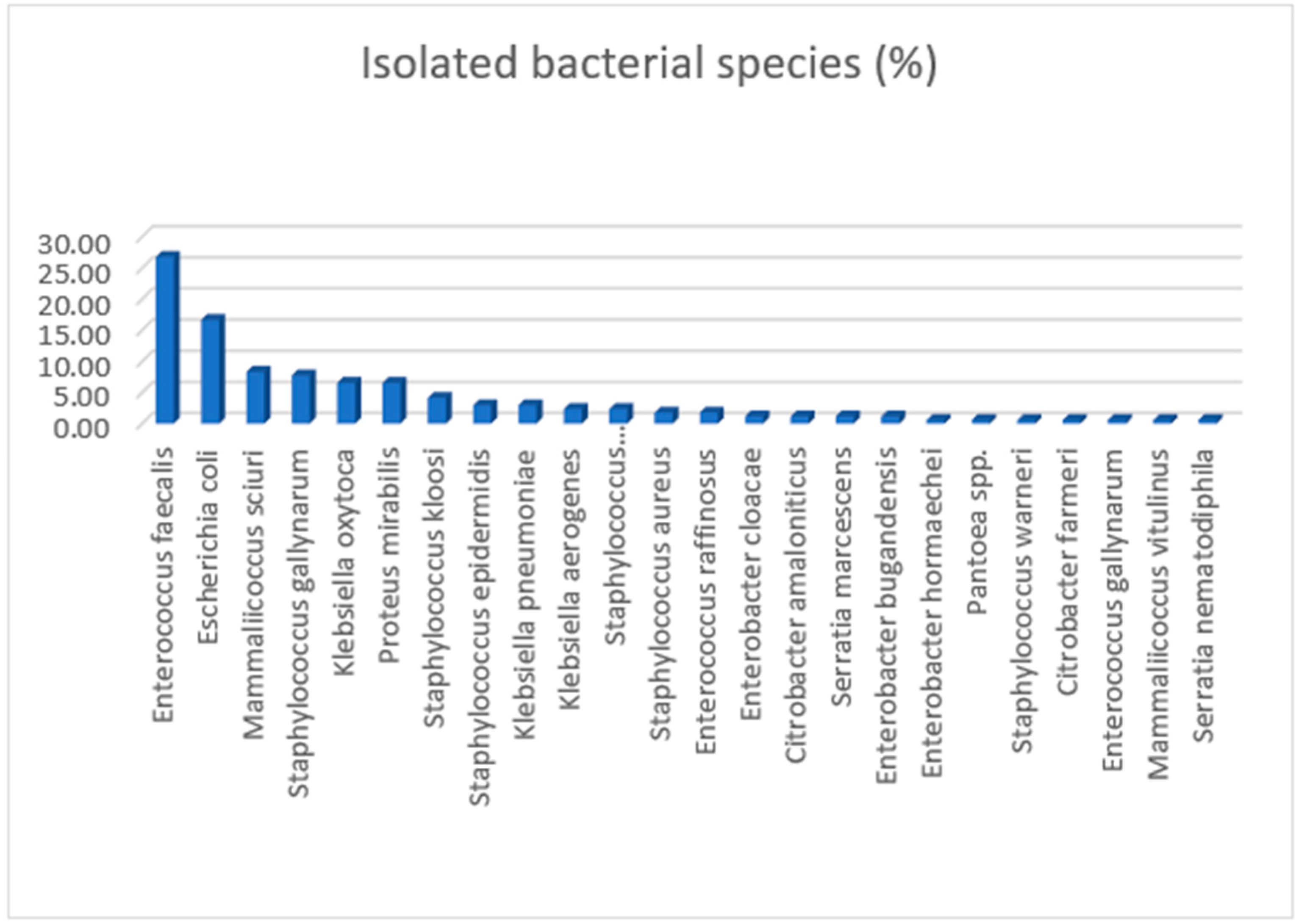
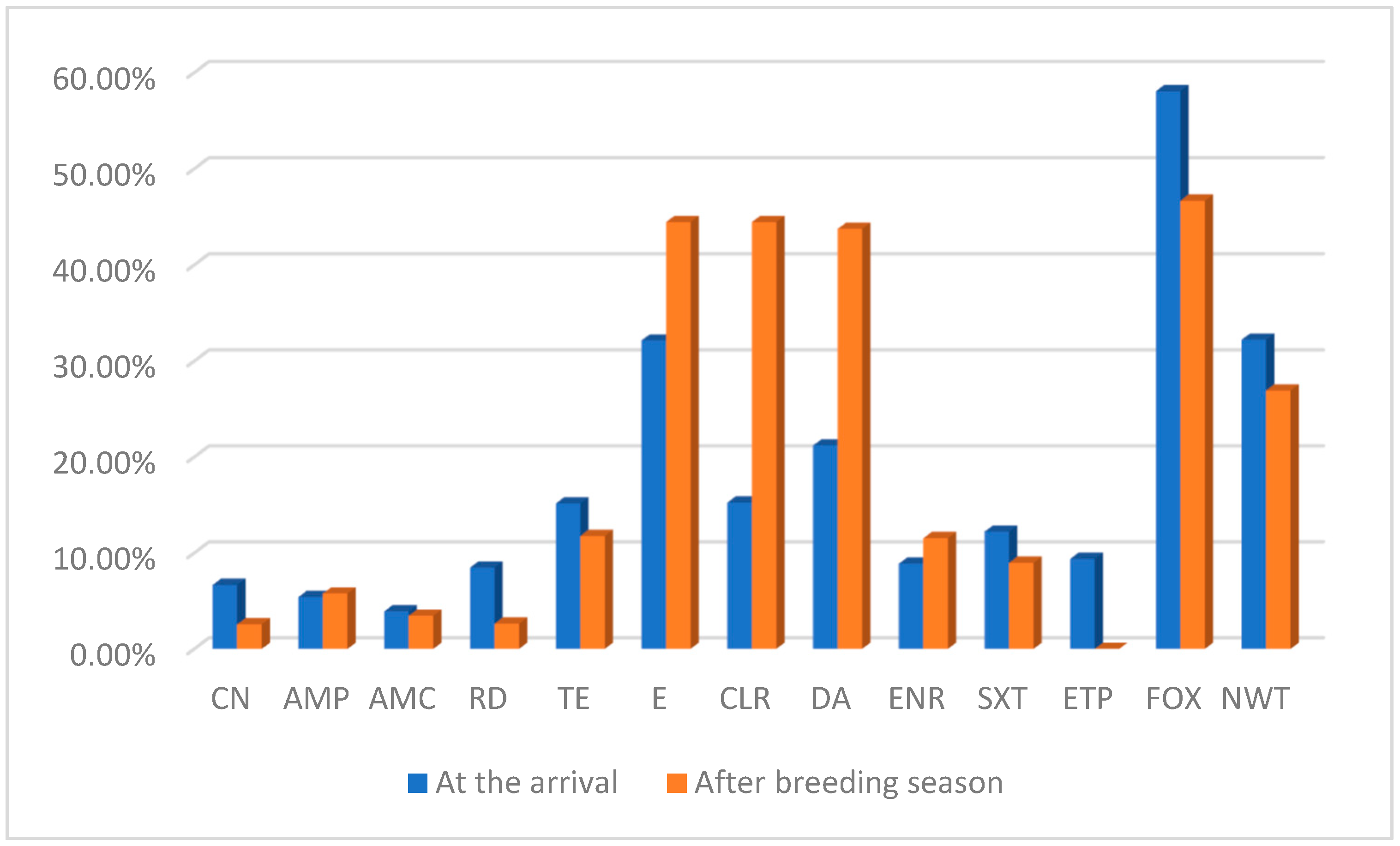

| Antimicrobial Class | Antimicrobial | Code (μg) | Bacterial Order Tested | ECOFFs (NWT < mm) | EUCAST Clinical Zone Diameter Breakpoints (R < mm) |
|---|---|---|---|---|---|
| Aminoglycosides | Gentamicin | CN (10) | Bacillales, | S. aureus (18); S. epidermidis (20) | |
| Enterobacterales | E. coli, P. mirabilis, Serratia marcescens (16); K. oxytoca, C. freundii, E. cloacae (15); K. pneumoniae, K. aerogenes (14); | ||||
| Penicillins + beta-lactamase inhibitors | Ampicillin | AMP (10) | Enterobacterales, | E. coli (13); P. mirabilis (19) | |
| Lactobacillales | E. faecalis (12) | ||||
| Amoxicillin + clavulanic acid | AMC (30) | Enterobacterales | E. coli (14); K. pneumoniae (22); P. mirabilis (22) | ||
| Lactobacillales | N. A. | ||||
| Cephalosporins | Cefoxitin | FOX (30) | Bacillales | - | S. aureus, CoNs (22); S. epidermidis (27) |
| Rifamycins | Rifampicin | RD (5) | Bacillales | S. aureus (24); S. epidermidis (30) | |
| Lactobacillales | N. A. | ||||
| Lincosamides | Clindamycin | DA (2) | Bacillales | S. aureus, S. epidermidis (21) | |
| Tetracyclines | Tetracycline | TE (30) | Bacillales, | S. aureus (20) | |
| Enterobacterales | E. coli (21) | ||||
| Lactobacillales | N. A. | ||||
| Macrolides | Erythromycin | E (15) | Bacillales | S. aureus (22) | |
| Clarithromycin | CLR (15) | Bacillales | N. A. | ||
| Fluoroquinolones | Enrofloxacin | ENR (5) | Bacillales, | N. A. | |
| Lactobacillales, | N. A. | ||||
| Enterobacterales | N. A. | ||||
| Sulfonamides + dihydrofolate reductase inhibitors | Trimethoprim-sulfamethoxazole | SXT (25) | Bacillales, | S. aureus (23) | |
| Lactobacillales, | E. faecalis (26) | ||||
| Enterobacterales | E. coli (22); K. oxytoca (21); K. pneumoniae (18); E. cloacae, P. mirabilis (20) | ||||
| Carbapenems | Ertapenem | ETP (10) | Enterobacterales, | E. coli (24); K. pneumoniae (22) | |
| Bacillales | N. A. |
| Gene | Sequences (5′–3′) | Product Size (bp) | References |
|---|---|---|---|
| mecA | Fw: TCCAGATTACAACTTCACCAGG | 162 | [19] |
| Rev: CCACTTCATATCTTGTAACG | |||
| mecC | Fw: AAAAAAAGGCTTAGAACGCCTC | 138 | [19] |
| Rev: GAAGATCTTTTCCGTTTTCAGC |
| Grouped Swifts | Tot Isolates (n) | Enterobacterales (n); (%) | Bacillales (n); (%) | Lactobacillales (n); (%) |
|---|---|---|---|---|
| TOTAL | 168 | 71; (42.26%) | 48; (28.57%) | 49; (29.17%) |
| AT THE ARRIVAL | 90 | 31; (34.44%) | 33; (36.67%) | 26; (28.89%) |
| AFTER BREEDING SEASON | 78 | 40; (51.28%) | 15; (19.23%) | 23; (29.49%) |
| At the Arrival | After Breeding Season | |||||
|---|---|---|---|---|---|---|
| NWT/R/Zero Halo | NWT (ECOFFs) | Zero Halo | NWT/R/Zero Halo | NWT (ECOFFs) | Zero Halo | |
| CN | 6.66% (6/90) | 16.21% (6/37) | 0% (0/53) | 2.56% (2/78) | 4.87% (2/41) | 0% (0/37) |
| AMP | 5.40% (2/37) | 6.25% (2/32) | 0% (0/5) | 5.76% (3/52) | 5.76% (3/52) | 0% (0/26) |
| AMC | 3.92% (2/51) | 8.33% (1/12) | 2.56% (1/39) | 3.44% (2/58) | 6.25% (2/32) | 0% (0/26) |
| RD | 8.47% (5/59) | 0% (0/7) | 9.61% (5/52) | 2.63% (1/38) | 0% (0/1) | 0% (0/37) |
| TE | 15.55% (14/90) | 45.45% (5/11) | 11.39% (9/79) | 11.76% (8/68) | 0% (0/20) | 16.66% (8/48) |
| E | 32.14% (9/28) | 50% (1/2) | 30.76% (8/26) | 44.44% (8/18) | 100% (1/1) | 41.17% (7/17) |
| CLR | 15.25% (9/59) | − | 15.25% (9/59) | 44.44% (8/18) | − | 44.44% (8/18) |
| DA | 21.21% (7/33) | 28.57 (2/7) | 19.23% (5/26) | 43.75% (7/16) | 0% (0/1) | 46.66% (7/15) |
| ENR | 8.88% (8/90) | − | 8.88% (8/90) | 11.53% (9/78) | − | 11.53% (9/78) |
| SXT | 12.22% (11/90) | 8.33% (4/48) | 16.66% (7/42) | 8.97% (7/78) | 11.66% (7/60) | 0% (0/18) |
| ETP | 9.37% (6/64) | 9.09% (1/11) | 9.43% (5/53) | 0% (0/55) | 0% (0/22) | 0% (0/33) |
| FOX | 58.06% (18/31) | − | − | 46.66% (7/15) | − | − |
| Adults at the Arrival | Adults After Breeding Season | Juveniles | |
|---|---|---|---|
| CN | 3.33% (1/30) | 0% (0/13) | 5.60% (7/125) |
| AMP | 0% (0/24) | 0% (0/10) | 4.85% (5/103) |
| AMC | 0% (0/29) | 0% (0/13) | 3.45% (4/116) |
| RD | 5.26% (1/19) | 0% (0/7) | 5.63% (4/71) |
| TE | 16.67% (5/30) | 15.38% (2/13) | 13.51% (15/111) |
| E | 22.22% (2/9) | 20% (2/10) | 31.60% (12.38) |
| CLR | 22.22% (2/9) | 20% (2/10) | 34.21% (13/38) |
| DA | 22.22% (2/9) | 20% (2/10) | 26.31% (10/38) |
| ENR | 10% (3/30) | 23.08% (3/13) | 9.91% (11/111) |
| SXT | 3.33% (1/30) | 15.38% (2/13) | 9.91% (11/111) |
| ETP | 0% (0/20) | 0% (0/10) | 8% (6/75) |
| FOX | 44.44% (4/9) | 50% (2/4) | 54.29% (19/35) |
| NWT | 33.33% (10/30) | 38.46% (5/13) | 28.8% (36/125) |
Disclaimer/Publisher’s Note: The statements, opinions and data contained in all publications are solely those of the individual author(s) and contributor(s) and not of MDPI and/or the editor(s). MDPI and/or the editor(s) disclaim responsibility for any injury to people or property resulting from any ideas, methods, instructions or products referred to in the content. |
© 2026 by the authors. Licensee MDPI, Basel, Switzerland. This article is an open access article distributed under the terms and conditions of the Creative Commons Attribution (CC BY) license.
Share and Cite
Esposito, E.; Scarpellini, R.; De Lorentis, T.; Zaghini, A.; Marliani, G.; Mondo, E.; Pesaro, S.; Piva, S. A Two-Year Study on Swifts (Apus spp.) as Bioindicators of Environmental Antimicrobial Resistance Within a One Health Framework. Pathogens 2026, 15, 97. https://doi.org/10.3390/pathogens15010097
Esposito E, Scarpellini R, De Lorentis T, Zaghini A, Marliani G, Mondo E, Pesaro S, Piva S. A Two-Year Study on Swifts (Apus spp.) as Bioindicators of Environmental Antimicrobial Resistance Within a One Health Framework. Pathogens. 2026; 15(1):97. https://doi.org/10.3390/pathogens15010097
Chicago/Turabian StyleEsposito, Erika, Raffaele Scarpellini, Tiziano De Lorentis, Anna Zaghini, Giovanna Marliani, Elisabetta Mondo, Stefano Pesaro, and Silvia Piva. 2026. "A Two-Year Study on Swifts (Apus spp.) as Bioindicators of Environmental Antimicrobial Resistance Within a One Health Framework" Pathogens 15, no. 1: 97. https://doi.org/10.3390/pathogens15010097
APA StyleEsposito, E., Scarpellini, R., De Lorentis, T., Zaghini, A., Marliani, G., Mondo, E., Pesaro, S., & Piva, S. (2026). A Two-Year Study on Swifts (Apus spp.) as Bioindicators of Environmental Antimicrobial Resistance Within a One Health Framework. Pathogens, 15(1), 97. https://doi.org/10.3390/pathogens15010097

