Thermal Inactivation of Multiple Veterinary-Relevant Viruses: Effects of Environmental Conditions, Surface Type, and Organic Matrix

 and
and
Abstract
1. Introduction
2. Materials and Methods
2.1. Viruses and Cells
2.2. Study Design
2.3. Virus Inactivation on Surfaces Under Dry and Wet Conditions
2.4. Virus Inactivation in Organic Matter
2.5. Virus Titration
3. Results and Discussion
3.1. Non-Enveloped +ssRNA Viruses (FCV, SVA, PSV)
3.2. Enveloped +ssRNA Viruses (PEDV, BVDV, PRRSV)
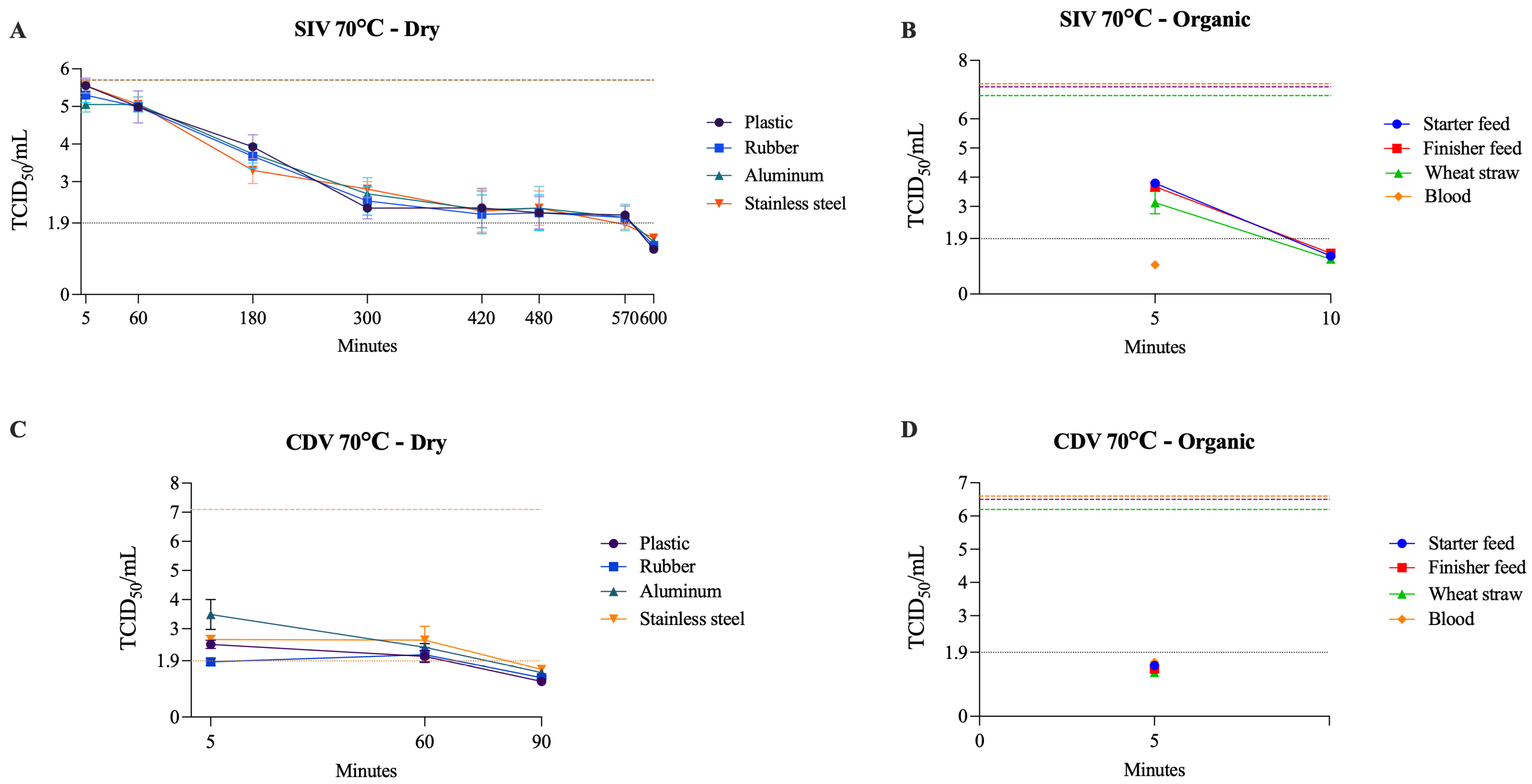
3.3. Enveloped −ssRNA Viruses (SIV, CDV)
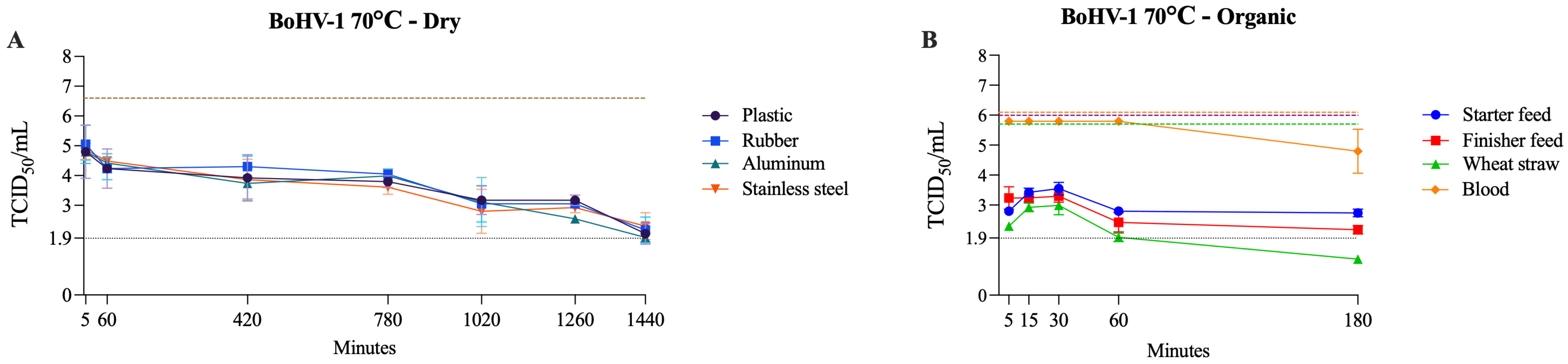
3.4. Enveloped dsDNA Virus (BoHV-1)
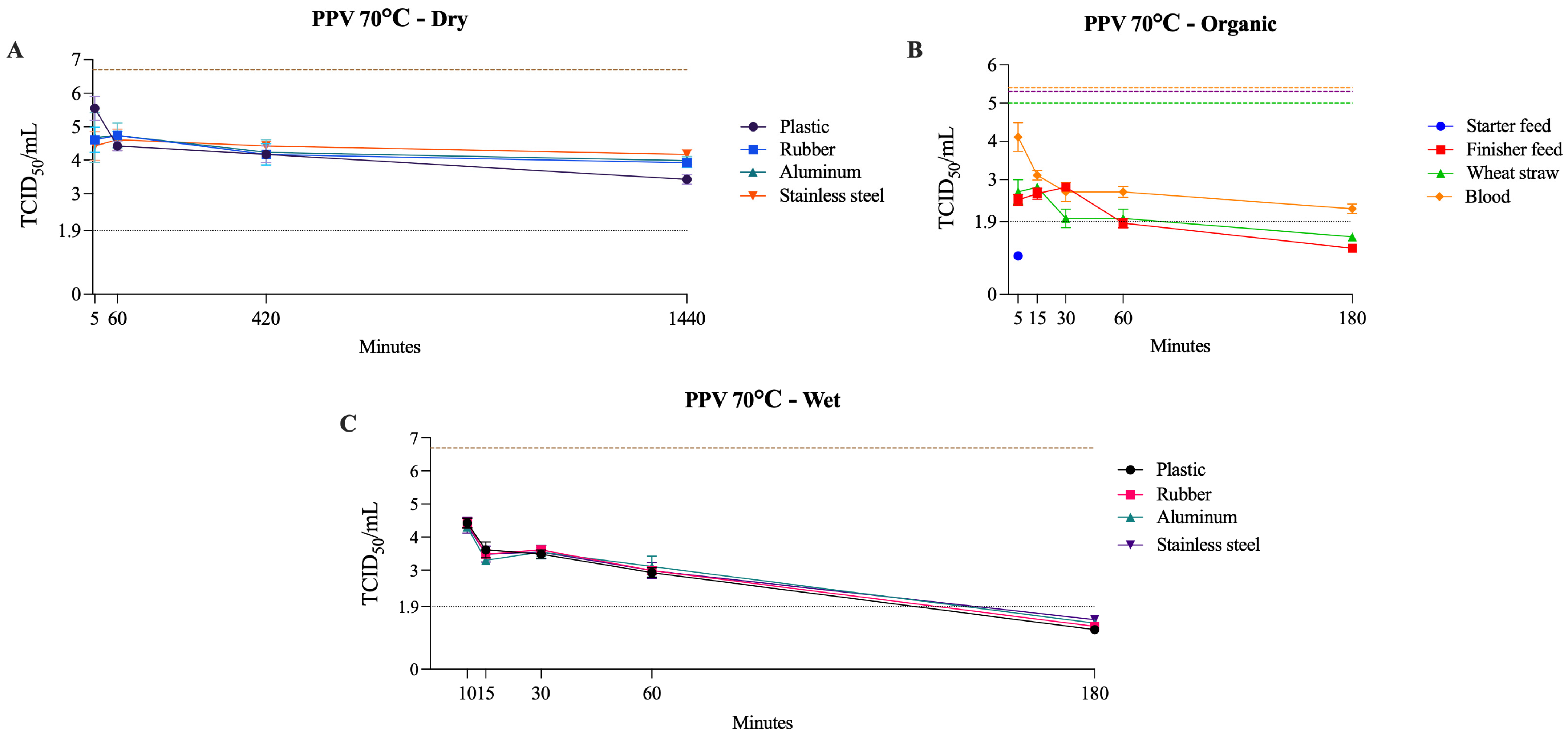
3.5. Non-Enveloped DNA Virus (PPV)
4. Conclusions
Author Contributions
Funding
Institutional Review Board Statement
Informed Consent Statement
Data Availability Statement
Conflicts of Interest
References
- Roth, J.A.; Galyon, J. Food Security: The Ultimate One-Health Challenge. One Health 2024, 19, 100864. [Google Scholar] [CrossRef] [PubMed]
- Kappes, A.; Tozooneyi, T.; Shakil, G.; Railey, A.F.; McIntyre, K.M.; Mayberry, D.E.; Rushton, J.; Pendell, D.L.; Marsh, T.L. Livestock Health and Disease Economics: A Scoping Review of Selected Literature. Front. Vet. Sci. 2023, 10, 1168649. [Google Scholar] [CrossRef]
- Osemeke, O.; Silva, G.S.; Corzo, C.A.; Kikuti, M.; Vadnais, S.; Yue, X.; Linhares, D.; Holtkamp, D. Economic Impact of Productivity Losses Attributable to Porcine Reproductive and Respiratory Syndrome Virus in United States Pork Production, 2016–2020. Prev. Vet. Med. 2025, 244, 106627. [Google Scholar] [CrossRef]
- Maes, D.G.D.; Dewulf, J.; Piñeiro, C.; Edwards, S.; Kyriazakis, I. A Critical Reflection on Intensive Pork Production with an Emphasis on Animal Health and Welfare. J. Anim. Sci. 2020, 98, S15–S26. [Google Scholar] [CrossRef]
- VanderWaal, K.; Deen, J. Global Trends in Infectious Diseases of Swine. Proc. Natl. Acad. Sci. USA 2018, 115, 11495–11500. [Google Scholar] [CrossRef]
- Negesso, G.; Hadush, T.; Tilahun, A.; Teshale, A. Trans-Boundary Animal Disease and Their Impacts on International Trade: A Review. Acad. J. Anim. Dis. 2016, 5, 53–60. [Google Scholar]
- Gaudino, M. Understanding the Mechanisms of Viral and Bacterial Coinfections in Bovine Respiratory Disease: A Comprehensive Literature Review of Experimental Evidence. Vet. Res. 2022, 53, 70. [Google Scholar] [CrossRef]
- Bessler, A.L.; Nayee, S.; Garabed, R.; Krug, P.; Obrycki, J.; Rodriguez, L. Surviving the Summer: Foot-and-Mouth Disease Virus Survival in U.S. Regional Soil Types at High Ambient Temperatures. Front. Vet. Sci. 2024, 11, 14480–14493. [Google Scholar] [CrossRef]
- Silverman, A.I.; Boehm, A.B. Systematic Review and Meta-Analysis of the Persistence of Enveloped Viruses in Environmental Waters and Wastewater in the Absence of Disinfectants. Environ. Sci. Technol. 2021, 55, 14480–14493. [Google Scholar] [CrossRef] [PubMed]
- Yadav, M.P.; Singh, R.K.; Malik, Y.S. Epidemiological Perspective in Managing Viral Diseases in Animals. In Recent Advances in Animal Virology; Springer: Singapore, 2019; pp. 381–407. [Google Scholar] [CrossRef]
- Serbessa, T.A.; Geleta, Y.G.; Terfa, I.O. Review on Diseases and Health Management of Poultry and Swine. Int. J. Avian Wildl. Biol. 2023, 7, 27–38. [Google Scholar] [CrossRef]
- Neumann, E.J.; Hall, W.F. Disease Control, Prevention, and Elimination. In Diseases of Swine; John Wiley & Sons, Ltd.: Hoboken, NJ, USA, 2019; pp. 123–157. ISBN 978-1-119-35092-7. [Google Scholar]
- Santman-Berends, I.M.G.A.; Mars, M.H.; Weber, M.F.; van Duijn, L.; Waldeck, H.W.F.; Biesheuvel, M.M.; van den Brink, K.M.J.A.; Dijkstra, T.; Hodnik, J.J.; Strain, S.a.J.; et al. Control and Eradication Programs for Six Cattle Diseases in the Netherlands. Front. Vet. Sci. 2021, 8, 670419. [Google Scholar] [CrossRef]
- Dee, S.; Clement, T.; Schelkopf, A.; Nerem, J.; Knudsen, D.; Christopher-Hennings, J.; Nelson, E. An Evaluation of Contaminated Complete Feed as a Vehicle for Porcine Epidemic Diarrhea Virus Infection of Naïve Pigs Following Consumption via Natural Feeding Behavior: Proof of Concept. BMC Vet. Res. 2014, 10, 176. [Google Scholar] [CrossRef]
- Yang, Q.; Gruenbacher, D.M.; Stamm, J.L.H.; Amrine, D.E.; Brase, G.L.; DeLoach, S.A.; Scoglio, C.M. Impact of Truck Contamination and Information Sharing on Foot-and-Mouth Disease Spreading in Beef Cattle Production Systems. PLoS ONE 2020, 15, e0240819. [Google Scholar] [CrossRef]
- Dee, S.; Otake, S.; Deen, J. An Evaluation of Ultraviolet Light (UV254) as a Means to Inactivate Porcine Reproductive and Respiratory Syndrome Virus on Common Farm Surfaces and Materials. Vet. Microbiol. 2011, 150, 96–99. [Google Scholar] [CrossRef]
- Dee, S.; Deen, J.; Rossow, K.; Weise, C.; Eliason, R.; Otake, S.; Joo, H.S.; Pijoan, C. Mechanical Transmission of Porcine Reproductive and Respiratory Syndrome Virus throughout a Coordinated Sequence of Events during Warm Weather. Can. J. Vet. Res. 2003, 67, 12–19. [Google Scholar]
- Nuanualsuwan, S.; Songkasupa, T.; Boonpornprasert, P.; Suwankitwat, N.; Lohlamoh, W.; Nuengjamnong, C. Persistence of African Swine Fever Virus on Porous and Non-Porous Fomites at Environmental Temperatures. Porcine Health Manag. 2022, 8, 34. [Google Scholar] [CrossRef]
- Van Kessel, J.; Strom, S.; Deason, H.; Vanmoorlehem, E.; Berube, N.; Hauta, S.; Fernando, C.; Hill, J.; Fonstad, T.; Gerdts, V. Time and Temperature Requirements for Improved Heat Killing of Pathogens in Swine Transport Trailers. In Proceedings of the 2020 ASABE Annual International Virtual Meeting, Online, 13–15 July 2020; American Society of Agricultural and Biological Engineers: St. Joseph, MI, USA, 2020. [Google Scholar]
- Lowe, J.; Gauger, P.; Harmon, K.; Zhang, J.; Connor, J.; Yeske, P.; Loula, T.; Levis, I.; Dufresne, L.; Main, R. Role of Transportation in Spread of Porcine Epidemic Diarrhea Virus Infection, United States. Emerg. Infect. Dis. 2014, 20, 872–874. [Google Scholar] [CrossRef]
- Dee, S.A.; Deen, J.; Otake, S.; Pijoan, C. An Experimental Model to Evaluate the Role of Transport Vehicles as a Source of Transmission of Porcine Reproductive and Respiratory Syndrome Virus to Susceptible Pigs. Can. J. Vet. Res. 2004, 68, 128–133. [Google Scholar] [PubMed]
- HPAI Response: Using Heat Treatment for Virus Elimination; United States Department of Agriculture: Washington, DC, USA, 2022.
- Hirneisen, K.A.; Black, E.P.; Cascarino, J.L.; Fino, V.R.; Hoover, D.G.; Kniel, K.E. Viral Inactivation in Foods: A Review of Traditional and Novel Food-Processing Technologies. Compr. Rev. Food Sci. Food Saf. 2010, 9, 3–20. [Google Scholar] [CrossRef] [PubMed]
- Thomas, P.; Karriker, L.; Ramirez, A.; Zhang, J.; Ellingson, J.; Crawford, K.; Bates, J.; Hammen, K.; Holtkamp, D. Evaluation of Time and Temperature Sufficient to Inactivate Porcine Epidemic Diarrhea Virus in Swine Feces on Metal Surfaces. J. Swine Health Prod. 2015, 23, 84–90. [Google Scholar] [CrossRef] [PubMed]
- Batéjat, C.; Grassin, Q.; Manuguerra, J.-C.; Leclercq, I. Heat Inactivation of the Severe Acute Respiratory Syndrome Coronavirus 2. J. Biosaf. Biosecur. 2021, 3, 1–3. [Google Scholar] [CrossRef]
- Allingham, C.; Taniguchi, M.; Kinchla, A.J.; Moore, M.D. The Influence of Simulated Organic Matter on the Inactivation of Viruses: A Review. Viruses 2024, 16, 1026. [Google Scholar] [CrossRef]
- Krug, P.W.; Davis, T.; O’Brien, C.; LaRocco, M.; Rodriguez, L.L. Disinfection of Transboundary Animal Disease Viruses on Surfaces Used in Pork Packing Plants. Vet. Microbiol. 2018, 219, 219–225. [Google Scholar] [CrossRef]
- Mendes Peter, C.; Pinto Paim, W.; Maggioli, M.F.; Ebling, R.C.; Glisson, K.; Donovan, T.; Vicosa Bauermann, F. Evaluation of Ultraviolet Type C Radiation in Inactivating Relevant Veterinary Viruses on Experimentally Contaminated Surfaces. Pathogens 2022, 11, 686. [Google Scholar] [CrossRef] [PubMed]
- Dee, S.; Torremorell, M.; Thompson, B.; Deen, J.; Pijoan, C. An Evaluation of Thermo-Assisted Drying and Decontamination for the Elimination of Porcine Reproductive and Respiratory Syndrome Virus from Contaminated Livestock Transport Vehicles. Can. J. Vet. Res. 2005, 69, 58–63. [Google Scholar] [PubMed]
- Thomas, P.R.; Ramirez, A.; Zhang, J.; Ellingson, J.S.; Myers, J.N. Methods for Inactivating PEDV in Hog Trailers; Report 12.1; Iowa State University: Ames, IA, USA, 2015. [Google Scholar]
- Dee, S.A.; Bauermann, F.V.; Niederwerder, M.C.; Singrey, A.; Clement, T.; de Lima, M.; Long, C.; Patterson, G.; Sheahan, M.A.; Stoian, A.M.M.; et al. Survival of Viral Pathogens in Animal Feed Ingredients under Transboundary Shipping Models. PLoS ONE 2018, 13, e0194509. [Google Scholar] [CrossRef] [PubMed]
- Ebling, R.; Paim, W.P.; Turner, J.; Flory, G.; Seiger, J.; Whitcomb, C.; Remmenga, M.; Vuolo, M.; Ramachandran, A.; Cole, L.; et al. Virus Viability in Spiked Swine Bone Marrow Tissue during Above-Ground Burial Method and under in Vitro Conditions. Transbound. Emerg. Dis. 2022, 69, 2987–2995. [Google Scholar] [CrossRef]
- Merchioratto, I.; Mendes Peter, C.; Ramachandran, A.; Maggioli, M.F.; Vicosa Bauermann, F. Viability of Veterinary-Relevant Viruses in Decomposing Tissues over a 90-Day Period Using an In-Vitro System. Pathogens 2023, 12, 1104. [Google Scholar] [CrossRef]
- Guan, J.; Chan, M.; Brooks, B.W.; Spencer, J.L.; Algire, J. Comparing Escherichia Coli O157:H7 Phage and Bovine Viral Diarrhea Virus as Models for Destruction of Classical Swine Fever Virus in Compost. Compost. Sci. Util. 2012, 20, 18–23. [Google Scholar] [CrossRef]
- Welch, J.L.; Shrestha, R.; Hutchings, H.; Pal, N.; Levings, R.; Robbe-Austerman, S.; Palinski, R.; Shanmuganatham, K.K. Inactivation of Highly Transmissible Livestock and Avian Viruses Including Influenza A and Newcastle Disease Virus for Molecular Diagnostics. Front. Vet. Sci. 2024, 11, 1304022. [Google Scholar] [CrossRef] [PubMed]
- Crossley, B.M.; Miramontes, C.C.; Rejmanek, D.; Gallardo, R.; Pereira, R. In-Laboratory Inactivation of H5N1 in Raw Whole Milk through Milk Acidification: Results from a Pilot Study. J. Dairy Sci. 2025, 108, 2264–2275. [Google Scholar] [CrossRef]
- Tree, J.A.; Adams, M.R.; Lees, D.N. Disinfection of Feline Calicivirus (a Surrogate for Norovirus) in Wastewaters. J. Appl. Microbiol. 2005, 98, 155–162. [Google Scholar] [CrossRef]
- D’Souza, D.H.; Sair, A.; Williams, K.; Papafragkou, E.; Jean, J.; Moore, C.; Jaykus, L. Persistence of Caliciviruses on Environmental Surfaces and Their Transfer to Food. Int. J. Food Microbiol. 2006, 108, 84–91. [Google Scholar] [CrossRef]
- Spiri, A.M.; Meli, M.L.; Riond, B.; Herbert, I.; Hosie, M.J.; Hofmann-Lehmann, R. Environmental Contamination and Hygienic Measures After Feline Calicivirus Field Strain Infections of Cats in a Research Facility. Viruses 2019, 11, 958. [Google Scholar] [CrossRef] [PubMed]
- Buckley, D. Survival, Recovery, and Inactivation of Human Norovirus Surrogates, Feline Calicivirus and Murine Norovirus, on Carpets. Ph.D. Thesis, Clemson University, Clemson, SC, USA, 2017. [Google Scholar]
- Zee, Y.C.; Hackett, A.J. The Influence of Cations on the Thermal Inactivation of Vesicular Exanthema of Swine Virus. Arch. Gesamte Virusforsch. 1967, 20, 473–476. [Google Scholar] [CrossRef] [PubMed]
- Caserta, L.C.; Noll, J.C.G.; Singrey, A.; Niederwerder, M.C.; Dee, S.; Nelson, E.A.; Diel, D.G. Stability of Senecavirus A in Animal Feed Ingredients and Infection Following Consumption of Contaminated Feed. Transbound. Emerg. Dis. 2022, 69, 88–96. [Google Scholar] [CrossRef]
- Kamolsiripichaiporn, S.; Subharat, S.; Udon, R.; Thongtha, P.; Nuanualsuwan, S. Thermal Inactivation of Foot-and-Mouth Disease Viruses in Suspension. Appl. Environ. Microbiol. 2007, 73, 7177–7184. [Google Scholar] [CrossRef]
- Kristensen, T.; Belsham, G.J.; Tjørnehøj, K. Heat Inactivation of Foot-and-Mouth Disease Virus, Swine Vesicular Disease Virus and Classical Swine Fever Virus When Air-Dried on Plastic and Glass Surfaces. Biosaf. Health 2021, 3, 217–223. [Google Scholar] [CrossRef]
- Li, Y.; Du, L.; Jin, T.; Cheng, Y.; Zhang, X.; Jiao, S.; Huang, T.; Zhang, Y.; Yan, Y.; Gu, J.; et al. Characterization and Epidemiological Survey of Porcine Sapelovirus in China. Vet. Microbiol. 2019, 232, 13–21. [Google Scholar] [CrossRef]
- Bai, H.; Liu, J.; Fang, L.; Kataoka, M.; Takeda, N.; Wakita, T.; Li, T.-C. Characterization of Porcine Sapelovirus Isolated from Japanese Swine with PLC/PRF/5 Cells. Transbound. Emerg. Dis. 2018, 65, 727–734. [Google Scholar] [CrossRef] [PubMed]
- Turner, C.; Williams, S.M. Laboratory-Scale Inactivation of African Swine Fever Virus and Swine Vesicular Disease Virus in Pig Slurry. J. Appl. Microbiol. 1999, 87, 148–157. [Google Scholar] [CrossRef]
- Pujols, J.; Rosell, R.; Russel, L.; Campbell, J.; Crenshaw, J.; Weaver, E.; Rodríguez, C.; Ródenas, J.; Polo, J. Inactivation of Swine Vesicular Disease Virus in Porcine Plasma by Spray-Drying; American Association of Swine Veterinarians: Perry, IA, USA, 2007. [Google Scholar]
- Trudeau, M.P.; Verma, H.; Sampedro, F.; Urriola, P.E.; Shurson, G.C.; McKelvey, J.; Pillai, S.D.; Goyal, S.M. Comparison of Thermal and Non-Thermal Processing of Swine Feed and the Use of Selected Feed Additives on Inactivation of Porcine Epidemic Diarrhea Virus (PEDV). PLoS ONE 2016, 11, e0158128. [Google Scholar] [CrossRef]
- Trudeau, M.P.; Verma, H.; Urriola, P.E.; Sampedro, F.; Shurson, G.C.; Goyal, S.M. Survival of Porcine Epidemic Diarrhea Virus (PEDV) in Thermally Treated Feed Ingredients and on Surfaces. Porcine Health Manag. 2017, 3, 17. [Google Scholar] [CrossRef] [PubMed]
- Phinney, D.M.; Frelka, J.C.; Heldman, D.R. Composition-Based Prediction of Temperature-Dependent Thermophysical Food Properties: Reevaluating Component Groups and Prediction Models. J. Food Sci. 2017, 82, 6–15. [Google Scholar] [CrossRef] [PubMed]
- Mil-Homens, M.; Aljets, E.; Paiva, R.C.; Machado, I.; Cezar, G.; Osemeke, O.; Moraes, D.; Jayaraman, S.; Brinning, M.; Poeta Silva, A.P.; et al. Assessment of Temperature and Time on the Survivability of Porcine Reproductive and Respiratory Syndrome Virus (PRRSV) and Porcine Epidemic Diarrhea Virus (PEDV) on Experimentally Contaminated Surfaces. PLoS ONE 2024, 19, e0291181. [Google Scholar] [CrossRef]
- Bøtner, A.; Belsham, G.J. Virus Survival in Slurry: Analysis of the Stability of Foot-and-Mouth Disease, Classical Swine Fever, Bovine Viral Diarrhoea and Swine Influenza Viruses. Vet. Microbiol. 2012, 157, 41–49. [Google Scholar] [CrossRef]
- Rae, A.G.; Sinclair, J.A.; Nettleton, P.F. Survival of Bovine Virus Diarrhoea Virus in Blood from Persistently Infected Cattle. Vet. Rec. 1987, 120, 504. [Google Scholar] [CrossRef]
- Rossi, C.R.; Bridgman, C.R.; Kiesel, G.K. Viral Contamination of Bovine Fetal Lung Cultures and Bovine Fetal Serum. Am. J. Vet. Res. 1980, 41, 1680–1681. [Google Scholar] [CrossRef]
- Sauerbrei, A.; Wutzler, P. Testing Thermal Resistance of Viruses. Arch. Virol. 2009, 154, 115–119. [Google Scholar] [CrossRef]
- Pirtle, E.C.; Beran, G.W. Stability of Porcine Reproductive and Respiratory Syndrome Virus in the Presence of Fomites Commonly Found on Farms. J. Am. Vet. Med. Assoc. 1996, 208, 390–392. [Google Scholar] [CrossRef] [PubMed]
- Linhares, D.C.L.; Torremorell, M.; Joo, H.S.; Morrison, R.B. Infectivity of PRRS Virus in Pig Manure at Different Temperatures. Vet. Microbiol. 2012, 160, 23–28. [Google Scholar] [CrossRef]
- Haas, B.; Ahl, R.; Böhm, R.; Strauch, D. Inactivation of Viruses in Liquid Manure. Rev. Sci. Tech. 1995, 14, 435–445. [Google Scholar] [CrossRef]
- Poulson, R.L.; Tompkins, S.M.; Berghaus, R.D.; Brown, J.D.; Stallknecht, D.E. Environmental Stability of Swine and Human Pandemic Influenza Viruses in Water under Variable Conditions of Temperature, Salinity, and pH. Appl. Environ. Microbiol. 2016, 82, 3721–3726. [Google Scholar] [CrossRef]
- McDevitt, J.; Rudnick, S.; First, M.; Spengler, J. Role of Absolute Humidity in the Inactivation of Influenza Viruses on Stainless Steel Surfaces at Elevated Temperatures. Appl. Environ. Microbiol. 2010, 76, 3943–3947. [Google Scholar] [CrossRef] [PubMed]
- Lo, J.P.; Svehag, S.E.; Gorham, J.R. Thermostability of Distemper Virus and Its Neutralization by Antibody. Acta Vet. Scand. 1965, 6, 329–340. [Google Scholar] [CrossRef] [PubMed]
- Watanabe, S.; Fukushi, S.; Harada, T.; Shimojima, M.; Yoshikawa, T.; Kurosu, T.; Kaku, Y.; Morikawa, S.; Saijo, M. Effective Inactivation of Nipah Virus in Serum Samples for Safe Processing in Low-Containment Laboratories. Virol. J. 2020, 17, 151. [Google Scholar] [CrossRef] [PubMed]
- Hume, A.J.; Olejnik, J.; White, M.R.; Huang, J.; Turcinovic, J.; Heiden, B.; Bawa, P.S.; Williams, C.J.; Gorham, N.G.; Alekseyev, Y.O.; et al. Heat Inactivation of Nipah Virus for Downstream Single-Cell RNA Sequencing Does Not Interfere with Sample Quality. Pathogens 2024, 13, 62. [Google Scholar] [CrossRef]
- Levings, R.L.; Kaeberle, M.L.; Reed, D.E. The Effect of Some Common Inactivation Procedures on the Antigens of Bovine Herpesvirus 1. Vete. Microbiol. 1984, 9, 313–328. [Google Scholar] [CrossRef]
- Stoian, A.M.M.; Petrovan, V.; Constance, L.A.; Olcha, M.; Dee, S.; Diel, D.G.; Sheahan, M.A.; Rowland, R.R.R.; Patterson, G.; Niederwerder, M.C. Stability of Classical Swine Fever Virus and Pseudorabies Virus in Animal Feed Ingredients Exposed to Transpacific Shipping Conditions. Transbound. Emerg. Dis. 2020, 67, 1623–1632. [Google Scholar] [CrossRef]
- Wittmann, G. Spread and Control of Aujeszky’s Disease (AD). Comp. Immunol. Microbiol. Infect. Dis. 1991, 14, 165–173. [Google Scholar] [CrossRef]
- Caruso, C.; Gobbi, E.; Biosa, T.; Andra’, M.; Cavallazzi, U.; Masoero, L. Evaluation of Viral Inactivation of Pseudorabies Virus, Encephalomyocarditis Virus, Bovine Viral Diarrhea Virus and Porcine Parvovirus in Pancreatin of Porcine Origin. J. Virol. Methods 2014, 208, 79–84. [Google Scholar] [CrossRef] [PubMed]
- Blümel, J.; Schmidt, I.; Willkommen, H.; Löwer, J. Inactivation of Parvovirus B19 during Pasteurization of Human Serum Albumin. Transfusion 2002, 42, 1011–1018. [Google Scholar] [CrossRef] [PubMed]
- Kadji, F.M.N.; Shimizu, M.; Kotani, K.; Kishimoto, M.; Hiraoka, Y. Chemical and Heat Treatment for Viral Inactivation in Porcine-Derived Gelatin. BMC Biotechnol. 2024, 24, 99. [Google Scholar] [CrossRef]
- Vereecke, N.; Kvisgaard, L.K.; Baele, G.; Boone, C.; Kunze, M.; Larsen, L.E.; Theuns, S.; Nauwynck, H. Molecular Epidemiology of Porcine Parvovirus Type 1 (PPV1) and the Reactivity of Vaccine-Induced Antisera against Historical and Current PPV1 Strains. Virus Evol. 2022, 8, veac053. [Google Scholar] [CrossRef]
- Simpson, A.A.; Hébert, B.; Sullivan, G.M.; Parrish, C.R.; Zádori, Z.; Tijssen, P.; Rossmann, M.G. The Structure of Porcine Parvovirus: Comparison with Related Viruses. J. Mol. Biol. 2002, 315, 1189–1198. [Google Scholar] [CrossRef]
- Tu, M.; Liu, F.; Chen, S.; Wang, M.; Cheng, A. Role of Capsid Proteins in Parvoviruses Infection. Virol. J. 2015, 12, 114. [Google Scholar] [CrossRef] [PubMed]
- Vasickova, P.; Pavlik, I.; Verani, M.; Carducci, A. Issues Concerning Survival of Viruses on Surfaces. Food Environ. Virol. 2010, 2, 24–34. [Google Scholar] [CrossRef]
- Rzeżutka, A.; Cook, N. Survival of Human Enteric Viruses in the Environment and Food. FEMS Microbiol. Rev. 2004, 28, 441–453. [Google Scholar] [CrossRef]



| Viral Family | Target Virus | Surrogate Viruses Employed | Strain | Cell Line Used for Amplification | Virus Titer (TCID50/mL) |
|---|---|---|---|---|---|
| Arteriviridae | Porcine reproductive and respiratory syndrome Virus | Not applied | NVLS | MARC-145 | 104.8 |
| Caliciviridae | Vesicular exanthema of swine virus | Feline calicivirus | FCV2280 | CRFK | 108.2 |
| Coronaviridae | Porcine epidemic diarrhea virus | Not applied | Colorado 2013 | VERO 81 | 105.4 |
| Flaviviridae | Classical swine fever virus | Bovine viral diarrhea virus | Singer | MDBK | 106.2 |
| Orthoherpesviridae | Pseudorabies virus | Bovine alphaherpesvirus 1 | Colorado strain | MDBK | 107.6 |
| Orthomyxoviridae | Swine influenza virus A | Not applied | A/Swine/Iowa/73/H1N1 | MDCK | 106.7 |
| Paramyxoviridae | Nipah virus | Canine distemper virus | Snyder Hill | VERO 81 | 108.1 |
| Parvoviridae | Porcine parvovirus | Not applied | NADL-1 (Mengeling) | ST | 106.9 |
| Picornaviridae | Foot and mouth disease virus | Senecavirus A1 | HI/2012-NADC40 | ST | 108.7 |
| Picornaviridae | Swine vesicular disease virus | Porcine sapelovirus | Smedia (PS27) | PK-15 | 107.7 |
| Virus | Condition | Matrix | Viability Time in Minutes (Viral Titer) | |||
|---|---|---|---|---|---|---|
| 70 °C | 60 °C | 50 °C | ~20–22 °C | |||
| Feline calicivirus (FCV) | Dry | Plastic | 1440 (3.4) | 1440 (3.4) | 1440 (4.3) | 900 (3.8) |
| Rubber | 1440 (3.3) | 1440 (3.3) | 1440 (4.3) | 1440 (2.8) | ||
| Aluminum | 1440 (4.1) | 1440 (3.9) | 1440 (4.6) | 1440 (2.6) | ||
| Stainless steel | 1440 (4.3) | 1440 (3.5) | 1440 (3.8) | 1440 (2.6) | ||
| Wet | Plastic | 5 (ND) | 5 (ND) | 15 (3.9) | 60 (6.6) | |
| Rubber | 5 (ND) | 5 (ND) | 15 (4.1) | 60 (6.4) | ||
| Aluminum | 5 (ND) | 5 (ND) | 15 (2.8) | 60 (6.8) | ||
| Stainless steel | 5 (ND) | 5 (ND) | 15 (3.2) | 60 (6.8) | ||
| Organic matter | Starter feed | 15 (2.3) | 30 (2.7) | 180 (1.9) | 180 (4.1) | |
| Finisher feed | 30 (2.3) | 180 (1.9) | 180 (2.8) | 180 (5.6) | ||
| Wheat straw | 15 (2.8) | 30 (2.7) | 180 (2.6) | 180 (5.8) | ||
| Blood | 5 (ND) | 15 (1.9) | 180 (2.3) | 180 (5.8) | ||
| Senecavirus A (SVA) | Dry | Plastic | 1440 (2.6) | 1440 (3.1) | 1440 (4.3) | 1440 (5.3) |
| Rubber | 1440 (3.2) | 1440 (2.9) | 1440 (3.4) | 1440 (5.1) | ||
| Aluminum | 1440 (3.2) | 1440 (3.9) | 1440 (4.7) | 1440 (4.8) | ||
| Stainless steel | 1440 (2.6) | 1440 (3.6) | 1440 (3.9) | 1440 (4.8) | ||
| Wet | Plastic | 5 (ND) | 5 (ND) | 30 (2.3) | 60 (6.8) | |
| Rubber | 5 (ND) | 5 (ND) | 30 (2.5) | 60 (6.8) | ||
| Aluminum | 5 (ND) | 5 (ND) | 30 (2.1) | 60 (6.8) | ||
| Stainless steel | 5 (ND) | 5 (ND) | 30 (2.1) | 60 (6.8) | ||
| Organic matter | Starter feed | 30 (4.7) | 180 (1.9) | 180 (3) | 180 (2.9) | |
| Finisher feed | 60 (2.6) | 180 (2.6) | 180 (3.2) | 180 (2.3) | ||
| Wheat straw | 60 (2.1) | 180 (1.9) | 180 (2.1) | 180 (1.9) | ||
| Blood | 15 (2.1) | 60 (2.4) | 180 (6.8) | 180 (6.8) | ||
| Sapelovirus (PSV) | Dry | Plastic | 60 (2.2) | 120 (2.2) | 120 (2.6) | 120 (4.8) |
| Rubber | 90 (2.5) | 120 (2.2) | 120 (2.9) | 120 (4.8) | ||
| Aluminum | 120 (2) | 120 (2.6) | 120 (3.4) | 120 (4.8) | ||
| Stainless steel | 120 (2) | 120 (2.2) | 120 (3.4) | 120 (4.8) | ||
| Wet | Plastic | 5 (ND) | 5 (ND) | 5 (1.9) | 30 (6.1) | |
| Rubber | 5 (ND) | 5 (ND) | 20 (2.9) | 30 (6.2) | ||
| Aluminum | 5 (ND) | 5 (ND) | 5 (ND) | 30 (6.5) | ||
| Stainless steel | 5 (ND) | 5 (ND) | 5 (1.9) | 30 (6.2) | ||
| Organic matter | Starter feed | 15 (3.4) | 30 (3.6) | 180 (3.3) | 180 (4.9) | |
| Finisher feed | 10 (2.2) | 60 (3.2) | 180 (3) | 180 (5.1) | ||
| Wheat straw | 10 (2.3) | 60 (2.4) | 60 (3.1) | 180 (5.1) | ||
| Blood | 5 (ND) | 5 (ND) | 15 (3) | 180 (4.9) | ||
| Virus | Condition | Matrix | Viability Time in Minutes (Viral Titer) | |||
|---|---|---|---|---|---|---|
| 70 °C | 60 °C | 50 °C | ~20–22 °C | |||
| Porcine epidemic diarrhea virus (PEDV) | Dry | Plastic | 150 (2.1) | 150 (3.1) | 150 (3.1) | 180 (2.9) |
| Rubber | 5 (2.3) | 150 (2.1) | 150 (2.9) | 180 (2.4) | ||
| Aluminum | 150 (2.1) | 150 (3) | 150 (3.3) | 180 (2.4) | ||
| Stainless steel | 150 (2.2) | 150 (3.2) | 150 (3.3) | 180 (2.4) | ||
| Wet | Plastic | 5 (ND) | 5 (ND) | 10 (1.9) | 15 (4.1) | |
| Rubber | 5 (ND) | 5 (ND) | 10 (2.2) | 15 (3.7) | ||
| Aluminum | 5 (ND) | 5 (ND) | 10 (1.9) | 15 (3.9) | ||
| Stainless steel | 5 (ND) | 5 (ND) | 10 (1.9) | 15 (3.6) | ||
| Organic matter | Starter feed | 5 (ND) | 5 (ND) | 5 (ND) | 15 (1.9) | |
| Finisher feed | 5 (ND) | 5 (ND) | 5 (ND) | 15 (1.9) | ||
| Wheat straw | 5 (2.1) | 5 (2.5) | 20 (2.1) | 30 (3.3) | ||
| Blood | 5 (3.2) | 5 (3.1) | 60 (3.1) | 180 (3.4) | ||
| Bovine virus diarrhea virus (BVDV) | Dry | Plastic | 210 (2.1) | 210 (3.3) | 210 (4.2) | 240 (1.9) |
| Rubber | 120 (2) | 210 (3.2) | 210 (4.3) | 180 (2.2) | ||
| Aluminum | 210 (2.1) | 210 (3.3) | 210 (4.2) | 240 (1.9) | ||
| Stainless steel | 210 (2.1) | 210 (3.1) | 210 (4.2) | 240 (1.9) | ||
| Wet | Plastic | 5 (ND) | 5 (ND) | 15 (2.2) | 30 (4.5) | |
| Rubber | 5 (ND) | 5 (ND) | 20 (1.9) | 30 (4.5) | ||
| Aluminum | 5 (ND) | 5 (ND) | 20 (1.2) | 30 (4.5) | ||
| Stainless steel | 5 (ND) | 5 (ND) | 20 (1.9) | 30 (4.3) | ||
| Organic matter | Starter feed | 30 (2.8) | 30 (3.2) | 30 (3.3) | 30 (3.9) | |
| Finisher feed | 30 (2.6) | 30 (3.3) | 30 (2.8) | 30 (3.6) | ||
| Wheat straw | 15 (2.8) | 15 (3.3) | 15 (3.5) | 60 (2.6) | ||
| Blood | 30 (2.4) | 180 (3.8) | 180 (3.8) | 180 (5.8) | ||
| Porcine reproductive and respiratory syndrome virus (PRRSV) | Dry | Plastic | 90 (1.9) | 90 (2.4) | 90 (2.3) | 90 (2.1) |
| Rubber | 90 (1.9) | 90 (2.4) | 90 (2.2) | 90 (2) | ||
| Aluminum | 90 (1.9) | 90 (2.1) | 90 (2.2) | 90 (2.1) | ||
| Stainless steel | 90 (1.9) | 90 (2.2) | 90 (2.2) | 90 (2.2) | ||
| Wet | Plastic | 5 (ND) | 5 (ND) | 60 (2) | 60 (2.6) | |
| Rubber | 5 (ND) | 5 (ND) | 60 (1.9) | 60 (2.3) | ||
| Aluminum | 5 (ND) | 5 (ND) | 60 (1.9) | 60 (2.6) | ||
| Stainless steel | 5 (ND) | 5 (ND) | 60 (2) | 60 (2.6) | ||
| Organic matter | Starter feed | 5 (ND) | 5 (ND) | 5 (ND) | 5 (1.9) | |
| Finisher feed | 5 (ND) | 5 (ND) | 5 (ND) | 5 (ND) | ||
| Wheat straw | 5 (ND) | 5 (ND) | 5 (ND) | 5 (ND) | ||
| Blood | 5 (ND) | 5 (ND) | 5 (ND) | 5 (ND) | ||
| Virus | Condition | Matrix | Viability Time in Minutes (Viral Titer) | |||
|---|---|---|---|---|---|---|
| 70 °C | 60 °C | 50 °C | ~20–22 °C | |||
| Swine influenza virus A (SIV) | Dry | Plastic | 570 (2.1) | 540 (3.7) | 540 (4.5) | 600 (5.4) |
| Rubber | 570 (2.1) | 540 (3.1) | 540 (4.5) | 600 (5.2) | ||
| Aluminum | 570 (1.9) | 540 (3.4) | 540 (4.4) | 600 (5.4) | ||
| Stainless steel | 570 (1.9) | 540 (3.4) | 540 (4.5) | 600 (5.2) | ||
| Wet | Plastic | 5 (ND) | 5 (ND) | 60 (3.8) | 60 (6.2) | |
| Rubber | 5 (ND) | 5 (ND) | 60 (3.7) | 60 (5.9) | ||
| Aluminum | 5 (ND) | 5 (ND) | 60 (3.8) | 60 (6.2) | ||
| Stainless steel | 5 (ND) | 5 (ND) | 60 (3.8) | 60 (6.3) | ||
| Organic | Starter feed | 5 (3.8) | 5 (3.8) | 5 (4) | 5 (3.8) | |
| Finisher feed | 5 (3.7) | 5 (3.6) | 5 (3.8) | 10 (3.8) | ||
| Wheat straw | 5 (3.4) | 20 (2.1) | 30 (2.6) | 180 (4.2) | ||
| Blood | 5 (ND) | 5 (4.8) | 30 (5) | 30 (4.7) | ||
| Canine distemper virus (CDV) | Dry | Plastic | 60 (2.1) | 60 (2.5) | 60 (2.3) | 60 (5.5) |
| Rubber | 60 (2.1) | 60 (2.1) | 60 (1.9) | 60 (4.7) | ||
| Aluminum | 60 (2.4) | 60 (2.5) | 60 (2.2) | 60 (5.6) | ||
| Stainless steel | 60 (2.6) | 60 (2.1) | 60 (1.9) | 60 (5.5) | ||
| Wet | Plastic | 5 (ND) | 5 (ND) | 5 (ND) | 15 (5.9) | |
| Rubber | 5 (ND) | 5 (ND) | 5 (ND) | 15 (4.7) | ||
| Aluminum | 5 (ND) | 5 (ND) | 5 (ND) | 15 (4.2) | ||
| Stainless steel | 5 (ND) | 5 (ND) | 5 (ND) | 15 (3.4) | ||
| Organic | Starter feed | 5 (ND) | 5 (ND) | 5 (ND) | 60 (3) | |
| Finisher feed | 5 (ND) | 5 (ND) | 5 (ND) | 60 (3) | ||
| Wheat straw | 5 (ND) | 5 (ND) | 5 (ND) | 15 (3) | ||
| Blood | 5 (ND) | 5 (ND) | 5 (ND) | 5 (2.1) | ||
| Virus | Condition | Matrix | Viability Time in Minutes (Viral Titer) | |||
|---|---|---|---|---|---|---|
| 70 °C | 60 °C | 50 °C | ~20–22 °C | |||
| Bovine herpesvirus 1 (BoHV-1) | Dry | Plastic | 1440 (2.1) | 1440 (3.2) | 1440 (4.4) | 1440 (4.1) |
| Rubber | 1440 (2.2) | 1440 (2.9) | 1440 (4.3) | 1440 (3.9) | ||
| Aluminum | 1440 (1.9) | 1440 (3.7) | 1440 (4.2) | 1440 (4.1) | ||
| Stainless steel | 1440 (2.9) | 1440 (3.4) | 1440 (4.7) | 1440 (3.6) | ||
| Wet | Plastic | 5 (ND) | 5 (2.5) | 180 (2.4) | 180 (6.7) | |
| Rubber | 5 (ND) | 5 (2.6) | 180 (1.8) | 180 (6.6) | ||
| Aluminum | 5 (ND) | 5 (2.9) | 180 (2.2) | 180 (6.8) | ||
| Stainless steel | 5 (ND) | 5 (2.9) | 180 (2.4) | 180 (6.8) | ||
| Organic | Starter feed | 180 (2.7) | 180 (4.2) | 180 (5.8) | 180 (3.9) | |
| Finisher feed | 180 (2.2) | 180 (4.2) | 180 (5.8) | 180 (2.7) | ||
| Wheat straw | 60 (1.9) | 180 (4.7) | 180 (5.8) | 180 (2.7) | ||
| Blood | 180 (4.8) | 180 (5.8) | 180 (5.8) | 180 (6.8) | ||
| Virus | Condition | Matrix | Viability Time in Minutes (Viral Titer) | |||
|---|---|---|---|---|---|---|
| 70 °C | 60 °C | 50 °C | ~20–22 °C | |||
| Porcine parvovirus (PPV) | Dry | Plastic | 1440 (3.4) | 1440 (4.1) | 1440 (4) | 1440 (4.3) |
| Rubber | 1440 (3.9) | 1440 (4.1) | 1440 (4) | 1440 (4.2) | ||
| Aluminum | 1440 (3.9) | 1440 (4.6) | 1440 (4.2) | 1440 (4.5) | ||
| Stainless steel | 1440 (4.2) | 1440 (4.4) | 1440 (3.9) | 1440 (4.4) | ||
| Wet | Plastic | 60 (2.9) | 60 (3.8) | 60 (3.8) | 60 (5.9) | |
| Rubber | 60 (3) | 60 (3.7) | 60 (3.8) | 60 (5.8) | ||
| Aluminum | 60 (3.1) | 60 (3.8) | 60 (3.8) | 60 (6.1) | ||
| Stainless steel | 60 (3.1) | 60 (3.8) | 60 (3.8) | 60 (5.8) | ||
| Organic | Starter feed | 5 (ND) | 60 (1.9) | 180 (2.2) | 180 (2.3) | |
| Finisher feed | 30 (2) | 180 (2.1) | 180 (2.3) | 180 (2.2) | ||
| Wheat straw | 60 (1.9) | 180 (2.6) | 180 (2.5) | 180 (3.4) | ||
| Blood | 180 (2.2) | 180 (2.6) | 180 (2.2) | 180 (4.6) | ||
Disclaimer/Publisher’s Note: The statements, opinions and data contained in all publications are solely those of the individual author(s) and contributor(s) and not of MDPI and/or the editor(s). MDPI and/or the editor(s) disclaim responsibility for any injury to people or property resulting from any ideas, methods, instructions or products referred to in the content. |
© 2025 by the authors. Licensee MDPI, Basel, Switzerland. This article is an open access article distributed under the terms and conditions of the Creative Commons Attribution (CC BY) license (https://creativecommons.org/licenses/by/4.0/).
Share and Cite
Roman, I.J.; Merchioratto, I.; Nobre da Fonseca, R.; Maggioli, M.F.; Vicosa Bauermann, F. Thermal Inactivation of Multiple Veterinary-Relevant Viruses: Effects of Environmental Conditions, Surface Type, and Organic Matrix. Pathogens 2025, 14, 1243. https://doi.org/10.3390/pathogens14121243
Roman IJ, Merchioratto I, Nobre da Fonseca R, Maggioli MF, Vicosa Bauermann F. Thermal Inactivation of Multiple Veterinary-Relevant Viruses: Effects of Environmental Conditions, Surface Type, and Organic Matrix. Pathogens. 2025; 14(12):1243. https://doi.org/10.3390/pathogens14121243
Chicago/Turabian StyleRoman, Isac Junior, Ingryd Merchioratto, Renata Nobre da Fonseca, Mayara Fernanda Maggioli, and Fernando Vicosa Bauermann. 2025. "Thermal Inactivation of Multiple Veterinary-Relevant Viruses: Effects of Environmental Conditions, Surface Type, and Organic Matrix" Pathogens 14, no. 12: 1243. https://doi.org/10.3390/pathogens14121243
APA StyleRoman, I. J., Merchioratto, I., Nobre da Fonseca, R., Maggioli, M. F., & Vicosa Bauermann, F. (2025). Thermal Inactivation of Multiple Veterinary-Relevant Viruses: Effects of Environmental Conditions, Surface Type, and Organic Matrix. Pathogens, 14(12), 1243. https://doi.org/10.3390/pathogens14121243