


A Survey of Helminths of Dogs in Rural and Urban Areas of Uzbekistan and the Zoonotic Risk to Human Population
 ,
,  , , , ,
  and
and
Abstract
1. Introduction
2. Materials and Methods
2.1. Sample Collection
2.2. Parasitological Examination
3. Results
4. Discussion
5. Conclusions
Author Contributions
Funding
Institutional Review Board Statement
Informed Consent Statement
Data Availability Statement
Acknowledgments
Conflicts of Interest
References
- McConnell, A.R.; Brown, C.M.; Shoda, T.M.; Stayton, L.E.; Martin, C.E. Friends with benefits: On the positive consequences of pet ownership. J. Pers. Soc. Psychol. 2011, 101, 1239–1252. [Google Scholar] [CrossRef] [PubMed]
- Deplazes, P.; van Knapen, F.; Alexander, S.; Paul, A.M. Role of pet dogs and cats in the transmission of helminthic zoonoses in Europe, with a focus on echinococcosis and toxocarosis. Vet. Parasitol. 2011, 182, 41–53. [Google Scholar] [CrossRef]
- Cui, J.; Wang, Z.Q.; Xu, B.L. The epidemiology of human trichinellosis in China during 2004–2009. Acta Trop. 2011, 118, 1–5. [Google Scholar] [CrossRef] [PubMed]
- Öge, S.; Öge, H.; Gönenç, B.; Özbakiş, G.; Yildiz, C. Presence of Toxocara eggs on the hair of dogs and cats. Ank. Üniv. Vet. Fak. Derg. 2013, 60, 171–176. [Google Scholar]
- Poglayen, G.; Marchesi, B. Urban faecal pollution and parasitic risk: The Italian skill. Parassitologia 2006, 48, 117–119. [Google Scholar]
- Traversa, D.; Frangipane di Regalbono, A.; Di Cesare, A.; La Torre, F.; Drake, J.; Pietrobelli, M. Environmental contamination by canine geohelminths. Parasites Vectors 2014, 7, 67. [Google Scholar] [CrossRef]
- Jarošová, J.; Antolová, D.; Lukáč, B.; Maďari, A. A Survey of Intestinal Helminths of Dogs in Slovakia with an Emphasis on Zoonotic Species. Animals 2021, 11, 3000. [Google Scholar] [CrossRef]
- D’ambroso Fernandes, F.; Rojas Guerra, R.; Segabinazzi Ries, A.; Felipetto Cargnelutti, J.; Sangioni, L.A.; Silveira Flores Vogel, F. Gastrointestinal helminths in dogs: Occurrence, risk factors, and multiple antiparasitic drug resistance. Parasitol. Res. 2022, 121, 2579–2586. [Google Scholar] [CrossRef]
- Delyanova, R.S. Helminth fauna of dogs on the territory of Uzbekistan. Uzb. Biol. J. 1958, 5, 47–57. (In Russian) [Google Scholar]
- Irgashev, I.K. On the issue of studying the helminth fauna of domestic and wild carnivores of the Samarkand region. Uzb. Biol. J. 1958, 5, 39–45. (In Russian) [Google Scholar]
- Matchanov, N.M. Helminth fauna of the Keles area dogs. Uzb. Biol. J. 1959, 6, 65–75. (In Russian) [Google Scholar]
- Sadykov, V.M. To the helminth fauna of dogs in Uzbekistan. Proc. Samarkand Samarkand Agric. Inst. 1967, 17, 61–66. (In Russian) [Google Scholar]
- Baratov, V.A. Sheep Coenurosis in the South of Uzbekistan. Ph.D. Thesis, Samarkand Institute of Agricultur , Samarkand, Uzbekistan, 1971; p. 24. (In Russian). [Google Scholar]
- Murtazaev, A. On the issue of the helminth fauna of the jackals of Karakalpakstan. Proc. UzNIVI 1964, 17, 164–165. (In Russian) [Google Scholar]
- Matchanov, N.M. To the helminth fauna of dogs in the Tashkent region. Trudy Uzb. NIVI 1967, 18, 163–173. (In Russian) [Google Scholar]
- Matchanov, N.M.; Sagdieva, A.T.; Sadykov, V.M. Larval Teniidoses of Humans and Karakul Sheep; Publishing House “Medicine”: Tashkent, Uzbekistan, 1977; 512p. (In Russian) [Google Scholar]
- Sultanov, M.A.; Sarymsakov, F.S.; Muminov, P. Helminths of animals of the Karakalpak ASSR. In Parasites of Animals and Humans in the Lower Reaches of the Amu Darya; Fan: Tashkent, Uzbekistan, 1969; pp. 3–65. (In Russian) [Google Scholar]
- Sultanov, M.A.; Azimov, D.A.; Gekhtin, V.I.; Muminov, P.A. Helminths of Domestic Mammals of Uzbekistan; Fan: Tashkent, Uzbekistan, 1975. (In Russian) [Google Scholar]
- Zewdu, E.; Semahegn, Y.; Mekibib, B. Prevalence of helminth parasites of dogs and owners’ awareness about zoonotic parasites in Ambo town, central Ethiopia. Ethiop. Vet. J. 2010, 14, 17–30. [Google Scholar] [CrossRef]
- Meyer, M.C.; Olsen, O.W. Essentials of Parasitology; W.C. Brown Publishers: Dubuque, IA, USA, 1988; 294p. [Google Scholar]
- Kozlov, D.P. Keys to Helminths of Carnivorous Mammals of the USSR; The Science: Moscow, Russia, 1977. (In Russian) [Google Scholar]
- Khalil, L.F.; Jones, A.; Bray, R.A. Keys to the Cestode Parasites of Vertebrates; CAB International: Wallingford, UK, 1994; 656p. [Google Scholar]
- Gibson, D.J.; Jones, A.; Bray, R.A. Keys to the Trematoda; CABI: London, UK, 2002; Volume 1, 544p. [Google Scholar]
- Krabbe, G. Cestodes (based on the materials of Fedchenko “Journey to Turkestan”). Proc. Imp. Soc. Nat. Sci. Anthropol. Ethnogr. Lovers 1879, 34, 1–40. (In Russian) [Google Scholar]
- Linstov, O. Roundworms and flukes (based on Fedchenko’s “Journey to Turkestan”). Proc. Imp. Soc. Nat. Sci. Anthropol. Ethnogr. Lovers 1886, 34, 1–40. (In Russian) [Google Scholar]
- Petrov, A.M. To the fauna of parasitic worms of domestic carnivores of Turkestan. Proc. GIEV 1926, 2, 93–95. (In Russian) [Google Scholar]
- Zhdanova, M.G. On the issue of the helminth fauna of dogs in the city of Samarkand. Proc. Uzb. Agric. Inst. 1949, 7, 127–133. (In Russian) [Google Scholar]
- Safarov, A.A.; Akramova, F.D.; Shakarbaev, U.A.; Azimov, D.A. Parasitic fauna of domestic dog (Canis familiaris Dom.) of the modern metropolis of Tashkent. Russ. J. Parasitol. 2018, 12, 41–49. (In Russian) [Google Scholar] [CrossRef]
- Macpherson Calumn, N.L. The epidemiology and public health importance of toxocariasis: A zoonosis of global importance. Int. J. Parasitol. 2013, 43, 999–1008. [Google Scholar] [CrossRef] [PubMed]
- Torgerson, P.R.; Rosenheim, K.; Tanner, I.; Ziadinov, I.; Grimm, F.; Brunner, M.; Shaiken, S.; Shaikenov, B.; Rysmukhambetova, A.; Deplazes, P. Echinococcosis, toxocarosis and toxoplasmosis screening in a rural community in eastern Kazakhstan. Trop. Med. Int. Health 2009, 14, 341–348. [Google Scholar] [CrossRef] [PubMed]
- Nazirov, F.G.; Ilkhamov, I.L.; Ambekov, N.C. Echinococcosis in Uzbekistan: Types of problems and methods to improve treatment. Med. J. Uzb. 2002, 2/3, 2–5. [Google Scholar]
- Safarov, A.A.; Akramova, F.D.; Azimov, D.A.; Mihalca, D.A.; Ionică, A.M. Updates on the distribution and host spectrum of Diroflaria repens in the Republic of Uzbekistan. Parasitol. Res. 2021, 120, 3987–3992. [Google Scholar] [CrossRef] [PubMed]
- Dubná, S.; Langrová, I.; Nápravník, J.; Jankovská, I.; Vadlejch, J.; Pekár, S.; Fechtner, J. The prevalence of intestinal parasites in dogs from Prague, rural areas, and shelters of the Czech Republic. Vet. Parasitol. 2007, 145, 120–128. [Google Scholar] [CrossRef]
- Fok, E.; Szatmari, V.; Busak, K.; Rozgonyi, F. Epidemiology: Prevalence of intestinal parasites in dogs in some urban and rural areas of Hungary. Vet. Q. 2001, 23, 96–98. [Google Scholar] [CrossRef]
- Safarov, A.A.; Norqobilov, B.T.; Azimov, D.A.; Akramova, F.D.; Mavlonov, S.I. The Parasites of Dogs in Tashkent Metropolis; Fan: Tashkent, Uzbekistan, 2021; 154p. (In Russian) [Google Scholar]
- Chiejina, S.N.; Ekwe, T.O. Canine Toxocariasis and the associated environmental contamination of urban areas in Eastern Nigeria. Vet. Parasitol. 1986, 22, 157–161. [Google Scholar] [CrossRef]
- Idikaa, I.K.; Onuoraha, E.C.; Obia, C.F.; Umeakuanac, P.U.; Nwosua, C.O.; Onaha, D.N.; Chiejina, S.N. Prevalence of gastrointestinal helminth infections of dog in Enugu State, South Eastern Nigeria. Parasite Epidemiol. Control. 2017, 2, 97–104. [Google Scholar] [CrossRef]
- Safarov, A.A.; Akramova, F.D.; Azimov, D.A. Nematodes of the genus Dirofilaria Railliet et Henry, 1911, parasites of carnivorous mammals in Uzbekistan: Spread and ecology. Russ. J. Parasitol. 2022, 16, 101–111. (In Russian) [Google Scholar] [CrossRef]
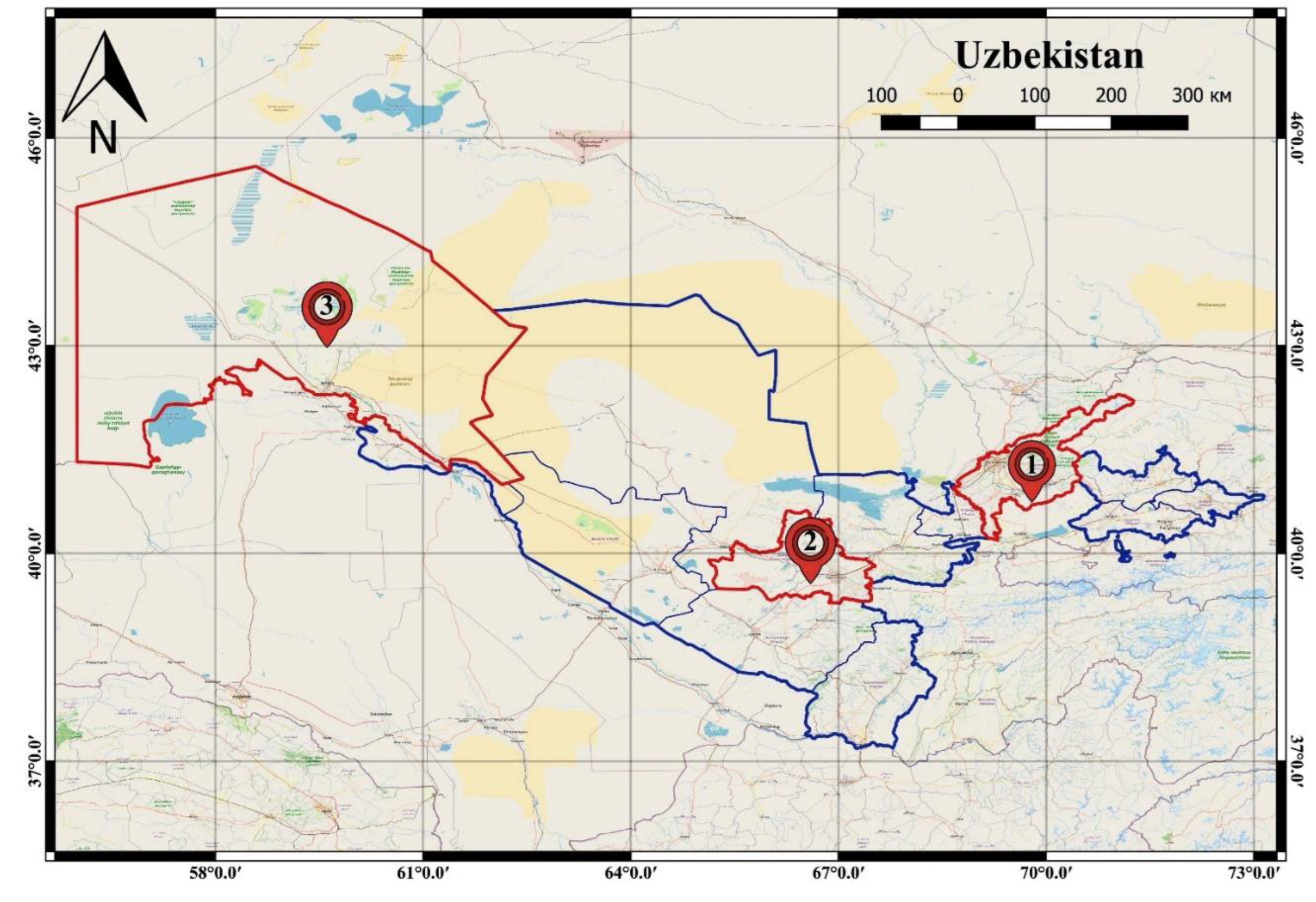
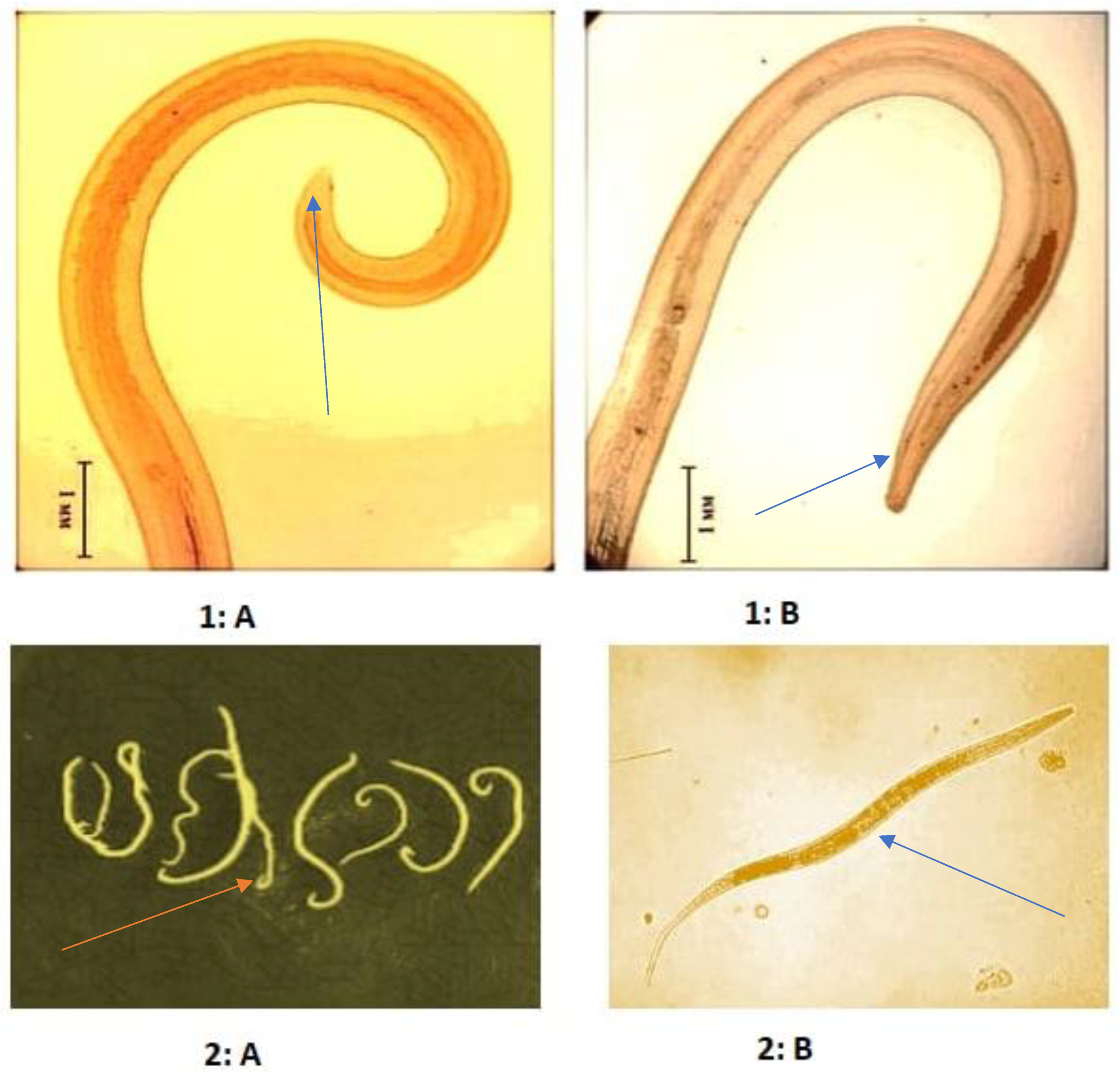
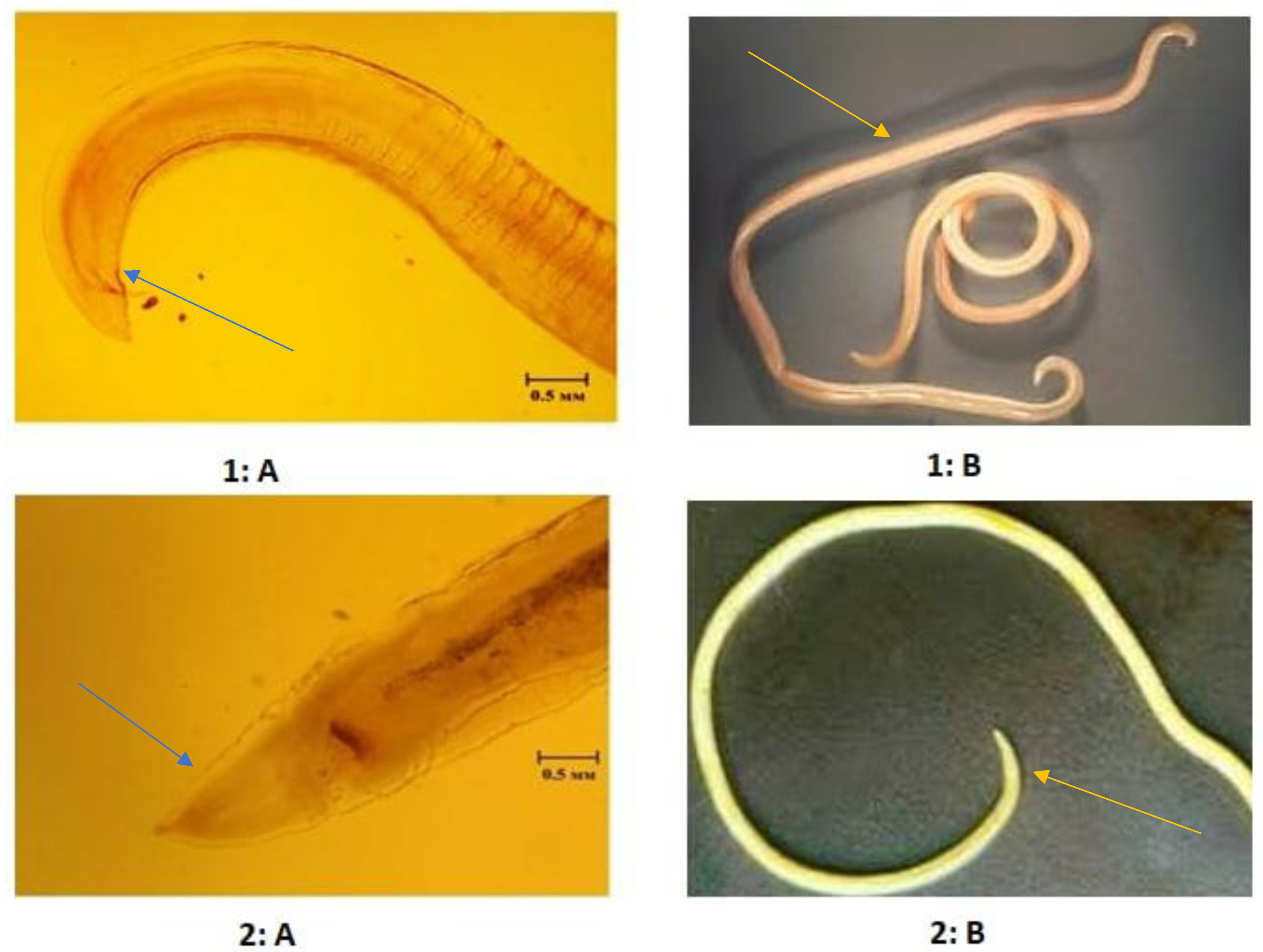

| Class | Family | Species | TOTAL | Rural | Urban | χ2; d.f. = 1 | p | |||
|---|---|---|---|---|---|---|---|---|---|---|
| % | 95% CI | % | 95% CI | % | 95% CI | |||||
| Cestoda | Diphyllobothridae | D. latum | 31.58 | 27.21–36.3 | 78.75 | 71.59–84.81 | 0 | 0–1.53 | 271.44 | <0.0001 |
| Dipylidiidae | D. caninum | 51.38 | 46.48–56.25 | 58.13 | 50.08–65.87 | 46.86 | 40.4–53.4 | 4.42 | 0.031 | |
| J. rossicum | 38.85 | 34.19–43.71 | 44.38 | 36.53–52.43 | 35.15 | 29.1–41.56 | 3.05 | 0.08 | ||
| Mesocestoididae | M. lineatus | 24.56 | 20.59–29.01 | 20.63 | 14.64–27.73 | 27.2 | 21.66–33.31 | 1.89 | 0.154 | |
| Taeniidae | T. hydatigena | 68.67 | 63.96–73.03 | 53.13 | 45.08–61.05 | 79.08 | 73.37–84.06 | 28.81 | <0.0001 | |
| T. pisiformis | 32.58 | 28.17–37.33 | 81.25 | 74.33–86.98 | 0 | 0–1.53 | 284.34 | <0.0001 | ||
| T. multiceps | 46.37 | 41.53–51.27 | 63.13 | 55.15–70.61 | 35.15 | 29.1–41.56 | 29.05 | <0.0001 | ||
| T. taeniaeformis | 39.35 | 34.68–44.22 | 53.75 | 45.7–61.65 | 29.71 | 23.99–35.94 | 22.21 | <0.0001 | ||
| E. granulosus | 63.91 | 59.09–68.47 | 64.38 | 56.43–71.78 | 63.6 | 57.15–69.7 | 0.002 | 0.915 | ||
| Trematoda | Diplostomidae | A. alata | 16.29 | 12.99–20.23 | 40.63 | 32.94–48.66 | 0 | 0–1.53 | 113 | <0.0001 |
| Plagiorchiidae | P. elegans | 17.79 | 14.35–21.85 | 44.38 | 36.53–52.43 | 0 | 0–1.53 | 125.99 | <0.0001 | |
| Dicrocoeliidae | D. dendriticum | 10.78 | 8.1–14.2 | 26.88 | 20.18–34.45 | 0 | 0–1.53 | 69.22 | <0.0001 | |
| Acanthocephala | Oligacanthorinchidae | M. catulinus | 12.03 | 9.19–15.59 | 17.5 | 11.95–24.29 | 8.37 | 5.19–12.63 | 6.71 | 0.009 |
| Nematoda | Capillariidae | C. plica | 31.58 | 27.21–36.3 | 46.88 | 38.95–54.92 | 21.34 | 16.32–27.08 | 27.75 | <0.0001 |
| Trichocephalidae | T. vulpis | 30.58 | 26.26–35.26 | 40 | 32.35–48.03 | 24.27 | 18.97–30.21 | 10.44 | 0.001 | |
| Dioctophymidae | D. renale | 39.85 | 35.16–44.73 | 69.38 | 61.61–76.41 | 20.08 | 15.2–25.73 | 95.1 | <0.0001 | |
| Strongyloididae | S. stercoralis | 10.28 | 7.67–13.64 | 25.63 | 19.06–33.12 | 0 | 0–1.53 | 65.5 | <0.0001 | |
| Ancylostomidae | A. caninum | 24.06 | 20.13–28.49 | 42.5 | 34.73–50.55 | 11.72 | 7.93–16.49 | 48.03 | <0.0001 | |
| U. stenocephala | 36.84 | 32.26–41.68 | 45 | 37.14–53.05 | 31.38 | 25.55–37.68 | 7.06 | 0.006 | ||
| Crenosomatidae | C. vulpis | 18.3 | 14.81–22.39 | 45.63 | 37.74–53.67 | 0 | 0–1.53 | 130.42 | <0.0001 | |
| Ascarididae | T. leonina | 88.72 | 85.24–91.46 | 78.75 | 71.59–84.81 | 95.4 | 91.91–97.68 | 24.9 | <0.0001 | |
| Ascarididae | T. canis | 93.73 | 90.91–95.72 | 86.25 | 79.93–91.18 | 98.74 | 96.38–99.74 | 23.39 | <0.0001 | |
| Spirocercidae | S. lupi | 36.84 | 32.26–41.68 | 31.25 | 24.17–39.04 | 40.59 | 34.3–47.11 | 3.199 | 0.071 | |
| S. arctica | 17.04 | 13.67–21.04 | 42.5 | 34.73–50.55 | 0 | 0–1.53 | 119.45 | <0.0001 | ||
| Physalopteridae | Ph. praeputialis | 34.59 | 30.09–39.38 | 37.5 | 29.98–45.49 | 32.64 | 26.73–38.98 | 0.798 | 0.334 | |
| Ph. sibirica | 26.07 | 22–30.59 | 65 | 57.07–72.36 | 0 | 0–1.53 | 206.75 | <0.0001 | ||
| Gongylonematidae | G. pulchrum | 22.81 | 18.96–27.17 | 56.88 | 48.82–64.67 | 0 | 0–1.53 | 172.87 | <0.0001 | |
| Rictulariidae | R. affinus | 33.33 | 28.89–38.1 | 39.38 | 31.75–47.4 | 29.29 | 23.6–35.5 | 3.94 | 0.039 | |
| R. cahirensis | 15.54 | 12.31–19.42 | 38.75 | 31.16–46.76 | 0 | 0–1.53 | 106.71 | <0.0001 | ||
| Onchocercidae | D. immitis | 11.53 | 8.76–15.04 | 12.5 | 7.81–18.64 | 10.88 | 7.23–15.53 | 0.11 | 0.634 | |
| D. repens | 8.02 | 5.74–11.1 | 9.38 | 5.34–14.99 | 7.11 | 4.2–11.14 | 0.39 | 0.53 | ||
| Species | Tashkent | Karakalpakistan | Samarkand | |||||||||
|---|---|---|---|---|---|---|---|---|---|---|---|---|
| Rural | Urban | Rural | Urban | Rural | Urban | |||||||
| % | 95% CI | % | 95% CI | % | 95% CI | % | 95% CI | % | 95% CI | % | 95% CI | |
| D. latum * | 57.5 | 40.89–72.96 | 0 | 0–2.28 | 80 | 67.67–89.22 | 0 | 0–6.06 | 91.67 | 81.61–97.24 | 0 | 0–16.84 |
| D. caninum * | 52.5 | 36.13–68.49 | 41.88 | 34.13– 49.92 | 85 | 73.43–92.9 | 64.41 | 50.87–76.45 | 35 | 23.13– 48.4 | 35 | 15.39–59.22 |
| J. rossicum | 20 | 9.05– 35.65 | 33.13 | 25.9– 40.99 | 45 | 32.12–58.39 | 52.54 | 39.12–65.7 | 60 | 46.54–72.44 | 0 | 0–16.84 |
| M. lineatus | 7.5 | 1.57– 20.39 | 26.25 | 19.62– 33.78 | 35 | 23.13–48.4 | 18.64 | 9.69–30.91 | 15 | 7.1– 26.57 | 60 | 36.05–80.88 |
| T. hydatigena * | 27.5 | 14.6– 43.89 | 80 | 72.96– 85.9 | 68.33 | 55.04–79.74 | 89.83 | 79.17–96.18 | 55 | 41.61–67.88 | 40 | 19.12–63.95 |
| T. pisiformis * | 47.5 | 31.51–63.87 | 0 | 0–2.28 | 90 | 79.49–96.24 | 0 | 0–6.06 | 95 | 86.08–98.96 | 0 | 0–16.84 |
| T. multiceps * | 52.5 | 36.13–68.49 | 27.5 | 20.75– 35.11 | 95 | 86.08–98.96 | 35.59 | 23.55–49.13 | 38.33 | 26.07–51.79 | 95 | 75.13–99.87 |
| T. taeniaeformis * | 77.5 | 61.55–89.16 | 16.25 | 10.9– 22.9 | 63.33 | 49.9–75.41 | 49.15 | 35.89–62.5 | 28.33 | 17.45–41.44 | 80 | 56.34–94.27 |
| E. granulosus * | 80 | 64.35–90.95 | 66.88 | 59.01– 74.1 | 81.67 | 69.56–90.48 | 45.76 | 32.72–59.25 | 36.67 | 24.59– 50.1 | 90 | 68.3– 98.77 |
| A. alata | 15 | 5.71– 29.84 | 0 | 0–2.28 | 63.33 | 49.9–75.41 | 0 | 0–6.06 | 35 | 23.13– 48.4 | 0 | 0–16.84 |
| P. elegans | 45 | 29.26–61.51 | 0 | 0–2.28 | 81.67 | 69.56–90.48 | 0 | 0–6.06 | 6.67 | 1.85– 16.2 | 0 | 0–16.84 |
| D. dendriticum | 15 | 5.71– 29.84 | 0 | 0–2.28 | 45 | 32.12–58.39 | 0 | 0–6.06 | 16.67 | 8.29– 28.52 | 0 | 0–16.84 |
| M. catulinus | 7.5 | 1.57– 20.39 | 10.63 | 6.31– 16.47 | 30 | 18.85–43.21 | 0 | 0–6.06 | 11.67 | 4.82– 22.57 | 15 | 3.21– 37.89 |
| C. plica | 22.5 | 10.84–38.45 | 3.13 | 1.02– 7.14 | 71.67 | 58.56–82.55 | 59.32 | 45.75–71.93 | 38.33 | 26.07–51.79 | 55 | 31.53–76.94 |
| T. vulpis * | 27.5 | 14.6– 43.89 | 12.5 | 7.81– 18.64 | 55 | 41.61–67.88 | 47.46 | 34.3–60.88 | 33.33 | 21.69–46.69 | 50 | 27.2– 72.8 |
| D. renale * | 72.5 | 56.11– 85.4 | 7.5 | 3.94– 12.73 | 75 | 62.14–85.28 | 32.2 | 20.62–45.64 | 61.67 | 48.21–73.93 | 85 | 62.11–96.79 |
| S. stercoralis | 65 | 48.32–79.37 | 0 | 0–2.28 | 18.33 | 9.52–30.44 | 0 | 0–6.06 | 6.67 | 1.85– 16.2 | 0 | 0–16.84 |
| A. caninum * | 77.5 | 61.55–89.16 | 8.13 | 4.4– 13.49 | 35 | 23.13–48.4 | 22.03 | 12.29–34.73 | 26.67 | 16.07–39.66 | 10 | 1.23– 31.7 |
| U. stenocephala * | 40 | 24.86–56.67 | 22.5 | 16.28– 29.76 | 65 | 51.6–76.87 | 45.76 | 32.72–59.25 | 28.33 | 17.45–41.44 | 60 | 36.05–80.88 |
| C. vulpis | 15 | 5.71– 29.84 | 0 | 0–2.28 | 66.67 | 53.31–78.31 | 0 | 0–6.06 | 45 | 32.12–58.39 | 0 | 0–16.84 |
| T. leonina * | 47.5 | 31.51–63.87 | 98.75 | 95.66– 99.85 | 93.33 | 83.8–98.15 | 88.14 | 77.07–95.09 | 85 | 73.43– 92.9 | 90 | 68.3– 98.77 |
| T. canis * | 52.5 | 36.13–68.49 | 99.38 | 96.57– 99.98 | 96.67 | 88.47–99.59 | 96.61 | 88.29–99.59 | 98.33 | 91.06–99.96 | 100 | 91.06– 100 |
| S. lupi * | 40 | 24.86–56.67 | 48.75 | 40.78– 56.77 | 38.33 | 26.07–51.79 | 32.2 | 20.62–45.64 | 18.33 | 9.52– 30.44 | 0 | 0–16.84 |
| S. arctica * | 52.5 | 36.13–68.49 | 0 | 0–2.28 | 55 | 41.61–67.88 | 0 | 0–6.06 | 23.33 | 13.38–36.04 | 0 | 0–16.84 |
| Ph. praeputialis | 75 | 58.8– 87.31 | 31.88 | 24.74– 39.7 | 50 | 36.81–63.19 | 38.98 | 26.55–52.56 | 0 | 0–5.96 | 20 | 5.73– 43.66 |
| Ph. sibirica | 67.5 | 50.87–81.43 | 0 | 0–2.28 | 80 | 67.67–89.22 | 0 | 0–6.06 | 48.33 | 35.23–61.61 | 0 | 0–16.84 |
| G. pulchrum * | 47.5 | 31.51–63.87 | 0 | 0–2.28 | 88.33 | 77.43–95.18 | 0 | 0–6.06 | 31.67 | 20.26–44.96 | 0 | 0–16.84 |
| R. affinus | 82.5 | 67.22–92.66 | 43.75 | 35.93– 51.8 | 45 | 32.12–58.39 | 0 | 0–6.06 | 5 | 1.04– 13.92 | 0 | 0–16.84 |
| R. cahirensis | 45 | 29.26–61.51 | 0 | 0–2.28 | 51.67 | 38.39–64.77 | 0 | 0–6.06 | 21.67 | 12.07– 34.2 | 0 | 0–16.84 |
| D. immitis * | 27.5 | 14.6– 43.89 | 10.63 | 6.31– 16.47 | 15 | 7.1– 26.57 | 3.39 | 0.41–11.71 | 0 | 0–5.96 | 35 | 15.39–59.22 |
| D. repens * | 7.5 | 1.57– 20.39 | 3.13 | 1.02– 7.14 | 18.33 | 9.52–30.44 | 13.56 | 6.04–24.98 | 1.67 | 0.04– 8.94 | 20 | 5.73– 43.66 |
| Species | Tashkent | Karakalpakistan | Samarkand | χ2; d.f. = 2 | p | |||
|---|---|---|---|---|---|---|---|---|
| % | 95% CI | % | 95% CI | % | 95% CI | |||
| D. latum | 11.5 | 7.43–16.75 | 40.34 | 31.45–49.72 | 68.75 | 57.41–78.65 | 92.7 | <0.0001 |
| D. caninum | 44 | 37.01–51.17 | 74.79 | 66.01–82.3 | 35 | 24.67–46.48 | 39.05 | <0.0001 |
| J. rossicum | 30.5 | 24.2–37.39 | 48.74 | 39.47–58.07 | 45 | 33.85–56.83 | 12.04 | 0.002 |
| M.lineatus | 22.5 | 16.91–28.92 | 26.89 | 19.18–35.79 | 26.25 | 17.04–37.29 | 0.93 | 0.628 |
| T. hydatigena | 69.5 | 62.61–75.8 | 78.99 | 70.57–85.92 | 51.25 | 39.81–62.59 | 17.24 | 0.0002 |
| T. pisiformis | 9.5 | 5.82–14.44 | 45.38 | 36.23–54.76 | 71.25 | 60.05–80.82 | 111.83 | <0.0001 |
| T. multiceps | 32.5 | 26.06–39.47 | 65.55 | 56.28–74.02 | 52.5 | 41.02–63.79 | 34.27 | <0.0001 |
| T. taeniaeformis | 28.5 | 22.36–35.29 | 56.3 | 46.91–65.37 | 41.25 | 30.35–52.82 | 24.31 | <0.0001 |
| E.granulosus | 69.5 | 62.61–75.8 | 63.87 | 54.55–72.47 | 50 | 38.6–61.4 | 9.42 | 0.009 |
| A. alata | 3 | 1.11–6.42 | 31.93 | 23.69–41.1 | 26.25 | 17.04–37.29 | 53.07 | <0.0001 |
| P. elegans | 9 | 5.42–13.85 | 41.18 | 32.24–50.57 | 5 | 1.38–12.31 | 64 | <0.0001 |
| D. dendriticum | 3 | 1.11–6.42 | 22.69 | 15.52–31.27 | 12.5 | 6.16–21.79 | 30.38 | <0.0001 |
| M. catulinus | 10 | 6.22–15.02 | 15.13 | 9.22–22.85 | 12.5 | 6.16–21.79 | 1.87 | 0.391 |
| C. plica | 7 | 3.88–11.47 | 65.55 | 56.28–74.02 | 42.5 | 31.51–54.06 | 123.88 | <0.0001 |
| T. vulpis | 15.5 | 10.78–21.27 | 51.26 | 41.93–60.53 | 37.5 | 26.92–49.04 | 47.2 | <0.0001 |
| D. renale | 20.5 | 15.13–26.77 | 53.78 | 44.41–62.96 | 67.5 | 56.11–77.55 | 69.39 | <0.0001 |
| S. stercoralis | 13 | 8.67–18.47 | 9.24 | 4.71–15.94 | 5 | 1.38–12.31 | 4.16 | 0.124 |
| A. caninum | 22 | 16.46–28.39 | 28.57 | 20.67–37.57 | 22.5 | 13.91–33.21 | 1.89 | 0.387 |
| U. stenocephala | 26 | 20.07–32.66 | 55.46 | 46.07–64.57 | 36.25 | 25.79–47.76 | 27.84 | <0.0001 |
| C. vulpis | 3 | 1.11–6.42 | 33.61 | 25.22–42.85 | 33.75 | 23.55–45.19 | 62.76 | <0.0001 |
| T. leonina | 88.5 | 83.25–92.57 | 90.76 | 84.06–95.29 | 86.25 | 76.73–92.93 | 0.99 | 0.609 |
| T. canis | 90 | 84.98–93.78 | 96.64 | 91.62–99.08 | 98.75 | 93.23–99.97 | 9.88 | 0.007 |
| S. lupi | 47 | 39.92–54.17 | 35.29 | 26.76–44.58 | 13.75 | 7.07–23.27 | 27.32 | <0.001 |
| S. arctica | 10.5 | 6.62–15.6 | 27.73 | 19.92–36.68 | 17.5 | 9.91–27.62 | 15.68 | 0.0004 |
| Ph. praeputialis | 40.5 | 33.63–47.65 | 44.54 | 35.43–53.93 | 5 | 1.38–12.31 | 39.25 | <0.0001 |
| Ph. sibirica | 13.5 | 9.09–19.03 | 40.34 | 31.45–49.72 | 36.25 | 25.79–47.76 | 33.26 | <0.0001 |
| G. pulchrum | 9.5 | 5.82–14.44 | 44.54 | 35.43–53.93 | 23.75 | 14.95–34.58 | 52.07 | <0.0001 |
| R. affinus | 51.5 | 44.35–58.61 | 22.69 | 15.52–31.27 | 3.75 | 0.78–10.57 | 67.27 | <0.0001 |
| R. cahirensis | 9 | 5.42–13.85 | 26.05 | 18.44–34.89 | 16.25 | 8.95–26.18 | 16.56 | 0.0003 |
| D. immitis | 14 | 9.51–19.59 | 9.24 | 4.71–15.94 | 8.75 | 3.59–17.2 | 2.41 | 0.299 |
| D. repens | 4 | 1.74–7.73 | 19 | 9.9–23.81 | 6.25 | 2.06–13.99 | 14.9 | 0.0006 |
| Variable | Examined | Infected | Χ2; d.f.; p | ||
|---|---|---|---|---|---|
| n | % | 95% CI | |||
| Age (months) | |||||
| 0–6 | 62 | 61 | 98.39 | 91.34–99.96 | Χ2 = 2.7; d.f. = 2; p = 0.259 |
| >6–12 | 207 | 193 | 93.24 | 88.91–96.25 | |
| >12 | 130 | 124 | 95.38 | 90.22–98.29 | |
| Sex | |||||
| Male | 218 | 197 | 90.37 | 85.65–93.94 | Χ2 = 16.52; d.f. = 1; p < 0.0001 |
| Female | 181 | 181 | 100 | 97.98–100 | |
| Climate | |||||
| Humid continental | 200 | 195 | 97.5 | 94.26–99.18 | Χ2 = 24.22; d.f. = 2; p < 0.0001 |
| Mediterranean | 80 | 67 | 83.75 | 73.82–91.05 | |
| Extreme continental | 119 | 116 | 97.48 | 92.91–99.48 | |
Publisher’s Note: MDPI stays neutral with regard to jurisdictional claims in published maps and institutional affiliations. |
© 2022 by the authors. Licensee MDPI, Basel, Switzerland. This article is an open access article distributed under the terms and conditions of the Creative Commons Attribution (CC BY) license (https://creativecommons.org/licenses/by/4.0/).
Share and Cite
Safarov, A.; Mihalca, A.D.; Park, G.-M.; Akramova, F.; Ionică, A.M.; Abdinabiev, O.; Deak, G.; Azimov, D. A Survey of Helminths of Dogs in Rural and Urban Areas of Uzbekistan and the Zoonotic Risk to Human Population. Pathogens 2022, 11, 1085. https://doi.org/10.3390/pathogens11101085
Safarov A, Mihalca AD, Park G-M, Akramova F, Ionică AM, Abdinabiev O, Deak G, Azimov D. A Survey of Helminths of Dogs in Rural and Urban Areas of Uzbekistan and the Zoonotic Risk to Human Population. Pathogens. 2022; 11(10):1085. https://doi.org/10.3390/pathogens11101085
Chicago/Turabian StyleSafarov, Alisher, Andrei D. Mihalca, Gab-Man Park, Firuza Akramova, Angela M. Ionică, Otayorjon Abdinabiev, Georgiana Deak, and Djalaliddin Azimov. 2022. "A Survey of Helminths of Dogs in Rural and Urban Areas of Uzbekistan and the Zoonotic Risk to Human Population" Pathogens 11, no. 10: 1085. https://doi.org/10.3390/pathogens11101085
APA StyleSafarov, A., Mihalca, A. D., Park, G.-M., Akramova, F., Ionică, A. M., Abdinabiev, O., Deak, G., & Azimov, D. (2022). A Survey of Helminths of Dogs in Rural and Urban Areas of Uzbekistan and the Zoonotic Risk to Human Population. Pathogens, 11(10), 1085. https://doi.org/10.3390/pathogens11101085

