Article

Expression Patterns of miR398, miR167, and miR159 in the Interaction between Bread Wheat (Triticum aestivum L.) and Pathogenic Fusarium culmorum and Beneficial Trichoderma Fungi
1
Department of Plant Microbiomics, Institute of Plant Genetics, Polish Academy of Sciences, 60-479 Poznan, Poland
2
Department of Chemistry, Poznan University of Life Sciences, 60-625 Poznan, Poland
*
Author to whom correspondence should be addressed.
Pathogens 2021, 10(11), 1461; https://doi.org/10.3390/pathogens10111461

Submission received: 12 October 2021 / Revised: 5 November 2021 / Accepted: 9 November 2021 / Published: 11 November 2021
(This article belongs to the Special Issue Endophytes in Plant Health and Disease)

Abstract

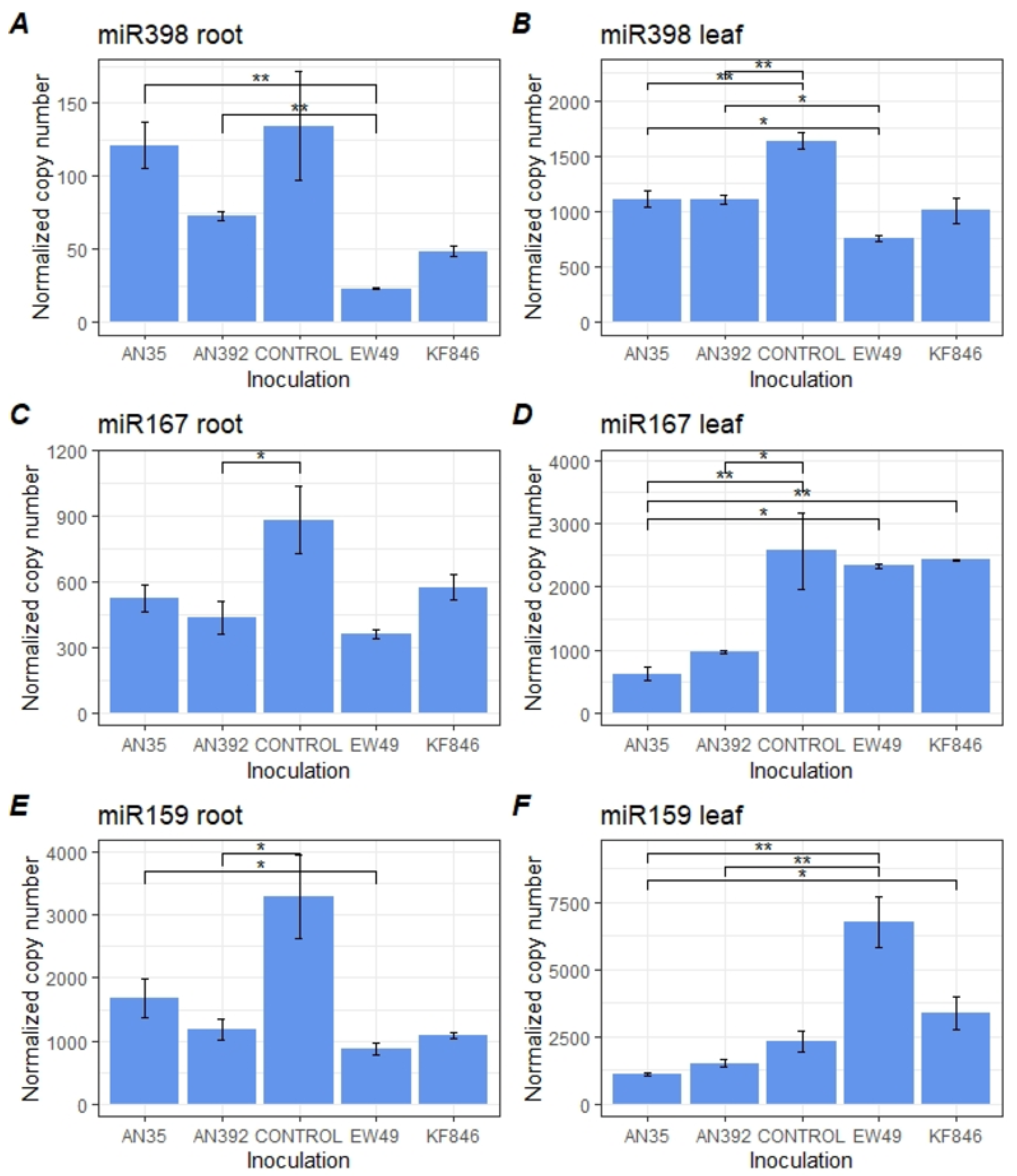
Bread wheat (Triticum aestivum L.) is an agronomically significant cereal cultivated worldwide. Wheat breeding is limited by numerous abiotic and biotic stresses. One of the most deleterious factors is biotic stress provoked by the Fusarium culmorum fungus. This pathogen is a causative agent of Fusarium root rot and Fusarium head blight. Beneficial fungi Trichoderma atroviride and T. cremeum are strong antagonists of mycotoxigenic Fusarium spp. These fungi promote plant growth and enhance their tolerance of negative environmental conditions. The aim of the study was to determine and compare the spatial (in above- and underground organs) and temporal (early: 6 and 22 hpi; and late: 5 and 7 dpi reactions) expression profiles of three mature miRNAs (miR398, miR167, and miR159) in wheat plants inoculated with two strains of F. culmorum (KF846 and EW49). Moreover, the spatial expression patterns in wheat response between plants inoculated with beneficial T. atroviride (AN35) and T. cremeum (AN392) were assessed. Understanding the sophisticated role of miRNAs in wheat–fungal interactions may initiate a discussion concerning the use of this knowledge to protect wheat plants from the harmful effects of fungal pathogens. With the use of droplet digital PCR (ddPCR), the absolute quantification of the selected miRNAs in the tested material was carried out. The differential accumulation of miR398, miR167, and miR159 in the studied groups was observed. The abundance of all analyzed miRNAs in the roots demonstrated an increase in the early and reduction in late wheat response to F. culmorum inoculation, suggesting the role of these particles in the initial wheat reaction to the studied fungal pathogen. The diverse expression patterns of the studied miRNAs between Trichoderma–inoculated or F. culmorum–inoculated plants and control wheat, as well as between Trichoderma–inoculated and F. culmorum–inoculated plants, were noticed, indicating the need for further analysis.
Keywords: wheat; plant–fungi interactions; microRNA; Fusarium culmorum; Trichoderma atroviride; Trichoderma cremeum; ddPCR wheat; plant–fungi interactions; microRNA; Fusarium culmorum; Trichoderma atroviride; Trichoderma cremeum; ddPCR