2. Neo-Decadence and Neo-Passéism
One of Fredric Jameson’s most haunting observations occurs after he explains how personal style disappears under late capitalist demands for commodification and mass production. In its place is pastiche: the earnest imitation of other styles “without any of parody’s ulterior motives, amputated of the satiric impulse, devoid of laughter … a statue with blind eyeballs” (
Jameson 1991, p. 17). His ableist language notwithstanding, this figure, Jameson explains, serves capitalism’s ends by commodifying what were once markers of individuality into tokens to be taken on and off, while at the same time being unable, or unwilling, to create anything fresh (which requires more labor and thus more compensation). Pastiche shapes the social realm as well, from workplace professionalisms that flatten individual affect, to the “badges of affirmation of ethnic, gender, race, religious, and class-fraction adhesion” (p. 17) that not only define identity politics, but also devalue the more delicate and time-consuming labor of acknowledging the self’s multilayered ambiguities (labor that, by the way, is at the heart of the continually underfunded arts and humanities).
The late capitalist logic governing pastiche intersects with what Jameson calls the hysterical sublime. Recounting his walk in John Portman’s Bonaventure building in Los Angeles, he expresses how the glass and steel giant, although filled with people, is so expansive that it flattens sight and sounds into sonic and visual echoes, and how its massive elevators and rotating cocktail lounges silently move your body this way and that as you stare through the giant windows of the building’s glassy skin. Of course, they move you about in a manner that is not necessarily unconsensual. Yet they betray how a much larger force controls your mobility, all while repeatedly flashing your flattened but glossy reflection back at you as though that force were yourself, even when you know—or think you know—that it is not. This peculiar sensation is what Jameson conceptualizes, by way of Edmund Burke, Immanuel Kant, and Susan Sontag, as the hysterical sublime: a campy experience that is awesome and crushing, exhilarating and terrifying.
Jameson’s late twentieth-century references—atriums, elevators, lounges—can seem trite to the twenty-first century reader. Yet in their place is the explosion of digital technologies that mark the hysterical sublime in the first half of our century, such as widespread internet. On one hand, it cannot be overstated just how consequential the internet has been, and continues to be, for connecting people instantaneously across geographical distances, national borders, and languages through wide-ranging sonic and visual formats. Nor can it be overstated just how much the internet underpins what Donna Haraway (
Haraway 2016) identified as the cyborgian condition, where the boundaries between human and machine, and the physical and the non-physical, are dissolved to expose how artificial such distinctions were to begin with. For Haraway, this dissolve serves as a utopian starting point for building what she describes as a socialist-feminist world without capitalism, gender binaries, and racism.
On the other hand, it also cannot be denied that the internet’s breathtaking capacity for connection is, at the time of writing, deeply intertwined with the annihilation of privacy and the violent conversion of people into data points for maximizing profit and amassing power. Data is, indeed, the new oil. Every click leaves millions of virtual footprints on the world wide web—footprints that data companies collect and analyze in order to flash curated advertisements on social media and news feeds across the websites you visit, tailored to your interests while filtering out content that opposes your pre-existing beliefs, habits, and tastes. Repeatedly encountering hordes of like-minded people and products that align with one’s pre-existing beliefs, however, goes on to produce echo chambers that prevent one’s engagement with other perspectives (
Hartmann et al. 2025). Like the rotating cocktail lounge turning you this way and that, what the chamber does isn’t entirely unconsensual either. Indeed, while pocketing paychecks from corporations and politicians, in its defense the chamber might tearfully proclaim: isn’t my only crime showing you what you already believe in, thus reflecting, albeit in exaggerated form, who you are?
The hysterical sensation of connection and annihilation, freedom and subjugation, and exhilaration and terror marks other digital technologies as well, such as generative artificial intelligence. Generative AI produces full essays on any topic or question in the mere seconds that it takes for a human hand to pick up a pen. Yet it often flattens the essayistic voice into depersonalized prose that confidently cites sources that do not exist. It can automate everyday tasks and address urgent needs that social structures have failed to meet, such as playing—to varying degrees of success and failure—the role of a tutor or therapist for those who cannot afford one. Yet maintaining this machine also requires plunging overheated data centers into the ocean, thus accelerating our planet’s environmental degradation, and outsourcing the moderation of its discriminatory biases to underpaid workers in the global south (
Perrigo 2023). Moreover, in its quest to secure the user’s continued attention (and payment), generative AI can develop a sycophantic streak that induces delusions of grandeur (
Sample 2025). Exasperation with this invention is rivaled only by the grim realization that it was trained by techno-billionaires who curated massive datasets comprising articles and books that we and thousands of others across time wrote, while distributing none of the profits back to us. Generative AI, then, is ours and not ours, all at once.
Of course, the observations outlined above are not new. Yet they hold special relevance to our discussion because Neo-Decadence contains the first generation of decadent writers who are immersed in the digital (rather than analog) conditions that I have just described. This necessarily impacts what they write about and how they write, and it is in this sense that their work—as we shall see once we turn to the short stories—departs from the more well-known decadent literatures from the European fin de siècle, and offers us something new. Neo-Decadence is also deeply skeptical of the condition of art and literature under the digitized hysterical sublime, especially the evolution of the Jamesonian pastiche into Neo-Passéism. “Against Neo-Passéism,” co-written by Isis, Damian Murphy, Gaurav Monga, Quentin S. Crisp, and LC von Hessen (
Isis et al. 2021a) is the longest section in
12 Manifestos and offers a useful sketch of what the pastiche has become. “Neo-Passéism,” they explain, “is a mere vector or vehicle for ambient market forces and their associated manners … the unexamined artistic logic of capitalist realism” (p. 132). Where the pastiche was a “statue with blind eyeballs,” the Neo-Passéist is the full-blown commercialization, institutionalization, and professionalization of this statue—one who unknowingly or willingly fails to discern what Sianne Ngai has described as late capitalism’s gimmicks (
Ngai 2020). Slamming the publishing industry as “maintained by a limited class and caste of writers, most of them educated at the same schools, occupying the same social position and aiming for contracts with the same small group of presses” (p. 133), the writers of “Against Neo-Passéism” (
Isis et al. 2021a) argue that the Neo-Passéist sees words as vehicles for profit. This leads to pleasing the masses in whatever way possible, be it the recycling of past genres; enforcing types of craft that flatten individuality in communities such as writing workshops; or using literary works as mere springboards for more lucrative mediums, such as film or television—longing for literature “to be anything other than itself” (p. 133). When understood in this way, the manifesto argues, the Neo-Passéist betrays a “puritan disgust for language [that] implies a prophylactic approach to writing … terrified to admit that language exists in the same way their physical bodies exist [and] this fear prevents them from being poets, or feeling deeply beyond a thin scum of anxiety and its corresponding need for validation” (p. 134). The hunger for validation leads the Neo-Passéist down other treacherous routes, such as casting art and literature as civic projects:
… the average Neo-Passéist will not engage with a given work unless some perceived virtue is appended through crudely applicable life lessons, “uplifting” themes, displays of performative wokeness, or stores of easily-digested cultural capital in the form of studiously researched depictions of the “experiences” of a particular group (reinforcing the hub-and-spokes, monocultural model of art—the opposite of true crosscultural collaboration).
(p. 134)
The anti-capitalist critique that underpins Neo-Decadence aligns with much of the contemporary literature that engages with decadence today, from On’s
Decadence, which satirizes the commodification of social differences in the publishing industry, to von Reinhold’s
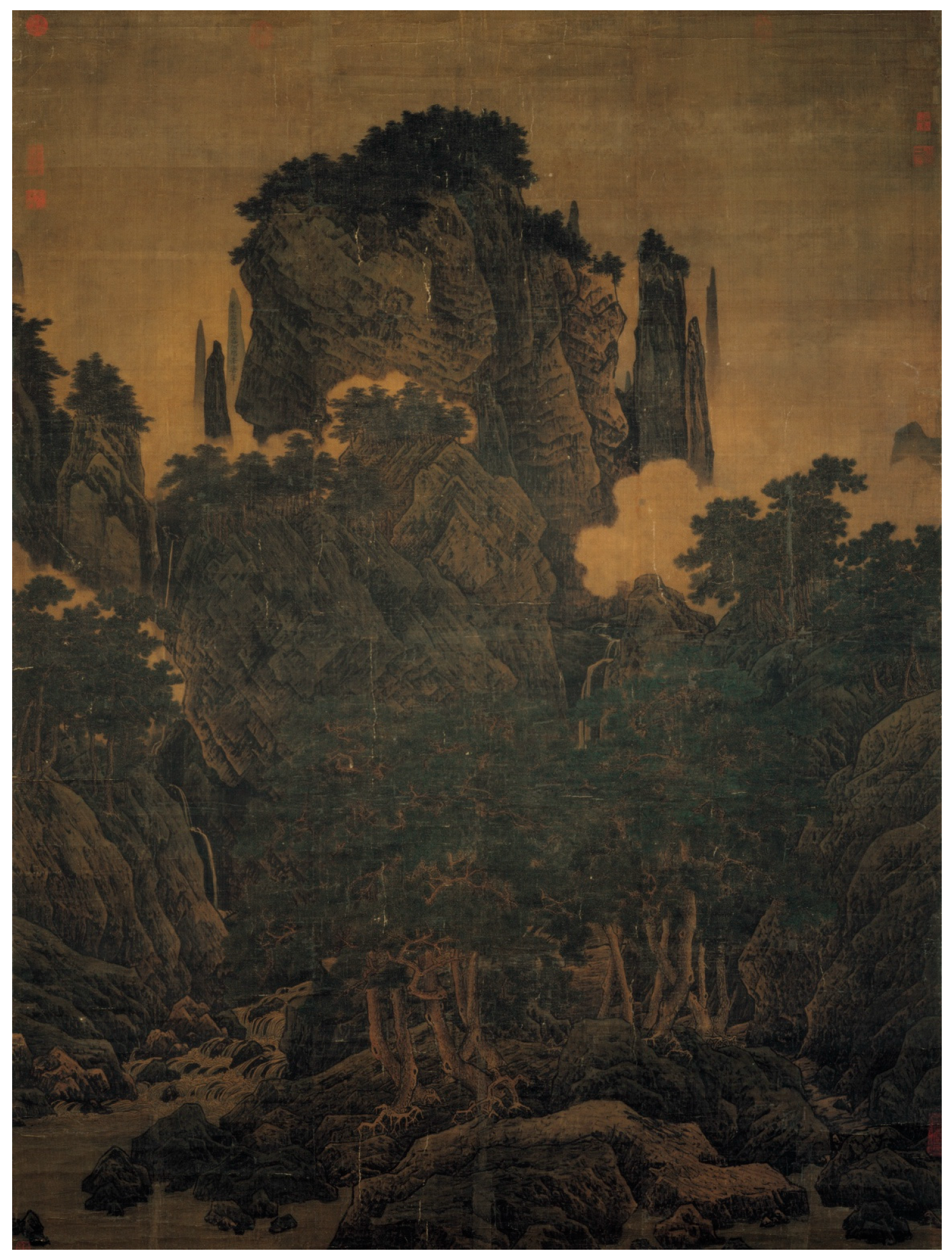
LOTE, which explores the place of aesthetic excess for descendants of the enslaved and colonized in the wake of enslavement (and, indeed, dedicates itself to “all those struggling with fascism, racism, and capitalism”). Yet the explicitly “uncompromising aesthetic war” against Neo-Passéism also leads those working in Neo-Decadence to pair their anti-capitalist critique with a fresh vision for the Neo-Decadent artist altogether—a vision which finds its basis in Chinese artist Li Tang (李唐)’s
Wind in the Pines Among a Myriad Valleys/萬壑松風 (c.1124) (
Figure 1).
The magic of Tang’s painting, the manifesto explains, lies not in what we see, but what we don’t:
[I]t was the wind he [Tang] was painting though it was the pines and valleys that were visible. This is not simply to say that he had mastered a technique for showing movement … The wind here has another meaning. The art is in the artist, and this is what is passed on—what is most secret and most alive. The artwork is merely the visible remains of the art. Those who have first understood the wind in the pines will understand the artwork. The Neo-Passéist will simply think it is a picture of the pines”.
In the same way that the patterns on Tang’s mountains are the revealing traces—the visible remains—of how the wind has blown across (and thus, eroded and shaped) the valley and trees, the Neo-Decadent artist aims to disturb and redirect the late capitalist wind that cannot be concretely grasped yet is everywhere in the air, tacitly molding all that we engage with.
Such an aim, though, does require some deliberate aesthetic, social, and political commitments, such as the refusal to continue “listlessly pleasing the crowd” (p. 10), as Brendan Connell explains in “Neo-Decadence (I),
” another contribution in
12 Manifestos. This, in turn, necessitates a departure from genre writing. “We are BORED with all genres,” they announce (emphasis theirs), “corporate spectacles, straitjackets of profitable rules … Away with the tedium of crime, horror, fantasy, and the rest” (
Isis et al. 2021a, p. 138), including autobiography, memoir, myths, romance, and folklore, and any writing whose minimalism mimics the flat “plane of glass” that covers corporate skyscrapers. Instead, the Neo-Decadents “exalt the sticky, gummy, opaque, constructive, and viral character of words” (
Isis et al. 2021a, p. 141), signaling a desire for writing that is individualistic rather than minimalistic or pseudo-objective; dynamically expressive rather than depersonalized; textured rather than transparent. The more idiosyncratic writing is—a voice that
sticks rather than one that can be slickly interchanged—the harder it is to commodify and recycle; it is also writing that, although requiring more time and labor from the reader to navigate, repositions literature as a site for substantive engagement, rather than an object for easy consumption.
In the process, the aesthetic and political concerns of Neo-Decadence partially overlap with European decadence at the fin de siècle. Charles Baudelaire, too, critiqued the recycling of genres in
The Painter of Modern Life/Le Peintre de la view moderne (1863), where he lamented “the tendency among artists to dress all their subjects in the garments of the past … the Middle Ages, the Renaissance or the Orient/
les peintres actuels, choisissant des sujets d’une nature générale applicable à toutes les époques, s’obstinent à les affubler des costumes du Moyen Âge, de la Renaissance ou de l’Orient” (
Baudelaire 1965, p. 13;
Baudelaire 1976, p. 694) and celebrated practices such as dandyism for stressing a personal originality that reflected nineteenth-century Parisian modernity. His gripes were informed by his concern with the way that the “rising tide of democracy, which invades and levels everything /
la marée montante de la démocratie, qui envahit tout et qui nivelle tout, noie jour à jour ces derniers représentants de l’orgueil humain et verse des flots d’oubli sur les traces de ces prodigieux myrmidons” would kill individuality (
Baudelaire 1965, p. 29;
Baudelaire 1976, p. 712). To
Regenia Gagnier’s (
2018) point that global decadence arises in places and time periods where local traditions meet the forces of modernization, Baudelaire’s position indexes how European decadence was negotiating with democracy’s rise against the backdrop of rapid industrialization in the nineteenth century. His concerns were shared by decadent writers in Britain who opposed narratives of progress as the Industrial Revolution flourished, and, as
Alex Murray (
2023) has shown, some of those writers later celebrated conservatism as a result. Two hundred years later, though, the Neo-Decadents are informed by the global
failure of democracy after industrialization’s mutation into late capitalism, as well as the authoritarian might that has arisen in the wake of democracy’s failure. Indeed, while late capitalism has enforced a Neo-Passéist aesthetic leveling, that leveling masks exorbitant economic and political inequalities. Extreme global poverty remains an urgent problem; meanwhile, digital technologies seduced by government funds have offered authoritarian nation-states new ways to surveil populations, stoke jingoism, and manipulate elections.
When Neo-Decadence exalts “sticky, gummy, opaque,” writing, then, it is not merely a repackaging of the European fin de siècle’s art-for-art’s-sake doctrine. In the call for short story submissions to
Evangelion, for instance, Isis solicits writing that showcases “our lopsided and unequal world … monstrous gaps between rich and poor … the excesses of the new aristocracy vs. the despair of the global underclass” by way of everyday subjects such as “clothes, fashion, Instagram influencers, video games, [and] new media” that are “not set in the Anglosphere … [emphasizing instead] characters in transit, immigrants, “third-culture” types, etc. …”(
Isis 2021, np). Indeed, as Isis has explained, while Neo-Decadence draws some of its aesthetic forcefulness from twentieth-century avant-garde movements such as Futurism, Vorticism, and Surrealism, it rejects the nationalism inherent in some of those movements. “For Neo-Decadence,” as he has said, “the question is—what would a truly cross-cultural artistic movement not based on nationalism look like? Or localism?” (
Isis 2025).
3. The Neo-Decadent “Real” and Fugitive Aestheticism in Arturo Calderón’s “Yawar Jaguar”
An important area that Neo-Decadence addresses is anti-realism, a longstanding topic in the genealogy of decadent literature more broadly. Though the European decadents of the fin de siècle opposed the social realism that shaped many canonical British and European novels of the nineteenth century, that realism has spawned ardent imitators in our own century, and in other genres beyond the novel. Indeed, British writer Jeremy Reed’s ironically titled “English Poetry” contribution to
12 Manifestos argues that British writing needs a “new real” to prevent it from being “sucked backwards into maintaining an increasingly tired language that excludes in most cases our dizzying acceleration into techno-apocalyptic realities” (
Reed 2021, p. 115).
The need for a “new real,” however, also expands beyond the borders of Britain, especially in postcolonial nations. One example is the Peruvian capital of Lima—the setting of Arturo Calderón’s “Yawar Jaguar” and Calderón’s own birthplace, where he now teaches English at a university. Although the Spanish Empire colonized Peru from the sixteenth century until 1821, other European Empires also influenced Peruvian culture and society. In 1934, for instance, Carleton Beals observed that nineteenth and early twentieth-century Peruvian literature was largely modeled after Spanish, British, French, and other European literatures and articulated from the perspective of the academic and upper classes, rather than the cultural dualities of “Indian [Quechua] and Spanish, highland and coast” (
Beals 1934, p. 373) that are at the heart of Peruvian life. He argued that a new cohort of
mestizo Peruvian writers “born of the varying schools of decadence, modernism, skepticism, individualism, aestheticism” (
Beals 1934, p. 376) such as Magda Portal, Alcides Spellucín, and Enrique López Albujar would shift Peruvian literature toward a heterogenous perspective that grapples with the “communal indigenous experience and the inrush of the machine age” (
Beals 1934, p. 376). Similarly, to Calderón in the twenty-first century, the most celebrated novels of the Peruvian canon explore class struggle and racism, but through a narrative realism that reproduces the atmosphere of canonical nineteenth-century European social realist novels, and reifies a type of postcolonial Peruvian nationalism that does not sufficiently capture the late capitalist and hyper-digital reality that he faces today (
Calderón 2025). His critiques are in conversation with other postcolonial artists and writers such as Agha Shahid Ali, Derek Walcott, Yinka Shonibare, Bernardine Evaristo, and Derek Mahon that, as
Robert Stilling (
2018) has argued, have also expressed skepticism toward the dominance of social realism in the postcolonial nationalist project.
While the writers in Stilling’s study go on to draw from, or ironically reinvent, European decadence’s anti-realism in the fin de siècle as a form of postcolonial critique (
Robert Stilling 2018), those working in Neo-Decadence take a different approach to the same problem of social realism’s dominance. The movement’s firm resistance to Neo-Passéism and the urgency of accounting for the “dizzying acceleration” of the digital and late capitalist twenty-first century means that, for writers like Calderón, the European fin de siècle is not the only nor the most important resource to draw from; indeed, as Isis has explained, “no precedence is given to the Decadent writers of the 19th century” (
Isis 2021). Instead,
Evangelion stories such as “Yawar Jaguar” index what I call, after Reed, a Neo-Decadent “Real”: a narrative form that conveys the techno-apocalyptic realities of our century. The “world around us,” as Isis has argued, “is ALREADY excessive and grotesque enough that departures into fantasy and the supernatural aren’t necessary… train your microscope VERY CLOSELY on what is actually happening, and wondrous and terrible things will doubtless come to light … [in] our lopsided and unequal world …” (
Isis 2021, emphasis Isis, np). Unlike the European fin de siècle’s turn toward monsters, mutant portraits, or vampires, the Neo-Decadent “Real” insists that the grotesque is already here—we are, indeed, living in it, particularly those in the global south. “I was taking a taxi [in Lima] the other day,” as Calderón explained, “and it was literally falling apart as we were driving. That’s the absurd right there.” (
Calderón 2025).
To that end, Calderón’s choice to examine online streaming in “Yawar Jaguar” is not a mere metaphor. In “Yawar Jaguar,” everyone is hunting or being hunted, or both at once, since every character is implicated in the predator–prey dynamic that maintains the profit-making values of online streaming culture. Anonymous male viewers fixate on the protagonist—a working-class college student named Urpi—through her visually captivating and erotic streams, while she monetizes their gaze by raking in the payment that they offer for her continued exhibitionism. The situation echoes some of the lived experiences of the 132 million users globally who log into Steam every month (the same streaming platform that Urpi uses in “Yawar Jaguar”) and find themselves flattened in a visual virtual arena defined by commodification, exploitation, and obsessive fascination.
The predator–prey dynamic of streaming culture is disrupted in the story, however, when Urpi (who is majoring in Biology) encounters a life-sized stuffed jaguar at her university. She is especially drawn to its teeth: those fangs, gleaming with danger and eroticism, provoke “an aesthetic hunger” (
Calderón 2023, p. 63) so acute that it causes her to menstruate two weeks earlier than expected—literally making her bleed, but without puncturing skin. She subsequently hunts down videos depicting teeth extractions of large panthers on YouTube, fantasizing about transforming into these felines and carrying their agency and power.
Urpi later attempts to bring her fantasy to life through cosplay and streams her performance under the title “Urpi’s Cyber Feline World.” It fails, eliciting complaints and confusion from her viewership. As Jolyne (another college student who spots Urpi from a distance and later watches her livestream) points out through an online message, by “wearing” the jaguar Urpi reiterates precisely the predatory loop that she aspires to transcend, crudely commodifiying the jaguar into yet another “disposable obsession” (p. 78). Indeed, Jolyne, who herself has particularly long canine teeth that others have obsessed over, knows all too well how commodification feels. Meanwhile, Urpi is forced to return to broadcasting regular livestreams where she wears tight latex dresses that do little to conceal her soft brown skin, all while playing first-person shooter games and offering cheery responses to thinly veiled fetishistic questions from male viewers, who then reward her with cash whenever she responds to their liking. Ironically hunting others down in a video game with a virtual gun as her male viewers prey on her through the stream, a flood of stars fill Urpi’s screen with each donation to her bank account, ensnaring her into a numbing hypnosis of financial gain and emotional detachment.
In the process, “Yawar Jaguar” offers a new understanding of aestheticism that is part of the Neo-Decadent “Real” that it depicts. Walter Pater’s
The Renaissance (1873) has for decades offered an understanding of aestheticism grounded in how artistic forms such as painting, music, and sculpture each aspire, within and against the limits of their mediums, to the condition of music—to fuse form and matter into a single gesture that is free from moralism or utilitarianism. For him, this striving provokes aesthetic beauty and delight as well as life itself, whereby “gesture and speech, and the details of daily intercourse … elevate[d] into “ends in themselves” … gives them a mysterious grace and attractiveness” (
Pater 2010, p. 126). Yet this languid philosophy, which primarily finds its basis in fifteenth-century Italian art, holds little relevance for the Neo-Decadence of the twenty-first century. Though Pater and Neo-Decadence share a resistance to utilitarianism, they differ with respect to how they perceive aesthetic experiences. Where Pater envisions a Eurocentric commune of reciprocal aesthetic forms striding toward music, the twenty-first century’s hyper-digital space has engendered a tyranny of the visual and the sonic—the two sensory experiences that the internet can most readily capture, commodify, and circulate in ways that taste, touch, and smell cannot be. Indeed, as Urpi and Jolyne bond by exchanging instant messages during Urpi’s live-streaming breaks, they both long for a sensation that escapes capitalist and digital capture. Urpi fantasizes about a touch that, she imagines, feels like jaguar fangs on her skin—a bite that does not draw blood (and thus does not consume), but bite that grazes her skin and connects nevertheless (“ …
y los imagino sobre mi piel. No deseo una laceración sino el tacto óseo que solo tan bellas piezas dentales pueden poseer/I imagine them against my skin. I don’t want a laceration, just the boney touch that only teeth this beautiful can give” (
Calderón 2023, p. 62).
1The fin de siècle aspiration to fuse form and matter is replaced, then, by the desire to breathe texture and volume back into a twenty-first century world trained to flatten and mass-produce all art and peoples into portable icons and sounds. When Urpi and Jolyne finally meet in-person, Jolyne rolls Urpi’s flesh in her mouth and the brief but intense encounter is “the transcendental experience” (p. 81) that Urpi was looking for—one that lifts them, momentarily, out of the relentless capitalist structures that bind the story. Yet the pleasure is dashed once the moment is over: Jolyne falls to the ground as she leaves, and Urpi abruptly loses interest in her jaguar transformation project, reflecting how late capitalism’s insatiability results in dissatisfaction and exhaustion. Eventually, the story’s conclusion suggests that their encounter becomes commodified fodder, too, since it later forms the basis for the raps written by Urpi’s friend and hip-hop artist Ricardo Banderas (whose rhymes are a bit cringe, but I suppose that is the point).
The critique of the digitized hysterical sublime that characterizes our late capitalist era in “Yawar Jaguar,” however, should not be perceived as the final word on the subject. Indeed, there are ways that virtuality—when constructed more thoughtfully—might restore the dimensionality and texture that streaming culture has flattened. In the “Electronic Gaming” contribution to
12 Manifestos, Calderón, along with his co-writers, reimagine what gaming might look like outside of the reward-based “goals [and] time-wasting soul-numbing trophies” (
Calderón 2021, p. 81) that shapes gaming and online streaming. They emphasize open-ended virtual worlds that unfold like “a long-form Modernist poem,” worlds that not only allow one to replace the gender–sex binary into a trans/itory understanding of gender through virtual avatars but also to travel seamlessly across time and culture to, say, “[b]urning Gothic cathedrals where a magical girl can attain Nirvana with the help of a César Vallejo-quoting non-playable character” (p. 82). This is a virtual world that ultimately allows one to become a “21st century virtual flaneur across the multi-platform spectrum” (79), where the only goal is “the absolute pursuit of jouissance” (p. 83) that does not rely on satisfying a rewards-based system. Indeed, “I’m not,” as Calderón has said, “just about my work. Beauty, pleasure, repose—what about that? Why can’t I have that, also?”(
Calderón 2025). The manifesto’s campy vision does not demand a specific game so much as convey how virtuality can be designed and understood as a fractal arena for individuality, exploration, and enjoyment, where play is restored to the role of gameplayer.
Interestingly, although the transtemporal and transcultural play in “Electronic Gaming” is missing from the predation defining Urpi’s streams in “Yawar Jaguar,” they exist in the story’s hypertextual narrative voice, which mirrors how the hyperlinked internet allows one to leap instantly from one culture, language, and time period to the next with a single click. In the process, “Yawar Jaguar” addresses another dimension that accounts for the “increasingly tired language” that Reed pointed out about English poetry, and exists in postcolonial societies as well: the English language itself. A challenge that Calderón has noticed when teaching English in Peru, for instance, are student requests for him to adopt a British accent. Peruvian universities require students to study foreign languages, and while many of his students are interested in Japanese or Korean due to the global popularity of anime, manga, and K-pop, they choose to study English. Many understandably perceive it as a vehicle for upward class mobility, economic success, and, thus, a better life. Their choices index a wider cultural condition inherited from one postcolonial generation to the next, one that not only sees English as a superior language but also elevates British English as the most legitimate type of English. Stirring behind some of these inherited aspirations is an inability to, or a lack of resources for, envisioning how success might be understood outside of the trappings of the elite colonial Victorian, who, having ruled the streets of nineteenth-century London, may find himself reborn in postcolonial Lima.
By contrast, Calderón’s distinct upbringing as the son of an upper-class Spanish father and an Indigenous Peruvian working-class mother means that he considers himself mixed-race, and English therefore came to embody a contagion to the nationalistic and monolingual Peruvian canon of literatures that he had found difficult to fully embrace. English, for him, is less an emblem of socioeconomic success than a language that holds his interest in ways that his students, who are somewhat pressured into learning the language, do not necessarily share. For him, the foreignness of English from Spanish spurs his creative energy, allowing him to concentrate on sculpting the aesthetic elements in his fiction. “The story [“Yawar Jaguar”] is not translated from Spanish,” he points out, “it was written in English so as to put me at a deliberate distance” (
Calderón 2025). It would be a mistake to presume, though, that this means he simply substitutes Spanish monolingualism with English monolingualism. To Paul Cunningham’s point in
12 Manifestos that Neo-Decadence involves “the threat of the foreign, the excess of translation … [the] contortion and crossing of languages” (
Cunningham 2021, pp. 122–23) in order to resist jingoist and monolingual fantasies, English is not the only language shaping “Yawar Jaguar.” The narrator’s hypertextual voice reflects some of the sticky, gummy qualities described in “Against Neo-Passéism” (
Isis et al. 2021a) as it roams across English, Japanese, Spanish, and Quechua (“Yawar” is Quechua for blood); Catholicism and cosplay pornography; French deconstructionism and anime; Chinese philosophy and Michael Jackson. This excessive hypertextuality is both oppressive and expansive: while Urpi’s “Web 2.0” (
Calderón 2023, p. 63) memory means that “everything stayed there forever with no means of deletion: dick pics and bad poetry, the definitions of mitosis and Charles Darwin …” (p. 63), it also allows the story to become a literary jaguar itself—a feline with Latin American origins but a global appetite.
4. Consuming Desires and Queer Reversions in Golnoosh Nour’s “Sadprince”
If everyone is hunting or being hunted in “Yawar Jaguar,” everyone is consuming someone else or longing to be consumed in Golnoosh Nour’s “Sadprince” (2023). Set in the Iranian capital of Tehran, “Sadprince” depicts the renegotiation of familial, national, and sexual structures within and against late capitalism’s consumerist mindset as well as the century’s global swing toward authoritarianism after democracy’s failures. In a smoldering world where coercion is care, desire is disdain, and violence is pleasure, the story’s unnamed queer protagonist explores what it means to consume, and be consumed by, two men. Meanwhile, the psychosexual figures structuring their ménage à trois undergo grotesque distortions as the dominant daddy morphs into the flamboyant mommy, and the twink’s slender charm withers under the ambitions of the naïve yet skillful femme.
“Sadprince” epitomizes a dimension of what I call Neo-Decadent sexuality—one that inverts the fin de siècle’s perfumed obsession with the male love that dare not speak its name, while also critiquing Neo-Passéism’s reductive classification of social identities. “Neo-Decadence is not the only thing that defines my work,” as Nour has explained, but the movement’s appeal for her lies in its opposition to the streak of “puritanical virtue signaling and identity politics” that she has observed in contemporary literature (
Nour 2025). In “Sadprince,” what is beautiful but degenerate, inevitable but doomed, felt but forbidden from explicit expression, is not only same-sex desire, but also consumption as a sexuality itself: all-devouring, hungry, obsessive. The story satirizes queer desire as a consumptive hunger while at the same time justifying its indulgent appetites as a form of survival in the absence of equality (if it had ever existed in the first place) in our century. In the process, it slyly reverses depictions of queerness as a radical liberating force, echoing
Kristin Mahoney’s (
2022) recent remarks, by way of Kadji Amin, about de-idealizing queerness in her study about the transnational afterlives of Wildean decadence.
The protagonist of “Sadprince” is a young college student in her early twenties in Tehran, who initially encounters the blog of a poet named Ali through her social media feed, where he writes under the pseudonym Sadprince. The internet is again a site for exploration as well as entrapment as she idolizes Ali’s erotic poems about boys who beat each other up as often as they kiss each other. With each poem that she consumes, she perceives herself as “a beaten-up boy … even though I’m neither a boy nor beaten” (p. 20), and burns all her books after reading his blog:
I don’t want to consume any other form of art apart from his insanely graphic descriptions of boys bruising each other … when I read him, I am the one being consumed. And I enjoy this consumption, for I am both the bruised boy and the bruiser.
The obsessive relationship that she has to Ali’s poetry, as well as the pleasure and violence that his poems depict, deepen when he asks to meet her after noticing that she has left long online comments praising his poems. Ali, almost two decades older than she, becomes a ravishing angel under her gaze as they share a coffee and a smoke. She subsequently abandons all her friends for the pleasure of being consumed by his seductive presence; he, by contrast, takes every advantage of her adoration by remaining just out of reach, kissing her cheek but never her lips.
Nour coyly destabilizes the cozy loop that develops between the protagonist and Ali, however, by slipping in a third figure: the twink. This recognizable individual once held significant gravity in the European fin de siècle, perhaps exemplified best in
Wilde’s (
2006)
The Picture of Dorian Gray through the doe-eyed Dorian in London and the moonlit Jokanaan of
Salomé (1896) in Judea (now part of present-day Israel). In both those texts, Central Asia, East Asia, and South Asia play a role—often through objects and settings—in tacitly conveying the beauty and degeneracy of queer desire, be it same-sex desire in Dorian Gray’s case or celibacy in Jokanaan’s case.
Yet in “Sadprince,” the twink is satirized as a joke, a yawn, or a sexual instrument twenty-first century Tehran: a “tooyink” (
Nour 2023, p. 20). With a laugh and wink, Ali and the protagonist distort the English term to weave it seamlessly amongst their Persian conversations, for “it almost sounds like a part of Persian to us” (p. 20). Like “Yawar Jaguar,” translation in “Sadprince” becomes a corrupting disease as Persian campily performs a linguistic drag on the English language, foreshadowing the twink’s decay in the narrative as Ali and the protagonist surveil different tooyinks on the Tehranian streets. Line by line, the twink’s gleam rots into a beautiful but bland tooyink who insists that while he has homosexual sex, he isn’t
gay, and that he finds Ali’s poetry disturbing based on its brutality. Indeed, these words flow from the latest tooyink—Nami—that the protagonist has spied. Disagreeing with his critique about Ali’s poetry, she asks Nami how he could possibly separate violence from sexuality. “Because,” he chirps, “I’m healthy?” (p. 23).
Nami is so healthy that the person he wants is the protagonist. Yet she feels nothing when he touches her. Ever attentive to Ali’s erotic tastes, however, she shares Nami’s Instagram page with Ali instead to see if he would like to meet him. Only when Ali responds with delight to Nami’s pictures does she feel a thrill—but this does not last long. In Ali’s sumptuous apartment, the erotic tension amongst the three escalates into a drunken dance, and the tooyink becomes a site where Ali and the protagonist renegotiate the terms of their consumptive loop. Until now, she has been so consumed by Ali that his desires have become entangled with her own. “Am I obsessed with the idea of fucking tooyinks,” she wonders, “or the idea of watching Ali fuck them?” (p. 20). She tries to manage this entanglement by adopting one prescribed role after another, but each one fails under Nour’s deft authorial hand. When she fantasizes about performing fellatio on Ali, casting herself as the presumed tooyink, shame floods her as she recognizes that this substitution also positions her in heterosexual terms to Ali. The usual associations drawn between queerness and shame are reversed as heterosexuality rather than homosexuality provokes embarrassment. Yet her liaisons with women are not necessarily more thrilling; by her own admission, they occur out of convenience rather than desire. She looks at Nami’s dark curly hair, his lips, and his derriere through the lens of Ali’s desirous gaze in his apartment, and snaps. Is this tooyink really going to have all the fun again? Instead of politely leaving as she usually does when the air heats up between Ali and his tooyink of his week, she decides to “stay, watch, take note, even participate if possible, claim what’s mine—whatever it may be” (p. 26), with a boldness that mirrors the Wildean Salomé.
Indeed, in Wilde’s play, gazing—looking too long, too steadily, too
hungrily—leads the characters to encounter intense visual beauty as well as intense violence. The Page of Herodias’ concern about the Young Syrian’s preoccupation with Salomé in the French original—“
Il ne faut pas la regarder. Vous la regardez trop!/You mustn’t look at her. You are looking at her too much” (
Wilde 1893, p. 12) —becomes a warning by the time Wilde translates the play into English. “It is dangerous,” warns the Page of Herodias as the Syrian gazes at Salome, who later gazes at Jokanaan and is then gazed upon by her step-father Herod, “to look at people in such fashion. Something terrible might happen” (
Wilde 1907, p. 2). Later, the Syrian and Salome both die while Jokanaan, who seeks to escape the gaze, is nevertheless consumed by it as he pays the cost for Herod’s demand to gaze at Salome’s dance. In “Sadprince,” though, gazing leads the characters to adopt, shed, and then adopt once more, the roles that are available to them under the century’s late capitalist conditions. She who was consumed now aspires to consume, and she leaps at her first chance to do so by kissing Nami on the couch. The kiss holds more thrill this time because the gesture occurs in Ali’s presence and introduces her foray into the role of consumer. Yet it fails when Ali snidely compares them to “a bunch of thirsty heteros” (p. 28). Nami subsequently turns to Ali, while she is left on the couch.
The sight of the two men together is erotic, but it also resigns her to the tired cultural trope that relies on gay men triangulating a woman out, forcing her into archetypical familial roles such as “repressed auntie” (p. 26), “blind granny” (p. 27), or “little sister” (p. 28) in order to endow themselves with the glamor of excitement, maturity, and subversion. Her attempts to escape her fate fail, and the prose collapses with her: “Ummmmmmm … your lemon cake tastes so good it takes like my ex-girlfriend’s cunt” (p. 28), she exclaims, as she tries to catch their attention by eating the food on the table. Her despair continues until she finds a role that eschews replicating easy turns to heterosexuality and homosexuality, and leads her—with high arousal, disdain, and rage—to an orgasm: becoming the consumptive circuit’s orchestrator. She stands up and under her wordless force, Nami is denuded and Ali is brought to his knees to consume him while she, gazing upon them, pleasures herself. Ali, who is initially surprised, finally recognizes her as a co-consumer. Yet where she once would have swooned under his praise, she now commands him to shut up. When Ali later invites her to share some of the tooyink after her climax, she refuses. “He’s all yours—my present to you” (p. 29) she states breezily, eliciting the first and only time that Ali tells her that he loves her.
“Sadprince” demonstrates how the circuits of sexuality, corrupted as they are by late capitalism, do not run principally along stable labels of gender identity and sexual orientation so much as the question of who, how, and why someone consumes or is consumed. For this Neo-Decadent woman, it is not heterosexuality, homosexuality, nor a loving touch that grants pleasure, but the rush of bending this queerly violent loop to her will. Indeed, just before she orgasms, she thinks of how much she disdains Ali for playing “a game that has gone on for too long” (p. 28)—one that she finally disrupts, even if briefly, with her own rules.
The provocative role reversals that the protagonist undergoes in “Sadprince” are echoed across the other characters in ways that similarly undo easy turns to the labels and scripts that structure social intimacy and sexuality. If Nami rots from twink to tooyink, so, too, does Ali rot through a few roles. Introduced as an ethereal idol, Ali later ages into a daddy role that he detests. The replacement that Nour offers, though, satirizes the fin de siècle’s elevation of male youth: Ali slathers himself with Estée Lauder face cream that the protagonist steals for him from her mother. In the process, the story’s presumptive daddy escapes his aging condition by becoming the protagonist’s mommy through cosmetic drag—linked to her, as the protagonist observes, through shared smell and texture. The grotesque collapse of psychosexual boundaries enacted through this American-based, European inflected, but globally circulated cosmetic object also allows the protagonist to observe how Ali’s corrosive charms echo the abusive inflictions that she has suffered under her own mother. Yet the narrative does not allow even this parallel to remain stable. In a haze of hilarity, Ali later rubs Nami’s resulting deposits onto his face, claiming that this is his favorite face cream and describing it as akin to pure mother’s milk. The diabolical act disturbs any coherent determination of Ali’s (and Nami’s) place on the psychosexual spectrum, conveying what sexuality is outside of sanitized Neo-Passéist labels: utterly disordered.
The messy consumptive circuits shaping desire in Ali’s apartment are also refracted outward in the city of Tehran. The Iran of “Sadprince” is the same Iran of our century, constrained by Islamic theocracy. Authoritarianism is its own form of political consumption, swallowing up individuality to enforce a coherent national community through cultural, heteronormative, social, and religious conformity. The bruises that this unforgiving iron fist leaves behind are visible in the city’s restless population, which “Sadprince” registers through passing references to political activists and revolutions, and cab drivers who routinely pull their passengers into conversations about the news or politics.
Yet in the same way the bruised boy is also the bruiser, those under authoritarian rule can sometimes find surprising ways to bruise the city back. The mandatory gender segregation that shapes Islamic theocracy, for instance, ironically guarantees the best conditions for making “us all into raging homosexuals,” (p. 20) Ali says with a wink. Indeed, the protagonist’s own claim that sleeping with women was more convenient results from the fact that she “has been surrounded by other women at school, at gatherings, even at the university, where it’s not gender segregated” (p. 20). How strange iron fists are, constructing precisely the conditions for nurturing the desires that they wish to crush! No wonder the protagonist thinks, as she looks over Valiasr Square while sitting with Ali in a cab, “[h]ow I loved wounding this city, and being wounded by it” (p. 24).
Authoritarianism, though, is not restricted to Iran alone. When Nima later asks whether Ali and the protagonist will move to the West, she sharply asserts that no Western country could give her “boundless freedom” (p. 29) that she has just experienced in Ali’s apartment, which she considers a dream come true:
My ambition isn’t in harmony with becoming an English-speaking cab driver, or hairdresser in America, or Canada. Why would I want that? My mother and I have money and properties here, thanks to my dead father; that’s how we can live like two evil queens. We will be pulled down to the lower-middle-class in the West. Ali is my angel. He knows we can live our best lives in our motherland, away from red-faced racist foreigners, who would beat us up for being cleverer and prettier than them.
(p. 29)
The West’s prolonged affair with racism and its impact on class mobility, she observes, means that they can only accept the Other who they can consume: the good little immigrant who is dumber, poorer, and uglier than they are, or the postcolonial pet who performs all the right scripts of austerity, compliance, and gratitude while reaffirming the west’s heroic self-image. All her siblings who are “scattered all over the West: Germany, France, Canada, the US, England” (p. 30), she says, are so sad—and, understandably so, for how exactly is all of that any better than what she faces in Iran? The options, in the end, remain limited: either one leaves the Middle East only to experience the violence of structural racism in the West, or one stays, queening over a city that she can never truly rule. Interestingly, the protagonist’s predicament inadvertently mirrors, in refracted form, Iran’s political crisis at the time of this journal article’s writing, three years after “Sadprince” was published. As millions in Tehran protest their nation’s authorities amidst rising casualty numbers, internet blackouts, and restricted phone service, right-wing politicians in the United States have suggested that American military intervention might “rescue” (
Adams 2026) those in the region. Should the suggestion become a reality, then the options are no longer about the West or the Middle East, but which West—the West at home or the West abroad—one can best endure. Like Estée Lauder face cream, the West is a global export.
If migration, mobility, and travel are not viable strategies for survival, though, what then are the alternatives? When sharing a cab with Ali, the protagonist inhales the bergamot and orange blossom scent that he dabs onto himself—a lush perfume so intoxicating that she compares it to cocaine. The ripe smell lingers like an olfactory feather in the smog that has seeped through the cab’s half-open window. The only other instance in the story that rivals the aesthetic intensity of this heady scent is the protagonist’s potent orgasm when she commands the circuits of desire amongst herself, Ali, and Nami. The story suggests that these vivacious sensorial experiences may be the only options left in a century where individual expression continues to face ever more constraints, embodying one dimension of what Neo-Decadent queerness might mean today: fugitive pleasures erupting through pain, surging scents signalling an elsewhere that we can barely describe yet perpetually yearn for. If Neo-Decadence, as Isis has explained, is “a beautiful rotting flower” (“General Neo-Decadence Guidelines”,
Isis 2021, np), inhaling the rotten odor may be the only way to catch, for one moment, the vestiges of beauty; in turn, participating in the consumptive loop, and the dangerous play of gazing that shapes it, might be the only way one might momentarily bend it to one’s will.
And it is, indeed, only for a moment. Tehran’s smog (the result of global climate change, which in turn is the result of late capitalism) quickly swallows Ali’s lush scent. After commanding the room, the protagonist finds that Ali’s apartment remains suspiciously similar to how it was when she entered it. For all her assertion a moment ago, she slowly regresses as she claims, in a juvenile turn, that all she needs in Tehran is “my Mummy and Ali” (p. 30), the two figures who have consumed her the most in the narrative. Meanwhile, Ali’s pseudonym, which serves as the story’s title—Sadprince—as well as the protagonist’s conspicuous absence of a name altogether, convey how constraint, depression, and muteness nevertheless persist amongst those who stay. At the story’s close, Ali throws his arm around her. Together they gaze at the unclothed and unconscious tooyink. Ali asks, in a deathly murmur, what they should do with Nami now. In a chilling stroke, the dynamics of coercion, grooming, and violation underpinning the narrative leap to the surface, leaving the reader to consider whether the democratic frameworks of consent, dignity, and mutual respect may no longer be available in an unequal world where so much has already been consumed with—and without—the consent of the people
2.
5. Conclusions
The stories that I have outlined in this article foreground what is most compelling and useful about Neo-Decadence at the time of writing, especially from a postcolonial angle. More broadly, the movement’s awareness of authoritarianism, late capitalism, and hyperdigitality offer strong starting points for new directions that decadence studies might take as we grapple with our own cultural decline and our aesthetic investments. Indeed, the internet’s unique formal features may help scholars reconceptualize literary relationships between Neo-Decadent or other decadent texts. For example, in addition to the explicit citations and stable lines of inheritance that
Matthew Potolsky (
2013) uses to conceptualize the circulation, reception, and translation of decadent texts, what if we also tracked circulation, reception, and translation through the circuitous, spontaneous, and sometimes glitchy charm of the hyperlink—where a single word, image, or term can bring culturally, linguistically, temporally, and geographically disparate texts into instant conversation with each other? Or how might we understand the “canon” of decadent literature in terms of an echo chamber, and the “margins” of decadent literature as texts that are not commodified or consumed by search algorithms, newsfeeds, or award organizations? Or to theorize generative AI as a new (and fraught) form of decadent artifice?
The possibilities that Neo-Decadence raises, however, also sit alongside some limitations that the movement displays in some of its literature. The first is its general perspective on women across other stories and manifestos, where descriptions or claims that are presumably campy provocations about femininity and gender more broadly can just as easily be ratifications of misogyny, incel culture, or white reactionarism. This was a problem in some of the European decadent literature of the fin de siecle; it is still a problem in some Neo-Decadent writing, though this could change in the future.
The second is the place of academia in Neo-Decadence. Generally speaking, its writers understandably carry a deep contempt for academia. They perceive the instantiation of creative writing workshops and MFA degree programs as key factors in keeping literary Neo-Passéism and the guild-like structures of literary publishing in place—“a parade,” they say, “of inbred dogs” (
Isis et al. 2021b, p. 12). Instead, Neo-Decadence promises to “honour the fragmented, the contorted, the unfinished, the unpublished” (
Connell 2021), as well as the upcoming generation of artists and writers rather than those who are currently respected (
Isis et al. 2021a, p.151). Be that as it may, many contributors to
12 Manifestos and
Evangelion are the alumni of creative writing programs or workshops, and they frequently cite those who have also completed creative writing programs or workshops as other exemplars of Neo-Decadent writing. Moreover, despite the movement’s rejection of the university, it remains an important space for some of the movement’s postcolonial writers. For instance, the university is a key space for Calderón and Nour, since this is where they earn the livelihood that enables them to write in the first place. “I don’t believe in the myth,” Calderón has said, “of the starving artist. I have starved enough. I need to have all the things I need to write—my food, my water, my shelter, that sort of thing” (
Calderón 2025). Meanwhile, Nour, who is a professor based in London, has explained that “growing up under an Iranian dictatorship means that the university [has become] very important” in that it offers a space for her writing to find material support, though that is not to deny that the university has several imperfections of its own (
Nour 2025).
Finally, while an awareness of environmental degradation is noticeable across the stories that this article examines as well as other texts in the movement, Neo-Decadence as a whole has not yet sufficiently conceptualized its relationship to the environment. This is interesting since climate change (or, rather, the denial of it) remains an important site where the devastating impact of authoritarianism, late capitalism, and digital technology in the twenty-first century are evinced most clearly. Moreover, the terms demarcating who, or what, is decadent also shift once we move from a global scale to what
Gayatri Spivak (
2003) has called a planetary scale—one that stresses how this planet, which we inhabit on a loan, belongs to another (much larger) system that is within, and not within, human control. As we contend with increasingly extreme air pollution, draughts, hurricanes, pandemics, plant extinction, polar-vortexes, species extinction, water pollution, and wildfires, as well as the scientific data highlighting humanity’s role in enabling our planet’s environmental collapse, has the mere act of writing itself—especially writing with, or about, pleasure—become Neo-Decadent?