1. Introduction
Arthur Schnitzler (1862–1931) is widely considered to be one of the most emblematic dramatists and novelists of the Viennese modernist movement. Although he was far more productive as a dramatist, his novels still enjoy critical attention as well as some popular success.
Der Weg ins Freie [
The Road Into the Open] (1908) seems to be republished in English every few years, with a new edition for the Kindle appearing as recently as 2024.
1 Though, modern scholarly translations seem to have been largely produced in the 1990s. There is no shortage of editions in the original German—including an independently published, illustrated edition (2021)—and the novel has been translated into at least seven languages.
In the preparation of a new edition, editors and/or the publisher will be tasked with the election of cover art. When I was asked to choose cover art for my forthcoming translation and companion edition of Sofia Casanova’s
La madeja, the publisher asked me to consider the following factors: major themes, time period, the subject positions of the author and artist, and of course, the marketability of the image. While these guidelines are perhaps not universal, they do provide a basic framework for dissection of cover art choices. Ideally, the cover art reflects any of the significant elements of the contained literary work—and perhaps its author—while being visually interesting and marketable, however that may be interpreted. As the adage goes, one should never judge a book by its cover.
2 Nonetheless, wisdom shows that audiences do just that. This article will mutually analyze an assortment of cover art choices for various editions of Schnitzler’s
Der Weg ins Freie against the novel, making way for a new mode of Schnitzlerian critique and inviting multimodal pedagogical considerations for the teaching of
Der Weg ins Freie.
While some editions feature a photograph of the author or a novel design, this article focuses on editions featuring Austrian artists on the cover. Editions of the novel have featured paintings or drawings by contemporary Austrian artists, including Max Kurzweil (1867–1916), Gustav Klimt (1861–1918), and Egon Schiele (1890–1918). Klimt’s overornamented Golden Period works embody Austrian bourgeois indifference towards political action and engage a public conversion of art into religion. And for his part, Schiele’s works, however under wrought in terms of precious metals, capture the “skeletal” anguish pervading Vienna (
Mays 1997). The less-studied Kurzweil, on the other hand, is most closely associated with the Viennese Secession, and his iconically indifferent
Dame im Gelb (1899) appears on at least cover of
Der Weg ins Freie. Despite the differences in their art, Kurzweil, Klimt, and Schiele were all heavily influenced by the Viennese Secession movement
3 and shared Schnitzler’s commitment to modernism. Many scholarly works illuminate the connection between Klimt and Schnitzler (
Lorenz 2003;
Meyer 2015;
Morton 2014;
Niekerk 2011, for instance) and, though less frequently, Schnitzler and Schiele have also been studied together (
George 2020;
Meisler 1986;
Terrasi 2020). What unites the author and the three painters, the common thread enwrapping them, is the preoccupation with a decadent Vienna. Schnitzler’s novel initially emerges in Pre-World-War-I Austria, a society grappling with political instability, fears about moral decline, and a preoccupation with neuroses. Indeed, Vienna has often been considered an example
par excellence of turn-of-the-century decadent thinking. Yet, Klimt, Kurzweil, and Schiele, whose works were profoundly influenced by these social anxieties, took different approaches to the concept of decadence in their art. These differences in mind, I interrogate the meaning co-created of the novel and its cover art vis-à-vis this decadent sensibility. The multi-modal semiotic analyses that follow provide a framework for interdisciplinary classroom discussions.
2. Paratext and Cover Art
Gérard Genette elaborates the elements of paratext in the seminal work,
Seuils (1987).
4 Genette comments on the elements of a literary work that adorn, reinforce, and accompany its textual elements, for the presentation of the work to an audience. Genette thinks of these paratextual elements as a “threshold” for the interpretation and reception of a work. These limits might invite the reader to “step inside” or “turn back” (
Genette 1997, p. 2). Genette reflects on the many components of the paratext, from the placement of the author’s name and historical and generic titling conventions to inscriptions, epigraphs, and even public and private responses to the text. Discussion of the election of cover art, though only brief, is relegated to a short section, “The cover and its appendages” (
Genette 1997, pp. 23–32).
5 A paratextual analysis of Genette’s texts reveals a lack of valuation of the cover illustration in specific.
6Genette insists in the conclusion that functionality, above aesthetic intention, is the purpose of the paratext, to deliver the work to a destiny consistent with the vision of the author (
Genette 1997, p. 407). Yet, as Genette recognizes in “The publisher’s paratext,” the cover illustration is the domain of the publisher, not the author. While Genette may not have placed value in the aesthetic presentation of the text, publishers are so highly concerned with it that they may effectively assume the choice of illustration if the author or editor does not provide a sufficient choice. Genette’s insistence on authorial destination in his concluding remarks strikes the reader as counter to his earlier analysis of paratextual elements, which is oriented around the reception of the text by the audience. The various receptive functions, nonetheless, have remained central to contemporary developments in paratextual scholarship (
Birke and Christ 2013;
Nottingham-Martin 2014;
Rockenberger 2015). Notably, the functions of paratext at large seem to have taken on the significance of the thematic title in Genette’s analysis.
Melissa Gross and Don Latham develop a method for supporting student learning through paratextual analysis, the peritextual literacy framework (PLF). Gross and Latham reveal several avenues for deepening student understanding and developing critical thinking through peritextual engagement (
Gross and Latham 2017, pp. 118–20). This type of multimodal development is gaining support by current critics of aesthetic education. In the co-authored first chapter of
Toward Critical Multimodality (2023), the editors argue that multimodal approaches to course materials provide both new meanings as well as new ways of making meaning (
Silvestri et al. 2023, p. 2), and of disturbing pre-existing frames of reference (
Silvestri et al. 2023, pp. 2–3). A critical multimodal approach allows students to consider and “shift power dynamics within interactions, texts, institutions, and societies” (
Silvestri et al. 2023, p. 3). Not only does such an approach open the door to improved understanding, but it “can help bring to the center cultural groups whose lived experiences and practices historically are thrust into the margins in educational spaces” (
Silvestri et al. 2023, p. 18). While the central concerns of
Toward a Critical Multimodality are with the implementation of social semiotics in the classroom, it is not the only text concerned with the cultivation of multi- or inter-modal understanding. Eveline Chan recognizes the international curricular shift to include multimodal literacy (
Chan 2011, p. 144). This push to improve multimodal literacy means students in the college classroom (a likely modern audience for
Der Weg ins Freie) are primed to consider the semiotics of cover art, simply waiting for the instructor to invite them to commit the cardinal sin of judging the book’s cover.
3. Turn-of-the-Century Viennese Decadence
Vienna at the turn of the century had entered a state of decay. Or at least the Viennese felt as much. As Richard Gilman writes in
Decadence: The Strange Life of an Epithet (1979), the decadents of the nineteenth and twentieth centuries, “[f]or all their hyperbole… were serious about it… You would not have found them toying with ‘decadence’ the way nearly all of us do… using it glibly, offhandedly… ‘Decadence’ was once a word that lived in the depths, under the pressure of extreme consciousness” (
Gilman 1979, p. 7). For Schnitzler and his contemporaries, the stakes were high, and their consciousness of this was only emboldened by the writings of Sigmund Freud (1856–1939), who diagnosed the
fin-de-siècle with decadence (
Bernheimer 2002, pp. 163–64). Building on Gilman’s work, Charles Bernheimer accepts a functional understanding of decadence as a sentiment of decline following a different imagined trajectory.
7 For Gilman, progress and decadence were two sides of the same illusion (
Gilman 1979, p. 160).
Having witnessed the successes of nineteenth-century liberalism, Vienna had transformed into a major cultural site and symbol of modernity. Urban, cultural, and philosophical developments arose from and within the city throughout the second half of the nineteenth century. Freud, Herzl, Wittgenstein, Loos, Wagner, and Mahler explored and exploded their respective disciplines. The Viennese had witnessed the intellectual, political, economic, and technological benefits of progress yet managed to remain deeply conservative, skeptical of these changes.
8 Despite the progress of Viennese society, there remained both a tangible decline (economic, imperial) as well as a societal sense of decay (moral, sexual, and physical).
German-speaking intellectuals of the turn of the century would have observed a notable focus on the body as a site of decay: Nietzsche and Freud shared this notion that decadence was first and foremost a physiological problem (
Bernheimer 2002). For Freud, this problem was a neurophysiological one, but nonetheless physically manifested. Freud, however, advanced more developed ideas of psychological manifestations than Nietzsche. Artists, as well as intellectuals seized upon these themes of both societal and—personal—decadence, the “flip side” of the decades of societal progress. Hermann Bahr (1863–1934), an Austrian dramatist and critic felt that “all honest attempts of the artist community ha[d] been in vain” (qtd. in
Charles and Carl 2011, p. 65). Despite the investments of the Viennese and Austrian governments and the marvelous productions of musicians and artists in the decades leading up to the secession, Bahr felt that Viennese art was in a state of decline and that it was time for a new, contemporary, European movement to appear in Vienna (
Charles and Carl 2011, p. 65).
During the second half of the nineteenth century, and particularly with the maturation of the style of Hans Makart (1803–1887), Austrian painters began to veer from more classical forms, opting instead to focus on painting complex motifs (
Charles and Carl 2011, p. 68). As part of the
Ringstraße urban development project of Emperor Franz Joseph I, a fine arts exhibition hall was to be constructed: the
Künstlerhaus.
9 Opening its doors in 1868, the
Künstlerhaus would serve as a training grounds and exhibition hall for the
Vereinigung bildender Künstler Österreichs (Association of Visual Arts in Austria). However, in 1897, a generational schism would officially rupture the group (
Charles and Carl 2011, pp. 65, 68). The younger generation, including Klimt, Kurzweil, and others, founded an opposition movement: The Viennese Secession. Ludwig Hevesi (1843–1910), an active contributor to the Secession’s official periodical,
Ver sacrum, wrote of the movement, “Today there is no doubt left that a new art has come forward. She has borne her first fruit, some of them strange and tartly, but with their very own sweetness or acerbity” (qtd.
Charles and Carl 2011, p. 76).
Yet some of the Secession’s “fruits” caused such controversy that they would be seized for their alleged indecency. The controversial content in question: a nude image. Despite cultural and social advancements, the Viennese upper class remained, in the words of Victoria Charles and Klaus Carl, “extremely conservative” (
Charles and Carl 2011, p. 11). While large numbers of Viennese enjoyed a hedonic nimiety of modern amenities and activities, another sect regarded these indulgences as a clear sign of the degradation of their society. Although there is some disagreement as to what extent the wealthy were aware of or engaged with social problems, the claim remains uncontested that the available options for distraction were numerous.
Ver sacrum, however, was not aimed at a strictly upper-class audience. In fact, as Hevesi remarked in his essay in the first issue, they sought and cultivated an uncultivated audience, one who was likely unfamiliar with even the basic principles of literary study (
Charles and Carl 2011, p. 76).
After gaining significant influence as an imperial power in the eighteenth century, the Austrian Empire had begun to lose control of its territories in the first half of the nineteenth. From March of 1848 to November of 1849, imperial subjects of all ethnicities revolted, rejecting Austrian rule. At the same time, there was growing unity among the German provinces, an even more pronounced threat to Austrian control over the region than the already successful individual uprisings. Concurrent to Austria’s crisis of imperial decline was a surge in suspicion towards German-speaking and particularly Jewish individuals, both of which groups represented convenient targets for fears about conformity and assimilation under Austrian rule. Moreover, with the 1867
Augsleich, there was a lifting of restrictions on Jewish migration and occupation, resulting in a remarkable increase in the Jewish population of Vienna.
10 The increased contact of Jews and antisemites in Austria created a volatile political situation. Throughout the late-nineteenth and early-twentieth centuries, Jews living in Austria experienced an increase in antisemitism.
11 The shift towards out-and-out antisemitism was officiated with the election of avowed antisemite Karl Lueger in 1897. Lueger would serve as mayor of Vienna until his death in 1910. Indeed, it was this very time in this very city that shaped the racial ideology of one Adolf Hitler.
Schnitzler himself would have been subject to this same cultural antisemitism as a Jew, which he discusses to some extent in
Jungend in Wien (1968), Schnitzler’s posthumously published autobiography. Schnitzler observes in his memoir that he was exposed to more antisemitism in academic circles than others.
12 Yet despite this antisemitic environment, Jewish culture and thought flourished in Vienna, including the very popular plays by Schnitzler, who has been claimed and reframed over and again by Zionists, Nazis, and post-Nazi Germany.
13 Because of its content,
Der Weg ins Freie has been a popular source for parsing Schnitzler’s own opinions about Zionism (
Loentz 2003;
Bruce 2003). Elizabeth Loentz reads the novel against Schnitzler’s diaries and autobiography, demonstrating that the author was most closely aligned with the character of Heinrich Bermann (
Loentz 2003, p. 91). Bermann and Schnitzler respectively express some sincere doubts about the claim of Zionists to an ancestral homeland in Palestine, ultimately seeing Austria, the land of their fathers and their fathers’ fathers, as their true homeland. While Schnitzler supported the socioemotional benefits of Zionism, namely its potential to give Jews a new means of improving their group self-esteem, he remained skeptical of the ideology (
Loentz 2003, p. 92).
14 Furthermore, because Schnitzler viewed Zionism through a shrewd psychoanalytical lens as opposed to a political one, he did not envision broad political solutions to The Jewish Question, opting instead for interior solutions. Yet as we see in the novel, there were a range of ideas being tossed around in salons and coffee shops across Vienna, and Schnitzler attempted to present a variety of them “ohne Tendenz” [without bias] (qtd.
Loentz 2003, p. 87).
Der Weg ins Freie follows young aspiring composer Baron Georg von Wergenthin-Recco. Georg, who John Neubauer characterizes as an “overaged adolescent,” despite his musical ambitions, spends most of his time socializing with male friends instead of developing his compositions. He does carry on an affair with a young Catholic girl, Anna Rosen, whom he eventually impregnates. A true decadent, rather than engaging in traditional and appropriately gentlemanly behaviors of work and family-making, Georg vacillates in his career and abdicates his duties as a father and as a partner to the pregnant Anna, eventually pressuring her to receive an abortion. Georg’s (not Anna’s) failure—or unwillingness—to bring forth a new life is the ultimate figure of Georg’s impotence and lack of growth or character advancement by the end of the novel. The loss of his potential child sparks no sense of commitment in Georg, who feels relieved that he does not have to marry Anna and can continue to live as a bachelor.
While this brief summary may recount the major action of the novel, there are also philosophical and psychological aspects to the narrative that are primarily explored through the homosocial dialogues of George and his friends. Schnitzler has been criticized for an apparent failure to effectively weave these two threads of the novel (
Loentz 2003;
Lorenz 2003), but recent scholarship has attempted to define or design motifs that unite these two threads, seeking ways to understand the author’s perspective on the novel and its critics (
Neubauer 2003). Schnitzler himself felt that there was no intervention on his part that could have changed the novel:
… sie flossen ineinander, ganz ohne mein Zuthun—sodaß ich unmöglich daran hätte etwas ändern können… Mir war das Verhältnis Georgs zu seiner Geliebten immer geradeso wichtig wie seine Beziehung zu den verschiedentlichen Juden des Romans.
[… they flowed into one another without my intervention—so that it would have been impossible for me to change anything… For me, Georg’s relationship with his lover was just as important as those with the various Jewish characters in the novel.]
Perhaps today these criticisms of Georg’s concern with the social issues pertaining to his Jewish friends seem less difficult to reconcile with his relatively average existence outside of the intimate salons in which he observes and participates in discussions with them. It is possible that Georg is both aware of Zionism and antisemitism while also being content to explore romances, travel, and the leisurely procrastination of his career and effectively his adult life. The critiques of the novel’s apparently disjointed form might amount to nothing more than a distaste for Georg’s privilege to move in and out of issues of antisemitism. Whether Schnitzler might have intervened is perhaps debatable.
5. Die Liebespaar
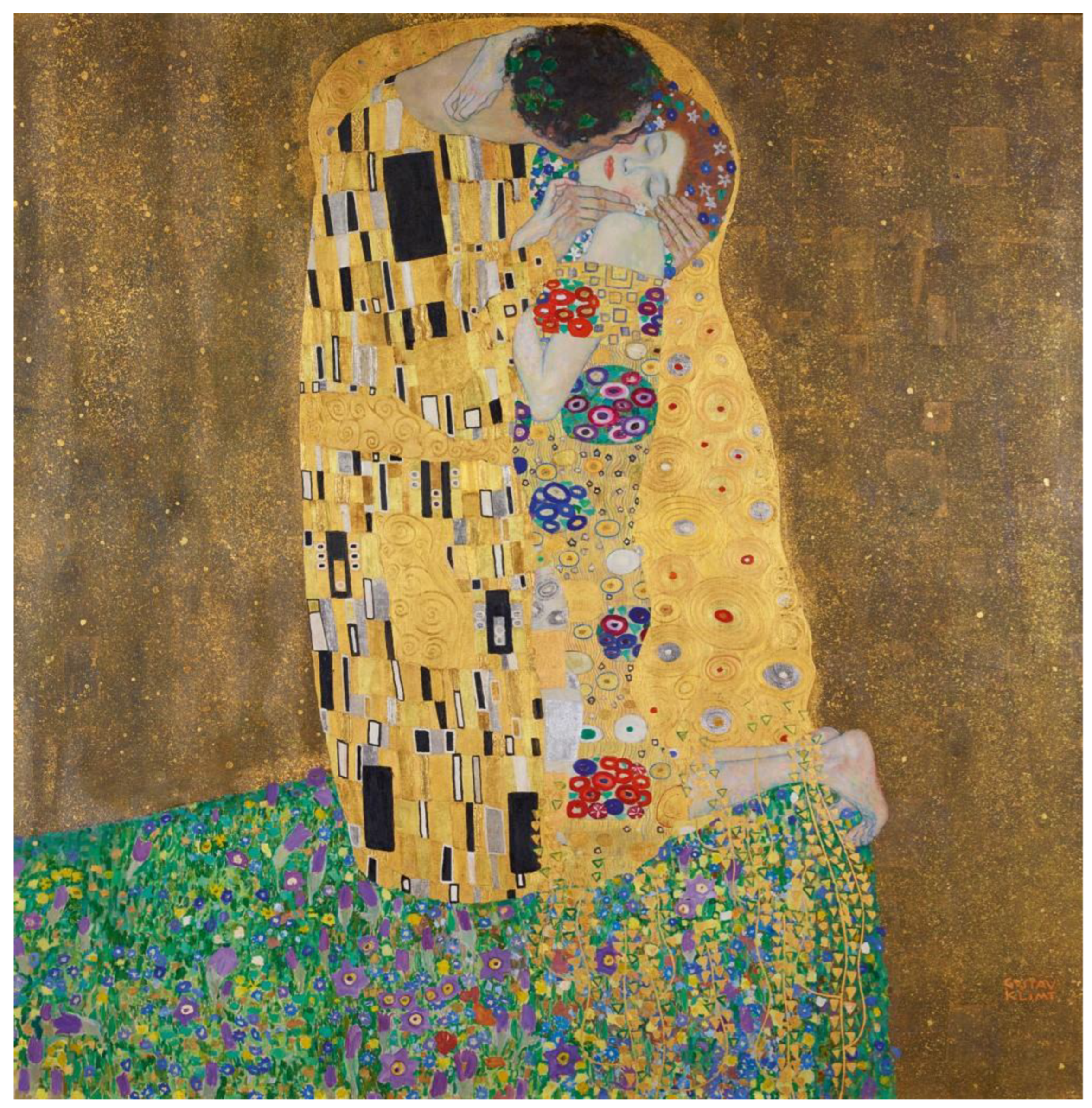
Klimt’s
Liebespaar (
The Kiss,
Klimt 1908–1909) is perhaps one of the most iconic works to come from the Viennese Secession. Klimt’s Golden Period (1901–1909), moreover, perfectly embodies the principles of the artist’s approach to decadence.
15 Dani Cavallaro locates the dissolution-fusion “of human bodies and profuse ornamentation, and the integration of separate human bodies into a composite body consisting of one sinuous ensemble of lines and colors” (
Cavallaro 2018, pp. 93–94). Nowhere are these techniques more beautifully and completely rendered than in
Die Liebespaar (
Figure 1).
Against an empty background, foregrounded by a bed of flowers, a man and a woman embrace. The bottoms of their respective clothes blend seamlessly into the landscape of the foreground, the grey-purples of the man’s clothes appearing again in the flowers. A suffuse golden aura simultaneously cloaks, highlights, and unites the pair, each also dressed in a distinct gold fabric. The man wears a leafy crown, while the woman’s hair is adorned with flowers, adding to the halo imagery created by the golden aura and the concentric circles. The forms of the man and woman press so seamlessly against one another as to never be unmeshed. Only upon close examination and with self-certainty does a viewer begin to demarcate the bodies. The woman, blushing and kneeling before her lover, closes her eyes in pleasure. The man seems to hold her up, as though she may collapse. Indeed, if not for the woman’s blush, one might mistake her for dead, and this their final kiss. The viewer has encountered a private, erotic, moment. It is plainly presented yet hidden.
16 In the words of Cavallaro, “The juxtaposition of alternate—or even seemingly incompatible—meanings urgers viewers to confront the ironical suspension of truth” (
Cavallaro 2018, p. 94). Draped in gold, surrounded by flowers, and composed of the symbols of classical beauty, the subjects are blissfully unaware of the voyeur.
Klimt has left no room for interpretation of the sentiment behind the lover’s embrace. This representation of sexuality and human erotism is a distinctly positive one. The tenderness with which the lovers hold one another, the softness of the lines, and even their unity with the natural landscape intimate the uprightness of the scene. The obvious parallel to this couple in the novel, however, has less of this tenderness. Dagmar C.G. Lorenz discusses Schnitzler’s critical attitude towards the types of homosocial relationships that Georg cultivates and, in particular, the misogyny that all-male spaces breed (
Lorenz 2003, p. 3). This embrace of human sexuality aligns with the Freudian theories of the decadent, a small sexual liberation allowing the pair to exist in bliss, rather than under the extreme pressures of turn-of-the-century decadence. While the painting may not capture the plot of the novel, it opens the door for classroom discussions about sexuality and the importance of Freud both to the novel and to Viennese culture at the turn of the century.
6. Adele Bloch-Bauer
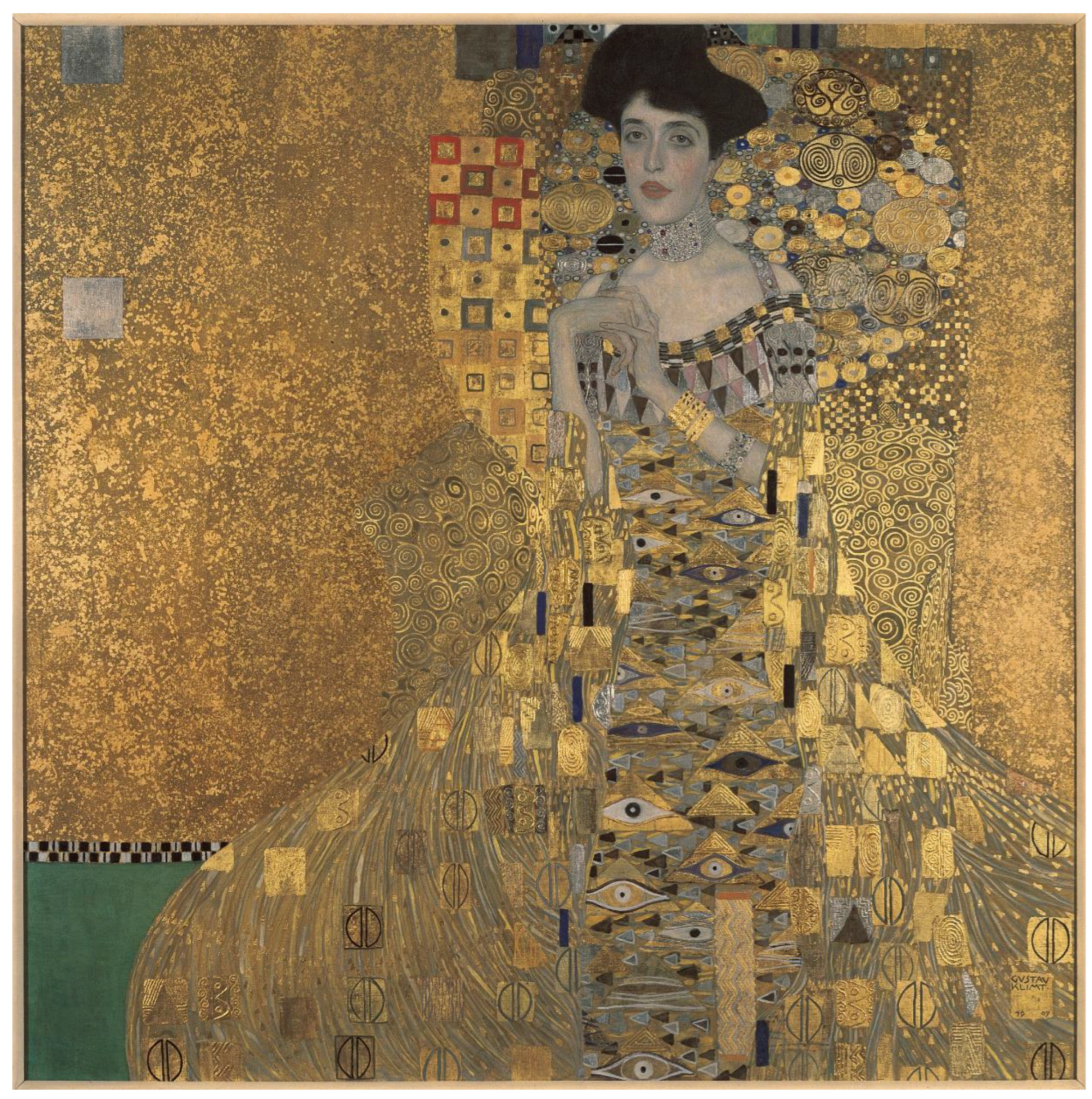
Klimt’s
Portrait of Adele Bloch-Bauer I (
Klimt 1907) is another product of the Golden Period.
17 This portrait is one of Klimt’s many portraits of Jewish subjects and shows Bloch-Bauer with seductively parted lips and perfectly coifed hair (
Figure 2). As with
Die Liebespaar, this portrait features a subject whose ornate garments blend perfectly into the environment. Her long, elegant fingers create a strange but delicate gesture, hands drawn close to the right breast. The asymmetry created by her gesture appears as a motif in the painting, with patterns, shapes, and colors varying in the background, as well as the subject’s face: while beautiful Adele Bloch-Bauer is depicted here with an anti-romantic realism that demonstrates the beauty of the subject’s imperfection. Like
Die Liebespaar, this painting features the overflowing fabrics, carefully blended into the background, and the undulating lines of the subject’s body never precisely represent a realistic human form.
Of the Klimt paintings chosen for cover art of Der Weg ins Freie, this portrait bears the least thematic resemblance to the novel. The painting, unlike the narrative, features a female subject as the only focus. Moreover, Adele Bloch-Bauer was Jewish, and the women populating Georg’s life are Gentiles. While there are certainly Jewish characters in the novel, Jewish women hardly feature for favor of the homosocial relationships of Georg. Therefore, to make sense of this cover art choice, we must take a more distant view, not of the novel, but of Klimt’s oeuvre. Much like Georg, himself a Gentile fascinated by the company of Jews, Klimt was known for his affinity for his Jewish patrons. Indeed, Adele Bloch-Bauer has the distinction of being the only person to pose for Klimt twice, and a number of Klimt’s other paintings featured Jewish subjects and/or were commissioned by Jewish patrons.
We might then look at the representational similarities of Jewish characters to parse some meaning for this otherwise curious cover art choice. Susanne Kelley illuminates the defamiliarization of the Jewish female body that occurs in Klimt’s paintings. Klimt, as can be observed in
Portrait of Adele Bloch-Bauer I, masks the subject’s familiarity by draping her in fabrics evocative of African and Asian fashions (
Kelley 2012, p. 110). These paintings arise from existing Viennese associations between Jews and foreignness (
Kelley 2012, p. 110). Kelley also observes that rising antisemitism did not limit opportunities for Jewish actresses nor the creation of Jewish female roles (
Kelley 2012, pp. 110–11). The same was true for visual arts as well, with non-Jewish artists taking Jews as subject more frequently than assimilated Jewish artists (
Kelley 2012, p. 111). Klimt, argues Kelley, was uniquely empathetic in his treatment of feminine subjects (
Kelley 2012, pp. 110, 112) but almost ironically erases their Jewish identity, which had so attracted him in the first place.
Der Weg ins Freie, however, presents a diverse cast of Jewish characters with varying opinions on issues like rising antisemitism and Zionism (
Bruce 2003;
Loentz 2003;
Lorenz 2003). Unlike the Jewish subjects of Klimt’s paintings, the Jewish identities of Schnitzler’s characters remains unmasked. Kelley characterizes the
Portrait of Adele Bloch-Bauer I as “frozen,” “metallic and lifeless” (
Kelley 2012, p. 112). Yet the scenes in the novel featuring Jewish characters contain the liveliest moments of discourse that would not remain frozen in time. Neubauer argues that Georg has an unstable view of women, Jews, himself, and those around him (
Neubauer 2003, p. 270). Perhaps one could argue that the shifting of Georg’s perception is reflected in the diffuse lines of Klimt’s paintings. The treatments of Jews by Klimt and Schnitzler differ greatly, even though both the painter and novelist were swimming against the current of antisemitism.
Portrait of Adele Bloch-Bauer remains one of the most iconic images of a Jewish woman, and it seems that may be its highest qualification for the cover of
Der Weg ins Freie.
7. Die Musik
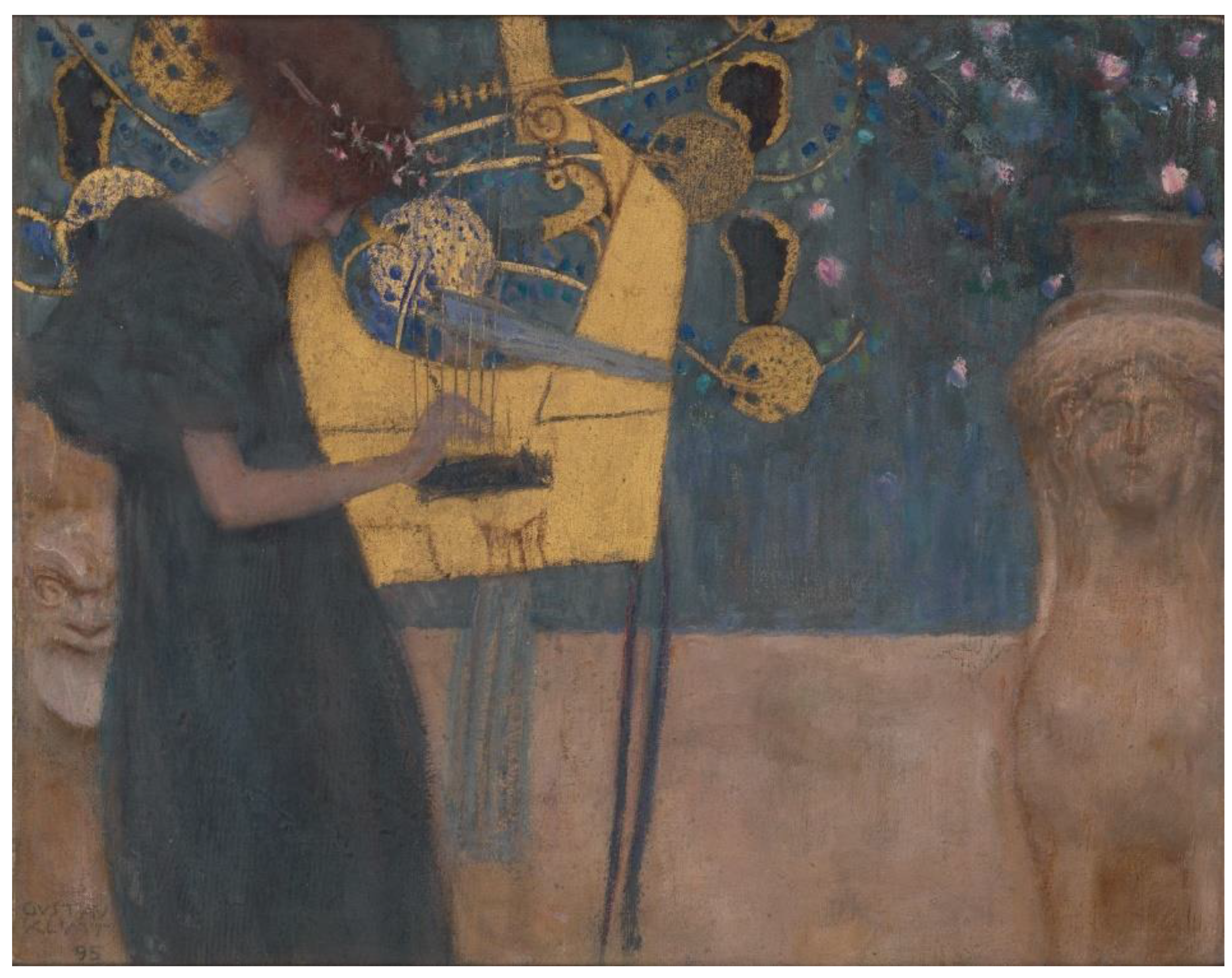
Die Musik (
Music,
Klimt 1895,
Figure 3), though it falls outside the recognized Golden Period, demonstrates some early application of the techniques that would later define Klimt’s style and artistic legacy.
18 This painting bears a dual thematic resemblance to the novel. There is the immediate connection between the subject of the painting and the protagonists of the novel. Anna and Georg both have musical aspirations, but throughout the novel, it is Anna who makes the most sincere effort to practice the craft. Though Anna is a vocalist rather than an instrumentalist like the subject of the painting, it is possible to read these women against one another. The subject here bows her head, eyes closed. She is pictured alone, clutching her lyre to her chest. Like the subject, Anna would eventually be left with only the vestiges of her musical aspirations. Georg’s pressure to terminate her pregnancy ultimately results in the relief of his social obligation to Anna. Georg, undetermined as he is, leaves Anna. Dejected, Anna eventually moves on, though not without social or emotional consequences of the relationship and the pregnancy. If we are to read Anna into the portrait, to read the subject as Anna, the peaceful expression becomes one of dejection, the subject’s solitude becomes a troubled isolation.
In addition to this relationship with Anna and the painting’s conjuration of the musical ambitions of the characters, both the novel and
Die Musik explore the importance of music in turn-of-the-century Vienna.
Die Musik has been read as an allegory for music, with the woman and her lyre embodying the ancient union of melody and lyric (
Niekerk 2011, p. 97). Moreover, in Klimt’s description of the painting, the artist establishes a connection to Beethoven’s Ninth symphony by quoting Friedrich Schiller’s
An die Freude (
Ode to Joy, 1785) in another version of this painting (
Niekerk 2011, p. 97). Carl Niekerk argues that Klimt intends to challenge the aesthetic tradition of Schiller and Beethoven and simultaneously to invite the audience to reconsider the function of art in the public (
Niekerk 2011, pp. 98–99). Klimt would eventually stop taking public commissions in favor of private ones after receiving significant pushback from the aesthetically traditionalist Vienna School of Medicine, highlighting the importance of the relationship between art, artist, and audience. (
Niekerk 2011;
Müller et al. 2025). The connection between the painting, the novel, and the musical atmosphere of Vienna provides a unique opportunity to incorporate another modality into lectures and student discussions (
Niekerk 2011;
Weiner 1986).
Although Niekerk (somewhat curiously) invokes Schnitzler’s
Lieutenant Gustl (1900) to demonstrate that Schnitzler, too, was concerned with the relationship between art and its public,
Der Weg ins Freie also takes up this debate, perhaps more directly; given the musical affinities of the protagonists, the novel offers a perfect backdrop for this discussion. According to Niekerk, Gustl only attends an opera because he hopes to meet women but is disappointed—or at least antisemitically surprised—to discover that so many of the woman in the audience are Jewish. Because Gustl lacks an understanding of the form and the content of the performance, there is a perceptible breach between the performance and its audience. This sequence highlights the troubling relationship between art and audience (
Niekerk 2011, p. 101). In
Der Weg ins Freie, however, what we see is the fraught relationship between art, artist, and audience. Anna and Georg are repeatedly frustrated in their efforts to produce art and to find an audience for their art. Anna arranges and prepares for an audition that would be canceled. Georg, in his impulse to help Anna make the center stage, plans to eventually, someday very soon, start the “real work” of a composition that he has toiled over in theory for months. Georg remains perpetually at the precipice of beginning “real work” on his composition, despite assurances from those around him that he could be a great composer—if he were to do anything. Else, a woman with whom George establishes another romance after Anna, sings for Georg, but he finds her voice small and shrill. Throughout the novel, the artists are in constant tension with their own art forms and the would-be audiences. Like the subject of
Die Musik, these musicians must play alone.
The images by Klimt, particularly those from his Golden Period, are visually captivating, recognizable, and evocative of the ironic leisure of the simultaneously crumbling and thriving Viennese society of Schnitzler and Klimt, a society that, like the fabrics of Klimt’s painting overflowed, masked, and highlighted Vienna. Moreover, despite their erotic overtones, the images are suitable for and perhaps even enjoyable for viewing by a broad audience. That is to say that the paintings by Klimt are not overtly pornographic or otherwise scandalizing to a modern audience.
19 Klimt himself still enjoys significant scholarly attention, making the selection of his major artworks for cover art a somewhat opportunistic one. Ultimately, the choice of Klimt, to whomever the decision fell, may have been made purely for name recognition. Whether these elections were made independently or dependently, they nonetheless co-create the meanings of the text—and vice versa, though that may be a separate article.
9. Die Familie
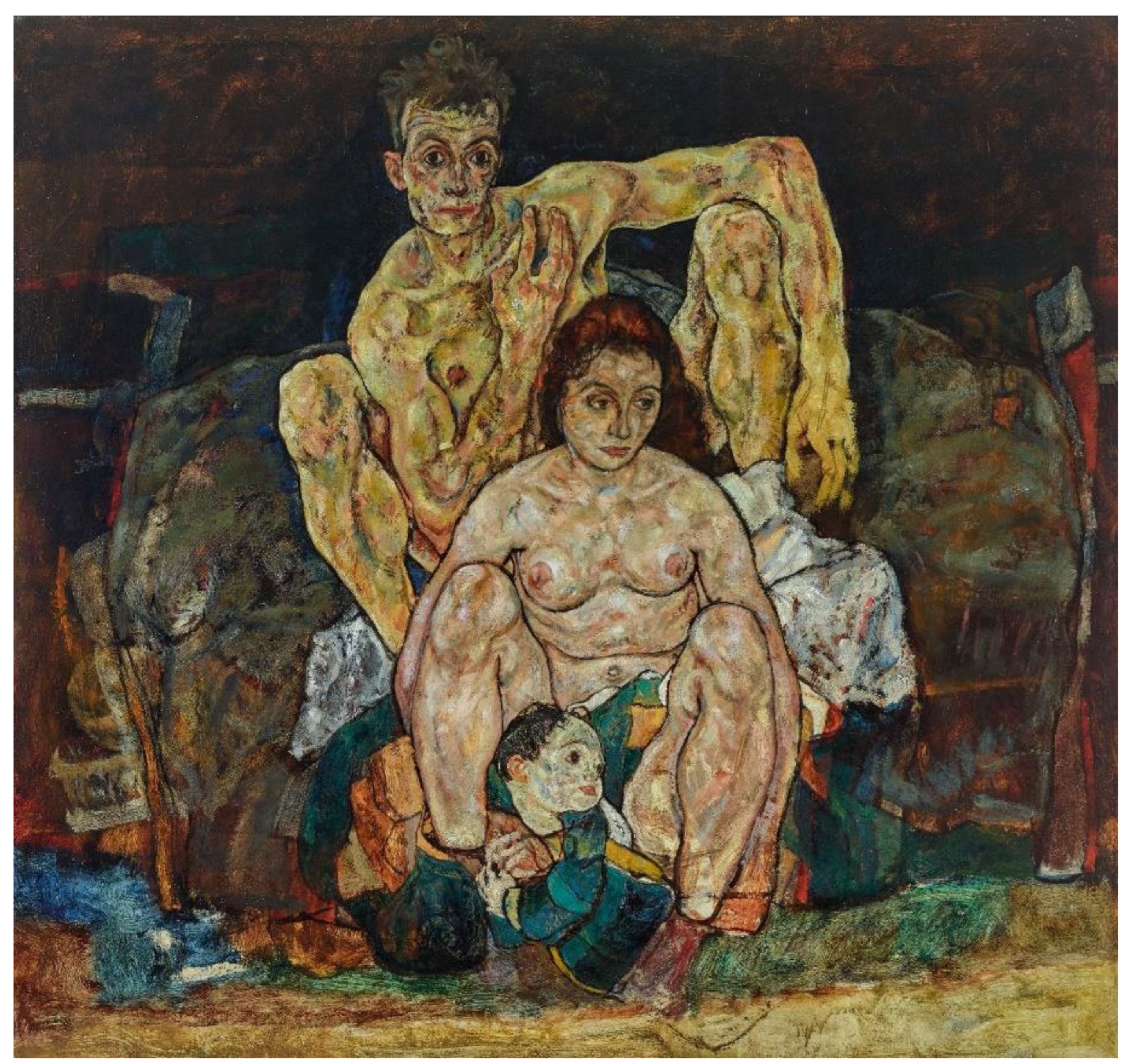
Schiele’s
Die Familie (
The Family,
Schiele 1918,
Figure 4) was one of the artist’s final works before his death.
20 Like many of Schiele’s paintings,
Die Familie is a venture in auto-portraiture. The artist is seated naked, behind a woman, also nude, and a child, clothed. The woman and child, though colored in a typically splotchy, grungy manner, have skin of mottled pink and brown, while Schiele appears a sickly yellow. Their surroundings, dark, abstract, conjures a sense of claustrophobia. This sense is iterated in the painter’s position over the woman, whose body is dwarfed in comparison to Schiele’s imposing figure. The painter, with an almost empty gaze, stares at—or perhaps past—the viewer, challenging the viewer to break the gaze and examine the rest of the scene. The woman, whose expression and body language express disinterest, defeat, and withdrawal, though seated above the child, fails to emulate Schiele’s protective and possessive aura. The child, looking in yet another direction, clutches something, perhaps the mother’s hand, to his chest.
As a cover art choice for Schnitzler’s novel, this painting evokes the relationship between Georg and Anna, and especially their aborted fetus. The woman in the painting is suspected to be Schiele’s lover, Wally Neuzil, and the child their firstborn. The child in the painting becomes especially significant in the interpretation of the paratextual materials when taking into account that the publisher of at least one version of the novel, Insel Press, has chosen to crop the painting in such a way that the child does not appear at all. This unusually editorial cropping serves as an intriguing datum. In fact, Die Familie seems to be the only cover art that is cropped in such a way. Like Georg and Anna’s child, the child in the painting would be erased. Yet this is hardly the painting by Schiele that is most evocative of the relationship between childbirth and mortality. Therefore, the choice of Die Familie, as opposed to his Dead Mother (1910) draws our attention not only to the premature death of Austria’s future, for which Georg and Anna’s child is a proxy, but to the familial relationship that Georg resists starting.
Schiele’s
oeuvre reflects the masculine crisis that occurred during this period of social decadence. According to Gerald Izenberg, the newly discovered influence of women and mothers, as well as the attendant anxieties at this influence, was central to Schiele’s work. However,
Die Familie is perhaps less evocative of this crisis, as it represents in the child a masculine success. Yet Izenberg argues that, to some extent, Schiele is always painting women or painting about or around them, even in his own self-portraits. In opposition to, for example, Beauvoirian feminist principles, Izenberg argues that Viennese men at the turn of the century were so lousy with this masculine crisis that they were defining themselves against women. As Izenberg observes, this gender awareness of Schiele’s was remarkably ahead of its time (
Izenberg 2006, p. 471).
This interpretation of the theme of masculine identity certainly appears in
Der Weg ins Freie. As has been observed, Georg is either unwilling to do or incapable of doing the basic things expected of men: work, marry, reproduce. Suffering from a pervasive and defining dilettantism, Georg becomes effectively feminized. In fact, Georg views the prospect of fatherhood as “heavy” and “dark” (
Schnitzler 1992, p. 98). Whereas Anna is decisive and thoughtful, planning ahead, Georg is uncertain and thoughtless. Therefore, not only is Georg emasculated but Anna is masculinized, assuming the role of family planner. The gender reversals of this novel, like Schiele’s paintings, demonstrate the extent to which Viennese men assumed identities in relation to the women around them.
The mutual reading of Die Familie, a positive treatment of sexuality and parenting, and Der Weg ins Freie reveals an immediate incongruity: Anna and Georg never have a child while the couple in the portrait do. What, then, is the significance of featuring a painting with a living child as the cover art for this novel? In choosing Die Familie, the editor or publisher has emphasized this absence in the text. Perhaps this choice of cover art reflects a reception of the novel’s content: the plot that occurs between Anna and Georg, and especially Anna’s loss of the pregnancy, are the central elements of the plot. By emphasizing this element of the plot, it is possible that the cover art understates the importance of the discursive and homosocial elements of the novel.
There is also something to be said about the depiction of children in turn-of-the century Viennese culture. Imke Meyer exposes a fascination with the “vexing, schizophrenic, and uncanny nature of children” (
Meyer 2015, p. 185). As Meyer observes, children operate as “signifier of both past and future,” bringing to life repressed memories in the adult while also representing potential, even a threatening potential (
Meyer 2015, p. 185). Georg certainly feels threatened by the impending child, knowing that it will force him into a role for which he feels unsuited or unprepared. A child would represent for Georg not only the uncanny embodiment of past, present, and future that children paradoxically represent, but the death of his current, burdenless life.
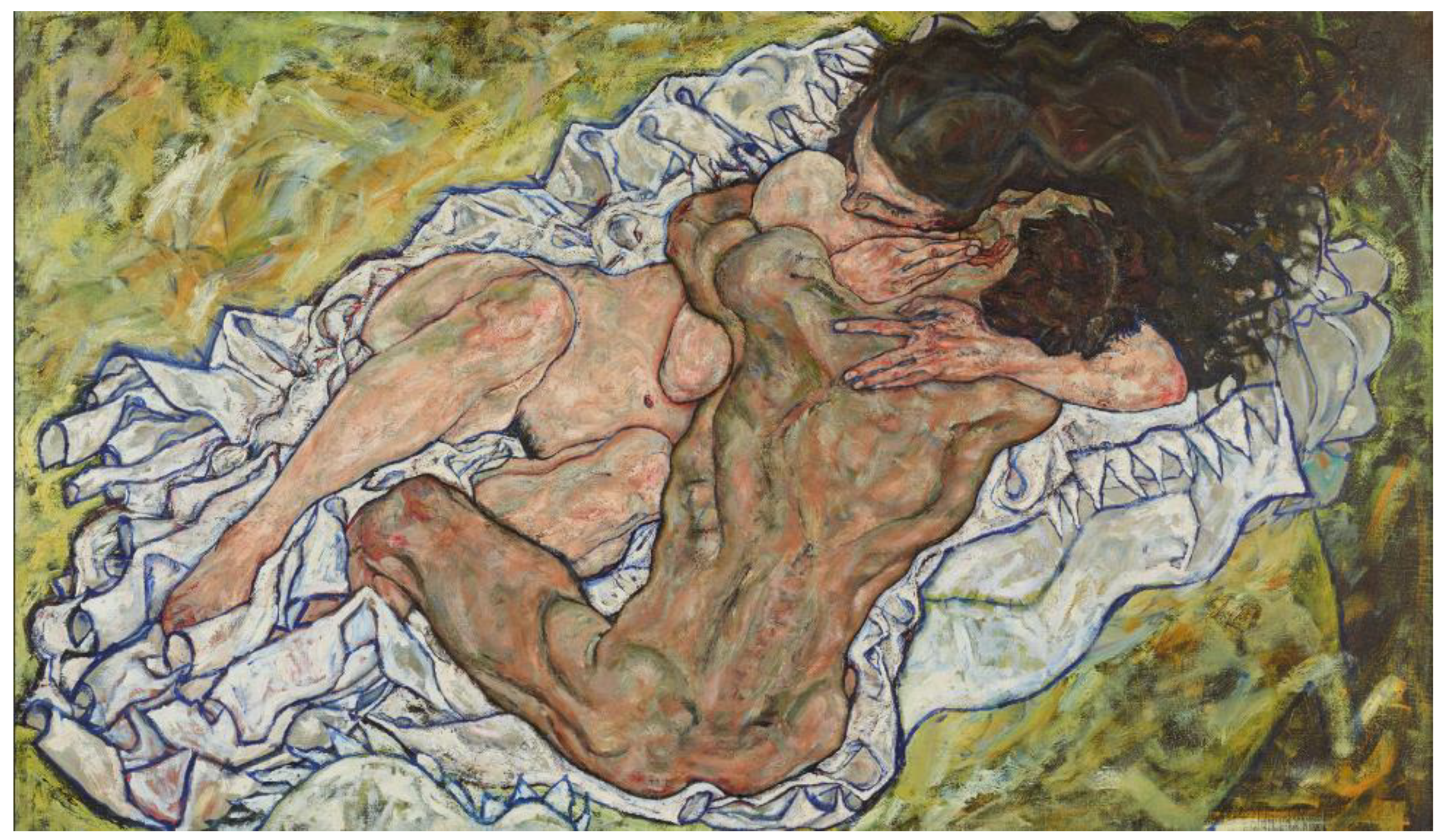
10. Die Umarmung
Schiele’s
Die Umarmung (
The Embrace,
Schiele 1917,
Figure 5) represents one of Schiele’s masterworks.
21 Appearing later in the artist’s life,
Die Umarmung features a man and woman, lovers, embracing. Their bodies, jagged, seem almost to share a texture with the sheet on which they lie. Beneath the sheet is a green background, evoking a meadow or other natural landscape. Muscles bulging beneath the bruised skin, the subjects hold each other actively, desperately. Lying cheek to cheek, they do not see one another.
This scene, like many of Schiele’s, explores sexuality and the strangeness of the human body. Unlike Klimt, Schiele makes no attempt to cloak the intimacy of the subjects, nor to adorn them with gold, nor to blend the subjects’ bodies. Rather, the male and female forms have clear beginnings and ends, sometimes harshly demarcated by thick, black outlines. This work notably lacks a broad use of color. Consisting of mostly neutral tones, Die Umarmung evokes a sense of degeneration rather than regeneration or reproduction. The sickly, withered bodies, seemingly hovering somewhere between life and death, show no vitality or reproductive potency. The desperation with which the lovers hold one another is, therefore, not only of a sexual nature, but of a grave one. If at any moment one lets go of the other, if their eyes meet, the ghastly reality of their romance might be realized, and their loved one will become a corpse before their eyes, their impotence on full display. The denialism of their reality contributes to the fragmentation of identity already visible in the rugged, ugly bodies, a perfectly Freudian decadence. Unlike the loving, unabashed embrace of Liebenspaar, the one in Die Umarmung is a repressed, decaying one.
Not unlike the subjects of the painting, Georg and Anna fail to truly see one another. Anna hopes that Georg will rise to the challenge of parenting, and Georg hopes that Anna will be a more effective comrade and muse. Susan C. Anderson discusses the power of visual metaphors in Schnitzler’s work, revealing a relationship between gender and sight. This relationship was part of the Viennese
zeitgeist. Men viewed: women were viewed. This modernist phenomenon reaches its pinnacle in Walter Benjamin’s
flâneur, a man whose only occupation was to gaze. However, this gendering of the act of gazing unduly stabilizes it (
Anderson 2003, p. 304). Expanding on earlier scholarship by Andreas
Huyssen (
1998), Anderson establishes that Schnitzler destabilized this gendering of sight in
Paracelsus (1899),
Leutnant Gustl (1900), and
Fräulein Else (1924). The same technique may be observed in
Der Weg ins Freie. For example, Georg approaches the Rosner residence to call upon Anna and her family. He sees an open window with its white curtains fluttering out into the breeze. Despite the openness of the window, he is unable to see into the home, his view of Anna obstructed. Instead, he must be led into the house to see the hosts. When Georg enters the room, Anna gazes directly at him. In the little description offered here, there is no mention of Georg’s sight of Anna, and the other man in the room, Anna’s father, is depicted with bleary, heavily lidded eyes. Here, the only person who seems capable of unimpeded vision is Anna.
And while Anna might be able to physically cast her gaze over Georg, it remains true that Anna cannot fully perceive Georg for the overaged child that he is and continues to expect more of him than what he will give. Unlike the subjects of Die Umarmung, the characters of the novel are able to physically see one another, but their gaze is never connected to a deeper understanding of the other’s interiority. It seems possible that, like the subjects of the painting, the incompatibility of their situation with life in Vienna would cause an existential rupture for both of them. If Georg and Anna were to stop looking past one another, as do the subjects of Schiele’s painting, the illusion of their embrace would dissolve.
Following Klimt, Egon Schiele is one of the most significant Austrian painters of the modernist movement. Schiele’s paintings, however, do not possess the same marketability that Klimt’s paintings enjoy—and this has always been the case. Schiele has a scandalous legacy: one he may have overcome had he lived longer.
22 Although mores surrounding nudity have widely relaxed, Schiele’s works remain shocking. Though we would likely no longer call the images not produced in his capacity as a pornographer “porn,” either. Nonetheless,
Die Familie and
Die Umarmung are perhaps the most suitable of Schiele’s works for the cover of this novel, as well as being some of his most major works. Simply put, many of Schiele’s works are intentionally disturbing (
Meyer 2015;
Németh 1999). Even though Schiele’s somewhat solipsistic and entirely fragmented
oeuvre might more closely resemble the attitude of Georg and his own unstable identity, the frightening and “embarrassing” (
Németh 1999) nature of Schiele’s works perhaps prevents many of Schiele’s work from being an obvious choice for the novel’s cover art. It may even be said that the majority of Schiele’s works are actively excluded from consideration for questions of marketability and audience preference. However, the use of Schiele on the cover allows instructors to discuss the body as a site of decay more effectively than either the novel or the other artists studied herein, providing additional insights for students into the broader (under-)currents of Viennese decadent thought.
11. Max Kurzweil
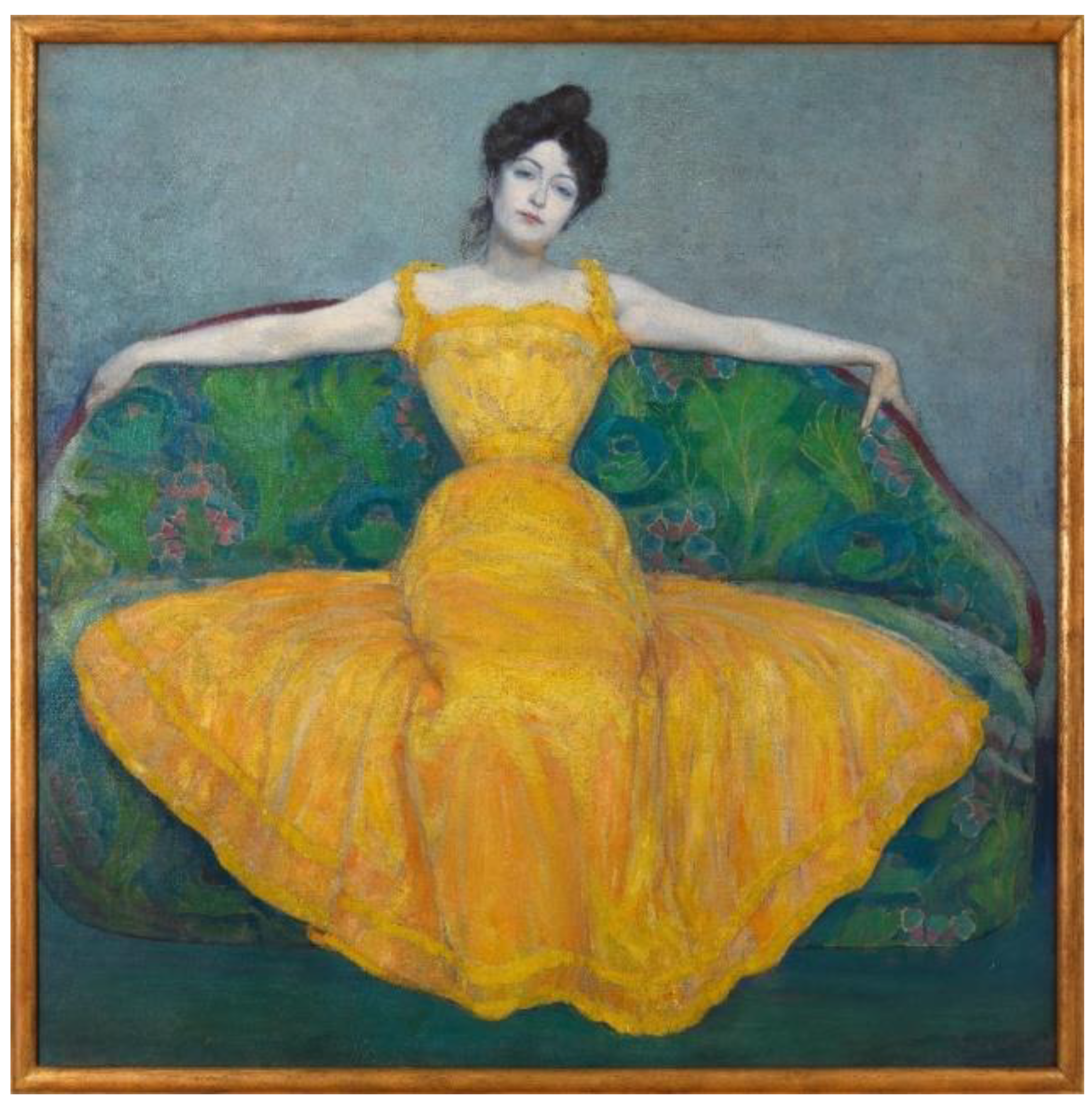
Max Kurzweil has not enjoyed the artistic legacy and critical attention of his contemporaries, Klimt and Schiele, but he was no less involved in nor significant to the Secession and decadent movements at the time. As one of the founding members of the Viennese Secession, Kurzweil clearly adopted the principles of the movement. His
Dame im Gelb (
Kurzweil 1899,
Figure 6), Kurzweil’s most significant painting, captures a moment of seductive leisure.
23 The subject, presumably a bourgeois woman by her dress and surroundings, adopts a bold, open pose. Her skin bears a faint blue tint, and she is unadorned. With her head cocked, the subject holds the viewer’s gaze. The subject’s open arms seem to invite the viewer into an embrace, but her expression is one of indifference, as if the viewer’s choice to embrace her has nothing to do with desire, is a matter of course. Kurzweil captures the subject in an overtly mundane but intimate scene. The background, including the settee upon which the subject sits, is composed of cool blues and greens. The highest areas of contrast are the flowing bright yellow dress, the clot of black hair, and the pinch of pink lips against the paleness of the subject’s skin. These high contrast areas literally and figuratively center the body of the subject.
As with
Die Umarmung by Schiele,
Dame im Gelb subverts gender expectations through stance and gaze. The self-assured pose of the woman, along with her wide gesture have a masculine quality, an early form of gender-bent “man-spreading.”
24 And like Schiele in
Die Familie, she stares at the viewer. As has already been established, this direct gaze also disturbs gender norms, converting the female subject into a sort of
flâneuse. This open masculinity is not the sort that is thrust upon Anna due to Georg’s inaction, but the painting does call to mind another female character of the novel: Else Ehrenberg. Else seems in the narrative quite the keen observer, and open as well. In one scene, Else criticizes Georg for the lack of progress on his compositions, saying that his work has essentially become a myth and that he should be more industrious (
Schnitzler 1992, p. 140). Moreover, in the same conversation, Else goes on to say that if she were a man, she would “scatter” too, seeing the world, joining the military and becoming an officer (
Schnitzler 1992, p. 140). Not only does Else envision herself in these masculine roles, but she imagines herself as being so good at performing masculinity that she would literally rise in the ranks of men.
However, it is possible that a viewer of the cover would see the image and associate it with Anna’s character. Therefore, it is pertinent to consider how one might read Anna against this painting. Anna could perhaps be the woman in gold, but then the subject’s stare becomes less self-assured and more seductive. Anna, then, would no longer be the casualty of Georg’s indecision and becomes instead a
femme fatale or seductress figure who is rightly punished for her unmarried indiscretions with the loss of her child. If we are to read the subject as the woman whom Georg impregnates, the implication is not of Anna’s masculinity but her femininity. The aristocratically blue skin might read as vampiric or tuberculotic, feeding into existing archetypes of the
femme fatale, the seductress, downfall of man. While other paintings discussed in this article provide opportunities to discuss the gender dynamics within the novel as well as within decadent thought,
Dame im Gelb represents a particular defiance of prescribed roles for women at the turn of the century, a point of conversion of the bold female into the
femme fatale (
Rojas-Viana 2024).
13. Back to the Classroom
To this point, I may have seemingly focused on the semiotic limitations of these cover choices. I have only meant so far to highlight the ways in which the images conform or do not conform with the text, and how the images might themselves contribute to our (mis-)understanding of the text. I arrive at the unfortunate assessment that many of these works do not very well reflect the themes of the novel, despite their shared connection of a particularly Viennese mode of decadence. All of the paintings share with the novel a clear modernist and decadent sensibility, each demonstrating some fear, anxiety, or embrace of the shifts in society that were associated with moral decadence, from music and public entertainment to sexuality and supposedly private moments of interpersonal intimacy. Each painting and, at least in the case of Schiele, the artist, does not fulfill the qualifications laid out by modern academic publishers. In consideration of the nationalities, ethnicities, religions, and genders of the author and his characters, the painters and their subjects, each of these paintings or authors have some significant power to sway the reader away from the plotline of antisemitism and towards significance of the romantic/familial drama. Given the long history of accusations of a narrative incongruency, Schnitzler’s novel may be especially vulnerable to just such a reader’s deviation.
While some of these paintings, namely
Die Umarmung and
Liebenspaar, perhaps over-emphasize the relevance of the romantic plotline at the expense of the less actionable (though no less important or relevant), discursive plot elements of Georg and his friends, this may not be the biggest sin committed by these pairings.
25 Further into the circles of edition hell is the pairing cast for the feature of a single female subject as the text’s container (as with
Dame im Gelb,
Portrait of Adele Bloch-Bauer I, and
Die Musik): this choice represents perhaps an outright misreading of either the novel or the chosen painting. If, indeed, as we all implicitly recognize (even if we reject or dislike it), the cover is meant to somehow signify the content and therefore inform our judgment of said content, how can we then accept a misdirection as serious as the one present in a female subject on the cover art? I have possibly overstated the grievousness of this act, but one must wonder: why shouldn’t a student—or any reader, for that matter—be informed (or misinformed) by the “literal container” of the text?
Imagine, for the sake of the argument, a student whose engagement of the text goes only as far as seeing the cover and reading the title. This blaspheming and certainly imaginary student would have little, but more than nothing, to go on as for grasping the major themes of the work. The knowing reader might question why a Jewish woman, Adele Bloch Bauer, appears on the cover of a novel which does not majorly feature any Jewish women. The uninitiated, however, may be led to believe, for example, that the protagonist is a woman. Or, for another example, why shouldn’t
Die Liebenspaar signify a tender love story within?
26As early as the Viennese Secession, a connection between the text and the paratext has been recognized:
… of course, Ver Sacrum is only a start. But it is a good start. Our audience, which is not as well-versed in its understanding of modern literature, can learn many things from this magazine. Especially what an artistically well-illustrated page looks like, how image and text work together to create living organism—even if it only lives in the confines of a limited page-space… Modern book decoration thus appears for the first time in a magazine with the conscious knowledge of being an integral part—not simply padding.
When choosing editions for the classroom, instructors might consider the interaction between text and image. These paratextual interactions also offer the additional educational opportunity of interdisciplinary, intermedial exploration. Instructors might consider introducing students to the artists and their works, offering discussion of the inter-currents of art and literature, guiding students in analysis of the paintings themselves, and inviting students to consider the personal (affective and analytical) effects of the artworks on their interpretations of the text. On the other hand, instructors who do not wish to engage these considerations in their classrooms may yet regard the effects of cover art on student analysis.