Article

COVID-19-Related Discrimination and Mental Distress: Mediating Role of Loneliness, Resilience, and Financial Worries


1
Department of Sociology, Anthropology and Criminal Justice, Clemson University, Clemson, SC 29634, USA
2
School of Mathematical and Statistical Sciences, Clemson University, Clemson, SC 29634, USA
3
Clemson Center for Geospatial Technologies, Clemson University, Clemson, SC 29634, USA
4
Office of Institutional Effectiveness and Analysis, University of Alabama, Tuscaloosa, AL 35487, USA
5
Department of Sociology, Texas State University, San Marcos, TX 78666, USA
*
Author to whom correspondence should be addressed.
Soc. Sci. 2026, 15(6), 370; https://doi.org/10.3390/socsci15060370
Submission received: 3 March 2026 / Revised: 15 May 2026 / Accepted: 2 June 2026 / Published: 5 June 2026

Abstract

This study examines the relationship between COVID-19-related discrimination and mental distress in the later stages of the COVID-19 pandemic. It also explores whether this relationship can be accounted for by loneliness, resilience, and financial worries. A random sample of 302 respondents from four Upstate South Carolina counties completed surveys between March and August 2022. Results from path analysis indicate a strong positive association between experiences of COVID-19-related discrimination and mental distress, with approximately half of this association accounted for by loneliness, resilience, and financial worries. Additionally, job disruptions and material hardships account for the relationship between discrimination and financial worries. While recognizing that causal inferences cannot be drawn from the cross-sectional design, these findings highlight the interconnected social, psychological, and economic factors linked to discrimination and mental distress and suggest potential targets for future research and intervention.

1. Introduction

COVID-19-related discrimination refers to unfair and unjust treatment of individuals or groups based on their perceived status of having contracted, spread, or exposed to the COVID-19 virus (Strassle et al. 2022). National data revealed a surge in discriminatory behaviors during the initial months of the COVID-19 pandemic, often linked to individuals’ perceived connection to the virus. In a national survey, a total of 22.1% of the respondents reported experiencing discriminatory behaviors (being called names or insulted, being threatened or harassed, hearing racist comments about them), and 42.7% reported that people acted afraid of them (Strassle et al. 2022). COVID-19-related discrimination may have intensified existing mental health disparities, as it has been associated with multiple mental health outcomes, including increased depression, anxiety, suicidal ideation, insomnia, post-traumatic stress, mental disorders, and substance use across various populations (Campo-Arias et al. 2022; Chae et al. 2021; Lee et al. 2022b; Liu et al. 2020; Ong et al. 2022; Raj et al. 2023; Shi et al. 2022). Research also shows that the experience of COVID-19-related discrimination partially explains the disproportionate mental health impact of the pandemic on Asians (Wu et al. 2021).
Although most studies focusing on COVID-19-related discrimination and mental health have focused on the early period of the COVID-19 pandemic, when there was a lockdown policy in place, a relatively small number of studies examined the impact of COVID-19-related discrimination in the later period of the pandemic. This study extends prior research on the mental health impact of COVID-19-related discrimination in the third year of the pandemic by focusing on the potential mediating roles of loneliness, resilience, and financial worries during this later phase. These factors capture disruptions in social connection, psychological resources, and economic stability, respectively, and are grounded in prior theory and research on stress and coping (Pearlin and Bierman 2013; Williams et al. 2019).
Our study contributes to the existing literature in two important ways. First, our study is one of the few late-pandemic investigations using a random, community-based sample rather than convenience data, offering a timely opportunity to examine the enduring impact of COVID-19-related discrimination on mental health. While the immediate health threat of COVID-19 has subsided, the long-term social, psychological, and economic consequences remain significant (Amini-Rarani et al. 2024; Panchal et al. 2023). Compared to the early months of the pandemic, the later stage presents a unique context: acute lockdown-related stressors had diminished, but the social and economic aftershocks, including discrimination, persisted and may have accumulated. Individuals may have also been more vulnerable due to prolonged stress exposure and fewer coping resources (Amini-Rarani et al. 2024). In this later period, discrimination may have reflected evolving social norms, pandemic fatigue, or entrenched stigma, which differ qualitatively from early-pandemic experiences. This phase allows for a deeper understanding of how key social, psychological and economic factors, such as loneliness, resilience, job disruptions, and material hardship, operate across distinct but interconnected domains to shape mental distress over time (Pearlin and Bierman 2013; Williams et al. 2019). Studying these processes with representative data is essential for identifying persistent disparities in post-pandemic recovery and informing long-term, targeted interventions to reduce the lingering mental health burden and structural inequities exacerbated by the pandemic.
Second, we simultaneously test three theoretically grounded variables that may account for the association between perceived COVID-19-related discrimination and mental distress in a single path analysis model. Loneliness, resilience, and financial worries represent distinct but interconnected domains through which discrimination may influence mental distress. Consistent with stress process theory, discrimination can function as a primary stressor that generates secondary stressors and erodes psychosocial resources across these domains, which often co-occur and interact (Pearlin and Bierman 2013). Examining multiple indirect associations in a single model allows for a more comprehensive understanding of how discrimination affects mental distress across social, psychological, and economic domains. This approach accounts for the interrelationships among multiple indirect associations, clarifies their unique and combined contributions, and prevents the overestimation of individual effects (VanderWeele and Vansteelandt 2014). It also helps identify the most prominent indirect associations, offering potential guidance for targeted interventions to address mental health disparities in the post-pandemic context. Additionally, the scales employed in this study show solid internal consistency (described in Section 3, Materials and Methods, below), which is essential in path analysis to reduce error, support valid conclusions, improve model performance, and ensure replicability (Kline 2023).

2. Literature Review

Our conceptual model draws on stress process theory (Pearlin and Bierman 2013; Pearlin et al. 2005; Pearlin and Skaff 1998), which posits that social stressors such as discrimination can adversely affect mental health both directly and through secondary stressors and resource erosion. In this framework, COVID-19-related discrimination functions as a primary stressor that may initiate or intensify job disruptions and material hardship (stress proliferation), while simultaneously diminishing psychosocial resources like resilience and social connection. By examining multiple mediating pathways, social, psychological, and economic, our model reflects the theory’s emphasis on the dynamic interplay of stressors and resources across life domains in shaping mental distress. Previous research has shown that discrimination is associated with increased anxiety, depression, and engagement in harmful behaviors like smoking and alcohol use, as well as physiological conditions such as high blood pressure and reduced self-rated health (Luo et al. 2012a; Paradies et al. 2015; Pascoe and Richman 2009; Schmitt et al. 2014; Williams and Mohammed 2009; Williams et al. 2019). Research using data collected before and during the pandemic further suggests that the relationship between discrimination and health and well-being outcomes was intensified during the pandemic (Luo et al. 2025).
Although research on stress processes has accumulated since at least the 1980s (e.g., Pearlin et al. 1981), the global outbreak of COVID-19 in early 2020 created unique circumstances to utilize the stress process model in the context of the pandemic. Louie et al. (2023) used a probability sample of U.S. adults in the 2021 Crime Health and Politics Survey to assess the cumulative impact of pandemic-related stressors, finding that the effects of greater numbers of these stressors (loneliness, and various economic hardships, such as job loss and traumatic events, such as hospitalization or bereavement) reduced the stress-buffering provided by mastery, self-esteem, and social support. Although this study did not have measures of COVID-19-related discrimination, it controlled for race, gender, age, employment, income, marital status, and region. An earlier community survey in the Intermountain West in July 2020 researched the linkages between exposure to pandemic-related stressors and psychological distress (particularly depressive symptoms), testing not only for a direct effect but also for an indirect effect through discrimination moderated by disability status (Brown and Ciciurkaite 2022). Satran et al. (2022) researched perceived discrimination and stress among the Arab population living in Israel using a cross-sectional online survey conducted in April 2020, and their structural equation model showed that perceived threat and trust mediated between discrimination and stress, with discrimination negatively associated with trust, and trust negatively associated with stress. Dambrun et al. (2023) found that anger and sadness mediated the relationship between perceived discrimination due to COVID-19 symptoms and poor mental health (stress, burnout, and low self-esteem) in a 2020 online survey. Our research extends the stress-process model by including COVID-19-related discrimination in the late-pandemic period.
While prior research has identified various factors associated with discrimination and mental distress, such as social support, identity threat, and coping style (Brondolo et al. 2009; Pascoe and Richman 2009; Schmitt et al. 2014), our model emphasizes three key factors that are especially salient in the pandemic context and have shown strong empirical support: loneliness, resilience, and financial worries. Together, they reflect social, psychological, and economic dimensions that are not only interrelated but also independently associated with mental distress. By testing them simultaneously in a path analysis model, we are able to estimate their unique and shared contributions to the observed associations between discrimination and mental distress, offering a more integrated view than studies using single-variable or regression-based approaches (VanderWeele and Vansteelandt 2014). This contributes to late-pandemic research by highlighting key, and potentially modifiable, factors linked to mental health disparities.

2.1. Loneliness in the Discrimination–Mental Distress Association

Loneliness can be a direct consequence of discriminatory experiences. Individuals who are treated unfairly may feel socially rejected or marginalized, leading to increased feelings of isolation (Chin et al. 2020; Han et al. 2021). These experiences may prompt coping strategies such as avoidance or withdrawal, further limiting opportunities for meaningful interaction (Courtin and Knapp 2017). Loneliness, in turn, is a well-established risk factor for mental distress, increasing depressive symptoms, anxiety, and stress (Cacioppo et al. 2010; Luo et al. 2012b). Previous research, including studies conducted during the COVID-19 pandemic, confirms that loneliness accounts for the relationship between discrimination and adverse outcomes like sleep problems, self-injury, and heightened stress (Lee and Bierman 2019; Liao et al. 2015; Majeno et al. 2018; Wang et al. 2021). Accordingly, we expect that COVID-19-related discrimination will be associated with higher levels of mental distress through its association with loneliness.

2.2. Resilience in the Discrimination–Mental Distress Association

Discrimination can erode resilience, the capacity to adapt and recover from adversity, by functioning as a chronic social stressor that drains emotional, cognitive, and social resources (Brown and Tylka 2010; Williams et al. 2019). Repeated exposure to unfair treatment can provoke feelings of anxiety, anger, and hopelessness while also disrupting trust and cohesion within social networks, weakening essential support systems (Cook et al. 2023; Leahy and Chopik 2020). Discrimination is also linked to adverse physical health and cognitive strain, such as elevated blood pressure, poor sleep, rumination, and reduced emotional regulation, further impairing resilience (Lewis et al. 2014; Hoggard and Hill 2018). Although resilience is widely studied as a buffer against mental distress (Romero et al. 2014; Andrade et al. 2021), less attention has been given to how discrimination may actively diminish resilience and thereby increase vulnerability to distress. Recent evidence, for example, suggests that resilience partially accounts for the effects of pandemic-related stress on anxiety and depression among U.S. women (Kumar et al. 2022) and pandemic survivors (Xiao et al. 2023).

2.3. Financial Worries in the Discrimination–Mental Distress Association

Financial worries may account for the relationship between discrimination and mental distress, and they are often shaped by more immediate stressors such as job disruptions and material hardship. Discrimination in employment, housing, and financial services can lead to financial instability by limiting job opportunities, reducing wages, and restricting access to credit and loans (Pager and Shepherd 2008; Quillian et al. 2020; Williams et al. 2019). Job disruptions, such as job loss, reduced hours, or precarious employment, are particularly salient outcomes of discriminatory practices and directly contribute to financial worries by undermining income security and creating uncertainty about future earnings (Wilson et al. 2020). Material hardship reflects unmet basic needs such as difficulty affording food, healthcare, and stable housing, and serves as a source of stress that contributes to broader financial insecurity (de Miquel et al. 2022; Heflin and Iceland 2009). Discrimination may also restrict access to financial services (e.g., loans or credit) and undermine social and institutional trust, further reducing coping resources (Dickerson 2020; Quillian et al. 2020). These compounding effects increase the likelihood of financial worries, defined by a persistent sense of uncertainty and instability. Financial stress, in turn, has been shown to predict heightened symptoms of depression, anxiety, and feelings of lack of control, particularly when linked to unjust treatment (Knapp and Wong 2020; Ridley et al. 2020; Shippee et al. 2017).
These patterns reflect structural disadvantages that accumulate over time. Studies during and after the COVID-19 pandemic highlight how discrimination-related job loss and material hardship disproportionately affected socially disadvantaged groups and were associated with intensified mental distress (de Miquel et al. 2022; Fitzpatrick et al. 2020; Piacentini et al. 2022). By incorporating job disruptions and material hardship as part of the modeled associations, our analysis highlights the cascading nature of economic stressors through which discrimination is linked to financial worry and mental health.

2.4. Current Study

This study focuses on mental distress, a broad term referring to the subjective experience of emotional discomfort, feelings of lack of control, anxiety, or psychological stress (Centers for Disease Control and Prevention 2025). While research indicates that mental distress rose modestly during the early months of the COVID-19 pandemic, average levels declined by 2022–2023. However, the long-term mental health burden remains significant, particularly among marginalized and economically vulnerable populations, underscoring the need for continued investigation (Panchal et al. 2023). In this study, we estimate a theoretically informed model to examine the association between COVID-19-related discrimination and mental distress in the later stage of the pandemic. We focus on three distinct and complementary factors that may account for this association: (1) loneliness, representing the disruption of social connections; (2) reduced resilience, capturing psychological vulnerability; and (3) financial worries, reflecting economic stress. These factors were selected based on prior literature and theory (Hobfoll 1989; Pearlin and Bierman 2013) and because they are modifiable, policy-relevant factors that span key dimensions of mental health risk. While social support is often studied as a moderator, our model centers on factors that are both theoretically grounded and empirically linked to discrimination and mental health outcomes during crisis periods.
In our conceptual model, experiences of discrimination are hypothesized to have a positive association with mental distress, and this association is accounted for by loneliness, resilience, and financial worries. In addition, as suggested by the findings in de Miquel et al. (2022), material hardship and job disruptions are hypothesized to account for the relationship between discrimination and financial worries. The conceptual model without estimated parameters is presented in Supplementary Figure S1, and the model with estimated parameters will be presented in Section 4.

3. Materials and Methods

3.1. Data

We used data from the COVID-19 Exposure, Prevention, and Impact Study in Upstate South Carolina, which was a cross-sectional survey conducted by Luo, Li, Haller, Carbajales-Dale, Wang, and Jones. Data were collected from March 2022 to August 2022 using an address-based sampling mail-to-web survey. A random sample of 1500 household addresses in four counties of Upstate South Carolina, United States, (Anderson, Greenville, Oconee, and Pickens), was initially selected and the adult (age 18 or over) in the household who had the most recent birthday was asked to complete the survey. A recruitment letter was mailed to these addresses, and the respondents were instructed to complete the survey on the web. Two follow-up letters were mailed, and for those who still had not responded, a fourth mailing included a paper questionnaire for respondents to complete and return. Upon completion of the survey, respondents received a $20 gift card via mail or email. Among 1402 valid addresses, 302 completed the survey (213 web surveys and 89 mail surveys), with a response rate of 21.4% (reporting of response rates follows the Association for Public Opinion Research definition of response rate 2, which includes partial interviews; partial interviews are defined as those who completed 50% to 80% of essential survey questions) (The American Association of Public Opinion Research 2023). Female (66.2%), White (87.2%), and older adults (65 and older) (32.6%) were over-represented in our sample compared to the 2020 Census Bureau’s estimates (52.2%, 73.8%, 23.1% respectively) (United States Census Bureau n.d.). A detailed comparison of our sample with the 2020 Census is in Supplementary Table S1. The study was approved by the Institutional Review Board at Clemson University and all respondents consented to participate in the survey.

3.2. Measures

Mental distress. Mental distress was assessed with K-6 Non-specific Distress Scale which has been validated across diverse populations (Kessler et al. 2003). Respondents were asked how often in the past month they felt: (i) nervous, (ii) hopeless, (iii) restless or fidgety, (iv) so depressed that nothing could cheer them up, (v) everything was an effort, and (vi) worthless, with 5-point response options ranging from 1 “none of the time” to 5 “all of the time”. Mental distress was measured by the average of the answers to these six items (Cronbach’s alpha = 0.88).
COVID-19-related discrimination. This study assessed experiences of COVID-19-related discrimination using a 4-item scale adapted from the Short Form of the Everyday Discrimination Scale (Liu et al. 2020; Sternthal et al. 2011), which was abbreviated from a commonly used 9-item scale (Williams et al. 1997). Respondents were asked whether, since the outbreak of the COVID-19 pandemic, they had the following experiences because people thought they might have COVID-19: (i) being treated with less courtesy and respect than others, (ii) receiving poorer services at restaurants or stores than others, (iii) people acting as if they were afraid of the respondent, and (iv) being threatened or harassed. Following Liu et al. (2020), who studied COVID-19-related discrimination in the early period of the pandemic, response options were coded 1 (“no”), 2 (“maybe”), and 3 (“yes”). While it offers less detail, a 3-point response scale is simple and quick, reducing respondent burden and improving data quality, especially in diverse or sensitive populations. COVID-19-related discrimination was measured with the average of answers to these four items with higher values associated with higher levels of discrimination experienced (Cronbach’s alpha = 0.73). Treating this measure as continuous allows for capturing gradations in reported experiences and is consistent with prior research using abbreviated discrimination scales.
Loneliness. We used the 3-Item UCLA Loneliness Scale, a brief measure adapted from the longer UCLA Loneliness Scale, to assess loneliness (Hughes et al. 2004). Respondents were asked how often in the past month they felt that they: (i) lacked companionship, (ii) left out, (iii) were isolated from others, with 5-point response options ranging from 1 (“none of the time”) to 5 (“all of the time”). Loneliness was measured by the average of the answers to these three items, with higher values associated with higher levels of loneliness (Cronbach’s alpha = 0.87).
Resilience. Resilience was assessed with the Brief Resilience Scale designed to measure an individual’s ability to bounce back or recover from stress (Smith et al. 2008). Respondents were asked how much they agreed or disagreed with the six statements: (i) I tend to bounce back quickly after hard times, (ii) I have a hard time making it through stressful events, (iii) It does not take me long to recover from stressful events, (iv) It is hard for me to snap back when something bad happens, (v) I usually come through difficult times with little trouble, and (vi) I tend to take a long time to get over setbacks in my life. The 5-point response scale ranged from 1 (“strongly disagree”) to 5 (“strongly agree”). Resilience was measured by averaging answers to the six items after reverse-coding the negatively worded items, with higher scores associated with higher levels of resilience (Cronbach’s alpha = 0.87).
Material hardship. This is a count of the material hardship respondents experienced since the start of the COVID-19 pandemic, including (i) missed any regular payments on rent or mortgage, (ii) missed any regular payments on credit cards or other debt, (iii) missed any other regular payments such as utilities or insurance, (iv) could not pay medical bills, and (v) could not pay for food.
Job disruptions. This is a count of the job-related changes respondents experienced due to the pandemic, including (i) had to change workdays or hours, (ii) switched to working from home or working remotely, (iii) work became more risky or dangerous, (iv) work became harder, (v) lost job/laid off permanently, (vi) was furloughed/laid off temporarily, and (vii) quit the job.
Financial worries. Respondents were asked how worried they were in the past few months due to the COVID-19 pandemic about (i) their financial situation and (ii) their job security, with the 5-point response options ranging from 1 (“not at all worried”) to 5 (“extremely worried”). Financial worries were measured by the average of the scores on these two items, with higher values associated with more financial worries (Cronbach’s alpha = 0.71). Although one item captures concerns about job security, which may be less applicable to respondents not in the labor force, the two items together provide a general measure of perceived financial strain.
Demographic covariates. Sociodemographic covariates included age in years, gender, race (White, Black and other races), marital status (married, divorced/separated, widowed, and never married), socioeconomic status (SES), political ideology (ranging from 1 “extremely liberal” to 7 “extremely conservative”), religion (Protestant, Catholic, Other religion, and no religion), number of chronic conditions the respondent had before COVID-19 (top-coded at 4 when there were more than 4 conditions), and whether any household member had medical conditions that increased their risk of COVID-19 infection. SES was measured with the factor scores from factor analysis which combined education level (ranging from 1 “8th grade or less” to 9 “graduate/professional degree”), household income level (ranging from 1 “Less than $10,000” to 11 “$100,000 or more”), and employment status (working or not working). We used principal component factor analysis with orthogonal varimax rotation. All three indicators loaded positively on a single factor (loadings: 0.76, 0.83, 0.53), which explained 52% of the variance. This approach reduces multicollinearity among SES components and provides a more parsimonious representation of overall socioeconomic position compared to including each variable separately.
Covariates were selected based on prior theory and empirical research identifying factors associated with both discrimination and mental health, with the goal of reducing potential confounding. In addition to core sociodemographic characteristics, we included religion and political ideology because they capture broader social and cultural orientations that shape coping resources and responses to the COVID-19 pandemic. Prior studies have linked these factors to pandemic-related attitudes, behaviors, and mental health outcomes (Calvillo et al. 2020; Schnabel and Schieman 2022). To maintain model parsimony and stability given the sample size, we limited covariates to those with strong theoretical and empirical support.

3.3. Statistical Analysis

We first calculated descriptive statistics for all variables. We then estimated a path analysis model (a form of structural equation modeling with observed variables only) using the Stata SEM procedure (Stata 18, College Station). This model included a linear regression with mental distress as the dependent variable and discrimination as the key independent variable, adjusting for all intervening variables and demographic covariates. Separate regression equations were specified for each intervening variable as a function of discrimination and covariates. The equation for financial worries additionally included material hardships and job disruptions. Residuals of loneliness, resilience, and financial worries were allowed to correlate to account for shared unobserved factors across social, psychological, and economic domains.
The rate of missing data ranged from 0 to 9.3%, with the SES index having the highest rate, followed by political ideology (6.6%) (see Table 1). Missingness was associated with fewer job disruptions, lower SES, and being older, and missing on SES was associated with fewer job disruptions and older age. We used maximum likelihood with missing values (MLMV), which allows for the efficient use of partially observed data under the assumption that data are missing at random (MAR). As a sensitivity analysis, we also estimated a model using listwise deletion, which produced substantively similar results.
Because several variables were skewed and the assumption of joint normality was not fullly met (see Supplementary Table S2), we used robust standard errors to draw inferences. Model fit was evaluated using multiple indices, including χ2, RMSEA, CFI, and TLI. Model fit was considered acceptable if the χ2 statistic was nonsignificant, RMSEA was ≤0.06, and CFI/TLI values were ≥0.95 (Hu and Bentler 1999). Non-robust estimates are reported in Supplementary Table S3 to provide additional fit statistics.
Although several variables (e.g., Likert-scale measures and count variables) are not strictly continuous, they were modeled as continuous for parsimony and interpretability. This approach is common in path analysis when variables have multiple response categories or represent summed indices, particularly when robust standard errors are used to account for non-normality (Kline 2023). Material hardship and job disruptions, while count variables and somewhat skewed, were treated as continuous to reflect cumulative exposure to stressors and to facilitate the estimation of indirect effects within a single-model framework.
Given the modest sample size, model specification was guided by theory to balance explanatory depth and parsimony. The inclusion of multiple intervening variables reflects distinct domains identified in stress process theory, social, psychological, and economic pathways, while allowing their interrelationships to be modeled simultaneously. To assess the stability of estimates, we examined multicollinearity by estimating variance inflation factors (VIFs) for each regression equation. All VIF values were below 2.5, indicating no evidence of problematic multicollinearity.
To address potential sparse-cell concerns, we conducted sensitivity analyses using more parsimonious coding of categorical covariates. Specifically, race was recoded as White versus non-White; marital status was grouped into married/cohabiting, previously married, and never married; and religion was categorized as Christian versus non-Christian. Results were substantively consistent across specifications. In addition, we estimated a reduced model including only age, gender, and race as covariates, which yielded substantively similar results (see Supplementary Table S4). A Monte Carlo power analysis was also conducted to evaluate the adequacy of statistical power (see Section 4).
Model specification was theory-driven rather than data-driven. We did not modify paths based solely on statistical fit indices. We tested an alternative specification including a reciprocal path from distress to experiences of discrimination, given theoretical support for a feedback mechanism (Pascoe and Richman 2009). However, this path was not statistically significant and did not improve model fit. Consistent with recommendations for parsimony and interpretability in non-recursive models (Bollen 1989; Kline 2023), this path was not retained in the final model.
As a sensitivity analysis, we re-estimated the model using an alternative specification of financial worries that excluded the job security item, given that this item may not apply equally to respondents outside the labor force. This analysis assessed the robustness of the estimated associations to measurement specification.
We did not apply survey weights in the analysis. While survey weights can improve population representativeness, they may also introduce estimation instability, inflated standard errors, and convergence challenges in smaller samples (Kline 2023). Weights may increase variance without reducing bias if the model is already adjusted for variables related to the sampling process (Winship and Radbill 1994). When the primary objective is to estimate relationships among variables rather than population-level parameters, unweighted models with appropriate covariate adjustment often provide more efficient and stable estimates (Winship and Radbill 1994). Accordingly, we included key demographic covariates to account for potential sampling imbalances.

4. Results

4.1. Descriptive Statistics

Table 1 presents descriptive statistics for all variables. On a scale of 1 to 5, the average mental distress score was 1.6, indicating a relatively low level of distress. On a scale of 1 to 3, the average COVID-19-related discrimination index score was 1.29, with about 30% reporting some form of discrimination. On a scale from 1 to 5, the average scores for loneliness, resilience and financial worries were 1.43, 3.58, and 1.81, respectively. The average number of material hardships experienced was 0.60, and the average number of job disruptions was 1.14.
The average age of the respondents was 54 years, two-thirds were female, 87% were White, and 68% were married. Political ideology had a mean of 4.58, indicating that more respondents identified as politically conservative. More than two-thirds were Protestant and 16% were not affiliated with any religion. The average number of chronic conditions before COVID-19 was 0.88 with half reporting having one or more conditions. About 36% of respondents reported having household members who had medical conditions that increased their risk for COVID-19 infection.

4.2. Path Analysis Model

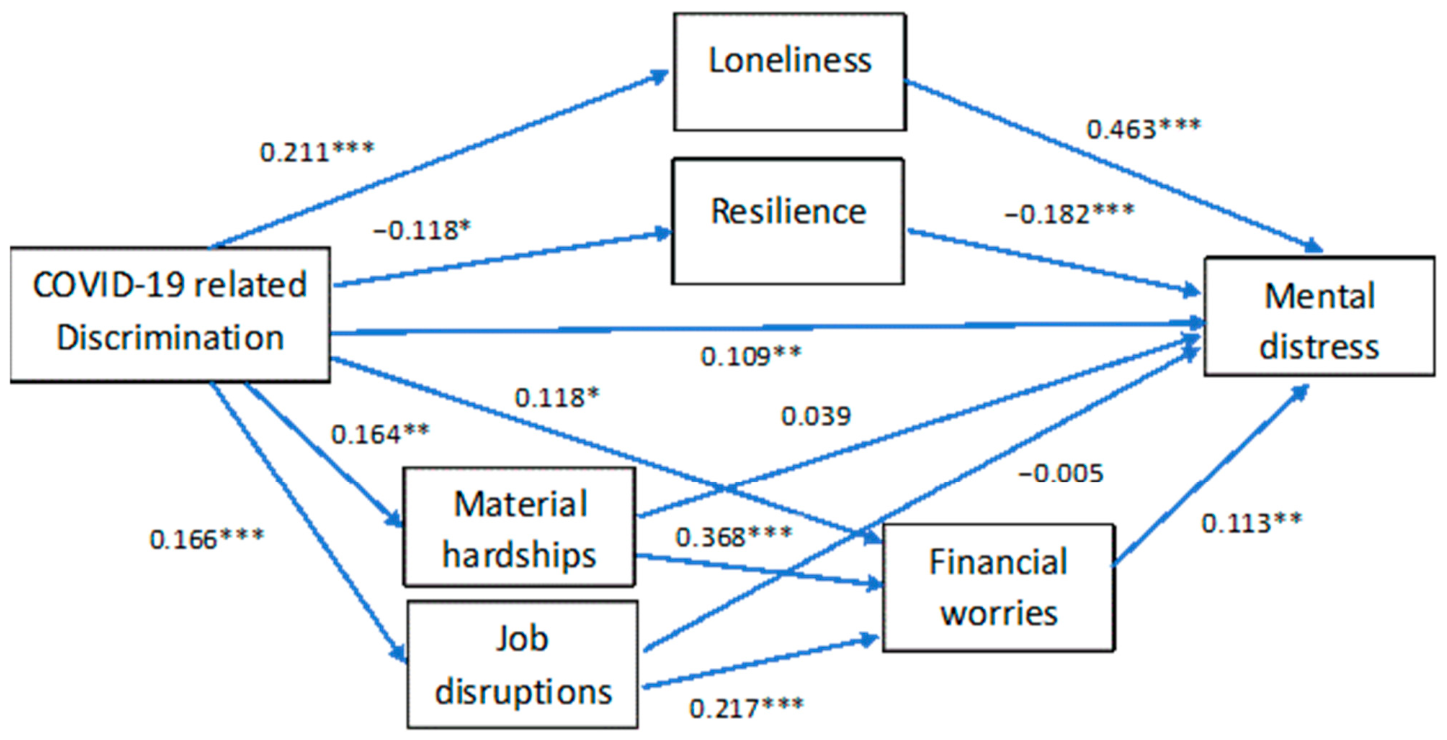
Table 2 reports results from path analysis with robust standard errors. The goodness-of-fit statistics indicated that the model fit the data well (χ2 = 8.730, p = 0.120; RMSEA = 0.050; CFI = 0.995; TLI = 0.889). The model explained a substantial proportion of variance across endogenous variables (overall R2 = 0.707), reflecting the combined explanatory power of the full path model, including intervening variables and the outcome equation. With sociodemographic variables controlled for, the discrimination index had a significant positive association with loneliness (b = 0.358, p < 0.01), number of hardships (b = 0.482, p < 0.01), number of job disruptions (b = 0.523, p < 0.01) and it had a significant negative association with resilience (b = −0.208, p < 0.1). The discrimination index (b = 0.255, p < 0.1), hardships (b = 0.270, p < 0.01) and job disruptions (b = 0.149, p < 0.01) were significantly associated with higher levels of financial worries. In the equation for mental distress that included all the intervening variables, the discrimination index was significantly associated with higher levels of mental distress (b = 0.170, p < 0.05). Loneliness (b = 0.423, p < 0.01) and financial worries (b = 0.081, p < 0.05) were also positively associated with mental distress while resilience (b = −0.161, p < 0.01) was negatively associated with mental distress.
Figure 1 presents the standardized regression coefficients from the path analysis, and Table 3 summarizes the total, direct, and indirect effects of discrimination on mental distress. About half of the effect of the discrimination index on mental distress was indirect and significant (β = 0.149, p < 0.01), while the other half was direct and was also significant (β = 0.109, p < 0.05). The indirect effects of discrimination on distress through loneliness (β = 0.097, p < 0.01) and resilience (β = 0.022, p < 0.1) were significant. The indirect effect of discrimination on distress through financial worries was also significant, but this was mainly due to the positive effects of discrimination on hardships and job disruptions which in turn, had positive effects on financial worries. The path from discrimination to distress through financial worries was not significant after hardships and job disruptions were accounted for. After accounting for the mediating effect of financial worries, hardships and job disruptions were not significantly associated with distress.
In a sensitivity analysis excluding the job security item from the financial worries measure, the association between financial worries and mental distress was attenuated and no longer statistically significant, and the corresponding indirect associations were not observed. Other model estimates remained substantively similar.

4.3. Power Analysis

We conducted a Monte Carlo power analysis using Mplus. Based on the hypothesized model with 5 mediators and 14 covariates, and assuming standardized path coefficients of 0.2 (which represents a moderate effect for all direct paths from discrimination to each mediator, one mediator to another mediator, each mediator to distress, and discrimination to distress, for a sample size of 302 and 1000 replications, the model had 100% power to detect the total effect and total indirect effect of discrimination on distress, 93% power to detect a direct effect from discrimination to distress, 92–97% power to detect each individual direct path, 78–83% power to detect each path from discrimination to a mediator to distress, and about 45% power to detect the path from discrimination to a mediator to another mediator to distress. This suggests that our data were underpowered to detect the two-step path from discrimination to distress, but they had sufficient power to detect moderate direct, one-step indirect and total indirect effects. In addition, we estimated a model with only sex, age, and race as covariates which produced similar results for the effects of discrimination on distress (see Supplementary Table S5).

5. Discussion and Conclusions

This study examined the relationship between COVID-19-related discrimination and mental distress in the later stages of the COVID-19 pandemic and explored whether this relationship can be accounted for by loneliness, resilience, and financial worries. The results showed a strong positive association between experience of COVID-19-related discrimination and mental distress, with approximately half of this association explained by loneliness, resilience, and financial worries. Additionally, job disruptions and material hardships were found to jointly explain the association between discrimination and financial worries. Our study contributes to the growing literature on the long-term mental health impact of the COVID-19 pandemic by using a community-based probability sample collected during the late-pandemic period. Our findings highlight how persistent discrimination, operating in a context of accumulated stress and resource depletion, is associated with mental distress through distinct social, psychological, and economic factors. By testing multiple indirect associations simultaneously in a path analysis model, this study provides a more integrated understanding of these relationships and suggests potential targets for future interventions.
Previous research has revealed that reports of discrimination are common, with over three-fifths of U.S. adults reporting discriminatory experiences in their everyday life (Kessler et al. 1999; Luo et al. 2012a). Our study showed that about 30% of respondents reported some form of COVID-19-related discrimination. This difference may be attributed to several factors. For example, our study focused on discrimination that resulted from being perceived as having COVID-19 infection while previous studies reported on discrimination for any reason. Also, respondents in our study resided in four counties of the Upstate South Carolina which have a higher proportion of White people than the general U.S. adult population, and previous research has shown that people from racial minorities are more likely to experience discrimination than white people (Kessler et al. 1999; Luo et al. 2012a). Our data also suggest that white people are not marginalized on the basis of race; however, they may hold other marginalized identities including socioeconomic status, disability status, religion and sexual orientation.
The finding that COVID-19-related discrimination had a strong positive association with mental distress supports the stress process theory, which posits that discrimination, as a chronic stressor, overtaxes individuals’ ability to cope and increases the probability of injury, disease, and mental disorder (Pearlin and Bierman 2013; Pearlin et al. 2005; Pearlin and Skaff 1998). This finding is consistent with other studies that looked at the immediate aftermath of the pandemic outbreak and found a strong association between experiences of discrimination and mental distress (Cook et al. 2023; Lee et al. 2022a; Liu et al. 2020), as well as with prior stress process research on discrimination and mental health in the pandemic context that tested multi-mediator models, including work on disability, racial discrimination, and other stigmatized statuses (Brown and Ciciurkaite 2022; Dambrun et al. 2023; Satran et al. 2022; Xiao et al. 2023). Because our data were collected during the later stages of the COVID-19 pandemic, our findings may suggest that COVID-19-related discrimination could have long-term impacts on health and well-being.
The results from this study provide insight into the complex relationship between COVID-19-related discrimination and mental distress, highlighting both direct and indirect associations. The significant positive association between experiences of discrimination and loneliness, hardships, job disruptions, and the negative association with resilience suggest that discrimination has a multifaceted relationship with individuals’ socio-emotional well-being and economic stability. The finding that experience of discrimination was significantly associated with loneliness aligns with existing literature, which has shown that discrimination is often associated with social isolation, marginalization, and feelings of exclusion (Chin et al. 2020; Courtin and Knapp 2017; Han et al. 2021). Similarly, the association between discrimination and hardships and job disruptions may reflect the economic challenges that individuals facing discrimination encounter, as discriminatory practices in employment or economic spheres limit opportunities and increase financial instability. Interestingly, the negative association between discrimination and resilience, although moderate in our sample, is consistent with the notion that ongoing experiences of discrimination may diminish self-efficacy, undermine mental resources, and impede the development of resilience (Cook et al. 2023; Hoggard and Hill 2018). It is important to note that, because of the cross-sectional data used in this study, our findings cannot be interpreted as causal relationships. An alternative explanation is that distress, demoralization, marginalization, feelings of exclusion, etc., alter perceptions such that discrimination is perceived more easily.
The analysis of indirect effects underscores the significant role of loneliness and resilience in accounting for the relationship between discrimination and mental distress. The indirect association of discrimination with distress through financial worries is noteworthy, as this indirect association was no longer significant after taking into account the two-step association pathways from discrimination to material hardships and job disruptions to financial worries to distress. This finding suggests that economic shocks resulting from discrimination, such as material hardships and job disruptions, may lead to financial worries, which, in turn, can influence mental distress. However, after accounting for financial worries, hardships and job disruptions were not directly associated with mental distress, which suggests that financial concerns may be the primary reason that these economic disruptions have an association with mental distress. This finding is particularly important because financial insecurity often exacerbates stress, leading to greater overall mental distress. These findings are consistent with stress proliferation processes, whereby discrimination as a primary stressor generates secondary economic stressors that subsequently influence mental health (Pearlin and Bierman 2013; Pearlin et al. 2005; Pearlin and Skaff 1998). This suggests that financial concerns may reflect downstream consequences of more concrete disruptions rather than acting as independent drivers of distress.
The sensitivity analysis using a single-item measure of financial worries provides additional insight into the role of financial worries. The attenuation of the association when excluding the job security item suggests that employment-related concerns may be a key component of pandemic-related financial stress. In this context, financial worries appear to reflect a broader set of economic insecurities, particularly those tied to employment disruptions, rather than general financial strain alone. This interpretation is consistent with research on stress proliferation, which highlights how disruptions in employment can give rise to cascading economic concerns that are closely linked to mental health. At the same time, the sensitivity of this indirect association to measurement specification suggests that the financial domain may be more heterogeneous and context-dependent than social and psychological factors such as loneliness.
Our study showed a direct positive association of COVID-19-related discrimination with distress after accounting for the indirect associations through loneliness, lack of resilience, and financial worries. This finding further attests to the complexity of the relationship between discrimination and mental health. As depicted in the biopsychosocial model, experience of discrimination can have a cascade of negative effects on health and well-being through mental, biological, behavioral, healthcare use, and other individual and collective responses (Williams et al. 2019). Future research that investigates additional factors would provide more insights into our understanding of the relationship between discrimination and distress.
This study has several limitations. First, although we derived our conceptual model from previous theories and research, the data used in this study were cross-sectional, which limits our ability to establish causal directions of the relationships. For example, although prior studies have theorized a reciprocal relationship in which psychological distress may heighten sensitivity to or perceptions of discrimination, our data did not support this pathway. The feedback path from distress to discrimination was non-significant and did not improve model fit; it was therefore excluded from the final model. This suggests that, within our sample, distress may function more as an outcome of discrimination rather than as a driver of discrimination. Nevertheless, the potential for bidirectional effects warrants further investigation in future longitudinal studies.
Second, our data were collected from four counties in Upstate South Carolina, which are broadly representative of the wider Foothills region of the Southern Appalachian Mountains in terms of demographics, economy, and social attitudes (Srygley et al. 2024). Thus, our findings may generalize to that region, though caution is warranted when extending them to other settings. Importantly, the analytic sample overrepresents White, older, and female respondents, reflecting selective survey participation despite the use of probability-based sampling. Because experiences of discrimination are closely tied to social stratification, this sample composition has substantive implications. COVID-19-related discrimination has been shown to disproportionately affect racial and ethnic minority groups, particularly Asian Americans, and its meaning, prevalence, and consequences may differ substantially across populations. Accordingly, our findings primarily reflect patterns within a mostly White, older, Southern community sample and should not be interpreted as representative of groups most affected by pandemic-related discrimination. This imbalance may also contribute to a lower reported prevalence and may underestimate or alter the true associations between discrimination and mental distress. Although we adjusted key sociodemographic characteristics in the path analysis model to reduce bias (Winship and Radbill 1994), such adjustments cannot fully compensate for underrepresentation. Future research using larger and more diverse samples is needed to examine subgroup differences and better capture how these processes vary across social contexts.
Third, our measure of COVID-19-related discrimination was adapted from the Everyday Discrimination Scale and focused on face-to-face interpersonal experiences. As such, it did not capture other relevant forms of discrimination, such as online harassment or institutional bias (e.g., in healthcare, employment, or housing settings). This limited scope may lead to an underestimation of the full extent and impact of COVID-19–related discrimination, particularly for individuals who are more likely to encounter structural or digital forms of mistreatment.
Fourth, although our analytic approach used path modeling with robust standard errors, several variables were measured using brief or ordinal scales, and material hardships and job disruptions were operationalized as skewed count variables and treated as continuous for modeling purposes. While this is common in large-scale survey-based path models and allows for estimation of complex mediation structures, it does not fully capture measurement error or distributional non-normality. In addition, some variables were measured using short multi-item indices rather than fully validated latent measures. As a result, findings should be interpreted as associations among observed indicators rather than fully measured latent factors. In addition, although our model was theoretically informed, its complexity relative to the sample size may affect the stability of smaller parameter estimates, particularly for less frequent categories and multi-step indirect pathways. These findings should therefore be interpreted with appropriate caution and replicated in larger samples. Furthermore, the absence of data from the early stages of the pandemic for this population prevents direct comparisons of how these processes may have evolved over time.
Despite these limitations, our study is among the few studies that examined the impact of COVID-19 specific discrimination on mental health using a probability sample of U.S. adults in Upstate South Carolina. While our findings are correlational and do not establish causal or prospective risk pathways, they nonetheless offer valuable insights into potential targets for public health attention and future research. The results suggest that COVID-19-related discrimination is associated with increased mental distress, and this relationship is accounted for by loneliness, resilience, and financial worries. These findings suggest potential targets for future interventions, pending further causal evidence. The observed associations underscore the importance of further research, particularly longitudinal and experimental designs, to test whether reducing discrimination can lead to measurable improvements in mental health outcomes. In the meantime, raising public awareness of the harm associated with discrimination remains a valuable goal. Anti-discrimination campaigns and programs could play a role in mitigating distress, particularly if they also address related factors such as loneliness and financial hardship. Informed by our findings, we recommend that future interventions take a holistic approach, considering the complex interplay between discrimination and other psychosocial stressors. While these suggestions are preliminary and should be tested through rigorous prospective studies, they offer a framework for hypothesis generation and policy development in the context of public health crises like the COVID-19 pandemic.

Supplementary Materials

The following supporting information can be downloaded at: https://www.mdpi.com/article/10.3390/socsci15060370/s1, Figure S1. Conceptual model of the relationship between COVID-19-related discrimination and mental distress. Table S1. Demographic comparison between the study sample and 2020 US Census in the four South Carolina counties. Table S2. Report of skewness and Kurtosis. Table S3. Unstandardized and standardized regression coefficients from path analysis with OIM standard errors. Table S4. Unstandardized and standardized regression coefficients from path analysis with robust standard errors. Table S5. Path analysis model with a reduced number of covariates and robust standard errors.

Author Contributions

Conceptualization, Y.L., M.L. and W.H.; Methodology, Y.L., M.L., W.H., Y.-B.W. and P.C.-D.; Validation, Y.L. and W.H.; Formal analysis, Y.L.; Investigation, W.H. and S.J.; Data curation, Y.L., W.H. and S.J.; Writing—original draft, Y.L.; Writing—review and editing, Y.L., M.L., W.H., Y.-B.W., P.C.-D., S.J. and X.P.; Visualization, Y.L.; Supervision, Y.L. and W.H.; Project administration, Y.L. and W.H.; Funding acquisition, Y.L., M.L., W.H., Y.-B.W. and P.C.-D. All authors have read and agreed to the published version of the manuscript.

Funding

This study is funded by the Clemson University School of Health Research COVID Research Launch Grant, https://news.clemson.edu/clemson-grants-125000-to-support-covid-19-research/. (accessed on 1 June 2026).

Institutional Review Board Statement

The study was conducted in accordance with the Declaration of Helsinki, and approved by Clemson University’s Institutional Review Board, IRB2021-0685 on 5 October 2025.

Informed Consent Statement

Informed consent was obtained from all subjects involved in the study.

Data Availability Statement

The raw data supporting the conclusions of this article will be made available by the authors on request.

Conflicts of Interest

The authors declare no conflicts of interest.

References

  1. Amini-Rarani, Mostafa, Saber Azami-Aghdash, Haleh Mousavi Isfahani, and Mohammad Mohseni. 2024. Estimation of the prevalence of anxiety during the COVID-19 pandemic: A meta-analysis of meta-analyses. BMC Public Health 24: 2831. [Google Scholar] [CrossRef]
  2. Andrade, Nadia, Athena D. Ford, and Carmen Alvarez. 2021. Discrimination and Latino health: A systematic review of risk and resilience. Hispanic Health Care International 19: 5–16. [Google Scholar] [CrossRef]
  3. Bollen, Kenneth A. 1989. Structural Equations with Latent Variables. Hoboken: John Wiley & Sons. [Google Scholar]
  4. Brondolo, Elizabeth, Nisha Brady ver Halen, Melissa Pencille, Danielle Beatty, and Richard J. Contrada. 2009. Coping with racism: A selective review of the literature and a theoretical and methodological critique. Journal of Behavioral Medicine 32: 64–88. [Google Scholar] [CrossRef] [PubMed]
  5. Brown, Danice L., and Tracy L. Tylka. 2010. Racial discrimination and resilience in African American young adults: Examining racial socialization as a moderator. Journal of Black Psychology 37: 259–85. [Google Scholar] [CrossRef]
  6. Brown, Robyn Lewis, and Gabriele Ciciurkaite. 2022. Disability, discrimination, and mental health during the COVID-19 pandemic: A stress process model. Society and Mental Health 12: 215–29. [Google Scholar] [CrossRef] [PubMed]
  7. Cacioppo, John T., Louise C. Hawkley, and Ronald A. Thisted. 2010. Perceived social isolation makes me sad: 5-Year cross-lagged analyses of loneliness and depressive symptomatology in the Chicago Health, Aging, and Social Relations Study. Psychology and Aging 25: 453–63. [Google Scholar] [CrossRef] [PubMed]
  8. Calvillo, Dustin P., Bryan J. Ross, Ryan J. B. Garcia, Thomas J. Smelter, and Abraham M. Rutchick. 2020. Political ideology predicts perceptions of the threat of COVID-19 (and susceptibility to fake news about it). Social Psychological and Personality Science 11: 1119–28. [Google Scholar] [CrossRef]
  9. Campo-Arias, Adalberto, John Carlos Pedrozo-Pupo, and Carmen Cecilia Caballero-Domínguez. 2022. Relation of perceived discrimination with depression, insomnia and post-traumatic stress in COVID-19 survivors. Psychiatry Research 307: 114337. [Google Scholar] [CrossRef]
  10. Centers for Disease Control and Prevention. 2025. About Mental Health. Available online: https://www.cdc.gov/mental-health/about/index.html (accessed on 20 April 2026).
  11. Chae, David H., Tiffany Yip, Connor D. Martz, Kara Chung, Jennifer A. Richeson, Anjum Hajat, David S. Curtis, Leoandra Onnie Rogers, and Thomas A. LaVeist. 2021. Vicarious racism and vigilance during the COVID-19 pandemic: Mental health implications among Asian and Black Americans. Public Health Reports 136: 508–17. [Google Scholar] [CrossRef]
  12. Chin, Dorothy, Tamra B. Loeb, Muyu Zhang, Honghu Liu, Michele Cooley-Strickland, and Gail E. Wyatt. 2020. Racial/ethnic discrimination: Dimensions and relation to mental health symptoms in a marginalized urban American population. American Journal of Orthopsychiatry 90: 614–22. [Google Scholar] [CrossRef]
  13. Cook, Stephanie H., Erica P. Wood, Emma Risner, Chenziheng Allen Weng, and Yao Xin. 2023. A national examination of discrimination, resilience, and depressive symptoms during the COVID-19 pandemic: The All of Us Research Program. Frontiers in Psychology 14: 1175452. [Google Scholar] [CrossRef]
  14. Courtin, Emilie, and Martin Knapp. 2017. Social isolation, loneliness and health in old age: A scoping review. Health & Social Care in the Community 25: 799–812. [Google Scholar] [CrossRef]
  15. Dambrun, Michaël, Eric Bonetto, Ladislav Motak, Julien S. Baker, Reza Bagheri, Foued Saadaoui, Hana Rabbouch, Marek Zak, Hijrah Nasir, Martial Mermillod, and et al. 2023. Perceived discrimination based on the symptoms of COVID-19, mental health, and emotional responses-the international online COVISTRESS survey. PLoS ONE 18: e0279180. [Google Scholar] [CrossRef]
  16. de Miquel, Carlota, Joan Domènech-Abella, Mireia Felez-Nobrega, Paula Cristóbal-Narváez, Philippe Mortier, Gemma Vilagut, Jordi Alonso, Beatriz Olaya, and Josep Maria Haro. 2022. The mental health of employees with job loss and income loss during the COVID-19 pandemic: The mediating role of perceived financial stress. International Journal of Environmental Research and Public Health 19: 3158. [Google Scholar] [CrossRef] [PubMed]
  17. Dickerson, A Mechele. 2020. Systemic racism and housing. Emory Law Journal 70: 1535. [Google Scholar]
  18. Fitzpatrick, Kevin M., Casey Harris, and Grant Drawve. 2020. Living in the midst of fear: Depressive symptomatology among US adults during the COVID-19 pandemic. Depression and Anxiety 37: 957–64. [Google Scholar] [CrossRef]
  19. Han, Shuyu, Yan Hu, Lina Wang, Yaolin Pei, Zheng Zhu, Xiang Qi, and Bei Wu. 2021. Perceived discrimination and mental health symptoms among persons living with HIV in China: The mediating role of social isolation and loneliness. AIDS Care 33: 575–84. [Google Scholar] [CrossRef]
  20. Heflin, Colleen M., and John Iceland. 2009. Poverty, material hardship, and depression. Social Science Quarterly 90: 1051–71. [Google Scholar] [CrossRef]
  21. Hobfoll, Stevan E. 1989. Conservation of resources. A new attempt at conceptualizing stress. American Psychologist 44: 513–24. [Google Scholar] [CrossRef] [PubMed]
  22. Hoggard, Lori S., and LaBarron K. Hilll. 2018. Examining how racial discrimination impacts sleep quality in African Americans: Is perseveration the answer? Behavioral Sleep Medicine 16: 471–81. [Google Scholar] [CrossRef]
  23. Hu, Li-tze, and Peter M. Bentler. 1999. Cutoff criteria for fit indexes in covariance structure analysis: Conventional criteria versus new alternatives. Structural Equation Modeling 6: 1–55. [Google Scholar] [CrossRef]
  24. Hughes, Mary Elizabeth, Linda J. Waite, Louise C. Hawkley, and John T. Cacioppo. 2004. A Short scale for measuring loneliness in large surveys: Results from two population-based studies. Research on Aging 26: 655–72. [Google Scholar] [CrossRef]
  25. Kessler, Ronald C., Kristin D. Mickelson, and David R. Williams. 1999. The prevalence, distribution, and mental health correlates of perceived discrimination in the United States. Journal of Health and Social Behavior 40: 208–30. [Google Scholar] [CrossRef]
  26. Kessler, Ronald C., Peggy R. Barker, Lisa J. Colpe, Joan F. Epstein, Joseph C. Gfroerer, Eva Hiripi, Mary J. Howes, Sharon-Lise T. Normand, Ronald W. Manderscheid, Ellen E. Walters, and et al. 2003. Screening for serious mental illness in the general population. Archives of General Psychiatry 60: 184–89. [Google Scholar] [CrossRef]
  27. Kline, Rex B. 2023. Principles and Practice of Structural Equation Modeling. New York: Guilford Publications. [Google Scholar]
  28. Knapp, Martin, and Gloria Wong. 2020. Economics and mental health: The current scenario. World Psychiatry 19: 3–14. [Google Scholar] [CrossRef] [PubMed]
  29. Kumar, Shivani, Nita Karnik Lee, Elizabeth Pinkerton, Kristen E. Wroblewski, Ernst Lengyel, and Marie Tobin. 2022. Resilience: A mediator of the negative effects of pandemic-related stress on women’s mental health in the USA. Archives of Women’s Mental Health 25: 137–46. [Google Scholar] [CrossRef] [PubMed]
  30. Leahy, Katelin E., and William J. Chopik. 2020. The effect of social network size and composition on the link between discrimination and health among sexual minorities. Journal of Aging and Health 32: 1214–21. [Google Scholar] [CrossRef]
  31. Lee, Andrea D. Y., Peizhong Peter Wang, Weiguo Zhang, and Lixia Yang. 2022a. COVID-19 peritraumatic distress and loneliness in Chinese residents in North America: The role of contraction worry. International Journal of Environmental Research and Public Health 19: 7639. [Google Scholar] [CrossRef]
  32. Lee, Yeonjung, and Alex Bierman. 2019. Loneliness as a mediator of perceived discrimination and depression: Examining education contingencies. The International Journal of Aging and Human Development 89: 206–27. [Google Scholar] [CrossRef]
  33. Lee, Younga H., Zhaowen Liu, Daniel Fatori, Joshua R. Bauermeister, Rebecca A. Luh, Cheryl R. Clark, Sarah Bauermeister, André R. Brunoni, and Jordan W. Smoller. 2022b. Association of everyday discrimination with depressive symptoms and suicidal ideation during the COVID-19 pandemic in the All of Us research program. JAMA Psychiatry 79: 898–906. [Google Scholar] [CrossRef]
  34. Lewis, Tené T., David R. Williams, Mahader Tamene, and Cheryl R. Clark. 2014. Self-reported experiences of discrimination and cardiovascular disease. Current Cardiovascular Risk Reports 8: 365. [Google Scholar] [CrossRef]
  35. Liao, Kelly Yu-Hsin, Susan Kashubeck-West, Chih-Yuan Weng, and Cori Deitz. 2015. Testing a mediation framework for the link between perceived discrimination and psychological distress among sexual minority individuals. Journal of Counseling Psychology 62: 226–41. [Google Scholar] [CrossRef] [PubMed]
  36. Liu, Ying, Brian Karl Finch, Savannah G. Brenneke, Kyla Thomas, and PhuongThao D. Le. 2020. Perceived discrimination and mental distress amid the COVID-19 pandemic: Evidence from the Understanding America Study. American Journal of Preventive Medicine 59: 481–92. [Google Scholar] [CrossRef] [PubMed]
  37. Louie, Patricia, Laura Upenieks, and Terrence D. Hill. 2023. Cumulative pandemic stressors, psychosocial resources, and psychological distress: Toward a more comprehensive test of a pandemic stress process. Society and Mental Health 13: 245–60. [Google Scholar] [CrossRef]
  38. Luo, Ye, Jun Xu, Ellen Granberg, and William M. Wentworth. 2012a. A Longitudinal study of social status, perceived discrimination, and physical and emotional health among older adults. Research on Aging 34: 275–301. [Google Scholar] [CrossRef]
  39. Luo, Ye, Louise C. Hawkley, Linda J. Waite, and John T. Cacioppo. 2012b. Loneliness, health, and mortality in old age: A national longitudinal study. Social Science and Medicine 74: 907–14. [Google Scholar] [CrossRef]
  40. Luo, Ye, Louise C. Hawkley, Linda J. Waite, and John T. Cacioppo. 2025. Social statuses, perceived everyday discrimination and health and well-being before and after COVID-19 pandemic. Journal of Racial and Ethnic Health Disparities 12: 929–42. [Google Scholar] [CrossRef]
  41. Majeno, Angelina, Kim M. Tsai, Virginia W. Huynh, Heather McCreath, and Andrew J. Fuligni. 2018. Discrimination and sleep difficulties during adolescence: The mediating roles of loneliness and perceived stress. Journal of Youth and Adolescence 47: 135–47. [Google Scholar] [CrossRef]
  42. Ong, Lydia Q., Patrick Klaiber, Anita DeLongis, and Nancy L. Sin. 2022. Everyday discrimination, daily affect, and physical symptoms during the COVID-19 pandemic. Health Psychology 41: 843–52. [Google Scholar] [CrossRef]
  43. Pager, Devah, and Hana Shepherd. 2008. The sociology of discrimination: Racial discrimination in employment, housing, credit, and consumer markets. Annual Review of Sociology 34: 181–209. [Google Scholar] [CrossRef]
  44. Panchal, Nirmita, Heather Saunders, Robin Rudowitz, and Cynthia Cox. 2023. The Implications of COVID-19 for Mental Health and Substance Use. Kaiser Family Foundation. Available online: https://www.kff.org/mental-health/issue-brief/the-implications-of-covid-19-for-mental-health-and-substance-use/# (accessed on 1 June 2026).
  45. Paradies, Yin, Jehonathan Ben, Nida Denson, Amanuel Elias, Naomi Priest, Alex Pieterse, Arpana Gupta, Margaret Kelaher, and Gilbert Gee. 2015. Racism as a determinant of health: A systematic review and meta-analysis. PLoS ONE 10: e0138511. [Google Scholar] [CrossRef]
  46. Pascoe, Elizabeth A., and Laura Smart Richman. 2009. Perceived discrimination and health: A meta-analytic review. Psychological Bulletin 135: 531–54. [Google Scholar] [CrossRef]
  47. Pearlin, Leonard I., and Alex Bierman. 2013. Current issues and future directions in research into the stress process. In Handbook of the Sociology of Mental Health. Edited by Carol S. Aneshensel, Jo C. Phelan and Alex Bierman. Dordrecht: Springer Netherlands, pp. 325–40. [Google Scholar] [CrossRef]
  48. Pearlin, Leonard I., and M. M. Skaff. 1998. Perspectives on the family and stress in late life. In Handbook of Aging and Mental Health: An Integrative Approach. Edited by Jacob Lomranz. New York: Plenum Press, pp. 323–40. [Google Scholar]
  49. Pearlin, Leonard I., Elizabeth G. Menaghan, A. Lieberman Morton, and Joseph T. Mullan. 1981. The stress process. Journal of Health and Social Behavior 22: 337–56. [Google Scholar] [CrossRef]
  50. Pearlin, Leonard I., Scott Schieman, Elena M. Fazio, and Stephen C. Meersman. 2005. Stress, health, and the life course: Some conceptual perspectives. Journal of Health and Social Behavior 46: 205–19. [Google Scholar] [CrossRef]
  51. Piacentini, J., H. J. Frazis, P. B. Meyer, M. Schultz, and L. Sveikauskas. 2022. The Impact of COVID-19 on Labor Markets and Inequality; Washington, DC: US Department of Labor, US Bureau of Labor Statistics, Office of Survey Research Methods.
  52. Quillian, Lincoln, John J. Lee, and Brandon Honoré. 2020. Racial discrimination in the U.S. housing and mortgage lending markets: A quantitative review of trends, 1976–2016. Race and Social Problems 12: 13–28. [Google Scholar] [CrossRef]
  53. Raj, Anita, Sangeeta Chatterji, Nicole E. Johns, Jennifer Yore, Arnab K. Dey, and David R. Williams. 2023. The associations of everyday and major discrimination exposure with violence and poor mental health outcomes during the COVID-19 pandemic. Social Science and Medicine 318: 115620. [Google Scholar] [CrossRef] [PubMed]
  54. Ridley, Matthew, Gautam Rao, Frank Schilbach, and Vikram Patel. 2020. Poverty, depression, and anxiety: Causal evidence and mechanisms. Science 370: eaay0214. [Google Scholar] [CrossRef] [PubMed]
  55. Romero, Andrea J., Lisa M. Edwards, Stephanie A. Fryberg, and Michele Orduña. 2014. Resilience to discrimination stress across ethnic identity stages of development. Journal of Applied Social Psychology 44: 1–11. [Google Scholar] [CrossRef]
  56. Satran, Carmit, Ola Ali-Saleh, Michal Mashiach-Eizenberg, and Shiran Bord. 2022. Stress and perceived discrimination among the Arab population in Israel: The mediation role of the perceived COVID-19 threat and trust in the healthcare system. Ethnicity & Health 27: 1377–94. [Google Scholar] [CrossRef]
  57. Schmitt, Michael T., Nyla R. Branscombe, Tom Postmes, and Amber Garcia. 2014. The consequences of perceived discrimination for psychological well-being: A meta-analytic review. Psychological Bulletin 140: 921–48. [Google Scholar] [CrossRef]
  58. Schnabel, Landon, and Scott Schieman. 2022. Religion protected mental health but constrained crisis response during crucial early days of the COVID-19 pandemic. Journal for the Scientific Study of Religion 61: 530–43. [Google Scholar] [CrossRef]
  59. Shi, Lu, Donglan Zhang, Emily Martin, Zhuo Chen, Hongmei Li, Xuesong Han, Ming Wen, Liwei Chen, Yan Li, Jian Li, and et al. 2022. Racial discrimination, mental health and behavioral health during the COVID-19 pandemic: A national survey in the United States. Journal of General Internal Medicine 37: 2496–504. [Google Scholar] [CrossRef]
  60. Shippee, Tetyana P, Lindsay R Wilkinson, Markus H Schafer, and Nathan D Shippee. 2017. Long-term effects of age discrimination on mental health: The role of perceived financial strain. The Journals of Gerontology: Series B 74: 664–74. [Google Scholar] [CrossRef]
  61. Smith, Bruce W., Jeanne Dalen, Kathryn Wiggins, Erin Tooley, Paulette Christopher, and Jennifer Bernard. 2008. The brief resilience scale: Assessing the ability to bounce back. International Journal of Behavioral Medicine 15: 194–200. [Google Scholar] [CrossRef]
  62. Srygley, Sara, Nurfadila Khairunnisa, and Diana Elliott. 2024. The Appalachian Region: A Data Overview from the 2018–2022 American Community Survey Chartbook. Appalachian Regional Commission. Available online: https://www.arc.gov/report/the-appalachian-region-a-data-overview-from-the-2018-2022-american-community-survey/ (accessed on 1 June 2026).
  63. Sternthal, Michelle J., Natalie Slopen, and David R. Williams. 2011. Racial disparities in health: How much does stress really matter? Du Bois Review: Social Science Research on Race 8: 95–113. [Google Scholar] [CrossRef]
  64. Strassle, Paula D., Anita L. Stewart, Stephanie M. Quintero, Jackie Bonilla, Alia Alhomsi, Verónica Santana-Ufret, Ana I. Maldonado, Allana T. Forde, and Anna María Nápoles. 2022. COVID-19–related discrimination among racial/ethnic minorities and other marginalized communities in the United States. American Journal of Public Health 112: 453–66. [Google Scholar] [CrossRef]
  65. The American Association of Public Opinion Research. 2023. Standard Definitions: Final Dispositions of Case Codes and Outcome Rates for Surveys. Available online: https://aapor.org/standards-and-ethics/standard-definitions/ (accessed on 1 June 2026).
  66. United States Census Bureau. Tables. n.d. Available online: https://data.census.gov/table (accessed on 20 May 2025).[Green Version]
  67. VanderWeele, T. J., and S. Vansteelandt. 2014. Mediation analysis with multiple mediators. Epidemiologic Methods 2: 95–115. [Google Scholar] [CrossRef]
  68. Wang, Quanquan, Ye Zhang, and Xia Liu. 2021. Perceived discrimination, loneliness, and non-suicidal self-injury in Chinese migrant children: The moderating roles of parent-child cohesion and gender. Journal of Social and Personal Relationships 38: 825–47. [Google Scholar] [CrossRef]
  69. Williams, David, and Selina Mohammed. 2009. Discrimination and racial disparities in health: Evidence and needed research. Journal of Behavioral Medicine 32: 20–47. [Google Scholar] [CrossRef]
  70. Williams, David R., Jourdyn A. Lawrence, Brigette A. Davis, and Cecilia Vu. 2019. Understanding how discrimination can affect health. Health Services Research 54: 1374–88. [Google Scholar] [CrossRef]
  71. Williams, David R., Yan Yu, James S. Jackson, and Norman B. Anderson. 1997. Racial differences in physical and mental health: Socio-economic status, stress and discrimination. Journal of Health Psychology 2: 335–51. [Google Scholar] [CrossRef]
  72. Wilson, Jenna M., Jerin Lee, Holly N. Fitzgerald, Benjamin Oosterhoff, Bariş Sevi, and Natalie J. Shook. 2020. Job insecurity and financial concern during the COVID-19 pandemic are associated with worse mental health. Journal of Occupational and Environmental Medicine 62: 686–91. [Google Scholar] [CrossRef]
  73. Winship, Christopher, and Larry Radbill. 1994. Sampling weights and regression analysis. Sociological Methods & Research 23: 230–57. [Google Scholar] [CrossRef]
  74. Wu, Cary, Yue Qian, and Rima Wilkes. 2021. Anti-Asian discrimination and the Asian-White mental health gap during COVID-19. Ethnic and Racial Studies 44: 819–35. [Google Scholar] [CrossRef]
  75. Xiao, Weijun, Xiaoyang Liu, Hao Wang, Yiman Huang, Zhenwei Dai, Mingyu Si, Jiaqi Fu, Xu Chen, Mengmeng Jia, Zhiwei Leng, and et al. 2023. Mediating role of resilience in the relationship between COVID-19 related stigma and mental health among COVID-19 survivors: A cross-sectional study. Infectious Diseases of Poverty 12: 27. [Google Scholar] [CrossRef]
Figure 1. Standardized coefficients from path analysis model of discrimination and mental distress (N = 302). Note: *** p < 0.01, ** p < 0.05, * p < 0.1 (two-tailed tests).
Socsci 15 00370 g001
Table 1. Descriptive statistics.
VariablesNMean/%SD% Missing
Mental distress (1–5)2941.5980.6962.6
Discrimination index (1–3)2931.2430.4473.0
Loneliness (1–5)2931.4300.7603.0
Resilience (1–5)2893.5790.7854.3
Material hardships (0–5)3020.5961.3150.0
Job disruptions (0–6)3021.1361.4040.0
Financial worries (1–5)2961.8070.9792.0
Age (18–99)28854.12818.7374.6
Gender290 4.0
  Male 33.8
  Female 66.2
Race288 4.6
  White 87.2
  Black 5.6
  Other races 7.3
Marital status287 5.0
  Married 68.3
  Divorced/separated 11.5
  Widowed 7.7
  Never married 12.5
Socioeconomic status2740.0001.0009.3
Political ideology (1–7)2824.5821.7726.6
Religion288 4.6
  Protestant 68.1
  Catholic 11.1
  Other religion 4.5
  No religion 16.3
Chronic conditions before COVID (0–4)3020.8811.1140.0
HH member with medical condition 292 3.3
  No 63.4
  Yes 36.6
Table 2. Unstandardized and standardized regression coefficients from path analysis with robust standard errors.
LonelyResilienceMaterial HardshipsJob DisruptionsFinancial WorriesMental Distress
VariablesBβBβBβBβBβBβ
Discrimination index0.358 ***0.211−0.208 *−0.1180.482 **0.1640.523 ***0.1660.255 *0.1180.170 **0.109
(0.114) (0.112) (0.204) (0.194) (0.138) (0.081)
Loneliness 0.423 ***0.463
(0.054)
Resilience −0.161 ***−0.182
(0.038)
Material hardships 0.270 ***0.3680.0200.039
(0.047) (0.032)
Job disruptions 0.149 ***0.217−0.002−0.005
(0.033) (0.024)
Financial worries 0.081 **0.113
(0.037)
Note. N = 302. Robust standard errors in parentheses. All equations controlled for age, gender, race, marital status, socioeconomic status, political ideology, religion, number of chronic conditions prior to COVID-19, and whether any household member had medical conditions that increased their risk of COVID-19 infection. *** p < 0.01, ** p < 0.05, * p < 0.1 (two-tailed tests). See Supplementary Table S4 for the full table, which includes results for the covariates.
Table 3. Direct, indirect, and total effects of discrimination on mental distress.
Standardized Effects
Total effect: discrimination->distress0.258 ***
Direct effect: discrimination->distress0.109 **
Total indirect effect:0.149 ***
  discrimination->loneliness->distress0.097 ***
  discrimination->resilience->distress0.022 *
  discrimination->financial worries->distress0.013
  discrimination->material hardships->distress0.006
  discrimination->job disruptions->distress−0.001
  discrimination->material hardships->financial worries->distress0.007
  discrimination->job disruptions->financial worries->distress0.004 *
Note: *** p < 0.01, ** p < 0.05, * p < 0.1 (two-tailed tests).
Disclaimer/Publisher’s Note: The statements, opinions and data contained in all publications are solely those of the individual author(s) and contributor(s) and not of MDPI and/or the editor(s). MDPI and/or the editor(s) disclaim responsibility for any injury to people or property resulting from any ideas, methods, instructions or products referred to in the content.