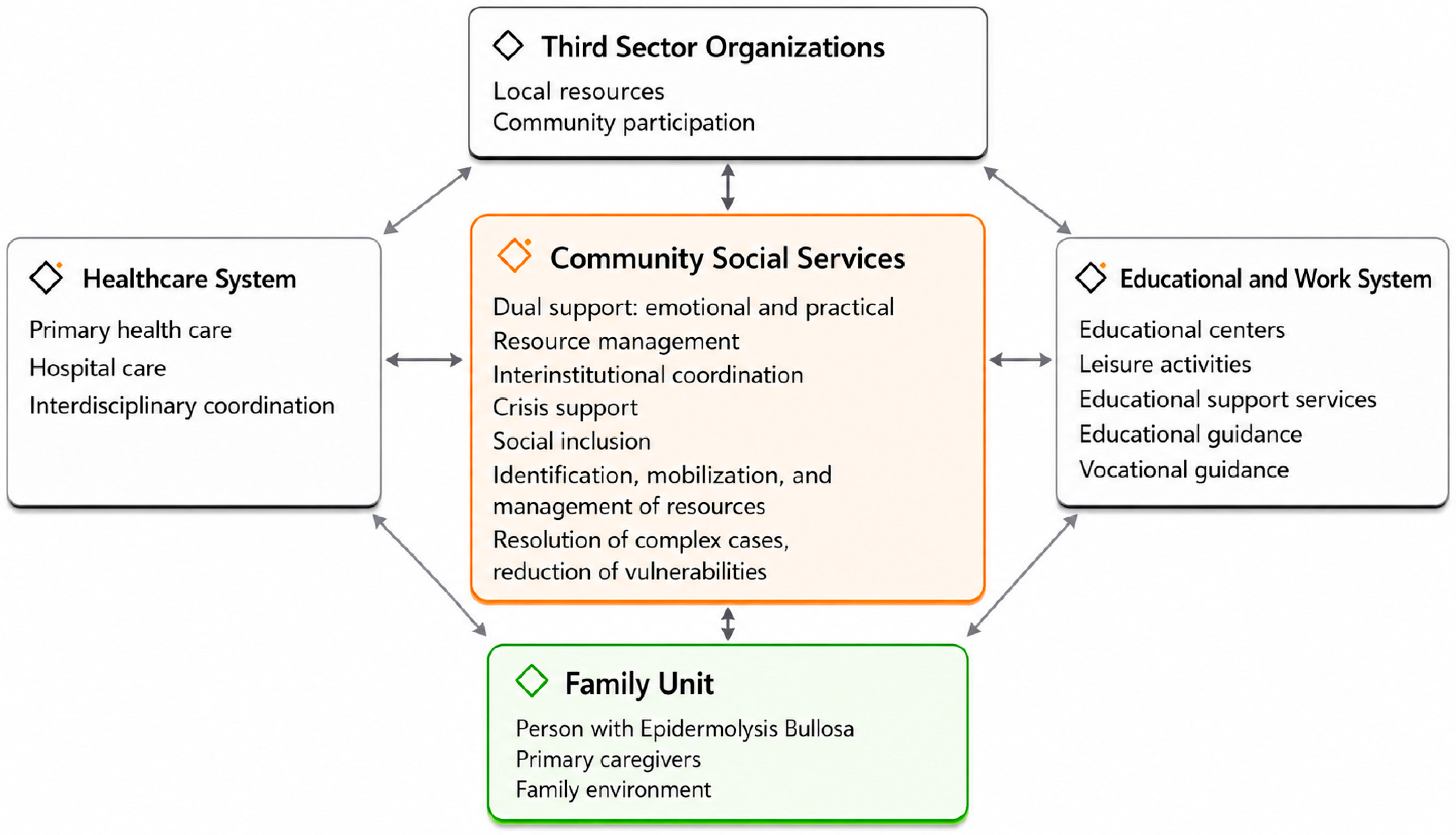

The Role of Social Work in Supporting Individuals with Epidermolysis Bullosa and Their Families: Community Social Services as the Coordinating Hub



Abstract
1. Introduction
1.1. Background
1.2. Literature Review
1.3. Study Objective and Research Question
2. Materials and Methods
2.1. Research Design
2.2. Participants, Procedure and Instrument
2.3. Data Analysis
- Challenges in social work practice with individuals with EB and their families.
- Impacts of social work intervention on families and professional practice.
- Intervention strategies and interinstitutional coordination: the role of Community Social Services.
- Professional scope of the participant (CSS, PHC, TSO, EIP, HC).
- Type of EB treated (RDEB, JEB, EBS).
3. Results
3.1. Challenges in Social Work Practice with Individuals with Epidermolysis Bullosa and Their Families
“Most professionals are unfamiliar with the disease, which creates insecurity in practice and delays decision-making.” HC/RDEB (2)
“Many families prefer not to request any resources due to waiting times and the complexity of the procedures.” CSS/EBS (19)
“For families from abroad, additional documents and language barriers generate even greater delays, adding to socioeconomic vulnerability that is often significant in these contexts.” CSS/RDEB (5)
“The families we support often live in situations of structural poverty, requiring more intensive and urgent interventions. The problem is institutional, as we do not have adequate resources.” PHC/JEB (13)
“We work with many families who, in addition to coping with the disease, face economic precarity and difficulty accessing basic services. Care often focuses on addressing urgent needs.” CSS/JEB (14)
“Some parents limit their children’s participation out of fear of harm, negatively impacting their social and emotional development.” TSO/RDEB (12)
3.2. Impacts of Social Work Intervention on Families and Professional Practice
“Families who were initially overwhelmed were able to manage the condition independently thanks to therapeutic education and effective coordination.” HC/RDEB (9)
“When I first engaged with the family, there was considerable distrust toward services. Gradually, by accompanying them, explaining processes, and facilitating communication with different professionals, we helped them feel heard and understood.” CSS/JEB (16)
“Seeing the child engage in recreational activities and participate like any other child has been a very significant step for her and her family.” CSS/RDEB (7)
“The early moments were emotionally challenging, but with adequate information and training, everything becomes more manageable.” EIP/RDEB (8)
“When you see the child’s progress and the family’s peace of mind, you understand the real value of your intervention.” PHC/RDEB (1)
3.3. Intervention Strategies and Interinstitutional Coordination: The Role of Community Social Services
“Coordination with dermatology, pediatrics, nursing, and psychology is essential to address all dimensions of the case.” PHC/JEB (15)
“When communication between DEBRA Spain, social services, and hospital care flows smoothly, cases progress more effectively and families feel better supported.” PHC/RDEB (4)
“We do not just provide assistance; we also help organize routines and provide emotional support to the family. That makes a difference in their daily lives.” CSS/RDEB (6)
“Social services have the best understanding of the family’s overall reality and are able to coordinate referrals coherently.” PHC/RDEB (11)
“Having a clear point of reference improves continuity of care and reduces confusion for families.” TSO/RDEB (3)
4. Discussion
5. Conclusions
Author Contributions
Funding
Institutional Review Board Statement
Informed Consent Statement
Data Availability Statement
Acknowledgments
Conflicts of Interest
Abbreviations
| EB | Epidermolysis Bullosa |
| RDEB | Recessive dystrophic epidermolysis bullosa |
| JEB | Junctional Epidermolysis Bullosa |
| EBS | Epidermolysis Bullosa Simplex |
| CSS | Community Social Services |
| PHC | Primary Health Care |
| TSO | Third-Sector Organizations |
| HC | Hospital Care |
| EIP | Early Intervention Programs |
| CEIH | Human Research Ethics Committee |
| COREQ | Consolidated Criteria for Reporting Qualitative Research |
References
- Bardhan, Ajoy, Leena Bruckner-Tuderman, Iain L. C. Chapple, Jo-David D. Fine, Natasha Harper, Cristina Has, Thomas M. Magin, M. Peter Marinkovich, John F. Marshall, John A. McGrath, and et al. 2020. Epidermolysis Bullosa. Nature Reviews Disease Primers 6: 78. [Google Scholar] [CrossRef]
- Braun, Virginia, and Victoria Clarke. 2021. One Size Fits All? What Counts as Quality Practice in (Reflexive) Thematic Analysis? Qualitative Research in Psychology 18: 328–52. [Google Scholar] [CrossRef]
- Butterworth, Sondra, Andrew E. P. Mitchell, Elizabeth Mason-Whitehead, and Kate Martin. 2019. Epidermolysis Bullosa: How Social Support Affects Quality of Life. Nursing Times 115: 48–51. [Google Scholar] [CrossRef]
- Carrión, Juan, and Estrella Mayoral. 2017. Federación Española de Enfermedades Raras (FEDER). El Trabajo Social en las Enfermedades Raras: Un Enfoque Teórico y Práctico. Available online: https://dixit.gencat.cat/es/detalls/Article/trabajo_social_enfermedades_raras_enfoque (accessed on 20 December 2025).
- Chan, Jennifer M., Amy Weisman, Alex King, Susan Maksomski, Carrissa Shotwell, Claire Bailie, Helen Weaver, Rebecca Bodan, Estrella Guerrero, Matija Zmazek, and et al. 2019. Occupational Therapy for Epidermolysis Bullosa: Clinical Practice Guidelines. Orphanet Journal of Rare Diseases 14: 129. [Google Scholar] [CrossRef] [PubMed]
- Chateau, Antoinette, David Blackbeard, and Colleen Aldous. 2023. The Impact of Epidermolysis Bullosa on the Family and Healthcare Practitioners: A Scoping Review. International Journal of Dermatology 62: 459–75. [Google Scholar] [CrossRef] [PubMed]
- Dures, Elaine, Maianne Morris, Karen Gleeson, and Nichola Rumsey. 2010. ‘You’re Whatever the Patient Needs at the Time’: The Impact on Health and Social Care Professionals of Supporting People with Epidermolysis Bullosa. Chronic Illness 6: 215–27. [Google Scholar] [CrossRef] [PubMed]
- Dures, Emma, Mark Morris, Kate Gleeson, and Nichola Rumsey. 2011. The Psychosocial Impact of Epidermolysis Bullosa. Qualitative Health Research 21: 771–82. [Google Scholar] [CrossRef]
- Fine, Jo-David, and Helmut Hintner, eds. 2009. Life with Epidermolysis Bullosa (EB): Etiology, Diagnosis, Multidisciplinary Care and Therapy. Vienna: Springer. [Google Scholar] [CrossRef]
- Goldschneider, Kenneth, Julie Good, Emily Harrop, Christina Liossi, Anne Lynch-Jordan, Anna E. Martinez, Lynne G. Maxwell, and Danette Stanko-Lopp. 2014. Pain Care for Patients with Epidermolysis Bullosa: Best Care Practice Guidelines. BMC Medicine 12: 178. [Google Scholar] [CrossRef]
- Has, Cristina, Johann Bauer, Christine Bodemer, Mary C. Bolling, Leena Bruckner-Tuderman, Anja Diem, Jo-David D. Fine, Adrian Heagerty, Alain Hovnanian, M. Peter Marinkovich, and et al. 2020. Consensus Reclassification of Inherited Epidermolysis Bullosa and Other Disorders with Skin Fragility. British Journal of Dermatology 183: 614–27. [Google Scholar] [CrossRef]
- Has, Cristina, Maya El Hachem, Hana Bučková, Petr Fischer, Michaela Friedová, Celine Greco, Petra Nevoránková, Claudia Salavastru, Jemima E. Mellerio, Giovanna Zambruno, and et al. 2021. Practical Management of Epidermolysis Bullosa: Consensus Clinical Position Statement from the European Reference Network for Rare Skin Diseases. Journal of the European Academy of Dermatology and Venereology 35: 2349–60. [Google Scholar] [CrossRef]
- Hübl, Vinzenz, Lotta Berninger, and Cristina Has. 2026. Social participation of patients with epidermolysis bullosa: Barriers and facilitators in education, employment, and economic life—A biographic interview study. Orphanet Journal of Rare Diseases 21: 138. [Google Scholar] [CrossRef]
- Johnson, Jessica, Donna Adkins, and Sheila Chauvin. 2020. A Review of the Quality Indicators of Rigor in Qualitative Research. American Journal of Pharmaceutical Education 84: 138–46. [Google Scholar] [CrossRef]
- Laimer, Martin, Gabriela Pohla-Gubo, Anja Diem, Christine Prodinger, Johann W. Bauer, and Helmut Hintner. 2017. Epidermolysis Bullosa House Austria and Epidermolysis Bullosa Clinical Network: Example of a Centre of Expertise Implemented in a European Reference Network to Face the Burden of a Rare Disease. Wiener Klinische Wochenschrift 129: 1–7. [Google Scholar] [CrossRef][Green Version]
- Linertová, Renata, Márta Péntek, Benjamín Rodríguez-Díaz, Christine Bodemer, Vinzenz Hübl, May El Hachem, Gudrun Salamon, Verónica Alonso-Ferreira, Georgi Stefanov, Ritu Jain, and et al. 2026. Health-related quality of life in adults with epidermolysis bullosa: A cross-sectional study in seven European countries using EQ-5D-5L. Orphanet Journal of Rare Diseases 21: 167. [Google Scholar] [CrossRef] [PubMed]
- Marchili, Maria R., Giulia Spina, Marco Roversi, Cristina Mascolo, Elisabetta Pentimalli, Marialuisa Corbeddu, Andrea Diociaiuti, Maya El Hachem, and Alberto Villani. 2022. Epidermolysis Bullosa in Children: The Central Role of the Pediatrician. Orphanet Journal of Rare Diseases 17: 147. [Google Scholar] [CrossRef] [PubMed]
- Martin, Katherine, Sam Geuens, Judith Kristin Asche, Rebecca Bodan, Fiona Browne, Annette Downe, Nora G. García, Gemma Jaega, Bernadette Kennedy, Petra J. Mauritz, and et al. 2019. Psychosocial Recommendations for the Care of Children and Adults with Epidermolysis Bullosa and Their Family: Evidence Based Guidelines. Orphanet Journal of Rare Diseases 14: 133. [Google Scholar] [CrossRef]
- Martínez-Ripoll, Juan Manuel, Marta García-Domingo, and Yolanda María de la Fuente Robles. 2024. Epidermolysis Bullosa in Spain: A Qualitative Analysis of Its Social Impact on Families with Diagnosed Minors. Health Expectations: An International Journal of Public Participation in Health Care and Health Policy 27: e14128. [Google Scholar] [CrossRef] [PubMed]
- Martínez-Ripoll, Juan Manuel, Marta García-Domingo, and Yolanda María De la Fuente Robles. 2026. Interdisciplinary Approach in Pediatric Patients with Recessive Dystrophic Epidermolysis Bullosa: Experience from the Dermatology Service and the Palliative Care and Complex Chronic Patient Team at Sant Joan de Déu Hospital (Barcelona, Spain). Journal of Evaluation in Clinical Practice 32: e70345. [Google Scholar] [CrossRef]
- Maseda Pedrero, Rocío, Lucía Quintana Castanedo, Isabel Pérez Conde, María Jiménez González, María José Escámez Toledano, and Raúl de Lucas Laguna. 2021. Epidermolysis Bullosa in Spain: Observational Study of a Cohort of Patients Treated in a National Referral Center. Actas Dermo-Sifiliográficas 112: 781–93. [Google Scholar] [CrossRef]
- Pilo, Cinzia, Laura Benedan, Valentina Morra, May El Hachem, Gianluca Tadini, Giuseppina Annicchiarico, Michela Brena, Sophie Guez, Lucia Lospalluti, Mariani Wigley, and et al. 2026. Quality of life in children and adults with epidermolysis bullosa: The QoL-REB explorative study. Orphanet Journal of Rare Diseases 21: 181. [Google Scholar] [CrossRef]
- Popenhagen, Mark P., Paola Genovese, Mo Blishen, Dilini Rajapakse, Anja Diem, Alex King, Jennifer Chan, Eduard Pellicer Arasa, Simone Baird, Anna Carolina Ferreira da Rocha, and et al. 2023. Consensus-Based Guidelines for the Provision of Palliative and End-of-Life Care for People Living with Epidermolysis Bullosa. Orphanet Journal of Rare Diseases 18: 268. [Google Scholar] [CrossRef]
- Posada, Manuel, María Concepción Martín-Arribas, Álvaro Ramírez, Antonio Villaverde, and Ignacio Abaitua. 2008. Enfermedades Raras: Concepto, Epidemiología y Situación Actual en España. Anales del Sistema Sanitario de Navarra 31: 9–20. [Google Scholar] [CrossRef]
- Prodinger, Christine M., Martin Laimer, Johann W. Bauer, and Helmut Hintner. 2019. Epidermolysis Bullosa House Austria as a Role Model for the Care of a Rare Disease. Almanac of Clinical Medicine 47: 2–11. [Google Scholar] [CrossRef]
- Salamon, Gudrun, Sophie Strobl, Marie-Stephanie Matschnig, and Anja Diem. 2025. The Physical, Emotional, Social, and Functional Dimensions of Epidermolysis Bullosa: An Interview Study on Burdens and Helpful Aspects from a Patients’ Perspective. Orphanet Journal of Rare Diseases 20: 3. [Google Scholar] [CrossRef] [PubMed]
- Stamm, Beth H. 2010. The Concise ProQOL Manual, 2nd ed. Pocatello: ProQOL.org. [Google Scholar]
- Tong, Allison, Peter Sainsbury, and Jonathan Craig. 2007. Consolidated Criteria for Reporting Qualitative Research (COREQ): A 32-Item Checklist for Interviews and Focus Groups. International Journal for Quality in Health Care 19: 349–57. [Google Scholar] [CrossRef] [PubMed]
- Weisman, Amy, Jennifer M. Chan, Chantal LaPointe, Kaye Sjoholm, Kristy Steinau, Kaycie Artus, Suci Widhiati, Rebecca Bodan, Michelle Wood, Julio C. Salas-Alanis, and et al. 2021. Physiotherapy for Epidermolysis Bullosa: Clinical Practice Guidelines. Orphanet Journal of Rare Diseases 16: 406. [Google Scholar] [CrossRef] [PubMed]


| Sample Size | N = 20 | % |
|---|---|---|
| Age (mean, range) | 43.8 years (range: 33–53 years) | |
| Male | 4 | 20 |
| Female | 16 | 80 |
| Professional setting | ||
| Community Social Services | 7 | 35 |
| Early Intervention | 2 | 10 |
| Primary Health Care | 5 | 25 |
| Third Sector Organizations | 4 | 20 |
| Hospital | 2 | 10 |
| Type of Epidermolysis Bullosa | ||
| Recessive Dystrophic EB (RDEB) | 12 | 60 |
| Junctional EB (JEB) | 6 | 30 |
| EB Simplex (EBS) | 2 | 10 |
| Province | ||
| Barcelona | 8 | 40 |
| Madrid | 4 | 20 |
| Almería | 1 | 5 |
| Granada | 1 | 5 |
| Cáceres | 1 | 5 |
| Huesca | 1 | 5 |
| Málaga | 3 | 15 |
| Jaén | 1 | 5 |
| Challenge | Description | Consequences |
|---|---|---|
| Lack of training and protocols | Absence of specialized training EB; lack of standardized intervention guidelines | Professional insecurity; limited decision-making; risk of inconsistent interventions; lack of coordination with other services |
| Administrative barriers and lack of resources | Complex and lengthy bureaucratic procedures; shortage of human and material resources; additional difficulties in migrant families or those with language barriers | Delays in care; prioritization of administrative tasks over direct interventions; reduced quality of support |
| Family socioeconomic vulnerability | Poverty and social exclusion; instability and limitations in housing access | Emergency interventions; increased complexity in planning support; need for multidisciplinary coordination |
| Emotional overload and family dynamics | Overprotection of the person with EB; difficulty integrating the disease into family life | Management of emotional aspects; establishment of user-professional attachment bonds |
| Impact | Description |
|---|---|
| Family autonomy | Enhances families’ ability to manage the disease independently, make informed decisions, and cope with complex situations. |
| Caregiver emotional well-being | Reduces isolation, overload, and vulnerability by providing support, containment, and emotional security. |
| Social, educational, and occupational inclusion | Promotes full participation in community, educational, and work-related activities, fostering holistic development and social integration. |
| Professionals | Impact |
|---|---|
| Emotional impact | Initially, interventions may generate frustration, anxiety, or feelings of inadequacy, especially in contexts with limited resources or institutional barriers. |
| Professional growth and development | Over time, interventions foster the acquisition of new competencies, strengthen coordination and networking skills, and enhance mediation and decision-making abilities. |
Disclaimer/Publisher’s Note: The statements, opinions and data contained in all publications are solely those of the individual author(s) and contributor(s) and not of MDPI and/or the editor(s). MDPI and/or the editor(s) disclaim responsibility for any injury to people or property resulting from any ideas, methods, instructions or products referred to in the content. |
© 2026 by the authors. Licensee MDPI, Basel, Switzerland. This article is an open access article distributed under the terms and conditions of the Creative Commons Attribution (CC BY) license.
Share and Cite
Martínez-Ripoll, J.M.; García-Domingo, M.; de la Fuente Robles, Y.M. The Role of Social Work in Supporting Individuals with Epidermolysis Bullosa and Their Families: Community Social Services as the Coordinating Hub. Soc. Sci. 2026, 15, 371. https://doi.org/10.3390/socsci15060371
Martínez-Ripoll JM, García-Domingo M, de la Fuente Robles YM. The Role of Social Work in Supporting Individuals with Epidermolysis Bullosa and Their Families: Community Social Services as the Coordinating Hub. Social Sciences. 2026; 15(6):371. https://doi.org/10.3390/socsci15060371
Chicago/Turabian StyleMartínez-Ripoll, Juan Manuel, Marta García-Domingo, and Yolanda M. de la Fuente Robles. 2026. "The Role of Social Work in Supporting Individuals with Epidermolysis Bullosa and Their Families: Community Social Services as the Coordinating Hub" Social Sciences 15, no. 6: 371. https://doi.org/10.3390/socsci15060371
APA StyleMartínez-Ripoll, J. M., García-Domingo, M., & de la Fuente Robles, Y. M. (2026). The Role of Social Work in Supporting Individuals with Epidermolysis Bullosa and Their Families: Community Social Services as the Coordinating Hub. Social Sciences, 15(6), 371. https://doi.org/10.3390/socsci15060371