Article

Evaluating Generative AI for Identifying Ethical, Legal, and Social Dimensions in Migration Narratives: A Case Study of Ukrainian Discourse


1
Department of Computing Science, Umeå University, 901 87 Umeå, Sweden
2
Department of Intelligent Computer Systems, National Technical University “Kharkiv Polytechnic Institute”, 61002 Kharkiv, Ukraine
3
Department of Informatics in Management, Gdańsk University of Technology, 80-233 Gdańsk, Poland
*
Author to whom correspondence should be addressed.
Soc. Sci. 2026, 15(6), 341; https://doi.org/10.3390/socsci15060341

Submission received: 16 April 2026 / Revised: 14 May 2026 / Accepted: 19 May 2026 / Published: 22 May 2026
(This article belongs to the Section International Migration)

Abstract

Collective endorsement of shared values across diverse social groups is essential for the development and sustainability of democratic societies, yet capturing the perspectives of marginalised populations remains a persistent challenge, particularly when examined through ethical, legal, and social (ELS) lenses. This study develops a structured Migration ELS taxonomy to guide a GenAI-assisted semantic classification model designed to identify ELS dimensions in textual data. The model is fine-tuned and evaluated within a human-in-the-loop framework using expert annotations to ensure reliability and interpretive accuracy. As an empirical case, the approach is applied to migration-related official policy documents and narratives of Ukrainian migrants published on the Telegram platform. The resulting framework enables the analysis of alignment between governmental and migrant perspectives, revealing thematic and temporal divergences in ELS dimensions across institutional and user-generated discourse. The findings demonstrate the potential of this scalable framework, which combines taxonomy-driven modelling with generative AI and expert-in-the-loop validation, to reveal patterns of alignment and temporal dynamics in the representation of values across different social groups.

1. Introduction

One of the fundamental priorities in the development of democratic societies is the enhancement of social cohesion, a core dimension of which encompasses institutional trust and the collective endorsement of shared values across all social groups (United Nations High Commissioner for Refugees (UNHCR) 2024b). Obviously, the stability of communication between the government and citizens, facilitated by long-established communication and feedback mechanisms such as the media, social surveys, and monitoring assessments, as well as more recent open government platforms (Schmidthuber et al. 2021), plays a crucial role in strengthening social cohesion.
At the same time, the reflections and narratives of marginalised segments of society, for instance, refugees or immigrants, are not always immediately apparent to governmental institutions, often due to limited representation within conventional feedback mechanisms, constraints in outreach efforts, or language barriers. Traditional data collection methods, such as social surveys, often fail to engage enough individuals from these closed communities (Ojo et al. 2024). Additionally, marginalised individuals may lack awareness of existing communication and feedback mechanisms, further widening the gap in understanding their reflections and communicative expressions (Reddick et al. 2017).
A possible solution for integrating the opinions and views of all social groups is the analysis of large volumes of user-generated data from social networks, which enables a more comprehensive representation of the full range of opinions, ways of thinking, and perspectives within society. At the same time, the analysis of large-scale data offers unique insights into the lived experiences, concerns, and opinions of marginalised communities, while allowing this to be done without accessing personal or private information. Big data technologies and artificial intelligence (AI) methods, including generative AI (GenAI), can reveal critical trends in internal discourse across different population groups and detect misalignments between government policy and public sentiment that are often overlooked in traditional policy processes.
Moreover, in analysing societal discourse, it is essential to consider the convergence of social groups around shared public values, the negotiation of which plays a key role in fostering social cohesion. These values encompass the ethical, legal, and social aspects embedded in public communication. Particular attention should be paid to examining how these ethical, legal, and social dimensions are manifested in narratives related to marginalised groups, as well as to assessing the interaction between governmental regulation and public responses across these three normative domains. The successful alignment of policies and public opinion with the ELS dimensions ensures that institutional actions resonate with societal values and are recognised and shared across all social groups, thereby fostering long-term trust and cooperation (OECD 2022).
However, despite the growing use of generative AI for analysing large-scale social data, the extent to which these models can reliably capture key aspects of shared value narratives across different social groups remains uncertain. In particular, it is unclear whether generative AI can effectively identify and interpret ethical, legal, and social dimensions embedded in complex textual content. To address this issue, the study examines the following research question:
[RQ1] Can generative AI models identify the ethical, legal, and social (ELS) components embedded in textual content?
To examine this question, the study employs a human-in-the-loop semantic classification approach, in which human experts guide and fine-tune the model while also validating its outputs.
As an empirical case to demonstrate the capability of generative AI to identify ELS dimensions in textual data, the study examines the alignment between governmental narratives and those of Ukrainian migrants, who were displaced as a result of the Russian invasion. Considering Ukrainian migrants as a case of a marginalised group provides a unique opportunity for analysis due to the scale and urgency of the crisis: over six million Ukrainians were forcibly displaced by the end of 2024, according to the United Nations High Commissioner for Refugees (UNHCR) (2024a). This humanitarian emergency not only exposed the limitations of existing regulatory frameworks but also will be able to test the adaptability of public institutions in addressing key needs across ethical, legal, and social dimensions.
Accordingly, as a practical demonstration of the applicability of this approach, the study examines the extent to which European governmental regulations align with the lived experiences and normative expectations of Ukrainian migrants, viewed through the lenses of ELS dimensions. To this end, the study seeks to answer the following second research question:
[RQ2] How can the alignment between governmental and Ukrainian migrant narratives be evaluated across ethical, legal, and social aspects?
The research focused on the twelve main host countries for Ukrainian refugees: Poland, Canada, the United States, Slovakia, Moldova, Germany, the Czech Republic, Spain, the United Kingdom, Italy, Sweden, and Ireland (Fransen and De Haas 2022). It analyses Telegram messages posted by Ukrainian migrants between February 2022 and February 2024 in these countries and compares them with official EU migration-related regulations.
The study therefore combines two complementary objectives. First, it contributes methodologically by developing and evaluating a GenAI-assisted framework for identifying and analysing ethical, legal, and social dimensions in complex textual data. Second, it demonstrates the applicability of this framework through an empirical analysis of governmental and Ukrainian migrant narratives, using migration discourse as a real-world case study. The methodological and empirical components are intentionally integrated, as the migration case both motivates and validates the proposed analytical approach.
To address these two research questions, the study adopts an interdisciplinary approach that integrates generative AI with computational social science methods. Specifically, the analysis proceeds in four main steps: (i) the development of the Migration ELS Taxonomy, comprising hierarchically organised ethical, legal, and social dimensions; (ii) the application of a GenAI-assisted semantic classification model fine-tuned using this taxonomy; (iii) the validation of the model’s performance through comparison with expert annotations to assess reliability and interpretive accuracy; and (iv) the analysis of temporal and thematic variations in ELS dimensions across official policy documents and Ukrainian migrant narratives.
In this study, the term “migration narratives” refers to discursive and thematic representations of forced migration experiences, refugee integration, institutional responses, and public communication related to the displacement of Ukrainians following the Russian invasion. Although the analysed population primarily consists of refugees, the broader term “migrants” is occasionally used in relation to migration-related discourse and communication contexts discussed in the prior literature and policy documents.
The remainder of the paper is structured as follows. The Methods section presents the development of the ELS taxonomy and the implementation of the generative AI-based classification approach to address RQ1. The Results section applies this framework to analyse governmental and migrant narratives, addressing RQ2.

2. Literature Review

2.1. Generative AI for Analysing Social Discourse

The rapid expansion of social media platforms has produced vast amounts of user-generated content, including text posts, comments, images, and videos. Applying GenAI to the analysis of this large-scale data presents both challenges and opportunities for researchers aiming to understand public sentiments, opinions, and attitudes toward diverse societal issues. One of the key applications of GenAI in this field is sentiment analysis, reflecting a growing recognition of its potential for understanding and forecasting public opinion. For instance, Cerina and Duch (2026) presented a methodology for public opinion research by employing GenAI to derive structured, survey-like insights from unstructured social media content. Similarly, Wei et al. (2025) proposed a computational framework that integrates an enhanced LLM with retrieval-augmented generation (RAG) to predict both the opinions of influential figures and the emotional responses of general users. These approaches effectively anticipated public sentiment trends by synthesising influencer perspectives and aligning them with broader social reactions. Recent studies (Li et al. 2023; Krugmann and Hartmann 2024) demonstrated the successful use of LLM-based social media sentiment analysis to capture and forecast nuanced consumer emotions, opinions, and perceptions that shape social dynamics.
Other recent research also showed that GenAI-based approaches extend traditional sentiment analysis by enabling the identification, clustering, and interpretation of thematic patterns in large-scale social conversations (Wang and Zhai 2017). Unlike traditional unsupervised models such as Latent Dirichlet Allocation (LDA) and Non-Negative Matrix Factorization (NMF), which primarily identify statistical co-occurrences of words, GenAI models were shown to be capable of capturing higher-order semantic relationships and contextual dependencies between themes (Chiarello et al. 2024; Matwin et al. 2023). This shift from probabilistic to generative modelling expanded analytical precision and allowed for a better representation of the complexity of social discourse. As explored by (Khairova et al. 2024), identifying the thematic distribution of social attention and opinion dynamics over time can contribute to strengthening social cohesion by revealing the issues that matter most to specific communities. In turn, Gokcimen and Das (2024) applied topic modelling to climate change discourse, uncovering dominant themes, emerging trends, and key stakeholders.
In recent years, LLMs have demonstrated the capacity to mirror how humans structure knowledge and meaning within specific domains, encapsulating this through the conceptual organisation of language. According to (Du et al. 2025), this capability was evident in their ability to answer questions, generate coherent text, and infer information about entities, objects, and properties that they had not directly encountered. Further evidence was provided by (N. Xu et al. 2025) and (Q. Xu et al. 2025), who argued that although LLMs do not possess grounded representations beyond text, the relational structures they capture among linguistic concepts can approximate the cognitive organisation of conceptual knowledge. In their study, Patel and Pavlick (2022) examined whether LLMs were able to map widely recognised conceptual categories, such as spatial directions, cardinal directions, and colour names, onto unseen textual contexts. The results suggested that these models were able to successfully align such abstractions, including emotional and temporal concepts, with coherent internal representations.
There is a growing research focus on fine-tuning LLMs to convert unstructured text into structured conceptual representations capable of capturing complex and overlapping issues. One example is the work by (Perin et al. 2023), who employed fine-tuned models to extract structured representations from unstructured text, identifying 51 distinct concepts with a maximum precision of 0.71. Similarly, Wan et al. (2024) developed taxonomies of user intent and conversational domains based on transcripts from Microsoft’s Bing Consumer Copilot system. The study employed GPT-4 and GPT-3.5-Turbo models for taxonomy generation and evaluation. These taxonomies, comprising 10 and 25 categories, respectively, were subsequently used to fine-tune the LLM for text classification, with performance evaluated using Cohen’s Kappa coefficient. In recent years, increasing attention has been directed toward applying LLMs to the classification of abstract conceptual categories, including behavioural emotions (Merrill et al. 2021) and societal and cultural norms (Perin et al. 2023).
Taken together, these studies demonstrate a progressive shift from surface-level language modelling toward the effective interpretation of complex, abstract, overlapping, and often morally significant categories. However, while existing research highlights the utility of GenAI in extracting structured sentiment, identifying influential opinions, and mapping broad public discourse, it rarely addresses how such tools can be used to compare divergent social narratives through the lens of ethical, legal, and social norms. This gap motivates the present study, which investigates whether generative AI models can systematically identify ELS dimensions in textual data.

2.2. Taxonomic Challenges in Analysing ELS Dimensions from Migration Narratives

Despite the growing application of GenAI in analysing social media content, several challenges remain unresolved. As noted by (Chimbga 2023), key issues include ethical concerns related to data privacy, algorithmic and data bias, and the potential misuse of digital content. Further complications arise when attempting to extract insights from social media generated by marginalised communities, such as migrant groups. These challenges stem not only from the limitations and inconsistencies of official migration records but also from the limited accessibility and visibility of migrants’ own perspectives. Datasets related to migration often suffer from incompleteness, inaccuracies, and inconsistent reporting standards across countries and institutions (Ahmad Yar and Bircan 2025). For example, differences in classification practices, as well as underreporting, can distort the interpretation of migration patterns. Moreover, these datasets frequently lack information about migrants’ motivations or socioeconomic backgrounds, which restricts the ability of researchers and policymakers to fully understand the complexity of migration flows (Sahin-Mencutek 2020).
Importantly, quantitative data alone cannot capture the complex and context-dependent aspects of migrant narratives. A more comprehensive understanding therefore requires the integration of qualitative insights, particularly those derived from social network content. However, analysing such textual data introduces additional challenges, including information oversaturation (Abkenar et al. 2023) and linguistic limitations associated with low-resource languages (Dash and Ramamoorthy 2019). In such cases, automated translation may fail to preserve linguistic or cultural nuances essential for accurate analysis (Vanmassenhove et al. 2019).
These challenges, particularly those related to linguistic variability and the interpretation of complex textual data, further complicate the integration of social media data with official datasets. Therefore, despite its potential, social media data remains difficult to integrate with official sources, especially when working with migrant narratives. Existing methods still lack robust frameworks to bridge this gap. Building on these methodological challenges, recent research has increasingly turned toward the development of taxonomies as a way to organise complex migration-related textual information.
One illustration of this approach is provided by (Mendola and Pera 2022), who developed a multilayered taxonomy of refugee vulnerability that considers multiple dimensions of the concept, including legal status, physical safety, socio-economic exclusion, and psychological harm. (Pisarevskaya et al. 2020) developed a meta-taxonomy of migration studies that traced the field’s evolution across disciplines, thematic domains, and methodological approaches. Their analysis identified shifting thematic clusters over time, including integration, governance, and identity. The taxonomy developed by IMISCOE (International Migration, Integration and Social Cohesion Network) and described by (Scholten 2022) provides a systematic framework for organising the field of migration studies. It categorises research across thematic areas and offers a structured overview of how the field has evolved and diversified over time.
However, these studies, while useful for structuring information related to migration processes, primarily conceptualise and classify relatively concrete dimensions of the migration experience, such as research domains, psychosocial support needs, or economic conditions (Iacus et al. 2025). Although existing taxonomies provide important insights into refugee vulnerability and methodological challenges in migration research, they rarely address the structuring of ethical, legal, and social dimensions that emerge from migration discourse.
Moreover, although interest in applying LLMs to abstract and normative domains is increasing, as demonstrated in recent work analysing ethical, legal, and social aspects in responsible AI for the agri-food sector (van Hilten et al. 2025), there remains limited research that systematically examines the capacity of LLMs to classify and interpret ethical, legal, and social norms simultaneously. This gap is particularly evident in multilingual settings and in complex domains such as migration and public policy.
To address this gap between the capabilities of generative AI and the lack of conceptual taxonomies for abstract, intersectional, and complex interpretive concepts, we propose a novel taxonomy specifically designed for analysing ethical, legal, and social dimensions in migration-related narratives. Using this taxonomy, we evaluate the ability of a generative AI model to identify and map ELS concepts across both citizen-driven migration discourse and corresponding governmental policy texts.

3. Materials and Methods

This section addresses RQ1 by presenting the development of the Migration ELS Taxonomy and the generative AI-based framework used to identify and classify ethical, legal, and social dimensions in textual data. It also describes the data collection and preprocessing procedures underpinning the analysis.

3.1. Data Collection

To achieve the objectives of this study, two datasets were utilised: (1) Dataset 1, consisting of official governmental publications from multiple countries addressing regulations related to Ukrainian refugees (Redozub and Khairova 2025), and (2) Dataset 2, comprising textual messages posted by Ukrainian refugees on public Telegram channels (Khairova et al. 2025). Data collection for both datasets was guided by the query: “migrationORmigrantsORrefugeeANDUkrain*”, ensuring thematic relevance to Ukrainian refugee issues across both institutional sources and user-generated social media content.
The data selection process for Dataset 1 involved collecting official governmental documents from a variety of national and international sources. Web scraping was performed using Python’s BeautifulSoup library (beautifulsoup4 version 4.11.2), and data from PDF files were extracted using PyPDF2 version 1.26.0. The LangDetect library (version 1.0.9) was used to identify the language of each document, while the WordNinja package (version 2.0.0) was applied to segment and clean raw text. For audio and video content, multilingual transcriptions were generated using the Sonix web service. In cases where automated scraping was restricted or unfeasible due to the limited scale or structure of certain sources, manual extraction methods were applied.
In total, Dataset 1 comprises documents collected from 34 information sources across multiple countries, resulting in a dataset of 708 official texts in English, Ukrainian, and Russian. These documents address issues related to Ukrainian refugee migration and living conditions abroad between February 2022 and February 2024. A substantial proportion of the dataset (33.05%) was sourced from the Global Data Institute of the IOM, as well as from the official websites of the IOM and its Ukrainian branch. Government portals of host countries contributed 32.06% of the documents, while an additional 15.25% originated from national ministries and other governmental institutions. A further 12.15% of the documents were collected from the State Migration Service of Ukraine and migration services in host countries. Social media and multimedia sources were also included, with 1.98% of the documents derived from Twitter posts by government officials and 5.51% transcribed from official YouTube channels. Table 1 summarises the distribution of documents across these sources.
Telegram was selected as the primary platform for this research due to its central role in public discourse among Ukrainian refugees (Ghasiya and Sasahara 2023) and its accessibility for collecting textual data through open channels (Navumau and Matveieva 2025; Willaert 2023). While the analysed Telegram messages cannot be assumed to fully represent all Ukrainian migrants, previous studies have shown that Telegram constitutes one of the central communication platforms among displaced Ukrainian communities. Consequently, the discourse observed in these Telegram channels may, with appropriate methodological caution, provide important insights into broader communication and narrative patterns among Ukrainian migrants displaced by the war.
The data selection process for Dataset 2 involved collecting messages from Ukrainian refugee group chats on Telegram. Data collection focused on messages published between February 2022 and February 2024 and was conducted using the Telethon Python library, which enables automated access to publicly available Telegram content. To minimise potential geographical bias and ensure the reliability and integrity of the dataset, the selection of Telegram channels was guided by United Nations migration flow statistics identifying the main host countries that receive the largest numbers of Ukrainian refugees (United Nations High Commissioner for Refugees (UNHCR) 2024b). In total, 632,372 messages were collected.
To ensure linguistic consistency and prepare the textual data for further analysis, the texts from both Dataset 1 and Dataset 2 were processed using several cleaning steps, including removal of emojis, symbols, and icons; basic text cleaning; and word lemmatisation. To harmonise the textual content across datasets and align it with the predominantly English-language training models used in GenAI systems, Dataset 2 (messages posted by Ukrainian refugees) was translated from Ukrainian and Russian into English using the Google Translate API, while Dataset 1 (official governmental publications) was originally in English.
Table 2 presents a comparative overview of the data distribution across the selected countries, including both official governmental documents (Dataset 1) and Telegram messages (Dataset 2).

3.2. Four-Step Methodological Framework for Measuring ELS Dimensions

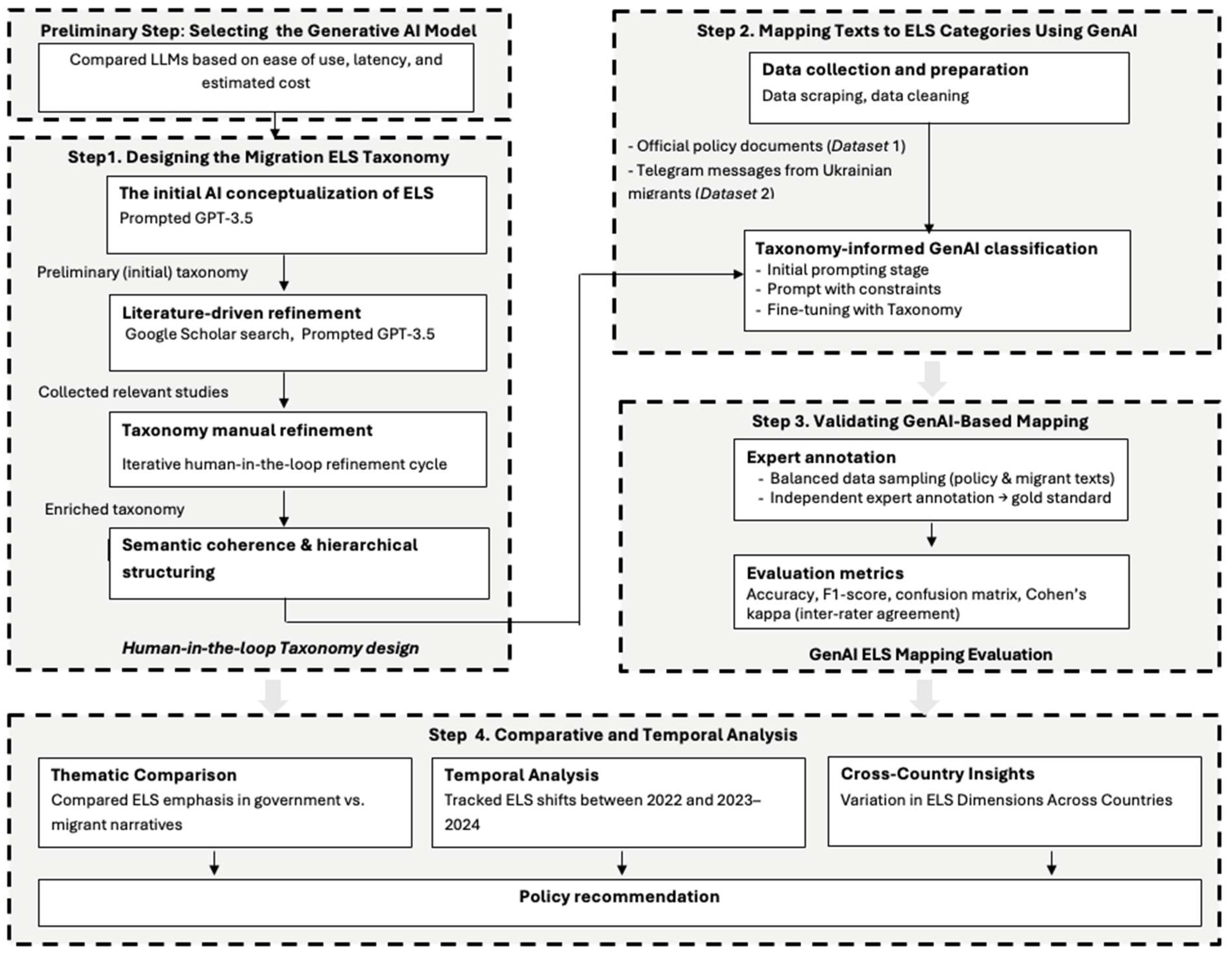
To assess the interaction between government regulations and public discourse across the three normative dimensions (ELS), a GenAI-assisted mapping process was applied, followed by comparative and temporal analyses. The methodological framework is presented in Figure 1 and comprises a preliminary stage followed by four core processing steps.
The preliminary stage of the methodology involved selecting a generative AI model aligned with the analytical objectives of the study. Since the aim was to investigate the applicability of generative AI for identifying fundamental ELS components embedded in textual content, rather than conducting a benchmark comparison between multiple models, the selection process was guided primarily by practical and operational considerations. These considerations included ease of use, latency, estimated cost per million processed tokens, and the approximate cost of processing a typical unit of analysis (250 input tokens and 50 output tokens). A comparative assessment was conducted using three widely used generative AI models: LLaMA-2, Claude 3, and GPT-3.5. Although all three models demonstrated the capability to support ELS-oriented text classification, GPT-3.5 was selected due to its comprehensive documentation, stable response latency, accessible API infrastructure, and relatively lower operational costs.
The first core component of the methodology is the development of a dedicated Migration ELS taxonomy. This taxonomy is required due to the abstract, overlapping, and context-dependent nature of ethical, legal, and social categories, which lack the concrete and distinct features typically relied upon by machine learning models for reliable classification. These categories are expressed through normative language and are shaped by cultural, institutional, and situational factors (Kumari 2024). This variability is particularly evident in the context of migration, where policy frameworks, public discourse, and lived experiences intersect.
Guided by these considerations, the taxonomy was developed through an iterative, expert-informed process involving cycles of refinement, evaluation, and feedback. During the evaluation and comparative analysis stages, it serves both as a classification framework and as an interpretive bridge between human reasoning and computational processing (Akata et al. 2020).
In the second step, texts from both datasets were mapped to one of the predefined domains (ethical, legal, or social) using a generative AI model. By embedding the Migration ELS Taxonomy into the prompt design, the model was guided towards more accurate, consistent, and transparent mapping of ELS concepts across both governmental documents and migrant-authored texts.
In the third step, the capability of the generative AI model to map governmental and migrant narratives to the ELS categories was evaluated through an expert-based validation procedure. This involved human experts manually annotating a subset of the dataset according to the three predefined dimensions. Model performance was then assessed using standard metrics, including accuracy, F1-score, and Cohen’s kappa, to evaluate agreement between annotations.
In the final step, comparative and temporal analyses were conducted to examine how governmental and Ukrainian migrant narratives align across the ELS dimensions, and how this alignment evolves over time. The four-step methodological framework for using generative AI to measure alignment between official and public narratives across ELS dimensions in Ukrainian migration discourse is presented in more detail below.

3.2.1. Human-in-the-Loop Development for the Migration ELS Taxonomy

The development of the Migration ELS Taxonomy follows a four-step pipeline, beginning with the initial conceptualisation of ELS categories generated by the GenAI model and progressing toward a refined and robust definition of ethical, legal, and social concepts within the migration domain through a human-in-the-loop refinement process.
In the first step, we examined how the GenAI model represents the ELS categories by prompting it to define and describe the key features of each domain (initial conceptual mapping). Based on the model’s responses, a preliminary set of representative concepts corresponding to each category was identified, as presented in Table 3.
In the second step, the taxonomy was expanded and contextualised for the migration domain through a review of the academic literature. To identify relevant publications, six keyword combinations were used in Google Scholar searches: “migration legal,” “migration legal Ukraine,” “migration social,” “migration social Ukraine,” “migration ethics,” and “migration ethics Ukraine.” For each query, the first five pages of search results were screened, and studies published from 2022 onwards were included to ensure relevance to the context of Ukrainian refugees. This process resulted in 14 ethics-related, 24 legal, and 26 social studies. Based on these sources, and supported by iterative prompting with GPT-3.5, three extended sets of migration-related concepts were generated, comprising 250 ethical, 400 legal, and 450 social terms.
In the third step, following a human-in-the-loop framework, the taxonomy was manually refined through an iterative, co-creative process incorporating expert feedback and continuous revision. This step involved removing duplicate entries, excluding overly abstract or ambiguous terms, and assigning concepts that appeared across multiple domains to the most appropriate category.
In the fourth step, the Migration ELS Taxonomy was finalised by verifying its internal consistency and organising the entries hierarchically. Each category was structured using an “is-a” relationship framework, in which high-level concepts were divided into sub-concepts to ensure semantic coherence.

3.2.2. GenAI-Based Mapping of Texts to ELS Categories

To address RQ1, a GenAI-based classification approach was applied to assign the content of both datasets to one of the three ELS dimensions. For Dataset 1, the full text of each document was analysed without reduction. For Dataset 2, a stratified sampling strategy was employed to ensure geographical and thematic diversity across countries. From national Telegram channels in each country, a balanced random sample of 1000 messages was selected to capture variation in refugee discourse. Due to token limitations and API constraints, longer messages were truncated to fit within the model’s prompt capacity.
The model was then used to label each document and message as belonging to one of the three categories: ethical, legal, or social. To improve the accuracy and consistency of the model’s alignment with the ELS categories, the Migration ELS Taxonomy was incorporated into a fine-tuned prompt framework. This framework was refined over three phases through iterative adjustments to prompt both structure and content.
In the first prompting phase, a basic instruction was applied that asked the generative AI model to assign each text from both datasets to one of the predefined ELS categories or, where classification was uncertain, to assign the label Other. As generative models tend to default to concrete and easily recognisable topical classifications, the second phase introduced stricter constraints. In this phase, the prompt was modified to require the model to assign each input to one of the three predefined ELS categories, thereby eliminating the Other option.
In the final phase, the prompt was further refined using the Migration ELS Taxonomy as a conceptual foundation. Based on this taxonomy, detailed definitions and descriptors of the ethical, legal, and social domains were incorporated into the prompt, providing clearer semantic guidance for the model.

3.2.3. Validation of GenAI-Driven Classification

To assess the effectiveness of the generative AI model in mapping governmental and migrant narratives to the ELS categories, an expert-based validation procedure was conducted. This evaluation was performed after the final classification stage and focused on the outputs generated by the model, which had been refined through taxonomy-guided prompt engineering.
A balanced subset of 300 texts was randomly selected for validation, comprising 150 texts from the official policy dataset and 150 from the migrant-generated Telegram dataset. This sampling strategy ensured equal representation of source types, as well as diversity in topical domains and linguistic variation.
The selected subset was independently annotated by two human experts with domain expertise in migration-related legal, social, and ethical issues. Annotators were instructed to assign each text to one of four categories: Ethical, Legal, Social, or Other, relying primarily on the taxonomy definitions to enhance labelling consistency and minimise interpretative variation. The use of the Other category was discouraged. In cases of disagreement between the two annotators, a third expert adjudicated to determine the final label. This expert-annotated subset served as the gold standard for evaluating the model’s classification performance.
Model effectiveness was assessed using standard classification performance metrics, including accuracy, F1-score, and the confusion matrix. In addition, to evaluate the reliability of expert judgements and the consistency of the labelling process, inter-rater agreement between the two primary annotators was measured using Cohen’s kappa coefficient.

3.3. Research Ethics

Throughout the study, ethical considerations were addressed at each stage of the research process, particularly in relation to data handling, human involvement, and the interpretation of normative ELS components. These considerations were guided by the ELS framework and ethical design principles (Dignum et al. 2018; Teixeira et al. 2025; Qian et al. 2024).
During data collection, the primary ethical priority was to ensure that no personal, private, or sensitive information, particularly relating to a vulnerable population such as Ukrainian refugees, was included in the analysis in order to avoid exacerbating existing vulnerabilities (Lutz 2022). To address this, only publicly available data were used, including official documents and posts from open-access Telegram channels. All data were collected and processed in full compliance with data protection regulations, including the General Data Protection Regulation (GDPR). No identifiable user information was collected, stored, or analysed. The analysis focused strictly on public discourse rather than on individual users, thereby minimising the risk of harm, re-identification, or misrepresentation. This approach is consistent with best practices in ethical social media research (Williams et al. 2017; Townsend and Wallace 2016).
During the research design stage and the development of the Migration ELS taxonomy, ethical considerations focused on ensuring that the ethical, legal, and social dimensions were clearly defined to prevent bias and misinterpretation. To mitigate conceptual bias, the research team applied a transparent, iterative, and co-creative refinement process (Bowker and Star 2000). Ambiguous expressions, including politically charged language or vague references such as “imperial nations” or “social media information,” were excluded. Furthermore, overlapping concepts (e.g., “asylum seekers,” “human rights”) were carefully reassigned to the most contextually appropriate category. These refinements were guided by contextual analysis grounded in the migration literature rather than relying solely on automated tools (Arrieta et al. 2020).
During the narrative mapping stage using GenAI models, one of the primary ethical challenges was the risk of misclassification. Large language models often struggle with abstract categories and may generate biassed or reductive outputs when prompts are not carefully designed (Mittelstadt et al. 2016). To mitigate this risk, a human-in-the-loop approach was implemented, involving iterative prompt refinement and the integration of the taxonomy into the model’s classification process (Holzinger 2016). This approach reduced the likelihood of misrepresenting refugee voices or official documents. Care was also taken to prevent the model from reproducing harmful narratives (Leese et al. 2022). Only sanitised and relevant content was processed, and the use of broad categories such as Other was minimised through clearer conceptual guidance in the prompts.
To ensure ethical consistency during the expert evaluation stage, each expert was briefed on the purpose of the task, the sensitivity of the content, and the expectations for fair and consistent classification (Fort et al. 2011). Experts were instructed to use the Other category sparingly and only when the content clearly did not correspond to ethical, legal, or social concepts. To enhance transparency and reduce subjective bias, each set of texts was independently evaluated by two experts.
In the comparative and temporal analysis stage, a key ethical priority was to avoid attributing blame to any specific actor or policy. The analysis was descriptive and framed to highlight divergence or convergence in value expression, rather than to make normative judgements.

4. Results

This section presents the results of the study. Section 4.1, Section 4.2 and Section 4.3 report on the development and validation of the ELS taxonomy and the generative AI-based classification framework, while Section 4.4 applies this framework to analyse the alignment between governmental and Ukrainian migrant narratives.

4.1. Migration ELS Taxonomy Development

By implementing a four-step human-in-the-loop pipeline, a comprehensive Migration ELS Taxonomy comprising 450 elements was developed. The refinement process described in Section 3.2.1 progressively enhanced the precision, internal consistency, and normative clarity of the ethical, legal, and social domains. Table 4 presents the phased improvements achieved at each stage of the taxonomy’s development.
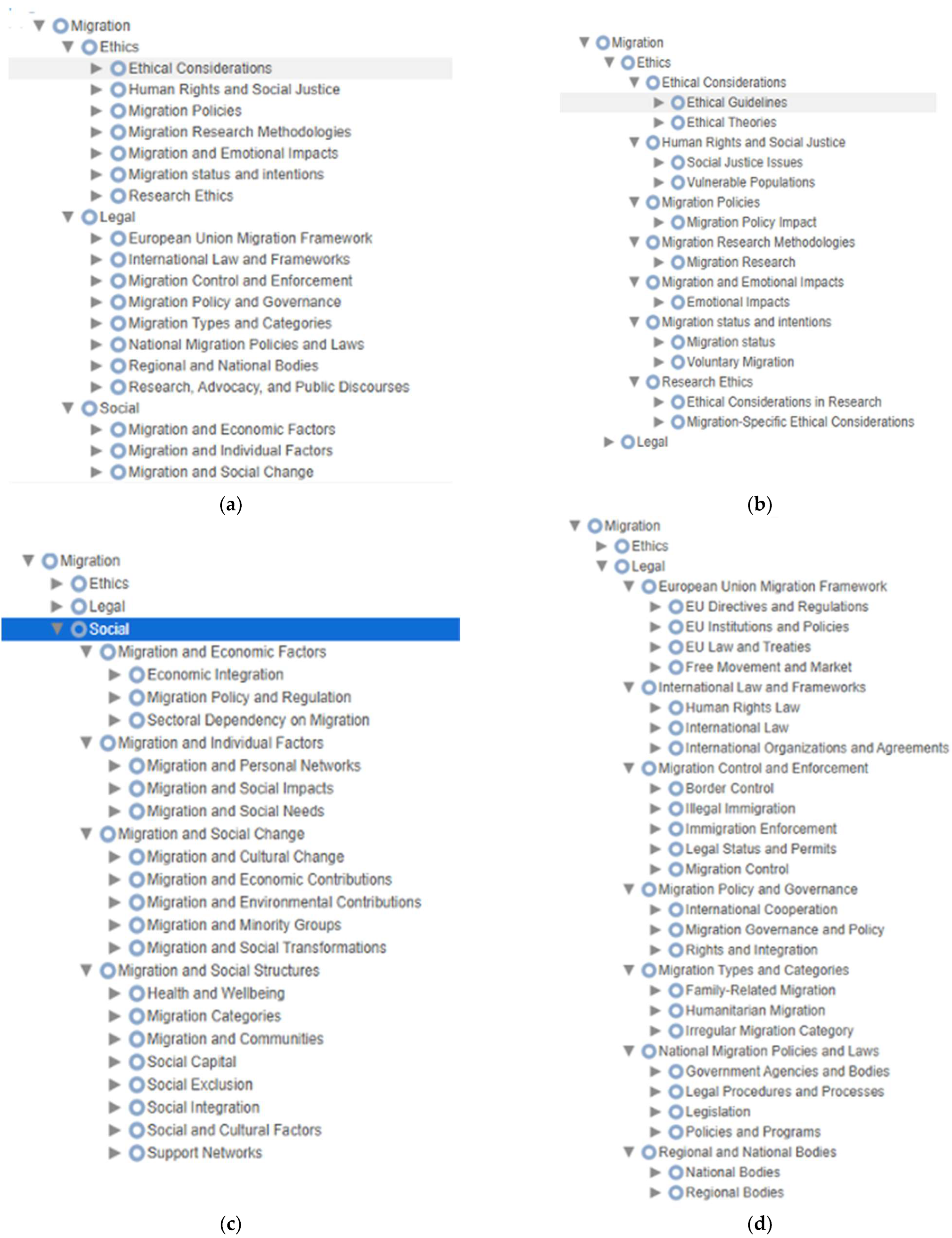
The hierarchically organised taxonomy comprises three normative dimensions: ethical (77 concepts, 17.1%), legal (145 concepts, 32.2%), and social (228 concepts, 50.7%). Table 5 presents the top-level hierarchy of the finalised Migration ELS taxonomy, while Figure A1 in Appendix A provides the full taxonomy structure.

4.2. ELS Taxonomy-Guided GenAI Classification

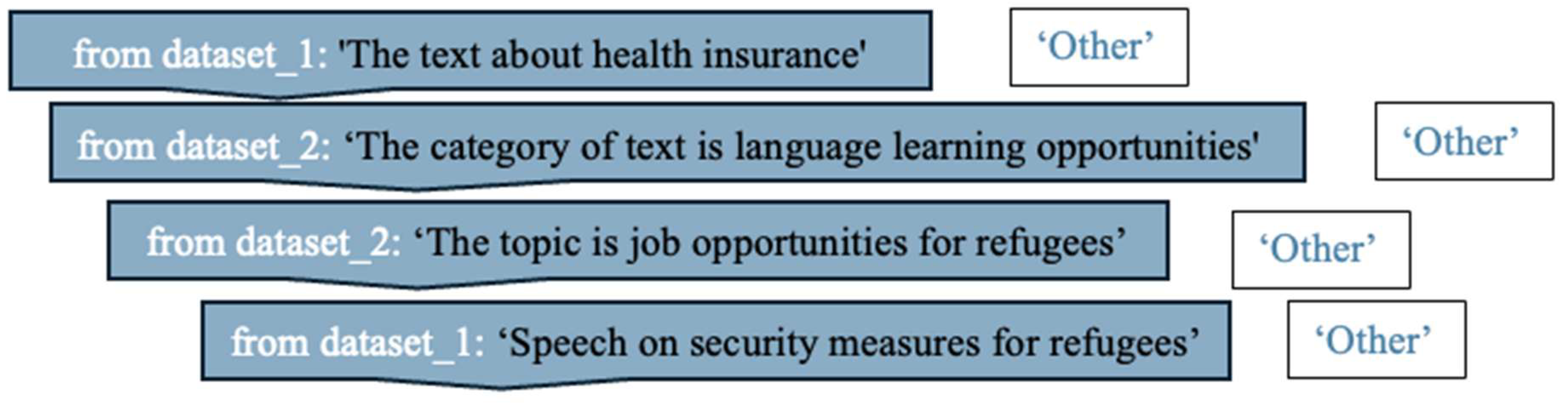
In accordance with the described approach, during the initial prompting stage, a basic instruction was applied in which the GenAI model was asked to categorise texts from both datasets into one of the predefined ELS categories or, where classification was uncertain, to assign the label Other. This approach resulted in a considerable proportion of texts being classified as Other: 12% for official policy documents and 20% for Telegram messages. Figure 2 presents examples of text themes assigned by the model to the Other category during this stage. Examination of these outputs indicates the model’s tendency to default to concrete, easily identifiable thematic classifications when uncertainty is present.
In the second phase of the fine-tuning process, the prompt was modified to impose stricter constraints. The model was explicitly instructed to assign each input to one of the three predefined ELS categories, thereby strongly discouraging the use of the Other option. This adjustment led to a notable reduction in Other classifications, decreasing to 4.5% in official texts and 10.5% in social media texts.
In the final, taxonomy-informed phase, the prompt was further refined using the Migration ELS taxonomy as a conceptual foundation. By embedding detailed descriptions of the ethical, legal, and social categories into the prompt, the model achieved greater contextual awareness and improved its ability to classify content. As a result, the vast majority of texts were successfully assigned to one of the three ELS categories, with only a small fraction remaining in the Other category. In this phase, the proportion of Other responses decreased to 0.7% for official documents and 1.9% for Telegram messages.
Table 6 presents the three phases of GenAI-based ELS text mapping (initial, constraint-based, and taxonomy-informed). Across these phases, the model progressively reduces the proportion of texts assigned to the undefined Other category. At the same time, the model increases the proportion of texts mapped to the legal category (from 16% to 32.7%) and slightly decreases social classifications (from 72% to 66.3%) in Dataset 1. In Dataset 2, a similar pattern is observed, with increases in texts mapped to both the social category (from 64% to 75%) and the legal category (from 15% to 22.8%).
Appendix B presents selected excerpts from official governmental documents and Telegram-based migrant discourse corresponding to each ELS category as examples of the model’s classification.

4.3. Results of Expert-Based Validation of GenAI-Driven Mapping

To evaluate the generative AI model’s ability to identify ethical, legal, and social aspects embedded in textual content, an assessment was conducted using the results obtained after the final prompt refinement stage, in which the Migration ELS taxonomy was incorporated into the prompt.
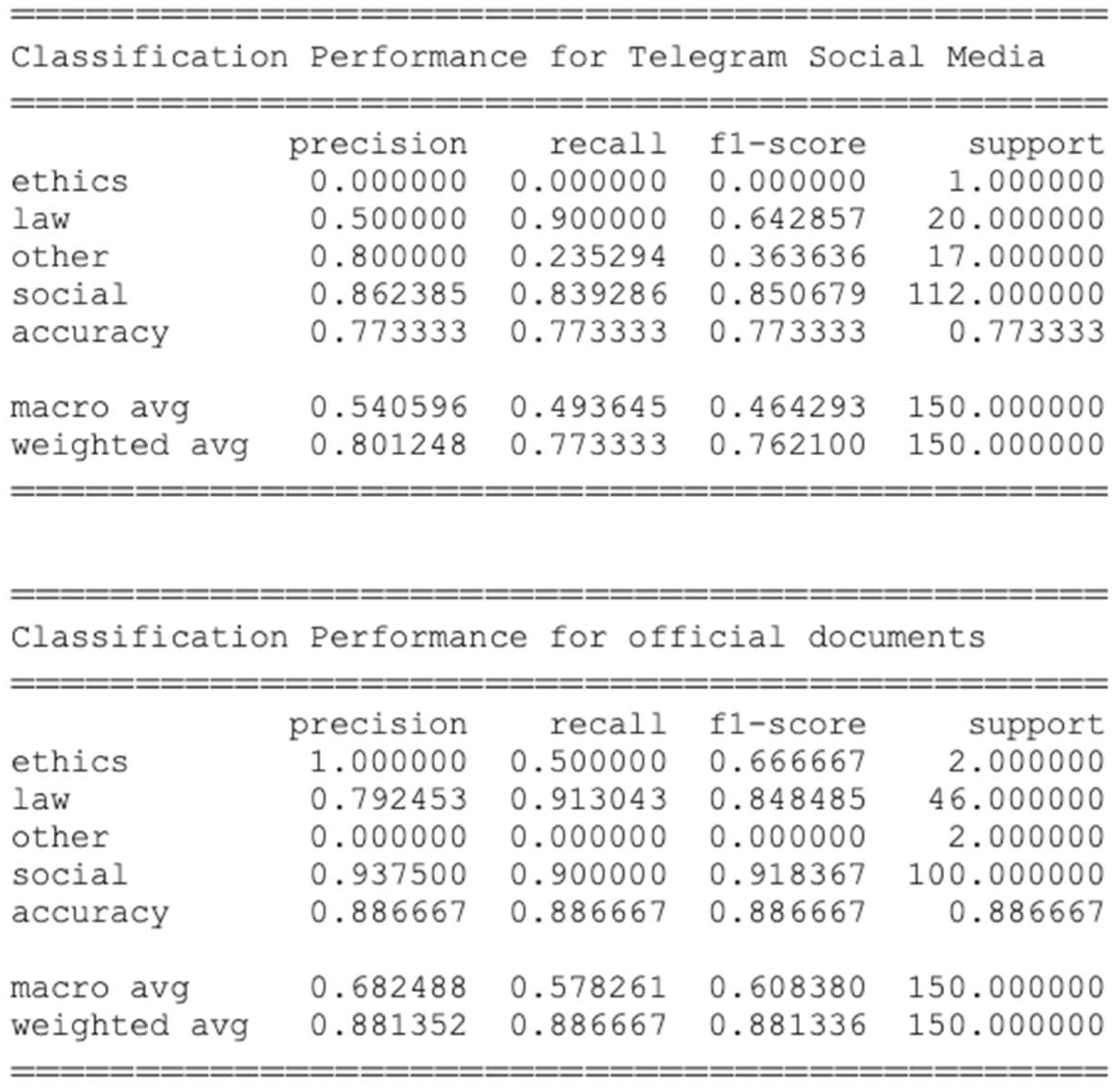
An expert-annotated subset of 300 text instances served as the gold standard for evaluation. Model performance was assessed using precision, recall, and F1-score. In cases where the two expert annotations did not agree, disagreements were resolved by a third expert, whose judgement was used to assign the final label. Figure 3 compares classification performance across the two datasets, comprising official documents and texts from the Telegram social network.
The results indicate that discrepancies between expert annotations and model classifications most frequently occur when the model assigns a text to the legal category, while experts classify the same text as social. Table 7 presents several examples of such mismatches across both the official document dataset and the social media dataset.

4.4. Comparative and Temporal Analysis of ELS Mapping Results

To address RQ2, a comparative analysis was conducted using the expert-validated mappings as a basis for comparing governmental publications and migrant-generated social media posts across the ELS dimensions. The analysis comprises three components.
First, an examination of the conceptual alignment between the two datasets was conducted by analysing the distribution of content across the three ELS categories in both official policy documents and migrant-generated Telegram messages. This analysis enabled the identification of dimensions that were emphasised or underrepresented in each dataset and allowed us to assess the extent to which governmental communication aligns with refugee discourse across the ethical, legal, and social dimensions. As shown in Table 6, social values are predominant in both official and migrant communications, though they are more pronounced in refugee discourse at 75 percent than in government texts at 66.3 percent. Legal content is more strongly represented in official documents at 32.7 percent, compared to migrant messages at 22.8 percent. Ethical concerns are almost absent in both datasets, at 0.3 percent. The proportion of content classified as Other, referring to texts that could not be assigned to any ELS dimension, was minimised through model fine-tuning.
To capture temporal dynamics, we analysed how discourse priorities evolved in both governmental documents and migrant-generated Telegram messages, assessing patterns of convergence or divergence over the study period. By segmenting each dataset into yearly intervals and reapplying the ELS classification to these temporal subsets, we traced shifts in governmental and migrant priorities across different phases of the Ukrainian migration crisis. Table 8 presents the distribution of classified content across two time periods, 2022 and 2023–2024, for each dataset.
The results indicate a shift in governmental documents, with the legal component increasing from 29.3% to 37.7%, while the social component decreased from 69.0% to 62.3%. This pattern suggests a growing formalisation of governmental response strategies as the refugee crisis evolved. In contrast, refugee discourse remained consistently centred on social themes, accounting for about 75% of the content, with a slight decline in legal references and a modest increase in Other content. The ethical category remained marginal in both datasets, indicating a continued underrepresentation of ethical considerations in governmental discourse and migrant-generated Telegram discourse.
Finally, cross-country variation in the distribution of the three ELS dimensions was examined, with attention to potential explanatory factors underlying differences observed across countries. Table 9 presents the distribution of Telegram messages by country and ELS category.
In migrant discourse observed on Telegram, social values dominate across all national contexts, indicating a widespread focus on daily life, inclusion, and integration. The proportion of the legal component varies by country, reflecting differences in host-country regulatory environments. Ethical issues remain marginal in all cases, while the share of content classified as Other is low.
Taken together, these analyses enabled an assessment of both the overall alignment between the two datasets within the ELS framework and the evolution of ethical, legal, and social priorities over time among authorities and marginalised social groups.

5. Discussion

This study evaluates the capacity of generative AI models to identify and classify ELS dimensions in textual data, using a comparison between governmental and Ukrainian migrant narratives as an empirical context to demonstrate the applicability of this approach. The findings align with previous research showing that LLMs often struggle to process abstract or complex topics without tailored prompts or domain-specific guidance (Mittelstadt et al. 2016; Weidinger et al. 2022). This limitation is reflected in the model’s strong tendency to assign a substantial proportion of inputs to the “Other” category during the initial mapping phase. However, through three iterative prompt fine-tuning phases, including the integration of the Migration ELS Taxonomy, the proportion of unclassified content was reduced by over 26% in official documents and 32% in migrant messages. This result is consistent with prior work emphasising the importance of human-in-the-loop design in AI systems tasked with interpreting ethically and socially grounded discourse (Fjeld et al. 2020).
Expert validation of the AI-assigned ELS labels indicates that the model achieved high accuracy for governmental texts (0.89) and moderate to high accuracy for social media data (0.77), demonstrating substantial alignment with expert judgements. Notably, similar levels of inconsistency were observed among human experts, as reflected in Cohen’s kappa values ranging from 0.65 to 0.72 across official documents and Telegram messages. Thus, while not perfect, the model, which was fine-tuned using expert-informed taxonomies, achieved a level of performance comparable to that of human annotators when handling ambiguous or abstract categories. This finding is consistent with well-documented challenges in interpreting normative language, particularly in cross-cultural and policy contexts (Ghallab 2019).
Building on the demonstrated capacity of generative AI to reliably map textual data onto ELS dimensions, this study extends the analysis to examine broader patterns in the data. The findings suggest that, although further validation is required, there is an emerging trend of increasing misalignment in narrative priorities between governmental documents and migrant-generated discourse. This misalignment appears in two main forms: first, thematic misalignment, referring to differences in ethical, legal, and social emphasis between institutional discourse and migrant-generated discourse observed on Telegram; and second, temporal misalignment, referring to divergent trends in the emphasis of these dimensions over time across these two forms of discourse.
Thematic misalignment is evident in the proportional emphasis of ELS components. Although both governmental discourse and Telegram-based migrant discourse are dominated by social themes, official communications consistently underrepresent social concerns compared to migrant-authored texts (66.3% vs. 75%). In governmental discourse, social dimensions primarily focused on institutional support, integration programmes, accommodation policies, and financial assistance. Although similar themes were also present in Telegram-based migrant discourse, migrant-generated messages more frequently emphasised everyday lived experiences, including housing and employment difficulties, language adaptation, access to healthcare and education, emotional stress, and community support networks. At the same time, the legal dimension is more prominent in policy documents (32.7%) than in Telegram-based migrant discourse (22.8%), reflecting the stronger regulatory focus of official institutions. This legal emphasis in official documents was primarily associated with temporary protection regulations, registration procedures, and residence requirements. Although similar legal themes were also present in Telegram-based migrant discourse, migrant-generated messages more frequently focused on practical legal procedures and everyday administrative challenges related to residence status, documentation requirements, temporary protection regulations, and access to rights and services within host countries.
Temporal misalignment is illustrated by two contrasting trends. Compared with 2022, governmental discourse during the 2023–February 2024 period shifted toward legal concerns, increasing by 8.3%, while references to social issues decreased by 6.7%. In contrast, migrant-generated messages remained relatively stable, with the social dimension declining only marginally from 75.4% to 74.5% and no comparable increase in the legal dimension. This pattern suggests that, while migrant concerns have remained relatively stable, focusing on housing, employment, integration, and everyday resilience, governmental discourse became increasingly oriented toward legal and administrative aspects of migration management. Such temporal divergence may indicate a gradual decline in the responsiveness of state communication and may provide indirect evidence of policy approaches that increasingly prioritise regulatory control over social and humanitarian considerations in migration governance.
Cross-national analysis reveals additional nuances. In some countries, such as Ireland and Sweden, the alignment between institutional discourse and migrant discourse observed on Telegram appears relatively strong, with both emphasising social and legal dimensions. In contrast, in countries such as the United States and the Czech Republic, the divergence is more pronounced, with migrant discourse focusing on community-building and everyday survival, whereas official communication emphasises security and immigration control. Notably, the ethical dimension is either absent or nearly absent across all countries, indicating a substantial gap in ethical reflection.
One of the most unexpected findings is the minimal presence of the ethical category in both datasets (approximately 0.3%). Within the Migration ELS Taxonomy, the ethical dimension refers to normative considerations related to moral responsibility, social justice, human rights, inclusion, vulnerability, and the ethical treatment of migrants and refugees. It includes issues such as fairness in refugee treatment, protection of vulnerable groups, discrimination, humanitarian responsibility, moral obligations toward displaced populations, socially responsible behaviour within host communities, prevention of exploitation and misinformation, and the protection of social cohesion during crisis conditions. However, despite the relevance of these concerns in migration-related contexts, the study demonstrates that their explicit representation in both governmental and migrant-generated discourse remains very limited. This limited representation of ethically relevant content may stem either from limitations of the model and the taxonomy or from a genuine lack of explicit ethical discourse in the source material. Furthermore, it may be assumed that, unlike legal or social dimensions, ethical considerations are often embedded indirectly within broader narratives and expressed implicitly through discussions of legal procedures and social difficulties, which may make them more difficult to identify consistently through the model and taxonomy. However, given the similarly low proportion of ethics-related labels assigned by human experts (approximately 1.5% to 3%), the results allow us to conclude with a reasonable degree of confidence that both governmental and migrant discourses devote limited attention to explicit ethical considerations. This marginal presence of ethical reflection may indicate a broader institutional and societal tendency to prioritise legal and social-administrative concerns over moral and humanitarian considerations, an imbalance widely discussed in the field of public administration ethics (Mittelstadt et al. 2016).

Limitations

Despite the strengths of the proposed approach, several limitations should be acknowledged.
First, the definition and operationalisation of abstract concepts such as ethical, legal, and social dimensions remain inherently challenging. These categories are overlapping and difficult to delineate semantically, which affects both model performance and expert agreement. This complexity is reflected in the moderate classification performance and Cohen’s kappa scores observed in the study. Although ethical, legal, and social dimensions are inherently overlapping normative concepts, the study attempted to reduce category vagueness through the application of a four-step human-in-the-loop development pipeline for the Migration ELS Taxonomy, incorporating GenAI-assisted conceptual mapping, literature-based contextualisation, iterative expert refinement, and hierarchical semantic structuring. However, despite these methodological procedures, some degree of ambiguity between normative categories remains unavoidable in complex migration-related discourse.
Second, the representativeness and accessibility of social network data pose important limitations. Although prior research supports the relevance of Telegram data for Ukrainian migrants, social media platforms tend to be used more frequently by younger and more affluent populations (Blank 2017). In addition, access to aggregated data is often restricted by platform providers (Lutz 2022), which may introduce biases when generalising findings to broader populations or other marginalised groups.
Third, linguistic differences between datasets (Ukrainian/Russian versus English) may introduce semantic inconsistencies. The translation of normatively sensitive expressions may alter meaning and affect the accuracy of ELS classification. Moreover, reliance on generative AI may introduce biases in the interpretation of nuanced expressions, particularly ethical ones. In this study, differences between Ukrainian, Russian, and English texts may have limited the model’s ability to capture implicit ethical meanings, which could result in the underrepresentation of ethical dimensions compared to more clearly expressed legal and social categories.
Fourth, while the Migration ELS Taxonomy provides a useful structure for classification, certain concepts inherently span multiple normative domains. Although the human-in-the-loop approach helps resolve such ambiguities, further refinement of the taxonomy, including more granular categories, could enhance conceptual clarity and classification performance.
Finally, another limitation of the study is the reliance on a single generative AI model (GPT-3.5) for the classification and mapping of ELS dimensions. The objective of the study was not to compare the performance of different generative AI systems, but rather to investigate the capability of a GenAI-assisted framework for mapping and analysing ethical, legal, and social dimensions in migration-related discourse. Future studies may expand this approach through comparative evaluations involving multiple generative AI models and architectures.

6. Conclusions

This study makes the following contributions. First, it develops a novel Migration ELS Taxonomy for structuring ethical, legal, and social dimensions in migration-related discourse. Second, it evaluates the capacity of generative AI models to identify and classify these dimensions in textual data using a human-in-the-loop approach. Third, it applies this framework to analyse the alignment between governmental and Ukrainian migrant narratives, providing empirical insights into thematic and temporal divergences in ELS dimensions.
Ultimately, this study introduces an initial and scalable framework that combines a domain-specific ELS taxonomy with generative AI and human-in-the-loop validation to systematically assess the alignment between governmental narratives and the perspectives of marginalised populations under crisis conditions.

Author Contributions

Conceptualization, N.K. and V.D.; methodology, N.K. and N.R.; software, I.R.; validation. I.R.; formal analysis, V.D.; investigation, N.K.; resources, N.K. and I.R.; data curation, I.R.; writing—original draft preparation, N.K. and N.R.; writing—review and editing, N.K., N.R. and V.D.; visualization, I.R.; supervision, N.K.; project administration, N.K. All authors have read and agreed to the published version of the manuscript.

Funding

This research received no external funding. The APC was funded by Umeå University.

Institutional Review Board Statement

Not applicable.

Informed Consent Statement

Not applicable.

Data Availability Statement

The datasets analysed in this study are publicly available on Zenodo: Ukrainian Migrants Telegram Discourse (2022–2023), Version 2, available at https://doi.org/10.5281/zenodo.20155260, and Ukrainian Migrants: Official Sources Discourse (2022–2023), available at https://doi.org/10.5281/zenodo.17565879.

Conflicts of Interest

The authors declare no conflict of interest.

Abbreviations

The following abbreviations are used in this manuscript:
AIArtificial intelligence
GenAIGenerative AI
ELSEthical, legal, and social
LLMLarge Language Model

Appendix A

Figure A1. Overall structure of the Migration ELS Taxonomy: (a) A high-level schematic; (b) Ethical dimension; (c) Social dimension; (d) Legal dimension. The grey background indicates a cursor-highlighted taxonomy element, whereas the blue background denotes a cursor-highlighted taxonomy element displayed in its expanded form, including subordinate hierarchical components.
Socsci 15 00341 g0a1

Appendix B

Table A1. Examples of model-classified ELS excerpts and associated narratives in official governmental documents.
ExcerptELS
Category
Associated
Narratives
Never in my life have I seen an international crisis where the dividing line between right and wrong has been so stark, as the Russian war machine unleashes its fury on a proud democracy. Russia’s reckless attack on the Zaporizhzhia nuclear power plant reminds us just how grave the stakes are for everyone. Millions of people are fleeing from the violence, towards an uncertain future *. […] His assault on Ukraine began with a confected pretext and a flagrant violation of international law. Now it is sinking further into a sordid campaign of war crimes and unthinkable violence against civilians. […] We must all work together to establish an immediate ceasefire and allow civilians safe passage, food and medical supplies. […] The UK has 1000 troops on standby for humanitarian operations on top of £220 million of aid.ethicsstark moral clarity, international ethical solidarity, humanitarian responsibility, moral condemnation of violence
Temporary protection for displaced persons from Ukraine… temporary protection… identity documentrights to accommodation, […] The need for the draft was dictated by the management of the massive influx of displaced persons, generated by the war in the neighboring country, as well as to align with EU legislation.legaltemporary protection regulations, registration procedures, accommodation rights
Spain has exceeded 180,000 temporary protections for Ukrainian refugees […] Up to 7 July 2023, the Office for Asylum for Refugees (OAR) of the Ministry of Home Affairs and the National Police have processed and granted a total of 180,785 protections. Last March, the European Commission informed the Council of Ministers for Home Affairs of the extension of temporary protection until March 2024 […]. First activation of the European directivelegaltemporary protection regulations, registration procedures, work permits. EU migration regulation
Commercial accommodation offers for BOTPs are currently paused to allow the Department to carry out a strategic review of its current accommodation […] The International Protection Accommodation Services (IPAS) are continuing to receive and assess offers of accommodationlegalresidence requirements, temporary protection regulations
Considering the current security situation in Ukraine, we inform that the Centre for Promotion of Refugees (CSPB) Eurasia continues to operate refugees in the USA (USAP).We continue to process your documents. This situation does not affect the process of considering your documents by the US Citizenship and Immigration Service (USCIS) and making the appropriate decision […] inform the Centre for Promotion of Eurasia Refugeeslegalimmigration services guidance, registration procedures, immigration document processing
1915 interviews with refugees from Ukraine… displacement patterns, needs and intentions… 70% intend to remain… […] By the time of the data collection, 90 per cent of the Ukrainian s have already received humanitarian assistance food supplies, personal hygiene and sanitary products, clothes and shoes mainlysocialinstitutional support, refugee needs monitoring
1.44 million people who fled from the war in Ukraine… refugees… solidarity with residents of Ukraine… humanitarian assistance… common European taskfinancial assistancesocialinstitutional support, integration programmes, financial assistance
5,562,000 returnees… conditions of return…However, higher shared of returnees in the East 9 and West 7 described their current shelter as inadequate. The low proportion of returnees residing in shelters… While the need for financial assistance was ubiquitous, male returnees were the least likely of all population groups to report this needsocialreturnee demographics, integration programmes, financial assistance, accommodation policies
I am convinced our duty is to help people that need our help […] We implemented over 50 similar assistance projects last year, with the humanitarian and developmental cooperation of Czech firms […] new technologies in the teaching programs of medical universities, and in the development of the fields of physiotherapy and rehabilitation of childrensocialhumanitarian medical aid, Czech solidarity, institutional support, support for refugee children
Meeting family, accessing health care or obtaining new documents were the top three reasons for a short term visit to Ukraine in both quarters… immediate needs (health services, financial support)group composition with childrensocialreturn crossing survey, institutional support, support for refugee children
* Italicised text denotes fragments that influenced class definitions, as identified by experts.
Table A2. Examples of model-classified ELS excerpts and associated narratives in Telegram-based migrant discourse.
Excerpt *ELS
Category
Associated
Narratives
Phishing attempts ** are increasingly appearing in chat rooms for Ukrainians […] Phishing… is a type of fraud, the purpose of which is to entice gullible or inattentive network users with personal data ethics protection of vulnerable groups, prevention of exploitation, personal data protection
Behave like cultured people, don’t spoil your hosts’ mood. Don’t make them regret responding to our plight. If you are categorically not satisfied with Ireland, take a breath, rest a little and move on in search of the country of your dreams. ethics cultural adaptation rules, social responsibility, ethical integration behaviour
Be honest. Some choose a model of behaviour—to put pressure on pity… To say that there was an experience of living together… You know that you need to respect the rights and current life of other people… If cleanliness is important to the host, and you are not a fan, it may be possible to deceive him for a while, but then it will make everything very difficult for you… And it is imperative that the words coincide with the actions… You are a guest. You need to behave like a guest. ethics moral responsibility, respect for others’ rights, ethical integration behaviour
How to recognize a fake? Here are some simple tips… Pay attention to the headlines. Fake news is accompanied by loud headlines […] During the war, it is especially important to distinguish fakes from the truth. This deprives the enemy of the opportunity to sow demotivation and discord in society.ethicsprevention of misinformation, protection of social cohesion, social responsibility
registration of a TIE (resident card). […] Again, you need to register online at Policia Nacional on the website. […] Bring with you the completed and signed EX 17 form. […] Again, they will print several fingers. […] passport or other identification document, application for temporary protection… pick up the resident card after 30–40 days…legalresidence status registration, documentation procedures, access to legal residence rights
Starting from 29 June 2022, driver’s licenses issued in Ukraine will be recognized in Europe without any restrictions… This innovation allows Ukrainian drivers who have evacuated to the EU with their cars or intend to rent vehicles in other countries to drive in Europe without any obstacles. euEntry to Europe with Ukrainian license Ukrainians can use driver’s licenseslegalrecognition of Ukrainian documents, driving rights in host countries, access to mobility rights
Refugees in Poland can be forced to return aid !!Ukrainians who received temporary asylum in Poland must inform ZUS about their return home. If they leave without saying goodbye, they can be forced to return financial aid with interest. All aid is paid to Ukrainians, who are in Poland and do not leave the country for more than 30 days. If Ukrainians are going to return, they need to inform ZUS […] can report this through the Platform of Electronic Services (PUE) of the Social Insurance Officelegaltemporary asylum regulations, reporting requirements for refugees
ONLINE WORKSHOP ABOUT STRESS RELEASE Stress is a normal human reaction to extreme life circumstances… But what to do when stress does not disappear and becomes a chronic companion in your life? We invite you to a short workshop about 5 techniques for quick stress relief… During the workshop, you will learn: How can you normalize the psychological state through the body? Why is relaxation important… TRE® (Stress, Tension and Trauma release)?socialemotional stress, psychological support, community support networks.
Humanitarian centre for refugees ““Global Expo”“ in Warsaw accepts Ukrainians who need help. Here you can get: free accommodation; free 3 meals a day; get the necessary clothes and shoes; get personal hygiene products; help from doctors, necessary medicines; help from a qualified psychologist; free legal assistance; children’s room for children; contests and entertainment for childrensocialpractical everyday support access to healthcare, emotional stress, child-oriented community support
Good afternoon. Attention, REPOST! People with disabilities from Ukraine and their companions… are invited to the concert of the OE group on 27.11 free of charge. We can offer free and partial payment for the visit concerts under the following conditions: Person with disability group 1–2 from Ukraine—free of charge; Person with disability group 3 from Ukraine—50%… Accompanying person—50%…socialsocial inclusion, disability inclusion
Social assistance to refugees in Belgium. To receive social assistance, you first need to register and obtain the status of a person in need… Payments in Belgium are monthly… They charge 1478 euros per family… Child benefits are paid separately. About 170 euros per child… If, prior to or during the payment of financial assistance, I receive a salary… this will be taken into account by the local authorities…socialBelgian social assistance, financial assistance, child benefits.
* Telegram messages were translated from Ukrainian or Russian. ** Italicised text denotes fragments that influenced class definitions, as identified by experts.

References

  1. Abkenar, Sepideh Bazzaz, Mostafa Haghi Kashani, Mohammad Akbari, and Ebrahim Mahdipour. 2023. Learning Textual Features for Twitter Spam Detection: A Systematic Literature Review. Expert Systems with Applications 228: 120366. [Google Scholar] [CrossRef]
  2. Ahmad Yar, Ahmad Wali, and Tuba Bircan. 2025. Challenges with International Migration Data: An Analysis of the Experience of National Statistical Institutions. International Migration Review 59: 1332–66. [Google Scholar] [CrossRef]
  3. Akata, Zeynep, Dan Balliet, Maarten de Rijke, Frank Dignum, Virginia Dignum, Guszti Eiben, Antske Fokkens, Davide Grossi, Koen Hindriks, Holger Hoos, and et al. 2020. A Research Agenda for Hybrid Intelligence: Augmenting Human Intellect with Collaborative, Adaptive, Responsible, and Explainable Artificial Intelligence. Computer 53: 18–28. [Google Scholar] [CrossRef]
  4. Arrieta, Alejandro Barredo, Natalia Díaz-Rodríguez, Javier Del Ser, Adrien Bennetot, Siham Tabik, Alberto Barbado, Salvador Garcia, Sergio Gil-Lopez, Daniel Molina, Richard Benjamins, and et al. 2020. Explainable Artificial Intelligence (XAI): Concepts, Taxonomies, Opportunities and Challenges toward Responsible AI. Information Fusion 58: 82–115. [Google Scholar] [CrossRef]
  5. Blank, Grant. 2017. The Digital Divide Among Twitter Users and Its Implications for Social Research. Social Science Computer Review 35: 679–97. [Google Scholar] [CrossRef]
  6. Bowker, Geoffrey C., and Susan Leigh Star. 2000. Sorting Things Out: Classification and Its Consequences. Cambridge: MIT Press. [Google Scholar]
  7. Cerina, Roberto, and Raymond M. Duch. 2026. Artificially Intelligent Opinion Polling. Royal Society Open Science 13: 251150. [Google Scholar] [CrossRef]
  8. Chiarello, Filippo, Vito Giordano, Irene Spada, Simone Barandoni, and Gualtiero Fantoni. 2024. Future Applications of Generative Large Language Models: A Data-Driven Case Study on ChatGPT. Technovation 133: 103002. [Google Scholar] [CrossRef]
  9. Chimbga, Bridget. 2023. Exploring the Ethical and Societal Concerns of Generative AI in Internet of Things (IoT) Environments. In Artificial Intelligence Research. Edited by Anban Pillay, Edgar Jembere and Aurona J. Gerber. Communications in Computer and Information Science. Cham: Springer Nature Switzerland, vol. 1976. [Google Scholar] [CrossRef]
  10. Dash, Niladri Sekhar, and L. Ramamoorthy. 2019. Utility and Application of Language Corpora. Singapore: Springer. [Google Scholar] [CrossRef]
  11. Dignum, Virginia, Matteo Baldoni, Christina Baroglio, Maurizio Caon, Raja Chatila, Louise Dennis, Gonzalo Génova, Galit Haim, Malte S. Kließ, Maite Lopez-Sanchez, and et al. 2018. Ethics by Design: Necessity or Curse? Paper presented at the 2018 AAAI/ACM Conference on AI, Ethics, and Society, New Orleans, LA, USA, February 2–3; pp. 60–66. [Google Scholar] [CrossRef]
  12. Du, Changde, Kaicheng Fu, Bincheng Wen, Yi Sun, Jie Peng, Wei Wei, Ying Gao, Shengpei Wang, Chuncheng Zhang, Jinpeng Li, and et al. 2025. Human-like Object Concept Representations Emerge Naturally in Multimodal Large Language Models. Nature Machine Intelligence 7: 860–75. [Google Scholar] [CrossRef]
  13. Fjeld, Jessica, Nele Achten, Hannah Hilligoss, Adam Nagy, and Madhulika Srikumar. 2020. Principled Artificial Intelligence: Mapping Consensus in Ethical and Rights-Based Approaches to Principles for AI. No. 2020–1. Cambridge: Berkman Klein Center Research Publication. Available online: https://papers.ssrn.com/sol3/papers.cfm?abstract_id=3518482 (accessed on 20 May 2025).
  14. Fort, Karën, Gilles Adda, and K. Bretonnel Cohen. 2011. Last Words: Amazon Mechanical Turk: Gold Mine or Coal Mine? Computational Linguistics 37: 413–20. [Google Scholar] [CrossRef]
  15. Fransen, Sonja, and Hein De Haas. 2022. Trends and Patterns of Global Refugee Migration. Population and Development Review 48: 97–128. [Google Scholar] [CrossRef] [PubMed]
  16. Ghallab, Malik. 2019. Responsible AI: Requirements and Challenges. AI Perspectives 1: 3. [Google Scholar] [CrossRef]
  17. Ghasiya, Piyush, and Kazutoshi Sasahara. 2023. Messaging Strategies of Ukraine and Russia on Telegram during the 2022 Russian Invasion of Ukraine. First Monday. Available online: https://firstmonday.org/ojs/index.php/fm/article/view/12873 (accessed on 14 March 2025).
  18. Gokcimen, Tunahan, and Bihter Das. 2024. Exploring Climate Change Discourse on Social Media and Blogs Using a Topic Modeling Analysis. Heliyon 10: e32464. Available online: https://www.cell.com/heliyon/fulltext/S2405-8440(24)08495-0 (accessed on 12 March 2025).
  19. Holzinger, Andreas. 2016. Interactive Machine Learning for Health Informatics: When Do We Need the Human-in-the-Loop? Brain Informatics 3: 119–31. [Google Scholar] [CrossRef]
  20. Iacus, Stefano M., Haodong Qi, and Jiyoung Han. 2025. Deep Literature Reviews: An Application of Fine-Tuned Language Models to Migration Research. arXiv. [Google Scholar] [CrossRef]
  21. Khairova, Nina, Arsenii Lukashevskyi, and Ivan Redozub. 2025. Ukrainian Migrants Telegram Discourse (2022–2023). Version 2. Geneva: Zenodo. [Google Scholar] [CrossRef]
  22. Khairova, Nina, Nina Rizun, Charalampos Alexopoulos, Magdalena Ciesielska, Arsenii Lukashevskyi, and Ivan Redozub. 2024. Understanding the Ukrainian Migrants Challenges in the EU: A Topic Modeling Approach. Paper presented at the 25th Annual International Conference on Digital Government Research, Taipei, Taiwan, June 11–14; pp. 196–205. [Google Scholar] [CrossRef]
  23. Krugmann, Jan Ole, and Jochen Hartmann. 2024. Sentiment Analysis in the Age of Generative AI. Customer Needs and Solutions 11: 3. [Google Scholar] [CrossRef]
  24. Kumari, Rabita. 2024. Shaping Societal Realities: The Dynamic Relationship between Language and Social Norms. International Journal of Cultural Studies and Social Sciences 20: 118–23. [Google Scholar]
  25. Leese, Matthias, Simon Noori, and Stephan Scheel. 2022. Data Matters: The Politics and Practices of Digital Border and Migration Management. Geopolitics 27: 5–25. [Google Scholar] [CrossRef]
  26. Li, Yihui, Yice Zhang, Yifan Yang, and Ruifeng Xu. 2023. A Generative Model for Structured Sentiment Analysis. In Artificial Intelligence and Mobile Services–AIMS 2023; Lecture Notes in Computer Science. Edited by Yujiu Yang, Xiaohui Wang and Liang-Jie Zhang. Cham: Springer Nature, vol. 14202. [Google Scholar] [CrossRef]
  27. Lutz, Christoph. 2022. Inequalities in Social Media Use and Their Implications for Digital Methods Research. In The SAGE Handbook of Social Media Research Methods. New York: SAGE Publications Ltd., pp. 679–90. [Google Scholar]
  28. Matwin, Stan, Aristides Milios, Paweł Prałat, Amilcar Soares, and François Théberge. 2023. Generative Methods for Social Media Analysis. Springer Briefs in Computer Science. Cham: Springer Nature. [Google Scholar] [CrossRef]
  29. Mendola, Daria, and Alessandra Pera. 2022. Vulnerability of Refugees: Some Reflections on Definitions and Measurement Practices. International Migration 60: 108–21. [Google Scholar] [CrossRef]
  30. Merrill, William, Yoav Goldberg, Roy Schwartz, and Noah A. Smith. 2021. Provable Limitations of Acquiring Meaning from Ungrounded Form: What Will Future Language Models Understand? Transactions of the Association for Computational Linguistics 9: 1047–60. [Google Scholar] [CrossRef]
  31. Mittelstadt, Brent Daniel, Patrick Allo, Mariarosaria Taddeo, Sandra Wachter, and Luciano Floridi. 2016. The Ethics of Algorithms: Mapping the Debate. Big Data & Society 3: 2053951716679679. [Google Scholar] [CrossRef]
  32. Navumau, Vasil, and Olga Matveieva. 2025. Telegram as a Lifeline and a Battlefield: A Socio-Informatics Study of Communication and Resistance Among Ukrainians in War. Paper presented at the 12th International Conference on Communities & Technologies (C&T 2025), Siegen, Germany, July 21–23; Available online: https://dl.eusset.eu/items/23b13c5c-cfd6-4eaa-8132-288182f3c406 (accessed on 14 January 2026).
  33. OECD. 2022. Building Trust to Reinforce Democracy: Main Findings from the 2021 Building Trust to Reinforce Democracy: Main Findings from the 2021 OECD Survey on Drivers of Trust in Public Institutions. In Building Trust in Public Institutions. Paris: OECD Publishing. [Google Scholar] [CrossRef]
  34. Ojo, Adegboyega, Nina Rizun, Grace Walsh, Mona Isazad Mashinchi, Maria Venosa, and Manohar Narayana Rao. 2024. Prioritising National Healthcare Service Issues from Free Text Feedback–A Computational Text Analysis & Predictive Modelling Approach. Decision Support Systems 181: 114215. [Google Scholar]
  35. Patel, Roma, and Ellie Pavlick. 2022. Mapping Language Models to Grounded Conceptual Spaces. International Conference on Learning Representations. Available online: https://openreview.net/forum?id=gJcEM8sxHK (accessed on 14 March 2025).
  36. Perin, Wagner de A., Davidsom Cury, Camila Zacché de Aguiar, and Crediné S. de Menezes. 2023. From Text to Maps: Automated Concept Map Generation Using Fine-Tuned Large Language Model. In Simpósio Brasileiro de Informática Na Educação (SBIE). pp. 1317–28. Available online: https://sol.sbc.org.br/index.php/sbie/article/view/26757 (accessed on 14 March 2025).
  37. Pisarevskaya, Asya, Nathan Levy, Peter Scholten, and Joost Jansen. 2020. Mapping Migration Studies: An Empirical Analysis of the Coming of Age of a Research Field. Migration Studies 8: 455–81. [Google Scholar] [CrossRef]
  38. Qian, Yuzhou, Keng L. Siau, and Fiona F. Nah. 2024. Societal Impacts of Artificial Intelligence: Ethical, Legal, and Governance Issues. Societal Impacts 3: 100040. [Google Scholar] [CrossRef]
  39. Reddick, Christopher G., Akemi Takeoka Chatfield, and Adegboyega Ojo. 2017. A Social Media Text Analytics Framework for Double-Loop Learning for Citizen-Centric Public Services: A Case Study of a Local Government Facebook Use. Government Information Quarterly 34: 110–25. [Google Scholar] [CrossRef]
  40. Redozub, Ivan, and Nina Khairova. 2025. Ukrainian Migrants: Official Sources Discourse (2022–2023). Geneva: Zenodo. [Google Scholar] [CrossRef]
  41. Sahin-Mencutek, Zeynep. 2020. Migration Narratives in Policy and Politics. Available online: https://www.researchgate.net/publication/346946202_Migration_Narratives_in_Policy_and_Politics (accessed on 18 May 2026).
  42. Schmidthuber, Lisa, Alex Ingrams, and Dennis Hilgers. 2021. Government Openness and Public Trust: The Mediating Role of Democratic Capacity. Public Administration Review 81: 91–109. [Google Scholar] [CrossRef]
  43. Scholten, Peter, ed. 2022. Introduction to Migration Studies: An Interactive Guide to the Literatures on Migration and Diversity. In IMISCOE Research Series. Cham: Springer International Publishing. [Google Scholar] [CrossRef]
  44. Teixeira, Sónia, Atia Cortés, Dilhan Thilakarathne, Gianmarco Gori, Marco Minici, Monowar Bhuyan, Nina Khairova, Tosin Adewumi, Devvjiit Bhuyan, Jack O’Keefe, and et al. 2025. A Multidimensional Approach to Ethical AI Auditing. Proceedings of the AAAI/ACM Conference on AI, Ethics, and Society 8: 2480–92. Available online: https://ojs.aaai.org/index.php/AIES/article/view/36732 (accessed on 14 January 2026). [CrossRef]
  45. Townsend, Leanne, and Claire Wallace. 2016. Social Media Research: A Guide to Ethics. University of Aberdeen 1: 1–16. [Google Scholar]
  46. United Nations High Commissioner for Refugees (UNHCR). 2024a. Effective Inclusion of Refugees: Participatory Approaches for Practitioners at the Local Level. UNHCR US, UNHCR. Available online: https://www.unhcr.org/us/effective-inclusion-refugees-participatory-approaches-practitioners-local-level (accessed on 14 March 2025).
  47. United Nations High Commissioner for Refugees (UNHCR). 2024b. Operational Data Portal: Ukraine Situation. Available online: https://data.unhcr.org/en/situations/ukraine (accessed on 14 March 2025).
  48. van Hilten, Mireille, Mark Ryan, Vincent Blok, and Nina de Roo. 2025. Ethical, Legal and Social Aspects (ELSA) for AI: An Assessment Tool for Agri-Food. Smart Agricultural Technology 10: 100710. [Google Scholar] [CrossRef]
  49. Vanmassenhove, Eva, Dimitar Shterionov, and Andy Way. 2019. Lost in Translation: Loss and Decay of Linguistic Richness in Machine Translation. In Proceedings of Machine Translation Summit XVII: Research Track. Dublin: European Association for Machine Translation, pp. 222–32. Available online: https://aclanthology.org/W19-6622.pdf (accessed on 20 March 2025).
  50. Wan, Mengting, Tara Safavi, Sujay Kumar Jauhar, Yujin Kim, Scott Counts, Jennifer Neville, Siddharth Suri, Chirag Shah, Ryen W. White, Longqi Yang, and et al. 2024. TnT-LLM: Text Mining at Scale with Large Language Models. Paper presented at the 30th ACM SIGKDD Conference on Knowledge Discovery and Data Mining, Barcelona, Spain, August 25–29; pp. 5836–47. [Google Scholar] [CrossRef]
  51. Wang, Hongning, and Chengxiang Zhai. 2017. Generative Models for Sentiment Analysis and Opinion Mining. In A Practical Guide to Sentiment Analysis. Edited by Erik Cambria, Dipankar Das, Sivaji Bandyopadhyay and Antonio Feraco. Socio-Affective Computing. Berlin: Springer International Publishing, vol. 5. [Google Scholar] [CrossRef]
  52. Wei, Qinglan, Ruiqi Xue, Hongjiang Xiao, Yuan Zhang, Long Ye, and Yutian Wang. 2025. Mimicking the Mavens: Agent-Based Opinion Synthesis and Emotion Prediction for Social Media Influencers. Journal of Social Computing 6: 221–38. [Google Scholar] [CrossRef]
  53. Weidinger, Laura, Jonathan Uesato, Maribeth Rauh, Conor Griffin, Po-Sen Huang, John Mellor, Amelia Glaese, Myra Cheng, Borja Balle, Atoosa Kasirzadeh, and et al. 2022. Taxonomy of Risks Posed by Language Models. Paper presented at the 2022 ACM Conference on Fairness Accountability and Transparency, Seoul, Republic of Korea, June 21–24; pp. 214–29. [Google Scholar] [CrossRef]
  54. Willaert, Tom. 2023. A Computational Analysis of Telegram’s Narrative Affordances. PLoS ONE 18: e0293508. [Google Scholar] [CrossRef] [PubMed]
  55. Williams, Matthew L., Pete Burnap, Luke Sloan, Curtis Jessop, and Hayley Lepps. 2017. Users’ Views of Ethics in Social Media Research: Informed Consent, Anonymity, and Harm. Available online: https://www.emerald.com/books/edited-volume/15060/chapter-abstract/86216839 (accessed on 14 March 2025).
  56. Xu, Ningyu, Qi Zhang, Chao Du, Qiang Luo, Xipeng Qiu, Xuanjing Huang, and Menghan Zhang. 2025. Revealing Emergent Human-like Conceptual Representations from Language Prediction. Proceedings of the National Academy of Sciences 122: e2512514122. [Google Scholar] [CrossRef] [PubMed]
  57. Xu, Qihui, Yingying Peng, Samuel A. Nastase, Martin Chodorow, Minghua Wu, and Ping Li. 2025. Large Language Models without Grounding Recover Non-Sensorimotor but Not Sensorimotor Features of Human Concepts. Nature Human Behaviour 9: 1871–86. [Google Scholar] [CrossRef]
Figure 1. GenAI-assisted framework for mapping and comparing ethical, legal, and social dimensions in Ukrainian migration discourse.
Socsci 15 00341 g001
Figure 2. Examples of text themes assigned by the model to the Other category during the initial prompting stage.
Socsci 15 00341 g002
Figure 3. Classification performance of the generative AI model across Dataset 1 and Dataset 2.
Socsci 15 00341 g003
Table 1. Distribution of official documents by selected information sources (Dataset 1).
Source of DocumentsSource Details *Number of
Documents
International Organization
for Migration
IOM Ukraine: Displacement Tracking Matrix 234
Government portalsUK, Polish, Spanish, Irish,
Swedish, Italian, Czech Republic
226
Migration AgenciesGerman, US, Swedish,
Moldovan, Czech, Canada
53
Ukraine Migration ServicesState Migration Service of Ukraine51
Foreign MinistriesSpanish, Slovak, Italian, Czech Republic49
Ukrainian EmbassiesGermany, Slovakia18
Video PlatformYouTube39
Social Media PlatformTwitter/X14
OtherCzech, Slovak Education
and Health Portals
25
* Depending on the source category, the column includes countries, institutions, governmental agencies, official portals, or digital platforms associated with the collected documents.
Table 2. Country-level distribution of official governmental documents (Dataset 1) and Telegram messages (Dataset 2).
CountryDataset 1Dataset 2
Official Texts (n) Tokens
(n)
Telegram
Messages (n)
Tokens
(n)
Canada24871473233,233
Czech6123,270173,607 6,754,443
Germany2891,246235,7371,862,742
Ireland2726,055157,8583,712,852
Italy179403169,560421,089
Moldova4109863,1221,682,927
Poland6724,670235,1085,739,128
Slovakia11230794,6912,513,625
Spain5136,44443,5691,245,337
Sweden2015,924139,5603,225,243
United Kingdom8870,19460,6311,707,510
USA106699359,5148,731,600
Ukraine7023,623--
IOM252697,128
Total7081,028,5481,734,43037,829,729
Table 3. Preliminary representative concepts identified through GenAI-assisted conceptual mapping of ELS categories.
EthicsLegalSocial
morality principles,
decision-making
responsibility, social norms agreements, professional ethics, ethical dilemmas
rules and regulations,
enforcement authority protection of rights, legal system adaptability, interpretation and
application
social interactions,
social norms,
social institutions,
socialisation, social change,
social stratification
Table 4. Phased refinement of the Migration ELS taxonomy using a human-in-the-loop pipeline.
Taxonomy DimensionsFirst StepDuplicates
Deleting
Manual
Adjustment
Final Number of
Concepts/Top Level
Ethics250165 (85 deleted)77 (88 deleted)77/7
Legal400324 (76 deleted)145 (179 deleted)145/8
Social450350 (100 deleted)228 (122 deleted)228/4
Table 5. Top-level hierarchy of the Migration ELS taxonomy.
EthicsLegalSocial
Migration status and intentionsInternational Law and FrameworksMigration and Social
Structures
Ethical ConsiderationsEuropean Union
Migration Framework
Migration and Economic Factors
Migration and Emotional ImpactsNational Migration
Policies and Laws
Migration and Social Change
Research EthicsMigration Control and EnforcementMigration and Individual Factors
Migration PoliciesMigration Types and
Categories
Human Rights and Social JusticeMigration Governance and Policy
Migration Research MethodologiesRegional and National Bodies
Research, Advocacy, and Public Discourses
Table 6. Three phases of GenAI-based text mapping (initial, constraint-based, taxonomy-informed).
DatasetThree Phases (Initial/Constraint-Based/Taxonomy-Informed)
Ethics (%)Legal (%)Social (%)
Dataset 1: Official documents 0/<1/0.316/25.5/32.772/70/66.3
Dataset 2: Telegram texts 1/<1/0.315/21.5/22.8 64/68/75
Table 7. Examples of classification mismatches between expert annotations and model predictions across Dataset 1 (official documents) and Dataset 2 (Telegram messages).
Official Documents (Dataset 1) Expert
Label
Model
Label
…The aim of the project is to provide support for the functioning of national asylum and migration management systems * by increasing the efficiency of activities in the area of voluntary returns. On the one hand, raising knowledge on the mechanism of voluntary return… *sociallegal
You have the right to work when you receive a temporary protection permit in accordance with the Temporary Protection Directive. Your children have the right to go to school, and you are entitled to health care as soon as you submit a defense application in accordance with the Temporary Protection Directive. The right to work. A person who is 16 years old is entitled to work after receiving a residence permit with protection in accordance with the Temporary Protection Directive…You or your employer must submit an application for a pre-employee income tax (A-Skatt) to the Skatteverketlegallegal
…Because we have monitored and understand how many our citizens need documentation according to passports, this is first and foremost what is very pleased. The fact that they simultaneously design our citizens, at the same time draw these cards. This means that they do not lose this sacred connection with Ukraine. We also expand the range of services we provide with the Ministry of Internal Affairs of Ukraine. It is an exchange of driver’s licenseslegallegal
Telegram Messages (Dataset 2) **Expert
Label
Model
Label
Spain provides temporary protection to Ukrainians until 4 March 2024. What you will receive: The right to legal residence in Spain (until 4 March 2024). The right to work in Spain. The right to free state medical care in Spain Free housing is NOT PROVIDED!!… Language courses—are free for Ukrainians, you look for it yourself. !! That is, you need to rely only on yourself and your financial capabilities. !! What they write about programs is from organizations such as the Red Cross and others. They provide shelter (without animals) and foodsociallegal
How to get an electronic copy of your diploma If you forgot or were unable to take all the necessary documents and were forced to leave your homes, you can read the instructions on how to independently get an electronic version of your higher education diplomasociallegal
Vacancy Free Responsibilities: sewing car seats and completing …Accommodation: • provided by the employer FREE OF CHARGE • … We guarantee: • Official employment in accordance with Czech legislation • Timely payment of wages (to a card or cash) • Weekly advances of 1000–1500 CZK • Payment of all state taxes for the employee • Free processing of all employee documents necessary for employment • Assistance and consultation in processing tolerance visassocialsocial
* Italicised text denotes fragments that influenced class definitions, as identified by experts. ** Telegram messages were translated from Ukrainian or Russian.
Table 8. Temporal distribution of ELS categories in official and migrant-generated texts.
Dataset 1 (%)Dataset 2 (%)
2022 2023–February 202420222023–February 2024
Social69.062.375.474.5
Legal29.437.723.6 21.9
Ethics0.5<1<1<1
Other1.2<10.83.0
Table 9. Distribution of ELS categories in migrant Telegram messages by country (percentages).
ITMDPLSKSPSEUKIRDECZCAUSAAverage
Social77.477.97671.675.769.577.783.272.386.57062.875
Legal20.720.82327.423.63020.915.825.812.528.524.522.8
Ethics0.20.30.20.20.200.20.50.20.10.11.50.3
Other1.711.10.80.50.51.20.51.70.91.411,.21.9
Disclaimer/Publisher’s Note: The statements, opinions and data contained in all publications are solely those of the individual author(s) and contributor(s) and not of MDPI and/or the editor(s). MDPI and/or the editor(s) disclaim responsibility for any injury to people or property resulting from any ideas, methods, instructions or products referred to in the content.