
Article

From Students to Professionals: Digital Skills in Social Services for the Practice of Social Work

by
Teresa Gómez-Rasco
*,
Rocío Muñoz-Moreno
,
Elena Ferri-Fuentevilla
and
Octavio Vázquez-Aguado
Faculty of Social Work, University of Huelva, 21007 Huelva, Spain
*
Author to whom correspondence should be addressed.
Soc. Sci. 2026, 15(5), 277; https://doi.org/10.3390/socsci15050277
Submission received: 26 February 2026 / Revised: 14 April 2026 / Accepted: 16 April 2026 / Published: 23 April 2026
(This article belongs to the Special Issue Contemporary Community Social Services: Issues and Challenges)

Abstract

The incorporation of digital technologies has transformed Social Work, generating new demands in terms of professional competencies. It is worth questioning whether, in contexts as sensitive as social services, the mere acquisition of instrumental mastery of these tools is sufficient to ensure safe practice. Considering that the level of proficiency with these tools is influenced by age, the aim of this study is to conduct a comparative analysis of the digital competence levels of social work professionals and students in order to contrast the skills and shortcomings of both groups. To achieve this, a quantitative methodological design was employed using questionnaires based on the European DigComp 2.2 framework. The sample included 451 professionals from Spain and 171 students from the University of Huelva, whose data were processed using statistical software (SPSS 27). The results show that students display a higher overall level of digital competence, particularly in the creation of digital content and the use of artificial intelligence tools. Professionals, on the other hand, demonstrate stronger competencies in digital security and data literacy. The findings reveal a clear complementarity between the two groups, highlighting an opportunity for mutual feedback and learning that can help combine technological efficiency with ethical responsibility and respect for human rights.

1. Introduction

In today’s society, digital technologies are generating new ways of learning, entertaining ourselves, working and interacting with others. They are profoundly changing everyday life and influencing both communication and the development of work activities (Aykanian 2022). As a result of this transformation, they have reconfigured social processes and consolidated technology as a central element of human relations. In this regard, Colomo et al. (2023) point out that technology not only facilitates communication but also changes the training and performance of professional activities.
This entire process was accelerated by the COVID-19 pandemic, which drove a profound transformation in personal, academic and professional spheres, accelerating previous dynamics and highlighting the central role of Information and Communication Technologies (ICTs). As a result, ICTs have become integrated into daily life and have changed current habits and social organisation (Zubillaga and Cortazar 2020). Currently, the effects of digital transformation are visible in the way people work, interact, take care of their health, manage their free time and access entertainment (Pongrac et al. 2025). Given this landscape, in which ICTs have been incorporated into virtually all areas of our daily lives, the need to acquire specific skills and competencies for the proper use of these tools has become a fundamental issue (Pongrac et al. 2025). Finally, this reality has had a direct impact on various professions, which have been forced to adapt to increasingly digitised environments (European Commission 2018). Social intervention, social work and social services have not been immune to this dynamic of change and, in just a few years, have gone from being an exclusively face-to-face activity based on direct relationships to the accelerated use of digital technologies, not only for bureaucratic tasks or remote working, but also, in a novel way, for social intervention itself (Gómez-Rasco et al. 2026).
Taking into account the above, this paper poses the following research questions, which guide the research design and structure the results obtained:
What is the level of digital skills of the new generations of social workers for the development of social services?
Is a higher level of digital skills related to better professional performance in the field of social work?
What are the fundamental differences between professionals and students in terms of their mastery of digital tools?
In what dimension or dimensions are the main shortcomings of professionals and students found?
Are there areas where there is an opportunity for mutual learning and feedback?

2. Literature Review

2.1. Regulatory and Strategic Framework: From Europe to the Spanish Context

From a regulatory perspective, the European Digital Agenda 2020–2030 reflects a firm commitment by the European Union to digitisation processes, incorporating, among other advances, the development and integration of artificial intelligence. These advances are conceived as instruments for achieving the Sustainable Development Goals (SDGs), such as the eradication of poverty and the reduction of inequalities. It should be noted that these goals are closely linked to the social services system. Within the framework of the European Union’s Digital Strategy, Member States have committed to jointly achieving the goals of the “Digital Decade” by 2030. Specifically, these goals focus on protecting and empowering people and society by promoting a human-centred digital environment. Priority is also given to strengthening digital skills in order to reduce the digital divide and promote social inclusion. The ultimate aim is to ensure that everyone can participate in and access care services in reliable digital environments. The strategy seeks to promote a digital regulatory framework that ensures ethical, secure technological development that respects fundamental rights. And, with regard to vulnerable people who are the focus of social work and social services, the aim is to leave no one behind by preventing technological development from accelerating social inequality (Fernández-Borrero and Gómez-Rasco 2025).
In the Spanish context, the update of the Spain Digital 2026 Agenda reinforces this commitment by promoting connectivity throughout the country. This strategy seeks to reduce the digital divide between rural and urban areas, as well as to strengthen the digitisation of public administrations, especially in strategic areas such as social policies. Similarly, it promotes the strengthening of citizens’ digital skills from compulsory education to university. This process is being developed through regional strategies, as social services competences have been transferred to the autonomous communities. As a result, there are different paces, implementation phases and scopes in achieving the objectives.

2.2. Digitalisation in the Social Work Profession and in the Field of Social Services: Ethics and Professional Practice

In this scenario, social work must respond to the changes that technology is introducing in its field of intervention (Grech-Santi et al. 2025). Particularly since the pandemic, professionals have transformed their roles by incorporating digital tools into management, intervention, coordination, referrals and communication with citizens. Although access to rights and communication with the administration have changed, this digital transition has not been uniform, generating new opportunities for communication and new challenges, but also new forms of exclusion (Muñoz-Moreno et al. 2023). For this reason, professional practice faces specific challenges, especially in the development of digital skills that enable an effective, ethical and responsive response to the needs of citizens and the social protection system itself (Fernández-Borrero and Gómez-Rasco 2025).
However, this digitalisation process has not always been accompanied by adequate training or a systematic analysis of professional skills. To remedy this situation, various regulatory and ethical frameworks have begun to explicitly address the importance of digital skills in the social work profession and in the context of social services (European Commission 2018; International Federation of Social Workers 2018a). For example, the American Society of Social Work Professionals expressly recognises the need to make appropriate use of digital technology in professional social work practice, incorporating key aspects such as the informed consent of the user, the ability to access and use technologies, and the identification and understanding of specific communication challenges associated with issues of privacy, cultural, environmental and economic diversity, disability, language and other dimensions of social diversity that may affect the provision of digitalised or technology-mediated services.
Complementarily, International Federation of Social Workers (2018b) devotes a specific section to the ethical use of technology and social media. This document emphasises the need to acquire skills to ensure confidentiality and prevent unethical practices. Along the same lines, the General Council of Social Work in Spain also aligns itself with these approaches, promoting training initiatives aimed at strengthening the digital skills of social work professionals. These ideas reinforce the notion that digital competence is an essential component of responsible professional practice in digitalised contexts. In this context, the integration of ICTs requires more than just instrumental use. It is essential that professionals balance the use of digital resources to improve efficiency without compromising ethics or the centrality of the user (Grech-Santi et al. 2025; Castillo de Mesa et al. 2017).

2.3. Definition and Relevance of Digital Competencies in Social Services

Recently, there has been increased interest in scientific production around the role of digital competences within social services (Ferri-Fuentevilla 2023; Gómez-Rasco et al. 2026; Grech-Santi et al. 2025; Nordesjö et al. 2022). The European Union defined digital competence in 2006 as the ability to use Information Society Technologies critically and safely in work, leisure and communication contexts. This competence encompasses the use of computers to retrieve, evaluate, store, produce, present and exchange information, communicate and participate in collaborative networks via the Internet (European Parliament and of the Council 2006). In 2018, the update of the Council Recommendation on key competences for lifelong learning expanded this definition. The responsible use of digital technologies at work and in social participation, as well as interaction with them, was incorporated. The updated version includes areas such as information and data search and management, communication and collaboration, digital content creation (including programming), security (with an emphasis on digital well-being and cybersecurity), and problem solving (Vuorikari et al. 2022).
Today, digital skills are a fundamental intangible resource in hybrid work processes. In social services, these skills are essential to ensure the quality of the services provided to citizens. For this reason, it is important to promote digital skills to ensure that digital tools are used ethically and responsibly. In fact, the integration of ICTs is essential for the professional development of the discipline (Gutiérrez-Provecho et al. 2021). Training in ICTs enables participatory, collaborative and efficient work (Fernández et al. 2022). In addition, professionals require ongoing training, specialisation and research (García-Castilla et al. 2017; García 2022), additional training, the development of specific skills, the management of technical problems and the implementation of appropriate security measures to maintain the quality and effectiveness of social intervention (Jang and Landuyt 2023). The success of this implementation depends on the team’s ability to improve its level of digital competence (Ayuso-Goig et al. 2024). There is already empirical evidence that digitisation increases the well-being of users and professionals (Fisk et al. 2022; Jacob and Souissi 2024). Consequently, staff must possess a minimum level of digital skills to avoid the risk of being left out of the labour market in an increasingly technological and changing world (Iniesta-Alemán et al. 2020).
The need for these skills became clear following the impact of COVID-19 and the resulting lockdown on social work. Professionals were forced to adapt urgently to working in a new context characterised by digitalisation. It was an abrupt change. A rapid one. It involved not only using digital tools but also starting to approach social work in a different way. A new paradigm took hold: what was previously only face-to-face—the work of social workers—came to be carried out, in part, virtually. This change was not merely a temporary measure, an adaptation to the circumstances of lockdown, but represented a significant shift in the way we intervene. And not all professionals are, or were, prepared for it. As we have already highlighted in other studies (anonymized reference), age, gender, years of experience… all influenced the ability to adapt to the use of technology.
For these reasons, we believe it is of great importance to place greater emphasis on continuing professional development and the training of future social workers in the use of technology, which is an element that is here to stay and will transform social work practice permanently.
However, online work presents challenges for professionals. Some social workers may experience difficulties or discomfort in establishing a therapeutic relationship through digital platforms, which can affect the quality of care (Connolly et al. 2022). There are also concerns about privacy and confidentiality and limited institutional support (Castellano-Díaz et al. 2022). Despite this, studies have found that digital skills development and training have been carried out informally, through self-learning and mutual assistance among colleagues (Zenarolla 2024). It is therefore essential to promote the development of digital skills in order to effectively manage technological adaptation.

2.4. Training Future Generations: From Students to Social Work Professionals

Generational differences in the development of digital skills are particularly relevant in the context of social work training and professional practice. Younger generations, specifically Generation Z and Millennials (Generation Y), have higher levels of digital skills and greater use of ICT compared to Generation X and Baby Boomers (Villao and Silva 2025). For the purposes of this study, the generational cohorts are defined as follows: Baby Boomers (born 1946–1964), Generation X (1965–1980), Millennials or Generation Y (1981–1996), and Generation Z (1997–2012).
Generation Z is identified as digitally native (García Flores et al. 2016), as it has grown up in an interconnected environment where technology is an essential part of everyday life (Poláková and Klímová 2019). Compared to previous generations, they have had broader and more continuous access to technology (Sakdiyakorn et al. 2021). This generation stands out for its high level of proficiency in social media platforms and its capacity for innovation and digital content creation (Asang-Mañay 2018). They also demonstrate an ability to search for information quickly, a preference for visual content (Ashour 2020) and speed in their actions and decision-making (Hernandez-de-Menendez et al. 2020).
In terms of social media use, both Generation Z and Millennials frequently use these platforms for personal purposes (Vizcaya-Moreno and Pérez-Cañaveras 2020). Their favourite networks include Instagram, WhatsApp and Twitter. Baby Boomers, on the other hand, mainly use WhatsApp, YouTube, Facebook and Instagram (Mori-Cureses 2023).
From a broader generational perspective, Millennials and Generation Z are considered digital natives, while Baby Boomers are considered digital immigrants, as they did not grow up in this technological society and need to learn how to use these tools responsibly and safely (Mori-Cureses 2023).
However, despite their greater digital skills, Millennials and Generation Z have weaknesses in terms of security and develop less secure digital practices. In contrast, Generation X and Baby Boomers have lower levels of digital skills but maintain safer digital behaviours and also require greater training support (Anggini and Santosa 2023; Villao and Silva 2025). Furthermore, Baby Boomers and Generation X face greater difficulties in using digital tools compared to Millennials and Generation Z (Villao and Silva 2025).
In the wake of the COVID-19 pandemic, educational institutions were forced to implement virtual tools and technological means to ensure the continuity of teaching and learning processes (Segrera-Arellana et al. 2020). This new situation required rapid adaptation by all stakeholders (Zubillaga and Cortazar 2020). In this way, technology positioned the digital skills of students and teachers as a key factor for educational success (Cabero-Almenara et al. 2021). Given that university students represent the future generations of professionals in any discipline, their unique learning characteristics need to be considered in the design of pedagogical proposals (Alruthaya et al. 2021). These particularities open up new lines of analysis for understanding the impact of technology on higher education. In this case, it is recommended to adapt teaching methods using creative and visual formats to increase student participation and learning (Vizcaya-Moreno and Pérez-Cañaveras 2020).
In this context, social work students take on particular relevance as the future generation responsible for designing social interventions. Their perspectives, perceptions, and experiences are fundamental to understanding the challenges and opportunities of digitalisation in the field of social work (Boddy and Dominelli 2017; Wang et al. 2024). However, research on social work students’ opinions about the implementation of digitalised services is still limited (Wang et al. 2024), despite the fact that they demonstrate significant digital skills (Gómez-Rasco et al. 2025). Therefore, deepening our understanding of their training needs contributes to improving the quality of higher education and guiding the design of public policies, regulatory frameworks and professional practices in line with the digital transformations underway (Gómez-Rasco et al. 2025; Morilla-Luchena et al. 2025; Wang et al. 2024).
In line with the above, the incorporation of ICTs in both education and continuing training for social work professionals is essential for the professional development of the discipline (Gutiérrez-Provecho et al. 2021). It is a priority to promote strategic connection skills so that students understand how digital tools can be used in social intervention. However, there is a gap between the digital skills required in the labour market and the actual skills of young people and professionals. Therefore, it is recommended to promote initiatives aimed at developing digital skills where both groups contribute to driving digital transformation in the social and professional spheres (Muñoz Moreno et al. 2025; López-Peláez et al. 2024). Ultimately, universities, through their bachelor’s and master’s degree programmes in social work, are responsible for equipping students with the digital skills necessary for their professional performance (Cwikel and Friedman 2020).

3. Materials and Methods

To address the objectives of this research, we used data from two primary sources obtained through the administration of questionnaires, in Spanish, designed specifically for this purpose. These questionnaires aimed to explore the use of technologies by both social work professionals at the national level and undergraduate social work students at the University of Huelva, Andalusia (Spain).
Online administration methods were used for both groups. The online method took advantage of the familiarity of professionals and students with digital tools and, in the case of professionals, facilitated the collection of data in a wider geographical area.

3.1. Sample

The data collection phase was structured in two distinct stages. First, the survey was administered to the group of professionals and then, as a result of the researchers’ participation in a teaching innovation project at the University of Huelva, it was administered to social work students in order to obtain comparative data between the two groups.
A non-probabilistic chain sampling method was used to select the professionals. This was justified due to the limited accessibility and geographical dispersion of this population (Goodman 1961). The dissemination was facilitated through established professional social work networks and email lists, which may introduce a selection bias, as the sample is likely to be drawn from active members of these networks. This method was used to encourage dissemination and exchange among professional colleagues working in social services. In addition, social media was used to disseminate the questionnaire. This resulted in a sample of 451 professionals between June and August 2023.
The student questionnaire was administered during the 2024/2025 academic year, between November 2024 and April 2025. The sample consisted of 171 students, distributed across the four years of the Bachelor’s Degree in Social Work. After the data collection phase, the database was compiled and refined, and statistical analysis was performed using IBM SPSS Statistics 27.0 software.

3.2. Research Technique

The questionnaires administered to both groups were developed based on existing validated frameworks, which allowed us to ensure their conceptual soundness and comparability. The digital skills self-assessment questionnaire was used for data collection, based on the Spanish Citizenship Digital Skills Model developed by the Sub-Directorate General for Talent and Digital Entrepreneurship of the Secretariat of State for Digitalisation and Artificial Intelligence of the Ministry of Economic Affairs and Digital Transformation. These tools are part of the actions of the Technical Support Instrument (TSI) funding programme of the European Commission’s Directorate-General for Structural Reform Support (Subdirectorate-General for Talent and Digital Entrepreneurship 2023).
The instrument is structured around the five dimensions and 21 specific competencies defined in the framework (see Table 1). To ensure a granular quantitative assessment, each of these 21 competencies was operationalized through three specific statements with dichotomous answers (yes/no), resulting in a total of 63 items. This structure allows for a precise measurement of proficiency while maintaining a consistent and comparable basis for assessing the various digital skills of both students and professionals. The choice of the DigComp framework as the source for the questionnaire is justified by its standardised and widely recognised structure for defining and measuring digital competence (Vuorikari et al. 2022). The questionnaires used in this study are deposited in open access repositories. The professionals’ questionnaire and data are available at: [https://hdl.handle.net/10272/23559] (accessed on 22 February 2026). The questionnaire for students and the corresponding data can be found at: [https://hdl.handle.net/10272/28036] (accessed on 22 February 2026). The dimensions covered in the questionnaire provide a comprehensive overview of the relevant aspects related to the use of technology in social services, from both the students’ and professionals’ perspectives.

3.3. Data Analysis

The data collected was analysed using descriptive analysis to generate an overview of perceived and actual digital skills. IBM SPSS Statistics 27.0 software was used for data processing and analysis.
The administration of this tool allowed us to collect information from 171 social work students and 451 social services professionals. A consent statement was included at the beginning of the questionnaire, before participants began answering the survey questions. Participants were informed about the nature and objectives of the study, the voluntary nature of their participation, and the measures taken to ensure the confidentiality of their data. Only those who gave their explicit consent were able to continue with the survey. It is important to note that, as this study falls within a context where ethical approval for survey research was not required, this statement is provided to explain and contextualise the absence of formal ethical approval by a research ethics committee.
Artificial intelligence tools (Google AI Studio; ChatGPT AI, GPT-5.3) were used to improve the initial draft of the manuscript, refine the English language, and help structure ideas.
The use of Google AI Studio and ChatGPT AI in this study was guided by ethical principles of data protection, transparency, and researcher accountability. The tools was used solely as an exploratory support mechanism to complement, not replace, the researchers’ analysis. The suggestions generated by the AI were treated as provisional and non-binding, and were critically examined, contextualised or rejected by the research team through review and analysis of the empirical material. This approach is consistent with ethical debates on the responsible use of artificial intelligence in social research and supports methodological integrity in research.

4. Results

The results of this study are structured around the research questions posed. Thus, the first part provides an initial overview of the profile of students and professionals, while the following section is devoted to a comparative analysis of the two groups in terms of their level of digital skills in more general terms, followed by a more detailed analysis of these results among students and professionals.

4.1. Profile and Characteristics of the Sample: Students and Professionals

In terms of the characteristics of the students, there is a greater presence of women, as is still common in this discipline (88.3% women compared to 11.7% men). Some 38.6% have not worked before, others have done or are doing some kind of voluntary work in the social field (28.7%), 28.1% have worked previously and only 4.7% are currently working. Most of the students are in the morning shift (79.5%) and are distributed among the four years that make up the degree in Social Work. Thus, 17.5% of the students are in the 1st year, 19.3% in the 2nd year, 28.7% in the 3rd year and 34.5% in the 4th year. The average age is just over 23, ranging from 17 to 58 years old. 97.1% of the sample is under 29 years of age, indicating that the group over 30 years of age is composed of only 5 people.
In terms of the sociodemographic characteristics of the professionals, there is a clear majority of women (86.5%). In terms of educational level, 66.5% have only university studies, 29.4% have a master’s degree, and only 3% have a doctorate. In terms of employment status, 88% of professionals are currently working, 8% are unemployed, and the rest are in other minority situations (retirement or studying). More than half (57.1%) are employed in a public organisation, 26.5% in the third sector and 10.4% in private organisations. 6.1% are in other situations or practise the profession independently.
The profile of the sample obtained from the group of social work professionals in social services shows an age range from 22 to 66, with an average age of 43.5 years. As in the case of students, this is a highly feminised sample, in line with the profile of this discipline. Thus, 86.5% of the sample is made up of women who have been working at their current organisation for an average of 11 years.

4.2. Comparative Analysis of the Level of Digital Skills Among Social Work Students and Professionals

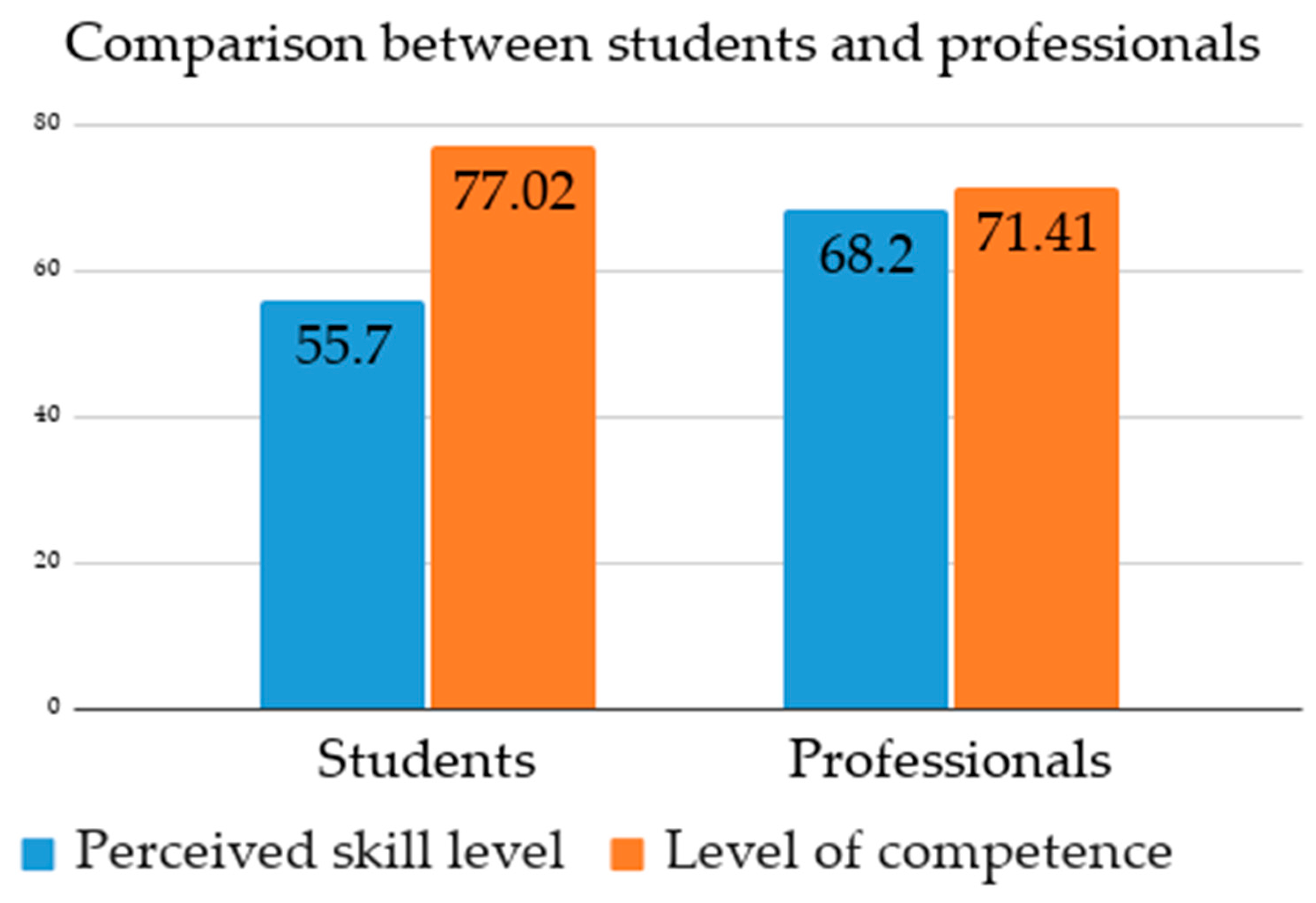
In a first analysis, in general terms, a high level of digital competence is observed among students (77 out of 100), which is significantly higher than the self-perceived level with regard to the application of these skills to professional practice (55.7 out of 100). However, no significant differences are observed between courses. For their part, the group of professionals presents a self-perceived level of skills of 68.2 out of 100, while the level obtained through the completion of the questionnaire yields a result of 71.4 (Figure 1). For both students and professionals, the self-assessed level refers to the initial self-assessment at the beginning of the questionnaire, while actual digital competence corresponds to the final score obtained after completing all items.
The following tables are intended for the comparative analysis of the data obtained from social services professionals in Spain and social work students at the University of Huelva.
Table 2 shows the level of competence in each of the dimensions in which the questionnaire is structured, highlighting the differences between the two groups. This table shows the aggregate mean for each dimension, whilst the following tables (Table 3, Table 4, Table 5, Table 6 and Table 7) show the individual items that make up each dimension. The questionnaire responses are dichotomous (Yes/No), so the data shown corresponds to the percentage of affirmative responses to each item.
The results indicate a higher level of competence among students in all dimensions, except for “Security,” where professionals score slightly higher. The most substantial differences between the two groups can be seen in the dimensions “Digital content creation” and “Problem solving.” A more detailed analysis of the items in which each dimension is broken down will give us more clues about the differences between the two. The results obtained for each of the dimensions are shown below in order to observe the differences that occur in each of the elements included in them and to observe different patterns in terms of the level of proficiency of students and professionals. The “% difference” column uses the student group as a reference; therefore, positive values indicate that students demonstrate a higher level of proficiency on that item, while negative values reflect a higher level among the professionals (Table 3, Table 4, Table 5, Table 6 and Table 7).
Thus, although in general terms social work students have a higher level of competence in the dimension of “Information and data literacy”, we can see that professionals excel in some specific areas, such as the use of different types of search engines, the ability to help others perform and improve their searches, checking the accuracy of news and/or videos they receive, and the ability to classify files into different folders. The areas where the greatest differences are observed, and where students perform most strongly, are the use of search engines with voice assistants (13.2%) and the use of data retrieval tools (13.5%).
The “Communication and collaboration” dimension is the most prevalent among the skills of both students and professionals, as it is the most widespread at an informal level among both groups. However, we again find significant differences between the two when we carry out a more detailed analysis of the items that make up the dimension. Thus, professionals stand out in the use of the digital certificate for more complex procedures, the ability to help others with online administrative procedures (a widespread practice linked to the professional sphere), collaboration on digital platforms, publishing and sharing information of interest to others, and the ability to write respectfully and adapt their form of expression to the audience and the medium through which they are communicating.
On the other hand, students excel in the use of virtual assistants, synchronising accounts between devices, the ability to modify documents in collaborative digital environments, and the ability to explain to others how collaborative digital services work. It is noteworthy that, although in general terms students seem to attach less importance to security, they claim to be able to control the information shared on the internet and modify the privacy settings on social media profiles. This could also be because they make greater use of these types of tools and are therefore more proficient in using them, without this necessarily meaning that they actually make use of them.
It is in the dimension “Creation of digital content” where the differences between the two groups are most clearly seen (more than 12 points difference). In fact, it is the dimension that shows the lowest level of proficiency on both sides. Students excel in the handling of practically all items related to digital content creation, with a particularly notable difference in the use of artificial intelligence (with a difference of more than 50 points between the two). Similarly, they show greater mastery in content management for website creation and problem-solving. However, professionals excel in respecting digital content usage licences and are more likely to avoid consuming illegally obtained content.
The “Security” dimension is the only one in which, in general terms, professionals have a higher level of competence. This dimension not only refers to security practices related to the use of digital media but also covers other types of practices, such as sustainability and efficiency in their use and postural hygiene. In this regard, we can see that these practices are more widespread among professionals, although in certain specific items, such as the use of lock patterns or the limitation of shared personal data, students seem to have greater mastery.
Finally, with regard to the “Problem solving” dimension, we can see that in all cases, students show a greater ability to solve the problems they encounter, as well as to help others do so. The only item in which the group of professionals stands out is in taking training courses to improve their digital skills, a fact that is linked to this group’s perceived need for training in this area and is directly related to their level of digital skills.

5. Discussion

The results show that social work students report a higher overall level of digital competence than practicing professionals (77.02 vs. 71.41), with particularly pronounced differences in Digital Content Creation (D3) and Problem Solving (D5). These results seem to align with the idea of “digital natives,” which attributes a technological advantage to younger generations due to their daily exposure to digital environments (Poláková and Klímová 2019).
However, a more detailed analysis links the results with critical approaches that question whether intensive use of technology implies consolidated digital literacy (Kirschner and De Bruyckere 2017). The literature on higher education and social work has pointed out that the use of social networks or applications does not guarantee advanced search, critical analysis, or data management skills (Punie and Redecker 2017). In our study, students’ strengths are concentrated in operational and creative tasks (fluent use of applications, experimentation with digital tools, and resolution of everyday technical incidents), while professionals excel in information evaluation, structured data management, and systematic verification practices.
This pattern indicates that digital competence in professional contexts cannot be reduced to technical fluency or instrumental mastery of tools. In environments such as social services, it involves discriminating relevant information from information overload, assessing the reliability of sources, anticipating risks associated with the processing of sensitive data, and making technological decisions aligned with regulatory frameworks and ethical principles (Vuorikari et al. 2022; European Commission 2018). Previous studies in social work have emphasized that these skills are central to safe practice in digitized environments (Baker et al. 2014; Reamer 2013). It is not just a matter of knowing how to use digital tools, but of knowing when, how, and under what conditions to use them responsibly.
In this sense, the findings support the analytical usefulness of frameworks such as DigComp 2.2 to differentiate between instrumental skills and strategic or reflective competencies (Vuorikari et al. 2022) that allow for more complex conceptualizations of digital literacy in the professional sphere.
In relation to the second research question, there is a significant difference between technical skills and professional competence in practice. Although professionals obtain slightly lower overall scores in digital competence, they outperform students in the Security dimension (D4) and in specific items related to information and data literacy. These areas are important in social services, where the management of sensitive information, the protection of personal data, and risk assessment are structural elements of practice (Fernández-Borrero and Gómez-Rasco 2025; Grech-Santi et al. 2025).
In line with the previous distinction between technical skill and contextualized professional capacity, the results suggest that work experience does not simply translate into a quantitative increase in digital skills, but rather into a quantitative and qualitative transformation of their orientation. Professional practice introduces criteria of prudence, regulatory compliance, and institutional responsibility that reconfigure the use of technologies (López-Peláez et al. 2024). This phenomenon is consistent with the literature on the use of digital technologies in social work, which shows how professional experience and position in the services influence the way in which the risks, opportunities, and ethical implications of their use in intervention are assessed (Rodríguez-Martínez et al. 2024).
In this way, the study expands general models of digital competence by explicitly placing them within the regulatory and relational framework of social work. This contribution is grounded in a growing body of sector-specific literature that documents how digital competence in social services differs qualitatively from its application in other professional fields. Studies conducted in the Spanish context have shown that professionals in social services face particular challenges related to the ethical use of ICTs, the protection of sensitive user data, and the digital management of social intervention processes (Fernández-Borrero and Gómez-Rasco 2025; Gómez-Rasco et al. 2026; Grech-Santi et al. 2025). At the international level, research has similarly highlighted that digital competence in social work involves not only technical proficiency but also ethical judgment, understanding of the institutional context, and professional judgment aligned with ethical codes that emphasise responsibility in the use of technology (International Federation of Social Workers 2018a; Reamer 2013; Rodríguez-Martínez et al. 2024). Furthermore, sector-specific studies have emphasised the centrality of data literacy and security competences in contexts where professionals routinely handle confidential and legally protected information (Baker et al. 2014; Nordesjö et al. 2022). It is precisely this combination of technical skill, ethical reflexivity, and contextualised professional judgment that the present study operationalises through the DigComp 2.2 framework, making its application to the social work field both novel and empirically grounded.
The dimensional analysis reveals that the greatest differences between students and professionals occur in Digital Content Creation (D3) and Problem Solving (D5), with a particularly striking gap in the use of generative Artificial Intelligence (AI), where students outperform professionals by more than 50 percentage points. This result is particularly relevant in a context in which AI tools are beginning to be integrated into social intervention, offering new perspectives for professionals in Social Work and other related disciplines (Montalbá-Ocaña and Russo-Botero 2021).
From an ethical standpoint, the gap poses a twofold challenge. On the one hand, professionals with little familiarity with AI may find themselves displaced from technological innovation processes, limiting their influence over tools that directly affect their practice (Hasselblad et al. 2024). On the other hand, students, who show greater technical confidence in the use of these applications, may lack sufficient knowledge about intellectual property, licensing, data protection, and the risks associated with automation. Therefore, the issue is not only to expand the use of AI, but also to ensure that its integration is accompanied by criteria of transparency, professional supervision, and ethical responsibility consistent with the principles of social work (International Federation of Social Workers 2018a).
In the Communication and Collaboration dimension (D2), professionals demonstrate greater mastery of what can be termed “administrative digital competence”: management of electronic certificates, digital signatures, and bureaucratic procedures associated with e-governance. Students, on the other hand, exhibit greater familiarity with collaborative cloud platforms and social media environments. The literature has highlighted the existence of this gap between different professional spaces (Vizcaya-Moreno and Pérez-Cañaveras 2020). In turn, professionals seem to rely on informal or self-taught learning to keep up to date with emerging technologies such as AI (Zenarolla 2024). These differences suggest the need to integrate both administrative digital literacy and competence in emerging technologies into training and continuing professional development strategies. To this end, this training should be structured on at least two complementary levels: on the one hand, within the framework of formal degree and postgraduate training in social work; and, on the other hand, through updating and continuing education processes aimed at developing the skills and socio-digital capital necessary for professional practice in digitized contexts (Fernández-Borrero and Gómez-Rasco 2025).
Despite the differences in the dimensions analyzed, the results point to clear complementarity. Students bring agility, creativity, and familiarity with emerging digital tools, while professionals contribute procedural experience, critical evaluation skills, and ethical reflexivity.
In this sense, the fact that students and professionals have complementary skills provides an opportunity to promote joint workspaces that allow for mutual enrichment. This complementarity opens the door to structured intergenerational learning strategies, such as reverse mentoring (Murphy 2012). In this model, young professionals share their technological knowledge and, at the same time, learn from more experienced professionals the professional judgment and ethical principles necessary for the practice of the profession. However, these exchanges do not occur spontaneously but require a structural framework that provides them with adequate time and space.
These ideas are directly linked to what is known as e-social work (Prakash and Roy 2023), understood as the professional practice of social work through the use of technologies to address traditional social problems in digital or hybrid environments (López-Peláez et al. 2017). In this context, building e-professionalism depends not only on technical mastery but also on the integration of technological competence and professional judgment. From this perspective, digitization should not be understood as a replacement for professional interaction, but rather as a process of hybridization that combines the agile use of technology with prudence and professional judgment.

6. Conclusions

This study concludes that there are significant generational differences in digital skills proficiency within social work. Students demonstrate a higher overall level of proficiency, particularly in content creation and the use of artificial intelligence. In contrast, practicing professionals perform better in the areas of security and e-government management, such as the use of digital certificates.
The results suggest that digital competence in social services is not purely instrumental. It should be understood as “e-professionalism” that combines technical skill with ethical judgment, prudence, and institutional responsibility. A clear complementarity between the two groups is identified: while young people bring agility and creativity, experts ensure safe and thoughtful practice when handling sensitive data. Therefore, it is necessary to update university curricula and promote continuing education to integrate these strategic skills into professional practice.

Limitations and Future Lines of Research

This study has several limitations that should be taken into account when interpreting its results. First, the student sample comes from a single university, which limits the generalizability to other institutional and national contexts. Second, the use of self-assessment instruments may lead to biases in overestimating competencies, especially in technical domains. Finally, the method of administering the questionnaire—online—could introduce additional bias, as responding electronically presupposes familiarity with digital technologies. These limitations underscore the need for caution when generalizing our findings beyond the specific context of this study.
Future research could focus on exploring these territorial differences and extending the study to other universities in order to compare results and analyze possible variations in training and the development of digital skills. It would also be advisable to use mixed methods approaches to reduce possible biases in data collection and enrich the interpretation of results. In particular, the use of qualitative methodologies, such as interviews, would provide a better understanding of how professionals experience the integration of emerging technologies in real intervention contexts. Similarly, it would be relevant to analyze the impact of specific training programs on the configuration and evolution of digital competence trajectories in the field of social work.

Author Contributions

Conceptualization, T.G.-R., E.F.-F. and O.V.-A.; methodology, R.M.-M. and T.G.-R.; software, R.M.-M. and T.G.-R.; validation, E.F.-F., R.M.-M. and T.G.-R.; formal analysis, R.M.-M. and T.G.-R.; investigation, R.M.-M., T.G.-R., E.F.-F. and O.V.-A.; resources O.V.-A.; data curation, R.M.-M. and E.F.-F.; writing—original draft preparation, R.M.-M. and T.G.-R.; writing—review and editing, R.M.-M., O.V.-A. and T.G.-R.; visualization, E.F.-F. and O.V.-A.; supervision, R.M.-M., E.F.-F. and O.V.-A.; project administration, O.V.-A. and T.G.-R.; funding acquisition, O.V.-A. and T.G.-R. All authors have read and agreed to the published version of the manuscript.

Funding

This research was funded by the Research and Transfer Policy Strategy 2023 of the University of Huelva (Action 5.2. of 2023: Promotion of the recruitment of new research personnel).

Institutional Review Board Statement

This study was exempted from ethical review and approval because it did not involve sensitive personal data or interventions with human subjects. The research consisted of administering a questionnaire on digital skills to professionals and students. In accordance with applicable national and institutional regulations, this type of study does not fall within the scope of prior evaluation by an ethics committee. At the time the study was conducted, the university in our province did not have an internal ethics committee for social science research, so formal ethical approval could not be obtained. However, all participants were informed in detail about the objectives and procedures of the study, and their written informed consent was obtained prior to their participation.

Informed Consent Statement

Informed consent was obtained from all subjects involved in the study.

Data Availability Statement

The questionnaires used in this study are deposited in open access repositories. The professionals’ questionnaire and data are available at: [https://hdl.handle.net/10272/23559] (accessed on 22 February 2026). The questionnaire for students and the corresponding data can be found at: [https://hdl.handle.net/10272/28036] (accessed on 22 February 2026).

Acknowledgments

The authors express their gratitude to all participants in this study. Additionally, heartfelt thanks are extended to the reviewers of this article for their insightful comments, which greatly contributed to the enhancement of the manuscript. During the preparation of this manuscript, the authors used the ChatGPT AI language model (OpenAI, 2024) to improve the initial drafting of the manuscript, enhance the English language, and assist in structuring ideas. The authors have reviewed and edited the output and take full responsibility for the content of this publication.

Conflicts of Interest

The authors declare no conflicts of interest.

References

  1. Alruthaya, Ali, Thanh-Thuy Nguyen, and Sachithra Lokuge. 2021. The Application of Digital Technology and the Learning Characteristics of Generation Z in Higher Education. Education, Computer Science. arXiv. [Google Scholar] [CrossRef]
  2. Anggini, Wulan Yulian, and Imam Santosa. 2023. Professional Digital Competency of English Teacher: Generation Differences. Research and Development Journal of Education 9: 139–51. [Google Scholar] [CrossRef]
  3. Asang-Mañay, Andrés. 2018. Análisis de las Competencias Digitales de los Docentes, Según Factores Personales, Contextuales y sus Percepciones hacia las TIC en la Educación [Analysis of Teachers’ Digital Competencies, According to Personal and Contextual Factors and Their Perceptions of ICT in Education]. Doctoral thesis, Repositorio Universidad Casa Grande, Guayaquil, Ecuador. Available online: http://dspace.casagrande.edu.ec:8080/handle/ucasagrande/1531 (accessed on 23 February 2026).
  4. Ashour, Sanaa. 2020. How technology has shaped university students’ perceptions and expectations around higher education: An exploratory study of the United Arab Emirates. Studies in Higher Education 45: 2513–25. [Google Scholar] [CrossRef]
  5. Aykanian, Amanda. 2022. A qualitative exploration of frontline homeless service worker experiences during the COVID-19 pandemic. Journal of Social Service Research 49: 67–78. [Google Scholar] [CrossRef]
  6. Ayuso-Goig, María, Margarita Vasco-González, Ángel De Juanas-Oliva, and Diego Galán Casado. 2024. Intervención social de los profesionales de servicios sociales a través de herramientas digitales [Social intervention by social service professionals through digital tools]. In Juventud y Autorregulación del Tiempo. Intervención Socioeducativa para el Bienestar Integral. Edited by Angel De Juanas-Oliva, Francisco Javier García-Castilla and Hossein Hossein-Mohand. Madrid: Dykinson, pp. 259–76. [Google Scholar] [CrossRef]
  7. Baker, Steven, Jeni Warburton, Suzanne Hodgkin, and Jan Pascal. 2014. The New Informational Paradigm: Developing practice-led approaches to the use of mobile ICT in social work. British Journal of Social Work 44: 2266–83. [Google Scholar] [CrossRef]
  8. Boddy, Jennifer, and Lena Dominelli. 2017. Social media and social work: The challenges of a new ethical space. Australian Social Work 70: 172–84. [Google Scholar] [CrossRef]
  9. Cabero-Almenara, Julio, Francisco Guillen-Gamez, Julio Ruiz-Palmero, and Antonio Palacios-Rodríguez. 2021. Classification models in the digital competence of higher education teachers based on the DigCompEdu Framework: Logistic regression and segment tree. Journal of E-Learning and Knowledge Society, Modena 17: 49–61. [Google Scholar] [CrossRef]
  10. Castellano-Díaz, Regina, Juan Carlos Martín, and Pedro Francisco Alemán. 2022. El papel de las competencias digitales en el Trabajo Social: Un análisis de las líneas de investigación [The role of digital competencies in Social Work: An analysis of lines of research]. Paper presented at IX Jornadas Iberoamericanas de Innovación Educativa en el ámbito de las TIC y las TAC: InnoEducaTIC 2022, University of Las Palmas de Gran Canaria, Las Palmas de Gran Canaria, Spain, November 17–18; pp. 91–98. Available online: https://accedacris.ulpgc.es/bitstream/10553/119594/1/Papel_competencias_digitales.pdf (accessed on 23 February 2026).
  11. Castillo de Mesa, Joaquín, María de las Olas Palma-García, and Luis Gómez-Jacinto. 2017. Abordando el reto de la transformación digital desde el Trabajo Social [Addressing the challenge of digital transformation from Social Work]. Documentos de Trabajo Social: Revista de Trabajo y Acción Social 60: 115–37. Available online: https://hdl.handle.net/10630/29963 (accessed on 21 February 2026).
  12. Colomo, Ernesto, Vicente Gabarda, Andrea Cívico, and Nuria Cuevas. 2023. Análisis de la competencia digital de futuros profesionales de la educación en tiempos de pandemia [Analysis of the digital competence of future education professionals in times of pandemic]. Educação e Pesquisa 49: e267866. [Google Scholar] [CrossRef]
  13. Connolly, Samantha. L, Christopher J. Miller, Allen L. Gifford, and Michael E. Charness. 2022. Perceptions and use of telehealth among mental health, primary, and specialty care clinicians during the COVID-19 pandemic. JAMA Network Open 5: e2216401. [Google Scholar] [CrossRef]
  14. Cwikel, Julie, and Enav Friedman. 2020. E-therapy and social work practice: Benefits, barriers, and training. International Social Work 63: 730–45. [Google Scholar] [CrossRef]
  15. European Commission. 2018. Recomendación del Consejo, de 22 de Mayo de 2018, Relativa a las Competencias Clave para el Aprendizaje Permanente [Council Recommendation of 22 May 2018, on Key Competences for Lifelong Learning]. Available online: https://eur-lex.europa.eu/legal-content/es/ALL/?uri=CELEX:32018H0604(01) (accessed on 15 February 2026).
  16. European Parliament and of the Council. 2006. Recomendación del Parlamento Europeo y del Consejo, de 18 de Diciembre de 2006, sobre las Competencias clave para el Aprendizaje Permanente. [Recommendation of the European Parliament and of the Council of 18 December 2006 on Key Competences for lifelong Learning]. Diario Oficial de la Unión Europea, L 394/10, de 30 de diciembre de 2006. pp. 10–18. Available online: https://www.boe.es/buscar/doc.php?id=DOUE-L-2006-82748 (accessed on 22 February 2026).
  17. Fernández, Ana, María Jódar, and María Isabel Valenzuela. 2022. Tecnologías de la información y comunicación (TIC) en formación y docencia [Information and communication technologies (ICT) in training and teaching]. FMC-Formación Médica Continuada en Atención Primaria 29: 28–38. [Google Scholar] [CrossRef]
  18. Fernández-Borrero, Manuela Ángela, and Teresa Gómez-Rasco. 2025. Challenges of digitalization in Spanish social services: Competence assessment. Quaderno LUMSA Social Work LAB 1: 91–116. [Google Scholar]
  19. Ferri-Fuentevilla, Elena. 2023. Una revisión sistematizada sobre el impacto de la tecnología en la relación de los/as usuarios/as con los Servicios Sociales [A systematized review of the impact of technology on the relationship between users and Social Services. In Los Servicios Sociales ante el Reto de la Innovación: Participación, Tecnologías e Investigación. Edited by Manuela Fernández-Borrero and Octavio Vázquez Aguado. Valencia: Tirant lo Blanch, pp. 83–104. [Google Scholar]
  20. Fisk, Raimond, Andrew Gallan, Alison Joubert, Jenine Beekhuyzen, Lilliemay Cheung, and Rebekah Russell–Bennett. 2022. Healing the Digital Divide With Digital Inclusion: Enabling Human Capabilities. Journal of Service Research 26: 542–59. [Google Scholar] [CrossRef]
  21. García, Yolanda. 2022. El Trabajo Social necesita adoptar un enfoque basado en la práctica para integrar las tecnologías de la comunicación móviles [Social work needs to adopt a practice-based approach to integrating mobile communication technologies]. Servicios Sociales y Política Social XXXIX 128: 11–22. Available online: https://www.serviciossocialesypoliticasocial.com/-112 (accessed on 15 January 2026).
  22. García-Castilla, Francisco Javier, Ángel De Juanas, and Javier y Páez. 2017. E-social work y las competencias digitales en la formación de los trabajadores sociales [E-social work and digital skills in social worker training]. In Comunidades Sostenibles: Dilemas y Retos Desde el Trabajo Social. Edited by Ana I. Lima-Fernández, Enrique Pastor-Seller and Carmen Verde-Diego. Cizur Menor: Aranzadi Thomson Reuters, pp. 1196–207. [Google Scholar]
  23. García Flores, Jacinto, José Arturo Fuentes Rojas, María del Socorro Enriqueta López Moreno, Linda Laura Silva Ambriz, Edith Cajica Ángeles, and María Luisa Flores Hernández. 2016. Estrategias de enseñanza aprendizaje a utilizar en las generaciones Baby Boomer, X, Y, y Z en la educación superior [Teaching and learning strategies to use with Baby Boomers, Generations X, Y, and Z in higher education]. Horizontes de la Contaduría 5: 133–46. Available online: https://bit.ly/3LK6LDH (accessed on 15 January 2026).
  24. Goodman, Leo A. 1961. Snowball sampling. The Annals of Mathematical Statistics 32: 148–70. [Google Scholar] [CrossRef]
  25. Gómez-Rasco, Teresa, Rocío Muñoz-Moreno, Elena Ferri-Fuentevilla, Ana Vallejo-Andrada, and Aleix Morilla-Luchena. 2025. Digital competencies and technological tools in social services professionals in Andalusia. Global social work. Trabajo Social Global-Global Social Work 15: 52–80. [Google Scholar] [CrossRef]
  26. Gómez-Rasco, Teresa, Rocío Muñoz-Moreno, Elena Ferri-Fuentevilla, and Octavio Vázquez-Aguado. 2026. Digitalization in Social Services: Assessment of Professionals’ Digital Competencies and Integration of ICTs. Human Service Organizations: Management, Leadership and Governance, 1–20. [Google Scholar] [CrossRef]
  27. Grech-Santi, Clara, Paula Frieiro, and Rubén González-Rodríguez. 2025. Formación en competencias digitales en el Trabajo Social en España [Training in digital Social Work skills in Spain]. Alternativas. Cuadernos de Trabajo Social 32: 374–401. [Google Scholar] [CrossRef]
  28. Gutiérrez-Provecho, Loudes, Mercedes López-Aguado, José Luis García, and José y Quintanal. 2021. La brecha digital en población en riesgo de exclusión social [The digital divide among populations at risk of social exclusion]. Pedagogía Social. Revista Interuniversitaria 39: 123–38. [Google Scholar] [CrossRef]
  29. Hasselblad, Annika, Sheila Zimic, and Leif Sundberg. 2024. Making Techno-Economic Rationality Work: Tensions in Technology-Enabled Social Service Evaluations. Journal of Technology in Human Services 42: 1–24. [Google Scholar] [CrossRef]
  30. Hernandez-de-Menendez, Marcela, Carlos Escobar, and Rubén Morales-Menendez. 2020. Educational Experiences with Generation Z. International Journal on Interactive Design and Manufacturing 14: 847–59. [Google Scholar] [CrossRef]
  31. Iniesta-Alemán, Isabel, Ana Segura-Anaya, and Ana Cristina Mancho-De la Iglesia. 2020. Las competencias digitales como recurso intangible en la empresa [Digital skills as an intangible resource in the enterprise]. Revista Prisma Social 29: 155–71. Available online: https://revistaprismasocial.es/article/view/3587 (accessed on 13 January 2026).
  32. International Federation of Social Workers. 2018a. Global Declaration of Ethical Principles of Social Work. Available online: https://www.ifsw.org/declaracion-global-de-los-principios-eticos-del-trabajo-social/ (accessed on 9 January 2026).
  33. International Federation of Social Workers. 2018b. Global Social Work Statement of Ethical Principles. Available online: https://www.ifsw.org/global-social-work-statement-of-ethical-principles/ (accessed on 9 January 2026).
  34. Jacob, Steve, and Seima Souissi. 2024. Social Workers in the Context of Digital Transformations. Revue des Politiques Sociales et Familiales 149: 207–16. [Google Scholar] [CrossRef]
  35. Jang, Kyeonghee, and Noel G. Landuyt. 2023. Limited Benefits of Technological Advances in Human Service Organizations: Going beyond the Hype Using Sociotechnical Knowledge Management System. Journal of Social Service Research 49: 426–46. [Google Scholar] [CrossRef]
  36. Kirschner, Paul A, and Pedro De Bruyckere. 2017. The myths of the digital native and the multitasker. Teaching and Teacher Education 67: 135–42. [Google Scholar] [CrossRef]
  37. López-Peláez, Antonio, Raquel Pérez-García, and María Victoria Aguilar-Tablada. 2017. E-Social work: Building a new field of specialization in social work. European Journal of Social Work 21: 804–23. [Google Scholar] [CrossRef]
  38. López-Peláez, Antonio, Soña Vávrová, Alice Gojová, Amaya Erro-Garcés, and Rafael Valentín. 2024. Digital social work. International Social Work 68: 728–34. [Google Scholar] [CrossRef]
  39. Montalbá-Ocaña, Carmen, and Mayra Russo-Botero. 2021. Socio-digital intervention: Towards what future do we want to walk to? Sociology and Technoscience 11: 310–25. [Google Scholar] [CrossRef]
  40. Mori-Cureses, Marta. 2023. Boomers versus Millennials y Generación Z: Alfabetización digital y redes sociales [Boomers versus Millennials and Generation Z: Digital literacy and social media]. Ámbitos. Revista Internacional de Comunicación 61: 116–31. Available online: https://revistascientificas.us.es/index.php/Ambitos/article/view/23511/21205 (accessed on 9 January 2026). [CrossRef]
  41. Morilla-Luchena, Aleix, Teresa Gómez-Rasco, Rocío Muñoz Moreno, and Octavio Vázquez-Aguado. 2025. Design of strategies for the process of digitalisation and technological modernisation in social services organisations. Cuadernos de Trabajo Social 38: 37–48. [Google Scholar] [CrossRef]
  42. Muñoz-Moreno, Rocío, Manuela Fernández, Elena Ferri Fuentevilla, Fernando Relinque, Aleix Morilla, and O. Vázquez. 2023. Technologies and social services. An overview of technology use by users of social services. PLoS ONE 18: e0284966. [Google Scholar] [CrossRef]
  43. Muñoz Moreno, Rocío, Teresa Gómez-Rasco, Manuela Fernandez-Borrero, Susana Martí-García, and Rubén Calero Del Valle. 2025. Competencias digitales en el alumnado de trabajo social: Diagnóstico y oportunidades para la innovación docente [Competencias digitales en el alumnado de trabajo social: Diagnóstico y oportunidades para la innovación docente]. Paper presented at the VII Congreso Internacional de Innovación Docente en Educación Superior: Explorando retos y oportunidades en la enseñanza y el aprendizaje, Madrid, Spain, November 17–21. [Google Scholar]
  44. Murphy, Wendy Marcinkus. 2012. Reverse mentoring at work: Fostering cross-generational learning and developing millennial leaders. Human Resource Management 51: 549–73. [Google Scholar] [CrossRef]
  45. Nordesjö, Kettil, Gabriella Scaramuzzino, and Rickard Ulmestig. 2022. The social worker–client relationship in the digital era: A configurative literature review. European Journal of Social Work 25: 303–15. [Google Scholar] [CrossRef]
  46. Poláková, Petra, and Blanka Klímová. 2019. Mobile technology and Generation Z in the English language classroom—A preliminary study. Education Sciences 9: 203. [Google Scholar] [CrossRef]
  47. Pongrac, Danijela, Marta Alić, and Brigitta Cafuta. 2025. Digital Competences of Digital Natives: Measuring Skills in the Modern Technology Environment. Informatics 12: 23. [Google Scholar] [CrossRef]
  48. Prakash, Shaurya, and Kheyali Roy. 2023. E-social Work: The Fourth Industrial Revolution. Adhyayan: A Journal of Management Sciences 12: 37–39. [Google Scholar] [CrossRef]
  49. Punie, Yves, and Christine Redecker. 2017. European Framework for the Digital Competence of Educators: DigCompEdu. EUR 28775 EN. Brussels: Publications Office of the European Union. [Google Scholar] [CrossRef]
  50. Reamer, Frederic G. 2013. Social work in a digital age: Ethical and risk-management challenges. Social Work 58: 163–72. [Google Scholar] [CrossRef] [PubMed]
  51. Rodríguez-Martínez, Antonia, María Teresa Amezcua Aguilar, Javier Cortés Moreno, and Juan José Jiménez-Delgado. 2024. Ethical issues related to the use of technology in social work practice. A systematic review. Sage Open 14: 21582440241274842. [Google Scholar] [CrossRef]
  52. Sakdiyakorn, Malinvisa, Maria Golubovskaya, and David Solnet. 2021. Understanding Generation Z through Collective Consciousness: Impacts for Hospitality Work and Employment. International Journal of Hospitality Management 94: 102822. [Google Scholar] [CrossRef]
  53. Segrera-Arellana, Jesús Rafael, Heyder David Paez-Logreira, and Alexander Alberto Polo-Tovar. 2020. Competencias digitales de los futuros profesionales en tiempos de pandemia. Utopía y Praxis Latinoamericana 25: 222–32. [Google Scholar] [CrossRef]
  54. Subdirectorate-General for Talent and Digital Entrepreneurship. 2023. Modelo de las competencias digitales de la ciudadanía española. Madrid: Secretaría de Estado de Digitalización e Inteligencia Artificial, Ministerio para la Transformación Digital y de la Función Pública. Available online: https://generaciond.gob.es/sites/default/files/2023-10/20231009%20Modelo%20de%20las%20competencias%20digitales%20de%20la%20ciudadan%C3%ADa%20V6%20.pdf (accessed on 17 June 2025).
  55. Villao, Elián José, and Marianela Silva. 2025. Brecha digital generacional en los procesos de formación de cuarto nivel [Generational digital divide in higher education processes]. Dilemas Contemporáneos: Educación, Política y Valores 3: 1–22. [Google Scholar] [CrossRef]
  56. Vizcaya-Moreno, M. Flores, and Rosa María Pérez-Cañaveras. 2020. Social Media Used and Teaching Methods Preferred by Generation Z Students in the Nursing Clinical Learning Environment: A CrossSectional Research Study. International Journal of Environmental Research and Public Health 17: 8267. [Google Scholar] [CrossRef] [PubMed]
  57. Vuorikari, Riina, Stefano Kluzer, and Yves Punie. 2022. DigComp 2.2: The Digital Competence Framework for Citizens—With New Examples of Knowledge, Skills and Attitudes. EUR 31006 EN. Brussels: Publications Office of the European Union. [Google Scholar] [CrossRef]
  58. Wang, Qi, Jia Li, and Xiaochen Zhou. 2024. Chinese social work students’ attitudes toward online social work services: AQ methodology study. Clinical Social Work Journal 53: 166–79. [Google Scholar] [CrossRef]
  59. Zenarolla, Anna. 2024. Digitisation as a tool to enhance learning processes and organisational knowledge in Social Services. First results from a qualitative study conducted in the North East of Italy. Alternativas. Cuadernos de Trabajo Social 31: 357–77. [Google Scholar] [CrossRef]
  60. Zubillaga, Ainara, and Lucas Cortazar. 2020. COVID-19 y Educación: Problemas, Respuestas y Escenarios [COVID-19 and Education: Problems, Responses, and Scenarios]. [Monográfico]. In La economía española en tiempos de pandemia: Una primera aproximación. Edited by Angel de la Fuente, Juan F. Jimeno and Antonio Roldan. Madrid: Debate, pp. 200–5. [Google Scholar]
Figure 1. Comparison of self-perceived and obtained levels of professionals and students.
Socsci 15 00277 g001
Table 1. Self-assessment questionnaire, based on the Model of Digital Competencies of Spanish citizens.
DimensionsSub-Dimensions
DIMENSION 1: Information and data literacy1.1. Navigate, search and filter data, information and digital content.
1.2. Evaluate data, information and digital content.
1.3. Manage data, information and digital content.
DIMENSION 2: Communication and collaboration2.1. Interact through digital technologies.
2.2. Share through digital technologies.
2.3. Engage in digital citizenship.
2.4. Collaborate through digital technologies.
2.5. Netiquette.
2.6. Managing digital identity.
DIMENSION 3: Creation of digital content3.1. Developing digital content.
3.2. Integrating and reworking digital content.
3.3. Understanding copyright and licences.
3.4. Programming.
DIMENSION 4: Security4.1. Protect devices.
4.2. Protect personal data and privacy.
4.3. Protect health and wellbeing.
4.4. Protect the environment.
DIMENSION 5: Problem solving5.1. Solve technical problems.
5.2. Identify needs and technological responses to those needs.
5.3. Use digital technology creatively.
5.4. Identify areas for improvement in one’s own digital competences.
Table 2. Dimensions of digital competence. Comparison between students and professionals.
DimensionsNMinimumMaximumMeanStandard Deviation
Professionals
Students
415
171
1. Information and data literacyProfessionals11.111072.6616.63
Students33.3310074.7217.26
2. Communication and collaborationProfessionals27.7810078.6616.3
Students38.8910081.2512.17
3. Digital content creationProfessionals0.0010057.4721.66
Students2510070.0817.24
4. SecurityProfessionals16.6710076.8917.51
Students251075.4917.26
5. Problem solvingProfessional0.001068.0327.39
Students8.3310080.8517.48
Total Digital CompetenceProfessionals25.4010071.4115.15
Students33.3310077.0211.75
Source: Prepared by the authors based on the data obtained.
Table 3. Dimension 1. Information and data literacy.
% Students
(74.72)
% Prof
(72.66)
% Difference (2.06)
Use different types of search engines78.984.1−5.2
Perform searches with voice assistants47.434.213.2
Help others perform and improve their searches7677.8−1.8
Be alert to possible fraud98.299.5−1.3
Verify the accuracy of news and/or videos you receive86.588.4−1.9
Help others identify fraudulent information81.375.75.6
Classify files into different folders88.394−5.7
Create backups on external storage or the cloud82.580.52
Use tools to recover data33.319.813.5
Source: Prepared by the authors based on the data obtained.
Table 4. Comparative analysis. D2. Communication and collaboration.
% Students
(81.25)
% Prof
(78.66)
% Difference (2.59)
Use instant messaging applications99.498.60.8
Using different digital communication applications and platforms9395.2−2.2
Take advantage of virtual assistant features59.628.431.2
Send photos or videos via instant messaging applications98.298.3−0.1
Sharing content in the cloud73.776.1−2.4
Share content by synchronising accounts across devices88.370.417.9
Carry out simple administrative tasks and procedures online98.299.3−1.1
Use a digital certificate for more complex procedures73.194.5−21.4
Help others to carry out administrative procedures online77.888.9−11.1
Contributing to digital platforms by posting information of interest to others50.356.9−6.6
Modify documents/photographs or other documents in collaborative digital environments55.643.112.5
Ability to explain collaborative digital services to others81.356.424.9
Writing respectfully92.499.3−6.9
Adapting the way you express yourself to the audience and the medium94.797.6−2.9
Help others adapt their messages to the audience and medium97.190.17
Able to modify privacy settings on social media profiles93.6867.6
Control the information shared when uploading images to the internet85.476.98.5
Search for my name on the internet, view my information and limit it50.960−9.1
Source: Prepared by the authors based on the data obtained.
Table 5. Comparative analysis. D3. Digital content creation.
% Students
(70.08)
% Prof
(57.47)
% Difference (13.33)
Create digital content with simple tools for my own use94.292.31.9
Depending on the digital content I want to create, I use one service or another95.371.324
I create different types of digital content for other people.77.856.421.4
I integrate other people’s content into the content I create.91.276.914.3
I create content by combining resources from various sources.88.36721.3
I incorporate or adapt AI-generated digital content72.51953.5
I avoid consuming illegally obtained content65.579.8−14.3
I respect licences for the use of digital content81.995.2−13.3
Ability to explain to others the types of licences that exist42.728.714
Identify applications or programmes that slow down the system and terminate them55.654.21.4
Use content management systems to create websites33.724.19.6
I debug a programme when a code problem arises42.724.817.9
Source: Prepared by the authors based on the data obtained.
Table 6. Comparative analysis. D4. Security.
% Students
(75.49)
% Prof
(76.89)
% Difference (−1.4)
Having antivirus software installed70.288.7−18.5
Use lock patterns on digital devices and change passwords
change passwords
98.281.416.8
Check and limit the personal data accessed by applications92.478.613.8
Use basic security measures when conducting transactions or making payments online97.798.3−0.6
Limit access to my personal data on websites or applications90.684.36.3
Use official digital certificates issued by the authorities79.591.8−12.3
Correct posture habits46.250.1−3.9
Take preventive measures against clickbait60.870.8−10
Limit the number of hours spent in front of the screen50.357.6−7.3
Limit use of consumables78.986.3−7.4
Reduce energy use in devices88.383.64.7
Inform others about how to reduce the environmental impact of digital technologies52.651.11.5
Source: Prepared by the authors based on the data obtained.
Table 7. Comparative analysis. D5. Problem solving.
% Students
(80.85)
% Prof
(68.03)
% Difference
(12.82)
Identify and resolve simple incidents with cameras or microphones in video calls90.680.510.1
Ability to resolve technical problems on my device myself90.67911.6
Ability to help others solve technical problems74.96113.9
Making transfers or purchases through secure digital platforms94.288.95.3
Adapt device settings to my needs90.679.311.3
Ability to help others respond digitally to their needs87.768.918.8
Using applications to carry out my creative ideas87.14641.1
Using digital media to respond to social problems74.358.116.2
Using smart devices to perform everyday tasks78.958.120.8
Be aware of technological limitations and ask for help if needed8380.52.5
I am taking or have taken training courses in digital skills48.562.2−13.7
My friends and family usually turn to me when they need help69.65415.6
Source: Prepared by the authors based on the data obtained.
Disclaimer/Publisher’s Note: The statements, opinions and data contained in all publications are solely those of the individual author(s) and contributor(s) and not of MDPI and/or the editor(s). MDPI and/or the editor(s) disclaim responsibility for any injury to people or property resulting from any ideas, methods, instructions or products referred to in the content.