
Article

Framing Wars: The Politics of Labeling and Identity Construction in Ghana
by
Alexander Angsongna
1,*,
Maxwell Bogpene
2,
Vitus Ngaanuma
3 and
Adams Bodomo
1
1
Department of African Studies (Linguistics & Literatures), University of Vienna, Spitalgasse 2, Court 5, A-1090 Vienna, Austria
2
Department of Political Science, University of British Columbia, 1066 Main Mall, Vancouver, BC V6T 1Z1, Canada
3
School of Law, University of Ghana, Anne Jiagge Road, Legon, Accra P.O. Box LG 70, Ghana
*
Author to whom correspondence should be addressed.
Soc. Sci. 2026, 15(5), 278; https://doi.org/10.3390/socsci15050278
Submission received: 4 March 2026 / Revised: 20 April 2026 / Accepted: 21 April 2026 / Published: 24 April 2026

Abstract

In Ghana’s political landscape, actors from both ruling and opposition parties deploy a range of linguistic and rhetorical strategies in their pursuit of political power. Prominent among these is political labeling, a discursive practice used to construct favorable self-images while delegitimizing opponents through derogatory and face-threatening expressions. This study examines how political labeling functions as a strategic tool for identity construction and power negotiation in Ghana’s electoral landscape. Situated within the fields of political discourse and communication studies, the study demonstrates how labeling operates simultaneously as a rhetorical and framing device that reflects and reinforces underlying sociopolitical power dynamics. Drawing on empirical data from major Ghanaian news portals, the study adopts an integrated analytical framework combining Framing Theory and the Theory of Impoliteness. It analyzes public labeling directed at three prominent political figures across three election cycles (2016, 2020, and 2024). The findings show that politicians, activists, and their supporters strategically deploy labels to reconstruct rivals’ identities, inflict reputational damage, and provoke ridicule, thereby undermining their perceived competence and public credibility. Focusing on derogatory labels, we argue that political labeling serves primarily to generate emotional responses, shape public perception, and mobilize collective action, ultimately influencing the trajectory of national political discourse. By examining the interplay between language, identity construction, and power, this research offers a nuanced account of how political labeling shapes individual attitudes, group dynamics, and the broader political culture in Ghana.

1. Introduction

Research on campaign communication (Druckman et al. 2009, 2010) shows that rhetorical choices such as negative language, issue ownership, and position-taking are particularly common during critical political moments such as internal party elections like primary elections, and general elections. In the Ghanaian sociopolitical context, labeling—often manifested through name-calling, political tagging—has increasingly emerged as a strategic communicative device with far-reaching social consequences. It serves as a persuasive strategy for shaping public perception and framing political discourse. Against this backdrop, this study addresses a central question: How does political labeling function as a discursive strategy for identity construction and power negotiation in Ghana’s electoral politics?
Since the beginning of the Fourth Republic in 1992, political actors in Ghana and their supporters, especially those affiliated with the two major political parties, the National Democratic Congress (NDC) and the New Patriotic Party (NPP), have consistently employed labeling as a potent instrument of political propaganda. This strategy is frequently used to construct positive self-representations while simultaneously discrediting opponents. Labeling occurs across multiple communicative platforms, including campaign rallies, parliamentary debates, media appearances, social media, and radio and television discussions. In this sense, labeling reflects the broader function of political communication as a medium of constructing meaning about political practices and processes. It is through such interactions that politicians exercise power and influence public opinions, shape policy debates, and ultimately shape the trajectory of a country.
In the Ghanaian political environment, labeling serves as a discursive mechanism for persuasion and ideological contestation. It fuels what Cammaerts (2012) describes as “framing wars,” in which competing actors attribute contrasting moral and ideological qualities, such as competent versus incompetent, honest versus corrupt, to themselves and their rivals. Political labeling, therefore, extends beyond mere linguistic expression; it constitutes a deliberate act of political positioning and symbolic struggle.
Although substantial research in established democracies highlights the impact of strategic labeling and negative campaigning (Druckman et al. 2009, 2010; Moncrieffe and Eyben 2013; Wood 2013), scholarly attention to labeling as a distinct dimension of political communication in Ghana remains limited. This study therefore seeks to address this gap by (i) identifying and categorizing the types of political labels used in Ghanaian electoral discourse and examining how they function as face-threatening and delegitimizing acts; (ii) analyzing how labeling contributes to reputational damage and public ridicule; (iii) exploring how political actors deploy labeling to reconstruct and redefine opponents’ identities; and (iv) applying an integrated theoretical framework to explain how labels shape interpretation, meaning-making, and power relations. The study is primarily motivated by the growing prevalence of aggressive, derogatory, and identity-based rhetoric in Ghana’s electoral discourse.
Drawing on an integrated theoretical framework that combines Framing theory (Borah 2011; Chong and Druckman 2007; De Vreese 2005), and the Theory of (im)politeness (Brown and Levinson 1987; Culpeper 1996; Culpeper and Hardaker 2017; Terkourafi 2008), this research examines the strategic deployment of labeling and its broader social and political implications. While political labeling has historical roots predating the Fourth Republic (established in 1992), and while many prominent figures have shaped Ghana’s political landscape, this study specifically focuses on three political actors from the last decade—Nana Akufo-Addo, John Dramani Mahama, and Mahamudu Bawumia—each of whom has been subjected to sustained and intense derogatory labeling. Their selection is informed by their central and continuous presence in Ghana’s contemporary political landscape.
Our study draws on empirical data from major Ghanaian news outlets to examine the dynamics of political labeling. It contributes to existing scholarship by offering a deeper understanding of the interplay between language, politics, and power within a thriving democracy such as Ghana. Also, it seeks to foster critical awareness of political communication practices and their implications for the country’s evolving political culture.

2. Labeling and Its Historical and Scholarly Review

2.1. Labeling: A Brief Overview

In everyday social interactions, people assign labels to one another as a means of differentiating among individuals based on perceived identity markers. We may accept some of the labels society assigns to us from childhood (e.g., black, white, brown, poor) and reject some (e.g., negro, racist, etc.). Labels impose boundaries and define categories. They serve as a means to construct our social world and define norms in relation to others who bear similar or different labels (Moncrieffe and Eyben 2013).
The politics of labeling is not new; it is often historically traced to the French Revolution in the late Eighteenth Century (Bobbio 1996; Hanson 2010), where terms like “left” and “right” originated from seating arrangements in the French National Assembly. These spatial divisions ultimately gave rise to ideological labels like “liberal”, “conservative”, “socialist”, “communist”, “capitalist”, etc. As party systems became more developed and expanded, particularly in Europe and the United States, political labeling became a powerful tool in campaign and public discourse.
In contemporary sociopolitical space, labeling is a sociological concept that involves assigning roles and attributes that deviate from social and moral standards of behavior (Moncrieffe and Eyben 2013; Hall 2018; Raybeck 1991). It is socially constructed through different modes of social interaction. The concept of labeling has been studied in various fields ranging from criminology in relation to homosexuality (Fasoli et al. 2015; Iudici and Verdecchia 2015; Matsick et al. 2022), stigma about HIV/AIDS (Mbonu et al. 2009; Yuh et al. 2014), and mental illness (Angermeyer and Matschinger 2003; Rose et al. 2007; Wright et al. 2011).
Beyond these domains, several studies have explored how labels are used across a range of sociopolitical and communicative contexts. For instance, Meeks (2012) analyzes media coverage of four women—Elizabeth Dole, Claire McCaskill, Hillary Clinton, and Sarah Palin—relative to their male competitors across U.S. elections. The study demonstrates that leadership in such contexts is often associated with “masculine” traits, including toughness, decisiveness, and authority, and examines whether women candidates are framed as lacking these qualities or evaluated differently when they display them.
Similarly, Ojala and Pantti (2017) show that coverage of the Ukrainian conflict in four European newspapers frequently adopts a “new Cold War” label, positioning Russia and the West as opposing blocs. This framing simplifies the conflict, presenting it as a continuation of historical rivalry rather than a complex and evolving geopolitical situation, thereby contributing to the normalization of a Cold War worldview while marginalizing alternative perspectives.
Within political communication, labeling has also been examined as a strategic resource. Chou (2019) shows that labeling candidates as “underdogs” can generate voter sympathy, emotional engagement, and support mobilization; however, these effects are contingent, as the label may also reinforce perceptions of weakness, making it a double-edged communicative strategy. In migration discourse, Janky (2019) demonstrates that terms such as “asylum seekers,” “refugees,” and “immigrants,” as well as more negatively charged labels, significantly shape public perceptions by activating distinct emotional and political responses.
In digital communication contexts, Bou-Franch (2021) finds that labels such as maleducado (“ill-mannered”) are highly salient in Spanish discourse on X. These labels function as metapragmatic tools that not only describe impoliteness but also construct social meaning, enforce norms, and shape interaction, particularly in contentious political exchanges. Likewise, Metz (2024) shows that populist leaders such as Viktor Orbán in the Hungarian political landscape strategically deploy labeling alongside moral emotions, such as fear, anger, and pride, to frame politics as a struggle between “good people” and “evil enemies,” thereby reinforcing processes of othering and sustaining political support.
In all, these studies highlight the centrality of labeling in shaping perception, identity, and power relations across contexts. This resonates with the present study of political labeling in Ghana, where labeling is strategically deployed to construct and contest representations of identity, integrity, credibility, and authority within a dynamic democratic environment.
More broadly, labeling involves the ways in which individuals and groups are named and categorized—both by themselves and by others—to reflect particular social identities. It reveals subjective perceptions of how people fit into different spaces in social order. Thus, in politics, labeling based on this understanding enables political actors to shift and reinvent their opponents’ identities, fitting them with new forms of identity based on perceived political subjectivities (Mensah et al. 2022).
There are diverse motivations for labeling, as the process produces varied anticipated and unanticipated outcomes. Even if there is altruistic intent, labeling has classificatory and regulatory functions (Moncrieffe and Eyben 2013): it can misrepresent a whole category of people, can stimulate and incite, and/or sustain sociopolitical discord. At the same time, malevolent labeling may lead unexpectedly to productive outcomes where, over time, people use these adverse labels as a basis for making claims and gaining political space. Labels, therefore, are objects of moral and political evaluation that aim to expose power abuse and remedy social wrongs (Blommaert 2005).

2.2. Labeling in Ghana: Its Emergence and Development

Labeling has long existed in various contexts in Ghana. For instance, the north vs south divide is a particularly common label. “Northerner” is commonly used to refer to individuals from the five northern regions: Northern, Savannah, Northeast, Upper East, and Upper West. Although northern Ghana comprises five distinct administrative regions, the use of the term “northerner” tends to flatten this diversity, often implying that the entire area is a homogeneous region. While the term may not always be intended as derogatory or used with overtly negative connotations, this oversimplification displays a deep-rooted disregard for the cultural and ethnic distinctions within northern Ghana.
On a clearly negative note, labels such as “ntaafoɔ”, “ntaani”, and “pepeni (also rendered as papafoɔ)” are widely regarded as disrespectful, demeaning, and offensive terms used to describe people from northern Ghana. Importantly, these terms, ntaafoɔ/(ntaani) ‘twins’, and pepeni, which suggests sincerity or genuineness, are not inherently negative in meaning. However, they acquire derogatory connotations in certain sociolinguistic contexts. For example, when ntaafoɔ is used by some Southern Ghanaians to refer broadly to people from Northern Ghana, it implies that Northerners tend to move in pairs or groups while in the South. While this behavior may simply reflect social cohesion or mutual support, the label is often perceived as dismissive or disrespectful. Similarly, pepeni, which denotes honesty—a trait that should be valued—takes on a pejorative sense. It is often used to portray people from Northern Ghana as excessively honest and suggesting that their integrity is a weakness, which makes them lack the “keenness or interest” to navigate or manipulate prevailing social systems. In this way, otherwise neutral or positive terms become vehicles for subtle but powerful forms of social and cultural stigmatization.
Another misnomer is “Dagarti”, often used by people of southern Ghana to refer to speakers of Dagaare. The correct terms are “Dagao” (singular) and “Dagaaba” (plural). Even some native speakers of Dagaare unknowingly refer to themselves as “Dagarti”, perpetuating this error due to a lack of awareness. The continued misuse of such labels reveals a lack of cultural sensitivity and geographical knowledge and therefore contributes to the marginalization of communities in northern Ghana.
On the other hand, derogatory labeling is not one-sided. The term “kɔmbɔngɔ”, for example, is used by some groups in the northern regions of Ghana to describe people from southern Ghana, especially the Akan people. In various contexts, it is a derogatory expression associated with the word “donkey” and translated as “seaside/waterside donkey”, reflecting a similar pattern of ethnic prejudice. Beyond these regional and ethnocentric labels, Ghanaian political discourse has been rife with labeling.
Leaders of various jurisdictions, whether political or non-political in most cases, earn certain descriptions from their followers and opponents based on the characteristics they exhibit or based on the events that happen during their tenure. Successive political leaders in Ghana have been given nicknames or labels based on their personal attributes, performance in office, or political events that occurred during their tenure. Most of these names, usually funny, ridiculous, and offensive, tend to stick and are often remembered, used, and spread during and even long after such leaders are out of office. For example, Kwame Nkrumah, the first president of Ghana, was allegedly labeled “African showboy”, a seemingly positive name he earned as a result of his Pan-Africanism. However, in a negative vein, his political opponents tagged him “a Great African but not a Great Ghanaian” (Biney 2021) because he was seen to be focusing much on the emancipation of Africa in general at the expense of his own country, Ghana.
Between 1972 and 1978, General Acheampong’s Supreme Military Council (SMC) government was marred by the so-called “Green Pen Syndrome,” a term describing the alleged exchange of favors—often sexual—for privileged access to loans and goods at the Ghana National Trading Corporation (GNTC). The regime became synonymous with this form of transactional corruption and was captured in the phrase fa wo to begye Golf ‘offer your body in exchange for a Golf car’ (Osei-Tutu et al. 2014).
Known for his strong stance, outspoken opinions, and fiery delivery on matters concerning the Ghanaian public, the first president of the Fourth Republic, Jerry John Rawlings, earned the nickname “Mr. Boom” for the explosive impact of his speeches—often perceived as having the “boom” effect. In a slightly different case, former president John Agyekum Kufour, the second president of the Fourth Republic, was labeled “Gentle giant”, a nickname inspired by his imposing physical appearance but calm nature. It also symbolically reflects the elephant, the New Patriotic Party’s (NPP) emblem, a creature known for its gigantic size, yet graceful and gentle movements.
Finally, the third president of Ghana’s Fourth Republic, John Atta Mills, was widely recognized for his consistent advocacy of peace, earning him the affectionate title Asomdwehene (King of Peace). His burial site was later named Asomdwe Park ‘Peace Park’, reflecting the lasting resonance of this label. Mills was also popularly associated with the term “ecomini”, a mispronunciation of the word economy during a State of the Nation Address. This was a label, which resulted from a brief instance of spoonerism—a speech error involving the accidental transposition of sounds, and it became a source of public humor. These labels, whether endearing, critical, or satirical, highlight the symbolic power of political nicknames in shaping public perception.
Crucially, in Ghana, political labeling is pervasive, reflecting the vibrant democratic culture that upholds freedom of expression. Unlike in more restrictive political environments where speech is heavily monitored or suppressed, Ghanaians enjoy the liberty to assign and disseminate labels that can significantly influence political narratives and public memory. Whether this freedom to engage in such forms of political communication ultimately strengthens or challenges democratic ideals remains an open question—one that warrants further scholarly exploration.

3. Methodology and Theoretical Framework

3.1. Data Sources and Methods

To examine the sociopolitical impacts of negative labeling in Ghana’s political discourse, we gathered data from major Ghanaian online news portals, including GhanaWeb, Graphic Online, CitiNewsroom, 3News, JoyNews/myjoyonline, Asaase Radio, ModernGhana, DailyGuide Network, KasapafmOnline, and some international news portals (BBC, Independent, Africawatch, and The African Report). These media platforms provide up-to-date news on politics, business, sports, entertainment, and other issues in Ghana and beyond. News articles were identified using targeted keywords or headlines relevant to the Ghanaian political discourse and environment. The relevant lexical items, keywords, or phrases were as follows: nicknames of Ghana politicians, clearing agent, incompetent, liar, nicknames of Ghanaian presidents, dumsor, dictator in Ghana, corruption in Ghana, John Mahama, Nana Akufo-Addo, and Mahamudu Bawumia. These keywords were used either in isolation or in combination with one another. Google search was used as the primary search engine owing to its accessibility and broad indexing of Ghanaian media content.
A total of fifty-four (54) articles were initially retrieved. Each article was then evaluated against three pre-established inclusion criteria: (1) topical relevance, the article must explicitly engage with Ghanaian political discourse and contain at least one instance of labeling, nicknaming, or evaluative descriptor directed at Mahama, Akufo-Addo, or Bawumia; (2) source credibility and accessibility, the article must be traceable to a verifiable, publicly accessible news outlet; and (3) temporal scope, the article must have been published between January 2015 and March 2025, a period spanning three Ghanaian electoral cycles (2016, 2020, and 2024). News articles were excluded if they were duplicates of content already captured from another outlet, if they referenced the target politicians only in passing without containing explicit labeling language, or if the source could not be independently verified. After applying these criteria and removing seventeen duplicates, thirty-seven (37) articles were retained for analysis. The news articles retained span a decade marked by heightened political mobilization, propaganda, character assassination, and verbal confrontation, making this corpus particularly well-suited to the study of political labeling as a discursive strategy.
Data coding proceeded in two stages to ensure consistency and intersubjective validity. In the first stage, the lead author conducted multiple systematic passes through the corpus, assigning each article to thematic categories (e.g., derogatory labels, nicknames, evaluative descriptors) and documenting the specific linguistic forms identified. This single-coder approach was adopted at this stage to maintain a coherent analytical framework throughout the initial categorization process.
In the second stage, the co-authors independently reviewed the coding record against the news articles to ensure interpretive consistency and reliability. Points of disagreement or ambiguity were flagged and subsequently resolved through structured discussion until consensus was reached. This process approximates a consensual validation procedure (Hill et al. 1997), whereby the research team collectively adjudicates interpretive differences rather than relying on a single coder’s judgment. In total, nine labels (three for each politician) were selected based on their relative prominence compared to other labels. This selection was informed by their frequent occurrence across major news and media outlets.
Following the selection and categorization of the data, we conducted a textual and thematic analysis, a qualitative method used to identify, analyze, and interpret recurring patterns/themes within the data, with the aim of understanding meaning and significance (Castleberry and Nolen 2018; Clarke and Braun 2017; Lochmiller 2021). This approach is particularly useful for tracing how meaning is constructed around political actors through repeated patterns of labeling across diverse media contexts. Our analysis focused on the specific labels assigned to political actors across various contexts, seeking to understand the underlying narratives and perceptions embedded in these labels. The analytical process proceeded in three stages: (i) identifying the most prominent derogatory labels associated with each political figure; (ii) examining the meanings and connotations embedded in these labels; and (iii) interpreting their broader sociopolitical implications, particularly in shaping public perception and opinion.

3.2. Theories of Political Labeling

Given the interconnected themes that surround the phenomenon of labeling, we draw on an integration of two relevant theories that offer unique insights into understanding labeling within the context of Ghanaian politics. These theories—the framing theory and theory of (im)politeness—are discussed below.

3.2.1. Framing Theory

Framing theory, which traces its roots to Goffman (1949, 1968), is a communication theory that explains how information is presented or “framed” to influence the way people interpret and respond to it. The major premise of framing theory is that an issue can be viewed from a variety of perspectives and construed as having implications for multiple values or considerations (Chong and Druckman 2007). The way messages are structured or framed through language, emphasis, context, and tone shapes public perception and opinion. Framing thus involves a process in which people develop a particular conceptualization of an issue or reorient their thinking about it. Framing theory is conceptually said to have two broad foundations—sociological (Entman 1991; Goffman 1974) and psychological (Domke et al. 1998; Iyengar 1994; Kahneman and Tversky 1984). From a sociological perspective, it refers to “frames in communication” (Chong and Druckman 2007), focusing on words, phrases, and images used to construct new stories and identities, as well as the processes that shape this construction. Frames or labels are socially constructed. Within the psychological perspective, this theory determines how people interpret and react to information on a psychological level. This primarily hinges on how the public processes information and makes judgments and decisions.
Politically, the concept of framing, which refers to “characterizations” (Sniderman and Theriault 2004, p. 136), is a powerful tool for examining how political actors are labeled in media, public discourse, and political communication. It is concerned with how specific linguistic choices and narratives shape public perception of these actors, often influencing political outcomes, reputation, and power dynamics. In an attempt to construct political actors in some light, the media or other politicians may deploy specific frames for positive labeling (e.g., “nation-builder”, “king of infrastructure”) or negative labeling (“corrupt”, “incompetent”, etc.) to control narratives. Political campaigns actively use framing to manage how their candidates and opponents are labeled or tagged. In particular, using slogans, speeches, and media platforms, politicians frame their own actors in a positive light (e.g., visionaries, democrats, etc.). At the same time, they frame their opponents in a negative light (e.g., failures, autocrats, etc.).
In this paper, we examine labeling as a negative form of framing used by politicians and their supporters to discredit their opponents. Through the strategic use of labels, political actors seek to influence public perception—often for personal or group advantage. Framing theory has often been grouped with agenda-setting theory (McCombs and Shaw 1972; McCombs et al. 2018), though that has been contested. Additionally, identity framing through labeling can be considered a face-threatening act—an impoliteness strategy that targets one’s social image. In the following section, we provide an overview of the theory of impoliteness.

3.2.2. Theory of Impoliteness

Within the general framework of pragmatics and sociolinguistics, impoliteness refers to the deliberate use of language to offend, attack, or threaten others in a manner that violates social norms of politeness (Culpeper 1996; Culpeper and Hardaker 2017). Impoliteness, which is often examined as the reverse of politeness, refers to a discursive behavior that causes unintended (rather than deliberate) offense (Holmes and Schnurr 2017). It is the act of engaging in aggressive facework in a way that causes social disruption. Building on the theory of politeness as developed by Brown and Levinson (1978, 1987), the theoretical model of impoliteness focuses on communicative events in which a speaker’s main objective is to damage the hearer’s “face” rather than save it (Culpeper 1996). This model looks at the violation of polite language in human interaction. Based on Brown and Levinson’s model, termed “a theory of facework”, the basic building block of the concept of (im)politeness is face-threatening acts (FTAs)—communicative actions that threaten a person’s face, their public self-image, and their desire to be respected and approved.
FTAs in communication are actions that risk embarrassing and/or disrespecting the hearer, and this is why politeness exists to mitigate the effects of FTAs. Five superstrategies have been proposed (Brown and Levinson 1987) for performing face-threatening acts, which are systematically related to the degree of the face threat. These include bald on record—the FTA that is performed “in the most direct, clear, unambiguous and concise way possible”(Brown and Levinson 1987, p. 69); positive politeness—the use of strategies designed to redress the addressee’s positive face wants; negative politeness—the use of strategies designed to redress the addressee’s negative face wants; off-record—the FTA is performed via indirection, e.g., through the use of sarcasm, and mockery; and withhold FTA—not being polite when one is expected to. Overall, impoliteness is intended to generate disharmony between interlocutors in social interactions.
In this study, we examine labeling as an FTA and, by extension, a form of impolite communication involving how simple terms and nicknames are strategically deployed by political actors to slander opponents, reinforce power dynamics, and manipulate public perception. In political discourse, impolite labels, e.g., “corrupt” or “incompetent,” or mocking and sarcastic labels like “Bawuliar” or “king promise,” function as FTAs. Importantly, these labels are rarely neutral as they carry ideological weight grounded in conflict, rivalry, and partisanship. We therefore argue that impoliteness theory provides an important guide to analyzing how political actors in Ghana construct their public identity and that of their rivals.
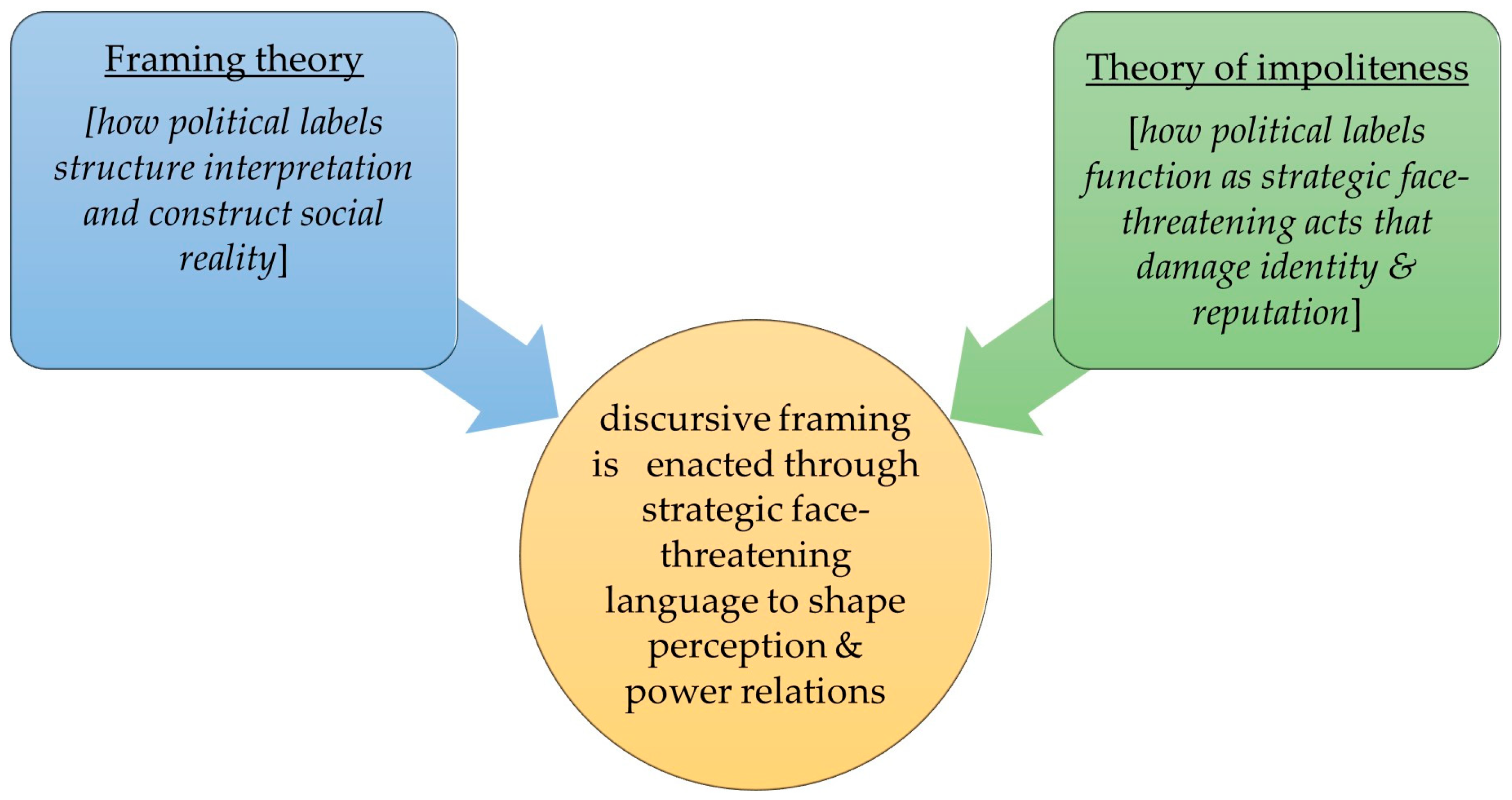
Together, framing theory and the theory of impoliteness constitute an integrated analytical approach, as both examine how meaning is strategically constructed in interaction, particularly within power-laden contexts such as electoral politics. Applied to political labeling in Ghana, framing explains what labels do cognitively by shaping interpretation and guiding perception, while impoliteness explains what they do relationally by enacting face-threatening attacks and negotiating power. In this sense, impoliteness serves as the linguistic mechanism through which framing acquires persuasive and emotional force. Framing operates at the macro-discursive level, structuring meaning and legitimacy, whereas impoliteness functions at the micro-linguistic level, detailing how identity attacks are enacted in interaction. Figure 1 schematically illustrates how the two frameworks complement and integrate with each other.
At their intersection, the two theories converge on three core dimensions: (i) identity construction, (ii) power negotiation, and (iii) audience interpretation. This study demonstrates that their innovative integration not only offers a nuanced perspective on derogatory labeling in Ghana’s electoral politics but also makes a meaningful contribution to the use of integrated theoretical approaches in longitudinal qualitative analysis.

4. Empirical Findings

In this section, we present the empirical findings of the study focusing on the identification, contextual description, and distribution of political labels across the dataset. This features three political figures over three election cycles. While each of these politicians has been assigned a variety of negative labels and nicknames over time, as noted earlier, our discussion centers on a selected set of what we found through our data queries to be the most viral and widely circulated labels. Specifically, we present them as follows: (i) John Mahama as “The incompetent one”, “Mr. Dumsor”, and “Terminator 1”; (ii) Nana Akufo-Addo referred to as “King promise”, “Mother serpent of corruption”, and “Clearing agent”; and (iii) Mahamudu Bawumia labeled as “Bawuliar”, “E-Bawumia’’, and “Economic Maguire”. These labels, rooted in political rivalry and public sentiment, provide valuable insight into how language is used as a tool of political branding, delegitimization, and identity construction in Ghana’s political landscape. Table 1 below outlines the labels, their referents, and some indigenous language equivalents (e.g., in Dagaare and Twi), offering insights into how local linguistic communities interpret these terms.

4.1. Case Study 1: John Dramani Mahama1

John Mahama began his political career in 1996 as a Member of Parliament for the NDC and later served as Minister of Communications. He became Vice President of Ghana in 2009 and assumed the presidency in 2012 following the death of President Atta Mills. Mahama later won the December 2012 presidential election but lost his reelection bids in 2016 and 2020 to Nana Akufo-Addo. Known for his focus on infrastructure, he faced criticism for economic hardship and corruption during his first term in office. Following his electoral defeats, Mahama made a political comeback, emerging victorious in the 2024 general elections. Since first assuming office in 2012, he has been the subject of numerous derogatory labels and characterizations: this study focuses on three prominent labels. As discussed in the sections that follow, the labels associated with John Mahama predominantly construct a narrative of ineffective leadership, policy failure, insensitivity, and authoritarian tendencies, grounded in both specific political events and sustained opposition discourse.

4.1.1. Mahama as “The Incompetent One”

John Mahama’s first tenure as president between 2012 and 2016 faced a barrage of intense criticism, personal attacks, name-calling, and questions about his potential and leadership abilities. During this period, widespread public discontent was rife. Economic challenges and allegations of corruption created fertile ground for the opposition parties (Adu-Gyamfi et al. 2020), especially the major opposition at the time (the NPP), to mount a relentless and sustained campaign against him. Particularly in the build-up to the 2016 elections, vice-presidential candidate of the NPP, Bawumia, famously labeled Mahama as “incompetent”, a characterization that was amplified across mainstream and social media platforms. This label, rooted in agenda-setting strategy (McCombs et al. 2018; McCombs and Shaw 1972), appeared to have significantly damaged Mahama’s public image, leadership chances, and credibility. As hard as he tried to counter or dispel this narrative, the label stuck, contributing to growing disillusionment and a negative public perception of him (see Adu-Gyamfi et al. 2020, pp. 22–25). In the end, the existing economic hardship and widespread perception of incompetence likely contributed in part to Mahama’s defeat to Akufo-Addo and Bawumia in the 2016 elections.
The label of “incompetent” attached to Mahama did not fade after the 2016 elections. Instead, it remained a powerful rhetorical device in Ghanaian political discourse, especially in opposition circles. Thus, as an attempt at making the label more entrenched, Bawumia in 2018 reinforced and rebranded this label with an “improved” version referring to Mahama as “The incompetent one” as exemplified in the following statement “I hear the incompetent one says he wants to come back, he wants to come and do more damage…” (Ghanaweb 2018b, 8 October). This rearticulation was clearly part of a negative rhetorical strategy aimed at reminding Ghanaians that Mahama lacked the requisite governance skills and competence to compete in the 2020 presidential election.
Crucially, the use of the definite determiner “the” without naming Mahama directly was a strategic rhetorical attempt by Bawumia to suggest that his audience already knew and were aware of the referent of that label. In effect, “incompetent” became synonymous with Mahama’s political identity, demonstrating how deeply this characterization had permeated the public space. Strategically, this label emerged in various forms and gained popularity as “incompetent Mahama” (3News 2023, 15 April), further entrenching the negative identity construction of Mahama to evoke ridicule, stir public sentiment, and change public perception about him. The relentless use of the label produced significant political dividends for the opposition. It fostered and engendered group solidarity through shared mockery and delegitimized Mahama in the eyes of the public.
The label “The incompetent one” can be interpreted as a powerful framing device that reduces Mahama’s political identity to a single negative attribute. Such labels are not random (Eckert 2003); they occur in specific contexts of power struggle, rivalry, and partisanship. From a framing perspective, it simplifies complex governance issues into an easily recognizable narrative of failure. At the same time, within the theory of impoliteness, it functions as a face-threatening act aimed at damaging Mahama’s public image and credibility. Its repeated use demonstrates how strategic labeling can solidify negative political identities and influence public perception. In this case, Bawumia’s use of the label was a deliberate political tactic aimed at weakening Mahama’s public image while bolstering his own chances as a more competent presidential candidate.

4.1.2. Mahama as “Mr. Dumsor”

The first tenure of President Mahama (2012–2016) is often remembered with displeasure by some due to a series of crises that plagued his administration. Central among these crises was the protracted issue of intermittent power supply, popularly referred to as “dumsor”. This crisis, which persisted for the better part of Mahama’s first term at the presidency, had far-reaching consequences as it severely hampered productivity across businesses and industries. The frustration and anger it generated led to widespread mass demonstrations and public outcry. In particular, on 18 February 2015, several thousand people, including opposition supporters, marched through the capital, Accra, to protest widespread power shortages (allAfrica 2015, 18 February). The term “dumsor”, derived from two Akan words—dum ‘to turn off’ and ‘to turn on’, literally means “off and on”, capturing the erratic and unreliable nature of the national power supply during that period. Power outages were not only frequent but also unpredictable, going off and on multiple times a day. This significantly disrupted household and economic activities. In an unprecedented intervention response, the government was compelled to implement a load-shedding timetable.
In the wake of the crisis, the main opposition party, the NPP, capitalizing on public frustration, branded President Mahama “Mr. Dumsor” (GraphicOnline 2015, 21 January). This label became prominent and was repeatedly reinforced through media and political discourse, thereby dangerously damaging Mahama’s public image. It also surfaced in another version on some media platforms as “Dumsorhene,” ‘king of dumsor’ (GhanaWeb 2017, 11 November). In some ways, many recognized Mahama as the president who was associated with frequent power failures. As the 2016 elections approached, public anger reached a tipping point, and the opposition intensified the issue with strategic communication and propaganda, which impacted and swayed public opinion about Mahama as ineffective and not capable of resolving the energy crisis (see Destrée 2019; Dye 2023). Ultimately, this negative framing in part contributed to his defeat in the December 2016 polls (The New York Times 2016, 26 December).
“Mr. Dumsor” served as a powerful rhetorical device neologized and propagated by the opposition with clear political intent. By associating Mahama with power failure and ineffectiveness, and positioning themselves as the solution, the opposition seemed to have tarnished President Mahama’s positive image, thereby shaping voter perceptions. This pejorative construction of Mahama underscores Bucholtz’s (1999) definition of impoliteness as a negative identity practice. Labeling in this context is therefore considered a relationship of power foregrounded in communicative behavior (Culpeper and Hardaker 2017). As a negative descriptor, it served to delegitimize Mahama and discredit him as the political “other”, effectively illustrating how language is a vital instrument in political contestation.

4.1.3. Mahama as “Terminator 1”

Upon returning to office as president for a second term in 2025, Mahama immediately took some radical and controversial decisions in the early days of his presidency. One decision, in particular, which has attracted significant attention from both local and international media, as well as political critics and analysts, is the mass revocation of public sector appointments. On 10 February 2025, barely a month into his administration, a letter was issued by the Chief of Staff, dissolving all public sector appointments made by the outgoing Akufo-Addo government following the 7 December 2024, general elections (GhanaWeb 2025a, 11 February). A communiqué from the Chief of Staff cited the late-term appointments as inconsistent with “established good governance practices and principles”. The opposition NPP strongly condemned the decision, describing it as politically motivated and detrimental to national stability. Asserting the legitimacy of the appointments, the opposition called for their reversal and launched a series of media campaigns, accusing the Mahama administration of terminating jobs and warning that the decision could have long-term repercussions for good governance and democratic practices.
The backlash intensified on 3 March 2025, when the Minority in Parliament, led by the former Finance Minister, Mohammed Amin Adam, labeled President Mahama as “Terminator 1” during a press briefing (CitiNewsroom 2025, 3 March). This can be understood as what Sniderman and Theriault (2004, p. 136) refer to as “characterization”—a rhetorical strategy of attributing certain traits to an individual to influence public perception. The construct “Terminator 1” was therefore crafted to associate Mahama’s actions with insensitivity and authoritarian tendencies, presenting him as a president indifferent to the plight of ordinary Ghanaians, especially the youth. The label evolved into another form as “Terminator-in-Chief,” as amplified by the US-based NPP branch in their 7 March 2025, statement, which condemned Mahama’s decision, claiming that Ghanaians are witnessing a new form of tyranny. This rhetorical technique reveals an interesting layer of intertextuality—a literary and linguistic concept referring to the way texts or cultural references relate to and build upon one another (Allen 2011; Martin 2011; Velykoroda and Moroz 2021). The term “Terminator 1” references the American action film franchise starring Arnold Schwarzenegger. By invoking this cinematic figure known for relentless force and emotional detachment, the opposition sought to symbolically align Mahama with traits of authoritarianism and insensitive governance, thereby reinforcing a negative public frame through a culturally recognizable metaphor.
Despite growing criticism, the NDC appropriated the label initially used by the opposition and further reframed and “elevated” it to “ruthless terminator” (GhanaWeb 2025b, 4 March)—a symbol of decisive leadership. Some key NDC political figures (e.g., Isaac Adongo) rather praised the president’s decisive action as a necessary “house cleaning” effort aimed at dismantling the perceived systemic rot that prevailed during the past administration. In doing that, the NDC contested all negative connotations of the label and reframed it as a reflection of the president’s commitment to uphold reform and accountability.
Irrespective of how the label was justified by the ruling government, the overarching purpose of “Terminator 1” from the opposition’s standpoint is to tarnish the president’s public image and provoke negative emotions and reactions. This aligns with what Obeng (1997, p. 49) regards as an effort to gain “interactional and political advantage” over their political opponents. By negatively painting President Mahama as insensitive toward the people, the NPP seeks to show their support to the people as the more empathetic and people-centered group, while presenting Mahama and the NDC negatively. In the next section, we turn our attention to Nana Akufo-Addo.

4.2. Case Study 2: Nana Akufo-Addo2

The political career of Nana Addo Dankwa Akufo-Addo began in 1996 when he was elected as the New Patriotic Party’s (NPP) Member of Parliament for the Abuakwa constituency, a position he held from 1997 to 2008. Under President John Agyekum Kufuor’s administration, Akufo-Addo served as Attorney General and Minister for Justice (2001–2003), and later as Minister for Foreign Affairs (2003–2007). He was elected as the NPP’s flagbearer for the 2008 general elections. Despite losing the 2008 and 2012 presidential elections to NDC candidates John Evans Atta Mills and John Dramani Mahama, respectively, Akufo-Addo was eventually elected President of Ghana, serving from 2016 to 2024. His presidency was marked by notable reforms and development efforts, but it was also marred by criticism over administrative excesses, including allegations of corruption, authoritarian tendencies, arrogance, and a perceived disregard for public interest. As a result of these controversies, Akufo-Addo, like Mahama and Bawumia, became the target of numerous derogatory labels. Labels directed at Nana Akufo-Addo primarily target issues of credibility, moral integrity, and institutional accountability, often highlighting perceived discrepancies between campaign rhetoric and governance outcomes. Some of the most common ones are presented below.

4.2.1. Akufo-Addo as “King Promise”

In a bid for political power, Nana Akufo-Addo, before the 2016 general elections, made several promises to transform the country and presented himself as a champion of the people. At the time, many Ghanaians were left frustrated by the perceived poor governance and economic hardship under then-President Mahama. This created a promising platform for Akufo-Addo and the NPP to gain public support. Capitalizing on this public discontent, Akufo-Addo unveiled an ambitious agenda filled with many promises of transformative solutions.
After two unsuccessful electoral contests in 2008 and 2012, his 2016 campaign appeared more desperate and urgent. For example, he promised $1 million per constituency per year, the development of interconnected roads, railways, ports and harbors, the construction of affordable housing and a wide range of initiatives such as: one district, one hospital; one district, one factory; one village, one dam; and even rental loan schemes for the youth (GhanaWeb 2018a, 28 March; GraphicOnline 2020, 16 June). Many of these promises were never fulfilled after he assumed office following his 2016 election victory. Yet ahead of the 2020 elections, Akufo-Addo went on to reiterate some of these promises and introduced new ones.
The failure to deliver on a significant chunk of his promises inspired growing public skepticism about his campaign messages. In particular, among members of the opposition, frustration mounted as Akufo-Addo’s campaign messages increasingly appeared hollow and unconvincing. In response, he was mockingly labeled “king promise” (BBC News Pidgin 2018, 19 March), a sarcastic label used to reflect the perceived emptiness of his many promises. This nickname became deeply implanted in the political discourse and served to ridicule his credibility. Opposition members actively promoted its use to frame Akufo-Addo and the NPP as phonies who made several promises without any serious intention of fulfilling them. Viewed through both the sociological (Entman 1991; Goffman 1974) and psychological (Domke et al. 1998; Iyengar 1994) perspectives of framing theory, this label represents a “frame in communication”. It functions as a strategic narrative phrase meant to construct an image of Akufo-Addo and shape how the public process, interpret his political persona, ultimately influencing how they make judgments and decisions.
The label “king promise” was a deliberate linguistic strategy used to erode trust in Akufo-Addo’s campaign messages. It is a negative political frame, impacting opinions in a way that casts doubt on Akufo-Addo’s integrity and reliability. In the context of Schubert’s (2022) notion of impoliteness strategies, this label served to damage the face of the politician, portraying him as lacking sincerity and authority.
As influential as this label seemed, it did not significantly affect Akufo-Addo’s personal electoral success. However, its effects rippled through to his party in general, casting a long shadow over the party’s credibility and appeared to have affected Bawumia, the NPP’s 2024 flagbearer. This is because many Ghanaians viewed Bawumia’s campaign promises as mere extensions of the “king promise” legacy. This connection, therefore, weakened his presidential aspirations, since the doubt once directed at Akufo-Addo spilled over to his party and successor (see Angsongna et al., forthcoming; Agbevade 2025).

4.2.2. Akufo-Addo as “Mother Serpent of Corruption”

Throughout his political career until he became president, Akufo-Addo cultivated a reputation for integrity and incorruptibility. Notably, prior to becoming president, there were virtually no allegations linking him to corruption or misconduct of any sort in public office, and this helped solidify his image as a credible and principled political figure. This reputation, widely perceived as untarnished, played a central role in influencing public opinion, particularly ahead of the 2016 elections, where he positioned himself as a staunch anti-corruption advocate and fighter. This positive public image likely contributed significantly to his electoral victories in both the 2016 and 2020 elections.
In alignment with this public belief in his incorruptible personality, Akufo-Addo promised to make corruption a high-risk enterprise and to build a government committed to eradicating it (MyjoyOnline 2016, 12 December). In line with this promise, he established the Office of the Special Prosecutor, an independent body charged with the responsibility of “investigating and prosecuting certain categories of cases”, including those implicating political officeholders. In 2018, Akufo-Addo nominated popular anti-corruption crusader, Martin Amidu, to head the office—an action that was widely approved by the public and endorsed by Parliament (CitiNewsroom 2018, 12 July).
However, in a dramatic turn of events, Amidu resigned from the position of special prosecutor on 16 November 2020, about two years into office. His resignation followed the release of a corruption risk assessment report on a controversial government agreement to monetize the country’s future mineral revenues (BBC News Pidgin 2020, 17 November; CitiNewsroom 2020, 16 November). Amidu cited political interference in his work—an accusation the government strongly denied. Following his resignation, in a scathing 27-page letter addressed to Akufo-Addo on 26 November 2020, Amidu described the president as “mother serpent of corruption” (GhanaWeb 2020, 27 November) and accused him of overseeing what he termed “the greatest corruption plot in the history of Ghana”. This stinging rebuke stood in stark contrast to Akufo-Addo’s previously unblemished image as “anti-corruption Moses” and cast serious doubt on his political image and commitment to fighting corruption.
Even before Amidu’s resignation, the credibility of the government’s anti-corruption stance had begun to waver. For instance, in July 2020, the Auditor-General, Daniel Domelevo, was placed on mandatory leave because he was investigating suspicious and scandalous transactions by top government officials (Africawatch 2016, 1 March). This move was criticized and seen by the public as an attempt to stifle accountability. Moreover, following the special prosecutor’s departure from office, a series of corruption scandals came to light, with party members implicated in fiscal misconduct. These developments lent credence to Amidu’s damning characterization of the president as “mother serpent of corruption”.
The label “mother serpent of corruption” proved particularly detrimental. It painted a bleak picture of Akufo-Addo’s political persona and raised questions about whether his self-presentation as incorruptible was merely a calculated political strategy to gain power. The opposition seized on this narrative, amplifying it through traditional and social media platforms to portray Akufo-Addo as the most corrupt president in the history of Ghana (The Fourth Estate 2022, 25 January; MyjoyOnline 2024, 8 May; CitiNewsroom 2024, 24 May; ModernGhana 2025, 22 March). This pejorative label, as analyzed from the perspective of Brown and Levinson’s (1987) politeness theory, illustrates the superstrategy of withholding politeness in which any attempt at civil discourse is deliberately absent. Similarly, Lakoff (1989) would describe Amidu’s language as a deliberately confrontational form of impoliteness, meant to cause reputational harm.
Though Amidu’s explosive resignation and accusations surfaced at a critical political time—less than a month before the 2020 general elections—their immediate impact on Akufo-Addo’s electoral success was quite insignificant. However, the legacy of those allegations endured. By the time the 2024 elections approached, perception of entrenched corruption under Akufo-Addo’s leadership had significantly influenced public sentiment—this time to the detriment of his vice president, Bawumia, who struggled to distance himself from that tainted legacy. As a result, the “mother serpent of corruption” label not only marred Akufo-Addo’s personal image but also became an effective weapon that undermined his party’s electoral fortunes in the long term.

4.2.3. Akufo-Addo as “Clearing Agent”

For the greater part of Akufo-Addo’s eight-year reign as president, his administration was deeply stained by several corruption scandals involving financial misappropriation, embezzlement, and abuse of the public purse. Many of the people involved were his own appointees and party members. At times, new scandals appeared with notable frequency, contributing to perceptions of a system under significant strain. In particular, despite numerous allegations, those implicated in various misconduct were often shielded from accountability, fostering a culture of impunity under his leadership.
Between January 2017 and December 2024, the scandals that rocked his presidency included BOST contaminated fuel case, the “Cash for seat” controversy, the Power Distribution Service (PDS) scandal, the Commonwealth Games visa fraud, the Ghana Maritime Authority expenditures, the Sputnik V vaccine procurement scandal, questionable COVID-19 spending, the Public Procurement Authority (PPA) contracts-for-sale saga, the National Cathedral scandal, the Cecilia Dapaah cash hoarding revelations, Pwalugu Dam project scandal and a host of other high profile cases (ModernGhana 2024, 29 November). Collectively, these cases suggested a degree of recurring misconduct that warranted attention within Ghana’s democratic context.
Public outrage intensified when many of these cases ended without detailed investigation or prosecution, fueled by perceptions of a politically compromised judiciary. Regularly, individuals implicated in these crimes were cleared without consequences. Disappointed by the president’s apparent inaction, many Ghanaians began referring to Akufo-Addo as the “clearing agent” (ModernGhana 2024, 17 September; BBC News Pidgin 2019, 9 September)—a label that stuck and gained popularity among the opposition NDC to reflect his repeated defense and exoneration of accused officials. This label, both sarcastic and damning, epitomized the betrayal of his earlier promises to fight corruption and “protect the public purse”, especially after creating the Office of the Special Prosecutor.
President Akufo-Addo’s tendency to dismiss allegations without due process became one of the most profound disappointments of his government. The label “clearing agent” therefore evolved into a powerful metaphor for his perceived betrayal of anti-corruption promises. Although the label might not have affected his personal political aspirations directly, it left a negative depiction of him, deeply tainting his image and casting a long shadow over the NPP. Based on the concept of impoliteness, “clearing agent” served as a deliberate face-threatening attack—reflecting a negative moral judgment on his integrity. It is a frame that characterizes Akufo-Addo not as a reformer but as a protector of fiscal misconduct. With several corruption scandals during his eight-year reign, public dissatisfaction heightened by the day, and this had a huge political cost, especially for his vice president, Bawumia, who was the NPP’s presidential candidate in the 2024 elections. That is, Bawumia inevitably inherited much of Akufo-Addo’s baggage. For many Ghanaians, the corruption scandals during Akufo-Addo’s leadership were seen as a significant breach of public trust and, for some, a notable aspect of how his presidency was perceived.

4.3. Case Study 3: Mahamudu Bawumia3

Mahamudu Bawumia, a former Deputy Governor of the Bank of Ghana, was the NPP’s vice-presidential candidate in 2008 and later served as Vice President from 2016 to 2024. He was elected as the NPP’s flagbearer for the 2024 elections. As Vice President, he was the head of the Economic Management Team during the NPP’s tenure. However, his political persona has been notably characterized by several ambitious campaign promises—traits that have earned him significant criticism, leading to the emergence of several derogatory labels. Bawumia contested the 2024 general elections but lost to John Mahama, the current president. Analyzing the labels and names associated with him assumes critical importance, as it serves as an avenue to understanding the broader sociopolitical consequences of labeling in Ghanaian political discourse. As discussed below, the labels associated with Mahamudu Bawumia focus largely on credibility, policy inconsistency, and perceived underperformance, particularly in relation to his economic credentials.

4.3.1. Bawumia as “Bawuliar”

Bawumia, in the lead-up to the 2016 elections, labeled John Mahama “incompetent”, an attack on his governance style. By the 2020 election period, however, Bawumia himself was at the receiving end of similar unpalatable labels, primarily orchestrated by members of the then-opposition party, the NDC. Known for his dramatized rhetoric and ambitious promises, he was allegedly nicknamed by the NDC members as “Bawuliar” (DailyGuide 2023, 21 June). This name resulted from the linguistic word formation process of blending, where the first part (first two syllables) of “Bawumia” combined with the word “liar” effectively translates as ‘Bawumia the liar’.
The label “Bawuliar” did not just appear out of nowhere; it was rooted in a series of inconsistencies between Bawumia’s promises and the realities of the NPP administration of which he was the vice president. For instance, Bawumia, before the 2016 elections, made a campaign promise to shift Ghana’s economic focus “from taxation to production” (KasapafmOnline 2016, 9 October). This was on the back of allegations that the ruling NDC government under Mahama had imposed taxes on various items. As Angsongna and Bodomo (2026) note, Bawumia’s promise of tax relief, along with other promises, likely contributed to the electoral triumph of the NPP in December 2016. However, to the disappointment of many Ghanaians, Bawumia and his government introduced new taxes, including the controversial e-levy, a COVID-19 tax, an emission levy, and a betting tax, among others. With these policy shifts, perceptions were fueled among the opposition and segments of the public that Bawumia had misled the people, hence cementing the label “Bawuliar” and raising questions about his sincerity.
Moreover, Bawumia had previously criticized the Mahama administration for what he described as “unnecessary” borrowing, asserting that Ghana was wealthy enough to develop without external loans. Citing his experience as former Deputy Governor of the Bank of Ghana, Bawumia emphasized that Ghana was rich: “I am telling you, we can develop Ghana without borrowing, the money is here” (GhanaWeb 2022, 18 October). Upon assuming power, however, his government resorted to extreme borrowing throughout the eight-year reign. Thus, by July 2024, Ghana’s national debt had ballooned from GHC 86 billion to GHC 742 billion—an increase of over GHC 600 billion in less than eight years (GhanaWeb 2024a, 24 July; Ministry of Finance Ghana 2024, 23 July). This stark contradiction between his campaign rhetoric and the governance reality reinforced the public perception of dishonesty, lending further legitimacy to the “Bawuliar” moniker. This label also emerged as “master of lies” in other circles.
This kind of labeling is an example of political name-calling, a strategic use of language that attributes negative traits to a public figure. Therefore, by blending “Bawumia” with “liar”, the opposition essentially tarnished his public image, presenting him as someone with a consistent pattern of misleading the electorate to gain political power. It is a form of negative impoliteness aimed at deliberately attacking, characterizing, and ridiculing his image and public appeal. As a consequence, the “Bawuliar” label endured, impacted public opinion, and partly contributed to Bawumia’s defeat in the December 2024 elections, thereby underscoring how effective negative labeling in political discourse can influence electoral outcomes.

4.3.2. Bawumia as “E-Bawumia”

As a former deputy governor of the Bank of Ghana, Mahamudu Bawumia was selected as the running mate and later as the vice president due to his strong economic background and his proposals for transformative economic solutions. He was celebrated as a prominent economist with party supporters hailing him as the “Economic Wizkid/wizard”, “Economic Messiah”, and “The Walewale Adam Smith” (GhanaWeb 2019, 8 April). His appointment as the head of the Economic Management Team (EMT) further underscored the trust placed in his ability to restore economic stability and growth.
However, during his tenure as vice president, Bawumia emerged as a strong advocate for digitalization, playing a significant role in advancing that agenda. That is, he pivoted his core economic responsibilities to become the leading advocate for Ghana’s digital transformation. As part of this perceived digital transformation, several digitalization initiatives were introduced, including an integrated digital economy, deployment of zipline technology for healthcare delivery, electronic health insurance registration, digital address system, digitization of the Driver and Licensing Authority, and the roll-out of the National identification card (Ghana Card) (AsaaseRadio 2024, 8 June). The digital push was further extended with the introduction of an electronic levy (E-levy).
While these initiatives were positioned as part of a broader modernization plan, their real impact remains contentious. As such, critics have pointed out reports of technical failures and the limited reach of some of these digital programs. Meanwhile, the economy continued to deteriorate with rising public debt, an unstable exchange rate, sharp depreciation of the currency (Ghana cedi), rising inflation, extreme taxation, and a high rate of unemployment. In the midst of these worsening economic indicators, Bawumia’s preoccupation with digitalization drew public criticism.
The growing disconnect between his initial economic mandate and his digital focus led opponents to question his reliability as an economist. Consequently, he was labeled “E-Bawuma,” which simply means “Electronic Bawumia”—a name that arose more out of sarcasm and mockery than one of admiration. The label represented the avoidance of his economic responsibilities to focus on digitalization, which the opposition believed had yielded nothing to restore an ailing economy. In fact, for some critics, the “E” stands for “electronic,” referencing his perceived less impactful digital agenda; for others, it stood for “empty”—a jab at what they perceived as a hollow performance in both economic leadership and digital reform.
By referring to him as “E-Bawumia”, the opposition sought to label him as an incompetent leader, who mishandled the country’s economic affairs, deflected responsibility by advancing a perceived easier and more symbolic domain. In the sense of opposition and broader public criticism, Bawumia’s perceived failure as chair of the Economic Management Team (EMT), coupled with the questionable outcomes of his digital initiatives, stripped him of the authority to seek the presidency or promise any economic transformation, especially in the lead-up to the 2024 general elections. In short, the label “E-Bawumia” denotes a rhetorical weapon designed not only to mock but to frame Bawumia as an incompetent figure who shirked and failed to manage the responsibilities with which he was entrusted. It is a politically charged attempt to damage his political image and cast doubt on his presidential and leadership ambitions.

4.3.3. Bawumia as “Economic Maguire”

One particular label attributed to Bawumia that gained both local and international attention is “Economic Maguire”. This tag, coined by critics, illustrates how political labels often draw on familiar references from other social spheres to amplify their meaning. In this case, the label invokes football, a widely popular sport in Ghana, to underscore perceived economic missteps. Bawumia was believed to be the economic “messiah” of Ghana, rising to greater prominence during the 2016 and 2020 election campaigns, where he promised economic restoration, delivered lectures on various platforms on how to revive the falling standards of the cedi, and discussed Ghana’s wealth.
However, upon gaining power, many critics (e.g., the opposition members) believed that Bawumia veered off and failed to deliver on his promises. Instead of fulfilling the expectations, he was alleged to have presided over worsening economic conditions. This sentiment reached a peak on 1 December 2022, when a Member of Parliament in the opposition NDC, Isaac Adongo, famously likened Bawumia to Harry Maguire, a Manchester United defender known for his poor form and defensive errors at that time. Adongo therefore named him “Economic Maguire” (CitiNewsroom 2022, 1 December; Independent 2022, 1 December), suggesting that Bawumia—much like Maguire—was entrusted with defending Ghana’s economic “goalpost” but instead became a liability, destroying the very foundations he was meant to protect. According to Adongo, Bawumia, who had presented himself as the architect of Ghana’s economic transformation, eventually became a threat to its stability. In effect, just as Maguire was once considered a promising defender who later turned into a defensive risk, Bawumia was perceived to have transitioned from a champion of economic hope to a figure of economic mismanagement.
This label became widely disseminated across both local and international media, contributing to a public perception of limited economic competence to transform Ghana. The opposition significantly amplified the nickname, using it as a rhetorical device to undermine his potential. By referring to Bawumia as “Economic Maguire”, Adongo employed Culpeper’s (2005) concept of intentionality in impoliteness, where the speaker deliberately engages in face-attack to cause reputational harm. The label was aimed at achieving several objectives, including ridicule, mockery, political image sabotage, and creating an impression in the public’s mind that Bawumia lacked the capacity to reform Ghana’s economy and, by extension, lacked the necessary qualifications to be a president. In essence, “Economic Maguire” was not just a catchy political jab, but a strategic face-threatening act meant to reshape public perception and weaken Bawumia’s political future.
In summary, we have presented the three most topical labels associated with each of the three politicians discussed in this section. Based on the discussion of these labels and their effects, we have proposed a categorization into distinct types, which includes competence/performance-based labels, corruption/moral-deviance labels, economic hardship/policy failure labels, authoritarian labels, and credibility/honesty-based labels. These categories are summarized in Table 2 below.

5. Discussion

This section provides a focused discussion and interpretation of political labeling in Ghana, examining it as a mechanism of identity construction (Section 5.1), as a face-threatening act (FTA) (Section 5.2), as a strategy of power negotiation (Section 5.3), and in terms of its emotional and political effects (Section 5.4).

5.1. Labeling as Identity Construction

Political labeling functions as a central mechanism of identity construction in political discourse, actively shaping how political actors are perceived and evaluated (Mensah et al. 2022; Moncrieffe and Eyben 2013). Rather than merely describing individuals, labels selectively foreground particular traits, thereby constructing simplified and often negative identities.
Through repetition and circulation, labels such as ‘the incompetent one’ and ‘mother serpent of corruption’ become dominant identity frames, reducing complex political figures to singular characterizations. In line with framing theory, these labels guide interpretation by structuring how audiences perceive and make sense of political actors (Chong and Druckman 2007; Entman 1991).
Importantly, identity construction through labeling is inherently relational. By negatively defining opponents, political actors simultaneously position themselves as more competent, credible, or morally upright. Labeling, therefore, serves as a dual process of othering and self-legitimation, reinforcing group boundaries and political identities.

5.2. Labeling as a Face-Threatening Act (FTA)

Within impoliteness theory, political labeling constitutes deliberate face-threatening act aimed at damaging an opponent’s public image (Brown and Levinson 1987; Culpeper 1996). Such labels target both positive face—the desire for approval—and negative face—the desire for autonomy and respect. Expressions like ‘Bawuliar’ and mother serpent of corruption’ exemplify strategic impoliteness where language is intentionally deployed to ridicule, delegitimize, and undermine credibility (Culpeper and Hardaker 2017). These labels frequently rely on sarcasm, exaggeration, and mockery, amplifying their emotional and reputational impact. In this context, impoliteness is not incidental but instrumental, functioning as a calculated communicative strategy within competitive political environments.

5.3. Labeling and Power Negotiation

Labeling operates as a key instrument of power negotiation in political discourse, enabling politicians to shape narratives, influence public perception and assert symbolic dominance. Through labeling, political actors attempt to impose specific interpretations of reality that serve strategic interests.
The effectiveness of a label depends on its ability to gain traction within public discourse. Once widely adopted, a label becomes a discursive resource, which reinforces specific frames and shaping political meaning. This reflects broader struggles over legitimacy and representation in democratic contexts.
At the same time, labeling remains contested, as political actors resist, reject or reframe imposed identities. Such contestation underscores the dynamic nature of power in discourse, where meaning is continuously negotiated rather than fixed (Blommaert 2005).

5.4. Emotional and Political Effects of Labeling

It is important to recognize that the effectiveness of political labeling lies in its capacity to operate at both cognitive and emotional levels, shaping not only how people think but also how they feel about political actors (Janky 2019; Metz 2024). Labels simplify complex issues into easily recognizable symbols while simultaneously evoking strong emotional responses.
For instance, labels grounded in lived experience, such as “Mr. Dumsor,” evoke frustration, while metaphorical labels like “Economic Maguire” generate humor and ridicule. Similarly, “Terminator 1” evokes perceptions of insensitivity and emotional detachment. Such emotional reactions enhance the memorability and persuasive force of labels, thereby facilitating their circulation and impact within public discourse.
Ultimately, the widespread use of derogatory labeling carries broader implications for democratic discourse. The following section, therefore examines the sociopolitical implications of labeling in Ghana.

6. Implications and Significance

Political labeling in Ghana bears profound social and political consequences for democratic participation, social harmony, and national integration. As we highlight in our study, labeling transcends mere party affiliation; it is a sociopolitical identity construction that often dictates access to political opportunities and social relationships between political actors and the public. In Ghana’s multi-party democracy, where political discourse is highly polarized, party candidates are typically labeled based on their perceived or actual political affiliations. We argue that the pervasiveness of this phenomenon is, in part, a byproduct of Ghana’s strong democratic foundations, particularly its constitutional protections for free speech and a vibrant, independent media. However, while these freedoms are vital to democracy, political labeling also has the potential to deepen societal divisions. It can fuel mistrust, reinforce stereotypes, and escalate tensions, especially during election periods, thereby undermining efforts toward national unity and inclusive political discourse.
The significance of our study lies in its nuanced exploration of how political labeling affects individual attitude, group dynamics, public opinion, and broader political culture. By analyzing various labels, we demonstrate how labeling or name-calling is widely used in Ghana’s political discourse as a tool to stigmatize political actors and foster exclusion, especially for those aligned with opposition parties in areas dominated by ruling party supporters. Our study also highlights how political labeling can erode objectivity in public discourse and inhibit constructive dialogue on national issues.
The findings of this study thus have important implications for policy in the areas of civic education and political tolerance in Ghana. The prevalence of derogatory labeling in public discourse highlights the need for strengthened civic education that promotes critical media literacy, respectful sociopolitical engagement, and awareness of the consequences of divisive language. Institutions such as the National Commission for Civic Education (NCCE) can play an important role in fostering a culture of responsible political communication by sensitizing citizens to the impact of language on democratic cohesion. The study therefore underscores the need for political tolerance as a core democratic value, as derogatory labels may contribute to polarization. Policy interventions should therefore encourage issue-based political discourse rather than personality-driven attacks.

7. Conclusions

We have examined how politicians and their supporters in Ghana express difference and discrimination through the rhetorical technique of labeling, using it as an instrument to advance the construction and reinforcement of personal and political identities. Basing our analysis on framing theory (Chong and Druckman 2007; De Vreese 2005) and the theory of impoliteness (Brown and Levinson 1987; Culpeper and Hardaker 2017; Terkourafi 2008), we have demonstrated how political actors and their followers undermine and negatively evaluate the identity, integrity, and public persona of their political opponents. Through damaging their reputations and attacking their face wants, political actors employ labeling as a deliberate face-threatening act (FTA) designed to ridicule, mock, and diminish their rivals. The overarching aim in all this is to stir emotions, drive actions, shape public opinions, and effectively influence the direction of national discourse. As rightly noted by Ette and Joe (2019), labels play a powerful role in shaping public discourse and constructing meaning around political and social realities.
Our study focused on nine distinct cases of labeling involving three prominent political figures in Ghana—John Mahama, Nana Akufo-Addo, and Mahamudu Bawumia, with three top labels identified for each candidate. In each case, labels were used by political opponents, including some sections of the public, to highlight perceived shortcomings and frame them in a negative way, while presenting themselves as the preferable alternative. Although political labeling has been a recurring feature of Ghanaian political discourse, there has been limited research attention devoted to it. Our study has therefore attempted to address this gap, showing how language and discourse are manipulated to damage reputations and sway public sentiment in a developing democracy, such as Ghana.
The study makes significant conceptual, contextual, and methodological contributions. Conceptually, the integration of framing theory and the theory of impoliteness offers a dual-layered analytical approach: framing structures interpretation and shapes cognitive meaning at the macro level, while impoliteness explains how face-threatening language operationalizes these frames at the micro level to construct social reality and negotiate power. In relation to our research question and objectives, the analysis demonstrates that political labels reconstruct opponents’ identities, reducing them to simplified negative traits through strategic framing and impoliteness strategies. The findings further show that labeling operates as a tool of delegitimization and credibility erosion. The study systematically classifies the labels into competence-based, corruption/moral-deviance, economic/policy failure, authoritarian, and credibility/honesty-based categories.
Notwithstanding its contributions, this study acknowledges an important limitation. The analysis draws primarily on data from major Ghanaian news portals. Although these platforms are influential, other significant sites of political communication, particularly social media, where much political labeling circulates, as well as radio and television, were not included. This exclusion was due to the dynamic and less regulated nature of social media content, which is often difficult to systematically verify in terms of authorship, authenticity, and originality. In addition, the research is situated within Ghana’s Fourth Republic and focuses on the 2016–2024 electoral cycles, which means the findings may not be fully generalizable to other African democracies or political contexts. Future research could therefore broaden the range of data sources to incorporate verifiable and much-regulated social media platforms and broadcast media, while also undertaking comparative studies beyond Ghana.
Overall, this study contributes to scholarship in language and politics, political discourse, political sociology, and communication studies by deepening understanding of contemporary sociopolitical dynamics in Ghana. It also opens avenues for further research on labeling, both within political contexts and across other spheres of social life, as well as beyond the Ghanaian context.

Author Contributions

Conceptualization, A.A., M.B. and V.N.; methodology, M.B. and A.A.; validation, A.A., M.B. and V.N.; formal analysis, A.A.; data curation, M.B., A.A. and V.N.; writing—original draft preparation, A.A.; writing—review and editing, A.A., M.B., V.N. and A.B.; supervision, A.B.; project administration, A.A. and A.B. All authors have read and agreed to the published version of the manuscript.

Funding

This research received no external funding.

Institutional Review Board Statement

Not applicable.

Informed Consent Statement

Not applicable.

Data Availability Statement

The original contributions presented in this study are included in the article.

Acknowledgments

We are grateful to Solomon Kofi Amoah and Faustina Tantie for their valuable assistance in translating the labels into Twi and Dagaare, respectively. Open Access Funding by the University of Vienna.

Conflicts of Interest

The authors declare no conflict of interest.

Notes

1
John Mahama has also been labeled “second-hand” (DailyGuide 2024, 29 September).
2
Aside these labels, Akufo-Addo has been a target of “dictator under democracy” (GhanaWeb 2020, 22 November).
3
Other labels associated with Bawumia include “borrowmia”.

References

  1. 3News. 2023. ‘Incompetent Mahama Administration’: Fmr Prez Confesses How Frustrated He Became. April 15. Available online: https://3news.com/news/politics/incompetent-mahama-administration-fmr-prez-confesses-how-frustrated-he-became/#google_vignette (accessed on 25 February 2025).
  2. Adu-Gyamfi, Samuel, Isaac Forson Adjei, Charles Ofosu Marfo, Emmanuel Antwi Fordjour, and Henry Tettey Yartey. 2020. A Rhetorical Interpretation of Character Assassination in the Contemporary History of Ghana. African Notes 44: 1–31. [Google Scholar]
  3. Africawatch. 2016. Ghana: Democratic Dictatorship | Africawatch. March 1. Available online: https://africawatchonline.com/guinea-democratic-dictatorship/ (accessed on 17 April 2026).
  4. Agbevade, Akpeko. 2025. The Return of the Elephant to the Bush: An Analysis of the Electoral outcome of Ghana’s 2024 Election from the perspective of the Functional Theory of Political Campaign Discourse. African Journal of Democracy and Election Research 5: 45. [Google Scholar] [CrossRef]
  5. allAfrica. 2015. Thousand Opposition Supporters Protest Power Shortages in Ghana. February 18. Available online: https://allafrica.com/stories/201502190573.html (accessed on 17 April 2026).
  6. Allen, Graham. 2011. Intertextuality. London: Routledge. [Google Scholar]
  7. Angermeyer, Matthias C., and Herbert Matschinger. 2003. The stigma of mental illness: Effects of labelling on public attitudes towards people with mental disorder. Acta Psychiatrica Scandinavica 108: 304–9. [Google Scholar] [CrossRef] [PubMed]
  8. Angsongna, Alexander, and Adams Bodomo. 2026. Talking politics: Deception, persuasion, and linguistic strategies in Ghanaian political discourse. Social Sciences & Humanities Open 13: 102436. [Google Scholar] [CrossRef]
  9. Angsongna, Alexander, Solomon Kofi Amoah, Ebenezer Odame Darkwah, and Danladi Abah. Forthcoming. Voting against governance failure: Public perceptions in Ghana’s 2024 electoral shift. Frontiers in Political Science—Elections and Representation.
  10. AsaaseRadio. 2024. Ghana’s Digital Transformation—Pioneering Achievements of Dr Mahamudu Bawumia and Why He Must Lead the Nation. June 8. Available online: https://asaaseradio.com/opinion-ghanas-digital-transformation-pioneering-achievements-of-dr-mahamudu-bawumia-and-why-he-must-lead-the-nation/#google_vignette (accessed on 25 February 2025).
  11. BBC News Pidgin. 2018. Ghana: From ‘Commissioner General’ Mahama to Akufo-Addo aka ‘King Promise. March 19. Available online: https://www.bbc.com/pidgin/43460828 (accessed on 25 February 2025).
  12. BBC News Pidgin. 2019. ‘I No Be Clearing Agent, e Be Investigative Agencies Wey Dey Clear Gov’t Appointees of Corruption’—Prez Akufo-Addo. September 19. Available online: https://www.bbc.com/pidgin/tori-49636169 (accessed on 17 April 2026).
  13. BBC News Pidgin. 2020. Martin Amidu Resignation Letter: Why Ghana Special Prosecutor Resign. November 17. Available online: https://www.bbc.com/pidgin/tori-54970440 (accessed on 25 February 2025).
  14. Biney, Ama. 2021. Kwame Nkrumah: “A Great African, But Not a Great Ghanaian”? In The Pan-African Pantheon. Manchester: Manchester University Press, pp. 157–66. [Google Scholar]
  15. Blommaert, Jan. 2005. Discourse: A Critical Introduction. In Key Topics in Sociolinguistics. Cambridge: Cambridge University Press. [Google Scholar] [CrossRef]
  16. Bobbio, Norberto. 1996. Left and Right: The Significance of a Political Distinction. Chicago: University of Chicago Press. [Google Scholar]
  17. Borah, Porismita. 2011. Conceptual issues in framing theory: A systematic examination of a decade’s literature. Journal of Communication 61: 246–63. [Google Scholar] [CrossRef]
  18. Bou-Franch, Patricia. 2021. “Maleducados/Ill-mannered” during the #A28 political campaign on Twitter: A metapragmatic study of impoliteness labels and comments in Spanish. Journal of Language Aggression and Conflict 9: 271–96. [Google Scholar]
  19. Brown, Penelope, and Stephen C. Levinson. 1978. Universals in language usage: Politeness phenomena. In Questions and Politeness: Strategies in Social Interaction. Cambridge: Cambridge University Press, pp. 56–311. [Google Scholar]
  20. Brown, Penelope, and Stephen C. Levinson. 1987. Politeness: Some Universals in Language Usage. Cambridge: Cambridge University Press, vol. 4. [Google Scholar]
  21. Bucholtz, Mary. 1999. “Why be normal?”: Language and identity practices in a community of nerd girls. Language in Society 28: 203–3. [Google Scholar] [CrossRef]
  22. Cammaerts, Bart. 2012. The strategic use of metaphors by political and media elites: The 2007–2011 Belgian constitutional crisis. International Journal of Media & Cultural Politics 8: 229–49. [Google Scholar]
  23. Castleberry, Ashley, and Amanda Nolen. 2018. Thematic analysis of qualitative research data: Is it as easy as it sounds? Currents in Pharmacy Teaching and Learning 10: 807–15. [Google Scholar] [CrossRef]
  24. Chong, Dennis, and James N. Druckman. 2007. Framing theory. Annual Review of Political Science 10: 103–26. [Google Scholar] [CrossRef]
  25. Chou, Hsuan-Yi. 2019. Labeling candidates as underdogs in political communications: The moderation of candidate-related factors. Electoral Studies 59: 120–35. [Google Scholar] [CrossRef]
  26. CitiNewsroom. 2018. Nana Addo Swears in Office of the Special Prosecutor Board. July 12. Available online: https://citinewsroom.com/2018/07/nana-addo-swears-in-office-of-the-special-prosecutor-board/ (accessed on 10 December 2024).
  27. CitiNewsroom. 2020. Martin Amidu Resigns as Special Prosecutor. November 16. Available online: https://citinewsroom.com/2020/11/martin-amidu-resigns-as-special-prosecutor/ (accessed on 10 December 2024).
  28. CitiNewsroom. 2022. ‘Bawumia Has Become an Economic Harry Maguire’—Adongo. December 1. Available online: https://citinewsroom.com/2022/12/bawumia-has-become-an-economic-harry-maguire-adongo/ (accessed on 25 February 2025).
  29. CitiNewsroom. 2024. Akufo-Addo’s Government Most Corrupt in Ghana’s History. May 28. Available online: https://citinewsroom.com/2024/05/akufo-addos-government-most-corrupt-in-ghanas-history-ansa-asare/ (accessed on 20 January 2025).
  30. CitiNewsroom. 2025. Public Sector Dismissals: Mahama Now Known as ‘Terminator 1’—Minority. March 3. Available online: https://citinewsroom.com/2025/03/public-sector-dismissals-mahama-now-known-as-terminator-1-minority/ (accessed on 19 March 2025).
  31. Clarke, Victoria, and Virginia Braun. 2017. Thematic analysis. The Journal of Positive Psychology 12: 297–98. [Google Scholar] [CrossRef]
  32. Culpeper, Jonathan. 1996. Towards an anatomy of impoliteness. Journal of Pragmatics 25: 349–67. [Google Scholar] [CrossRef]
  33. Culpeper, Jonathan. 2005. Impoliteness and Entertainment in the Television Quiz Show: The Weakest Link. Journal of Politeness Research 1: 35–72. [Google Scholar] [CrossRef]
  34. Culpeper, Jonathan, and Claire Hardaker. 2017. Impoliteness. In The Palgrave Handbook of Linguistic (Im)Politeness. London: Palgrave Macmillan UK, pp. 199–225. [Google Scholar]
  35. DailyGuide. 2023. ‘Bawuliar’ Is NDC Creation—Report. June 21. Available online: https://dailyguidenetwork.com/bawuliar-is-ndc-creation-report/ (accessed on 24 May 2025).
  36. DailyGuide. 2024. Mahama Will Be Second-Hand Failed President—Bawumia Jabs—DailyGuide Network. September 29. Available online: https://dailyguidenetwork.com/mahama-will-be-second-hand-failed-president-bawumia-jabs/ (accessed on 17 April 2026).
  37. Destrée, Pauline. 2019. Power Flashes: The Political and Visual Cultures of Electricity in Accra, Ghana. Ph.D. thesis, University College London, London, UK. [Google Scholar]
  38. De Vreese, Claes H. 2005. News framing: Theory and typology. Information Design Journal + Document Design 13: 51–62. [Google Scholar] [CrossRef]
  39. Domke, David, Dhavan V. Shah, and Daniel B. Wackman. 1998. “Moral referendums”: Values, news media, and the process of candidate choice. Political Communication 15: 301–21. [Google Scholar] [CrossRef]
  40. Druckman, James N., Martin J. Kifer, and Michael Parkin. 2009. Campaign communications in US congressional elections. American Political Science Review 103: 343–66. [Google Scholar] [CrossRef]
  41. Druckman, James N., Martin J. Kifer, and Michael Parkin. 2010. Timeless strategy meets new medium: Going negative on congressional campaign web sites, 2002–2006. Political Communication 27: 88–103. [Google Scholar] [CrossRef]
  42. Dye, Barnaby Joseph. 2023. When the means become the ends: Ghana’s ‘good governance’ electricity reform overwhelmed by the politics of power crises. New Political Economy 28: 91–111. [Google Scholar] [CrossRef]
  43. Eckert, Penelope. 2003. Language and adolescent peer groups. Journal of Language and Social Psychology 22: 112–18. [Google Scholar] [CrossRef]
  44. Entman, Robert M. 1991. Framing US coverage of international. Journal of Communication 41: 52. [Google Scholar] [CrossRef]
  45. Ette, Mercy, and Sarah Joe. 2019. Boko Haram in the Nigerian press: The politics of labelling. Journal of African Media Studies 11: 65–80. [Google Scholar] [CrossRef]
  46. Fasoli, Fasoli, Anne Maass, and Andrea Carnaghi. 2015. Labelling and discrimination: Do homophobic epithets undermine fair distribution of resources? British Journal of Social Psychology 54: 383–93. [Google Scholar] [CrossRef]
  47. GhanaWeb. 2017. Ghanaian Presidents and Their Hilarious Nicknames. November 11. Available online: https://www.ghanaweb.com/GhanaHomePage/NewsArchive/Ghanaian-presidents-and-their-hilarious-nicknames-599595 (accessed on 20 November 2024).
  48. GhanaWeb. 2018a. 6 Juicy Campaign Promises Nana Addo Made in 2016 Still Not Fulfilled. March 28. Available online: https://www.ghanaweb.com/GhanaHomePage/NewsArchive/6-juicy-campaign-promises-Nana-Addo-made-in-2016-still-not-fulfilled-638349 (accessed on 24 May 2025).
  49. Ghanaweb. 2018b. Incompetent Mahama Wants to Come Back and Do More Damage. October 8. Available online: https://www.ghanaweb.com/GhanaHomePage/NewsArchive/Incompetent-Mahama-wants-to-come-back-and-do-more-damage-Bawumia-691057 (accessed on 24 May 2025).
  50. GhanaWeb. 2019. It’s an Honour to Recognize Bawumia as ‘Walewale Adam Smith’. April 8. Available online: https://www.ghanaweb.com/GhanaHomePage/NewsArchive/It-s-an-honour-to-recognize-Bawumia-as-Walewale-Adam-Smith-John-Boadu-736517 (accessed on 17 April 2026).
  51. GhanaWeb. 2020. Akufo-Addo Is the “Mother Serpent of Corruption”—Amidu. November 27. Available online: https://www.ghanaweb.com/GhanaHomePage/NewsArchive/Akufo-Addo-is-the-mother-serpent-of-corruption-Amidu-1120196 (accessed on 10 December 2024).
  52. GhanaWeb. 2022. What Bawumia Said About Borrowing, Economic Managers While in Opposition. October 18. Available online: https://www.ghanaweb.com/GhanaHomePage/NewsArchive/What-Bawumia-said-about-borrowing-economic-managers-while-in-opposition-1644710 (accessed on 10 December 2024).
  53. GhanaWeb. 2024. Ghana’s Debt Reaches GH¢742 Billion, Accounting for 70.6% of GDP. July 24. Available online: https://www.ghanaweb.com/GhanaHomePage/NewsArchive/Ghana-s-debt-reaches-GH-742-billion-accounting-for-70-6-of-GDP-1941977 (accessed on 10 December 2024).
  54. GhanaWeb. 2025a. “John Mahama Is a Ruthless Terminator”—Isaac Adongo Responds to Dr. Amin Adam. March 4. Available online: https://www.ghanaweb.com/GhanaHomePage/NewsArchive/John-Mahama-is-a-ruthless-terminator-Isaac-Adongo-responds-to-Dr-Amin-Adam-1973991 (accessed on 19 March 2025).
  55. GhanaWeb. 2025b. President Mahama Revokes All Public Service Appointments, Recruitments Made After December 7. February 11. Available online: https://www.ghanaweb.com/GhanaHomePage/NewsArchive/President-Mahama-revokes-all-public-service-appointments-recruitments-made-after-December-7-1971119 (accessed on 19 March 2025).
  56. Goffman, Erving. 1949. Presentation of self in everyday life. American Journal of Sociology 55: 6–7. [Google Scholar]
  57. Goffman, Erving. 1968. Management of spoiled identity. In Deviance: The Interactionist Perspective. Text and Readings in the Sociology of Deviance. New York: The Macmillan Company, pp. 344–48. [Google Scholar]
  58. Goffman, Erving. 1974. Frame Analysis: An Essay on the Organization of Experience. Cambridge: Harvard University Press. [Google Scholar]
  59. GraphicOnline. 2015. I’ve Been Named ‘Mr Dumsor’ in Ghana—Prez Mahama Tells Ghanaians in Germany. January 21. Available online: https://www.graphic.com.gh/news/politics/i-ve-been-named-mr-dumsor-in-ghana-prez-mahama-tells-ghanaians-in-germany.html/ (accessed on 20 November 2024).
  60. GraphicOnline. 2020. Sammy Gyamfi Lists 25 of NPP’s Most Outstanding Campaign Promise Failures. June 16. Available online: https://www.graphic.com.gh/news/politics/sammy-gyamfi-lists-25-of-npp-s-most-outstanding-campaign-promise-failures.html (accessed on 20 November 2024).
  61. Hall, Stuart. 2018. Deviance, politics, and the media. In Deviance and Social Control. London: Routledge, pp. 261–306. [Google Scholar]
  62. Hanson, Stephen E. 2010. Post-Imperial Democracies: Ideology and Party Formation in Third Republic France, Weimar Germany, and Post-Soviet Russia. Cambridge: Cambridge University Press. [Google Scholar]
  63. Hill, Clara E., Barbara J. Thompson, and Elizabeth Nutt Williams. 1997. A guide to conducting consensual qualitative research. The Counseling Psychologist 25: 517–72. [Google Scholar] [CrossRef]
  64. Holmes, Janet, and Stephanie Schnurr. 2017. (Im)politeness in the Workplace. In The Palgrave Handbook of Linguistic (Im)Politeness. London: Palgrave Macmillan UK, pp. 635–60. [Google Scholar]
  65. Independent. 2022. England Defender Harry Maguire Mocked in Ghanaian Parliament. December 1. Available online: https://www.independent.co.uk/sport/football/world-cup/harry-maguire-ghana-parliament-b2237040.html (accessed on 24 February 2025).
  66. Iudici, Antonio, and Massimo Verdecchia. 2015. Homophobic labeling in the process of identity construction. Sexuality & Culture 19: 737–58. [Google Scholar] [CrossRef]
  67. Iyengar, Shanto. 1994. Is Anyone Responsible?: How Television Frames Political Issues. Chicago: University of Chicago Press. [Google Scholar]
  68. Janky, Béla. 2019. Changing connotations and the evolution of the effect of wording: Labeling asylum seekers in a political campaign. International Journal of Public Opinion Research 31: 714–37. [Google Scholar] [CrossRef]
  69. Kahneman, Daniel, and Amos Tversky. 1984. Choices, values, and frames. American Psychologist 39: 341. [Google Scholar] [CrossRef]
  70. KasapafmOnline. 2016. NPP Will Move Away from Taxation to Production—Bawumia. October 9. Available online: https://kasapafmonline.com/?p=74271 (accessed on 10 November 2024).
  71. Lakoff, Robin. 1989. The limits of politeness: Therapeutic and courtroom discourse. Multilingua 8: 101–30. [Google Scholar] [CrossRef]
  72. Lochmiller, Chad R. 2021. Conducting thematic analysis with qualitative data. The Qualitative Report 26: 2029–44. [Google Scholar] [CrossRef]
  73. Martin, Elaine. 2011. Intertextuality: An introduction. The Comparatist 35: 148–51. [Google Scholar] [CrossRef]
  74. Matsick, Jes L., Mary Kruk, Lindsay Palmer, Eric K. Layland, and Anna C. Salomaa. 2022. Extending the social category label effect to stigmatized groups: Lesbian and gay people’s reactions to “homosexual” as a label. Journal of Social and Political Psychology 10: 369–90. [Google Scholar] [CrossRef]
  75. Mbonu, Ngozi C., Bart Van den Borne, and Nanne K. De Vries. 2009. Stigma of people with HIV/AIDS in Sub-Saharan Africa: A literature review. Journal of Tropical Medicine 2009: 145891. [Google Scholar] [CrossRef]
  76. McCombs, Maxwell E., and Donald L. Shaw. 1972. The agenda-setting function of mass media. Public Opinion Quarterly 36: 176–87. [Google Scholar] [CrossRef]
  77. McCombs, Maxwell E., Donald L. Shaw, and David H. Weaver. 2018. New directions in agenda-setting theory and research. In Advances in Foundational Mass Communication Theories. London: Routledge, pp. 131–52. [Google Scholar]
  78. Meeks, Lindsey. 2012. Is she “man enough”? Women candidates, executive political offices, and news coverage. Journal of Communication 62: 175–93. [Google Scholar] [CrossRef]
  79. Mensah, Eyo, Samson Nzuanke, and Theophilus Adejumo. 2022. Giving a dog a bad name: The strategic use of labelling in contemporary Nigerian political discourse. Communicatio 48: 63–84. [Google Scholar] [CrossRef]
  80. Metz, Rudolf. 2024. ‘Sympathy for the devil’: The strategic use of the populist repertoire in Viktor Orbán’s politics. Intersections. East European Journal of Society and Politics 10: 95–113. [Google Scholar] [CrossRef]
  81. Ministry of Finance Ghana. 2024. 2024 Mid-Year Fiscal Policy Review. July 23. Available online: https://mofep.gov.gh/sites/default/files/budget-statements/2024-Mid-Year-Fiscal-Policy-Review.pdf (accessed on 10 December 2024).
  82. ModernGhana. 2024. Chronological Listing of Scandals Involving Key Figures from 2016 to 2024. November 29. Available online: https://www.modernghana.com/news/1361182/chronological-listing-of-scandals-involving-key.html (accessed on 18 January 2025).
  83. ModernGhana. 2025. Akufo-Addo’s Government the Most Corrupt Since Independence. March 22. Available online: https://www.modernghana.com/news/1388040/akufo-addos-govt-the-most-corrupt-since-independ.html (accessed on 17 April 2026).
  84. Moncrieffe, Joy, and Rosalind Eyben. 2013. The Power of Labelling: How People Are Categorized and Why It Matters, 1st ed. Edited by Joy Moncrieffe and Rosalind Eyben. London: Earthscan. [Google Scholar] [CrossRef]
  85. MyjoyOnline. 2016. Fighting Corruption: Akufo-Addo to Rely on Independent Prosecutor. December 12. Available online: https://www.myjoyonline.com/fighting-corruption-akufo-addo-to-rely-on-independent-prosecutor/ (accessed on 10 November 2024).
  86. MyjoyOnline. 2024. Akufo-Addo Is the Most Corrupt President in Ghana’s History. May 8. Available online: https://www.myjoyonline.com/akufo-addo-is-the-most-corrupt-president-in-ghanas-history (accessed on 17 April 2026).
  87. Obeng, Samuel Gyasi. 1997. Language and politics: Indirectness in political discourse. Discourse & Society 8: 49–83. [Google Scholar] [CrossRef]
  88. Ojala, Markus, and Mervi Pantti. 2017. Naturalising the new cold war: The geopolitics of framing the Ukrainian conflict in four European newspapers. Global Media and Communication 13: 41–56. [Google Scholar] [CrossRef]
  89. Osei-Tutu, Ernest, Kofi Offei-Nyako, Collins Ameyaw, and Kwadwo Twumasi Ampofo. 2014. Conflict of interest and related corrupt practices in public procurement in Ghana. International Journal of Civil Engineering Construction and Estate Management 1: 1–15. [Google Scholar]
  90. Raybeck, Douglas. 1991. Deviance, labelling theory and the concept of scale. Anthropologica 33: 17–38. [Google Scholar] [CrossRef]
  91. Rose, Diana, Graham Thornicroft, Vanessa Pinfold, and Aliya Kassam. 2007. 250 labels used to stigmatise people with mental illness. BMC Health Services Research 7: 97. [Google Scholar] [CrossRef]
  92. Schubert, Christoph. 2022. Strategic functions of linguistic impoliteness in US primary election debates. Journal of Language and Politics 21: 391–412. [Google Scholar] [CrossRef]
  93. Sniderman, Paul M., and Sean M. Theriault. 2004. The structure of political argument and the logic of issue framing. Studies in Public Opinion: Attitudes, Nonattitudes, Measurement Error, and Change 3: 133–65. [Google Scholar]
  94. Terkourafi, Marina. 2008. Toward a unified theory of politeness, impoliteness, and rudeness. In Impoliteness in Language. Berlin: De Gruyter, Inc., vol. 21. [Google Scholar] [CrossRef]
  95. The Fourth Estate. 2022. Corruption Index: Mahama’s Worst Still Remains Akufo-Addo’s Best. January 25. Available online: https://thefourthestategh.com/2022/01/corruption-index-mahamas-worst-still-remains-akufo-addos-best/ (accessed on 17 April 2026).
  96. The New York Times. 2016. Opinion | The End for Ghana’s ‘Power-Cut’ President—The New York Times. December 26. Available online: https://www.nytimes.com/2016/12/26/opinion/the-end-for-ghanas-power-cut-president.html (accessed on 17 April 2026).
  97. Velykoroda, Yuriy, and Oksana Moroz. 2021. Intertextuality in media discourse: A reader’s perspective. Explorations in English Language and Linguistics 9: 56–79. [Google Scholar] [CrossRef]
  98. Wood, Geof. 2013. Labels, welfare regimes and intermediation: Contesting formal power. In The Power of Labelling. London: Routledge, pp. 17–32. [Google Scholar]
  99. Wright, Annemarie, Anthony F. Jorm, and Andrew J. Mackinnon. 2011. Labeling of mental disorders and stigma in young people. Social Science & Medicine 73: 498–506. [Google Scholar] [CrossRef]
  100. Yuh, Joyceline Ntoh, Karen Ellwanger, Lydia Potts, and Joseph Ssenyonga. 2014. Stigma among HIV/AIDS patients in Africa: A critical review. Procedia-Social and Behavioral Sciences 140: 581–85. [Google Scholar] [CrossRef]
Figure 1. Theoretical approach.
Socsci 15 00278 g001
Table 1. Dagaare and Twi versions of political labels.
Name of ReferentLabelNative Versions
DagaareTranslationTwiTranslation
John Dramani Mahama‘The incompetent one’a soba na nang ko bang e yeli‘one who cannot do anything’deɛ wasa‘one who is not good’
‘Mr. Dumsor’N ba [m ba] kpinni-kyɛ-kyɔng‘Mr. off and on’owura dumsɔ‘mr. off and on’
‘Terminator 1’yɛlsaana dɛngdɛng soba/kpɛsaanseɛrɛ‘relentless destroyer’ɔsɛefo piesie‘destroyer’
Nana Akufo Addo‘King promise’nɔ-eng-naa‘promise king’bɔhyɛ hene‘promise king’
‘Mother serpent of corruption’poɔrong ma/naa‘corruption mother/king’porɔwyɛ ɛna ɔwɔ‘mother snake of corruption
‘Clearing agent’a soba na nang kaala yɛlsaama pɔgrɔ‘one who covers/excuses/ignores wrongdoing’
Mahamudu Bawumia‘Bawuliar’Bawumia ziringmaara/ziringma-naa‘Bawumia the liar/king of lies’ɔtorofo Bawumia‘Bawumia the liar’
E-BawumiaE-BawumiaE-BawumiaE-BawumiaE-Bawumia
‘Economic Maguire’Economic Maguire sikasɛm mu Maguire‘Economic Maguire’
Before describing the specific cases of labeling, we provide a brief background profile of each politician.
Table 2. Types of derogatory political labels.
ReferentLabelCategory/Type of LabelIdentity Effect
John Dramani Mahama‘The incompetent one’competence/performance-based weak leadership and poor governance
‘Mr. Dumsor’policy failure linked to national power (electricity) failure
‘Terminator 1’authoritarianinsensitivity toward the citizenry
Akufo-Addo‘King promise (sarcastic)’competence/performance-basedfailure to deliver promises
‘Mother serpent of corruption’corruption/moral-devianceassociated with deep-seated corruption
‘Clearing agent (sarcastic)’corruption/moral-deviancecomplicit with corrupt practices
Mahamudu Bawumia‘Bawuliar’credibility/honesty-basedperceived lying and distortion of facts
‘E-Bawumia’policy failuremockery of perceived digital failure
‘Economic Maguire’competence/performance-basedpoor economic management skills
The preceding description and presentation of labels provide the foundation for the discussion, implications and conclusion presented in the following sections.
Disclaimer/Publisher’s Note: The statements, opinions and data contained in all publications are solely those of the individual author(s) and contributor(s) and not of MDPI and/or the editor(s). MDPI and/or the editor(s) disclaim responsibility for any injury to people or property resulting from any ideas, methods, instructions or products referred to in the content.