Article

“Getting on with the Other”: Violence and Everyday School Life in the Metropolitan Region of Buenos Aires


Human Sciences Research Laboratory, National University of San Martín, 25 de Mayo y Francia, San Martín 1650, Argentina
*
Authors to whom correspondence should be addressed.
Soc. Sci. 2026, 15(4), 270; https://doi.org/10.3390/socsci15040270
Submission received: 15 May 2025 / Revised: 22 July 2025 / Accepted: 15 April 2026 / Published: 21 April 2026
(This article belongs to the Special Issue Revisiting School Violence: Safety for Children in Schools)

Abstract

The return to in-person classes after the COVID-19 pandemic revealed an increase in physical violence among students of secondary school. This article examines the role of the school as a setting that enables students to learn how to coexist with others. Based on an educational qualitative research study conducted in two state-run schools in the Metropolitan Area of Buenos Aires, located in urban poverty contexts, it investigates the effects of COVID-19-induced isolation on school coexistence. The fieldwork involved participant observation, interviews, and analysis of student productions during school workshops. Students and teachers were selected through purposive sampling. The working hypothesis posits that learning to coexist involves not only dealing with conflicting situations but also the need to verbalize them, a practice that schools actively foster. The findings show that, by providing a place where time and space are shared, the school acts as a key mediator, where students’ physical and verbal interactions become essential to reconfiguring relationships among classmates. The study concludes that the school plays a decisive role in transforming conflict into voiced experience, replacing physical aggression with meaningful narratives.

1. Introduction

“I think unity has been lost in the classroom, which is different from virtual settings. Kids spent so much time locked up, unable to go out, experiencing very tough situations that they have forgotten how to be together. That is what the classroom gives you, in a way. […] Just that, I mean. Spending eight hours in a classroom with your classmates. Bancándose al otro”.
(In-depth interview—History teacher—2023)
The final phrase used in Spanish by this History teacher in her attempt to explain in 2023 what classrooms have been experiencing over the two previous years is a colloquial expression meaning to cope with or to try to get on with someone, as well as to support or back them up. The teacher refers to children returning to school after compulsory isolation due to the pandemic, a moment when conflicts began to escalate. The pandemic intensified social isolation, excluding many young adults and children from school, where one of the most widespread social rituals of encounter takes place. We live in times where hatred is intensifying and aggressive discourse seems to have become fashionable, as if the “other” could be nothing more than a scapegoat on which to unleash our anxiety, sorrow and frustration. Not engaging in this behavior in social media seems to be synonymous with weakness and worthy of punishment. In school, by contrast, getting on with others becomes a skill that is not only a must to learn, but also, as the teacher expresses, something that is learned by the very act of being there—“the classroom gives you that.” If learning to coexist with others was an inherent task of the 19th century school, in the 21st century, teaching how to get along with the unavoidable other becomes even more pressing. This is what the teacher highlights in her statement: within the classroom, we cannot cancel, block or silence the other. The physical classroom, where one spends 4 to 8 h in person among classmates, becomes a counter-current space, a dynamic on which we will focus in this article.
Returning to school after the pandemic exposed the void that the lack of daily routine and interaction with others had left. This brought about a hiatus in the process of learning to interact with others, something that becomes evident in the resurgence of hate speech and the logic of violence that often dominate social media. Based on research results conducted in secondary schools in the Metropolitan Area of Buenos Aires, we understand that learning to get on with the other expresses both the difficulty of the bodily encounter, which in school life takes the form of an increase in physical violence, as well as the urgent need to put these experiences into words—something that happens at school. Similarly, supporting others means learning to stand by them. It is this double meaning that is central here. ‘Bancarse al otro’ is more than just an expression; it highlights two important aspects of the school’s role that become particularly important at a time when algorithms seem to fulfill their function so well. In this article, we present research carried out in 2023 in two state-run secondary schools in the Buenos Aires Metropolitan Area. We propose focusing on the process of being and learning to be with others at school. The return after the pandemic provides a unique opportunity to explore the impact that the absence of daily routine has had on the experiences of teachers and students, shedding light on the challenges they face to recover a sense of community.
In a way, neither violence nor the difficulties of community life are foreign to the school, but unlike what may happen in other institutions or social spaces, here such difficulties are, or should be, dealt with in a different way. We focus on the dynamics involved in learning to get on with the other, attending to both how the conflict unfolds as well as the daily strategies employed by schools to make this learning possible. This is done with the aim of gaining a deeper understanding of school life that may contribute to finding ways of strengthening daily practice, which often occurs blindly. Far from being free of conflict, this physical encounter within school increasingly demands the implementation of a series of mechanisms designed to ensure a communicative manner and a fluid dialog. The return to in-person classes showed not only that this hiatus had impacted on learning—especially in areas where continuity through online classes was nearly impossible— but also that the ways of being with others had eroded. For this History teacher, classroom closures, and the associated impossibility for students to meet face-to-face, led to a decline in the ability to cope with the other, triggering, upon returning to in-person classes, outbursts of physical violence—something that echoes the accounts of teachers and students across different schools. It is by inquiring about the forms that the presence of others assume in school—a presence that is unavoidable and often uncomfortable—and whether it is possible to share a space and time with others that the classroom becomes a way to encounter and share a life together (Collet and Grinberg 2021).
In this sense, the school is possibly one of the few institutions that confronts us with differences personified in others, in their bodies, in their perceptions, and it must do something with that. It is by bearing these complexities in mind that we aim to think about the school: as a sounding board, where these discourses multiply, but also as an institution that allows us to reconnect with the unavoidable presence of the other and to mend bonds. As we will analyze in the following sections, the school can be seen as a space that, as the History teacher anticipated, restores a set of necessary elements to create the conditions for that “being together” […] “getting on with the other”; that is, to share a life together.
Thus, this article aims to identify the role played by schools at times when the presence of others becomes almost unbearable. To this end, it examines the cases of two state-run secondary schools with a student population from urban poverty contexts.

Literature Review

The academic literature has explored school violence from different approaches and contexts. In the Anglo-Saxon world, studies such as those carried out by Olweus (1993) were pioneering in investigating the phenomenon of school bullying, particularly focusing on how these dynamics of violence are not merely the result of interpersonal relationships but embedded within a broader context of social exclusion and competition. In this regard, authors like Reay (2006) and Youdell (2006) emphasize that experiences of school violence are not isolated occurrences, but deeply influenced by power structures related to gender, class, and race, as well as by neoliberal educational policies promoting competition among students (Ball 2003).
European studies, particularly those developed in France, have evolved theoretically in recent decades. Based on the works of Bourdieu and Passeron (1970), school violence has initially been understood as a manifestation of the power relationships the school reproduces. However, since the 1980s, and under the influence of relational theories, research began to consider the school as part of broader social dynamics enabling violence. Theorists such as Debarbieux (1996) have insisted on the need to analyze school violence from a situated perspective, recognizing that it is not merely an internal problem of the institution, but rather a reflection of broader social processes affecting communities.
In Latin America, school violence has been approached from a critical perspective, contextualizing the phenomenon in relation to structural inequality and precarious social dynamics. In Argentina, this approach has been central in the work of Kaplan (2009), who has analyzed school violence not as an isolated phenomenon, but as part of a broader social framework influenced by the structure of society and power relations in the community. Kaplan highlights how violence extends beyond the school, being interconnected with the social, political, and cultural conditions of students. Furthermore, Kriger (2010) has deepened the analysis of youth cultures and how processes of subjectivization in contexts of vulnerability and social conflict shape the way in which young people experience and perceive school violence.
In Mexico, recent studies have contributed significantly to the understanding of school violence. In their work “Is it my fault? The Role of Guilt in Peer Victimization among Adolescents”, León-Moreno et al. (2023) offer empirical evidence on how feelings of guilt mediate between victimization and loneliness in adolescents. Their study underscores how adolescents experiencing victimization internalize guilt, leading to greater psychological distress. The emotional dimension is crucial for understanding school violence since it addresses subjective aspects that fuel violence but which are often overlooked in analyses that focus solely on physical or verbal aggression. Nonetheless, although including the emotional perspective strengthens the discussion, Grinberg et al. (2020) observed that educational policies designed with this approach seem to focus on the ability of individuals to continually recover from their distress, monitor their emotions, and move forward, without questioning the structural conditions that originated their issues. This perspective seems to be aligned with what Berlant (2011) describes as “cruel optimism,” where superficial solutions fail to address the root causes of violence and distress in schools. In other words, it attempts to repair harm without confronting the structural conditions that perpetuate exclusion and violence within educational institutions.
In this context, it is also important to consider how dynamics of illegality and violence in most vulnerable neighborhoods directly affect schools. Bonilla-Muñoz (2023) points out that schools located in marginalized neighborhoods are deeply affected by violence stemming from territorial conflicts, such as those related to drug trafficking and territorial control. These situations impact both students and teachers, transforming the school into a refuge where students can protect their lives while learning. Bonilla-Muñoz emphasizes how the school becomes a sounding board for neighborhood violence derived from illegal activities, a reality increasingly prevalent in Latin America and the Global South.
Within this framework, our purpose has been to approach school violence as the result of an absence of face-to-face interaction with the “other,” where beyond being a space for staging and reproducing violence, the school becomes a place where this violence can be addressed and, most importantly, where students can learn to coexist with others. This learning, which is often taken for granted, has been forgotten, especially following the extended isolation and social withdrawal brought on by the pandemic.

2. Method

2.1. Research Design

This educational research follows an exploratory qualitative approach aimed at understanding the school’s role regarding the increase in physical aggression cases among secondary students.
We adopted a research methodology that favors a flexible and emerging nature, in accordance with qualitative traditions within the educational research field. This allowed us to adapt research strategies and techniques to group dynamics and fieldwork development. This type of research design has proved to be particularly accurate for accessing the meanings constructed by participants in specific contexts, guided by an inductive and situated approach (Flick 2014; Hernández Sampieri et al. 2014).
Researchers participated in school projects where secondary student groups problematized school violence. Participant observation, in-depth interviews and analysis of audiovisual materials produced by students were the techniques used for conducting fieldwork.

2.2. Participant Selection Criteria

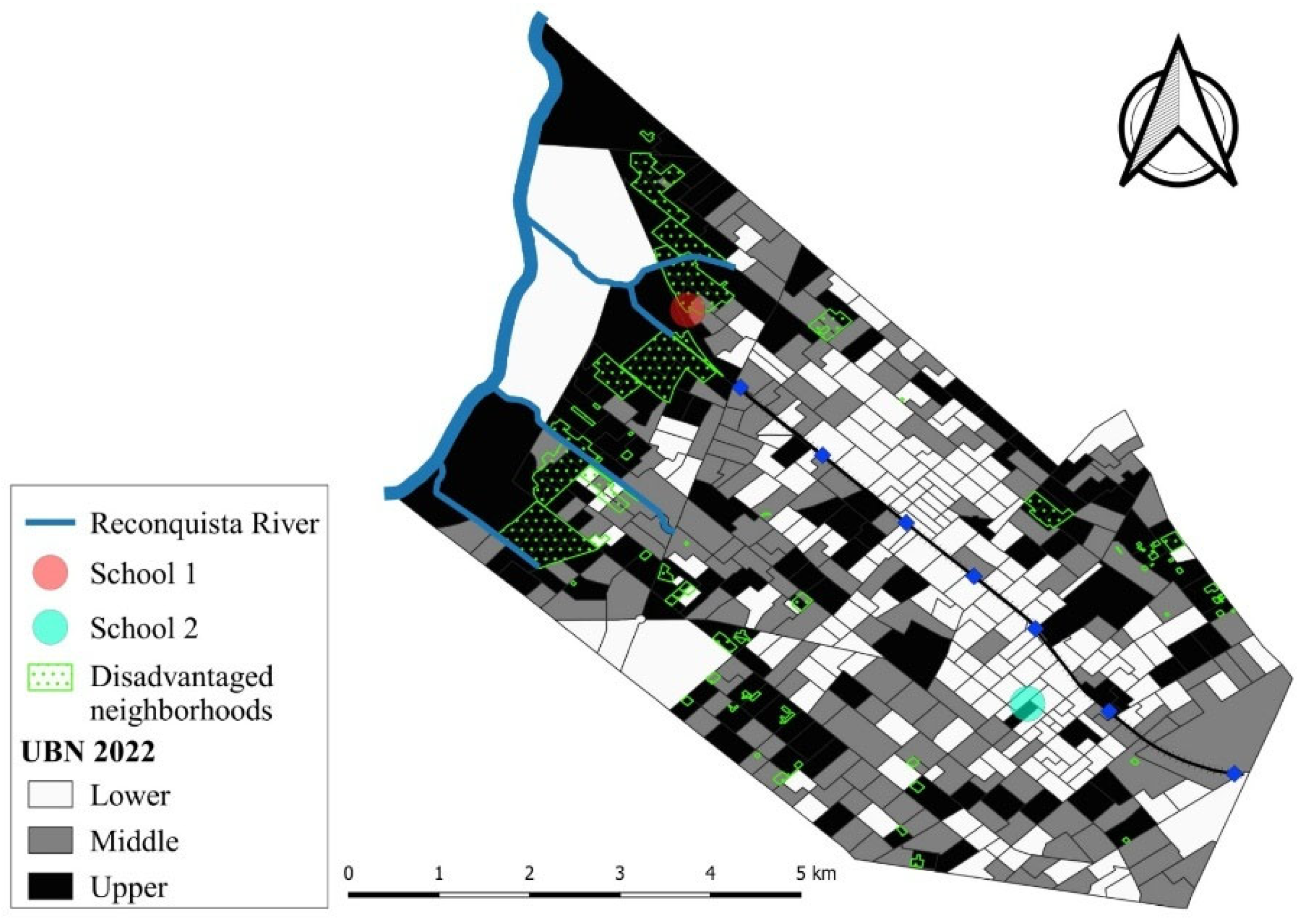
The sample included two groups each comprising 10 final-year secondary school students aged between 16 and 18, along with their respective teacher, from two different state-run schools located in urban poverty contexts in the San Martin region, Buenos Aires province, Argentina. Both schools were selected applying a purposive sampling technique, based on their location in or enrollment from socially disadvantaged areas and the willingness of students and teachers to address school or neighborhood violence. A georeferenced map showing the location of the schools according to the Unsatisfied Basic Needs Index (UBN) is presented below. It is important to note that, although the schools have different UBN levels, their student populations come from disadvantaged neighborhoods. See Figure 1.

2.3. Research Tools

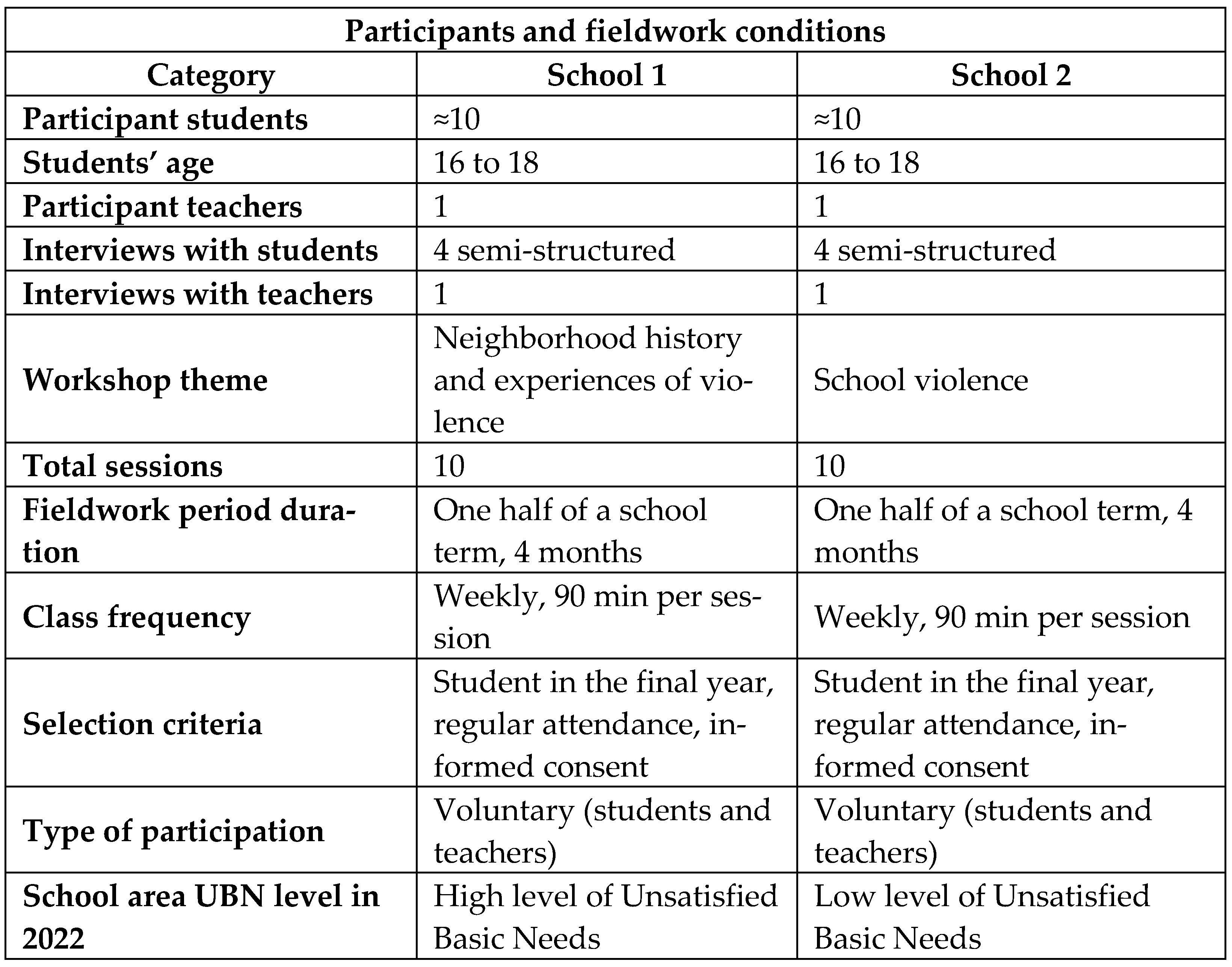
In-depth interviews were carried out with 8 students (4 for each group) and 2 teachers. The selection criteria were being a student in the final year of one of the participant schools, regularly attending the classes working in the project, and providing informed consent (students were also required to provide their legal guardians’ informed consent). Both teachers and students participated voluntarily in this research.
The observation period lasted one half of a school term (4 months). Data were collected through participation in weekly workshops of 90 min each conducted by students and teachers, a total of 20 sessions. In one group, the research theme was school violence, while in the other, the history of the neighborhood was addressed, with a sub-theme related to experiences of violence and their repercussions on the school. Our involvement was limited to participant observation and did not affect the selection of themes. See Figure 2.

2.4. Data Collection Techniques

The fieldwork involved various qualitative data collection techniques, such as:
Participant observation: During the workshops, the researchers actively participated in the process, observing interactions, group dynamics, and the development of the projects.
In-depth interviews: Interviews were conducted with students and teachers to gain a deeper understanding of their perceptions regarding the themes discussed in the workshops, particularly related to school and neighborhood violence.
Artistic and audiovisual production: Students participated in workshops focused on artistic and audiovisual creation, producing materials that were analyzed as part of the research process. These works included videos, graphic narratives, and other visual products that creatively explored the participants’ experiences and reflections.

2.5. Data Analysis

An inductive approach was used. Data were organized into emerging categories, which were then analyzed in-depth to identify patterns, recurring themes, and relationships between the different dimensions of school and neighborhood violence. The focus of the analysis was on students’ perceptions and experiences regarding how violence manifests in their environment, how they experience it, and the impact it has on their relationships within the school.

2.6. Ethical Considerations

The study adhered to the ethical guidelines established by the authors’ affiliated institution. In all the stages of the research process, informed consent was obtained from the participants, both students and teachers, ensuring their right to confidentiality and anonymity. Permission was also requested to record the interviews, observe the workshops, and use visual and artistic materials produced in the research context. The names of the schools, neighborhoods, and participants were modified to protect their privacy and ensure that the research findings complied with ethical principles and confidentiality standards.

3. Results

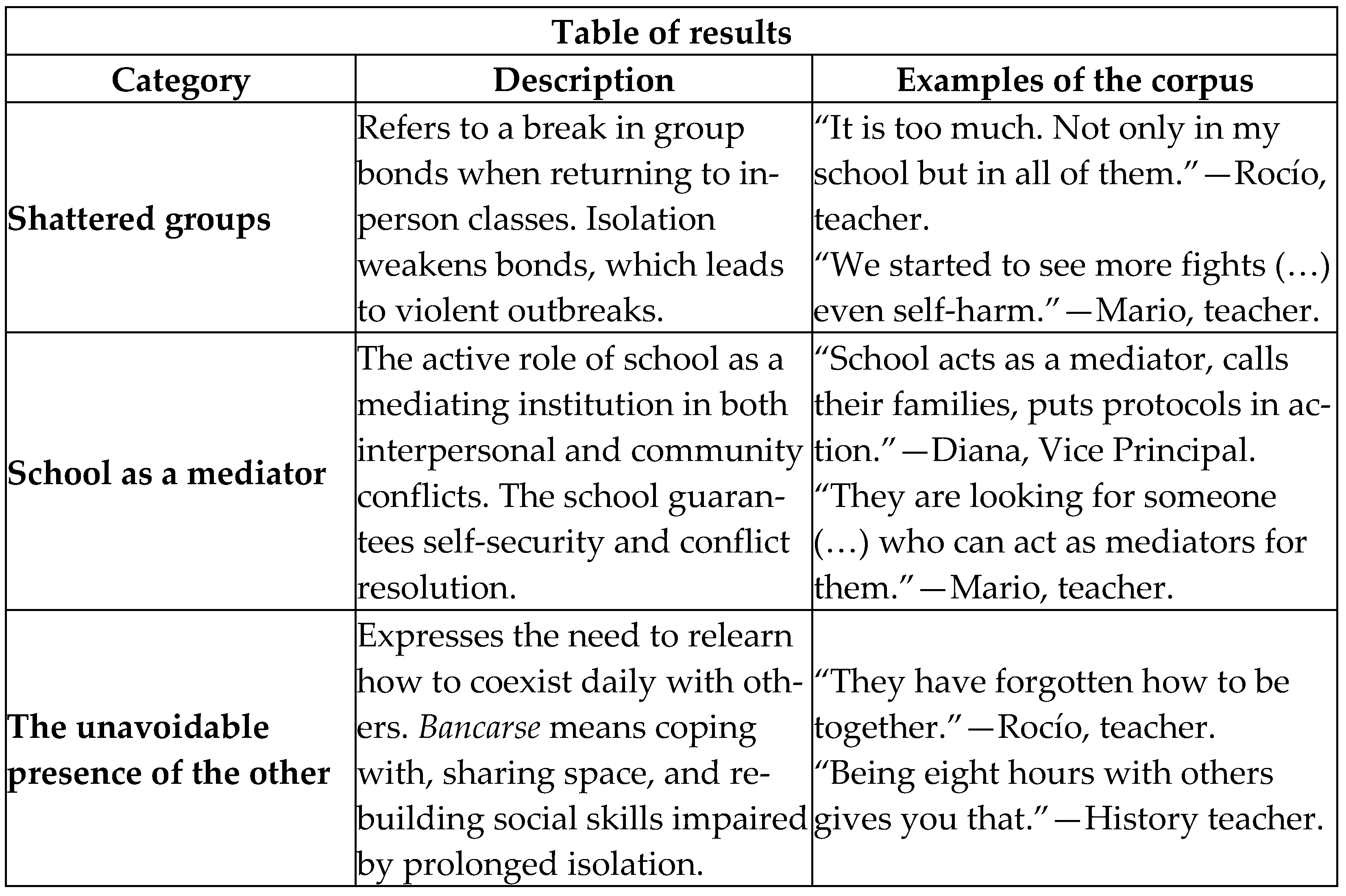
After a qualitative analysis of the data collected, we identified three categories that allow us to understand the change in students’ relationship after the pandemic and the role the school plays in it: (a) fragmented groups turn into “shattered groups”, (b) the school as a mediator and (c) the unavoidable presence of the other. The following subsections present a detailed description of these categories, the third one containing (b) and (c).

3.1. Fragmented Groups Turn into “Shattered Groups”

One of the impacts the pandemic has had on schools was the fragmentation of student groups. In two years, classes went from conventional classrooms to virtual classrooms and virtual meetings via platforms like Zoom and Meet, to WhatsApp groups, to bubbles (small groups of students who attended class in person to reduce the possibility of contagion) and back again to traditional in-person classrooms. During the two years of the pandemic, enrollment and students’ trajectories suffered a reconfiguration, and the same applies for classroom groups. Upon returning to classrooms, students had ceased to know each other, at least in the sense of sharing a common classroom. Students grouped back together were faced with challenges such as: having to inhabit a shared space, to interact face-to-face after a long period of isolation, and to encounter others who, like everyone else, were dealing with the aftermath of the pandemic, which in many cases was really painful (loss of a loved one or extended isolation in precarious living conditions). Teachers and school administrators do their best to restore school enrollment by attending to the demands of both new and returning students. Undoubtedly, the return to classrooms posed challenges in the socialization process of students, especially when it implied confronting an “other” face-to-face, whereas before, during schools’ closure, relationships had been mediated by screens. This was an in-person socialization, where the other became unavoidable. The fragmentation led to what we call “shattered groups,” where conflicts suddenly erupt, involving insults, arguments, fights or suicidal practices. Regarding this, another teacher says:
“I think the return after the pandemic exposed something that was already there in schools, but that has intensified. We started to see more fights, quarrels, even episodes of depression among kids, and even self-harm. In some schools, there were even cases of suicide. Things that, at least like this, so harsh, I personally had never experienced as a teacher”.
(Mario, History teacher, field notes, School 1, May 2023)
As we can see, teachers consistently note that returning to in-person classes involved a clash among students who had lost basic interpersonal skills after two years of remote learning. This prolonged lack of socialization resulted in what teachers call “shattered groups” (grupos estallados): groups with fragile and low-cohesion bonds that lead to the emergence of unexpected conflicts. This description relates to the notion of “getting on with the other” since it means having the ability to bear the other’s presence in a shared space and time. During the pandemic, interactions through screens reduced social contact, negatively affecting empathy and emotional regulation processes that are generally learned and trained in person.
There has been much speculation about the future of post-pandemic schools, and even some experienced voices advocated a complete shift to remote learning. However, neither those with radical views nor more nuanced ones expected such a dramatic increase in violent conflicts among students. Cases were singled out by teachers and students as physical violence, and specifically described as “fistfights,” sudden eruptions of violence without notice or reason, out of irritability, because students “couldn’t take it anymore”, which burst out in classrooms, hallways and schoolyards alike. Teachers insist on the unexpectedness of these episodes, where they feel urged to intervene instantly, to “run and separate them.” Teachers also highlight three problematic factors. First, the influence of social media, encouraging confrontations and spreading the fights. Second, an increase in physical aggression among female students. And third, that there have been teachers injured for intervening in the fights. A School Supervisor underlines the spontaneous nature of the fights saying:
“I had a situation once I was in charge of the yard, making sure the kids didn’t get hurt or hit each other, just seeing that everything was okay. Two female students started fighting, pulling each other’s hair, hurting each other. I tried to separate them. I grabbed one of them by her waist, trying to pull her apart, but they were so angry, pulling each other’s hair with such a force that I couldn’t divide them. The other student, the one who was facing the one I had grabbed, threw her classmate, and I fell with her. I fell on my knee and it got all swollen. I had to inform the ART (Workers’ Compensation Insurance) because I wasn’t sure what condition my leg was in”.
(Claudia, School Supervisor, School 2, interview, June 2023)
According to a teacher, the increase in conflicts and fights at schools is partially explained by the disruption caused by two years of physical distancing:
Teacher: “I think the problem with the fights comes from the pandemic. There have always been fights in school. Even when I myself was at school, and I can assure you that I graduated a long time ago (laughs). But now it’s too much. Not just in my school, in all of them.”
Researcher: “What do you think it’s due to?”
Teacher: “I think unity has been lost in the classroom, which is different from virtual settings. The kids spent so much time locked up, unable to go out, experiencing very tough situations that they have forgotten how to be together. That is what the classroom gives you, in a way.”
Researcher: “What do you mean, exactly?”
Teacher: “Just that, I mean. Being in a classroom for eight hours with other classmates. Bancándose al otro. It’s like… what happens to all of us. And on top of that, you have the mess of these kids’ lives,” referring to the poverty conditions many students live in. (Rocío, History teacher, School 2, field notes, July 2023).
What the teacher highlights here is that “getting on with the other”, coexisting with others and, in particular, with the physical presence of others, is something that has to be learned, and the school provides an opportunity for that. From this perspective, violence, irritability and the inability to cope with the other are seen as consequences of the disruption to the socialization process. The school addresses this problem by resorting to the space–time mechanisms that it has traditionally implemented, as the teacher already summarized: spending eight hours in a physical classroom with your classmates. In fact, teachers and school administrators report an emerging trend toward a reduction in cases, which could be an indicator of the benefits produced by a school’s socialization processes. The question that remains is how to address the recurrence of episodes where the other becomes unbearable in school, and also what the school’s possibilities to address them are. A preliminary answer is that gathering a group of people in the same time and space becomes a challenge in an era where encounters with others have taken on new forms, with its associated consequences regarding confinement, isolation and loneliness. These conditions, as the teacher points out, result in forgetting how to be together. The key to forge this kind of relationship is largely provided by the classroom, where bodies meet and learn to understand others.

3.2. The School as a Mediator and the Unavoidable Presence of the Other

What does the school do when life with others becomes conflicted and, in the worst case, unbearable? Some teachers propose a “mediating school,” where students express their conflicts in a space where it is possible to find a third party who observes and intervenes, who can help build a different relationship with the other, potentially contributing to conflict resolution. Speaking about one of the schools where he works, a teacher says:
“What I see in that school is that episodes of violence between students are recurrent. My hypothesis, and it’s just an idea of mine, is that the fact that the school brings together kids from different neighborhoods is what causes these conflicts, among kids themselves, their families, or neighborhood gangs represented there. And maybe, in a way, they are looking for someone who can help them or who can act as mediators for them in a situation they cannot solve by themselves”.
(Mario, History teacher, School 1, field notes, October 2023)
For schools located in urban poverty contexts, performing as mediators is not uncommon, given that the school is one of the most active institutions within communities, and many of them have been built following community claims for their right to education. This close relationship has turned the school into an ally for the communities, which sometimes ask it to intercede in neighborhood issues (Grinberg 2008). And while it is true that these alliances have particular characteristics in impoverished neighborhoods, it is worth highlighting that the school has historically acted as a mediator on behalf of its enrolled population. In this sense, the principal of School 2 says that after a fight, one of the students claimed to have been harassed by her classmate and ex-boyfriend in her own home. As a result, the Vice Principal suggests:
“Since the issue goes beyond the scope of the school, besides school’s intervention, I recommended that her father filed a criminal report for the harassment she was suffering from two guys, who were not only classmates, they were also her neighbors”.
(Diana, Vice Principal, School 2, field notes, September 2023)
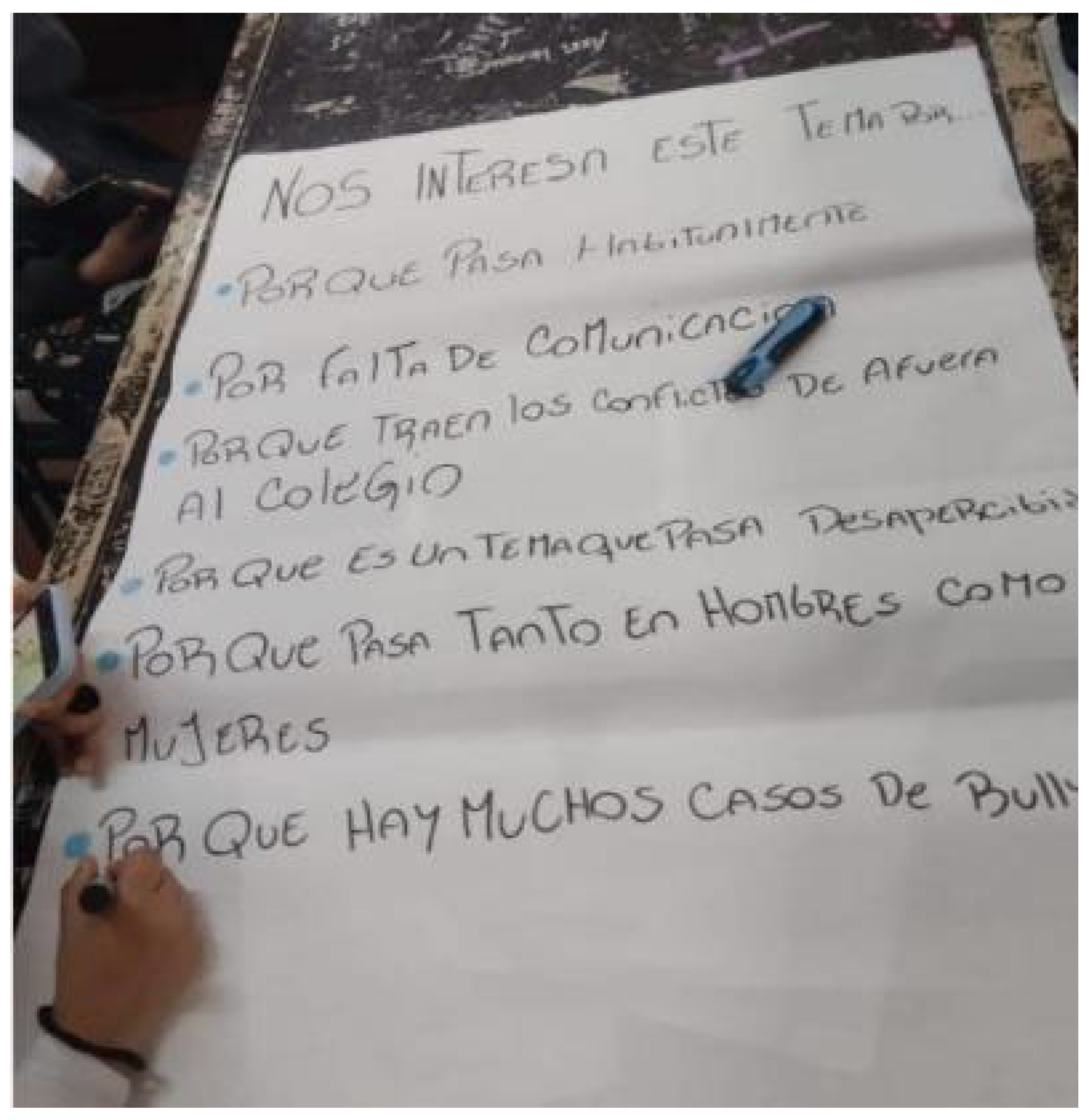
Scenes like this expose the mediation that school provides on a daily basis in dealing with issues that affect students’ lives. In the school, students find teachers and administrators who intervene, stop fights, mediate arguments, inform families about what is happening, refer cases to other institutions and professionals when necessary, and activate protocols to safeguard the physical integrity of those involved in conflicts. This is why teachers believe that students choose the school as their setting for confrontations: to seek a mediator to help solve the issue but, above all, to prevent the harm these confrontations can cause. Furthermore, through fieldwork, it was possible to observe how the school enables the circulation of speech, everyday conversation, writing, debate, and, in this way, the possibility of relating to others through storytelling. This narrative, unlike what happens on social media, has its own voice and does not get lost in the anonymity where incendiary discourses promoting hatred often operate. It is an embodied narrative that merges with that of others and with the environment. In this sense, the school’s power as a shared space, where students can interact face-to-face, becomes central. However, in the cases studied here, the pandemic represented not just a break from encountering others but also a rupture of communication, of words. This was partly evident by the increase in confrontations between students. In this sense, a research project carried out by one of the schools (School 2) focused precisely on addressing the rise in physical violence cases in schools. See Figure 3.
We are interested in this topic:
Because it happens regularly;
Because communication is insufficient;
Because street conflicts are solved by students at school;
Because it goes unnoticed by society;
Because both women and men suffer violence;
Because there are a lot of cases of bullying.
This poster was crafted by students, who decided to carry out a research project centered on physical violence in schools. Like their teachers, they were also worried by the increase in the number of fights among their classmates. Moreover, they perceived that fights had gone from being occasional to occurring frequently. Some of their hypotheses to try to explain this increase were aligned with those posed by teachers, especially in regard to neighborhood conflicts and the role of social media in fostering confrontation. In fact, these students produced a short film based on videos shared on social media. This motivated school authorities to instruct teachers to dedicate time in class for discussions on the importance of preventing physical violence in schools. Additionally, they asked the school counseling team to work together with teachers in order to develop strategies that help prevent confrontations and protocols to deal with any manifestation of violence that may have been encouraged through social media. Both the students’ research project and the school authorities’ call for action to find ways in which to avoid physical aggression among students show the school as an active and caring actor. It is by enabling conversation that the school manages to mediate and rebuild the bonds broken by hatred and a deprecation of the other. Thus, students find words to express what before they could only express by resorting to physical aggression. Conversations with principals, teachers and students involved in conflicts; group talks; posters crafted by students; interviews and debates carried out by students during research projects; notes and conversations among teachers, the school counseling team and the families; the referring of certain cases which required a certified professional opinion—all these actions emphasize that the school is capable of developing a collective discourse that withstands hatred. See Figure 4.

4. Discussion

We have undertaken the task of highlighting that the school is one of the institutions—and perhaps the most suitable one—where students learn to “get on with the other” in societies where this other often appears unbearable. This happens partly because, since the end of the 20th century, we have been living in societies mediated by discourses that encourage autonomy, self-responsibility and freedom within a context of increasingly fierce and unequal relationships of competition (Grinberg 2008). Consequently, in their pursuit of ideals like independence, proactivity, and competitiveness, individuals find themselves facing loneliness, exhaustion, and the constant threat of the other that must be guarded against. “Being unique and unparalleled” is one of the many ways to synthesize the horizon of contemporary processes of subjectivization (Berlant 2011). As Grinberg (2008) suggests, while in disciplinary societies the processes of subjectivization operated in relation to a law that indicated what one should be, today we are permanent objects of construction and change, called to become others. And it is precisely in the ongoing self-production of subjectivity—that is, in the constant search for a way to become someone else—that the other seems to fade away. This is an updated version of what Lasch (2020) prophetically called the advent of the “culture of narcissism” in the 1970s, where isolation and self-worship function as remedies against disenchantment with politics, which inevitably leads to the renunciation of the construction of common ground.
This paper aimed to highlight the school as one of the key institutions —maybe the most adequate— to help teach how to “get on with others” in societies where this other usually becomes unbearable. While the theoretical framework situates this problem within the context of wider sociohistorical transformations—such as a rise in individualism and narcissistic culture (Lasch 2020), and the self-production of subjectivity (Grinberg 2008)—the findings presented here show that these processes are embodied in the experience of returning to school after the pandemic.
In particular, the data collected from students and teachers reveal that the school has become both an echo chamber and a space for resistance within a context of growing fragmentation intensified by isolation and the proliferation of hate speech on social media. For instance, the fragmentation of student groups—often expressed through physical violence—signals a loss of social references which are essential for connecting with others. The findings suggest that returning to school involved not only reestablishing routines but also renegotiating the very meaning of coexistence. These contributions enrich current debates on schooling, conflict, and the possibilities of reconstructing common space after the dislocation caused by the pandemic.
Undoubtedly, the growth of anxiety, fear of failure, egotism, and a desire for fame—traits of the narcissistic personality that Lasch saw exacerbated by television and the film industry—have skyrocketed in the 21st century due to social networks and the virtualization of life. This must also be understood within sociohistorical contexts such as the pandemic and the spread of hate speech. Indeed, it is not that the other disappears completely or that there is an anthropological metamorphosis by which individuals can discard the other, but rather a reconfiguration of the territories under governance where governance falls upon individuals. The school is not immune to these currents, especially when, since its modern origin, it has been entrusted with the task of introducing young generations to common life. The scenes of daily school life presented in the previous section show some of the effects that the problem of the other brings upon schools, especially after a period of isolation and exposure to hate speech through social media, as in the pandemic. In this sense, it is evinced that once the school managed to spatially and temporally rebuild itself, it became both a sounding board for the aftermath of the pandemic and an active agent in the socialization of students. The struggles of the school with fragmented groups that burst into recurrent conflicts mediated by physical violence are not so much a reflection of a fragmented society but its daily battle of turning the person who represents the otherness into an equal. Indeed, the power of the school lies precisely in its ability to make those who were initially distant and different now close and similar by sharing common time and space. The school, through the encounters and processes of teaching and learning, offers a space where a crowd becomes a community. As Hickey-Moody (2023) points out, this requires believing that the future will be qualitatively superior if it is experienced in community rather than in solitude.
Far from being neutral or static, the school emerges here as an active institution mediating these conflicts. The role of teachers as third parties who intervene to reconfigure the encounter with others is central. Through these interventions, the school enables a way of communicating that transforms violent gestures into narrative forms. This illustrates how, by sharing common time and space—especially through physical presence—the school can become a community where difference becomes not only bearable, but even enriching.
Consequently, the question about the other—especially when they present themselves as unbearable—raises in turn the question about common space–time (Collet and Grinberg 2021). Thus, the school does not completely solve the problem of the other; it is not about seeing the school as a return to the lost paradise, but rather as an institution that manages to gather a group of individuals together in a common space–time, where the other along with the inherent difficulties involved in building any relationship become unavoidable. If, as the History teacher suggests, learning to bancarse al otro requires common space and time; it also demands a physical encounter. In this regard, the analysis of school space and time implies understanding that the students inhabit the school through bodily experiences. Considering the cases described here, teachers and students believe that the increase in physical aggression is linked to a loss of the reference once provided by the other’s corporeality. Irritability, physical violence, and mistreatment are signs of the difficulty of dealing with the other as well as with oneself. It would seem as if we were living in a somatic culture that values body and performance but struggles in connection with others. With regard to school violence it is important to note that beginning in the 20th century, mass media have been consolidating an image of youth that oscillates between civilization and barbarism, assigning marginalized youth to the latter and characterizing them as violent and irrational. The school, as a mediator, as suggested by teachers and students, embody a perspective that attends to, cares for, and intervenes in student conflicts. In this sense, teachers operate as third parties in the mediation of conflicts, seeking to reframe the meaning of encounters with others. Indeed, the task demands putting oneself in the other’s shoes, to leave stigmatization aside and be sensitive to communication. Learning is one way to achieve such communication and learning is precisely what the school insists on. Learning processes allow students to give word to and build a narrative about what sometimes can only be expressed through physical violence. This is evident in the conversations between teachers and students enabled by the school when the other presents themselves as unbearable.
However, we can acknowledge some methodological limitations. The data collected is qualitative and based on a limited number of interviews and observations carried out in two schools. While this allowed for a situated and nuanced perspective, it may not fully capture the whole range of school experiences in post-pandemic contexts. Future research may broaden the scope by including different types of institutions and student populations, or by adopting a longitudinal approach to observe how these dynamics evolve over time.
Rather than anticipating conclusions, we end this section highlighting that the school’s mediating role in conflicts with the other is neither automatic nor guaranteed. It requires pedagogical interest, institutional support, and spaces where students and teachers can process and reframe their experiences. These conditions are fragile but essential for transforming encounters with otherness into opportunities for coexistence.

5. Conclusions

We have intended to highlight how the school today is caught in the tensions of a society where, under the dynamics of the virtualization of life, hate speech, the tyranny of the self, and savage competition, the presence of others becomes unbearable. The school is by no means a passive result of these discourses; rather, it is an active setting that shapes the ways in which common ground and a relationship with others are constructed. We sought to underline that in times of fractured encounters, broken conversations, and the loss of physical interaction, the school manages to mend this rupture by bringing students together in a shared environment. It is a place where it becomes possible to learn to coexist, to care for others, and to experience their physical presence at a time when people seem increasingly unable to connect with one another.
In this way, the school transforms the anonymous, disqualifying discourses circulating on social media into embodied forms of interaction that acknowledge the other’s presence and potential. The school thus becomes a place where discourses of fear and hatred are confronted. This highlights the importance of conversation, visibility, and encounters with others, as illustrated in the scenes from everyday school life. Although the foundations of shared life are under threat today, the school still has the potential to create the necessary conditions for “being together… bancándose al otro,” and for sustaining a common life.

Author Contributions

Data collection, analysis and authorship were jointly conducted. All authors contributed equally to this work. All authors have read and agreed to the published version of the manuscript.

Funding

This research was funded by Concejo de ciencia y tecnica de la Argentina, grant number [PICT-SALTO INSTITUCIONAL].

Institutional Review Board Statement

The study was conducted in accordance with the Declaration of Helsinki, and approved by the Institutional Review Board (or Ethics Committee) of Laboratorio de Investigaciones en Ciencias Humanas N/A 15 January 2025.

Informed Consent Statement

Informed consent was obtained from all subjects involved in the study.

Data Availability Statement

The original contributions presented in this study are included in the article. Further inquiries can be directed to the corresponding authors.

Conflicts of Interest

The authors declare no conflicts of interest arising in the course of the study or this publication.

References

  1. Ball, Stephen J. 2003. The teacher’s soul and the teacher’s body: The labour of teaching and the future of education. Journal of Education Policy 18: 215–28. [Google Scholar]
  2. Berlant, Lauren. 2011. Cruel Optimism. Durham: Duke University Press. [Google Scholar]
  3. Bonilla-Muñoz, Marco Antonio. 2023. De docentes a héroes. La profesión docente en medio de micro conflictos bélicos urbanos en el marco de las políticas de la vida contemporáneas. Confluencia de Saberes 8: 52–70. [Google Scholar]
  4. Bourdieu, Pierre., and Jean Claude Passeron. 1970. La Reproducción: Elementos para una Teoría del Sistema de Enseñanza. Buenos Aires: Editorial Siglo XXI. [Google Scholar]
  5. Collet, Jordi, and Silvia Grinberg. 2021. Capítulo 1. La educación managerial y sus fugas entre la individualización y lo común. In Hacia una Escuela para lo Común. Debates, Luchas y Propuestas en América Latina y España. Madrid: Ediciones Morata, pp. 13–30. [Google Scholar]
  6. Debarbieux, Éric. 1996. La Violence en Milieu Scolaire: 1. État des Lieux. Paris: ESF Editeur. [Google Scholar]
  7. Flick, Uwe. 2014. Introducción a la Investigación Cualitativa, 5th ed. Madrid: Morata. [Google Scholar]
  8. Grinberg, Silvia. 2008. Educación y Poder en el Siglo XXI: Gubernamentalidad y Pedagogía en las Sociedades de Gerenciamiento. Buenos Aires: Miño y Dávila. [Google Scholar]
  9. Grinberg, Silvia, Julieta Armella, and Marco Antonio Bonilla-Muñoz. 2020. Mens sana in corpore exhausto. Emociones y gestión de sí en escuelas secundarias del sur global. Arxius de Sociología 42: 144–57. [Google Scholar] [CrossRef]
  10. Hernández Sampieri, Roberto, Carlos Fernández Collado, and Pilar Baptista Lucio. 2014. Metodología de la Investigación, 6th ed. Columbus: McGraw-Hill. [Google Scholar]
  11. Hickey-Moody, Anna. 2023. Faith Stories: Sustaining Meaning and Community in Troubling Times. Manchester: Manchester University Press. [Google Scholar]
  12. Kaplan, Carina Viviana. 2009. Violencia Escolar bajo Sospecha. Buenos Aires: Miño y Davila. [Google Scholar]
  13. Kriger, Miriam Elizabeth. 2010. Jóvenes de Escarapelas Tomar: Escolaridad, Comprensión Histórica y Formación Política en la Argentina Contemporánea. Buenos Aires: Editorial de la Universidad Nacional de La Plata (EDULP). [Google Scholar]
  14. Lasch, Christopher. 2020. The Culture of Narcissism: American Life in an Age of Diminishing Expectations. New York: W. W. Norton & Company. [Google Scholar]
  15. León-Moreno, Celeste, Cristian Suárez-Relinque, Juan Evaristo Callejas-Jerónimo, and Fernanda Inéz García-Vázquez. 2023. ¿Es mi culpa? El papel del sentimiento de culpa en la victimización entre iguales en adolescentes. Frontiers in Psychology 13: 1089689. [Google Scholar] [CrossRef]
  16. Olweus, Dan. 1993. Bullying at School: What We Know and What We Can Do. Malden: Blackwell. [Google Scholar]
  17. Reay, Diane. 2006. The Zombie Stalking English Schools: Social Class and Educational Inequality. British Journal of Educational Studies 54: 288–307. [Google Scholar] [CrossRef]
  18. Youdell, Deborah. 2006. Diversity, Inequality, and a Post-Structural Politics for Education. Discourse: Studies in the Cultural Politics of Education 27: 33–42. [Google Scholar] [CrossRef]
Figure 1. Georeferenced map of the two research schools based on the 2022 Unsatisfied Basic Needs (UBN) Index.
Socsci 15 00270 g001
Figure 2. Table showing participants and fieldwork conditions.
Socsci 15 00270 g002
Figure 3. Poster containing the reasons why students consider it relevant to study cases of physical violence occurring in schools.
Socsci 15 00270 g003
Figure 4. Table of results.
Socsci 15 00270 g004
Disclaimer/Publisher’s Note: The statements, opinions and data contained in all publications are solely those of the individual author(s) and contributor(s) and not of MDPI and/or the editor(s). MDPI and/or the editor(s) disclaim responsibility for any injury to people or property resulting from any ideas, methods, instructions or products referred to in the content.