
Systematic Review

Bordering, Surveillance, and Schooling: An Integrative Bibliometric-Informed Systematic Review of Refugee/(Im)migrant Education Governance

1
College of Education, Texas State University, San Marcos, TX 78666, USA
2
Faculty of Education, Anadolu University, Eskisehir 26470, Türkiye
3
College of Education, Eskişehir Osmangazi University, Eskisehir 26040, Türkiye
*
Author to whom correspondence should be addressed.
Soc. Sci. 2026, 15(4), 232; https://doi.org/10.3390/socsci15040232
Submission received: 19 January 2026 / Revised: 9 March 2026 / Accepted: 25 March 2026 / Published: 1 April 2026

Abstract

This study presents a bibliometric analysis of 461 studies on refugee and (im)migrant education governance, covering the period from 2015 to 2025. All studies were articles indexed in the Web of Science category. The analysis reveals publication trends, conceptual and intellectual structures, and the evolution of themes. Data were analyzed using the Bibliometrix R package. Document coupling and thematic analyses indicate a modular research ecosystem structured around policy governance, inclusion and diversity, refugee education, and access to higher education, with governance-focused scholarship playing a prominent connective role. A systematic review, guided by the PRISMA technique, was conducted to enhance these structural insights, focusing on the 25 most cited and conceptually significant studies identified during the bibliometric phase. The systematic review examined research features, participant demographics, educational settings, and analytical frameworks, with particular attention to the theoretical and operational aspects of governance, bordering, and surveillance themes. The findings reveal a pronounced geographic concentration in affluent Western contexts, especially the United States, alongside a smaller but conceptually significant body of work situated in refugee-hosting regions of the Global South. Education systems are consistently described as mechanisms of migratory governance, in which policies, accountability frameworks, and routine institutional activities establish borders and surveillance. This study combines extensive bibliometric mapping with comprehensive systematic synthesis to present a coherent overview of the conceptualization of refugee and (im)migrant education over the past decade, highlighting ongoing theoretical fragmentation and the need for more cross-scalar, integrative strategies in education governance within migration contexts.

1. Introduction

In modern era, the term school serves not only as an institution of learning and teaching but also as an important instrument of regulation of societal norms, building an identity, structures of power, creation of generations, and perpetuation. Thus, the notions of bordering and monitoring have emerged as instruments of governance. Before the political and systematic upheavals of the last ten years, schools were often idealized and identified as neutral environments which are dedicated to intellectual and social development (Giroux 1982; Kotzee 2018). But in contemporary times, especially the years between 2015 and 2025, schools are the places where boundaries are delineated, examined and enforced explicitly and implicitly (Dunne et al. 2020; Loader 2021). With this paradigmatic change, the processes in schooling areas affect students’ actions in a way that they feel surveilled. So, the literature started to mention bordering with such terms as material, institutional, and symbolic that categorize persons and regulate access to educational possibilities (Hunt 2021; Annala 2022; Lulua and Moch 2024).
The concept of borders in education comprises three primary layers: material, institutional, and symbolic. Each of these delineates the criteria for membership, exclusions, and the allocation of educational opportunities. Boundaries within educational institutions operate on various levels that collectively influence children’s perceptions of belonging, mobility, and access to opportunities. At the very first level, which is the material one, the term borders is manifested via the configuration of the educational environments such as fences, gates, and controlled access points which means there are separated areas that make students inequal and ostracized. At the second level, which is institutional, borders become evident in regulations and administrative procedures such as enrollment criteria, zoning regulations, monitoring and streaming mechanisms with disciplinary policies. In addition to these formal and solid boundaries, symbolic boundaries are also evident through cultural norms, curriculum selections, language policies, and the implicit curriculum. Altogether, these factors establish a standard for the “ideal” pupil and marginalize individuals whose language practices, cultural identity, or behavior deviate from the dominant norm.
The complex border and surveillance protocols established in educational institutions are not standalone. These protocols are also a production of social, economic, and demographic factors. Educational institutions became a projection of a society and governance policies in terms of external factors such as national welfare and national discussions on security, mobility, and identity. Thus, the constraints or freedoms that are imposed on schools are the reflection of the national policy that the government implements. Although schools were seen as policy-blind organizations, in the last ten years they began to be seen as base or primary areas where students, who came from another county, culture and society, systematically encounter conflicts.

2. Theory and Practice: Insights into Refugee/(Im)Migrant Education Governance Dynamics

The studies or research on migration and education have undergone a restrict and solid transformation in the last decade. The main reason behind this transformation is the reality of the sharp increase in the number of people who are plucked from their homelands. This upheaval and change transformed and directly impacted government policies (Başaran et al. 2024). Governments and educational administrators alter and modify curricula, teaching methodologies, and consequently schools and their systems when they face a big number of youths at the age of schooling (Rahal and Arar 2025). Furthermore, based on the dominant societal norms, some issues on identity roles, borders which are solid and abstract, teacher roles or status, and surveillance principles persist.
Education and education governance policies are shaped by complex and interdependent factors such as political, institutional and normative challenges. In this aspect, there has been a worldwide educational transition in the incorporation of refugees, migrants, and immigrants to the mother systems. These incorporations mainly fed on the notions of access to education, social inclusion, and economic engagement, respectively. Nonetheless in practice, formal and social inclusion, in terms of sustained economic engagement, substantial educational access and quality, or a solid social integration, cannot be ensured. In comparative policy analyses, certain countries such as the Netherlands, Canada, Sweden, Germany, and Turkey are frequently described as demonstrating relatively higher enrolment continuity, transition access, and institutional integration mechanisms for refugee students (Crul et al. 2019; Korntheuer et al. 2021). By contrast, scholarship examining contexts such as the United States, France, Italy, Greece, and Spain highlights persistent challenges, including fragmented governance structures, assimilation-oriented policy paradigms, disparities in completion rates, and capacity constraints (Bris and Bendito 2017; Feinstein et al. 2022; Ho et al. 2023; Tsitselikis 2018). These distinctions should be understood as relative tendencies identified in the literature rather than definitive hierarchies of policy effectiveness.
To understand how schools in the U.S. treat students who are refugees or immigrants, it is necessary to examine how the policies, rules, safety measures, and tracking systems all work together. Every student in the country has the right to go to a public school from kindergarten through twelfth grade, no matter how they get there (Crawford et al. 2025).
One of the goals of their integration method is to get them back on their feet financially fast and make sure everything runs smoothly. Taking a language class and getting ready for the job market are more important than making sure everyone gets the same education right now and for the long run. Every child has a place in a classroom where they must go to school. The students will keep this promise only if they do certain things, like finish jobs that are right for their age, do well on tests, and learn English at the expected rate. When college officials think of “nonresident” or “foreign” students, they often forget to include students who are refugees or who are forced to move.
School districts can keep people from moving around by setting official limits. Even though it is against the law to keep students from going to school, there are still things that make it hard, like rules about where to put kids based on their language skills, time limits on papers, and uneven access to resources like money and programs (Koyama and Turan 2024). When kids move from one school to another, there are a lot of steps they need to take that are written down. For big changes, like going from high school to college, this is very important.
When accountability systems are added to bigger immigration police systems, they change learning in even more ways. Kids and families of immigrants and refugees get stressed out when they must report data, keep an eye on performance, and keep track of attendance. This makes them lose interest in school and self-censor (Arar et al. 2022). All these things work together to make a system of rules that uses internalized control and conditional inclusion to make sure people can get in while narrowing their options for education.
Because the nature of governance is a complex process which consists of multiple tiers and actors such as international organizations, national governments, municipal authorities, and educational institutions, a paradigmatic approach to responsibilities frequently results in policy deficiencies, redundancies, or discrepancies which some refugee, immigrant or migrant students face with negative bordering and surveillance practices. At this point a dilemma occurs, which has evolved into a fundamental governance quandary between assimilationist strategies and frameworks that recognize cultural diversity, as well as the principle of equal opportunity and the imperative to meet the distinct educational, linguistic, and emotional needs of refugee students (Bajaj et al. 2022). According to the literature, state policies lead to major variations in education rules at both the macro and micro levels. The main reason behind this occurrence is because of policy implementers, administrators, counselors, and teachers have different information, motivations, resources, and paradigms about immigrant students (Meehan et al. 2021; Callahan et al. 2020; Bunar and Juvonen 2021).
The studies conducted in Turkey, the United States, China, and the European Union countries indicate that educational organizations and institutions are utilized by the state policies in terms of a reinforcement concepts of citizenship, belonging, and implicit boundaries along with the main or fundamental role of being an area of teaching and learning community (Arkan 2016; Yılmaz 2020; Bengtsson 2015; Sager 2021). Thus, the concept of governing of refugee or immigrant students cannot be comprehended only with policy text, reports, and solid measurements. It should also be analyzed via the daily practices which take part in schooling areas where borders are negotiated, constructed, and lastly disputed.
In this context, schools can be seen as grassroots governmental entities which translate abstract policies regarding migration, security, and citizenship into tangible decisions concerning placement, assessment, language assistance, discipline, and visibility. Thus, educators, school administrators, and guidance counselors serve as essential governance mediators, often exercising discretionary power that can either alleviate or exacerbate discriminatory attitudes. In this aspect, the literature implicitly says that while some educators employ inclusive methods and adaptive techniques to meet the academic, social, and cultural requirements of refugee or im/migrant students, others are constrained by pressures such as standard curricula, or inadequate resources of schools’ social and monetary capital (Antony-Newman and Niyozov 2023; Cerna 2019; Li and Qin 2022; McDiarmid et al. 2021; Radhouane 2023). Thus, the second group of educators can sometimes reinforce deficit viewpoints and surveillance practices.
Consequently, research and the literature underscore the importance of comprehension of the reality of governance as a process and human action should be from the ground up. That means governance as a process should concentrate on the real-life experiences and experiential reality of boundaries or surveillance practices which take place in schools and classrooms. Thus, themes such as power, agency, and justice which illustrate a meaningful inclusion in refugee, immigrant, and migrant education rely on policy objectives but also transforming the logics inherent in everyday practices.

Objectives and Purposes of Study

This study adopts a two-stage review design combining bibliometric mapping and systematic review synthesis of the research on governance of refugee and immigrant education which is written between the years of 2015 and 2025, the decade which is characterized by alterations in global migration reality and the educational response to them. In this period, educational institutions have progressively operated as administrative and symbolic border zones wherein states monitor, classify, and restrict migratory populations. Research in this area has diversified, incorporating concepts from critical policy studies, border studies, surveillance studies, and migrant governance. Thus, this review illustrates how educational institutions influence migration policy and shape the lives of refugee and (im)migrant youth by delineating patterns of productivity, conceptual clusters, and thematic shifts.
Thus, this study addresses the following research questions:
RQ1. What productivity models, collaborative networks, and topic cluster evolutions define research on refugee/migrant education governance from 2015 to 2025?
RQ2. In what ways do intellectual and conceptual frameworks, including restriction, surveillance, and migration governance, shape this field, and how do studies define schools as arenas of governance, surveillance, and boundary building for refugee and migrant youth?
RQ3. What governing logics, restrictive behaviors, and monitoring mechanisms are discovered in the most effective research on refugee and migrant education?
RQ4. What mechanisms influence how governing logics, restrictive behaviors, and surveillance systems determine inclusion and exclusion in education?

3. Data Resource, Study Perspective, and Method

The data source of this study was taken from the Web of Science Collection, which provides an extensive and qualified coverage of articles on education and educational research. When compared to other interdisciplinary databases such as Scopus or Google Scholar, the Web of Science guarantees that citation metadata and categorization requirements are regularly incorporated, which is essential for scientific mapping research (Bar-Ilan 2010; Van Der Pol et al. 2015).
To identify and retrieve relevant studies on refugee and (im)migrant education governance, a set of search terms was developed based on established concepts in migration, policy, and education research. At this point, the Boolean lexical query included three main strings of keywords. At the very first string, the following keywords are used: “refugee”, “asylum seeker”, “forced migrant”, “immigrant”, “immigrant student”, “newcomer student”, “undocumented student”. The second string is made off the following keywords: “education”, “school”, “higher education”, “university”, “universities”, “teacher education”, “adult education”. The third and last string consists of the following: “policy”, “education policy”, “governance”, “school leadership”, “educational leadership”, “policy”, “security”, “surveillance”, “bordering”, “border regime”, “discipline”, “disciplinary”, “hostile environment”, “accountability regime”, “age of hostility”. These keywords were linked with the operator “OR” while the strings of keywords were linked with the operator “AND”. The paper’s duration was set to the years between 2015 to 2025.
On the other hand, the search was conducted in December 2025, and the sole document type included was “articles” authored in English. The dataset was then retrieved and exported in plain text format (Full Record and Cited References). Further analysis was performed using the Bibliometrix R program software, which allowed researchers to investigate publishing patterns, author and country productivity, citation networks, and the field’s conceptual and thematic organization.

3.1. Inclusion and Exclusion Criteria

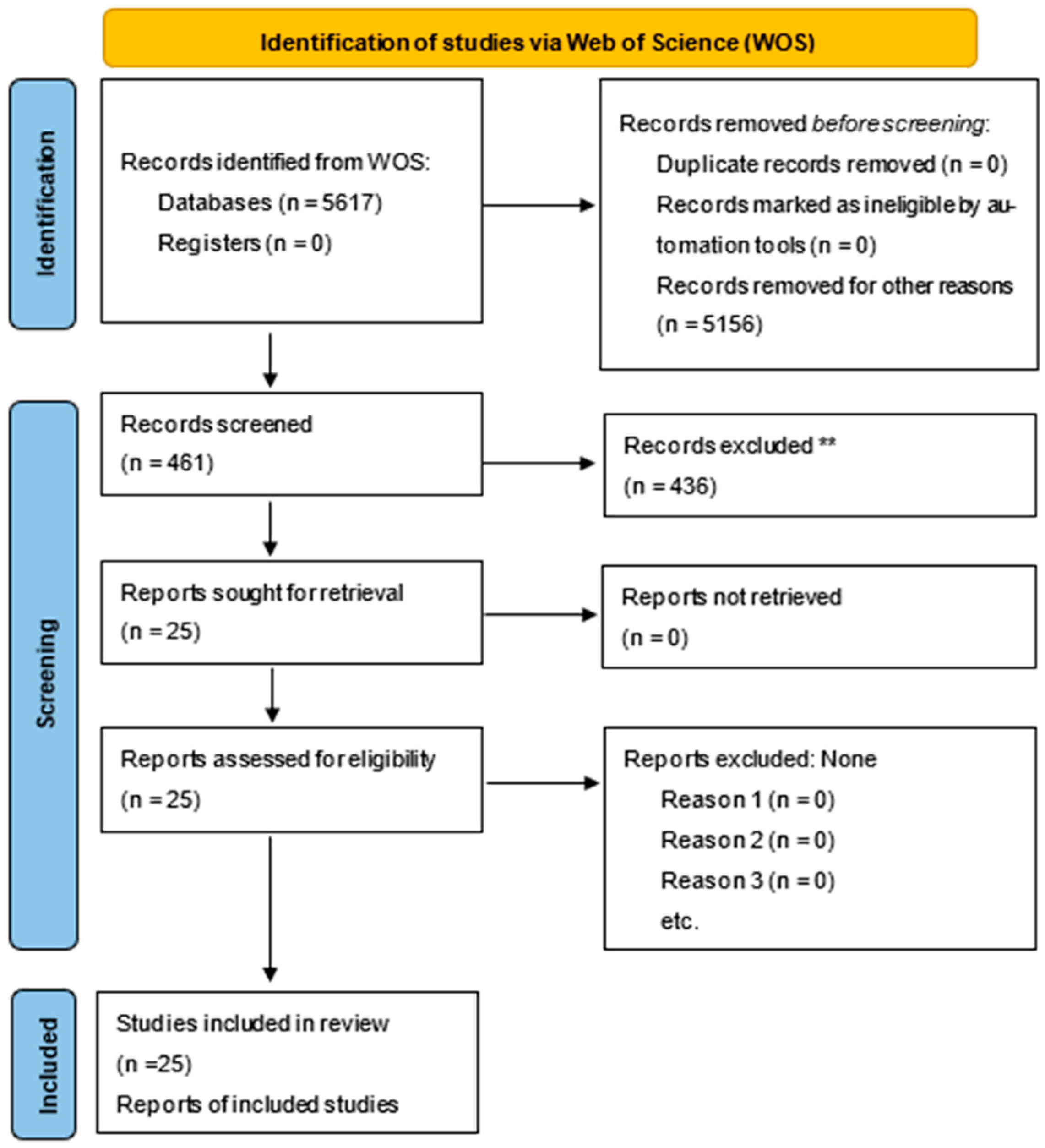
At the very first step, without any inclusion and exclusion criteria, 5617 studies were scoped with the keywords reported above. Then, as a document type, “article” was picked; using this criterion, 5097 studies were found. As a second step, just the articles in the “educational and educational research” category were polished, and 1400 remained; after that, only the articles written in English were refined and 1346 studies were left. In the final two steps, researchers added a date range from 2015 to 2025, resulting in 1018 articles, and then the articles in the SSCI index were left behind, giving the number 461. The restriction to SSCI-indexed journals enhances comparability and ensures a consistent peer-reviewed corpus; however, it also entails epistemic trade-offs. This decision may privilege established academic networks and Global North publication venues while underrepresenting regionally situated scholarship, non-English contributions, practitioner-oriented research, and gray literature, including policy reports from international organizations such as UNHCR or UNESCO. As a result, certain locally grounded or policy-embedded perspectives on refugee and (im)migrant education governance may remain less visible within the present analysis. The findings should therefore be interpreted as reflecting the intellectual contours of indexed academic production rather than the full spectrum of governance practices and lived experiences. This limitation invites further research incorporating broader databases and policy-oriented sources to expand representational and epistemic diversity.
In the second stage, the systematic review section, all original inclusion and exclusion criteria, such as keyword strings and longitudinal scope, indexing, context, and language, were the same because the dataset was the same. The 461 SSCI-indexed articles were ranked by total citation counts retrieved from the Web of Science Core Collection (December 2025), excluding self-citations to minimize inflation bias. The 25 most cited studies (5.4% of the corpus) were selected for full-text analysis in order to capture sustained intellectual influence in refugee and (im)migrant education governance research (Table 1). Full-text screening confirmed relevance to four dominant thematic nodes identified in the bibliometric phase: governance and policy rationalities, bordering practices, surveillance, accountability, and assessment mechanisms, and justice, equity, or inclusion discourses. Studies were included if they directly addressed refugee or (im)migrant education governance within educational institutions and provided conceptual or empirical insight into governance-related mechanisms; studies lacking a clear educational focus or substantive engagement with these themes were excluded. A PRISMA-style flow diagram (Figure 1) details each stage of identification, screening, eligibility, and inclusion. To strengthen the analytical connection between bibliometric mapping and systematic synthesis, a structured data extraction framework was developed based on the identified thematic clusters. For each included study, conceptual definitions, operationalizations, institutional mechanisms, and data sources were comparatively analyzed, moving the synthesis beyond descriptive clustering toward conceptual clarification. While citation-based selection facilitates the identification of influential scholarship, it may privilege established contributions and underrepresent emerging or regionally situated research. Moreover, restricting the dataset to SSCI-indexed journals enhances comparability but excludes gray literature and policy reports; findings should therefore be interpreted within this defined scope.
To strengthen the evidentiary foundation of the synthesis, a structured methodological quality appraisal was conducted using the Mixed Methods Appraisal Tool (McGill University 2011). Each study was evaluated according to design-specific criteria, including clarity of research questions, appropriateness of methodology, transparency of data collection, analytical coherence, and alignment between evidence and conclusions. Appraisal outcomes were not used as exclusion criteria; rather, they informed the calibration of interpretive weight in the synthesis. A summary of appraisal results is presented in Table 1. While most studies demonstrated moderate to high methodological robustness, several relied on context-specific case designs or limited samples, which constrains generalizability. These variations were explicitly considered when formulating conceptual and governance-related implications. At the same time, it should be noted that the MMAT assesses methodological design quality rather than theoretical depth or normative positioning; accordingly, the appraisal captures robustness of research procedures but does not exhaustively evaluate conceptual sophistication.

3.2. Methods of Analysis

As a method of analysis, a multiphase bibliometric and science mapping methodology was employed in this study. That means the researchers integrated descriptive performance indicators, network analysis techniques and thematic trajectories, and scholarly conceptualizations of the topic, which is educational governance of refugees and immigrants. The main aim for this process is to provide a comprehensive reconstruction of the practical, theoretical, and transformative sides of bordering, surveillance, and schooling in the very specific context in the years between 2015 and 2025. To reach the framework and main aspects of the topic, the Bibliometrix R package is used. Then, the researchers employed a systematic review method to support the bibliometric analysis by offering a clear and theory-informed synthesis of the substantive material.
While bibliometric tools help to map key publications, thematic clusters, and intellectual frameworks, they do not capture how core ideas like governance, boundaries, and surveillance are defined, operationalized, and experimentally tested inside particular research.
The methods used in this study are congruent with other systematic reviews on migration, education policy, and inequality in schooling contexts (Arar et al. 2022; Cabral-Gouveia et al. 2023; Torres-Zaragoza and Llorent-Bedmar 2024). To guarantee methodological rigor, transparency, and replicability, the review documented the study identification, screening, eligibility, and inclusion processes in accordance with the Preferred Reporting Items for Systematic Reviews and Meta-Analyses (PRISMA; Page et al. 2021).

3.3. Productivity Patterns and Collaboration Networks

The researchers employed and produced bibliometric indicators with an eye to grasp the subject’s developmental dynamics and structure. To do so, longitudinal production activity and longitudinal changes in average citations in research on refugee/(im)migrant education governance on the scope of bordering, surveillance, and schooling were looked at. With this step, it becomes clear which trends in educational and academic output are dominant. Then, a co-authorship collaboration network was established deep into the patterns.

3.4. Conceptual and Intellectual Structures

The researchers used bibliometric analyses to find out the research field’s theoretical foundations, thematic organization, and knowledge dynamics. With this aim, co-occurrence network analysis, thematic map network analysis, and factorial map analysis were done. Then, to draw an intellectual structure framework, the researchers employed co-citation analysis and bibliographic coupling. To go deeper, three-field plot, authors-references-abstract, co-citation network, and cluster by documents coupling methods are used to map out the intellectual structure. Lastly, a document coupling network has been employed to find out how the field structurally organized at the level of active research production.

3.5. Thematic Evolution and Emerging Trends

The area’s conceptual framework was examined using a keyword co-occurrence network, in which author-provided phrases were standardized through lemmatization and synonym alignment (for example, “refugee education”, “education of refugees” and “bordering”, “border governance”). The co-occurrence matrix was displayed with association-strength normalization to aid in the identification of dominating topic clusters and their interrelationships. Thematic evolution research was carried out to investigate temporal changes. The dataset was divided into time periods to reflect significant geopolitical and policy shifts in global migration governance.

3.6. Conceptualizations of Schools as Sites of Governance and Bordering

To create a conceptual structure on this topic, the researchers conducted a content focused cluster validation approach by using a bibliometric practice. In this context and process, three subject matter experts, who possess considerable expertise in the topic of immigration and education, conducted evaluations on publicized studies within each thematic cluster independently. They analyzed and evaluated titles, keywords, themes, abstracts, and full text when needed.
In this aspect, researchers only focused on how the clusters conceptualize schools and the process of schooling as pivotal domains for the policy implementations of bordering and surveillance areas. Furthermore, the experts or researchers discerned recurring subthemes which respectively are school-level micro borders, the securitization of quotidian educational affairs, physical, psychosocial, and psychological wellbeing, the feeling of belonging, inclusion, and exclusion. By means of these steps, the chart of chorological evolution for the refugee, migrant, or immigrant and undocumented youth emerged.
Consequently, narrative cluster summaries were shaped and created to combine bibliometric data with the interpretive insights via elucidating how the literature depicts schools as arenas which are the creation of state logic and state policy, norms which are direct institutions, and lastly students’ converged identities. With this approach and process, the analytical basis for the discussion part, social control, and the politics of mobility, contextualizing the field’s theme patterns within wider debates on educational governance were established.

4. Results and Discussion

This section synthesizes data from the bibliometric analysis and the systematic review to deliver a thorough overview of research on the governance of refugee and (im)migrant education. The bibliometric analysis delineates the intellectual framework and thematic progression of the discipline, while the systematic review provides a comprehensive assessment of the empirical and theoretical articulation of governance, borders, and surveillance in significant research.

4.1. Bibliometric Analysis Results and Discussion

In the following subsections, researchers examined publication activity and collaboration patterns within the years 2015 and 2025. In this process, descriptive metrics and network visualizations were used to illustrate temporal trends and co-authorship networks. Furthermore, the intellectual and conceptual foundations of the field were analyzed by identifying prevailing frameworks such as borders, surveillance, and migratory governance through co-word and co-citation analyses. Then, contemporary theme clusters were presented with bibliometric timeline analysis and clustering methods with an eye to highlight their relative magnitude, internal consistency, and development over time. Consequently, the synthesis of these findings emphasizes how the studies conceptualize schools or schooling activities as central sites of educational governance, surveillance, and border making of refugee and (im)migrant youth by integrating and combining structural patterns with substantive interpretations of educational institutions.
RQ1. What productivity models, collaborative networks, and topic cluster evolutions define research on refugee/migrant education governance from 2015 to 2025?
In bibliometric studies, publication activity assesses the quantity of published articles, authorship contributions, and publication dates to serve as the foundation for evaluating the development, productivity, and progression of research domains, institutions, and lastly individual scholars who studied on a subject (Ninkov et al. 2021). Thus, the studies in published between 2015 and 2025 were taken into consideration with same aim to reflect a decade long expansion of the topic.
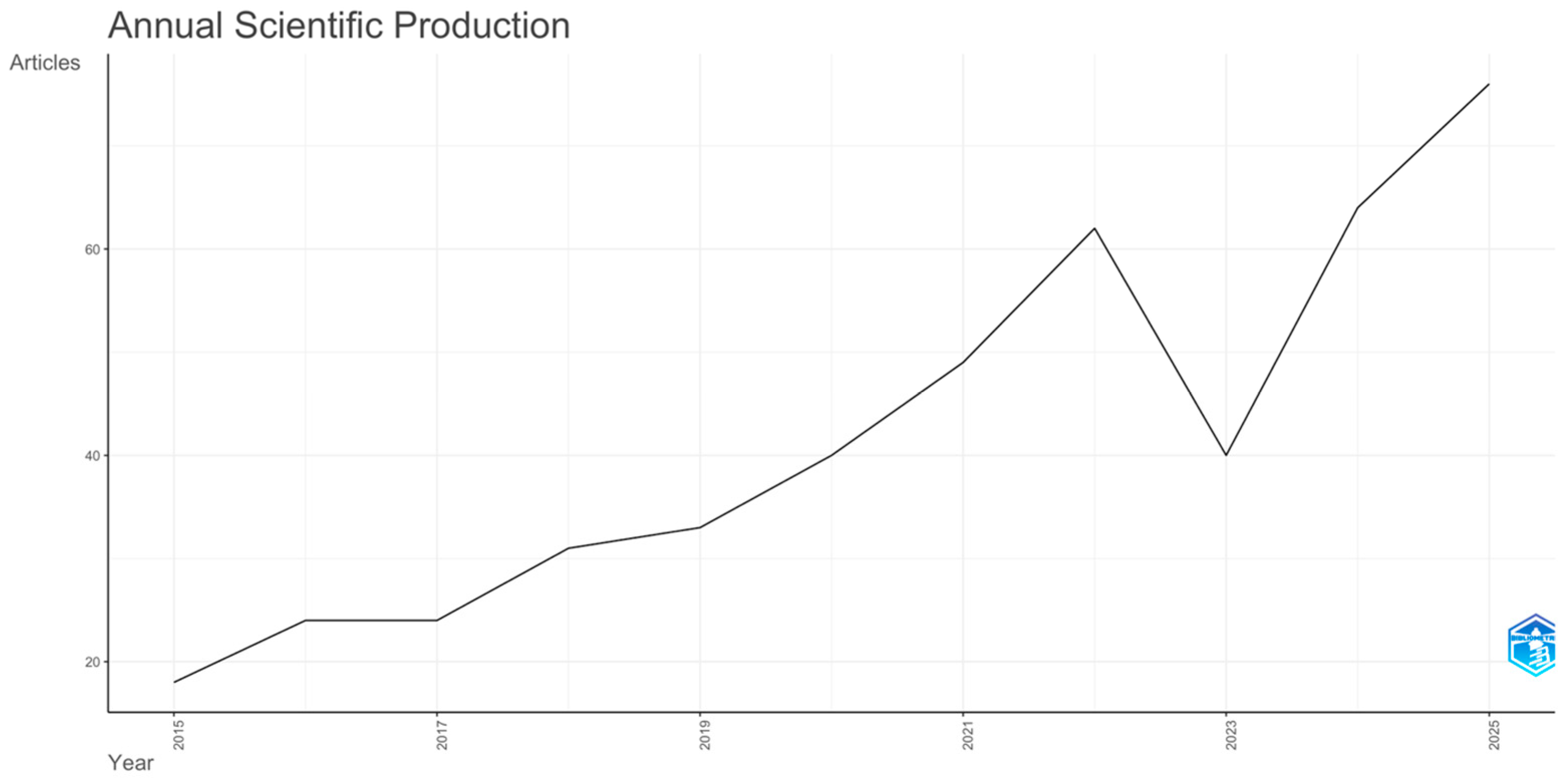
Figure 2 shows the annual scientific production and academic output in the very specific subject from 2015 to 2025, which suggests a discernible long-term upward trend that reveals the ongoing consolidation and increasing interest in scholars. During the initial phase (2015–2017), publication output remains comparatively modest and steady, exhibiting a progressive rise from fewer than 20 articles to the mid-20s. Thus, this period can be regarded as a developmental era which scholars and the discipline itself start to flourish but not yet achieve an academic and critical threshold in the field. Nevertheless, in the beginning of 2018, a consistent and notable positive change begun to take place. This change indicates a shift from an emerging and flourishing area to an expanding research area. Throughout 2019 and 2022, the number of academic enterprises rose significantly, reaching a zenith of over 260 outputs. This intensified attention indicates the beginning of a strong and international policy-oriented focus, alongside augmented research funding and cross-disciplinary collaboration. By 2023, a noticeable decline in publication counts is observed. Given that this pattern reflects a single-year fluctuation within the analyzed period, it should be interpreted cautiously and not as evidence of a structural contraction in the field. Publication levels in 2024 and 2025 show an increase relative to 2023, suggesting variability across years rather than a sustained downward trajectory. Taken together, these patterns indicate temporal fluctuation within the observed period, without supporting definitive conclusions about long-term expansion or decline. In all, Figure 1 suggests the scientific literature in this field has grown from a relatively modest body of work into an active and rapidly expanding area of research.
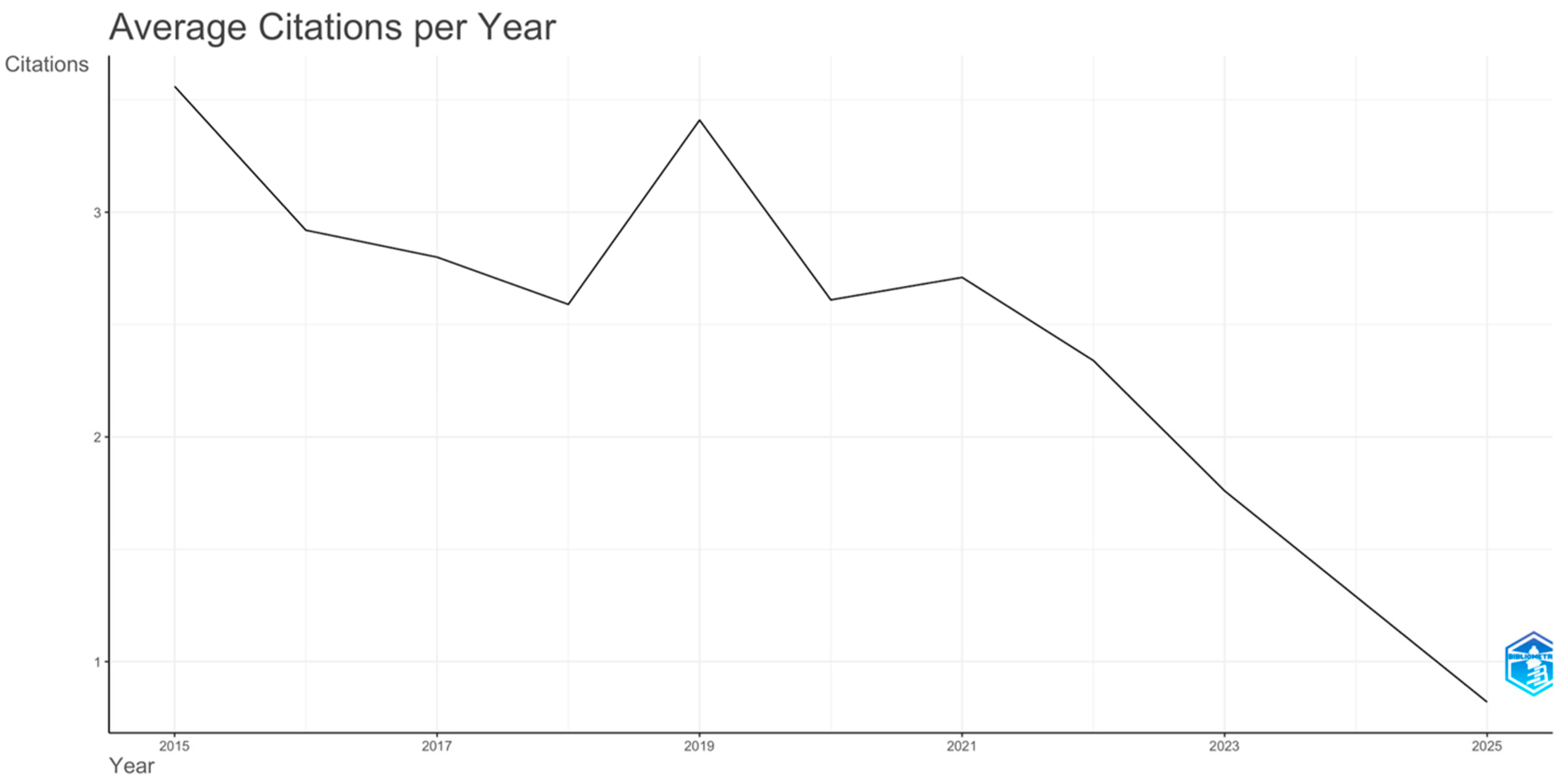
Figure 3 is about the trend in the average number of citations per article, which provides an insight into the citation impact and temporal visibility of the field. During the initial years of the period, notably in 2015, studies demonstrate the highest average citation rates, suggesting that early contributions garnered significant academic interest. On the other hand, from 2016 to 2018, the average number of citations exhibits a small decrease, indicating an increasing number of publications vying for recognition. A significant exception to this declining timeline is observed in 2019. This increase probably indicates the publication of highly influential or conceptually integrative studies that resonated within the field and were swiftly cited. Following this, citation averages decline once more from 2020 onwards, exhibiting slight stabilization in 2021, before experiencing a more significant decline in subsequent years.
Considering the inherent citation latency effect, more recent publications have had less opportunity to accrue citations. Therefore, the observed decline does not inherently signify a reduction in scholarly significance but rather illustrates the temporal patterns of citation accrual within an evolving and maturing field. Overall, the figure suggests a gradual downward trend, interrupted by short-term fluctuations, indicating that early and mid-period studies attained greater citation impact per article, while the field has evolved into a stage marked by increased publication output and thematic diversification.
The rise in annual scientific output with a continuous decrease in average citations per article does not represent a contradiction but instead it signifies a fundamental structural transformation in the field. As the volume of publications increases, citations are dispersed across an expanding and increasingly diverse body of work, while recent contributions have had limited opportunity to accumulate citations (Nielsen and Andersen 2021; Kim et al. 2020). Thus, this pattern on this specific subject shows that academic studies on the field are still maturing and developing.
Except from the information about annual scientific production and average citations per year, author collaboration network analysis has been employed with an eye to grasp the pattern.
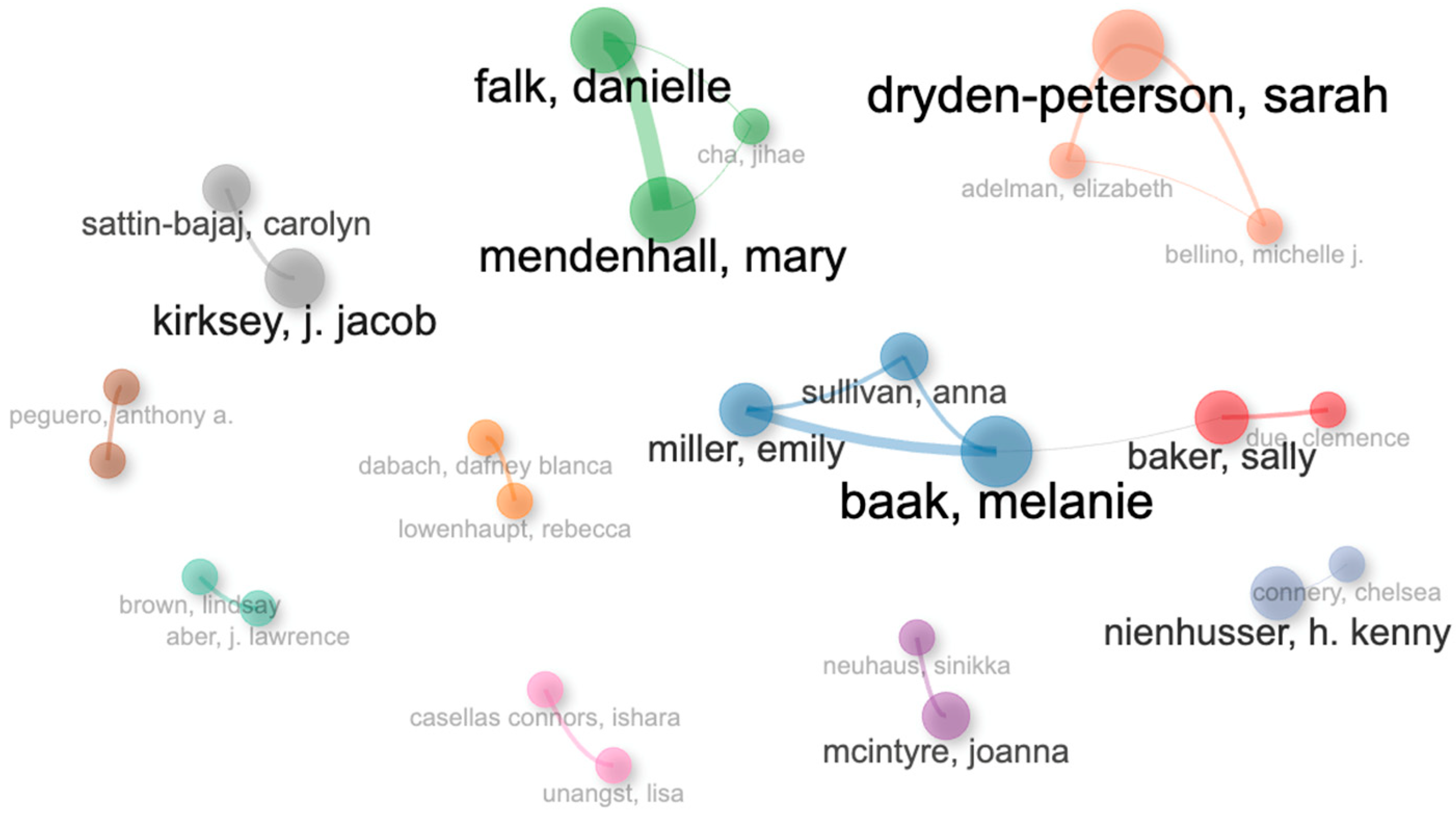
Figure 4 shows the author collaboration network and academic cooperation’s structure. The network’s fragmented and somewhat concentrated topology suggests that research collaboration is centered on small, stable author groups rather than a tightly interconnected community. Multiple collaboration clusters are concentrated around one or two notable writers as local centers. Baak and Melanie, Mendenhall and Mary; Dryden-Peterson and Sarah, Baker and Sally, and Nienhusser and H. Kenny are central nodes in their clusters, indicating regular co-authorship and long-term collaboration.
The connections between these nodes suggest strong, regular collaboration, whereas their sizes imply network centrality or productivity. Meanwhile, the figure shows limited cluster connectivity, with few intermediary writers linking collaborative groups. This shows that collaboration occurs mostly inside thematically or institutionally constrained research teams rather than across the field. Furthermore, the other interpretation from this figure is that the field operates through separate scholarly groups rather than a coherent collaborative network. Moreover, smaller peripheral nodes and dyadic linkages highlight short-term or project-specific interactions between two or three writers. In short, the collaboration network shows that refugee/(im)migrant education governance research emphasizes decentralized and cluster-oriented collaboration even though many notable scholars lead productive research groups.
RQ2. In what ways do intellectual and conceptual frameworks, including restriction, surveillance, and migration governance, shape this field, and how do studies define schools as arenas of governance, surveillance, and boundary building for refugee and migrant youth?
The analysis of conceptual and intellectual frameworks in bibliometric analyses is critically important for determining a research field’s theoretical foundations, thematic organization, and knowledge dynamics, allowing for a more in-depth understanding of how academic discourse is organized, consolidated, and grows over time (Casprini et al. 2020; Forliano et al. 2021). Thus, in this section of the study, researchers analyzed the data with the goal of developing a conceptual and intellectual structure to suit the natural demand of the bibliometric study mentioned earlier.
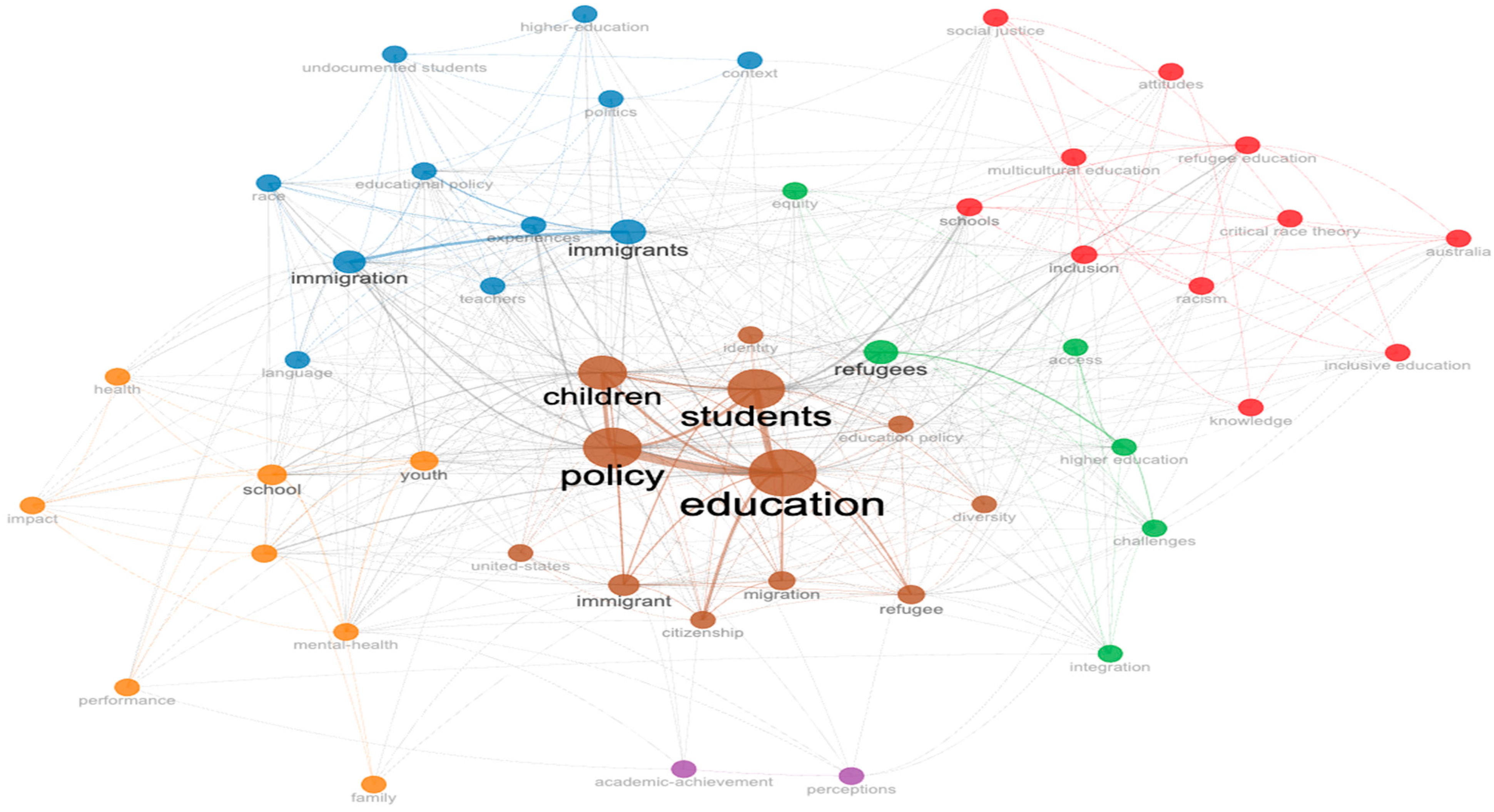
The co-occurrence network in Figure 5 displays a highly structured and thematically consolidated field, with a distinct conceptual core and multiple interrelated thematic clusters. The most prominent and highly connected nodes in the network are “education, policy, students, and children”, demonstrating that the literature is basically organized around education systems and policy frameworks for im/migrant and refugee students.
Their central positioning and strong interconnections suggest that these concepts act as integrative anchors, linking different research strands rather than being confined to a specific thematic niche. Surrounding this core, distinct yet overlapping clusters are evident. One notable cluster (blue) centers on “immigration, immigrants, undocumented students, race, and educational policy”, indicating a body of research on “legal status, racialization, and access to education”, particularly in higher education contexts. This cluster reflects governance-oriented approaches that address structural restrictions, policy regimes, and institutional barriers affecting educational outcomes.
A second cluster (red) highlights “critical race theory, social justice, multicultural education, racism, and inclusion”, representing a critical-theoretical branch of the topic. The internal density of this cluster, along with its connections to refugee education and schools, indicates that critical frameworks are actively used to examine schooling as a site of power, exclusion, and resistance. However, its partial separation from the policy-centered core suggests that critical perspectives, while influential, are not always fully integrated into mainstream policy discourse. Another cluster (green) focuses on “refugees, access, integration, challenges, and higher education”, emphasizing research on integration processes and institutional responses to refugee students, which appears to bring together humanitarian, policy, and educational viewpoints, connecting macro-level access arguments to meso-level institutional practices.
More peripheral categories address “mental health, family, youth, language, academic achievement, and perceptions”, emphasizing the psychosocial and experiential aspects of migrant and refugee schooling. Their relative marginality suggests that, although these challenges are discussed in the literature, they are sidelined in favor of more pressing policy and governance concerns.
Overall, the use of “All Keywords” enables comprehensive theme mapping that captures both author-driven conceptual emphases and underlying thematic patterns across the field. The network indicates that the literature is not fragmented but is instead organized around a strong educational-policy core, with critical, sociocultural, and psychological perspectives forming interconnected but hierarchically positioned subfields. This framework highlights how education for migrants and refugees is primarily conceived as a policy-governed and institutionally regulated domain, while also being challenged and reinterpreted through critical and equity-oriented perspectives.
Figure 6 depicts a thematic map of the literature on refugee and (im)migrant education, created by term co-occurrence analysis with “All Keywords”. The map depicts the field’s conceptual organization by arranging theme clusters in order of centrality and internal development and coherence. According to the map, the major themes are “education, policy, students, and children”. Thus, it can easily be said that there is a condensed focus on children and students from migrant and refugee backgrounds while the field is generally structured on the paradigm that sees education systems as policy-governed areas.
The strong and interdependent links between the themes point out a unified and solid study approach which places educational processes on regulatory implementations, policy-oriented paradigms, and institutional affairs. Furthermore, when the focus steps out from the core, there is a notable cluster which reveals how migrant students’ status, racialization, and linguistic difference impact their educational experiences. Another set of well-developed subjects is “refugees, inclusion, citizenship, higher education, and integration,” which emphasizes a line of research on institutional responses to refugee populations, particularly postsecondary education and long-term social integration. The relativeness between these terms indicates that refugee education is not considered as a trivial or humanitarian concern, but rather as a critical issue in broader education governance discussions. Furthermore, more distant but interconnected clusters focus on “mental health, achievement, family, identity, and language habits”. These themes capture the experiential and psychosocial aspects of migrant and refugee schooling. While internally coherent, their lesser centrality suggests that such perspectives are secondary to dominant policy and governance-driven framings in the specific literature.
Long story short, the thematic map suggests that the area is extremely interconnected, with education policy functioning as the key organizing axis, structuring critical, sociocultural, and experiential issues. Nonetheless, to delve deeper into the factors that influence refugee and (im)migrant education and its governance studies, showing underlying contradictions between governance, critical, and experiential views, the researchers used a factorial analysis of the original data.
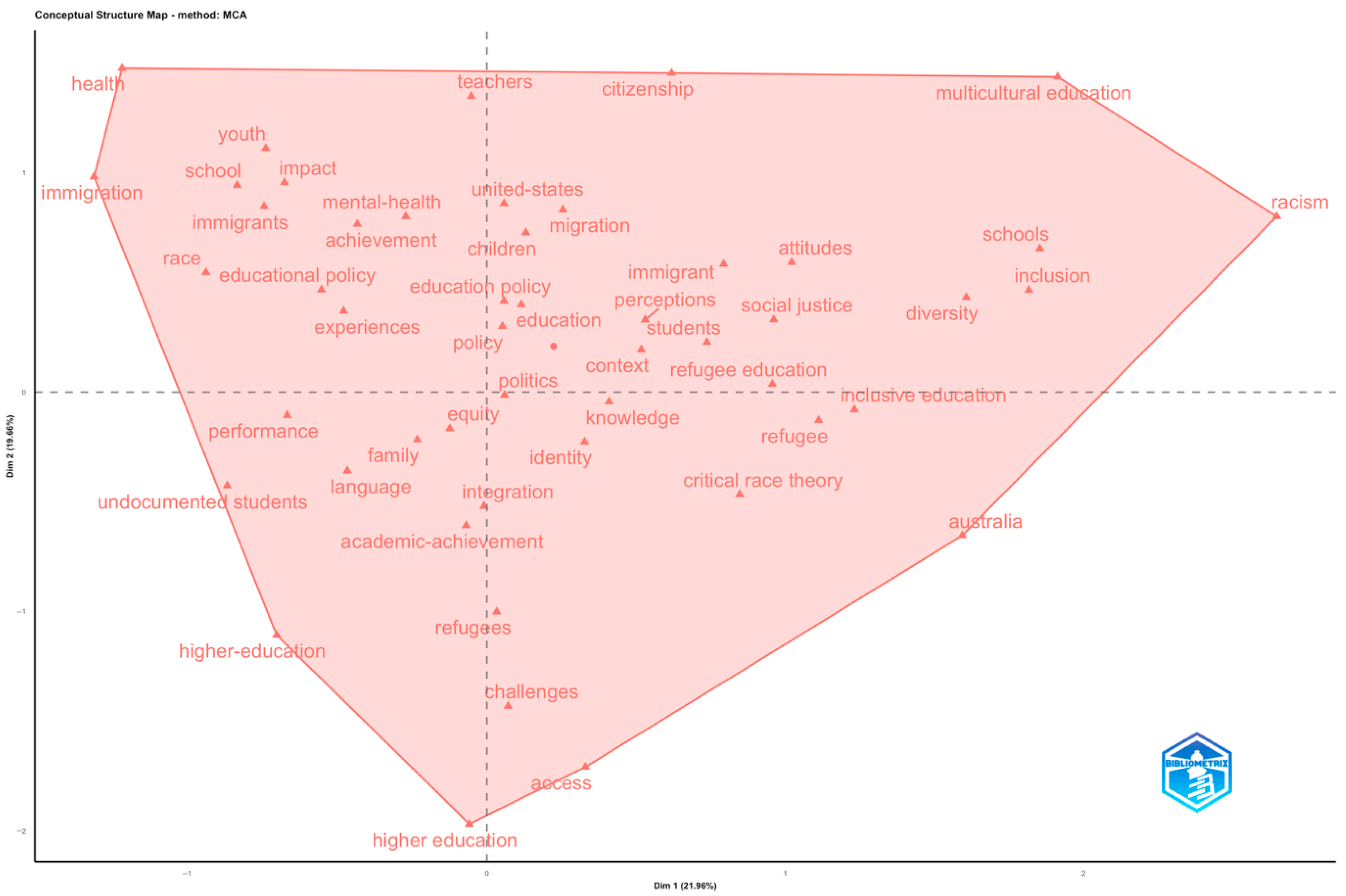
Figure 7 depicts the field’s factorial analysis map, which was constructed by performing numerous correspondence analyses on keyword co-occurrence, which depicts the conceptual structure of refugee and immigrant education research in two dimensions, allowing for the identification of latent dimensions that organize scholarly discourse beyond surface-level topic clustering.
The first dimension (Dim 1), which accounts for the majority of the explained variance, indicates a conflict between normative and governance-oriented viewpoints. Keywords such as multicultural education, racism, critical race theory, and social justice dominate the right side of the axis while the keywords on the left side include immigration, educational policy, accomplishment, performance, and undocumented youth. While the body of literature on the right side identifies education as a location of power, inequality and inequality, and recognition, the literature on the left side identifies education as an indication of a governance-oriented framework in which education is viewed by regulatory, administrative, and outcome-based paradigms. The conflict between these sides shows that the field is organized around a core argument about policy normalization and critical contestation, rather than a single unified paradigm.
On the other hand, the second dimension (Dim 2) appears to distinguish between institutional/structural and experiential/relational paradigms. Keywords which are positioned higher on this axis, such as teachers, schools, attitudes, and citizenship, highlight institutional players, formal educational contexts, and policy enactment processes. The interpretation of this finding shows the reality of the categorizing, monitoring, and excluding side of institutions. Lower-level terms on Dim 2, such as access, integration, refugees, identity, family, and language, are based on migrant and refugee communities’ real-life experiences. This vertical distinction illustrates the shift between the macro-level governance paradigms and the micro-level experiences of exclusion, negotiation in educational systems, and the feeling of belonging.
When taken together, the factorial map shows that refugee and (im)migrant education research is not only thematically diverse, but also conceptually structured around governance logics. Education emerges as a regulatory domain in which borders are reproduced through policy, language requirements, performance measures, and citizenship classifications, while also being challenged by critical pedagogical and social justice perspectives. Surveillance functions implicitly through assessment, accomplishment, and integration discourses, establishing students as subjects of ongoing review inside institutional institutions.

4.2. Connecting the Thematic Map and Factorial Map to Governance, Borders, and Surveillance

The theme arrangement is directly relevant to the study’s research issues of governance, bordering, and monitoring in refugee and (im)migrant schooling. The fundamental reason for this detail is that linking the thematic map to government, borders, and surveillance is crucial because it lifts bibliometric findings from descriptive mapping to a theoretically relevant and analytically explanatory contribution.
First, the importance of policy, education, and students emphasizes that education is largely viewed as a site of governance, with state and institutional policies governing access, participation, and advancement. The prevalence of policy-related topics suggests that schooling is often regarded as administrative and regulatory machinery rather than a neutral instructional space. Second, the prevalence of immigration, citizenship, race, and language indicates the existence of bordering mechanisms inside educational institutions. These concepts represent how legal status, linguistic procedures, and racial identities work as symbolic and structural barriers that divide students and define educational trajectories. The conceptual proximity of these sentences to the core suggests that bordering is deeply embedded in everyday governance of education rather than happening at the periphery. Third, terms like achievement, evaluation, insertion, and inclusion indicate the presence of surveillance logics, in which students are monitored, classified, and evaluated in line with institutional norms and performance expectations. The location of these parts suggests that monitoring is carried out gently through academic requirements, language evaluation, and incorporation indicators rather than overt supervision.
When taken as a whole, the thematic map reveals that the literature considers educational institutions and systems to be crucial areas where governance, bordering, and surveillance all come together. Thus, education emerges not only as a way of inclusion, but also as an organized arena in which migrant and refugee students are monitored, observed, and positioned differently within larger sociopolitical hierarchies, which makes schools or educational institutions a structured arena.

4.3. Intellectual Structure Based on Three-Field Plot and Co-Citation Network

To draw an intellectual structure framework, the researchers employed co-citation analysis and bibliographic coupling. With this process, three major shifts occurred, blue, red, and green nodes. Nevertheless, before making any further interpretation on these nodes, the researchers employed a three-field plot method with an eye to see the illustrations of the triadic framework to legitimate upcoming discussions. The reason for this sub-analysis is about the reality and limitation of the descriptive nature of bibliometric works, which means that the “intellectual structure” button on the biblioshiny R package only provides the dataset’s co-citation network and histography, but not the main framework that constitutes essential intellectual underpinnings used by engaged researchers and transformed into prevailing subject focuses (Zupic and Čater 2014). Thus, to break this surface-level analysis and to make a robust, rich, and legitimate interpretation about co-citation network analysis, the researchers employed and converged the outputs of three-field plot with the co-citation network analysis.
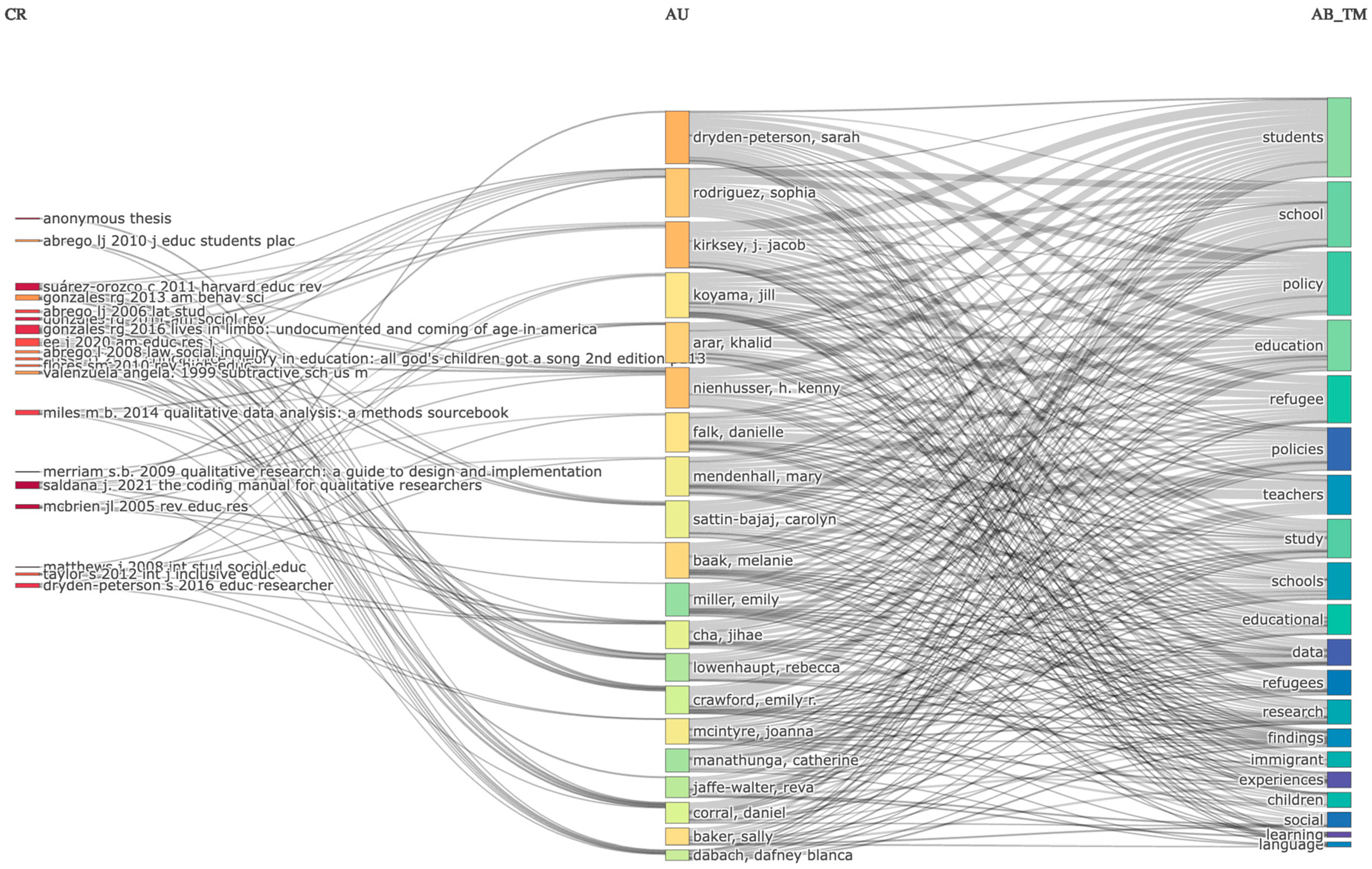
Figure 8 illustrates a triadic framework connecting references, authors, and abstract terminology. In the dataset, the most frequently cited works, which are the ones in the left column above, are, respectively, Suárez-Orozco et al. (2015), Gonzalez et al. (2016), Abrego (2006, 2010), Saldaña (2015), McBrien (2005). These scholars are the ones who constitute the intellectual inputs of the field. The column in the middle represents the authors producing the current body of the literature, who are the knowledge producers, who are, respectively, Dryden-Peterson, Kirksey, Koyama, Nienhusser, Baak, Mendenhall. Finally, the column on the right, which is high-frequency terms extracted from article abstracts, represents the knowledge outputs on the topical focus which respectively are “students, school, policy, refugee, education, teachers, language, and immigrant”. In short, the three-field analysis reveals that refugee and immigrant education studies follow a structured and intellectual lineage in which cannon authors create a coherent and policy-relevant thematic focus based on the educational process and student experiences.
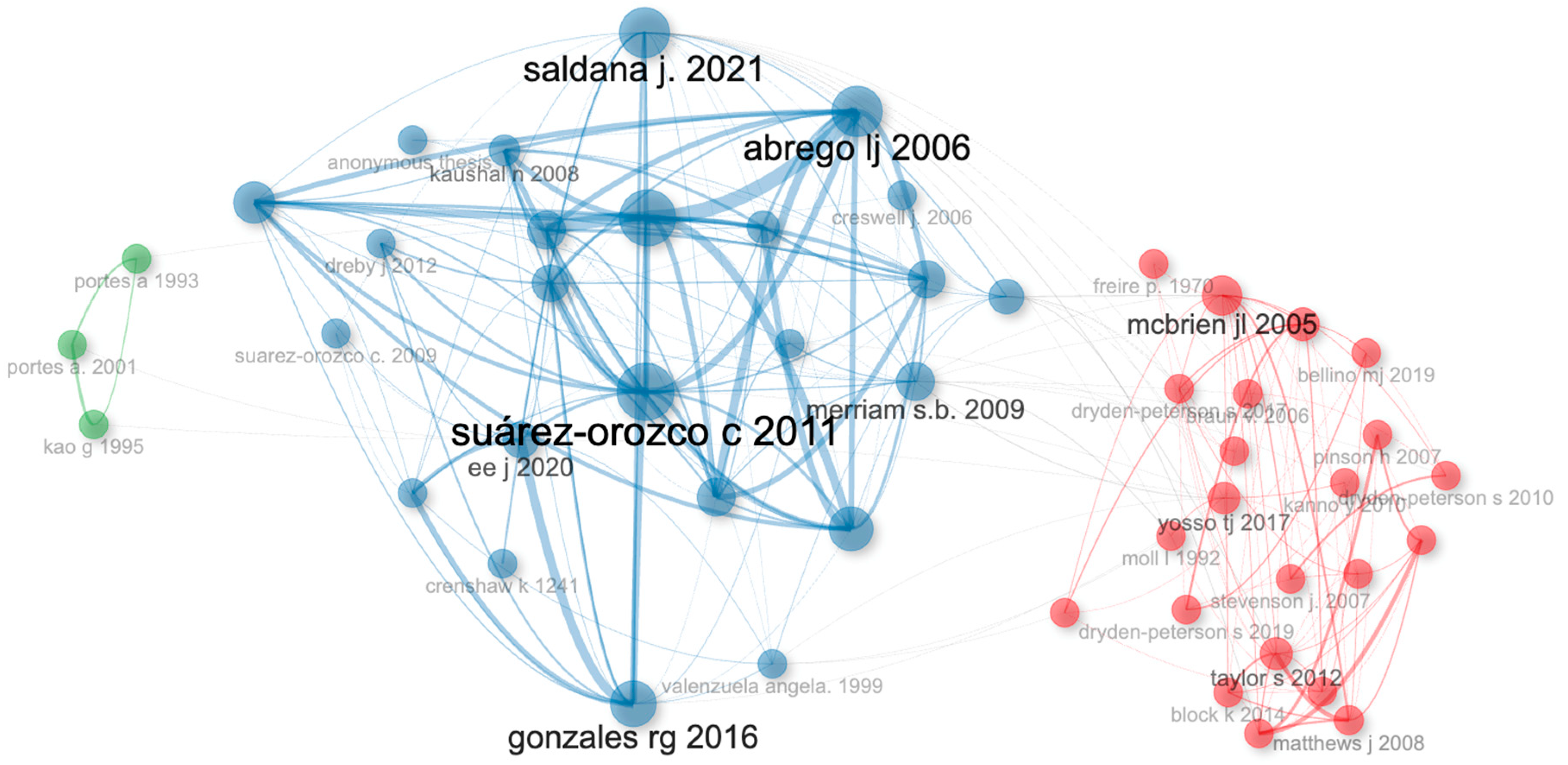
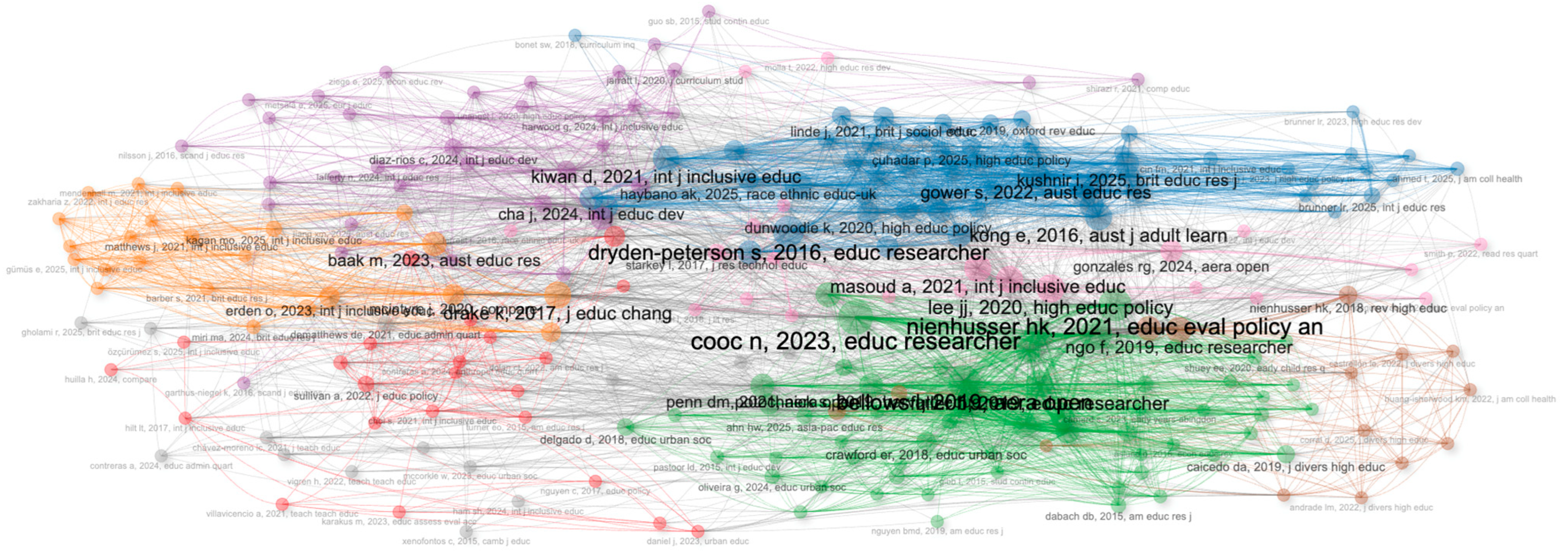
Figure 9 depicts the co-citation network of major references, which suggests the field’s intellectual structure and conceptual clustering. The network exhibits three separate yet interrelated groups. When Figure 4 and Figure 5 are converged, which are the three-field plot and co-citation network analysis, researchers gain the ability of reconstruction of the knowledge in which the selected theme or subject was legitimated, organized, and connected via shared theoretical foundations and citation practices. In this light, it can be said that the largest and most significant cluster is centered on works by Suárez-Orozco et al. (2015), Gonzalez et al. (2016), and Abrego (2006), revealing a dominant intellectual core concerned with migration, undocumented status, educational paths, and student experiences.
The strong links within this cluster point to a shared conceptual underpinning and frequent collaborative citation, confirming its position as the primary knowledge base for empirical research. A second, clearly defined cluster focuses on McBrien (2005), Dryden-Peterson (2015), and Yosso et al. (2009) who constitute a critical and governance-oriented tradition that emphasizes power, equity, identity, and refugee education policies. Although prominent, this cluster appears to be less integrated with the main core, implying that critical perspectives exist alongside rather than entirely within the prevailing empirical framework. A smaller and more peripheral cluster includes foundational sociological studies which serve as long-standing theoretical underpinnings for the discipline but are less central to present co-citation practices. Overall, the network reveals a field marked by theoretical diversity, with substantial internal coherence within clusters but low cross-cluster connectivity.

4.4. Thematic Evolution and Emerging Trends

A document coupling analysis was used to identify current study areas in refugee and (im)migrant education with an eye to identify thematic proximity between publications based on shared reference patterns, and it is especially useful for mapping ongoing and forward-looking intellectual structures rather than a field’s historical breaking points.
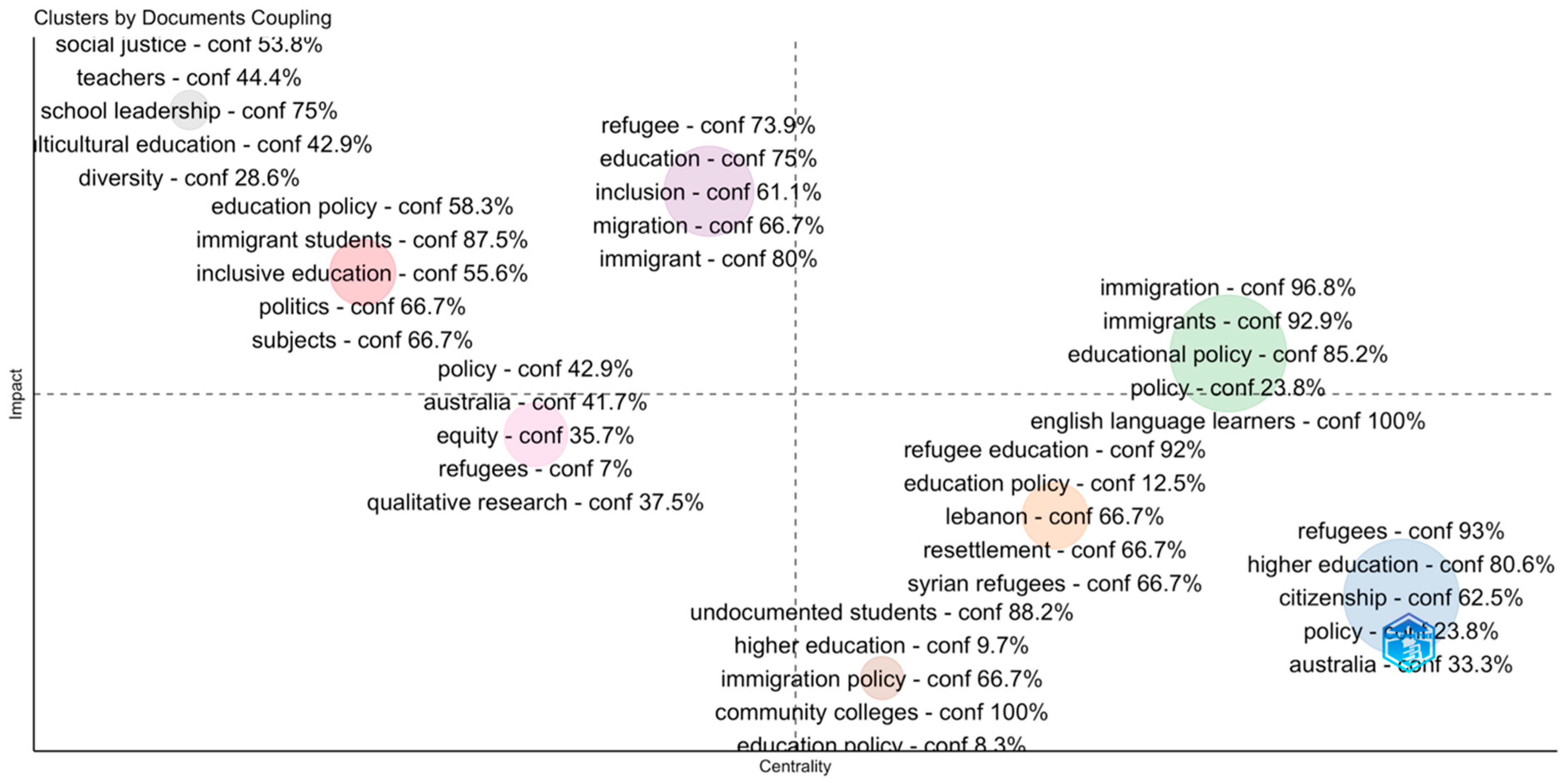
Figure 10 shows clusters obtained from document coupling shown by centrality connectedness and effect. The findings suggest a field organized around governance-related topics, with significant divisions between policy-driven and justice-oriented strands. The upper right quadrant has the most prominent motor theme, which is organized around immigration, immigrants, educational policy, policy, and English language learners. These terms have extremely high confidence levels, indicating significant internal coherence and extensive cross-cluster connectedness.
This design places migration and language policy as the main structure, which means that educational institutions or schools serve as a regulated area to administrate migrant status, access, and inclusion. This is an indication of how modern schooling conceptualizes refugee and immigrant education via state governance and regulatory systems instead of conceptualizing pedagogical or classroom-level process alone. Aside from this core, there is a closely related cluster which focuses on refugee education, education, inclusion, migration, and immigration. This second cluster has a high impact and positioning power on institutional activities, which represents a link between macro- and meso-level governance discourses.
The upper left quadrant, on the other hand, contains several high impacts but peripheral themes, such as social justice, school leadership, teachers, multicultural education, and diversity. These themes, which lack linkages to the field’s basic core, suggest that justice-oriented and leadership-focused studies are structurally sidelined in the dominant policy and migratory debate. Thus, it is obvious that educational leadership and social justice are often considered as a supplementary component rather than being the essential components of migratory governance in educational organizations.
The lower right quadrant consists of emerging and context-specific themes such as undocumented students, community colleges, resettlement, Syrian refugees, and regionally anchored studies (e.g., Lebanon, Australia). Although these clusters have high centrality, they have less effect or impact on the literature. The reason behind this is that they serve as the bridge which integrates the field but have not achieved a strong consolidation yet. Nevertheless, their stance can be interpreted as a reflection of an increasing empirical focus on multifaced experiences and national settings which are backed by a very restricted and small theoretical synthesis.
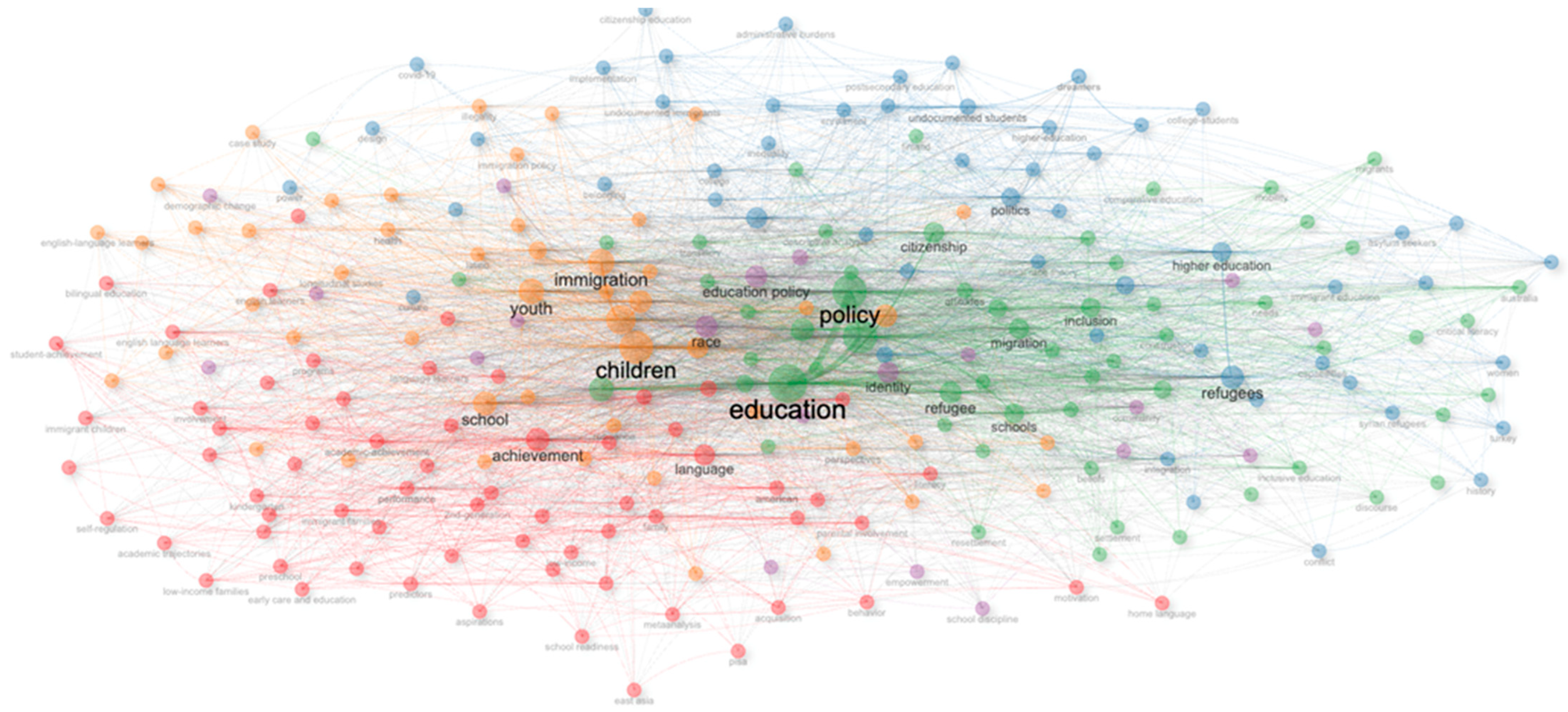
Figure 11 is a depiction of the document coupling network which shows the field’s underlying structure. According to this, several research communities develop, including a policy assessment and governance cluster, a diversity and inclusion cluster, a contextualized refugee education cluster, and a higher education and access cluster. While intra-cluster connections are extensive, inter-cluster interconnections are rather weak, reflecting a modular path rather than completely integrated information structure. This network pattern indicates that the field is defined by parallel theme paths rather than cumulative integration. Policy-oriented research dominates the connective center, while justice-based and educational approaches circulate on the periphery, having little influence on the governing core.

4.5. Systematic Review Findings and Discussion

The nature of this field is conceptually complex and fragmented. Thus, the researchers employed a systematic review method to enable a concentrated and in-depth examination of how essential ideas like governance, bordering, and surveillance are understood and implemented in educational settings in the process of schooling and governance of this process (Siddaway et al. 2019). When looking at the bibliometric findings, the occurrence of four main themes can be detected. These themes are, respectively, “governance and policy rationalities”, “bordering practices in educational contexts”, “surveillance and accountability mechanisms”, and “limits of justice-oriented approaches”. Thus, the 25 most cited documents in the global arena were read, analyzed, and coded according to these four main themes. Table 2 shows the details about these articles while giving the article reference details including DOI’s and citation metrics.
RQ3. What governing logics, restrictive behaviors, and monitoring mechanisms are discovered in the most cited research on refugee and migrant education?
The 25 studies included in the systematic review were undertaken in a variety of national and international contexts, with a significant focus on high-income Western countries. Nearly half of the studies (n = 12, 48%) were undertaken in the United States and included both state-level case studies (e.g., Texas, California, Wisconsin, and South Carolina) and national-scale analyses. European environments were covered in 20% of the research (n = 5), which included Sweden, Norway, Germany, and the United Kingdom. A smaller but considerable fraction of research focused on refugee-hosting nations in the Global South, particularly in Africa and the Middle East (n = 4, 16%), with empirical attention given to Uganda and Kenya, as well as large-scale comparative work spanning several refugee contexts. Asian contexts were relatively underrepresented, with only two single-country studies on China and Malaysia (n = 2, 8%). Canada and Australia each had one trial (n = 2, 8% combined). Furthermore, two studies (8%) used explicitly transnational or meta-synthetic approaches to investigate refugee and immigrant education across many regions, including North America, Europe, Asia, and Australia. Overall, the geographic distribution reveals a substantial epistemic dominance of U.S.-based scholarship, as well as a smaller but theoretically influential body of work situated in refugee-hosting contexts in the Global South.
Participant characteristics differed significantly across studies based on geographic location, educational level, and analytical focus, demonstrating the multidimensional nature of refugee and (im)migrant education research. Most research focused on refugee and immigrant pupils in primary, secondary, and higher education (Dryden-Peterson 2016; Miyamoto et al. 2017; Suárez-Orozco et al. 2015). Participants in refugee-hosting contexts in East Africa and the Middle East included Somali and Congolese students in Uganda and Kenya, as well as refugee teachers, community leaders, and secondary school graduates. Sample sizes ranged from small qualitative cohorts to large diaspora surveys. European research has primarily focused on unaccompanied or newly arrived refugee adolescents in preparatory and upper secondary education, particularly in Norway, Sweden, and Germany, with longitudinal designs being used. Significant quantitative datasets from Asian and Australian environments were used to represent foreign postgraduate students, urban secondary groups, and second-generation immigrant adolescents. In the United States, a large body of research has concentrated on undocumented students in higher and secondary school, combining small-scale qualitative studies with national surveys. Aside from children, numerous studies involved educators, school administrators, and policy actors as well as global stakeholders such as UNHCR officials, ministry representatives, and non-governmental organizations. Parental perspectives arose primarily via research on Latinx immigrant mothers and meta-analyses of immigrant family experiences. Overall, the participant profiles demonstrate a student-centered field that is gradually including organizational and governance players to reflect the regulatory facets of migration and education.

4.6. Governance and Policy Rationales

Across the examined studies, education appears to be a main site for regulating migration, exhibiting popular policy rationalities that treat refugee and (im)migrant students as managerial objects rather than persons with rights. Governance is usually conveyed through narratives of integration, responsibility, and risk mitigation, particularly in high-income Western cultures. National and regional policies influence access to education, language teaching, and postsecondary options, frequently relating educational inclusion to labor demand or security concerns (Crawford 2017; Dryden-Peterson et al. 2017). Humanitarian logics drive governance in refugee-hosting settings in the Global South, with education considered as a tool for stabilization, containment, and self-reliance rather than long-term civic growth (Gonzalez et al. 2016). Comparative and international studies show how global policy actors, such as international organizations and donor agencies, exert significant power over national education systems, widening the gap between policy design and local implementation. Overall, governance is founded on multiple and disparate policy frameworks that determine who can be educated, under what circumstances, and with a particular future trajectory (Turan et al. 2025).

4.7. Bordering Practices in Educational Contexts

According to the research examined, borders are actively reproduced within educational institutions rather than being isolated to territorial edges. Schools and universities serve as internal bordering locations through enrollment procedures, documentation requirements, language examinations, and varied academic courses. Bordering practices are prominently evident in the experiences of undocumented and asylum-seeking students in the United States and Europe, where educational admission is dependent on legal status, residence verification, or adherence to fluctuating immigration restrictions (Dryden-Peterson 2016; Rodriguez and Monreal 2017). Research undertaken in refugee camps and transit environments suggests how educational systems foster inclusion while simultaneously enforcing spatial and temporal constraints, hindering mobility and restricting future opportunities (Nilsson and Bunar 2016). Bordering is thereby implemented both formally and symbolically, creating hierarchies of belonging that distinguish citizens, refugees, migrants, and the undocumented within ostensibly inclusive educational environments.

4.8. Surveillance and Accountability Mechanisms

Surveillance is an important tool for enforcing rules and keeping an eye on things in schools. Several studies have shown that refugee and immigrant students are tracked through data gathering, monitoring, and performance measures (Umansky 2016; Wallace 2017). This is usually done to make schools more accountable and help students learn. In places with a lot of law enforcement, schools become involved with immigration control by sharing information, having police officers present, and following state tracking programs (Rodriguez and Monreal 2017). This makes kids, families, and teachers afraid and makes them self-censor. Accountability models often push for uniform results and behavior, which can hurt culturally relevant teaching methods and hide real differences. In this way, surveillance is not only a technical practice; it is also a form of disciplinary authority that affects how people learn and how subjects grow.

4.9. Limits of Justice-Oriented Approaches

A lot of research sets normative goals like social justice, inclusiveness, or equity (Dryden-Peterson 2016; Philip and Sengupta 2020; Rodriguez and Monreal 2017; Turner 2014). However, the study shows that there are major problems with how justice-focused projects are thought of and carried out. People often only think of justice in terms of access or influence, without questioning the systems of government that keep some people out in the first place. There are not many studies that directly look at the problems that arise when people try to help others while also controlling them or when people help students while also controlling migration (DeMatthews et al. 2021; Turner 2014). Also, actions that focus on justice are usually small and scattered, and they do not have enough structural power to question dominant policy rationalities or neighboring regimes. This gap shows a bigger problem with the way we think about the field: we tend to look at harm and resilience without fully looking at the political situations that keep refugee and (im)migrant groups from getting the same education opportunities.
RQ4. What mechanisms influence how governing logics, restrictive behaviors, and surveillance systems determine inclusion and exclusion in education?
The systematic review indicates that educational inclusion and exclusion in refugee and (im)migrant situations are influenced by the interplay of governing logics, institutional bordering practices, and monitoring systems (Dryden-Peterson 2016; De Wal Pastoor 2014; Antony-Newman 2019). Instead of operating independently, these dimensions serve as interconnected mechanisms that convert policy rationalities into hierarchical educational pathways.
Governing logics, especially integration, risk management, humanitarian protection, and labor-market alignment, shape inclusion via established criteria including language benchmarks, age norms, and performance metrics (Umansky 2016; DeAngelo et al. 2016; Suárez-Orozco et al. 2015). In the examined studies, these criteria function as sorting mechanisms, providing formal access but simultaneously limiting academic advancement and mobility. Consequently, inclusion is contingent and unevenly allocated. Bordering approaches institutionalize these principles inside educational institutions. Documentation requirements, verification of legal status, recognition of credentials, and transition points between educational levels function as internal barriers, disproportionately impacting undocumented students, asylum seekers, and individuals with unstable status (Rodriguez and Monreal 2017; Crawford 2017; Bellino and Dryden-Peterson 2018). Critical junctures, particularly the transition from secondary to higher education, represent pivotal points of exclusion even within ostensibly inclusive systems. Surveillance and accountability methods exacerbate these impacts. Data surveillance, attendance monitoring, performance assessment, and connections to immigration enforcement foster environments of fear and self-censorship, deterring engagement from students and families (Wallace 2017; DeMatthews et al. 2021). Accountability pressures for educators restrict discretionary measures that could otherwise alleviate exclusion.
Thus, exclusion arises not from singular policies but from the accumulated alignment of governance measures, institutional boundaries, and surveillance systems. At the intersection of these dynamics, inclusion is diminished to mere access devoid of security, participation lacking mobility, and belonging stripped of rights.

5. Conclusions

This study used bibliometric mapping and systematic review approaches to produce a thorough and multifaceted synthesis of the literature on refugee and (im)migrant education as a site of governance, borders, and surveillance. By combining large-scale structural patterns with in-depth qualitative and conceptual analysis, the essay increases our understanding of both how the field is organized and what it indicates about the political roles of education in migration situations.
The bibliometric research revealed that the field has a fragmented yet well-structured intellectual landscape. Co-citation, coupling, and theme mapping revealed the existence of multiple parallel research clusters, most notably policy and governance, diversity and inclusion, refugee education, and higher education access, which are linked by weak inter-cluster links. This modular arrangement implies that scholarship developed along multiple thematic lines rather than through cumulative theoretical integration. Policy-oriented research constitutes the central framework of the area, while justice-based, instructional, and experimental approaches remain comparatively marginal. These tendencies indicate an epistemic hierarchy wherein policy and governance structures significantly influence the intellectual body of the discipline, whereas vital concepts often circulate at the periphery.
The systematic review elaborated on these conclusions by examining the operationalization of governance, borders, and surveillance in the significant empirical and theoretical literature. In various national and institutional contexts, education has developed into a significant mechanism for both inclusion and the regulation of migration. Governance rationalities characterize refugee and (im)migrant students in regard to control, risk, and compliance, connecting educational policies with overarching state objectives such as labor markets, security, and population regulation. Bordering practices were discovered to extend well beyond territorial limits, appearing within educational institutions through paperwork mandates, surveillance mechanisms, and inequitable access to academic programs. Surveillance and responsibility systems improve these processes by positioning educational institutions as intermediaries among the provision of benefits and migration regulation.
The systematic analysis critically identified the shortcomings of existing justice-oriented methodologies in the literature. Although numerous studies emphasize inclusion, equity, and resilience, they often neglect to critically analyze the underlying systems that sustain exclusion. Consequently, justice is often articulated in limited, procedural terms rather than as a critique of the political frameworks that underpin educational authority. This conclusion aligns with bibliometric evidence of conceptual fragmentation, suggesting that the area has not yet integrated critical migration theory, administration studies, and research on education into an integrated analytical framework.
The findings collectively indicate a significant conclusion: research on refugee and (im)migrant education is profoundly shaped by governance logics that have not been adequately examined across several disciplines. The preeminence of policy-focused research, coupled with insufficient theoretical integration, constrains the field’s capacity to critically examine education as a domain of care, control, and conflict (Nichols and Herrick 2023). This study integrates bibliometric analysis with systematic, theory-driven synthesis to enhance the understanding of education as a governing technology under contemporary migratory regimes.
Future research would benefit from enhanced conceptual convergence, especially through continued engagement with concepts of borders, monitoring, and governance across many empirical contexts. This integration is essential for advancing academic dialog and promoting more thoughtful and equitable educational practices in an era of heightened global mobility and securitization.

6. Limitations and Future Directions

Several limitations should be acknowledged when considering the study’s conclusions. For starters, the bibliometric analysis is inextricably linked to the bibliographic database’s knowledge. Although the data includes a large amount of high impact and peer-reviewed articles, the language of these studies is English; thus, regionally focused articles and policy-oriented outputs such as national reports may be ignored. On the other hand, the systematic review purposely focused on highly cited articles to reach influential papers which achieved theoretical coherence. While this strategy improves analytical depth, it may also perpetuate existing epistemic hierarchies by prioritizing work from high-income Western environments and elite academic institutions. So, future research may address alternative sample procedures to address this limitation.
The analytical classification of studies into governance, bordering, surveillance, and justice-related components required interpretive judgment. Although systematic classification processes were used, these categories are not mutually exclusive, and they frequently overlap empirically. This represents a basic feature of the subject, in which main and core concepts are still imperfectly integrated. Nonetheless, future syntheses should improve transparency by doing multi-coder qualitative analyses and explicitly reporting inter-coder agreement. So, future research should highlight theoretically integrative techniques that investigate how governance, borders, and surveillance are interconnected in educational organizations.
There is also a need for further empirical research in refugee-hosting and transit environments where education is typically influenced by humanitarian governance and international accountability mechanisms. Finally, longitudinal and comparative designs, as well as greater involvement of educators, families, and local administrations, would help to improve understanding of how educational institutions affect migration control over time. Addressing these gaps is vital to furthering cumulative and critical study on education as a core site of migration governance.

Author Contributions

Conceptualization, K.A. and A.B.; methodology, H.Ö.; software, Y.A.Y.; validation, K.A., A.B., H.Ö. and Y.A.Y.; formal analysis, Y.A.Y. and A.B.; investigation, H.Ö.; resources, H.Ö. and Y.A.Y.; data curation, A.B. and Y.A.Y.; writing—original draft preparation, K.A., A.B., H.Ö. and Y.A.Y.; writing—review and editing, K.A. and A.B.; visualization, Y.A.Y.; supervision, A.B. and H.Ö.; project administration, K.A.; All authors have read and agreed to the published version of the manuscript.

Funding

This research received no external funding.

Institutional Review Board Statement

The study did not require ethical approval.

Informed Consent Statement

The study did not involve humans.

Data Availability Statement

This study is based on secondary data retrieved from the WoS database. The bibliographic dataset and analytical outputs are available from the corresponding author upon reasonable request.

Conflicts of Interest

The authors declare no conflicts of interest.

References

  1. Abrego, Leisy. 2006. “I Can’t Go to College Because I Don’t Have Papers”: Incorporation Patterns of Latino Undocumented Youth. Latino Studies 4: 212–31. [Google Scholar] [CrossRef] [Scilit]
  2. Abrego, Leisy J., and Roberto G. Gonzales. 2010. Blocked paths, uncertain futures: The postsecondary education and labor market prospects of undocumented Latino youth. Journal of Education for Students Placed at Risk (JESPAR) 15: 144–57. [Google Scholar] [CrossRef] [Scilit]
  3. Adair, Jennifer Keys, Kiyomi Sánchez-Suzuki Colegrove, and Molly E. McManus. 2017. How the Word Gap Argument Negatively Impacts Young Children of Latinx Immigrants’ Conceptualizations of Learning. Harvard Educational Review 87: 309–34. [Google Scholar] [CrossRef] [Scilit]
  4. Annala, Johanna. 2022. What knowledge counts—Boundaries of knowledge in cross-institutional curricula in higher education. Higher Education 85: 1299–315. [Google Scholar] [CrossRef] [Scilit]
  5. Antony-Newman, Max. 2019. Parental involvement of immigrant parents: A meta-synthesis. Educational Review 71: 362–81. [Google Scholar] [CrossRef] [Scilit]
  6. Antony-Newman, Max, and Sarfaroz Niyozov. 2023. Barriers and Facilitators for Academic Success and Social Integration of Refugee Students in Canadian and US K–12 Schools: A Meta-Synthesis. Canadian Journal of Education/Revue Canadienne de l’Éducation 46: 980–1012. [Google Scholar] [CrossRef] [Scilit]
  7. Arar, Khalid, Deniz Örücü, and Sedat Gümüş. 2022. Educational leadership and policy studies in refugee education: A systematic review of existing research. Educational Review 76: 1032–56. [Google Scholar] [CrossRef] [Scilit]
  8. Arkan, Zeynep. 2016. Imagining ‘Europe’: Constituting turkey’s identity on the path to EU membership. Tijdschrift voor Economische en Sociale Geografie 107: 134–46. [Google Scholar] [CrossRef] [Scilit]
  9. Bajaj, Monisha, Daniel Walsh, Lesley Bartlett, and Gabriela Martínez. 2022. Humanizing Education for Immigrant and Refugee Youth: 20 Strategies for the Classroom and Beyond. New York: Teachers College Press. [Google Scholar]
  10. Bar-Ilan, Judit. 2010. Citations to the “Introduction to Informetrics” indexed by WOS, Scopus and Google Scholar. Scientometrics 82: 495–506. [Google Scholar] [CrossRef] [Scilit]
  11. Başaran, Orbay, Hamit Özen, and Selda Yeten. 2024. The Teacher Precariat: Implications and policies in the Turkish educational landscape. Leadership and Policy in Schools, 1–19. [Google Scholar] [CrossRef] [Scilit]
  12. Bellino, Michelle J., and Sarah Dryden-Peterson. 2018. Inclusion and exclusion within a policy of national integration: Refugee education in Kenya’s Kakuma Refugee Camp. British Journal of Sociology of Education 40: 222–38. [Google Scholar] [CrossRef] [Scilit]
  13. Bengtsson, Anki. 2015. Educating European citizenship: Elucidating assumptions about teaching civic competence. Policy Futures in Education 13: 788–800. [Google Scholar] [CrossRef] [Scilit]
  14. Bris, Pablo, and Félix Bendito. 2017. Lessons Learned from the Failed Spanish Refugee System: For the Recovery of Sustainable Public Policies. Sustainability 9: 1446. [Google Scholar] [CrossRef] [Scilit]
  15. Bunar, Nihad, and Päivi Juvonen. 2021. ‘Not (yet) ready for the mainstream’–Newly arrived migrant students in a separate educational program. Journal of Education Policy 37: 986–1008. [Google Scholar] [CrossRef] [Scilit]
  16. Cabral-Gouveia, Carmo, Isabel Menezes, and Tiago Neves. 2023. Educational strategies to reduce the achievement gap: A systematic review. Frontiers in Education 8: 1155741. [Google Scholar] [CrossRef] [Scilit]
  17. Callahan, Rebecca, Leslie Gautsch, Megan Hopkins, and Maria Del Carmen Unda. 2020. Equity and State Immigrant Inclusivity: English Learner Education in ESSA. Educational Policy 36: 1011–53. [Google Scholar] [CrossRef] [Scilit] [PubMed]
  18. Casprini, Elena, Marina Dabic, Josip Kotlar, and Tommaso Pucci. 2020. A bibliometric analysis of family firm internationalization research: Current themes, theoretical roots, and ways forward. International Business Review 29: 101715. [Google Scholar] [CrossRef] [Scilit]
  19. Cerna, Lucie. 2019. Refugee education. In OECD Education Working Papers. Paris: OECD Publishing. [Google Scholar] [CrossRef]
  20. Crawford, Emily R. 2017. The ethic of community and incorporating undocumented immigrant concerns into ethical school leadership. Educational Administration Quarterly 53: 147–79. [Google Scholar] [CrossRef] [Scilit]
  21. Crawford, Emily R., Juan José Reyes, Oksana Kozlova, and Lisa Dorner. 2025. Navigating New Beginnings: A Study of State-Level Grant Funding Support for K-12 Refugee Education. Social Sciences 14: 46. [Google Scholar] [CrossRef] [Scilit]
  22. Crul, Maurice, Frans Lelie, Özge Biner, Nihad Bunar, Elif Keskiner, Ifigenia Kokkali, Jens Schneider, and Maha Shuayb. 2019. How the different policies and school systems affect the inclusion of Syrian refugee children in Sweden, Germany, Greece, Lebanon and Turkey. Comparative Migration Studies 7: 10. [Google Scholar] [CrossRef] [Scilit]
  23. DeAngelo, Linda, Maximilian T. Schuster, and Michael J. Stebleton. 2016. California DREAMers: Activism, identity, and empowerment among undocumented college students. Journal of Diversity in Higher Education 9: 216–30. [Google Scholar] [CrossRef] [Scilit]
  24. DeMatthews, David E., Amy Serafini, and Terri N. Watson. 2021. Leading Inclusive Schools: Principal perceptions, practices, and Challenges to Meaningful change. Educational Administration Quarterly 57: 3–48. [Google Scholar] [CrossRef] [Scilit]
  25. De Wal Pastoor, Lutine. 2014. The mediational role of schools in supporting psychosocial transitions among unaccompanied young refugees upon resettlement in Norway. International Journal of Educational Development 41: 245–54. [Google Scholar] [CrossRef] [Scilit]
  26. Dryden-Peterson, Sarah. 2015. Refugee education in countries of first asylum: Breaking open the black box of pre-resettlement experiences. Theory and Research in Education 14: 131–48. [Google Scholar] [CrossRef] [Scilit]
  27. Dryden-Peterson, Sarah. 2016. Refugee education. Educational Researcher 45: 473–82. [Google Scholar] [CrossRef] [Scilit]
  28. Dryden-Peterson, Sarah, Elizabeth Adelman, Michelle J. Bellino, and Vidur Chopra. 2019. The Purposes of Refugee Education: Policy and practice of including refugees in national education systems. Sociology of Education 92: 346–66. [Google Scholar] [CrossRef] [Scilit]
  29. Dryden-Peterson, Sarah, Negin Dahya, and Elizabeth Adelman. 2017. Pathways to Educational success among refugees: Connecting locally and globally situated resources. American Educational Research Journal 54: 1011–47. [Google Scholar] [CrossRef] [Scilit]
  30. Dunne, Máiréad, Sara Humphreys, and Salihu Bakari. 2020. Troubled spaces: Negotiating school–community boundaries in northern Nigeria. Journal of Education Policy 36: 843–64. [Google Scholar] [CrossRef] [Scilit]
  31. Ee, Jongyeon, and Patricia Gándara. 2019. The impact of immigration enforcement on the nation’s schools. American Educational Research Journal 57: 840–71. [Google Scholar] [CrossRef] [Scilit]
  32. Feinstein, Scott, Cristina Poleacovschi, Riley Drake, and Leslie Ann Winters. 2022. States and Refugee Integration: A Comparative Analysis of France, Germany, and Switzerland. Journal of International Migration and Integration 23: 2167–94. [Google Scholar] [CrossRef] [Scilit]
  33. Forliano, Canio, Paola De Bernardi, and Dorra Yahiaoui. 2021. Entrepreneurial universities: A bibliometric analysis within the business and management domains. Technological Forecasting and Social Change 165: 120522. [Google Scholar] [CrossRef] [Scilit]
  34. Giroux, Henry. 1982. The Politics of Educational Theory. In Social Text. Durham: Duke University Press, pp. 87–107. [Google Scholar] [CrossRef] [Scilit]
  35. Gonzalez, Jorge E., Sandra Acosta, Heather Davis, Sharolyn Pollard-Durodola, Laura Saenz, Denise Soares, Nora Resendez, and Leina Zhu. 2016. Latino Maternal Literacy Beliefs and Practices Mediating socioeconomic status and maternal education effects in predicting child receptive vocabulary. Early Education and Development 28: 78–95. [Google Scholar] [CrossRef] [Scilit]
  36. Guo, Shibao. 2015. The colour of skill: Contesting a racialised regime of skill from the experience of recent immigrants in Canada. Studies in Continuing Education 37: 236–50. [Google Scholar] [CrossRef] [Scilit]
  37. Hilt, Line Torbjørnsen. 2016. Education without a shared language: Dynamics of inclusion and exclusion in Norwegian introductory classes for newly arrived minority language students. International Journal of Inclusive Education 21: 585–601. [Google Scholar] [CrossRef] [Scilit]
  38. Ho, Chi H., Andrea H. Denton, Sarah R. Blackstone, Nadia Saif, Kara MacIntyre, Mustafa Ozkaynak, Rupa S. Valdez, and Fern R. Hauck. 2023. Access to Healthcare Among US Adult Refugees: A Systematic Qualitative Review. Journal of Immigrant and Minority Health 25: 1426–62. [Google Scholar] [CrossRef] [Scilit] [PubMed]
  39. Hunt, Lucy. 2021. Bordered Trajectories: The Impact of Institutional Bordering Practices on Young Refugees’ (Re-)Engagement with Post-15 Education in Greece. Social Sciences 10: 421. [Google Scholar] [CrossRef] [Scilit]
  40. Jerrim, John. 2015. Why do East Asian children perform so well in PISA? An investigation of Western-born children of East Asian descent. Oxford Review of Education 41: 310–33. [Google Scholar] [CrossRef] [Scilit]
  41. Kim, Lanu, Christopher Adoph, Jevin West, and Katherine Stovel. 2020. The Influence of Changing Marginals on Measures of Inequality in Scholarly Citations: Evidence of Bias and a Resampling Correction. Sociological Science 7: 314–41. [Google Scholar] [CrossRef] [Scilit]
  42. Korntheuer, Annette, Michaela Hynie, Martha Kleist, Safwathullah Farooqui, Eva Lutter, and Manuela Westphal. 2021. Inclusive Resettlement? Integration Pathways of Resettled Refugees With Disabilities in Germany and Canada. Frontiers in Human Dynamics 3: 668264. [Google Scholar] [CrossRef] [Scilit]
  43. Kotzee, Ben. 2018. Intellectual Perfectionism about Schooling. Journal of Applied Philosophy 36: 436–56. [Google Scholar] [CrossRef] [Scilit]
  44. Koyama, Jill, and Adnan Turan. 2024. Coloniality and Refugee Education in the United States. Social Sciences 13: 314. [Google Scholar] [CrossRef] [Scilit]
  45. Li, Guofang, and Kongji Qin. 2022. Supporting and Advocating for Immigrant and Refugee Students and Families in America’s Urban Schools: Educators’ Agency and Practices in Everyday Instruction. Urban Education 59: 600–28. [Google Scholar] [CrossRef] [Scilit]
  46. Loader, Rebecca. 2021. Shared spaces, separate places: Desegregation and boundary change in Northern Ireland’s schools. Research Papers in Education 37: 1097–118. [Google Scholar] [CrossRef] [Scilit]
  47. Lulua, Dina-Ruth, and Shirra Moch. 2024. Symbolic access: Medical students’ awareness of institutional culture and its influence on learning, a phenomenographic study. BMC Medical Education 24: 27. [Google Scholar] [CrossRef] [Scilit]
  48. McBrien, J. Lynn. 2005. Educational needs and Barriers for Refugee students in the United States: A review of the literature. Review of Educational Research 75: 329–64. [Google Scholar] [CrossRef] [Scilit]
  49. McDiarmid, Serena, Natalie Durbeej, Anna Sarkadi, and Fatumo Osman. 2021. Schools’ and teachers’ roles and challenges in supporting the mental wellbeing of refugee youths: A qualitative study with Swedish teachers. International Journal of Qualitative Studies on Health and Well-Being 17: 2007568. [Google Scholar] [CrossRef] [Scilit]
  50. McGill University. 2011. Mixed Methods Appraisal Tool (MMAT): Version 2011. Available online: http://mixedmethodsappraisaltoolpublic.pbworks.com/w/file/fetch/84371689/MMAT%202011%20criteria%20and%20tutorial%202011-06-29updated2014.08.21.pdf (accessed on 18 January 2026).
  51. Meehan, Amalee, Silvia de Almeida, Barbara Bäckström, Glorianne Borg-Axisa, Nathanaël Friant, Øystein Lund Johannessen, and Monica Roman. 2021. Context rules! Top-level education policies for newly arrived migrant students across six European countries. International Journal of Educational Research Open 2: 100046. [Google Scholar] [CrossRef] [Scilit]
  52. Miyamoto, Ai, Maximilian Pfost, and Cordula Artelt. 2017. Reciprocal relations between intrinsic reading motivation and reading competence: A comparison between native and immigrant students in Germany. Journal of Research in Reading 41: 176–96. [Google Scholar] [CrossRef] [Scilit]
  53. Nichols, Sharon L., and Imogen R. Herrick. 2023. Introduction to the special issue on policy-oriented research: Enhancing the relevancy of educational psychology to policy. Educational Psychologist 58: 205–13. [Google Scholar] [CrossRef] [Scilit]
  54. Nielsen, Mathias Wullum, and Jens Peter Andersen. 2021. Global citation inequality is on the rise. Proceedings of the National Academy of Sciences 118: E2012208118. [Google Scholar] [CrossRef] [Scilit]
  55. Nienhusser, H. Kenny, Blanca E. Vega, and Mariella Cristina Saavedra Carquin. 2016. Undocumented Students’ Experiences with Microaggressions during Their College Choice Process. Teachers College Record the Voice of Scholarship in Education 118: 1–33. [Google Scholar] [CrossRef] [Scilit]
  56. Nilsson, Jenny, and Nihad Bunar. 2016. Educational Responses to newly arrived students in Sweden: Understanding the structure and influence of Post-Migration Ecology. Scandinavian Journal of Educational Research 60: 399–416. [Google Scholar] [CrossRef] [Scilit]
  57. Ninkov, Anton, Jason R. Frank, and Lauren A. Maggio. 2021. Bibliometrics: Methods for studying academic publishing. Perspectives on Medical Education 11: 173–76. [Google Scholar] [CrossRef] [Scilit] [PubMed]
  58. Page, Matthew J., Joanne E. McKenzie, Patrick M. Bossuyt, Isabelle Boutron, Tammy C. Hoffmann, Cynthia D. Mulrow, Larissa Shamseer, Jennifer M. Tetzlaff, Elie A. Akl, Sue E. Brennan, and et al. 2021. The PRISMA 2020 statement: An updated guideline for reporting systematic reviews. BMJ 372: N71. [Google Scholar] [CrossRef] [Scilit] [PubMed]
  59. Philip, Thomas M., and Pratim Sengupta. 2020. Theories of learning as theories of society: A contrapuntal approach to expanding disciplinary authenticity in computing. Journal of the Learning Sciences 30: 330–49. [Google Scholar] [CrossRef] [Scilit]
  60. Radhouane, Myriam. 2023. Pedagogical challenges in integrating refugee students in the Global North: A literature review. Prospects 53: 151–68. [Google Scholar] [CrossRef] [Scilit]
  61. Rahal, Ahlam, and Khalid Arar. 2025. The Epistemology and ontology of school counselling in a colonial ethnocentric education system. JORMA International Journal of Health and Social Sciences 3: 25–34. [Google Scholar] [CrossRef] [Scilit]
  62. Rodriguez, Sophia, and Timothy Monreal. 2017. “This state is racist ..”: Policy problematization and undocumented youth experiences in the New Latino South. Educational Policy 31: 764–800. [Google Scholar] [CrossRef] [Scilit]
  63. Sager, Alex. 2021. Political philosophy beyond methodological nationalism. Philosophy Compass 16: E12726. [Google Scholar] [CrossRef] [Scilit]
  64. Saldaña, Johnny. 2015. Goodall’s verbal exchange coding. Qualitative Inquiry 22: 36–39. [Google Scholar] [CrossRef] [Scilit]
  65. Shafaei, Azadeh, and Nordin Abd Razak. 2016. International Postgraduate Students’ Cross-Cultural Adaptation in Malaysia: Antecedents and Outcomes. Research in Higher Education 57: 739–67. [Google Scholar] [CrossRef] [Scilit]
  66. Siddaway, Andy P., Alex M. Wood, and Larry V. Hedges. 2019. How to do a Systematic Review: A best practice guide for conducting and reporting narrative reviews, Meta-Analyses, and Meta-Syntheses. Annual Review of Psychology 70: 747–70. [Google Scholar] [CrossRef] [Scilit]
  67. Suárez-Orozco, Carola, Dalal Katsiaficas, Olivia Birchall, Cynthia M. Alcantar, Edwin Hernandez, Yuliana Garcia, Minas Michikyan, Janet Cerda, and Robert T. Teranishi. 2015. Undocumented undergraduates on college campuses: Understanding their challenges and assets and what it takes to make an undocufriendly campus. Harvard Educational Review 85: 427–63. [Google Scholar] [CrossRef] [Scilit]
  68. Torres-Zaragoza, Lucía, and Vicente Llorent-Bedmar. 2024. Barriers to inclusion of Muslim migrant students in western schools. A systematic review. International Journal of Educational Research 125: 102363. [Google Scholar] [CrossRef] [Scilit]
  69. Tsitselikis, Konstantinos. 2018. Refugees in Greece: Facing a Multifaceted Labyrinth. International Migration 57: 158–75. [Google Scholar] [CrossRef] [Scilit]
  70. Turan, Selahattin, Hamit Özen, and Emre Konucuk. 2025. Challenges Faced by Refugees in Accessing Education in Türkiye. In Global Leadership for Equity and Inclusion in Education. London: Routledge, pp. 168–86. [Google Scholar]
  71. Turner, Erica O. 2014. Districts’ responses to demographic change. American Educational Research Journal 52: 4–39. [Google Scholar] [CrossRef] [Scilit]
  72. Umansky, Ilana M. 2016. To be or not to be EL. Educational Evaluation and Policy Analysis 38: 714–37. [Google Scholar] [CrossRef] [Scilit]
  73. Van Der Pol, Christian B., Matthew D. F. McInnes, William Petrcich, Adam S. Tunis, and Ramez Hanna. 2015. Is Quality and Completeness of Reporting of Systematic Reviews and Meta-Analyses Published in High Impact Radiology Journals Associated with Citation Rates? PLoS ONE 10: E0119892. [Google Scholar] [CrossRef] [Scilit]
  74. Wallace, Derron. 2017. Cultural capital as whiteness? Examining logics of ethno-racial representation and resistance. British Journal of Sociology of Education 39: 466–82. [Google Scholar] [CrossRef] [Scilit]
  75. Wang, Haining, Zhiming Cheng, and Russell Smyth. 2018. Do migrant students affect local students’ academic achievements in urban China? Economics of Education Review 63: 64–77. [Google Scholar] [CrossRef] [Scilit]
  76. Yosso, Tara, William Smith, Miguel Ceja, and Daniel Solórzano. 2009. Critical race theory, racial microaggressions, and campus racial climate for latina/o undergraduates. Harvard Educational Review 79: 659–91. [Google Scholar] [CrossRef] [Scilit]
  77. Yılmaz, Hakan. 2020. Turkey and Europe. In The Oxford Handbook of Turkish Politics. New York: Oxford University Press, pp. 544–62. [Google Scholar] [CrossRef] [Scilit]
  78. Zupic, Ivan, and Tomaž Čater. 2014. Bibliometric Methods in Management and Organization. Organizational Research Methods 18: 429–72. [Google Scholar] [CrossRef] [Scilit]
Figure 1. Identification of studies selected for systematic review section via WoS. Note. ** denotes records excluded during the screening phase based on predefined inclusion and exclusion criteria.
Socsci 15 00232 g001
Figure 2. Longitudinal activity in research on refugee/(im)migrant education governance on the scope of bordering, surveillance, and schooling.
Socsci 15 00232 g002
Figure 3. Longitudinal changes in average citations per year in the research on Refugee/(Im)migrant Education Governance on the scope of Bordering, Surveillance, and Schooling.

Socsci 15 00232 g003
Figure 4. Author collaboration network.
Socsci 15 00232 g004
Figure 5. Co-occurrence network analysis.
Socsci 15 00232 g005
Figure 6. Thematic map network analysis.
Socsci 15 00232 g006
Figure 7. Factorial map.
Socsci 15 00232 g007
Figure 8. Three-field plot; authors-references-abstract.
Socsci 15 00232 g008
Figure 9. Co-citation network.
Socsci 15 00232 g009
Figure 10. Cluster by documents coupling.
Socsci 15 00232 g010
Figure 11. Document coupling network.
Socsci 15 00232 g011
Table 1. Summary of methodological quality appraisal of included studies.
Methodological DimensionAppraisal OutcomeNumber of StudiesIllustrative Characteristics
Overall methodological robustnessModerate–High18Clear research questions, appropriate design, transparent analytical procedures
Limited generalizabilityPresent in several studies11Small samples, single-site case studies, context-specific institutional analyses
Risk of selection biasIdentified in some studies8Purposive sampling, volunteer participation, snowball recruitment
Reliance on self-reported dataIdentified in some studies7Survey-based or interview-based self-reported responses
Strong quantitative methodological rigorHigh6Large-scale datasets, longitudinal or quasi-experimental designs
Strong qualitative analytical depthHigh13Multi-source data, coding transparency, theoretically grounded analysis
Table 2. Articles included in systematic review.
RankAuthor(s) (Year)JournalTotal CitationsTC per YearStudy TypeEducational ContextPrimary FocusAnalytical DimensionLocation
1Dryden-Peterson (2016)Educational Researcher13913.9Conceptual/Policy AnalysisGlobal/Refugee EducationRefugee education and global governanceGovernance rationalitiesUganda
2Antony-Newman (2019)Educational Review12818.29Empirical (Qualitative)Secondary EducationEquity, inclusion, and teacher practiceJustice-oriented approachesNorth America, Europe, Asia, Australia
3Dryden-Peterson et al. (2019)Sociology of Education11816.86Empirical (Comparative)GlobalRefugee education systemsGovernance and policy14 countries in the Global South
4Suárez-Orozco et al. (2015)Harvard Educational Review11610.55Empirical (Qualitative)K-12 and Higher EducationMigrant youth identity and belongingBordering practicesUSA
5De Wal Pastoor (2014)International Journal of Educational Development1059.55Empirical (Qualitative)Primary and SecondaryInclusion/exclusion of refugee studentsBordering and institutional practicesNorway
6Adair et al. (2017)Harvard Educational Review9911Empirical (Qualitative)Early ChildhoodImmigration and schoolingGovernance and accessUSA (Texas)
7Ee and Gándara (2019)American Educational Research Journal8514.17Empirical (Qualitative)Secondary EducationSchooling of refugee-background youthSurveillance and accountabilityUSA (13 states)
8Jerrim (2015)Oxford Review of Education827.45Empirical (Quantitative)Secondary EducationEducational inequalityPolicy evaluationAustralia
9Umansky (2016)Educational Evaluation and Policy Analysis787.8Empirical (Quantitative)Secondary EducationLanguage policy and trackingSurveillance mechanismsUSA (California)
10DeMatthews et al. (2021)Educational Administration Quarterly7214.4Empirical (Qualitative)K-12School leadership and accountabilityGovernance and surveillanceUSA (Texas; US–Mexico border)
11DeAngelo et al. (2016)Journal of Diversity in Higher Education656.5Empirical (Quantitative)Higher EducationCampus diversity policiesJustice-oriented approachesUSA (California)
12Nilsson and Bunar (2016)Scandinavian Journal of Educational Research656.5Empirical (Qualitative)Upper SecondaryRefugee student transitionsBordering practicesUSA (California)
13Wang et al. (2018)Economics of Education Review627.75Empirical (Quantitative)Secondary EducationImmigration and achievementPolicy effectsChina
14Turner (2014)American Educational Research Journal605.45Empirical (Quantitative)Secondary EducationStudent outcomesAccountability regimesUSA (Wisconsin)
15Philip and Sengupta (2020)Journal of the Learning Sciences6012Empirical (Qualitative)K-12Learning and inequalityLimits of justice approachesUSA
16Shafaei and Razak (2016)Research in Higher Education585.8Empirical (Quantitative)Higher EducationImmigrant student accessGovernance and accessMalaysia
17Hilt (2016)International Jo. of Inclusive Education566.22Conceptual/QualitativeSecondary EducationCitizenship and belongingBordering and governanceNorway
18Guo (2015)Studies in Continuing Education555Empirical (Qualitative)Adult EducationMigrant adult learnersBordering practicesCanada
19Rodriguez and Monreal (2017)Educational Policy515.67Policy AnalysisK-12Immigration policy and schoolingGovernance rationalitiesUSA (South Carolina)
20Wallace (2017)British Journal of Sociology of Education516.38ConceptualK-12 and Higher EducationEquity and policy discourseJustice-oriented critiqueUK (London) and USA (New York City)
21Nienhusser et al. (2016)Teachers College Record the Voice of Scholarship in Education505Empirical (Qualitative)K-12Undocumented studentsBordering and accessUSA (New York City)
22Miyamoto et al. (2017)Journal of Research in Reading506.25Empirical (Quantitative)Primary EducationLanguage and migrationSurveillance via assessmentGermany
23Gonzalez et al. (2016)Early Education and Development505.56Empirical (Qualitative)Early ChildhoodImmigration and early schoolingGovernance and accessUSA (Texas)
24Dryden-Peterson et al. (2017)American Educational Research Journal485.33Empirical (Comparative)GlobalRefugee education systemsGovernance and policyKenya (Dadaab camps)
25Crawford (2017)Educational Administration Quarterly475.22Empirical (Qualitative)K-12School administration and equityAccountability and governanceUSA (Northern California)
Disclaimer/Publisher’s Note: The statements, opinions and data contained in all publications are solely those of the individual author(s) and contributor(s) and not of MDPI and/or the editor(s). MDPI and/or the editor(s) disclaim responsibility for any injury to people or property resulting from any ideas, methods, instructions or products referred to in the content.