
Teacher Policy Selection in China’s Higher Vocational Education: Evidence from 124 Central and Provincial Policy Documents

Abstract
1. Introduction
2. Literature Review
3. Research Methodology
3.1. Data Sources
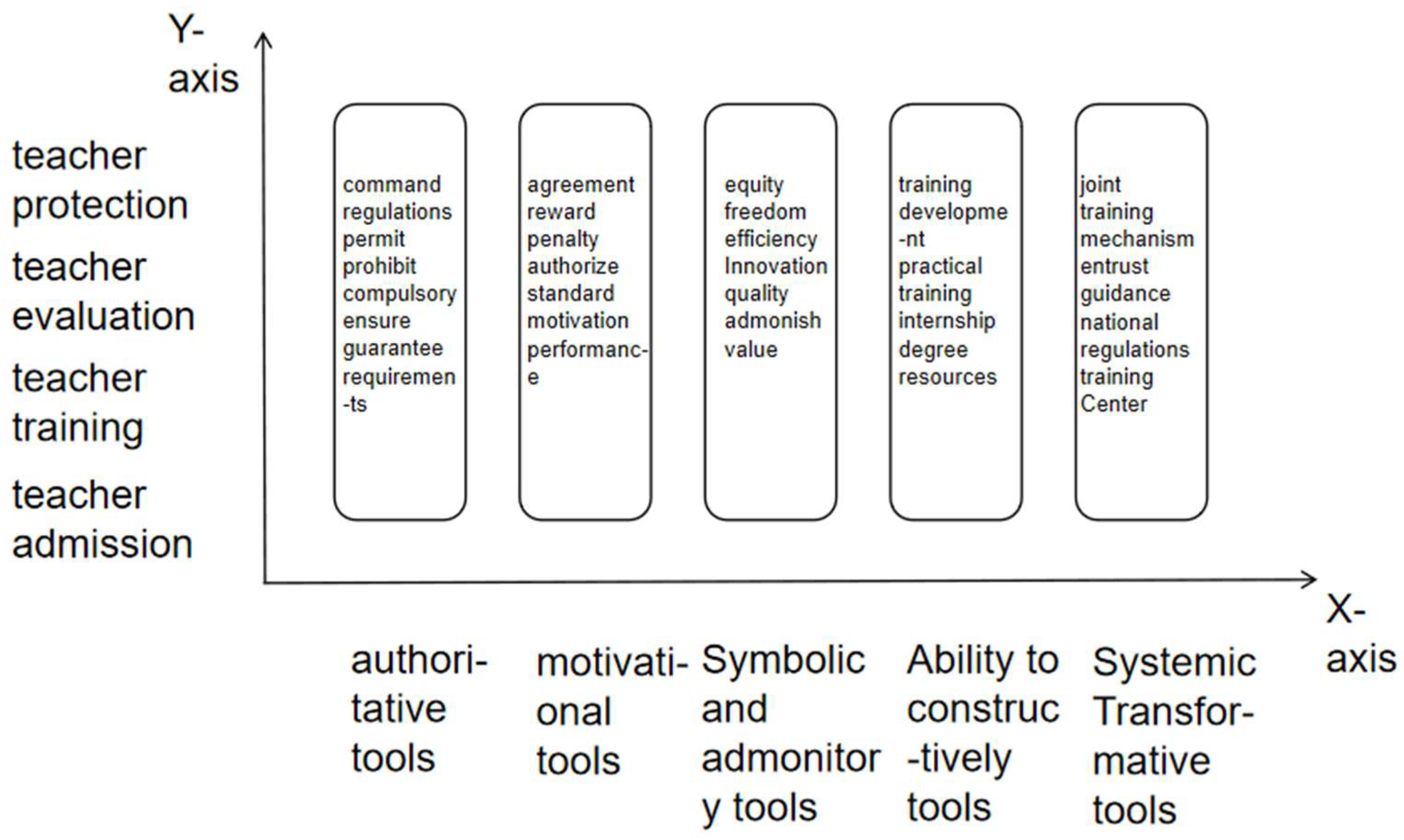
3.2. Analytical Framework
3.3. Coding Methods
3.4. Data Analysis
Analysis Based on the Policy Instrument Dimension
3.5. Analysis Based on the Dimension of Policy Content Elements
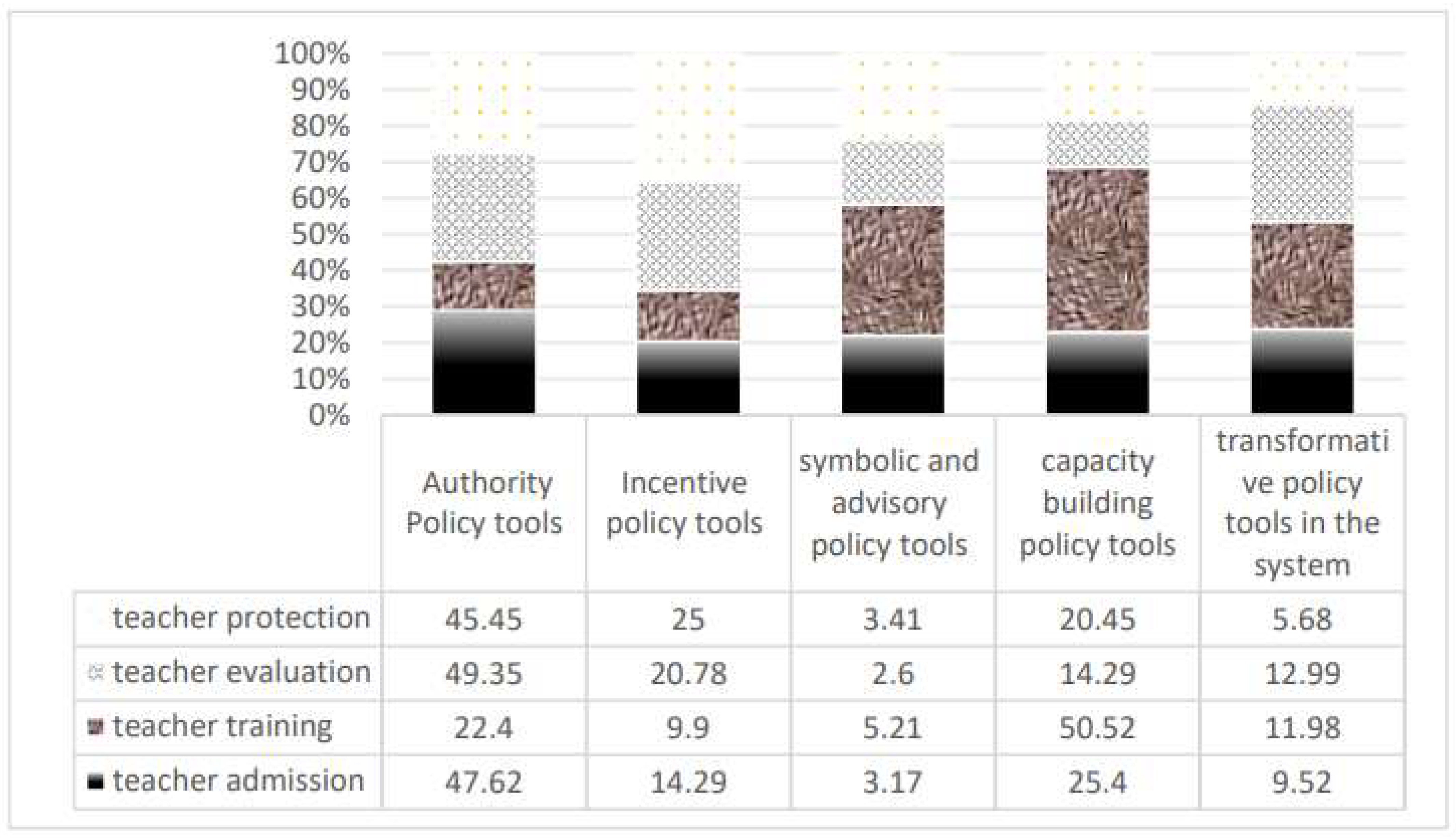
3.6. Cross-Analysis of the Policy Instrument Dimension and the Content Element Dimension
4. Conclusions and Implications
4.1. Conclusions and Discussion
4.2. Implications for Policy
Author Contributions
Funding
Institutional Review Board Statement
Informed Consent Statement
Data Availability Statement
Conflicts of Interest
References
- Bao, Shui Mei, and Jun Mei Hu. 2023. Selection preference and improvement strategy of policy tools for teachers’ moral and teachers’ style construction in colleges and universities in China. Jiangsu Higher Education 4: 33–42. [Google Scholar] [CrossRef]
- Cai, Wei Ping. 2024. Realistic Dilemma and Practical Path of High-Quality Development of Dual-professional Teachers in Higher Vocational Education. China Higher Education 18: 55–58. [Google Scholar]
- Chen, Zhen Ming. 2003. Policy Science—An Introduction to Public Policy Analysis, 2nd ed. Beijing: Renmin University of China Press. [Google Scholar]
- Cheng, Tian Jun., Ming Kai Zhang, and Yu You Qin. 2021. Thoughts and directions for deepening educational evaluation reform in the New Era. China Educational Technology 7: 1–12+21. [Google Scholar]
- CPC Central Committee and State Council. 2024. Opinions on Carrying Forward the Spirit of Educators and Strengthening the Construction of a Highly Qualified and Professional Teaching Staff in the New Era. Available online: http://www.moe.gov.cn/jyb_xxgk/moe_1777/moe_1778/202408/t20240826_1147269.html (accessed on 22 December 2025).
- CPC Central Committee State Council. 2018. Opinions on Comprehensively Deepening the Reform of Teacher Team Construction in the New Era. Available online: https://www.gov.cn/xinwen/2018-01/31/content_5262659.htm (accessed on 21 December 2025).
- Cui, Yu Xin., and Wei Ping Shi. 2020. The construction of dual-professional teacher team in double-high colleges and universities: Logic, dilemma and path. Journal of Vocational Education 36: 90–95. [Google Scholar]
- Francis, F. 2007. Introduction to Educational Policy, 2nd ed. Translated by Qingyu Xu. Nanjing: Jiangsu Education Press. [Google Scholar]
- Guo, Tian Ping, and You Li Chen. 2019. Research on cultivation mechanism for classification management of high-level teacher team under the perspective of “double-high plan” construction. Modern Education Management 8: 66–70. [Google Scholar] [CrossRef]
- Hao, Tian Cong. 2024. Why is there insufficient motivation for enterprises to participate in the integration of production and education in vocational education?—An Analysis of the Dilemma of Implementing Teachers’ Enterprise Practice Policy. Education and Research. Monthly 10: 104–12. [Google Scholar] [CrossRef]
- He, Zhen, Cheng Ming Yang, and Zhen Zhen Xie. 2018. Integrity of the logical structure of teachers’ professional development in higher vocational colleges and their supporting environment. Modern Distance Education Research 5: 32–38+103. [Google Scholar]
- Howlett, Michael, and M. Ramesh. 2006. Public Policy Research: Policy Cycles and Policy Subsystems. Beijing: Life-Reading-Xinzhi Sanlianshubian. [Google Scholar]
- Hu, Qin Tai, Shu Li Wang, and Li Guo. 2024. The current situation and review of the digital transformation of education in China under the perspective of policy tools. E-Education Research 1: 61–67+99. [Google Scholar] [CrossRef]
- Huang, D. 2006. Quantitative Research on Policy Literature. Beijing: Science Press. [Google Scholar]
- Huang, Yan, and Xin Zhang. 2024. Flexible employment and flexible management: Research on the operation mechanism of new teacher employment system in colleges and universities under multiple institutional logic. Journal of Jiangxi Normal University (Philosophy and Social Sciences Edition) 57: 86–94. [Google Scholar]
- Huang, Zhong Jing. 2008. Classification and selection strategies of educational policy tools. Journal of National Academy of Education Administration 8: 47–51. [Google Scholar]
- Hughes. 2007. Introduction to Public Management. Translated by Chengfu Zhang. Beijing: Renmin University of China Press. [Google Scholar]
- Jiang, Yi Hua. 2007. Research on teacher standards in contemporary China. Teacher Education Research 4: 32–36. [Google Scholar]
- Jin, Jin Biao, and Li Zhen Sun. 2024. Institutional guarantee for the construction of industrial faculty in the context of industry-education integration. Research in Higher Education of Engineering 1: 42–47. [Google Scholar]
- Kong, Ling Shuai, and Chao Wang. 2022. The dilemma and transcendence of teachers’ expressive evaluation. Educational Research 43: 140–51. [Google Scholar]
- Li, Mang, and Dong Xin Duan. 2022. Development of teaching access standards for university teachers in China. Chongqing Higher Education Research 10: 60–70. [Google Scholar] [CrossRef]
- Li, Shu Feng. 2014. Positioning of professional development of vocational education teachers from the evolution of dual-professional teacher policy. Teacher Education Research 26: 17–22. [Google Scholar] [CrossRef]
- Li, Si Wen, and Tian Cheng Xiang. 2024. The inner picture and optimization strategy of rural teacher team building policy in the new period. Education and Research. Monthly 8: 95–104. [Google Scholar] [CrossRef]
- Li, Xiao Yan, and Si Yuan He. 2022. Research on the policy of dual-professional teacher team building—An analysis based on McDonnell and Elmore’s policy tools. Journal of North Minzu University (Philosophy and Social Science) 3: 170–76. [Google Scholar]
- Liu, Sheng Tao. 2022. Research on policy tools for higher education evaluation reform in the new era. University Education Science 1: 81–88. [Google Scholar]
- Liu, Xuan Xuan. 2024. Opportunities, dilemmas and breakthroughs: Teaching staff construction for 2035. Teacher Education Research 36: 34–39. [Google Scholar] [CrossRef]
- Liu, Yan, Xin Fa Li, and Si Min Li. 2021. 10 years of implementation of the program for improving the quality of teachers in vocational colleges and universities-achievements, values and prospects. Education and Research. Monthly 2: 20–26. [Google Scholar]
- Ma, Xin Yue, Chao Yang Chen, and Xin Jun Zou. 2023. Evolution of vocational teacher education policies and reform orientation—Based on policy text analysis from 1985–2022. Journal of Soochow University (Educational Science Edition) 11: 61–71. [Google Scholar] [CrossRef]
- McDonnell, Lorraine M., and Richard F. Elmore. 1987. Getting the job done: Alternative policy instruments. Educational Evaluation and Policy Analysis 9: 133–52. [Google Scholar] [CrossRef]
- Ministry of Education. 2024. Notice on Issuing <Some Measures to Further Strengthen the Work of Respecting and Benefiting Teachers>. Available online: https://www.gov.cn/zhengce/zhengceku/202412/content_6991902.htm (accessed on 21 December 2025).
- Ministry of Human Resources and Social Security, and Ministry of Education. 2020. Guiding Opinions on Deepening the Reform of Higher School Teachers’ Title System. Available online: https://www.gov.cn/zhengce/zhengceku/202412/content_6991902.htm (accessed on 11 December 2025).
- Mu, Wei, and Chun Ping Yang. 2017. On the starting point and path of integration of faculty in higher vocational colleges and universities. Heilongjiang Researches on Higher Education 3: 138–40. [Google Scholar]
- Nie, Sheng, and You Zhi Huang. 2024. The construction of high-quality specialized teacher team needs legislation to guarantee teachers’ right to professional development. Journal of Educational Science of Hunan Normal University 23: 38–47+55. [Google Scholar] [CrossRef]
- Nie, Wei Jin. 2022. Review and reflection on the policy of dual-professional teacher team construction in higher vocational colleges and universities—Analysis based on 36 policy texts released from 2010 to 2020. Jiangsu Higher Education 3: 119–24. [Google Scholar] [CrossRef]
- Peng, Huan Huan, and Ying Zhi Xu. 2010. A statistical test of the interaction between higher education and regional economic growth. Statistics & Decision 11: 71–74. [Google Scholar]
- Qi, Zhan Yong, and Yu Song. 2022. Selection preference and improvement strategy of higher vocational education policy tools in China. Journal of Hebei Normal University (Educational Science Edition) 24: 91–101. [Google Scholar] [CrossRef]
- Rothwell, Roy, and Walter Zegveld. 1984. An assessment of government innovation policies. Policy Studies Review 34: 436–44. [Google Scholar] [CrossRef]
- Salamon. 2016. Tools of Government: A Guide to New Governance. Translated by X. Na. Beijing: Peking University Press. [Google Scholar]
- Schneider, Anne, and Helen Ingram. 1990. Behavioural assumptions of policy tools. Journal of Politics 2: 510–29. [Google Scholar] [CrossRef]
- Shanghai Education Commission. 2024. Guidelines for Promoting the Improvement of Professional Teachers’ Quality and Ability in Shanghai Vocational Schools. Available online: https://edu.sh.gov.cn/xxgk2_zdgz_jsgz_02/20240515/a592181082c747529bb3387bf5fa0f26.html (accessed on 12 December 2025).
- Song, Nai Qing, Shi YanLuo, and Lin Xiao. 2018. Ruminations on the cultivation of good teachers in China in the New Era. China University Teaching 7: 17–21+35. [Google Scholar]
- Tang, Jie, and Wei Ping Shi. 2020. Policy tools for the connotation construction of higher vocational education: Review and outlook-an analysis based on the higher vocational policy texts from 1995–2019. Education and Research Monthly 1: 45–52. [Google Scholar] [CrossRef]
- Tian, Shi Xu. 2024. Retrospect and prospect of China’s primary and secondary school teacher policies since the 18th party congress—Analysis based on the framework of policy “tools and elements”. Chinese Journal of Distance Education 44: 24–37. [Google Scholar] [CrossRef]
- Tong, Jing, and Min Li. 2024. Local governments’ policies to promote high-quality teacher construction: Instrumental preferences and optimization strategies. Forum on Contemporary Education 6: 19–26. [Google Scholar] [CrossRef]
- Wang, Jian Hua. 2023. How higher education responds to changes in the world of work. Modern University Education 39: 1–9+112. [Google Scholar]
- Wang, Ming Shuai, and Sai Xie. 2011. Teacher access system based on teacher entry standards: Foreign experiences and implications. Research in Educational Development 31: 53–58. [Google Scholar] [CrossRef]
- Wang, Sheng Nian, and Guo Qing Xu. 2023. The key institutional barriers to high-quality development of vocational education and their structural dissolution. Journal of Higher Education Management 17: 92–99. [Google Scholar] [CrossRef]
- Wang, Xiao, Pei Li Yuan, and Nai Yi Wang. 2024. Policy instrument selection and optimization of publicly-funded education for local teacher trainees in China-an empirical study of 20 provincial policy texts. Teacher Education Research 36: 47–54. [Google Scholar] [CrossRef]
- Wang, Zhi Yuan, and De Quan Zhu. 2024. The rational logic of educational evaluation reform in the New Era. Tsinghua Journal of Education 45: 99–109. [Google Scholar] [CrossRef]
- Wei, Shu Guang, Kun Wang, and Xiao Hui Zhang. 2024. Research on transformation and development policies of local colleges and universities in China—Analysis of 138 central and provincial policy texts. Journal of Higher Education Management 18: 113–24. [Google Scholar] [CrossRef]
- Wu, He Wen. 2011. Analysis of Higher Education Policy Tools. Beijing: Beijing Normal University Press. [Google Scholar]
- Xu, Guo Qing, and Hao Nan Wang. 2022. The core logic of the reconstruction of teacher training system of vocational education in China. Modern Education Management 12: 71–77. [Google Scholar] [CrossRef]
- Xu, Han, and Xiao Hua Yuan. 2024. The evolution logic and optimization path of China’s vocational education “two-teacher” teacher recognition policies—A content analysis based on 87 national policy texts. Modern Education Management 6: 108–18. [Google Scholar]
- Xu, Zhe Chuan. 2022. Achievements and prospects of China’s special education teachers’ policy system construction from the perspective of policy tools. Chinese Journal of Special Education 8: 88–96. [Google Scholar]
- Yan, Jian Zhang, and Wen Hua Shang. 2024. Research on the content of high-quality teacher team building and its path optimization in China—NVivo qualitative analysis based on policy text. Education and Research. Monthly 8: 86–94. [Google Scholar]
- Yang, Jia Le. 2023. Quality assessment and improvement path of provincial college teacher evaluation policies—A mixed study based on policy texts in 14 provinces. Modern Education Management 11: 74–84. [Google Scholar]
- Yang, Yi, and Li Dan Song. 2021. The present construction and analysis of countermeasures of teaching staff in higher vocational colleges. Higher Vocational Education (Journal of Tianjin Vocational Institute) 30: 14–18+95. [Google Scholar]
- Zhang, Jing Ke, and Zhan Yong Qi. 2022. Selection preference and improvement strategy of China’s highereducation internationalization policy instruments-based on Schneider and Ingram’s analytical framework. China Higher Education Research 1: 49–55. [Google Scholar] [CrossRef]
- Zhao, Ying. 2019. A Study of Teacher Quality Accountability Mechanisms in the United States. Beijing: Beijing Normal University Press. [Google Scholar]
- Zhou, Ya, and Zhen Gai Zhang. 2017. Evolutionary analysis of the choice of preschool education policy tools in China. Studies in Early Childhood Education 1: 13–22. [Google Scholar] [CrossRef]
- Zhu, De Quan, Zhi Jun Liu, and Huai Yin Hou. 2025. Key issues in the construction of a stronger education nation and its practical roadmap (conversation by writing). Journal of Educational Science of Hunan Normal University Volume 2023: 1–19. [Google Scholar]
- Zhu, Nan, and Li Shi. 2023. A policy study on teacher team building in integrated education from the p 2023erspective of policy instruments—A content analysis based on 26 national-level policy texts. Disability Research 3: 47–57. [Google Scholar]


| Tool Type | Operational Definitions | Iconic Words in the Policy Literature |
|---|---|---|
| Authoritative | Authoritative government that, by virtue of its political authority, issues mandatory provisions and requirements to both policy targets and implementers, typically in the form of orders, regulations, permits, prohibitions, etc. | Must, shall, implement, enforce, prescribe, develop, establish, perfect, implement, allow, approve, consent, authorize, prohibit, shall not, restrict, strictly prohibit, compel, ensure, safeguard, require, standard, necessary conditions |
| Motivational | Policy instruments that influence target audiences and implementers to take actions desired by policy makers through positive or negative incentives and feedback, typically in the form of agreements, rewards, penalties, authorizations, lowering of standards, etc. | Reward, recognition, priority, funding, subsidy, remission, penalty, revocation, prohibition, recourse, authorization, autonomy, qualification, lowering of standards, relaxation of requirements, incentives, pay for performance, appraisal, tilt |
| Symbolic and exhortative | A tool that motivates target audiences and policy implementers to act by guiding, inspiring, and interacting with people’s values and beliefs, often through techniques such as “labeling” and “symbolizing and appealing to intangible values (equity, freedom, efficiency, etc.)”. | Equity, freedom, efficiency, innovation, quality, sustainability, ideals, ethics, social responsibility, lifelong learning, teamwork, communication, consultation, cooperation, participation, feedback, exemplary, recognition, branding, culture, logo, appeal, exhortation, guidance, motivation, education |
| Capacity-building | Capacity-building tools support policy targets and implementers in various ways, including by providing training, education resources, appropriate equipment, and access to relevant information and evaluation methods. | Training, development, training, practical training, further training, education, study, degree, equipment, tools, resources, information, data, assessment, support, services, counseling, guidance, evaluation, certification, appraisal, standards, incentives, development, promotion, rewards |
| Systemic-changing | When policymakers determine that an organization cannot achieve desired policy outcomes under the current incentive mechanism and resource allocation model, they must modify the organizational structure to redistribute authority and facilitate goal attainment, often by redefining functions and reallocating resources. | Joint training, mechanism, commissioning, guidance, national regulations, training and training bases, open recruitment, first standard, part-time teachers, mobile positions, optimizing team building, groundwork, education power, high level |
| Elements of Policy Content | Meaning |
|---|---|
| teacher admission | It is the gateway and entry point to the teaching profession, involving a series of criteria and procedures designed to ensure that only individuals who meet certain qualifications and competencies can become teachers (Li and Duan 2022). |
| teacher training | It refers to the entire process of developing and preparing teachers for educational and instructional responsibilities, encompassing all aspects of a teacher’s career—from their initial training to ongoing professional development. The primary goal of teacher formation is to equip teachers with the knowledge, skills, and attitudes necessary educate students effectively and facilitate their learning and development (Song et al. 2018). |
| teacher evaluation | Teacher evaluation is a value judgment activity, focusing on “human needs.” It involves the systematic assessment and analysis of teachers’ performance, competence, and effectiveness in teaching and education. In evaluating teaching performance, it is essential to reject the undesirable tendencies of “only papers” and “only hats,” and instead prioritize teachers’ morals and ethical behavior, teaching achievements, and the actual level of focusing on teaching and educating people (Cheng et al. 2021). |
| teacher protection | Protection is provided in areas such as teacher status, posting, title evaluation, and rights and remedies, covering a wide range of measures aimed at safeguarding teachers’ legitimate rights and interests, upgrading their social status, and improving their working and living conditions (Jin and Sun 2024). |
| Serial Number | Name of Policy | Chapters | Entry (Policy Text Analysis Module) | Serial Number |
|---|---|---|---|---|
| 1 | Opinions of the Central Committee of the Communist Party of China and the State Council on Comprehensively Deepening the Reform of the teaching staff in the New Era | The first chapter emphasizes that national development must be preceded by strengthening of teachers and thoroughly understanding the significance and overall requirements of building the teaching staff. | Article I. Strategic significance. Teachers carry the historical mission of imparting knowledge, transmitting ideas, and promoting truth. They also bear the responsibility of shaping character, nurturing lives, and cultivating talents for new era. They are the primary resource for educational development and key pillar of national prosperity, national revitalization, and people’s happiness. | 1-1-1-1 |
| … | … | … | … | … |
| 124 | Development Plan for Higher Education in Henan Province | (iii) Objectives and tasks | (c) Create an innovative and highly educated teaching staff. The proportion of dual-professional teachers in higher vocational colleges and universities should reach approximately 30%. Simultaneously, teachers’ professional ethics and support for constructing teaching staff should be improved to build an open and flexible teacher education system. By 2020, both the academic level and overall quality of teachers will have been further improved. | 124-3-1-1 |
| Policy Tools | Centralized Policy | Provincial Policies | ||
|---|---|---|---|---|
| Frequency/Times | Percentage/% | Frequency/Times | Percentage/% | |
| Authoritative policy instruments | 78 | 30.71 | 73 | 44.51 |
| Incentive policy instruments | 55 | 21.65 | 11 | 6.71 |
| Symbolic and exhortative policy instruments | 13 | 5.12 | 4 | 2.44 |
| Capacity-building policy instruments | 75 | 29.53 | 67 | 40.36 |
| Systemic-changing policy instruments | 33 | 12.99 | 11 | 6.71 |
| Elements of Policy Content | Keyword Examples | Centralized Policies | Provincial Policies | ||
|---|---|---|---|---|---|
| Frequency/Times | Percentage/% | Frequency/Times | Percentage/% | ||
| teacher admission | Teacher recruitment methods, teaching qualifications, two-way teacher mobility, work experience, practical experience, integration of industry-university-research, “dual-professional teachers” quality | 33 | 13.10 | 30 | 18.29 |
| teacher training | Teachers’ Professional Quality, School-Enterprise Cooperation, Teachers’ Ideological and Moral Education, Business Training, Dual-professional Teachers Team Construction, Teacher Team Construction for Industry-Teaching Integration, Dual-professional Teachers Cultivation and Training Bases, 1+X Certificate System, Vocational Skill Training, Informatization Construction, Teachers’ Subject Competence and Subject Literacy | 100 | 39.68 | 90 | 54.88 |
| teacher evaluation | Vocational education teacher qualification, regular registration, performance assessment, title evaluation, merit assessment and reward, employment management, reform of the teacher title system, assessment and evaluation standards, teacher ethics standards, teaching workload, teaching performance, teaching research, evaluation of representative achievements | 56 | 22.22 | 21 | 12.80 |
| teacher protection | Special education allowance, protection of relevant treatment, sound mechanism for the use of highly skilled personnel positions, sound teacher honor system, dual-professional teachers team tilt, financial security | 65 | 25.79 | 25 | 15.06 |
Disclaimer/Publisher’s Note: The statements, opinions and data contained in all publications are solely those of the individual author(s) and contributor(s) and not of MDPI and/or the editor(s). MDPI and/or the editor(s) disclaim responsibility for any injury to people or property resulting from any ideas, methods, instructions or products referred to in the content. |
© 2026 by the authors. Licensee MDPI, Basel, Switzerland. This article is an open access article distributed under the terms and conditions of the Creative Commons Attribution (CC BY) license.
Share and Cite
Song, Y.; Zang, Z.; Ni, H. Teacher Policy Selection in China’s Higher Vocational Education: Evidence from 124 Central and Provincial Policy Documents. Soc. Sci. 2026, 15, 171. https://doi.org/10.3390/socsci15030171
Song Y, Zang Z, Ni H. Teacher Policy Selection in China’s Higher Vocational Education: Evidence from 124 Central and Provincial Policy Documents. Social Sciences. 2026; 15(3):171. https://doi.org/10.3390/socsci15030171
Chicago/Turabian StyleSong, Yu, Zhen Zang, and Hao Ni. 2026. "Teacher Policy Selection in China’s Higher Vocational Education: Evidence from 124 Central and Provincial Policy Documents" Social Sciences 15, no. 3: 171. https://doi.org/10.3390/socsci15030171
APA StyleSong, Y., Zang, Z., & Ni, H. (2026). Teacher Policy Selection in China’s Higher Vocational Education: Evidence from 124 Central and Provincial Policy Documents. Social Sciences, 15(3), 171. https://doi.org/10.3390/socsci15030171