1. Introduction
The social and legal landscape for women in the Kingdom of Saudi Arabia (KSA) is a site of profound and public contestation. This transformation is characterized by a central paradox of “dual mobilities.” Internally, the state’s ambitious Vision 2030 framework has propelled a top-down modernization project primarily aimed at economic diversification (
Al-Rasheed 2021). A key plank of this strategy has been the instrumentalization of women’s empowerment to achieve economic goals (
Jamilah and Isnarti 2024), resulting in high-profile reforms: the lifting of the female driving ban in 2018, the promotion of women’s workforce participation, and the partial (though not total) dismantling of the male guardianship (wilayah) system (
Amnesty International 2022).
Simultaneously, a second, geographic mobility has been occurring for decades, accelerated by state-sponsored initiatives like the King Abdullah Scholarship Program (KASP). This has enabled a generation of Saudi women to engage in international sojourns as students, professionals, and accompanying family members. These women are positioned as key agents in the nation’s development, yet their time abroad places them in direct, daily confrontation with social, legal, and gender norms vastly different from those at home.
This paper is situated at the intersection of these dual mobilities. It focuses on Saudi women as sojourners, a population distinct from permanent migrants, defined by their temporary status and a “return orientation”. Their experience is not a linear, one-way path toward assimilation or “liberation,” but a liminal, temporary state. We posit that the sojourn functions as a “laboratory of selfhood” and a “ritual passage” where normative constraints are temporarily suspended, allowing for an accelerated process of identity negotiation and the “reconstruction of selfhood” (
Turner 1967;
Aguilar 2018).
While a growing body of research has explored the experiences of Saudi women abroad (e.g.,
Lefdahl-Davis and Perrone-McGovern 2015;
Mustafa and Troudi 2017), often focusing on “culture shock,” “adaptation,” or re-entry (
Alkhalaf et al. 2024;
Asiri 2025), it has largely been siloed from concurrent literature analyzing the impacts of Vision 2030 within Saudi Arabia. This study bridges that gap. It examines how Saudi women sojourners in Canada transnationally negotiate their autonomy, using their lived experiences in the diaspora as a critical lens to evaluate the “moving target” of reforms they observe from afar.
We argue that these women develop a liminal autonomy, an agency that is real, embodied, and transformative, yet remains fragile, intersectionally constrained, and perceived as potentially reversible upon their anticipated return. This paper is guided by three central research questions:
How do Saudi women sojourners narrate their experiences of physical, social, and symbolic autonomy in Canada, relative to their pre-migration lives under guardianship?
How do they negotiate these newfound freedoms in relation to ongoing transnational obligations (e.g., family, community) and the specific context of Canadian multiculturalism (e.g., Islamophobia, racialization)?
How do ongoing legal and social reforms in Saudi Arabia (e.g., Vision 2030 and the 2022 Personal Status Law) shape their reflections on their sojourn and their imagined futures upon return?
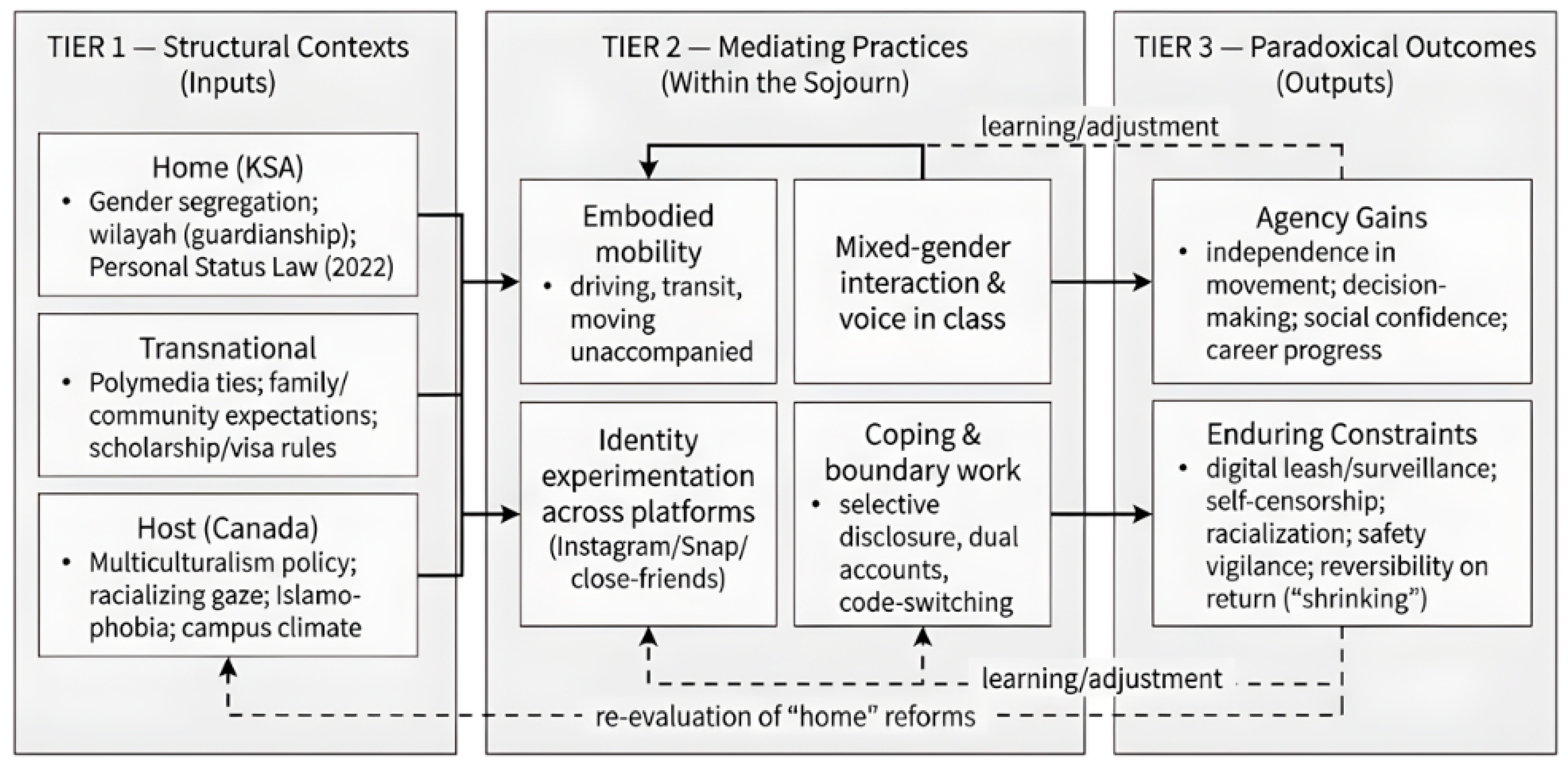
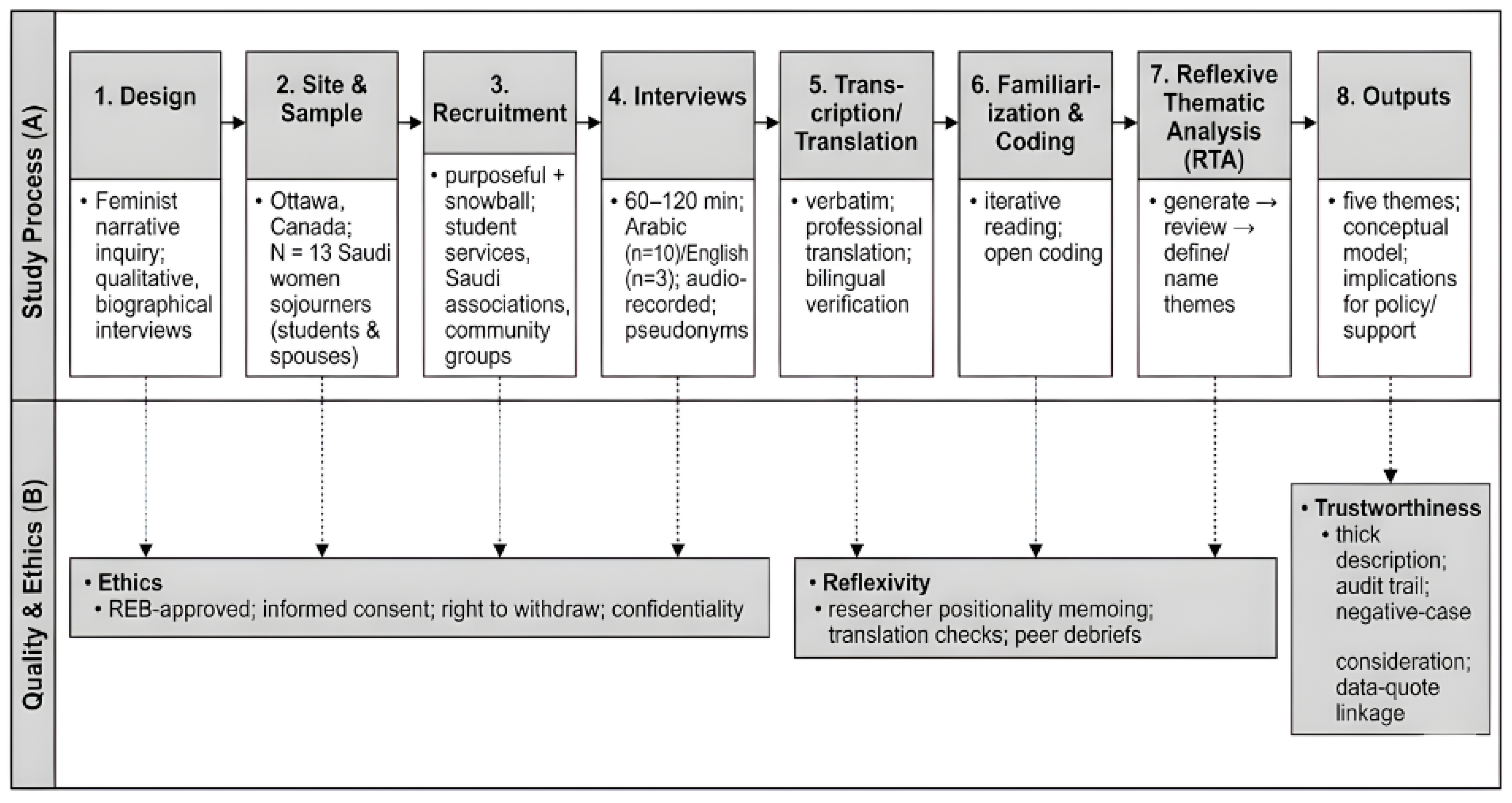
To answer these questions, the article first outlines the theoretical framework, connecting Saudi Arabia’s changing gender regime with theories of mobility and transnational feminism. It then details the feminist narrative inquiry methodology employed. The findings section presents an integrated thematic analysis in which empirical narratives are interpreted alongside relevant theoretical perspectives. The paper concludes by considering implications for scholarship, policy, and support services.
This article contributes three advances. First, it theorizes liminal autonomy to capture the fragile, reversible, and context-dependent agency that emerges during a temporary sojourn. Second, it demonstrates how polymedia sustain a transnational “digital leash,” exporting social control across borders. Third, it analyzes a moving target of reform in Saudi Arabia, separating lifestyle freedoms (e.g., driving) from enduring structural constraints (e.g., the 2022 Personal Status Law).
4. Findings and Theoretical Analysis
Rather than presenting participants’ narratives and their interpretation as separate analytic moments, this section integrates empirical findings with relevant theoretical perspectives. Doing so enables the women’s accounts of mobility, autonomy, and constraint to be read not only as lived experience but as situated interventions into broader debates on liminality, gendered mobility regimes, and transnational feminist agency.
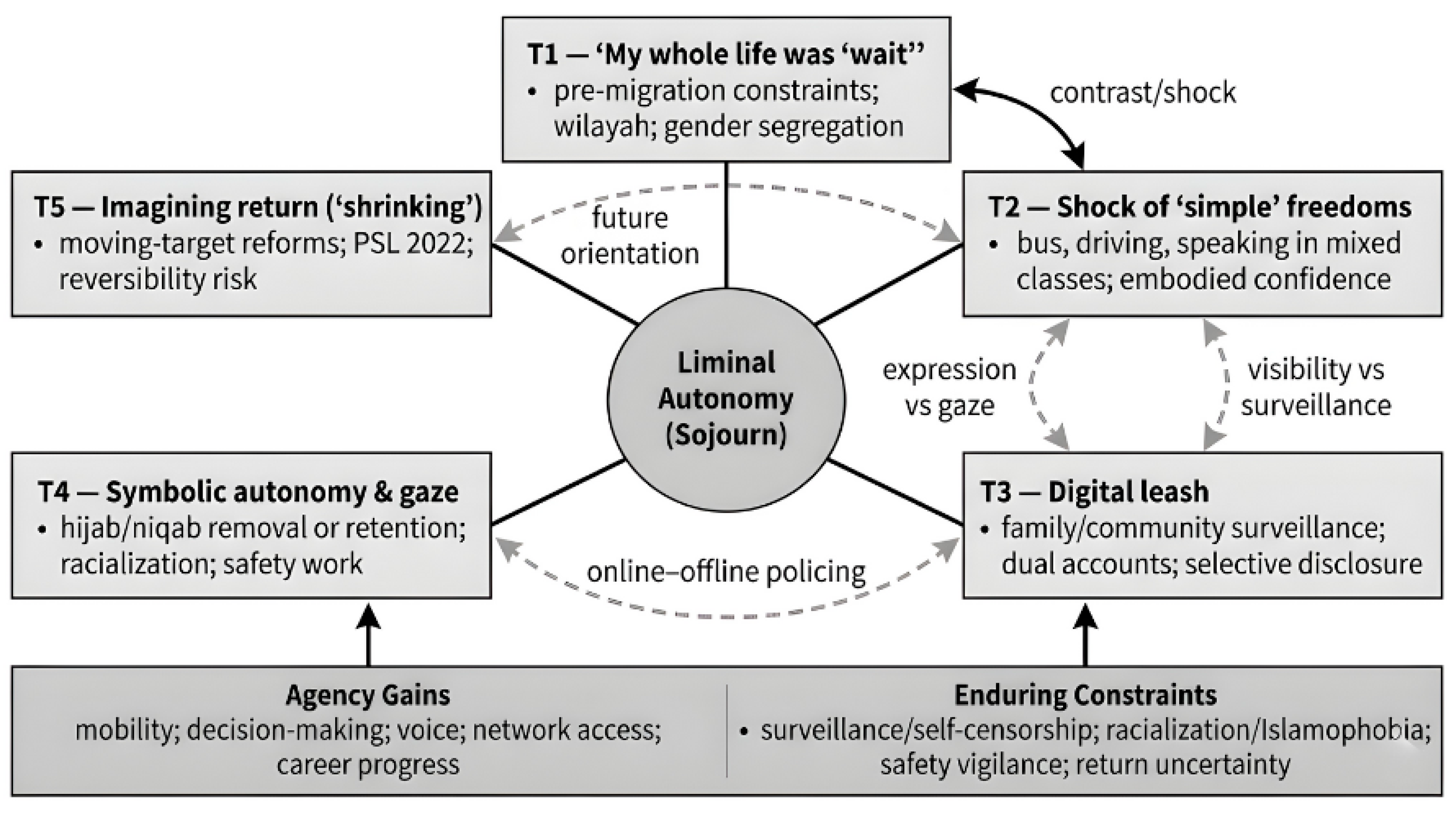
The participants’ narratives wove a complex tapestry of gain, loss, negotiation, and adaptation. Their stories of autonomy are presented here across five central themes, illustrating how these women negotiated autonomy across borders during their sojourn.
Figure 3 provides a thematic map of the five interrelated themes and their links to gains and constraints.
Collectively, the five themes demonstrate that autonomy during a temporary sojourn is best understood as liminal: it is embodied and meaningful, yet context-dependent and potentially reversible. The analysis also shows how participants assess a “moving target” of reform under Vision 2030 while navigating two constraints that travel with them: transnational digital surveillance and the racializing gaze in Canada.
4.1. “My Whole Life Was ‘Wait’”: Pre-Migration Life Under Guardianship
All narratives of the Canadian sojourn were grounded in the “baseline” of life before departure. Participants universally described their pre-migration lives as defined by constrained mobility and a relational dependence on male guardians, aligning with long-standing critiques of the wilayah (guardianship) system. Autonomy was not depicted as an inherent right but rather as a concession to be requested from others.
“In Riyadh, I couldn’t even go to the supermarket alone. My driver, my husband, my father. My whole life was ‘wait.’ Waiting for a man to take me somewhere. Waiting for a man to finish his coffee so we could leave. Waiting for permission. Here… I just go. The going is… it’s everything. I didn’t realize how much of my life was just… waiting.”
(Fatima, 35, sojourner spouse)
Fatima’s powerful metaphor of “waiting” captures the sense of suspended agency inherent in the traditional gender regime. This waiting was not always experienced as overt oppression, but it was pervasive. Lina, a 27-year-old engineering student, spoke to the absurdity of the system when its rules governing a woman’s movements trumped any consideration of her competence or age:
“Before, my brother, who is five years younger than me, had to… ‘give permission’ on the [Absher government] app if I wanted to travel. I have a PhD scholarship. He failed high school. It’s… it was… humiliating. It’s not about him—he is a good kid—but… the system. It makes you feel… not like an adult. Not real.”
(Lina, 27, master’s student)
Reem, a 22-year-old who came to Canada at 19 for undergraduate studies, articulated how these norms were internalized to the point that the absence of freedom felt “normal” before she left Saudi Arabia:
“It wasn’t… bad, you know? It’s just normal. My family is not so strict, but of course you cannot just meet a friend for coffee. You plan. You ask. You are… driven. You don’t just… walk. The idea of just walking out the door… it didn’t exist.”
(Reem, 22, undergraduate student)
Lina’s narrative highlights the structural humiliation of a system that invalidated her adult agency and achievements in favor of a younger male relative’s authority. Fatima’s metaphor of “waiting” illustrates the everyday suspension of women’s independence. Together, these stories establish the backdrop against which the shock of Canadian autonomy would later be experienced.
Analytically, these accounts situate participants’ pre-migration lives within what feminist scholars have described as structurally enforced relational autonomy, where agency is exercised primarily through negotiation rather than independent decision-making. The language of “waiting” and “permission” reflects not only the legal architecture of the wilayah system (
Human Rights Watch 2016) but also its internalization as a temporal condition shaping women’s sense of adulthood and selfhood. In this respect, the sojourn does not begin from a neutral baseline but from a subject position already marked by suspended agency, against which subsequent experiences of autonomy acquire their intensity.
4.2. The Shock of “Simple” Freedoms: Embodied Autonomy in Canada
The transition to Canada was universally described as a “shock,” but one centered on the sudden, overwhelming, and often terrifying acquisition of what participants called “simple” or “basic” freedoms. These narratives of first-time experiences—“firsts”—were deeply somatic and emotional, aligning with
Kim’s (
2001) stress–adaptation model in which the new environment initially acts as a stressor that, when overcome, precipitates profound personal growth.
“The first time I took the bus. Alone. At night. My heart was… thumping. I was terrified. I was holding my pepper spray. I was sure I was doing something wrong, that I would be… I don’t know. But I was also… I felt so powerful. I got home and I just… cried? It was just a bus! [laughs] But it wasn’t. It was the first time in my life I moved my own body from A to B without a man’s permission or a man’s car.”
(Reem, 22)
These early encounters with mobility exemplify what
Kim (
2001) conceptualizes as the stress–adaptation–growth dynamic, but with a distinctly gendered inflection. The stress described here is not cultural unfamiliarity per se, but the sudden withdrawal of external regulation over women’s bodies and movement. Mastery of mundane practices such as public transport or classroom participation thus operates as embodied proof of autonomy, transforming routine acts into rites of passage that recalibrate participants’ sense of personal capacity.
For Mariam, a 41-year-old PhD student and divorced mother, the mundane act of driving in Canada was inextricably linked to a political struggle she had participated in back home:
“Driving. I have an Ontario license. In Saudi, I campaigned for years [for the right to drive]. I was one of the women… well, I was quiet, but I was there. Now… I drive my son to school. I go to the grocery. It feels… normal. But I know it is not. I know what this ‘normal’ cost us. Every time I turn the key, I remember.”
(Mariam, 41)
This new autonomy was not just physical, but also social and intellectual. Lina, the engineering student, described the challenge of Canada’s mixed-gender academic spaces:
“Mixed classes. The first time the professor (male) asked me a question, I… I froze. I was so used to being invisible. In my Saudi university [women’s campus], I was the top of my class. I was… loud! But here… I am not used to a man I am not related to… asking my opinion. Here, I have to have an opinion. It took a year for my voice to… come back.”
(Lina, 27)
These “firsts”—the bus ride, the turn of the ignition key, the act of speaking up in class—function as rites of passage in the participants’ narratives. The palpable fear and tears (as Reem described) accompanying these ostensibly simple acts illustrate how deeply the pre-migration norms of constraint had been embodied. Mastering these tasks became symbolic milestones in the women’s self-development, marking the shedding of one layer of constraint and the tentative claiming of a new, self-directed identity.
4.3. The “Digital Leash”: Transnational Surveillance and Relational Autonomy
Participants’ autonomy in Canada was not absolute. Their stories revealed a constant, transnational negotiation with family and community at home, mediated by digital technology. While participants were geographically free, they remained bound by what one called a “digital leash,” which limited their social and relational autonomy.
Aisha, a 25-year-old master’s student, described the “heavy love” of her family, expressed through persistent online surveillance:
“My family trusts me. But my mother… she calls on WhatsApp video. ‘Show me the room, yalla.’ She wants to see I am alone. She wants to see what I am wearing. She will say, ‘Why is it dark? Are you outside?’ It’s… not trust. It’s… love, but it’s a heavy love. I cannot just… be.”
(Aisha, 25)
To manage this, participants developed sophisticated “agency maneuvers” and strategic self-presentation tactics (what one participant laughingly called “social media gymnastics”). Reem, the undergraduate, explained her strategy of effectively living two lives online:
“My social life? I have two. My Snapchat for my cousins… I am studying in the library, very boring. My ‘close friends’ story on Instagram… maybe I am at a café, music, friends… boys and girls. I am not doing anything haram [forbidden], but… it’s just… easier to be two people. Why make them worry? Why make them talk?”
(Reem, 22)
Importantly, this surveillance was not limited to direct family. Several participants described a “transnational panopticon” in which the judgmental gaze of their home community was effectively transplanted into the diaspora, often enforced by other Saudis abroad. This finding echoes other qualitative studies of Saudi students overseas. Lina explained:
“We call it the ‘Saudi CIA’ [laughs]. The other Saudi students. Who is watching who? Who will report back to whose family? ‘Oh, I saw Lina at a coffee shop with a man.’ ‘Oh, I saw Reem’s hair.’ I felt this more in my first year. This judgment… it followed us here.”
(Lina, 27)
These narratives demonstrate the limits of physical mobility. Participants are geographically “free” but remain relationally bound. Reem’s “two people” strategy is a clear act of agency aimed at managing this cross-border scrutiny—carving out a private sphere of autonomy while performing a public, digital self that conforms to home-community expectations. In this way, the sojourners practice autonomy within constraint, carefully negotiating how much of their new freedom is visible to those back home.
Conceptually, the digital leash illustrates how regimes of mobility operate beyond physical borders. While geographic movement enables partial escape from direct guardianship, polymedia infrastructures reproduce relational surveillance across distance, effectively reterritorializing control (
Glick Schiller and Salazar 2013). Participants’ strategic self-presentation practices do not signal false consciousness or duplicity, but rather represent agentic adaptations within constraint, aligning with transnational feminist understandings of agency as negotiated rather than oppositional. This extends the findings beyond ‘homesickness’ framings by showing how digital intimacy can function as a governance mechanism that structures everyday decision-making abroad.
4.4. “Am I Canadian or Am I Saudi?”: Symbolic Autonomy, Hijab, and Islamophobia
Participants’ negotiations of dress, visibility, and religious expression reveal symbolic autonomy as a particularly charged site of liminal agency, where gender, religion, and racialization intersect.
Symbolic autonomy—the freedom of expression, dress, and religious practice—emerged as a central site of identity work for participants. However, it was precisely at this juncture that the “freedom” of Canada met the constraints of an intersectional identity. Here, the “oppressed vs. liberated” binary most clearly collapsed.
For Hessa, a 29-year-old PhD student, wearing the niqab (face veil) in Canada was a profound act of agentic piety, consistent with
Mahmood’s (
2005) framework. It was a choice she made against the expectations of both her family and her new host society:
“In Riyadh, I wear niqab. Here, I wear niqab. My family… they thought I would take it off. ‘It will be hard for you,’ they said. But here, I feel it is… my choice. It is my jihad [struggle]. It is my identity. But people… they look. They are afraid. Or they are angry. One man yelled at me, ‘Go back to Saudi Arabia!’ I… I was raised in Canada [as a child], but… they see this [gestures to niqab] and I am not Canadian. It is… tiring.”
(Hessa, 29)
Conversely, for Aisha—who had worn the hijab since childhood—the agentic choice was to remove it. This act did not bring simple liberation, but rather a complex mix of freedom and guilt:
“I took off my hijab. I started… second year. My family does not know. I feel… guilty. 100%. But I also… I just wanted to feel the wind in my hair. I just wanted to… blend in. And then I feel guilty for wanting to blend in! [laughs] It’s… complex. Am I a bad Muslim? Am I… ‘West-toxified’? Or am I just… me?”
(Aisha, 25)
Participants found that in Canada, they had, in a sense, traded the patriarchal gaze of their home community for the Orientalist/racializing gaze of the host society. Fatima, who wears hijab, described being reduced to a stereotype in her daily interactions:
“Here, I am ‘free’ to be a Muslim. But I am also… a ‘problem’ for being a Muslim. In Saudi, I am just… a woman. Here, I am a Muslim woman. A ‘Middle Eastern woman.’ I am a stereotype. People ask me… ‘Oh, you can talk? You are so… articulate.’ It is… racist. I gain the freedom to drive, but I get… this. It’s a trade.”
(Fatima, 35)
Fatima’s account illustrates how symbolic autonomy in the host society can trigger new forms of constraint. Participants described being read through a presumptive script in which visible Muslim identity signaled oppression or lack of agency, producing everyday encounters that ranged from microaggressions to overt hostility. The result was a double bind in which exercising choice, whether veiling or unveiling, invited judgment from different directions.
These divergent practices underscore
Mahmood’s (
2005) argument that agency cannot be reduced to resistance against norms. Whether through veiling or unveiling, participants exercised choice within overlapping systems of power, encountering new constraints even as they escaped others. Intersectionality is therefore not an abstract framework here, but a lived condition: autonomy is expanded along one axis while curtailed along another, destabilizing any linear narrative of liberation through migration.
Participants’ accounts also complicate any simple “Canada equals freedom” narrative. Several described trading the patriarchal gaze of home for the racializing gaze of the host society, where visible Muslim identity could attract suspicion, hostility, or microaggressions. This produced a double bind in which symbolic autonomy, whether expressed through veiling or unveiling, invited scrutiny from different directions. Autonomy therefore emerged not as a destination reached through migration but as an ongoing negotiation within intersecting systems of power.
4.5. “Will I Have to Shrink Again?”: Imagining Return and Vision 2030
As sojourners, all participants’ narratives were oriented toward an eventual return to Saudi Arabia. This anticipated future was viewed with profound ambivalence, blending hope in the Kingdom’s new reforms with a deep-seated fear of personal regression—essentially, a fear of reverse culture shock.
Mariam, the 41-year-old PhD student, articulated this fear using a striking physical metaphor of “shrinking,” echoing themes in re-entry shock literature:
“My biggest fear… is that I will go back and… I will shrink. That all this… bigness… I feel here… this voice I have found… will just get… quiet. Because it’s easier to be quiet there. That is what I am afraid of. Will I have to shrink again?”
(Mariam, 41)
This fear of shrinking was complicated by the “moving target” of the home society they were set to re-enter. Participants were keenly aware—and deeply analytical—of the Vision 2030 reforms unfolding in their absence. Lina, the engineering student, captured this ambiguity:
“It’s… strange. My friends in Riyadh are going to concerts, they are driving… my life there now would be so different. Maybe… maybe I didn’t need to leave to be free? But… I read about the new law… It feels like… one step forward, five steps back. They give you the car, but they… still own you in the house.”
(Lina, 27)
Hessa, the PhD student, offered the most trenchant structural critique. Like others, she distinguished between surface-level reforms and an underlying, unchanged mentality:
“The [Vision 2030] reforms are for… they are economic. They want women to work… so they let them drive. It is not… a change of mentality. It is… strategy. Here, the freedom… it is in the mentality. Even with the racism… the idea is that I am equal. At home, the idea is still that I am… ‘protected’.”
(Hessa, 29)
Several participants framed their anticipated return through an explicitly economic lens, linking employability and income to their ability to preserve aspects of the autonomy developed abroad. This aligns with scholarship on gendered development regimes in the Gulf, which has shown that women’s empowerment under Vision 2030 is primarily framed through market participation rather than through dismantling patriarchal authority in private and legal domains (
Al-Rasheed 2021;
Jamilah and Isnarti 2024). Economic participation was therefore imagined not as sufficient for social autonomy, but as a necessary—if fragile—precondition. As feminist political economy scholars have noted, such forms of instrumentalized empowerment can expand women’s public presence while leaving underlying gender hierarchies intact, rendering autonomy contingent rather than secured.
Participants’ fears of “shrinking” upon return resonate strongly with literature on re-entry and reverse culture shock, which emphasizes that return migration can be psychologically destabilizing when transformed identities encounter unchanged—or only superficially altered—structures at home (
Alkhalaf et al. 2024;
Asiri 2025). Unlike classic models of reverse culture shock that focus on readjustment stress, however, participants here articulated a more profound concern: the possibility that the agentic dispositions cultivated abroad would become socially illegible or actively discouraged upon return. Their anticipatory anxiety centered less on cultural mismatch than on the sustainability of selfhood within a legal and familial regime that continues to prioritize women’s protection and obedience over autonomy.
While Vision 2030 was acknowledged as enabling women’s labor market entry, participants remained skeptical that economic inclusion alone could sustain their expanded sense of self without parallel shifts in familial authority and legal practice.
Observing from a liminal position in Canada, participants functioned as critical interpreters of state-led reform rather than passive recipients of it. They acknowledged tangible lifestyle freedoms enabled under Vision 2030 (mobility, public life, labor market participation), yet repeatedly distinguished these changes from structural autonomy in private and legal domains. Lina’s formulation that reforms “give you the car, but still own you in the house” captured this distinction succinctly, while Hessa’s contrast between an economic “strategy” and a genuine “change of mentality” articulated skepticism toward liberalization framed primarily through market imperatives. In this way, participants differentiated modernization from liberation and treated the 2022 Personal Status Law as evidence that patriarchal authority remained legally codified despite expanded public mobilities.
The findings demonstrate that the autonomy gained by sojourners is not a permanent acquisition but a process: a form of liminal autonomy lived in the interim, structurally enabled yet socially precarious. As theorized in migration and mobility studies, autonomy acquired through temporary mobility remains conditional when return is governed by enduring legal frameworks and relational obligations (
Aguilar 2018;
Glick Schiller and Salazar 2013). Participants’ fear of “shrinking” therefore reflects not personal insecurity but a realistic assessment of structural constraints. Their narratives foreground autonomy as reversible, contingent on context, and unevenly distributed across public, private, and legal spheres. In this sense, 4.5 completes the analytic arc of the paper by showing how liminal autonomy is temporally bounded, politically situated, and continuously negotiated rather than progressively accumulated.
5. Conclusions
This section synthesizes the integrated findings and theoretical analysis presented above and then outlines implications, limitations, and directions for future research.
5.1. Core Contributions
This article has provided a rich narrative account of autonomy and mobility among Saudi women sojourners, yielding three core contributions. First, it offers empirical insight into the lived experiences of sojourners—a distinct and sociologically significant group whose return orientation fundamentally shapes their negotiation of selfhood. Second, it develops the concept of “liminal autonomy” to theorize the fragile, transformative, yet context-dependent agency cultivated during a temporary sojourn. This concept moves beyond static models of acculturation and adaptation toward a more dynamic understanding of identity work in transience. Third, it demonstrates the importance of simultaneously analyzing internal domestic reforms (Vision 2030, including the 2022 PSL) and external migration experiences. The participants are not evaluating a static home society, but a moving target; their liminal position in Canada provides a unique critical vantage point from which to deconstruct state-led reform narratives.
5.2. Implications for Future Practice
The findings have several implications. For sociological scholarship, this study urges a move beyond both static acculturation models and simplistic “liberation” narratives. Future research on gender and migration should account for transnational digital ties as mechanisms of social control and analyze “home” and “host” societies as mutually constitutive fields of power. For universities and sojourner support services, our results suggest that programming must go beyond generic “culture shock” orientation. Support should be intersectional, with dedicated resources to address Islamophobia, racism, and othering on campuses, as well as culturally attuned counseling that recognizes the unique psychological pressures of the “digital leash” (family expectations and surveillance via social media), which simple adjustment workshops cannot adequately address. For Saudi policymakers, the message is clear: the thousands of women returning from sojourns are not blank slates. They return with an embodied taste of structural autonomy and a sophisticated, critical analysis of domestic reforms. They will likely be key agents in pushing for the change of mentality required to make the promises of Vision 2030 a lived social reality, rather than merely an economic initiative.
5.3. Limitations and Future Research
This study, like all small-scale qualitative research, has limitations. The narratives of 13 women in one Canadian city are not statistically generalizable; rather, our aim has been analytic generalization, providing conceptual insights that may resonate beyond this sample. The data rely on participants’ self-reported (and storied) experiences, which are inherently subjective and reflective. However, this is also a strength, given our focus on personal meaning-making.
Future research would benefit from a longitudinal design. Following these women (and others) through their return to Saudi Arabia would empirically test their fears of “shrinking” and document how they navigate their “bigger” selves within the evolving context of the new Saudi Arabia. Comparative studies could also illuminate the role of host society context—for instance, comparing Saudi sojourners in a non-Western country (e.g., Malaysia) or in a more securitized Western context (e.g., post-9/11 United States) to see how experiences differ. Finally, research should explore the perspectives of the men in these transnational scenarios (the guardians, husbands, brothers, and fellow students who accompany or await these women). These men are also negotiating and co-constructing new gender roles and expectations through the sojourn process, and understanding their experiences would complement the insights from this study, painting a fuller picture of gender role negotiation in the context of Saudi transnational mobility.