
Membership as a Double-Edged Sword?: Group Membership, Urban Communities, and Mental Health in South Korea

Abstract
1. Introduction
2. Theoretical Backgrounds
2.1. Interpersonal Networks and Mental Health
2.2. Group Membership and Mental Health
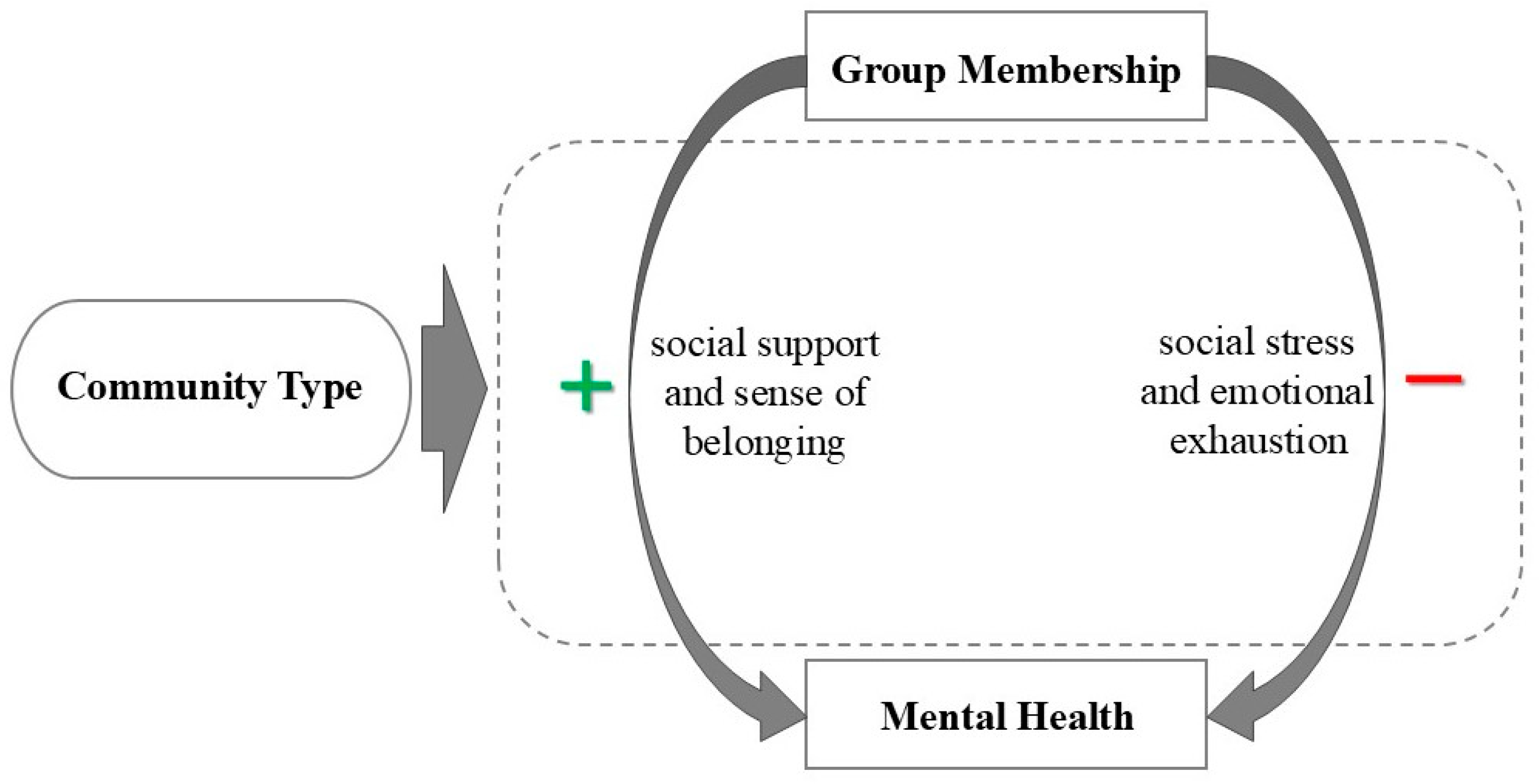
2.3. Theoretical Model and Hypotheses
3. Data and Methods
3.1. Data
3.2. Analytic Strategy
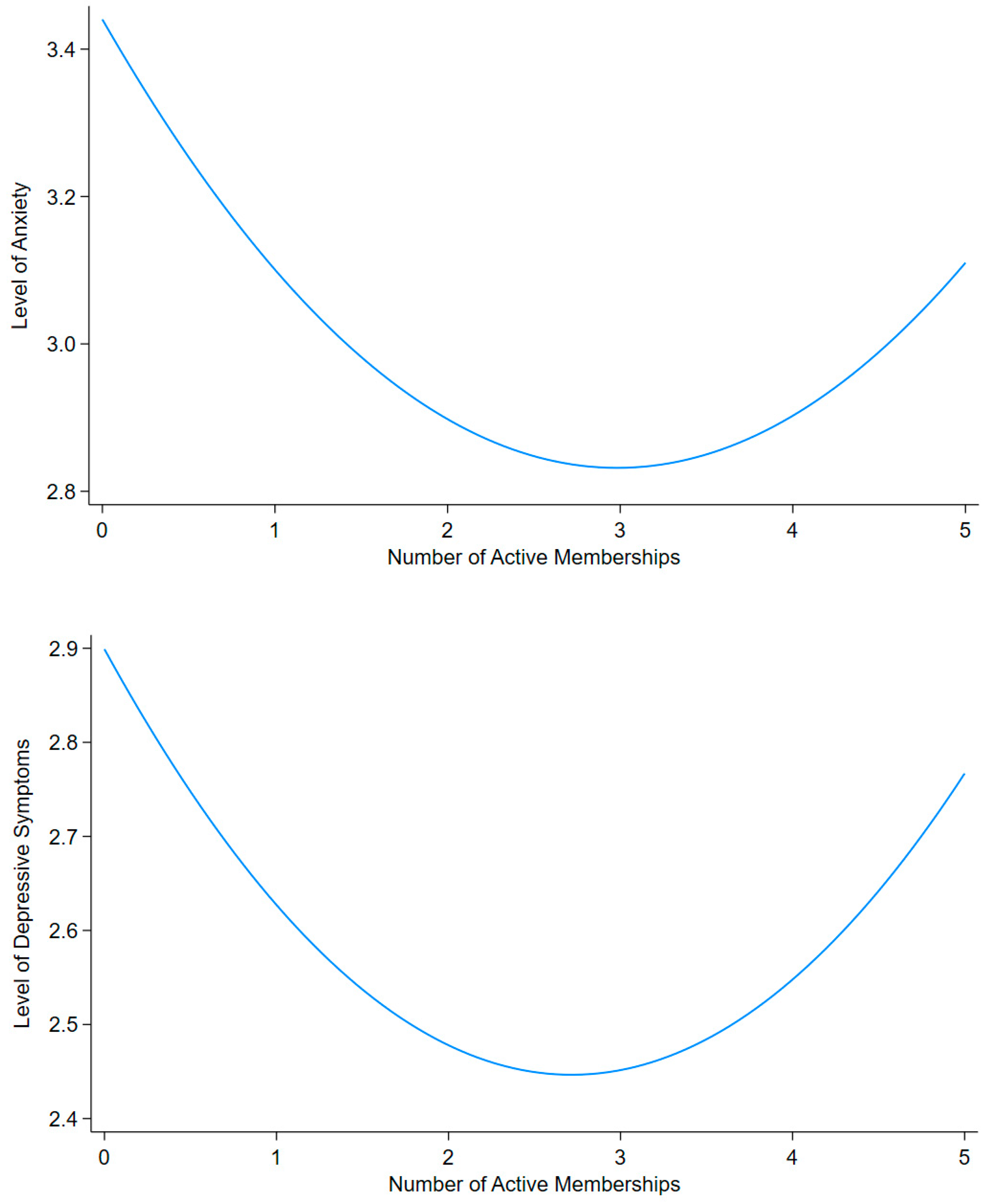
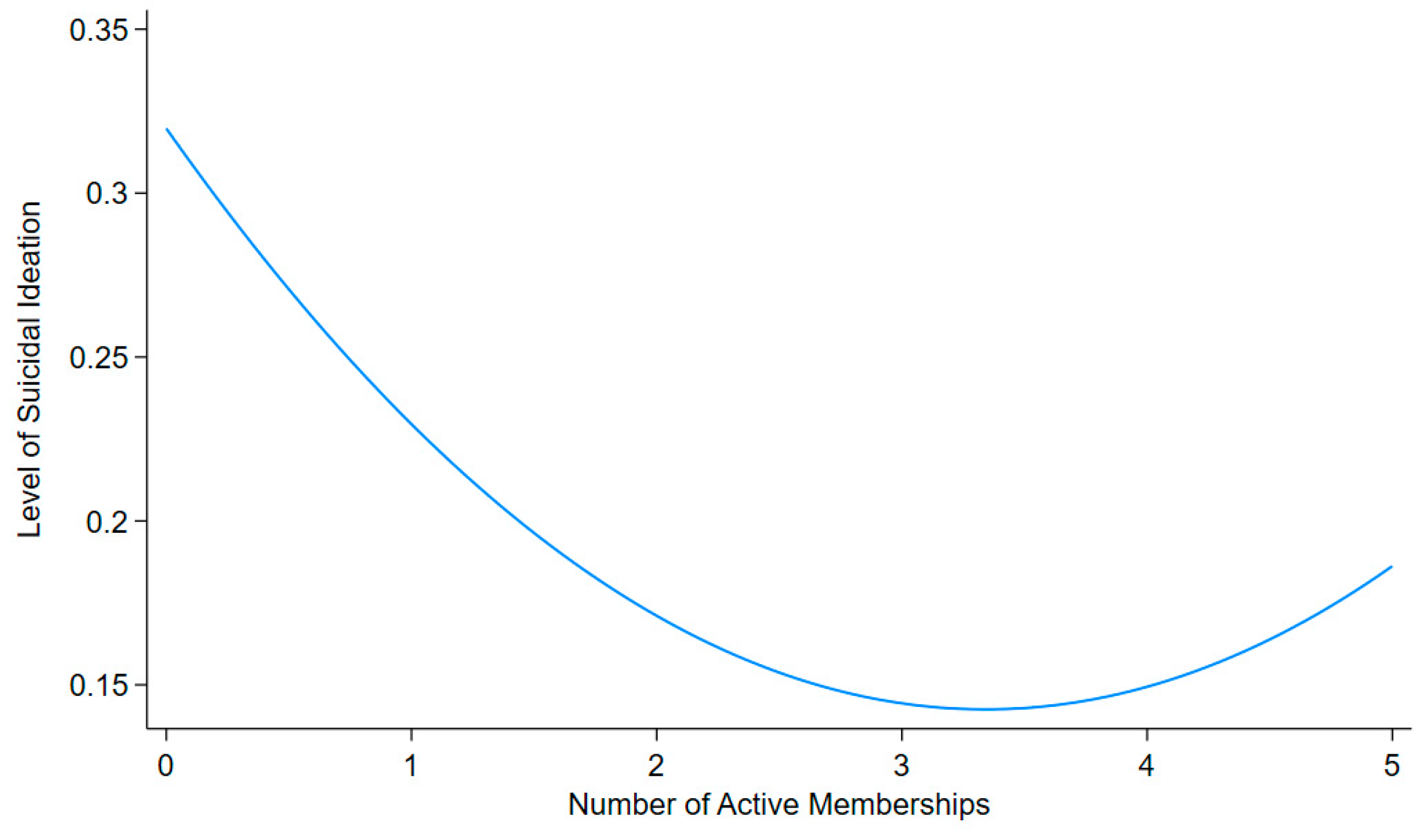
4. Results
5. Conclusions and Implication
Author Contributions
Funding
Institutional Review Board Statement
Informed Consent Statement
Data Availability Statement
Conflicts of Interest
References
- Berkman, Lisa F., Thomas Glass, Ian Brissette, and Teresa E. Seeman. 2000. From social integration to health: Durkheim in the new millennium. Social Science & Medicine 51: 843–57. [Google Scholar] [CrossRef] [Scilit]
- Borgatti, Stephen P., and Martin G. Everett. 1997. Network analysis of 2-mode data. Social Networks 19: 243–69. [Google Scholar] [CrossRef] [Scilit]
- Bourdieu, Pierre. 1986. The Forms of Capital. In Handbook of Theory and Research for the Sociology of Education. Edited by John G. Richardson. New York: Greenwood, pp. 241–58. [Google Scholar]
- Brashears, Matthew E., Michael Genkin, and Chan S. Suh. 2017. In the organization’s shadow: How individual behavior is shaped by organizational leakage. American Journal of Sociology 123: 787–849. [Google Scholar] [CrossRef] [Scilit]
- Breiger, Ronald L. 1974. The duality of persons and groups. Social Forces 53: 181–90. [Google Scholar] [CrossRef]
- Chappell, Neena L., and Mark Badger. 1989. Social isolation and well-being. Journal of Gerontology 44: S169–S176. [Google Scholar] [CrossRef] [Scilit]
- Cohen, Sheldon, and Denise Janicki-Deverts. 2009. Can we improve our physical health by altering our social networks? Perspectives on Psychological Science 4: 375–78. [Google Scholar] [CrossRef] [Scilit]
- Coleman, James S. 1988. Social capital in the creation of human capital. American Journal of Sociology 94: S95–S120. [Google Scholar] [CrossRef] [Scilit]
- Cornwell, Erin York, and Linda J. Waite. 2009. Social disconnectedness, perceived isolation, and health among older adults. Journal of Health and Social Behavior 50: 31–48. [Google Scholar] [CrossRef] [Scilit]
- Dehle, Crystal, Debra Larsen, and John E. Landers. 2001. Social support in marriage. American Journal of Family Therapy 29: 307–24. [Google Scholar] [CrossRef] [Scilit]
- Driskell, Robyn L., Larry Lyon, and Elizabeth Embry. 2008. Civic engagement and religious activities: Examining the influence of religious tradition and participation. Sociological Spectrum 28: 578–601. [Google Scholar] [CrossRef] [Scilit]
- Ertel, Karen A., M. Maria Glymour, and Lisa F. Berkman. 2009. Social networks and health: A life course perspective integrating observational and experimental evidence. Journal of Social and Personal Relationships 26: 73–92. [Google Scholar] [CrossRef] [Scilit]
- Falci, Christina, and Clea McNeely. 2009. Too many friends: Social integration, network cohesion and adolescent depressive symptoms. Social Forces 87: 2031–61. [Google Scholar] [CrossRef] [Scilit]
- Feld, Scott L. 1981. The focused organization of social ties. American Journal of Sociology 86: 1015–35. [Google Scholar] [CrossRef] [Scilit]
- Ferlander, Sara. 2007. The importance of different forms of social capital for health. Acta Sociologica 50: 115–28. [Google Scholar] [CrossRef] [Scilit]
- Fischer, Claude S. 1975. Toward a subcultural theory of urbanism. American Journal of Sociology 80: 1319–41. [Google Scholar] [CrossRef] [Scilit]
- Fischer, Claude S. 1982. To Dwell Among Friends: Personal Networks in Town and City. Chicago: University of Chicago Press. [Google Scholar]
- Granovetter, Mark S. 1973. The strength of weak ties. American Journal of Sociology 78: 1360–1380. [Google Scholar] [CrossRef] [Scilit]
- Jung, Jong Hyun. 2014. Religious attendance, stress, and happiness in South Korea: Do gender and religious affiliation matter? Social Indicators Research 118: 1125–45. [Google Scholar] [CrossRef] [Scilit]
- Kawachi, Ichiro, and Lisa F. Berkman. 2001. Social ties and mental health. Journal of Urban Health 78: 458–67. [Google Scholar] [CrossRef] [Scilit]
- Kim, Hyung Min, and Sun Sheng Han. 2012. Seoul. Cities 29: 142–54. [Google Scholar] [CrossRef] [Scilit]
- Korea Institute of Public Administration. 2023. Korea Social Integration Survey 2023 [Data Set]. Seoul: Korea Institute of Public Administration. [Google Scholar]
- Lim, Chaeyoon, and Carol Ann MacGregor. 2012. Religion and volunteering in context: Disentangling the contextual effects of religion on voluntary behavior. American Sociological Review 77: 747–79. [Google Scholar] [CrossRef] [Scilit]
- Lim, Chaeyoon, and Robert D. Putnam. 2010. Religion, social networks, and life satisfaction. American Sociological Review 75: 914–33. [Google Scholar] [CrossRef] [Scilit]
- Lin, Nan. 2001. Social Capital: A Theory of Social Structure and Action. Cambridge: Cambridge University. [Google Scholar]
- Lin, Nan, Xiaolan Ye, and Walter M. Ensel. 1999. Social support and depressed mood: A structural analysis. Journal of Health and Social Behavior 40: 344–59. [Google Scholar] [CrossRef] [Scilit] [PubMed]
- Long, J. Scott, and Jeremy Freese. 2006. Regression Models for Categorical Dependent Variables Using Stata. College Station: Stata Press, vol. 7. [Google Scholar]
- Maier, Christian, Sven Laumer, Andreas Eckhardt, and Tim Weitzel. 2015. Giving too much social support: Social overload on social networking sites. European Journal of Information Systems 24: 447–64. [Google Scholar] [CrossRef] [Scilit]
- McPherson, Miller. 1983. An ecology of affiliation. American Sociological Review 48: 519–32. [Google Scholar] [CrossRef] [Scilit]
- McPherson, Miller, Lynn Smith-Lovin, and Matthew E. Brashears. 2006. Social isolation in America: Changes in core discussion networks over two decades. American Sociological Review 71: 353–75. [Google Scholar] [CrossRef] [Scilit]
- Portes, Alejandro. 1998. Social Capital: Its Origins and Applications in Modern Sociology. Annual Review of Sociology 24: 1–24. [Google Scholar] [CrossRef] [Scilit]
- Putnam, Robert D. 1995. Tuning in, tuning out: The strange disappearance of social capital in America. PS: Political Science & Politics 28: 664–83. [Google Scholar]
- Putnam, Robert D. 2000. Bowling Alone: The Collapse and Revival of American Community. New York: Simon and Schuster. [Google Scholar]
- Qu, Tianyao. 2024. A bridge too far? Social network structure as a determinant of depression in later life. Social Science & Medicine 345: 116684. [Google Scholar] [CrossRef] [Scilit]
- Sampson, Robert J., Jeffrey D. Morenoff, and Thomas Gannon-Rowley. 2002. Assessing “neighborhood effects”: Social processes and new directions in research. Annual Review of Sociology 28: 443–78. [Google Scholar] [CrossRef] [Scilit]
- Simmel, Georg. 2016. The metropolis and mental life. In Social Theory Re-Wired. London: Routledge, pp. 469–77. First published 1903. [Google Scholar]
- Smith, Kirsten P., and Nicholas A. Christakis. 2008. Social networks and health. Annual Review of Sociology 34: 405–29. [Google Scholar] [CrossRef] [Scilit]
- Song, Lijun, Philip J. Pettis, Yvonne Chen, and Marva Goodson-Miller. 2021. Social cost and health: The downside of social relationships and social networks. Journal of Health and Social Behavior 62: 371–87. [Google Scholar] [CrossRef] [Scilit]
- Suh, Chan S., Matthew E. Brashears, and Michael Genkin. 2016. Gangs, clubs, and alcohol: The effect of organizational membership on adolescent drinking behavior. Social Science Research 58: 279–91. [Google Scholar] [CrossRef] [Scilit]
- Suh, Chan S., Paul Y. Chang, and Yisook Lim. 2012. Spill-Up and Spill-Over of Trust: An Extended Test of Cultural and Institutional Theories of Trust in South Korea. Sociological Forum 27: 504–26. [Google Scholar] [CrossRef] [Scilit]
- Suh, Chan S., Yisook Lim, and Harris Hyun-soo Kim. 2023. Ready to rumble? Popularity, status ambiguity, and interpersonal violence among school-based children. Journal of Interpersonal Violence 38: 3612–36. [Google Scholar] [CrossRef] [Scilit] [PubMed]
- Thoits, Peggy A. 2011. Mechanisms linking social ties and support to physical and mental health. Journal of Health and Social Behavior 52: 145–61. [Google Scholar] [CrossRef] [Scilit] [PubMed]
- Thoits, Peggy A., and Lyndi N. Hewitt. 2001. Volunteer work and well-being. Journal of Health and Social Behavior 42: 115–31. [Google Scholar] [CrossRef] [Scilit]
- Umberson, Debra, and Jennifer Karas Montez. 2010. Social Relationships and Health: A Flashpoint for Health Policy. Journal of Health and Social Behavior 51: S54–S66. [Google Scholar] [CrossRef] [Scilit]
- Uslaner, Eric M. 2002. The Moral Foundations of Trust. Cambridge: Cambridge University Press. [Google Scholar]
- Verba, Sidney, Kay Lehman Schlozman, and Henry E. Brady. 1995. Voice and Equality: Civic Voluntarism in American Politics. Cambridge: Harvard University Press. [Google Scholar]
- Villalonga-Olives, Ester, and Ichiro Kawachi. 2017. The dark side of social capital: A systematic review of the negative health effects of social capital. Social Science & Medicine 194: 105–27. [Google Scholar] [CrossRef] [Scilit]
- Wang, Hongmei, Mark Schlesinger, Hong Wang, and William C. Hsiao. 2009. The flip-side of social capital: The distinctive influences of trust and mistrust on health in rural China. Social Science & Medicine 68: 133–42. [Google Scholar] [CrossRef] [Scilit]
- Wasserman, Stanley, and Katherine Faust. 1994. Social Network Analysis: Methods and Applications. Cambridge: The Press Syndicate of the University of Cambridge. [Google Scholar]
- Wellman, Barry. 1979. The community question: The intimate networks of East Yorkers. American Journal of Sociology 84: 1201–31. [Google Scholar] [CrossRef] [Scilit]
- Wickramaratne, Priya J., Tenzin Yangchen, Lauren Lepow, Braja G. Patra, Benjamin Glicksburg, Ardesheer Talati, Prakash Adekkanattu, Euijung Ryu, Joanna M. Biernacka, Alexander Charney, and et al. 2022. Social connectedness as a determinant of mental health: A scoping review. PLoS ONE 17: E0275004. [Google Scholar] [CrossRef] [Scilit]
- Woo-Cumings, Meredith. 1999. The Developmental State. Ithaca: Cornell University Press. [Google Scholar]



| Variables | Mean | S.D. | Min. | Max. |
|---|---|---|---|---|
| Anxiety | 3.334 | 1.975 | 0 | 10 |
| Depressive Symptoms | 2.816 | 1.945 | 0 | 10 |
| Suicidal Ideation | 0.291 | 0.572 | 0 | 3 |
| Group Memberships | 0.390 | 0.785 | 0 | 5 |
| Interpersonal Contact Networks | 2.057 | 0.985 | 0 | 5 |
| Age | 3.431 | 1.437 | 1 | 5 |
| Sex (Female = 1) | 0.507 | 0.500 | 0 | 1 |
| Education | 3.197 | 0.905 | 1 | 4 |
| Household Income | 4.630 | 1.857 | 1 | 7 |
| Health Condition | 3.630 | 0.747 | 1 | 5 |
| Marital Status (Married = 1) | 0.659 | 0.474 | 0 | 1 |
| Generalized Interpersonal Trust | 1.534 | 0.574 | 0 | 3 |
| Areas: Metropolitan Cities | 0.431 | 0.495 | 0 | 1 |
| Areas: Non-Metropolitan Cities | 0.364 | 0.481 | 0 | 1 |
| Areas: Towns and Villages | 0.205 | 0.403 | 0 | 1 |
| Anxiety | Depressive Symptoms | Suicidal Ideation | |||||||
|---|---|---|---|---|---|---|---|---|---|
| Model 1 | Model 2 | Model 3 | Model 4 | Model 5 | Model 6 | Model 7 | Model 8 | Model 9 | |
| Group Memberships | −0.269 *** (0.053) | −0.236 *** (0.053) | −0.188 *** (0.053) | −0.161 ** (0.053) | −0.465 *** (0.081) | −0.427 *** (0.081) | |||
| Group Memberships2 | 0.045 ** (0.016) | 0.039 * (0.016) | 0.036 * (0.016) | 0.031 (0.016) | 0.064 * (0.026) | 0.057 * (0.026) | |||
| Interpersonal Networks | −0.559 *** (0.069) | −0.550 *** (0.069) | −0.611 *** (0.070) | −0.606 *** (0.070) | −0.342 *** (0.090) | −0.336 *** (0.090) | |||
| Interpersonal Networks2 | 0.091 *** (0.015) | 0.092 *** (0.015) | 0.108 *** (0.015) | 0.108 *** (0.015) | 0.038 (0.020) | 0.042 * (0.020) | |||
| Age | −0.091 *** (0.019) | −0.083 *** (0.019) | −0.084 *** (0.019) | −0.044 * (0.019) | −0.039 * (0.019) | −0.040 * (0.019) | −0.012 (0.026) | 0.004 (0.026) | −0.001 (0.026) |
| Sex (Female = 1) | −0.001 (0.039) | −0.007 (0.039) | −0.006 (0.039) | 0.041 (0.039) | 0.034 (0.039) | 0.038 (0.039) | −0.038 (0.053) | −0.038 (0.053) | −0.044 (0.053) |
| Education | −0.012 (0.030) | −0.014 (0.030) | −0.006 (0.030) | 0.017 (0.030) | 0.009 (0.030) | 0.020 (0.030) | 0.083 * (0.039) | 0.097 * (0.039) | 0.098 * (0.039) |
| Household Income | 0.025 * (0.013) | 0.024 (0.013) | 0.030 * (0.013) | −0.001 (0.013) | −0.003 (0.013) | 0.001 (0.013) | −0.016 (0.017) | −0.018 (0.017) | −0.010 (0.017) |
| Health Condition | −0.580 *** (0.032) | −0.580 *** (0.032) | −0.568 *** (0.032) | −0.530 *** (0.032) | −0.532 *** (0.032) | −0.521 *** (0.032) | −0.457 *** (0.041) | −0.454 *** (0.041) | −0.438 *** (0.041) |
| Marital Status (Married = 1) | −0.079 (0.049) | −0.089 (0.049) | −0.089 (0.049) | −0.149 ** (0.049) | −0.155 ** (0.049) | −0.155 ** (0.049) | −0.214 ** (0.064) | −0.222 *** (0.064) | −0.222 *** (0.064) |
| Generalized Interpersonal Trust | −0.152 *** (0.034) | −0.154 *** (0.034) | −0.146 *** (0.034) | −0.193 *** (0.034) | −0.200 *** (0.034) | −0.191 *** (0.034) | −0.044 (0.046) | −0.047 (0.046) | −0.035 (0.046) |
| Observation (N) | 8221 | 8221 | 8221 | 8221 | 8221 | 8221 | 8221 | 8221 | 8221 |
| Anxiety | Depressive Symptoms | Suicidal Ideation | |||||||
|---|---|---|---|---|---|---|---|---|---|
| Metro Cities | Small Cities | Towns and Villages | Metro Cities | Small Cities | Towns and Villages | Metro Cities | Small Cities | Towns and Villages | |
| Group Memberships | −0.419 *** (0.085) | −0.155 (0.085) | −0.046 (0.123) | −0.234 ** (0.083) | −0.099 (0.085) | −0.190 (0.122) | −0.409 ** (0.121) | −0.448 ** (0.142) | −0.366 (0.190) |
| Group Memberships2 | 0.071 ** (0.027) | 0.015 (0.024) | 0.030 (0.040) | 0.036 (0.027) | 0.016 (0.024) | 0.068 (0.039) | 0.076 * (0.037) | 0.037 (0.048) | 0.039 (0.071) |
| Interpersonal Networks | −0.539 *** (0.126) | −0.522 *** (0.106) | −0.480 ** (0.141) | −0.464 *** (0.124) | −0.693 *** (0.107) | −0.523 *** (0.141) | −0.659 *** (0.155) | −0.075 (0.149) | −0.372 * (0.175) |
| Interpersonal Networks2 | 0.073 ** (0.027) | 0.087 *** (0.022) | 0.104 *** (0.029) | 0.048 (0.027) | 0.134 *** (0.022) | 0.123 *** (0.029) | 0.091 ** (0.034) | −0.008 (0.033) | 0.067 (0.036) |
| Age | −0.035 (0.029) | −0.076 * (0.032) | −0.203 *** (0.046) | −0.010 (0.029) | −0.042 (0.032) | −0.103 * (0.046) | 0.007 (0.038) | −0.002 (0.043) | −0.029 (0.061) |
| Sex (Female = 1) | 0.031 (0.060) | −0.022 (0.065) | −0.064 (0.088) | 0.031 (0.060) | 0.057 (0.065) | −0.024 (0.089) | −0.093 (0.080) | −0.026 (0.090) | 0.005 (0.117) |
| Education | 0.044 (0.050) | 0.045 (0.051) | −0.183 ** (0.059) | 0.073 (0.050) | 0.046 (0.051) | −0.153 ** (0.059) | 0.086 (0.065) | 0.127 (0.067) | 0.042 (0.078) |
| Household Income | 0.020 (0.021) | 0.010 (0.020) | 0.068 * (0.028) | 0.001 (0.021) | −0.054 ** (0.020) | 0.078 ** (0.028) | −0.005 (0.028) | −0.059 * (0.028) | 0.071 (0.037) |
| Health Condition | −0.411 *** (0.050) | −0.674 *** (0.053) | −0.649 *** (0.067) | −0.435 *** (0.051) | −0.626 *** (0.052) | −0.529 *** (0.066) | −0.412 *** (0.065) | −0.505 *** (0.070) | −0.406 *** (0.085) |
| Marital Status (Married = 1) | −0.089 (0.077) | −0.119 (0.080) | −0.111 (0.105) | −0.176 * (0.077) | −0.102 (0.080) | −0.275 ** (0.105) | −0.270 ** (0.100) | −0.065 (0.108) | −0.373 ** (0.134) |
| Interpersonal Trust | −0.178 ** (0.055) | −0.227 *** (0.055) | 0.057 (0.076) | −0.169 ** (0.055) | −0.291 *** (0.055) | −0.008 (0.076) | −0.011 (0.073) | −0.156 * (0.076) | 0.119 (0.100) |
| Observation (N) | 3543 | 2996 | 1682 | 3543 | 2996 | 1682 | 3543 | 2996 | 1682 |
Disclaimer/Publisher’s Note: The statements, opinions and data contained in all publications are solely those of the individual author(s) and contributor(s) and not of MDPI and/or the editor(s). MDPI and/or the editor(s) disclaim responsibility for any injury to people or property resulting from any ideas, methods, instructions or products referred to in the content. |
© 2026 by the authors. Licensee MDPI, Basel, Switzerland. This article is an open access article distributed under the terms and conditions of the Creative Commons Attribution (CC BY) license.
Share and Cite
Hong, S.; Suh, C.S. Membership as a Double-Edged Sword?: Group Membership, Urban Communities, and Mental Health in South Korea. Soc. Sci. 2026, 15, 84. https://doi.org/10.3390/socsci15020084
Hong S, Suh CS. Membership as a Double-Edged Sword?: Group Membership, Urban Communities, and Mental Health in South Korea. Social Sciences. 2026; 15(2):84. https://doi.org/10.3390/socsci15020084
Chicago/Turabian StyleHong, Sunmin, and Chan S. Suh. 2026. "Membership as a Double-Edged Sword?: Group Membership, Urban Communities, and Mental Health in South Korea" Social Sciences 15, no. 2: 84. https://doi.org/10.3390/socsci15020084
APA StyleHong, S., & Suh, C. S. (2026). Membership as a Double-Edged Sword?: Group Membership, Urban Communities, and Mental Health in South Korea. Social Sciences, 15(2), 84. https://doi.org/10.3390/socsci15020084