Article

(Im)permanent Settlement: Protracted Displacement and Secondary Movement Experiences of Syrian Refugees from Turkey to Austria


by
Judith Kohlenberger
1,2,*,
Sophie Reichelt
3 and
Kotayba Kadri
3
1
Research Institute for Migration and Forced Displacement Management (FORM), Vienna University of Economics and Business (WU), 1020 Vienna, Austria
2
Einstein Center Digital Future (ECDF), 10117 Berlin, Germany
3
Austrian Institute for International Affairs (oiip), 1090 Vienna, Austria
*
Author to whom correspondence should be addressed.
Soc. Sci. 2026, 15(2), 67; https://doi.org/10.3390/socsci15020067
Submission received: 13 November 2025 / Revised: 18 January 2026 / Accepted: 23 January 2026 / Published: 27 January 2026
(This article belongs to the Special Issue Refugee Admissions and Resettlement Policies)

Abstract

In 2022, Austria experienced a significant surge in Syrian arrivals. Unlike refugees arriving to Europe in 2015/2016, who predominantly embarked on direct journeys from Syria, most of the recently admitted cohort experienced protracted displacement in Turkey. During these prolonged periods in transit, individuals’ fundamental rights and essential economic, social, and psychological needs frequently remained unmet, due to the weak Temporary Protection Status they were granted in Turkey and rising tensions with the local population. To assess protracted displacement histories of recently arrived Syrians in Austria, we employ a qualitative approach with four qualitative focus group discussions, 17 semi-structured interviews (in total N = 29) and an additional online questionnaire on sociodemographic characteristics to support the qualitative data collection. Furthermore, expert interviews (N = 21) help to contextualize the situation of recently arrived Syrians in Austria and assess differences to the first cohort of arrivals (2015–2016). Our results reflect the marginalizing dynamics encountered by Syrians who underwent impermanent settlement experiences and their multidimensional experience of socio-economic marginalization in Turkey. This includes limited employment opportunities and economic deprivation, limited access to education as well as experiences of racial discrimination, harassment, violence, and state-sanctioned deportations. These have added to their eventual secondary migration to the EU. Our study allows for a more comprehensive understanding of the (im)permanent settlement challenges faced by refugee populations with Temporary Protection such as applied to Syrians in Turkey.

1. Introduction

The outbreak of the Syrian civil war in 2011 forced millions of Syrians to flee their homes and seek safety beyond their national borders. Owing to its 911-km land border with Syria, Turkey emerged as one of the countries most profoundly affected by this humanitarian crisis. Between 2011 and 2016, more than 2.7 million Syrians fled to Turkey (İçduygu 2016). In response to the initial influx in 2011, the Turkish government implemented an open-door policy toward Syrians (İçduygu and Şimşek 2016; Özertürk 2019). During this period, Syrian arrivals were officially designated as “guests”, reflecting a discourse of hospitality premised on the temporary nature of their stay and the expectation of return (Toğral Koca 2016). As the conflict persisted, it became evident that Syrians in Turkey were not temporary visitors but long-term refugees seeking durable protection (IOM 2018). This realization prompted significant integration policy shifts in Turkey, redefining Syrians’ status under Temporary Protection and granting tightly regulated access to healthcare, education, social assistance, and the labour market.
At the international level, Turkey sought support, particularly from the European Union. On 18 March 2016, the European Union and Turkey concluded the EU–Turkey Statement. In fact, the Statement was conceived as a reaction to the more than one million irregular sea arrivals to the European Union in 2015—around 850,000 of which reached the Greek islands (IOM 2016)—amid widespread media coverage featuring front pages dominated by reports of hundreds of migrants who had lost their lives in the Mediterranean and Aegean Seas. Instead of increasing the availability of safe and legal routes for refugees, the Statement exemplified the EU and its member states’ growing emphasis on the externalization of migration governance.
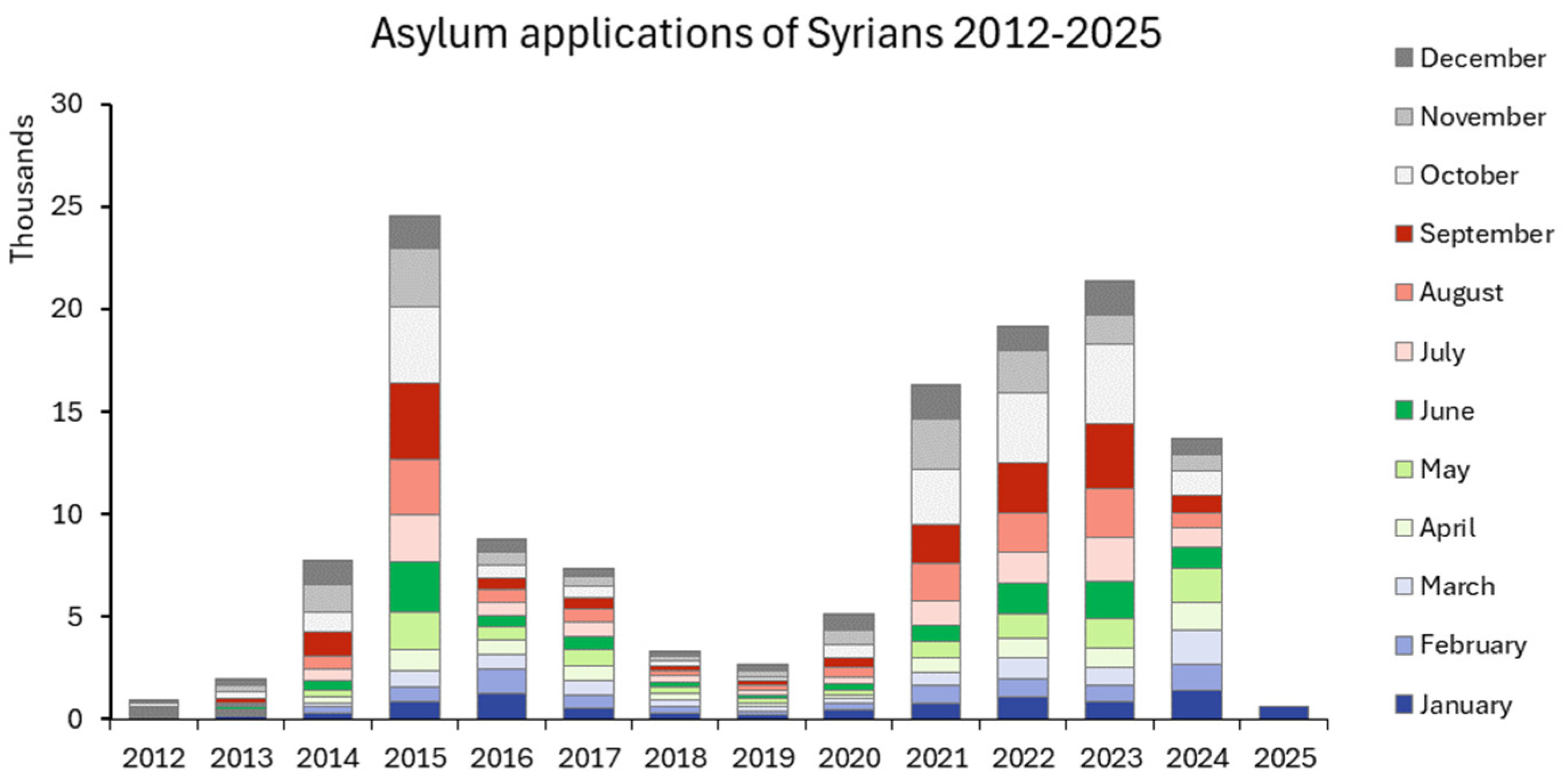
Besides the aim “to offer migrants an alternative to putting their lives at risk” (Council of the European Union 2016), the proclaimed objective of the Statement was to enhance the living conditions of Syrian refugees in Turkey and to create opportunities “so that they have no reason to try to reach the EU irregularly” (The Federal German Government 2021). This strategy, however, appears to have been largely ineffective, particularly in the medium and long run. In 2021, the number of Syrian refugees arriving in Western European host countries such as Austria increased markedly again (see Figure 1 in chapter “Country Context Austria”). In contrast to Syrian refugees who had arrived in Europe in 2015–2016, primarily migrating directly from Syria, the majority of more recent arrivals had experienced longer episodes of “protracted displacement” (Etzold et al. 2019; Crawley et al. 2017; Pries and Zulfikar Savci 2023; UNHCR 2024a) in Turkey under the Statement before arriving in EU member countries. As recent research shows, these refugees exhibit a higher proportion with no formal education, fragmented work histories, and significant mental health challenges (Kohlenberger et al. 2025), a pattern that was further corroborated by the expert interviews conducted for this paper (File S5).
Drawing on qualitative data from Syrian refugees arrived in Austria after 2021 (N = 29) and Austrian integration experts (N = 21), this paper contributes to the growing body of research on the precarious living conditions experienced by Syrians during protracted displacement in the context of the EU-Turkey Statement. Contrary to its intended goals, many Syrians in Turkey were left without adequate access to the essential services and support necessary for their long-term integration and well-being, primarily because they were accorded only Temporary Protection Status rather than full refugee status under Turkish law (İneli-Ciger 2015; Rygiel et al. 2016; Eder and Özkul 2016; Şimşek 2017; Çelik and White 2021).1 Moreover, our research shows that initially medium to high staying intentions of Syrians in the neighbouring country (Müller-Funk 2019; Kaya 2017a, 2017b; Rottmann and Kaya 2021; Düvell et al. 2021) changed into aspirations to travel onwards to Europe due to worsening politico-institutional, economic, human development and security conditions in Turkey. Based on our qualitative findings and supported by existing literature on the precarious living conditions of Syrian refugees in Turkey, we cautiously argue that the EU’s externalization of migration governance to Turkey has been, to a large degree, ineffective in its mid- and long-term goals: it delayed some refugees’ arrival in the EU, while their experiences of protracted displacement and impermanent settlement under the Statement negatively affected their integration opportunities in the eventual host society.

2. Literature Review: Protracted Displacement of Syrian Refugees in Turkey

Our theoretical approach in this paper aligns with calls in the literature to situate protracted displacement within multi-sited, transnational frameworks that better capture the realities faced by displaced populations today (Etzold et al. 2019; Earle 2020; Tobin et al. 2023; Serra Mingot 2023; Patterson 2023). This broader perspective is important as it includes groups displaced for shorter durations and those who have eventually resettled in destination countries due to secondary migration. While traditional definitions would exclude these populations despite their experience of significant displacement hardships, we aim to offer a more comprehensive understanding of (protracted) displacement, its varied manifestations, and on onward migration as a response by affected individuals outside of formal camps and beyond rigid temporal thresholds.
The concept of protracted refugee situations has been central to UNHCR’s analytical and operational frameworks for decades and has gained increasing academic attention in recent years (Crisp 2002; Loescher et al. 2008; Milner and Loescher 2011; Bohnet et al. 2015; Etzold et al. 2019). UNHCR (2024b) defines such situations as those in which more than 25,000 refugees from the same country of origin have remained in exile within a low- or middle-income host country for a minimum of five consecutive years (Castillo and Hathaway 1997), emphasizing that this classification reflects a collective condition rather than individual experiences. Earlier UNHCR analyses characterize these contexts as states of prolonged limbo, wherein refugees’ fundamental rights and socio-economic and psychological needs remain unmet despite relative physical safety. Such dependency on external assistance underscores the structural challenges preventing the attainment of durable solutions or self-reliance within many host environments (UNHCR 2004).
The notion of “protracted displacement” has evolved significantly over time, challenging the conventional policy-oriented definitions dominated by quantitative thresholds and specific settings. Etzold et al. (2019) reconceptualize protracted displacement as a dynamic constellation characterized by the severe limitation of displaced persons’ capabilities and opportunities over extended periods, emphasizing structural constraints rather than fixed durations or population sizes. This approach critiques the mainstream definitions, such as those by UNHCR, which anchor protracted displacement to a minimum duration and to camp-based scenarios and exclude urban refugees and internally displaced persons (Etzold et al. 2019). Such narrow definitions overlook short-term but deeply precarious displacements and the self-organized livelihoods of urban refugees. Academic interest in the phenomenon has grown since the early 2000s, highlighting the profound existential uncertainty faced by displaced people, often described as “living in limbo” (UNHCR 2004; Brun and Fábos 2015; İneli-Ciger 2015; Rygiel et al. 2016; Çelik and White 2021). However, Etzold et al. (2019) stress the agency of displaced persons, who navigate complex governance regimes and develop diverse strategies to cope with their circumstances, thereby challenging static images of protracted displacement as mere immobility or involuntary confinement. This more fluid and process-oriented conceptualization calls for a shift in focus beyond conventional durable solutions (i.e., return, local integration, or resettlement) and towards recognizing displaced persons’ translocal connectivity and (secondary) mobility as integral to understanding and addressing protracted displacement (Etzold et al. 2019).
On the level of policy, protracted displacement can be linked to precarious legal statuses of displaced persons and refugees, including that of Temporary Protection as is the case for Syrians in Turkey under the EU-Turkey Statement. More refugees worldwide are increasingly living in what has been described as a “permanently temporary” (Fábos and Brun 2022) status, reflecting a global trend of prolonged displacement (Schultz 2020). Host countries in the USA and Western Europe, but also in the Global South, are increasingly offering only temporary legal status, rather than full international protection, even as the displaced population continues to rise (Ferris 2018). This shift foregrounds a broader pattern of extended temporariness in refugee experiences, exposing refugees to ongoing legal and social precarity without clear pathways to permanence.
This development is encapsulated in the context of Syrian refugees in Turkey, for which Şahin-Mencütek et al. (2023) introduce the concept of “strategic temporality”. It elucidates how the state deliberately leverages time as a governance tool to manage refugees through institutional, legislative, and discursive means across policy domains of reception, protection, and integration. Supporting dimensions of this strategy include liminality (i.e., refugees’ in-between status), uncertainty (i.e., lack of predictability for all actors; and complexity (i.e., the intricate legal and institutional entanglements shaping refugee governance). In cumulation, adverse conditions can lead to secondary migration when a tipping point of adverse conditions is reached (Czaika and Reinprecht 2022) and resources to support moving exist (Czaika and Reinprecht 2020), as our findings suggest was the case for many Syrians in 2021 and later.
Recently advanced academic concepts have provided nuance and contrast to different policies and geographical situations producing protracted displacement. For instance, “hyper-precarity” as conceptualized by Şanlıer (2025) denotes the compounded insecurities stemming from Temporary Protection Status, restrictive work permits, and informal labour markets, all of which applies to Syrians in Turkey. In a similar vein, Biehl’s (2015) notion of “protracted uncertainty” describes refugees’ indefinite waiting, limited information, and unpredictable legal statuses, which are particularly salient experiences for Syrian asylum seekers and, as our qualitative data suggests, are relevant factors in inspiring onward migration to escape that very uncertainty. Accordingly, Özkan et al.’s (2023) socio-demographic investigations revealed that beyond employment status, citizenship status is a significant factor shaping Syrians’ intentions to remigrate to Western countries, with naturalized individuals reporting lower remigration intentions than non-citizen refugees. At the same time, Kayali’s (2025) conceptualization of “residual temporariness” aims to capture that even naturalized Syrian refugees may continue to experience persistent uncertainty and provisional belonging, as exemplified by doctors facing bureaucratic obstacles and social discrimination even after formal citizenship acquisition. It reveals how legal recognition does not automatically translate into substantive integration. Kayali argues that Turkey’s reliance on Temporary Protection policies serves to defer durable integration solutions, maintaining refugees in a state of ongoing precarity, which, again, might inspire secondary migration.
Together, these interrelated concepts illuminate the multifaceted and enduring nature of protracted displacement, underscoring how prolonged legal, economic, and social uncertainties shape Syrian’s lives in Turkey. They reveal how states employ time strategically to manage displacement, often at the cost of meaningful integration, creating conditions of precarity that extend well beyond initial displacement periods, and may, eventually, lead to onward migration. For Syrian nationals in Turkey, this situation was created by the externalisation practice of the EU-Turkey Statement, under which Syrians are granted Temporary Protection in their neighbouring country, with severe consequences for their rights, physical safety, and socio-economic inclusion.

3. Policy Context: Temporary Protection and the EU-Turkey-Statement

The EU-Turkey Statement, concluded in March 2016, represented a landmark and highly consequential agreement aimed at managing irregular migration flows from Turkey to the European Union, particularly targeting the movement of refugees across the Aegean Sea to the Greek islands. Central to the agreement is the one-for-one mechanism, under which for every Syrian returned from the Greek islands to Turkey, another Syrian residing in Turkey was supposed to be resettled to the EU, provided individuals meet the UN Vulnerability Criteria. In parallel, the EU committed substantial financial support through the Facility for Refugees in Turkey (FRiT), initially promising €3 billion, later increased to €6 billion, aimed at improving humanitarian conditions, including education, health, migration management, and socio-economic support for refugees within Turkey (European Commission n.d.). Additionally, the EU pledged to accelerate visa liberalization for Turkish citizens contingent upon Turkey fulfilling specified benchmarks, to re-energize EU accession talks and refurbish the Customs Union between the EU and Turkey. Turkey reciprocally agreed to take necessary measures to prevent new migratory routes from opening, accept rapid returns of irregular migrants not entitled to international protection, and cooperate in tackling human smuggling networks (Ovacık et al. 2024).
Legally, the EU-Turkey Statement occupies an ambiguous position within EU migration governance, raising issues of accountability and compliance (de Vrieze 2018; Poon 2016; Osso 2019). The Court of Justice of the European Union (CJEU) ruled that the Statement does not constitute a binding treaty under international law but rather a “soft law” instrument, reflecting a strategic form of informal governance to circumvent more rigorous EU-level policymaking and potential vetoes. Accordingly, the Statement is often described as an instrument of “informalisation” in the EU’s external action, diverging from traditional treaty law and formal agreements (Kassoti and Idriz 2022). Several studies (Schotel 2022; Saarikoski 2020) situate this development within a broader framework of informal EU migration governance, arguing that this form of “soft law” limits possibilities for judicial review and effective accountability while expanding flexible cooperation mechanisms and justifying exceptional governance strategies (Vitiello 2020). Indeed, the EU-Turkey- Statement is often described as a paradigmatic example of the externalisation of EU migration policy, whereby border control, asylum processing, and return operations are delegated to third countries to prevent irregular migration (Düvell 2002; Liguori 2019; Casaglia and Pacciardi 2022), aligning with broader global trends in deterrence-based migration management (Üstübici 2019). Thus, the Statement is often described as having institutionalized externalisation within EU asylum policy (Vanheule 2020; Vitiello 2020), while creating a transactional relationship (Ulusoy 2025), reinforcing selective Europeanisation and crisis management at the expense of international protection norms (Beach and Smeets 2020). Similarly, it is considered a prime instance of “migration diplomacy” (Mertek 2024; Tsourapas 2025), transforming migration policy into a strategic arena of economic leverage and regional political negotiation.

Effects and Criticism of the EU-Turkey-Statement

While the Statement is often credited with significantly reducing irregular sea arrivals to Greece, the extent to which it caused this decline remains subject to academic debate. Other factors, such as the closure of the Western Balkan route, seasonal migration patterns, media campaigns, and granted work rights for Syrians in Turkey in 2016, may have also contributed to lower arrivals (Spijkerboer 2016; Ovacık et al. 2024; Thym 2025). Additionally, Greece’s increased pushback practices at the Aegean border and poor conditions in island hotspots have influenced migration trends (Ovacık et al. 2024). The initial resettlement of 40,000 Syrians to the EU (by 2024) is relatively small compared to Turkey’s hosting of several million Syrians under Temporary Protection, though reliable numbers are the subject of academic debate (Düvell 2019). Many critical pledges by the EU under the Statement have remained unfulfilled (Ovacık at al. 2024; Toygür and Benvenuti 2017; Terry 2021; Kirişçi 2021; Walter-Franke 2018). The failure to deliver visa liberalization, a key motivation for Turkey’s agreement, has strained relations and contributed to Turkey’s waning commitment to curtailing migration towards Europe (Ovacık et al. 2024) and harsher treatment of Syrians.
Complementing the migration management efforts and to support Syrians’ livelihoods in Turkey, the EU funded several key projects, including the Emergency Social Safety Net (ESSN), PIKTES for integrating Syrian children into education, SIHHAT to improve refugees’ health status, and Conditional Cash Transfer for Education (CCTE). The ESSN program was initiated as a cash transfer scheme designed to provide monthly financial assistance to the most vulnerable refugee households. While it has been lauded as a humanitarian success in mitigating acute financial vulnerabilities, critical scholarship indicates the program operates within the broader, problematic framework established by the EU-Turkey Statement. Despite the cash support, many Syrians in Turkey continue to face significant barriers to labour market integration, social inclusion, and stable livelihoods (Demirci and Kırdar 2023). Moreover, the exclusion of formally employed refugees from ESSN support complicates pathways toward long-term economic independence, potentially perpetuating cycles of vulnerability within refugee populations. Consequently, the ESSN must be understood not only as a cash transfer policy but as a pivotal component of the EU’s broader migration governance strategy that externalizes responsibility and maintains refugees in prolonged temporariness.
In a similar vein, Turkey’s role as a safe third country under the deal is heavily contested, given systemic reports of refoulement, lack of effective asylum procedures, internal conflicts with minority groups and rather high asylum acceptance quota for Turkish nationals in the EU (Ulusoy 2016; Roman et al. 2016; Peers and Roman 2016; Şimşek 2017; Heck and Hess 2017; Carp 2018; Aydın 2018; Ovacık et al. 2024; Refugee Support Aegean 2024; AIDA and ECRE 2025a). Critics, including the Greek asylum authorities, thus largely rejected Turkey’s designation as a safe third country for refugees, calling to impede deportations under the Statement (Gkliati 2017; Avelas and Bosman 2024; Kassoti and Idriz 2022). Indeed, the readmission of asylum seekers to Turkey resulted in significant safety and human rights violations (Kaya 2017a, Bozkurt 2022; İneli-Ciger and Ulusoy 2020; Peers and Roman 2016). Ulusoy and Battjes (2017) found that readmitted migrants and refugees, particularly Syrians, face arbitrary detention, limited access to international protection, and violations of procedural rights, raising risks of refoulement (Alpes et al. 2017). Human Rights Watch (2022) documents forced deportations involving arrest, ill-treatment, and coercion. Similar patterns of pushbacks and forced returns have been reported by Amnesty International (2015) and other NGOs, pointing to deteriorating conditions since the EU-Turkey deal (Euromed Rights 2024; Bulman et al. 2024). Despite Turkey’s claims of facilitating voluntary returns, the rising numbers of deportations and extended surveillance and deportation campaigns reflect coercive dynamics rather than genuine voluntariness (Chulov 2019; Dadouch and Ashawi 2019; FENIX 2023)
Our study contributes to a growing body of research on the protracted displacement of both Syrian nationals readmitted from Greece to Turkey and of Syrians having chosen Turkey as their (im)permanent host country (see, most recently, Ovacık et al. 2024), and their eventual onward movement to Europe. Contrary to the framing of the Statement as a partnership promoting humanitarian support and migration management, our empirical analysis shows that it has systematically undermined the fundamental rights of refugees at multiple junctures.
Our results contribute to the literature on legal and economic precarity in protracted displacement faced by Syrian nationals in Turkey, based on qualitative primary data on Syrians who migrated from Turkey to Austria since 2021. Moreover, expert interviews (N = 21) allow for a comparison with the first cohort (2015–2016), highlighting differences in educational attainment, work experience, health outcomes, and socioeconomic status associated with experiences of protracted displacement and limited protection in Turkey under the EU–Turkey Statement.

4. Country Context: Austria

After 2015/2016, when large numbers of asylum seekers from Syria arrived in Europe, their human capital, education, attitudes, values, health status and integration into host societies such as Austria have been the subject of extensive scholarly research (Buber-Ennser et al. 2016; Aksoy and Poutvaara 2021; Guichard 2020). While previous studies remain fully valid for the first cohorts of Syrian refugees, more recent arrivals display notable differences in key characteristics among later arrivals, underscoring the importance of complementary contemporary research. Kohlenberger et al. (2025) documents these differences and provides the empirical basis for this paper, showcasing that protracted displacement in Turkey exacerbates disadvantages for Syrian refugees across multiple domains. Representing a substantially enlarged group of asylum seekers in Austria from 2021 onwards, insights into this recent cohort are particularly relevant.
The majority of recently arrived Syrians in Austria are men aged 20 to 29, accounting for 46% of the 2022–2024 cohort (compared to 40% in 2015–2016) (Kohlenberger et al. 2025). Female representation has declined, comprising only 19% compared to 26% in the preceding cohort, respectively. Many of them arrived through family reunification (Baumgartner et al. 2025; BMI 2022, 2023, 2024).
A particularly stark contrast emerges when the school education of different cohorts is compared. In the most recent cohort (since 2022), a substantially higher proportion have no formal education or only ISCED 1-level (i.e., primary) schooling compared to the 2015–2016 cohort (38% vs. 16%, see Table 1) (Kohlenberger et al. 2025).
This results in significantly lower literary in the first language (Arabic) and lower German proficiency. Three out of ten recently arrived individuals had no German proficiency one and a half years after their initial AMS registration, while roughly half possessed basic skills (A1: 21%, A2: 23%, A: 10%). In comparison, the 2017–mid-2022 cohort exhibits higher language skills at the same stage, with fewer lacking German (20%) and more reaching A2 (16%) or B-level proficiency (16%)2. As concerns social inclusions, most recently arrived Syrians in Austria foster strong bonding capital within the community but limited contact with the general society. Many maintain primarily or exclusively intra-community contacts, which in turn affects German language acquisition and job opportunities. Interactions with the local (Austrian) population are often superficial or absent, frequently attributed to cultural distance and perceived differences in attitudes, with the urban host society viewed as relatively unwelcoming. Furthermore, the mental health of recently arrived Syrian refugees in Austria has deteriorated markedly compared to earlier cohorts, with women and young people being particularly affected. Frequent disorders include anxiety, depression and PTSD (Kohlenberger et al. 2025).
Despite lower levels of education and German language proficiency, newly arrived Syrians achieved higher employment levels than earlier cohorts. This apparent paradox can be explained by the non-linear relationship between German skills and employment: while individuals with C-level German reported significantly more employment days than those with A- or B-level skills, men with no German proficiency recorded a comparable number of employment days to those at C-level. This suggests that many recently arrived Syrians prioritized immediate entry into the labour market over language acquisition or qualification for higher-skilled positions. As a result, the total number of employment days is relatively high; however, much of this work is concentrated in unskilled or semi-skilled positions, which seldom contribute to sustainable labour market integration. Austrian companies have capitalized on this situation, benefiting considerably, while Syrian refugees often enter precarious, exploitative employment contracts.
Although the numbers of initial employment are higher, the relatively low educational attainment of the recent cohort, which also affects their German proficiency, represents a growing challenge that requires higher initial investment by the host country, as it hampers integration into the local community, limits the recognition of formal qualifications, and constrains sustainable participation in the labour market. In summary, Syrians having arrived in Austria in 2022 or later display adverse outcomes in terms of health, educational attainment, literacy in their first language, and employment history (Kohlenberger et al. 2025). As our analysis shows, these can be, among other factors, attributed to the impermanent settlement many of them experienced in Turkey.

5. Materials and Methods

5.1. Research Design

Qualitative data were collected for a research project commissioned by the Austrian Public Employment Service (AMS) dealing with the labour market integration and socioeconomic backgrounds of Syrian refugees recently arrived in Austria (Kohlenberger et al. 2025). The methodological approach combined focus group discussions and semi-structured interviews with Syrian refugees, who arrived in Austria from 2020 onwards, complemented by a quantitative online questionnaire (see Table A1). The interviews and focus group discussions (File S1) with Syrian study participants were designed to elicit their experiences in Turkey and the motivations behind their onward migration from Turkey to Austria, as well as their educational and professional backgrounds, daily life and the challenges they encounter in Austria. Additionally, expert interviews with practitioners in the fields of labour market integration and refugee support (see Table A2) were conducted to generate comparative insights into differences between the first and the recent cohort, particularly regarding educational attainment, professional experience, and physical and psychological well-being. In addition, they offered valuable insights into the integration challenges encountered by this group in Austria.

5.2. Data Collection with Syrian Refugees

Within the research project commissioned by the Public Employment Service Austria (AMS), a sample of 53 Syrian refugees was recruited. To address the specific research question of this paper, a subsample of 29 Syrian nationals was deemed eligible from the original cohort. More precisely, inclusion criteria encompassed individuals who had entered Austria since 2020, with a notable concentration of arrivals post-20223; all participants had previously endured protracted displacement in Turkey prior to their arrival in Austria. Data collection comprised 17 individual interviews (9 women, 8 men, File S2 and File S3 female) and four focus groups segregated by gender)4.
Recruitment followed a purposive sampling strategy (Prinzen 2020) and was facilitated by Austrian Public Employment Service (AMS) counsellors and staff members from training institutes affiliated with AMS. In recruiting Syrian participants, efforts were made to ensure they broadly represented the diversity of individual characteristics and contextual living conditions among the population of recently arrived Syrian AMS clients in Austria. Accordingly, participants were recruited from Vienna, Styria, and Upper Austria.
The focus group discussions and individual interviews were conducted on the basis of informed consent and recorded in audio format (see Files S1–S4). The recordings were transcribed by the Arabic-speaking interviewers and subsequently served as the foundation for analytical protocols. Data analysis followed the principles of inductive qualitative content analysis as outlined by Mayring (2022). The interview excerpts presented in this article are not verbatim translations but have been paraphrased to reflect the intended meaning. Data storage, and analysis were performed exclusively by the research team and complied with internationally recognized ethical standards, including the Ethical Guidelines of the Refugee Studies Centre at the University of Oxford (RSC 2007).

5.3. Expert Interviews

In total 21 expert interviews were conducted (see File S5). Respondents were employed at AMS offices, NGOs cooperating with AMS, or independent organizations in the migration sector based in Vienna, Styria and Upper Austria. Examples of such include Asylkoordination, ABZ* Austria, Diakonie, Volkshilfe, Caritas, Ikemba, but in many situations, these details were not offered for anonymity reasons. Their expertise derived from direct professional engagement with Syrian and other refugee groups. The expert perspectives systematically complemented the narratives of the refugees. While the latter provided first-hand accounts of protracted displacement experiences and integration challenges, experts contextualized these within broader institutional and structural frameworks. Given the rather small sample size of Syrian study participants (N = 29) and experts (N = 21), the findings are not statistically generalizable; rather, the study seeks analytical generalization through in-depth qualitative analysis.

5.4. Ethical Considerations and Researcher Positionality

Research with displaced populations entails heightened ethical and methodological sensitivity. Psychological conditions such as depression and post-traumatic stress disorder, frequently linked to experiences of war, persecution, or protracted uncertainty, may affect interview participation (UNHCR 2013). Furthermore, the discussion of sensitive topics—including bereavement, forced displacement, and war-related violence—carries the risk of retraumatisation for participants as well as emotional strain for researchers (Decker et al. 2011; van der Velden et al. 2013). Trust-building thus represented an indispensable prerequisite for this study (Hynes 2003).
To address these challenges, two key strategies were prioritized. First, interview and focus group discussion settings were designed to create an atmosphere conducive to openness and psychological safety. Second, careful consideration was given to the recruitment of Arabic-speaking moderators and interviewers. In addition to social science expertise, relevant cultural background knowledge was deemed crucial. Two male moderators were of Syrian origin and the female moderator originated from Jordan. Their biographical proximity, combined with their disciplinary expertise, was crucial in creating an interview setting that was both culturally sensitive and methodologically rigorous, while reducing the risk of cultural misinterpretation and improving the overall validity and reliability of the data.
Beyond trauma sensitivity, the project was informed by a critical reflection on power asymmetries in refugee research, particularly those between Western academic institutions and participants from the Global South. In line with the guidelines of the German Network on Forced Migration Studies (Krause et al. 2024), the team engaged in continuous reflexivity regarding positionality, privilege, and inclusivity. Transparent communication and participatory decision-making were integral elements of the research process.

5.5. Language and Translation

Linguistic and cultural translation represented an additional methodological consideration. Particular care was devoted to the translation of info sheets and questionnaires of the online questionnaire (File S4) to guarantee participants were properly informed before they participated. Likewise, the translation of transcripts and interview quotations was done with great care to maintain the nuances of context and meaning (Warfa et al. 2012). The close collaboration between researchers and Arabic-speaking moderators/interviewers ensured both accuracy and cultural adequacy. Such procedures are essential in multilingual research settings to safeguard data quality and interpretive validity (Harkness et al. 2004).

6. Results

6.1. Violation of Refugees Rights

As mentioned above, the European Union’s strategy of containing Syrian refugees in Turkey and even returning them from Greece under the one-for-one resettlement mechanism of the 2016 EU–Turkey Statement5, hinges on Turkey’s designation as a safe third country. Our results add to the assessment that Turkey’s compliance to the criteria that a non-EU country must meet to be designated a safe third country under Article 38 of Directive 2013/32/EU (Asylum Procedures Directive) remains, at best, doubtful—a conclusion widely shared among scholars, NGOs, and policymakers (Ulusoy 2016; Roman et al. 2016; Peers and Roman 2016; Şimşek 2017; Carp 2018; Aydın 2018; Ovacık et al. 2024; Refugee Support Aegean 2024).
To begin with, asylum seekers in safe third countries must have access to procedures for claiming refugee status and, if recognized, to protection in full accordance with the Geneva Convention. As Syrians in Turkey are covered by Temporary Protection, they enjoy access to a limited set of rights and public services, including healthcare, education and conditional access to the labour market (Çelik and White 2021). In practice, our interviewees reported that the politico-institutional conditions did not allow them to remain safely and rebuild their lives until durable solutions such as return, resettlement, or local integration are found, as envisioned by the Directive. Many lived for years under this provisional status without knowing when their protection might expire and what happens afterwards (Biehl 2015; Şimşek 2017; Şahin-Mencütek et al. 2023; Şanlıer 2025). This uncertainty was compounded by restrictions on mobility. Syrians often required travel permits to move between provinces, limiting their ability to pursue education, employment, or family reunification opportunities. As one interviewee explained:
“The situation in Turkey worsened in terms of how people treated us and through new regulations. We were no longer allowed to travel between provinces without travel permission.”
(Interview P18)
Such constraints generated legal and spatial precarity, leaving Syrians in a state of prolonged uncertainty regarding their residence and future prospects in Turkey, resulting in impermanence of settlement with little incentive and possibility to find sustainable employment or education. As another participant emphasized:
“I want to find stability, to settle down, build my life, work, study and learn the language—I am ready to learn and to work. That was not possible in Turkey, nor in Syria.”
(Interview P23)
Consequently, the existing politico-institutional conditions prompted many Syrians to consider onward migration to Europe, seeking safety and stability in EU host countries where they hoped to be able rebuild their lives under more secure and predictable conditions, most notably with an international (rather than a temporary) protection status.
Article 38(1)(c) of the EU Asylum Procedures Directive requires that an applicant’s life and liberty must not be at risk on account of race, religion, nationality, membership of a particular social group, or political opinion, and that there exists no threat of serious harm (echoing Article 33(1) of the Geneva Convention). In contradiction to this requirement, Syrians in Turkey face widespread discrimination, xenophobic violence, and even physical violence from both the local population and security forces, as reported by multiple interviewees:
“I had to leave Turkey in 2021 due to discrimination and racism because Turks attacked us in our homes and at work. When I criticized someone at work, I was attacked by Turks. We were also harassed on the street. I was often told that I should go back to Syria and fight.”
(Interview P13)
“Turkish people and the Turkish police don’t like Syrians. They keep beating Syrians and deporting them all the time.”
(Interview P15)
Anti-Syrian sentiment within the Turkish population has intensified in recent years, fuelled by economic hardship, political polarization, and perceptions that Syrians place an additional burden on public services and employment opportunities (Rottmann and Kaya 2021). This rising hostility further constrained Syrians’ prospects for social integration and contributed to an overall sense of insecurity and exclusion. Besides the feelings of instability, racism from the Turkish society was another big driver for precarious livelihoods and onward migration, as some interviewees reported:
“The reason [why we left Turkey] is that there is widespread hostility toward Syrians—they are often disliked, deceived, and discriminated against. Many face various forms of abuse, including verbal harassment, physical violence, and even abduction.”
(Interview P22)
“Our stay in Turkey was very difficult, which ultimately forced us to leave the country abruptly. A conflict had arisen between my son and a group at school known as “Janagel.”6 This group was known to be highly dangerous and troublesome, showing little regard for the law or state authority.”
(Interview P10)
In addition, the implementation of the principle of non-refoulement remained highly contested, particularly for “undocumented” Syrians without Temporary Protection Status. In some instances, Syrians avoided registration so they could move more freely between different Turkish regions and cities, or because they faced administrative impediments, including the absence of identification documents such as passports or entry permits, the governmental suspension of new registrations, and entrenched bureaucratic complexities (Human Rights Watch 2018; Baban et al. 2017; 11.11.11. and Upinion 2024). Informational deficits, apprehensions regarding deportation, and procedural challenges may also apply (Imrie-Kuzu and Özerdem 2023; AIDA and ECRE 2025b)7. Several interviewees described living in constant fear of deportation and family separation:
“I never left the apartment in Turkey. I had no documents and was constantly afraid of being caught by the police and deported. Life is full of challenges—in Turkey and everywhere else. (…) There is no greater challenge than being sent back to a warzone.”
(Interview P20)
“Racism in Turkey was very strong. Many Syrians were deported back to Syria, and families were separated. I wanted to leave Turkey again as quickly as possible.”
(Interview P14)
As participants concluded, this pervasive sense of insecurity ultimately motivated their onward migration:
“We were afraid they would deport us to Syria, so we sought a safer country.”
(Interview P18)
“We went to Turkey together and stayed there for about three to four months, but the situation was extremely difficult, especially since we did not possess Turkish documents. At the time, people were being deported to Syria, and my husband felt that life under such circumstances was unsustainable and that we could not achieve any stability. Consequently, he decided to leave the country, and I eventually returned to Syria.”
(Interview P27)
Overall, these testimonies suggest strong repercussions of the precarity produced by temporary protection on all dimensions of life, impacting their mental and physical well-being, as remarked by Austrian integration experts:
“And then maybe also the timing: many of those who came later didn’t come directly from Syria; they had also been in other countries. They went through a lot, so to speak. We heard many stories from people about being in other countries, in Turkey or in Egypt or somewhere else, and how difficult it was for them there—and all of that also plays a role. I mean, you experience so much; maybe you have trauma and so on, and I think that’s also a reason why learning German is harder or takes longer.”
(Expert Interview P4)

6.2. Precarious Labour Market Conditions

The integration of Syrian refugees into Turkey’s labour market evolved gradually through a combination of national regulations and EU-supported initiatives linked to the EU–Turkey Statement. The first significant legal step was the 2013 Law on Foreigners and International Protection, which formally recognized the right of Syrians to access the labour market. However, implementation remained limited until January 2016, when Turkey enabled registered Syrians to apply for work permits. To qualify, applicants were required to hold a Temporary Protection identification card for at least six months, and the share of Syrian employees in any enterprise could not exceed ten percent of Turkish staff. Additionally, refugees were generally restricted to employment within the province of their registration, and work permits were valid for one year, subject to renewal (İçduygu and Şimşek 2016). These administrative and geographic constraints, coupled with the loss of eligibility for the ESSN cash assistance when a family member gained formal employment, limited the policy’s practical impact (Del Carpio and Wagner 2016; Del Carpio et al. 2018; Demirci and Kırdar 2023). Alongside national measures, the European Union supported Turkey in improving the socio-economic integration of Syrians (European Court of Auditors 2024) by allocating billions of euros to strengthen employability and promoting skill development and cooperation with local employers.
Despite formal access and active economic integration support, informal employment continues to be the dominant mode for many Syrians; by around 2020, an estimated one million refugees were working without official registration in Turkey, highlighting the scale of the informal economy in which Syrians are embedded (UNDP 2022). The dominance of informal work underlines that while Syrians are in principle eligible for formal employment, practical barriers and open resentment continue to limit uptake (Kaya 2016; Dayıoğlu et al. 2023).
Working in the informal economy, however, often means precarious and exploitative conditions. As one Syrian refugee, who lived in Turkey from the age of 15 to 21, described:
“The working hours were very tough. […] The work itself was extremely hard. I had no insurance, and if you were two minutes late, you could be fired. I was not allowed to refuse overtime; Turkish workers could, but we Syrians could not.”
(Interview P13)
While a minority of Syrians have been able to secure professional positions, most interviewees described highly fragmented employment histories consisting of temporary or low-skilled jobs. One Syrian woman, who had studied medicine in Syria, reported that she managed to have her qualification recognized and worked as a paediatrician during her 8.5 years in Turkey (Interview P16). In contrast, the majority engaged in precarious manual or service-sector work such as taxi driving, factory work, or tailoring—often unrelated to their previous experience. As one expert summarized:
“When I ask them, they say: ‘We lived in a tent for ten years, I fled when I was 15 and just worked, did whatever work I could find in Turkey.’”
(Expert Interview P6)
One participant explained:
“In Turkey, I worked for about seven years in furniture production—bedroom and kitchen furniture. That was new for me because in Syria I worked in my uncle’s jewellery workshop.”
(Interview P13)
Others engaged in part-time or voluntary work without formal recognition (FGD and Interview P10). Similarly, a young respondent noted:
“There [in Turkey], I went to school—10th and 11th grade—and at the same time worked in different places like construction sites and cleaning companies.”
(Interview P12)
Such experiences demonstrate that while legal and institutional frameworks aim to foster socio-economic integration, the realities of protracted displacement in Turkey often force Syrians into a cycle of informal, low-paid, and discontinuous employment. This is reflected in their professional profiles upon arrival in European host countries, where refugees from more recent cohorts exhibit lower skill levels, more fragmented career trajectories, and limited formal job training (Kohlenberger et al. 2025), as experts remark:
“When we talk about the current refugee movement or a refugee population from Syria, or Syrian nationals, it very often involves people who have not lived in their country of origin for years, but rather in refugee-like situations in Turkey, Lebanon, or other neighbouring countries, and then come to us. That of course can have an impact on mental health. And, if you want to put it that way, there is also not the same level of suitability for the labour market as there would be if someone came to Austria on a work visa, directly from a specific job, for example from a third country.”
(Expert Interview P9)
“The first wave is noticeably more highly educated. And that is understandable. It was very, very striking when two young people sat with me here. One was the interpreter, and the other was the recently arrived refugee—though not entirely fresh from the flight. He had experienced the war for several years, either in his home country or somewhere in between, in Turkey or along the way, and had to struggle with many things. […] [T]hey have endured years of psychological strain and had no access to school or any regular work—anything that a young person their age would normally do.”
(Expert Interview P2)
Overall, experts report notable difference between refugee cohorts, especially those arriving in 2015/16 and those having arrived more recently, who display little progress in their integration journey over time. Experts link this to limited learning ability given the lack of formal schooling, no regular work experience and psychological factors. Collectively, these exacerbate integration challenges within highly formalized European labour markets.

6.3. Restricted Access to Education

The integration of Syrians into the Turkish education system was meant to be addressed through a combination of national policies and EU support, including the construction of new schools, funding for Turkish language programs, teacher training, and transportation assistance for vulnerable children. Complementary programs implemented by UNICEF and GIZ focused on early childhood education and on improving inclusivity for vulnerable children (UNICEF 2021; GIZ 2023). Syrian students have been permitted to enrol in Turkish universities either through the foreign student entrance examination or via special quotas and scholarship schemes since 2013 (AIDA and ECRE 2025a). Despite these considerable efforts, the realities on the ground reveal persistent inequalities, as our results reveal. Legal and practical barriers to educational access at all levels led to approximately 400,000 Syrian children lacking access to schooling in 2024 (UNICEF 2024). As one Syrian mother reports:
“We went to Turkey, and my husband went directly to Europe. My children had no future anymore. There was no possibility to learn. We had no documents—nothing official that would allow them to study.”
(Interview P26)
Indeed, enrolment in schools and universities remained conditional on legal documentation. Children and youth without Temporary Protection status were often registered as “guest students”, allowing attendance but excluding them from certification or diplomas unless they later complete formal registration (AIDA and ECRE 2025a). In practice, some public schools refrained from enrolling unregistered students altogether. Private institutions remained unaffordable for most refugee families (Human Rights Watch 2015; Hauber-Özer 2019; GIZ 2023).
Educational participation drops even more sharply in secondary and upper-secondary levels. According to recent data, approximately 66.3% of Syrian children attend primary or middle school, yet only 29.8% remain in high school or continue to tertiary education (Yükseker et al. 2023). This was also emphasized by an expert in our study:
“The largest group are those without a compulsory school leaving certificate. Then there is a smaller group who obtained a compulsory school leaving certificate abroad. Perhaps in their home country or in Turkey, in the meantime, while they were waiting, just after displacement. And very few have more than a compulsory school leaving certificate.”
(Expert Interview P2)
“They are predominantly male; only 5% are women. Some, or for the most part, are not literate. Without a compulsory school qualification, without second-language skills, without an apprenticeship; mostly they were already unskilled workers in their home countries. Many had a stopover in Turkey or in Libya. They are male, between 20 and 40.”
(Expert Interview P3)
“In recent years, however, more and more people have arrived who do not have such a high level of education. […] This is of course also related to the fact that this is a protracted conflict, a conflict that has dragged on over a long period of time. As a result, many of the people who come to Austria have already been on the move for a long time, meaning they have been in other countries, in transit countries. There, material conditions were for the most part simply worse than in the country of origin. So not those who fled directly from Syria to Austria at the beginning, but rather those who in some cases lived for years in transit countries such as Lebanon or Turkey, where access to healthcare, education, and so on was naturally more limited. And that is why their level of education is of course not as high as that of those who may have arrived at the beginning.”
(Expert Interview P9)
The decline in education remarked upon by experts working with those who eventually arrived in Austria is tied to restricted formal access to the educational system, but also to the deteriorating economic conditions during their stay in Turkey. As one interviewee, who lived in Turkey between the ages of 15 and 21, explained:
“In Turkey, I only worked because studying was impossible—you have to support yourself there.”
(Interview P13)
This was corroborated by an Austria integration expert working with refugees, who summarized the situation of many recently arrived young Syrians to Austria as follows:
“They tell me: ‘We lived in a tent for ten years, I fled when I was 15 and just worked, did whatever work I could find in Turkey.’ Most of them were in Turkey and didn’t study anything there. And before that, because of the war, they couldn’t go to school either. Unfortunately, that’s the main problem.”
(Expert Interview P6)
The economic hardship and structural exclusion experienced by Syrian families, exacerbated by limited access to formal employment, compelled many children and adolescents to enter the labour market prematurely to contribute to household income (Kaya 2016; Dayıoğlu et al. 2023; Alpaydın 2017; Aygun et al. 2024)). These pressures were particularly acute in metropolitan and earthquake-affected regions, where the cost of living rose sharply (UNICEF 2024; Gümüş et al. 2020). Moreover, the same economic constraints intersected with social vulnerabilities to produce rising rates of early and child marriage, particularly among adolescent girls (AIDA and ECRE 2025a). Overall, this led to a circle of neglect and social as well as mental health issues, which further impede learning and formal education, as one expert reports:
“What was or is noticeable […] is that the children and women who arrive [in Austria] have been in refugee camps for so long and that, how shall I put it, the degree of neglect is increasing. Neglect in the sense of being overwhelmed. […] But, in my opinion, people are arriving in increasingly worse mental states. And that is also due to being overwhelmed with many children. And this long life in the camps, which is very basic, […] no electricity, no running water, no educational opportunities for the kids.”
(Expert Interview P12)
Even in cases where educational opportunities and school access did exist, social factors exclusion produced actual barriers for some Syrian kids, especially as resentment among the Turkish population grew. Discrimination and bullying in schools have been widely reported, discouraging attendance and undermining educational outcomes (AIDA and ECRE 2025a). As described above, one interviewee described how her son faced threats from a violent group at school, forcing the family to leave Turkey (Interview P10). Another former student reported:
“There was a lot of bullying from Turkish classmates and sometimes from teachers because we were Syrians and foreigners.”
(Interview P17)
Taken together, these experiences made continuous quality education unattainable, which resulted in low literacy rates, low formal education attainment and mental health issues of Syrians who later arrived in Western European host countries like Austria.

7. Discussion

In summary, our research suggests that under the EU-Turkey Statement, Syrian nationals in Turkey faced a multiplicity of impermanent settlement arrangements that added to their experiences of protracted displacement and eventually to their decision for secondary migration to Europe, where their experiences in Turkey presented heighted integration challenges to host countries, given the oftentimes fragmented educational and professional biographies and deteriorated mental health. Many of those recently arrived in Austria had lived in limbo for months or even years on end, with limited access to education, regular employment or healthcare. Our interviewees also reported mass deportations and family separations and an increasing hostile climate towards Syrians, which gave rise to harassment, hate crimes and ostracization, resulting in lack of trust and anxiety, contributing to learning impediments once they had arrived in Austria.
Our findings thus not only underscore persistent inconsistencies between the European Union’s designation of Turkey as a safe third country and the empirical realities faced by Syrian refugees but also reveal the eventual negative effects of these conditions on European host countries and their structural integration targets. Both legal and academic analysis (Ulusoy 2016; Roman et al. 2016; Ovacık et al. 2024) indicate substantial deficits in Turkey’s compliance with the minimum protection standards. The lived experiences presented in our study reinforce earlier critiques that Turkey failed to ensure access to durable protection, settlement and employment (Şimşek 2017; Çelik and White 2021; Refugee Support Aegean 2024), which has led to the onward migration of Syrian nationals to Europe after 2021.
Our respondents described pervasive insecurity resulting from provisional legal status, mobility and labour market access restrictions, and uncertainty about the permanence of their protection (Biehl 2015; Şahin-Mencütek et al. 2023; Şanlıer 2025). These conditions have produced what may be termed institutionalized impermanence curtailing Syrians’ opportunities for education, employment, and integration (Abrams and Birdal 2016; Rottmann and Kaya 2021). The findings corroborate prior research showing that anti-Syrian sentiment, coupled with the threat of forcible returns, has driven many to undertake onward migration to Europe (Aydın 2018; Carp 2018), where their specific profiles, conditioned under the experience of protracted displacement in Turkey, pose challenges for long-term integration in job markets and society, as remarked by Austrian integration experts. In addition, many respondents detailed pervasive harassment and fear of deportation, which they explicitly linked to their decision to pursue onward migration to the EU, illustrating the practical failures of externalized migration governance to provide durable safety or integration (Şanlıer 2025).
Our results also reveal the fragility of labour-market inclusion under Turkey’s Temporary Protection regime. Although legal mechanisms and EU-funded programmes aimed to foster structural integration (European Court of Auditors 2024; United Nations 2018), sustainable outcomes remain limited. Intentional and ad hoc implementation barriers confined many Syrian refugees to precarious informal employment (Demirci and Kırdar 2023; UNDP 2022). Respondents described fragmented and often exploitative labour trajectories, characterized by low-skilled or unrelated jobs, lack of contract security, and absence of social protections, which reflect and reinforce systemic obstacles to integration both in Turkey (Demirci and Kırdar 2023; UNDP 2022) and, later on, in their eventual European host country, such as Austria.
Our findings thus echo Şanlıer’s (2025) notion of hyper-precarity in contexts where legal access exists on paper but is undermined by socioeconomic and regulatory obstacles. The prevailing economic constraints resulted in only those Syrians with higher educational attainment and stronger socioeconomic standing being able to afford to remain in Turkey (Şimşek 2020), which our results reflect: Refugees who chose onward migration to Austria display socioeconomically disadvantaged backgrounds and little to no formal schooling, with a relatively high illiteracy rate (Kohlenberger et al. 2025), which has proving challenging to European integration systems, according to Austrian experts. Furthermore, our results contribute to an increasing number of both academic and journalistic insights (Abrams and Birdal 2016; Rottmann and Kaya 2021) on widespread discrimination and xenophobic hostility from both local populations and state security actors, which numerous of our interviewees described as including verbal abuse, physical violence, and social exclusion, exacerbating precarity and motivating secondary migration.
This study faces several limitations that should be acknowledged. First, given the small qualitative sample of 29 Syrian participants and 21 expert interviews, the findings cannot be generalized statistically and should not be considered representative of all Syrians displaced to or through Turkey, or arriving in Austria since 2021. The evidence presented is necessarily anecdotal and exploratory in nature, precluding any causal inference. Moreover, no direct causal link can be established between refugees’ experiences in Turkey and their subsequent integration outcomes in Austria. Rather, the mechanisms identified should be interpreted as contributory factors shaping these trajectories. Finally, the cohort comparisons rely on findings from prior research (Kohlenberger et al. 2025), and additional empirical analyses would be required to further substantiate the results. These limitations point to the need for more extensive mixed-method and longitudinal research to deepen our understanding of protracted displacement and temporary protection policies across contexts.
In conclusion, our results do, however, corroborate that the EU’s reliance on Turkey as a containment space for Syrian refugees rests on a legally fragile and empirically contested foundation with potentially negative consequences in the mid- and long-term that reach well beyond Turkey. Rather than ensuring protection in line with international obligations, the current framework of the Statement seems to have reproduced spatial, economic and legal precarity that inhibits integration and changes initially medium to high staying intentions (Müller-Funk 2019; Kaya 2017a, 2017b; Rottmann and Kaya 2021; Düvell et al. 2021) into aspirations to travel onwards to Europe, as our qualitative interviews reflected. Our study thus contributes to the growing academic literature on the worsening politico-institutional, economic, human development, and security situation in Turkey, which has further disrupted Syrian refugees’ formal employment paths, constrained their ability to pursue education, and contributed to negative (mental) health outcomes. Ultimately, this also undermines refugees’ sustainable integration into the labour market in their eventual European host countries such as Austria and results in overall higher integration efforts (and costs). As the coming CEAS reform frames “mutually beneficial partnerships” as central to EU migration governance (İneli-Ciger and Ulusoy 2020), Europe will likely continue relying on Turkey as a cornerstone for its externalisation strategies. Our results suggest that mid- to long-term consequences of protracted displacement inspired by temporary protection and externalisation policies may not only negatively affect refugees’ well-being, education and professional trajectories, but also, after secondary migration, their integration outcomes in their eventual host countries in Europe.

Supplementary Materials

The following supporting information can be downloaded at: https://www.mdpi.com/article/10.3390/socsci15020067/s1, File S1: Focus Group Discussion Guide for Syrian Study Participants. File S2: Interview Guide for Female Syrian Study Participants. File S3: Interview Guide for Male Syrian Study Participants. File S4: Online Questionnaire Syrian Study Participants. File S5: Expert Interview Guide.

Author Contributions

Conceptualization, J.K. and S.R.; methodology, S.R., J.K. and K.K.; validation, J.K.; formal analysis, S.R. and J.K.; investigation, J.K., S.R. and K.K.; resources, J.K. and K.K.; data curation, K.K.; writing—original draft preparation, S.R. and J.K.; writing—review and editing, J.K. and S.R.; supervision, J.K.; project administration, S.R.; funding acquisition, J.K. All authors have read and agreed to the published version of the manuscript.

Funding

This research was funded by the Austrian Public Employment Service (AMS).

Institutional Review Board Statement

The study was conducted in accordance with the EU Charter of Human Rights and approved by the Institutional Review Board of the Austrian Institute for International Affairs (oiip), approved on 6 November 2025.

Informed Consent Statement

Informed consent was obtained from all subjects involved in the study.

Data Availability Statement

Data is unavailable due to privacy restrictions.

Conflicts of Interest

The authors declare no conflicts of interest. The funders had no role in the design of the study; in the collection, analyses, or interpretation of data; in the writing of the manuscript; or in the decision to publish the results.

Abbreviations

The following abbreviations are used in this manuscript:
AMSAustrian Public Employment Service
CCTEConditional Cash Transfer for Education
CJEUCourt of Justice of the European Union
ESSNEmergency Social Safety Net
FRiTFacility for Refugees in Turkey

Appendix A

Table A1. Overview of Syrian FGD and Interview Participants.
Overview
Syrian
Participants
DateFGD/
Interview
AgeGenderArrival in
Austria
Duration of
Stay in Turkey
P12 July 2024FGD30m20217 months
P22 July 2024FGD35m20239 years (2013–2022)
P32 July 2024FGD36m2021N/A **
P42 July 2024FGD37m2022N/A
P52 July 2024FGD44m20221, 5 years
P62 July 2024FGD22m2021N/A
P72 July 2024FGD27m20221 year
P82 July 2024FGD28m20228 years (2014–2022)
P92 July 2024FGD35m2021N/A
P1022 July 2024
18 August 2024
FGD
Interview
49f20226 years (2015–2021)
P1122 July 2024FGD26f2024N/A
P1230 July 2024Interview20m20222.5 years (2020–2022)
P132 August 2024Interview25m20216 years (2015–2021)
P146 August 2024Interview24m20224 months
P156 August 2024Interview24m20236 years (2017–2023)
P16 *15 August 2024Interview-f-8.5 years
P1718 August 2024Interview20f20226 years *
P1818 August 2024Interview33f20216 years
P19 *19 August 2024Interview27f20226 months
P204 September 2024Interview24m20226 months *
P214 September 2024Interview25m20212 months *
P2211 September 2024Interview23m20226 years *
P2311 September 2024Interview29m20236 years (2017–2023)
P24 *5 December 2024Interview32f20231 year
P25 *5 December 2024Interview27f20232 years
P2621 December 2024Interview39f20231.5 years
P27 *8 January 2025Interview22f20243 months
P283 February 2025FGD27f2022N/A
P293 February 2025FGD30f2022N/A
* Responses taken from personal interviews. ** N/A is used when no information was supplied by the respondent, neither in the questionnaire nor during the personal interviews.
Table A2. Overview of Expert Interviews.
Overview
Participating
Experts
DateLocation
Organization
GenderDirect Contact to RefugeesPersonal
Experience
of Flight
EP119 March 2024Viennafno
EP217 April 2024Viennafyes
EP312 April 2024Viennaf + myesyes (m)
EP419 March 2024Viennamyesyes
EP519 March 2024Viennamyes
EP620 March 2024Viennamyesyes
EP720 March 2024Viennafyes
EP826 March 2024Viennafyes
EP918 March 2024Viennamno
EP1012 April 2024Viennafyes
EP118 March 2024Viennamyes
EP1229 March 2024Viennafno
EP1320 March 2024Viennamyes
EP1429 April 2024Viennafyesyes
EP1519 April 2024Viennaf + fyes
EP1626 March 2024Viennamyes
EP1716 April 2024Linz,
Upper Austria
fyes
EP1822 April 2024Linz,
Upper Austria
myesyes
EP198 May 2024Linz,
Upper Austria
fyes
EP2019 April 2024Graz, Styriafyes
EP2124 May 2024Graz, Styriamyes

Notes

1
Although Turkey is a party to both the 1951 Geneva Convention Relating to the Status of Refugees and its 1967 New York Protocol, it maintains a geographical limitation to the Convention. This means that only individuals fleeing events in Europe can be formally recognized as refugees under Turkish law. Syrians are hence excluded from protection in full accordance with the Geneva Convention. Instead, for Syrians, a separate and exceptional regime was introduced: the Temporary Protection Status. The temporary nature of this protection reflects the—at least initial—assumption that displacement from Syria would be short-lived and that beneficiaries would return once conditions allowed.
2
Language proficiency levels refer to the Common European Framework of Reference for Languages (CEFR), ranging from A1 and A2 (basic user), B1 and B2 (independent user), to C1 and C2 (proficient user). In some cases, the German language skills of clients were assessed by AMS advisors. Therefore, in addition to the standardized CEFR categories A1, A2, B1, B2, C1, and C2, which are usually based on the successful completion of corresponding German courses and examinations, there are also the categories A, B, and C (Kohlenberger et al. 2025). German language proficiency among those Syrians who arrived in 2015 and 2016 was largely undocumented during the reference period (Kohlenberger et al. 2025).
3
Participant 16 did not complete the online questionnaire; therefore, the exact year of arrival in Austria is unknown. Based on information provided during the personal interview (e.g., duration of stay in Turkey), it can be inferred that the participant’s arrival occurred after 2021.
4
Each focus group discussion comprised 6–9 participants. Only participants who met the eligibility criteria pertinent to this paper were included in the reported sample. Participant 10 took part in both a focus group discussion (FGD) and an individual interview.
5
By designating Turkey as a “safe third country,” Greece thereupon declared asylum applications submitted by individuals from Syria inadmissible if they have transited through Turkey.
6
According to our research, this seems to be a local youth gang operating in and around schools.
7
Reasons for being undocumented are tied to a mix of restrictive policies and chaotic implementation. Authorities in Istanbul and several border provinces have halted most new registrations, which has led to forced returns, loss of access to services, and widespread uncertainty (Human Rights Watch 2018). Registration efforts were also inconsistent and disorganized, with different offices applying contradictory criteria, charging unofficial fees, or imposing long delays that left large numbers unregistered (Baban et al. 2017). The situation tightened further with the 2022 policy capping the proportion of foreigners in each neighborhood at 20 percent, which effectively closed over a thousand areas to new registrations (11.11.11. and Upinion 2024).

References

  1. 11.11.11., and Upinion. 2024. Syrian Refugees in Türkiye—A State of Limbo. Available online: https://www.3rpsyriacrisis.org/wp-content/uploads/2024/01/11-Upinion-report-State-of-limbo-Syrian-refugees-Turkiye.pdf (accessed on 11 November 2025).
  2. Abrams, Dominic, and Banu K. Birdal. 2016. Suriyelilere Yönelik Algı ve Tutumlar Araştırması: Ön Değerlendirme Raporu. Istanbul: University of Kent & Kemerburgaz University. [Google Scholar]
  3. AIDA/European Council on Refugees and Exiles (ECRE). 2025a. Access to Education—Türkiye. Available online: https://asylumineurope.org/reports/country/turkiye/content-temporary-protection/employment-and-education/access-education/#_ftn50 (accessed on 11 November 2025).
  4. AIDA/European Council on Refugees and Exiles (ECRE). 2025b. Overview of Main Changes Since the Previous Report Update—Türkiye. Available online: https://asylumineurope.org/reports/country/turkiye/overview-main-changes-previous-report-update/ (accessed on 5 November 2025).
  5. Aksoy, Cevat G., and Panu Poutvaara. 2021. Refugees’ and Irregular Migrants’ Self-Selection into Europe. Journal of Development Economics 152: 102681. [Google Scholar] [CrossRef]
  6. Alpaydın, Yusuf. 2017. An Analysis of Educational Policies for School-aged Syrian Refugees in Turkey. Journal of Education and Training Studies 5: 36–44. [Google Scholar] [CrossRef]
  7. Alpes, Maybritt J., Sevda Tunaboylu, Orçun Ulusoy, and Saima Hassan. 2017. Post-Deportation Risks under the EU–Turkey Statement: What Happens after Readmission to Turkey? MPC Policy Brief. November. Available online: https://cadmus.eui.eu/bitstream/handle/1814/49005/PB_2017_30_MPC.pdf?sequence=1&isAllowed=y (accessed on 5 November 2025).
  8. Amnesty International. 2015. Europe’s Gatekeeper: Unlawful Detention and Deportation of Refugees from Turkey. AI Index: EUR 44/3022/2015. Amnesty International. December 16. Available online: https://www.amnesty.org/en/documents/eur44/3022/2015/en/ (accessed on 5 November 2025).
  9. Avelas, Ines, and Aron Bosman. 2024. A Rare Win: Greek Asylum Practices Before the CJEU. VerfBlog. November 19. Available online: https://verfassungsblog.de/a-rare-win/ (accessed on 22 January 2026).
  10. Aydın, Esen. 2018. Avrupa Birliği Mevzuatında Güvenli Üçüncü Ülke Kavramı ve Türkiye-AB Geri Kabul Anlaşmasına Yansımaları. Public and Private International Law Bulletin 38: 11–40. [Google Scholar] [CrossRef]
  11. Aygun, Aysun, Murat G. Kirdar, Murat Koyuncu, and Quentin Stoeffler. 2024. IZA DP No. 14513: Keeping Refugee Children in School and out of Work: Evidence from the World’s Largest Humanitarian Cash Transfer Program. Journal of Development Economics 168: 103266. [Google Scholar] [CrossRef]
  12. Baban, Feyzi, Suzan Ilcan, and Kim Rygiel. 2017. Playing Border Politics with Urban Syrian Refugees: Legal Ambiguities, Insecurities, and Humanitarian Assistance in Turkey. Movements Journal für kritische Migrations-und Grenzregimeforschung 3: 81–105. [Google Scholar]
  13. Baumgartner, Paul, Sophie Röttger, and Veronika Bilger. 2025. Familiennachzug und Integration. Auswertung des FIMAS-Surveys. In ÖIF-Forschungsbericht. Wien: Österreichischer Integrationsfonds—Fonds zur Integration von Flüchtlingen und MigrantInnen (ÖIF). Available online: https://www.integrationsfonds.at/fileadmin/content/AT/monitor/Familiennachzug_und_Integration.pdf (accessed on 20 January 2025).
  14. Beach, Derek, and Sam Smeets. 2020. New Institutionalist Leadership—How the New European Council-Dominated Crisis Governance Paradoxically Strengthened the Role of EU Institutions. Journal of European Integration 42: 837–54. [Google Scholar] [CrossRef]
  15. Biehl, Kristen Sarah. 2015. Governing through Uncertainty: Experiences of Being a Refugee in Turkey as a Country for Temporary Asylum. Social Analysis 59: 57–75. [Google Scholar] [CrossRef]
  16. Bohnet, Heidrun, Katja Mielke, Markus Rudolf, Conrad Schetter, and Ruth Vollmer. 2015. Protected Rather Than Protracted: Strengthening Displaced Persons in Peace Processes: A State-of-the-art Paper. In BICC Working Paper. No. 3/2015. Bonn: BICC. Available online: https://bicc.de/Publikationen/working_paper_0315.pdf~dr891 (accessed on 5 November 2025).
  17. Bozkurt, Kutluhan. 2022. The EU–Turkey Relationships and Evaluation of Human Rights Axis of the Relationship. Available online: https://www.gedik.edu.tr/wp-content/uploads/Bozkurt-K.-The-EU%E2%80%93Turkey-relationships-and-evaluation-of-human-rights-axis-of-the-relationship.pdf (accessed on 20 January 2025).
  18. Brun, Cathrine, and Anita Fábos. 2015. Making Homes in Limbo? A Conceptual Framework. Refuge: Canada’s Journal on Refugees 31: 5–17. [Google Scholar] [CrossRef]
  19. Buber-Ennser, Isabella, Judith Kohlenberger, Bernhard Rengs, Zakarya Al Zalak, Anne Goujon, Erich Striessnig, Michaela Potančoková, Rudolf Gisser, Maria Rita Testa, and Wolfgang Lutz. 2016. Human Capital, Values, and Attitudes of Persons Seeking Refuge in Austria in 2015. PLoS ONE 11: e0163481. [Google Scholar] [CrossRef]
  20. Bulman, May, Fahim Abed, Mahmoud Naffakh, Mohannad Al-Najjar, Şebnem Arsu, Andrés Mourenza, Melvyn Ingleby, Zia Weise, Ylenia Gostoli, Giacomo Zandonini, and et al. 2024. Turkey’s EU-funded deportation machine. Lighthouse Reports. October 11. Available online: https://www.lighthousereports.com/investigation/turkeys-eu-funded-deportation-machine/ (accessed on 22 January 2026).
  21. Bundesministerium für Inneres (BMI). 2022. Detail-STATISTIK—Kennzahlen BFA. Available online: https://www.bmi.gv.at/301/Statistiken/files/Jahresstatistiken/Detailstatistik_BFAKennzahlenJahr_2022-inklVertriebene.pdf (accessed on 6 November 2025).
  22. Bundesministerium für Inneres (BMI). 2023. Detail-STATISTIK—Kennzahlen BFA. Available online: https://www.bmi.gv.at/301/Statistiken/files/Jahresstatistiken/Detailstatistik_BFA_Kennzahlen_Jahr_2023.pdf (accessed on 6 November 2025).
  23. Bundesministerium für Inneres (BMI). 2024. Detail-STATISTIK—Kennzahlen BFA. Available online: https://www.bmi.gv.at/301/Statistiken/files/Jahresstatistiken/Detailstatistik_BFA_Kennzahlen_Jahr_2024.pdf (accessed on 6 November 2025).
  24. Carp, Radu. 2018. How Safe Shall Be a Third Country for Asylum-Seekers from a European Perspective? The Human Rights Implications of the EU-Turkey Deal and the Assessment of the ECHR/General Court. Journal of Identity and Migration Studies 12: 50–59. Available online: https://www.academia.edu/123810317/How_Safe_Shall_be_a_Third_Country_for_Asylum_Seekers_from_a_European_Perspective_The_Human_Rights_Implications_of_the_EU_Turkey_Deal_and_the_Assessment_of_the_ECHR_General_Court (accessed on 5 November 2025).
  25. Casaglia, Anna, and Agnese Pacciardi. 2022. A Close Look at the EU–Turkey Deal: The Language of Border Externalisation. Environment and Planning C: Politics and Space 40: 1659–76. [Google Scholar] [CrossRef]
  26. Castillo, Maria-Teresa Gil-Bazo, and James C. Hathaway. 1997. Temporary Protection. In Reconceiving International Refugee Law. Edited by James C. Hathaway. The Hague: Martinus Nijhoff Publishers, pp. 1–21. [Google Scholar]
  27. Chulov, Martin. 2019. Syrian Refugees in Beirut and Istanbul Detained and Deported. The Guardian. Available online: https://www.theguardian.com/world/2019/jul/29/syrian-refugees-in-beirut-and-istanbul-detained-and-deported (accessed on 5 November 2025).
  28. Council of the European Union. 2016. EU–Turkey Statement. Press release, March 18. Brussels: European Council/Council of the European Union. Available online: https://www.consilium.europa.eu/en/press/press-releases/2016/03/18/eu-turkey-statement/ (accessed on 5 November 2025).
  29. Crawley, Heaven, Franck Düvell, Katharine Jones, Simon McMahon, and Nando Sigona. 2017. Unravelling Europe’s ‘Migration Crisis’: Journeys over Land and Sea. Bristol: Policy Press. [Google Scholar]
  30. Crisp, Jeff. 2002. No Solutions in Sight: The Problem of Protracted Refugee Situations in Africa. Working Paper No. 68. San Diego: Centre for Comparative Immigration Studies. Available online: https://ccis.ucsd.edu/_files/wp68.pdf (accessed on 5 November 2025).
  31. Czaika, Mathias, and Constantin Reinprecht. 2020. Drivers of migration. A synthesis of knowledge. International Migration Review 163: 1–45. [Google Scholar]
  32. Czaika, Mathias, and Constantin Reinprecht. 2022. Migration drivers: Why do people migrate? In Introduction to Migration Studies. IMISCOE Research Series; Edited by Pieter Scholten. Cham: Springer. [Google Scholar] [CrossRef]
  33. Çelik, Çetin, and Holly White. 2021. Forced Migration and Protection: Turkey’s Domestic Responses to the Syrian Refugees. European Review 30: 1–21. [Google Scholar] [CrossRef]
  34. Dadouch, Sarah, and Khalil Ashawi. 2019. Istanbul Gives Syrians One Month to Return to Provinces in Which They Are Registered. Reuters. July 23. Available online: https://www.reuters.com/article/us-turkey-syrians/istanbul-gives-syrians-one-month-to-return-to-provinces-in-which-they-are-registered-idUSKCN1UH1Y6 (accessed on 5 November 2025).
  35. Dayıoğlu, Meltem, Murat G. Kırdar, and İsmet Koç. 2023. The Making of a “Lost Generation”: Child Labor among Syrian Refugees in Turkey. International Migration Review 58: 1075–113. [Google Scholar] [CrossRef]
  36. Decker, Suzanne E., Amy E. Naugle, Robin Carter-Visscher, Kathryn Bell, and Abby Seifert. 2011. Ethical issues in research on sensitive topics: Participants’ experiences of distress and benefit. Journal of Empirical Research on Human Research Ethics 6: 55–64. [Google Scholar] [CrossRef]
  37. Del Carpio, Xavier, and Mathias Wagner. 2016. The Impact of Syrian Refugees on the Turkish Labor Market. Policy Research Working Paper Series 7402; Washington, DC: World Bank. [Google Scholar]
  38. Del Carpio, Xavier, Selin Demir-Seker, and Aysegül L. Yener. 2018. Integrating Refugees into the Turkish Labour Market. Forced Migration Review 58: 10–13. [Google Scholar]
  39. Demirci, Murat, and Murat G. Kırdar. 2023. The Labor Market Integration of Syrian Refugees in Turkey. World Development 162: 106138. [Google Scholar] [CrossRef]
  40. de Vrieze, Kim. 2018. The EU-Turkey Statement: A Design for Human Rights Violations. An Examination Concerning the Compatibility of the EU-Turkey Statement with Human Rights in EU Law. European Union Studies. Master’s thesis, Leiden University, Leiden, The Netherlands. Available online: https://studenttheses.universiteitleiden.nl/access/item%3A2629459/view (accessed on 5 November 2025).
  41. Düvell, Franck. 2002. Die Globalisierung des Migrationsregimes—Zur Neuen Einwanderungspolitik in Europa. Berlin: Association A. [Google Scholar]
  42. Düvell, Franck. 2019. Are there really 3.6 million refugees in Turkey or could there be considerably fewer? In DeZIM Briefing Notes 1. Berlin: Deutsches Zentrum für Integrations-und Migrationsforschung (DeZIM). Available online: https://www.dezim-institut.de/en/publications/are-there-really-3-6-million-refugees-in-turkey-or-could-there-be-considerably-fewer/ (accessed on 5 November 2025).
  43. Düvell, Franck, David Schiefer, Ali Zafer Sağıroğlu, and Lena Mann. 2021. How Many Syrian Refugees in Turkey Want to Migrate to Europe and Can Actually Do So? Results of a Survey Among 1900 Syrians. In DeZIM Research Notes 5. Berlin: Deutsches Zentrum für Integrations-und Migrationsforschung (DeZIM). Available online: https://www.dezim-institut.de/en/publications/publication-detail/how-many-syrian-refugees-in-turkey-want-to-migrate-to-europe-and-can-actually-do-so/ (accessed on 5 November 2025).
  44. Earle, Lucy. 2020. Responding to Protracted Displacement in an Urban World. London: International Institute for Environment and Development (IIED). Available online: https://www.iied.org/responding-protracted-displacement-urban-world (accessed on 5 November 2025).
  45. Eder, Mine, and Derya Özkul. 2016. ‘Editors’ introduction: Precarious lives and Syrian refugees in Turkey’. New Perspectives on Turkey 54: 1–8. [Google Scholar] [CrossRef]
  46. Etzold, Benjamin, Milena Belloni, Russell King, Albert Kraler, and Ferruccio Pastore. 2019. Transnational Figurations of Displacement: Conceptualising Protracted Displacement and Translocal Connectivity Through a Process-Oriented Perspective. TRAFIG Working Paper No. 1. Bonn: BICC. [Google Scholar] [CrossRef]
  47. Euromed Rights. 2024. How EU Funds in Türkiye Fuel Human Rights Violations and Forced Deportations. Available online: https://euromedrights.org/publication/how-eu-funds-in-turkiye-fuel-human-rights-violations-forced-deportations/ (accessed on 5 November 2025).
  48. European Commission. n.d. EU Support to Refugees in Türkiye. Available online: https://neighbourhood-enlargement.ec.europa.eu/enlargement-policy/turkiye/eu-support-refugees-turkiye_en (accessed on 5 November 2025).
  49. European Court of Auditors. 2024. Special Report 06/2024: The Facility for Refugees in Turkey—Beneficial for Refugees and Host Communities, but Impact and Sustainability Not Yet Ensured. Available online: https://www.eca.europa.eu/ECAPublications/SR-2024-06/SR-2024-06_EN.pdf (accessed on 5 November 2025).
  50. Fábos, Anita H., and Cathrine Brun. 2022. Some refugees stay in temporary status indefinitely—How they still manage to create homes and communities. The Conversation. August 26. Available online: https://theconversation.com/some-refugees-stay-in-temporary-status-indefinitely-how-they-still-manage-to-create-homes-and-communities-187664 (accessed on 5 November 2025).
  51. Fenix Humanitarian Legal Aid (FENIX). 2023. A Bilateral Instrumentalisation of Asylum Seekers: A Legal and Political Analysis of the Failures of the EU–Türkiye Deal and Recommendations from the Ground at the Greek Borders. Available online: https://www.fenixaid.org/articles/a-bilateral-instrumentalisation-of-asylum-seekers-a-legal-and-political-analysis-of-the-failures-of-the-eu-turkiye-deal-and-recommendations-from-the-ground-at-the-greek-borders (accessed on 5 November 2025).
  52. Ferris, Elizabeth. 2018. When Refugee Displacement Drags on, Is Self Reliance the Answer? Washington, DC: The Brookings Institution. Available online: https://www.brookings.edu/articles/when-refugee-displacement-drags-on-is-self-reliance-the-answer/ (accessed on 5 November 2025).
  53. Gesellschaft für Internationale Zusammenarbeit (GIZ). 2023. Early Childhood Education for the Integration of Refugee and Vulnerable Children in Turkey. Available online: https://www.giz.de/en/projects/early-childhood-education-integration-refugee-and-vulnerable-children-turkey (accessed on 11 November 2025).
  54. Gkliati, Mariana. 2017. The Application of the EU–Turkey Agreement: A Critical Analysis of the Decisions of the Greek Appeals Committee. European Journal of Legal Studies 10: 81. [Google Scholar]
  55. Guichard, Léa. 2020. Self-Selection of Asylum Seekers: Evidence from Germany. Demography 57: 1089–116. [Google Scholar] [CrossRef]
  56. Gümüş, Emine, Zeynep Kurnaz, Hasan Eşici, and Sedat Gümüş. 2020. Current Conditions and Issues at Temporary Education Centres (TECs) for Syrian Child Refugees in Turkey. Multicultural Education Review 12: 53–78. [Google Scholar] [CrossRef]
  57. Harkness, Janet, Beth-Ellen Pennell, and Alisú Schoua-Glusberg. 2004. Survey questionnaire translation and assessment. In Methods for Testing and Evaluating Survey Questionnaires. Edited by Stanley Presser, Jennifer M. Rothgeb, Mick P. Couper, Judith T. Lessler, Elizabeth Martin, Jean Martin and Eleanor Singer. Hoboken: John Wiley & Sons, pp. 453–73. [Google Scholar] [CrossRef]
  58. Hauber-Özer, Melissa. 2019. Schooling gaps for Syrian refugees in Turkey. Forced Migration Review, 60—Education: Needs, Rights and Access in Displacement. March. Available online: https://www.fmreview.org/education-displacement/hauberozer/ (accessed on 11 November 2025).
  59. Heck, Gerda, and Sabine Hess. 2017. Tracing the Effects of the EU–Turkey Deal: The Momentum of the Multi-Layered Turkish Border Regime. Movements 3: 1–231. [Google Scholar]
  60. Human Rights Watch. 2015. “When I Picture My Future, I See Nothing”: Barriers to Education for Syrian Refugee Children in Turkey. Available online: https://reliefweb.int/report/turkey/when-i-picture-my-future-i-see-nothing-barriers-education-syrian-refugee-children (accessed on 11 November 2025).
  61. Human Rights Watch. 2018. Turkey Stops Registering Syrian Asylum Seekers. Available online: https://www.hrw.org/news/2018/07/16/turkey-stops-registering-syrian-asylum-seekers (accessed on 11 November 2025).
  62. Human Rights Watch. 2022. Turkey: Hundreds of Refugees Deported to Syria. EU Should Recognize Turkey Is Unsafe for Asylum Seekers. Available online: https://www.hrw.org/news/2022/10/24/turkey-hundreds-refugees-deported-syria (accessed on 5 November 2025).
  63. Hynes, Tricia. 2003. New Issues in Refugee Research: The Issue of ‘Trust’ or ‘Mistrust’ in Research with Refugees: Choices, Caveats and Considerations for Researchers. Available online: https://www.academia.edu/download/36253743/UNHCR_working_paper_98.pdf (accessed on 12 November 2025).
  64. Imrie-Kuzu, Durukan, and Alpaslan Özerdem. 2023. Keeping Syrian Refugees in Turkey Is Not a Good Idea: A New Concept of ‘Reluctant Local Integration’. Third World Quarterly 44: 1606–24. [Google Scholar] [CrossRef]
  65. International Organization for Migration (IOM). 2016. IOM Counts 3771 Migrant Fatalities in Mediterranean in 2015. Available online: https://www.iom.int/news/iom-counts-3771-migrant-fatalities-mediterranean-2015 (accessed on 5 November 2025).
  66. International Organization for Migration (IOM). 2018. Migrants and Refugees Increasingly Choosing Turkey as Final Destination. Available online: https://turkiye.iom.int/news/migrants-and-refugees-increasingly-choosing-turkey-final-destination-flow-monitoring-survey-finds (accessed on 5 November 2025).
  67. İçduygu, Ahmet. 2016. Study for the European Parliament’s Committee on Employment and Social Affairs, Directorate General for Internal Policies. IP/A/EMPL/2016 13, PE 595.328 EN. Turkey: Labour Market Integration and Social Inclusion of Refugees. Available online: https://www.europarl.europa.eu/RegData/etudes/STUD/2016/595328/IPOL_STU(2016)595328_EN.pdf (accessed on 5 November 2025).
  68. İçduygu, Ahmet, and Deniz Şimşek. 2016. Syrian Refugees in Turkey: Towards Integration Policies. Turkish Policy Quarterly 15: 59–69. [Google Scholar]
  69. İneli-Ciger, Meltem. 2015. Implications of the New Turkish Law on Foreigners and International Protection and Regulation No. 29153 on Temporary Protection for Syrians Seeking Protection in Turkey. Oxford Monitor of Forced Migration 4: 28–36. [Google Scholar]
  70. İneli-Ciger, Meltem, and Orçun Ulusoy. 2020. Why the EU-Turkey Statement Should Never Serve as a Blueprint. ASILE Project. October 7. Available online: https://www.asileproject.eu/why-the-eu-turkey-statement-should-never-serve-as-a-blueprint/ (accessed on 11 November 2025).
  71. Kassoti, Eva, and Narin Idriz, eds. 2022. The Informalisation of the EU’s External Action in the Field of Migration and Asylum. Global Europe: Legal and Policy Issues of the EU’s External Action. Cham: Springer, The Hague: T.M.C. Asser Press, vol. 1, Available online: https://www.asser.nl/asserpress/books/?rId=13988 (accessed on 5 November 2025).
  72. Kaya, Ayhan. 2016. Syrian Refugees and Cultural Intimacy in Istanbul: “I Feel Safe Here!” European University Institute, Robert Schuman Centre for Advanced Studies Working Paper RSCAS 2016/59. Available online: https://cadmus.eui.eu/server/api/core/bitstreams/53f9c213-fd9f-599c-a3b2-84afcfaf0569/content (accessed on 6 November 2025).
  73. Kaya, Ayhan. 2017a. A Tale of Two Cities: Aleppo and Istanbul. European Review 25: 365–87. [Google Scholar] [CrossRef]
  74. Kaya, Ayhan. 2017b. Istanbul as a Space of Cultural Affinity for Syrian Refugees. Southeastern Europe 41: 333–58. [Google Scholar] [CrossRef]
  75. Kayali, Nihal. 2025. Residual Temporariness and the Limits of Citizenship for Syrian Doctors in Turkey. Journal of Ethnic and Migration Studies, advance online publication. [Google Scholar] [CrossRef]
  76. Kirişçi, Kemal. 2021. As EU Turkey Migration Agreement Reaches the Five-Year Mark, Add a Job Creation Element. Washington, DC: The Brookings Institution. Available online: https://www.brookings.edu/articles/as-eu-turkey-migration-agreement-reaches-the-five-year-mark-add-a-job-creation-element/ (accessed on 5 November 2025).
  77. Kohlenberger, Judith, Bernhard Rengs, Sophie Reichelt, Isabella Buber Ennser, and Hannah Kalcher. 2025. Recent Arrivals in Austria: Neue Geflüchtete aus Syrien am österreichischen Arbeitsmarkt. Vienna: AMS Österreich. Available online: https://forschungsnetzwerk.ams.at/dam/jcr:9845e25b-6a6a-4d26-a7d3-99e832a597f0/AMS_2025_Recent%20Arrivals_syrische%20Fluechtlinge_Arbeitsmarkt.pdf (accessed on 5 November 2025).
  78. Krause, Ulrike, Franzciska Zanker, and Christiane Fröhlich. 2024. Ethikleitlinien des Netzwerks Fluchtforschung. Münster: University of Muenster, Institutional Repository MIAMI. [Google Scholar] [CrossRef]
  79. Liguori, Anna. 2019. Migration Law and the Externalization of Border Controls: European State Responsibility, 1st ed. London and New York: Routledge. Available online: https://www.routledge.com/Migration-Law-and-the-Externalization-of-Border-Controls-European-State-Responsibility/Liguori/p/book/9781032241364 (accessed on 5 November 2025).
  80. Loescher, Gilburt Damian, James Milner, Edward Newman, and Gary G. Troeller. 2008. Protracted Refugee Situations: Political, Human Rights and Security Implications. Available online: https://digitallibrary.un.org/record/646997?v=pdf (accessed on 5 November 2025).
  81. Mayring, Philipp. 2022. Qualitative Inhaltsanalyse: Grundlagen und Techniken, 13 Revised ed. Weinheim and Basel: Beltz. [Google Scholar]
  82. Mertek, Sefa. 2024. Hegemony, Europeanization, and Migration Diplomacy: Case of the EU-Turkey Statement and Action Plan. Journal of Balkan and Near Eastern Studies 27: 172–87. [Google Scholar] [CrossRef]
  83. Milner, James, and Gil Loescher. 2011. Responding to Protracted Refugee Situations: Lessons from a Decade of Discussions. Forced Migration Policy Briefing Series No. 6; Oxford: Refugee Studies Centre. Available online: https://www.refworld.org/docid/4da83a682.html (accessed on 5 November 2025).
  84. Müller-Funk, Lea. 2019. Adapting to Staying, or Imagining Futures Elsewhere: Migration Decision Making of Syrian Refugees in Turkey. IMI Working Paper No. 154. Hamburg: GIGA Institute for Middle East Studies. Available online: https://pure.uva.nl/ws/files/48803126/WP_154_Muller_Funk.pdf (accessed on 5 November 2025).
  85. Osso, Berfin N. 2019. Rethinking Rightlessness: The “Right to Have Rights” and the EU Turkey Statement. Tampere: Tampere University. [Google Scholar] [CrossRef]
  86. Ovacık, Gamze, İneli Meltem Ciger, and Orçun Ulusoy. 2024. Taking Stock of the EU Turkey Statement in 2024. European Journal of Migration and Law 26: 154–78. [Google Scholar] [CrossRef]
  87. Oxford Refugee Studies Centre (RSC). 2007. Ethical guidelines for good research practice. Refugee Survey Quarterly 26: 162–72. [Google Scholar] [CrossRef]
  88. Özertürk, Onur K. 2019. Turkey’s Refugee Policies in Mass Displacements: The Case of Mass Displacement from Syria. Master’s Thesis, Graduate School of Social Sciences, Middle East Technical University, Ankara, Turkey. Available online: https://open.metu.edu.tr/handle/11511/45047 (accessed on 5 November 2025).
  89. Özkan, Zafer, Ayberk Eryılmaz, and Naif Ergün. 2023. Intentions to return and migrate to the third countries: A socio-demographic Investigation among Syrians in Turkey. Journal of International Migration and Integration 24: 1571–87. [Google Scholar] [CrossRef]
  90. Patterson, Deirdre. 2023. Education as a Means of Facilitating Onward Migration and Transnational Participation for South Sudanese Refugee Communities. In Onward Migration and Multi Sited Transnationalism. IMISCOE Research Series; Edited by Jill Ahrens and Russell King. Cham: Springer. [Google Scholar] [CrossRef]
  91. Peers, Steve, and Emanuela Roman. 2016. EU Law Analysis: The EU, Turkey and the Refugee Crisis: What Could Possibly Go Wrong? Available online: http://eulawanalysis.blogspot.com.tr/2016/02/the-eu-turkey-and-refugee-crisis-what.html (accessed on 5 November 2025).
  92. Poon, James. 2016. EU Turkey Deal: Violation of, or Consistency with, International Law? European Papers—A Journal on Law and Integration 2016: 1195–203. [Google Scholar] [CrossRef]
  93. Pries, Ludger, and Berna Safak Zulfikar Savci. 2023. Syrian Refugees Arriving in Germany: Choice of Corridor and Individual Characteristics of Forced Migrants. Frontiers in Sociology 8: 1070065. [Google Scholar] [CrossRef]
  94. Prinzen, Katrin. 2020. Gruppendiskussionen und Fokusgruppeninterviews. In Handbuch Methoden der Politikwissenschaft. Edited by Claudius Wagemann, Achim Goerres and Markus B. Siewert. Wiesbaden: Springer VS, pp. 305–324. [Google Scholar]
  95. Refugee Support Aegean (RSA). 2024. Eight Years of Failure of the EU–Turkey Deal: The “Safe Third Country” Concept Comes Under Scrutiny by the Court of Justice of the European Union. Available online: https://rsaegean.org/en/eu-turkey-deal-safe-third-country-concept-under-scrutiny-cjeu/ (accessed on 5 November 2025).
  96. Roman, Emanuela, Theodore Baird, and Talia Radcliffe. 2016. Statewatch Analysis: Why Turkey is Not a “Safe Country”. Available online: https://www.statewatch.org/media/documents/analyses/no-283-why-turkey-is-not-a-safe-country.pdf (accessed on 5 November 2025).
  97. Rottmann, Susan, and Ayhan Kaya. 2021. “We can’t integrate in Europe. We will pay a high price if we go there”: Culture, Time and Migration Aspirations for Syrian Refugees in Istanbul. Journal of Refugee Studies 34: 474–90. [Google Scholar] [CrossRef]
  98. Rygiel, Kim, Feyzi Baban, and Suzan Ilcan. 2016. The Syrian Refugee Crisis: The EU Turkey ‘Deal’ and Temporary Protection. Global Social Policy 16: 315–20. [Google Scholar] [CrossRef]
  99. Saarikoski, Atlas A. 2020. In Search of Protection and Judicial Review: The Legal Nature of the EU Turkey Statement under EU Law. Available online: https://helda.helsinki.fi/server/api/core/bitstreams/0359dc8e-7676-4946-9ebf-72a3539b70e7/content (accessed on 5 November 2025).
  100. Schotel, Bart. 2022. The EU Turkey Statement and the Structure of Legal Accountability. In The Informalisation of the EU’s External Action in the Field of Migration and Asylum. Edited by Eva Kassoti and Narin Idriz. The Hague: T.M.C. Asser Press, Cham: Springer, pp. 73–94. [Google Scholar]
  101. Schultz, Jessica. 2020. An End to Asylum? Temporary Protection and the Erosion of Refugee Status. In Waiting and the Temporalities of Irregular Migration. Edited by Christine M. Jacobsen, Marry Anne Karlsen and Shahram Khosravi. London and New York: Routledge, pp. 170–85. [Google Scholar] [CrossRef]
  102. Serra Mingot, Ester. 2023. Onward Migration from an Aspirations–Capabilities Framework: The Multi-sited Transnational Practices of Sudanese Families Across Europe, Sudan and Beyond. In Onward Migration and Multi Sited Transnationalism. IMISCOE Research Series. Edited by Jill Ahrens and Russell King. Cham: Springer. [Google Scholar] [CrossRef]
  103. Spijkerboer, Thomas. 2016. Fact Check: Did the EU-Turkey Deal Bring Down the Number of Migrants and of Border Deaths? In Border Criminologies Blog. Oxford: University of Oxford. Available online: https://blogs.law.ox.ac.uk/research-subject-groups/centre-criminology/centreborder-criminologies/blog/2016/09/fact-check-did-eu (accessed on 5 November 2025).
  104. Şahin-Mencütek, Zeynep, N. Ela Gökalp Aras, Ayhan Kaya, and Susan B. Rottmann. 2023. Syrian Refugees in Turkey: Between Reception and Integration. Cham: Springer Nature. [Google Scholar] [CrossRef]
  105. Şanlıer, İlke. 2025. Navigating the Shadows: Syrians under Temporary Protection, Employment, and Hyper Precarity in Türkiye. In Global Asylum Governance and the European Union’s Role. International Perspectives on Migration; Edited by Sergio Carrera Nunez, Eleni Karageorgiou, Gamze Ovacik and Nikolas Feith Tan. Cham: Springer, vol. 18. [Google Scholar] [CrossRef]
  106. Şimşek, Deniz. 2017. Turkey as a “Safe Third Country”? The Impacts of the EU-Turkey Statement on Syrian Refugees in Turkey. PERCEPTIONS: Journal of International Affairs 22: 161–82. [Google Scholar]
  107. Şimşek, Deniz. 2020. Integration Processes of Syrian Refugees in Turkey: ‘Class-based Integration’. Journal of Refugee Studies 33: 537–54. [Google Scholar] [CrossRef]
  108. Terry, Kyilah. 2021. The EU Turkey Deal, Five Years On: A Frayed and Controversial but Enduring Blueprint. Washington, DC: Migration Policy Institute. Available online: https://www.migrationpolicy.org/article/eu-turkey-deal-five-years-on (accessed on 5 November 2025).
  109. The Federal German Government. 2021. Fifth Anniversary of the EU–Turkey Statement. The Federal Government. March 18. Available online: https://www.bundesregierung.de/breg-en/service/archive/faq-eu-turkey-statement-1878730 (accessed on 5 November 2025).
  110. Thym, Daniel. 2025. Migration Steuern: Eine Anleitung für das Hier und Jetzt. München: C.H. Beck. Available online: https://www.chbeck.de/thym-migration-steuern-einwanderungsgesellschaft/product/37976538 (accessed on 5 November 2025).
  111. Tobin, Sarah A., Benjamin Etzold, Fawwaz Momani, Tamara Adel Al Yakoub, Rola Fares Saleem AlMassad, and Ahmad Ghanem Shdefat. 2023. Ambivalent Entanglements: Syrian Refugees’ Network Relations and (Im)mobilities in Protracted Displacement. In Onward Migration and Multi Sited Transnationalism. IMISCOE Research Series; Edited by Jill Ahrens and Russell King. Cham: Springer. [Google Scholar] [CrossRef]
  112. Toğral Koca, Burcu. 2016. Syrian Refugees in Turkey: From “Guests” to “Enemies”? New Perspectives on Turkey 54: 55–75. [Google Scholar] [CrossRef]
  113. Toygür, Ilke, and Bianca Benvenuti. 2017. One Year On: An Assessment of the EU Turkey Statement on Refugees. Madrid: Real Instituto Elcano. Available online: https://www.iai.it/en/pubblicazioni/c21/one-year-assessment-eu-turkey-statement-refugees (accessed on 5 November 2025).
  114. Tsourapas, Gerasimos. 2025. Migration Diplomacy and Greek–Turkish Relations: A Three-Level Game Analysis. International Migration 63: e70004. [Google Scholar] [CrossRef]
  115. Ulusoy, Orçun. 2016. Turkey as a Safe Third Country? Oxford Law Faculty Blog—Border Criminologies. March 29. Available online: https://blogs.law.ox.ac.uk/research-subject-groups/centre-criminology/centreborder-criminologies/blog/2016/03/turkey-safe-third (accessed on 5 November 2025).
  116. Ulusoy, Orçun. 2025. Financing Externalisation: The Role That EU Funds Play in Shaping the Turkish Asylum and Migration Policies. Journal of Immigrant and Refugee Studies 23: 91–103. [Google Scholar] [CrossRef] [PubMed]
  117. Ulusoy, Orçun, and Hemme Battjes. 2017. Situation of Readmitted Migrants and Refugees from Greece to Turkey Under the EU–Turkey Statement. VU Migration Law Series No. 15; Amsterdam: Vrije Universiteit Amsterdam. Available online: https://research.vu.nl/ws/portalfiles/portal/361286092/15_UlusoyBattjes_Migration_Law_Series_No_15_tcm248-861076.pdf (accessed on 5 November 2025).
  118. UNICEF Türkiye Country Office. 2021. Inclusion of Syrian Refugee Children into the National Education System—Turkey: Education Case Study, Turkey. Available online: https://www.unicef.org/media/111666/file/Inclusion%20of%20Syrian%20refugee%20children%20into%20the%20national%20education%20system%20-%20Turkey.pdf (accessed on 11 November 2025).
  119. UNICEF Türkiye Country Office. 2024. Report on Analysis for out of School Syrian Children: Türkiye Country Report. Available online: https://www.unicef.org/turkiye/en/media/18041/file/REPORT%20ON%20ANALYSIS%20FOR%20OUT%20OF%20SCHOOL%20SYRIAN%20CHILDREN.pdf (accessed on 11 November 2025).
  120. United Nations. 2018. Global Compact for Safe, Orderly and Regular Migration. Available online: https://refugeesmigrants.un.org/sites/default/files/180713_agreed_outcome_global_compact_for_migration.pdf (accessed on 22 January 2026).
  121. United Nations Development Programme (UNDP). 2022. Feasibility Study for Türkiye Compact: Win-Win Solutions for the Turkish Economy, Syrian Refugees & Host Communities—Stimulating Economic Growth and Employment of Refugees and Host Communities in Türkiye Through International Preferential Trade. Available online: https://www.undp.org/sites/g/files/zskgke326/files/2022-10/UNDP%20Feasibility%20Study%20for%20Tu%CC%88rkiye%20Compact%20English%20Policy%20Brief%20Final.pdf (accessed on 5 November 2025).
  122. United Nations High Commissioner for Refugees (UNHCR). 2004. Protracted Refugee Situations. Executive Committee of the High Commissioner’s Programme, Standing Committee, 30th Meeting, Document EC/54/SC/CRP.14. Geneva: UNHCR. Available online: https://www.refworld.org/reference/annualreport/unhcr/2004/en/93484 (accessed on 5 November 2025).
  123. United Nations High Commissioner for Refugees (UNHCR). 2013. A New Beginning: Refugee Integration in Europe. Geneva: United Nations High Commissioner for Refugees. Available online: https://www.unhcr.org/media/new-beginning-refugee-integration-europe (accessed on 12 November 2025).
  124. United Nations High Commissioner for Refugees (UNHCR). 2024a. Syria Refugee Crisis Explained. Available online: https://www.unrefugees.org/news/syria-refugee-crisis-explained/ (accessed on 5 November 2025).
  125. United Nations High Commissioner for Refugees (UNHCR). 2024b. Global Trends—Forced Displacement in 2023. Geneva: United Nations High Commissioner for Refugees. Available online: https://www.unhcr.org/global-trends-report-2023 (accessed on 5 November 2025).
  126. Üstübici, Ayşen. 2019. The impact of externalized migration governance on Turkey: Technocratic migration governance and the production of differentiated legal status. CMS 7: 46. [Google Scholar] [CrossRef]
  127. van der Velden, Peter G., Mark W. G. Bosmans, and Annette C. Scherpenzeel. 2013. The burden of research on trauma for respondents: A prospective and comparative study on respondents’ evaluations and predictors. PLoS ONE 8: e77266. [Google Scholar] [CrossRef] [PubMed]
  128. Vanheule, Dirk. 2020. The EU–Turkey migration deal and the externalisation of migration policy. Pencere–Yeditepe Üniversitesi Hukuk Fakültesi Öğrenci Dergisi 1: 35–37. [Google Scholar]
  129. Vitiello, Daniela. 2020. Legal narratives of the EU external action in the field of migration and asylum: From the EU-Turkey statement to the migration partnership framework and beyond. In Securitising Asylum Flows. Leiden/Boston: Brill Nijhoff, pp. 130–166. [Google Scholar]
  130. Walter-Franke, Marie. 2018. Two years into the EU-Turkey ‘deal’: Impact and challenges of a turbulent partnership. Jaques Delors Institut Blog. Available online: https://hertieschool-f4e6.kxcdn.com/fileadmin/user_upload/20180315_Two-years-into-the-EU-Turkey-Deal_Walter-Franke.pdf (accessed on 22 January 2026).
  131. Warfa, Nasir, Sarah Curtis, Charles Watters, Ken Carswell, David Ingleby, and Kamaldeep Bhui. 2012. Migration experiences, employment status and psychological distress among Somali immigrants: A mixed-method international study. BMC Public Health 12: 1–12. [Google Scholar] [CrossRef]
  132. Yükseker, Deniz, Hatice Kurtuluş, Uğur Tekin, and Esra Kaya Erdoğan. 2023. Göçmen Mahallelerinde Leben: Türkiye’de 2010 Sonrası Göçler und Göçmenlerin Toplumsal Katılımı/Life in Migrant Neighbourhoods: Post 2010 Migration in Turkey and the Social Participation of Migrants. İstanbul: Heinrich Böll Stiftung Turkey Representation. Available online: https://tr.boell.org/sites/default/files/2023-11/gocmenyasamirapor_tr_28.11.23_web.pdf (accessed on 11 November 2025).
Figure 1. Asylum applications of Syrians in Austria 2012–2025. Visualization: Vienna Institute of Demography (VID), based on data from BMI 2025.
Socsci 15 00067 g001
Table 1. Education of Syrian AMS clients 18 months after initial registration with AMS, by arrival cohort (Kohlenberger et al. 2025).
Highest Level of Education
Stated by the Person
2015–201607/2022–08/2024Total
Absolute number14.8638.70354.391
ISCED 0–116%38%29%
ISCED 244%39%42%
ISCED 324%18%19%
ISCED 41%0%1%
ISCED 5–611%4%7%
Unknown3%1%3%
For the original analysis (Kohlenberger et al. 2025), three central groups were constructed, as these represent the largest arrival cohorts to Austria. For the purposes of the analysis and argument of the present paper, however, the comparison between the first and the last cohort is of primary relevance. We therefore focus on these two cohorts and omit the intermediate one.
Disclaimer/Publisher’s Note: The statements, opinions and data contained in all publications are solely those of the individual author(s) and contributor(s) and not of MDPI and/or the editor(s). MDPI and/or the editor(s) disclaim responsibility for any injury to people or property resulting from any ideas, methods, instructions or products referred to in the content.