1. Introduction
In the twenty-first century, Artificial Intelligence (AI) has been widely recognized as a transformative force shaping the future of social, economic, and educational development. Education systems worldwide are under increasing pressure to adapt their curricula and learning processes to cultivate digital competencies that prepare students to participate in the knowledge-based economy (
Caringal-Go et al. 2024;
Regmi 2017). Schools are thus no longer limited to transmitting knowledge; they are reimagined as incubators of innovation where students are expected to design and apply AI technologies to generate new solutions. Such transformations are often framed as essential for national progress and global competitiveness. However, in practice, AI is frequently introduced in instrumental ways as a technical means to demonstrate innovation, accountability, or competitiveness, rather than as a domain for critical or ethical inquiry, including in the field of education (
Selwyn 2019). Additionally, as critical scholars argue, this shift also reflects the growing influence of marketization that prioritizes performativity, accountability, and market alignment over democratic and ethical forms of learning (
Giroux 2014;
Costa and Murphy 2025;
Riley 2021).
AI and digital education are often introduced through developmentalist or catch-up discourses, with policies designed to integrate marginalized nations into the global knowledge economy (
Boossabong 2017;
Biccum 2024). Much of the existing literature has documented these transformations primarily in the Global North. However, when viewed through the lens of the Global South, different and uneven dynamics come into focus (
Connell 2019;
Rose et al. 2021). These efforts are frequently mediated by international organizations and private partnerships, which present technology as a neutral vehicle for modernization, while overlooking local epistemologies, inequalities, and power relations (
Saleemad et al. 2022). As a result, education in the Global South tends to reproduce dependency structures, where technological progress is measured primarily through global competitiveness rather than social justice (
Aulia et al. 2024;
Dahlstrom 2009).
In this sense, the Global South is not only a geographic category but also an analytical lens for examining structural inequalities in knowledge flows and educational reforms (
Kapfudzaruwa 2025). The discourse of AI for Social Responsibility (AI for SR) exemplifies this tension: it emerges as both a moral aspiration and a policy instrument. In this hybrid space, ethical claims intersect with market imperatives (
Zawacki-Richter et al. 2019). While Social Responsibility (SR) in principle should cultivate students’ awareness of the social, ethical, and environmental implications of technology, guiding them to employ AI for the collective good, in practice, it is often reframed as symbolic capital used to enhance institutional visibility and legitimacy in competitive educational markets (
Biccum 2024;
Turker et al. 2016).
Thailand provides a compelling case study through which to analyze these dynamics. Positioned within the Global South and actively pursuing digital development, Thailand has embraced AI through national policy frameworks such as the Thai National Education Plan (2017–2036) and the Thai National AI Action Plan (2022–2030). These plans emphasize positioning schools as engines of the digital economy by producing “AI innovators.” where AI is predominantly framed as a marker of technological progress, employability, and global competitiveness. These narratives of technological modernity are further enhanced through the selective invocation of social responsibility, which functions less as a substantive ethical commitment and more as a discursive device to make AI-driven innovation appear socially and morally acceptable (
Office of the Education Council 2017;
Ministry of Higher Education, Science, Research, and Innovation and Ministry of Digital Economy and Society 2022).
Many institutions have responded by embedding SR into AI initiatives that create business value, aligning curricula with global standards such as ISO 26000 (
International Organization for Standardization 2010), or launching AI for Community projects showcased in competitions, student portfolios, and branding campaigns (
Ibad 2019;
Mohammadi 2025). Within these practices, SR is frequently approached as a task to be successfully completed and evidenced, rather than as a process of ethical understanding or critical engagement. AI is subsequently employed as a supportive instrument to enhance project legitimacy, efficiency, and visibility, helping initiatives meet evaluative and competitive expectations (
Ball 2003;
Selwyn 2019;
Costa and Murphy 2025). These practices reflect the reorganization of educational space under marketing logic, privileging competitiveness and visibility over substantive ethical engagement (
Bartlett et al. 2002).
Within this environment, students navigate dual pressures. On one hand, they are urged to develop genuine digital skills essential for participation in the global economy; on the other, they are compelled to produce marketable forms of social responsibility as credentials for university admissions and social recognition (
Cogavin 2024). The outcome is a schooling environment where learning becomes inseparable from performance, producing certificates, awards, and portfolios that signify both moral and technological sophistication (
Promata et al. 2024). Such tendencies exemplify what
Apple (
2004) and
Boossabong (
2017) describe as the marketization of education, where the language of responsibility conceals the deeper colonization of educational values by market imperatives.
Previous studies have examined Corporate Social Responsibility (CSR) primarily in business contexts (
Lundahl 2017) or analyzed AI in education as a strategic and technical reform (
Costa and Murphy 2025). However, the intersection of AI and SR in schools, particularly in the Global South, has rarely been studied as a symbolic commodity that reflects the global restructuring of education under globalized capitalism (
Mollema 2024). Drawing on critical education scholarship, this study situates the Thai case within transnational debates over the tension between democracy and marketization. As
Payne (
2017) argues, classrooms can function as democratic spaces only when pedagogy nurtures thick democracy and critical engagement, rather than compliance with global metrics.
The Thai case of AI for SR epitomizes this tension. Rather than fostering critical inquiry and ethical reflection, SR has been appropriated as evidence of conformity to globalized standards and market demands (
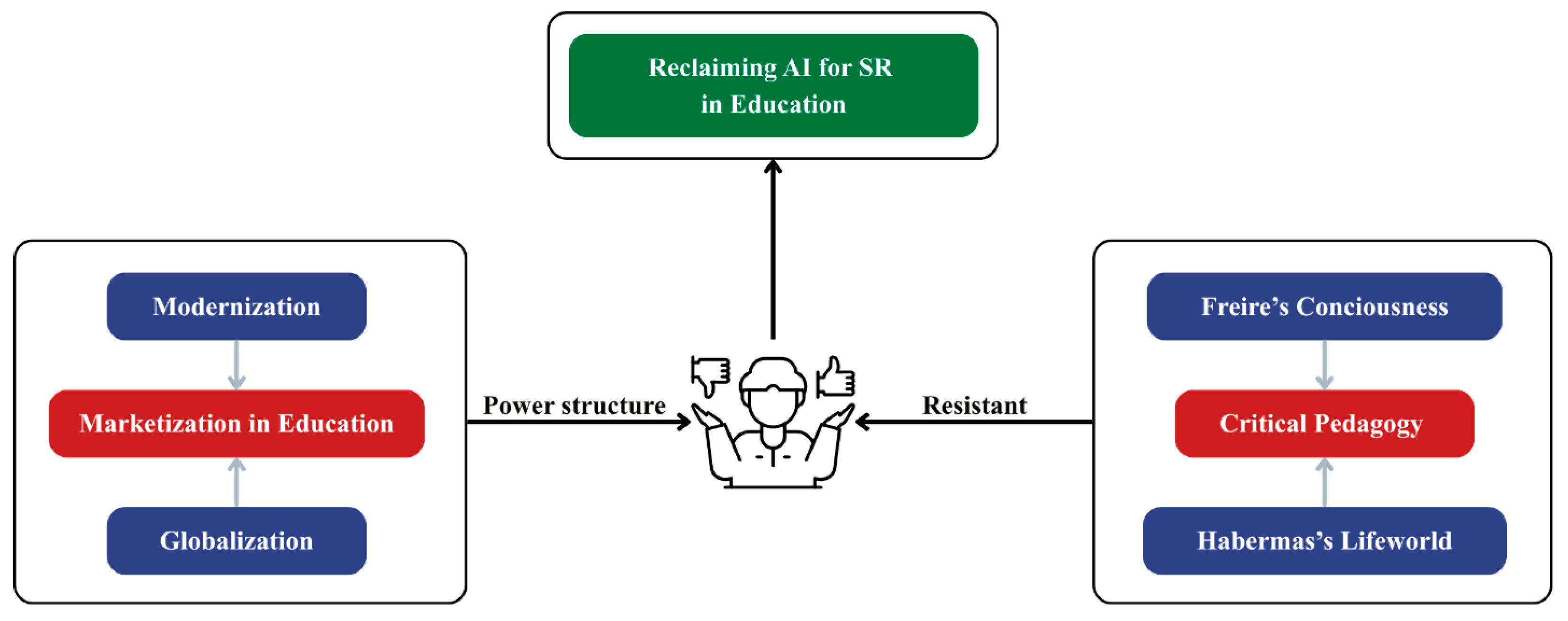
Chofa et al. 2025). In response, this paper critically examines how the use of AI for SR is transformed into a mechanism of marketization within Thai schools, and analyzes its resulting impacts on educational spaces, pedagogical practices, and the roles of students, teachers, and communities. AI is conceptualized not as a neutral tool or innovation, but as a socio-technical mediator that enables social responsibility to become measurable, visible, auditable, and convertible into symbolic outputs within competitive education systems. Specifically, the study investigates how AI for SR is framed and enacted under policy and competitive pressures, how these practices reshape the meaning of learning and participation, and how social responsibility is reconfigured as symbolic capital aligned with accountability and performance regimes. By situating the Thai case within broader global trends from AI-driven citizenship initiatives in East Asia to competitive digital education agendas across the Global South, this study highlights the structural conditions through which ethical discourses are absorbed into market logics. Ultimately, it calls for reclaiming education through critical pedagogy, ensuring that AI and SR function as dialogical and participatory practices for social justice rather than as instruments of symbolic value within the global education marketplace.
5. Methodology
5.1. Research Design
This study adopted a qualitative research design grounded in critical phenomenology to understand the lived experiences of teachers and students engaged in AI for SR activities in Thai schools. The approach emphasized interpreting individual experiences while critically examining the policy conditions and social structures shaping how AI for SR was framed and implemented.
To analyze the data, Interpretative Phenomenological Analysis (IPA) was employed, not only to capture the meanings that participants attached to their experiences but also to examine how these meanings were transformed within the education sector into a mechanism of marketization, and to situate those meanings within broader marketization pressures of competition, evaluation, and global benchmarking (
Smith et al. 2009). Rather than treating students’ and teachers’ accounts as isolated perspectives, this approach highlighted how motivations such as producing portfolios or securing awards were shaped by systemic imperatives that colonize the educational lifeworld of Habermas concept.
In this sense, IPA, when embedded in a critical phenomenological stance, served as more than a descriptive tool; it functioned as a method for exposing domination and advancing critical pedagogy by linking lived experience with structural critique (
Guenther 2019).
5.2. Unit of Analysis
The unit of analysis is the Thai educational policy space, which pushes schools to develop AI innovators with a sense of social responsibility. National frameworks, including the National Education Plan (2017–2036) and the National AI Action Plan (2022–2030), guided this study (
Office of the Education Council 2017;
Ministry of Higher Education, Science, Research, and Innovation and Ministry of Digital Economy and Society 2022). Participants were selected using a perspective strategy and theoretical sampling, with access facilitated by institutional gatekeepers such as school administrators, colleagues, supervisors, or close relatives, from both well-resourced urban schools and rural schools with limited resources, ensuring diverse perspectives and multiple dimensions of Thailand’s experience.
5.3. Data Collection
Three methods were employed:
1. Document Analysis—reviewed a variety of sources, including policy documents, school reports, websites, and promotional materials related to AI for SR.
2. Observations—focused on AI for SR activities, including event organization, participation, and framing, to capture how AI for SR was enacted in everyday educational practices.
3. In-depth Interviews—conducted semi-structured interviews with 20 participants, including 10 high school teachers, five students, and five university lecturers. This composition was deliberately designed to capture multiple perspectives across key educational roles involved in AI for SR initiatives. The sample size was guided by considerations of analytic adequacy and thematic sufficiency, with data collection continuing until recurring patterns across participant accounts became evident, while still allowing attention to individual experiential nuance, consistent with IPA principles (
Smith et al. 2009;
Guest et al. 2006). As summarized in
Table 1, students shared lived experiences of portfolio-driven learning, teachers reflected on policy implementation, and lecturers provided critical insights into educational transitions (see
Table 1 for details).
5.4. Data Analysis and Credibility
Data were analyzed using Interpretative Phenomenological Analysis (IPA). Transcripts and documents were repeatedly read, coded, and clustered into themes, following an iterative IPA process that involved initial descriptive reading and coding based on repeated close engagement with each transcript and document, with a focus on participants’ explicit experiential accounts, concerns, and meanings at a case-by-case level. After that, the code turns to interpretative coding, the identification of emergent meaning units, and the subsequent grouping of related codes into higher-order thematic patterns (
Smith et al. 2009), such as School Image-Building for Competition and Resource Mobilization, Community Projects as Credentials for University and Labor Market Competition, and Projects Driven by Funding Agendas and External Demands. While IPA traditionally emphasizes idiographic depth, this study adopted a flexible IPA approach, prioritizing in-depth analysis within and across participant groups rather than treating each case in isolation. This approach allowed for detailed engagement with individual accounts while also examining shared meaning-making processes shaped by common policy and marketization pressures (
Smith et al. 2009;
Guest et al. 2006).
The credibility of the findings was ensured through triangulation and trustworthiness. Triangulation was achieved by incorporating multiple data sources, employing varied data-collection methods, and conducting member checks with participants (
Creswell and Poth 2018;
Lincoln and Guba 1985). Trustworthiness was further supported through transferability (facilitated by diverse sampling), dependability (ensured by systematic documentation of interviews, observations, and field notes), and confirmability (reinforced through reflexive journaling and engagement with relevant literature). Collectively, these strategies enhanced the rigor, reliability, and applicability of the study (
Nowell et al. 2017).
5.5. Researcher Positioning
As a secondary school teacher implementing AI innovation policies, I occupied an insider role, granting me privileged access to participants’ experiences. While this insider perspective enriched data collection, it also introduced potential bias. To maintain credibility, I employed reflexive journaling, triangulation, and critical self-interrogation throughout the research process.
5.6. Ethical Considerations
This research received ethical approval from the Human Research Ethics Committee of Srinakharinwirot University, under approval number SWUEC-672723. All participants were informed about the study’s purpose, procedures, and confidentiality protocols, and provided written informed consent before participation. Anonymity was ensured through the use of pseudonyms and secure data storage, in line with the Declaration of Helsinki and national ethical guidelines for research involving human participants.
6. Findings and Discussion
Across interviews, observations, and document analysis, participants consistently described SR activities as structured requirements linked to portfolios, awards, and institutional expectations rather than as self-initiated ethical engagements. These findings reflect that SR initiatives in Thai schools are rarely rooted in students’ autonomous choices or authentic community interaction (
Noklang 2020). Instead, they are structured and constrained by policy frameworks that emphasize compliance with international standards and global benchmarks. Across the data, this policy-driven orientation reorganizes SR as a strategic resource rather than a pedagogical process of ethical learning. This reflects a broader shift in education, where schools are compelled to demonstrate social responsibility through certificates, awards, and portfolios that can be exchanged for legitimacy, funding, and reputation. Within this context, SR becomes embedded in competitive institutional practices, shaping how schools present themselves, how students participate, and how projects are designed and evaluated.
In this sense, SR becomes less a moral practice than a commodified performance, aligned with what
Freire (
[1970] 2000) described as banking education, where students are positioned as passive recipients of predefined expectations rather than active co-creators of social meaning. This transformation is manifested in three interconnected patterns observed across the findings. First, SR is mobilized as a mechanism for school image-building and resource mobilization, reshaping teachers’ work and institutional priorities toward visibility, awards, and reputation. Second, community projects are increasingly reframed as credentials for university admission and future labor-market competition, particularly within portfolio-driven systems such as TCAS, thereby encouraging students to engage strategically rather than reflectively. Third, project-based learning is driven by funding agendas and external demands, compelling students and teachers to produce technically polished outputs aligned with evaluation criteria rather than sustained community engagement or ethical inquiry.
This transformation mirrors patterns observed globally, particularly across the Global South. For example, in China and Singapore, AI and citizenship initiatives are often tied to state-led innovation agendas that prioritize national competitiveness over dialogical learning (
Teddy-Ang and Toh 2020;
Lee 2024;
Qu et al. 2023;
Rizvi 2017). Similarly, OECD and World Bank frameworks promote human capital development as the primary purpose of education, reducing values such as responsibility to instruments of economic growth (
Hunter and Shaffer 2021;
Torabian 2022). The Thai case thus illustrates how these global pressures are translated into everyday school practices, exemplifying how the colonization of the lifeworld (
Habermas 1987) operates in education, where value-based communication and critical engagement are subordinated to instrumental rationalities of policy compliance, market branding, and global competitiveness.
In short, the study finds that SR in Thai education has shifted from an ethical orientation to an economic tool through marketization, thereby transforming schools into sites of symbolic production. Taken together, the findings demonstrate how SR operates simultaneously at institutional, pedagogical, and experiential levels, highlighting an urgent need to reclaim educational spaces through critical pedagogy, and position SR not as a commodity for institutional advantage but as a participatory practice fostering equity and social justice.
6.1. School Image-Building for Competition and Resource Mobilization
Participants emphasized that SR activities are increasingly planned, documented, and evaluated according to their visibility, award potential, and contribution to institutional reputation. The findings indicate that in Thai education, social responsibility (SR) has been reframed as a strategic mechanism for competition rather than as a process of ethical cultivation. Schools and universities are compelled to produce visible “evidence of virtue”, such as volunteer activities, awards, and student portfolios, as proof of their moral and academic capacity to compete and to gain the trust of parents, sponsors and external stakeholders.
One illustrative example of this dynamic is the way SR activities are designed and evaluated primarily through their visibility, award potential, and contribution to institutional reputation, rather than through sustained engagement with social issues or communities. This competitive orientation directly reshapes teachers’ work and responsibilities. Instead of focusing on facilitating critical reflection or long-term community collaboration, teachers are increasingly expected to design, manage, and document SR activities that generate recognizable outputs, such as certificates, awards, media coverage, or portfolio materials that can be publicly displayed and evaluated. As one secondary teacher reflected,
“Nowadays it is not enough to teach students to be good; we must also show that they are good, like doing PR for the school all the time, so the school looks respectable, attracts applicants, and remains competitive”
(secondary school teacher, personal communication, 14 June 2025).
This account illustrates how moral learning becomes inseparable from performance. SR activities function less as spaces for ethical reflection and more as symbolic resources that can be mobilized to secure reputation, funding, and external partnerships. Students’ expectations are shaped in parallel. Participation in SR activities is increasingly understood by students as a strategic requirement for success within competitive educational pathways, rather than as an opportunity for ethical learning or civic engagement. Consequently, students come to evaluate SR projects in terms of their usefulness for university admission, awards, and public recognition, reinforcing instrumental motivations over reflective or dialogical engagement.
This dynamic resonates with broader processes of the marketization of education, in which schools increasingly operate in ways analogous to business organizations (
Lundahl et al. 2013). Driven by modernization and globalization, educational values are reshaped into instruments of economic competition and institutional positioning (
Spring 2012;
Manarbek et al. 2019). In this context, learning practices increasingly resemble what
Freire (
[1970] 2000) described as banking education, where students accumulate certificates and accolades rather than engage as critical participants who question the meaning and consequences of social action. Another teacher explained,
“Prizes have become a crucial strategy for shaping the school’s image. When students win, it is not just prestige that increases, but also opportunities for the school to attract external funding and partnerships” (secondary school teacher, personal communication, 16 June 2025). Such practices underscore how learning is transformed into the production of evidence to satisfy systemic demands, rather than into spaces for generating critical and ethical understanding (
Jemal 2017). From this perspective, SR and AI initiatives are increasingly absorbed into the logics of market and policy systems, subordinating communicative action to instrumental objectives and institutional performance (
Habermas 1987;
Regmi 2017). This example reflects broader patterns observed across the paths of some Global South education systems, where modernization agendas reconfigure schools to operate within competitive, market-oriented frameworks. What should serve as a site of moral learning and student participation instead becomes a mechanism for image-making and competition in the education marketplace. Consequently, Thai schools are increasingly driven by branding strategies and symbolic capital, rather than by the cultivation of critical consciousness that might empower students to transform society (
McLaren 2019;
Monchinski 2008).
6.2. Community Projects as Credentials for University and Labor Market Competition
Students and university lecturers described community projects as strategic assets within portfolio-based admission systems, particularly under the Thai University Central Admission System (TCAS). The findings reveal that community projects and volunteer initiatives in Thai secondary schools have shifted away from their original purpose of fostering relationships and value-based learning. Instead, they have increasingly become mechanisms of educational competition, particularly within TCAS, which places strong emphasis on student portfolios. Under these conditions, community engagement is no longer primarily framed as a process of social learning, but as a strategic resource for accumulating credentials.
One clear manifestation of this shift is how students plan their participation in SR and community-based projects. Rather than selecting projects based on personal interest or community relevance, students are encouraged to prioritize activities that can generate certificates, awards, or portfolio evidence aligned with university admission criteria. This orientation is also reinforced by expectations articulated at the university level. As one university lecturer involved in student admissions explained, “When we evaluate portfolios, we are looking for evidence that students can manage projects, show innovation, and demonstrate social responsibility in a tangible way. Projects that can be clearly presented, documented, and linked to awards or recognizable outputs tend to stand out more in the selection process” (university lecturer, personal communication, 18 June 2025).
For many students, the primary motivation for engaging in such projects is not authentic social engagement but the production of credentials to enhance their competitiveness in higher education. This reconfiguration reframes project-based learning away from inquiry and toward strategic compliance with externally defined criteria. As one secondary school student explained:
“For me, doing volunteer or community development projects is something I must do because I saw many seniors doing them and getting certificates to include in their portfolios. When it came time to apply to university, they got into the programs they wanted. The ideas come from the internet or everyday life, but if the project can be turned into evidence for my portfolio, that motivates me automatically”
(secondary school student, personal communication, 13 June 2025).
This account illustrates how participation in community projects becomes governed by portfolio-driven rationalities. Learning is oriented toward producing recognizable outcomes rather than engaging critically with social problems or sustaining relationships with communities. Students are trained to evaluate projects according to their exchange value within competitive educational pathways, reinforcing instrumental motivations over reflective or dialogical engagement (
Spring 2012).
Teachers themselves acknowledge that activities are often designed to fit competitive requirements. Teachers’ practices adapt accordingly, as community projects are redesigned to meet the expectations of competitions, evaluation frameworks, or external audiences. One teacher commented:
“…Some students wanted to do simple projects, like improving the classroom space, but once they knew the project would be submitted to a contest, we had to make it more complex, sometimes adding AI to make it look attractive…” (secondary school teacher, personal communication, 25 June 2025). Such adjustments reveal how pedagogical decisions are shaped less by students’ interests or community needs and more by the demands of visibility, innovation, and competitiveness, reflecting how projects are tailored to institutional and evaluative expectations rather than to meaningful community engagement (
Bartlett et al. 2002).
Consequently, community projects become evidence of competition rather than opportunities for co-creating meaning. Students are trained as “project producers” tasked with generating symbolic artifacts certificates, reports, narratives, and portfolios, rather than as critical learners who engage with the root causes of social issues (
Freire [1970] 2000;
Jemal 2017). In this configuration, responsibility becomes something to be demonstrated rather than experienced. The community is reduced to a backdrop, while the imperative displaces learning to create marketable outputs. In this way, SR is transformed into an extension of the marketization of education (
Cohen 2024;
Lundahl et al. 2013), where projects serve institutional branding and individual advantage rather than collective empowerment.
Moreover, these projects are increasingly linked to labor market imaginaries. Students are aware that distinctive, innovation-oriented or AI-based initiatives can function as signals of employability, enhancing their perceived value in future educational and professional contexts (
Costa and Murphy 2025). What were once intended as spaces for solidarity and social responsibility thus become commodified credentials that bridge university admission and labor market competition, limiting opportunities for dialog, ethical reflection, and the co-creation of social meaning.
6.3. Projects Driven by Funding Agendas and External Demands
The findings show that Thai educational structures compel students to produce tangible projects and outputs that align with institutional and external requirements. Rather than functioning as spaces for questioning, dialog, or reflection, projects are shaped by competition criteria, funding priorities, and institutional strategies. As a result, they become technical products designed for presentation, reputation building, and the reproduction of dominant discourses (
Apple 2004). This dynamic redefines project-based learning as a compliance-oriented practice, where success is measured by alignment with external benchmarks rather than by ethical inquiry or social relevance.
“Our teacher said that if we won awards with the project, we might get scholarships. So, we tried to make it look impressive with academic references, even though we weren’t sure if it really helped the community or if people would use it”
(secondary school student, personal communication, 14 June 2025).
This account reflects the pressure to prioritize appearance over authenticity. As a result, students learn to evaluate projects primarily in terms of how convincingly they can be presented to evaluators, rather than how meaningfully they address community needs or social problems. In response, both students and teachers adapt projects to meet external expectations, mastering the art of persuasive presentations, producing reports tailored to evaluation frameworks, and embedding artificial intelligence to make outputs appear modern and competitive. Yet these practices simultaneously narrow opportunities for critical reflection and meaningful community engagement. As one teacher remarked:
“Students wanted to do simple projects, but they had to change them into AI-based ones because that’s the current trend” (secondary school teacher, personal communication, 12 June 2025). Such pressures illustrate how external demands reshape learning into a process of producing symbolic evidence for assessment rather than cultivating ethical or dialogical capacities (
Diemer et al. 2016;
Lundahl et al. 2013).
Taken together, these patterns reveal how SR projects, once intended to build shared meaning with communities, are increasingly appropriated as instruments of audit culture (
Nygreen 2017), where compliance with evaluation frameworks supersedes genuine social learning. In this environment, responsibility becomes commodified: projects function simultaneously as credentials for student portfolios, evidence for teachers’ career advancement, and branding strategies for institutional reputation. This finding aligns with
Al-Haija and Mahamid (
2021) argue that market-driven reforms transform social responsibility into a symbolic commodity, a tradable asset linked to funding, partnerships, and competitive advantage.
What should be spaces of ethical and participatory learning are thus reduced to strategic performances shaped by the pressures of modernization and globalization. Schools operate increasingly like businesses, prioritizing image management, competitiveness, and responsiveness to external audits (
Morley 2024;
Dahlstrom 2009). In this process, communities are reduced to backdrops, while external imperatives drive students, teachers, and institutions. These dynamics underscore the necessity of reclaiming SR as a space for critical pedagogy, shared value creation, and authentic participation, rather than as a mechanism of marketization and symbolic accumulation.
7. Conclusions: Reclaiming AI for Social Responsibility Through Critical Pedagogy
This study demonstrates that AI for SR in Thai education has shifted from an ethical orientation to a commodified mechanism, functioning as a tool for competition, reputation, and accountability. Instead of cultivating authentic participation, SR initiatives are structured by policy frameworks, funding priorities, and admission systems that privilege certificates, awards, and portfolios. Students are trained as producers of symbolic outputs, teachers are reduced to managers of institutional image, and communities are relegated to backdrops in projects designed to impress evaluators rather than to foster shared meaning. These findings resonate with Freire’s critique of banking education and Habermas’s concern over the colonization of the lifeworld, illustrating how market logics infiltrate educational spaces and transform responsibility into symbolic capital. Within this configuration, AI does not function as a medium for deepening social understanding or ethical engagement; rather, it operates as a supportive instrument that enhances the efficiency, visibility, and legitimacy of market-oriented SR practices, aligning educational activity with the demands of competition, evaluation, and the labor market rather than with the complexities of lived social realities.
Yet, these dynamics are not confined to Thailand. Across the Global South and worldwide, AI and SR are being incorporated into human capital agendas that prioritize global competitiveness and compliance with international benchmarks. The Thai case thus reflects a broader transformation of education under modernization and globalization.
To resist this trend, a reimagined framework grounded in critical pedagogy is essential. First, SR initiatives must be rooted in student-led inquiries that connect AI to real social problems, enabling learners to interrogate inequalities and co-create solutions with communities. Second, teachers should act as facilitators and co-learners, supported by professional development that emphasizes reflexivity, dialog, and participatory methodologies. In practice, this requires shifting classroom pedagogy away from pre-defined project templates toward inquiry-based learning designs, where students begin by identifying social issues through dialogue with communities before determining whether and how AI technologies are relevant. Third, communities should be repositioned as knowledge partners, contributing lived expertise rather than serving as tokenistic recipients of student projects. Fourth, evaluation frameworks must move beyond certificates and rankings toward democratic accountability, privileging participation, dialogue, and ethical reflection. Finally, AI for SR should serve not only local engagement but also global solidarity, connecting students to transnational debates on technology, ais, and justice.
Reclaiming AI for SR through critical pedagogy, therefore, means redefining it not as a symbolic commodity but as a public good. By embedding dialog, participation, and critical consciousness at the center of educational practice, schools can transform AI for SR into a practice of social justice, equipping students to resist commodification and contribute to more equitable futures both locally and globally.