Rape Victim–Survivors’ Experiences of Social Relationships and Supports: Implications of Sexism and Racism


Abstract
1. Introduction
2. Definition of Key Concepts
2.1. Racism and Racial Trauma
2.2. Sexism
2.3. Sexual Trauma
3. Methodology
4. Literature Review and Case Illustration
4.1. The Invisible Wounds of Rape Victim–Survivors Facing Gendered and Racial Traumas
4.2. Suffering in Silence for Fear of Negative Social Reaction
4.3. Anna’s Case (Adapted from Maisha 2020)
Anna’s Case Discussion
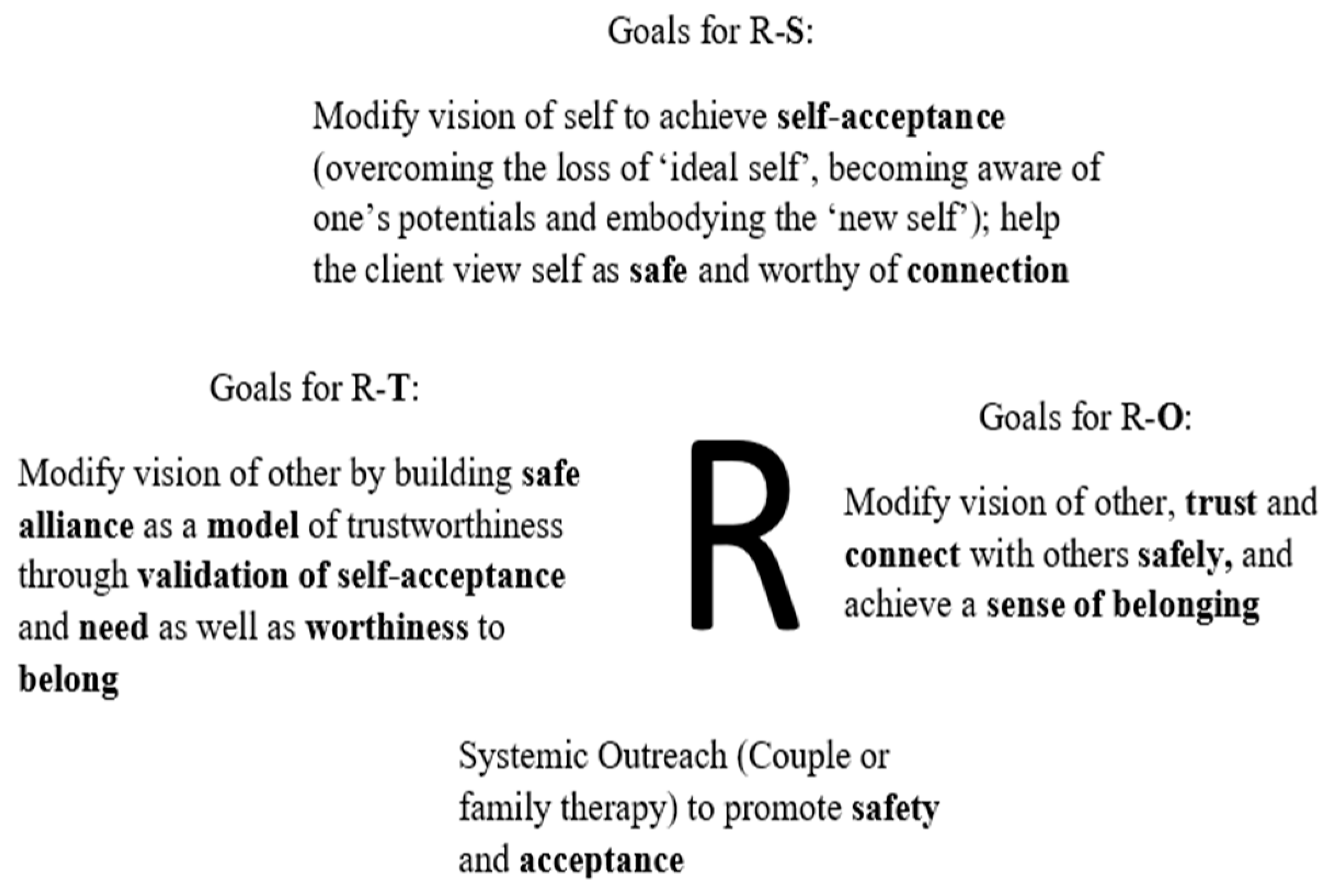
4.4. Applying a Therapeutic Modality: ReSTO—Systemic Therapeutic Care for Victim–Survivors
5. Discussion
- A negative perception of self (defiled, family betrayer) as a woman, a mother, a wife, a daughter, a member of the community, and a believer (e.g., Christian);
- An internalized negative perception of others stemming from social rejection;
- A demoted social status as an untrustworthy member of her community;
- Isolated/sent away under the assumption that she represents a danger to in-group cohesion;
- Vulnerability to (re)victimization.
6. Conclusions
7. Limitations
Funding
Data Availability Statement
Conflicts of Interest
Appendix A
| List of Cited Sources Based on Inclusion Criteria in the Literature Review | |||
| Source | Inclusion Criteria (a) Year of Publication and (b) Scientific Value for Frequency of Citation in Existing Literature | Inclusion Criterion (c) Contains Keywords/Similar to Those Used in the Review (Rape/Sexual Trauma a; Sexism b; Racism c; Racial Trauma d; Marginalization e; Victim/Survivor f; Relationships g; Recovery/Healing h) | |
| 2010+ | <2010 But Cited More than 100 Times | ||
| Ahrens (2006) | - | 1 | a, f, and g |
| Ahrens and Aldana (2012) | 1 | a and g | |
| Ajayi et al. (2022) | 2 | - | a, b, f, and g |
| Banyard et al. (2002) | - | 2 | a and f |
| Barrios et al. (2025) | 3 | - | a and e |
| Bird et al. (2021) | 4 | - | c, f, and h |
| Bower (2025) | 5 | - | a and f |
| Boykins et al. (2010) | 6 | - | a, f, and g |
| Bryant-Davis et al. (2009) | - | 3 | a, c, and h |
| Bryant-Davis and Tummala-Narra (2017) | 7 | - | a and c |
| Bryant-Davis et al. (2011) | 8 | - | a, g, and h |
| Carr et al. (2014) | 9 | - | a, b, and c |
| Cénat (2022) | 10 | - | c and d |
| Clark et al. (1999) | - | 4 | c and g |
| Comas-Díaz (2016) | 11 | - | c and d |
| Cromer and Freyd (2007) | - | 5 | a, b, and f |
| Donovan and Williams (2002) | - | 6 | a and b, |
| Eshelman et al. (2024) | 12 | - | a, c, and h |
| Essed (1991) | - | 7 | b, c and g |
| Fiske (2018) | 13 | - | b and c |
| Forbes et al. (2004) | 8 | a and b | |
| Fortuna et al. (2022) | 14 | c, d, and f | |
| Foussiakda et al. (2025) | 15 | - | a, f, g, and h |
| Franklin and Garza (2021) | 16 | - | a, f, and g |
| Glick and Fiske (1996) | - | 9 | b and e |
| Gobin and Gómez (2022) | 17 | - | a, c, and f |
| Gómez (2015) | 18 | - | a and g |
| Gómez et al. (2023) | 19 | - | a and c |
| Gómez and Gobin (2020) | 20 | - | a, c, d, g, and h |
| Gusenbauer (2024) | 21 | - | - |
| Haddaway et al. (2022) | 22 | - | - |
| Hardy (2023) | 23 | - | d and g |
| Hyman et al. (2003) | 10 | a and g | |
| Jean-Charles (2014) | 24 | - | a and f |
| Katz et al. (2018) | 25 | - | a, b, and c |
| Koci and Strickland (2009) | - | 11 | a and e |
| Lahav and Elklit (2016) | 26 | - | a, f, and g |
| Lanthier et al. (2023) | 27 | - | a, e, and f |
| Lanthier et al. (2023) | 28 | - | a, e, and f |
| Leung (2017) | 29 | - | a, c, e, and g |
| Lewis et al. (2019) | 30 | - | a, c, f, and g, |
| Lewis et al. (2013) | 31 | - | b and c |
| Maisha et al. (2024) | 32 | - | a, b, e, f, g, and h |
| Maisha (2021) | 33 | - | a, g, and h |
| Maisha (2020) | 34 | - | a, f, and h |
| Maisha et al. (2017) | 35 | - | a, e, f, g, and h |
| Maisha (2016) | 36 | - | a, e, f, g, and h |
| McNair and Neville (1996) | - | 12 | a, b, c, and f |
| McQueeney and Girgenti-Malone (2018) | 37 | - | a, b, c, and f |
| Mulumeoderhwa (2017) | 38 | - | a, b, and f |
| Murray et al. (2024) | 39 | - | - |
| Norris (1992) | - | 13 | a and c |
| Ogle et al. (2013) | 40 | - | a and c |
| Perilloux et al. (2012) | 41 | - | a, b, and f |
| Petrak and Hedge (2002) | - | 14 | a and g |
| Pitino (2021) | 42 | - | a, e, f, and g |
| Roberts et al. (2010) | 43 | a, e, and f | |
| Samuel (2024) | 44 | - | a, b, c, and f |
| Sigurvinsdottir and Ullman (2016) | 45 | - | a, c, and e |
| Slatton and Richard (2020) | 46 | - | a, b, c, e, and f |
| Staples and Fuller (2021) | 47 | - | a and c |
| Swim and Hyers (2009) | - | 15 | a, b, e and g |
| Watson et al. (1996) | - | 16 | a, b, e, and f |
| Yagi et al. (2022) | 48 | - | a and e |
| 1 | The term victim–survivor is used in this article to acknowledge both the sexual assault endured and the recovery journey of the racialized women whose experience as a victim is often denied or minimized (Bower 2025; Slatton and Richard 2020; Jean-Charles 2014). |
| 2 | The previous publication (Maisha 2021) used the acronym R-STO. In this work and subsequent publication, the acronym ReSTO is used for an easier pronunciation and memorisation. |
References
- Ahrens, Courtney E. 2006. Being Silenced: The Impact of Negative Social Reactions on the Disclosure of Rape. American Journal of Community Psychology 38: 263–74. [Google Scholar] [CrossRef] [Scilit] [PubMed]
- Ahrens, Courtney E., and Erendira Aldana. 2012. The Ties That Bind: Understanding the Impact of Sexual Assault Disclosure on Survivors’ Relationships with Friends, Family, and Partners. Journal of Trauma & Dissociation 13: 226–43. [Google Scholar] [CrossRef] [Scilit]
- Ajayi, Chinyere E., Khatidja Chantler, and Lorraine Radford. 2022. The Role of Cultural Beliefs, Norms, and Practices in Nigerian Women’s Experiences of Sexual Abuse and Violence. Violence Against Women 28: 465–86. [Google Scholar] [CrossRef] [Scilit]
- Banyard, Victoria L., Linda M. Williams, Jane A. Siegel, and Carolyn M. West. 2002. Childhood Sexual Abuse in the Lives of Black Women: Risk and Resilience in a Longitudinal Study. Women & Therapy 25: 45–58. [Google Scholar] [CrossRef] [Scilit]
- Barrios, Veronica R., Kristen Budd, Rose Marie Ward, and Elizabeth Neilson. 2025. Disclosure of Campus Sexual Assault Among Students with Marginalized and Majority Identities: Implications for Future Research. Journal of School Violence 24: 266–82. [Google Scholar] [CrossRef] [Scilit]
- Bird, Claire M., E. Kate Webb, Andrew T. Schramm, Lucas Torres, Christine Larson, and Terri A. deRoon-Cassini. 2021. Racial Discrimination is Associated with Acute Posttraumatic Stress Symptoms and Predicts Future Posttraumatic Stress Disorder Symptom Severity in Trauma-Exposed Black Adults in the United States. Journal of Traumatic Stress 34: 995–1004. [Google Scholar] [CrossRef] [Scilit]
- Bower, Laura J. 2025. Is ‘Victim-Survivor’ Our Imperfect Alternative to Describing People with Lived Experience of Sexual Violence? A Feminist Symbolic Interactionist Analysis, Considering How Ethnicity, Gender, and Disability Interact with Language Choice. Violence Against Women. [Google Scholar] [CrossRef] [Scilit]
- Boykins, Anita D., Anika A. H. Alvanzo, Susan Carson, Janett Forte, Monica Leisey, and Stacey B. Plichta. 2010. Minority Women Victims of Recent Sexual Violence: Disparities in Incident History. Journal of Women’s Health 19: 453–61. [Google Scholar] [CrossRef] [Scilit] [PubMed]
- Bryant-Davis, Thema, and Pratyusha Tummala-NarraLynch. 2017. Cultural Oppression and Human Trafficking: Exploring the Role of Racism and Ethnic Bias. Women & Therapy 40: 152–69. [Google Scholar] [CrossRef] [Scilit]
- Bryant-Davis, Thema, Heewoon Chung, and Shaquita Tillman. 2009. From the Margins to the Center: Ethnic Minority Women and the Mental Health Effects of Sexual Assault. Trauma, Violence, & Abuse 10: 330–57. [Google Scholar] [CrossRef] [Scilit]
- Bryant-Davis, Thema, Sarah E. Ullman, Yuying Tsong, and Robyn Gobin. 2011. Surviving the Storm: The Role of Social Support and Religious Coping in Sexual Assault Recovery of African American Women. Violence Against Women 17: 1601–18. [Google Scholar] [CrossRef] [Scilit]
- Carr, Erica R., Dawn M. Szymanski, Farah Taha, Lindsey M. West, and Nadine J. Kaslow. 2014. Understanding the Link Between Multiple Oppressions and Depression Among African American Women: The Role of Internalization. Psychology of Women Quarterly 38: 233–45. [Google Scholar] [CrossRef] [Scilit]
- Cénat, Jude M. 2022. Complex Racial Trauma: Evidence, Theory, Assessment, and Treatment. Perspectives on Psychological Science 18: 675–87. [Google Scholar] [CrossRef] [Scilit] [PubMed]
- Clark, Rodney, Norman B. Anderson, Vernessa Clark, and David R. Williams. 1999. Racism as a stressor for African Americans: A biopsychosocial model. American Psychologist 54: 805–16. [Google Scholar] [CrossRef]
- Comas-Díaz, Lillian. 2016. Racial trauma recovery: A race-informed therapeutic approach to racial wounds. In The Cost of Racism for People of Color: Contextualizing Experiences of Discrimination. Edited by Alvin N. Alvarez, Christopher T. H. Liang and Helen A. Neville. Washington: American Psychological Association. [Google Scholar] [CrossRef] [Scilit]
- Cromer, Lisa D., and Jennifer J. Freyd. 2007. What Influences Believing Child Sexual Abuse Disclosures? The Roles of Depicted Memory Persistence, Participant Gender, Trauma History, and Sexism. Psychology of Women Quarterly 31: 13–22. [Google Scholar] [CrossRef] [Scilit]
- Donovan, Roxanne, and Michelle Williams. 2002. Living at the Intersection: The Effects of Racism and Sexism on Black Rape Survivors. Women & Therapy 25: 95–105. [Google Scholar] [CrossRef] [Scilit]
- Eshelman, Lee R., Selime R. Salim, Prachi H. Bhuptani, and Mariam Saad. 2024. Sexual Objectification Racial Microaggressions Amplify the Positive Relation Between Sexual Assault and Posttraumatic Stress Among Black Women. Psychology of Women Quarterly 48: 180–94. [Google Scholar] [CrossRef] [Scilit]
- Essed, Philomena. 1991. Understanding Everyday Racism: An Interdisciplinary Theory. London: Sage, vol. 2. [Google Scholar] [CrossRef] [Scilit]
- Fiske, Susan T. 2018. Social Cognition: Selected Works of Susan T. Fiske, 1st ed. London: Routledge. [Google Scholar] [CrossRef] [Scilit]
- Forbes, Gordon B., Leah E. Adams-Curtis, and Kay B. White. 2004. First- and Second-Generation Measures of Sexism, Rape Myths and Related Beliefs, and Hostility Toward Women: Their Interrelationships and Association with College Students’ Experiences with Dating Aggression and Sexual Coercion. Violence Against Women 10: 236–61. [Google Scholar] [CrossRef] [Scilit]
- Fortuna, Lisa R., Amalia L. Tobón, Yohanis L. Anglero, Alejandra Postlethwaite, Michelle V. Porche, and Eugenio M. Rothe. 2022. Focusing on racial, historical and intergenerational trauma, and resilience: A paradigm to better serving children and families. Child and Adolescent Psychiatric Clinics of North America 31: 237–50. [Google Scholar] [CrossRef] [Scilit]
- Foussiakda, Cécilia A., Juvénal B. Balegamire, Gavray Claire, Yannick Mugumaarhahama, and Adélaïde Blavier. 2025. Posttraumatic Stress Disorder, Dyadic Adjustment, Sexual Desire, and Couple Resilience 10 Years After the Experience of Rape by Survivors in the Eastern Democratic Republic of the Congo. Social Sciences 14: 131. [Google Scholar] [CrossRef] [Scilit]
- Franklin, Cortney A., and Alondra D. Garza. 2021. Sexual Assault Disclosure: The Effect of Victim Race and Perpetrator Type on Empathy, Culpability, and Service Referral for Survivors in a Hypothetical Scenario. Journal of Interpersonal Violence 36: 2327–52. [Google Scholar] [CrossRef] [Scilit]
- Glick, Peter, and Susan T. Fiske. 1996. The Ambivalent Sexism Inventory: Differentiating hostile and benevolent sexism. Journal of Personality and Social Psychology 70: 491–512. [Google Scholar] [CrossRef]
- Gobin, Robyn L., and Jennifer M. Gómez. 2022. The Cultural Context of Sexual Assault and Its Consequences Among Ethnic Minority Women. In Handbook of Interpersonal Violence and Abuse Across the Lifespan. Edited by Geffner Robert, Jacquelyn W. White, Kevin L. Hamberger, Alan Rosenbaum, Viola Vaughan-Eden and Victor I. Vieth. Cham: Springer International Publishing, pp. 3741–64. [Google Scholar] [CrossRef] [Scilit]
- Gómez, Jennifer M. 2015. Conceptualizing trauma: In pursuit of culturally relevant research. Trauma Psychology Newsletter (American Psychological Association Division 56) 10: 40–44. [Google Scholar]
- Gómez, Jennifer M., and Robyn L. Gobin. 2020. Black Women and Girls & #MeToo: Rape, Cultural Betrayal, & Healing. Sex Roles 82: 1–12. [Google Scholar] [CrossRef] [Scilit]
- Gómez, Jennifer M., Jennifer J. Freyd, Jorge Delva, Brenda Tracy, Lori N. Mackenzie, Victor Ray, and Beverly Weathington. 2023. Institutional Courage in Action: Racism, Sexual Violence, & Concrete Institutional Change. Journal of Trauma & Dissociation 24: 157–70. [Google Scholar] [CrossRef] [Scilit]
- Gusenbauer, Michael. 2024. Beyond Google Scholar, Scopus, and Web of Science: An evaluation of the backward and forward citation coverage of 59 databases’ citation indices. Research Synthesis Methods 15: 802–17. [Google Scholar] [CrossRef] [Scilit] [PubMed]
- Haddaway, Neal R., Matthew J. Grainger, and Charles T. Gray. 2022. Citationchaser: A tool for transparent and efficient forward and backward citation chasing in systematic searching. Research Synthesis Methods 13: 533–45. [Google Scholar] [CrossRef] [Scilit]
- Hardy, Kenneth V. 2023. Racial Trauma: Clinical Strategies and Techniques for Healing Invisible Wounds. New York: WW Norton & Company. [Google Scholar]
- Hyman, Scott M., Steven N. Gold, and Melissa A. Cott. 2003. Forms of Social Support That Moderate PTSD in Childhood Sexual Abuse Survivors. Journal of Family Violence 18: 295–300. [Google Scholar] [CrossRef] [Scilit]
- Jean-Charles, Régine M. 2014. Toward a Victim-Survivor Narrative: Rape and Form in Yvonne Vera’s Under the Tongue and Calixthe Beyala’s Tu t’appelleras Tanga. Research in African Literatures 45: 39–62. [Google Scholar] [CrossRef] [Scilit]
- Katz, Jennifer, Christine Merrilees, Jillian LaRose, and Claire Edgington. 2018. White Female Bystanders’ Responses to a Black Woman at Risk for Sexual Assault: Associations with Attitudes About Sexism and Racial Injustice. Journal of Aggression, Maltreatment & Trauma 27: 444–59. [Google Scholar] [CrossRef] [Scilit]
- Koci, Anne, and Ora Strickland. 2009. Marginality and Physical and Sexual Abuse in Women. Health Care for Women International 30: 79–92. [Google Scholar] [CrossRef] [Scilit]
- Lahav, Yael, and Ask Elklit. 2016. The cycle of healing—Dissociation and attachment during treatment of CSA survivors. Child Abuse & Neglect 60: 67–76. [Google Scholar] [CrossRef] [Scilit]
- Lanthier, Stephanie, Robin Mason, Carmen H. Logie, Ted Myers, and Janice Du Mont. 2023. “Coming out of the closet about sexual assault”: Intersectional sexual assault stigma and (non) disclosure to formal support providers among survivors using Reddit. Social Science & Medicine 328: 115978. [Google Scholar] [CrossRef] [Scilit]
- Leung, Lai-ching. 2017. Intersectional Challenges: Marginalization of Ethnic Minority Sexual Assault Survivors in Hong Kong. Affilia 32: 217–29. [Google Scholar] [CrossRef] [Scilit]
- Lewis, Jioni A., Ruby Mendenhall, Stacy A. Harwood, and Margaret B. Huntt. 2013. Coping with gendered racial microaggressions among Black women college students. Journal of African American Studies 17: 51–73. [Google Scholar] [CrossRef] [Scilit]
- Lewis, Kaleea R., Alyssa Robillard, Deborah Billings, and Kellee White. 2019. Differential perceptions of a hypothetical sexual assault survivor based on race and ethnicity: Exploring victim responsibility, trauma, and need for social support. Journal of American College Health 67: 308–17. [Google Scholar] [CrossRef] [Scilit] [PubMed]
- Maisha, Buuma. 2016. «Image de soi et de l’autre souillées: La problématique des tabous sexuels en thérapie et l’apport du rite de purification dans la reconstruction du ‘soi’ chez la femme survivante de viol à l’Est de la R.D. Congo». Doctoral thesis, Saint Paul University, Ottawa, ON, Canada. [Google Scholar] [CrossRef]
- Maisha, Buuma. 2020. Contextualising therapeutic care for child survivors of sexual violence in situations of war: A reflection on theory, context and practice. Intervention 18: 45–51. [Google Scholar] [CrossRef] [Scilit]
- Maisha, Buuma. 2021. Relationships as resilience and posttraumatic growth factors for war-time survivors with interpretations of rape as sexual taboo: Healing Embrace. In Fostering Resilience Before, During, and After Experiences of Trauma: Insights to Inform Practice Across the Lifetime. Edited by Buuma Maisha, Stephanie Massicotte and Melanie Morin. New York: Routledge. [Google Scholar] [CrossRef] [Scilit]
- Maisha, Buuma, Janelle Anglin, Timothee Mwindo, Carolanne Tomsine, and Sandrine M’Bassé Florent. 2024. Exploring Cultural Factor in the “Systemic Revictimization” of Rape Survivors in Mwenga (DRC). Social Sciences 13: 411. [Google Scholar] [CrossRef] [Scilit]
- Maisha, Buuma, Judith Malette, and Karlijn Demasure. 2017. Survivors’ sociocultural status in Mwenga: A comparison of the issue before and after rape. Social Sciences 6: 64. [Google Scholar] [CrossRef] [Scilit]
- McNair, Lily D., and Helen Neville. 1996. African American Women Survivors of Sexual Assault: The Intersection of Race and Class. Women & Therapy 18: 107–18. [Google Scholar] [CrossRef] [Scilit]
- Mcqueeney, Krista, and Alicia Girgenti-Malone, eds. 2018. Girls, Aggression, and Intersectionality: Transforming the Discourse of “Mean Girls” in the United States, 1st ed. London: Routledge. [Google Scholar] [CrossRef] [Scilit]
- Mulumeoderhwa, Maroyi. 2017. Virginity Requirement Versus Sexually-Active Young People: What Girls and Boys Think About Virginity in South Kivu, Democratic Republic of Congo. Archives of Sexual Behavior 47: 565–75. [Google Scholar] [CrossRef] [Scilit]
- Murray, Samuel, Gino M. C. Díaz, Laura S. Vega-Plazas, William Jiménez-Leal, and Santiago Amaya. 2024. Loyalty from a personal point of view: A cross-cultural prototype study of loyalty. Journal of Experimental Psychology: General 153: 3002–26. [Google Scholar] [CrossRef] [Scilit] [PubMed]
- Norris, Fran H. 1992. Epidemiology of trauma: Frequency and impact of different potentially traumatic events on different demographic groups. Journal of Consulting and Clinical Psychology 60: 409–18. [Google Scholar] [CrossRef] [PubMed]
- Ogle, Christin M., David C. Rubin, Dorthe Berntsen, and Ilene C. Siegler. 2013. The Frequency and Impact of Exposure to Potentially Traumatic Events Over the Life Course. Clinical Psychological Science 1: 426–34. [Google Scholar] [CrossRef] [Scilit]
- Perilloux, Carin, Joshua D. Duntley, and David M. Buss. 2012. The Costs of Rape. Archives of Sexual Behavior 41: 1099–1106. [Google Scholar] [CrossRef] [Scilit] [PubMed]
- Petrak, Jennifer, and Barbara Hedge. 2002. The Trauma of Sexual Assault: Treatment, Prevention and Practice. New York: Wiley. [Google Scholar]
- Pitino, Marta. 2021. Destined For Exclusion?: Resilient Group Identities and Social Acceptance of Wartime Sexual Violence Survivors. Master’s dissertation, Uppsala University, Uppsala, Sweden. Available online: https://urn.kb.se/resolve?urn=urn:nbn:se:uu:diva-444323 (accessed on 5 January 2026).
- Roberts, Sushma T., Christina G. Watlington, Sara D. Nett, and Sonja V. Batten. 2010. Sexual trauma disclosure in clinical settings: Addressing diversity. Journal of Trauma & Dissociation 11: 244–59. [Google Scholar] [CrossRef] [Scilit]
- Samuel, Danielle A. 2024. Ain’t i a Survivor Too: Contextualizing Black Women’s Experience of Sexual Trauma and Healing. Doctoral dissertation, Antioch University New England, Keene, NH, USA. Available online: https://aura.antioch.edu/cgi/viewcontent.cgi?article=2055&context=etds (accessed on 5 January 2026).
- Sigurvinsdottir, Rannveig, and Sarah E. Ullman. 2016. Sexual orientation, race, and trauma as predictors of sexual assault recovery. Journal of Family Violence 31: 913–21. [Google Scholar] [CrossRef] [Scilit] [PubMed]
- Slatton, Brittany C., and April L. Richard. 2020. Black Women’s experiences of sexual assault and disclosure: Insights from the margins. Sociology Compass 14: e12792. [Google Scholar] [CrossRef] [Scilit]
- Staples, Jennifer M., and Caitlin C. Fuller. 2021. Adult sexual assault severity among transgender people of color: The impact of double marginalization. Journal of Aggression, Maltreatment & Trauma 30: 694–706. [Google Scholar] [CrossRef] [Scilit]
- Swim, Janet K., and Lauri L. Hyers. 2009. Sexism. In Handbook of Prejudice, Stereotyping, and Discrimination. Edited by Todd D. Nelson. New York: Psychology Press. [Google Scholar] [CrossRef] [Scilit]
- Watson, Gilli, Carol Scott, and Sandra Ragalsky. 1996. Refusing to be Marginalized: Groupwork in Mental Health Services for Women Survivors of Childhood Sexual Abuse. Journal of Community & Applied Social Psychology 6: 341–54. [Google Scholar] [CrossRef] [Scilit]
- Yagi, Ines, Judith Malette, Timothee Mwindo, and Buuma Maisha. 2022. Characteristics and Impacts of Conflict-Related Sexual Violence against Men in the DRC: A Phenomenological Research Design. Social Sciences 11: 34. [Google Scholar] [CrossRef] [Scilit]

Disclaimer/Publisher’s Note: The statements, opinions and data contained in all publications are solely those of the individual author(s) and contributor(s) and not of MDPI and/or the editor(s). MDPI and/or the editor(s) disclaim responsibility for any injury to people or property resulting from any ideas, methods, instructions or products referred to in the content. |
© 2026 by the author. Licensee MDPI, Basel, Switzerland. This article is an open access article distributed under the terms and conditions of the Creative Commons Attribution (CC BY) license.
Share and Cite
Maisha, B. Rape Victim–Survivors’ Experiences of Social Relationships and Supports: Implications of Sexism and Racism. Soc. Sci. 2026, 15, 57. https://doi.org/10.3390/socsci15020057
Maisha B. Rape Victim–Survivors’ Experiences of Social Relationships and Supports: Implications of Sexism and Racism. Social Sciences. 2026; 15(2):57. https://doi.org/10.3390/socsci15020057
Chicago/Turabian StyleMaisha, Buuma. 2026. "Rape Victim–Survivors’ Experiences of Social Relationships and Supports: Implications of Sexism and Racism" Social Sciences 15, no. 2: 57. https://doi.org/10.3390/socsci15020057
APA StyleMaisha, B. (2026). Rape Victim–Survivors’ Experiences of Social Relationships and Supports: Implications of Sexism and Racism. Social Sciences, 15(2), 57. https://doi.org/10.3390/socsci15020057