2. Theoretical Background and Hypotheses
Teams have long been a key feature of the modern workplace (
Kozlowski and Ilgen 2006). Teams have become even more central as the nature of work becomes increasingly complex, which has initiated a movement away from jobs performed by individuals and towards jobs performed by groups of people who combine their skills to achieve task success (e.g.,
Devine et al. 1999). Workplace teams can take many forms; they may be face-to-face, virtual, or hybrid, and members of the team may not be required to perform their duties at the same time. Whatever the structure of a team, though, team members must engage in coordinated interaction toward a shared purpose (
Wageman et al. 2012). Recognizing the importance of smooth team interaction, employers often give workers choices about who else will be on their team, and in some workplaces, teams are formed at the complete discretion of participating employees.
Decisions about team membership are fundamentally driven by a desire to achieve success. While this suggests that perceived competence would be the most important factor guiding team member selection (
Thibaut and Kelley 1959), theory and research suggest that people weigh a variety of factors when choosing workplace partners (
Hinds et al. 2000). This is because people not only want to succeed in the workplace, but they also want to reduce uncertainty across social interaction contexts (
Tversky and Kahneman 1974). They may also assume that they will work better when uncertainty is low, leading to a higher chance of team success. As a result, people often balance competing motivations when choosing a work partner. As we discuss below, these motivations are represented in theories of homophily and of status (
Skvoretz and Bailey 2016).
Homophily is the tendency for people to associate with those who are like them (
Lazarsfeld and Merton 1954). Homophily is both structural, in the sense that people have more access to those who are similar to them, increasing the likelihood of association (
McPherson and Smith-Lovin 1987), and active, in the sense that when people are given choices, they tend to choose to associate with others who are most like them (
McPherson et al. 2001;
Lawrence and Shah 2020). Homophily results in in-group favoritism in workplace team selection. As suggested above, the theoretical mechanism for homophily in teammate selection centers around uncertainty reduction.
Hinds et al. (
2000) argue that the desire to reduce uncertainty leads people to select teammates who are like them because they anticipate that they will get along better with a similar other, leading to more pleasant and smooth interactions. Research supports homophily arguments in team selection (
Ruef et al. 2003;
Bailey and Skvoretz 2024), though some research finds that while people tend to choose to work with those of the same race, they do not show a preference for working with people of the same gender (
Hinds et al. 2000). Thus, while homophily processes are known to guide teammate selection, the exact nature of these processes is not settled.
Status arguments, in contrast, predict that people prefer to work with high-status others, because high status is believed to be associated with competence (
Skvoretz and Bailey 2016). These arguments are based on status characteristics theory, which argues that people in collectively oriented task groups expect that higher-status people will have higher levels of performance than will lower-status people (
Berger et al. 1972). Because people are motivated to succeed at the task, they then logically select a teammate who is most likely to contribute positively toward the group goal. Research testing the effects of status processes on teammate selection reports mixed findings.
Kelley et al. (
2017) find that people are more likely to select a high-status person than a low-status person as a teammate, supporting the status prediction, while
Bailey and Skvoretz (
2024) do not find that status guides team selection once homophily effects are taken into account.
Finally, previous research on how cultural messages about gender affect men’s teammate selection found that men were slightly more likely to select a female teammate than a male teammate, regardless of the cultural messages they received, though results were not statistically significant (
Tinkler et al. 2022). This counters the status argument and suggests that a different kind of gendered process is operating. Interestingly,
Bailey and Skvoretz (
2024) found that both men and women were more likely to select women partners, consistent with
Tinkler et al. (
2022). It may be that the preference for a female teammate is driven by stereotypes about women’s greater interactional skills, which would improve team dynamics. It may also be that the strength of gender as a status characteristic has declined, given women’s increasing levels of education and economic power (e.g.,
Foschi and Lapointe 2002). In any case, given the research support for homophily, along with research finding a general preference for female teammates, we predict that our all-female sample will display a general tendency to choose to work with another woman.
H1: Women will exhibit a preference for working with a same-gender partner.
2.1. Structural Arrangements: Relative Power
While we expect that in-group favoritism will lead women to prefer to work with another woman, we also expect that the relative power a woman holds in a task group will affect the strength of the preference for women partners. Traditional gender stereotypes hold women to be more communal and men to be more agentic (for a review, see
Ellemers 2018). The content of communality vs. agency stereotypes maps onto the relative position of groups in the social structure, with social groups that are stereotyped as more agentic tending to also have more power and status in society (
Fiske et al. 2007). Gender stereotypes also shape normative expectations such that men and women who behave in counter-stereotypical ways face social sanctions. For example, research has shown that because enacting dominance violates gender-stereotypical expectations of women’s communality, women leaders are often perceived as less likable. In other words, women face backlash (i.e., a dominance penalty) when they act authoritatively (
Brescoll and Uhlmann 2008;
Rudman 1998;
Rudman et al. 2012;
Tinkler et al. 2019;
Williams and Tiedens 2016).
Women in positions of power may feel less comfortable enacting dominance over men because doing so violates traditional gender norms (
Rudman et al. 2012). This may make women in leadership wary of working with men, all else equal. In contrast, women in more subordinate roles may perceive the relative costs and benefits of working under a male leader as more balanced. Stereotypes continue to hold men to be more effective leaders (
Ellemers 2018). In addition, research has shown—and has been widely shared in mainstream media—that diverse teams can be more effective than teams in which members are more homogenous (
McKinsey & Company 2023). For these reasons, women who are not in leadership and thus are less concerned about men feeling threatened by a more powerful woman may expect that choosing a male partner will lead to a more effective team performance. These positive effects of working with men may make in-group favoritism or homophilic tendencies less pronounced among women in subordinate positions.
H2: Women assigned to a leadership role will be less inclined to work with a male partner than women assigned to a subordinate role.
2.2. Cultural Messages: Sexual Harassment Training
We have competing hypotheses regarding the effects of sexual harassment training on women’s expectations about working with men: one set that presupposes women experience sexual harassment training as empowering and one set that presupposes women experience it as disempowering.
Empowerment argument. Sexual harassment policy trainings aim to reset cultural expectations around appropriate workforce behavior and provide recourse when these expectations are violated. The underlying message that these trainings communicate to women is that they should be treated respectfully. Since women are more likely to be targets of sexual harassment and men are more likely to be perpetrators, these messages may be interpreted as particularly protective for women. If the policy trainings are effective, we should find that women exposed to the trainings have more favorable attitudes about working with men and an increased willingness to work with men. Women who are in subordinate positions will be reassured that the organization will act appropriately if they experience sexual harassment. Women in leadership positions will recognize that they are valued by the organization, resulting in increased comfort in serving in a supervisory role over men.
H3a: Women exposed to sexual harassment training will be more inclined to work with a male partner than women who are not exposed to sexual harassment training.
While the empowerment argument enables the prediction that sexual harassment policy training is empowering to both women subordinates and leaders, the argument is particularly applicable to female subordinates. Sexual harassment schemas, i.e., the dominant images embedded in cultural understandings of sexual harassment, tend to highlight male supervisor/female subordinate harassment as the most common and consequential (
Popovich et al. 1995). In addition, sexual harassment is a dominance behavior that confers power to the harasser (
Uggen and Blackstone 2004). Given the extent to which the #MeToo movement publicized powerful men who sexually harass women, we expect women who are put in positions in which they will be subordinate to their male partners to be most attuned to the protective benefits of sexual harassment policy training.
H3b: Leadership status will moderate the empowering effect of sexual harassment training such that it will make women in a subordinate role more inclined to work with a male partner than it will make women in a leader role.
Disempowerment argument. While designed to upend gendered inequality, research on the effect of sexual harassment training has shown mixed effects (e.g.,
Dobbin and Kalev 2019;
Tinkler et al. 2015). Training increases knowledge about sexual harassment and rules for reporting (
Roehling et al. 2022) but has also been shown to increase negative attitudes about women and traditional gender stereotypes that associate men with greater power (
Tinkler 2013). If sexual harassment trainings remind women of their low-status position and need for protection, they may unwittingly reinforce gender stereotypes and solidify the very concerns that lead organizations to institute sexual harassment policy trainings. If so, then women exposed to sexual harassment training will be even more nervous about working with men than those who are not exposed to the training.
H4a: Women exposed to sexual harassment training will be less inclined to work with a male partner than women who are not exposed to sexual harassment training.
These disempowering effects are likely to be particularly acute for women leaders. Sexual harassment trainings remind women leaders of their low status (
Tinkler 2013), as these trainings suggest that women need organizational intervention to be on equal footing with men, which threatens their legitimacy. Sexual harassment trainings may also be threatening to women because these trainings can invite backlash (
Dobbin and Kalev 2019). Women may reasonably anticipate that men will resent the trainings and the limits on their behavior that the trainings instruct. If so, then trainings may undermine women leaders.
H4b: Leadership status will moderate the disempowering effect of sexual harassment training such that it will make women in a leader role less inclined to work with a male partner than it will make women in a subordinate role.
4. Results
4.1. Bivariate Analyses
Hypothesis 1 predicts that women will have more positive expectations about working with a same-gender partner. To evaluate this hypothesis, we examine participants’ attitudes and behavior. To test whether women have different attitudes about working with a female vs. a male partner, we conducted a paired-sample t-test to compare the mean attitudes about working with “Jessica” vs. “Michael.” On a 7-point scale, the average rating for the female partner was 4.78 (SD = 0.74) and the average rating of the male partner was 4.59 (SD = 0.80). The difference between these means is statistically significant (p = 0.03). On the behavioral measure, a one-sample proportion test also indicates that participants were significantly more likely than chance to choose the female partner (64% vs. 50%; z = 2.8; p = 0.007). These results suggest an overall preference for working with another woman.
Hypothesis 2 predicts that women assigned to be leaders will be less inclined than subordinates to work with a man. For the measure of attitudes about a male partner, higher numbers indicate more favorable attitudes. We conducted an independent samples t-test to compare this measure across the leader vs. helper conditions. On the attitudinal measure, we do not find support for hypothesis 2 (leader mean = 4.63, SD = 0.70; helper mean = 4.54, SD = 0.89; p = 0.58). On the behavioral measure, however, we find preliminary support for hypothesis 2. Twenty-eight percent of women leaders chose a male partner, while 45% of women helpers chose a male partner (Chi2 p = 0.07).
4.2. Multivariate Analyses
To test the competing hypotheses about the moderating effect of sexual harassment policy training on participants’ inclinations to work with a male partner, we turn to multivariate models. Hypotheses 3a and b predicted sexual harassment training to be empowering, particularly for women helpers. Hypotheses 4a and b predicted sexual harassment training to be disempowering, particularly for women leaders.
We begin by examining favorable attitudes about working with the male partner across conditions. We analyzed the effects of the condition assignments on these ratings using ANOVAs in which policy condition and leadership status were between-subject factors. In terms of model effects, we find no statistically significant main effects of policy condition (F = 1.70; p = 0.20) or leadership status (F = 0.52; p = 0.58), but there was a statistically significant interaction between the two (F = 4.14; p = 0.04).
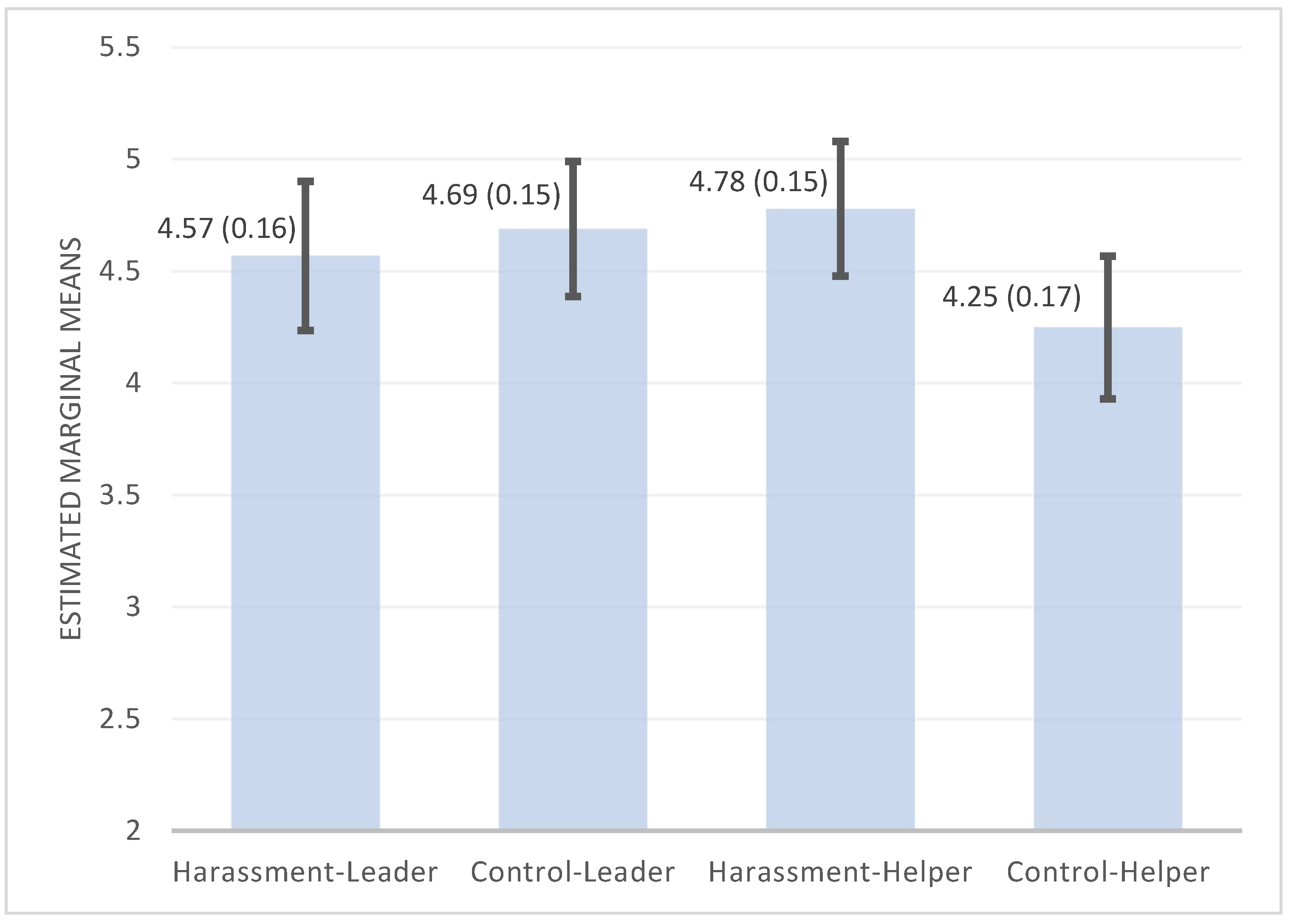
To help visualize the interaction effects,
Figure 1 reports the estimated marginal means and standard errors, with 95% confidence intervals, across conditions. Positive numbers indicate favorable attitudes about working with the male partner. As seen in
Figure 1, women assigned to be helpers had significantly less favorable attitudes about working with Michael in the control condition than in the sexual harassment training condition (
p = 0.02). This finding is consistent with hypothesis 4a, which expected sexual harassment training to have more empowering effects on women subordinates than women leaders. We find no evidence for the disempowering effect of sexual harassment training. In addition, while we do not wish to capitalize on chance, we note that contrary to hypothesis 2, which expected women leaders to be less inclined to want to work with men, leaders in the control condition (mean = 4.69) expressed more favorable attitudes about working with Michael than helpers in the control condition (mean = 4.25;
p = 0.06). We discuss this unexpected finding in more detail below.
Next, we conducted a binary logistic regression to examine whether leadership status and viewing the sexual harassment training video affected partner choice (our behavioral measure). In preliminary analyses, we found no significant interaction effect between policy training and leadership status, so we report the results from a model without the interaction term. In addition, given our unexpected finding (discussed above) that in the control condition, women leaders were more positive than women helpers in their attitudes about working with a male partner, we conducted the analysis with and without a control variable for participants’ attitudes about working with a male partner. The findings are the same in both models.
Table 1 reports the model that controls for participants’ attitudes.
Table 1 shows that sexual harassment training did not affect partner choice. In other words, we find no support for either hypothesis 3 or hypothesis 4 on the behavioral measure. Consistent with hypothesis 2 and the bivariate analysis, we find that women assigned as leaders were more likely to choose a female partner than women assigned as helpers.
To learn more about participants’ reasons for partner selection, we also asked them to explain their partner choice, and their open-ended responses revealed an interesting pattern. Among those who chose a female partner, 30% explicitly said their partner’s gender was a factor. For example, participants answered, “because she was female,” “get along with women better than with men,” “a woman…would help bring nervousness down,” and “women are more cooperative and easier to collaborate with.” In contrast, among those who chose a male partner, none mentioned his gender in their explanation. This pattern suggests that it is more socially acceptable for women to express a preference for a same-gender partner. We read this as consistent with
Elsesser and Peplau’s (
2006) argument that concerns about cross-gender interactions being interpreted as romantic, or even sexual harassment, create a “glass partition” that encourages gender homophily. Even if participants in this study were not worried about sexual harassment occurring in the laboratory, the sense that cross-gender relations are more fraught may have still shaped the preference for a woman partner.
Since we found some evidence that leadership status led to discrepant attitudes and behavior (i.e., women leaders in the control condition expressed more favorable attitudes about working with Michael but chose him less often as a partner than helpers), we also explored whether the willingness to say that gender was a factor in their partner choice differed across leadership status. Looking just at those who explicitly said they chose a woman because she was a woman, fourteen helpers but only six leaders made such statements. Taken together, our results suggest that while women leaders preferred a female partner, the power that came with their position may have discouraged them from admitting that they held biases against men.
5. Discussion
The results suggest that exposure to sexual harassment training may serve to empower women in some circumstances. Women in the subordinate role who were exposed to sexual harassment training exhibited more positive attitudes about working with a man than those in the control condition. This suggests that sexual harassment training served to empower women helpers but had no effect on women leaders. Exposure to sexual harassment training, though, did not affect partner selection. Instead, women were more likely, overall, to choose a same-gender partner, and this tendency was particularly pronounced for women leaders. Together, these findings indicate that both status and homophily considerations shape women’s inclinations to work with a female vs. a male partner.
The positive effect of sexual harassment policy training on women helpers’ attitudes about working with a man suggests that such training may convey information to less powerful workers about an organization’s commitment to addressing sexual harassment, which can reduce concerns about experiencing it. The fact that the trainings did not have this effect on women leaders, though, suggests that this message has different meanings for women in different structural positions, complicating the way in which sexual harassment trainings are received in the workplace. Tailoring anti-harassment training specifically for supervisors and non-supervisors may be one way to address the differences we uncovered.
Participants’ behavioral preference for women partners, which was particularly strong among leaders, has important implications for labor market inequality. On the one hand, if women leaders more often choose to partner with other women, such choices may provide a corrective to the more common pattern in which homophily leads men in power to hire and promote other men more often. On the other hand, if women leaders eschew working with male subordinates, then men are less likely to be exposed to women in power positions, which reduces opportunities for stereotype-disconfirming interactions. It is also encouraging that sexual harassment policy training reduced women subordinates’ attitudinal preference for same-gender partners, as it may, over time, reduce the likelihood that women will avoid working with men who could offer access to new resources and connections. Yet, to the extent that cultural beliefs continue to value men’s work more than women’s, gender-segregating forces will continue to play a part in reproducing men’s advantages.
Our findings are consistent with research showing that attitudes and behavior often do not align (
Kammeyer-Mueller et al. 2024), but some of the differences across attitudinal and behavioral measures are unintuitive. Exposure to the sexual harassment training video affected women’s attitudes about working with a man vs. a woman, but it did not affect their partner choice. In addition, we found a direct effect of power on the behavioral measure, with women leaders choosing a male partner less often than women helpers, but the opposite effect of power on the attitudinal measure among women in the control condition was found.
Taken together, our findings may mean that subordinate women’s greater willingness to work with a male leader reflects the typical status order in workplaces, yet women continue to experience trepidation with this arrangement unless they are reassured that the organization takes sexual harassment claims seriously. More generally, the results suggest that cultural messages—like those imparted by sexual harassment trainings—may more strongly affect attitudes than behavior. On the other hand, structural arrangements—like occupying a role with more power—may have stronger effects on behavior. We hesitate to over-interpret the differences, however, as it is also quite possible that social desirability bias affected people’s attitudes more than their behavior. The behavioral measure forced participants to choose a partner, raising the stakes for making a bad choice and possibly discouraging social desirability bias more than the attitudinal questions.
To aid interpretation, it is helpful to compare our findings to those of
Tinkler et al. (
2022), who examined the effects of sexual harassment training and status on men’s inclination to work with a woman vs. a man. In that study, status did not affect men’s partner choice, while in this study, women leaders were more likely to choose to work with a woman than were helpers. This suggests that women leaders may be particularly attuned to the implications of working with a different-gender subordinate, while this is less of an issue for male leaders. In neither study, though, did exposure to sexual harassment training affect partner choice. Our findings on the attitudinal measure also suggest some similarities in how women and men react to sexual harassment training. In both studies, exposure to sexual harassment training led subordinates to have more favorable reactions to the possibility of working with a different-gender partner. This could be due to the organizational fairness message that harassment trainings send, which serves to assure subordinates that the organization is concerned about their welfare. At the same time, male leaders in
Tinkler et al. (
2022) were more anxious in the sexual harassment policy training condition than were subordinates, while we found no clear effect of the training on women leaders. This suggests that men and women may see the power dynamics surrounding discussions of sexual harassment in the workplace differently. An experimental study that compares men’s and women’s reactions to sexual harassment policies is needed to examine whether the patterns seen here hold up under direct testing.
This study has limitations that also suggest the need for additional research. First, our sample of college-aged women limits our ability to generalize to women who have more workplace experience and/or those in older generations who may experience gender stereotypes differently than do younger women. In addition, our results only allow us to generalize to situations in which women are choosing work partners with scant information about them. The choices women make at a new job about who they work with have downstream consequences, but they are likely different from the choices women make after having gained work experience and knowledge about their coworkers. Thus, future research should examine how women at different career stages would react under our study conditions.
Finally, because our design involved telling participants that the university required a training video due to an increase in reported problems (i.e., an increase in reports of sexual harassment in the treatment condition and an increase in repetitive stress injuries in the control condition), we cannot fully disentangle the effects of the sexual harassment training from the effect of learning that the number of sexual harassment complaints had risen. Since experimenters read the sentence about the rise in complaints in the midst of a longer cover story at the beginning of the session, and the training itself did not mention prevalence or changes in prevalence of sexual harassment, we do not know the extent to which students processed information about the rise in reports and/or incorporated it into their behavior. Future research focused on how the content of training affects attitudes and behavior should consider a design that better isolates the content from organizations’ justifications for it.