


Abstract
In Taiwan, with the increase in the elderly population and the emergence of a super-aging society, the Ministry of Health and Welfare (MOHW) has developed various long-term care (LTC) centers, offering different types of services to effectively improve the overall service quality. The Taiwanese LTC Service Quality Enhancement Plan, based on Articles 5 and 39 of the LTC Services Act and Article 3 of the Regulations Governing the Assessment of LTC Centers, seeks to realize guidance, supervision, inspection, and assessment, and reward successful actions. One of the most important purposes of LTC service assessment auditing is to guide the subsidization of LTC facilities by the MOHW. In this study, a rigorous and impartial assessment system was used to measure the service quality of the majority of the LTC centers (approximately 92.07%) in a county in Taiwan from 2023 to 2025, covering both community-based service centers (daycare centers) and home-care centers. According to the results, the perceived service quality is a multidimensional and multilayered reflection of the intrinsic assessment results, rather than a value judgment based solely on interim results. It is suggested that customer-oriented and customer rights concepts should be progressively introduced when planning and designing assessments of the implications and effectiveness of LTC services, with differences in competitive strategies between centers. Moreover, according to this study, LTC centers should focus on case-centered, integrated professional care and seek to establish a continuous competitive advantage. With the increasing burden on informal caregivers and the gradual disappearance of traditional family care functions, maintaining the most basic levels of safety and professional care to ensure the quality of LTC services is crucial, seeking to ensure the sustainable development of the care system and realize significant socioeconomic benefits.
1. Introduction
In Taiwan, the birth and mortality rates are simultaneously declining against a backdrop of social change and medical advancements; this resulted in the establishment of a super-aging society in 2025. As the population ages rapidly, a growing number of individuals will require long-term care (LTC). In addition, the burden on individual and family caregivers is increasing, alongside an overall reduction in family caregiving, resulting in socioeconomic issues that could hinder sustainable development. In response to the LTC needs of the increasing number of individuals with aging-related disabilities, the “National Ten-Year Long-Term Care Plan” (LTC Plan 1.0) was launched in 2008, aiming to expand the scope of subsidy recipients and promote innovative services, such as community-based care models. The Executive Yuan later approved the “National Ten-Year Long-Term Care Plan 2.0” (LTC 2.0), which was launched in 2017; the first phase, which promotes the Long-Term Care 3.0 policy, began in September 2025 (MOHW 2025a). The MOHW, which is responsible for allocating the LTC Services Development Fund to maintain the continuous delivery of case-centered LTC services and achieve the goals of the aging-in-place (or in-community) policy (MOHW 2021), increased the budget from NTD 16.1 billion in 2017 to NTD 92.7 billion in 2025 (MOHW 2023).
The MOHW provides case-centered care services to broaden the capacity of its LTC services. A new LTC payment system was introduced in 2018, in which LTC services are paid for separately. The LTC needs and maximum benefits of individuals with disabilities must be evaluated by the LTC management centers of their specific municipalities, cities, or counties to establish their eligibility. LTC service modes include caregiving management and policy encouragement services, caregiving and professional services, transportation services, assistive device and home accessibility modification services, and respite care. According to Article 3 of the LTC Services Act, a disabled person is someone who has lost some or all their physical or mental function, resulting in the need for caregivers to assist them in maintaining their daily life. The disability level reflects the performance of a disabled person in activities of daily living (ADL) and instrumental activities of daily living (IADL); in Taiwan, these are divided into eight levels, spanning level 1 to level 8. The higher the number, the higher the degree of disability. Moreover, in Taiwan, the most commonly used ADL scale is the Barthel Index, which has 10 items, each with a different scoring standard. The highest score is 100, which indicates complete independence, and the lowest score is 0, which indicates severe dependence. Meanwhile, the IADL scale has eight items, each assigned a value of 0 or 1 to indicate whether assistance is needed. The highest score is 8, indicating complete independence, and the lowest score is 0, indicating complete dependence. Based on the results of the ADL and IADL scales, care specialists at long-term care centers in each county and city conduct onsite assessments of the disability level for each case. The eight levels of disability are shown in Table 1, which includes the corresponding payment amounts for care and professional services for each LTC disability level.
Table 1.
Corresponding care and professional service payment amounts for each LTC disability level.
The number of care recipients and the LTC service coverage have increased since the promotion of the LTC Plan 2.0. From 2022 to 2024, the LTC service coverage increased from 69.51% to 84.86 (National Audit Office 2023); the total number of LTC service centers increased from 3106 to 4033 (a growth rate of 29.85%); the number of community-based LTC centers increased from 1187 to 1478 (accounting for 36.65% of all LTC centers); and the number of home-based LTC centers increased from 1696 to 2235 (accounting for 55.42% of all LTC centers) (Table 2) (MOHW 2025b).
Table 2.
Classification of LTC service models in Taiwan.
Applying uniform criteria across the country could strengthen the consistency, equity, and efficiency of care services by reducing regional disparities in access and care; it could also streamline administration, improve data collection for policy planning, and ensure that individuals can move between municipalities without losing benefits or facing reassessment (OECD 2025). The features of the LTC services in Taiwan can be summarized as follows:
- The provided personalized services are determined based on the severity of the user’s disability. Instead of applying standardized service arrangements according to an individual’s medical diagnosis, personalized LTC services are designed according to their abilities regarding self-care and daily living activities.
- LTC services in Taiwan emphasize improving the quality of life of individuals with disabilities and their families, while the long-term goal is to improve their self-reliance and dignity.
- LTC services require interdisciplinary and diversified resource integration. An individual’s basic needs (food, clothing, housing, transportation, education, and entertainment) may change as their physical functioning is altered, and LTC services should be broadened to include interdisciplinary services (a key advantage of the LTC Plan) based on these needs.
- The LTC assessment of the resident population should drive manager/staffing decisions and inform the model of skills and competencies that staff must possess to deliver the necessary care required by the residents being served. LTC assessment should also contribute to identifying additional needs for users, such as needs regarding the physical space, equipment, assistive technologies, individual communication devices, or other material resources necessary to provide the required care and services (Centers for Medicare & Medicaid Services (CMS) 2024).
- LTC services emphasize a continuous and humanized caregiving process and are modified according to an individual’s clinical condition or capacity. The caregiving process is centered on older adults, patients, or recipients, and stresses continuity.
In this study, the assessment results of home-based and community-based LTC centers are analyzed, as these account for 98.07% of all LTC service centers in Taiwan.
2. Materials and Methods
2.1. Quality Assessment Auditing of LTC Services
The quality assessment auditing of LTC services is based on the overall engagement of their users with life and health assistance services (Hsiao 2021), and the processes and auditing of LTC services are unique and purposeful, with specific implications and objectives that are associated with definition, control, supervision, and assessment. However, one of the most important purposes of LTC service assessment auditing is to guide the subsidization of LTC facilities by the MOHW. The performance of LTC service centers is assessed annually on-site based on the annual assessment criteria announced by the MOHW. In Taiwan, quality of care (i.e., in professional nursing) is the cornerstone of LTC quality management, bolstered by other factors, and institutionalized care is prioritized over non-institutionalized (home-based and community-based) care. However, the quality of LTC services should not differ according to their order of priority or level of importance. Instead, LTC services should ensure that internal and external (supervision and assessment) quality control measures are established and are mutually reinforcing. In other words, LTC implementation should be rooted in the concept of “quantity over quality”, as LTC services should be made available before they are perfected (Chen et al. 2019).
Speckemeier (2023) argues that new public–private partnerships in service delivery are formed when the government allocates supplementary funds and entrusts service centers in the county with the implementation of professional LTC services. In the future, while the government must take on greater management responsibility to ensure service quality, the private sector must adapt to the administrative culture to be eligible for outsourcing.
The purposes of assessing LTC centers include effectively reinforcing the service quality, highlighting and understanding their underlying issues, and guiding them to meet the assessment criteria and objectives by improving their internal and external quality control measures. The latter can range from enhancing the management of their infrastructure and improving their professional capacities for care delivery and organizational administration to guaranteeing the rights of stakeholders and service users (Hsiao 2021). Thus, an LTC center assessment can serve as the basis for internal and external control measures (Chang et al. 2024), and LTC services in administrative regions and service institutions are critical in improving overall LTC service performance, as reflected in Table 3.
Table 3.
Self-improvement measures for LTC centers in Taiwan.
2.2. Implications of LTC Service Quality Assessment Plan
In this research, we assessed the LTC Service Quality Enhancement Plan in one county in Taiwan based on Articles 5 and 39 of the LTC Services Act and Article 3 of the Regulations Governing the Evaluation of LTC Centers to realize guidance, supervision, inspection, evaluation, and reward actions. The research objectives were as follows:
- Unique advantages: One aim of this research is to improve the service quality and professionalism of LTC service centers and personnel through service evaluations and business performance inspections, including Japanese third-party evaluations, American senior living community models, diverse complementary therapies, and performance management tools.
- Benchmark advantages (key focus): To encourage the self-enhancement and benchmarking capabilities of LTC services, this research not only implemented onsite evaluations (quantification of quality) but also identified LTC facilities with unique quality-of-care service improvements as candidates for achievement awards (Hung 2024).
2.3. Assessment Planning Process
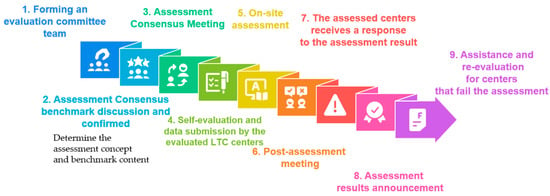
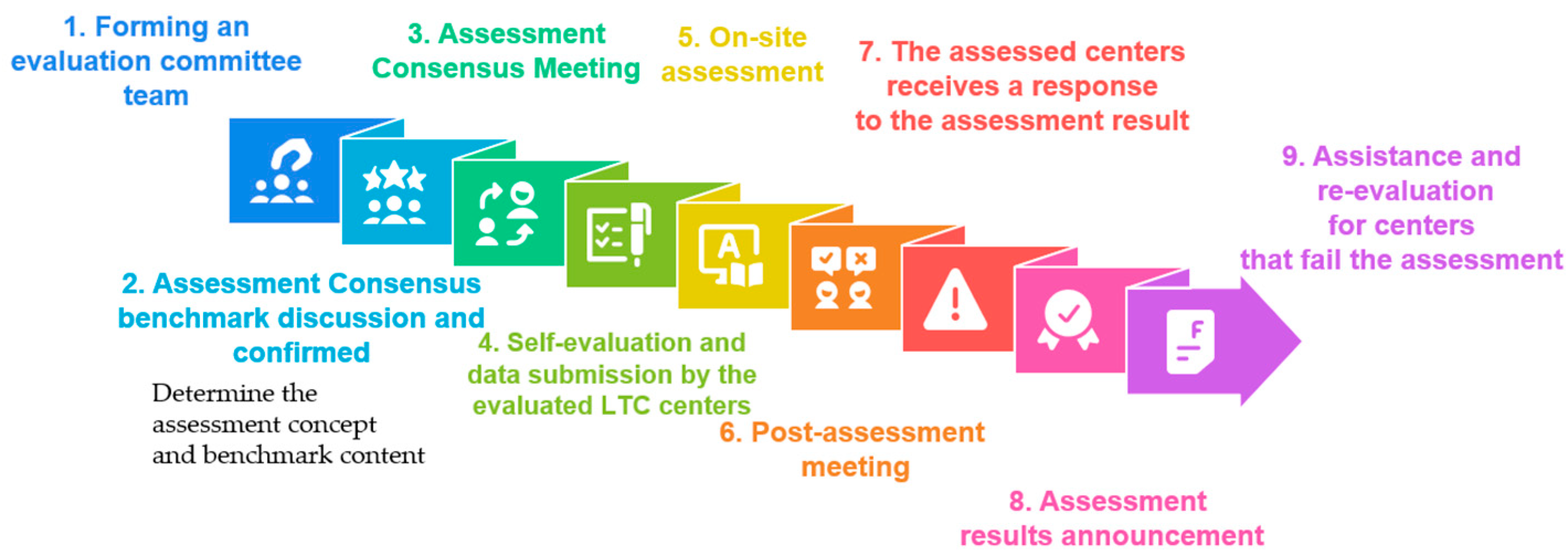
In this research, we performed LTC center assessment via onsite auditing. The assessment committee audited 98 LTC centers from 2023 to 2025, including 60 home-based LTC centers and 38 community-based daycare centers. The assessment planning process is shown in Figure 1 (Huang et al. 2019).
Figure 1.
Planning process of LTC assessment.
2.4. Division of Committee Board and Assessment Consensus Meeting
The selection principles for the assessment committee recruit experts and scholars in business management, elderly welfare, LTC services, nursing, social work, and environmental safety; practical experts representing institutions; representatives of competent authorities; and evaluation committee members reserved by MOHW for LTC centers in Taiwan. And, after completing the on-site assessment, they must participate in the post-assessment audit meeting to discuss and confirm the assessment result.
Each on-site assessment for home- and community-based LTC centers might be conducted by a panel of 4 assessment committee members, including 1 of management field expertise; 1 of social work or environmental safety field expertise; and 2 of nursing and LTC service field expertise.
Assessment committee should comply with Ethics Evaluation and Controversy Handling: (1) Due to the diversity in the missions and organizational forms of the assessment center, as well as differences in scale and operation methods, it is recommended that committee members avoid assessing home- and community-based LTC centers using the service types and standards of residential or medical institutions. (2) The assessment committee should respect the vision and goals of the center being evaluated. Members can understand whether the service execution model and strategies are appropriate through its vision and goals, rather than using them as criteria or standards for scoring. (3) The assessment committee should provide appropriate and feasible suggestions for each center being evaluated based on the practical difficulties and limitations. (4) During the on-site assessment process, the committee should not ask questions in a probing or doubtful manner. (5) Ethics should be handle according to the Assessment Consensus Benchmarks (Cheng 2025).
Assessment scoring was conducted via on-site assessment as a methodological triangulation approach (document review, observation, and interviews) to minimize information bias. The committee’s inter-rater reliability was established through a mandatory pre-assessment consensus workshop. This training calibrated the committees’ interpretation of the “A+ to C” scoring scale to ensure scoring consistency across different centers.
2.5. Assessment Structure of LTC Centers
According to Article 39 of the LTC Services Act and Article 3 of the Regulations Governing the Evaluation of LTC Centers, the assessment concept of home-based and community-based care centers includes their management effectiveness (administrative, human resource, and financial management, as well as assessment/audit improvement), professional care quality (service plan evaluation and treatment, healthy living care, and emergency event system and management for individuals), environmental and equipment safety (emergency disaster system and equipment, and daily activity equipment management), and individual equity guarantee (individual rights formulation and signing, and individual rights assurance). This concept integrates the measurement of the quality of life in LTC (LTC QoL) to develop assessment tools (McDonald 2020):
- Management effectiveness: The center might develop an annual business plan and operating guidelines, formulate employee manuals and administrative regulations, organize regular meetings, and maintain/manage equipment. Service personnel management might include standard human resource allocation, employee management, on-the-job training programs, and regular employee health checkups and vaccinations. Financial management might entail robust financial management and accident or emergency response measures (Hung et al. 2025).
- Professional care quality: The center might perform case assessment, care planning, evaluation tracing, care delivery, supervision, service user health checkups and management, infection control, family support provision, and quality monitoring.
- Environmental and equipment safety: The center might align with facility establishment criteria; provide an age-friendly environment, accessible washrooms, and adequate washing and sanitary facilities; comply with building public safety inspection certifications; install and manage fire safety equipment; design evaluation and escape routes; devise disaster response plans; inspect drinking water; execute environmental safety and infection control measures; and install simple first aid kits (Yang et al. 2023).
- Individual equity guarantee: The center might disclose information, devise user feedback/complaint channels and signed service agreements, and enforce personal information management and confidentiality.
The assessment criteria and score assignment structure are presented in Appendix A.
In this work, the Structure–Process–Outcome (S-P-O) model is utilized to synthesize the professional opinions of various expert committee members during the onsite assessment process (Yang et al. 2025). We use S-P-O as a theoretical lens to examine the causal chain whereby organizational capacity (Structure) influences service delivery (Process), which in turn determines the quality of care (Outcome). The assessment indicators were categorized into three dimensions.
- Structure: Reflects the static capacity of LTC centers, including administrative management, human resource allocation, financial stability, and environmental safety.
- Process: Reflects the dynamic delivery of care, such as service plan evaluation, the execution of nursing techniques, infection control procedures, and the protection of individual rights.
- Outcome: Reflects the results of care, including service satisfaction feedback and the remediation of deficiencies identified in previous audits.
2.6. Assessment Scoring and Task Division for Committee Board
The LTC quality assessments were audited at established LTC service centers in the final year of the assessment validity period (an evaluation was performed once every four years) or within the second year of operation in newly established centers. The assessment committee board used a congruent set of assessment benchmarks to conduct the onsite assessments (including written documents and personnel interviews), as well as grading scores, and they collectively decided the outcomes. A center qualified if it scored at least 70 points and received a validity period of four years. If the unqualified centers were still unqualified at the re-evaluation, their eligibility was revoked. The two modes of LTC centers involved in the LTC Service Quality Assessment Plan 2023–2025 were home-based LTC centers and community-based daycare centers, all located in a county in mid-south Taiwan. The assessment benchmarks were adopted based on the MOHW and consensus meetings with the assessment centers and the assessment committee and included the following: (1) for home-based LTC centers, there were 20 assessment criteria encompassing three dimensions: operation management effectiveness, professional care quality, and case equity guarantee, and each criterion had a total score of 5; (2) for community-based daycare LTC centers, there were 40 assessment criteria encompassing four dimensions: operation management effectiveness, professional care quality, environment and equipment safety, and case equity guarantee, with a total score of 2.5 for each consensus benchmark. The assessment committee board consisted of experts, scholars, and professionals with practical experience in LTC services, healthcare, management, social work, and environmental safety (McDonald 2020; Zheng et al. 2024).
The assessment scoring principles were based on the resolutions of the 2023–2025 Baselines for Grading LTC Centers meeting. Based on this research, the grade levels and committee board division of home-based and community-based daycare LTC centers are shown in Table 4 (the codes in Table 4 are described in Appendix A).
Table 4.
Grade levels and committee board division of the consensus benchmark.
2.7. Data Analysis
The passing rate and coincidence rate (compliance rate) were calculated for each assessment concept → factor → consensus benchmark. The coincidence rate was defined as the ratio of the actual score obtained by the center to the maximum possible score for each consensus benchmark. This analysis allowed for the identification of systemic strengths and weaknesses across the LTC network, distinguishing between concepts characterized by high performance (e.g., individual equity guarantees) and areas requiring policy intervention (e.g., emergency response systems).
3. Results
3.1. LTC Assessment Results
Based on the onsite assessments for the 2023–2025 LTC Service Quality Enhancement Plan, perceived service quality was identified as a multidimensional and multilayered reflection of the intrinsic assessment results rather than a score judgment based solely on interim results. As a result of the implementation of this plan, 98 centers were assessed, among which 90 passed and 8 did not. The results of the assessment center classification are presented in Table 5, and an analysis of the assessment grading for each LTC center concept is presented in Table 6.
Table 5.
Assessment centers from 2023 to 2025.
Table 6.
Assessment scores for each concept/factor/consensus benchmark.
Analysis of the assessment concept revealed that the coincidence ratios in the concepts of management effectiveness and individual equity guarantee were both above 80% for home-based (81.55%) and community-based daycare centers (81.9%). The coincidence ratio of professional care quality was higher in community-based daycare centers (80.6%) than in home-based centers (74.2%). The coincidence ratio of environment and equipment safety was over 90% in community-based daycare centers.
Based on the LTC model and factor coincidence ratio analysis, home-based long-term care institutions have less than 80% compliance rate with the concept of professional care quality. Home-based LTC centers exhibit greater “variability” in causing the three factors with the lowest coincidence rates, which are healthy living care, emergency event system and management for individuals, and service plan evaluation and treatment (72%, 72.5%, and 75.5%). Therefore, home-based LTC centers should establish management mechanisms that align with the characteristics of home-based service organizations, and effectively implement assessments and tracking to ensure the quality of services to present a professional image of the center. The coincidence rates for the two factors of financial management and individual rights formulation and signing are the highest (98.5% and 93.25%).
Therefore, community-based daycare centers have coincidence ratios of over 80% in all four concepts, especially the concept of individual equity guarantee (91%) and the concept of environment and equipment safety (90%), which perform best at over 90%. Because daycare LTC centers primarily provide living and resting services for disabled or dementia cases for about 6–10 h per service day, they are required to provide a safe environment that meets the daycare center setup standards (building, fire safety, and sanitation measures), which occupies the most (32.5%) in the concept of environmental and equipment safety. Higher compliance rates in the factors include: assessment/audit improvement, individual rights formulation and signing, emergency disaster system and equipment, and daily activity equipment management (97.84%, 95%, 90.72%, and 89.3%). Otherwise, the factors for the lower coincidence rates are: emergency event system and management for individuals, service plan evaluation and treatment, and administrative management system (75.72%, 77.14%, and 78.14%). The professional care quality of core services provided by daycare LTC centers focuses on assessment, individualized care plans, follow-up evaluations, case management, infection control, family support, and interdisciplinary resources related to ‘case-individualized management’.
3.2. Practical Issues in LTC Center Assessment
The findings included the following. (1) Absoluteness: Under the explicit assessment standards, the facilities and equipment, human resource allocation, operation standards, and financial systems in the LTC services were well grounded and compliant with regulations, ensuring the provision of basic care. (2) Personalization: The LTC services emphasize individual differences, expectations, and values, and a user-centered approach to provide specifically individualized and humanized care (Cheng 2025). (3) Social dimension: The LTC services account for overall social value, emphasize the uniform distribution of care resources, and forbid partiality toward specific groups and the neglect of social welfare. In addition to the uniform evaluation of the LTC service quality based on the announced assessment criteria (the evaluation committee decided each facility’s qualification), this research also recommends the featured service content designed and promoted by each assessment center, thereby shaping a multidimensional service quality evaluation mechanism for fostering a competitive climate and promoting continuous improvements in the LTC service quality.
The findings of this study validate the applicability of the S-P-O model in LTC assessment. Centers with advantages in terms of structure (e.g., financial management and staffing levels) consistently demonstrated better performance in process indicators (e.g., individualized care planning). However, a discrepancy was observed in the outcome dimension, particularly in satisfaction surveys. It was found that, while structural compliance is a prerequisite, it does not guarantee a superior user experience unless the service delivery process is truly person-centered. Therefore, quality management in LTC should move beyond mere structural compliance to focus on the dynamic interactions within the care process. To summarize the assessment results obtained from the LTC service quality enhancement plan, the existing weaknesses of home-based LTC centers and community-based daycare centers are listed in Table 7.
Table 7.
Suggestions for LTC centers.
4. Discussion and Suggestions
4.1. Discussion
Across on-site assessment, observations, and document analysis of home- and community-based daycare LTC centers in Taiwan. These findings of quality management in LTC should be case (user)-centered and focused on improving their quality of life. Management of the internal service quality should also be considered, in addition to the diverse methods of external quality control evaluation, to facilitate a cycle of continuous improvement. It reflects outpatient care’s quality requirement to expand interventional and qualitative studies. Also, the structural indicators offer more policy and resource support (Yang et al. 2025). Finding support for the quality indicators for home care services can be used to evaluate the service quality of home care from patients’ perspectives, and facilitate the determination of work priorities and improvement of quality (Zheng et al. 2024).
Furthermore, LTC centers should utilize assessment systems to assess the professional roles and skills of caregivers, identify the differences and characteristics of each LTC center, and demonstrate the spillover effects of these features. Care providers should also be able to apply a combination of physical and mental disability, dementia, and frailty assessment tools to identify differences in care needs to improve the quality of care (Cheng 2025; Hung 2024), which are relatively high-priority criteria, such as LTC service assessment, professional service management, nursing assistant training, human resource assessment systems, and professional certification programs (Chen et al. 2019).
Therefore, using assessment criteria as a benchmark for managing and accessing the quality of care in LTC centers actively, as well as appropriately applying or integrating local resources, is also an important point in improving the quality of LTC services (Zheng et al. 2024). Each LTC center might organize a LTC service quality improvement steering committee to provide in-depth consultation and guidance to improve various services in each LTC center regularly, and encourage caregivers to optimize service competence continuously (Yang et al. 2023).
4.1.1. Improvement Practices for Non-Passing LTC Centers
As shown in Table 5, the primary reason that LTC centers do not pass assessments is that managers do not fully understand the purposes of LTC assessment, the benchmark content of the assessment indicators, or the corresponding care service effectiveness demonstration materials. Furthermore, LTC centers that do not pass are likely to receive informal benchmark information from unfamiliar clients or other industry peers when seeking clarification. This misleading information is circulated within the same group/community, leading to misunderstandings about service quality improvement standards and reference benchmarks among non-passing assessment centers. Consistent with prior research, although LTC centers vary in service models, they all provide continuous care services centered on the case (user) as a core mission (Hung et al. 2025; Speckemeier 2023). Accordingly, LTC centers should support the continuous development of caregivers’ professional service knowledge and skill improvement to avoid diminishing their impact on individual care quality and satisfaction (Cheng 2025).
Therefore, it is recommended that, while announcing the consensus benchmark at the end of each year, government authorities should also communicate all consensus benchmark conventions to provide centers and business leaders with specific and clear preparation information to conduct pre-assessment work. This would help to avoid confusion regarding the relevant concepts and preparation methods for LTC center assessment, as well as addressing the perception that LTC center assessment only increases managers’ workloads, without clear outcomes or benefits (Hung 2024; Zheng et al. 2024).
4.1.2. Continuous Tracking and Problem-Solving Mechanisms in Qualified LTC Centers
Within LTC centers, the LTC assessment system should be used to establish a continuous tracking and management model after the assessment. The main responsible units of each county should conduct assessments of LTC centers and irregular inspections in accordance with the law, and they should implement the assessment mechanism to evaluate service effectiveness and service quality. Moreover, it is recommended that LTC centers establish a comprehensive service mechanism for those with low compliance rates (Chen et al. 2019).
This mechanism should follow a quality implementation cycle of establishment, implementation, recording, tracking, and improvement. The compliance rate should guide centers to connect routine and non-routine workflows through the compliance criteria, thereby enabling a proactive, organization-wide strategy for collaborative quality management (Hung 2024; Hung et al. 2025).
Quality management monitoring mechanisms should be implemented by an experienced supervisor who can monitor each caregiver’s service efficiency and timeliness, assist in troubleshooting, and communicate with and coordinate the support of other caregivers.
4.2. Suggestions
This research proposes the following recommendations for improving the tangible infrastructure, environment, assistive devices, and disaster response measures: (1) installing artificial intelligence (AI)-based (IoT) wandering prevention monitoring systems at center entrances; (2) installing AI-based automatic wheelchair/assistive device recognition systems; and (3) constructing AI systems that assist caregivers during various hazards (re-minder and reporting systems for different types of emergency evacuation procedures).
This research also proposes the following recommendations for improving personnel, cash, and information flows (MOHW 2025b): (1) An internal management loop should be formed within the center through the PDCA (Plan–Do–Check–Audit) management cycle. (2) Measures regarding personnel flow include providing full-/part-time personnel attendance evaluation and performance information, regularly calculating the patient volume/caregiving ratio (as a precaution) and maintaining the talent pool (individual/facility). (3) Measures regarding cash flow include calculating case fees, caregiver management and staff salaries, and receipt reports. (4) Measures regarding information flow include providing the self-improvement bases for cases and facilities and integrating patient-centered interdisciplinary resources. (5) Centers should improve the capability to analyze big data or historical records regularly. (6) The resource coordination and integration of the LTC service system should be strengthened. (7) An international cooperation and experience-sharing platform to enhance the quality of LTC services should be developed.
Regarding the implementation of business performance management mechanisms to improve the effectiveness of service quality benchmarking, the LTC industry in Taiwan is inconsistent with its jurisdiction from 2024 to 2025. The government is more focused on regulating the supply of services and personnel qualification and less on demand- and user-oriented performance metrics. Consequently, creating caregiving services that ac-count for user values is difficult. Various for-profit enterprises have taken the important step of adopting performance evaluation and management measures (e.g., 360-degree performance appraisals, key performance indicators, Six Sigma, balanced scorecards, and strategy maps). Different measures are always proposed in line with the changes in the macro environment, including management concepts and techniques, sharing and improvement approaches, various ways that industries eliminate ineffective processes, and the proposal of management exemplars at each period or phase based on the principle of knowledge and value sharing.
5. Conclusions
With the advent of the super-aged society, the government must continuously im-prove LTC policies. To guide LTC centers to improve their management systems and ser-vice quality through the assessment system, the assessment consensus benchmarks of all LTC center modes must be regularly reviewed. In addition to the routine management and implementation of basic service work, this research recommends combining expert onsite guidance, annual participation in professional courses for LTC public points, irregular inspections or regular supervision, and service quality assurance measures. LTC centers should focus on case-centered, integrated professional care and the creation of competitive advantages. The evolution of a super-aged society and the rapid changes in aging needs make the development of assessment criteria for service model innovation relatively important. The assessment system for LTC centers being able to connect policy developments with the fulfillment of innovative service needs is a future research issue.
Funding
This research received no external funding.
Institutional Review Board Statement
Not applicable.
Informed Consent Statement
Not applicable.
Data Availability Statement
The original contributions presented in this study are included in the article. Further inquiries can be directed to the author.
Conflicts of Interest
The author declares no conflicts of interest.
Abbreviations
The following abbreviations are used in this manuscript:
| LTC | Long-term care |
| MOHW | Ministry of Health and Welfare |
Appendix A
Assessment Structure and Consensus Benchmarks
| Assessment Concept | Assessment Concept Factor | Consensus Benchmark | Key Content of Benchmark | |
| Home-Based LTC Centers (H) | Community-Based Daycare Centers (D) | |||
| A: Management effectiveness | A1: Administrative management system | H-A1-1: Business plan development and implementation | D-A1-1: Business plan development and implementation |
|
| H-A1-2: Work manuals and administrative management regulations H-A1-3: Supervisory system operation | D-A1-3: Administrative operation and service quality management |
| ||
| H-A1-5: Actual participation of supervisor in administrative and care quality management meetings/activities | D-A1-5: Actual participation of supervisor in administrative and care quality management meetings/activities | The business manager is actively involved in administration and care quality management, and keeps records (such as constructing the annual business plan, presiding over administrative meetings, reviewing meetings for accidents or emergency incidents, etc.). | ||
| H-A1-4: Information system coding | NA | Service providers must record the service status of each case in the municipal government care service management information platform by the 10th of the following month. | ||
| NA | D-A1-2: Social participation and community resource linkage status |
| ||
| NA | D-A1-4: Disclosure of service information | Make LTC service information transparent and publicly available to select for those in LTC need. | ||
| A2: Human resource management | H-A2-1: Establishment and implementation of systems related to staff rights and interests | D-A2-1: Establishment and implementation of systems related to staff rights and interests |
| |
| H-A2-2: Regular health check-ups and follow-ups for staff | D-A2-2: Regular health check-ups and follow-ups for staff |
| ||
| H-A2-3: Pre-training for new staff | D-A2-3: Pre-training for new staff |
| ||
| H-A2-4: Establishment and implementation of a scheduling mechanism for caregiving staff | NA (The daycare center operates on a case-based group service model, so staff not need intensive scheduling) |
| ||
| A3: Financial management | H-A3-1: Financial management system | D-A3-1: Financial management system | Establish an independent accounting system based on the principle of accrual accounting basis, with tax reporting information. | |
| A4: Assessment/audit improvement | H-A4-1: Deficiency and improvement evaluation by the relevant authority during the auditing/inspection period | D-A4-1: Deficiency and improvement evaluation by the relevant authority during the auditing/inspection period |
A as improved by 80%, but not reached 100%. B+ as improvement reached 60% but not reach 80% B as improvement reached 40% but not reach 60% C as improvement not reach 40% | |
| B: Professional care quality | B1: Service plan evaluation and treatment | H-B1-1: Strengthening the professional skills of LTC service personnel | D-B1-5: Strengthening of LTC service personnel |
|
| H-B1-3: Management of case starting and finishing for service recipients | D-B1-3: Infection prevention, treatment, and monitoring during service delivery | Formulate procedures and processing guidelines for case initiation/acceptance, referral, service suspension, and case closure, and clearly explain them to service recipients and their families. | ||
| H-B1-2: Caregiver service execution and feedback from service recipients/family members | NA |
| ||
| NA | D-B1-1: Service plans and multi-professional services |
| ||
| NA | D-B1-2: Client adaptation counseling or support |
| ||
| NA | D-B1-4: Health check-ups and health management for service users |
| ||
| B2: Healthy living care | H-B2-1: Proactive referral of cross-professional services | D-B2-1: Handling of group or community activities for service recipients |
| |
| NA | D-B2-2: Supportive services provided for caregivers (related persons) |
| ||
| NA | D-B2-3: Living assistance for clients | Provide life assistance services such as eating, bathing and cleaning, mobility, and toileting according to the individual needs of the service recipients. | ||
| NA | D-B2-4: Maintenance of self-care skills D-B2-5: Nutritious meal service | Arrange daily activities and provide life care services according to the needs of service recipients, such as offering independent living support, assisting with shopping, or reminding them to take medication. | ||
| B3: Emergency event system and management for individuals | H-B3-1: Accident and emergency handling and prevention | D-B3-1: Handling and prevention of accidents and emergencies |
| |
| NA | D-B3-2: Emergency medical evacuation services available | |||
| C: Individual equity guarantee | C1: Individual rights formulation and signing | H-C1-1: Signing of a service contract with the service recipient or family member | D-C1-2: Service contract with the recipient or family member |
Sign a contract with the client (the person themselves, family members, guardian, or agent) The contract or annex should be updated when relevant regulations, service recipients, or institutional service conditions change. |
| H-C1-2: Fees and receipts | D-C1-3: Fees and receipts | The fee standards are subject to approval by the competent authority with regulations. | ||
| NA | D-C1-1: LTC center security insurance | Regularly and continuously purchase public liability insurance. | ||
| C2: Individual rights assurance | H-C2-1: Establishment and handling of feedback/complaint process | D-C2-1: Establishment and handling of the feedback response/grievance process |
| |
| H-C2-2: Service satisfaction surveys | D-C2-2: Service satisfaction surveys |
| ||
| D: Environmental and equipment safety | D1: Emergency disaster system and equipment | NA | D-D1-1: Emergency call system |
|
| D-D1-2: Fire safety management | Strengthen institutional fire safety management and refer to local disaster case experiences. | |||
| D-D1-3: Public safety inspection of building | Conduct public safety inspections of buildings in accordance with regulations. | |||
| D-D1-4: Evacuation system (evacuation setup) | Set up escape routes in accordance with relevant regulations that comply with the accessibility design standards for buildings. | |||
| D-D1-5: Formulation and implementation of emergency disaster response plans and operating procedures that meet the characteristics and needs of daycare LTC centers | Set up escape routes in accordance with relevant regulations that comply with the accessibility design standards for buildings. | |||
| D-D1-6: Institutional environmental cleanliness and vector control | Ensure the cleanliness of the facility environment and pest control to improve the quality of long-term care facility environments. | |||
| D-D1-7: Safe and clean drinking water supply | According to the “Drinking Water Management Regulations” and the “Regulations on the Use and Maintenance Management of Continuous Drinking Water Supply Fixed Equipment” in Taiwan. | |||
| D2: Daily activity equipment management | NA | D-D2-1: Rest equipment provided | The rest facilities comply with the center setup standards and relevant regulations. | |
| D-D2-2: Daily activities provided | On-site inspection to determine whether the center has sufficient facilities and equipment for the social interaction needs of service recipients. | |||
| D-D2-3: Clean and hygienic kitchen and dining environment | Ensure that the dining environment provided to service recipients is hygienic, clean, and meets their needs. | |||
| D-D2-4: Food hygiene | Food samples should be stored separately (either the entire portion or 200 g of each food item), labeled with the date and meal, and refrigerated for 48 h. | |||
| D-D2-5: Equipment maintenance and management | Ensure the safety of service users when using equipment. | |||
| D-D2-6: First aid items | Ensure that the center can respond to daily and emergency situations (e.g., basic first aid kit) | |||
References
- Centers for Medicare & Medicaid Services (CMS). 2024. Revised Guidance for Long-Term Care Facility Assessment Requirements; Woodlawn: Centers for Medicare & Medicaid Services. Available online: https://www.cms.gov/medicare/health-safety-standards/quality-safety-oversight-general-information/policy-memos-states-and-cms-locations/revised-guidance-long-term-care-facility-assessment-requirements (accessed on 2 January 2026).
- Chang, Ming-Chung, Jin-Li Hu, and Chih-Wei Liu. 2024. A regional efficiency assessment of long-term care services in Taiwan. Systems 12: 484. [Google Scholar] [CrossRef] [Scilit]
- Chen, Liang-Ju, Jung-Hsuan Wang, and Meng-Ting Chen. 2019. Opinion difference between evaluators and providers on home care service assessment system. Journal of Healthcare Management 20: 101–25. [Google Scholar] [CrossRef]
- Cheng, Chun-Yun. 2025. Applying IPA model to analysis the care quality of home care attendants. Journal of Geotechnology and Service Management 13: 1–22. [Google Scholar] [CrossRef]
- Hsiao, Wen-Kao. 2021. A multi-level network governance analysis on governance tools for elderly long-term care institutions. Social Policy & Social Work 25: 49–91. [Google Scholar] [CrossRef]
- Huang, Yao-Rong, Yuan-Mei Chang, Ming-Li Ye, and Xuan-Wen Su. 2019. Assessment indicators of environmental quality for dementia day care center. Journal of Architecture 109: 21–49. [Google Scholar] [CrossRef]
- Hung, Jui-Ying. 2024. Yunlin County Long-Term Care Service Quality Improvement Program Results Report. Yunlin: Yunlin County Health Bureau. [Google Scholar]
- Hung, Jui-Ying, Pin-Hsuan Chiang, and Kai-Lin Li. 2025. Analysis of different perspectives of community-based long-term daycare centers. International Journal of Environmental Research and Public Health 22: 1017. [Google Scholar] [CrossRef] [Scilit] [PubMed]
- McDonald, Tracey. 2020. Measurement features of a long-term care quality of life (LTC-QoL) assessment scale. Journal of Care Services Management 7: 76–86. [Google Scholar] [CrossRef] [Scilit]
- Ministry of Health and Welfare (MOHW). 2019. The Implementation and Challenge of the Long-Term Care 2.0 Program in Taiwan; Taipei: MOHW. Available online: https://ltc.kmu.edu.tw/images/%E8%96%9B%E6%AC%A1%E9%95%B7%E6%9C%80%E6%96%B0%E7%B0%A1%E5%A0%B1.pdf (accessed on 27 January 2026).
- Ministry of Health and Welfare (MOHW). 2021. White Paper on Aging Society; Taipei: MOHW. Available online: https://service.mohw.gov.tw/ebook/dopl/113/02/files/downloads/ebooke.pdf (accessed on 15 October 2025).
- MOHW. 2023. Long-Term Care 2.0 Implementation Status and Review Project Report; Taipei: MOHW. Available online: https://www.mohw.gov.tw/cp-4344-46546-2.html (accessed on 15 October 2025).
- MOHW. 2025a. Long-Term Care 3.0 Planning Report; Taipei: MOHW. Available online: https://www.ey.gov.tw/File/A9DB7136646A758E?A=C (accessed on 18 October 2025).
- MOHW. 2025b. Long-Term Ten-Year Plan 2.0 Related Statistics; Taipei: MOHW. Available online: https://1966.gov.tw/LTC/lp-6485-207.html (accessed on 18 October 2025).
- National Audit Office. 2023. Project Audit Report—Report on the Implementation of the Government’s 10-Year Plan for Long-Term Care 2.0; Taipei: National Audit Office. Available online: https://www.audit.gov.tw/p/405-1000-8867,c158.php?Lang=zh-tw (accessed on 15 October 2025).
- OECD. 2025. Needs Assessment and Eligibility Criteria in Long-Term Care: How Access Is Managed Across OECD Countries. OECD Health Working Papers, No. 181. Paris: OECD Publishing. [Google Scholar] [CrossRef] [Scilit]
- Speckemeier, Christian. 2023. Preferences for attributes of long-term care in dementia: A scoping review of multi-criteria decision analyses. Journal of Public Health 31: 1597–608. [Google Scholar] [CrossRef] [Scilit]
- Yang, Chih-Hao, Yen-Chi Chen, Wei Hsu, and Yu-Hui Chen. 2023. Evaluation of smart long-term care information strategy, portfolio decision model: The national health care environment in Taiwan. Annals of Operations Research 326: 505–36. [Google Scholar] [CrossRef] [Scilit] [PubMed]
- Yang, Jinrong, Fan Liu, Chunxia Yang, Jingyi Wei, Yonghong Ma, Lisheng Xu, Jingying Xie, and Jingjun Wang. 2025. Application of Donabedian Three-Dimensional Model in Outpatient Care Quality: A Scoping Review. Journal of Nursing Management 2025: 6893336. [Google Scholar] [CrossRef] [Scilit] [PubMed]
- Zheng, Qiu-Lan, Ling-Na Kong, Ping Hu, and Dun-Xiu Liu. 2024. Identifying quality indicators for home care services: A modified Delphi and Analytic Hierarchy Process study. BMC Nursing 23: 494. [Google Scholar] [CrossRef] [Scilit] [PubMed]

Disclaimer/Publisher’s Note: The statements, opinions and data contained in all publications are solely those of the individual author(s) and contributor(s) and not of MDPI and/or the editor(s). MDPI and/or the editor(s) disclaim responsibility for any injury to people or property resulting from any ideas, methods, instructions or products referred to in the content. |
© 2026 by the author. Licensee MDPI, Basel, Switzerland. This article is an open access article distributed under the terms and conditions of the Creative Commons Attribution (CC BY) license.