
Developing Energy Citizenship—Empowerment Through Engagement and (Co-)Ownership, Individually and in Energy Communities
Abstract
1. Introduction
1.1. The Challenge
1.2. Aim and Contribution
- Supposing that engaging citizens in RE is a complex and multifaceted process with strong interdependencies of its single steps, which is biassed against vulnerable consumers: What are barriers to, opportunities for, and key elements of inclusive engagement?
- To back our conceptual approach, refine the analysis of obstacles reported in the literature, and identify conducive conditions for inclusive participation/engagement, we analyze 82 semi-structured interviews conducted in eight European countries on energy citizenship. Against the background of this empirical interview data confirming said interdependencies, we can assume that low-income households (LIHs), if they could overcome the obstacles to engagement, would have the same or even a larger propensity to commit to EE, prosumership, and behavioural change than rich households.
- Taking into account the relationship between ownership, governance, and inclusive engagement and its embeddedness in institutional environments: What institutional and governance structures are best suited to support the different aspects of energy citizenship, and what role do energy communities have in this context?
- Collective prosumer action offers greater opportunities than individual engagement through economies of scale and diversity of sourcing. The collective action of prosumers allows for the aggregation of resources, leading to economies of scale in energy production and consumption, which can result in cost savings and increased efficiency (Horstink et al. 2020; Lavrijssen and Parra 2017). At the same time, the challenge of inclusive participation of underrepresented groups is not limited to commercially oriented initiatives but also pertains, e.g., to ECs. Against this background, the state as a citizenship-granting entity should not be acknowledged merely as the provider of network coverage but also as that of a guaranteed minimum supply indispensable for participation in our modern energy-based societies. Here, both state (co-)ownership and cooperation with private sector incumbents from the professional energy sector will have an important role to play. Therefore, we investigate how different ownership–governance settings relate to each other and which synergies are relevant for the success of meaningful inclusion, in particular with regard to ECs.
- In view of the governance trichotomy state/market/civil society and the functional context of different forms of energy ownership: What is the role of the public hand when fostering inclusive collective prosumership, and how can the state incentivise complementarities with individual private and collective civil society initiatives?
- As the CEP in various places calls on the MS to put into place concrete measures to facilitate inclusion, especially in the context of fighting energy poverty, we analyse how the new rules can respond to this policy objective. In the context of institutional environments and, again, with a focus on the deployment of ECs, we explore what policy recommendations can be made at the EU level both with regard to supporting individual citizens and ECs as organisations.
- We address these research questions by firstly presenting the regulatory background of the CEP and the status quo of citizens’ engagement (Section 2). Secondly, we provide theoretical foundations of energy citizenship and (co-)ownership under an institutional lens (Section 3). Thirdly, we present the interview data and the methods applied in the analysis (Section 4). We then discuss said barriers to and facilitatory factors for empowerment through engagement in light of the interview results (Section 5). Subsequently, we introduce a model of ownership vectors, linking their functional and their governance context to the interview results (Section 6). Our conclusions (Section 7) provide policy recommendations, again tailoring possible support measures to the institutional environments identified. As a more ambitious long-term measure, we propose a “European Pillar of Energy Rights” to be further explored and developed.
2. Regulatory Background of the CEP and the Status Quo of Citizen Engagement
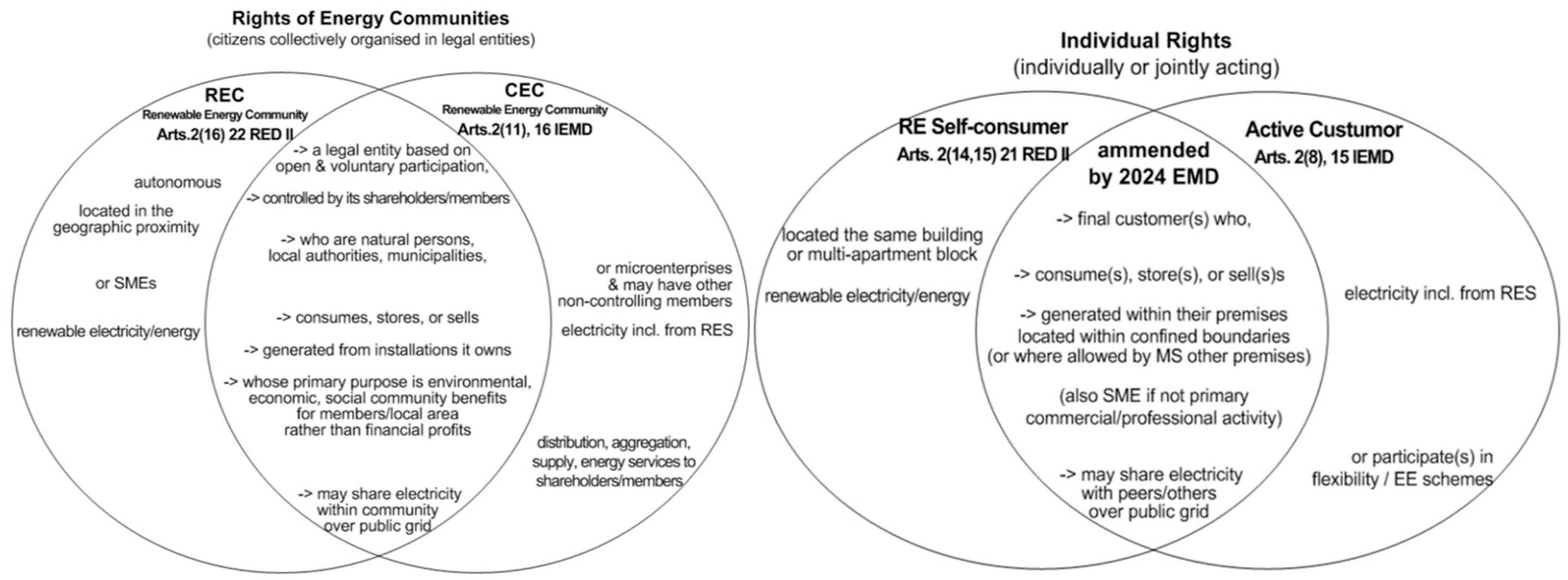
2.1. Introducing Individual and Collective Energy Rights
2.2. Regulating Energy Communities
3. Theory—Facilitating Empowerment Through Engagement and (Co-)Ownership
3.1. Energy Citizenship
3.2. Empirical Evidence on the Positive Effects of (Co-)Ownership from Germany
3.3. Capabilities and Their Link to Institutional Environments
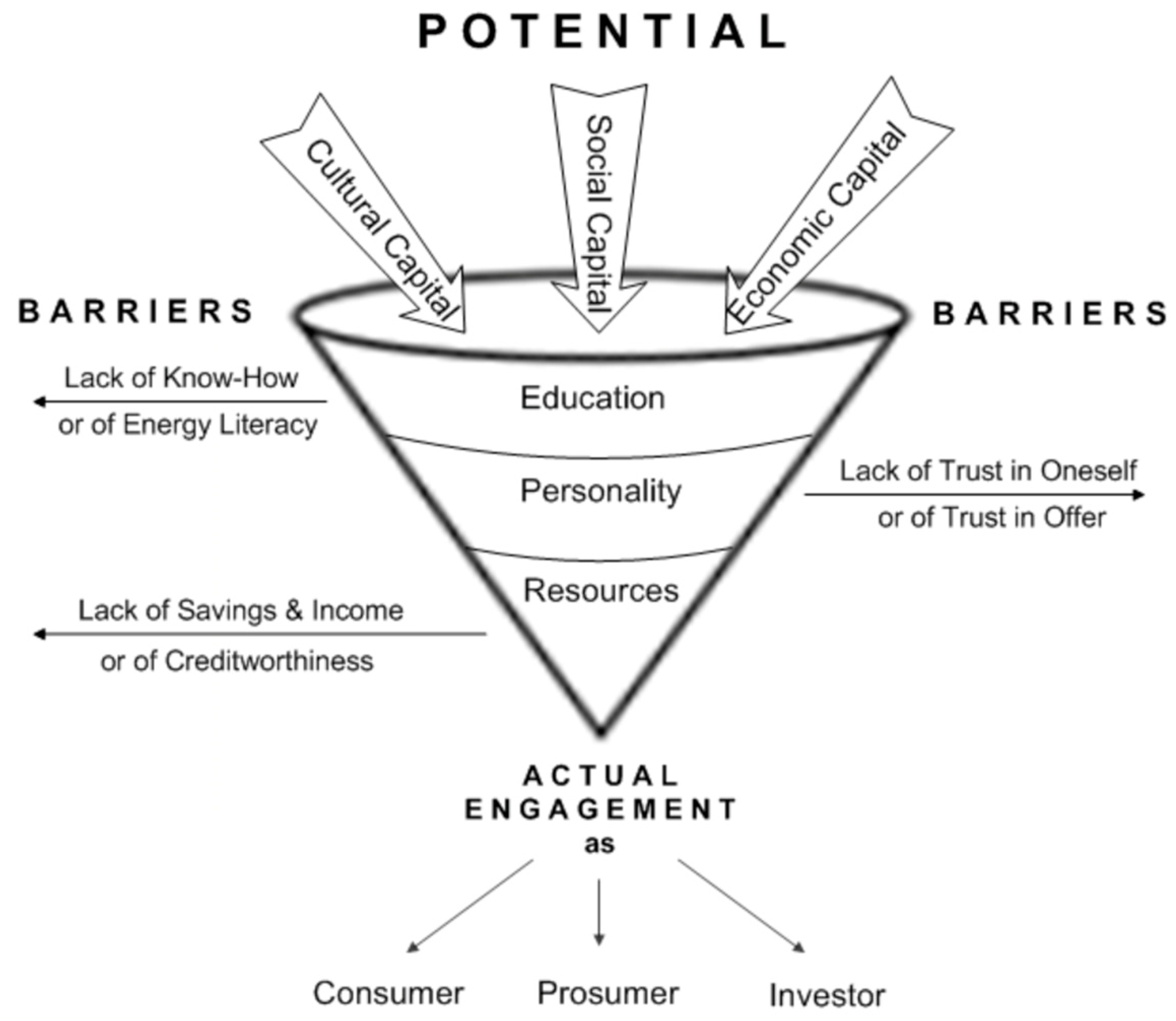
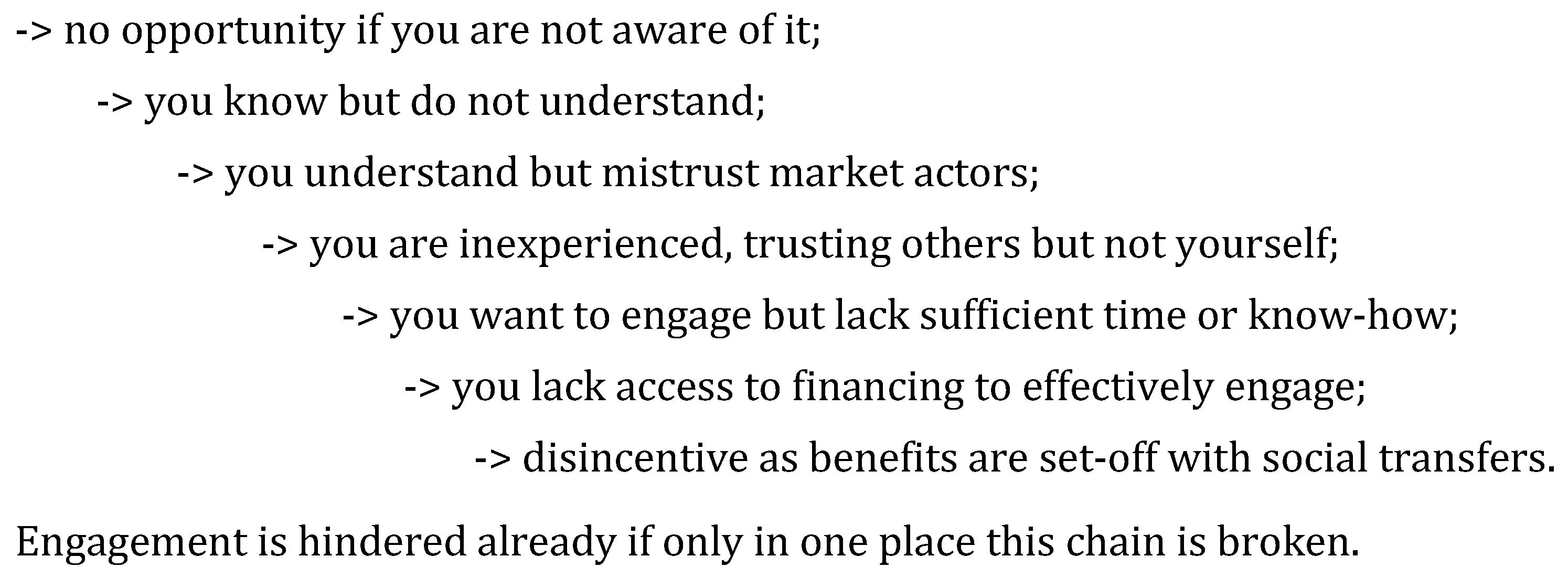
3.4. Interdependency of Obstacles—“The Engagement Chain”
3.5. Implications for Inclusion and the Energy Poor
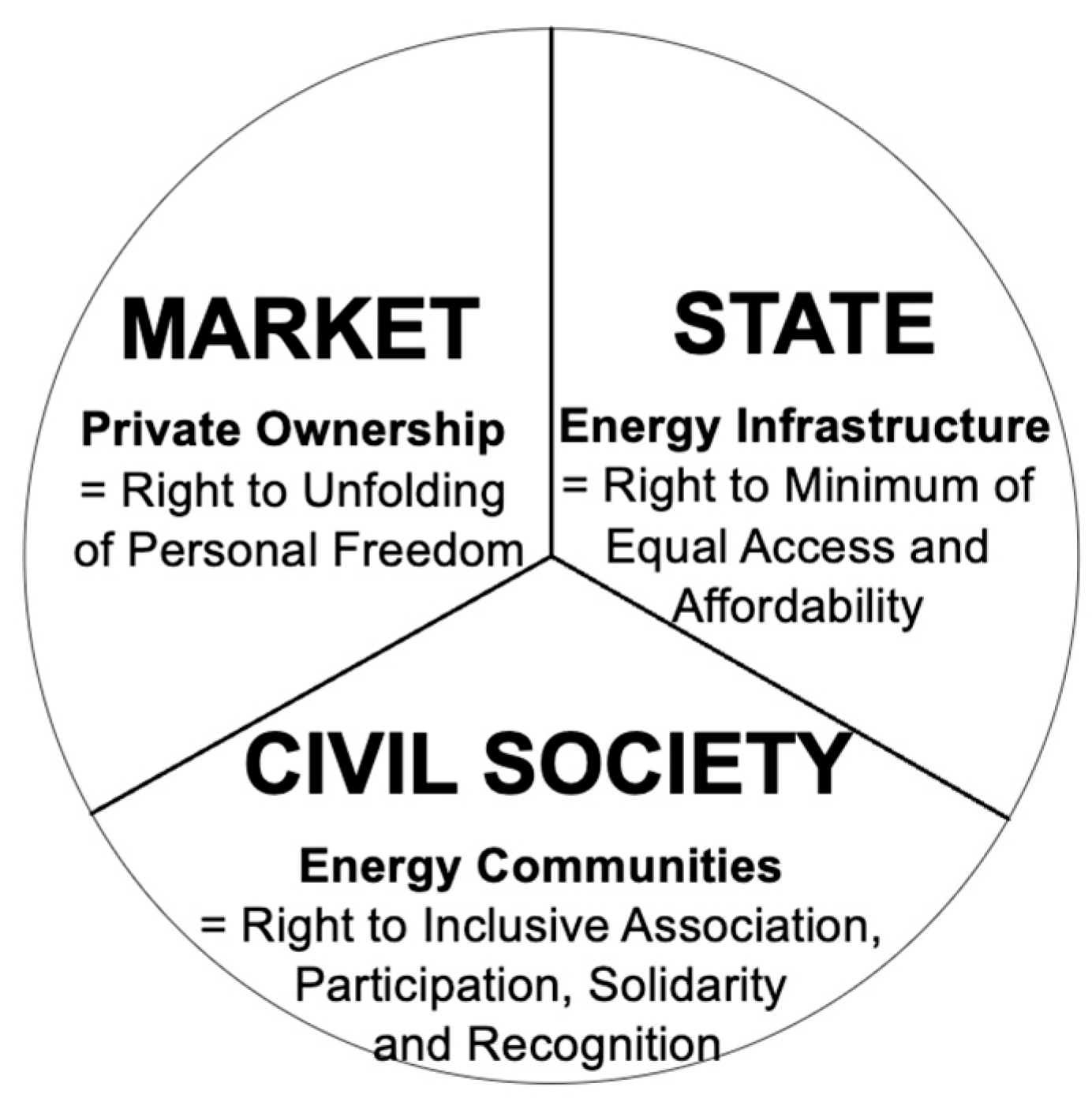
3.6. Institutional Embeddedness—The Governance Trichotomy
4. Materials and Methods
4.1. Semi-Structured Interviews and Sampling of Experts
4.2. Operationalisation of Research Questions and of Result Analysis
5. Results
5.1. Opportunities for Broader Engagement
5.2. Barriers to Broader Engagement
6. Discussion—Institutional Environments, Ownership Vectors and Their Functional and Governance Context
6.1. “Ownership” Under a Governance-Oriented Approach
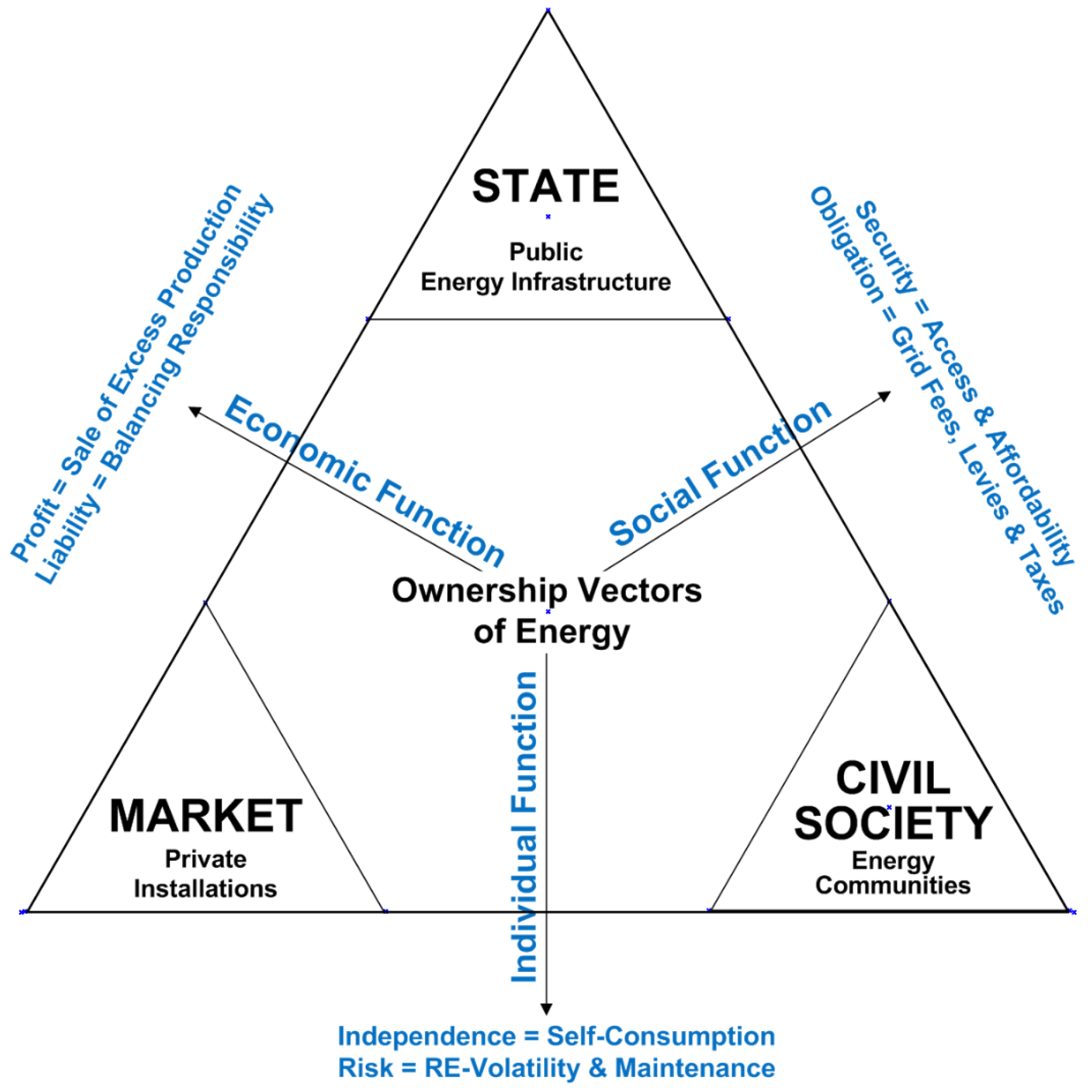
- The right to receive the yield of the sale of energy produced, but also the obligation to assume corresponding liabilities and risks, e.g., the balancing responsibility—the “economic function”;
- The guarantee of the personal right of producing energy for self-consumption, facilitating independence but also the associated risks, e.g., the volatility of RE and the burden of maintenance—the “individual function”;
- The provision of access to energy infrastructure and of energy security, but also the related obligations like grid fees, levies, and taxes—the integrational or “social function”.
6.2. Energy Ownership Vectors Require Different Types of “Energy Ownership”
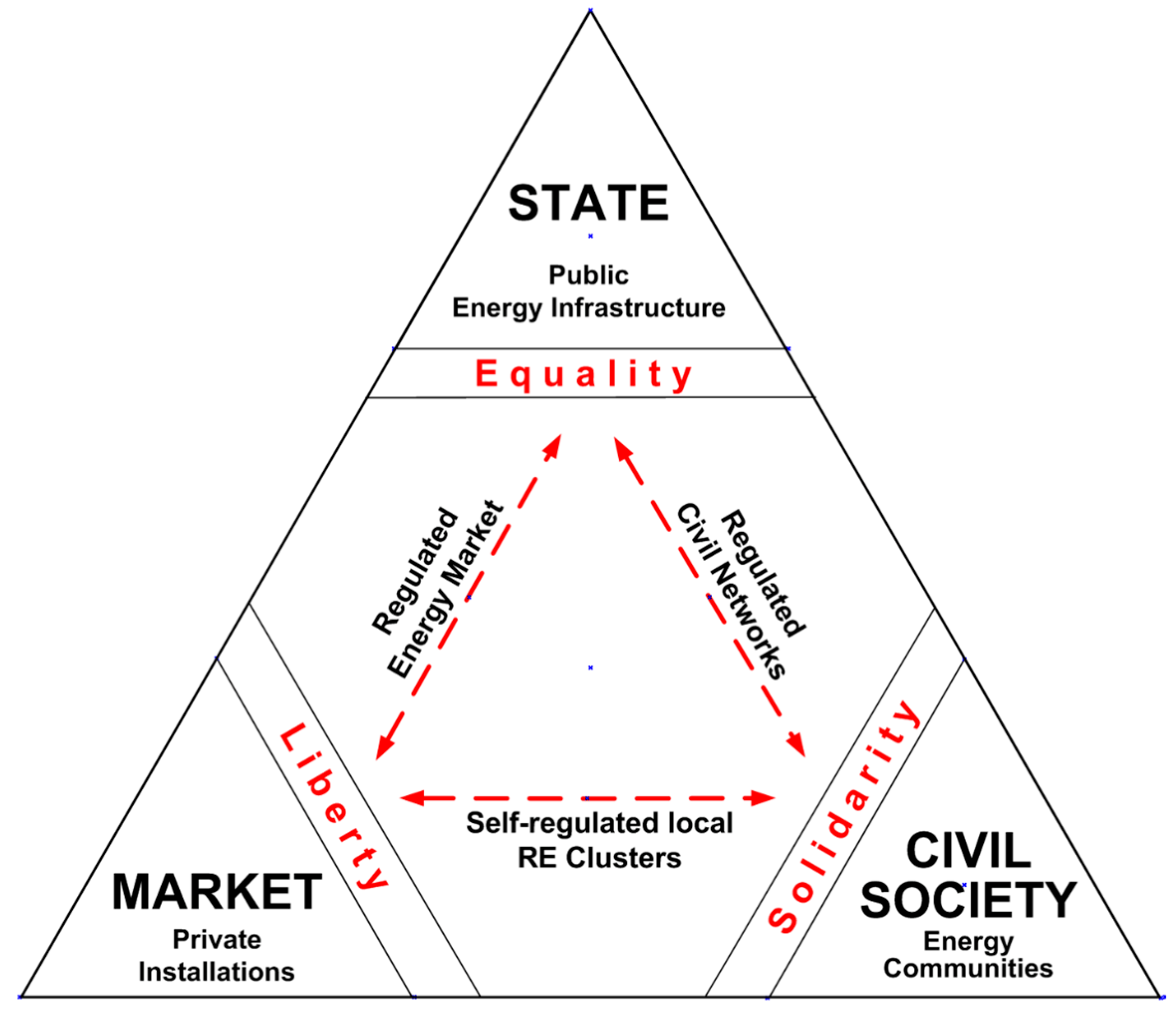
- Private ownership of production installations guaranteeing the unfolding of personal freedom of the economic subject, both with regard to entrepreneurial and individual rights, branded here with the catchword “liberty”.
- Public energy infrastructure, indispensable to guarantee broad access to all members of society independently of their geographic location and ensure the affordability of a basic energy supply, ensures a minimum of parity of all citizens—hence branded as “equality”.
- Ownership of energy infrastructure conveyed by ECs with a separate and distinct legal personality, be they private, public, or mixed, first and foremost RECs, but also CECs and other forms of ECs. The economic power of these entities typically stems from the large number of contributing shareholders or members based on a solidarity mechanism; while their primary purpose are community benefits rather than profits ECs—provided that they receive targeted support and are credited for doing so—could ensure the right to inclusive participation, solidarity, and recognition; thus, they can be captured by the term “solidarity”).
6.3. Complementarity—The Three Institutional Environments Seen as Participation Models
- (a)
- Those of state and market and thereby of liberty and equality—such as a ‘regulated energy market’ (to secure a level playing field, maintaining scope for profit-making and competition-driven innovation but also facilitating individual prosumership that is affordable and profitable);
- (b)
- Those of state and civil society and thereby of equality and solidarity—such as ‘regulated civil networks’ (to secure equal access to a minimum and reliable service, while enabling scope for collaboration on and sharing of common pool energy resources);
- (c)
- Those of market and civil society and thereby of liberty and solidarity—such as municipal ‘self-regulated local RE clusters’ (to allow ECs to enter B2B and B2C market transactions, while focusing on inclusive engagement that fits public entity involvement and enables citizen (co-)ownership).
- A liberty/market-guided mode of private resource control/allocation (e.g., the corporate form and decision-making mode, towards exchange transactions for private interest in private goods/services).
- An equality/government-guided mode of public resource control/allocation (e.g., the bureaucratic/government form and decision-making mode, towards command and control transactions for public interest in public/state goods/services).
- A solidarity/civil society-guided mode of common resource control/allocation (e.g., the cooperative/associative form and decision-making mode, towards collaborating/sharing transactions for collective interest in common goods/services).
7. Conclusions—Tailoring Support Measures to Different Institutional Environments
- When supporting self-regulated local RE clusters (intersection market and civil society) the focus is on joining ‘liberty’ with ‘solidarity’ by securing a proper balance within the EC between people, planet and profits (“Triple P”) in how benefits and burdens are fairly and sustainably distributed: Where LIHs are financially supported to participate and share in benefits and in exchange for an inclusive EC-charter CSO-Firm partnerships would receive statutory recognition and financial support to participate successfully in the competitive energy market.
- When supporting regulated civil networks (intersection state and civil society), the emphasis is on joining ‘solidarity’ with ‘equality’, by enabling diverse civil participation, especially of vulnerable citizens, through financial, informational and managerial support: Recognition of inclusive participation based on individual ownership rights in ECs and of rewarding ECs that tailored their charters to secure such inclusiveness, possibly with a localised service identity and preferential treatment in public tenders. The introduction of additional public procurement criteria (e.g., rewarding citizen participation) will be crucial to achieve an equitable balance between market, state, and community interests in the wind energy sector. The Energy and Environmental Design (LEED) (Uğur and Leblebici 2018), which governs the construction of green buildings in the United States, offers a good example of how point-based models can help achieve socio-economic goals.
- When supporting the regulated energy market (intersection market and state), the accent is on joining ‘liberty’ and ‘equality’ by protecting consumers, especially LIHs, against profit-/efficiency-driven exclusion from services: This includes both a guaranteed minimum energy supply for vulnerable groups and providing market-based incentives that foster inclusive innovative entrepreneurship upon a profit-oriented competitive basis.
7.1. Responding to the Three Tenets of Energy Justice
7.2. Specific Support for RECs
- Tax exemptions could be granted for those RECs that reach a certain diversity threshold—e.g., 10 percent of members are affected by vulnerability (Hanke and Lowitzsch 2020); in such a way, subsidies or other modes of support for RECs are granted only if membership/co-ownership confirms to a quota for LIHs or other ‘marginal’ groups, such as to avoid that general membership/co-ownership criteria inadvertently discriminate such groups (e.g., through ‘cooptation bias’).
- Diversity and heterogeneity of members could also be linked to access to preferential treatment in administrative procedures (Hanke and Lowitzsch 2020); establishing an administrative fast track would lead to an additional incentive for RECs to include vulnerable groups.
- Introduce a specific EC-label for inclusiveness and empowerment based on a self-assessment catalogue containing a set of predefined criteria for qualification (in analogy to e.g., B-corporations15), which would allow municipalities/regional governments to define eligibility for targeted support.
7.3. Specific Support for LIHs to Join RECs
- Offer vulnerable households 100% financial support to acquire RE installation (e.g., as in AT for the installation of heat pumps, see BMK 2023). This could be combined with similar support for EE investments, given the enormous potential amongst this group (Magalhães et al. 2024).
- Direct LIH subsidies could be tied to membership in an RE project, immediately increasing household income while providing a strong incentive to participate.
- Children are multipliers for engagement in RE and EE, as promoting pro-environmental habits at school affects not only the family but the entire community. Once children learn basic energy-saving behaviour, they pass this knowledge on to their parents and grandparents. Educating children about the benefits of membership in an REC is therefore likely to educate their parents as well and should be promoted as benefiting the future of the family.
- Exempting the value of RE (co-)ownership when it comes to calculating the overall worth of assets of a household that receives welfare benefits, and exempting investments in RE projects from the necessity to liquidate one’s assets when applying for social transfers with a cap of, e.g., EUR 1000 per person per year.
- With regard to (co-)ownership in RE, LIHs receiving subsidies for energy expenditures could be automatically enrolled as (co-)owners in RECs, overcoming restrictive prerequisites by a simple default participation.16 Default membership could be implemented for residents of public establishments with an opt-out mechanisms, such as social housing, overcoming the cognitive barrier low-income people might have when it comes to joining an EC (in FR social housing projects qualify by law as ECs which are combined with the opt-out mechanism: residents of these projects by default become members of ECs, but may opt out, see Art. 41, Loi EC no 2019-1147).
- Include financial participation in RE installations or RECs in the catalogue of seizure-proof property to avert the fact that LIHs are forced to liquidate such investments when in financial distress;
- In Germany, as of now, three federal states (Mecklenburg-Western Pomerania, Brandenburg and Lower Saxony) have introduced compulsory financial participation and compensation models for municipalities and citizens (Finanzielle Beteiligung von Anwohner*innen Und Gemeinden 2024).
7.4. Enshrining Support Measures Under a “European Pillar of Energy Rights”
- (1)
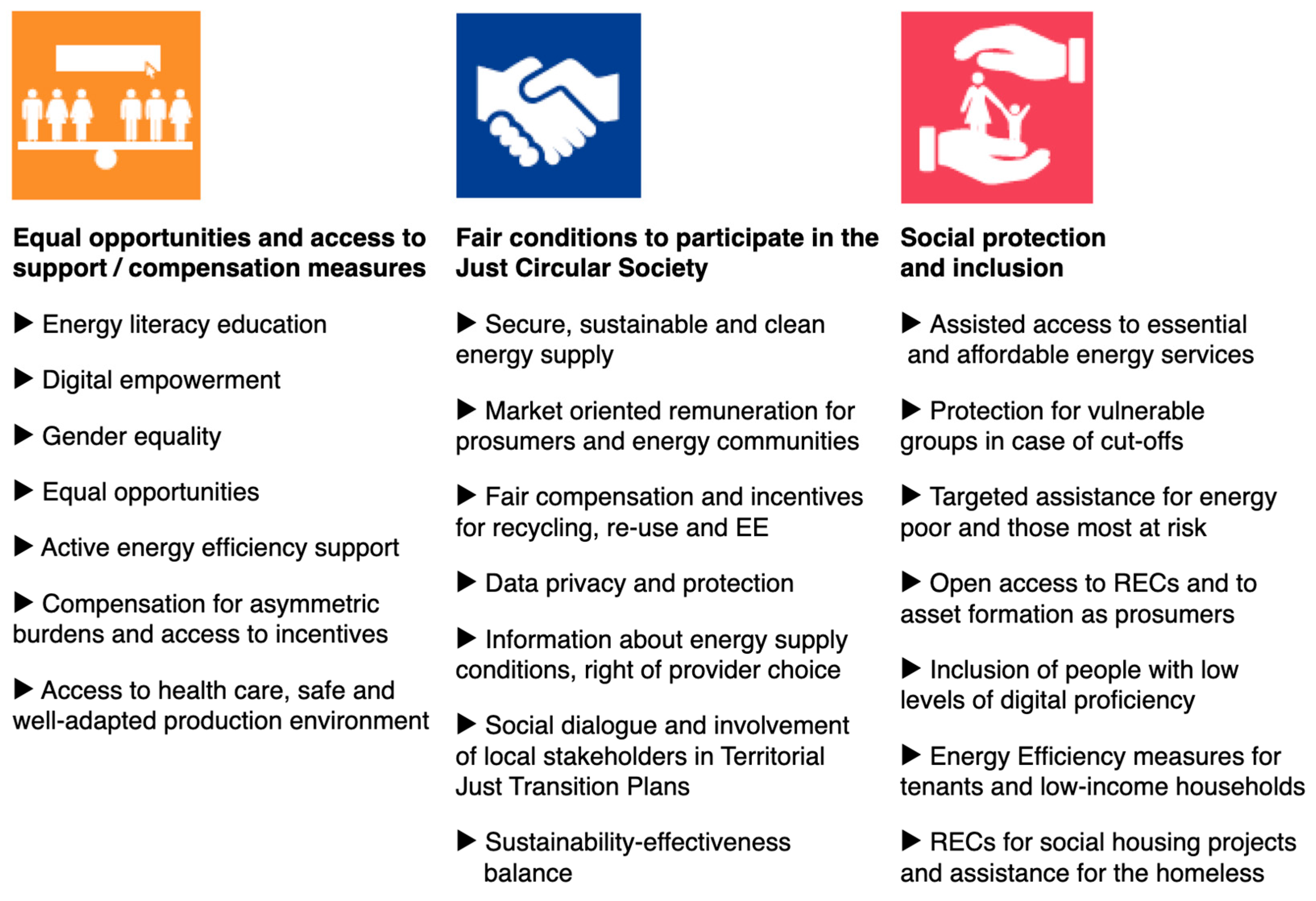
- Equal opportunities and access to support and compensation measures address the need to recognise the pertaining asymmetries of individual capabilities and capacities and to empower disadvantaged groups to ensure their engagement.
- (2)
- Fair conditions to participate in a Just Circular Society, transcending the mere provision of a level playing field but taking into account the need to ensure competition of small-scale and grass-roots initiatives on “equal footing” as postulated in Art. 22 para 7 RED II.
- (3)
- Social protection and inclusion assisting both individuals and collectively organised initiatives such as ECs to guarantee fair and equitable participation with regard to an unalienable minimum of energy access and provision for all citizens. Each of the principles contained in these three modules embraces, where necessary and suitable, the three tenets of energy justice (distribution, recognition, and procedure). Figure 9 presents a first draft for a future “European Pillar of Energy Rights” containing 21 principles based on the results of the analysis of this article. However, developing these principles further is outside the scope of this study and will be explored in future research and addressed in a subsequent article.
Author Contributions
Funding
Institutional Review Board Statement
Informed Consent Statement
Data Availability Statement
Conflicts of Interest
Abbreviations
| CEC | citizen energy community |
| CEP | Clean Energy for all Citizens Package |
| ECs | energy communities |
| EE | energy efficiency |
| EU | European Union |
| FITs | feed-in tariffs |
| IEMD | Internal Electricity Market Directive |
| LIHs | low-income households |
| MS | Member States |
| RE | renewable energy |
| REC | renewable energy communities |
| RED | Renewable Energy Directive |
| RES | renewable energy systems |
| SME | small- and medium-sized enterprise |
| TWh | Terawatt hours |
Appendix A
List of Interview Partners
| Interview Code | Country | Sector |
| INAT1 | Austria | Head of Innovation Department of Austrian Energy Utility |
| INAT2 | Austria | Senior Expert at the Austrian Regulation Agency |
| INAT3 | Austria | CEO of Austrian Energy Consulting Company |
| INAT4 | Austria | Senior Expert for Energy Communities in the Federal Government |
| INAT5 | Austria | Senior Expert in Austrian Energy Cooperation Start-up |
| INAT6 | Austria | Senior Expert for Gender/Inclusivity in an Austrian non-profit research organisation |
| INAT7 | Austria | Senior Expert for Technology Acceptance at an Austrian University |
| INAT8 | Austria | Senior Project Manager at a research centre for energy-efficient construction |
| INAT9 | Austria | Senior Expert for Energy Communities in the Federal Government |
| INAT10 | Austria | Professor of Psychology/Expert for Energy Citizenship topics at an Austrian University |
| INAT11 | Austria | Project Manager of a Sustainability Consulting Company |
| INBG1 | Bulgaria | Senior expert at a local municipality |
| INBG2 | Bulgaria | Academic (expert on energy topics) |
| INBG3 | Bulgaria | Expert at the local municipality |
| INBG4 | Bulgaria | Expert at a national CSO that campaigns for energy sustainability |
| INBG5 | Bulgaria | Expert at an energy agency providing energy sustainability solutions to national and local authorities and enterprises |
| INBG6 | Bulgaria | Two experts (senior and mid-level) at the Energy and Climate Division of a national NGO campaigning for environmental and energy sustainability |
| INBG7 | Bulgaria | Senior expert on energy innovations and environmental issues at a national utility company |
| INBG8 | Bulgaria | Entrepreneur, member of a non-profit association of business enterprises and experts interested in RES |
| INBG9 | Bulgaria | Senior expert on energy topics at a local municipality |
| INBG10 | Bulgaria | Representative of a local municipality |
| INDE1 | Germany | CEO of a digital platform for Energy Citizenship projects |
| INDE2 | Germany | CEO of a network for Energy Citizenship |
| INDE3 | Germany | Board of a renewable energy cooperative and political activist |
| INDE4 | Germany | Head of the political representation of an energy enterprise |
| INDE5 | Germany | Member of the German parliament (Green Party) |
| INDE6 | Germany | Former member of the German parliament (Social Democratic Party) |
| INDE7 | Germany | Board of a renewable energy cooperative and active member of FridaysForFuture initiative |
| INDE8 | Germany | CEO of an NGO supporting intercultural ecological work |
| INDE9 | Germany | Project leader for Energy Citizenship initiatives |
| INDE10 | Germany | Board of a renewable energy cooperative |
| INGR1 | Greece | University Professor |
| INGR2 | Greece | University Professor |
| INGR3 | Greece | High-level energy consultant in the Ministry of Environment and Energy |
| INGR4 | Greece | High-level representative in RES Association |
| INGR5 | Greece | Founder of an Energy Cooperative |
| INGR6 | Greece | High-level officer in the Ministry of Environment and Energy |
| INGR7 | Greece | High-level officer in the Electricity Distribution Network Operator |
| INGR8 | Greece | High-level officer in Energy Communities Federation |
| INGR9 | Greece | Mayor of a small island |
| INGR10 | Greece | Vice Mayor of a big island municipality |
| INIT1 | Italy | High-level representative of an environmental NGO |
| INIT2 | Italy | SME energy efficiency |
| INIT3 | Italy | High-level representative energy cooperative |
| INIT4 | Italy | Entrepreneur, scientific director, Business NGO |
| INIT5 | Italy | Head of energy agency |
| INIT6 | Italy | Energy cooperative executive manager |
| INIT7 | Italy | Architect |
| INIT8 | Italy | Energy cooperative executive manager |
| INIT9 | Italy | Foundation executive manager |
| INIT10 | Italy | Physicist and environmental engineer |
| INNO1 | Norway | Representative of a public agency that supports energy reduction and sustainable transformation measures |
| INNO2 | Norway | Academic expert with expertise in people-centred and gender sensitive approaches to energy transitions |
| INNO3 | Norway | Representative for a member-owned organisation working to make the construction and real estate sector more sustainable |
| INNO4 | Norway | Representative of an environmental interest organisation |
| INNO5 | Norway | Representative of a local government with expertise in civic involvement and co-creation processes |
| INNO6 | Norway | Energy advisor in a county council administration |
| INNO7 | Norway | Project leader with expertise in leading a community development and capacity building project |
| INNO8 | Norway | Entrepreneur entering the energy sector to establish a new business model. |
| INNO9 | Norway | Representative of an environmental interest organisation |
| INNO10 | Norway | Representative of an association organising small-scale power plants |
| INNO11 | Norway | Representative of a large European actor organising and representing small power plants |
| INCH1 | Switzerland | Consultant in an environmental NGO |
| INCH2 | Switzerland | NGO director and elected representative |
| INCH3 | Switzerland | High-level representative from a private utility company and a representative from a private utility company |
| INCH4 | Switzerland | Representative from a private utility company |
| INCH5 | Switzerland | Head of an energy community network |
| INCH6 | Switzerland | Representative of the cantonal energy department |
| INCH7 | Switzerland | Researcher in social science, expert in sustainable practices |
| INCH8 | Switzerland | Energy consultant for public authorities |
| INCH9 | Switzerland | High-level representative of the federal energy department |
| INCH10 | Switzerland | Climate activist |
| INTR1 | Türkiye | High-level representative from the Ministry of Energy and Natural Resources |
| INTR2 | Türkiye | High-level representative from Metropolitan Municipality |
| INTR3 | Türkiye | Director of research-oriented environmental NGO |
| INTR4 | Türkiye | Journalist/Activist |
| INTR5 | Türkiye | High-level Representative from Private Utility Company |
| INTR6 | Türkiye | Consultant to Local Government on Climate Change and Sustainability/Author |
| INTR7 | Türkiye | High-level Representative from State-owned Electricity Generation Company |
| INTR8 | Türkiye | Representative from the National Committee of Women in the Energy Sector |
| INTR9 | Türkiye | Representative of a Professional Network for Women in the Turkish Energy Sector |
| INTR10 | Türkiye | Coordinator of the Turkish Section of NGO Coalition Network |
| 1 | Eight legislative proposals on over 1000 pages covering governance, RE, EE, energy performance of buildings, internal electricity market, cooperation of regulators, innovation, etc. For information on content and state of play: Available online: https://ec.europa.eu/energy/en/topics/energy-strategy-and-energy-union/clean-energy-all-europeans (accessed on 3 January 2026). |
| 2 | Mirroring the emergence of innovative energy systems, as part of the CEP the RED II and the IEMD introduced renewable energy communities (RECs) and citizen energy communities (CECs). |
| 3 | https://single-market-economy.ec.europa.eu/sectors/proximity-and-social-economy/transition-pathway_en (accessed on 3 January 2026); see also Commission Staff Working Paper “Scenarios towards co-creation of a transition pathway for a more resilient, sustainable and digital Proximity and Social Economy industrial ecosystem” of 9 December 2021 SWD(2021) 982 final. |
| 4 | Compare recital (71) RED II stipulating that “REC should be capable of remaining autonomous from individual members and other traditional market actors that participate in the community as members or shareholders, or who cooperate through other means such as investment”; this requirement more generally translates into a 33% ceiling for ownership stakes of individual shareholders or members. |
| 5 | This area of policy action has been identified in the Commission Staff Working Paper “Scenarios towards co-creation of a transition pathway for a more resilient, sustainable and digital Proximity and Social Economy industrial ecosystem” of 9 December 2021 SWD(2021) 982 final; see esp. pp. 14–20 in the section “Fully enabling the ecosystem as agent for the green transition”. |
| 6 | Project “DIALOGUES—Energy Citizenship for a sustainable future” (https://www.dialoguesproject.eu/ (accessed on 3 January 2026) grant agreement ID 101022585 under the Horizon 2020 research and innovation programme of the European Commission; for details see “D3.2 Pathways to energy citizenship and their connection with ownership, participation, and conflict”. |
| 7 | See, e.g., the EaSI “Technical Assistance workshop on worker buyouts under the cooperative form: exploring the potential of social finance” on 31 May 2022; see https://ec.europa.eu/social/main.jsp?langId=en&catId=88&eventsId=1993&furtherEvents=yes (accessed on 3 January 2026). |
| 8 | See https://www.les-scic.coop/chiffres-cles (accessed on 3 January 2026). |
| 9 | CSOPs were pioneered in the Horizon 2020 project SCORE (2018-21, GA No. 784960) in five pilot regions and in cities across Europe. Available online: https://www.score-h2020.eu (accessed on 3 January 2026). |
| 10 | Settled case law of the European Court of Justice; see, e.g., Case 8/82 of 23 Feb. 1983, KG Hans-Otto Wagner vs. BflM, ECLI:EU:C:1983:41. |
| 11 | Cf. M. Jasiak, loc. cit. p.34; see e.g., Cases C-558/07 of 7 July 2009, S.P.C.M. et al. vs. Secretary of State for the Environment, Food and Rural Affairs, EU:C:2009:430, para. 74, C579/13 of 4 June 2015 P&S vs. Commissie Sociale Zekerheid Breda et al., EU:C 2015 369, para. 41 or C477/14 of 4 May 2016, Pillbox38 Ltd. vs. Secretary of State for Health, ECLlU:C:2016:324. |
| 12 | This regards in particular the criterium of “selectivity”; see J. Blumenberg “Aktuelle Entwicklungen des EU-Beihilferechts im Bereich der deutschen Unternehmensbesteuerung, pp. 19–27, p. 65; ifst-Schrift 516 (2017); for details see L. Neckenich “Selektivität im Steuerrecht” HFSt 8 2018. |
| 13 | That is, that the measure (a) be financed by the State or through State resources, (b) be selective, (c) have a possible effect on trade between Member States, and (d) potentially distort competition on the Single Market in the Joined Cases C-78/08 to C-80/08 O.J. 2011, C 311/06 (Paint Graphos). |
| 14 | See Commission Notice on the notion of state aid as referred to in Article 107(1) TFEU (2016/C 262/01), Cooperative societies (nos 157–160). Available online: https://eur-lex.europa.eu/legal-content/EN/TXT/?uri=oj:JOC_2016_262_R_0001 (accessed on 4 January 2026). |
| 15 | See https://www.bcorporation.net/en-us/programs-and-tools/b-impact-assessment/ (accessed on 3 January 2026). |
| 16 | The 2019 French Energy and Climate Law (Loi n° 2019-1147 du 8 novembre 2019 relative à l’énergie et au climat) transposing the RED II grants the legal status of a REC automatically to social housing associations having direct access to the enabling framework and-what is more—residents becoming automatically prosumers in case their social housing provider initiates RE production. |
References
- Anand, Paul, and Stephen Lea. 2011. The Psychology and Behavioural Economics of Poverty. Journal of Economic Psychology 32: 284–93. [Google Scholar] [CrossRef]
- Becker, Christian. 2006. The Human Actor in Ecological Economics: Philosophical Approach and Research Perspectives. Ecological Economics 60: 17–23. [Google Scholar] [CrossRef]
- Bedggood, Rowan, Rebekah Russell-Bennett, Ryan McAndrew, Charmaine Glavas, and Uwe Dulleck. 2023. Challenging the Social-Power Paradigm: Moving beyond Consumer Empowerment to an Energy Ecosystem of Shared Value. Energy Policy 173: 113405. [Google Scholar] [CrossRef]
- Belmar, Francisco, Patrícia Baptista, and Diana Neves. 2023. Modelling Renewable Energy Communities: Assessing the Impact of Different Configurations, Technologies and Types of Participants. Energy, Sustainability and Society 13: 18. [Google Scholar] [CrossRef]
- Berka, Anna L., and Emily Creamer. 2018. Taking Stock of the Local Impacts of Community Owned Renewable Energy: A Review and Research Agenda. Renewable and Sustainable Energy Reviews 82: 3400–19. [Google Scholar] [CrossRef]
- Bertram, Rebecca, and Radostina Primova. 2018. Energy Atlas 2018. Heinrich Böll Foundation, Friends of the Earth Europe, European Renewable Energies Federation, Green European Foundation. Available online: https://gef.eu/wp-content/uploads/2018/04/energyatlas2018_facts-and-figures-renewables-europe.pdf (accessed on 3 January 2026).
- BMK. 2023. Neue umfassende Förderung für Heizungstausch—Rund 75 Prozent Kostenübernahme. 29 November. See in the Reference List of a Publication by the Austrian Climate and Energy Fund. Available online: https://www.klimafonds.gv.at/wp-content/uploads/2025/10/C163512-ACRP13-TransFair-KR20AC0K18211-EB.pdf (accessed on 3 January 2026).
- Bogner, Alexander, and Wolfgang Menz. 2009. The Theory-Generating Expert Interview: Epistemological Interest, Forms of Knowledge, Interaction. In Interviewing Experts. London: Palgrave Macmillan UK. [Google Scholar] [CrossRef]
- Bosselmann, Klaus. 2004. In Search of Global Law: The Significance of the Earth Charter. Worldviews 8: 62–75. [Google Scholar] [CrossRef]
- Bourdieu, Pierre. 1986. The Forms of Capital. In Handbook of Theory and Research for the Sociology of Education. Edited by John G. Richardson. New York: Greenwood. [Google Scholar]
- Bódis, Katalin, Ioannis Kougias, Arnulf Jäger-Waldau, Nigel Taylor, and Sándor Szabó. 2019. A High-Resolution Geospatial Assessment of the Rooftop Solar Photovoltaic Potential in the European Union. Renewable and Sustainable Energy Reviews 114: 109309. [Google Scholar] [CrossRef]
- Brisbois, Marie Claire. 2019. Powershifts: A Framework for Assessing the Growing Impact of Decentralized Ownership of Energy Transitions on Political Decision-Making. Energy Research & Social Science 50: 151–61. [Google Scholar] [CrossRef]
- Bundesumweltministeriums. 2023. Solarpaket I: Bundeskabinett stärkt Photovoltaik-Ausbau und Verbraucherrechte in Deutschland-BMUV-Download. bmuv.de, August 16. Available online: https://www.bmuv.de/DL3145 (accessed on 3 January 2026).
- Campos, Inês, and Esther Marín-González. 2020. People in Transitions: Energy Citizenship, Prosumerism and Social Movements in Europe. Energy Research & Social Science 69: 101718. [Google Scholar] [CrossRef]
- Caramizaru, Aura, and Andreas Uihlein. 2020. Energy Communities: An Overview of Energy and Social Innovation. Scientific Analysis or Review, Policy Assessment KJ-NA-30083-EN-N (Online). Copenhagen: Publications Office of the European Union. [Google Scholar] [CrossRef]
- Cecchi, Claudio. 2013. Sostenibilità e Decrescita: Dall’homo Œconomicus All’homo Ecologicus. In Pensare Il Capitalismo: Nuove Prospettive per l’economia Politica. Edited by Elisabetta Basile, Giorgio Lunghini and Franco Volpi. Economia. Teoria Economica, Pensiero Economico 93. Milano: FrancoAngeli. Available online: https://www.francoangeli.it/Libro/Pensare-il-capitalismo.-Nuove-prospettive-per-l%27economia-politica?Id=21048 (accessed on 4 January 2026).
- Coy, Dominique, Shirin Malekpour, Alexander K. Saeri, and Roger Dargaville. 2021. Rethinking Community Empowerment in the Energy Transformation: A Critical Review of the Definitions, Drivers and Outcomes. Energy Research & Social Science 72: 101871. [Google Scholar] [CrossRef]
- Creamer, Emily, Will Eadson, Bregje van Veelen, Annabel Pinker, Margaret Tingey, Tim Braunholtz-Speight, Marianna Markantoni, Mike Foden, and Max Lacey-Barnacle. 2018. Community Energy: Entanglements of Community, State, and Private Sector. Geography Compass 12: E12378. [Google Scholar] [CrossRef]
- Denzin, K. Norman. 1970. The Research Act in Sociology: A Theoretical Introduction to Sociological Methods. London: Butterworths. Available online: https://books.google.de/books/about/The_Research_Act_in_Sociology.html?id=CbFrQgAACAAJ&redir_esc=y (accessed on 3 January 2026).
- Devine-Wright, Patrick. 2007. Energy Citizenship: Psychological Aspects of Evolution in Sustainable Energy Technologies. In Governing Technology for Sustainability. London: Routledge. [Google Scholar]
- Devine-Wright, Patrick. 2011. Public Engagement with Large-Scale Renewable Energy Technologies: Breaking the Cycle of NIMBYism. WIREs Climate Change 2: 19–26. [Google Scholar] [CrossRef]
- DGRV. 2013. Energiegenossenschaften. Available online: https://www.unendlich-viel-energie.de/media/file/34.AEE_DGRV_Energiegenossenschaften_2013_web.pdf (accessed on 3 January 2026).
- DGRV. 2021. Geschaeftsbericht. Available online: https://www.dgrv.de/publication/transparenzbericht-2021/ (accessed on 3 January 2026).
- Dröschel, Barbara, Katherina Grashof, and Eva Hauser. 2021. Kurzstudie—Stand der Umsetzung der RED II-Richtlinie in Deutschland mit Blick auf die Bürgerenergie Laufzeit: April 2021–Juli 2021. IZES gGmbH Institut für ZukunftsEnergie- und Stoffstromsysteme Wissenschaftlicher. Available online: https://www.buendnis-buergerenergie.de/fileadmin/user_upload/downloads/Studien/20210728_IZES_Kurzstudie_BBEn_RED_II_final.pdf (accessed on 4 January 2026).
- Dryzek, John S. 1996. Foundations for Environmental Political Economy: The Search for Homo Ecologicus? New Political Economy 1: 27–40. [Google Scholar] [CrossRef]
- EEA. 2023. Trends and Projections in Europe 2023. Publications Office. Available online: https://data.europa.eu/doi/10.2800/595102 (accessed on 3 January 2026).
- European Commission. 2019. Clean Energy for All Europeans. Brussels: European Commission. Available online: https://data.europa.eu/doi/10.2833/21366 (accessed on 3 January 2026).
- European Commission. 2021a. Scenarios Towards Co-Creation of a Transition Pathway for a Resilient, Innovative, Sustainable and Digital Proximity and Social Economy Ecosystem-European Commission. December 9. Available online: https://single-market-economy.ec.europa.eu/consultations/scenarios-towards-co-creation-transition-pathway-resilient-innovative-sustainable-and-digital_en (accessed on 3 January 2026).
- European Commission. 2021b. The European Pillar of Social Rights Action Plan. COM(2021) 102 Final. Brussels: European Commission. [Google Scholar] [CrossRef]
- European Commission. 2022a. Implementing the Repowering EU Action Plan: Investment Needs, Hydrogen Accelerator and Achieving the Bio-Methane Targets. SWD(2022) 230 Final. Brussels: European Commission. Available online: https://eur-lex.europa.eu/legal-content/EN/ALL/?uri=SWD:2022:230:FIN (accessed on 4 January 2026).
- European Commission. 2022b. Transition pathways for Proximity and Social Economy. Available online: https://ec.europa.eu/docsroom/documents/52015/attachments/1/translations/en/renditions/native (accessed on 4 January 2026).
- European Commission. 2024. La Hulpe Declaration on the Future of the European Pillar of Social Rights. April 16. Available online: https://socialsecurity.belgium.be/sites/default/files/content/docs/en/publications/la-hulpe-declaration.pdf (accessed on 4 January 2026).
- European Commission, Deloitte, IPSOS, and London Economics. 2016. Second Consumer Market Study on the Functioning of the Retail Electricity Markets for Consumers in the EU: Final Report. Brussels: Publications Office of the European Union. Available online: https://data.europa.eu/doi/10.2818/267955 (accessed on 3 January 2026).
- Eurostat. 2021. Gender Pay Gap. Available online: https://ec.europa.eu/eurostat/statistics-explained/index.php?title=Gender_pay_gap_statistics (accessed on 4 January 2026).
- Eurostat. 2023. Distribution of Population by Tenure status, Type of Households and Income Group. Available online: https://ec.europa.eu/eurostat/databrowser/view/ilc_lvho02__custom_12697765/bookmark/table?lang=en&bookmarkId=4b4bd471-585b-40a2-aabc-495ff4e56790&c=1724850706258 (accessed on 4 January 2026).
- Feenstra, Mariëlle, and Joy Clancy. 2020. A View from the North: Gender and Energy Poverty in the European Union. In Engendering the Energy Transition. Edited by Joy Clancy, Gül Özerol, Nthabiseng Mohlakoana, Mariëlle Feenstra and Lillian Sol Cueva. Cham: Springer International Publishing. [Google Scholar] [CrossRef]
- Finanzielle Beteiligung von Anwohner*innen Und Gemeinden. 2024. Bundesverband WindEnergie (BWE). Available online: https://www.wind-energie.de/fileadmin/redaktion/dokumente/publikationen-oeffentlich/themen/01-mensch-und-umwelt/01-windkraft-vor-ort/20240718_BWE-Informationspapier_Beteiligung_von_Anwohnern_und_Gemeinden.pdf (accessed on 3 January 2026).
- Fraune, Cornelia. 2015. Gender Matters: Women, Renewable Energy, and Citizen Participation in Germany. Energy Research & Social Science 7: 55–65. [Google Scholar] [CrossRef]
- George, Theodore. 2021. Hermeneutics. In The Stanford Encyclopedia of Philosophy. Winter 2021. Edited by Edward N. Zalta. Stanford: Metaphysics Research Lab, Stanford University. Available online: https://plato.stanford.edu/archives/win2021/entries/hermeneutics/ (accessed on 4 January 2026).
- Gjaltema, Jonna, Robbert Biesbroek, and Katrien Termeer. 2020. From Government to Governance…to Meta-Governance: A Systematic Literature Review. Public Management Review 22: 1760–80. [Google Scholar] [CrossRef]
- Grashof, Katherina. 2019. Are Auctions Likely to Deter Community Wind Projects? And Would This Be Problematic? Energy Policy 125: 20–32. [Google Scholar] [CrossRef]
- Grashof, Katherina, and Barbara Dröschel. 2018. Ausschreibungen Für Windenergie an Land: Erfahrungen in Acht Ländern. Available online: https://izes.eu/wp-content/uploads/EM_17_083.pdf (accessed on 3 January 2026).
- Hanke, Florian, and Jens Lowitzsch. 2020. Empowering Vulnerable Consumers to Join Renewable Energy Communities—Towards an Inclusive Design of the Clean Energy Package. Energies 13: 1615. [Google Scholar] [CrossRef]
- Hanke, Florian, Katrin Grossmann, and Leona Sandmann. 2023. Excluded despite Their Support-The Perspectives of Energy-Poor Households on Their Participation in the German Energy Transition Narrative. Energy Research & Social Science 104: 103259. [Google Scholar] [CrossRef]
- Hanke, Florian, Rachel Guyet, and Marielle Feenstra. 2021. Do Renewable Energy Communities Deliver Energy Justice? Exploring Insights from 71 European Cases. Energy Research & Social Science 80: 102244. [Google Scholar] [CrossRef]
- Hansen, Anders Rhiger, Mette Hove Jacobsen, and Kirsten Gram-Hanssen. 2022. Characterizing the Danish Energy Prosumer: Who Buys Solar PV Systems and Why Do They Buy Them? Ecological Economics 193: 107333. [Google Scholar] [CrossRef]
- Heldeweg, Michiel. 2017. Normative Alignment, Institutional Resilience and Shifts in Legal Governance of the Energy Transition. Sustainability 9: 1273. [Google Scholar] [CrossRef]
- Heldeweg, Michiel A., and Séverine Saintier. 2020. Renewable Energy Communities as ‘Socio-Legal Institutions’: A Normative Frame for Energy Decentralization? Renewable and Sustainable Energy Reviews 119: 109518. [Google Scholar] [CrossRef]
- Hirst, Paul. 1994. Associative Democracy: New Forms of Economic and Social Governance, 1st ed. Amherst: University of Massachusetts Press. [Google Scholar]
- Hohfeld, Wesley Newcomb. 1917. Fundamental Legal Conceptions as Applied in Judicial Reasoning. The Yale Law Journal 26: 710–70. [Google Scholar] [CrossRef]
- Horstink, Lanka, Julia M. Wittmayer, Kiat Ng, Guilherme Pontes Luz, Esther Marín-González, Swantje Gährs, Inês Campos, Lars Holstenkamp, Sem Oxenaar, and Donal Brown. 2020. Collective Renewable Energy Prosumers and the Promises of the Energy Union: Taking Stock. Energies 13: 421. [Google Scholar] [CrossRef]
- Hortaçsu, Ali, and Steven L. Puller. 2008. Understanding Strategic Bidding in Multi-Unit Auctions: A Case Study of the Texas Electricity Spot Market. The RAND Journal of Economics 39: 86–114. [Google Scholar] [CrossRef]
- Huntjens, Patrick, and René Kemp. 2021. Towards a Natural Social Contract: Transformative Social-Ecological Innovation for a Sustainable, Healthy and Just Society. Cham: Springer. [Google Scholar]
- IEA. 2023. World Energy Outlook 2023—Analysis. IEA. Available online: https://www.iea.org/reports/world-energy-outlook-2023 (accessed on 3 January 2026).
- Inês, Campos, Pontes Luz Guilherme, Marín-González Esther, Gährs Swantje, Hall Stephen, and Holstenkamp Lars. 2020. Regulatory Challenges and Opportunities for Collective Renewable Energy Prosumers in the EU. Energy Policy 138: 111212. [Google Scholar] [CrossRef]
- International Covenant on Economic, Social and Cultural Rifhts (ICESCR). 1966. General Assembly resolution 2200A (XXI). Available online: https://www.un.org/en/development/desa/population/migration/generalassembly/docs/globalcompact/A_RES_2200A(XXI)_economic.pdf (accessed on 3 January 2026).
- Jasiak, Mikołaj. 2018. Energy Communities in the Clean Energy Package. European Energy Journal 8: 29. [Google Scholar] [CrossRef]
- Jenkins, Kirsten. 2019. Energy Justice, Energy Democracy, and Sustainability: Normative Approaches to the Consumer Ownership of Renewables. In Energy Transition: Financing Consumer Co-Ownership in Renewables. Edited by Jens Lowitzsch. Cham: Springer International Publishing. [Google Scholar] [CrossRef]
- Jenkins, Kirsten, Darren McCauley, Raphael Heffron, Hannes Stephan, and Robert Rehner. 2016. Energy Justice: A Conceptual Review. Energy Research & Social Science 11: 174–82. [Google Scholar] [CrossRef]
- Kahla, Franziska, Lars Holstenkamp, Jakob R. Müller, and Heinrich Degenhart. 2017. Entwicklung Und Stand von Bürgerenergiegesellschaften Und Energiegenossenschaften in Deutschland. Munich: University Library of Munich, Germany. [Google Scholar] [CrossRef]
- Kalu, Michael. 2019. Using Emphasis-Purposeful Sampling-Phenomenon of Interest–Context (EPPiC) Framework to Reflect on Two Qualitative Research Designs and Questions: A Reflective Process. The Qualitative Report 24: 2524–35. [Google Scholar] [CrossRef]
- Kampman, Bettina, Jaco Blommerde, and Maarten Afman. 2016. The Potential of Energy Citizens in the European Union. CE Delft. Available online: https://cedelft.eu/wp-content/uploads/sites/2/2021/04/CE_Delft_3J00_Potential_energy_citizens_EU_final.pdf (accessed on 3 January 2026).
- Karl, Timo, and Madeline Bode. 2022. Mehr Frauen-Power für die Energiewende. Frauen in der Bürgerenergie. Available online: https://wwindea.org/wp-content/uploads/2022/10/Frauen_in_der_Bu%CC%88rgerenergie_2210.pdf (accessed on 4 January 2026).
- Katz, Larissa. 2012. Governing Through Owners: How and Why Formal Private Property Rights Enhance State Power. University of Pennsylvania Law Review 160: 2029–59. [Google Scholar]
- Kaufmann, Mark. 2020. The Devious Fossil Fuel Propaganda We All Use. July 13. Available online: https://mashable.com/feature/carbon-footprint-pr-campaign-sham (accessed on 3 January 2026).
- Klima- und Energiefonds. 2024. Solidarische Energiegemeinschaften. Available online: https://energiegemeinschaften.gv.at/solidarische-energiegemeinschaften/ (accessed on 4 January 2026).
- Kotilainen, Kirsi, and Ulla A. Saari. 2018. Policy Influence on Consumers’ Evolution into Prosumers—Empirical Findings from an Exploratory Survey in Europe. Sustainability 10: 186. [Google Scholar] [CrossRef]
- Kumar, Ankit. 2018. Justice and Politics in Energy Access for Education, Livelihoods and Health: How Socio-Cultural Processes Mediate the Winners and Losers. Energy Research & Social Science 40: 3–13. [Google Scholar] [CrossRef]
- Lavrijssen, Saskia, and Arturo Carrillo Parra. 2017. Radical Prosumer Innovations in the Electricity Sector and the Impact on Prosumer Regulation. Sustainability 9: 1207. [Google Scholar] [CrossRef]
- Lennon, Breffní, Niall P. Dunphy, and Estibaliz Sanvicente. 2019. Community Acceptability and the Energy Transition: A Citizens’ Perspective. Energy, Sustainability and Society 9: 35. [Google Scholar] [CrossRef]
- Lowitzsch, Jens, ed. 2019. The Consumer at the Heart of the Energy Market? In Energy Transition: Financing Consumer Co-Ownership in Renewables. Cham: Springer International Publishing. [Google Scholar] [CrossRef]
- Lowitzsch, Jens, and Florian Hanke. 2019. Consumer (Co-)Ownership in Renewables, Energy Efficiency and the Fight Against Energy Poverty—A Dilemma of Energy Transitions. Renewable Energy Law and Policy Review 9: 5–21. [Google Scholar] [CrossRef]
- Lowitzsch, Jens, Monika Bucha, and Sarah Lonscher. 2025. From Access to Ownership: Energy Communities et Social Inclusion in the EU’s Energy Transition. Hannover: Friedrich-Ebert-Stiftung. [Google Scholar]
- Łapniewska, Zofia. 2019. Energy, Equality and Sustainability? European Electricity Cooperatives from a Gender Perspective. Energy Research & Social Science 57: 101247. [Google Scholar] [CrossRef]
- Magalhães, Renan, Jens Lowitzsch, and Federico Narraci. 2024. Crowdfunding and Energy Efficiency Contracting: Exploring New Pathways for Private Investment in Build-Ing Renovations. FinTech 4: 6. [Google Scholar] [CrossRef]
- Mang-Benza, Carelle. 2021. Many Shades of Pink in the Energy Transition: Seeing Women in Energy Extraction, Production, Distribution, and Consumption. Energy Research & Social Science 73: 101901. [Google Scholar] [CrossRef]
- Marshall, T. H. 1950. Citizenship and Social Class: And Other Essays. Cambridge: Cambridge University Press. [Google Scholar]
- Martinot, Eric. 2016. Grid Integration of Renewable Energy: Flexibility, Innovation, and Experience. Annual Review of Environment and Resources 41: 223–51. [Google Scholar] [CrossRef]
- Maxwell, Joseph A. 2013. Qualitative Research Design: An Interactive Approach. Thousand Oaks: SAGE Publications, Inc. [Google Scholar]
- Mendes, Gonçalo, Annika Wolff, Helinä Melkas, and Toni Kuronen. 2020. Empowerment of Energy Citizens in the Digital Era: A Policy Brief. Lappeenranta: Lappeenranta University of Technology. [Google Scholar] [CrossRef]
- Moncecchi, Matteo, Stefano Meneghello, and Marco Merlo. 2020. Energy Sharing in Renewable Energy Communities: The Italian Case. Paper presented at 2020 55th International Universities Power Engineering Conference (UPEC), Torino, Italy, September 1–4. [Google Scholar] [CrossRef]
- Mori, Tomoko, and Tomohiro Tasaki. 2019. Factors Influencing Pro-Environmental Collaborative Collective Behaviors toward Sustainability Transition—A Case of Renewable Energy. Environmental Education Research 25: 566–84. [Google Scholar] [CrossRef]
- Nakamura, Hidenori. 2017. Political and Environmental Attitude toward Participatory Energy and Environmental Governance: A Survey in Post-Fukushima Japan. Journal of Environmental Management 201: 190–98. [Google Scholar] [CrossRef] [PubMed]
- O’Connor, Cliodhna, and Hélène Joffe. 2020. Intercoder Reliability in Qualitative Research: Debates and Practical Guidelines. International Journal of Qualitative Methods 19: 160940691989922. [Google Scholar] [CrossRef]
- O’Shaughnessy, Eric, Galen Barbose, Ryan Wiser, Sydney Forrester, and Naïm Darghouth. 2021. The Impact of Policies and Business Models on Income Equity in Rooftop Solar Adoption. Nature Energy 6: 84–91. [Google Scholar] [CrossRef]
- Ostrom, Elinor. 2010. Polycentric Systems for Coping with Collective Action and Global Environmental Change. Global Environmental Change 20: 550–57. [Google Scholar] [CrossRef]
- Palinkas, Lawrence A., Sarah M. Horwitz, Carla A. Green, Jennifer P. Wisdom, Naihua Duan, and Kimberly Hoagwood. 2015. Purposeful Sampling for Qualitative Data Collection and Analysis in Mixed Method Implementation Research. Administration and Policy in Mental Health 42: 533–44. [Google Scholar] [CrossRef]
- Parkins, John R., Curtis Rollins, Sven Anders, and Louise Comeau. 2018. Predicting Intention to Adopt Solar Technology in Canada: The Role of Knowledge, Public Engagement, and Visibility. Energy Policy 114: 114–22. [Google Scholar] [CrossRef]
- Petintseva, Olga, Rita Faria, and Yarin Eski. 2020. Interviewing Elites, Experts and the Powerful in Criminology. Bassingstoke: Palgrave Macmillan. [Google Scholar]
- Petrova, Saska, and Neil Simcock. 2021. Gender and Energy: Domestic Inequities Reconsidered. Social & Cultural Geography 22: 849–67. [Google Scholar] [CrossRef]
- Pons-Seres de Brauwer, C., and Jed J. Cohen. 2020. Analysing the Potential of Citizen-Financed Community Renewable Energy to Drive Europe’s Low-Carbon Energy Transition. Renewable and Sustainable Energy Reviews 133: 110300. [Google Scholar] [CrossRef]
- Radtke, Jörg. 2014. A Closer Look inside Collaborative Action: Civic Engagement and Participation in Community Energy Initiatives. People, Place and Policy Online 8: 235–48. [Google Scholar] [CrossRef]
- Radtke, Jörg, and Dörte Ohlhorst. 2021. Community Energy in Germany—Bowling Alone in Elite Clubs? Utilities Policy 72: 101269. [Google Scholar] [CrossRef]
- Radtke, Jörg, Özgür Yildiz, and Lucas Roth. 2022. Does Energy Community Membership Change Sustainable Attitudes and Behavioral Patterns? Empirical Evidence from Community Wind Energy in Germany. Energies 15: 822. [Google Scholar] [CrossRef]
- Rogers, Everett M. 1962. Diffusion of Innovations. New York: Free Press of Glencoe. [Google Scholar]
- Roggemann, H. 1997. Funktionswandel des Eigentums in Ost und West: Vergleichende Anmerkungen zur postsozialistischen Transformation in Ost- und Westeuropa. In Recht in Ost und West: ROW; Zeitschrift für Ostrecht und Rechtsvergleichung. Berlin: Berlin-Verl. [Google Scholar]
- Roth, Lucas, Jens Lowitzsch, and Özgür Yildiz. 2021. An Empirical Study of How Household Energy Consumption Is Affected by Co-Owning Different Technological Means to Produce Renewable Energy and the Production Purpose. Energies 14: 3996. [Google Scholar] [CrossRef]
- Roth, Lucas, Jens Lowitzsch, and Özgür Yildiz. 2023. Which (Co-)Ownership Types in Renewables Are Associated with the Willingness to Adopt Energy-Efficient Technologies and Energy-Conscious Behaviour? Data from German Households. Energy Policy 180: 113683. [Google Scholar] [CrossRef]
- Roth, Lucas, Jens Lowitzsch, Özgür Yildiz, and Alban Hashani. 2018. Does (Co-)Ownership in Renewables Matter for an Electricity Consumer’s Demand Flexibility? Empirical Evidence from Germany. Energy Research & Social Science 46: 169–82. [Google Scholar] [CrossRef]
- Ryghaug, Marianne, Tomas Moe Skjølsvold, and Sara Heidenreich. 2018. Creating Energy Citizenship through Material Participation. Social Studies of Science 48: 283–303. [Google Scholar] [CrossRef]
- Sanz-Hernández, Alexia. 2019. Social Engagement and Socio-Genesis of Energy Poverty as a Problem in Spain. Energy Policy 124: 286–96. [Google Scholar] [CrossRef]
- Schilbach, Frank, Heather Schofield, and Sendhil Mullainathan. 2016. The Psychological Lives of the Poor. American Economic Review 106: 435–40. [Google Scholar] [CrossRef]
- Schwanitz, Valeria Jana, August Wierling, Heather Arghandeh Paudler, Constantin von Beck, Simon Dufner, Ingrid Knutsdotter Koren, Tobias Kraudzun, Timothy Marcroft, Lukas Mueller, and Jan Pedro Zeiss. 2023. Statistical Evidence for the Contribution of Citizen-Led Initiatives and Projects to the Energy Transition in Europe. Scientific Reports 13: 1. [Google Scholar] [CrossRef]
- Segreto, Marco, Lucas Principe, Alexandra Desormeaux, Marco Torre, Laura Tomassetti, Patrizio Tratzi, Valerio Paolini, and Francesco Petracchini. 2020. Trends in Social Acceptance of Renewable Energy Across Europe—A Literature Review. International Journal of Environmental Research and Public Health 17: 9161. [Google Scholar] [CrossRef]
- Seidl, Roman, Timo von Wirth, and Pius Krütli. 2019. Social Acceptance of Distributed Energy Systems in Swiss, German, and Austrian Energy Transitions. Energy Research & Social Science 54: 117–28. [Google Scholar] [CrossRef]
- Sen, Amartya. 1995. Inequality Reexamined. Oxford: Oxford University Press. [Google Scholar]
- Sovacool, Benjamin K., and Marie-Claire Brisbois. 2019. Elite Power in Low-Carbon Transitions: A Critical and Interdisciplinary Review. Energy Research & Social Science 57: 101242. [Google Scholar] [CrossRef]
- Szabo, Manuela. 2020. The Impact of European State Aid Rules on Actor Diversity in the Context of Support Schemes for Renewable Energy. A Case Study of Denmark and Germany. Frankfurt: European University Viadrina Frankfurt (Oder). [Google Scholar]
- Śmiech, Sławomir, Lilia Karpinska, and Stefan Bouzarovski. 2025. Impact of Energy Transitions on Energy Poverty in the European Union. Renewable and Sustainable Energy Reviews 211: 115311. [Google Scholar] [CrossRef]
- Thomassen, Jacques. 2007. Citizens and the Legitimacy of the European Union. Den Haag: WRR (Netherland Scientific Council for Government Policy). Available online: https://library.oapen.org/bitstream/id/49c7f87f-ddd5-4d66-9b2d-d552784bd155/439851.pdf (accessed on 3 January 2026).
- Toke, David. 2015. Renewable Energy Auctions and Tenders; How Good Are They? International Journal of Sustainable Energy Planning and Management 8: 43–56. [Google Scholar] [CrossRef]
- trend:research. 2011. Marktakteure Erneuerbare Energie Anlagen in der Stromerzeugung. Studie im Rahmen des Forschungsvorhabens Genossenschaftliche Unterstützungsstrukturen für eine sozialräumliche Energiewirtschaft. Im Auftrag des Bundesministeriums für Umwelt, Naturschutz und Reaktorsicherheit, 2011. Available online: https://www.scribd.com/document/95208755/Marktakteure-Erneuerbare-Energie-Anlagen-in-Der-Stromerzeugung-2011 (accessed on 4 January 2026).
- trend:research. 2020. Eigentümerstruktur: Erneuerbare Energien, Entwicklung Der Akteursvielfalt, Rolle Der Energieversorger, Ausblick Bis 2025. Available online: https://www.trendresearch.de/studie.php?s=693 (accessed on 3 January 2026).
- Uğur, Latif Onur, and Neşe Leblebici. 2018. An Examination of the LEED Green Building Certification System in Terms of Construction Costs. Renewable and Sustainable Energy Reviews 81: 1476–83. [Google Scholar] [CrossRef]
- Umit, Resul, Wouter Poortinga, Pekka Jokinen, and Pasi Pohjolainen. 2019. The role of income in energy efficiency and curtailment behaviours: Findings from 22 European countries. Energy Research & Social Science 53: 206–14. [Google Scholar] [CrossRef]
- UNFCCC. 2015. The Paris Agreement|UNFCCC. Available online: https://unfccc.int/process-and-meetings/the-paris-agreement (accessed on 3 January 2026).
- van Bommel, Natascha, and Johanna I. Höffken. 2021. Energy Justice within, between and beyond European Community Energy Initiatives: A Review. Energy Research & Social Science 79: 102157. [Google Scholar] [CrossRef]
- Voss, Andreas, and Reinhard Madlener. 2017. Auction Schemes, Bidding Strategies and the Cost-Optimal Level of Promoting Renewable Electricity in Germany. The Energy Journal 38: 229–64. [Google Scholar] [CrossRef]
- Walker, Gordon, Neil Simcock, and Rosie Day. 2016. Necessary Energy Uses and a Minimum Standard of Living in the United Kingdom: Energy Justice or Escalating Expectations? Energy Research & Social Science 18: 129–38. [Google Scholar] [CrossRef]
- Weiler, Katja, Andreas Weber, Katherina Grashof, Lars Holstenkamp, Moritz Ehrtmann, and Umweltbundesamt (Herausgeber). 2021. CLIMATE CHANGE 49/2021 Entwicklung Und Umsetzung Eines Monitoringsystems Zur Analyse Der Akteursstruktur Bei Freiflächen-Photovoltaik Und Der Windenergie an Land Ergebnisse Des Monitorings Und Empfehlungen. Dessau-Roßlau: Umweltbundesamt. [Google Scholar] [CrossRef]
- Wierling, August, Valeria Jana Schwanitz, Jan Pedro Zeiß, Celine Bout, Chiara Candelise, Winston Gilcrease, and Jay Sterling Gregg. 2018. Statistical Evidence on the Role of Energy Cooperatives for the Energy Transition in European Countries. Sustainability 10: 3339. [Google Scholar] [CrossRef]
- Yang, Yan, Fan Chen, Mian Hu, Huaiyu Wu, and Yang Chen. 2024. A Hierarchical Energy Sharing Strategy for Multi-Communities with Heterogeneous Prosumers. In 2024 China Automation Congress (CAC). New York: IEEE, pp. 6997–7004. [Google Scholar] [CrossRef]
- Yildiz, Özgür, Jens Rommel, Sarah Debor, Lars Holstenkamp, Franziska Mey, Jakob R. Müller, Jörg Radtke, and Judith Rognli. 2015. Renewable Energy Cooperatives as Gatekeepers or Facilitators? Recent Developments in Germany and a Multidisciplinary Research Agenda. Energy Research & Social Science 6: 59–73. [Google Scholar] [CrossRef]
- Yin, Robert K. 2018. Case Study Research and Applications: Design and Methods. Thousand Oaks: SAGE Publications, Inc. [Google Scholar]


| Institutional Environment Characteristics | Constitutional Order (Vertical) | Competitive Market (Horizontal) | Civil Networks/Third Sector (Diagonal) |
|---|---|---|---|
| Key interest | Public | Private | Social |
| Key relationship | Command and control | Contracting | Share and collaborate |
| Key actors | Government and citizen | Buyer and seller | NGO and member |
| Key owner | The state | Individual private parties | Energy communities |
| Force Fields | Liberty | Solidarity | Equality |
|---|---|---|---|
| Resource optimisation (function) | Optimising individual economic ownership potential | Optimising collective social ownership potential | Optimising social–economic ownership potential |
| Opportunity/value | Opportunities for individual benefits (‘liberty to’) | Opportunities for collective benefits (‘solidarity to’) | Opportunities for public benefits (‘equality to’) |
| Energy citizenship | Private prosumership | Collective prosumership RECs, CECs and other ECs | Equal access and duty to contribute |
| Current legal basis In REDII and IEMD | Individual rights/obligations RE self-consumers (Art. 2 pt. 14, 15 and Art. 21 REDII) Active consumers (art. 2 Sec. 8 and Art. 15 IEMD) | Collective rights/obligations RECs (Art. 2 pt. 16 and Art. 22 REDII) CECs (Art. 2 pt. 11 and Art. 16 IEMD) | Public rights/obligations Access to the public grid Payment of fees |
| Matching institutional environment | Competitive market | Civil society | Constitutional order |
| Policy Field Type of Measure | Regulated Energy Market (REM) ‘Liberty & Equality’ | Regulated Civil Networks (RCN) ‘Equality & Solidarity’ | Self-Regulated Local Energy Clusters (SrLEC) ‘Solidarity & Liberty’ |
|---|---|---|---|
| Distributional | Minimum supply for vulnerable groups (means-tested). | Secure citizens/collective self-regulation in the face of financial dependence on regulated ‘state’ support. | Self-commitment to inclusiveness in statutes/municipal charters. |
| Recognitional | Exemptions of RE benefits from setoffs with social transfers; Protect marginalised, intersectionally vulnerable groups in case of cut-offs. | Public LIH inclusiveness requirements & facilitation following ‘power of the purse’; Introduce a Specific EC-label for inclusiveness (in analogy to e.g., B-corporations). | Offer distinction criteria for ‘marginalised’ and ‘intersectionally vulnerable’ groups; Austrian “solidary energy communities” (Klima- und Energiefonds 2024). |
| Procedural | Provide energy literacy education. Tie eligibility for state subsidies (also) to inclusiveness as criteria. | Provide 100% financial support to enable LIHs to acquire RE installations; Targeted financial incentives for LIHs’ engagement in EE. | Self-commitment to inclusiveness in ECs statutes/municipal charters. |
| Type of Entity Test Criteria | Cooperative Societies (Criteria Defined in Paras 55 to 62 of the “Paint Graphos” Decision) | Renewable/Citizen Energy Communities (Criteria Developed in Analogy for ECs) |
|---|---|---|
| Members’ Interest | (a) Cooperative societies must not be managed in the interest of outside investors but in the interest of their members; | (a) The REC/CEC acts in its members’ economic interest; |
| Mutual (local) benefits | (b) Activities should be conducted for the mutual benefit of the members; | (b) Relations of ECs are not purely commercial, but are linked to their local individual RE energy supply; |
| Prosumership | (c) Members must be simultaneously users, customers, or suppliers; | (c) Members/shareholders are actively involved as prosumers in the local RE project; |
| Direct economic participation | (d) Each member must benefit from the cooperative’s activities in accordance with his or her participation in the cooperative and his or her transactions with it. | (d) Members/shareholders are entitled to equitable distribution of the results of economic performance. |
Disclaimer/Publisher’s Note: The statements, opinions and data contained in all publications are solely those of the individual author(s) and contributor(s) and not of MDPI and/or the editor(s). MDPI and/or the editor(s) disclaim responsibility for any injury to people or property resulting from any ideas, methods, instructions or products referred to in the content. |
© 2026 by the authors. Licensee MDPI, Basel, Switzerland. This article is an open access article distributed under the terms and conditions of the Creative Commons Attribution (CC BY) license.
Share and Cite
Lowitzsch, J.; Heldeweg, M.; Epp, J.; Bucha, M. Developing Energy Citizenship—Empowerment Through Engagement and (Co-)Ownership, Individually and in Energy Communities. Soc. Sci. 2026, 15, 56. https://doi.org/10.3390/socsci15010056
Lowitzsch J, Heldeweg M, Epp J, Bucha M. Developing Energy Citizenship—Empowerment Through Engagement and (Co-)Ownership, Individually and in Energy Communities. Social Sciences. 2026; 15(1):56. https://doi.org/10.3390/socsci15010056
Chicago/Turabian StyleLowitzsch, Jens, Michiel Heldeweg, Julia Epp, and Monika Bucha. 2026. "Developing Energy Citizenship—Empowerment Through Engagement and (Co-)Ownership, Individually and in Energy Communities" Social Sciences 15, no. 1: 56. https://doi.org/10.3390/socsci15010056
APA StyleLowitzsch, J., Heldeweg, M., Epp, J., & Bucha, M. (2026). Developing Energy Citizenship—Empowerment Through Engagement and (Co-)Ownership, Individually and in Energy Communities. Social Sciences, 15(1), 56. https://doi.org/10.3390/socsci15010056