
Design Justice in Action: Co-Developing an HIV and Substance Use Linkage Intervention with Young Adults Involved in the Carceral System

 , , , and
Abstract
1. Introduction
2. Background
2.1. HIV, Substance Use, and the Carceral System
2.2. Young Adults with Carceral System Involvement
2.3. Community-Engaged Research: Applications and Challenges
2.4. Design Justice
3. Applying Design Justice Principles to Developing and Testing an Intervention to Improve HIV and Substance Use Service Linkage for Young Adults Involved in the Carceral System
3.1. Project LYNX Description
3.2. Project LYNX Community Advisory Board Processes
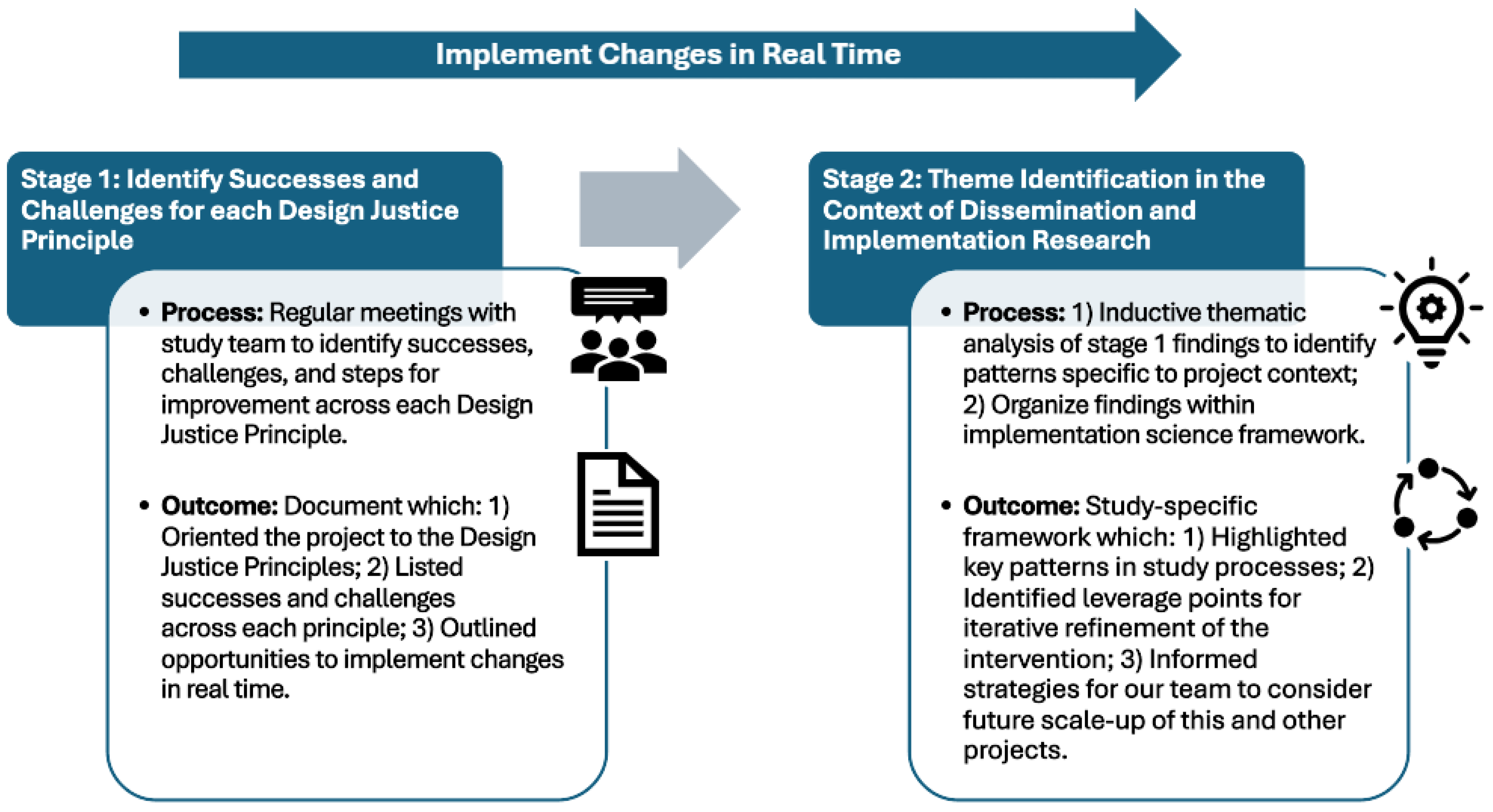
3.3. Procedures
3.4. Study Team Reflections from Implementing Stages 1 and 2
4. Discussion
Recommended Process: Design Justice-Guided Iterative Review of Study Processes
- Preparation and Synthesis. Prior to each review session, the research team should synthesize recent implementation reflections and process notes, highlighting salient successes, challenges, and decision points. These materials should be prepared in ways that support continuity and onboarding (e.g., in the event of CAB turnover), including clear documentation of prior decisions and rationales. Key items should be explicitly mapped to relevant Design Justice principles (e.g., centering community leadership, minimizing harm, equitable distribution of benefits) and implementation science frameworks using accessible language and formats to ensure meaningful engagement by CAB members with varied lived experiences, roles, and levels of familiarity with research and implementation science concepts.
- Collaborative Review Sessions. Research team members and CAB members should convene in structured review sessions facilitated using guided prompts or activities. These prompts should encourage participants to assess the extent to which study processes align with Design Justice principles and to identify areas requiring adjustment, and note where in implementation processes these could be addressed. CAB members should be supported to validate or contradict interpretations, raise concerns, and propose community-informed alternatives.
- Co-Development of Adaptations. Proposed adaptations to study procedures should be collaboratively generated during review sessions, with explicit attention to feasibility, ethical implications, and potential unintended consequences. Decision-making should prioritize CAB perspectives, particularly for changes that affect participant burden, accessibility, trust, or community benefit.
- Documentation and Accountability. All agreed-upon adaptations should be documented in a shared action log that specifies the rationale for changes, responsible parties, and anticipated timelines. Teams should communicate back to CAB members about how recommendations were implemented, modified, or deferred to reinforce transparency and accountability.
- Sustainability and Continuous Improvement. Teams should periodically reflect on the effectiveness of this iterative review process itself. This reflection should include structured opportunities for CAB members to provide feedback on the extent to which power sharing, transparency, and collaborative decision-making were meaningfully enacted. Teams are encouraged to assess whether the review cadence, facilitation approaches, and documentation practices adequately support equitable participation and timely responsiveness to community-identified concerns. Based on this feedback, teams should refine review structures as needed and document recommendations for sustaining Design Justice–aligned practices beyond the current study, including their integration into future projects, institutional workflows, or partnership agreements.
5. Conclusions
Author Contributions
Funding
Institutional Review Board Statement
Informed Consent Statement
Data Availability Statement
Acknowledgments
Conflicts of Interest
References
- Adler, Rachel R., Randi N. Smith, Kevin J. Fowler, Jeffery Gates, Nichole M. Jefferson, Joel T. Adler, and Rachel E. Patzer. 2022. Community Based Participatory Research (CBPR): An Underutilized Approach to Address Surgical Disparities. Annals of Surgery 275: 496–99. [Google Scholar] [CrossRef] [PubMed]
- Alang, Sirry, Hasshan Batts, and Abby Letcher. 2021. Interrogating academic hegemony in community-based participatory research to address health inequities. Journal of Health Services Research Policy 26: 215–20. [Google Scholar] [CrossRef] [PubMed]
- Arnold, Doris, Andrea Glässel, Tabea Böttger, Navina Sarma, Andreas Bethmann, and Petra Narimani. 2022. “What Do You Need? What Are You Experiencing?” Relationship Building and Power Dynamics in Participatory Research Projects: Critical Self-Reflections of Researchers. International Journal of Environmental Research and Public Health 19: 9336. [Google Scholar] [CrossRef] [PubMed]
- Attygalle, Lisa. 2017. The Context Experts. Available online: https://www.tamarackcommunity.ca/hubfs/Resources/Publications/The-Context-Experts.pdf?hsLang=en-us (accessed on 29 October 2025).
- Braun, Virginia, and Victoria Clarke. 2006. Using thematic analysis in psychology. Qualitative Research in Psychology 3: 77–101. [Google Scholar] [CrossRef]
- Cao, Michael, Michael Esposito, and Hedwig Lee. 2025. The U.S. Criminal Legal System and Population Health. Current Epidemiology Reports 12: 5. [Google Scholar] [CrossRef]
- Carson, Ann E. 2022. Prisoners in 2021—Statistical Tables. Available online: https://bjs.ojp.gov/library/publications/prisoners-2021-statistical-tables (accessed on 23 September 2025).
- Colder Carras, Michelle, Karen Machin, Marie Brown, Terry-Lee Marttinen, Charlotte Maxwell, Barbara Frampton, Matthew Jackman, and Nev Jones. 2023. Strengthening Review and Publication of Participatory Mental Health Research to Promote Empowerment and Prevent Co-optation. Psychiatric Services 74: 166–72. [Google Scholar] [CrossRef]
- Costanza-Chock, Sasha. 2020. Design Justice: Community-Led Practices to Build the Worlds We Need. Cambridge: The MIT Press. [Google Scholar] [CrossRef]
- Creasy, Stephanie L., Sheridan Sweet, Janet J. Myers, Martha Shumway, Marina Tolou-Shams, Nicole McCaffrey, and Emily F. Dauria. 2024. eHealth-Enhanced Peer Navigation for Substance Use Treatment and HIV Prevention Service Linkage for Young Adults Surveilled by the Criminal Legal System: Protocol for a Pilot Randomized Trial Study. JMIR Res Protoc 13: e54815. [Google Scholar] [CrossRef]
- Cunningham, William E., Terry Nakazono, Mark Malek, Steve Shoptaw, Robert Weiss, Susan Ettner, and Nina Harawa. 2017. Effectiveness of a Peer Navigation Intervention to Maintain Viral Suppresion Among HIV+ Men and Transgender Women Released From a Large Municipal Jail: Results of a Randomized Controlled Trial. Paper presented at 12th International Conference on HIV Treatment and Prevention Adherence, Miami, FL, USA, June 4–6. [Google Scholar]
- Dailey, André, Zanetta Gant, Jianmin Li, Shruthi Nagaraju, Faith Elenwa, Sonia Singh, Joseph E. Logan, Anna Satcher Johnson, Shacara Johnson Lyons, and Michael Friend. 2020. HIV Surveillance Report; 33, p. 143. Available online: https://stacks.cdc.gov/view/cdc/121127 (accessed on 5 January 2026).
- Dauria, Emily F., Priyanka Kulkarni, Angelo Clemenzi-Allen, Lauren Brinkley-Rubinstein, and Curt G. Beckwith. 2022. Interventions Designed to Improve HIV Continuum of Care Outcomes for Persons with HIV in Contact with the Carceral System in the USA. Current HIV/AIDS Reports 19: 281–91. [Google Scholar] [CrossRef]
- Daya, Indigo, Bridget Hamilton, and Cath Roper. 2020. Authentic engagement: A conceptual model for welcoming diverse and challenging consumer and survivor views in mental health research, policy, and practice. International Journal of Mental Health Nursing 29: 299–311. [Google Scholar] [CrossRef]
- Design Justice Network. 2025. Available online: https://designjustice.org/ (accessed on 5 January 2026).
- Egid, Beatrice R., María Roura, Bachera Aktar, Jessica Amegee Quach, Ivy Chumo, Sónia Dias, Guillermo Hegel, Laundette Jones, Robinson Karuga, Luret Lar, and et al. 2021. ‘You want to deal with power while riding on power’: Global perspectives on power in participatory health research and co-production approaches. BMJ Global Health 6: e006978. [Google Scholar] [CrossRef]
- Freeman, Harold P., and Rian L. Rodriguez. 2011. The History and Principles of Patient Navigation. Cancer 117: 3539–42. [Google Scholar] [CrossRef] [PubMed]
- Gaynor, Tia Sherèe. 2018. Social Construction and the Criminalization of Identity: State-Sanctioned Oppression and an Unethical Administration. Public Integrity 20: 358–69. [Google Scholar] [CrossRef]
- George, Asha S., Vrinda Mehra, Kerry Scott, and Veena Sriram. 2015. Community Participation in Health Systems Research: A Systematic Review Assessing the State of Research, the Nature of Interventions Involved and the Features of Engagement with Communities. PLoS ONE 10: e0141091. [Google Scholar] [CrossRef]
- Green, Gill, and Tracey Johns. 2019. Exploring the Relationship (and Power Dynamic) Between Researchers and Public Partners Working Together in Applied Health Research Teams [Empirical Study]. Frontiers in Sociology 4: 20. [Google Scholar] [CrossRef]
- Hightow-Weidman, Lisa B., Kathryn E. Muessig, Jose Bauermeister, Chen Zhang, and Sara LeGrand. 2015. Youth, Technology, and HIV: Recent Advances and Future Directions. Current HIV/AIDS Reports 12: 500–15. [Google Scholar] [CrossRef] [PubMed]
- Hinton, Elizabeth, and DeAnza Cook. 2021. The Mass Criminalization of Black Americans: A Historical Overview. Annual Review of Criminology 4: 261–86. [Google Scholar] [CrossRef]
- Howden, Lindsay M., and Julie A. Meyer. 2011. Age and Sex Composition: 2010; Washington: U.S. Department of Commerce. Available online: https://www.census.gov/content/dam/Census/library/publications/2011/dec/c2010br-03.pdf (accessed on 5 January 2026).
- Jones, Nev, Linda Callejas, Marie Brown, Michelle Colder Carras, Bevin Croft, Shannon Pagdon, Lindsay Sheehan, Oladunni Oluwoye, and Yaara Zisman-Ilani. 2023. Barriers to Meaningful Participatory Mental Health Services Research and Priority Next Steps: Findings From a National Survey. Psychiatric Services 74: 902–10. [Google Scholar] [CrossRef]
- Maruschak, Laura M. 2022. HIV in Prisons, 2020-Statistical Tables; Washington: Bureau of Justice Statistics.
- Masterson, Daniel, Kristina Areskoug Josefsson, Glenn Robert, Elisabeth Nylander, and Sofia Kjellström. 2022. Mapping definitions of co-production and co-design in health and social care: A systematic scoping review providing lessons for the future. Health Expectations 25: 902–13. [Google Scholar] [CrossRef]
- McGladrey, Margaret L., Marisa Booty, Ramona Olvera, Peter Balvanz, Hilary L. Surratt, Shannon Matthews, Susannah Stitzer, Owusua Yamoah, Sylvia Ellison, Kevin Campbell, and et al. 2025. Using photovoice to define “community” in substance use disorder research engaging service users, providers, and policymakers. SSM-Qualitative Research in Health 7: 100531. [Google Scholar] [CrossRef]
- McGovern, Mark P., Hélène Chokron Garneau, Heather J. Gotham, Sara Becker, William C. Becker, and C. Hendricks Brown. 2024. Dissemination and Implementation Research Capability—Self Survey (DIRC-SS). In HEAL Data2Action Research Adoption Support Center. Palo Alto: Center for Dissemination and Implementation at Stanford (C-DIAS). [Google Scholar]
- Meyer, Ilan H., Andrew R. Flores, Lara Stemple, Adam P. Romero, Bianca D. M. Wilson, and Jody L. Herman. 2017. Incarceration Rates and Traits of Sexual Minorities in the United States: National Inmate Survey, 2011–2012. American Journal of Public Health 107: 267–73. [Google Scholar] [CrossRef]
- Myers, Janet J., Mi-Suk Kang Dufour, Kimberly A. Koester, Mark Morewitz, Rebecca Packard, Kate Monico Klein, Milton Estes, Brie Williams, Alissa Riker, Jacqueline Tulsky, and et al. 2018. The Effect of Patient Navigation on the Likelihood of Engagement in Clinical Care for HIV-Infected Individuals Leaving Jail. American Journal of Public Health 108: 385–92. [Google Scholar] [CrossRef]
- Nellis, Ashley. 2021. The Color of Justice: Racial and Ethnic Disparity in State Prisons. Washington: The Sentencing Project. Available online: https://www.sentencingproject.org/reports/the-color-of-justice-racial-and-ethnic-disparity-in-state-prisons-the-sentencing-project/ (accessed on 5 September 2025).
- Okoroji, Celestin, Tanya Mackay, Dan Robotham, Davino Beckford, and Vanessa Pinfold. 2023. Epistemic injustice and mental health research: A pragmatic approach to working with lived experience expertise. Frontiers in Psychiatry 14: 1114725. [Google Scholar] [CrossRef]
- Rod, Naja Hulvej, Megan Davies, Tjeerd Rudmer de Vries, Bertina Kreshpaj, Henning Drews, Tri-Long Nguyen, and Leonie K. Elsenburg. 2025. Young adulthood: A transitional period with lifelong implications for health and wellbeing. BMC Global and Public Health 3: 25. [Google Scholar] [CrossRef]
- SAMHSA. 2019. Substance Misuse Prevention for Young Adults; Evidence-Based Recource Guide Series; Rockville: SAMHSA.
- SAMHSA. 2022. Key Substance Use and Mental Health Indicators in the United States: Results from the 2021 National Survey on Drug Use and Health; Rockville: SAMHSA.
- Sawyer, Wendy, and Peter Wagner. 2023. Mass Incarceration: The Whole Pie 2023. Northampton: Prison Policy Initiative. Available online: https://www.prisonpolicy.org/reports/pie2023.html (accessed on 5 January 2026).
- Siringil Perker, Selen, and Lael E. H. Chester. 2021. The Justice System and Young Adults with Substance Use Disorders. Pediatrics 147: S249–S258. [Google Scholar] [CrossRef]
- Steketee, Abby M., Thomas G. Archibald, and Samantha M. Harden. 2020. Adjust your own oxygen mask before helping those around you: An autoethnography of participatory research. Implementation Science 15: 70. [Google Scholar] [CrossRef]
- Sullivan, Patrick S., Robert Driggers, Joanne D. Stekler, Aaron Siegler, Tamar Goldenberg, Sarah J. McDougal, Jason Caucutt, Jeb Jones, and Rob Stephenson. 2017. Usability and Acceptability of a Mobile Comprehensive HIV Prevention App for Men Who Have Sex With Men: A Pilot Study. JMIR mHealth and uHealth 5: E26. [Google Scholar] [CrossRef] [PubMed]
- Widra, Emily. 2024. Addicted to Punishment: Jails and Prisons Punish Drug Use far More Than They Treat It. Northampton: Prison Policy Initiative. Available online: https://www.prisonpolicy.org/blog/2024/01/30/punishing-drug-use/ (accessed on 10 October 2025).
- Widra, Emily, and Tiana Herring. 2021. States of Incarceration: The Global Context 2021. Northampton: Prison Policy Initiative. Available online: https://www.prisonpolicy.org/global/2021.html (accessed on 12 October 2025).


| Principle | Description |
|---|---|
| Principle 1 | We use design to sustain, heal, and empower our communities, as well as to seek liberation from exploitative and oppressive systems. |
| Principle 2 | We center the voices of those who are directly impacted by the outcomes of the design process. |
| Principle 3 | We prioritize design’s impact on the community over the intentions of the designer. |
| Principle 4 | We view change as emergent from an accountable, accessible, and collaborative process, rather than as a point at the end of a process. |
| Principle 5 | We see the role of the designer as a facilitator rather than an expert. |
| Principle 6 | We believe that everyone is an expert based on their own lived experience, and that we all have unique and brilliant contributions to bring to a design process. |
| Principle 7 | We share design knowledge and tools with our communities. |
| Principle 8 | We work towards sustainable, community-led and -controlled outcomes. |
| Principle 9 | We work towards non-exploitative solutions that reconnect us to the earth and to each other. |
| Principle 10 | Before seeking new design solutions, we look for what is already working at the community level. We honor and uplift traditional, indigenous, and local knowledge and practices. |
| Design Justice Principle | Where Have We Been Challenged with This Principle? | Where Have We Had Success Applying This Principle? | How Could We Improve Our Process? |
|---|---|---|---|
| Design Justice Principle Number 1: We use design to sustain, heal, and empower our communities, as well as to seek liberation from exploitative and oppressive systems. | Because we are working to improve conditions within an oppressive criminal legal system, part of the challenge is to do so without feeding resources into harmful system or otherwise legitimizing the existing system. | We focus on empowerment by conceptualizing the goal of substance use treatment linkage within the context of harm reduction. | Hiring practices & improving representation on study team |
| We are reckoning with structural inequities while also trying to produce a product/provide an intervention—the timeline required to address the former is much longer than the time alloted to do the latter. | We engage in self-reflexivity (being transparent about our identities during project outreach and partnership development) | Continued community engagement | |
| The research/design team does not have the direct lived experience of criminal legal involvement and so the healing and empowerment process is separated from those most directly affected. | We explicitly name systemic harms as part of work in this space, describing where & how they shape disparities in all spaces in which we operate, to maintain the tension of improving conditions without feeding the oppressive system. | ||
| In line with empowerment of communities, the project involves staffing & budget for jobs uniquely developed for peers which will be implemented with Aim 2 | |||
| We engage and collaborate with organizations & people (systems partners) with similar goals/values |
| Dimension | Description |
|---|---|
| Evidentiary Support | The data that are used to support the development and implementation of the intervention/program/service. |
| Partner Engagement | Planning for the degree to which key and representative partners from the project site(s) and the community in which the project takes place had input into defining the population, clinical problem, or intervention/program/service being delivered to help ensure that interventions will be effective across diverse groups/contexts and used and sustained in practice over time. |
| Contextual Determinants | Consideration of systems, organizational, provider, and patient/consumer-level factors that affect implementation of the intervention (i.e., barriers and facilitators) that may impact the reach and adoption of the intervention/program/service. |
| Implementation Strategies | Selection, adaptation, and description of, methods, activities, and resources that support implementation and sustainment of the intervention/program/service (e.g., training, facilitation/coaching, incentives, performance data, audit and feedback), operationalized as the steps and methods taken to support users (within the project or in the real world) with the installation or sustainment of the intervention/program/service. |
| Implementation Outcomes | Evaluation of effects of actions to implement or sustain the intervention, program, or service (how much and how well an intervention was implemented/sustained). |
Disclaimer/Publisher’s Note: The statements, opinions and data contained in all publications are solely those of the individual author(s) and contributor(s) and not of MDPI and/or the editor(s). MDPI and/or the editor(s) disclaim responsibility for any injury to people or property resulting from any ideas, methods, instructions or products referred to in the content. |
© 2026 by the authors. Licensee MDPI, Basel, Switzerland. This article is an open access article distributed under the terms and conditions of the Creative Commons Attribution (CC BY) license.
Share and Cite
Sweet, S.; McCaffery, N.; Jiang, J.; Coulter, R.W.S.; Egan, J.E.; Myers, J.; Shumway, M.; Tolou-Shams, M.; Dauria, E.F. Design Justice in Action: Co-Developing an HIV and Substance Use Linkage Intervention with Young Adults Involved in the Carceral System. Soc. Sci. 2026, 15, 55. https://doi.org/10.3390/socsci15010055
Sweet S, McCaffery N, Jiang J, Coulter RWS, Egan JE, Myers J, Shumway M, Tolou-Shams M, Dauria EF. Design Justice in Action: Co-Developing an HIV and Substance Use Linkage Intervention with Young Adults Involved in the Carceral System. Social Sciences. 2026; 15(1):55. https://doi.org/10.3390/socsci15010055
Chicago/Turabian StyleSweet, Sheridan, Nicole McCaffery, Jerry Jiang, Robert W. S. Coulter, James E. Egan, Janet Myers, Martha Shumway, Marina Tolou-Shams, and Emily F. Dauria. 2026. "Design Justice in Action: Co-Developing an HIV and Substance Use Linkage Intervention with Young Adults Involved in the Carceral System" Social Sciences 15, no. 1: 55. https://doi.org/10.3390/socsci15010055
APA StyleSweet, S., McCaffery, N., Jiang, J., Coulter, R. W. S., Egan, J. E., Myers, J., Shumway, M., Tolou-Shams, M., & Dauria, E. F. (2026). Design Justice in Action: Co-Developing an HIV and Substance Use Linkage Intervention with Young Adults Involved in the Carceral System. Social Sciences, 15(1), 55. https://doi.org/10.3390/socsci15010055