
Abstract
The rapid technological development caused by industrial revolutions (Industry 4.0 and 5.0) puts a lot of pressure on the education system that regulates initial and continuous human resource development. The present study undertakes a scoping review of the policy papers of WEF, OECD, and UNESCO to understand the future challenges faced by education. The online databases of these international organizations were used to identify the English versions of the education policy reports published between 2020 and 2025 using the keywords “skills policy”, “closing skills gap”, “future skills”, “drivers of change”, “trends transforming education”, and “future education”. After screening and performing a thematic analysis, we identified fifteen publications that met the inclusion criteria. Choosing a systematic-narrative hybrid strategy, we conducted a systemic scoping review using the PRISMA-ScR guidelines. We found that the analyzed WEF and OECD policy reports contribute the most to understanding global skills policy and global trends driving changes in education. Our review has also revealed that the WEF-developed Global Skills Taxonomy and Taxonomy Adoption Toolkit contribute to further skills policy improvement and its practical implementation in bridging the skills gap.
1. Introduction
The contemporary world is marked by the rapid technological development and changes in all spheres of our life. They transform the world of work, labour markets, businesses, and education systems, which directly affects human resources. The modernization of education has always been going hand in hand with industrial revolutions. Innovations and technological changes have introduced novel ways of working and living. The social aspect of the technological progress related to social needs, social resources, and a suitable social ethos is highly important for the successful adoption of technological innovations. Industry 4.0 is marked by intensively developing digital technologies, artificial intelligence (AI), machine learning, the appearance of smart phones, automatic robots, and cyber-physical systems (CPSs). We are approaching Industry 5.0, which is a newly emerging industrialization phase. During this phase, humans and machines are expected to learn to work together, using both the advanced technologies and robots, powered by AI. In this AI context, a more human-centric approach should be employed in the transformation of the industrial workplace structure. The analysis and discussion of the concepts of “sustainability”, “human-centeredness”, and “concern for the environment” began in Industry 4.0 and continues in Industry 5.0. The researchers Al-Emran and Al-Sharafi (2022) highlight the important achievements of Industry 5.0, practical uses of AI, IoT, and big data analytics, when the data, collected from industrial sector systems, are used to diagnose systemic problems, find quick solutions, and employ advanced automation technologies, namely, robotics and machine learning for handling dangerous, repetitive tasks, which require high precision, continuous quality monitoring, and control (Al-Emran and Al-Sharafi 2022). Iterations in Industry 5.0 go beyond the manufacturing processes. They aim to strengthen technological changes in our society and its education system. They are based on personalization, increased resilience, and a focus on sustainability. The rapid advancement of digital technologies causes the appearance of skills gaps faced by many business and educational organizations globally (McKinsey & Company 2017, 2020).
Societies and economies worldwide face skills and talent shortages. The difficulties in finding workforce with relevant skills hinder economic advancement and put a lot of pressure on education. Rikala and colleagues (Rikala et al. 2024) stress the increasing exploration of a skills gap phenomenon. They (Rikala et al. 2024) agree with Schwarz (2023) that further steps, made to (re)conceptualize it, become critical challenges for Industries 4.0 and 5.0. They face shortages of right-skilled workers, which slows down the adaptation of key technologies (Bokrantz et al. 2020). Many researchers (Quintini 2011; McGuinness et al. 2018; Braun et al. 2022; Enders et al. 2019) and recent groups of researchers (Adepoju et al. 2022; Felsberger et al. 2019; López Peláez et al. 2021) agree that mismatches between required and possessed skills may have many different causes. As mentioned in the OECD Report (OECD 2017), this specifies environmental, economic, and social changes.
Hence, the complexity of operational structures in Industry 4.0 demands the workforce with a broad range of skills (Karacay 2018). Individuals must undergo continuous reskilling and upskilling to meet the requirements (Clark 2013). Digital transformations demand specific skills that are not always developed at work or taught at educational institutions. It has been argued, if reforming education and training systems would serve the purpose of closing the skills gaps, Rathelot and van Rens (2017) think that the reforming of education can be costly and ineffective. The assessment of lacking skills depends on an organization and an employee, who may set different goals for upskilling and reskilling; they may also be a problematic issue (Braun et al. 2022).
This paper seeks to explore how the policies of international organizations (IOs) (WEF, OECD, and UNESCO) address the skills gap problem. We also strive to identify drivers of change. According to Nelson et al. (2006), there are significant factors, forces, or processes that cause substantial and durable changes within the system (Nelson et al. 2006). We try to define future-oriented global drivers of change in education, looking at them from the international education policy perspectives. Our study, based on the scoping review, aims to answer the following research questions:
- (1)
- What is the future-oriented skills policy of the international organizations and how does it help to bridge/close the skills gaps?
- (2)
- What are the global trends driving changes in education?
2. Materials and Methods
We have conducted a scoping review of the policy papers of three international organizations (OECD, WEF, and UNESCO) published between 2020 and 2025. We have chosen these organizations as their policy has the greatest influence on the national policies of education systems worldwide. This review will help to identify the key drivers of change that shape the future developments of education and understand the challenges of the rapid technological advancements related to Industry 4.0 and 5.0, as well as the political mega context of evolving global trends driving changes in education.
We have used a systematic-narrative hybrid approach (Turnbull et al. 2023, p. 2) for the scoping review. Systematic and narrative reviews are the two frequently used methodologies for extracting and analyzing resources. In Whittemore and Knafl’s (2005) opinion, they try to balance the strengths of both approaches (Whittemore and Knafl 2005). The PRISMA guidelines (Page et al. 2021) are employed to guide us through a step-by-step systematic analysis of our scoping review (ScR), following a review report logical structure. The narrative approach is mainly used for analysis and synthesis of review data. The application of a systematic-narrative hybrid approach in the conducted document review made it possible to employ some elements of qualitative and quantitative data analyses, granting completeness of a systematic analysis, determined by the time constraints of the scoping review. Qualitative methods of document analysis and a reflexive thematic data analysis (Morgan 2022; Braun and Clarke 2006) are employed in an inductively grounded approach for gathering data.
2.1. Eligibility Criteria
Eligibility criteria (inclusion/exclusion criteria) were formulated following afore-mentioned PRISMA-ScR guidelines. (See Table 1).
Table 1.
Eligibility criteria (Page et al. 2021).
2.2. Information Sources
Following the defined eligibility criteria, we have searched available and open access information sources from the three databases of the international organizations and their digital libraries. The information sources include policy papers, reports and studies written in English and published between 2020 and 2025. The search has shown that the biggest amount of available and freely accessible publications can be found in the database of The Organization for Economic Cooperation and Development (OECD).
2.3. Selection Process
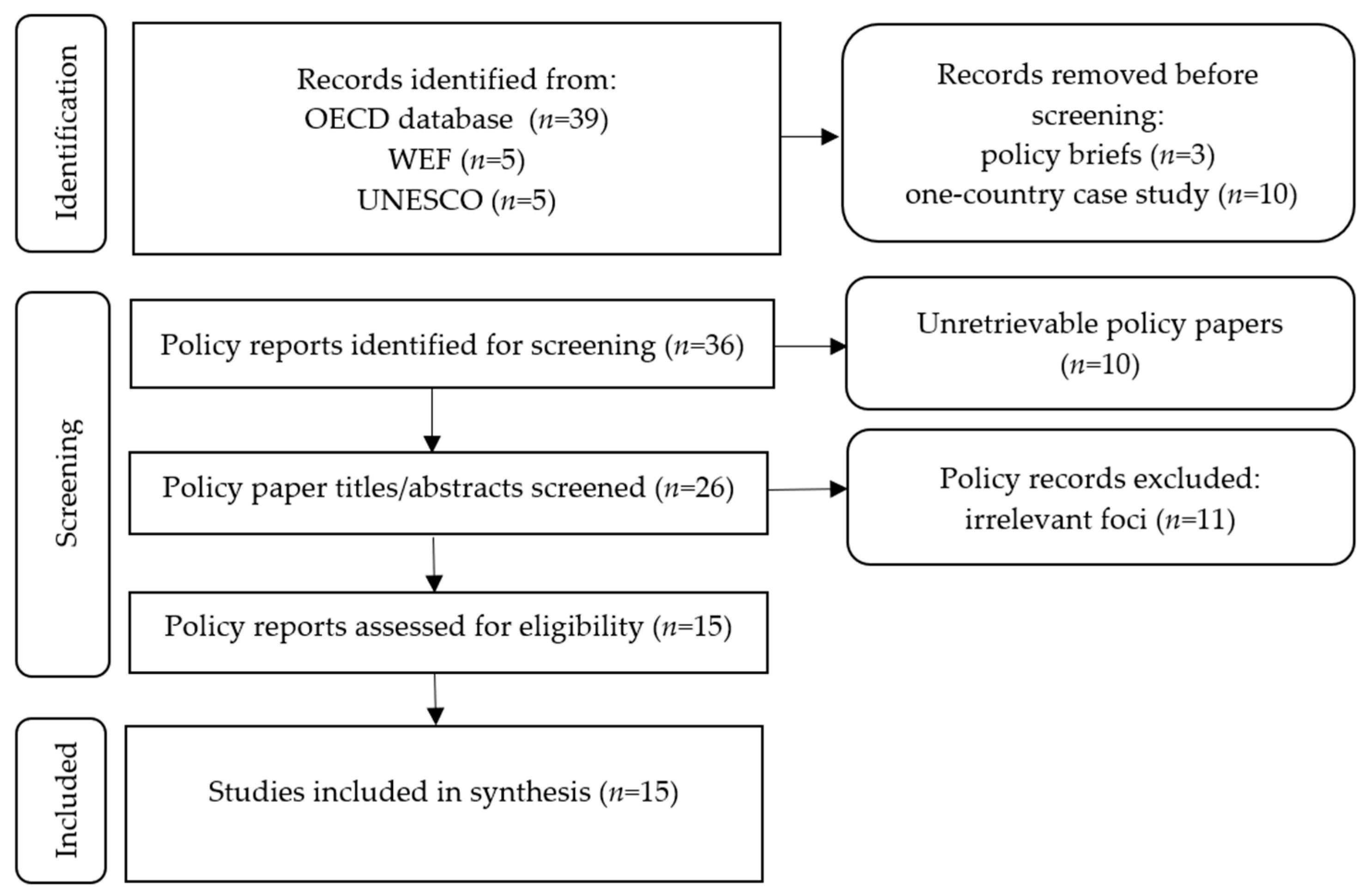
We started the systematic search and selection process in January 2023; the last executed search was performed in September 2025. We had to consider that most policy publications searched were rather long (on average about 200 pages, reports + survey data analyses), which made the Identification phase of selection process rather time-consuming. The selection of publications within a five-year timeframe was relevant to a future-oriented focus of our study. Older information sources were not included into our scoping review as less relevant, outdated, or having obsolete data. The primary data identification search yielded the selection of 49 sources of evidence.
In Figure 1, you can see the main steps of the systematic search and selection process. The identification of sources was followed by the screening process seeking the qualitative data condensation. We excluded policy briefs (n = 3), and one-country case studies (n = 10) were removed before the screening. We utilized RDiscovery (https://discovery.researcher.life, accessed on 14 November 2025), an AI-based research literature search platform to identify relevant sources for our study. This search helped in conducting a screening process. During screening we excluded unretrievable policy papers (n = 10) and policy records with irrelevant foci (n = 11). The final list of policy documents included into the scoping review is given in Section 3 (see Table 2 in Section 3.1).
Figure 1.
A flow diagram illustrating a PRISMA-ScR review process (adapted from Page et al. 2021).
Table 2.
The policy documents included into a scoping review.
2.4. Risk of Bias Assessment
Within the qualitative model of research used in the study, the researcher bias was not regarded as a concern, because all research is viewed as influenced (Morgan 2022). To ensure the consistency of selection process, the two authors of this manuscript were equally involved in the screening process and screened the same 36 publications. We resolved disagreements by discussing inconsistencies and clarifying different positions, so as to reach the consensus regarding the sources to be included into the final list of our scoping review. The systematic-narrative hybrid approach shows that a systematic and a narrative approach to review have advantages and disadvantages. Turnbull et al. (2023) think that narrative reviews are comprehensive in their coverage of the literature, but they are often criticized for being biased in the literature choice, whereas systematic reviews remove this bias by including detailed accounts of the selection process (Turnbull et al. 2023, p. 2). The reflexivity approach in our thematic analysis is based on a qualitative research paradigm. It emphasizes researcher’s subjectivity, but Morgan (2022), who explores qualitative document analysis, sees it as a resource rather than a bias problem. One way to use research subjectivity as a tool is by being reflexive, as we were. Both of the authors were involved in the data screening, collection, and thematic analysis processes. To avoid personal bias, discussions and exchanges of reflections were held on a regular basis. Occasionally, an anonymous expert was invited, when there was a need to reach a consensus regarding the selection of themes and the final list of documents to be included into the scoping review. We consider international policy documents to be trustworthy, as they are developed by experts and big research groups. Their biases are difficult to check.
2.5. Data Collection, Process, and Analysis
The screening process of policy documents was supplemented by a thematic analysis of documents. It was conducted according to the following six-stage process suggested by Braun and Clarke (2006): (1) familiarizing with data, (2) generating codes, (3) generating themes, (4) reviewing themes, (5) defining and naming themes, and (6) summarizing data. We collected data for the two selected themes according to the research questions of the scoping review. Firstly, we analyzed the concept of “skills policy” focusing on future skills policy and how it helps to bridge the skills gaps. Secondly, we identified the global trends driving changes in education.
We used a systematic-narrative hybrid approach (Turnbull et al. 2023, p. 2) throughout the scoping review. At the last stage, to analyze and synthesize the collected data, we applied a narrative approach, conducting constant comparisons (Rikala et al. 2024; Whittemore and Knafl 2005). The synthesized data are presented in the Results section below.
3. Results
This section presents insights into the conducted scoping review of the political documents of three international organizations. We start with a subsection, in which we present basic descriptive statistic data. Further on, we summarize data and present answers to our research questions.
3.1. Descriptive Statistics and an Overview of Included Publications
The criterion-based selection of policy documents reveals the growing concerns of the international organizations about education, particularly in recent years. This is reflected in the conducted research. Most of the relevant reports included into the review were published in 2025 (n = 4), 2024 (n = 2), 2023 (n = 5), 2022 (n = 1), 2021 (n = 2), and 2020 (n = 1). The majority of the selected reports focusing on education were developed by OECD researchers (n = 9), fewer by WEF (n = 5) and UNESCO (n = 1) (see Table 2).
3.2. Skills Policy
Our first research question seeks to explore skills policy as it is viewed and implemented by international organizations within the chosen five-year scope. In the data synthesis we tried to laconically present the main findings, wherever possible.
3.2.1. World Economic Forum Skills Policy
We have included three Future of Jobs Reports (World Economic Forum 2020, 2023b, 2025c) developed by WEF researchers. All these reports are future-oriented and present their outlook for the next 5 years. The main focus of the WEF international policy is to positively impact the global economic development through the changes in the labour market of all industries. The WEF employs a neoliberal approach and sees education as one of the industries, impacted by WEF policy.
Future of Jobs Report (World Economic Forum 2020). The COVID-19 pandemic-induced lockdowns and related global recession of 2020 created a highly uncertain skills outlook for the labour market and the future of work. The Report informs about (1) the pandemic-related disruption of economic cycles and (2) the expected outlook for technology adoption, jobs, and skills in the next 5 years. The report stresses the accelerated pace of technological advancement, the prioritized cloud computing and big data, and the rising interest in AI and non-humanoid robots. The report presents forecasts for labour market evolution, marking that by 2025 humans and machines will spend the same time on performing tasks at work. The economic crisis, emerging and vanishing jobs, and with them emerging and declining skills influence the skills policy of this period. The Report shows that demanded skills change. The top skills, seen as rising in demand, are critical thinking and analysis, problem-solving, and self-management skills, including active learning, resilience, and flexibility.
Future of Jobs Report (World Economic Forum 2023b) presents a global survey on future expectancies of 803 companies. The identified top ten core skills are classified by attitudes as follows: working with others (empathy, active listening, and leadership) and social influence skills. Management skills, engagement skills, technology skills, ethics, and physical abilities are considered to be less important than cognition, self-efficacy, and working with others. The electronics and education and training industries are united by an emphasis on the importance of a system- thinking skill. The skill evolution for 2023–2027 is marked by cognitive skills, growing in demand most quickly. The Report stresses the importance of complex problem-solving in the workplace. The respondents think that creative thinking is more important than analytical thinking. Technology literacy is the third rapidly growing core skill.
The skills outlook of this report mentions the WEF Global Skills Taxonomy (World Economic Forum 2025a); the refined version of it can be found at Reskilling Revolution 2030 (World Economic Forum 2025b). It presents a comprehensive, structured framework of ninety-three identified skills. It serves as a common language for employers, educators, and policymakers by providing standardized definitions and classifications, fostering alignment and a shared understanding of labour market trends and skills in demand.
Future of Jobs Report (World Economic Forum 2025c) is the most comprehensive one, out of the three within the same series. According to its skills outlook, analytical thinking is the most demanded core skill. It is followed by resilience, flexibility, and agility, along with leadership and social influence skills. AI and big data top the list of fastest-growing in-demand skills, followed by networks and cybersecurity. Technology skills are complemented by creative thinking, resilience, flexibility, and agility, along with curiosity and lifelong learning. Skills gaps are seen as biggest barriers to business transformation; 63% of Future of Jobs Survey respondents identify them as a major barrier over the 2025–2030 period.
WEF White Paper (World Economic Forum 2023b) Defining Education 4.0: Taxonomy for the Future Learning highlights the WEF skills policy in education. WEF refers to the teaching and learning of the set of abilities, skills, attitudes, and values as “Education 4.0”. This framework was developed by consulting education experts from schools, non-profits, education ministries, and the private sector. The Defining Education 4.0: A Taxonomy for the Future of Learning framework highlights the following two aspects: (1) content (built-in mechanisms for skills adaptation) and (2) experiences (utilization of innovative pedagogies), which are important for future improvements of education (see Table 3).
Table 3.
Education 4.0 framework (World Economic Forum 2023a, p. 4).
WEF White Paper The Education 4.0 Taxonomy for Future Learning (World Economic Forum 2023a) outlines innovative teaching and learning approaches, equipping learners with the skills, abilities, attitudes, and values essential for the future of education. It is aligned with the Global Skills Taxonomy. In WEF papers, education is understood as education industry, an actor of the labour market. The task of education industry community is to bring together leading education companies to advance a dedicated industry leadership agenda in education and human capital development. We see that the language used here is the language of the labour market ideology.
WEF Global Skills Taxonomy Adoption Toolkit: Defining a Common Skills Language for a Future-Ready Workforce. A Data-Driven Approach. Insight Report (World Economic Forum 2025a). It is another document recently developed by WEF experts. In it, the attention is given to the development of a common language in the Taxonomy and in the Adoption Toolkit. It is a practical tool for governments and education, industries, and businesses for developing their own skills frameworks, so as to forecast skills needs in the future and trends for decision-making. This toolkit is suitable to embed skills and proficiency levels into jobs description levels, to define and leverage skills for career progression, and to develop skills descriptions and proficiency levels. As we see, the reviewed WEF contribution into skills policy is significant.
3.2.2. OECD Skills Policy
OECD (2024a) Insights from Skills Strategies in the European Union. Lessons Learnt for Developing and Implementing Effective Skills Policies. This study, supported by the European Commission, analyses skills strategies, developed and implemented in the European Union over the past decade; twenty-six skills strategies are mapped. Nine key lessons are presented for further development and implementation of national skills strategies. The EU’s Skills Agenda of July 2020 called on the Member States to develop national skills strategies. The EC encourages countries to adopt a strategic approach to national skills policy. The project aims to enhance the understanding of how to effectively develop and implement skills strategies and to emphasize the importance of a strategic approach to skills policy. This is achieved by mapping the characteristics of twenty-six existing skills strategies, identifying the lessons learnt, and facilitating peer learning. It is suggested that EU governments should develop a skills strategy built on a strong base of evidence, adopt a whole-of-government approach to it, and finally, monitor and evaluate the implementation of skills strategy to ensure its effectiveness.
OECD (2024b) Understanding Skill Gaps in Firms: Results of the PIAAC Employer Module. In the global economy transformed by rapid technological advances, ageing populations, shifting global supply chains, changing consumer preferences, and efforts to achieve net-zero emissions, firms’ skill needs are changing. Skills gaps—the mismatch existing between skills that workers have and those which are in demand—create a challenge for firms to meet their needs. This report examines the prevalence and impact of skills gaps in the following five European countries: Hungary, Italy, the Netherlands, Portugal, and the Slovak Republic. The report finds that skills gaps are widespread in technical skills, teamworking, and problem solving. These gaps lead to increased workloads for existing staff, higher operating costs, and difficulties in implementing new practices. To address these gaps, most organizations focus on staff development, while fewer ones recruit new staff or change the way their work is organized (OECD 2024b).
OECD (2023a) Do Adults Have the Skills They Need to Thrive in a Changing World? Survey of Adult Skills 2023. Thirty-one countries and economies participated in the 2023 Survey of Adult Skills. According to the Survey, Finland, Japan, the Netherlands, Norway, and Sweden excel in all areas, with significant proportions of their adult populations demonstrating advanced abilities. On average, 18% of adults in OECD countries do not even have the most basic levels of proficiency in any of the skills domains. The survey shows that literacy and numeracy proficiency is decreasing, particularly among the least educated. These skills are necessary for personal, economic, and societal development. This has led to a widening gap in skills proficiency between high- and low-educated adults in the majority of OECD countries.
OECD (2023c) Survey of Adult Skills 2023 Technical Report is a product of the OECD Programme for the International Assessment of Adult Competencies (PIAACs). It provides a comprehensive overview of adults’ literacy, numeracy, and adaptive problem-solving skills—skills that are fundamental for personal, economic, and societal development. These key information-processing skills provide the access to employment, higher wages, and continuous learning; they enable adults to navigate the complexities of their personal and civic lives.
OECD (2025a) Empowering the Workforce in the Context of a Skills-First Approach. The labour markets across the OECD countries undergo significant changes due to technological advancements, demographic shifts, and the increasing importance of jobs, driving sustainability. These changes are reshaping skills demands and the way they are recognized. Traditional hiring models often rely on formal credentials. They are being reassessed as employers and policymakers explore alternative ways to expand and diversify the talent pool and to better match people with emerging job opportunities. This report explores the emergence of a skills-first approach in OECD labour markets and the opportunities and challenges that arise from the adoption of skills-first approaches in the light of demographic shifts and the green and digital transitions. The report shows how individuals signal their skills, to what extent employers adopt skills-based hiring practices, and whether these efforts allow them to reach a broader and diverse talent pool. A skills-first approach can lead to a better job matching and adaptability. A few barriers to its successful adoption remain. These include unequal access to digital tools, challenges in validating skills, as well as employers’ reluctance to trust non-traditional credentials. The report highlights key policy actions to support the adoption of skills-first practices. They call on governments to standardize skills recognition.
Skills signalling is defined as individuals explicitly communicating their skills through means such as professional networking sites, by listing their skills, or through peer endorsements. It is growing across the OECD countries. It is most common among younger individuals, professionals in digital and business sectors, and those with higher education.
Gaps in access to skills validation tools, digital proficiency, and employer recognition of non-traditional credentials may suggest that not all individuals can equally benefit from the opportunities that skills-first practices offer. Skills-based hiring is expanding, but implementation challenges remain. Many employers are shifting hiring practices to emphasize demonstrated skills over formal qualifications. Skills-first approach and practices may lead to long-term benefits depending on how well they are implemented (see Table 4).
Table 4.
Steps to support the implementation of skills-first approach (OECD 2025a).
3.3. Trends Driving Changes in Education
This subsection gives answers to the second research question of our study: (2) what are future-oriented global drivers of change and trends transforming education?
OECD (2021) Digital Education Outlook 2021: Pushing the Frontiers with Artificial Intelligence, Blockchain, and Robots. This report highlights smart technologies based on artificial intelligence (AI), learning analytics, and robotics, which are driving changes in transformation of education. This report focuses on how smart technologies currently change education in the classroom and on the management of educational organizations and systems. It addresses learning personalization, supporting students with special learning needs, and blockchain diploma credentialing. It offers pathways for teachers, policy makers, and educational institutions to digitalize education in order to optimize equity and inclusivity. Digitalization opens up new possibilities for education. Education has always been rich in data such as grades or administrative information on students’ absenteeism. However, the use of data to help students learn better and teachers to teach better, as well as to inform decision-making in educational administrations, is quite recent. Education stakeholders have had a difficult relationship with technology, alternating between strong enthusiasm and scepticism. Digital and smart technologies, based on AI, learning analytics, and robotics transform education in the same way as they transform the society.
Smart technologies have become drivers of change in the classroom. Adaptive learning technologies, namely, intelligent tutoring systems, enable the personalization of students’ learning using the following similar approaches: they can detect students’ knowledge gaps and diagnose the next appropriate steps for further learning. Technology also enables students with special needs to participate in education; thus, inclusive education becomes a reality. The use of well-known AI applications such as speech-to-text, text-to-speech, auto-captioning, and others allows blind, visually impaired, deaf, and hard-of-hearing students to participate in traditional educational settings and practices. Smart technologies can facilitate the diagnosis and remediation of some special needs (e.g., dysgraphia) and support the socio-emotional learning of students with autism, so they are able to easily participate in mainstream education. Smart technologies are human–AI hybrid systems, contributing to the effectiveness, equity, and efficiency of education systems.
OECD (2022) Trends Shaping Education 2022. This OECD report examines major economic, political, social, and technological trends affecting education. It covers topics related to economic growth, living and working, knowledge and power, identity, and belonging. It focuses on the impact of COVID-19, climate change, and other global trends that are transforming education. New futures thinking invites us to reflect on how the future developments might be different from our current expectations.
OECD (2025b) Trends Shaping Education 2025 is a report exploring the social, technological, economic, environmental, and political forces that affect global education systems. The trends are robust, but the issues raised in this report are suggestive. They are designed to inspire reflection and inform strategic thinking on how global trends transform education and how education can shape a better future. This report explores the topics related to the following key themes: global conflict and cooperation, work and progress, voices and storytelling, and bodies and minds. It builds on foresight exercises, while introducing a range of new futures thinking tools, such as reflection and action. The early 2020s are marked by increasing geopolitical tensions and escalating ecological crises, far-reaching changes, and implications for migration, energy security, trade dynamics, labour markets, and changing education policy priorities. The global conflicts and crises affect human and planetary health, exacerbate existing inequalities, and generate new disparities. The report explores the global megatrends that are shaping societies in the OECD countries and beyond, looking through an educational lens. It raises questions about the implications of the global trends for various stages and sectors of education. It offers thinking tools to help education systems anticipate disruptions and think strategically about the future. In times of rapid changes and uncertainty, futures thinking can help education systems learn how to navigate complex global challenges by imagining potential scenarios and exploring diverse possibilities. Geopolitical tensions and global crises underscore the role of education in fostering resilience and a sense of security in an increasingly conflict-ridden unstable world. Education may not be able to solve the root causes of polarization of the world, global conflicts, climate change, and inequality, but it can empower learners to understand, shape, and demand the changes they want to see. The recent past has shown that global challenges like pandemics, climate change, disruptions in energy supply, or cyberattacks can best be addressed through international efforts. The report stresses that opposing extremes in opinions and beliefs have become a feature of our societies, influencing everything from political discourses to social interactions. The trends reviewed in this report present a diverse and contrasting picture of social progress, where life outcomes are closely linked to the intersection of personal and group characteristics such as age, gender, migration, background, and socio-economic status.
OECD (2023b), OECD Digital Education Outlook 2023: Towards an Effective Digital Education Ecosystem, Trends in Adult Learning. New Data from the 2023 Survey of Adult Skills. The Digital Education Outlook 2023 provides a comparative, thematic analysis of how countries shape or could shape their digital ecosystem. The report stresses the importance of appearing student information systems (or education management information system—EMIS), learning management systems, digital assessment platforms, and study and careers guidance. The report tries to provide answers to the following questions: what are the different components of countries’ digital education ecosystem? How and to what extent do countries leverage teachers’ digital competences and the latest opportunities offered by AI? How can countries make the most of their digital ecosystem so that it is trustworthy, useful, effective, and equitable? How does digital education continue to improve and innovate education? Based on the numerous national examples from the OECD survey, the report shows where the countries stand and how they may benefit from digital transformations.
UNESCO (2021) Reimagining Our Future Together. A New Social Contract for Education. This report has been made by the United Nations Educational, Scientific, and Cultural Organization (UNESCO), International Commission on the Futures of Education. It invites the global community to work together on improving education. The report looks into 2050 and beyond and underscores the potential of education to create a better future for all. A new social contract should overcome discrimination, marginalization, and exclusion; it should ensure the right to quality education to the world’s future generations. Education should be transformed to shape peaceful, just, and sustainable futures (UNESCO 2021, p. 1). There is the need to rethink and reinvent our education, making it a powerful tool to provide the knowledge and skills, necessary to deal with the common challenges the humanity faces today and will face in the future. To do this, we need a new social contract for education that can repair injustices while transforming the future. Over the past decade, the world has seen a backsliding in democratic governance and a rise in identity-driven populist sentiment. At the same time, there has been an increase in active citizen participation and activism that is challenging discrimination and injustice worldwide. The starting point is a shared vision of the public purposes of education. The foundational principles of the new social contract are the following: assuring the right to quality education throughout life, as established in Article 26 of the Universal Declaration of Human Rights, and strengthening education as a public endeavour and a common good. This new social contract must be grounded in human rights and based on the principles of non-discrimination, social justice, respect for life, human dignity, and cultural diversity. It must encompass an ethic of care, reciprocity, and solidarity.
The UNESCO (2021, p. 4) Report formulates the following proposals for renewing education:
- “Pedagogy should be organized around the principles of cooperation, collaboration, and solidarity.
- Curricula must embrace an ecological understanding of humanity that rebalances the way we relate to Earth as a living planet and our singular home.
- Collaboration and teamwork should characterize the work of teachers.
- Schools should be protected educational sites because of the inclusion, equity and individual and collective well-being they support.
- There is a transformative potential in digital technologies, they should aim to support—and not replace—schools.
- People should have meaningful, quality educational opportunities. The right to education needs to be broadened to be lifelong and encompass the right to information, culture, science and connectivity” (UNESCO, 2021, p. 4).
The presented proposals show that the authors of this UNESCO (2021) report have a clear and holistic picture of educational changes to be made. In their future-oriented vision, the pedagogy, the school curricula, as well as the work of teachers, should be transformed. Teaching as a collaborative endeavour should be further professionalized. Teachers are recognized as knowledge producers and important figures in educational and social transformation. Curricula should emphasize ecological, intercultural, and interdisciplinary learning, promote active citizenship and democratic participation, develop humanistic values, empathy, and compassion, while at the same time fostering students’ critical attitude and their ability to distinguish falsehoods from truth. They become particularly important in the conditions of growing and spreading misinformation. There is also a proposal to transform schools as educational institutions, creating and connecting natural, built, and virtual sites of learning, strengthening the best potentials of each. The architecture of schools and their functions should undergo changes, making schools a better place for all.
4. Discussion
Our Discussion addresses the summarized findings of the scoping review regarding the following two themes chosen after the conducted thematic analysis: future skills policies and future drivers of change and trends in education.
The analysis of the policy documents, published between 2020 and 2025, provides evidence that the biggest contribution to the skills policy development is made by World Economic Forum (WEF) and Organization for Economic Co-operation and Development (OECD). The comparison of the impacts made by these two international organizations shows that there are some similarities in policy directions, as well as differences in its implementation. The main focus of the WEF international policy is to positively impact the global economic development and changes in the labour market. WEF neoliberal policy sees education as one of industries. This is evident in all Future of Jobs (World Economic Forum 2020, 2023a, 2025a) reports, which give much attention to future skills policy.
We see that the latest WEF policy is giving more attention to the development of practical policy tools, e.g., Global Skills Taxonomy (World Economic Forum 2025a). The adoption of a unified skills taxonomy offers numerous benefits. It helps to align skills language and skills requirements. Governments can use it to develop national skills taxonomies to address labour-market skills shortages. The Global Skills Taxonomy Adoption Toolkit (World Economic Forum 2025a) developed by WEF has a lot of practical value. This toolkit provides the key insights as well as a set of actions for organizations and governments with the taxonomy adoption road map and some practical guidance on common barriers and bottlenecks to skills taxonomy implementation. In this context, the WEF signifies the importance of education, not only of its sectoral role in effective upskilling and reskilling policies implementation, but also of the importance of its future improvement (see World Economic Forum 2023a, WEF White Paper Defining Education 4.0: A Taxonomy for the Future of Learning).
WEF thrives to globally influence world policy, whereas OECD focuses mainly on the policies of thirty-eight OECD Member States. Different from WEF, much attention is given to case studies of separate OECD countries (they are not included into our review) and their comparative policy analysis. The OECD documents, included in the scoping review, evidence bigger attention given to the analysis of education-related policy issues (EU skills strategies, digital education outlook, adult skills and learning, digital skills and teacher education, and trends shaping education).
We have included into a scoping review the only UNESCO (2021) policy document Reimagining Our Futures Together: A New Social Contract for Education. Different from the WEF and OECD policy impacts, which are seen as implementable ones, the UNESCO report focuses mainly on the futures thinking about education transformational potential for shaping just and sustainable futures for all, which may be regarded as a utopian vision, difficult to be globally implemented. UNESCO generates ideas, initiates public debate, and inspires research and actions to renew education. It affirms education as a public endeavour and a common good. It aims to build a new social contract for education, grounded on the principles of human rights, social justice, human dignity, and cultural diversity. However, the main challenges to be addressed remain, such as increasing uncertainty, an unprecedented speed of advancing digital technologies, and existing asymmetries in country developments and power relations. They are the main barriers to implementing this policy vision and signing a new social contract for global education.
As to the main drivers of change and global mega trends, they also persist. The continuing digital technology development, economic and demographic shifts, environmental and climate changes, polarization of the world and military conflicts, not to forget the COVID-19 pandemic, are all “the cause” in a cause–effect relationship that initiates or promotes changes. All of us will have to learn to manage them effectively. This is our future imperative.
5. Strengths and Limitation of Conducted Document Analysis
The conducted scoping review, focused on the analysis of policy documents, has helped to identify the strengths and limitations of the study. It may be important for replicating the study based on a qualitative document analysis (see Table 5).
Table 5.
Strengths and limitations of conducting document analysis (based on Morgan 2022, p. 70).
6. Conclusions, Implications of the Study, and Directions for Future Research and Practice
Following the defined eligibility criteria, we have searched the available and open access information sources from the three databases of international organizations and their digital libraries. The information sources include policy papers, reports, studies, and policy briefs written in English during the period of 2020–2025. The search has shown that the biggest amount of available and freely accessible publications is in the database of Organization for Economic Cooperation and Development (OECD) (see Table 2).
Our scoping review reveals the need for a common understanding of an international policy context and the importance of skills policy, conducted by international organizations. However, the skills gap still remains an important challenge to be addressed, specifically in the conditions of the rapidly advancing digital technologies. Moreover, the review provides insights for future transformations of the labour market and education systems. It clarifies future-oriented global drivers of change as well as the main trends accelerating changes in digital education and its huge impact on skills policy and practice.
6.1. Recommendations for Future Practice
The latest international skills policy developments are aimed at solving skills gap, which is a serious challenge. The WEF developed Global Skills Taxonomy; together with this Taxonomy, there is the Adoption Toolkit—these are useful tools to be employed for practical policy development and its application at national and subnational levels of skills policy implementation. We thus suggest that educators, employers, employees, students, and political decision-makers should comprehend the international policy context, the importance of skills policy and the skills-first approach, and recognize their collaborative roles in the practical implementation of this policy in today’s world.
6.2. Suggestions for Future Research
The results of the scoping review of international policy documents suggest that future studies could address the exploration of the international policy impact and its influence on the national education policy (in our case, on Lithuanian future), the problems related to the changing of the initial and continuous teacher education in the context of rapidly advancing digital technologies. The future research may explore how the advancement of technologies will transform the national and institutional management levels, schools as organizations, the teacher roles in the classroom, their skills gaps, and their views on future-oriented national policy and changes implemented at a subnational level of education in our country. Tested and validated approaches are needed to explore the ideal state of skills and to measure skills gaps. Furthermore, combining several approaches—such as observations, analysis of evidence of performance, interviews, case studies, and simulations—might lead to a better understanding of actual skills gaps and skills policy. It is also essential to research the links between the effectiveness of continuous learning and the existing training approaches, looking at skills gaps from the perspective of different actors involved in education.
Author Contributions
Conceptualization, T.B. and A.M.; methodology, T.B.; software, T.B. and A.M.; validation, T.B. and A.M.; formal analysis, T.B. and A.M.; investigation, T.B. and A.M.; resources, T.B. and A.M.; data curation, T.B. and A.M.; writing—original draft preparation, T.B. and A.M.; writing—review and editing, T.B.; visualization, A.M. All authors have read and agreed to the published version of the manuscript.
Funding
This research received no external funding.
Institutional Review Board Statement
Not applicable.
Informed Consent Statement
Not applicable.
Data Availability Statement
The original data presented in the study are openly available in https://www.oecd.org/en.html; https://www.weforum.org/; https://www.unesco.org/en. The links provided contain publicly available sources of information (reports, articles, statistical data, etc.) that we have used in our article.
Conflicts of Interest
The authors declare no conflict of interest.
References
- Adepoju, Omoseni, Clinton Aigbavboa, Nnamdi Nwulu, and Michael Onyia. 2022. Re-Skilling Human Resources for Construction 4.0. Springer Tracts in Civil Engineering. Available online: https://books.google.lt/books?id=tThIEAAAQBAJ&pg=PR7&hl=lt&source=gbs_selected_pages&cad=1#v=onepage&q&f=false (accessed on 16 February 2024).
- Al-Emran, Mostafa, and Mohammed Al-Sharafi. 2022. Revolutionizing Education with Industry 5.0: Challenges and Future Research Agendas. International Journal of Information Technology and Language Studies (IJITLS) 6: 1–5. Available online: https://www.researchgate.net/publication/367077900_Revolutionizing_Education_with_Industry_50_Challenges_and_Future_Research_Agendas (accessed on 12 December 2024).
- Bokrantz, Jon, Anders Skoogh, Cecilia Berlin, Thorsten Wuest, and Johan Stahre. 2020. Smart maintenance: An empirically grounded conceptualization. International Journal of Production Economics 223: 107534. Available online: https://www.researchgate.net/publication/336823176_Smart_Maintenance_an_empirically_grounded_conceptualization (accessed on 15 April 2024). [CrossRef]
- Braun, Greta, Miitta Jarvinen, Johan Stahre, and Raija Hamalainen. 2022. Motivational Challenges of Engineers Participating in an Online Upskilling Program. Available online: https://papers.academic-conferences.org/index.php/ecel/article/view/594/766 (accessed on 7 June 2024).
- Braun, Virginia, and Victoria Clarke. 2006. Using Thematic Analysis in Psychology. Available online: https://www.researchgate.net/publication/235356393_Using_thematic_analysis_in_psychology (accessed on 27 August 2024).
- Clark, Hope. 2013. A Comprehensive Framework for Measuring Skills Gaps and Determining Work Readiness. Available online: https://www.researchgate.net/publication/259537947_A_Comprehensive_Framework_for_Measuring_Skills_Gaps_and_Determining_Work_Readiness (accessed on 16 August 2024).
- Enders, Tobias, Viktor Hediger, Solveigh Hieronimus, Julian Kirchherr, Julia Klier, Jorg Schubert, and Mathias Winde. 2019. Future Skills: Six Approaches to Close the Skill Gap. Available online: https://research-portal.uu.nl/en/publications/future-skills-six-approaches-to-close-the-skill-gap/ (accessed on 22 May 2023).
- Felsberger, Andreas, Fahham Hasan Qaiser, Alok Choudhary, and Gerald Reiner. 2019. The Impact of Industry 4.0 on the Reconciliation of Dynamic Capabilities: Evidence from the European Manufacturing Industries. Available online: https://www.tandfonline.com/doi/full/10.1080/09537287.2020.1810765#d1e302 (accessed on 27 August 2024).
- Karacay, Gaye. 2018. Talent Development for Industry 4.0. Available online: https://www.researchgate.net/publication/319859892_Talent_Development_for_Industry_40 (accessed on 22 October 2024).
- López Peláez, A., Amaya Erro-Garcés, Francisco Javier Pinilla Garcia, and Dimitrios Kiriakou. 2021. Working in the 21st Century. The Coronavirus Crisis: A Driver of Digitalisation, Teleworking, and Innovation, with Unintended Social Consequences. Available online: https://www.researchgate.net/publication/354681865_Working_in_the_21st_Century_The_Coronavirus_Crisis_A_Driver_of_Digitalisation_Teleworking_and_Innovation_with_Unintended_Social_Consequences (accessed on 6 August 2023).
- McGuinness, Seamus, Konstantinos Pouliakas, and Paul Redmond. 2018. Skills Mismatch: Concepts, Measurement and Policy Approaches: Skills Mismatch. Wiley Journal of Economic Surveys 32: 985–1015. Available online: https://www.researchgate.net/publication/322668688_SKILLS_MISMATCH_CONCEPTS_MEASUREMENT_AND_POLICY_APPROACHES_SKILLS_MISMATCH (accessed on 20 October 2024). [CrossRef]
- McKinsey & Company. 2017. Jobs Lost, Jobs Gained: What the Future of Work Will Mean for Jobs, Skills and Wages. Available online: https://www.mckinsey.com/~/media/mckinsey/industries/public%20and%20social%20sector/our%20insights/what%20the%20future%20of%20work%20will%20mean%20for%20jobs%20skills%20and%20wages/mgi%20jobs%20lost-jobs%20gained_in%20brief_december%202017.pdf (accessed on 11 August 2024).
- McKinsey & Company. 2020. Beyond Hiring: How Companies Are Reskilling to Address Talent Gap. Available online: https://www.mckinsey.com/~/media/McKinsey/Business%20Functions/Organization/Our%20Insights/Beyond%20hiring%20How%20companies%20are%20reskilling%20to%20address%20talent%20gaps/Beyond-hiring-How-companies-are-reskilling.pdf (accessed on 25 April 2024).
- Morgan, Hani. 2022. Conducting a Qualitative Document Anlysis. Available online: https://hanimorgan.com/wp-content/uploads/2022/01/Hani-Morgan-Conducting-a-Qualitative-Document-Analysis-1.pdf (accessed on 28 July 2021).
- Nelson, Gerald C., Elena Bennett, Asmeret A. Berhe, Kenneth Cassman, Ruth DeFries, Thomas Dietz, Achim Dobermann, Andrew Dobson, Anthony Janetos, Marc Levy, and et al. 2006. Antropogenic Drivers of Ecosystem Change: An Overview. Ecology and Society 11: 29. Available online: https://www.researchgate.net/publication/289410508_Anthropogenic_Drivers_of_Ecosystem_Change_An_Overview (accessed on 29 August 2023). [CrossRef]
- OECD. 2017. Getting Skills Right: Assessing and Anticipating Changing Skill Needs. Available online: https://www.oecd.org/content/dam/oecd/en/publications/reports/2017/07/getting-skills-right-skills-for-jobs-indicators_g1g7b8c1/9789264277878-en.pdf (accessed on 21 January 2024).
- OECD. 2021. OECD Digital Education Outlook 2021: Pushing the Frontiers with Artificial Intelligence, Blockchain and Robots. Paris: OECD Publishing. Available online: https://www.oecd.org/content/dam/oecd/en/publications/reports/2021/06/oecd-digital-education-outlook-2021_0f1487d9/589b283f-en.pdf (accessed on 15 May 2023).
- OECD. 2022. Trends Shaping Education 2022. Paris: OECD Publishing. Available online: https://www.oecd.org/content/dam/oecd/en/publications/reports/2022/01/trends-shaping-education-2022_842d27ff/6ae8771a-en.pdf (accessed on 28 February 2024).
- OECD. 2023a. Do Adults Have the Skills They Need to Thrive in a Changing World: Survey of Adult Skills 2023, OECD Skills Studies. Paris: OECD Publishing. Available online: https://www.oecd.org/content/dam/oecd/en/publications/reports/2024/12/do-adults-have-the-skills-they-need-to-thrive-in-a-changing-world_4396f1f1/b263dc5d-en.pdf (accessed on 26 February 2024).
- OECD. 2023b. OECD Digital Education Outlook 2023: Towards an Effective Digital Education Ecosystem. Paris: OECD Publishing. Available online: https://www.oecd.org/content/dam/oecd/en/publications/reports/2023/12/oecd-digital-education-outlook-2023_c827b81a/c74f03de-en.pdf (accessed on 24 February 2024).
- OECD. 2023c. Survey of Adult Skillls 2023 Technical Report, OECD Skills Studies. Paris: OECD Publishing. Available online: https://www.oecd.org/content/dam/oecd/en/publications/reports/2025/08/survey-of-adult-skills-2023-technical-report_92061789/80d9f692-en.pdf (accessed on 15 February 2024).
- OECD. 2024a. Insights from Skills Strategies in the European Union. Lessons Learnt for Developing and Implementing Effective Skills Policies. Paris: OECD Publishing. Available online: https://www.oecd.org/content/dam/oecd/en/publications/reports/2024/11/in-brief-insights-from-skills-strategies-in-the-european-union_5f73692a/5b5ea7b2-en.pdf (accessed on 20 August 2025).
- OECD. 2024b. Understanding Skill Gaps in Firms: Results of the PIAAC Employer Module, OECD Skills Studies. Paris: OECD Publishing. Available online: https://www.oecd.org/en/publications/understanding-skill-gaps-in-firms_b388d1da-en.html (accessed on 24 July 2025).
- OECD. 2025a. Empowering the Workforce in the Context of a Skills-First Approach, OECD Skills Studies. Paris: OECD Publishing. Available online: https://www.oecd.org/content/dam/oecd/en/publications/reports/2025/06/empowering-the-workforce-in-the-context-of-a-skills-first-approach_0e3be363/345b6528-en.pdf (accessed on 27 August 2025).
- OECD. 2025b. Trends Shaping Education 2025. Paris: OECD Publishing. Available online: https://www.oecd.org/content/dam/oecd/en/publications/reports/2025/01/trends-shaping-education-2025_3069cbd2/ee6587fd-en.pdf (accessed on 20 November 2025).
- Page, Matthew, Joanne E. McKenzie, Patrick M. Bossuyt, Isabelle Boutron, Tammy C. Hoffmann, Jennifer M. Tetzalaff, Elie A. Akl, Sue E. Brennan, Forger Chou, Julie Glanville, and et al. 2021. The PRISMA 2020 Statement: An Updated Guideline for Reporting Systematic Reviews. Available online: https://www.bmj.com/content/372/bmj.n71 (accessed on 15 January 2025).
- Quintini, Glenda. 2011. Right for the Job: OverQualified or Under-Skilled? Available online: https://www.researchgate.net/publication/241764372_Right_for_the_Job_OverQualified_or_Under-Skilled (accessed on 13 August 2023).
- Rathelot, Roland, and Thijs van Rens. 2017. Rethinking the Skills Gap. Available online: https://www.researchgate.net/publication/320351927_Rethinking_the_skills_gap (accessed on 20 October 2025).
- Rikala, Pauliina, Greta Braun, Miitta Jarvinen, Johan Stahre, and Raija Hamalainen. 2024. Understanding and measuring skill gaps in Industry 4.0—A review. Technological Forecasting and Social Change. Available online: https://www.sciencedirect.com/science/article/pii/S0040162524000027 (accessed on 15 June 2024).
- Schwarz, Jan O. 2023. Strategic Foresight. An Introductory Guide to Practice. Oxfordshire: Routledge. [Google Scholar]
- Turnbull, Daren, Ritesh Chugh, and Jo Luck. 2023. Systematic-narrative hybrid literature review: A strategy for integrating a concise methodology into a manuscript. Social Sciences & Humanities Open 7: 100381. Available online: https://www.sciencedirect.com/science/article/pii/S2590291122001358?ref=pdf_download&fr=RR-2&rr=9aa21eb71a16e4ce (accessed on 4 March 2024).
- UNESCO. 2021. Reimagining Our Futures Together: A New Social Contract for Education. Report from International Commisssion on the Futures of Education. Available online: https://www.apru.org/wp-content/uploads/2022/03/Reimagining-our-futures-together_-a-new-social-contract-for-education-UNESCO-Digital-Library.pdf (accessed on 16 January 2024).
- Whittemore, Robin, and Kathleen Knafl. 2005. The Integrative Review: Update Methodology. Available online: https://www.researchgate.net/publication/7498980_The_integrative_review_Update_methodology (accessed on 24 January 2024).
- World Economic Forum. 2020. Future of Jobs Report 2020. Available online: https://www3.weforum.org/docs/WEF_Future_of_Jobs_2020.pdf (accessed on 24 May 2023).
- World Economic Forum. 2023a. Future of Jobs Report 2023. Insight Report. Available online: https://www3.weforum.org/docs/WEF_Future_of_Jobs_2023.pdf (accessed on 24 March 2024).
- World Economic Forum. 2023b. Defining Education 4.0: Taxonomy for the Future Learning. WEF White Paper 2023. Available online: https://www3.weforum.org/docs/WEF_Defining_Education_4.0_2023.pdf (accessed on 26 February 2024).
- World Economic Forum. 2025a. Global Skills Taxonomy Adoption Toolkit: Defining a Common Skills Language for a Future-Ready Workforce Data-Driven Approach. Insight Report. Available online: https://reports.weforum.org/docs/WEF_Global_Skills_Taxonomy_Adoption_Toolkit_2025.pdf (accessed on 27 July 2025).
- World Economic Forum. 2025b. Reskilling Revolution 2030. Available online: https://www1.reskillingrevolution2030.org/skills-taxonomy/index.html (accessed on 20 October 2025).
- World Economic Forum. 2025c. The Future of Jobs Report 2025. Available online: https://reports.weforum.org/docs/WEF_Future_of_Jobs_Report_2025.pdf (accessed on 15 June 2025).
Disclaimer/Publisher’s Note: The statements, opinions and data contained in all publications are solely those of the individual author(s) and contributor(s) and not of MDPI and/or the editor(s). MDPI and/or the editor(s) disclaim responsibility for any injury to people or property resulting from any ideas, methods, instructions or products referred to in the content. |
© 2026 by the authors. Licensee MDPI, Basel, Switzerland. This article is an open access article distributed under the terms and conditions of the Creative Commons Attribution (CC BY) license.