
Green Social Work as a Framework for Socio-Environmental Transformation: A Systematic Review
 ,
,  , and
, and
Abstract
1. Introduction
2. Materials and Methods
2.1. Eligibility Criteria
2.2. Search Strategy and Information Sources
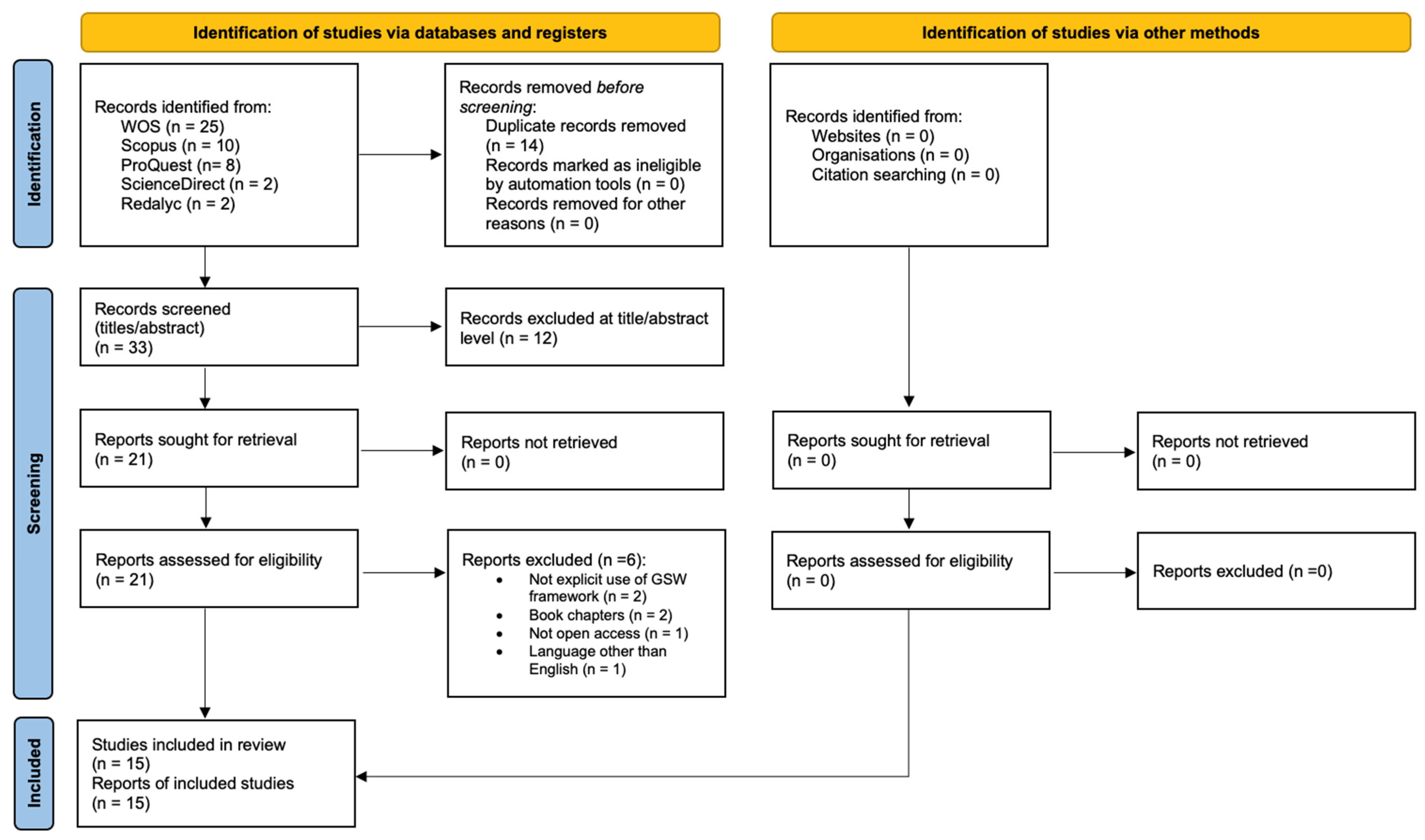
2.3. Study Selection Process
2.4. Data Extraction and Coding
2.5. Quality Appraisal and Risk of Bias Assessment
2.6. Synthesis of Results
3. Results
4. Discussion
5. Conclusions
Supplementary Materials
Author Contributions
Funding
Institutional Review Board Statement
Informed Consent Statement
Data Availability Statement
Conflicts of Interest
References
- Alamgir, Md. Shamsul, Jun Furuya, Satoshi Kobayashi, Most Sayma Rahman Binte, and Md. Rabiul Ahmed. 2021. Farm Income, Inequality, and Poverty among Farm Families of a Flood-Prone Area in Bangladesh: Climate Change Vulnerability Assessment. GeoJournal 86: 2861–85. [Google Scholar] [CrossRef]
- Androff, David, Cheryl Fike, and Jessica Rorke. 2017. Greening Social Work Education: Teaching Environmental Rights and Sustainability in Community Practice. Journal of Social Work Education 53: 399–413. [Google Scholar] [CrossRef]
- Birkmann, Jörn, Adeel Jamshed, Jillian M. McMillan, Daniel Feldmeyer, Yusuke Totoki, and William Solecki. 2022. Understanding Human Vulnerability to Climate Change: A Global Perspective on Index Validation for Adaptation Planning. Science of the Total Environment 803: 150065. [Google Scholar] [CrossRef] [PubMed]
- Bowles, Wendy, Heather Boetto, Peter Jones, and Jennifer McKinnon. 2016. Is Social Work Really Greening? Exploring the Place of Sustainability and Environment in Social Work Codes of Ethics. International Social Work 61: 503–17. [Google Scholar] [CrossRef]
- Breen, Karen, Michelle Greig, and Hsiu-Fang Wu. 2023. Learning Green Social Work in Global Disaster Contexts: A Case Study Approach. Social Sciences 12: 288. [Google Scholar] [CrossRef]
- Bronfenbrenner, Urie. 1979. The Ecology of Human Development: Experiments by Nature and Design. Cambridge: Harvard University Press. [Google Scholar]
- Buhaug, Halvard, and Nina von Uexkull. 2021. Vicious Circles: Violence, Vulnerability, and Climate Change. Annual Review of Environment and Resources 46: 545–68. [Google Scholar] [CrossRef]
- Buttel, Frederick H. 1987. New Directions in Environmental Sociology. Annual Review of Sociology 13: 465–88. [Google Scholar] [CrossRef]
- Castañeda-Meneses, Pablo. 2024. Trabajo Social Ambiental en Chile: Avanzando hacia un Green Social Work. Prospectiva. Revista de Trabajo Social e Intervención Social 38: e21213501. [Google Scholar] [CrossRef]
- Dominelli, Lena. 2012. Green Social Work: From Environmental Crises to Environmental Justice. Cambridge: Polity Press. [Google Scholar]
- Dominelli, Lena. 2013. Environmental Justice at the Heart of Social Work Practice: Greening the Profession. International Journal of Social Welfare 22: 431–39. [Google Scholar] [CrossRef]
- Dominelli, Lena. 2014. Promoting Environmental Justice through Green Social Work Practice: A Key Challenge for Practitioners and Educators. International Social Work 57: 338–45. [Google Scholar] [CrossRef]
- Dominelli, Lena. 2018. The Routledge Handbook of Green Social Work. London: Routledge. [Google Scholar]
- Dominelli, Lena. 2020. A Green Social Work Perspective on Social Work during the Time of COVID-19. International Journal of Social Welfare 29: 346–53. [Google Scholar] [CrossRef] [PubMed]
- Dominelli, Lena, and Hung-Bin Ku. 2017. Green Social Work and Its Implications for Social Development in China. China Journal of Social Work 10: 3–22. [Google Scholar] [CrossRef]
- Downey, Helen, Elisha Spelten, Kate Holmes, Sarah MacDermott, and Patrick Atkins. 2023. A Green Social Work Study of Environmental and Social Justice in an Australian River Community. Social Work Research 47: 207–19. [Google Scholar] [CrossRef]
- Dunlap, Riley E., and William R. Catton, Jr. 1979. Environmental Sociology. Annual Review of Sociology 5: 243–73. [Google Scholar] [CrossRef]
- Fraser, Heather, Nicole Taylor, and Damien W. Riggs. 2021. Animals in Disaster Social Work: An Intersectional Green Perspective Inclusive of Species. The British Journal of Social Work 51: 1739–58. [Google Scholar] [CrossRef]
- Gray, Mel, John Coates, and Tiani Hetherington. 2013. Environmental Social Work. London: Routledge. [Google Scholar]
- Hannigan, John. 2006. Environmental Sociology, 2nd ed. London: Routledge. [Google Scholar] [CrossRef]
- Intergovernmental Panel on Climate Change (IPCC). 2014. Climate Change 2014: Impacts, Adaptation, and Vulnerability. Part A: Global and Sectoral Aspects. Cambridge: Cambridge University Press. [Google Scholar]
- Intergovernmental Panel on Climate Change (IPCC). 2023. AR6 Synthesis Report: Climate Change 2023. Available online: https://www.ipcc.ch/report/ar6/syr/ (accessed on 20 September 2025).
- Jarvis, Darryl. 2013. Environmental Justice and Social Work: A Call to Expand the Social Work Profession to Include Environmental Justice. Columbia Social Work Review 11: 36–45. [Google Scholar] [CrossRef]
- Ku, Hung-Bin, and Lena Dominelli. 2018. Not Only Eating Together: Space and Green Social Work Intervention in a Hazard-Affected Area in Ya’an, Sichuan of China. The British Journal of Social Work 48: 1409–31. [Google Scholar] [CrossRef]
- Lockwood, Craig, Zachary Munn, and Kylie Porritt. 2015. Qualitative Research Synthesis: Methodological Guidance for Systematic Reviewers Utilizing Meta-Aggregation. International Journal of Evidence-Based Healthcare 13: 179–87. [Google Scholar] [CrossRef]
- Marlow, Christine, and Chris van Rooyen. 2001. How Green Is the Environment in Social Work? International Social Work 44: 241–54. [Google Scholar] [CrossRef]
- Matthies, A.-L., Kati Närhi, and David Ward, eds. 2001. The Eco-Social Approach in Social Work. SoPhi Publication No. 58. Jyväskylä: SoPhi, University of Jyväskylä. ISBN 951-39-0914-X. [Google Scholar]
- Moola, Sandeep, Zachary Munn, Catalin Tufanaru, Edoardo C. Aromataris, Kerry Sears, Raluca Sfetcu, Michelle Currie, Rizwan Qureshi, Paul Mattis, Kylie Lisy, and et al. 2020. Chapter 7: Systematic Reviews of Etiology and Risk. In JBI Manual for Evidence Synthesis. Edited by E. Aromataris and Z. Munn. Adelaide: Joanna Briggs Institute. Available online: https://synthesismanual.jbi.global (accessed on 18 June 2025).
- Muchacha, Munyaradzi, and Mudavanhu Mushunje. 2019. The Gender Dynamics of Climate Change on Rural Women’s Agro-Based Livelihoods and Food Security in Rural Zimbabwe: Implications for Green Social Work. Critical and Radical Social Work 7: 59–72. [Google Scholar] [CrossRef]
- Otto, Ilona M., Diana Reckien, Christian P. O. Reyer, Rachel Marcus, Virginie Le Masson, Lindsey Jones, Andrew Norton, and Olivia Serdeczny. 2017. Social Vulnerability to Climate Change: A Review of Concepts and Evidence. Regional Environmental Change 17: 1651–62. [Google Scholar] [CrossRef]
- Page, Matthew J., Joanne E. McKenzie, Patrick M. Bossuyt, Isabelle Boutron, Tammy C. Hoffmann, Cynthia D. Mulrow, Larissa Shamseer, Jennifer M Tetzlaff, Elie A Akl, Sue E Brennan, and et al. 2021. The PRISMA 2020 Statement: An Updated Guideline for Reporting Systematic Reviews. BMJ 372: n71. [Google Scholar] [CrossRef]
- Pardeck, John T. 1988. An Ecological Approach for Social Work Practice. The Journal of Sociology & Social Welfare 15: 11. [Google Scholar] [CrossRef]
- Pellow, David N., and Hollie Nyseth Brehm. 2013. An Environmental Sociology for the Twenty-First Century. Annual Review of Sociology 39: 229–50. [Google Scholar] [CrossRef]
- Ramsay, Stewart, and Jennifer Boddy. 2017. Environmental Social Work: A Concept Analysis. The British Journal of Social Work 47: 68–86. [Google Scholar] [CrossRef]
- Richmond, Mary. 1922. Social Diagnosis. New York: Russell Sage Foundation. [Google Scholar]
- Shaw, Todd V. 2011. Is Social Work a Green Profession? An Examination of Environmental Beliefs. Journal of Social Work 13: 3–29. [Google Scholar] [CrossRef]
- Viscarret Garro, Juan Jesús. 2007. Modelos y Métodos de Intervención en Trabajo Social. Madrid: Alianza Editorial. [Google Scholar]
- Wu, Hsiu-Fang, and Michelle Greig. 2022. Adaptability, Interdisciplinarity, Engageability: Critical Reflections on Green Social Work Teaching and Training. Healthcare 10: 1245. [Google Scholar] [CrossRef]



| Databases | Search String |
|---|---|
| Web of Science (WOS) | TITLE = (“green social work”) AND Language = (English) AND document types = (Article). |
| Scopus | TITLE-ABS-KEY (“green social work”) AND (LIMIT-TO (LANGUAGE, “English”)) AND (LIMIT-TO (DOCTYPE, “ar”)). |
| ScienceDirect | Title: green AND social AND work. (Article type: Research articles; Languages: English). |
| ProQuest | TI (“green social work”) AND Full Text (Yes) AND PEER (Yes) |
| Redalyc | “Green social work”, Articles, Languages: English |
| Studies | 1 | 2 | 3 | 4 | 5 | 6 | 7 | 8 | 9 | 10 | Average Degree of Agreement |
|---|---|---|---|---|---|---|---|---|---|---|---|
| Androff et al. (2017) | 100 | 100 | 100 | 100 | 100 | 100 | NO | NO | NO | 100 | 70% |
| Bowles et al. (2016) | 100 | 100 | 75 | 100 | 100 | 100 | NO | NA | NA | 100 | 84.4% |
| Breen et al. (2023) | 100 | 100 | 100 | 100 | 100 | 100 | NO | 75 | NO | 100 | 77.5% |
| Ku and Dominelli (2018) | 100 | 100 | 100 | 100 | 100 | 100 | 50 | 100 | 100 | 100 | 95% |
| Castañeda-Meneses (2024) | 100 | 100 | 100 | 100 | 100 | 100 | NO | NA | NO | 100 | 77.7% |
| Dominelli and Ku (2017) | 100 | 100 | NA | NA | 100 | 100 | NO | 100 | NO | 100 | 75% |
| Dominelli (2013) | 100 | 100 | 100 | NA | NA | 100 | NO | NA | NO | 100 | 71.4% |
| Dominelli (2014) | 100 | 100 | 100 | 100 | 100 | 100 | NO | 100 | NO | 100 | 80% |
| Dominelli (2020) | 100 | 100 | 100 | 100 | 100 | 100 | NO | NO | NA | 100 | 77.7% |
| Fraser et al. (2021) | 100 | 100 | NA | NA | NA | 100 | NO | NA | 100 | 100 | 83.3% |
| Wu and Greig (2022) | 100 | 100 | 100 | 100 | 100 | 100 | NO | 100 | NO | 100 | 80% |
| Studies | 1 | 2 | 3 | 4 | 5 | 6 | 7 | 8 | Average Degree of Agreement |
|---|---|---|---|---|---|---|---|---|---|
| Downey et al. (2023) | 100 | 100 | 100 | 100 | NO | NO | 100 | 100 | 75% |
| Marlow and van Rooyen (2001) | 100 | 100 | 100 | 100 | 75 | NO | NO | 100 | 71.9% |
| Muchacha and Mushunje (2019) | 100 | 100 | NA | 100 | NO | NO | 100 | 100 | 71.4% |
| Shaw (2011) | 100 | 100 | 100 | 100 | 100 | 100 | 100 | 100 | 100% |
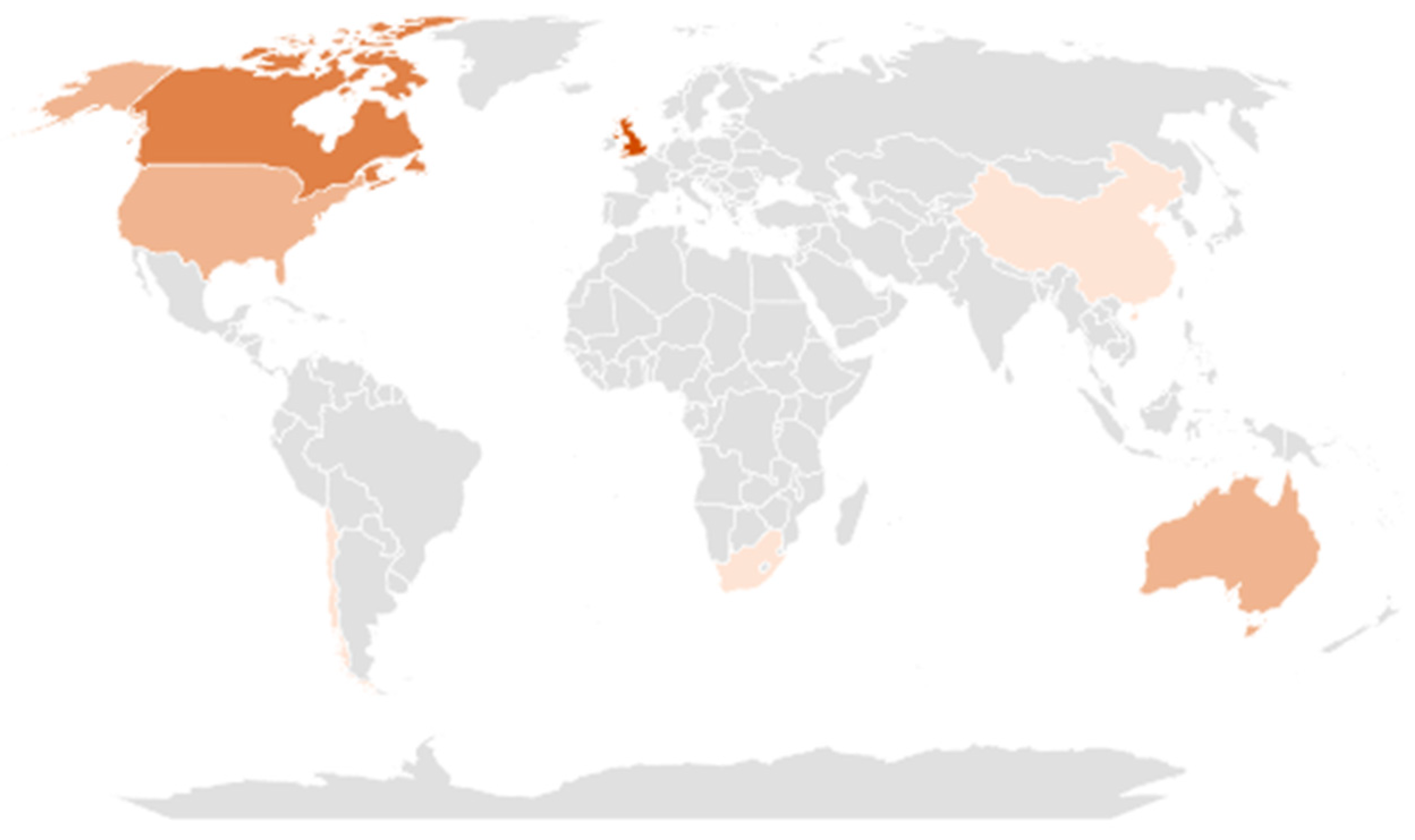
| Author and Year | Country | Journal | Topics Addressed | Emphasis |
|---|---|---|---|---|
| Androff et al. (2017) | USA | International Social Work | Food insecurity, access to green spaces, activism against open-pit mining. | Useful for developing macro-level competencies in social work students, especially in community-based practice. |
| Bowles et al. (2016) | Australia | International Social Work | Ethical codes and sustainability | Development of international ethical codes |
| Breen et al. (2023) | Canada | Social Sciences | Green social work in education, environmental justice | Education and professionalization in green social work |
| Ku and Dominelli (2018) | China | British Journal of Social Work | Community reconstruction, spatial justice, local participation | Social work in disasters and spatial justice Relevant for designing inclusive post-disaster reconstruction policies and for training social workers in collaborative practices |
| Castañeda-Meneses (2024) | Chile | Prospectiva. Revista de Trabajo Social e intervención social | Environmental crisis, environmental justice, related social issues (displacement, heat stress, job loss) | Professional. Useful for designing environmental intervention models in social work, especially in contexts of high environmental vulnerability |
| Dominelli and Ku (2017) | United Kingdom and China | China Journal of Social Work | Impact of disasters, rural-to-urban migration, environmental justice, environmental degradation | Useful for training social workers in sustainable approaches and for integrating environmental justice into social work practice |
| Dominelli (2013) | United Kingdom | International Journal of Social Welfare | Environmental justice, greening of the profession, interdependent world, climate change, disasters | Training social work professionals for disaster intervention |
| Dominelli (2014) | United Kingdom | International Social Work | Environmental justice, impact of natural disasters on communities, gender inequality, poverty, post-tsunami reconstruction | Useful for professionals and educators in environmental justice |
| Dominelli (2020) | United Kingdom | International Journal of Social Welfare | Pandemic and resilience in social workers | Technological and professional training in response to pandemics |
| Downey et al. (2023) | Australia | Social Work Research | Connections and meanings of water | Research |
| Fraser et al. (2021) | Canada | Critical and Radical Social Work | Speciesism, social justice, ecofeminism, intersectionality, animal agency, structural oppression, climate change | Advocates for the inclusion of non-human animals in GSW, expanding the approach toward a post-anthropocentric and interspecies perspective. |
| Marlow and van Rooyen (2001) | South Africa | International Social Work | Environmental inclusion | Environmental professional training and activism |
| Muchacha and Mushunje (2019) | Zimbawe | Critical & Radical Social Work | Gendered impact of climate change, food security, agricultural livelihoods | Rural women and agricultural sustainability. Useful for designing inclusive policies and strengthening agricultural resilience in vulnerable communities |
| Shaw (2011) | USA | Journal of Social Work | Environmental attitudes, ecological paradigm, sustainability, environmental justice, professional practices, environmental education, NEPS | Empirical study on environmental attitudes among social workers in California. Assesses their alignment with the ecological paradigm |
| Wu and Greig (2022) | Canada | Healthcare | Essential GSW capacities (adaptability, interdisciplinarity, participation), health and well-being in disaster contexts | Developing key competencies in students to address disasters and climate crises through social work |
| Author & Year | Key Authors | Definitions | Fields of Applications | Variables Associated with GSW |
|---|---|---|---|---|
| Androff et al. (2017) | Dominelli (2012) Weil (2013) Besthorn (2012) Alinsky (1971) Freire (1970) McKinnon (2008) | GSW is an integrative approach that connects human rights, social justice, and environmental sustainability | It is applied with social work students, addressing topics such as food insecurity, community gardens and environmental activism in contexts of poverty and marginalization | Green social work and educational social work. Relationship between social justice, human rights, and environmental sustainability in community contexts |
| Bowles et al. (2016) | Alston and Besthorn (2012) Coates and Gray (2012) Dominelli (2012) Peeters (2012) McKinnon (2008) | No specific definition of green social work is provided, but there is emphasis on professional ethical principles and environmental sustainability | It explores how social work codes of ethics in the UK, US, and Australia address environmental sustainability and the natural environment | Integration of the environment into professional ethics, ecological justice, environmental sustainability, the link between human well-being and the natural environment, and ecological social responsibility |
| Breen et al. (2023) | Dominelli (2012) | Framework that integrates social and environmental justice, adapting research, practice, and policy to respond to disasters and promote resilience among marginalized populations | Education and professional training. It focuses on equipping social workers with the necessary tools to address these types of hazards, tailoring research, practice, and policy to the unique needs of disaster survivors | Green social work, natural disasters, resilience, environmental justice, climate extremes |
| Ku and Dominelli (2018) | Dominelli (2015) Dominelli (2012) Lefebvre (1996) Harvey (1973) Foucault (1980) Park (1999) | GSW is presented as a participatory and transdisciplinary tool to address disasters and promote spatial justice and sustainability | Community affected by the Sichuan earthquake. Post-disaster community reconstruction. Proposal focused on long-term recovery. Spatial justice (linking social justice, environmental justice, and space). Community development in rural areas | Environmental intervention, social well-being, spatial justice, transdisciplinarity, community participation, sustainability, empowerment, equity, post-disaster resilience, and culturally relevant reconstruction integrated with the physical environment |
| Castañeda-Meneses (2024) | Dominelli (2012, 2018) Bonilla et al. (2022), ONU (2018) Barthel et al. (2022) | GSW as a professional commitment to the care of the planet, integrating environmental principles, social justice, and interdisciplinary action | Climate crisis in Chile, sacrifice zones, hierarchies of environmental intervention, food security, and climate change | Socio-environmental diagnosis, environmental justice, environmental education, prevention, minimization, mitigation, reparation, compensation |
| Dominelli and Ku (2017) | Dominelli (2012) Bullard (1990) Brofenbrenner (1979) Schumpeter (1973, 1999) | GSW as a comprehensive approach that integrates social and environmental justice, addressing inequalities and promoting sustainability | Environmental crises in China, sustainable development, environmental and social justice, rural-to-urban migration | Interdependence between communities and their environment, environmental and social justice, sustainable development, resilience |
| Dominelli (2013) | Bullard (1990) Brundtland (1987) Klinenberg (2015) Laugier and Paperman (2006) Pearce (2012) Pyles (2007) Wisner et al. (2004) Dominelli (2012) | Holistic social practice that integrates social and environmental justice, addresses structural inequalities, and promotes human and ecosystem well-being in contexts of crisis and disaster | Climate change, natural disasters, the impact of neoliberalism on environmental degradation, public health, community resilience, human rights, social mobilization, unsustainable development | Social and environmental inequality, power and economics, human-ecosystem interdependence, pollution and health, social activism, social and ecological responsibility |
| Dominelli (2014) | IIPP * Dominelli (2012) Bullard (1990) | Environmental justice understood as the equitable redistribution of natural resources, community participation in environmental decision-making, and protection of human and environmental rights of vulnerable communities | Post-disaster reconstruction after the 2004 tsunami in Sri Lanka, with a focus on environmental justice, gender equity, poverty, and community participation | Socio-environmental interdependence, resource equity, community empowerment, local participation, structural transformation, environmental sustainability, human and environmental rights |
| Dominelli (2020) | Dominelli (2012) | Role of social work during the pandemic GSW applies a holistic and transdisciplinary approach, linking public health, environmental justice, and human rights in health crises such as COVID-19 | Environmental and zoonotic impact of COVID-19 | Pandemic, precariousness, neoliberalism |
| Downey et al. (2023) | Dominelli (2014) | No specific definition provided | Applied in individual, community, and policy practice | Green social work, climate change related to water resources and well-being |
| Fraser et al. (2021) | Day (2017) Dominelli (2012, 2013) Alston (2013) Fraser and Taylor (2019) | GSW expanded through ecofeminist intersectionality, including species as an axis of oppression and promoting interspecies alliances | Conceptual application of GSW to disasters, focusing on the inclusion of non-human animals as an oppressed and excluded population in social planning | Speciesism, intersectionality, environmental justice, structural oppression, animal agency, human-animal relationships, post-anthropocentric approach |
| Marlow and van Rooyen (2001) | Germain and Gitterman (1980) Berger (1995) Gilman (1990) Allaby (1986) | Sustainable development, ecology, and the habitat destruction syndrome | Social work and the environment. Relationship between environmental crisis and social problems | Social work’s distance from environmental issues |
| Muchacha and Mushunje (2019) | Intergovernmental Panel on Climate Change (IPCC) (2014) Chagutah (2010) Dominelli (2012) Alston (2013) Arora-Jonsson (2011) | Impact of climate change on gender and food security GSW as a holistic tool that addresses structural inequalities and promotes community resilience Rural women in Zimbabwe | Rural women in Zimbabwe Impact of climate change on agricultural livelihoods, gender inequality, food security | Gender, food security, resilience, social justice, sustainability, community empowerment, resilience in the face of climate crises |
| Shaw (2011) | Germain and Gitterman (1987) Berger and Kelly (1993) Besthorn (1997) Coates (2003), Dunlap et al. (2000) NASW (2003) IFSW (2004) | GSW expands the ecological approach and calls for the incorporation of the natural environment into social work practice, policy, and education | Study in California on social workers’ environmental attitudes and their relationship with the ecological paradigm and environmental justice | Person–environment interconnection, ecology, sustainability, environmental justice, environmental attitude, ecological perspective, limits to growth, critique of the dominant paradigm |
| Wu and Greig (2022) | Dominelli (2012) Karls and O’Keefe (2008) Ferguson (2018) Drolet et al. (2015) | GSW promotes resilience, social and environmental justice, and is integrated into interventions at the micro, mezzo, and macro levels | Training of social work students, post-disaster community development, interdisciplinarity, and climate change | Adaptability, interdisciplinarity, community participation, resilience. |
| Author and Year | Objectives | Participants | Instruments | Type of Analysis | Results |
|---|---|---|---|---|---|
| Androff et al. (2017) | To examine how to integrate environmental rights and social justice into community social work practice | 3 case studies with small groups of students in community practice courses | Case studies, interviews, participatory observation | Comparative qualitative analysis through case studies | The students achieved significant outcomes in awareness campaigns, the creation of community gardens, and political activism |
| Bowles et al. (2016) | Compare international codes of ethics: United Kingdom, USA, and Australia | Not applicable (documentary analysis of codes of ethics) | Documentary review | Comparative analysis | Differences in professional ethics: national codes do not include concern for environmental sustainability as a central professional issue. Australia includes it most effectively |
| Breen et al. (2023) | Develop GSW in education and professional training through case studies | No direct participants (document analysis of case studies) | Case studies | Theoretical-applied study with qualitative case analysis and formulation of a four-step model | Three case studies were examined, each focused on one of the three main types of hazards: natural, technological, and intentional/voluntary. Each case study provided insight into how GSW works in practice and offered recommendations for professionals and students to learn how to use the framework |
| Ku and Dominelli (2018) | Implement a transdisciplinary model. Examine the impact of GSW in post-disaster reconstruction in China | Rural community affected. Temple Village community; number of participants not specified. | Participatory Action Research, observation, interviews, community workshops | Qualitative analysis focused on participatory methods. | Improvement in quality of life through local projects. Community participation enhances resilience and generates sustainable post-disaster strategies. A community kitchen was built in a temple through a participatory process that assessed people’s needs in a transdisciplinary manner |
| Castañeda-Meneses (2024) | Characterize the state of Environmental Social Work in Chile and its contributions to GSW | Documentary research with no direct participants (document source) | Review of documents, international reports, public policies, and scientific literature | Qualitative documentary analysis, categorized by thematic areas | Contributions of Social Work: (1) Use of environmental diagnosis. (2) Actions related to prevention, minimization, mitigation, reparation, and compensation. (3) Social problems derived from the environmental crisis |
| Dominelli and Ku (2017) | Promote social and environmental justice, community resilience, and reduce dependency on global markets through participatory research and environmental education | Rural communities, environmental NGOs, educators, social workers, policy administrators, environmental specialists | Workshops, surveys, interviews, focus groups, policy and social economy document analysis | Descriptive qualitative study | Resistance to GSW, lack of trained educators, limited access to green technologies, and need for community inclusion |
| Dominelli (2013) | Examine the role of GSW in environmental justice | Not applicable (conceptual study) | Not applicable (conceptual study) | Not applicable (conceptual study) | Promotion of environmental justice and GSW |
| Dominelli (2014) | Examine experiences of survivors of the 2004 Indian Ocean tsunami and links to environmental justice | Affected people in Sri Lanka: 368 interviews, 12 focus groups, 45 online questionnaires, 35 field notes | Interviews, questionnaires, transcripts analyzed using NVivo | Thematic qualitative analysis | Disasters exacerbate social inequalities; need to integrate environmental justice into social work |
| Dominelli (2020) | Explore social work’s role in COVID-19; analyze the pandemic’s impact on practice and worker challenges | Social workers and social care workers involved in pandemic service delivery | Surveys, narratives; observations and analysis of social workers’ working conditions, documentation of experiences with technology, personal protective equipment, limited supervision, and compliance with government guidelines | Descriptive and critical analysis of social work challenges during the pandemic | Environmental health relevance in pandemics; social workers adapted despite adversity, lack of equipment, and limited support |
| Downey et al. (2023) | Examine cultural, recreational, and environmental meanings of water for a rural community in Mildura | N = 33 Residents of the Mildura community. Inclusion criteria: Reside in Mildura and be at least 18 years old | Questionnaire adapted from the Social and Economic Long-Term Monitoring Program (SELTMP). It consists of 69 items and 4 open-ended questions. | Mixed methods. Deductive descriptive analysis of quantitative data using SPSS (Version 28). Inductive thematic analysis of open-ended responses using a green social work lens. NVivo software used to manage qualitative data | Water is considered essential for life, community identity, and cultural connection to the Murray River, including ties to Indigenous and agrarian cultures. Its recreational use is frequent. Tensions are identified between ecological and agricultural functions, as well as concern over the lack of institutional response to climate change |
| Fraser et al. (2021) | To evaluate the role of animals as relevant to green social work and in disaster contexts | Not applicable (conceptual study) | Not applicable (conceptual study) | Not applicable (conceptual study) | Social work urgently needs to reconsider its silence on animals and the anthropocentric framework that accompanies it. Recognizing speciesism as part of intersectional social work will require the profession to question the supposed primacy of humans over all other animals and the environment |
| Marlow and van Rooyen (2001) | Explore the connection between social work and the environment | Professionals and educators; N = 113 (54% New Mexico, 46% KwaZulu-Natal) | Literature review | Critical analysis | Disconnection between theory and practice. Both groups consider it important to include the environmental perspective and engage groups but face various challenges in doing so. |
| Muchacha and Mushunje (2019) | Analyze the impact of climate change on rural women and assess strategies based on GSW | Women from rural communities in Zimbabwe; number of participants not specified | Interviews, observations, statistical data, document analysis | Qualitative thematic analysis with a critical and structural approach | Gender inequalities exacerbate climate impacts; intervention through policies and GSW is required |
| Shaw (2011) | Measure environmental beliefs among social workers. Examine whether there are differences among social workers based on their level of participation in the environmental movement. | Members of the National Association of Social Workers (NASW) (N = 373) | Environmental Belief Scale (NEPS) | Descriptive quantitative analysis. Average scores on the 15 NEPS items were compared among respondents who identified as ‘Always’ or ‘Almost always’ participating in an environmental organization | Social workers do not differ from the general population in environmental beliefs. Differences were found based on political affiliation and support for environmental activism |
| Wu and Greig (2022) | Explore and improve social work teaching and practice interventions in a multi-disaster context; a two-academic-year qualitative study based on critical and reflective interaction. Examine the key components of GSW in social work education and training in Canada. | A junior faculty member with GSW experience and a Master’s in Social Work student; interaction in instructor–student and supervisor–apprentice roles over two academic years. | Critical reflection notes, emails, and virtual meetings; feedback from third parties | Thematic qualitative content analysis focused on health and well-being, based on pedagogical reflections and experiences. | Essential components, adaptability, interdisciplinarity, and participatory capacity to strengthen GSW in educational contexts. |
| Author and Year | Limitations |
|---|---|
| Androff et al. (2017) | Lack of financial resources and time constraints in semester-long projects; limited scope due to voluntariness. |
| Bowles et al. (2016) | Perspective limited to developed countries; no additional specific limitations mentioned. |
| Breen et al. (2023) | Limited international experience. Arising from literature and the case study itself, which does not capture longitudinal developments |
| Ku and Dominelli (2018) | Lack of generalization and dependence on community cooperation. |
| Castañeda-Meneses (2024) | The documentary nature of the work may limit its immediate practical applicability. |
| Dominelli and Ku (2017) | Lack of integration of GSW into education and national sustainable development policies in China. |
| Dominelli (2013) | Lack of empirical studies that measure the effectiveness of green social work. |
| Dominelli (2014) | Difficulty extrapolating results due to the exploratory nature of the design; cultural and social approaches limited to one region |
| Dominelli (2020) | Lack of preparedness for zoonotic disasters; no additional specific limitations provided. |
| Downey et al. (2023) | Small and self-selected sample with educational and environmental bias, low Indigenous participation, inconsistent scales, limitations of the quantitative approach to capture depth |
| Fraser et al. (2021) | Lack of empirical data on the inclusion of animals in practice. |
| Marlow and van Rooyen (2001) | It is an exploratory study. Rural bias, sample more inclined towards environmental issues. Difficulties in developing instruments |
| Muchacha and Mushunje (2019) | Difficulty extrapolating results to other contexts and dependence on contextual data. |
| Shaw (2011) | Small sample size, low political diversity (used as grouping and analysis variable). |
| Wu and Greig (2022) | Context limited to the experience of two researchers with possible subjective influences; lack of a broader approach in terms of sample or quantitative methods to validate findings; dependent on the specific context of multiple disasters in Canada and global situations during the study. Results are based on individual reflections, which limits generalization. |
Disclaimer/Publisher’s Note: The statements, opinions and data contained in all publications are solely those of the individual author(s) and contributor(s) and not of MDPI and/or the editor(s). MDPI and/or the editor(s) disclaim responsibility for any injury to people or property resulting from any ideas, methods, instructions or products referred to in the content. |
© 2025 by the authors. Licensee MDPI, Basel, Switzerland. This article is an open access article distributed under the terms and conditions of the Creative Commons Attribution (CC BY) license (https://creativecommons.org/licenses/by/4.0/).
Share and Cite
Lorenzo, M.; Rios-Rodríguez, M.L.; Chinea, C.; Hernández, B.; Rosales, C. Green Social Work as a Framework for Socio-Environmental Transformation: A Systematic Review. Soc. Sci. 2025, 14, 720. https://doi.org/10.3390/socsci14120720
Lorenzo M, Rios-Rodríguez ML, Chinea C, Hernández B, Rosales C. Green Social Work as a Framework for Socio-Environmental Transformation: A Systematic Review. Social Sciences. 2025; 14(12):720. https://doi.org/10.3390/socsci14120720
Chicago/Turabian StyleLorenzo, Maryurena, María Luisa Rios-Rodríguez, Cristina Chinea, Bernardo Hernández, and Christian Rosales. 2025. "Green Social Work as a Framework for Socio-Environmental Transformation: A Systematic Review" Social Sciences 14, no. 12: 720. https://doi.org/10.3390/socsci14120720
APA StyleLorenzo, M., Rios-Rodríguez, M. L., Chinea, C., Hernández, B., & Rosales, C. (2025). Green Social Work as a Framework for Socio-Environmental Transformation: A Systematic Review. Social Sciences, 14(12), 720. https://doi.org/10.3390/socsci14120720