
Article

Blind Spots: The Future of Art History and the Ecology of Early Modern Silver
University of York, York YO10 5DD, UK
Arts 2026, 15(5), 99; https://doi.org/10.3390/arts15050099
Submission received: 11 January 2026 / Revised: 20 March 2026 / Accepted: 23 March 2026 / Published: 7 May 2026
(This article belongs to the Special Issue Rethinking Art History and Culture: Defining an Ecological Approach)

Abstract

This essay examines the visual culture of what might be termed “the ecology of silver” between 1492 and 1710 in relation to colonialism on both sides of the Atlantic, with particular attention to both its shiny allure and the blind spots that that shininess produces. It focuses on three inter-related areas: depictions of Potosí, the great silver mountain in viceregal Peru; silver’s shine in European elite material culture; and the deployment of silver in celebrating the Spanish monarchy in viceregal Sicily, part of its empire within Europe. Current scholarship on early modern silver bifurcates between historical, political, and anthropological studies of silver’s extraction in the Americas and colonialism on one hand and a celebratory art historical scholarship focused on high-end European silver goods on the other. Scholars have energetically examined its extraction, the global trade in bullion, the rise of capitalism that it fed, and the wars that it fomented and paid for, but they stop short of inquiring into the ends to which silver was deployed within Europe and Asia beyond the naming of the principal ports. Meanwhile, studies of silver in Europe are overwhelmingly tightly drawn and connoisseurial, often with no reference to where the silver came from, let alone the circumstances of its extraction, transport, or even its effects. This split is due partly to a prevalent notion that silver’s value is inherent, objective, and caused by “rarity”; and it is partly due to art history’s unswerving identification with the rich and powerful. Such approaches overlook silver’s remarkable material and alchemical qualities and ignore its capacity to turn grubby profit into charismatic sparkle, which simultaneously drove the ecological and environmental damage and exonerated its profiteers. Early modern silver linked environmental destruction, colonialism, genocide, and coloniality to high culture, making it a particularly relevant topic for art historical analysis in this context. But more than that silver entwined them in complex, convulsive, and transformative ways, turning imperialism, violence and exploitation into beauty, shimmer and cultural sophistication. Hence, this essay insists on the centrality of imperial issues in the Old World as in the New, underscoring colonial dynamics within metropolitan culture while critically examining the work of seduction of art. The paradoxical quality of shine is the lens through which is seen the relation between violent coloniality and the allure and ecology of early modern silver.

What bodies will display lustre but not look illuminated?
Those bodies which are opaque and hard with a hard surface reflect light [lustre] from every spot on the illuminated side which is in a position to receive light at the same angle of incidence as they occupy with regard to the eye; but, as the surface mirrors all the surrounding objects, the illuminated [body] is not recognisable in these portions of the illuminated body.
Leonardo da Vinci1
[W]ith regard to the Lustre which exists in all Metals […] the purer they are, the more brilliant they become when they are planed, smoothed, and polished. In this, as in other Good Qualities, Gold excels beyond all others, and after it Silver excels the rest. White is a colour common to many Metals, although in the case of Silver it is more perfect.
Álvaro Alonso Barba, El Arte de los Metales2
The discovery of gold and silver in America, the extirpation, enslavement and entombment in mines of the indigenous population of that continent characterise the dawn of the era of capitalist production. These idyllic proceedings are the chief moment of primitive accumulation.
Karl Marx, Capital

1. Introduction: Towards a Critical Ecology of Silver

This essay investigates the visual culture of “the ecology of silver” between 1492 and 1710 in relation to colonialism and coloniality on both sides of the Atlantic, with particular attention to silver’s shiny allure, the blind spots that that splendour produces, and their inter-relation. Silver’s visual ecology is examined at three key points on its glittering journey: depictions of Potosí, the great silver mountain in viceregal Peru; silver’s shine in European elite material culture; and the deployment of silver in celebrating and sustaining culturally the Spanish monarchy in viceregal Sicily, a crucial part of its empire within Europe.3 Thus, I address silver’s refractive relationship with its extraction, its implication in the generation of court elites and its complex entwining within the double helix of the Spanish empire on both sides of the Atlantic. These three nodes are also inter-related. I identify and shed light on art history’s blind spots that have obscured silver’s alchemical capacity to turn grubby profit into charismatic sparkle, a capacity that simultaneously drove the human exploitation and ecological and environmental damage and exonerated its profiteers.
Silver is always already an ecological matter.4 The working of silver is ecological in many senses, extending way beyond familiar confines of environmental pollution to something quite as deadly, but far more refined. It is a troubled ecology of injustice, destruction, and greed, shot through with dazzle and shimmer. How does the silverizing of early modern visual culture shed light on the relationships amongst ecological devastation, colonialism, coloniality, and the legitimization—indeed, the seduction—of elite power? While silver in the “New World” was deeply implicated in European coloniality, brutal exploitation of Indigenous and African labour in mining and refining, forced resettlement of local populations, and devastating environmental damage, in Europe, it emerged as clean as a new pin. Despite its inextricable relationship with war, destruction and degradation, silver was associated culturally with social, religious, and political power and polish. This divergence is the measure of silver’s alchemical capacities and allure, of its intimate involvement in hegemonic cultural power and is key to an understanding of its colonializing ecology.5
Leonardo pointed out that lustro, the particular gleam of the highlight, is the direct reflection of a light source at points of the reflective surface to a situated viewer.6 Hence, lustro is shifting and mobile in the way that a mirror image is mobile. It produces the effect of something alive. Yet as Leonardo noted, at that specific point of gleam, the illuminated body itself cannot be seen. Shine flickers, gives the impression of situated presence, and yet it also obscures the very object that is being viewed, dazzles the viewer, and blinds them to what they are looking at.
This paradoxical quality of shine is the lens through which I examine the allure and ecology of early modern silver, focusing on the blind spots that silver’s gleam produces. The pernicious destruction that trailed in silver’s wake is generally treated as lying far away, far from Europe, and outside the domain of art history. And this is not incidental: the very work of art transforms implication into beguiling visual pleasure; and art historians of all people are far from immune to such seductions. What can silvery lustre tell us about how supremacies are reproduced and how colonialism and coloniality preserve and extend themselves? How is scintillating pleasure related to the blind spots of elites—and of art historians looking at those elites?
Jacques Rancière refers to such blind spots as “the distribution of the sensible”, the system of divisions and boundaries that define, among other things, what is visible and audible within a particular aesthetico-political regime.7 Scholarship on early modern silver demonstrates just such a distribution. It bifurcates between critical studies of silver’s extraction and colonialism in the Americas, largely by anthropologists and historians, and a celebratory art historical scholarship focused on high-end European silver goods.8 While historians and anthropologists have energetically examined silver’s extraction, the global trade in bullion, the rise in capitalism that it fed, and the wars that it fomented and paid for, they stop short of inquiring into the ends to which silver was deployed after it reached the European (and Asian) ports, beyond a supposed amassing of riches.9 Meanwhile, scholarship on silver artefacts depends on unexamined notions of “rarity”, “value” and “taste” and remains largely connoisseurial and technical.10 Recent scholarship has robustly challenged such approaches, exposing far more critically the cultural inflections of colonialism—in relation to pearls and emeralds in particular.11 But studies of European high-end silver artefacts almost invariably portray silver’s links to despoliation in the Americas as an unfortunate side-effect, if at all.12 Generally speaking, the source of “European” silver is not mentioned in exhibitions or scholarship. Even revisionist art history remains focused on colonialism rather than coloniality. The violence implicated in elite prestige, privilege, beauty, and power relations tends to be located overseas and preferably down a mine, leaving elite culture to be analysed in terms of consumption, allegory, erudition, wit, wisdom, and discernment. Scholarship still tends to treat imperialism, capitalism, industrialization, commercialization, patriarchy, racialization, and environmental damage as unfortunate parallel social processes, collateral damage for meeting European “taste”. “Taste” is assumed to be natural and innate, or, indeed, the very index of cultural sophistication. Taste, however, forms part of the habitus that is the weaponry of elite culture, its armature of sophistication and superiority, that is crucial to the reproduction of cultural and political dominance, and that lies at the heart of art.13
Such scholarship also stops short of examining how these art objects informed power relations within Europe, aside from iconographical figuration and beyond mere accumulation of wealth and “luxury” treasures. The separation of studies of the high-end culture of early modern silver from engagement with extractivism and exploitation effectively bypasses analysis of silver’s key role in the inter-relationships amongst colonialism, materiality, and elite cultural power in Europe (and hence, in turn, also beyond Europe).14
Such blind spots are frequently attributed to “specialization”, but this is less the cause than is art history’s default alliance with elite power—particularly pronounced in studies of Renaissance and early modern art—including in its methodological habit of seamless “contextualization” (itself allied to hegemonic power), its reluctance to relate particularity to wider issues dialectically, and its enmirement in coloniality.15 This is not mere oversight, but an effect of art history that identifies with elites, is steeped in privilege and works to exonerate it.
Colonialism, capitalism, and culture are particularly enmeshed in silver, which was at once a valuable commodity, currency, coin, money, profit, sign of divinely ordained power justifying its aggressive extraction, and lustrous adornment for church, state, and elites.16 Capitalism, colonialism, and visual culture variously operate to posit silver as an innocent, beautiful, and natural material located beyond them. Indeed, part of the power of the nexus of capitalism, colonialism, and visual culture is its production and framing of “nature” as distinct from “culture”, as something located elsewhere that can be made to work on culture’s behalf. Marx early recognised that American silver and colonialism were key to emergent capitalism, but his insights were displaced by widespread notions that capitalism is an economic system, set apart from nature and colonialism. Following Marx, Jason Moore observes that positing Nature as external is fundamental to capital accumulation.17 Capital demands that nature be viewed as passive and external to the economy and social politics: “capitalism is not an economic system; it is not a social system; it is a way of organizing nature”.18 A focus on “natural resources” inevitably renders the chief protagonists the Europeans, but there was nothing natural about the extraction, refinement, assaying, transportation, and working of early modern silver or its cultural significance. Indeed, as Allison Bigelow and others have shown, at every step in the mining, refining, and minting of colonial silver, Indigenous knowledge and skills—from Bartolomé de Medina’s choice of Pachuca for his assays in amalgamation to the “discovery” of Potosí—were crucial, rapidly appropriated by the invaders, and swiftly denied.19 The formidable apparatus that was early modern silver’s extraction, transport, and continuous exchange informed class structure, commodification, and world markets: it was an assemblage of human and extra-human nature and processes that reshaped relations of humanity-in-nature.
Likewise, in thinking art history in relation to ecology, no simple move to “nature” is possible, since part of the art of art is to produce art (and “culture”) as distinct from “nature”. Thus, that which is termed “nature” is artfully and artificially constructed from within and through artistic discourse. Art may invoke nature as its innocent antecedent, but nature cannot simply be set apart from that discourse or assumed to precede it.
Silver, then, cannot be thought extra-culturally. While it has much in common with other materials treated as part of “nature”, silver’s particularly intimate relationship with colonialism, capitalism, and high-end culture means that examining it critically illuminates their alchemical inter-relation, as its tentacles extended across the Atlantic, entwining social classes and power relations from the mine to the courtly elites and back again. It is not simple to say that after 1492, European and Native American phenomena were enmeshed and that capitalism and imperialism depended on the exploitation and denigration of subaltern groups. Rather, the disavowal of that dependence by elite Europeans was enmeshed in the production of their very eliteness, in their sense of themselves as superior, including through discourses of purification, refinement, redemption, elegance, and shine—in all of which silver played a crucial part.

2. The Distribution of the Sensible: Coloniality and Art History’s Blind Spots

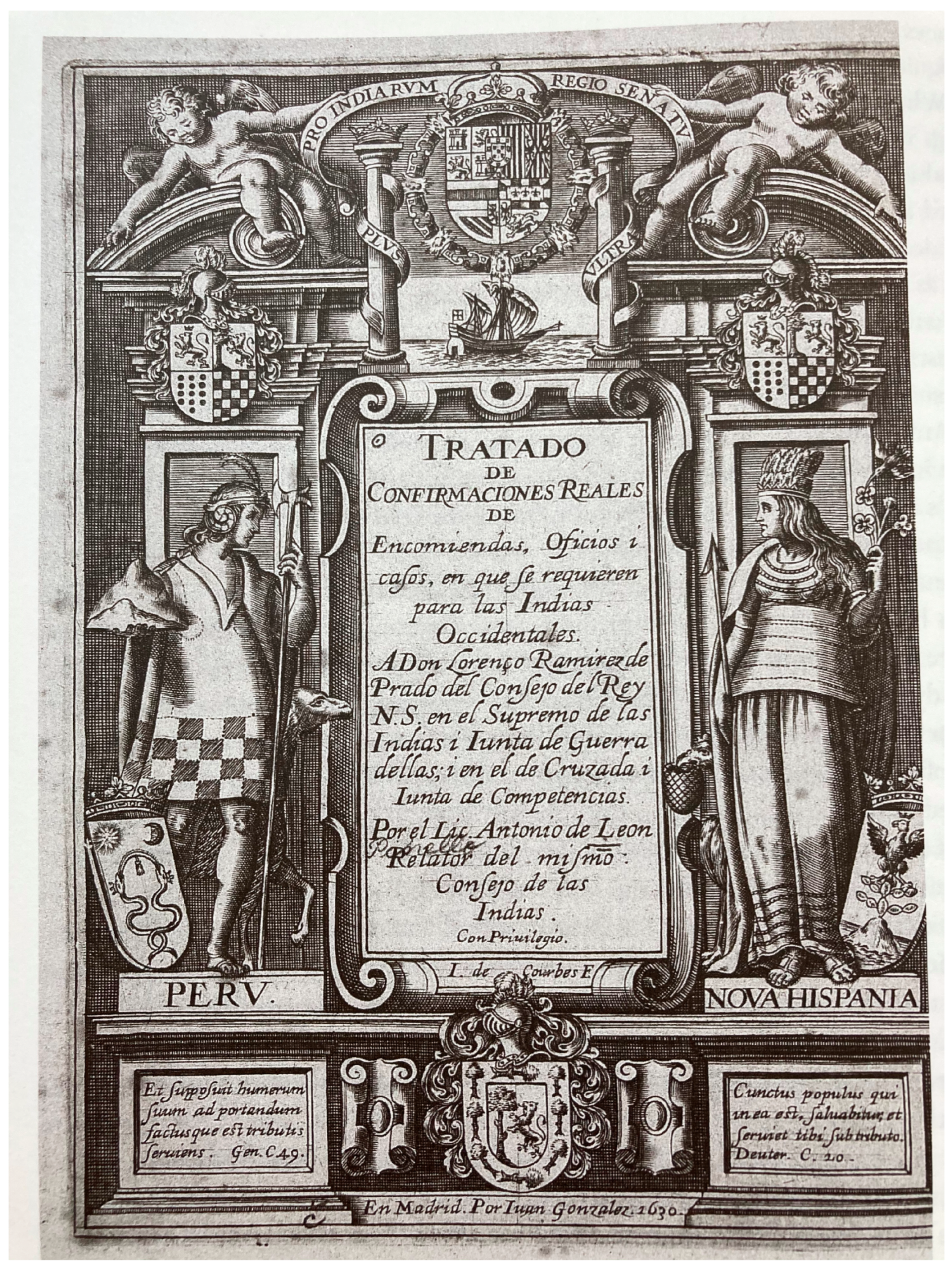
The Spanish empire depended on militarised settler occupation, an international network of credit, the circulation of commodities, and the extraction of gargantuan quantities of silver.20 While gold was king of metals and most prized, the vast bulk of treasure from Spanish Americas came to Europe in the form of silver. Silver was mined in far greater quantities, spread further (in particular, to China and East Asia), and was more widely used in a greater variety of artefacts than gold.21 Most of that silver came from the Viceroyalty of Peru, and specifically from Potosí, home of the fabulous silver mountain, the “discovery” of which by the Spaniards in 1545 was of global consequence.22 Estimates suggest that during the period of peak production, 1580–1630, Potosí produced 81% of the official silver of the viceroyalty of Peru and up to 60% of global production.23 Spanish rule was dealt in silver. Its ferocious extraction by indentured labour (mostly Indigenous but also African and European) jump-started capitalism and supplied the Spanish monarch with silver to support its wars and colonialism in Europe.24 Indeed, the expressions “vale un Perú” (“it’s worth a Peru”) and “vale un Potosí” (“it’s worth a Potosí”) show how entire histories and geographies of the Indies were reduced to silver. This is encapsulated in the title page to Antonio de León’s treatise on the measures required for empire in the figure of Peru holding the silver mountain (Figure 1).
Figure 1. Antonio de León Pinelo, Tratado de Confirmaciones Reales de Encomiendas, oficios y casos, en que se requieren para las indias Occidentales (Madrid 1630). Photo: Helen Hills. From the British Library Collection: G.4211, title page.
Arts 15 00099 g001
While there is excellent scholarship by historians and anthropologists on early modern extractive industries, ecocide and colonialism in the Americas, on the whole, art history—particularly European art history—side-steps these issues.25 Art history acknowledges European colonialism in relation to wars, occupation, mining, religious conversion, and even literary and religious texts and art and architecture of the New World, but when it comes to European high-end visual culture, its relationships with colonialism tend to be identified only where they are more or less explicit in figurative terms.26 Scholarship persists in analysing early modern imperialism iconographically, focusing on racializing depictions of colonized peoples and treating imported objects in terms of “exoticism” and “luxury” (itself a form of coloniality).27 Quick to designate artworks “symbols” of power and prestige, scholars of early modern European art flinch from examining how jewels, metals, and their depiction worked charismatically (beyond mere price) in forming, maintaining, fashioning, and reproducing power elites implicated more or less directly in the subalternization of entire peoples and social groups both over the Atlantic and at home.28 Hence, the implication of elite visual culture in social and environmental degradation is usually passed over in silence.
Walter Mignolo usefully distinguishes between colonialism and coloniality, suggesting that while the former refers to specific historical periods of military occupation and imperial domination, coloniality emerged in the discovery and conquest of the Americas by Europeans and refers to the logic of domination and exploitation veiled under the language of redemption and the idioms of modernization and progress.29
Early modern silver was part of that veil of coloniality, working through—not idioms of modernization and progress—but its materiality (cultural-material implication) in polish, refinement and shape-shifting, shimmering allure.30 Silver, extracted from the Viceroyalty of Peru in conditions of extreme brutality and exploitation, is shown here to serve as the very material of the spectacularization of power—such as to become its metaphor—of the Hapsburg Imperium and the cultural performance of European courtly elites and elite court culture.31
“European culture was made seductive: it gave access to power”, argues Aníbal Quijano:
After all, beyond repression, the main instrument of all power is its seduction. Cultural Europeanization was transformed into an aspiration. It was a way of participating and later to reach the same material benefits and the same power as the Europeans: viz, to conquer nature, in short, for “development.” European culture became a universal cultural model.32
However, it is not simply “European power” that was made seductive, but particular forms of elite European power (which tend to be naturalised within art historical scholarship).33 Silver was foremost in that seduction. It formed part of the entrancing embodiment and dazzling staging of cultural and social superiority, which enabled elites to commit concomitant gendered, classed, and racialised exploitation and violence—both overseas and within Europe, as part of their “civilizing mission”.34
I explore below how silver played a major role in fashioning the most powerful social classes on both sides of the Atlantic, not simply enriching them, but cladding and coddling them, making them feel like elites, with a concomitant entitlement and arrogance that blinded them to injustice. Silver bewitched the powerful in a manner analogous to that in which fossil fuels and rare earth metals enthral elites today. Just as rare earth metals are sought for their unique magnetic, fluorescent, and conductive properties, crucial for the technology that glamourises and eases the lifestyles of the already rich and powerful, so silver embellished their early modern counterparts.
This essay engages with silver’s cultural implications in Spain’s colonialism in both the so-called “New World” and within Europe to question the relationship between culture and colonialism. Art history—like most scholarship—continues to locate early modern colonialism and exploitation entirely outside of Europe. However, Spain stationed thousands of troops on a permanent basis to control vast swathes of the Low Countries and the Italian peninsula, including the Kingdom of Naples.35 In recognition of this, Barbara Fuchs has championed the term “imperium studies”, arguing that it opens to examination Spain’s position in the Old World—including the Spanish imperium in Naples and Flanders (and the role of the Ottoman empire) in the development of European states—that have been ignored by early modern studies and resists unduly nation-based approaches.36 However, resistance to acknowledging Spanish colonialism within Europe goes beyond the simple change in name that Fuchs suggests.37 Her claim that the term “imperium studies” avoids “the logical contradiction of postcolonial studies of incipient colonialism” is also perhaps somewhat hasty, since postcolonialism is a critical discourse more than a periodizing notion, and its terms are potentially useful to studies of Spain’s early modern empire, including within Europe.38 Indeed, rather than treating intra-European and early modern colonialism as if it does not merit the term “colonialism” and reserving this for later and extra-European practices, it may be more effective to use this lens for analysis of all its forms.
Above all, what is needed is more attention to the allure of silver and its role in the illusory mediations of the aesthetico-political regimes of early modern coloniality in the viceroyalty of Peru and in Europe, especially its peculiar capacities to transform exploitation into sparkle and blind spots. Attending to silver and its sheeniness simultaneously illuminates its paradoxical role in the abuses of colonialism and in their counterpart, the brilliance of the court. Paying attention to shine also usefully thwarts art history’s habitual yearning for objectivity by shifting focus from the enduring, extensive, and stable to the glancing, shifting, and unstable, a shift that further illuminates art history’s own blind spots, including its enduring complicity in colonialism, coloniality, and classism.39 Hence, this approach seeks to expose the intimacy of the traumatic conditions of the extraction of silver, elite coloniality on both sides of the Atlantic, and art history’s celebratory technicist narratives.
I turn now to discuss how art and visual culture operated in three key inter-related areas in the ecology of silver: the Cerro Rico, Potosí; the silverization of European monarchical and courtly elites, silver’s capacity to make them shine literally and metaphorically; and silver’s slippery implication in the production of obedient subjects in Spanish-colonized Italy.

3. The Cerro Rico

Despite Potosí’s significance for silver production and its frequent depiction in prints including maps and title pages, it has been little considered by art historians.40 Potosí was at once a mountain, source of apparently limitless silver for the Spanish monarchy and—since silver was deemed God’s recognition of righteousness—justification for its empire.41 It was also a site of brutal exploitation of Indigenous labour, relentless extraction, and despoliation of peoples and cultures.
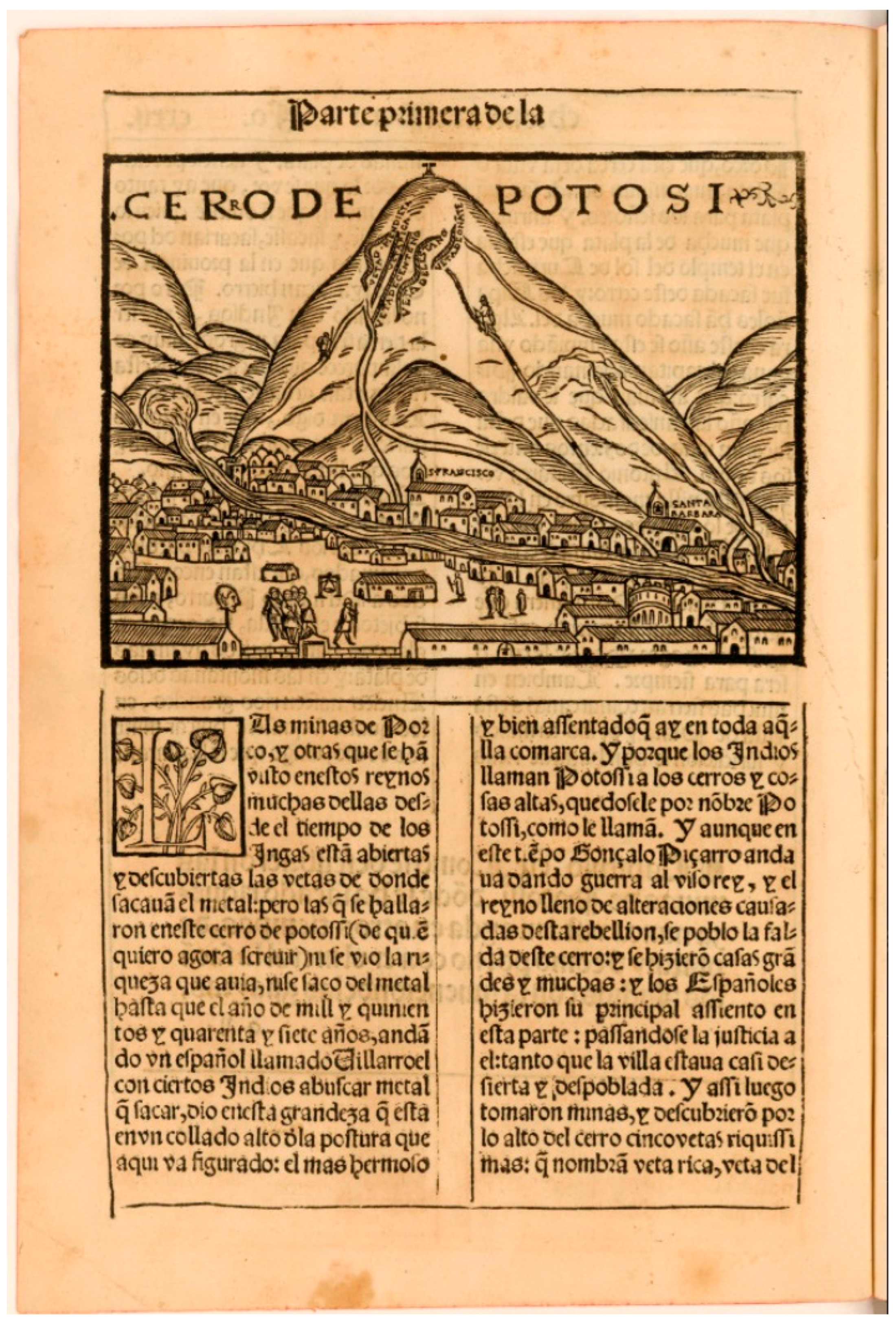
Figure 2. “Cerro de Potosí”, woodcut, from Pedro de Cieza’s Crónica del Peru, 1553. Private collection. Photo © Helen Hills.
Arts 15 00099 g002
A much-reproduced woodcut in Pedro de Cieza’s Crónica del Peru, 1553 (Figure 2) stages an undeclared struggle with the mountain, which is shown as enormous, mysterious, and defiant.42 The Cerro Rico dominates the image and defies pictorial constraints. It bursts through its own title; the cross on its summit is cut off by the frame; and it emits jets of water that look like metal, but behave like smoke. The Cerro resembles a great heart with veins pumping across it and coursing down and across the town below. Silver veins, paths, shafts, rivers, modes of movement and connection, slither over the surfaces of mountain and town. Two lonely figures—on the left an Indigenous labourer with a pack and on the right a Spaniard—trudge up the steep path in what is presented as symmetrical servitude. Meanwhile, the veins or entrails course down, paths spill over the lesser Huayna Potosí, rivers jut from the hillsides, tentacular and indifferent to the human settlement below. Five silver veins near the summit wriggle like snakes, their names inscribed as if scratched into the mountainside. Their names—Mendieta, Rica, Centeno, Estaño, and Oñate—follow the twists of the silver veins, like banderoles, as if the silver veins are speaking. The rivers, like locks of hair or threads of metal, burst from the slopes. The Ribera—along which the silver-processing mills operated—was a phenomenal piece of hydraulic engineering consisting of reservoirs linked to canals and aqueducts.43 Here it resembles an enormous worm, its head a vast reservoir. More like a flow of metal than water, it seems to drape itself across the settlement, more effacing than nurturing, like a plume of thickest smoke. The names of two churches—San Francisco and Santa Barbara—resonate with the names of the mines above, as if in communication. In the foreground plaza, a group of helmeted soldiers and several figures with lances gather. The whole is overseen by a decapitated head on a stick. This dead head enunciates the presence of colonialism. The blind spot of power and the deadly violence of royal justice, which sees everything and yet sees nothing.44
The print confounds clear identification of what flows—silver, water, paths or mines—and any easy distinction between what is above and what below ground, and what serves and what menaces. It conveys the attempted subjugation of this enormous mountain, and yet it is still the mountain and the river that command, despite the inroads made by settlement, the cross, the paths, the inscribed names, the head on a stick—these human efforts—at once paltry and momentous—to tame and order, to dominate and conquer. What emerges is the chilling, terrifying nature of the enterprise that is named Potosí: an awesome machine made monstrous in the service of empire that depends on silver.
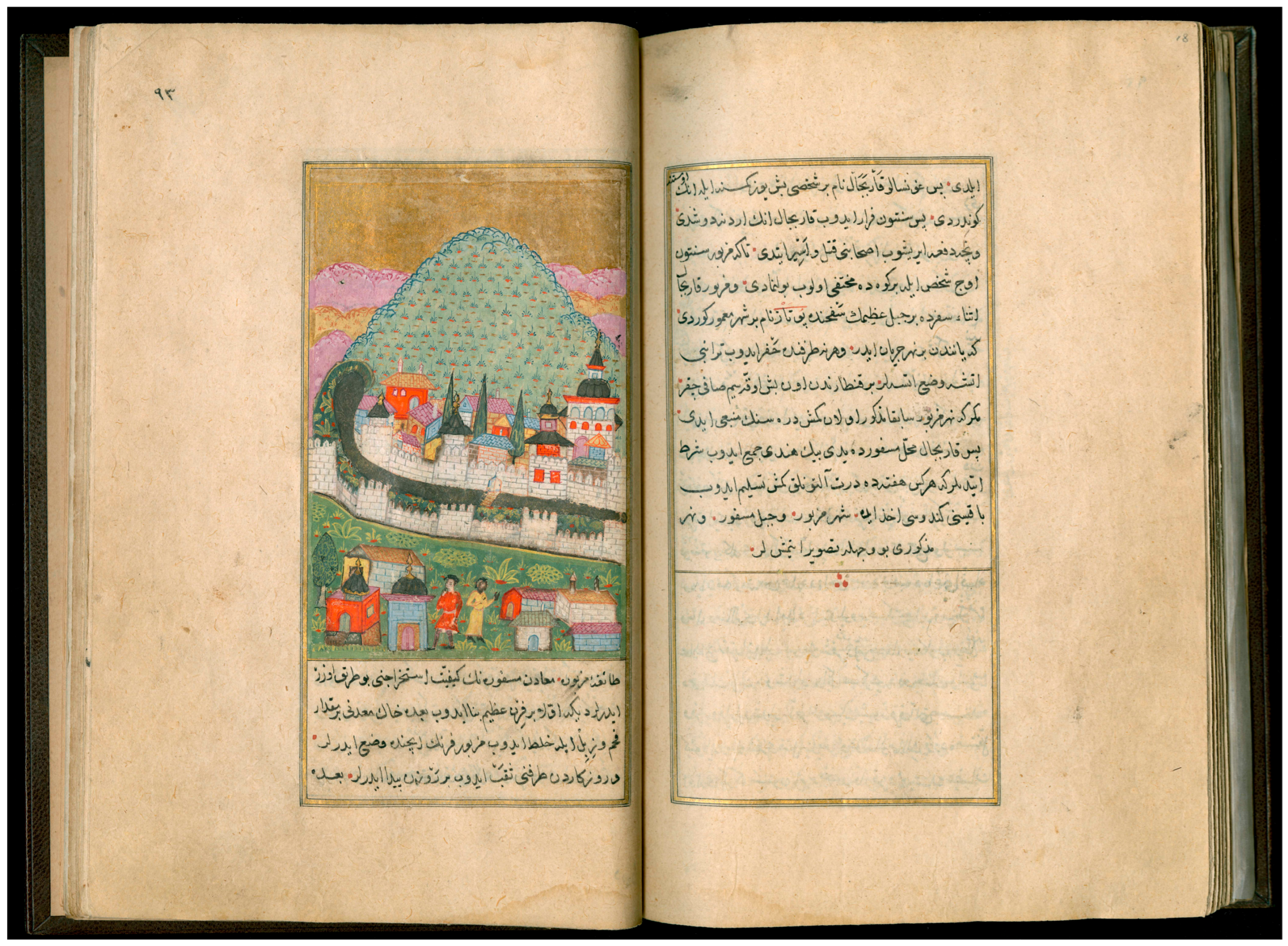
By contrast, an Ottoman depiction of Cerro Rico from ca.1580, derived from the Cieza woodcut or perhaps from an Italian copy, is in a compendium of writings on the Spanish Indies, known as Tarih-i Hind-i Garbi, dedicated to Sultan Murad III.45 It shows a beautiful, fertile green mountain in harmony with the prosperous walled city below (Figure 3). There is no trace of mining or paths. Instead, the mountain is resplendently verdant, dotted with shrubs. The Ribera, channeled and tamed, gushes from the mountainside to irrigate, rather than smother, the town. In the foreground, two citizens stand amidst shrines or tombs, and further lush vegetation. The whole radiates peace and well-being. The text, however, describes methods of extracting silver ore.46
Figure 3. The Cerro Rico of Potosí, Tarih-i Hind-i Garbi manuscript, ca.1582, Ayer MS 612 (Vault) ff.17–18. By permission of the Newberry Library.
Arts 15 00099 g003
Here Potosí, lovingly rendered as already Ottoman, floats in the dream of an Ottoman universal empire. Habsburg Spain was the Ottoman empire’s powerful enemy. American silverpushed up prices and caused trouble for the Ottomans; in this vision, peace and plenty and Potosí are now in Ottoman hands. Barbara Mundy and Dana Leibsohn suggest that the painting functions as an “image of desire, inviting contemplation of the geographic origins of silver, and, by implication, the wealth that silver could bestow upon those who could control it”.47 More than that, it boldly strikes a claim on the very heart of the Spanish empire. Such a vision was useful in displaying Ottoman knowledge of its imperial enemy and in strengthening the legitimacy of the sultan in his own empire. It is also a reminder of the very real threat to the Spanish empire posed by Ottoman ambition, a vulnerability that is eclipsed by the myth of Spain’s monolithic conquering power.48
Silver and its extraction are invisibilized in the painting, which conjures a beautiful dream of beneficent wealth without environmental or social costs, where nature, humans and the divine flourish in productive harmony—typical of an imperialist dream. It evokes the pre-Conquest Potosí recalled by a disenchanted visitor in 1603:
Even though today, because of all the work done on the mountain, there is no sign that it had ever had a forest, when it was discovered it was fully covered with trees they call quínoa […] On this mountain there was also much hunting of vicuñas, guanacos and viscachas […] There were also deer, and today not even weeds grow on the mountain, not even in the most fertile soils where trees could have grown.49
The Ottoman image magically restores this lost fertile landscape and presents the city as serene and beautiful, unscarred by exploitation and injustice. It is the imperialist’s fantasy: the source of wealth that bears no cost to people or place but secures proud and contented dominion.
The system of silver extraction under the Spanish was far more dreadful than these images suggest. Viceroy Francisco de Toledo ruthlessly increased extraction of precious metals for the Spanish monarchy by imposing a new method of silver refining using mercury amalgamation, intensifying the mita labour draft for mining, imposing reducciones (resettlements) to supply the mita, and building numerous vast reservoirs to power the mills that ground the ore.50 He also founded the royal mint, which turned his “mita-driven, mercury-soaked machine” into a “cash machine”, and assumed a life of its own.51 Human and environmental devastation ensued on a terrible scale, extending to African slaves.52 Silica dust, mercury, lead and zinc sentenced millworkers to cruel illnesses and early death, and poisoned the soil, water, and air with enduring toxins.53 The rapid devastation of Indigenous populations from epidemics, disease, exhaustion, mercury poisoning, industrial accidents, and forced migration of male tributaries to work reduced available labour, produced an extreme imbalance of women and the elderly, and resulted in despoblados, wastelands where settlements had once flourished.54
‘This fierce beast swallows them alive’, declared Potosí mine and refinery owner, Luis Capoche in 1585.55 The mita caused vast Indigenous slaughter through disease, accidents, and exhaustion, and eroded the agricultural subsistence base on which it depended.56 Villages and kin groups within the mita catchment zone were forced to provide 16% of able-bodied men for the mines annually (each man every seven years), amounting to 13,500 at any time, with 4500 underground in the Cerro Rico in rotation day and night.57 Mercury, known as azogue (from the Arabic az-zuq), for the amalgamation method was extracted from cinnabar in the mines of Huancavelica, even deadlier than Potosí. The mercury poisoning endures to this day.
Spanish colonization, building practices, and cattle grazing damaged the environment and indigenous patrimony, especially in the destruction of woodlands and cultivated trees, as Pedro Cieza de León himself early recognised. In The Second Part of the Chronicle of Peru, he writes:
There were very few cultivatable lands that remained desert in the time of the Incas, but all were peopled, as is well known to the first Christians who entered the country. Assuredly, it causes no small grief to reflect that these incas, being gentiles and idolaters, should have established such good order in government and maintenance of such vast provinces, while we, being Christians, have destroyed so many kingdoms. For wherever the Christians have passed, discovering and conquering, nothing appears but destruction.58
The mountain of Cerro Rico, emptied out and riddled with mines and ruthlessness, is more than testimony to the ecological devastation and moral bankruptcy of the extractive industry of Spanish imperialism; it is its very emblem. “All of it from below to above and all around, in all parts it is full of mouths, and in the part inside it is all hollow, such that one cannot know upon what it stands or what sustains it”, writes Hieronymite friar Diego de Ocaña, who lived in Potosí for over a year in about 1600, “It is a portrait of hell to enter inside”.59
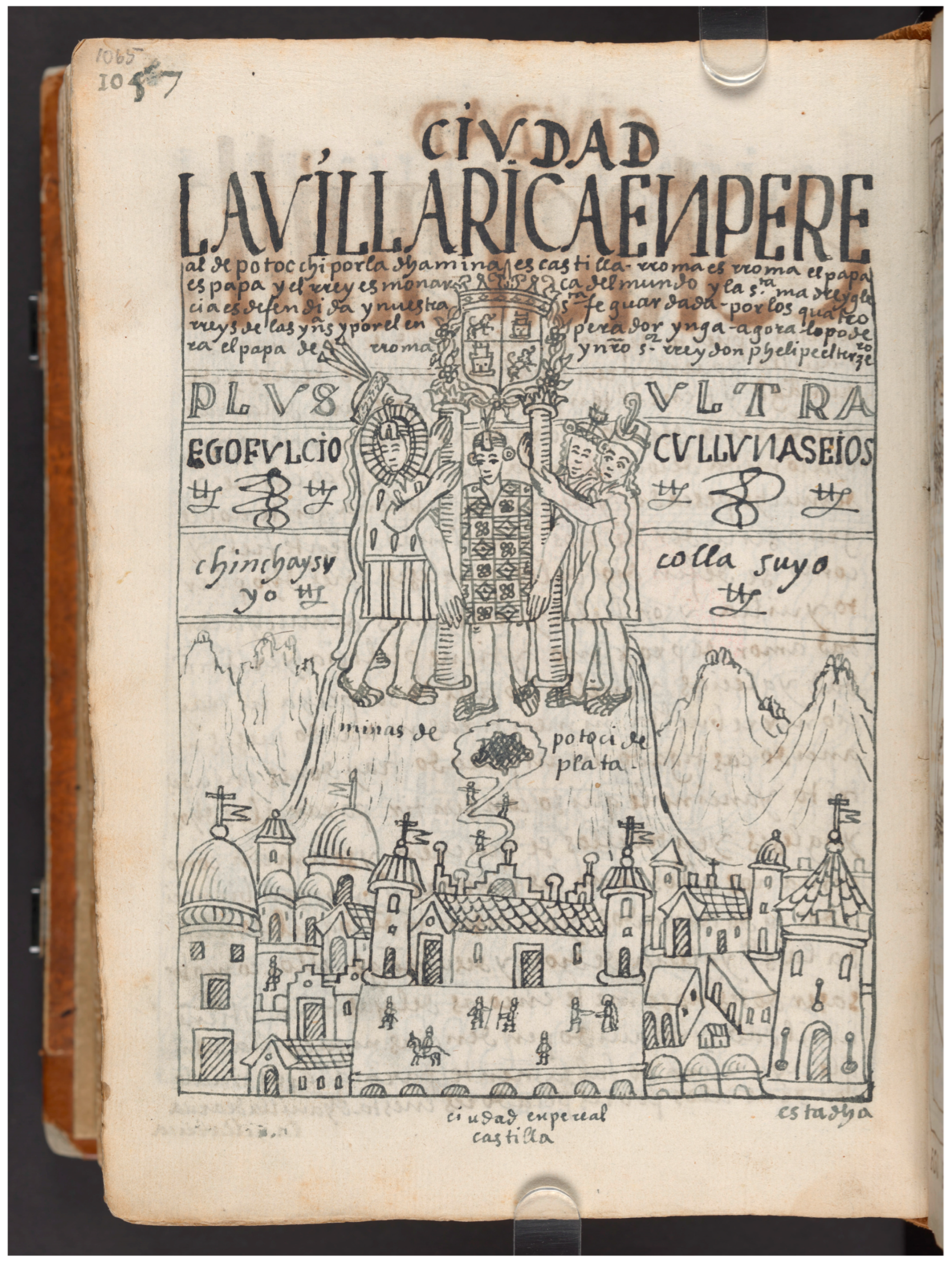
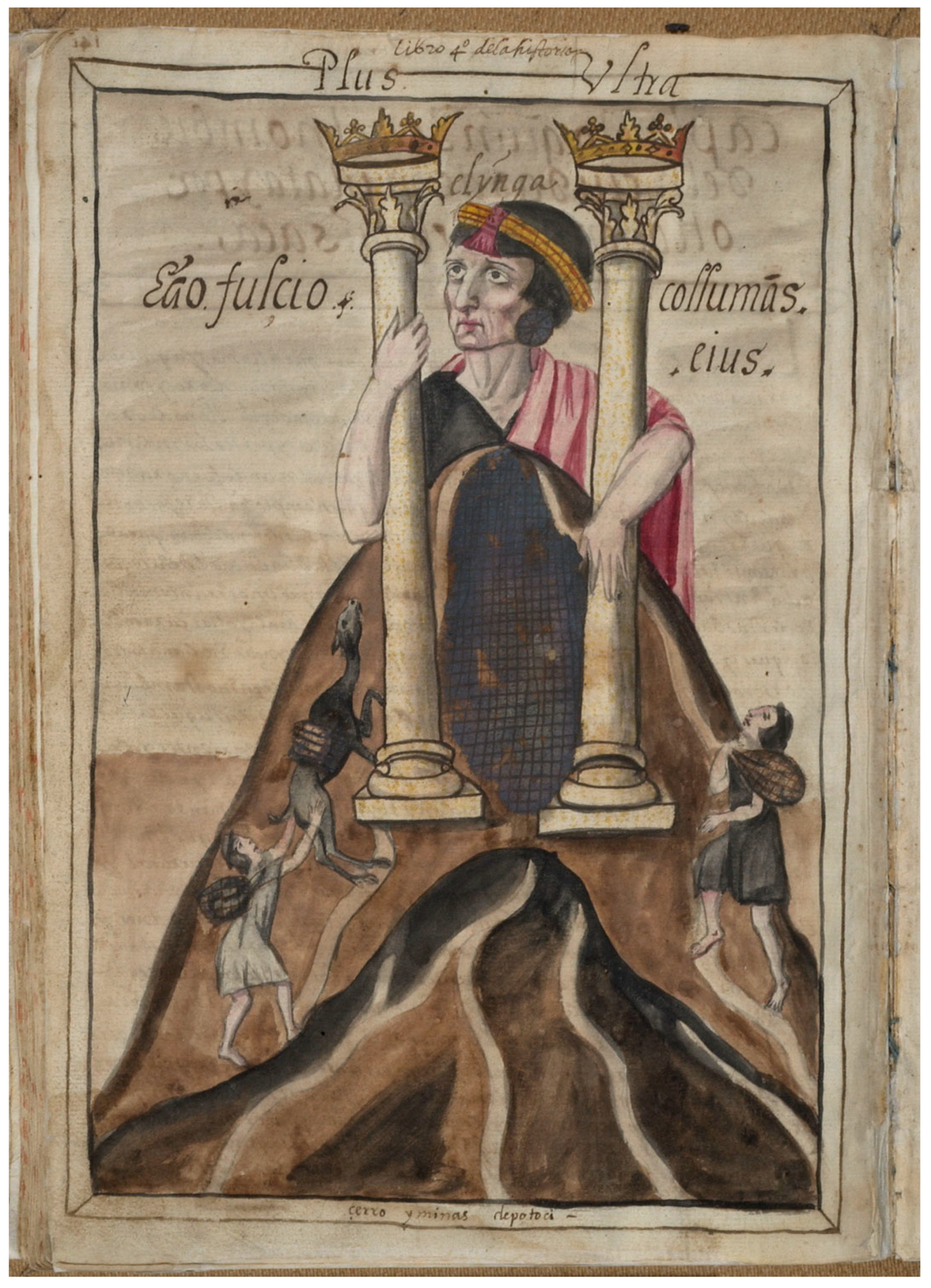
Environmental damage and the decline of the indigenous population greatly concerned some Spanish settlers and intellectuals, indigenous plaintiffs, and informed an entire genre of writings chronicling the Inka kings in early colonial Peru. “Ego fvlcio collumnas eius” (“I fortify its columns”) reads the inscription of the depiction of Potosí by the indigenous Andean Indian Felipe Guaman Poma de Ayala (ca.1555[?]–1616[?]) in Historia del origen y geneología real de los reyes Incas del Pirú by Mercedarian missionary, Martín de Murúa (Figure 4).60 The Inka and the great silver mines of Peru sustain Spain’s empire. The image is remarkable in its enactment of imitation as a strategy for inclusion. Its chiasmic intersplicing and creative manipulation of Western Christian iconographic traditions, calligraphy, and Andean forms of signification simultaneously ostensibly endorse but also challenge Conquest and colonialism. The Inka (‘el yñga’), lifting his head in divine and noble duty, stands behind the Cerro Rico, such that his body and mountain fuse as one, while he holds the crowned columns in gentle embrace, ostensibly showing support for the Spanish empire, but pointedly demonstrating the dependency of the Spanish monarchy on Inka authority and silver mountain. Indigenous workers ascending paths up the precipitous mountain with a llama evince the necessity of native labour and knowledge, including working animals, to the whole extractive-Indigenous-monarchical machine. The inscription “Plvs Vltra” (“more/further beyond”) refers to the Spanish empire.61 It suggests, too, that a new philosophy is required to encompass that very beyondness. That new philosophy is what the image offers: Guaman Poma foresees an autonomously ruled Christian Andean state.
Figure 4. Felipe Guaman Poma de Ayala, ‘Ego fvlcio collumnas eius’. The Inka’s Cerro Rico is the support of Spain’s empire, in Martín de Murúa, Historia del origen y genealogía real de los reyes Incas del Pirú, f.141v (1590). Pontificia Universidad Católica del Perú. https://repositorio.pucp.edu.pe/items/8f93e88c-3260-4376-b93f-97bdedb61882 (accessed on 7 November 2025).
Arts 15 00099 g004
Silver leaf was applied in the depiction of the mountain to infuse its open entrails with the very material that it bore, making them shine and glint (the silver has since tarnished and darkened). This silver is at once indexical and imaginary in its revelation of the heart of the matter: the Spanish monarchy’s baroque fantasy of possession of the silver mountain, the earth and its treasures. In this way, the image insists on silver’s indexicality, its peculiar splendour, and its mysterious origins deep in the earth and recognizes silver’s spell-binding hold on the Spanish monarchy.
According to Poma de Ayala, the Indies (las yndias) were named by Columbus because they were “the land in the day, yn dia”, meaning the westernmost land, closest to yndiyaucuna, where gold and silver were thought to “grow” in greatest abundance.62 Both Andeans and early modern Europeans considered the earth to be living and believed that veins of gold, silver and gems grew best in regions closest to the nutrifying energy of sun, moon and stars. In the drawing, cross hatching at the mountain’s opening suggests something at once inaccessible and obscured, and yet scoured, etched, measured and mined.63 There is no reference to Catholicism; the mountain is embedded in a political alliance, which it sustains. It is silver that shines and justifies, and Inka authority and command that make possible the Spanish Crown’s empire and access to it.
Guaman Poma’s depiction of Potosí’s relationship with the Spanish empire in his Nueva corónica y buen gobierno (Figure 5) is even more diagrammatic and emphatic than that in Murúa (Figure 4). This drawing forms part of Poma de Ayala’s great sermonizing cry for justice to King Philip III, a 1200 page address with 397 drawings, written in c.1615, roughly 80 years after the conquest of Tawantinsuyu.64 Guaman Poma cleverly approaches the European sphere as though he were simultaneously alien and native to it.65 While ostensibly simply informing the Spanish king about the richness of Andean culture before and during Inka rule and under colonialism, the model of “good government” emerges as that of the Incas, while colonial society plays the role of counter-model.66 The text proposes making his own son the prince of Peru in a universal kingdom where Philip III would be the “monarcha del mundo”, but Guaman Poma acknowledges that the world is upside down, unable to fulfil such goals.67
Figure 5. Guaman Poma de Ayala, “El primer nueva corónica y buen gobierno conpuesto por Don Phelipe Guaman Poma de Ayala, señor y príncipe” (MS, ca.1615). The text reads: “LA VILLA RICA ENPEREal de Potocchi. Por la dicha mina es Castilla, Roma es Roma, el papa es papa y el rrey es monarca del mundo1. Y la santa madre yglecia es defendida y nuestra santa fe guardada por los quatro rreys de las Yndias y por el enperador Ynga. Agora lo podera el papa de Roma y nuestro señor rrey don Phelipe el terzero./PLVS VLTRA/EGO FVLCIO CVLLVNAS EIOS2. [Yo fortifico sus columnas.]/Chinchay Suyo/Colla Suyo/minas de Potocí de plata/ciudad enpereal, Castilla/CIVDA.” Royal Danish Library, GSK 2232, f.1065v p. 1057. https://digitalesamlinger.kb.dk/manus/vmanus/2011/dec/ha/object852735/da/ (accessed on 7 November 2025).
Arts 15 00099 g005
Ostensibly recognizing the authority of the king, the drawing emphasizes Spain’s dependency on the Andeans and their rootedness in the mountainous terrain. Here, the Inka and the kings of the four subdivisions of the Kingdom support the symbols of Imperial Spain, the columns of Hercules and the arms of Castile and Leon. Inscriptions—‘Chinchay Suyo/Colla Suyo/minas de Potocí de plata/ciudad enpereal, Castilla’—underline the subordinate position of Castille in its dependency on the Andean government (the four suyus) and the silver mines of Potosí.68 The Inka is here located at the centre of the world, surrounded by the symbols of his empire (the four lords of the subdivisions), his feet just above the silver mines. While abstract symbols represent the Spanish monarchy, the Andeans are represented by depictions of human beings, suggesting that the basis of European power is abstraction, itself at odds with Andean philosophy and ways of being, and is the engine of destruction. The series of abstractions that produce and sustain monarchy and empire impinge on real living people in their own homelands. The hearts of Potosí emerge as a powerful animatory force containing the ancestral Inka body.
The drawing seeks to demonstrate that the king of Spain would be nothing without the wealth of Potosí and hence without Andean support. The silver mine is depicted as apparently detached from the colossi of power towering above, relatively small, extremely remote, and of an impenetrable darkness. The inscription declares it holds everything in place for the European colonisers: due to the mine of Potosí “Castille is [Castille], Rome is Rome, the pope is pope and the king is the monarch of the world”. The centrality of silver to the Spanish monarchy is acknowledged, while it is shown as darkness and detached from life. Meanwhile, “the holy church is defended and holy faith is protected by the four kings of the Indies and by the Inka emperor”.69
Guaman Poma depicts the Inkas as pivotal in the organizational nexus of nature, territory, place, people, and empire. The drawing emphasizes the support of the empire afforded by Andean knowledge and organizational capacity that enables the mining on which the empire depends. Surrounding mountains appear to be crowned with small scattered settlements, suggesting the “vertical archipelago” that traditionally provided for Andean subsistence, reproduction and well-being.70 Pointing out that a universal Christian empire presided over by the Spanish king is dependent on Andean silver and Andean peoples and government, what is called for is a sovereign Andean state.
Guaman Poma’s depictions of Potosí’s ecology acutely articulate the interdependence of the Spanish monarchy and Andean knowledge and labour. Jason Moore has recently suggested that “instead of capitalism as world-economy [we might] start to look at capitalism as world-ecology”.71 Guaman Poma presages this in emphasizing the silver mountain, understood as cosmic place, topography, and peoples, and Indigenous knowledge as bedrock of Spanish imperialism. From this, he sought to secure justice and good government in Peru, including greater autonomy for Andeans, in return for their upholding Christianity and securing the flow of silver. Sadly, he was unsuccessful. However astute his art in articulating ecological and political complexities, it was greed for silver that won the day.

4. Silver and Lustrous Elites

That same silver, torn from the Andes in brutal conditions, trailing destruction and devastation behind it, transported across the Atlantic, performed a miracle in European courts. It embellished European elites and cloaked them in spiritual purity, refinement, and polish. The horrors of colonialism have been much rehearsed, but they are rarely related directly to the very allure of early modern art. This is analogous to the dazzle that obscures the substance behind it. More than that, silver’s shininess was part of the fascination of the visual culture of the early modern elite. While early modern silver might usefully be interrogated in relation to many of its remarkable characteristics, including whiteness, ductility, and malleability, here I consider its shininess, a quality that has been largely overlooked by art history. Shine offers a way to consider the ephemeral, the glancing, the shifting, and the unstable in relation to situated complicity—qualities which also challenge art history’s perennial concern with the enduring, the measurable, the stable, and the supposedly detached viewer.72
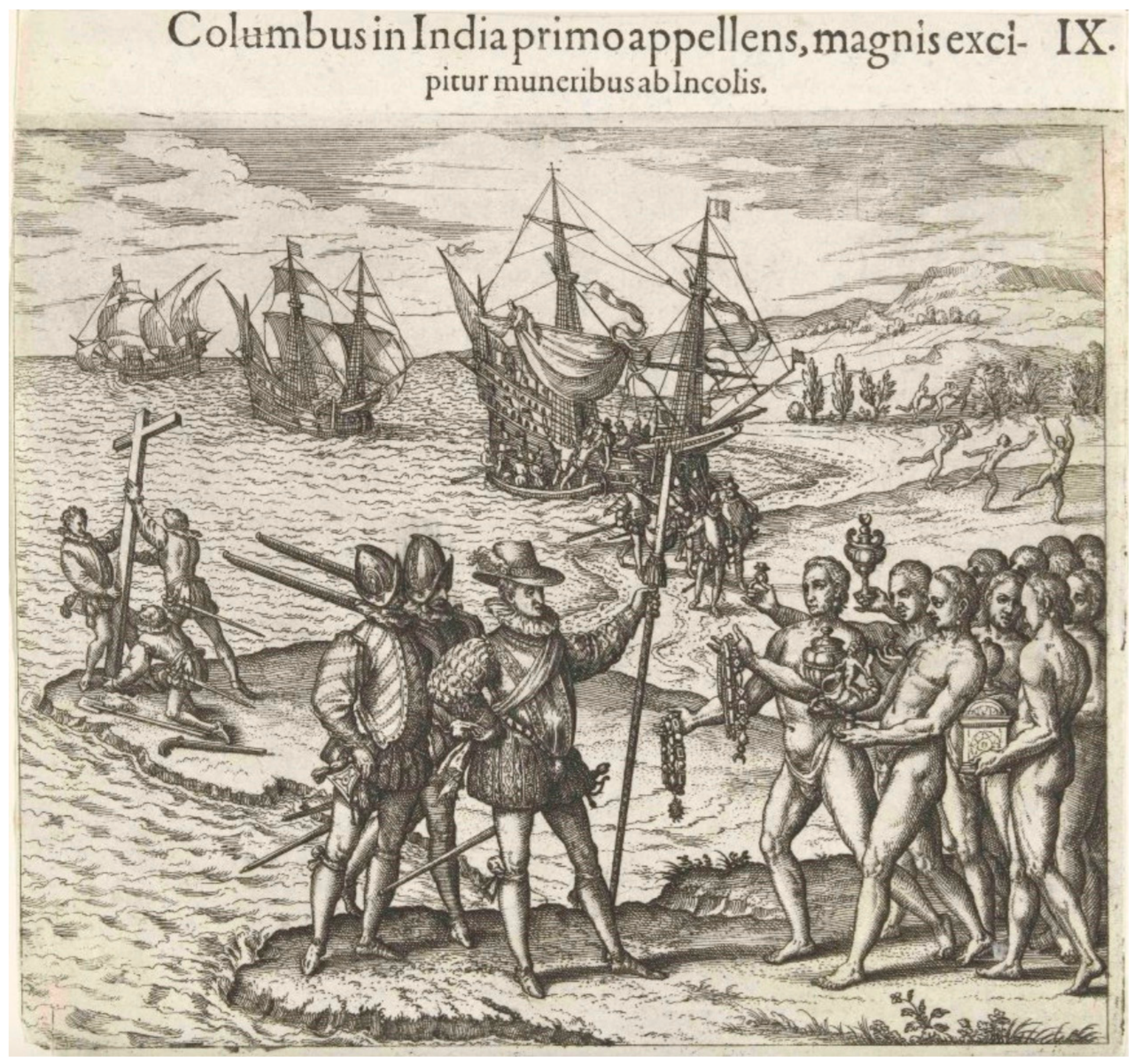
A consequence of the play of light, while apparently a property of objects, shininess can incite sensual engagement, at the same time as its fragility may refuse it”, suggest N. Maffei and T. Fisher.73 That paradoxical element was part of its attraction to courtly elites. Yet it was not mere shine that drew Europeans, but above all the shine of silver, gold, pearls and pelts for which they were quick to part with shiny cheap goods in exchange with Amerindians (Figure 6).
Figure 6. Theodor de Bry, “Columbus, on first landing in the Indies, was welcomed by the natives with magnificent gifts” (“Columbo in India primo appellens magnis excipitur muneribus ab Incolis”). Americae Pars Quarta sive, insignis & admiranda historia de reperta primum Occidentali India à Christophoro Colombo anno M.CCCCXCII. Scripta ab Hieronymo Bezono, Frankfurt: 1594. Photo: © Helen Hills. From the British Library Collection: G.6628(1), Plate IX.
Arts 15 00099 g006

5. Silver, Lustre, and the Divine

The brilliance of silver, the most reflective metal on earth, bore close associations with truth, purity, and the divine. Silver was closely associated with purity, and hence with water, as something mobile and unsullied: “thou sheer, immaculate and silver fountain” (Richard II, V, 3); “the silver spring where England drinks” (Henry VI, Pt. 2, IV, 1). More significantly, silver was closely linked to purification, because, unlike gold, it had to be refined to remove the dross: “The words of the Lord are pure words: as silver tried in a furnace of earth purified seven times” (Ps: 12:6). After the arduous processes of refining, silver emerged pure, and could be assayed or tested: “For thou, o God, has proved us: thou hast tried us, as silver is tried” (Ps: 66:10). Silver rang true: “The tongue of the just is as choice silver” (Prov:10:20). Hence silver came to be associated with virtue: “when beauty boasted blushes, in despite virtue would stain that o’er with silver white”.74
The Spanish monarchy claimed particularly close relationships amongst the divine, the monarchy, and the sun.75 A consideration of the metaphysics of light as the divine runs long and deep through Antiquity and Scripture and lies beyond the scope of this essay, but a few brief observations are useful here. The power of light has long been associated with the sun, daylight, virtue, and the divine.76 St John of the Cross (1542–1591) uses a metaphor of light and a besmudged window to describe how the soul may achieve union with God: when the soul is cleaned of all imperfection, the sunlight transforms and illumines it, such that the window and ray of light appear to be identical.77 In Christian thought, precious metals and gems reflecting light are more than a metaphor for divine light; they are part of a theology of light, a theophany, a particular manifestation of the Being.78 Abbot Suger famously invited his reader to consider the precious materials of the altar of St Denis anagogically, through matter and light to the ascent from material to the immaterial: “Bright is the noble work; but being nobly bright, the work should brighten the minds so that they may travel, through the true lights, to the True Light where Christ is the true door”, he writes.79. Pseudo-Dionysius (as he is recast), seeking to reconcile Platonism with Christianity, adopted apophatic theology to underscore the utter transcendence of God. He contrasts the transcendental darkness of God to the immanent brightness of His creative power, which is the metaphysical analogue to the illuminating power of physical light. Accordingly, the created universe is a theophany, a visible and ultimately intelligible manifestation of God as causal determinative force.80 Robert Grosseteste followed a similar line in De luce (ca.1228), positing that light (lux) in its purest and most spiritual state constitutes the “first corporeal form”. It naturally diffuses or multiplies instantaneously from a point to create a sphere of radiation which confers three dimensionality on the physical universe to the very edge of the firmament of Genesis. Having perfected corporeity at that edge, the light then returns towards its source as lumen in “waves” to create the planetary spheres and sublunary spheres of air, water, fire and earth. This diffusion of primordial light is an act of theophany in revealing the physical world by actualizing its potential corporeity and dimensionality.81
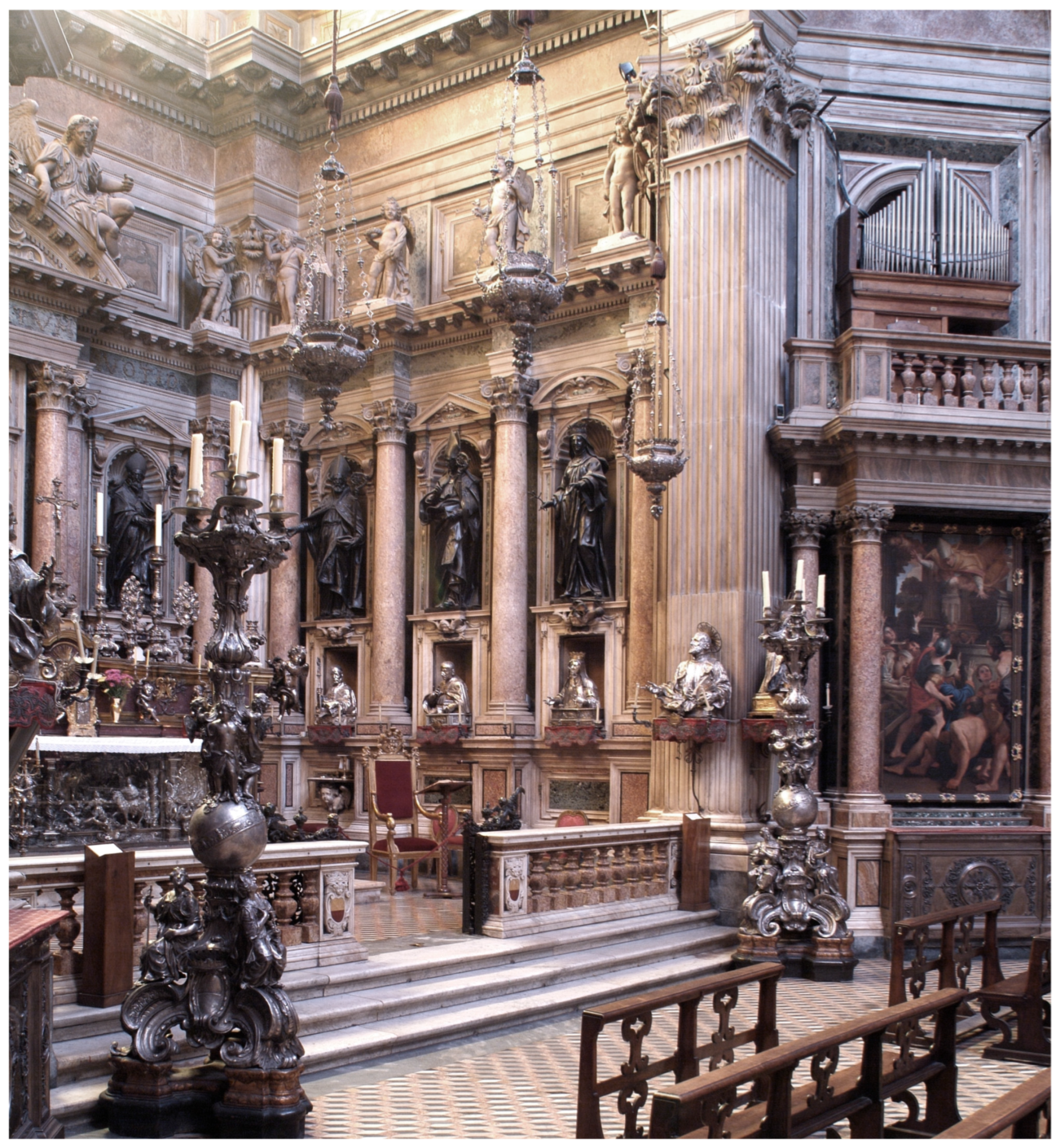
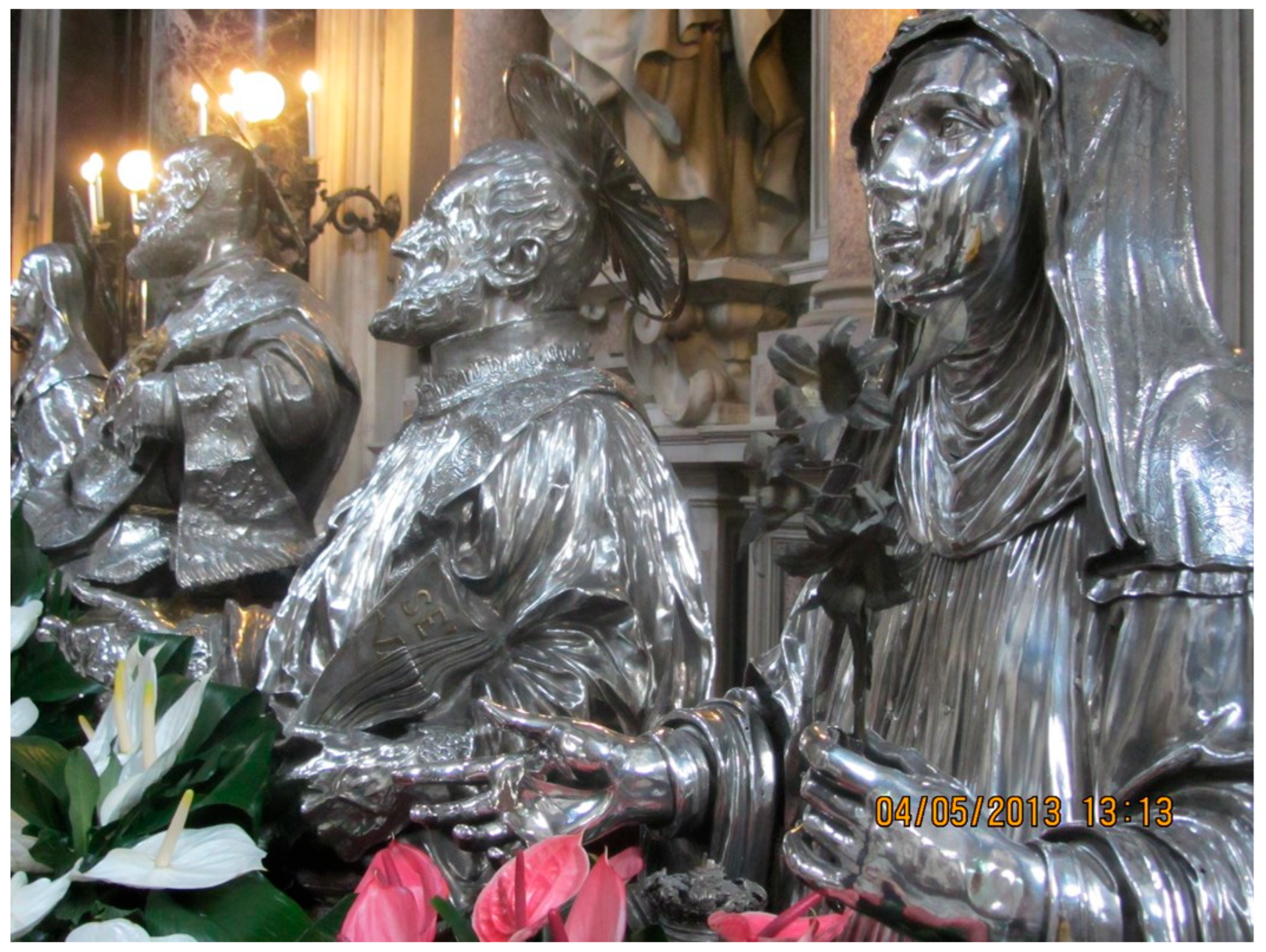
Figure 7. Silver reliquary busts and silver Paschal candelabra. Treasury Chapel of San Gennaro, Naples. By permission of the Eccellentissima Deputazione della Reale Cappella del Tesoro di San Gennaro. Photo: © Helen Hills.
Arts 15 00099 g007
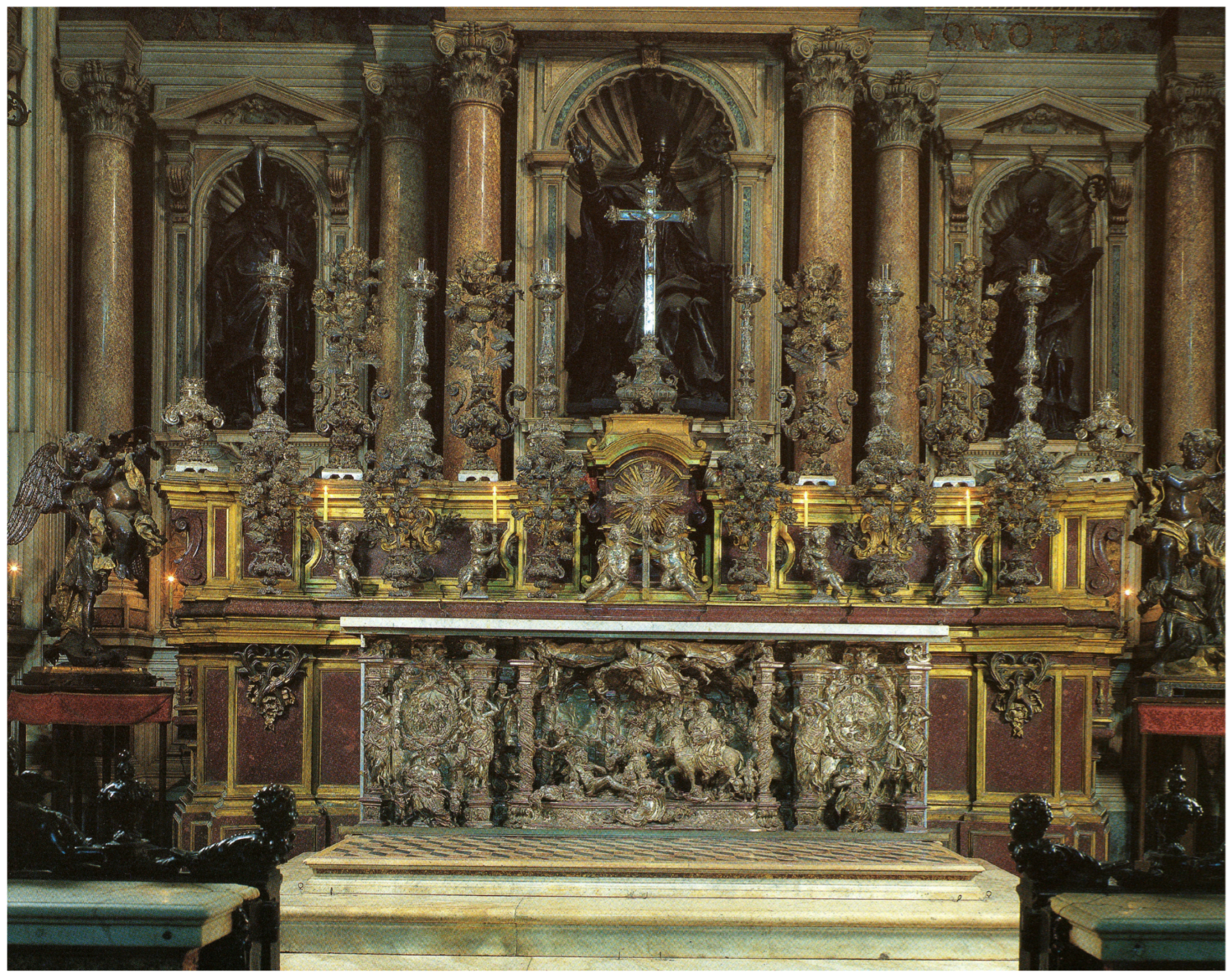
Silver’s remarkable responsiveness to light rendered it particularly capable of conveying the divine. As a highly reflective material, which also holds dark shadows and tarnish, it brilliantly stages the shift from lux to lumen. Silver was from earliest times mobilized in Judaic and Christian liturgy: silver lamps and candlesticks bestowed light on the sacred (Figure 7); silver embellished Kiddush cups, and yads; silver crowns and finials adorned the Torah; silver rendered altar furnishings (Figure 8), mass cards, and Bible bindings effulgent.
Figure 8. Silver altar frontal and silver altar furnishings. Treasury Chapel of San Gennaro, Naples. Photo © Helen Hills. By kind permission of the Eccellentissima Deputazione della Reale Cappella del Tesoro di San Gennaro, Naples.
Arts 15 00099 g008
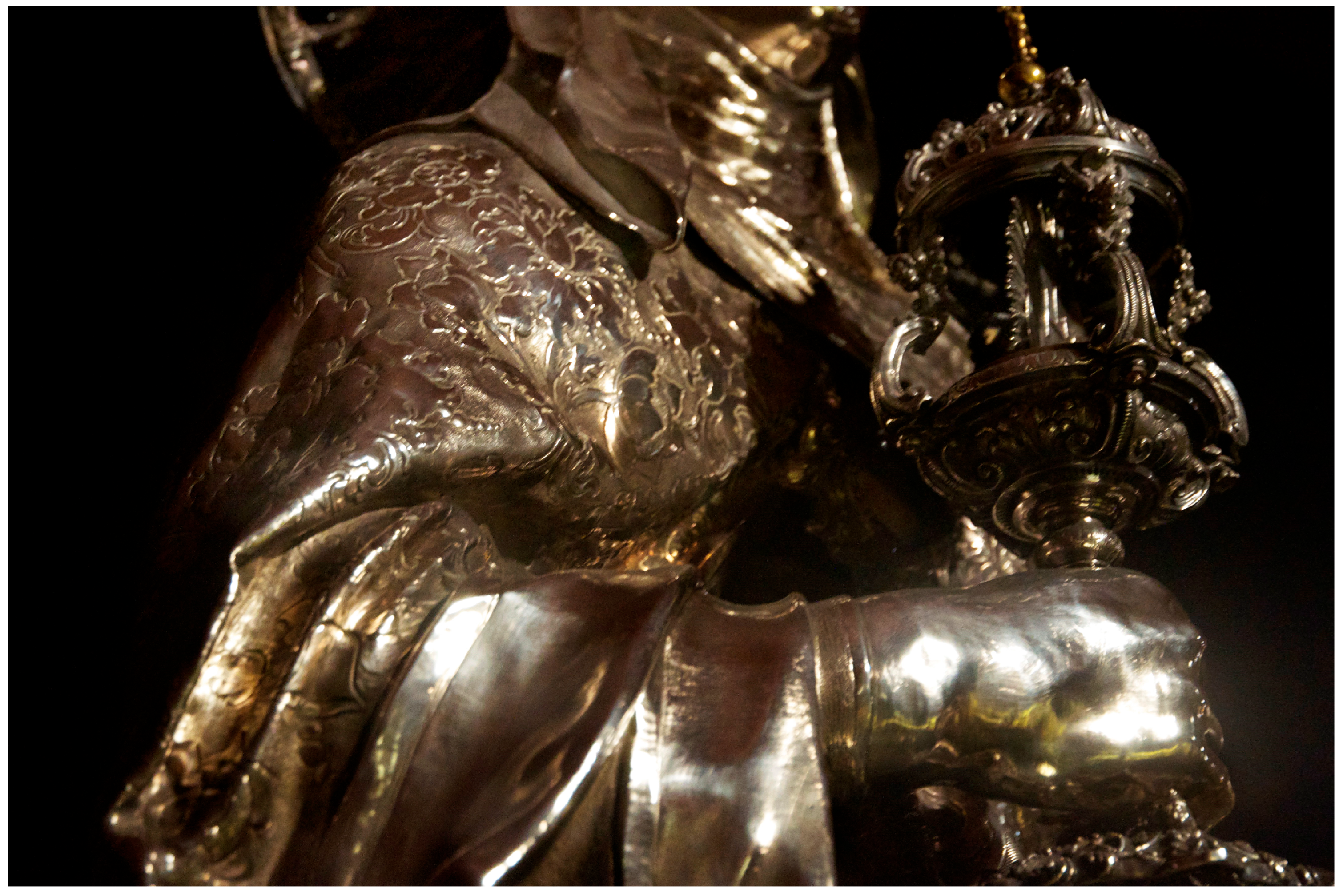
Silver reliquaries transmuted mere human bones into venerable relics and drew worshippers into the ambit of the saint in heaven in glory (Figure 9).
Figure 9. Reliquary bust of Santa Chiara glinting and shimmering. The Treasury Chapel of San Gennaro. Photo: Marina Cotugno. By permission of the Eccellentissima Deputazione della Reale Cappella del Tesoro di San Gennaro.
Arts 15 00099 g009
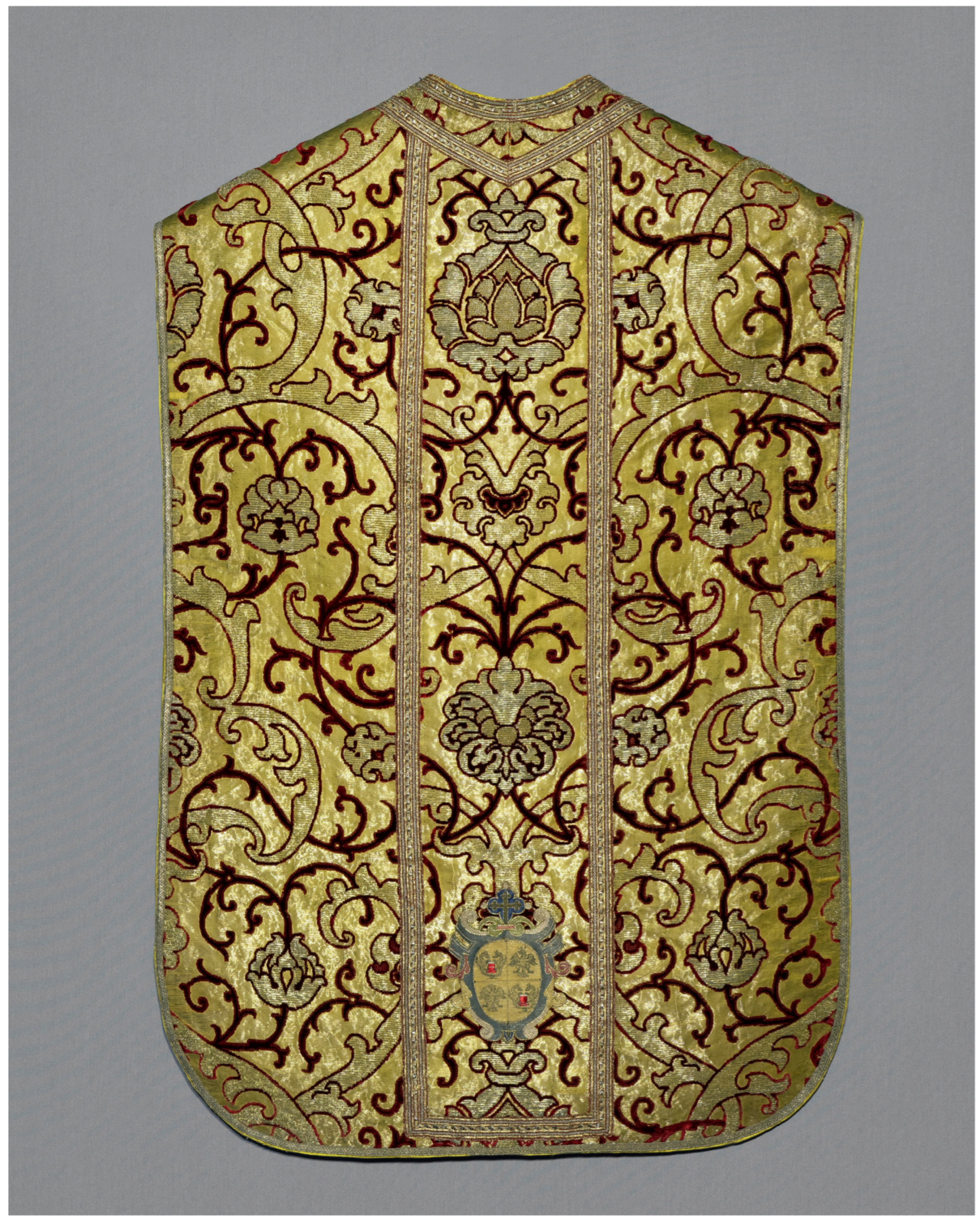
Priests and bishops wore chasubles, dalmatics, and mitres that glistened with silver thread (Figure 10).
Figure 10. Chasuble of Archbishop Carlo Antonio Dal Pozzo (1582–1607), ciselé velvet, brocade, silver thread, bouclé, laminated ground. Photo: © Helen Hills. Pisa Cathedral inv. No. 665727 A.F.O.P Archivio Fotografico Opera del Duomo di Pisa.
Arts 15 00099 g010
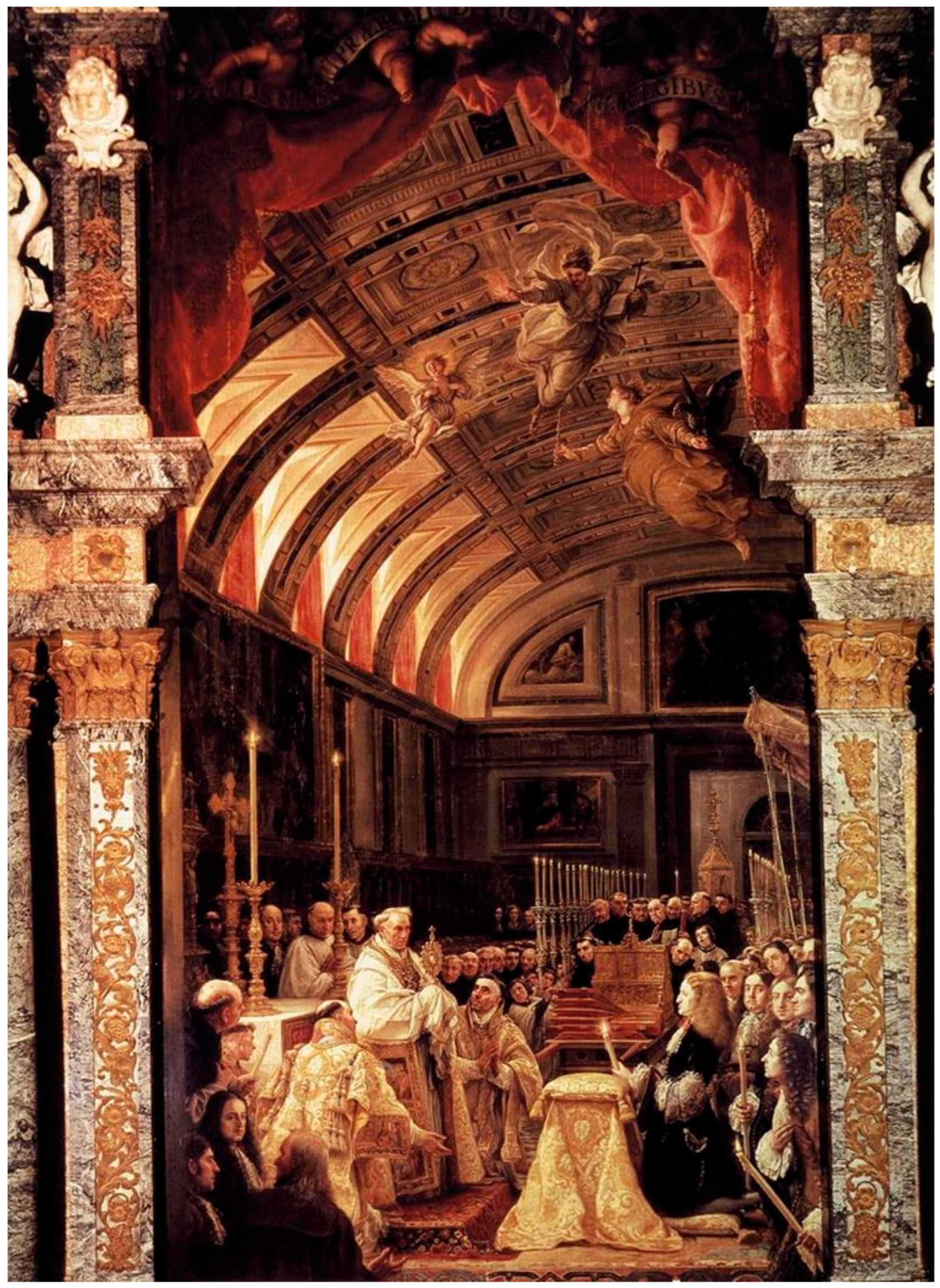
In the miracle of the Mass, it was silver in chalices, pyx and “plate” that communicated the divine to the human (Figure 11).
Figure 11. Claudio Coello, Adoration of the Holy Eucharist (detail), 1690, oil on canvas, 500 × 265 cm, Real Monasterio de San Lorenzo, El Escorial, Spain. Patrimonio Nacional. 10014789-DG125840.
Arts 15 00099 g011
Deployment of silver in worship and veneration reached a new apogee in early modern Catholic Europe. In Spanish-ruled Naples, silver replaced traditional wood for the reliquaries of its rapidly proliferating protector saints, and their vast public processions on feast days transformed the city streets into flows of glinting silver (Figure 12).82
Figure 12. Silver reliquaries from the Treasury Chapel of San Gennaro, Naples ready for the procession in a flow of silver to celebrate the feast of San Gennaro (2013). Photo: Helen Hills.
Arts 15 00099 g012

6. “Noble” Silver

Silver’s sheen promised elevation and was a guarantor of success. Silver, a “noble” metal, was attractive to elites supposedly endowed with “noble” qualities of political, social, and religious purity and refinement.83 “Gold is a metal generated in the earth’s entrails, the most noble of all [metals], after which follows silver in second place,” claims Gasparo Scaruffi in L’Alitininfo (1582), “The cause of their nobility, in my view […] comes from nothing other than that through their virtue they withstand every test of fire, and show their flawlessness [to be] unchanged in that fire; something that other metals are unable to do.”84
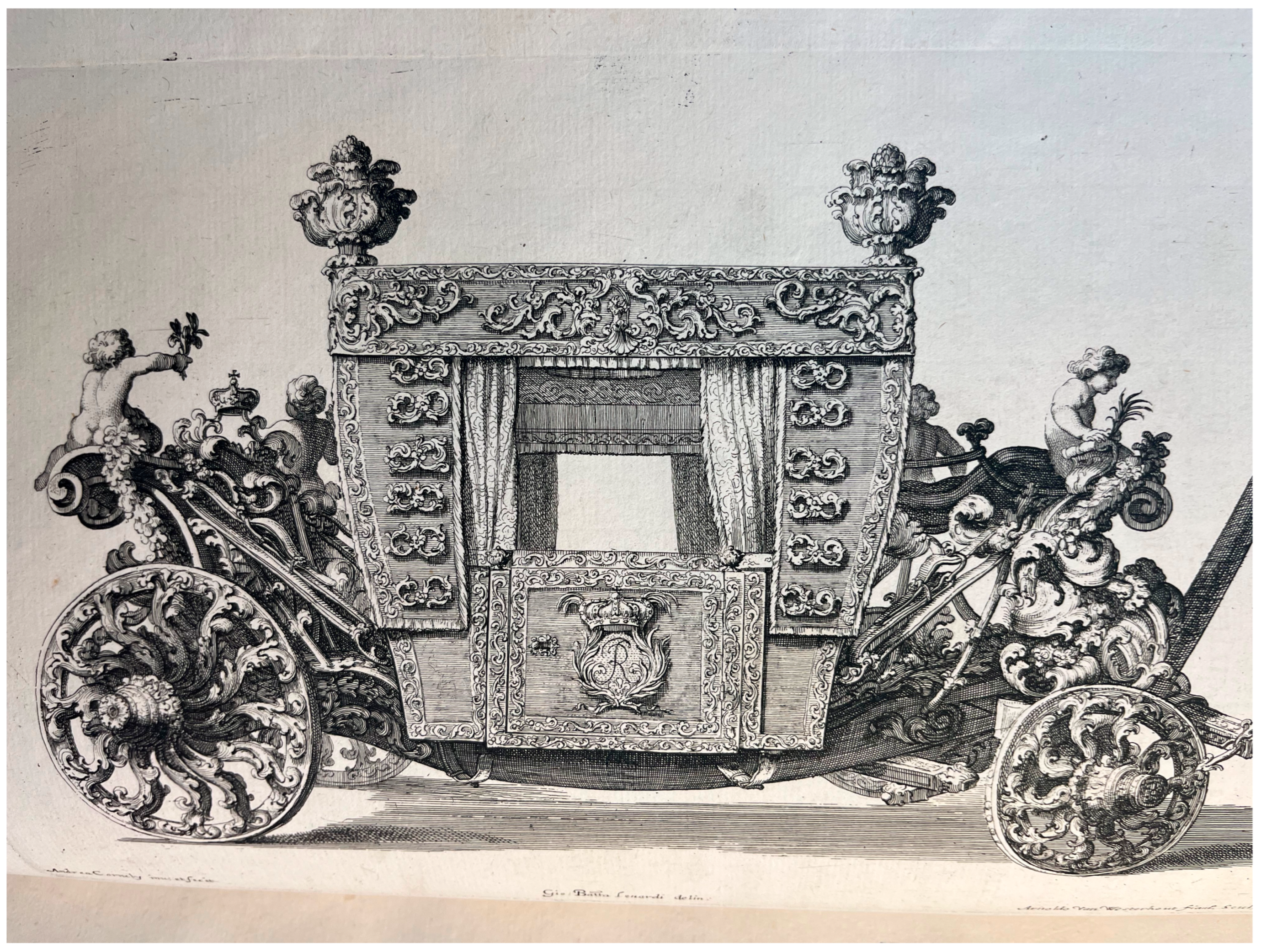
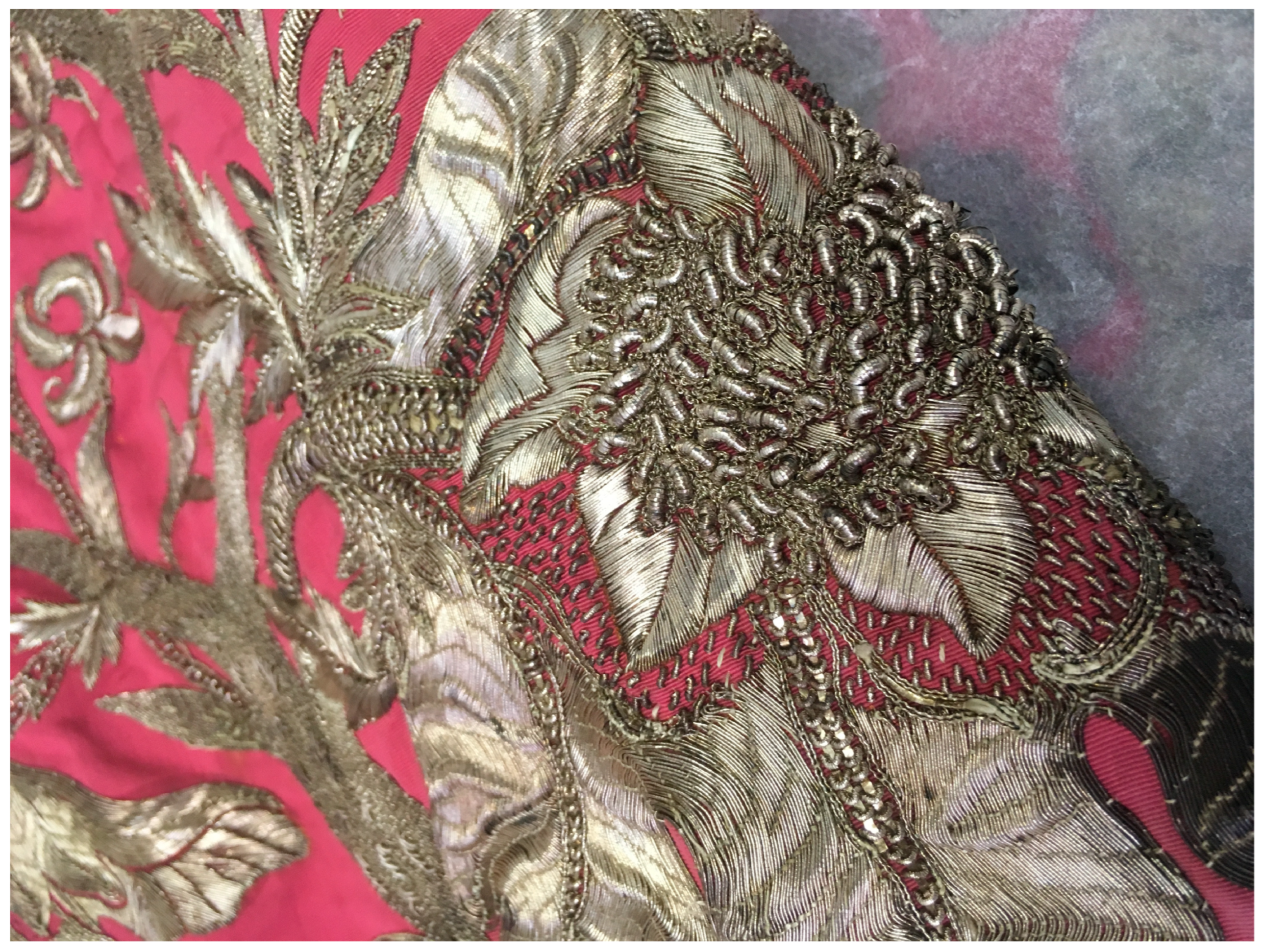
Nobles sought to restrict the use of silver to themselves—along with gold and other prized materials—through sumptuary laws to mark themselves as apart from the dross of the lower classes.85 Politically, socially, and spiritually, silver bestowed and conveyed immaculacy and polished sophistication. The silver sword and the silver-tipped cane designated military prowess and political distinction. Silver carriages (Figure 13), mirrors, furniture, chargers, and vast dinner services glittered with social sophistication. The display of silver and glass for the wedding banquet of Chiara Salcedo to the Marchese del Tufo, given by Giovanni Alonso de Salcedo, castellan for the Spanish king, was typical: “the credenze [sideboards] and bottiglieri [where glassware was displayed] were arrayed with the most sumptuous silverware and glassware that made for a nebulous and noble sight”.86 Lamellated silver strips, stretched by wyre drawers, wound round silk threads, produced fragile silver thread, with which highly skilled embroiderers embellished gowns and clad men and women in glittering clothes (Figure 14).87
Figure 13. Silver gilt coach from Giovanni Michele Writ, Ragguaglio solenne comparsa, fatta in Roma gli otto di Gennaio MDCLXXXVII dall’Illustrissimo et Eccellentissimo Signor Conte di Castelmaine Ambasciadore Straordinario della Sacra Real Maestà di Giacomo Secondo Rè d’Inghilterra, Scozia, Francia et Ibernia [...] all’Udienza della Santità di Nostro Signore Papa Innocenzo Undecimo, Roma: Domenico Antonio Ercole [1687]. Photo: © Helen Hills. From the British Library Collection: 603.1.19, n.p.
Arts 15 00099 g013
Figure 14. Pink Mantua petticoat with laminated silver embroidery. V&A. Photo: © Helen Hills.
Arts 15 00099 g014
The Spanish dramatist Leonor de la Cueva y Silva (1611–105) set her play La Firmeza en la ausencia (Absent but Faithful) at a lavish and excessive Neapolitan court in which princes are described as dressed “con recamos de plata” (embroidered with silver) and “toda de fina plata guarnecido” (entirely garnished with fine silver).88 And it must not be forgotten that silver’s trick of looking new and natural depended on the work of a myriad servants behind the scenes in the small hours, polishing and sheening chargers and rings, embroidered bodices and armour, missals and swords.
Elites were made of metals, not simply in terms of wealth and military might, but in terms of how brilliant and entitled they made them look and feel. Upper-class Europeans, emblazoned in lustrous metals and wearing the finest silks like nitid white skin, were then immortalized in oil paint, which outshone other media in its capacity to make surfaces glint and shine.89
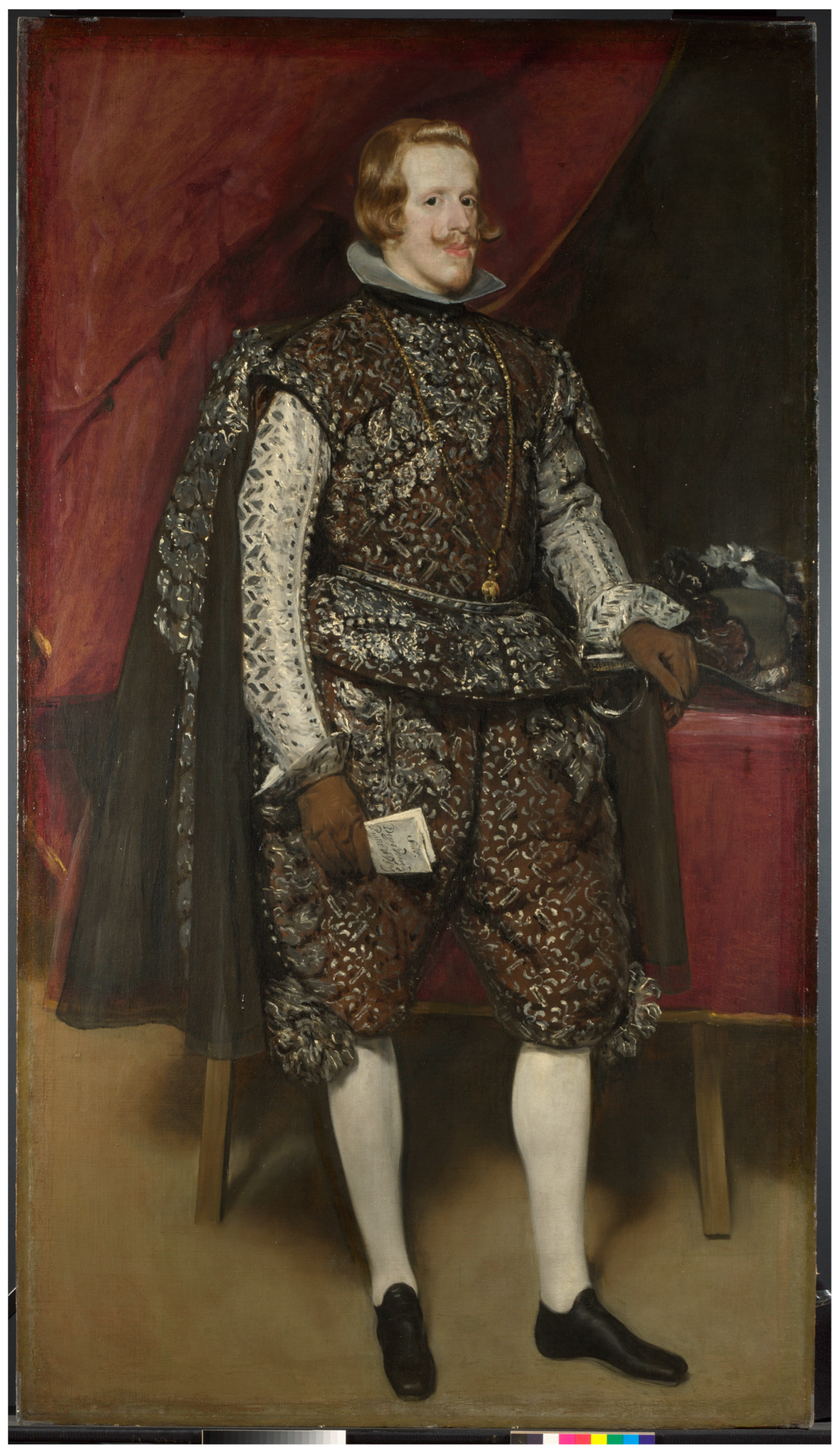
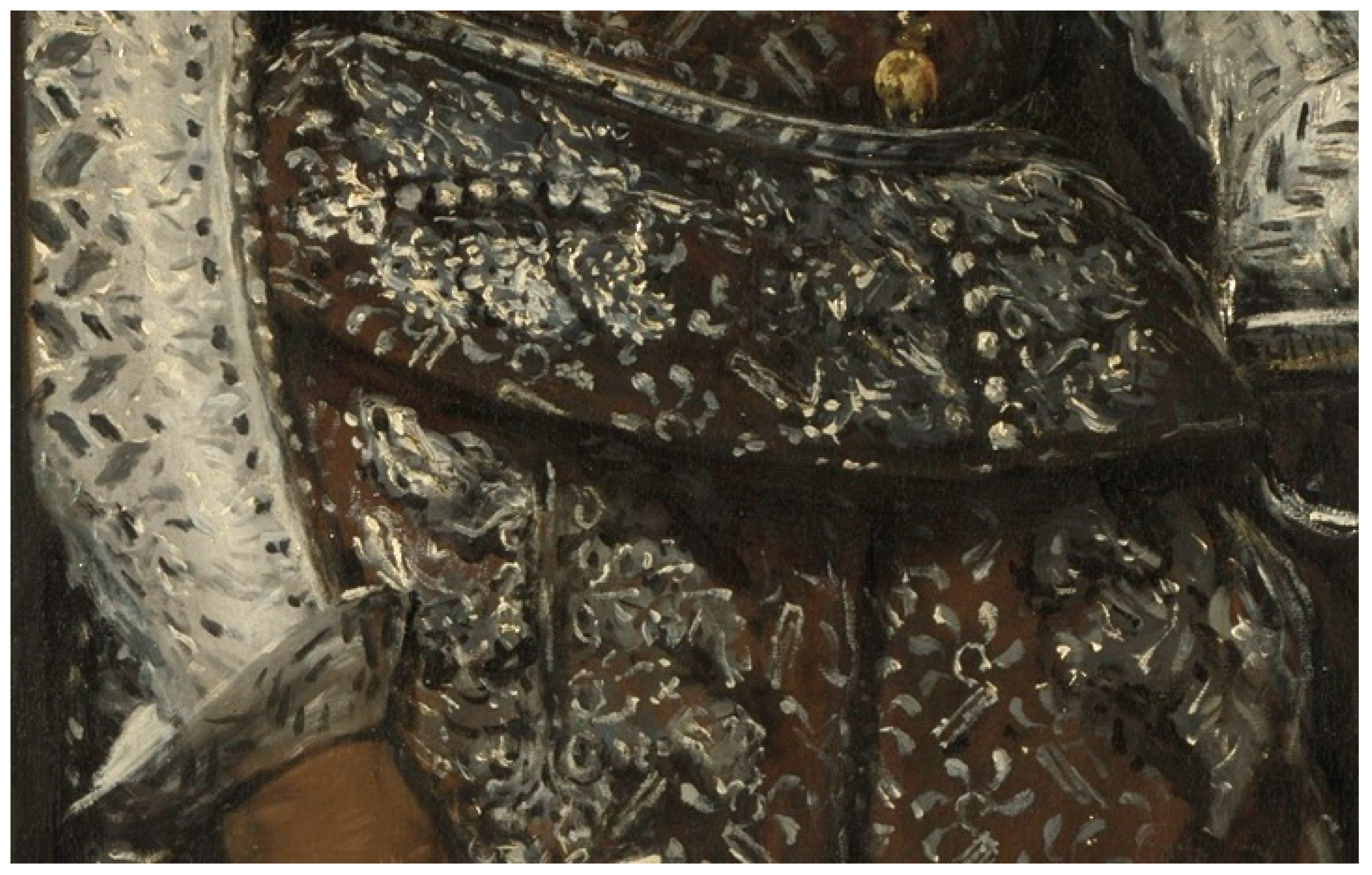
Artists brilliantly exploited silver’s associations with divinity and purity in depicting the powerful. Diego Velázquez’s Philip IV of Spain in Brown and Silver (Figure 15) depicts the king in a glittering outfit, a brown tunic and breeches adorned with silver thread brocade, and a blouse of silvery white and grey. It is an apparel not so much threaded through with New World silver, as utterly Other Worldly.90 He is all glint and glitter—not entirely unlike an Andean god.91 Rather than laboriously tracing intricate silver thread embroidery, the oil paint, in short impastoed flickering strokes, follows the scintillating effects of silver catching the light (Figure 16). The painting delights in the glitter of imperial silver. Silver strokes flicker across the figure and flash beyond the mesh of fabric and the rosette’s edge, at once enmeshed in and yet airily detached from the royal body. The king’s arms and legs are clad in fine pale fabrics, a rich silver blouse and white silk stockings. Clinging tightly to his limbs, that silvery whiteness codes it as white and pure, quintessentially “Spanish”, even while it is shaped by coloniality, politically, economically, and aesthetically.92 Yet the standard scholarship on this portrait of Philip IV barely mentions the Spanish empire and refers to silver as if it were a neutral material, somehow automatically available at court.93
Figure 15. Diego Velázquez, Philip IV of Spain in Brown and Silver, ca. 1631–2, oil on canvas (195 × 110 cm). National Gallery, NG1129 © The National Gallery, London.
Arts 15 00099 g015
Court society—tightly allied to the Church—was not simply a beneficiary of imperial power, but its motor and its refractor, instrument of conversion and transformation, its own purification machine, transforming filthy lucre into righteous privilege.94 The Spanish court, at the heart of the new centralized and absolutist monarchy, along with its dependent viceregal courts in Lima, Mexico city, and Naples, produced rank as legitimate order; a crucible, which transformed material resources into socio-political command; a place where groups competed to display their elegance and refinement and where the transcendental value of art ennobled and naturalized distinction. The portrait of Philip IV is a dazzling instantiation of this process. Velázquez converts a material of ruthless colonial exploitation into a thrilling bedazzlement. In its capacity to bring wealth, whiteness, beauty, brightness and shine to bear, silver scintillated and seduced both its viewers and those who wore it. This is what Stephen Greenblatt, in a related context, has dubbed “the production of wonder”, “a calculated rhetorical strategy, the evocation of an aesthetic response in the service of a legitimation process”.95 The silvering produces a utopian figure made possible by colonization and exploitation, a supernatural figure, stripped of the banality and corruption of power.96
Simultaneously, however, the painting calls attention to its own artifice, not so much to “emphasize the distinction between the canvas and the world outside it”, as to trace the ensnarement of radiance, the imbrication of power, representation and fantasy.97 Draw up close, and it all spins apart (Figure 16). The spectacular flash of silver emerges as a tango of faint and heavy brush strokes that permit, even invite, the unravelling of power’s ensnarement, the tracing of silver’s imperial command in a dazzling monarch into mere flecks of white paint. Fantasy and disenchantment, desire and disillusion dance together. The threads of power are shown to be as precarious as they are spell-binding.
Figure 16. Diego Velázquez, Philip IV of Spain in Brown and Silver, ca. 1631–2, oil on canvas (195 × 110 cm). National Gallery, NG1129 Detail. © The National Gallery, London.
Arts 15 00099 g016
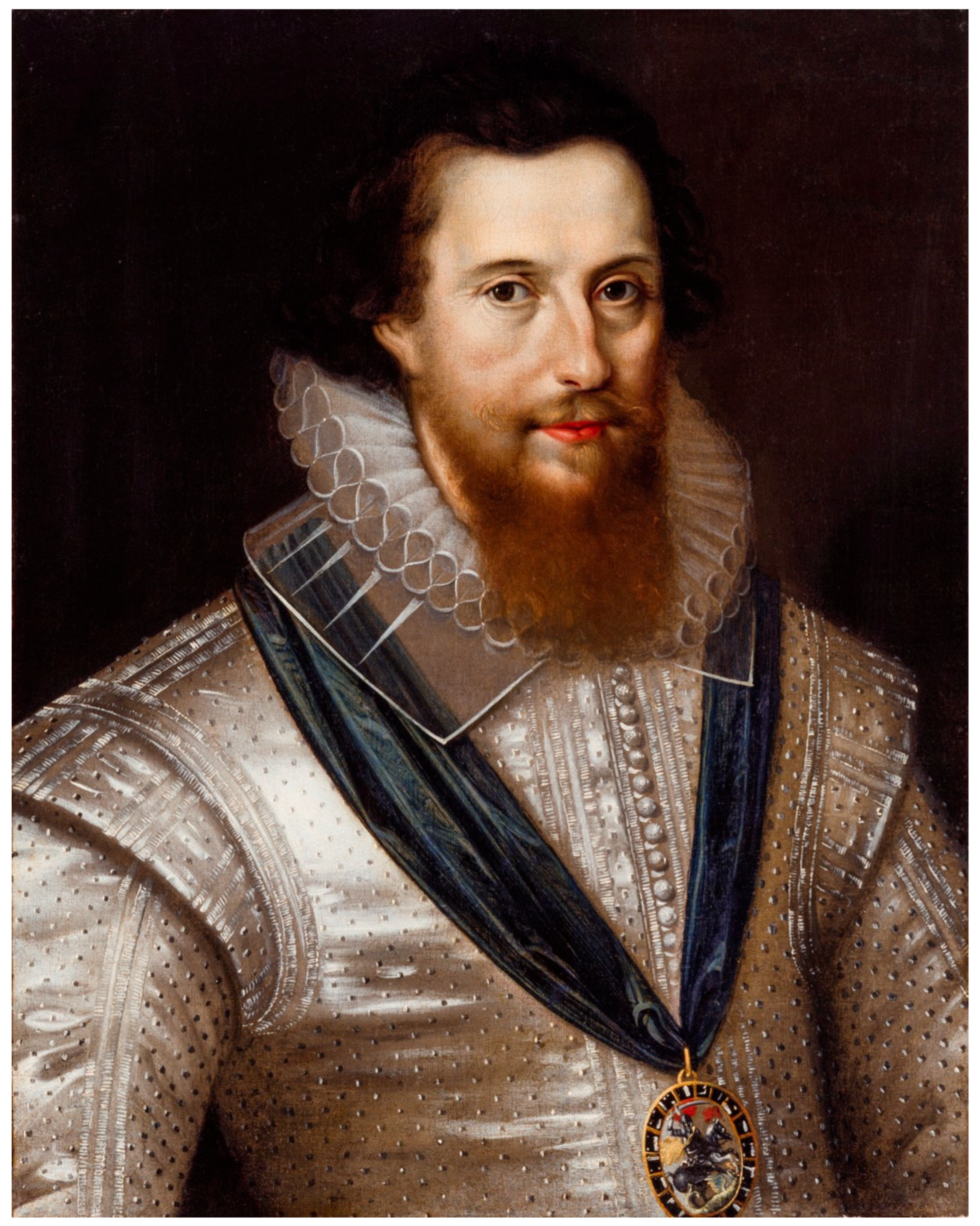
As in Spain, the courts of the emergent imperial power of England gleamed with Andean silver.98 A remarkable early 17th-century portrait by an unknown artist, based on a work of ca.1596, depicts Robert Devereux wearing a silver silk garment, a strange metal carapace, at once soft and seductive, metallic and harsh (Figure 17). Its ethereal sheen evokes Sir Walter Raleigh’s boast:
Figure 17. The gleam of silver. Unknown artist, Robert Devereux, 2nd Earl of Essex (1565–1601), early 17C, after a portrait by Marcus Gheeraerts the Younger. NPG 180. By permission of the National Portrait Gallery.
Arts 15 00099 g017
For that infinite wisdome of GOD, which hath distinguished his Angells by degrees: which hath given greater and less light and beauty, to Heavenly bodies: which hath made differences between beasts and birds […] and among stones, given the faintest tincture to the Ruby, and the quickest light to the Diamond; hath also ordained Kings, Dukes, or Leaders of the people, Magistrates, Judges, and other degrees among men.99
This portrait emphasizes Devereux’s pale skin and silver dress, as if his aristocratic skin were already sheeny silver, as if his silverized costume were at one with such a body.100 Indeed, in Macbeth, Duncan’s virtuous nobility is conjured by reference to his “silver skin”: “Here lay Duncan/His silver skin laced with his golden blood”.101 Such luminosity of skin and dress plays as insight into the body’s interior, its soul. Yet the gleam on his shoulder indicates that the source of the radiance is from the viewer herself—a flattering ensnarement in the illusion of being brilliant.
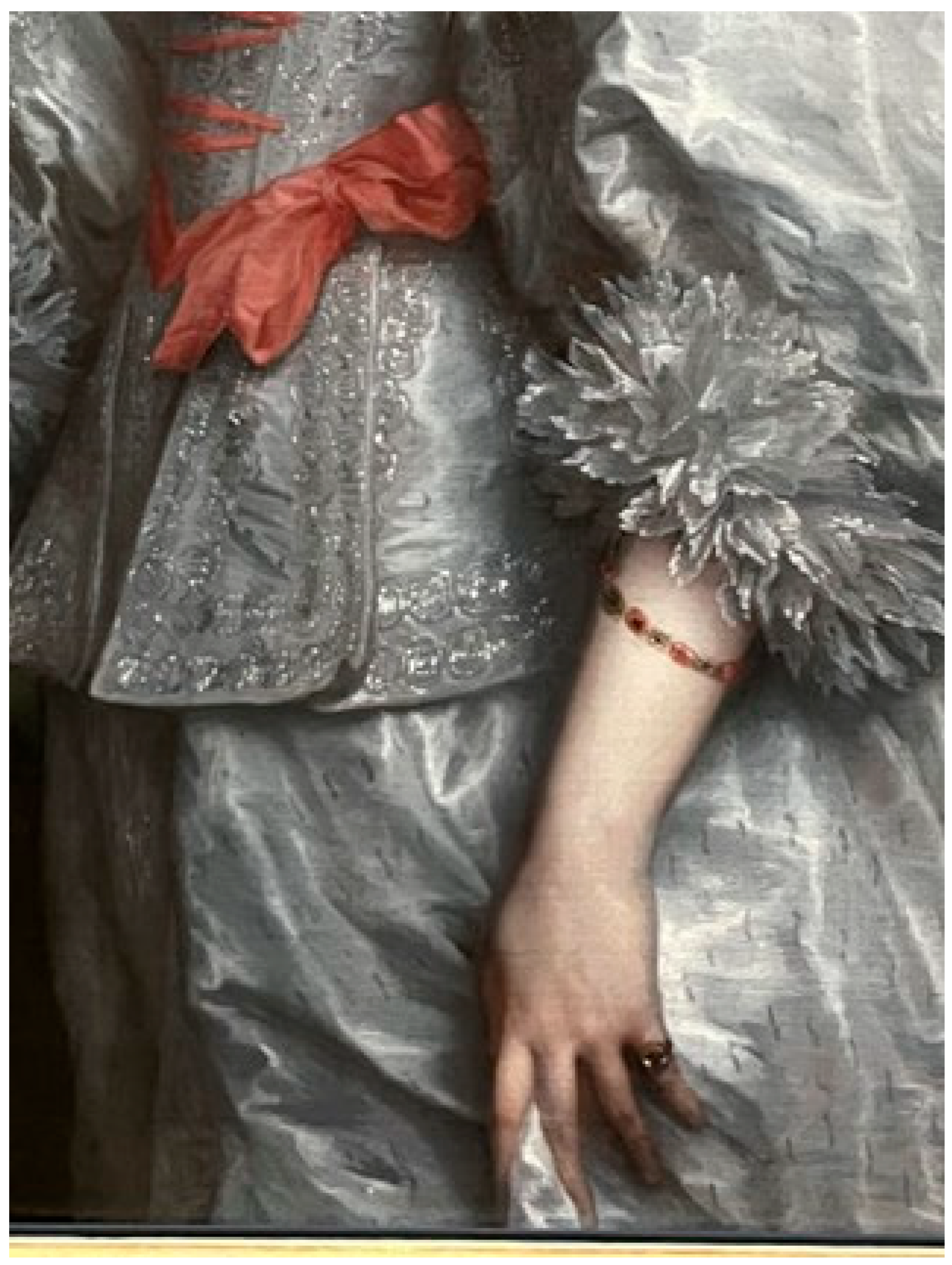
“What Marx understood better than most Marxists”, writes Jason Moore, “is that capitalism ‘works’ because it organizes work as a multispecies process”.102 The work of silver extended to upper-class reproduction. Silvery shimmer set the upper classes apart from those beneath them. Silver thread scintillated in candlelight and caught the eye; extravagant metallic embroidery invited the eye to linger to trace its dancing lines (Figure 14); silvered mirrors flashed exchanged glances. Silver was made for flirting. It suggested purity and virginity103, but played its part in securing dynastic lineage—safeguarding “purity of blood”—by justifying looking, being looked at, enticing and seducing, in its improvident confusion of wealth and beauty (Figure 18).104 In Tirso da Molino’s play El Burlador de Sevilla (the Playboy of Seville), set in Naples and written between 1616 and 1625, when the rich and noble Don Juan wants to seduce Aminta, the daughter of a poor small farmer, he swears that he will marry her and promises: “Tomorrow on your beautiful feet, you will put on shoe ornaments of polished silver”.105
Figure 18. Anthony Van Dyck, Portrait of Queen Henrietta Maria, 1632. Detail showing silver thread and white silk gown with elaborate flickering cuff. Photo by Helen Hills. © Royal Collection Enterprises Limited 2026 | Royal Collection Trust.
Arts 15 00099 g018

7. Silver in Viceregal Sicily: Melting into Obeisance

Finally, I turn to the deployment of silver in festival apparati—in effect, temporary public installations—created to celebrate Spanish rule in southern Italy, part of the display of sovereignty and sovereignty as display.106 To date, scholarship has treated such festival interventions overwhelmingly in terms of baroque style, as if that, rather than the maintenance of their empire, was the Spanish monarchy’s prime concern.107 In fact, internal control and external expansion were two sides of the same coin for the Spanish imperium and command of fortified ports in the Mediterranean remained crucial in the struggle with the Ottoman empire. Here I consider the use of silver in two apparati erected in Palermo to celebrate the victory at the battle of Brihuega in 1710 by Philip V’s forces in the war of Spanish Succession, as illustrated and described in Pietro Vitale’s The Joyful Accord between Palermo, Capital of the Kingdom of Sicily, and Castile, the Royal Capital of the Catholic Monarchy, a lavish publication dedicated to Carlo Spinola Colonna, Viceroy of Sicily.108
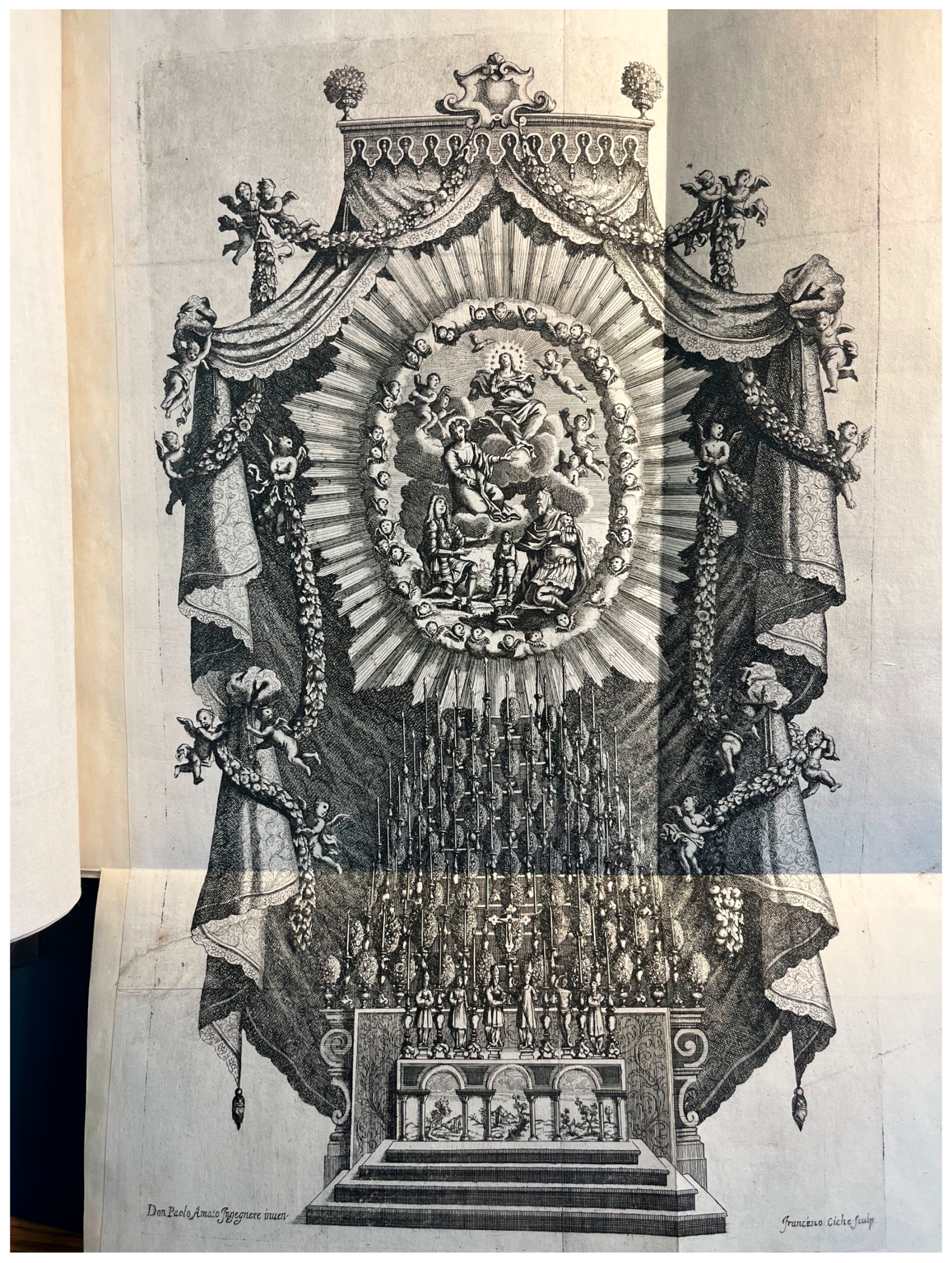
The cathedral’s principal altar displayed a towering apparato combining a dazzling display of candlelight and colourful, sumptuous fabrics with an iconography depicting the relationship between the Spanish monarchy and Palermo as divinely blessed (Figure 19).
Figure 19. Festival apparato for the principal altar in Palermo cathedral (1711) designed by Paolo Amato. Pietro Vitale, Le Simpatie dell’Allegrezza tra Palermo Capo del Regno di Sicilia e la Castiglia Reggia Capitale della Cattolica Monarchia manifestate nella relazione delle massime pompe festive de’ palermitani per la Vittoria ottenuta contro i Collegati sù le Campagne di Prihuega à 11. Dicembre 1710. Palermo: Stamperia del Palazzo Senatorio di Agostino Epiro, 1711. Photo: © Helen Hills. From the British Library Collection: 663.k.19.
Arts 15 00099 g019
Vast crimson velvet hangings, fringed with silver, embroidered with silver harpies and other adornments, set off the scene. A myriad burning candles and flowers in vases, arrayed in stages like a dizzying staircase, led up from the altar. Above this, a radiant medallion, framed by encircled cherubim, appeared suspended, like a huge ostensory. Within this glimpse of heaven, winged putti surround the Virgin of the Immaculate Conception, dressed in silver sendal silk; below her St Rosalia, “dressed in silver velvet the colour of gold”, intercedes on behalf of the genius of Palermo, flanked by the King of Spain, his “armour resplendent” (“arme lucidissime”) and the Prince of Asturias, the heir apparent.109 Glowing and scintillating, the whole improbable creation must have been irresistible, even to those without a grasp of its iconography. However, its iconography made the absent Spanish king and his heir particularly present in asserting their relation to the heavenly—in a distinctly local saintly confabulation. In what might be seen as a form of imitation as a strategy for inclusion, a local saint intercedes not only on behalf of Palermo, as one might expect, but on behalf of the King and heir, thereby localizing the king as much as subjectifying Palermitans and imperializing heaven.
In his text, Vitale insists on the “shared” emotions in Sicily and in Castile, despite their far-flung distance, suggesting that Spanish subjects are as one. This can be seen as part of a strategy of cultural homogenization on the Mediterranean front, where the threat of the Ottoman empire remained acute and against the rise of French power.110 Vitale claims that this apparato moved Palermitans to tears, such that dutiful Spanish subjects, silverised apparati, and burning candles become as one:
I’m not capable of expressing the sweetness that this sight elicited in all of the spectators. [But] I can well attest that the[ir] joy was tender, and distilled certain tears from the[ir] eyes, which glittered in sparks, imitating the multitude of burning candles—candles which surrounded the garland, as if interspersed with vases of flowering plants and graciously disposed along a lofty staircase, and were melting, 400 strong, upon the [already] described High Altar.111
It is in their weeping that Sicilians become true subjects, unified with the apparato celebrating Spain’s military triumph. Their brightly shining tears render them akin to the burning candles liquefying on the steps of the altar, part of the display of monarchy’s might blessed by the divine. Thus, a magnificent spectacle, glittering in silver and candlelight, mounted to celebrate the monarch’s military victory, forges tearful obeisance in its subjects—and on this the empire rests. Vitale conjures an extraordinary image in which all that is solid melts into tears.
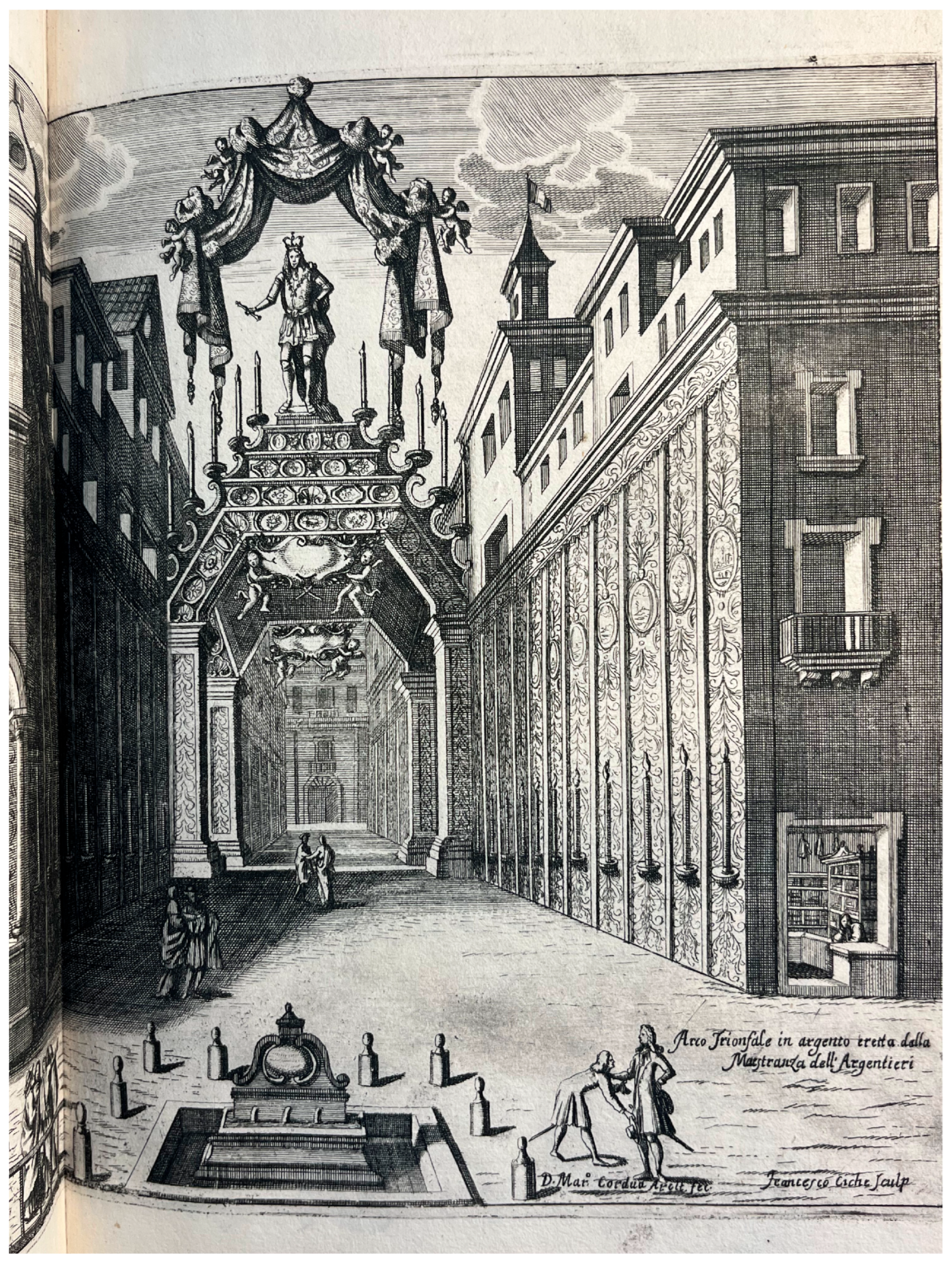
On the same occasion, even more was made of silver in the streets just around the corner near the silversmiths’ workshops and church of San Eligio, where silversmiths erected four fantastical temporary triumphal arches consisting entirely of silver vessels (Figure 20):
Figure 20. Silversmiths’ apparato made of silver vessels. Pietro Vitale, Le Simpatie dell’Allegrezza, Palermo: Stamperia del Palazzo Senatorio di Agostino Epiro, e sorte, 1711. Photo © Helen Hills. From the British Library Collection: 663.k.19.
Arts 15 00099 g020
From the ground to the vault’s apex, all of the arches on all four sides were encrusted with well-arranged silver objects, in an orderly tessellation of bowls, baskets, vases, flower arrangements and other artifacts, which made up and articulated the bases, pilasters, brackets, architrave and cornice; nor was there the tiniest gap revealing how they were joined. At the centre top on a float, where one could see the vault’s keystones, there was placed on a lofty pedestal consisting of smaller silver objects, neatly adorned, the statue in the round [rilevata] of the victorious monarch, for which the fervent hands of the smiths wrought in a few days from the finest hammered silver the whole hauberk, vambraces, boots; and set on his head a gold crown that sparkled with the intermingled rays of the most effulgent gems and diamonds.112
Solid silver, wrested from the earth thousands of miles away in another part of the empire, through the skill of local artisans, was made to shine in celebration of Spanish military power and become the embodiment of the Spanish empire. In these apparati, through local artisanship, silver is beaten into a material that produces subjects. Depredation and destruction that produced the silver and exported it to Sicily are refashioned into a public celebration of the Spanish monarchy in Palermo, capital of Sicily, a European kingdom under Spanish rule, which in turn further justifies the Spanish empire in the Americas.
Affixed to the first arch an epitaph, composed by Nicolò Merendino read:
In honour of Philip V, King of Spain and Sicily, victorious over his enemies, gold- and silver smiths have erected this massive silver structure, in order that the splendour of its silver parts may enhance the gleam of such a triumph and [thus] they show the world that to Philip there is nothing more precious to possess.113
This extravagant structure and sculpture, glinting in the sunshine of occupied Palermo, reaffirmed the presence of the absent king in Sicily, and also showed his subjects what mattered most to him: his empire, the military might that secured it, and silver at its ruthless gleaming heart. The empire legitimated the acquisition of the silver, but it was silver that produced the empire and it was silver that its rulers sought to use to manufacture its subjects.

8. Insatiable Hunger

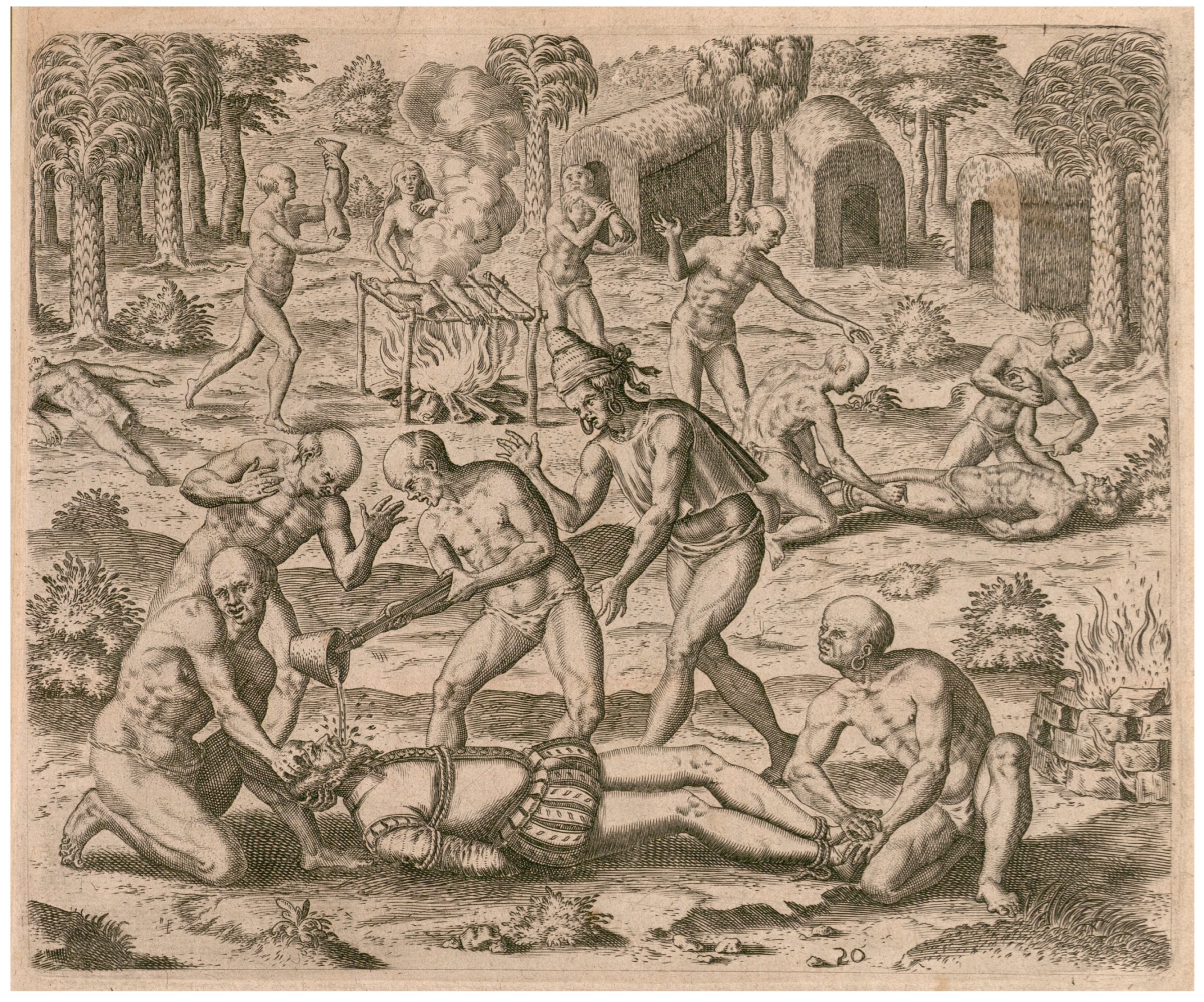
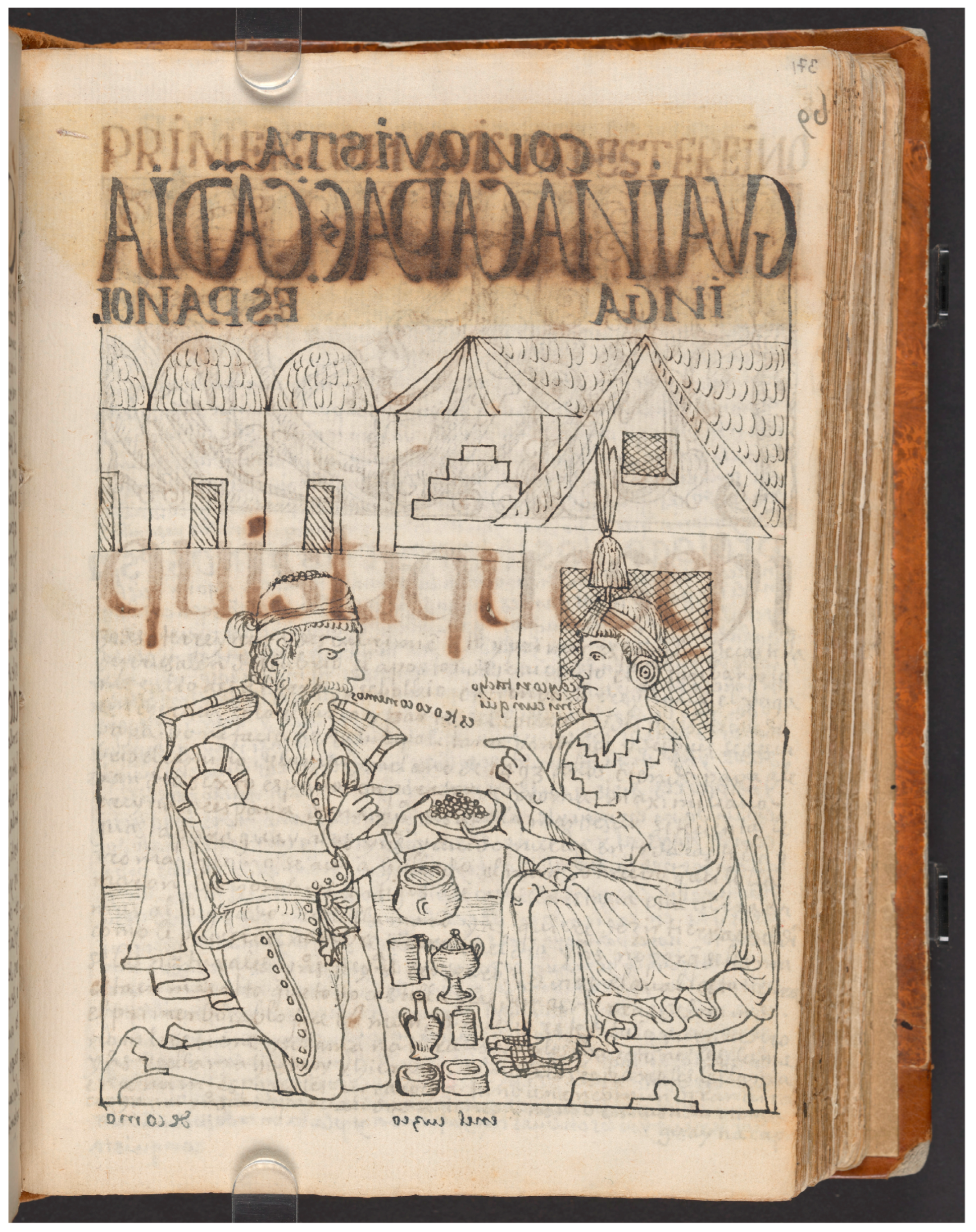
Guaman Poma depicts Europeans’ hunger for gold extending even to eating it (Figure 21).
Figure 21. Guaman Poma de Ayala, “El primer nueva corónica y buen gobierno conpuesto por Don Phelipe Guaman Poma de Ayala, señor y príncipe”, Manuscript. The text reads: “Cay coritacho micunqui? [Es éste el oro que comes?]/Este oro comemos/En el Cuzco” “Is this the gold that you eat?”/We eat this gold/In Cuzco”. Primer nueva corónica y buen gobierno (ca.1615), Royal Danish Library, GSK 2232, f.371v. https://digitalesamlinger.kb.dk/manus/vmanus/2011/dec/ha/object852735/da/ (accessed on 7 November 2025).
Arts 15 00099 g021
Figure 22. Theodor de Bry, “Indians pouring molten gold into the mouths of thirsty Spaniards” (“Indi Hispanis aurum sitienibus, aurum liquefactum infundunt”). Theodor de Bry, Americae Pars Quarta sive, insignis & admiranda historia de reperta primum Occidentalis India à Christophoro Colombo anno M.CCCCXCII. Scripta ab Hieronymo Bezono, Frankfurt: 1594, Figure 20. Photo: ©Helen Hills. From the British Library Collection: G.6628(1).
Arts 15 00099 g022
Inka Huayna Capac asks, “Is this the gold you eat?”; “We eat this gold”, replies the Spaniard.114 Capac offers gold and silver vessels with morsels of gold to the Spaniard to eat and demands that he leave Peru. To Guaman Poma, Europeans were literally devouring America. They had lost sight of what was good not only for others, but for themselves, in valuing silver more than their own souls. Guaman Poma describes the derangement of the Spanish conquistadores in their greed for silver and gold: “every day they did nothing but think about the gold and silver and riches of the Peruvian Indies”, he writes:
They were like desperate men, foolish, crazy, their judgement lost with the greed for gold and silver. Even worse are those of this generation, the Spaniards, corregidores, priests, encomenderos. With [their] greed of gold and silver they are going to hell.115
In showing the Spanish as eaters of gold, Guaman Poma inverted the notion, conjured by Theodor de Bry and others, that Indigenous people force-fed the colonisers with precious metals (Figure 22).
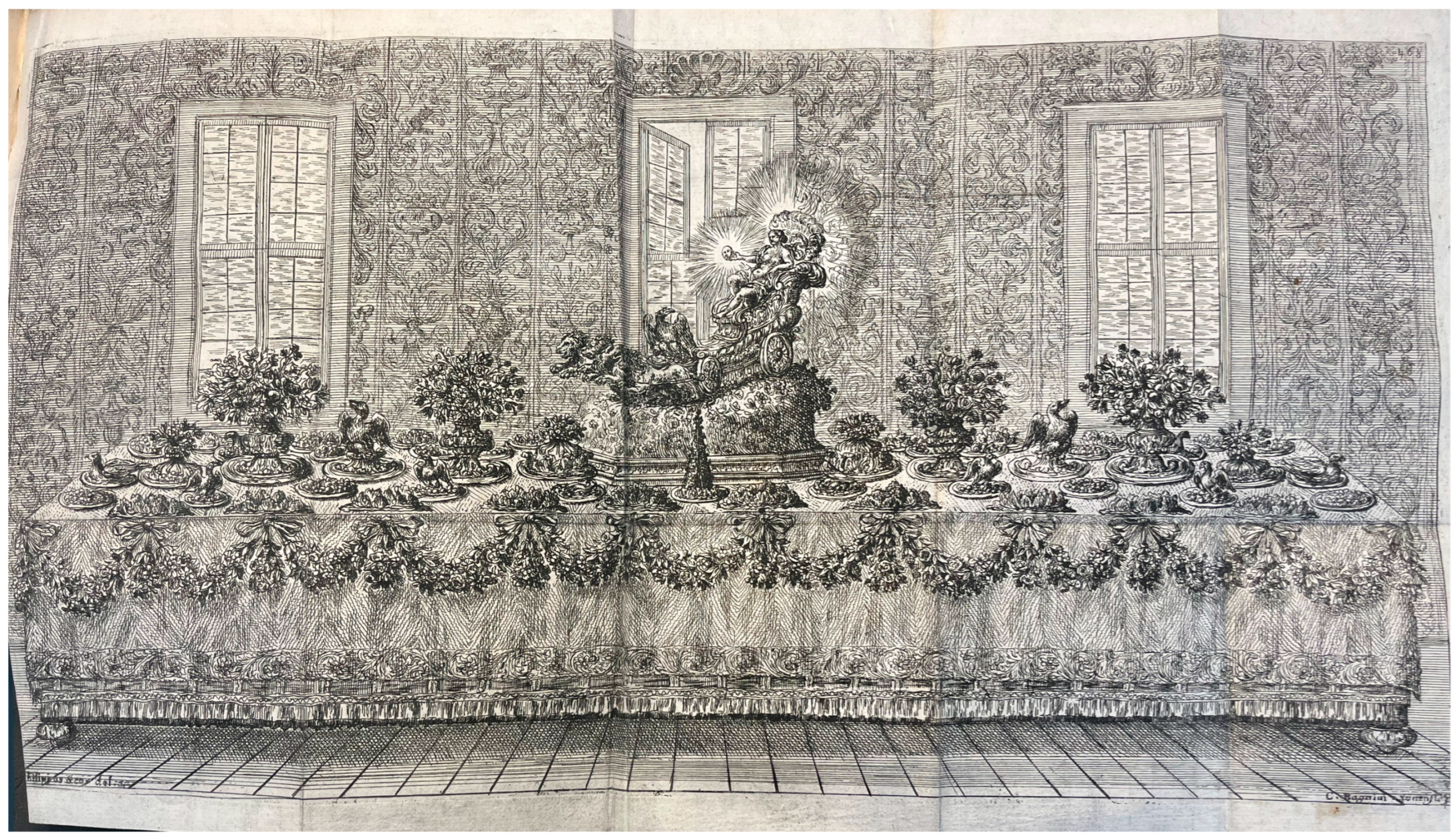
And yet Europeans really did devour the empire and gold and silver. At “royal” banquets, elaborate silver dishes displayed allegorical “triumphs”, edible sculptures of moralizing and mythical figures and scenes (Figure 23).116
Figure 23. Antonio Latini, ‘Banchetto Fatto nella Torre del Greco alla Massaria dell’Illustriss. Sig. Reggente mio Sig. e Padrone D. Stefano Carrillo, y Salcedo Decano del Supremo Collateral Consegnio di Sua Maestà Cattolica, nel Regno di Napoli, e Primo Ministro, in occasione che vi si trasferì il Sig. Marchese del Carpio, D. Gasparo De Aro [sic] Gusman allora Vicerè, e Capitan Generale nel Regno di Napoli’. Lo Scalco alla moderna overo l’Arte di be disporre li Conviti, con le regole più scelte di Scalcheria, insegnate, e poste in prattica, à beneficio de’Professori, ed altri Studiosi […] con un facile modo di far Profumi, in diverase maniere, Aceti odorosi, e Salutiferi, di conservare ogni Sorte di frutti per tutto l’Anno, di fare vaghi, e nobili Trionfi, di bene imbandire le Tavole, di conoscere i gradi qualitatuvi d’ogni sorte d’Animale comestibile, Napoli: Dom. Ant. Parrino, e Michele Luigi Mutii, Naples, 1694. Photo © Helen Hills. From the British Library Collection: 1570/435, p.488.
Arts 15 00099 g023
Antonio Latini in Lo Scalco moderno (Naples, 1694) recommends a glittering confection of empire in the central position:
in the middle of the Table, you might make a Triumph entirely out of sugar, [limned] in gold and representing Justice, Piety and Courage, each posed in such guise as with one hand she may [contribute to] hold[ing] aloft a large silvered Eagle, and on the said Triumph’s pedestal the following words could be imprinted in gold letters: Thus may the Imperial Eagle Soar above the Sun’s Tracks.117
He dwells on a voluptuous “triumph” allegorizing America:
America, in the guise of [a] most beautiful naked young woman, but decently draped, with golden hair and ropes of pearls and coral circling her arms, her thighs, her bosom, holding in her right hand a fan made from peacock feathers and in her left a rich Fleece, riding an Elephant [saddled] with a delightful tapestry and [seated] behind numerous gold and silver vases filled with gold coins, some standing and some toppled, with some parrots nearby.118
Such spectacular dishes, including those inflected with visual references to America, were frequently flecked with silver and gold. “An Indian cock [turkey] in the form of a Phoenix burning on flaming Cinnamon tinder [ignited] by the sun’s rays, with touches of gold and silver,” writes Antonio Latini in Naples in 1694, describing a banquet “triumph”.119
It is as if the reality of the “New World” was so overwhelming that it had to be reduced to something small, entertaining, and consumable. Hence, a talented chef crafted from comestibles a seductive allegorical figure of America, dematerializing its people and distilling an entire continent into a titillating admixture of naked female nubility, exotic beasts, and the precious treasures that rich Europeans coveted, while whole confections were sprinkled with flecks of silver and gold. As the diners, draped in fabulous costumes of silver thread, devoured the Continent and swallowed its silver, they doubtless felt glitteringly witty, flattered, and feted, even as they internalized colonialism and literalized their own limitless greed.

9. Conclusions

Art historical analysis can and should reach beyond its wont of merely conjugating colonial history and the isolated study of fine objects. The colonial is tangible and visible as this vast array of things made with silver and through the darting properties of silver informing a spectacular proliferation of instruments of political, social, and religious thought, imagination, and power. Courtly culture’s excess circulated around the adoration of silver, shimmering in theology and glittering violence. Upper-class cultural artefacts were not simply the end point of precious materials transported across the Atlantic, but one of the means that justified and demanded empire, produced its powerful supporters, exploited and annihilated peoples, and degraded the environment, mostly far away and out of sight. That same high-end culture produced the distinction that justified social elites by elevating them above those below (including in terms of sensibility, beauty, spirituality, polish) that licensed them to lord it over others. The visual culture of silver worked to justify the Spanish empire on both sides of the Atlantic while simultaneously legitimizing the human and environmental exploitation and destruction which produced that empire and the elites who benefited from it, even while it worked to distance those elites from that devastation. In short, silver performed multiple miracles as it turned dross into sparkle, culpability into credit, and filthy lucre into fabulous lustre.
Their silverised virtue worked to distance upper-class Europeans from their complicity in the brutal circumstances which produced it. It bestowed on them a resplendent respectability that enabled disavowal of their dependence on Indigenous technologies, expertise, and labour, and the concomitant environmental and political mayhem through the very material that caused it.120 This was not simply a denial of the entanglement of nature and culture, but a crucial aspect of how elite culture works to distantiate itself from the very violence, exploitation, and misery on which it depends, not only erasing signs of its dependence on colonial brutality and degradation of peoples and places, but deploying the very material that was instrumental in that degradation as sign of superiority and divine approval and as instrument to further subjugate peoples and to celebrate the forging of new subjects. Despoliation becomes dazzle and turns the world upside down.
Elite Europeans were in thrall to silver and relished its capacity to make themselves shine. But the ostentatious saturation of their lives in precious metal—reading silver psalters, sleeping in silver beds, eating off silver dishes, wearing silver clothes, dining on silver trimmings, and shitting in silver chamber pots—perhaps suggests less self-confidence and assurance of redemption than anxious assertion of their own worthiness. One might detect in the insistence on formulaic elegant postures and silvery dress of their portraits the repetition and fixity that Homi Bhabha identifies as the colonizer’s means of dealing with deep-seated anxieties inherent in the colonial relationship: “colonial discourse vacillates between what is always ‘in place’, already known and something that must be anxiously repeated.”121 This can be read in terms of both the colonial and class relations overseas and at home.
While it is tempting to think that the reiteration of shininess in the lives and portraits of aristocrats and monarchs to evoke their supposed nobility, purity, and virtue might betray an uneasy awareness that they were less close to these virtues or to God than they hoped, sadly, it more surely indicates the sheer arrogance of power. Such hubristic insistence on their own brilliance and shine exposes the superficial, transmutable, and precarious nature of power. Despite all the wealth pouring in from the New World, Spain was drained by decades of warfare in sustaining its colonialist ambitions.122 Its economic catastrophes included rampant inflation, escalating debts, and multiple bankruptcies. Unceasing intrigue combined with constant dynastic insecurities rendered life at court far from the idyllic existence suggested in the festival apparati.123 The problem of silver is that no matter how pure it may be, or how frequently it is polished, its shiny surface inevitably obnubilates and sullies into tarnish. Yet while the Spanish empire collapsed, the advance of silver fed the titanic roar of capitalism, which grows ever louder and gathers triumphant pace.

10. Reflectionss

In an era of intensifying environmental destruction accompanied by denial of climate break-down; at a time of rampant neo-colonialism when Israeli-US forces gratuitously bomb the sovereign nation of Iran; when Israeli genocide of Palestinians is live streamed by mobile phone, independently acknowledged, widely condemned, and yet openly supported by powerful nations including the USA and the UK; and when the blood of those murdered by the SAF and the RSF in El-Fashur in Sudan is visible from satellites in space, it might seem that it is time for a new kind of art history.124 An art history on the barricades, as it were. Or at least, an art history focused on present atrocities, ecocide, genocide, neo-colonialism, and their intimate inter-relationship.125
Indeed, current art history’s engagement with ecology, understood as environmentalism, tends to focus on contemporary art and on art that addresses such issues directly.126 The material ecology of early modern silver might seem entirely irrelevant to such pressing concerns. However, early modern silver’s threading of environmental destruction, colonialism, genocide, and coloniality to high culture makes it particularly pertinent to this Special Issue.127 Likewise, on the face of it, art history’s embroilment in the production of hierarchies of cultures, cultural capital, and canonical art at the expense of subaltern cultures of all kinds might seem to limit its capacity to undertake such work, but paradoxically, its very implication endows it with great potential to do so.128
One form of opposition to the greed and destruction of neocolonialism today is to consider the greed and destruction of colonialism of another era and the complicity in and benefit from it that would not have recognized itself as such, the better to understand the role of high-end culture in the widespread capacity to turn a blind eye and look the other way which allows the tide of current atrocities. In this regard, the cultural implications of Spain’s colonialism within early modern Europe—a colonialism that remains largely ignored by scholars—merit urgent consideration. This requires an approach that seeks to counter the still widespread tendency in art history—particularly in the fields of Renaissance and early modern European art—to identify more or less uncritically with those in power and with their artists who so brilliantly celebrated their glittering spoils.129
At a time of brazen new imperialisms, when “truth” has come to mean its opposite, when images are routinely used to justify sweeping lies, when US lives are treated -- even by educated liberals -- as necessarily more valuable than others, when disregard for difference and contempt for limits go hand in hand, a renewed scrupulous attention to point of view, to historical contingency, visual particularity, and formal specificity, and their complex inter-relationships becomes at once urgently necessary and a (limited) form of resistance.

Funding

This research received no external funding.

Institutional Review Board Statement

Not applicable.

Informed Consent Statement

Not applicable.

Data Availability Statement

No new data were created or analyzed in this study. Data sharing is not available.

Acknowledgments

My thanks to Claire Farago for the invitation. I am indebted to Mary Pardo for her rendering baroque Italian into exquisite translations (any infelicities or errors are mine) and to Griselda Pollock for her brilliant and inspirational reflections on this project. Dana Leibsohn generously made time in a busy schedule to offer encouraging comments on an early draft. Kris Lane unfailingly helped with all kinds of information. I gratefully acknowledge a Leverhulme Research Fellowship for research in Peru and Bolivia 2018–2019 and a British Academy Conference Award (2020) for an interdisciplinary conference on silver “The Matter of Silver: Substance, Surface, Shimmer, Trauma”, both of which in different ways paved the way for this article.

Conflicts of Interest

The author declares no conflict of interest.

Notes

1
“Quali corpi sō quelgi che avrā lustro e nō parte luminosa? Li corpi opachi densi con dēsa superfitie son quelgli che ànno tutto il lustro in tanti lochi della parte alluminata quāti sono li siti che possino ricievere l’angolo della incidentia del lume e dell’occhio; ma perchè tale superfitie spechia tutte le cose circustāti, la alluminata nō si conoscie in tal parte del corpo alluminato.” Section 111, excerpted from Codex Atlanticus 676 (ex-250ra), c. 1490. (Richter [1883] 1970).
2
3
Although officially, a “Spanish empire” did not exist (the only legally recognized empire in this era was the Holy Roman Empire), the Monarquía Hispánica (Spanish monarchy) operated as one. Universalism was one of the key elements of its identity: Juan de Solórzano repeated in Política indiana (Madrid, 1647) that the prophecies announcing that the “kingdom would be one everywhere in the world and that remote peoples and their gold and silver would be brought in its service” were fulfilled in the Spanish monarchs (Cañeque 2004, p. 10). For the strategic significance of the Mediterranean and hence Sicily in the conflict from the 1520s between the Spanish and Ottoman empires, in which both sides aimed at control of as many fortified ports as possible, see Greene (2007).
4
I use the term “ecology” in its broadest sense to embrace environmental considerations and also cultural habitus, drawing on the derivation of the term “ecology” from the Greek “οἶκος”, meaning dwelling place, house, household, and encompassing building, extended family, slaves, and lineage.
5
Art history has engaged far more energetically with colonialism of the 19C than with early modern colonialism, and hardly at all with intra-European early modern colonialism. Early discussion of art history’s implication in early modern colonialism includes (Farago 1995b). Insightful scholarship on Spanish colonialism and early modern art includes (Hamann 2010). Little scholarship engages with art’s relationship to early modern colonialism within Europe, but on the relationships between colonialism and the poor in Netherlandish art, see (Hochstrasser 2007); for Spanish colonialism in the Kingdom and city of Naples and its interrelationships with religious devotion, art, and architecture, see Hills (2016); and on silver in this relationship, pp. 447–78.
6
The Notebooks of Leonardo da Vinci, III, “Six Books on Light and Shade”, sections 134 and 135. On Leonardo’s working knowledge of silver, see (Radke 2012).
7
8
This disjunctive hiatus betrays a pervasive art historical politics of identification with European elites. Visual culture requires careful analysis in relation to the complex currents of Spanish monarchical dominion and empire, what Enrique Dussel calls “geopolitics of knowledge”, and what Frantz Fanon and Gloria Anzaldúa term “body politics of knowledge.” (Dussel 1977; Fanon 1967; Anzaldúa 1987).
9
The multiple stages of the mining process—extraction, refining, shipping, along with iron and steel tools, food, leather, candlewax, and fodder for draft animals in mines—inserted into the Spanish -American countryside fundamental tenets of the capitalist canon: wage labour, competition and the market, entrepreneurial risk as justifying massive profits and an amoral economy. See (Stein and Stein 2000, p. 23).
10
They ignore Marx’s critique of commodity fetishism and analysis of capital that makes explicit the co-implication of the economic and the political, which shows that neither political power nor the commodity’s value is the property of an innate substance, but is rather the effect of illusory and fetishistic metaphysical mediations. K. Marx, “The Transition of Mondey into Capital”, Capital. For attribution of the exquisite fashioning of silver in European court circles to “taste” and virtuosity rather than deciphering its implication in the generation of elite social classes, see, for instance, (Catello and Catello 1992).
11
On Caribbean pearls and their enmeshment in the Spanish and English empires in particular, see (Warsh 2018). On emeralds, see (Lane 2021; Vélez-Posada 2024). On the genesis and benefits of emeralds and their interplay with light, see (Bol 2019).
12
For instance, the magnificent silver galleries in the V&A Museum in London display a small diagram showing mining techniques in Latin America, thereby disingenuously presenting silver’s intimate relationship with colonialism as merely a technical matter.
13
14
The relationship between painting, extractivism, and 19thC colonialism is explored in O’Rourke (2025).
15
Indeed, hyper-specialization and research siloing are by-products of these modalities. Across the humanities, especially in art history, shoe-horning the particular into “the broader context” serves hegemonic views. For a useful critique, see (Didi-Huberman 2003). For New Historicist attempts to use particularity not to epitomise epochal truths, but to undermine them, see (Gallagher and Greenblatt 1972).
16
The silver peso minted in the New World was the base of prices and exchange rates from Livorno to Surat, Macao to Cadiz. (Irirgoin 2018). On the magic of money, see (Marx 1976, p. 187). On silver coins, see (Peterson 2013). For the argument that early silver colonialism was characterised by tributary culture rather than capitalism, see Wolf (1997).
17
The rise in capitalism after 1450 “marked a turning point in the history of humanity’s relation with the rest of nature”. Moore, “Cheap Nature”, p. 96.
18
Moore (2015). The notion that “humanity” is responsible for environmental degradation and climate change obscures its disproportionate cause by rich and “developed” countries and forms part of environmental colonialism. See (Agarwal and Narain 1991).
19
For example, the huyrachina method of smelting silver drew together Andean ontologies and metallurgical processes. Pointing out that the term survived in colonialism in the shortened “guayra”, Bigelow suggests that the endurance of the technology carried with it aspects of that ontology. (Bigelow 2016a). The old nature/culture binary tended to subsume Indigenous knowledge into “nature”, belying its appropriation by the colonisers. For one of many challenges to this: (Platt and Quisbert 2008).
20
For the argument that the Spanish Empire was nothing but a network of power and credit that sustained the universal aspirations of the Crown, less an occupation than a network of economic interests, see (Kamen 2013). There were, however, intense debates about its legitimacy. At issue in debates over the conquest of the Americas was not the Castilian crown’s sovereignty, but the nature of the rights, especially property rights (dominium), which that sovereignty entailed. For theologians, the conquest of America could only be made legitimate by showing that native populations had forfeited rights by their own actions. And this had to be done without jeopardising the claim that all rights were the products of God’s laws and not God’s grace (since that would mean that if a prince fell from grace, he might legitimately be deposed by his subjects or another godly ruler). The Spanish Dominican Francisco de Vitoria argued that ius gentium meant that Spain had the right to the seas, shores and harbours (ius communicandi) because they were exempt from the original division of property, along with the right to travel (ius peregrinandi) and the right to trade (communicatio). They also had the right to preach their religion (ius predicandi), which permitted them to wage a just war against tyranny in defence of the innocent. The Spanish could enforce their rights if opposed, because attempts to deprive a man of natural rights constitute an injury. Hence, ultimately, it was only by means of war that the Spaniards could legitimate their presence in America. Most Thomists rejected claims that the “Indians” were not the rightful owners of the gold and silver mined on their lands. For internal debates within Spain over the treatment of New World Natives and the moral and ethical challenges of the Conquista, see (Casas [1552] 1988, 35; Pagden 1983).
21
For China’s role as a warehouse for silver that circulated the world over, see (Flynn and Giráldez 1995; Godinho 1963).
22
Potosí was well-known to Andeans long before the Spanish conquest. Exploitation probably began after the collapse of the Tiwanaku Empire in 1000 AD and continued, albeit unevenly, throughout the pre-Hispanic period. Potosí was part of a vast sacred space, linked to the ancestors and the cult of the Sun; its summit held a waka (spiritual locus). The mining systems of Potosí, Porco, Oruro and Carabaya were ritualized around shamanic practices, whose gods and cults were never controlled or eradicated entirely by the Spanish (indeed, Andeans chose suicide rather than cede the Spanish control over the silver mines in Chaquí, reports Barba in El arte de los metales 53): (Bouysse-Cassagne 2023), here 1, 96.
23
R. Barragan, “Introduction: The Age of Silver” in (Barragán and Zagalsky 2023, p. 3).
24
Pursuit of silver for financing war drove Castile’s Hacienda (treasury) under the five Hapsburg monarchs between 1517 and 1700. On early modern silver’s relationship to war, see (Stein and Stein 2000). On bullion flow, see (Barrett 1990).
25
See (Hanke 1965; Flynn and Giráldez 1995; Seed 2001; Moore 2010a; Bigelow 2016b). For silver mining in Potosí, see footnotes 22; on Mexican silver, see (Brading 1971).
26
Objects from the Americas incorporated into early modern European collections have received intense scholarly attention, relating them to imperial expansion, “new world sovereignty”, artisanal dexterity, and wealth. See (Keating and Markey 2010). Keating and Markey claim that a large proportion of the objects from South Asia and the Americas that entered 16C Europe were collected by European rulers—the Austrian Habsburgs and the Medici Grand Dukes—who were “not involved in colonization”. This is to take an overly narrow view of both “involvement” and “colonization” and is typical of a dominant vein in art history. For a recent counter view in a different context, see (Holohan 2023).
27
See, for example, (Cañeque 2010; Schreffler 2007). On European “luxury” see, for instance, (Styles 1995). For the unhelpfulness of the terms “luxury” and “exotic” in the early modern world, see (Hamann 2010), here 13.
28
Complexities of power relations analysed by Michel Foucault, Louis Marin, and Stephen Greenblatt, amongst others, still tend to be bypassed in favour of notions of individualistic “self-fashioning” or “display”. See, for instance, (Delbrugge 2015); Jennifer Montagu claims that elaborate silver “basins or plates were designed for display on buffets, symbols of their owners’ wealth rather than objects of utility” (Montagu, Gold, Silver and Bronze, p. 94). The relationship is far richer than simply one of mere “display” of economic wealth (in which case displaying piles of silver ingots would have worked just as well). For a counter view, see Hills (2023).
29
(Mignolo 2005, 6–8). Aníbal Quijano locates coloniality of power as emerging in discussions about whether or not Indians had souls (Quijano 1992). The Spanish empire in America was conducted until the late eighteenth century largely as a Church-State venture. On postcolonial theory and Latin America, see (Seed 1993a; Beverley and Oviedo 1993).
30
The inter-relationships amongst early modern culture, colonialism, and coloniality have been examined far more critically in relation to European written texts than to European visual culture. For a range of positions on the legitimizing ideologies of empire in Spanish writings of all kinds, see (Greenblatt 1991; Adorno 1988; Bentancor 2017).
31
Within the Habsburg monarchy, the conception and imaginary of empire gathered expansionist ambition, from Castile’s move against the Arabs and their own Christian neighbours to become “a constituent of the political cultures of Spain and much of Italy”. Spanish kingdoms were linked by dynastic succession to the Kingdom of Sicily (to which was added the imperial fief of Milan in 1535). Spain thus became part of a wider project for the creation of a European imperium to provide defence against the Ottomans and Protestantism alike. Continuity between ancient and modern imperia was guaranteed and legitimized by the translation of power from Augustus to Constantine to Charles V, via Charlemagne, and by their shared aims. Even after the abdication of Charles V and the separation of the Imperium from the Monarchia, Spain remained the leading candidate for universal empire. Tommaso Campanella and others claimed that it was the Spanish Habsburgs, as heirs of Augustus, whom God had chosen to be the agents for the final unification of the world. The Spanish monarchy was justified in terms of its capacity to provide security for its members. Its failure to do so became the failure of its subjects to be good Catholics. But since the American possessions were legally a part of the Kingdom of Castile, it was the European states within the Spanish monarchy, which were, and would remain until the War of the Spanish Succession (1701–14), the crucial factor in all considerations of what kind of political entity that monarchy was or should be (Pagden 1995, pp. 40–46).
32
“Cultural Europeanization was transformed into an aspiration. It was a way of participating and later to reach the same material benefits and the same power as the Europeans: viz, to conquer nature—in short, for ‘development.’ European culture became a universal cultural model.” A. Quijano, “Coloniality and Modernity/Rationality,” p. 169.
33
Scholars have been reluctant to recognise this. “Spanish dominion” has long been the preferred term, and a series of distinguished historians, including Geoffrey Parker, C. R. Boxer, and Anthony Pagden, have plotted its course. But “Spanish dominion” is a polite way to miss the point that territories were governed by military occupation—the very definition of colonialism—and it was perpetrated within early modern Europe by Spain. Naples was critical to Spanish economic and military power. Heavy taxation was levied upon the kingdom to pay for Spain’s wars, especially after 1580. Naples provided troops to fight in support of Spanish occupation in the Low Countries, contributed significantly to the military costs of Spanish control of the Duchy of Milan, and paid for Spanish garrisons in Tuscany. This cost the kingdom 800,000 ducats annually, or about a third of the kingdom’s revenues; moreover, the public debt also had a military origin, and interest payments on it devoured 40 percent of all tax income. While the soldiers of Naples were under the command of the Spanish viceroy, Neapolitan nobles enjoyed ascendancy in the assemblies and committees that financed and administered the army. For Spanish colonialism in southern Italy, see (Benigno 2012; Benigno 2017); for Spanish colonialism of Naples and the Revolt of Masaniello, see (Benigno 2010). On the cultural and religious complexities of Spanish-ruled Naples, see (Carrió-Invernizzi 2007; Hills 2018).
34
(Cañeque 2004, pp. 185–212).
35
Of all the modern European powers, Spain and Portugal have by far the longest colonial record, stretching from the 14C with the settlement of the Canary Islands to the late 20C decolonization of Angola, Macao, east Timor, and the Spanish Sahara. Within the Habsburg monarchy, the conception and imaginary of empire gathered expansionist ambition, from Castile’s move against the Arabs and their own Christian neighbours to become “a constituent of the political cultures of Spain and much of Italy”. Spanish kingdoms were linked by dynastic succession to the Kingdom of Sicily (to which was added the imperial fief of Milan in 1535). Spain thus became part of a wider project for the creation of a European imperium to provide defence against the Ottomans and Protestantism alike. Continuity between ancient and modern imperia was guaranteed and legitimized by the translation of power from Augustus to Constantine to Charles V, via Charlemagne, and by their shared aims. Even after the abdication of Charles V and the separation of the Imperium from the Monarchia, Spain remained the leading candidate for universal empire. Tommaso Campanella and others claimed that it was the Spanish Habsburgs, as heirs of Augustus, whom God had chosen to be the agents for the final unification of the world. The Spanish monarchy was justified in terms of its capacity to provide security for its members. Its failure to do so became the failure of its subjects to be good Catholics. But since the American possessions were legally a part of the Kingdom of Castile, it was the European states within the Spanish monarchy, which were, and would remain until the War of the Spanish Succession (1701–14), the crucial factor in all considerations of what kind of political entity that monarchy was or should be (Pagden 1995, pp. 40–46).
36
Fuchs claims that referencing the Latin term for empire underscores early modern reliance on that model and that emphasizing the connection between internal sovereignty and external expansion also challenges post-facto views of the inevitability of nations. (Fuchs 2003).
37
At an academic conference in Naples in 2014, I was astonished when local scholars responded with outrage to my suggestion that since colonization can be defined as the military occupation of territory, Spain “colonised” the Kingdom of Naples. “We have never been colonised”; “Do you not know that the Spanish and Neapolitans inter-married?”; “You British are the colonisers!” came indignant cries from across the (usually politely hushed) aula. It was also widely asserted on the basis of no evidence at all that the enormous quantities of silver used by Church and aristocracy in 17C Naples came not from Spanish-occupied Peru, but from mysterious mines “just outside Naples”.
38
While historians have studied Spanish rule in the Kingdom of Naples in relation to court politics, European power struggles, and resistance (see, for instance, Benigno 2017; D’Alessio 2022), on the whole, art history has not grasped its richly complex cultural imbrications and simply continues to refer to “Spanish influence” (Nobile 2022).
39
This is to draw a distinction between an art history that thinks in terms of sustainability and duration and an art history concerned with instability and the momentary, between an art history that offers detailed analysis of supposedly enduring objects in stable contexts, and an art history concerned with partial glimpses and occluded glances in a shifting melting and lop-sided environment, between an art history that seeks to be sustainable and to deliver stable responses to the enduring and an art history that unsteadily seeks to respond to the momentary and the fleeting, the flimsy, and the eclipsed.
40
For discussion of depictions of Potosí, see (Barragán 2025). Invaluable though this study is, it tends to treat images in terms of imputed accuracy, rather than as embedded in power relations.
41
42
On Pedro de Cieza, see (León 1973); for discussion of this print, see (Barragán 2025, pp. 65–66).
43
Julio Aguilar argues that the knowledge and labour of mita workers and maestros were crucial for the construction of the impressive water infrastructure that secured—at over 4000 metres above sea level—a continuous flow of water necessary for ore processing. Water was channelled by canals and aqueducts from reservoirs in the Kari-Kari mountain chain near Potosí. (Aguilar 2023 pp. 175–209).
44
Michel Foucault contended that the theory of absolute monarchy “enables power to be founded in the physical existence of the sovereign, but not in continuous and permanent systems of surveillance”. That is why the authority of the sovereign was based on “spectacular and discontinuous interventions of power, the most violent form of which was the ‘exemplary’ because exceptional, punishment”. (Foucault 1980).
45
The depiction appeared in a compendium of writings on the Spanish Indies, known as Tarih-i Hind-i Garbi, which was reproduced in many versions with various titles. See (Goodrich 1990).
46
The entire text is in three parts. The first is dedicated to the cosmography, topography, and history of the New World. The last part describes the conquest, city, mountain, and river of Plata, based largely on Spanish accounts, particularly Francisco López de Gómara’s Historia de las Indias e Historia de la conquista de México or Crónica de la Nueva España (more than 30 editions between 1552 and 1596), Gonzalo Fernández de Oviedo y Valdés, De la Natura Historica de las Indias (1526), Pedro Martir, De Orbe Novo (1516), and Agustín de Zárate, Historia del Discubrimiento y Conquista del Perú (1555): see R. Barragán, Potosí Global, 70. The part dedicated to Potosí is entirely derived from Zárate (Goodrich 1990, 32).
47
Barbara Mundy & Dana Leibsohn. https://worldhistoryconnected.press.uillinois.edu/9.2/forum_mundy.html#_ednref12 (accessed on 6 April 2024).
48
Spain’s vulnerability to the Ottoman empire was acute, as the Turks’ attacks on Christendom, corsair raids on the Spanish coast and the 1568–71 rebellion of the Moors who remained in Spain after the fall of Granada showed. The Spanish monarchy long feared invasion by an alliance of Moriscos, Ottoman Turks, and North African “Moors”. On the strategy of Ottoman–Habsburg rivalry, see (Ágoston 2007). For discussion of Spanish literature in relation to the Ottoman threat, see (Fuchs 2001, 1–12, 35–38, 56–58). For cultural-religious response to the Islamic threat to Spanish-occupied Naples, see Hills (2016, pp. 199–204).
49
Descripción de la Villa y minas de Potosí—Ano de 1603, 1603, (Jimenez de la Espada 1885), here 114–5.
50
These reforms came not from the metropole but from within the colony, indicating how colonialism assumed life of its own. The extensive system of over 20 reservoirs was created to ensure the continuous supply of water that the patio system of mercury amalgamation required. For the waterworks, see (Gioda et al. 1998, 65–74).
51
Lane, Potosí, 91. Minted coinage was based on enslaved and coerced labour (with some margins).
52
From 1518, Portugal, France, the Netherlands, and England contracted to carry slaves to the American colonies in exchange for money and taxes. The Spanish Crown granted Portugal an asiento over the slave trade until 1640 for 100,000–150,000 ducats for 4000 people annually (“Introduction”, from (Barragán and Zagalsky 2023)). The Spanish Crown rejected mine owners’ pleas to subsidize African slaves. Although Toledo supported slave labour in Greater Peru’s mines, he regarded it as an insufficiently quick solution (Lane 2019, 69).
53
54
For this and Guaman Poma’s engagement with the ecology and geography of the Andes, especially of the Huamanga region where he spent most of his life, see (Cushman 2015), here p. 89.
55
56
Some Indigenous mita captains, responsible for rounding up workers from their home districts and mediating with Spanish magistrates and mine owners, became powerful and rich, and purchased enslaved Africans to serve as pages and cooks (Lane 2019, p. 78).
57
These figures come from Toledo’s 1572 census. Work-sharing contracts in Potosí support them. (Lane 2019, 71). Three million Andeans worked in the mines before the mita was abolished in 1819 (Moore 2016, 106).
58
Cieza de León (1883). Europeans were, of course, well aware of the environmental costs of mining. In De re metallica (1556), Georgius Agricola observed that mining initiates a chain of destruction in which felling trees for pitprops destroys animal habitats, while the processes for refining metals contaminate rivers and water supply. (Agricola 1556, pp. 41–42). See also (Studnicki-Gizbert and Schechter 2010).
59
(Lane 2019, 77).
60
Both here and in his El primer nueva corónica y buen gobierno, a new chronicle of Andean history and a treatise on good government or governmental reform for the Peruvian viceroyalty, addressed to King Philip III, Guaman Poma skilfully deployed Europeanising images, 16C Spanish traditions of history writing, and aspects of imperial ideologies, together with Andean conventions of representation as a mode of resistance, to present himself as an honorary Spaniard and a heterogenous subject of empire, thereby defying the scripting of the imperial subject in challenging the Crown about colonial abuses. Poma initially worked as an interpreter between Spanish and native peoples and collaborated in early campaigns against native resistance, but by the time he wrote the Nueva corónica, he was utterly disillusioned with the Spanish conquest. Sadly, his letter seems not to have reached its destination, but it remained in an archive in Copenhagen until 1908. (Guaman Poma de Ayala 1980; Baralt 1993; Adorno 2001; Adorno 1986); for Guaman Poma’s work with Martín de Murúa, see (Ossio 2015; Fuchs 2001, 64–98).
61
The “discovery” of the New World shattered the Ancient European notion that the Pillars of Hercules were the westernmost extremity (“nec plus ultra”; “nothing more beyond”) of the inhabitable world. Charles V coined the motto “plus ultra”, which was incorporated into the Spanish monarchy’s arms, to refer to the empire. Charles inherited both the Spanish and the Austrian-Germanic expectations of a universal monarch and was presented as the “Last World Emperor” under whose reign the Jews and pagans would be converted, and whose sovereignty would be followed by the millennium, the thousand-year reign of Christ and the Last Judgment. (Headley 1997).
62
Guaman Poma, “Nueva corónica”, 42–43, (Cushman 2015), here p. 92.
63
I assume the cross hatching is a result of the application of silver leaf.
64
On Guaman Poma de Ayala’s sermonizing, see (Adorno 1986, 74–79). I depart here from Adorno’s claim that “the spatial slot of propriety, the center, is consistently occupied by the Inca in depictions of Inca times, but […] in the colonial era, this slot is emptied of figures of Andean leadership […] filled either by impersonal symbols of the Spanish monarchy, or by human figures representing not the Inca as lord but the Andean as helpless victim”, (Adorno 1986, 93). Here, the Inka and the Andeans occupy the centre and support the Crown, but not as helpless victims.
65
For a rich analysis of this strategy, see (Adorno 1986, esp. pp. 121–39).
66
See (Ossio 2015). Guaman Poma likens his project to that of John the Baptist: “Come el precursor San Juan Bautista traxo los amenazos, azotes y castigos de Dios para que fuésemos enfrenados” (“Like the precursor St John the Baptist [who] brought the threats, calamities and punishments of God in order that humanity be restrained”), (Adorno 1986, 63).
67
(Adorno 1986, 140).
68
On Guaman Poma’s approach to Inca political hierarchy, see (Zuidema 2015).
69
The four subdivisions of the Inca empire were Chinchaysuyu, Antisuyu, Cuntisuyu, and Collasuyu. Guaman Poma commonly characterises the regional group of the Collas as ruthlessly greedy for the riches of the Potosí mines (Adorno 1986, 98), but that does not seem to be the case here.
70
For “vertical archipelago” see (Murra 1972, pp. 429–76).
71
(Moore 2016, 85).
72
Art historian Bissera Pentcheva drew attention to these issues in her brilliant analysis of Byzantine ekphrasis and liturgical texts and the activation of marble and gold in the sixth-century interior of Hagia Sophia through light and sound in worship. (Pentcheva 2017).
73
74
Rape of Lucrece, l.101.
75
See (Cañeque 2004, pp. 31–45).
76
77
(John of the Cross 1983, II.5.6–7).
78
Theophany as an analogy to physical light was considered by many scholars, including St Augustine, Pseudo Dionysius, and John Scottus Eriugena.
79
Panofsky points out that Suger’s lines are dependent on John Scottus Eriugena’s study of works then attributed to Dionysius the Areopagite: “The material lights, both those arranged in nature in the heavenly spaces and those produced on earth by human artifice, are images of intelligible lights, and especially of the true Light itself”: “Materialia lumina, sive quae naturaliter in caelestibus spatiis ordinata sunt, sive quae in terris humano artificio efficiuntur, imagines sunt intelligibilium luminum ac super omnia ipsius verae lucis”; (J. Scotus, Expositione super Ierarchiam caelestem S. Dionysii, P.L 122, col.139). (Panofsky 1946).
80
(Rorem 1993; Smith 2015, 234–35).
81
(Smith 2015, 256–57).
82
See Hills (2016).
83
Gold and silver were known as “noble” because Saturn was unable to vomit them up, the “noblest” of his children. Noble metals supposedly resist tarnish. For the superiority of “noble blood” in southern Italy, including in religious contexts, see (Hills 2004).
84
“L’Oro essere un metallo generato nelle viscere della terra, il più nobile di tutti gli altri; appresso il quale nel secondo luogo l’Argento segue. La cagion della nobiltà loro, al mio giuditio, [tralasciando però le ragioni naturali] da altro non viene, se non che per la virtù loro stanno in ogni cimento di fuoco, & mostrano paragone delle loro perfettioni in esso fuoco; cosa, che non possono fare gli altri metalli Scaruffi ([1582] 1979, 2).
85
Sumptuary laws attest to the voracity for silver to enhance status and to the awareness that elites maintained their position by restricting its use. See (Muzzarelli 2009).
86
“Si apparecchiarono le Credenze, e Bottiglieri tutti di sontuosissimi Argenti, e Cristalli che rendeveano una vaga, e nobil vista ». Twenty-four guests were treated to 12 hot courses. (Latini 1694, p. 570).
87
On the production of silver thread, see (Mascaro 1928; Brenni 1930; Glover 1975; Stewart 1891). On the production of metallic thread ornaments in Spanish Sicily, see (Proto Pisani 2000).
88
Leonor de la Cueva y Silva, like Lope de Vega, Tirso de Molina, and María de Zayas, treats the Neapolitan court as at once an extension of Spain, the epitome of Spain’s glory, but prone to excess and licentiousness. (Gamboa and Marin 2007), here p. 128.
89
While the cultural significance of light has long been recognized by art historians, that of shininess has not. Art history has energetically investigated light, brightness, and whiteness, but shimmer and shine remain relatively ignored, because their instability and discontinuity challenge the habitual practices of art history concerned with the stable and enduring. But see (Maffei and Fisher 2013; Kalas 2002; Anderson 2007). In general, early optics was designed to vindicate what amounted to a worldview, based on an assumption that objective reality truly conformed to the abstract “image” of it in the mind. But this changed when the focus of European optics shifted from sight to light in the 17C. Thitherto optics aimed at explaining not light and its physical manifestations, but sight in all its aspects. Consequently, light theory was regarded as subsidiary to sight theory and actually accommodated in it. The 17C shift in the analytic focus of optics was prompted partly by Johannes Kepler’s theory of retinal imaging (published in 1604), which treated the eye as a mere light-focusing device. The potentially profound transformation of worldview that this entailed tended to remain technical rather than socio-political, however. See (Smith 2015).
90
In Teatro de virtudes políticas que constituyen a un príncipe (Mexico, 1680) Carlos de Sigüenza y Góngora writes, “Princes are not so much vicars of God […] but rather his living image, or an earthly God” (los principes no son tanto vicarios de Dios [..] sino una viviente imagen suya, o Dios terreno”, cited by (Cañeque 2014), here p. 189.
91
While Europeans tended to value mass and solidity in silver and gold, Andean ways of working metals tended to elicit their radiance, capacity for movement, and flicker. (Saunders 1998).
92
In a wishful analogy, Spain cast the conquest of America as a reiteration of the Reconquista of Spanish territory from the Moors, supposedly concluded with the fall of Granada in 1492. Thus Francisco López de Gómara: “The conquest of the Indians began after that of the Moors was completed, so that Spaniards would ever fight the infidels” (López de Gómara [1552] 1932), vol. I, 8. This was part of a strategy to obscure the continuing conflicts between Spain and Muslims, especially the Ottoman Turks, throughout the 16C and 17C, and to construct “Spain” as homogenously Christian and white.
93
For instance, (Brown 1986).
94
The Spanish empire in America was conducted until the late eighteenth century largely as a Church-State venture. Within the Spanish empire was a logic of Christian eschatology, as Tommaso Campanella makes clear: “The name Christophorus should be interpreted to mean ‘he who carries Christ’ and as Columbus, Columba, the Church. And in another place: all the world shall serve you’ [Psalm 71:11]”. (Campanella 1633, 87).
95
(Greenblatt 1991, pp. 73–74).
96
For this idea, see (Greenblatt 1991, 25).
97
For the phrase “to emphasize the distinction between the canvas and the world outside it”, see (Spadaccini and Talens 1997).
98
Fuchs has suggested that despite affirmative statements of national identity, English and Spaniards could easily pass for one another, shifting identities almost seamlessly across the Atlantic world (Fuchs 2002). For the complex relationships between British and Spanish merchants in the 16C and 17C, see (Sheaves 2018). Piratical attacks on Spanish ships and ports were more or less formally authorised by the English crown during the war with Spain (1587–1604) and continued thereafter (sometimes to the travail of the Crown). Between 1575 and 1594, four English expeditions in the Pacific to attack and plunder Spanish galleons were led by John Oxenham (1576), Francis Drake (1577–80), Thomas Cavendish (1586–1588) and Richard Hawkins (1593–94). Drake’s booty in The Golden Hind alone allowed Elizabeth to pay off the whole foreign debt and invest a large part of the balance (about £42,000) in the Levant Company. The profits of the Levant Company largely formed the East India Company, which was the main foundation of England’s empire. (Senior 1976).
99
Raleigh (1614). Devereux himself may have been responsible for a poem which contains the lines “Confesse in glitering court all ar not goulde that shine,/Yet say one pearle and much fine gould growes in that princly mine”. (May 1980, p. 60).
100
Scholars tend to ignore the ways in which England’s racializing was filtered through Spanish encounters. Thomas Scalan argues that the construction of the “Black Legend” of Spanish cruelty marked the beginning of English attempts to fashion a national identity through colonial endeavour, see (Scanlan 1991). On whiteness and British aristocratic portraiture, see (Coulote 2025; Erickson 2000).
101
Shakespeare Macbeth, II, 3.
102
(Moore 2016, 93).
103
“What says the silver [casket] with her virgin hue” inquires the Prince of Aragon (Shakespeare The Merchant of Venice, II, 7).
104
On purity of blood, see (Hering Torres 2012; Weissbourd 2023).
105
Cited by (Seed 1993b).
106
On the tight nexus of Spanish colonialism and high end and religious culture in southern Italy, see (Hills 2016).
107
See, for example, (Fagiolo and Madonna 1981; Colonnese and Fagiolo 2024). The Spanish imperium in Sicily is overwhelmingly studied narrowly in relation to administrative politics, while its complex cultural imbrications continue to be reduced to “Spanish influence” or entirely ignored.
108
Following Charles II of Spain’s death without children in 1700, war broke out between Philip of Anjou (the nominated heir), supported by Louis XIV of France, against Archduke Charles of Austria, supported by the Grand Alliance, a coalition of the Dutch Republic, England and the Habsburg monarchy. The prints are published in (Vitale 1711).
109
Juan de Solórzano Pereira maintained in Política indiana (Madrid, 1647): “wherever there is an image of someone, there is a true representation of that one whose image is bright or represented […] as Plutarch rightly noticed with the example of the moon, which gradually gets bigger and more resplendent the more she is separated from the sun, which lends its splendour to her”. Cited by (Cañeque 2004, p. 25).
110
Spanish efforts at expansion were linked to cultural homogenization both in America and the Mediterranean. See (Fuchs 2001).
111
“Io non basto ad esperimere la dolcezza, che cagionò tal veduta à tutt’i Riguardanti; posso ben attestare, che s’intenerì l’allegrezza, e lambiccò sù gl’occhi certe lacrime, che brillavano in faville, ed imitavano la moltitudine dell’accese cere, le quali così attorno alla ghirlanda, come leggiadramente divise in un altissima scalinata, e framezzate à vasi di fiorite piantarelle, nel numero di quattrocento su’l descritto Altar Maggiore si liquefecero”. (Vitale 1711, p. 28).
112
“Da terra fino alla sommità della volta tutti gl’Archi de’ quattro lati vennero incrostati di ben disposte opere di argento, comettendosi così ordinatamente bacini, canestri, vasi, fiorami, ed altri lavori, che composero, e distinsero le basi, lipilastri, le mensole, l’architrave, la cornce, ne vi fù spatio benche menomo [sic], che palesasse la commessura. Nel centro superiore, e piazzattea, ove le chiavi dell’Archo si guadavano, fù collocata in sublime piedestallo d’opere più minute d’argento ordinatamente addobbato la rilevata Statua del Vittorioso Monarca, à cui la mano ferverosa de gl’Arteggiano lavorò, in pochi giorni di finissimo, e sodo argento di martello l’intiero usbergo, i braccialetti, lo stivale; e collocò in capo un diadema d’oro, che stellaggiava co’raggi confusi di fulgidissime gemme, e diamanti.” (Vitale 1711, pp. 33–34). The statue is described as “rilevata” which can mean in relief or in the round.
113
“Philippo Quinto/Hispaniarum ac Siciliae Regi/De hostibus triumphatori/Argenteam hanc molem/Auri, argentique opifices/Substernunt;/Ut sui Argenti splendore/Tanti triumphi lucem congeminent/Orbique exhibeant,/Nil Philippo Pretiosus habere.” (Vitale 1711, p. 34).
114
“Cay curitacho micunqui?” “este oro comemos”, Guaman Poma de Ayala, 159; Saunders “Stealers of Light”, 243.
115
“Cada día no se hazía nada cino todo era pensar en oro y plata y rriquiesas de las Yndias del Pirú. Estauan como un hombre desesperado, tonto, loco, perdidos el juycio con la codicia de oro y plata”; “Peor son los desta uida, los españoles corregidores, padres, comenderos. Con la codicia del oro y plata se uan al ynfierno”. Cited by (Adorno 1986, p. 125).
116
The term “royal” in the context of banquets refers to the scale, number, and elaboration of courses. (Latini 1694).
117
“in mezzo della Tavola, potrai fare un Trionfo, tutto di Zuccaro, contornato d’Oro, che rappresenta la Giustizia, la Pietà, & il Valore, in tal positura, che con una mano, sostengano in alto, un ‘Aquila grande argentata, en el Piedistallo di detto Trionfo, si potranno imprimere in lettere d’Oro, le seguenti parole: Cosi sia, che Sorvole, L’Aquila Imperial, le Vie del Sole”, (Latini 1694, pp. 470–71).
118
“l’America, in forma bellissima Giovane ignuda, mà decentemente coperta, con alcune bende, con Capelli d’Oro, con Monili alle Braccia, alle Coscie, & al Petto, di grosse Perle, e Coralli, con un Ventaglio di Piume di pavone, nella man destra, e con un ricco Tosone, nella sinistra, che sieda sopra un Elefante, in un delitioso Tapeto, con molti Vasi d’Oro, e d’Argento avanti, ripieni di molte Monete d’Oro, parte riversati, e parte in piedi, con alcuni Papagalli vicini”. (Latini 1694, 488).
119
“Un Gallo d’India à foggia di Fenice con l’esca, e fiamme di Cannella, che s’abbrugi, à i raggi del Sole, ritocco d’oro, e d’Argento”, (Latini 1694, 492).
120
See (Fischer 2017). In her discussion Norton sidesteps the role of capitalism.
121
122
In ca.1615 Góngora links the natural silver found in the Americas (“de la grande América es, oro sus venas, sus huesos plata”) with the greed of the Spanish Empire, lamenting that Ligurian (Genoese) merchants are “chupando [su] rubia sangre” (“sucking its ruddy blood”). Góngora, Égloga piscatoria.
123
For discussion of court intrigue by an earlier Viceroy of Sicily, see (Bazzano 2014).
124
For the visibility from space of blood in the Sudanese genocide, see the Humanitarian Research Lab at Yale School of Public Health reports, including (Humanitarian Research Lab 2025); and as reported by The Guardian, 3 November 2025: https://www.theguardian.com/commentisfree/2025/nov/03/blood-spilled-sudan-el-fasher-space-rsf-uae-darfur. (accessed on 27 December 2025)
125
I am not suggesting that art history can right these injustices or even adequately address them. However, at the very least, an ecological art history should desist from including databases to justify research grant applications, including the simple photographic transfer of archival material to websites (thereby obscuring all kinds of precious material evidence), as if such technology elevates the significance of research. Databases consume vast quantities of water and power—limited precious resources—entailing future wars and impoverishing powerless communities for years to come. Refusal to participate in these practices is one step that all art historians can take.
126
For instance, (Demos 2016). Valuable though many such studies are, their presentism tends to reinforce an unself-aware self-centredness and identitarianism.
127
We have been asked to address: “What is demanded of individual scholars, critics, curators, and artists when human rights, education, and freedom of the press are under attack by authoritarian leaders with fascist ideologies?”
128
There can be no doubt that there is blood on the hands of art historians, too, no matter how well manicured and polished.
129
For an early discussion of some of these issues, see (Farago 1995a). Those ideas are developed in (Farago 2025).

References

  1. Adorno, Rowena. 1986. Guaman Poma. Writing and Resistance in Colonial Peru. Austin: University of Texas Press. [Google Scholar]
  2. Adorno, Rowena. 1988. Discourses on Colonialism: Bernal Díaz, Las Casas and the Twentieth-century Reader. MLN 103: 239–58. [Google Scholar] [CrossRef]
  3. Adorno, Rowena. 2001. Guaman Poma and His Illustrated Chronicle from Colonial Peru: From a Century of Scholarship to a New Era of Reading. Copenhagen: Museum Tusculanum Press, University of Copenhagen & the Royal Library. [Google Scholar]
  4. Agarwal, Anil, and Sunita Narain. 1991. Global Warming in an Unequal World: A Case for Environmental Colonialism. Delhi: Centre for Science and Environment. [Google Scholar]
  5. Agricola, Georgius. 1556. De re Metallica. Basel: Froben & Episcopius. [Google Scholar]
  6. Aguilar, Julio. 2023. Water for the Monarch of the World. Mitayos and Maestros of Colonial Potosí Hydraulic Works. In Potosí in the Global Silver Age (16th–19th Centuries). Edited by Rossana Barragan and Paula C. Zalansky. Leiden and Boston: Brill, pp. 175–209. [Google Scholar]
  7. Anderson, Miranda. 2007. The Book of the Mirror. An Interdisciplinary Collection Exploring the Cultural Story of the Mirror. Cambridge: Cambridge Scholars Publishing. [Google Scholar]
  8. Anzaldúa, Gloria. 1987. The Borderlands/La Frontera: New Mestiza. San Francisco: Spinsters/Aunt Lute. [Google Scholar]
  9. Ágoston, Gábor. 2007. Information, ideology, and limits of imperial power. In The Early Modern Ottomans. Remapping the Empire. Edited by V. H. Aksan and D. Goffman. Cambridge: Cambridge University Press, pp. 75–103. [Google Scholar]
  10. Baralt, M. 1993. Guaman Poma, autor y artista. Lima: Universidad Católica del Perú. [Google Scholar]
  11. Barba, Álvaro Alonso. 1923. El Arte de los Metales. Translated by R. E. Douglas, and E. P. Mathewson. New York: John Wiley & Sons, pp. 52–53. First published 1640. [Google Scholar]
  12. Barragán, Rossana. 2017. Working Silver for the World: Mining Labor and Popular Economy in Colonial Potosí. Hispanic American Historical Review 97: 193–210. [Google Scholar] [CrossRef]
  13. Barragán, Rosanna. 2025. El imperio del trabajo. Historia social de la producción de plata de Potosí para el mundo (s.XVI–XVIII). La Paz: Plural Editores. [Google Scholar]
  14. Barragán, Rossana, and Paula C. Zagalsky. 2023. Potosí in the Global Silver Age (16th–19th Centuries). Leiden and Boston: Brill. [Google Scholar]
  15. Barrett, Ward. 1990. World Bullion Flows, 1450–1800. In The Rise of Merchant Empires: Long Distance Trade in the Early Modern World 1350–1750. Edited by J. D. Tracy. Cambridge: Cambridge University Press. [Google Scholar]
  16. Bazzano, Nicoletta. 2014. Ascanio Colonna à la cour de Philippe II (1582–1583). In À la Place du Roi. Vice-rois, gouverneurs et ambassadeurs dans les monarcries française e espagnole (XVIe–XVIIIe siècles). Edited by D. Aznar, G. Hanotin and N. May. Madrid: Casa de Velázquez, pp. 51–63. [Google Scholar]
  17. Benigno, Francesco. 2010. Mirrors of Revolution: Conflict and Political Identity in Early Modern Europe. Turnhout: Brepols. [Google Scholar]
  18. Benigno, Francesco. 2012. L’Esercizio della politica: La città di Palermo nel Cinquecento. Rome: Viella. [Google Scholar]
  19. Benigno, Francesco. 2017. L’isola dei viceré. Potere e conflitto nella Sicilia spagnola. Palermo: Palermo University Press. [Google Scholar]
  20. Bentancor, Orlando. 2017. The Matter of Empire: Metaphysics and Mining in Colonial Peru. Pittsburgh: University of Pittsburgh Press. [Google Scholar]
  21. Beverley, John, and José Oviedo, eds. 1993. The Postmodern Debate in Latin America. Boundary 2: 20. [Google Scholar]
  22. Bhabha, Homi. 1983. The Other Question: Homi K. Bhabha reconsiders the stereotype and colonial discourse. Screen 24: 18–36. [Google Scholar] [CrossRef]
  23. Bigelow, Allison M. 2016a. Incorporating indigenous knowledge into extractive economies: The science of colonial silver. The Extractive Industries and Society 3: 117–23. [Google Scholar] [CrossRef]
  24. Bigelow, Allison M. 2016b. Women, Men, and the Legal Language of Mining in the Colonial Andes. Ethnohistory 63: 351–65. [Google Scholar] [CrossRef]
  25. Bol, Marjolijn. 2019. The Emerald and the Eye: On sight and light in the artisan’s workshop and the scholar’s study. Techne 1: 71–101. [Google Scholar]
  26. Bourdieu, Pierre. 1984. Distinction. A Social Critique of the Judgement of Taste. Translated by R. Nice. Cambridge: Harvard UP. [Google Scholar]
  27. Bouysse-Cassagne, Thérèse. 2023. Potosí Revisited: Towards a Pre-Hispanic Potosí. In Potosí in the Global Silver Age (16th–19th Centuries). Edited by Rossanna Barragán and Paula C. Zagalsky. Leiden and Boston: Brill, pp. 51–105. [Google Scholar]
  28. Brading, David A. 1971. Miners and Merchants in Bourbon Mexico 1763–1810. Cambridge: Cambridge University Press. [Google Scholar]
  29. Brenni, Luigi. 1930. L’Arte del Battiloro ed i filati d’oro e d’argento. Milan: Brenni. [Google Scholar]
  30. Brown, Jonathan. 1986. Velázquez. Painter and Courtier. New Haven and London: Yale University Press. [Google Scholar]
  31. Campanella, Tommaso. 1633. Monarchia Messiae. Iesi: Adami. [Google Scholar]
  32. Cañeque, Alejandro. 2004. The King’s Living Image: The Culture and Politics of Viceregal Power in Colonial Mexico. New York and London: Routledge. [Google Scholar]
  33. Cañeque, Alejandro. 2010. Imaging the Spanish Empire: The Visual Construction of Imperial Authority in Habsburg New Spain. Colonial Latin American Review 19: 29–68. [Google Scholar] [CrossRef]
  34. Cañeque, Alejandro. 2014. El Simulacro del Rey. In À la Place du Roi. Vice-rois, gouverneurs et ambassadeurs dans les monarcries française e espagnole (XVIe—XVIIIe siècles). Edited by D. Aznar, G. Hanotin and N. May. Madrid: Casa de Velázquez, pp. 181–205. [Google Scholar]
  35. Capoche, Luis. 1959. Relación general de la Villa Imperial de Potosí. Edited by Lewis Hanke. Translated by Potosí Lane. Madrid: Biblioteca de Autores Españoles. [Google Scholar]
  36. Carrió-Invernizzi, Diana. 2007. El gobierno de las imágenes: Ceremonial y mecenazgo en la Italia española de la segunda mitad del siglo XVII en Madrid. Frankfurt: Vervuet. [Google Scholar]
  37. Casas, Bartolomé de Las. 1988. Brevísima relación de la destrucción de las Indias. Edited by Martínez Torrejón and José Miguel. Madrid: Caravelle. First published 1552. [Google Scholar]
  38. Catello, Elio, and Corrado Catello. 1992. Argenti napoletani dal XVI al XIX secolo. Naples: Banco di Napoli. [Google Scholar]
  39. Cieza de León, Pedro. 1883. The Second Part of the Chronicle of Peru. Edited and Translated by Clements Markham. London: Hakluyt Society. [Google Scholar]
  40. Colonnese, Fabio, and Marcello Fagiolo. 2024. Macchine effimere barocche a Palermo. Annali del Barocco in Sicilia—Studi e Ricerche di Storia dell’Architettura 10: 39–54 [Apparati festivi e macchine tra Rinascimento e Barocco. Cerimonie, potere e città nell’area del Mediterraneo, Edited by Lucia Trigilia]. Rome: Gangemi. [Google Scholar]
  41. Coulote, Janet. 2025. The Construction of Whiteness, Gender and Race in Early Modern Portraits. Tate Papers, n. 36. Available online: https://www.tate.org.uk/research/tate-papers/36/the-construction-of-whiteness-gender-and-race-in-early-modern-portraits (accessed on 7 November 2025).
  42. Cushman, Gregory. 2015. The Environmental Contexts of Guaman Poma: Inter-ethnic Conflict over Forest Resources and Place in Huamanga, 1540–1600. In Unlocking the Doors to the Worlds of Guaman poma and his Nueva corónica. Edited by R. Adorno and I. Boserup. Copenhagen: The Royal Library Museum Tusculanum Press, pp. 87–140. [Google Scholar]
  43. D’Alessio, Sylvia. 2022. Masaniello: The Life and Afterlife of a Neapolitan Revolutionary. Amsterdam: Amsterdam University Press. [Google Scholar]
  44. Delbrugge, Laura, ed. 2015. Self-Fashioning and Assumptions of Identity in Medieval and Early Modern Iberia. Aylesbury: Brill. [Google Scholar]
  45. Demos, T. J. 2016. Decolonizing Nature: Contemporary Art and the Politics of Ecology. Berlin: Sternberg Press. [Google Scholar]
  46. Didi-Huberman, Georges. 2003. Before the Image, Before Time: The Sovereignty of Anachronism. In Compelling Visuality. The Work of Art in and out of History. Edited by Claire Farago and Robert Zwijnenberg. Minneapolis: University of Minnesota Press, pp. 31–44. [Google Scholar]
  47. Dussel, Enrique. 1977. Filosofía de Liberación. México: Edicol. [Google Scholar]
  48. Erickson, Peter. 2000. God for Harry, England, and Saint George’: British National Identity and the Emergence of White Self-Fashioning. In Early Modern Visual Culture: Representation, Race, and Empire in Renaissance England. Edited by Peter Erickson and Clark Hulse. Philadelphia: University of Pennsylvania Press, pp. 315–46. [Google Scholar]
  49. Fagiolo, Marcello, and Maria-Luisa Madonna. 1981. Il Teatro del Sole: La rifondazione di Palermo nel Cinquecento e l’idea della città barocca. Roma: Officina Edizioni. [Google Scholar]
  50. Fanon, Frantz. 1967. Black Skin, White Masks. New York: Grove Press. [Google Scholar]
  51. Farago, Claire. 1995a. Introduction. In Reframing the Renaissance. Visual Culture in Europe and Latin America 1450–1650. Edited by Claire Farago. New Haven and London: Yale University Press, pp. 1–19. [Google Scholar]
  52. Farago, Claire, ed. 1995b. Reframing the Renaissance. Visual Culture in Europe and Latin America 1450–1650. New Haven and London: Yale University Press. [Google Scholar]
  53. Farago, Claire. 2025. Writing Borderless Histories of Art: Human Exceptionalism and the Climate Crisis. London and New York: Routledge. [Google Scholar]
  54. Fischer, Sibylle. 2017. Modernity Disavowed; Marcy Norton, ‘Subaltern technologies and early modernity in the Atlantic World’. Colonial Latin American Review 26: 18–38. [Google Scholar]
  55. Flynn, Dennis O., and Arturo Giráldez. 1995. Born with a ‘Silver Spoon’: The Origin of World Trade in 1571. Journal of World History 6: 207–8. [Google Scholar]
  56. Foucault, Michel. 1980. Power/Knowledge: Selected interviews and other writings 1972–1977. Translated by C. Gordon. New York: Knopf. [Google Scholar]
  57. Fuchs, Barbara. 2001. Mimesis and Empire. The New World, Islam, and European Identities. Cambridge: Cambridge University Press. [Google Scholar]
  58. Fuchs, Barbara. 2002. An English Picaro in New Spain. New Centenniel Review 2: 55–68. [Google Scholar] [CrossRef]
  59. Fuchs, Barbara. 2003. Imperium Studies: Theorizing Early Modern Expansion. In Postcolonial Moves: Medieval Through Modern. Edited by P. Ingham and M. Warren. Basingstoke: Palgrave Macmillan, pp. 71–90. [Google Scholar]
  60. Gallagher, Catherine, and Stephen Greenblatt. 1972. Practising New Historicism. Chicago: Harvard University Press. [Google Scholar]
  61. Gamboa, Yolanda, and Noemi Marin. 2007. Colonizing Naples. Rhetoric of Allure and the 17C Spanish Imaginary. Electronic Antiquity 11: 125–37. [Google Scholar]
  62. Gioda, Alain, Carlos Serrano, and Markus Frey. 1998. L’eau et l’argent à Potosí (ancien Haut-Pérou puis Bolivie). La Houille Blanche 7: 65–75. [Google Scholar] [CrossRef][Green Version]
  63. Glover, Elizabeth. 1975. The Gold and Silver Wyre Drawers. London and Chichester: Phillimore. [Google Scholar]
  64. Godinho, V. Magalhaes. 1963. Os Descombrimentos e a Economía Mundia. Lisbon: Arcádia. [Google Scholar]
  65. Goodrich, Thomas. 1990. The Ottoman Turks and the New World: A Study of Tarih-i Hind-i Garbi and Sixteenth-Century Ottoman Americana. Wiesbaden: Otto Harassowitz. [Google Scholar]
  66. Greenblatt, Stephen. 1991. Marvelous Possessions: The Wonder of the New World. Chicago: Chicago University Press. [Google Scholar]
  67. Greene, Molly. 2007. The Ottomans in the Mediterranean. In The Early Modern Ottomans. Remapping the Empire. Edited by V. H. Aksan and D. Goffman. Cambridge: Cambridge University Press, pp. 104–16. [Google Scholar]
  68. Guamana Poma de Ayala, Felipe. 1980. El primer nueva corónica y buen gobierno. Edited by Rowena Adorno and J. V. Murra. Quechua Translated J. Urioste. Mexico: Siglo Veintuno. [Google Scholar]
  69. Hamann, Byron Ellsworth. 2010. The Mirrors of Las Meninas: Cochineal, Silver and Clay. Art Bulletin 92: 6–35. [Google Scholar] [CrossRef]
  70. Hanke, Lewis. 1965. The Other Treasure from the Indies: The Histories written by Spaniards on their New World. In Bartolomé Arzáns de Orsúa y Vela’s History of Potosí. Edited by Lewis Hanke. Providence: Brown University Press. [Google Scholar]
  71. Headley, John M. 1997. Church, Empire and World. The Quest for Universal Order 1520–1640. Aldershot: Ashgate. [Google Scholar]
  72. Hering Torres, M.-S. 2012. Purity of Blood. Problems of Interpretation. In Race and Blood in the Iberian World. Edited by M. E. Martínez and D. Nirenberg. Münster: LIT Verlag Münster. [Google Scholar]
  73. Hills, Helen. 2004. ‘Enamelled with the Blood of a Noble Lineage’: Tracing Noble Blood and Female Holiness in Early Modern Neapolitan Convents and their Architecture. Church History: Studies in Christianity and Culture 73: 1–40. [Google Scholar] [CrossRef]
  74. Hills, Helen. 2016. The Matter of Miracles. Neapolitan Baroque Architecture and Sanctity. Manchester: Manchester University Press. [Google Scholar]
  75. Hills, Helen. 2018. Dislocating holiness: City, saint and the production of flesh. OpenArts Journal 6: 39–65. [Google Scholar] [CrossRef]
  76. Hills, Helen. 2023. Mattia Preti’s Credenzas: Trust and Betrayal in Colonial Naples. In Capodimonte: Un sito reale e un museo tra locale e globale. Edited by Elizabeth Ranieri and Francesca Santamaria. Naples: Arte’m, pp. 122–37. [Google Scholar]
  77. Hochstrasser, Julie. 2007. Still Life and Trade in the Dutch Golden Age. New Haven and London: Yale University Press. [Google Scholar]
  78. Holohan, Kate E. 2023. ‘If he is Converted’: A New Spain Featherwork Ecce Homo in Southeastern Africa. Religions 14: 1247. [Google Scholar] [CrossRef]
  79. Humanitarian Research Lab. 2025. Human Security Emergency Day Two of RSF Control: Mass Killings Continue in El-Fasher. New Haven: Humanitarian Research Lab. [Google Scholar]
  80. Irirgoin, Alejandra. 2018. The Rise and Demise of the Global Silver Standard. In Handbook of the History of Money and Currency. Edited by S. Battilossi. Singapore: Springer. [Google Scholar]
  81. Jimenez de la Espada, Marco. 1885. Descripción de la Villa y minas de Potosí—Ano de 1603. In Relaciones geograficas de Indias. Edited by Marco Jimenez de la Espada for the Ministerio de Fomento. Madrid: Tipografia de MG Hernández, vol. 2. [Google Scholar]
  82. John of the Cross, Saint. 1983. Ascent of Mount Carmel. Edited by E. A. Peers. Grand Rapids: Christian Classics Ethereal Library. [Google Scholar]
  83. Kalas, Rayna. 2002. The Technology of Reflection: Renaissance Mirrors of Steel and Glass. Journal of Medieval and Early Modern Studies 32: 519–42. [Google Scholar] [CrossRef]
  84. Kamen, Henry. 2013. Empire. How Spain Became a World Power 1492–1763. London: Penguin Books. [Google Scholar]
  85. Keating, Jessica, and Lia Markey. 2010. “Indian Objects”: Medici and Austrian-Habsburg Inventories: A case study of the 16C term. Journal of the History of Collecting 23: 283–300. [Google Scholar] [CrossRef]
  86. Lane, Kris. 2019. Potosí: The Silver City that Changed the World. Berkeley: University of California Press. [Google Scholar]
  87. Lane, Kris. 2021. Emeralds. In New World Objects of knowledge: A Cabinet of Curiosities. Edited by M. Thurner and J Pimentel. London: University of London Press, pp. 159–70. [Google Scholar]
  88. Latini, Antonio. 1694. Lo Scalco alla moderna overo l’arte di ben disporre i conviti. Naples: Dom. Ant. Parrino, e Michele Luigi Mutii. [Google Scholar]
  89. León, Pedro R. 1973. Algunas observaciones sobre Pedro de Cieza de León y la Crónica del Perú. Madrid: Editorial Gredos. [Google Scholar]
  90. López de Gómara, Francisco. 1932. Historia general de las Indias. Madrid: Espas Calpe. First published 1552. [Google Scholar]
  91. Maffei, Nicholas, and Tom Fisher. 2013. Historicizing Shininess in Design: Finding Meaning in an Unstable Phenomenon. Journal of Design History 26: 231–40. [Google Scholar] [CrossRef][Green Version]
  92. Marx, Karl. 1976. Capital. New York: International Publications, vol. 1. [Google Scholar]
  93. Mascaro, Andrea. 1928. L’Arte del Battiloro: Cenni storici- tecnici- statistici, con prefazione di Cesare Musatti. Venice: Industrie Poligraphiche Venete. [Google Scholar]
  94. May, Steven W., ed. 1980. “Poems possibly by Essex”, The Poems of Edward DeVere, 17th Earl of Oxford and of Robert Devereux, second Earl of Essex. Studies in Philology 77: 58–64. [Google Scholar]
  95. Mignolo, Walter. 2005. The Idea of Latin America. Oxford: Blackwell. [Google Scholar]
  96. Moore, Jason. 2010a. ‘Amsterdam is standing on Norway,’ Part I: The Alchemy of Capital, Empire and Nature in the Diaspora of Silver, 1545–1648. Journal of Agrarian Change 10: 33–68. [Google Scholar] [CrossRef]
  97. Moore, Jason. 2010b. ‘This lofty mountain of silver could conquer then whole world’. Potosí and the political ecology of underdevelopment, 1545–1800. Journal of Philosophical Economics IV: 58–103. [Google Scholar] [CrossRef]
  98. Moore, Jason. 2015. Capitalism in the Web of Life: Ecology and the Accumulation of Capital. London and New York: Verso. [Google Scholar]
  99. Moore, Jason. 2016. The Rise of Cheap Nature. In Anthropocene or Capitalocene? Edited by Jason Moore. Oakland: PM Press, pp. 78–115. [Google Scholar]
  100. Murra, John V. 1972. ‘El “control vertical” de un máximo de pisos ecológicas en la economía de las sociedaed andinas’. In Visita de la provincia de León de Huánuco en 1562. Edited by Iñigo Ortiz de Zuñiga. Huánuco: Universidad Nacional Hermilio Valdizán, pp. 429–76. [Google Scholar]
  101. Muzzarelli, Maria Giuseppina. 2009. Reconciling the Privileging of a few with the Common Good: Sumptuary laws in medieval and early modern Europe. Journal of Medieval and Early Modern Studies 39: 597–617. [Google Scholar] [CrossRef]
  102. Nobile, Marco. 2022. Storia dell’architettura in Sicilia dal tardo gotico al tardobarocco. Palermo: Vanità. [Google Scholar]
  103. O’Rourke, S. 2025. Picturing Landscape in an Age of Extraction. Europe and its Colonial Networks 1780–1890. Chicago: Chicago University Press. [Google Scholar]
  104. Ossio, Juan. 2015. Inca Kings, Queens, Captains and Tocapus in the Manuscripts of Martín de Murúa. In Unlocking the Doors to the Worlds of Guaman Poma and His Nueva Corónica. Edited by Rowena Adorno and I. Boserup. Copenhagen: The Royal Library Museum Tusculanum Press, pp. 291–330. [Google Scholar]
  105. Pagden, Anthony. 1983. The Fall of Natural Man: The American Indian and the Origin of Comparative Anthropology. Cambridge and New York: Cambridge UP. [Google Scholar]
  106. Pagden, Anthony. 1995. Lords of All the World. Ideologies of Empire in Spain, Britainand France c.1500-c.1800. New Haven: Yale UP. [Google Scholar]
  107. Panofsky, Erwin, ed. and trans. 1946. Abbot Suger on the Abbey Church of St-Denis and its Art Treasures. Princeton: Princeton University Press. [Google Scholar]
  108. Pentcheva, Bissera. 2017. Hagia Sophia. Sounds, Space & Spirit in Byzantium. Pennsylvania: Penn State UP. [Google Scholar]
  109. Peterson, Mark A. 2013. The World in a Shilling: Silver coins and the challenge of political economy in the early modern Atlantic world. In Early Modern Things. Objects and their Histories 1500–1800. Edited by Paula Findlen. London: Routledge, pp. 252–73. [Google Scholar]
  110. Platt, Tristan, and Pablo Quisbert. 2008. Tras las huellas del silencio: Potosí, los Inkas y el virrey Toledo. In Mina y metalurgia en los Andes del Sur, desde la época prehispánica al siglo XVII. Edited by Pablo Cruz and Jean-Joinville Vache. Sucre, Lima and Paris: Institut Français d’Études Andines, pp. 231–78. [Google Scholar]
  111. Pliny. 1952. Natural History. Vol. IX, Translated by H. Rackham. Cambridge and London: Harvard University Press. [Google Scholar]
  112. Proto Pisani, R. 2000. Invenzione e decorazione a fili d’oro e d’argento: Galloni, trine, frange. In Magnificenza nell’arte tessile della Sicilia centro-meridionale. Ricami, sete e brocati delle Dicose di Caltanisetta e Piazza Armerina. Edited by G. Cantelli. Catania: Giuseppe Maimone Editore. [Google Scholar]
  113. Quijano, Aníbal. 1992. Raza, etnia y naciòn: Cuestiones abiertas. In José Carlos Maritegui y Europa: La otra cara del descubrimiento. Edited by Roland Forgues. Lima: Amauta, not paginated. [Google Scholar]
  114. Radke, Gary M. 2012. Leonardo da Vinci e l’argento. In E l’informe infine si fa forma: Studi intorno a Santa Maria del Fiore in ricordo di Patrizio Osticeresi. Edited by L. Fabbri and A. Giusti. Florence: Mandragora, pp. 244–51. [Google Scholar]
  115. Raleigh, Sir Walter. 1614. The History of the World in Five Books. London: Walter Burke. [Google Scholar]
  116. Rancière, Jacques. 2014. The Distribution of the Sensible: Politics and Aesthetics. In Jacques Rancière. The Politics of Aesthetics. Edited and Translated by Gabriel Rockhill. London, New Delhi and Sydney: Bloomsbury, p. 10. [Google Scholar]
  117. Richter, Jean Paul, ed. 1970. The Notebooks of Leonardo da Vinci. Compiled by J. P. Richter. New York: Dover, First publised in 1883. [Google Scholar]
  118. Robins, Nicholas. 2011. Mercury, Mining, and Empire. The Human and Ecological Cost of Colonial Silver Mining in the Andes. Bloomington and Indianapolis: Indiana University Press. [Google Scholar]
  119. Rorem, Paul. 1993. Pseudo Dionysius. New York: Oxford University Press. [Google Scholar]
  120. Saunders, Nicholas. 1998. Stealers of Light, Traders in Bullion: European and Amerindian Metaphysics in the Mirror of the Conquest. RES 33: 225–56. [Google Scholar]
  121. Scanlan, Thomas. 1991. Colonial Writing and the New World 1583–1671: Allegories of Desire. Cambridge: Cambridge University Press. [Google Scholar]
  122. Scaruffi, Gasparo. 1979. L’Alitininfo. facsimile edition. Padua: Aldo Ausilio Editore. First published 1582. [Google Scholar]
  123. Schreffler, Michael. 2007. The Art of Allegiance: Visual Culture and Imperial power in Baroque New Spain. University Park: Penn State University Press. [Google Scholar]
  124. Seed, Patricia. 1993a. Colonial and Postcolonial Discourse. Latin American Review 28: 108–24. [Google Scholar] [CrossRef]
  125. Seed, Patricia. 1993b. Narratives of Don Juan: The language of seduction in 17C Hispanic literature and society. Journal of Social History 26: 745–68. [Google Scholar] [CrossRef]
  126. Seed, Patricia. 2001. American Pentimento. The Invention of Indians and the Pursuit of Riches. Minneapolis: University of Minnesota Press. [Google Scholar]
  127. Senior, Clive M. 1976. A Nation of Pirates. New York: Crane, Russak. [Google Scholar]
  128. Sheaves, Mark. 2018. The Anglo-Iberian Atlantic as a Hemispheric System? In Entangled Empires. The Anglo-Iberian Atlantic 1500–1830. Edited by J. Cañizares-Esguirra. Pennsylvania: University of Pennsylvania Press, pp. 19–41. [Google Scholar]
  129. Smith, A. Mark. 2015. From Sight to Light. The Passage from Ancient to Modern Optics. Chicago and London: The University of Chicago Press. [Google Scholar]
  130. Spadaccini, Nicholas, and Jenaro Talens. 1997. The Practice of Worldly Wisdom: Rereading Gracián from the New World Order. In Rhetoric and Politics. Baltasar Gracián and the New World Order, Hispanic Issues. Edited by N. Spadaccini and Jenaro Talens. Minneapolis and London: University of Minnesota Press, vol. 14. [Google Scholar]
  131. Stein, Stanley J., and Barbara H. Stein. 2000. Silver, Trade & War: Spain and America in the Making of Early Modern Europe. Baltimore and London: The Johns Hopkins UP. [Google Scholar]
  132. Stewart, Horace. 1891. History of the Worshipful Company of Gold and Silver Wyre-Drawers and of the Origin and Development of the Industry Which the Company Represents. London: The Leadenhall Press. [Google Scholar]
  133. Studnicki-Gizbert, Daviken, and David Schechter. 2010. The Environmental Dynamics of a Colonial Fuel-Rush: Silver mining and deforestation in New Spain 1522–1810. Environmental History 15: 94–119. [Google Scholar] [CrossRef]
  134. Styles, John. 1995. The Goldsmiths and the London luxury trades 1550–1750. In Goldsmiths, Silversmiths and the Bankers. Edited by D. Mitchell. London: Alan Strutton, pp. 112–20. [Google Scholar]
  135. Tandeter, Enrique. 1993. Coercion and Market. Silver Mining in Colonial Potosí 1626–1826. Albuquerque: University of New Mexico Press. [Google Scholar]
  136. Vélez-Posada, Andrés. 2024. Provenance and Meanings of Early Modern Emerald Matter. Centaurus 66: 579–619. [Google Scholar] [CrossRef]
  137. Vitale, Pietro. 1711. Le Simpatie dell’Allegrezza tra Palermo Capo del Regno di Sicilia e la Castiglia Reggia Capitale della Cattolica Monarchia manifestate nella relazione delle massime pompe festive de’ palermitani per la Vittoria ottenuta contro i Collegati sù le Campagne di Prihuega à 11. Dicembre 1710. Con le forze del fedelissimo braccio di Castigliani dalla Real Maesta di Filippo V. Monarca delle Spagne, e di Sicilia. Descritta dal Dottor D. Pietro Vitale Accademico, e gia secretario de’ Raccesi di Palermo, de Ricovrati di Padova, Fondatore de’ gl’Animosi di Venezia ed attual Secretario dell’ Illmo Senato Palermitano, consecrata all’ecc.mo Sig. D. Carlo Filipo Antonio Spinola Colonna Marchese di Balbeses, Vicere e Capitan Generale di Sicilia. Palermo: Stamperia del Palazzo Senatorio di Agostino Epiro, e sorte. [Google Scholar]
  138. Warsh, Molly. 2018. American Baroque: Pearls and the Nature of Empire, 1492–1700. Chapel Hill: University of North Carolina Press. [Google Scholar]
  139. Weissbourd, Emily. 2023. Bad Blood. Staging Race Between Early Modern England and Spain. Pennsylvania: University of Pennsylvania Press. [Google Scholar]
  140. Wolf, Eric. 1997. Europe and the People Without History. Berkeley: University of California Press. [Google Scholar]
  141. Zuidema, Tom. 2015. Guaman Poma on Inca Hierarchy, Before and in Colonial Times. In Unlocking the Doors to the Worlds of Guaman Poma and his Nueva corónica. Edited by Rowena Adorno and I. Boserup. Copenhagen: The Royal Library Museum Tusculanum Press, pp. 441–69. [Google Scholar]
Disclaimer/Publisher’s Note: The statements, opinions and data contained in all publications are solely those of the individual author(s) and contributor(s) and not of MDPI and/or the editor(s). MDPI and/or the editor(s) disclaim responsibility for any injury to people or property resulting from any ideas, methods, instructions or products referred to in the content.