1. Introduction
Processes of preparing repertoire for performance in the field of artistic pianism are far from linear, often involving many epistemic modes contributing to an ever-evolving relationship between the pianist, the score and their instrument. Beyond the absorption and internalisation of the score (note-learning, memorisation), a range of contingent elements preoccupy pianists in their artistic journey of interpretation. Among the factors which contribute to the construction of an interpretation are the performer’s body and technique, the acoustic properties of the instrument and performance space, the performer’s aesthetic sensibility and imagination, the performer’s previous experience of playing a particular composer (both physiological and stylistic), the influence of the performer’s engagement with and awareness of scholarship surrounding the works they interpret, and the performer’s wider experience in the world. These multifarious influences have increasingly been acknowledged in the field of Artistic Research, which has for some time sought to move beyond textualist, singular readings of works as bearers of fixed meanings and recognise the creative role of performers and the experience they bring to the act of interpretation and performance (
Cook 2013;
Doǧantan Dack 2021). Taking ‘La vallée des cloches’, the fifth piece in Maurice Ravel’s
Miroirs, as the site of exploration, in this article I attempt to represent the multi-modal complexity involved in the creative process of interpretation from my perspective as pianist and artistic researcher. I present novel engagement with scholarship in a multidisciplinary sense, demonstrating a dialogue through which scholarship and performance can interact. More specifically, I explore how pianists conceptualise sound, and how this manifests in my practice of ‘La vallée des cloches’. I then briefly examine some ideas relating to structural inference in ‘La vallée des cloches.’ Finally, I make some initial steps into opening a dialectic between scholarship and practice in relation to the practice and performance of ‘La vallée des cloches’.
The aforementioned variable and highly personal factors often contribute to the most creative, meaningful and affective aspects of interpretation. In their study of performers in the practice room, Wise, James and Rink acknowledge that ‘relatively little direct attention has been given to creativity in relation to individual practice’. They suggest practice ‘involves the dynamic and purposeful integration of technical, musical, expressive, interpretative and psychological dimensions, all of which are part and parcel of achieving a personal concept of a piece and a sense of ownership’ (
Wise et al. 2017, p. 161). Central to their findings is the notion that many elements of development and focus in musicians’ practice happen simultaneously: ‘the majority of creative episodes identified by our participants involved problem-solving on multiple levels, including integrating and negotiating elements of musical intention, emotional expression and technical realization’ (
Wise et al. 2017, p. 150). This layered nature of practice makes recording this kind of activity complex. Mine Doǧantan-Dack (& Gabrielsson) note that the challenge in articulating processes in practice may increase with the level of skill of the performer. ‘One difficulty that a phenomenology of the performing body needs to tackle has to do with the fact that “with increasing skill mental representations for performance become successively more dissociated from the movements involved” (
Gabrielsson 2003, p. 240); while performing, performers often do not focus on their bodily movements but on conceptual issues such as interpretation.’ (
Doǧantan-Dack 2011, p. 252). At the highest level, much of a performer’s artistic and creative activity happens on a conceptual level, whereby aural, bodily and material elements of performance are fused together with aesthetic judgements, taste, lived-experience, and engagement with ideas. In this article I address three significant interpretative themes which emerged from my practice: the imaginative conceptualisation of sound, questions of structural inference, and the construction of meaning. These tacit processes are interconnected in that they are determined by the practicing pianist’s imaginative relationship to the score.
A familiar trope in the study of French piano music is that composers were exacting and prescriptive in their directions; Roy Howat posits that Ravel’s direction to play
sans expression ‘is a clever prescriptive ruse to deter us from botching the inbuilt expression by emoting… Ravel’s colleagues repeatedly quoted his pleas to ‘play my music, not interpret it’ (
Howat 2009, pp. 209–10). When practicing and performing within a cultural context that seems ostensibly quite prescriptive, how do pianists make interpretations and performances that are original and creative? Of course, there are tempo indications, phrase marks, articulations, dynamics, expressive directions and programmatic associations to be considered, but when aesthetic notions reject romantic expressivity (such as rubato), the pianist’s creativity manifests in their imaginative relationship to sound, structure and the signification or personal meaning they attach to the music.
I draw on my own phenomenological enquiry in the form of a practice diary kept over three consecutive practice sessions. According to Arthur Sloan and Brian Bowe, ‘the viewpoint of hermeneutic phenomenology is: a belief in the importance and primacy of subjective consciousness, an understanding of consciousness as active–as meaning-bestowing, essential structures to consciousness of which we gain direct knowledge by a kind of reflection.’ (
Sloan and Bowe 2014, p. 1297)
Doǧantan-Dack notes that phenomenology is an appropriate means through which a practicing pianist can document their artistic ideas:
‘with its methodological basis in intentionality and directionality, phenomenology offers a particularly apt tool for exploring the relationship between a performer and her instrument, since the former’s musical, aesthetic, expressive and communicative intentions and actions are always directed towards, and achieved through the latter’
During the practice sessions I adopted an open, undirected attitude and strove to express and record my thoughts accurately—where my attention was focused in terms of sound, gesture, phrasing and signification—as they registered. I had previously studied, practiced and performed ‘La vallée des cloches’ twice before, in 2011 and 2018. The methodology employed resulted in a slower practice process because of the frequent pauses to record ideas.
I adopt the term ‘phenomenology’ over ‘autoethnography’ in this article in part because of the influence of Mine Doğantan-Dack’s use of these terms. This describes my methodological approach, and also theoretically connects the insights revealed in practice to Doğantan-Dack’s ‘Sketch for a Hermeneutic Phenomenology of the Piano’. The benefits of phenomenology as methodology in music research have been advocated by Holmes & Holmes, who also contextualise the term in the philosophical tradition (
Holmes and Holmes,
2013). Their premise is ‘that the subjective experience of individuals at particular points in space and time is a crucial and irreducible element of music performance … From this ontological appreciation of subjectivity, flows an epistemology that privileges investigation of experience as reported by the subject, rather than the quantitative comparison of indicators of that experience’ (
Holmes and Holmes 2013).
Miroirs is a suite of five pieces for solo piano written between 1904 and 1905 by Maurice Ravel, each dedicated to a member of the artist-group
les apaches. ‘Noctuelles’ is dedicated to the poet Léon-Paul Fargue; ‘Oiseaux tristes’ is dedicated to the pianist Ricardo Viñes; ‘Une barque sur l’océan’ is dedicated to the painter and set-designer Paul Sordes; ‘Alborada del gracioso’ is dedicated to the music critic Michel-Dimitri Calvocoressi; and ‘La vallée des cloches’ is dedicated to the composer and pianist Maurice Delage. Attempts at their classification, as with much ‘impressionist’ repertoire, can lead to more ambiguity rather than clarity (
Howat 2009, p. 3). Aesthetically, this work has variously been linked to symbolism, modernism and impressionism (
Korevaar 2000;
Howat 2009).
2. Conceptualising Sound
One of the distinctive and fundamental aspects of artistic pianism in the tradition of Western Art Music is the way in which the sound of the piano is conceptualised. Owing to the nature of the piano as a percussion instrument, and to the nature of music composed in Western Art Music as often conceived in terms of singing line, composers and performers in this tradition have created a discourse in the areas of performance and pedagogy that involves imagining the sound of the piano in terms other than its own sound. In the foreword to his two-part inventions, composed in 1720 and revised in 1723, J. S. Bach advises that their composition should, above all, help students to ‘obtain a
cantabile style of playing’, emphasising the two polyphonic parts in each invention as singing lines (
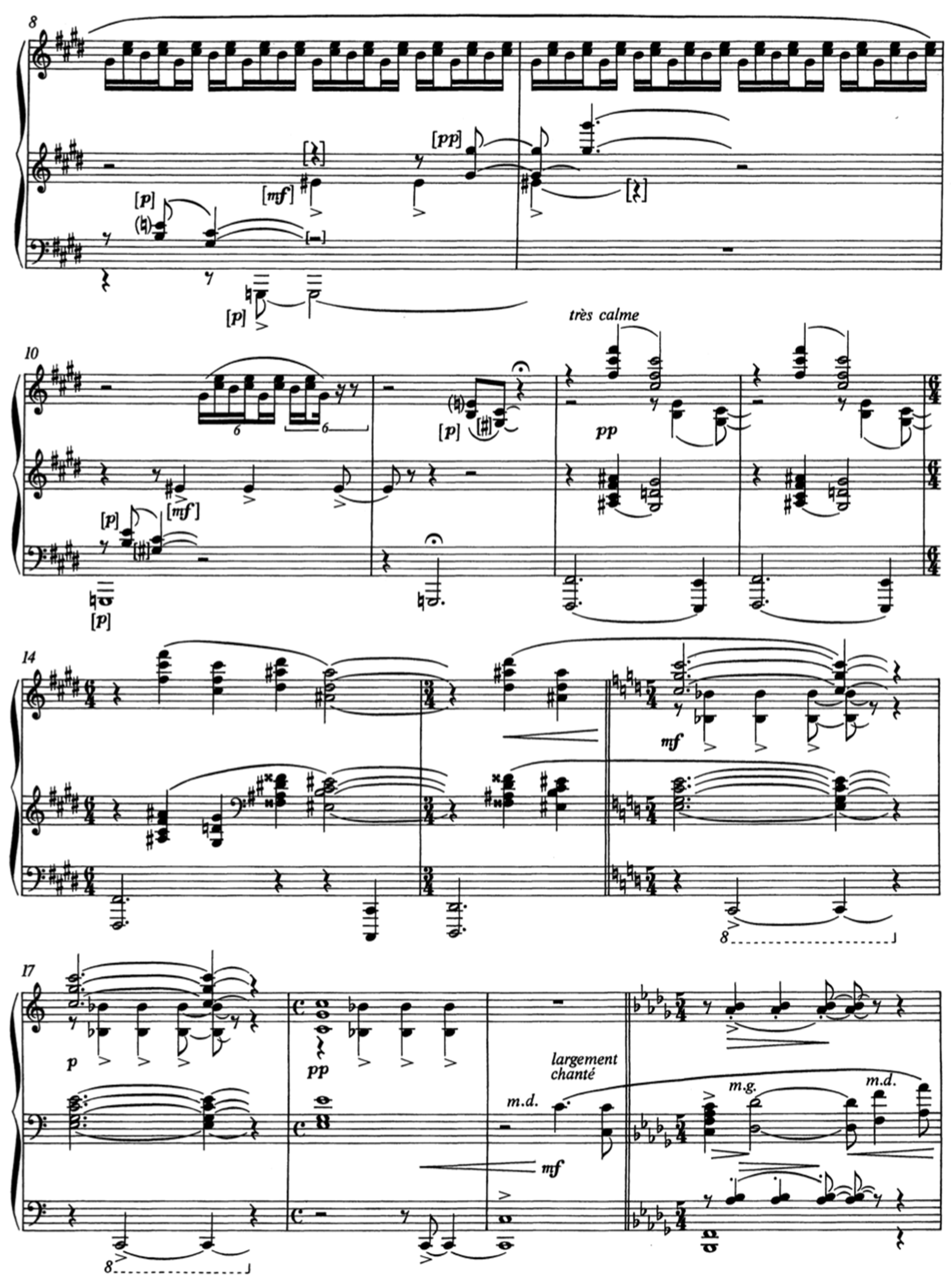
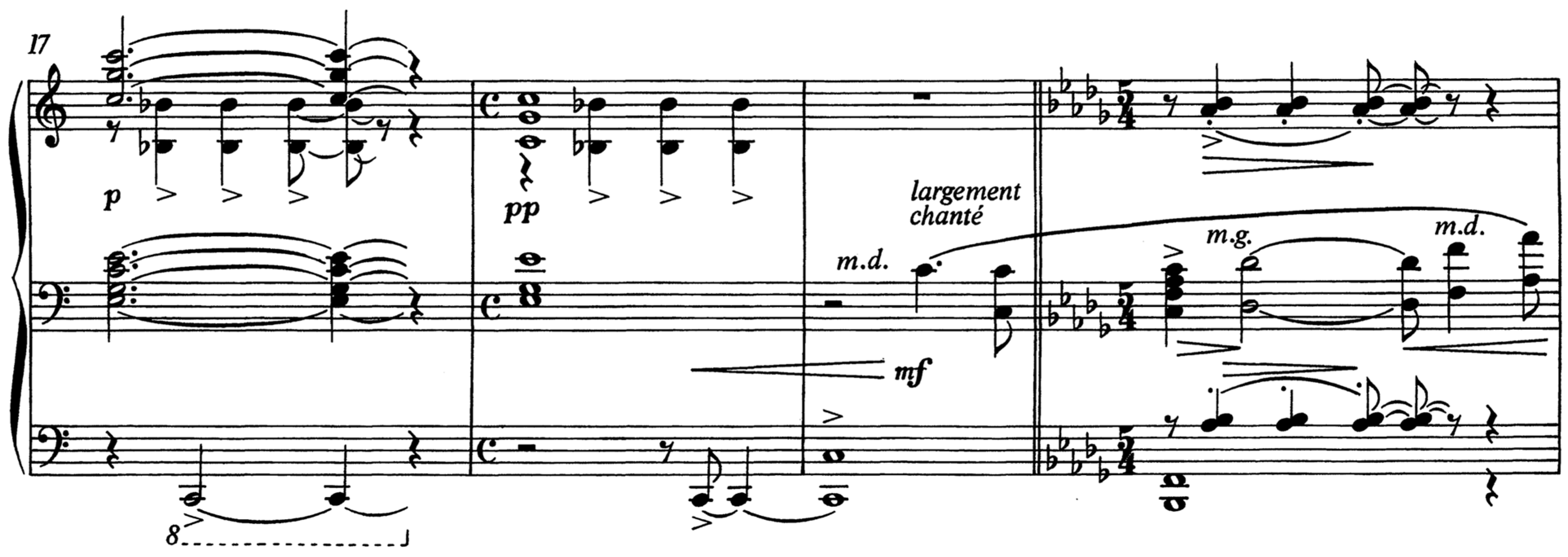
Bach [1723] 1894). In ‘La vallée des cloches’, Ravel also directs the performer to conceptualise its content in horizontal, sustained, ‘singing’ terms: the material at b. 19 is to be played
largement chanté (
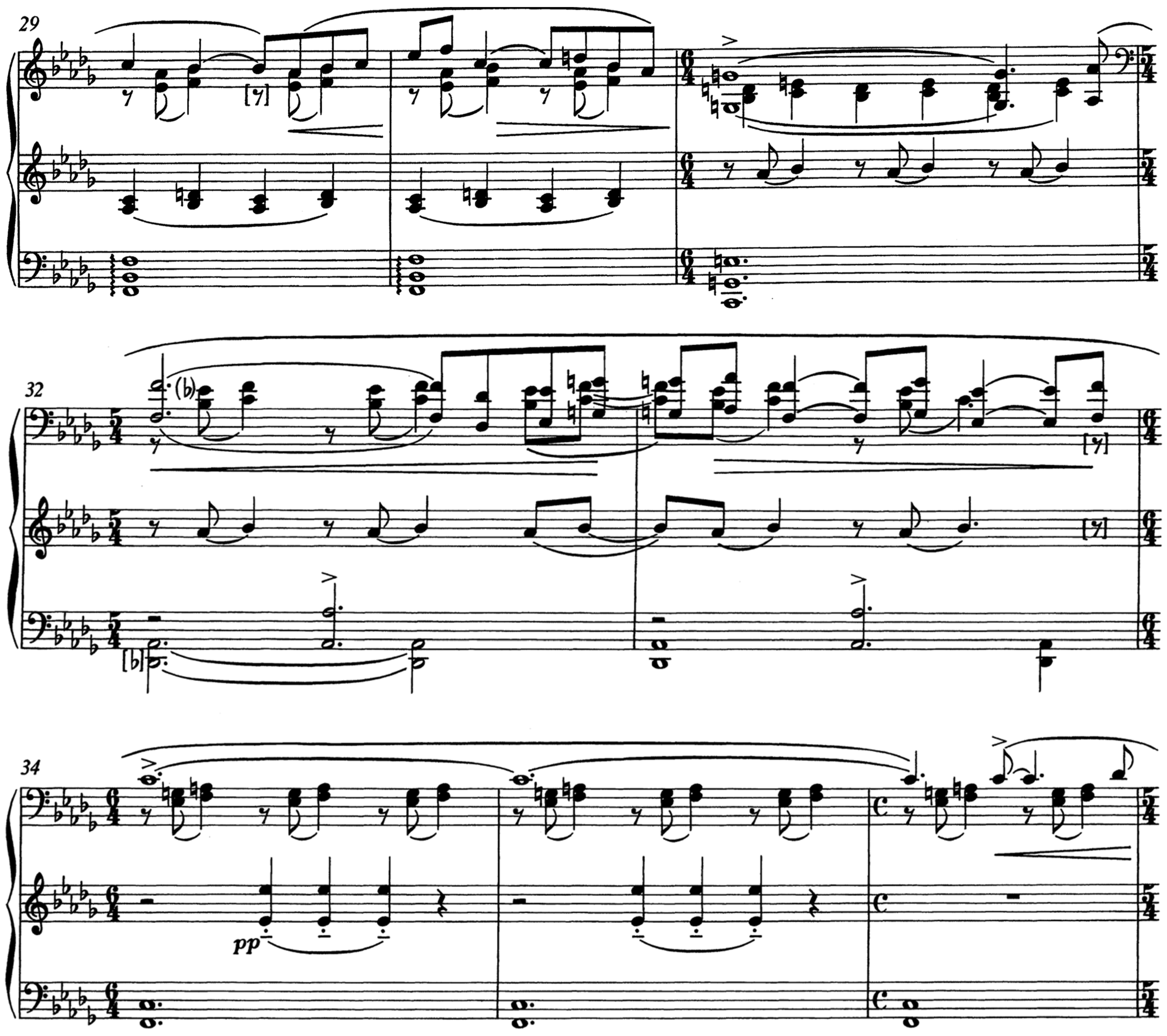
Figure 1), and the work contains many long phrase marks (the longest of which runs from the upbeat to b. 32 into b. 36 at a tempo marked
Très lent,
Figure 2). This common conceptual connection of the singing voice to the piano implies two inextricable musical features: the smooth connection of sounds (
legato), and, consequently, breathing in between connected sounds.
The abstract or imaginative representation of sound for the pianist is heightened because of two putative ‘negative’ attributes of the piano. The first is that pitch is not created by the pianist, but by the hammer hitting the string, and so pitch production is inherently inexpressive. Mine Doǧantan-Dack writes that ‘pitch does not require any
artistic interaction with the instrument’ (
Doǧantan-Dack 2018, p. 48). The second is that the piano tones begin to die away from the moment they are initiated. Doǧantan-Dack therefore proposes the melodic interval as the most expressive act of pianistic artistry and outlines that the phenomenological experience of playing the piano in the Western Art Music tradition consists of a very active imaginative element, where timbre, polyphony and phrasing are attended to psychologically, and in turn, transformed into an embodied choreography. She writes,
‘This basic necessity of grounding pianistic artistry in the spaces in between individual keys, and in temporal spans needed to traverse these spaces, is the foundation on which the piano rises–in the experience of its practitioners–as the instrument of the psychological, of the imaginary, of fantasy and illusion.’
A defining innovation that late nineteenth-century French music brought was a focus on colour, that is, timbre, and the search of musical expression through experimentation in timbre. Barbara Kelly notes that ‘the search for sonority for its own sake marks the Symbolist
esprit du temps of Debussy, Ravel and his circle’ (
Kelly 2013, p. 95). Timbral exploration and control is one of the most elevated aspects of Western Art Music practice, and exploration in tone is particularly prevalent pianistically in the study and performance of ‘impressionist’ music. It can be argued that timbral quality and control, that is, variation in tonal colour, can be as expressive as the playing of an interval; however, musical context is needed to elicit an affective response to timbre. Pianistic timbre has long been synonymous with the complex idea of pianistic ‘touch’. Bruno Repp undertook a study in which audiences assess the aesthetic quality of a performance of the opening bars of Chopin’s etude op. 10 no. 3. Repp speculated that other variables–for instance, ‘touch’–might play a greater role than timing and dynamics in making aesthetic evaluations (
Repp 1999). Although it is one of the most valuable assets of a pianist, the precise physical basis and the psychological effects of touch are not well understood (
Doǧantan-Dack 2011). The physical, gestural nature of eliciting pleasing sounds from the piano by referring to the performer’s ‘touch’ speaks to the physiological nature of the performer’s expressivity and communicative ability.
3. Metaphor and Sound
Whether considering the ‘singing’ lines of Bach’s two-part inventions, or the evocative, cross-sensory soundscapes of turn-of-the-century French piano music, the operation of metaphor and metaphorical thinking is commonly employed in pianistic interpretation. It is important for a pianist delving into Ravel’s
Miroirs to understand that a sometimes elusive suggestiveness is inherent to its aesthetic. Deborah Mawer connects the suggestiveness of literary symbolism through reference to Baudelaire’s
Correspondances to the ambiguous suggestiveness of
Miroirs’ titles (
Mawer 2000). She is clear, however, that although the aesthetic of symbolist poetry and music might be compared, the material of music as compared with other art forms is fundamentally different. ‘In formulating a definition of Ravel’s “
l’objet juste”, we must accept that in music, as distinct, say, from sculpture, we are already adopting a metaphor (or at least extending the Symbolist concept of
correspondances)–at least, apart from the score, we are not dealing with physical objects. Even so, something is still being made that exists in space and time (
Mawer 2000, p. 48).”
Michael Spitzer’s work on metaphor theory helps to elucidate the process of the pianist in consciously choosing or searching for sound. Although Spitzer writes from a listener’s perspective, it is helpful and insightful to consider his propositions as a pianist. The pianist can have a perception of, or attitude towards, a sound, chord or phrase, and this influences its sonic realisation. Spitzer argues that although listeners have no choice but to hear music as human, they have plenty of latitude with respect to how they hear music’s human aspects. ‘Representation, language and embodiment comprise three distinct and richly organised domains of human experience. It is astonishing that the listener can decide, at will, to hear the same phrase as a living tableau, a vocal utterance, or a person’ (
Spitzer 2004, p. 12). A pianist spends significant practice time ‘searching’ for a particular sound, a sound (timbre/colour) which aligns with a synthesis of the composer’s directions and the pianist’s artistic conception of a work, or a moment, phrase, textural aspect of a work. This process can be physical, involving the inculcation of a specific combination of gestures into the body so that the pianist’s artistic aims for the music are embodied and can be recreated automatically in performance. An element of this process of ‘searching’ for a particular sound also entails an imaginative aspect, ‘thinking of’ a phrase in a certain way, imagining a series of chords, for example, as a non-musical entity. Spitzer imagines how two crotchets, F followed by E, can be conceptualised as a life force in the following way:
‘Like a person moving through space, it traverses two coordinates of the pitch spectrum, F and E. Alternatively, the phrase is compounded of two living cells, F and E. Or perhaps a seed, F, grows into a two-note cell. The phrase might even be heard to objectify a life-force disembodied from any agency–a force of will or desire, perhaps. Regardless of the problem of individuation, the metaphor of “music as life” is a compelling one. It can even determine how one can relate to a musical work–as if it were an actual person. To anthropomorphize a tone is the first step to thinking of a concerto as an emperor, or an orchestral suite as a carnival of the animals’
The following extracts from my own practice of ‘La vallée des cloches’ relate to the ways in which I attend artistically to the exploration in sonority afforded by the score.
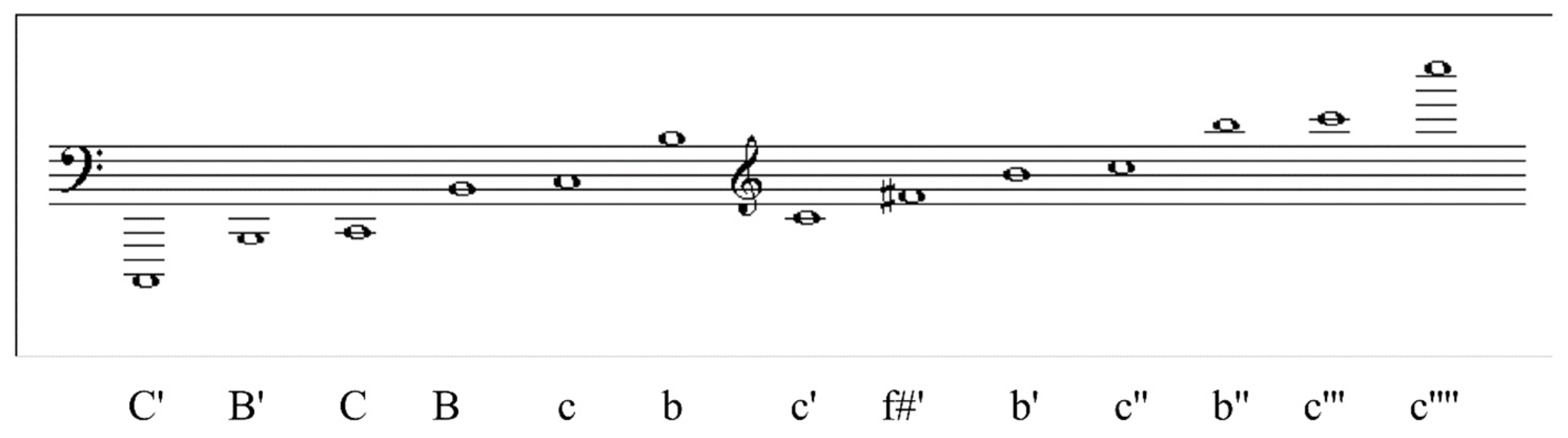
2 Specific pitches are indicated according to the Helmholtz system (
Figure 3).
Figure 3.
Helmholtz system of pitch indication.
Figure 3.
Helmholtz system of pitch indication.
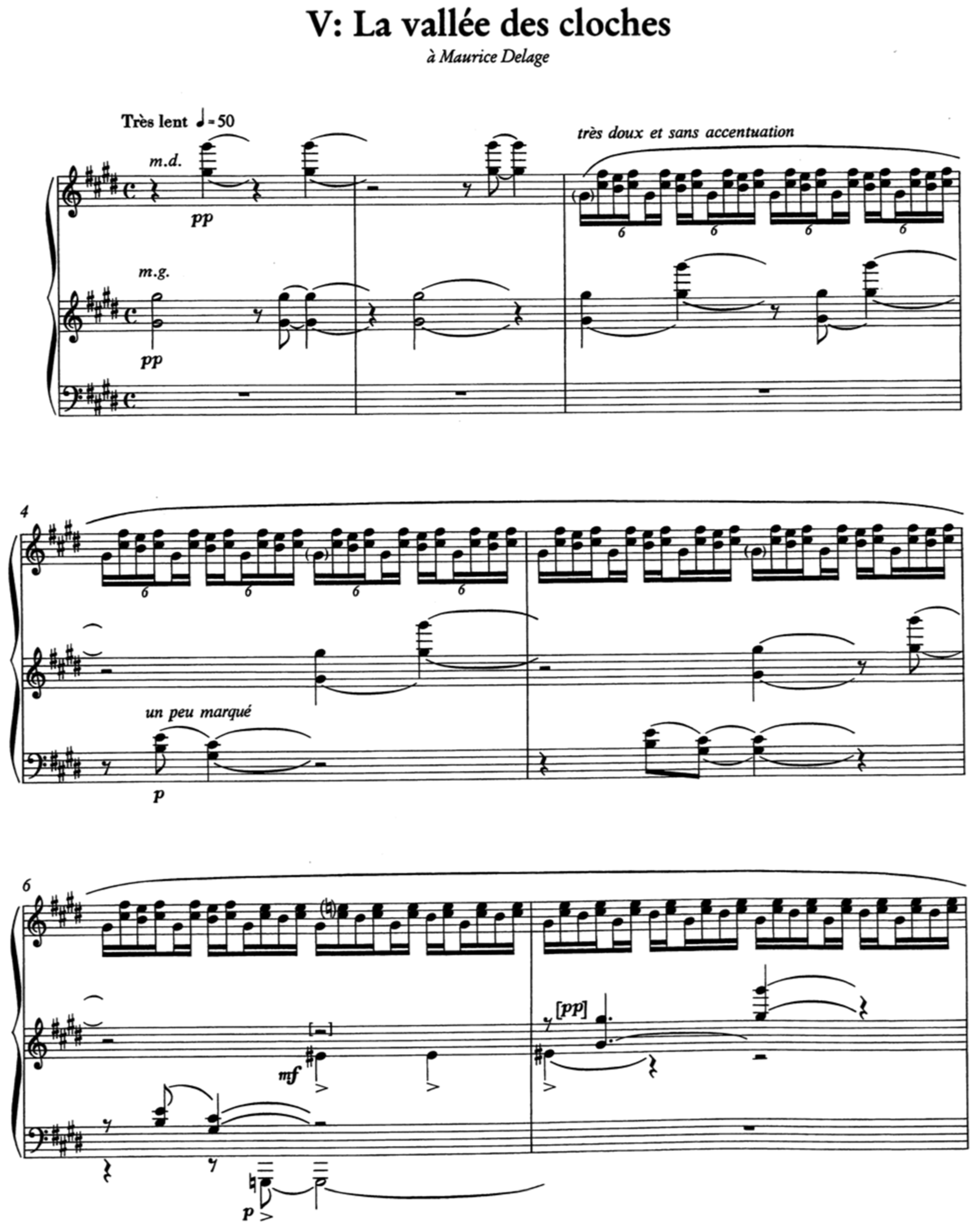
‘I notice that before I begin my play-through of ‘La vallée des cloches’, I can hear the G# octaves in my inner-ear, and wonder if the sound of this piano will match the one in my imagination (
Figure 4).
… The middle-register e#’s (in bar 6) are marked mf–the loudest dynamic direction so far. I think of these as bells being struck in a true and uninhibited way–not as echoes or resonances. I experiment with playing these with my thumb and third finger together. I press my thumb into the back of the last joint of my third finger, and try and play deeply, with a ‘striking’ motion, relaxing my wrist after each gesture. I find that if the ‘strike’ is too short, the sound becomes too percussive and piano-sounding. I try and ‘soften’ this percussive sound slightly by remaining a bit longer in the key before releasing. I am searching for a sound that has the kind of ‘ringing’ quality of a bell. I think about the feeling of being in a church or very close to a bell, and how sometimes I feel the reverberations in my body; like my body is also the instrument. I try again to play the e#s, and imagine that they reverberate in my body. I finish this session by playing through from bar 1–11 again. 12:31pm.’
Figure 4.
Maurice Ravel, ‘La vallée des cloches’, Miroirs (1905), bars 1–7.
Figure 4.
Maurice Ravel, ‘La vallée des cloches’, Miroirs (1905), bars 1–7.
To create a line in the fragmentary chordal melodies in bars 12, 13 and 14, I listen very carefully to top of the chords and try and enter into the space between the notes. I repeat this a few times, trying to make sure the voicing here is even, and thinking about the pedalling between these bars, as some of the inner ‘musical object’ material is sustained. The top notes in the left hand chords strike me as very expressive–a#’ falling to g#’ (in bars 12, 13 and 14, beats 2–3). I think I want to do a slight diminuendo between these. I try again, and this time, this same left-hand voice in bar 14, which continues through a descending line, strikes me as being very expressive: a#’–g#’–f##’–e#’ (
Figure 5).
… I hear the first chord of bar 20 as an appoggiatura in B♭ minor. This is emphasised by the accent on the first beat of the bar. I aim for a rich, singing sound by sinking deeply into the keys and ‘rounding out’ with an outward-moving gesture with my arms and wrists.
I do not want too much ‘muddiness’ between the first and second beats of bar 20, but I need to sustain the bass B♭ and F, so I try to flutter-pedal to clear some of the sound, but to hold on to some of the bass (
O’Brien 2022b, Practice Diary Entry 2).
My artistic intentions develop here around the metaphor of a church bell, and the replication of the ‘striking’ of this bell within the musical texture. I also refer to the wish to create a smooth line in bars 12–14 by trying to ‘enter into the space between the notes’. This is a way in which pianists, unable to change the quality of tones once initiated, must continue to attend to the sounds in between their individual initiation in order to relate them to each other in a way that aligns with the directions in the score, as interpreted through their artistic sensibility.
5. Meaning
Just as structural content is inferred, inconstant, and variable, not held within the parameters of the score but in the imagination and situatedness-in-time of the performer, so too is the music’s meaning and signification. Many contingent factors contribute to an ever-evolving imaginative, emotional, psychological relationship performers have with the music they play, in their conception and construction of what Neuhaus terms ‘the artistic image, that is: the content, meaning, the poetic substance, the essence of the music’ (
Neuhaus 1973, p. 2). These personal constructions of meaning are referred to by Doğantan-Dack as ‘layers of signification’ (
Doǧantan Dack 2021).
Alexandra Kieffer reveals the potential for Ravel’s pieces ‘La vallée des cloches’ and ‘Entre cloches’, the second movement of
Sites Auriculaires (1897), to be innovative in their conceptualisation of bell peals. Kieffer argues that their sonic realisation is a realist invocation of the pitches of the bells they conjure (
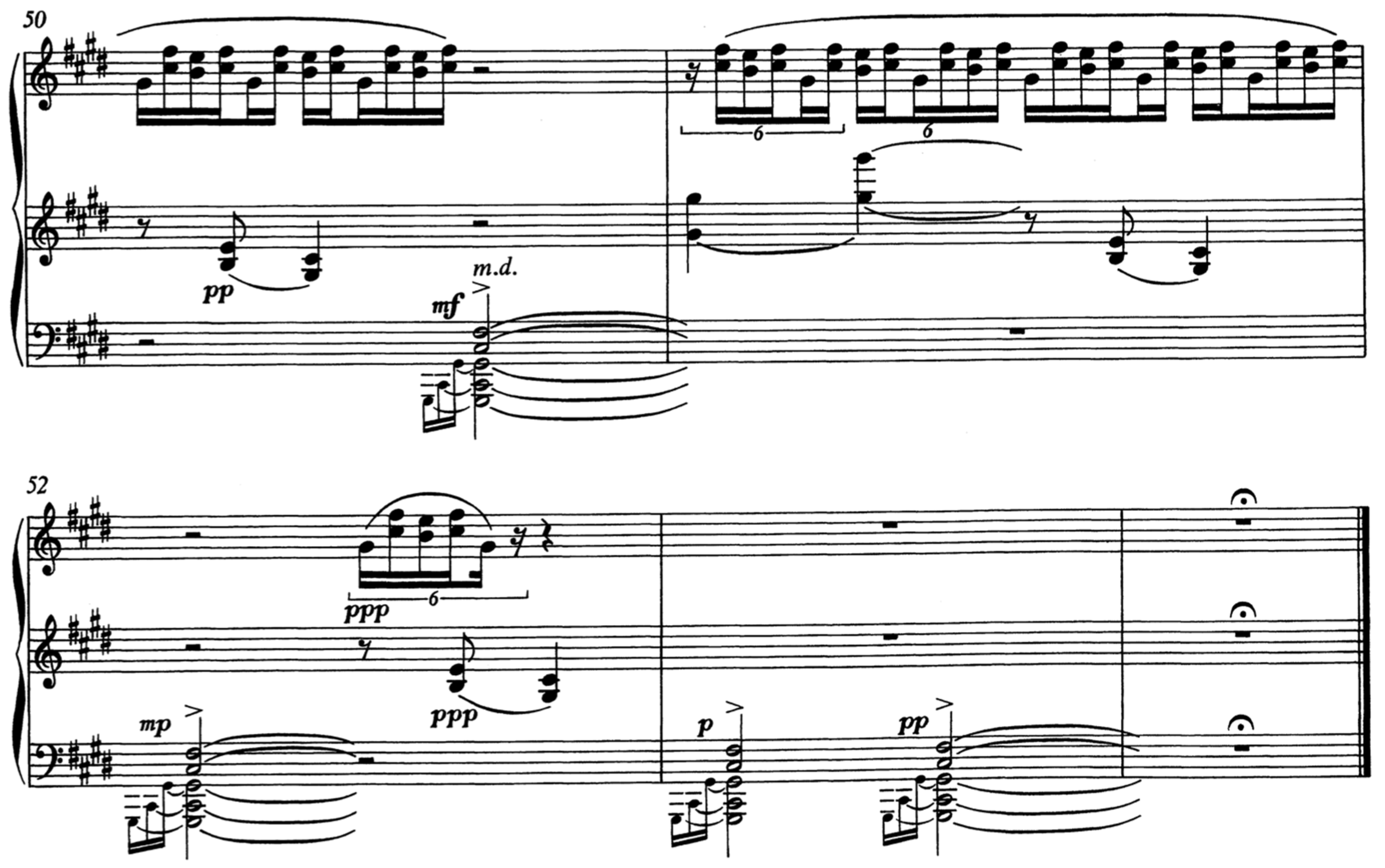
Kieffer 2017). Ravel once told a student that the final chord of ‘La vallée des cloches’ was his rendering of the peal of the Savoyarde bell in the Basilica of the Sacré-Coeur, Montmartre. ‘The pitches in Ravel’s chord are, in fact, an uncanny rendering of the pitches of the Savoyarde, down to the ascending grace notes evoking the physical striking of the bell’ (
Kieffer 2017, pp. 461–62) (
Figure 6). This is contrasted with Liszt’s ‘Cloches de Geneves’ from the first volume of his
Années de pélerinage (1855) in which the bell material is situated within the harmonic context of the work, present as symbolically and aesthetically suggestive, as opposed to aiming at realism.
In her detailed exploration, Kieffer suggests that, because of their register, the opening G# octaves of ‘La vallée des cloches’ are too high to invoke a church bell and proposes that the G# octaves could be ‘resonating upper-partials of another bell’, and the entry of the pentatonic quartal harmony in bar three and the parallel fourths of bars four and five complete the soundscape of the resonance of a single bell (musical example 3). I consider this in my practice:
I then remember Alexandra Kieffer’s suggestion that the opening bells are too high to be individually struck bells, but that they could be considered as the higher peals of a lower bell. I imagine these being the faint reverberations of a bell that was struck before the piece begins, and try again… This results in a more dampened sound. I notice that I create this by playing with ‘flatter’ tips of my fingers–less grip–and I do not differentiate between the two notes in each octave. I am imagining a less bright, more dull sound. I have the feeling that I prefer the brighter bell sounds to Kieffer’s more realist suggestion, because I think Kieffer’s idea might be too subtle, but I resolve not to decide yet and remain aware of it as I continue.
The particularity of the piano as the instrument through which the bells of ‘La vallée des cloches’ are presented (realistically realised or not) is significant. Its percussive action and resonance through the use of the sustained pedal affords the performer a material experience very close to that of striking a real bell. Scored across three staves, Ravel creates textural depth by combining bell material with contrasting ‘sung’ material. The piano is percussive, resonant, and smooth all in the same sound environment, giving the impression of physical depth and space. Pertinent here is Kyle Fyr’s original and lucid case for the ‘mapping’ of ‘la vallée des cloches’; that is, creating a metaphorical spatiotemporal map by identifying and labelling individual bell sounds and creating a framework for plotting a journey through the imagined valley (
Fyr 2020). Fyr finds methodological basis for his arguments in the work of David Lewin (
Lewin 2007), who established a framework for constructing a spatial map of a piece of music. Fyr and Lewin notably believe that ‘the value of creating a spatial representation of a piece of music lies not necessarily in the end result but rather in the process of creating it.’
The French music critic Jean Marnold believed that Ravel was concerned with the works of ‘late, last period Beethoven’ during the composition of Miroirs.
‘Coming after the picturesqueness of Jeux d’eau, the romantic grace of the Quartet and the sparkling exoticism of ‘Asie’, the Miroirs make a very similar impact to the sudden revelation of Kreisleriana in the work of Schumann … I have been assured … that at the very moment of their gestation … [Ravel] was, by his own admission, passionately absorbed in the works of Beethoven, the late, last-period Beethoven.’
The consideration of the final chord of the piece as the Savoyarde bell has the potential to imply temporal relation to all five pieces in
Miroirs. This prompts consideration of the lives of
Miroirs’ five dedicatees, and Ravel’s own life, and perhaps the symbolic significance of a bell knelling their ultimate conclusion. Jean Marnold’s suggestion that Ravel found inspiration in late Beethoven might refer to many aspects of Beethoven’s late style. In my exploration, this added to the spiritual, existentialist reading:
After this play-through I notice that the material from bar 42 to the end has a feeling of ‘after everything’ or ‘beyond’ for me; like an epilogue. It feels a bit religious or prayerful. The modulation at bar 42 gives me the feeling that the musical content is ‘elevated’ somehow.
… I am beginning to associate the très calme direction with a spiritual, prayerful feeling. This may be owing to the idea that this piece potentially represents the ultimate conclusion of the lives of the apaches, and Ravel. It helps to have this idea to commit to.
… I play this a few times, and notice that the voicing in the C major chords (bars 16, 17 and 18) really remind me of the organ. The strong thirds (Es) in the middle register and the low C put in mind the registers of an organ, with the low C being the pedal. This all reminds me of Alexandra Kieffer’s realist reading of ‘La vallée des cloches’, and I wonder if the church organ might also feature as well as the bell of the Sacré-Coeur. I check to verify if any of the other Miroirs are written across three staves–they are not.
… The largement chanté sections seems to say something serious, and slightly dark. The harmony and register contribute to this idea… I think of the singing voice, and wonder who might be singing this melody. It feels too personal to be Maurice Delage. There is something very deep and sorrowful about this melody. I think about it being Ravel, and try and imagine him singing this melody.
… The espressivo G♭ major section which follows from the upbeat to bar 24 gives a lighter, less ‘terrestrial’ feeling, something more spiritual; ‘higher’. Existential.
After the development of the middle sections–
largement chanté and
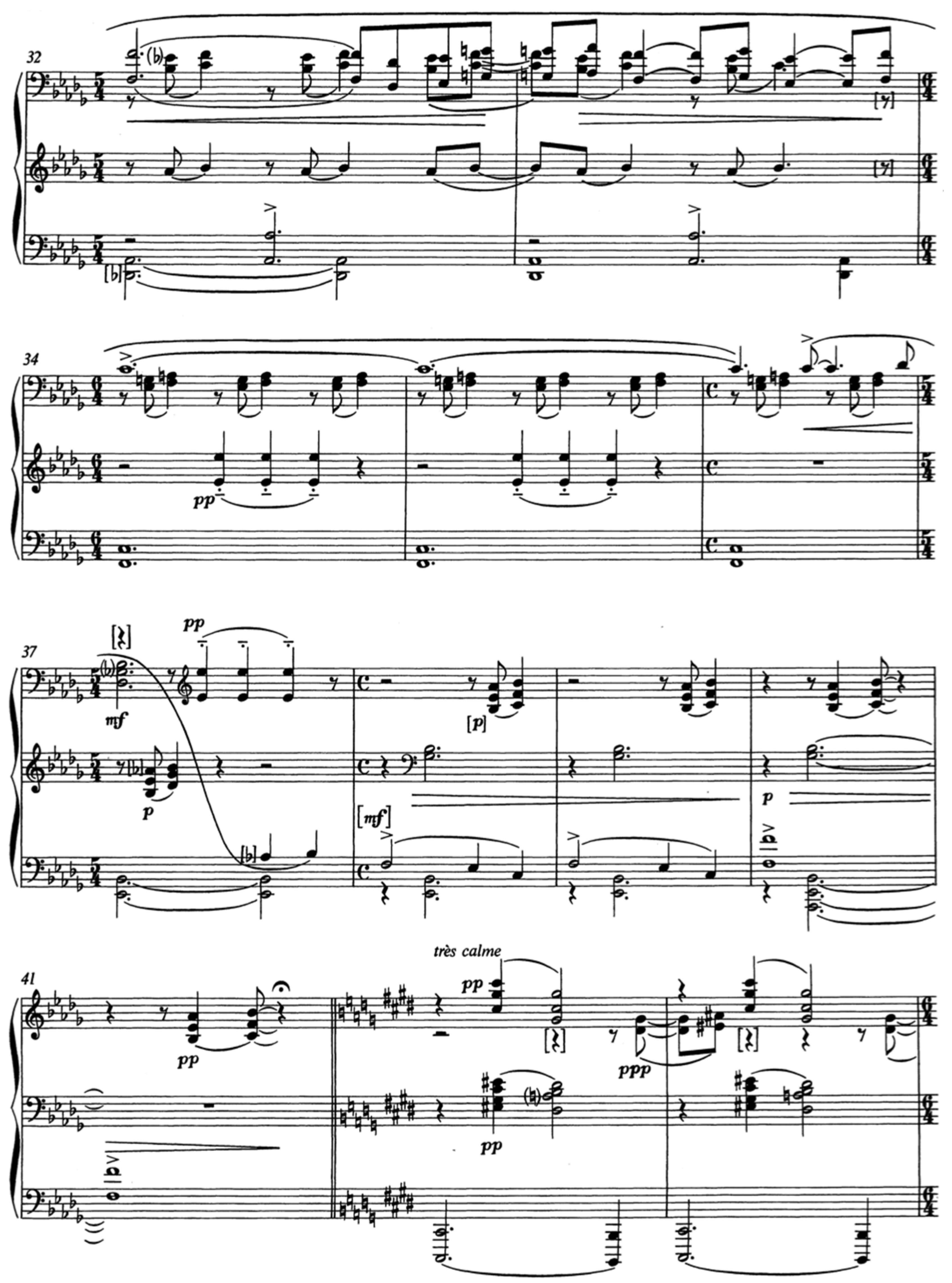
expressivo–these repeated inner patterns contribute to a sense of ritual or prayer … The pause at bar 41 adds to the sense that the ensuing material is ‘beyond’ the present (
Figure 7). I can only explain this as a sort of retrospective existential feeling. It feels both summative of the whole cycle of
Miroirs, and closes the ‘circle’ or ‘mirror’ of ‘La vallée des cloches’ itself, with the opening quartal harmony figure reappearing as a mirror of the opening.
Figure 7.
Maurice Ravel, ‘La vallée des cloches’, Miroirs (1905), bars 32–43.
Figure 7.
Maurice Ravel, ‘La vallée des cloches’, Miroirs (1905), bars 32–43.
This ‘retrospective, existential feeling’ which is generated during this practice session might find affinity in the work of Michael Puri, who suggests that ‘memory, conceived as the presence of the past, may be said to pervade the music of Maurice Ravel, thereby helping to unify what is otherwise an eclectic body of work’ (
Puri 2011a, p. 272). Puri proposes that memory, as an aspect of the aesthetics of decadence, involves the idealisation of the past, resulting in a melancholic present (
Puri 2011b). Puri focuses his study of memory on ‘those aspects that seem most helpful in understanding Ravel’s music,’ and through the functioning and thematisation of memory within
Marcel Proust’s Á la recherche de temps perdus. Puri’s memory studies focus on Ravel’s
Daphnis et Chloe and
Valses Nobles et Sentimentales; he does not deal with
Miroirs or ‘La vallée des cloches’ specifically (though he deals peripherally with ‘Oiseaux Tristes’). The temporal framework in operation if the final chord of ‘La vallée’ is considered as the Savoyarde bell can find further interpretative interest through the operation of the theme of memory.
6. Conclusions
I acknowledge the potential shortcomings of a methodology that self-reports, but here, I have aimed to foreground this essential subjectivity as the creative element of artistic process under scrutiny. As is suggested by both Schippers and Holmes & Holmes, ‘qualities that distinguish elite performers from other expert practitioners appear to lie largely beyond cognition and technique, in the intangible realms of expression (
Holmes and Holmes 2013;
Schippers 2006).
In this article, I have parsed the concepts of sound, structure and meaning to explore them clearly and deeply; however, as acknowledged in the introduction, these concepts become fused together as a guiding conception, one that in ‘La vallée des cloches’, for me, is essentially spiritual. Recurring metaphors—such as church bells, the organ, and the singing voice—at ‘local’ contextual levels aggregate to a larger spiritual ‘retrospective existential feeling’. This meaning, or signification, in turn determines how I relate to and present the music structurally.
These abiding religious and prayerful interpretative associations are supported by Ravel’s claim that the final bell peal is his pianistic rendering of the bell of the Basilica of the Sacré-Coeur and by the presentation of the score across three staves, as if it were scored for organ. I have come to relate to ‘La vallée des cloches’ not as a work of abstracted suggestiveness depicting a sonic journey through an imagined valley (although this is certainly a valid interpretation), but as a more symbolically significant work which bears an existential meaning related to Ravel’s life, and those of the dedicatees of Miroirs. Marnold’s suggestion that Ravel was concerned with Beethoven’s late works when composing Miroirs deepens this spiritual reading. My embodiment of this spiritual interpretation manifests in how I produce sound, for example, in how I conceptualise the bells, what kinds of bell peals and consequent reverberations these are, and how I approach the largement chanté line. This interpretation also influences my conception of the piece’s structure and how I relate the sections of the piece to one another. Temporality becomes thematic substance of this music: for example, I note that ‘the pause at bar 41 adds to the sense that the ensuing material is “beyond” the present’, and has a ‘retrospective existential feeling’; a feeling which is supported by Puri’s proposition that the theme of memory unifies many works in Ravel’s oeuvre.
My exploration of some of the critical and aesthetic ideas within recent Ravel scholarship led to their permeation into my artistic process. While Carolyn Abbate notably argues that the kinds of questions hermeneutics tries to settle are ‘virtually impossible’ to address when playing or absorbed in listening to music that is materially present (
Abbate 2004) my engagement with these ideas resulted in their manifestation in my consciousness as I practiced. This influence is present because of the process a pianist undergoes in their engagement with the music they interpret—a developing relationship with a work; a period of gestation. These ‘layers of signification’ are not always discernible to the listener but can form part of the performer’s artistic construction of a work. The act of recording with honesty the kinds of issues that are considered during my practice of ‘La vallée des cloches’ demonstrates the layered, diverse, multimodal nature of the artistic processes pianists undertake. Wise, James and Rink conclude that ‘collaboration between performers, teachers and researchers needs to be intensified’ (
Wise et al. 2017, p. 161); in this connection, I have also attempted to demonstrate that opening up a dialectic with scholarship shifts practice from a solitary act to a more dynamic activity that participates in an ongoing conversation—between composers, scholars and performers, between performers and themselves, and between our past, present and future selves.