Mickey Mouse and Marilyn Monroe share initials in common. MM is an acronym, a code or shorthand
1, for the evocation of two icons produced by the Dream factory.
2 Or perhaps more appropriately in relation to Martin Arnold’s glitched visions discussed in what follows, it is a short-circuit. In his recent work, the artist blasts these two figures open, subjects them to a drastic process of digital decomposition, revealing the inner workings of the imaging system that determines their appearance on screen. In our analysis of
In Tinseltown and
Full Rehearsal, we suggest that Arnold’s work allows for a radical reconsideration of the visual unconscious, as previously defined in 20th century thought, exposing the ways in which not only the frontiers between the functioning of the psyche and the machinic have become progressively more porous, but how the very notion of the unconscious is in question.
In the 1990s, Arnold’s found-footage works had already proven momentous for the exploration and theorization of the relationship between the cinema and the unconscious. His manipulation of 1950s Hollywood footage was widely acknowledged and analyzed as a probe into the hidden violence at the heart of film images, calling into question the ideal of the American model as represented in classical studio cinema (
André 2004;
Leo Cahill 2006;
Wegenstein 2008;
Mizuta Lippit 2012).
The artist’s practice was focused on radical forms of re-montage. Brief sequences extracted from Hollywood films were run back and forth through an optical printer. The result was an elongated sequence of partly overlapping images and sounds progressing through a series of uneven, spasmodic movement—a kind of audiovisual stuttering. Exemplified by the trilogy
Pièce touché (1989),
Passage à l’acte (1993),
Alone. Life Wastes Andy Hardy (1998), Arnold’s early work thus resonated with Ernst Jentsch and Sigmund Freud’s discussion of the uncanny (
Jentsch 1995;
Freud [1919] 1955). In particular, the effect of human gestures subjected to mechanical repetition evoked the ways in which both thinkers connected epileptic seizures and stammering to repression, automatisms, and the manifestation of the unconscious.
Switching to digital tools, Arnold stayed faithful to his initial approach but broadened the range of his interventions, working on the content and composition of the frames as well as re-montaging the chosen extracts. His early digital work was principally based on practices of erasure, sometimes coupled with in-painting. In
Deanimated: the Invisible Ghost (2002), Arnold progressively effaces the human figures from a 1941 American Horror film (
Matt and Miessgang 2003). Completed in 2010,
Shadow Cuts is the first in a series of works on Disney animation, where the artist gradually removes parts of the figures (Pluto’s eyes, nose, ears …) till only fragments of the original characters remain (
Janda 2015;
Beugnet 2021).
In Tinselton and
Full Rehearsal marked a new development in his digital manipulation of found-footage: the result of a collaboration with informaticians from Université Paris Cité as part of the “Technological Uncanny” project, both works are based on a misuse of the Lukas-Kanade visual data measurement software.
3 Named after its two inventors, Bruce D. Lucas and Takeo Kanade, the Lucas–Kanade method (1981) is designed to quantitatively measure movement in a film or video sequence. It mathematically calculates the optical flows and represents it with vectors. The trajectory of a motif (a moving object or a figure, a gesture …) is thus outlined, starting from a pixel that serves as a reference point and transforming into a line, whose trail varies in brightness and hue according to a color code adapted to the intensity and direction of the movement. The software’s applications are mainly industrial, covering a wide range of fields where object tracking and motion analysis play a key role: medical imaging, video surveillance, robotics, biology, and meteorology, amongst others. When applied to film sequences, however, the system struggled to account for the complexity and unpredictability of the data, resulting in a range of malfunctions and striking visual effects. In most of the initial analysis of film extracts by the Lukas–Kanade software, instead of being drawn correctly between calculated points, the vectors appeared in an anarchic, random fashion, creating sudden, radiating bursts of shimmering lines. To explore the graphic potential of the system’s glitches is what interested Arnold most: unleashing and drafting in the forces of randomness became an essential element in the production of the two short experimental films considered here.
1. In Tinselton: A Crystal Image of the Unconscious4
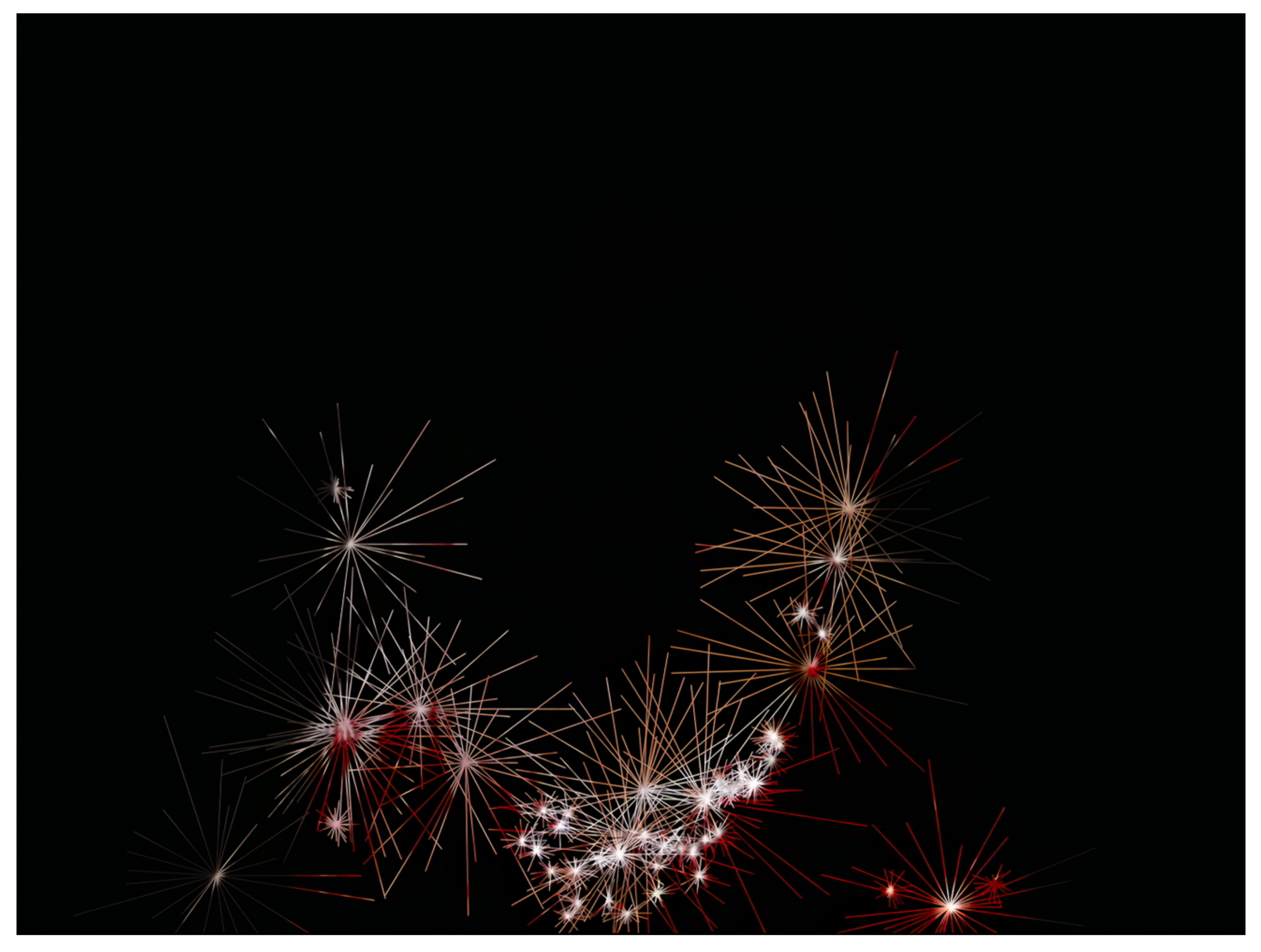
A pitch-dark screen. The image’s black expanse is first pierced by brief illuminations, straight arrows of light exploding in all directions like fireworks. As the sparkling formations start to linger and overlap, they create a progressively denser mesh at the bottom of the frame. A flickering, lurching process of apparition unfolds: coming through the web-like crisscrossing of star-shaped lines, a silhouette takes form. Monroe’s torso, outlined by the glittery texture of a red and white sequined costume, becomes visible; then the lower part of her face emerges. Though barely sketched, the figure is recognizable by the gestures and dress, and, eventually, by the painted lips, typically half-open over the whiteness of the teeth. The glimmering silhouette, half-completed, vibrates against the dark surface, before it gradually returns to obscurity.
The sequence progresses in stuttering, back and forth micro-shifts, giving the impression of a labored breathing or panting. The veiled, husky timbre that Monroe made her vocal signature remains as a distorted, amplified trace, at the cross-section between the mechanical and the grotesquely eroticized. Altered by the repetitions and slowing down of the images, the voice’s gasps and wheezing are accompanied by a distorted industrial noise—the sound of music turned into a machinic screech. Thus, the uncanny body–machine fusion that characterized the cinematic medium from its beginnings is here conveyed through the partial erasure of the figure, its gradual appearance and disappearance the subject of intense visual and sonic dramatization. In Arnold’s reworking of the footage, the illusion of totality sought by classical cinematographic spatial arrangement is replaced by a voided space partially animated by the spasmodic presence of Monroe’s warped, mutilated silhouette and voice. It is as if we were thrown into the dark recesses of a dreaming brain, a desiring machine briefly irradiated by scraps of images filtered from a collective imaginary.

Taking the form of a mining or “unfolding”
5 of the digitized and digitally manipulated cinematic image, the glitches that affect the images give us glimpses of visual and sonic matter that various processes of image modeling have obfuscated (from the Hollywood continuity system of conventions to the digitization of the analog footage and further digital analysis and patterning of the images). Hence, the anarchic explosion of vectors that govern over the image’s laborious disclosure calls forth partial visions of complex constellations or crystal-like formations: through Arnold’s manipulation of digitized analogue footage, Walter Benjamin’s notion of the dialectical, flash-image and Gilles Deleuze’s concept of the crystal image seemingly meet.
In Benjamin’s famous description, the dialectical image is not an image of the past casting “its light on what is present”, but a coming together, “in a flash”, of what has been with what is now, so as “to form a constellation” (
Benjamin [1927–1940] 1999, p. 462;
Weigel 2015). In
In Tinseltown, the images born out of the faulty digital system produce flashing constellations that call to mind Benjamin’s observations in the way they bear the persistent traces of the mechanical mode of production that ruled over the creation and display of the original, analogue footage. They also carry the vestiges of the regulated gesturalism, grounded in machinic precision, that the industrial era imposed on the human body, including through the recording and projection of images.
Yet of the initial footage there remain only partly erased vestiges, subjected to the disorderly, crystallizing force of the glitch. While the vectors that rule over the appearance of the silhouette contained in the wrecked analogue image display the straightness of technical drawing, their erratic formations recall the fleeting illuminations of slow-burning sparkler sticks. The figure that seemingly struggles to come to visibility is thus simultaneously conjured up and overlaid by the mesh of densely knitted lines created by the software.
In Tinseltown’s chaotic and cyclical appearance (for it ultimately relegates the figure to the voided space of the dark screen) thus arguably exemplifies the ways in which digital imaging regimes destroy outmoded conceptions of linear or clock-time, as well as spatialized time, while creating their own inner circuits (
Deleuze [1985] 1989, p. 80). Governed by the flashing vectorial formations, the images’ lurching progression and eventual return to complete darkness figuratively and conceptually echo Deleuze’s description of the crystal regime of imaging. A representation of the splitting of time, of the movement between past and present reflected in the workings of film, the crystal epitomizes the ways in which we make sense of the present of cinematic images as they unfold in front of us within the broader actual and virtual context of the film as a whole (
Deleuze [1985] 1989, p. 66). In the case of Arnold’s digital practice, however, the image stalls and starts, the partially erased, heavily distorted memory of Monroe’s silhouette and voice caught in the operations and circuits of a glitchy software. To paraphrase Deleuze: in
In Tinseltown, the actual optical image crystallizes with
its digitally rendered virtual images (
Deleuze [1985] 1989, p. 67).
Shooting in all directions, the beams of light open a multitude of splinters against the dark backdrop, accounting for so many virtual facets of the image. Arnold’s radical treatment of Monroe’s performing presence thus seems to enable the manifestation of an unruly desire to surface—a desire that is, at one and the same time, disorderly yet shaped by a calculating system (albeit a malfunctioning one) of optical flow. Indeed,
In Tinseltown’s dark, electrified visions appear to burrow into a collective unconscious shot through with an energy that is, at one and the same time, anarchic and machinic, obsessive yet destructive: the dream of a desiring machine that both absorbs and destroys the fabricated product of the factory of dream. In effect, to relate Arnold’s images of Monroe to a crystalline regime of visualization is to associate them with an alternative form of unconscious expression, one that bears an affinity with Deleuze and Félix Guattari’s theorizations rather than with Freud’s oedipal scheme. In this view, his images are reminiscent of Deleuze and Guattari’s conceptualization of the unconscious as flows moving in multiple, non-hierarchical directions, yet susceptible to being “recoded” in the service of an ever-adapting capitalist system (
Deleuze and Guattari 1980, pp. 13, 24)
6.
As the source of its exploration of this version of the unconscious,
In Tinseltown focuses on one of the most enduring tropes of the collective imaginary produced by industrial and post-industrial culture: the female automaton. In its various iterations and theorizations, the female automaton’s possible meanings extend to the notion of a shared unconscious,
7 shaped by the manufactured desires of a constantly evolving capitalist system of commodification (
Wollen 1989;
Mulvey 2019). In the experimental, critical practice of filmmakers such as Arnold, in the work of video artists and video essayists, and in mainstream cinema and advertisements’ ventriloquism and deepfakes, the female automaton continues to encompass the symbiotic fusion between technological change and obsolescence, as well as between spectacle and capitalism (
Beugnet and Ravetto 2026)
8.
2. The Female Automaton in the Digital Era
For In Tinseltown, Arnold appropriated a few seconds of the classic ‘Two Little Girls from Little Rock’ performance, part of Howard Hawks’ Gentlemen Prefer Blondes (1953). He was not the first to subject that particular sequence of images to a radical temporal and plastic transformation. In 2013, Laura Mulvey had already digitally re-edited a 30 s excerpt from the same Gentlemen Prefer Blondes’ opening musical number. However, in contrast with Arnold’s experimental video, Mulvey’s Marilyn Remix is a videographic essay, part of her own theorization of Hollywood’s female automaton. Furthermore, while she relies on the alteration of the images’ screening speed, Arnold’s refashioning of the image starts from the most elemental level of the processing of digital data: the reading of the images’ pixel-based structure. Yet both works share an interest in the same motif: the female automaton as a manifestation of a technological unconscious. As such, Mulvey’s critical account of this enduring cinematic trope proves illuminating in relation to Arnold’s later rendering and formal choices. Both her written interpretation and her video essay will therefore serve as a canvass against which to consider Arnold’s found-footage video.
In common with Mulvey’s study of the star figure, Arnold’s reinvention of Marilyn Monroe in
In Tinseltown finds its place in a long-lasting literary and cinematic tradition of the female automaton as the phantasmatic fusion of male desire, technology, and control over the feminine. In effect, Arnold’s melding of Monroe’s outline with the flickering outbursts produced by the Luka–Kanade software recalls Villiers de Lisle Adam’s
The Future Eve (1886), where the creator of the automaton is no other than the master of electricity, Edison himself.
9If the female automaton proved such a rich metaphor for the historically situated workings of the unconscious, it is because, as a technological product, it is fundamentally associated with disavowal. As Mulvey puts it, the automaton’s “exquisite exterior conceals the cogs and wheels that animate her” (
Mulvey 2019, p. 50). In other words, not only the unconscious but the machine itself has its own ways of combining desire and denial as part of its very configuration.
As a standardized and fully predictable object for the male sexual drive, the female robot thus prefigured Hollywood’s factory of ideal feminine figures and the fusion of cinematic spectacle and commodification (
Wollen 1989, p. 28;
Mulvey 2019, p. 50)
10. Accordingly, in their interpretation of Villiers de Lisle Adam’s story of mechanical simulacra and male desire
The Future Eve, both Raymond Bellour and Annette Michelson note how, as the perfect facsimile of image and sound, the female automaton stands as a prefiguration of the medium of the moving image (
Bellour 1986;
Michelson 1984). Crucially, through cinema, the relation of the female body to technology becomes symbiotic: the automaton is not merely an object of cinematic iconography, but effectively instantiates, Michelson underlines, “an ultimate, phantasmatic mode of representation [of the female body] as cinema.” (
Michelson 1984, p. 432).
Ultimately, the screen performance of classic Hollywood female stars mirrors the working of the medium’s apparatus: “In a kind of metonymical reference” their “highly stylized bodily movements” evoke “the jerky progression of the filmstrip through the projector.” (
Mulvey 2019, p. 22). Though Mulvey’s observation resonates with Arnold’s stuttering, decomposed version of Monroe’s performance, in this quote she associates the figure of the automaton with cinema in its mechanical, analogue form. Arnold’s Marilyn, on the other hand, is a digital recreation. The original footage is treated as data, analyzed by algorithms, and the resulting images are infinitely subjectable to code-based postproduction. In place of “the jerky progression of the filmstrip”, screening is a process of continuous realignment of pixels. Indeed, given the historical dimension of the forms of displacement and concealment that crystallize through the figure of the automaton, the contemporary, digital entanglement of the cinematic with fetishism needs to be envisaged in the context of convergence or remediation, where analogue media is ‘absorbed’ by digital forms.
3. “Cogs and Wheels”
In
In Tinseltown, the female automaton arguably operates as part of a 21st-century visual regime of the “dialectical image” (
Benjamin [1927–1940] 1999, p. 475 [N10a, 3]). It stands as the expression of a world caught between technological innovation and obsolescence—between digital and analogue modes of production—throwing into relief the anxiety generated by fast-evolving forms of technologies. More than a vehicle for the automaton as “ghost in the machine”, therefore, the digital image becomes the vessel for a medium’s haunting of another medium. Whereas in Arnold’s work, as we will see, the form of this haunting is embedded in the digital system itself, in Mulvey’s
Marilyn Remix, the digital manipulation of the footage essentially emulates classic cinematic forms, including those techniques associated with the initial definition of the optical unconscious.
One of the key concepts formulated in his seminal essay “The Work of Art in the Age of Mechanical Reproduction”, for Benjamin, the optical unconscious is that which surfaces unintentionally in an image produced by means of optical devices. Thanks to optical technology and techniques, the camera has the unique capacity to automatically capture and preserve that which, in habitual perception, escapes human attention (
Benjamin and Jennings [1935] 2010). In line with Benjamin’s description of such techniques, in her video, Mulvey uses repetition together with the slowing down of the images and freeze frames in order to analyze the precision of Marilyn Monroe’s dance performance, down to micro-movements. In doing so, she seeks to expose both the profound remodeling of the female figure by the technology and the complex relation that the cinema entertains with death, as evidenced in the re-animation of the now-dead star as a cinematic automaton (
Mulvey 2013,
2017). In her
Marilyn Remix, therefore, the optical unconscious manifests itself through cinema’s own techniques, the viewer becoming aware of the death-mask quality of Monroe’s face, as well as the perfection of her micro-gestures, through slow-motion, framing, and the serial montage of certain images.
In contrast, Arnold’s work does not seek to reprise and rework analogue cinema’s techniques of composition or editing. It is the algorithmic manipulation of the digitized analogue footage itself that allows for an alternate form of uncanny to surface. Yet in
In Tinseltown, the digital regime of imaging, including the malfunctions of software, is infused with a mechanical substrate that affects the form and apparition of the image at the encoding stage. Rather than attracting attention to the gestural quality of the appearing figure, the stuttering progression of the sequence, the back and forth, breathing or heaving progress of the image that results from the partial looping of the footage, signals the absorption, through digital programming, of an older mode of temporality and appearance. As observed by Lev Manovich: “If we strip the computer from its usual interface and follow the execution of a typical computer program, the computer will reveal itself to be another version of Ford’s factory, with a loop as its conveyer belt. “(
Manovich 2016, p. 37). Considered in the context of Arnold’s work on Monroe’s images, the comparison between the computer program functioning as a loop and the conveyor belt resonates with ideological readings of the Hollywood system and the notion of a political unconscious bridging the analogue and digital era. For, if narrative cinema’s combination of the continuity system and stardom contributed to erasing the origins of the image in labor, this process of erasure also takes place through the further shift in emphasis produced by the advent of the digital. From this point of view, electronic communication and digital dematerialization take attention away from the production of images and instead foreground their remediation and circulation (
Wollen 1989, pp. 28–29).
However, against the grain of the enduring associations of digitization with processes of dematerialized creation and friction-free display and circulation, Arnold’s version of the female automaton does not gloss over the “cogs and wheels” effect. On the contrary, in its unfolding of the remediated footage, it exposes its machinic innards: in In Tinseltown, the apparition of the figure takes place through an extremely labored process. On the one hand, the random bursts of light evoke a Frankenstein-like attempt at harnessing the powers of lightning to animate a dead or stalled figure. On the other hand, the form’s heaving movements and rusty, machinic sound recall that of a faltering engine, or the slow, lurching start of an obsolescent motor. In the process, the initial, erotic undertone of the strenuous panting-like noise is reduced to a grotesque, mechanical effect.
At the beginnings of the technologies of image and sound recording, part of the uncanny nature of the cinema and the phonograph’s productions was born out of their separation of body and voice: the phonograph effectively emitted a bodiless, ghostly version of the human voice (
Beugnet and Duplay 2024, pp. 657–705). While Hoffman and Villiers de Lisle Adam’s automata anticipated the later fusion of voice and body, in Arnold’s work, what had quickly become a norm—cinema as a synchronous synthesis of sound and image—is called into question. Rather than exploiting the realistic effect produced by the re-coupling of voice and body in sound cinema (
Doane 1980, p. 43), Arnold dramatically emphasizes its constructed nature.
As is well known, while Monroe obsessively refined her gestural performance and the photogenic dimension of her appearance, a string of voice and singing coaches also helped her overcome a tendency to stutter, contributing to creating the particular, breathy diction and smooth tone of voice that became one of her trademarks (
Beugnet and Ravetto 2026). To create Hollywood’s most beautiful automaton—Monroe as a fetish, the perfected woman-simulacra—it was necessary to erase the labor that went into bodily performance and voice. Yet ultimately, in Mulvey’s remix, the breaking down of the sequence into massively slowed-down components reveals a form of resistance on the part of the filmed figure. Outlining the precision and faultless timing of Monroe’s gestures, Mulvey suggests that the trace of the performer’s agency, labor, and the resulting mastery over her own image endured. In doing so, she puts into tension the manifestation of an optical unconscious (disclosed by the camerawork and emphasized through digital manipulations) and the actress’ conscious work on her own bodily expression.
In contrast, in Arnold’s video work, any such vestige of agency is swallowed up by the breaking up of the footage into digitally reworked fragments. Yet in spite of
In Tinseltown’s surreal, machinic distortions, both the residue of Monroe’s famously sensuous presence and that of the labor that went into fashioning the embodied individual into the model arguably persist, resurfacing as recognizable traits in spite of the grotesque deformations. Even at the heart of the digital image, the presence of the organic manifests itself through the “plasmatic” dimension of the imaging process, the suggestion of a primal force that seemingly governs the appearance of the figure (
Eisenstein [1941] 1988, pp. 45–46)
11. In the erratic fusion of glitter and coarseness, not only the mechanical but corporeality itself, in its visceral form, thus returns with a vengeance, effectively producing the kind of gray zone where the organic, the technological (in its mechanical as well as digital guise), and the imaginary meet.
In doing so, found-footage video work such as
In Tinseltown fully assumes the role of a bridge or conduit between different image regimes (or, to use Raymond Bellour’s term, its role as part of a regime of in-betweenness or “entre-image”) (
Bellour 1990). Where cinema embodied the Fordist fusion of the human and the mechanical, electronic and digital technologies worked to facilitate and promote the consumption of images and, as such, strived to erase both the traces of their production and mediation (
Treleani 2017). In found-footage cinema that relies, as Arnold’s now does, on digitized content and the digital manipulation of data, the two models clash: estrangement arises from the encounter between the film image as the trace of an eclipsed industrial world and the digital protocols that resuscitate it from an encoded form. In
In Tinseltown, the sparks that reanimate the automaton’s dormant figure thus bring to life an incomplete, grotesquely robotic version—a version that stands not only for an outdated technology but for the obsolete, yet persistent order for which classic Hollywood cinema stands. Caught in modes of appearance and exploitation that seem to be running their course, the original film image, as a digitized and reworked recording of the body of the dead star, subsists as mere glimpses. At the same time, the short-hand version of the cinematic-figure-turned-commodity is finally returned to its laborious, material, corporeal beginnings. Hence, beyond the literal re-reading of the phenomenon of the ‘star’ as the “Eve of the Future”, subjected to the artificial shimmer of light rays randomly drawn by algorithms, it is the intimate fusion of the organic, the sexual, and the technological that gives Arnold’s
In Tinseltown its disturbing character. Despite the radical decomposition–recomposition of image and sound, the video retains the memory not only of the older, mechanical operating of the cinematic apparatus, but beyond, the trace of a primary materiality, that of the presence of the flesh-and-bone body once captured by the camera.

4. The Optical and the Graphic Unconscious
Harnessed to the vestiges of an iconic silhouette that resists complete obliteration is the material memory of the analogue mode of recording that captured that silhouette in the first place. Does this mean that the optical unconscious of old, as it was initially described by Benjamin, still operates in the context of such heavily reworked and layered digital renderings?
As pointed out earlier, Benjamin’s argument initially focused on the work of the camera. For Benjamin, it is because filming techniques employed to record the reality around us do so in ways that extend and outweigh the capacities of habitual human perception that a particular form of unconscious, the optical unconscious, becomes visible. In his words, if “we first discover the optical unconscious”, it is because “the diverse aspects of reality captured by the film camera lie outside of the normal spectrum of sense impressions” (
Benjamin and Jennings [1935] 2010, p. 31). From the close-up to the traveling shot, the camerawork exposes the visible world in a way that is inaccessible to the human eye, and, more broadly, to human sensory perception, consciousness giving way to the unconscious in the process.
Technically, the practice of digital found-footage, which involves no actual filming, only bears an indirect relation to the original concept of the “optical” unconscious, which Benjamin described as grounded in camerawork. Accordingly, in
In Tinseltown, two types of imaging regimes seem to feed into one another while remaining separate, with the traces of the optical images returning in flashes, as if caught in a frenzied mode of digital parapraxis. In this way, as mentioned before, Arnold’s work is characteristic of a generation of film and video artists whose practice focuses on the conscious exploitation of digital distortions and malfunctions. As evidenced in such practices, the creative and critical potential of the glitch rests on its ability to disrupt one key expectation of digital visual culture: the claim to heightened legibility and lossless reproduction (
Thouvenel and Contant 2014;
Cameron 2017;
Beugnet 2021;
Jacobs 2022). This supposes an enhanced capacity to “evacuate the non-meaningful debris that pollutes the appearance of the image” (
Cameron 2017). In digital found-footage such as Arnold’s, debris is intentionally preserved, albeit thanks to a disfunctioning software whose operations cannot be fully anticipated. The dismembering of the image, of its material appearance, composition, and content, creates the condition for unconscious, ‘enfolded’ meaning to emerge (
Marks 2010). The optical unconscious therefore appears to supplement the kind of digital unconscious that arguably becomes visible thanks to the glitch. It comes to haunt the digital image through the unpredictability of the faulty software in the way the ruins of the initial film footage alternately surface and ebb away based on the (mis)calculations of the Lucas–Kanade software.
The moving configurations that result from the software’s analysis of the image simultaneously call forth and overlay the figure. In doing so, the visualization of computations emulates the travails of the technical draughtsman or the geometric compositions of the abstract artist and resonates with another dimension of the technical unconscious as Benjamin outlined it: a graphic rather than optical unconscious.
Common to the various versions of Benjamin’s “The Work of Art in the Age of Mechanical Reproduction”, a kind of slippage occurs in the paragraph where the thinker addresses the question of the unconscious in the fast-developing capitalist order. In the second part of the passage, as Benjamin shifts the attention more specifically to film as the expression of a collective unconscious, he points to Disney’s work, and more specifically, the figure of Mickey as an emblematic example of the forms of “psychic immunization” offered by film as a response to the brutality of the modern world (
Benjamin and Jennings [1935] 2010, p. 31).
In “The Work of Art”, therefore, Benjamin outlines not one but two distinct kinds of unconscious accessed through the medium of film: the optical unconscious, on the one hand, and a broader visual unconscious that encompasses both optical (in the sense of camera-based) and graphic forms to which the animation film belongs. In Arnold’s film Full Rehearsal (2017), which reworks Walt Disney footage featuring Mickey Mouse, the traces of a pre-logical thought process surface, revealing new modalities of the interface between the conscious and the unconscious.
5. Full Rehearsal: The “New Visual Unconscious”?
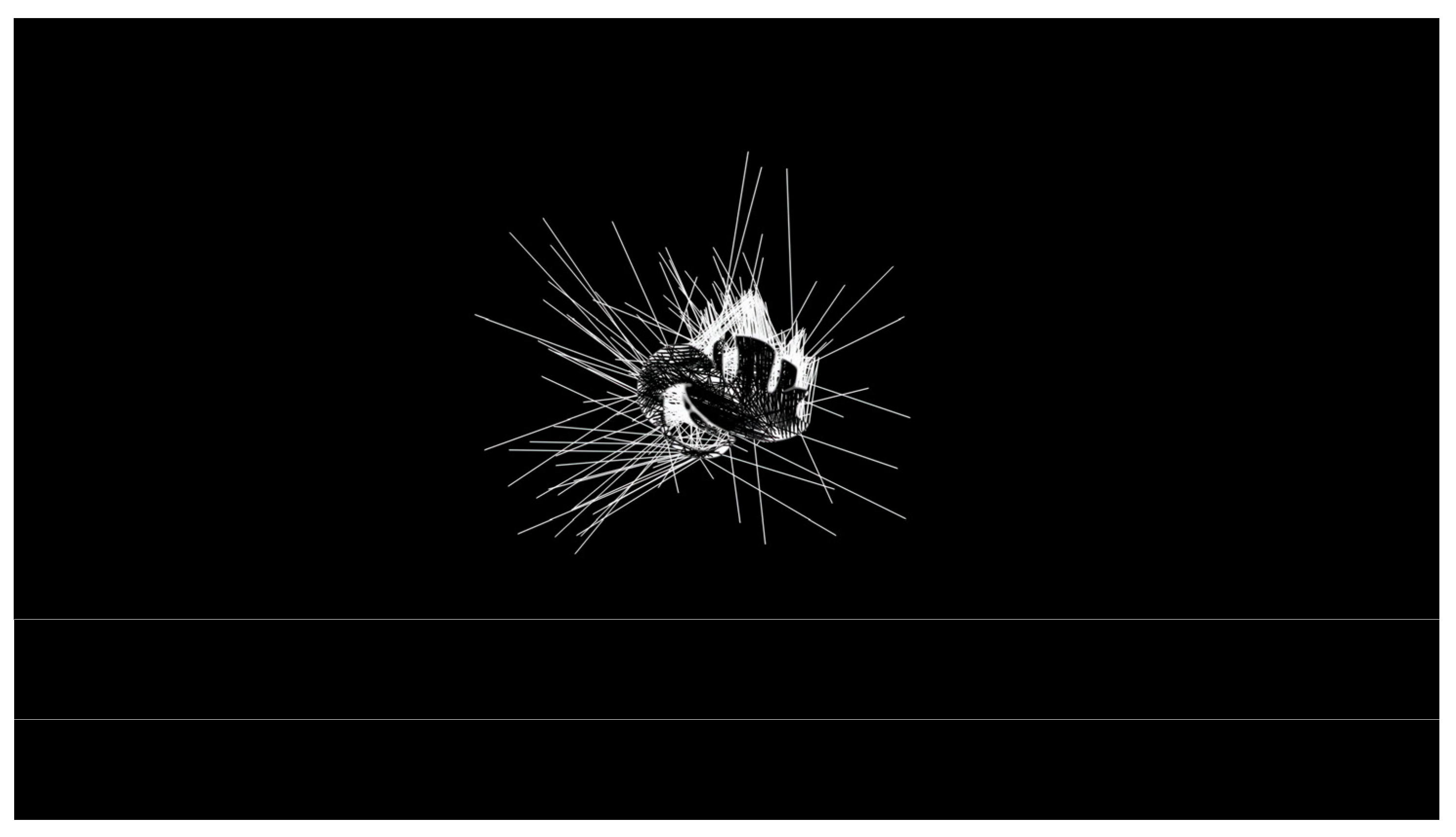
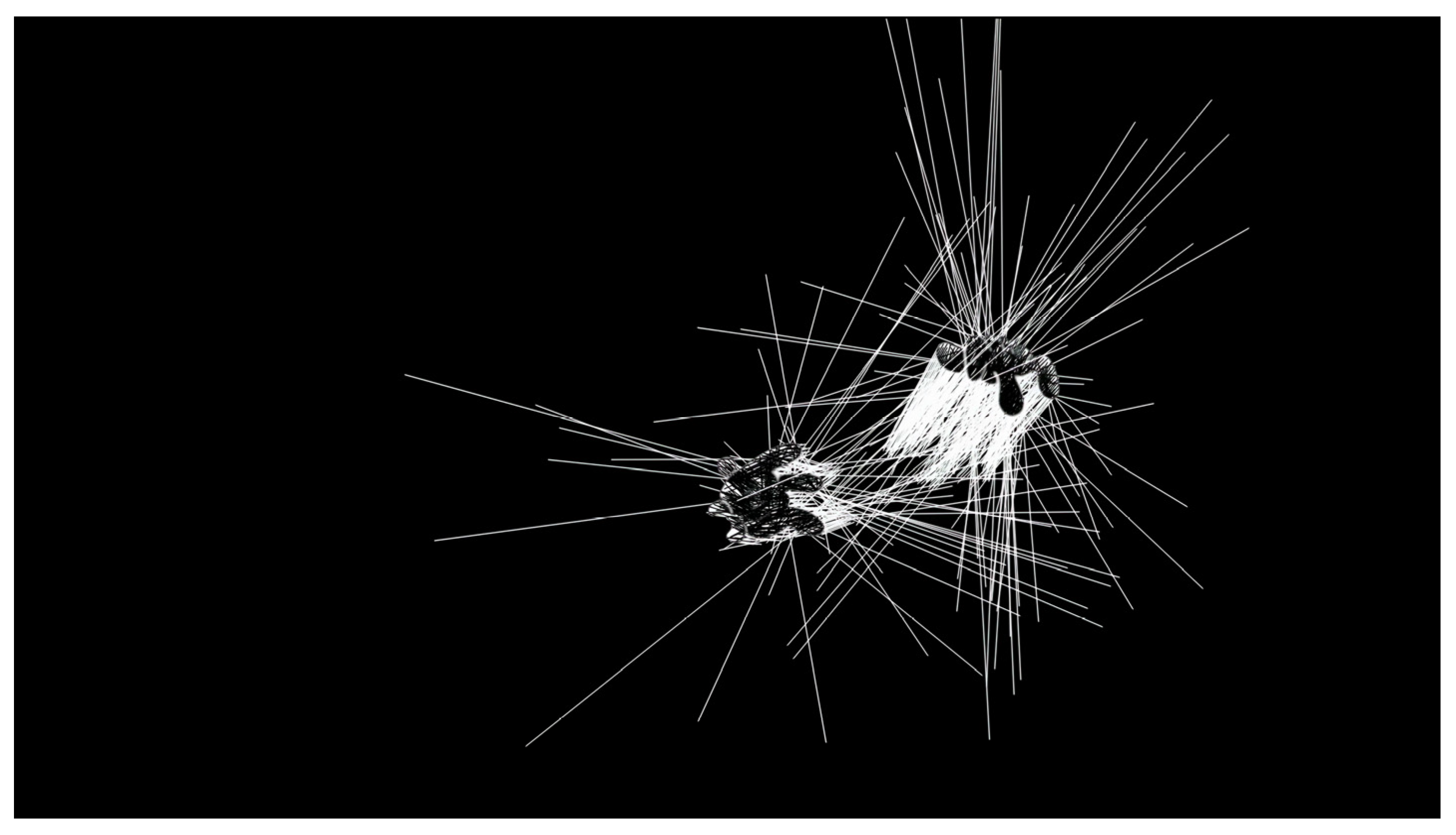
In the middle of a black screen, a small cluster of white lines intersect, from which a few straight lines escape. Coming out of this central, blinking islet, the lines radiate dynamically—the rhythm is rapid, the alternation hypnotic. What follows is a complex vectorial choreography. Lines shoot out spark-like, a tangle of geometric threads multiplying in every direction, until recognizable forms emerge. A gloved hand appears at first, then Mickey’s skeletal head, without the large ears, seemingly swallowed by the blackness. Indeed, obscurity enfolds the figure; the lines illuminate the screen and vanish. Mickey is in a dream, caught in a blast of glowing spikes that express ecstatic joy or, alternately, the threads of a web that ensnare its figure. The film arguably presents us with an experience of blindness at the heart of vision.

The experiment resonates with Jacques Derrida’s text
Memoirs of the Blind: in “The Self-Portrait and Other Ruins”, blindness, he says, is the condition of drawing. “In the beat of a wink, the line of the drawing is traced, between vision and its withdrawal.” (
Derrida [1990] 1993). Guided by his hand, the draftsman does not see the line, which withdraws to allow the figure to emerge. In Arnold’s silent film, designed as a loop, there is no pause—only an incandescent flicker. There is no other “guiding thread” than that of the lines radiating in all directions, simultaneously scratching out the visible and conjuring it. If Mickey’s figure emerges “in the wink of an eye,” it is not the hand of the artist that draws what then vanishes but a computer program to which the images have been entrusted.
This experience of blindness echoes a medical experiment. “Blind Vision” is the title of the first chapter of Samuel Naccache’s book,
Le Nouvel Inconscient. Freud, le Christophe Colomb des neurosciences (2006), which borrows from the British psychologist Larry Weiskrantz the name of a phenomenon—blindsight—that was at the origin of the discovery of non-conscious perception. A patient who is blind to part of the visual field is nevertheless able to identify visual stimuli coming from that same field. The experiment demonstrates that the patient sees unconsciously and, more broadly, allows for “the demonstration of the possibility of an unconscious cognitive life in humans.” (
Naccache 2006, p. 41). Neurologist at the Pitié-Salpêtrière Hospital and researcher in cognitive neuroscience, working in the wake of Antonio Damasio and Jean-Pierre Changeux, Lionel Naccache introduced brain imaging into cognitive psychology and clinical neuropsychology. This cutting-edge technology, which now makes it possible to record brain activity in real time, allows us to identify the cerebral traces of memory lapses in a way that calls into question the very foundations of Freudian psychoanalysis. In his seminal book, Naccache sketches “a living portrait of the contemporary unconscious” (
Naccache 2006, p. 9) and, on the basis of it, argues for the emergence of a “new field of knowledge” (10), a “New Unconscious”, which challenges the polarity of our psyche and the reciprocal roles of the conscious and unconscious mind. “Whereas common ideas about the ‘unconscious’ often stress the influence it exerts on our conscious life, we are now discovering the inverse phenomenon: some of our unconscious processes undergo the effects of our conscious psychological states. This ability of the unconscious to be modified by the course of the subject’s conscious activity grants a degree of plasticity and flexibility that earlier, automatic conceptions of unconscious psychic life did not envisage.” (209). In this sense, Freud may indeed be considered the Christopher Columbus of neuroscience. Like Columbus, he committed a decisive error: if he discovered a continent, it was not the unconscious but consciousness itself, which can never be really separated from it.
Based on the assumptions of Freudian theory, the optical unconscious has fueled art theory and philosophical analysis of works throughout the 20th century, modern American art (
Rosalind Krauss 1993), 19th-century novels (
The Political Unconscious by
Frederic Jameson [1982] 2002), Renaissance texts (
The Graphic Unconscious by
Tom Conley 1992) and the very idea of aesthetics (
The Aesthetic Unconscious by
Jacques Rancière 2001). All these texts question art’s ability to reveal the blindness at the heart of representation; the unconscious is thus explored in as many variables as the works question. But what becomes of such optical unconscious at a time when the notion of the unconscious is being challenged by discoveries in cognitive neuroscience? Thanks to Mickey, Arnold’s film offers an answer to that question.
Mickey, the figure around which the film unfolds, is a key figure in Benjamin’s 1935 version of “The Work of Art”, where the name Mickey Mouse serves as the title of chapter XVI, devoted to the visual unconscious. What Mickey represents is the collective dimension of the concept. If the camera grants access to the immense domain of subterranean perceptions, such perceptions, in turn, affect “the collective perception of the public,” which, Benjamin writes, is capable of “appropriating the individual modes of perception of the psychotic and the dreamer.” In other words, thanks to figures such as Mickey, the dream of each becomes shared by all. Whereas the female automaton stood as one of its expressions, Mickey, on the contrary, becomes the antidote to the collective psychoses produced by the effects of mechanization on the masses.

The figure of Mickey that is at stake here is the one from the late 1920s and early 1930s, capable, Benjamin says, “of making brutality and violence cheerfully acceptable as whims of fate.” This Mickey is a hybrid being, bridging the animal and the technical (as exemplified in Plane Crazy (1928) for example, where the construction of Mickey’s plane mimics the operations of an assembly line, turning the characters into mere cogs caught in a mechanical process). The ways in which Full Rehearsal returns to this particular occurrence of the figure resonate with In Tinseltown’s revisiting of Monroe and its evisceration of the organic and primitive in the machinic appearance of the beautiful automaton.
In his book on Disney, Eisenstein describes Mickey as possessing “plasmaticness
par excellence” (
Eisenstein [1941] 1988, p. 69), a notion that defines the primitive state of matter: like plasma, he has not yet acquired a stabilized form and can take shape as any form of animal existence. Eisenstein employs biological vocabulary. He speaks of “primal protoplasm,” and it is this biological grounding that allows him to pave the way toward what he calls “prelogical thought”: “a conceptual level of man not yet shackled by logic, reason, or experience,” (p. 2) “but man brought back, as it were to those pre-stages that were traced out by…Darwin.” (p. 10).
Pre-logical thought, as conceived by Eisenstein, is situated within the physiological body, thereby distinguishing it from Freud’s conception of the unconscious, which may explain why the first can be understood as the expression of an encounter between consciousness and the unconscious. Hence, in the preliminary note to The Method, from which the text on Disney is drawn: the “problem may be defined as the correlation of the rationally-logical and the sensuous in art: in a creative act, in the structure of a work, in the process of its perception.” (p. IX). From this to saying that this pre-logical thought paves the way to the new cognitive unconscious is only a small step—a step that Arnold’s film takes, provoking, a little less than a century after Disney, “a therapeutic blasting of the unconscious” reinterpreted in light of contemporary technologies.
6. Mickey = Diagram
As with In Tinseltown, Full Rehearsal exploits the flaws of the Lucas–Kanade software, transforming the image into a colored vectorial space. Instead of being properly traced, stretched toward the points, the lines—de-vectorized—escape their technological destiny and form celestial landscapes. Once they become uncontrollable, they convert data analysis into what can be described as a form of drawing. In this way, the disorientation of vectors simultaneously reinforces the experience of blindsight and Derrida’s proposition that the artist intuitively seeks: the shimmering creation arises from blind vision at the heart of the figure. No line without withdrawal, says Derrida. No program without de-programming, one might say in the era of digital visualization, which brings forth a diagram through the interstices of its operations. It is indeed a diagram that the machine’s outbursts brings forth here.

Unlike a program, which anticipates what is to be drawn, the diagram generates thought at the same time that it makes it visible. By combining heterogeneous modes of visualization—the word and the image or the image and the calculation—the diagram does not merely aim to illuminate, explain, or synthesize a set of data gathered into an original figure, usually schematic and abstract; it also stimulates imagination, reflection, and invention.
The diagram as a key concept runs through Gilles Deleuze and Félix Guattari’s book on Foucault, as well as
A Thousand Plateaus: capitalism and schizophrenia and Deleuze’s essay on Francis Bacon’s painting. When pictorialized, the diagram allows us to think about what the act of painting signifies. Starting from Bacon’s statements that the preparatory marks made at random on the canvas contain the work virtually, Deleuze constructs a definition of the concept based on two salient elements. The diagram, on the one hand, is manual. The marks are “manual strokes,” emphasizing the importance of the hand (
Deleuze 1996, p. 66). On the other hand, these marks, these manual strokes that introduce chaos onto the canvas, undo the visual organization of the painting, says Deleuze. They interrupt the process of resemblance—the second key element of the diagram, which tends toward abstraction. In a similar vein, in his course on painting, Deleuze takes the example of a diagram that “devours” the entire painting, as it does in Abstract Expressionism and Jackson Pollock’s work, which is made of lines that do not function as contours: “What is a Pollock line? (…) It is a line that changes direction at each of its moments and that traces no contour.” (
Deleuze 1996, p. 66) Lines that do not create contours “neither delimit interior nor exterior, neither concave nor convex. They do not go from one point to another, even virtually, but pass through points—the colored points thrown by Pollock—and this line meanders, breaks, convulses, constantly changing direction at each assignable moment.” (
Deleuze 1996, p. 66).
The lines in Full Rehearsal remain straight, yet they too pass through points selected by the artist and convulse across the figure, undoing its resemblance to Mickey. These tracings diagrammatize the film beyond its immediately visible graphic style. Infinite or segmented lines that do not outline are also found in the work of Sol LeWitt, with which the film shares affinities. In Lines to Specific Points (1975) and Lines from Corners, Sides and the Center to Points on a Grid (1977), lines originating from points form constellations that the frame seems unable to contain, much like in Arnold’s film where the process does not halt the figure’s gradual emergence. Sol LeWitt is well known for his wall drawings, murals executed from a diagram conceived by the artist, who then delegates the creation of the work to others (an assistant, a draftsman, etc.). Between 1968 and 2007, some 1200 wall drawings were produced, translating the artist’s mental processes, which are expressed in minimalist geometric formulas (lines, grids, circles…). Not exceeding the duration of the exhibition for which they were created, the wall drawings are ephemeral and contingent, for while the diagram sets the framework for execution, the draftsman “interprets” them, much like a musician interpreting a musical score.
Wall drawings are a key element of conceptual art, of which LeWitt is a founding figure: the idea of the work takes precedence over its execution, as he himself expresses in his manifestos
Paragraphs on Conceptual Art (1967) and
Sentences on Conceptual Art (1969): “Once the idea of the piece is established in the artist’s mind and the final form is decided, the process is carried out blindly. There are many side effects that the artist cannot imagine. These may be used as ideas for new works.” (
Le Witt 1969) If the work is “programmed” by the artist, it is also subject to a degree of indeterminacy, and it is to this dual arrangement that the diagram refers: by entrusting its execution to others, LeWitt accepts that “the process is carried out blindly”, precisely as it is in the software used by Arnold, which requires the machine to automatically interpret the data, to act blindly, in short. Deleuze emphasizes that the manual line—a line that creates no figure and which the eye struggles to follow—is one of the key elements of the diagram, which is ultimately understood as “a kind of unconscious of the painter.” (
Deleuze [1981] 2023, p. 151). This brings us to the main connection between the visual unconscious and its diagrammatic reinterpretation: the link these lines weave is caught in the web of the creative process.
Arnold’s film is not handmade, as a classical painting or drawing would be, yet the hand is present; it is even the first identifiable motif through which recognition occurs. Eisenstein had already noted the singularity of Mickey’s hands, which have the gift of stretching “well beyond the dimensions inherent to them.” (
Eisenstein [1941] 1988). They are the salient sign of pre-logical thought for their capacity to transform, to take the place of other limbs, or to become characters. These elastic hands lead toward “the exit from oneself and established norms,” which Eisenstein terms
ecstasy.
In Full Rehearsal, Mickey has lost his ears and his roundness. Pricked and crosshatched, he nonetheless attains the ecstatic joys of the “pre-stage of consciousness” that Benjamin praised and that Arnold reinvents, following numerous twentieth-century artists. The reprises of the mouse are countless—by Claes Oldenburg, Roy Lichtenstein, Andy Warhol, to name only the most famous. Today, these “plasmatic reminiscences,” as Eisenstein might call them, take on a new meaning. Displaced, deconstructed, emptied of content, Mickey—who over several decades has become an icon of American culture—adapts to all media, adopts all styles, and supports all causes, as if he had been filtered through an artificial intelligence program. Arnold’s film also confronts us with this: the potential technological management of a new state of consciousness.
As early as the 1980s, Vilém Flusser associated this new state of consciousness with digital technology, which he considered able to bring about a profound anthropological transformation. In opposition to linear, alphabetic writing, digital technology, he says, “allows a new image-generating gesture” that “manifests itself in the appropriation of point-like elements (calculated elements) to produce an image.” (
Flusser [1990] 2015, p. 51). Yet the terms the thinker uses to describe the possibilities offered by the digital image far exceed its immediate field of application and anticipate areas now covered by artificial intelligence. Flusser identifies the element of unpredictability at the heart of image generation: “The aim of these new images,” he says, “is to make the unexpected appear within given possibilities… They are presentations of calculations analyzing incredibly complex systems that deny resemblance (let us say chaotic). Such calculations give rise to unexpected, informative, ‘beautiful’ images, with which one can play infinitely.” (
Flusser [1990] 2015, p. 51). Flusser further connects unpredictability with imagination: “One can witness this sequence of images as a process whereby imagination has automated itself, as if it had migrated from the inside (let us say the brain) to the outside (to the computer), as if one could contemplate one’s own dreams from the outside.” (
Flusser [1990] 2015, p. 52). The “revolution in human consciousness,” Flusser suggests, is precisely what “image-calculation” aims at, which, instead of being dialogical as a written text is, instead of being “the result of a creative process,” “is the process itself—the act that processes information from which to derive new information.” He also states that the “new imaginary world [that] is being born is a world no longer pre-conceptual, but [a world] produced by the creative process itself. A world of super-conscious dreams.” (
Flusser [1984] 2019, p. 189).
This “world of super-conscious dreams” emerges from the diagrammatic capacity of this new form of making visible, the heuristic powers of which are evident here. It is no coincidence that Gregory Chatonsky, one of the contemporary artists most attentive to AI’s possibilities, refers to Sol LeWitt when describing the “transfinite” possibilities of latent space.
Incomplete Open Cubes (1974), he says, already seeks to construct an overflowing, unfoldable space—a space reduced to its pure potential, which he also calls a diagram (
Chatonsky 2020). In other words, the pre-conscious, pre-logical thought that Benjamin and Eisenstein perceive through Mickey’s figure finds a technological resolution in Arnold’s film, which, rather than fostering a nostalgic gaze on a period of American cinema, draws on twentieth-century conceptual art to reflect on the automation of creative gestures. At the end of his investigation, Lionel Naccache concludes that “Freud’s consciousness did not discover the unconscious; he invented it.” (
Naccache 2006, p. 438) But he immediately adds that “in inventing the unconscious, Freud uncovered a central mechanism of our consciousness: precisely this vital need to interpret, to make sense, to invent through imaginary constructions.” (
Naccache 2006, p. 438) And what if Arnold’s Mickey—protean, plasmatic—was the fictional expression of this very interpretation?
7. Conclusions
With Mickey Mouse and Marilyn Monroe, Arnold chose two key allegorical figures of pre-digital modernity: the first associated with the industrial era and the subjection of the body to a new regime of Taylorist fragmentation and Fordist mechanical rhythms and gesturalism; the second an emblematic figure of commodity fetishism and capitalism’s instrumentalization of human desire. As such, his digital practice can be described as a form of estrangement—the exploration of a technological unconscious that relies on the encounter between the old and the new. But the new, in this case, is a dysfunctional new: the digital software’s glitches are integral to the plastic deconstruction of the two iconic figures. Technology thus arguably mirrors, in its absorption of the accidental and non-intentional, both the symptomatic working of the unconscious as it surfaces in the conscious and the human imagination’s resistance to the notion of technological infallibility.
Both films conjure up what Benjamin called figures of a “collective dream”. Yet, in their reliance on live-action footage on the one hand and animation film on the other, they arguably stand as examples of two separate forms of unconscious, as introduced by Benjamin in “The Work of Art”. The successive analysis of Arnold’s two works therefore allows us to explore the eventuality of a specifically “digital” unconscious following two different methods: a more media-archeological approach that posits the haunting of one technology (the digital) by others (the analogue and beyond, the mechanical) and a cognitivist approach that suggests we could do away with the notion of the unconscious entirely. On the one hand, to address the question of the unconscious from the point of view of the digital absorption of analogue material is to reveal the enduring presence of an older regime of the image and sound, the traces of a machinic substratum that infuses digital technology. As a form of machinic repressed, this substratum exists as part of the digital systems, its presence revealed by the glitches and malfunctions of the software: the convulsing expression, in Arnold’s work, of encoded dreams that carry the traces of the mechanical and the organic. On the other hand, to consider Arnold’s work in the light of the recent research in cognitive sciences is to question the very existence of a separate unconscious. The glitch then arguably emulates the malfunctions or imperfect workings of the perceiving brain and its partial access to the visible.
Common to the two short and compulsive found-footage films by Arnold that inspired this text is the conjuring of images that reflect the (un)conscious mediated by today’s increasingly computerized systems of representation. The darkness pervading both works does not merely hark back to the darkness of the projection room that prompted many associations between the cinema and the unconscious in the first place. It also evokes the depthless well of the ever-expanding digital archive, the reservoir for an automatized memory system, inhabited by monstrous assemblages, briefly illuminated by partially erased figures and grotesque visions. In In Tinseltown and in Full rehearsal, Arnold’s radical reinvention of the cinematic image, where the creative intent folds into the processing of data, thus signals—anachronistically, through the reworking of two icons born in the era of analogue media—towards the super-conscious dreams of Artificial Intelligence which Flusser intuited in the 1980s. In the process, a whole history of rhythms and gestures, media forms and formats, ideological reclamations and iconic reinventions, as well as conventions and styles, is swallowed up and spewed back by the system in an explosion of splintered, sputtering visions.