1. Introduction
In March 2025, I was invited by Weland Art Centre, in Lhasa, Tibet, China, to create a site-specific performance that resonates with the theme of cultural commonalities between Tibetan and Han cultures (the dominant cultural tradition of China’s Han ethnic majority). Weland Art Centre is the first private art gallery founded by Xu Yinglong in Lhasa, built over a period of nine years and opened in 2019. As I found that both Han and Tibetan cultures share the common theme of “life path and self-transcendence”, I created a 25 min site-specific improvisatory dance performance Deconstruction and Reconstruction of the Path of Life. I premiered the performance on 27 March 2025 in Weland Art Centre, where there were twelve spectators at the scene, and livestreamed it simultaneously on Xiaohongshu and Douyin channels.
My positionality as a dancer and researcher is integral to this study. I am not a practitioner of Tibetan dance or Tibetan Buddhism. My relationship to Tibetan culture in this performance emerges from situational encounter during the artist residency in Lhasa, March 2025, and my knowledge about Tibetan culture comes from my high school Chinese history education in China, and my literature review work prepared for this performance. I have both Chinese classic dance training in China and contemporary dance training in Europe. I also have experience of teaching western and Chinese contemporary dance in a university in China. These experiences shaped my approach to improvisatory contemporary dance, which informed this performance. This work does not attempt to reconstruct codified Tibetan or Han dance vocabularies but aims to use contemporary dance improvisation to articulate the dialogue between Tibetan and Han culture through shared embodied experiences—such as pain, breathlessness, fatigue, and recovery.
This performance explores the philosophical commonality of Tibetan and Han cultures: throughout life, Tibetan and Han people are perpetually seeking their identity through deconstructing and reconstructing themselves. As for Tibetan culture, instead of representing a unified doctrinal position within the whole Tibetan Buddhism, my performance draws on interpretive strands found in certain Tibetan Buddhist practice-oriented traditions—such as teachings on lojong (mind training) and Mahāyāna and Vajrayāna practice. These traditions share the common notion that physical discomfort is often seen as the suffering that practitioners must experience as humans, and serves as a pre-stage for enlightenment and transformation (
Lopez 1998;
Powers 2007). In Han Chinese culture, hardship is regarded as an essential means of shaping character and realizing the value of life. In the classical work
Mencius, it is stated that when Heaven is about to confer a great responsibility on a person, it first exercises this person’s mind with suffering, and bones and muscles with toil (
Mencius 2003). This sentence means that trials and difficulties are necessary for assuming significant responsibilities and discovering the meaning of life.
My Han cultural background further informed my decision to use Xuan paper—traditional Chinese writing paper to function as a material partner in the dance to create cross-cultural dialogue. Xuan paper has always been an important material carrier of the spiritual connotation of Han culture from ancient poetry and calligraphy classics to today’s cultural heritage (
Xu and Yan 2024). Using Xuan Paper, I created two intersecting “paths of life” on the stage and then danced on them. When I was dancing, I did not deliberately avoid the physical limitations caused by altitude sickness; instead, I used my breathing as inspiration, combining the physical characteristics of the space, to complete a highly immersive site-specific improvisatory performance.
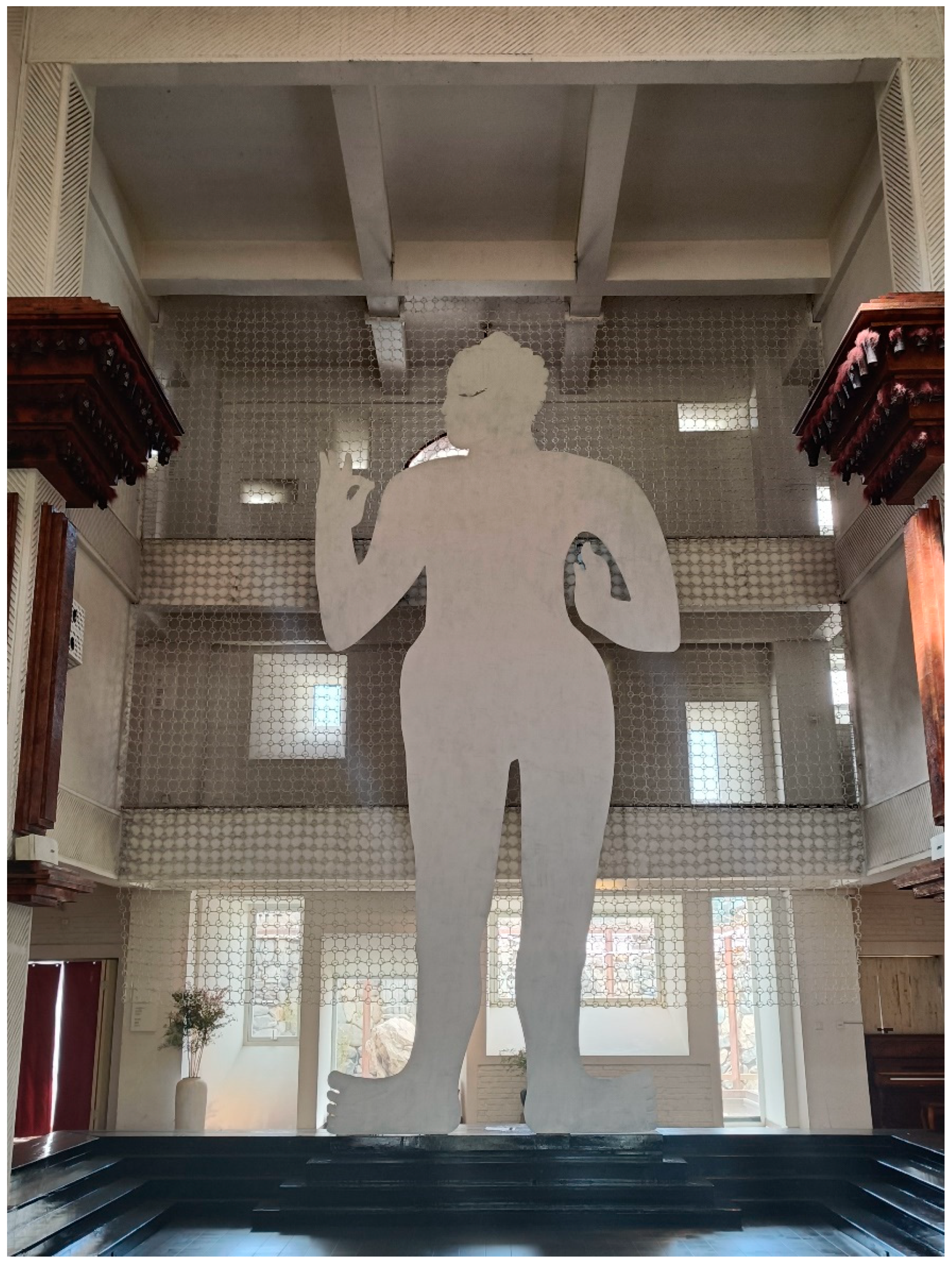
The performance venue, located in a high-altitude and religiously significant city –Lhasa, for it is the spiritual and religious centre of Tibetan Buddhism. The atrium of Weland Art Centre houses a steel Buddha statue (
Figure 1), which is 9 m in height and 4.2 m in width. Its presence reinforces the religious and sacred quality of the performance space, and resonates with the themes of pain, transformation, and self-discovery expressed in the performance. This high-altitude venue also rendered oxygen deficiency an unavoidable bodily condition. The respiratory pain, and body imbalance caused by oxygen deprivation constituted the body threshold that I had to cross before entering the sacred world. This pain was not only a physical response, but more importantly, a process that forced the awakening of my spiritual sensitivity. This cultural context resonates with my physical reactions in this dance performance, in which pain transformed from a mere physical experience into a spiritually significant turning point.
Unlike the traditional dance performance, which aims for pre-set choreography and predetermined movement structures (
Blom and Chaplin 1988a;
Foster 1996), my creation was based on two pillars: the physical setup and spiritual context provided by the dance space, and the improvisatory choreography driven by my breathing difficulties. These two elements intertwined, making the entire performance a response to the space both physically and physiologically. Furthermore, my real painful experience due to respiratory distress transforms the performance’s theme from an abstract concept of “self-discovery” into a more compelling and convincing narrative of the inevitable hardships, perseverance, and awakening along the path of life’s quest.
The following sections will first introduce the research context of site-specific dance, improvisatory dance and pain in dance culture to provide an academic background of this study. A case study analysis will then examine how spatial conditions, and breathing difficulty affect movement logic, respectively, and how they interact with each other to generate movement logic and achieve thematic expression. Finally, the paper will reflect on the research value of practice-based inquiry into embodied suffering and self-discovery.
2. Research Context
In this research context section, it is first necessary to bring together western and Chinese scholarship in the field of site-specific dance and improvisatory dance, because my research is set within the international theoretical context while my dance performance was conducted to intervene the specific cultural and geographic context in China. In other words, the fundamental concepts are drawn from international transactional field of site-specific dance and improvise dance, the inclusion of Chinese scholarship and practice is to provide empirical grounding and local traditions of choreographic experimentation.
In the context of western world, following influences form the visual arts, American postmodern dance began to forward site-specific works in the 1960s and 1970s with typical works such as
Street Dance by Lucinda Childs (1964) and
Walking Down the Side of a Building by Trisha Brown (1970), and soon attracted many other artists to engage in this art genre (
Edensor and Bowdler 2015). Site-specific performance does not occur in traditional theatre but often in unusual places such as city streets, heritage buildings or ruins, and natural landscapes (
Wahid et al. 2025). Site-specific dance is created according to the selected location’s specific features, such as its physical conditions, architectural appearance, ecological environment, and sociocultural characteristics instead of regarding space as a passive background (
Wahid et al. 2025). Similarly, in China, there is also similar practice called environmental dance or site-specific dance. Environmental dance is a rigorous art form that requires dancers to integrate movement language with the characteristics of the environment or space through careful thought and design (
Li and He 2024). It is not just dance casually happening in the environmental space, or simply applying the dance movements from the rehearsal room directly to the real environment (
Li and He 2024). In a word, both Western and Chinese literature emphasize the active role of space in choreography rather than a passive backdrop, and meaning of artworks are inseparable from their location and context.
Improvisation was first used in folk and theatrical dance, but gained its popularity among artists of post-modern dance in the 1960s (
Blom and Chaplin 1988b). Simone Forti criticized that prescriptive choreography and technical challenges forced dancers to give up all sorts of new things appearing throughout their body movements (
Couderc 2009). Improvisatory dance is a mode of thinking in movement, and means moving spontaneously; it is the dance at the particular moment and the particular place (
Sheets-Johnstone 2011). In Chinese contemporary dance context, improvisatory dance has the similar meaning as that in the western context. It is a form of dance that emphasizes instant choices and instinctive physical responses, without predefined movement structures (
Li 2025). The essence of improvisatory dance lies in discovery and creation, and creating a “thinking body”: achieving oneself, and realizing freedom inside and outside of body (
Cheng 2024).
In the field of contemporary dance studies and religious studies, pain is regarded as an experience with layered meanings. In religious studies scholarship, pain is not only a tool for achieving religious experience across diverse religious traditions, but may also constitute the religious experience itself, especially in practices involving endurance, or ritualized bodily discipline (
Salim 2020). In dance, dancers’ perception and experience of pain, and coping behaviours with pain not only reflect the reality of physical limitations but may also serve as a driving force for movement creation (
Soundy and Lim 2023). In dance culture, there is a difference between “good pain” (associated with training) and “bad pain” (associated with injury), but the difference is very subtle (
Tarr and Thomas 2021); it is the experience of pain that incentivizes dancers to engage in their bodily practice through forms of bodily awareness, pauses, tremors, and unplanned movement responses (
Tarr and Thomas 2021). In other words, rather than being a purely negative sensation, bad pain can also heighten bodily awareness, which can be used to shape improvisatory dance performance. In conclusion, the literature about religious pain and dance pain provide a theatrical basis for the expression of the theme (the life struggle) of my dance performance.
The above theory is connected with my creative experience and provides theoretical support to my performance. My dance performance The Deconstruction and Reconstruction of Path of Life is a combination of site-specific dance and improvisatory dance. While site-specific and improvisational dance scholarship has extensively examined spatial responsiveness, how involuntary physiological limitations affect improvisational choice-making is still less discussed. Rather than a radical departure from existing scholarship, my study contributes by extending them for it reveals how extreme physiological conditions can be understood as a generative force that actively shape improvisational logic. In my performance, the plateau breathing pain in this study is no longer merely a physical burden, but an important driving force for dance movement generation, emotional release, making dance a “practice of pain” and a “spiritual transformation through pain”.
3. Research Questions
This study focuses on the following research questions:
- (1)
How do spatial elements, such as Buddha statues, stairs, and flowers, actively shape this specific performance, rather than merely serving as a “stage backdrop”?
- (2)
How do the breathlessness and physical limitations brought by altitude sickness become a source of inspiration for improvisation and thus drive the plot of performance rather than being obstacles?
- (3)
What effects do the interplay of spatial elements and breathlessness caused by altitude sickness have on the performance?
4. Methodology
This study adopts practice-based research, in which artistic practice serves as the primary mode of inquiry. The site of the dance performance is the central research site and knowledge is generated, examined and articulated through the dance performance. Within the practice-based framework, this study employs auto-ethnography from an inside perspective to present my embodied experiences in the specific location, physical states, and spiritual atmosphere. This “inside” method means that I am both the creator and the researcher of the work; the final creative product and the journals I kept during the creative process are the data used for the research analysis (
Batty and Kerrigan 2017). Because this work relies heavily on my on-site perception, changes in breathing, bodily sensations of pain, and spiritual responses to sacred space, the auto-ethnographic account functions here as an analytical tool through which broader choreographic, cultural, and esthetic questions are examined. The design of the methodology is informed by the existing literature discussed in
Section 2. These studies provide the theoretical grounding and ensure the auto-ethnographic account remains in dialogue with established research.
The specific research method in this study includes the analysis of my creative journals and performance videos.
Firstly, the analysis of creative journals focuses on the logs of preparation before my performance and the reflective journals after the performance. These journals include my first impressions of the location, immediate bodily sensations of the atmosphere, the timeline of changes in breathing, the location and spread of pain in my body, the immediate reasons for choosing certain movements, emotional fluctuations, and how breath-related pain evokes spiritual associations. This writing allows me to trace the psychological and physiological logic behind the movements, and to analyze the internal logic of movement generation.
Secondly, the performance video analysis means that, by watching video recordings, I analyzed the details of my dance movements segment by segment. I compared the differences between initial concepts and the onsite improvisation, with an emphasis on how altitude sickness and spatial elements guided the performance logic. In particular, I marked key elements such as changes in breathing rhythm, shifts in movement pathways, moments of falling or pausing, and critical points of interaction with the Buddha statues, steps, flowers and Xuan paper. This process helped me observe how pain caused by oxygen deficiency shaped my physical movements, and how this sacred space supported the creation of a multi-layered story.
To sum up, as
Spry (
2001) argues, auto-ethnography enables performance practitioners to see how bodily experience existed in real life and cultural context. Video analysis further supports this process by critical re-analyzing of movement choices at certain time. These materials are analyzed alongside existing scholarship on site-specific dance, improvisation, allowing personal observations to be situated within established theoretical frameworks and cultural context.
Drawing on Merleau-Ponty’s phenomenology, the body can be seen as an active site of perception and sense-making rather than a passive recipient of stimuli, so meaning can emerge through movement (
Merleau-Ponty 1962). Sheets-Johnstone also sees movement as a mode of embodied thinking, and meaning generation (
Sheets-Johnstone 2011). Thus, this methodological framework enables the analysis of journals and videos to connect individual experience with the examination of how meaning emerges through bodily action in relation to spatial affordances and physiological constraint, while avoiding the reduction in movement logic to mere personal feelings. The following section applies this phenomenological perspective to examine how spatial conditions, breath regulation, and pain lead to the performance logic and generate movement meanings that support the theme of life’ s struggle.
5. Case Study Section of Deconstruction and Reconstruction of the Path of Life
In this section, I analyze three modes of movement generation within this site-specific improvisational performance: (1) site-induced improvisation, (2) physiological pain-induced improvisation, and (3) cooperative improvisation between site and physiological pain. This analytical framework emerged from a comparative study of my creative journals and the performance video, revealing how bodily sensation, spatial interaction, and respiratory difficulty shaped the improvisational process. The site-specific and improvisatory nature of the work transformed spatial elements into active partners and my body into a sensitive medium. Through the analysis of these three modes, I explain how breathing difficulties, specific objects, and architectural features informed the choreography, emotional expression, and symbolic meaning of the performance.
There are five sections of dance performance and they are summarized in
Table 1.
5.1. Creative Dialogue Between My Body and Space
At Lhasa Weland Art Center, the performance space is no longer a silent platform, but a “partner” engaging in a deep dialogue with my dancing body. In the improvisatory dance, the dancer formed embodied thought and emotional response through interactions with space; the body became a sensitive and responsive medium to the environment (
Hunter 2015). In a specific location, dancers may engage with many objects such as vertical surfaces, floor textures, plants, street facilities, and other infrastructural elements (
Edensor and Bowdler 2015).
In my dance performance, spatial elements, such as the square venue, the giant Buddha statue, the stairs at four edges of the stage, and flowers at the Buddha’s feet, explored through my improvised interaction to resonate the theme of life’s struggle. These interaction in my performance generated dynamic relationships and thematic resonance, rather than pre-determined choreographic meaning.
At the beginning of the performance, I laid out the intersecting “path of life” using Xuan paper (video file, 21″–4′12″). The path had small breaks, suggesting the imperfections and uncertainties of life’s journey. Wrapping the Xuan paper around the feet of the Buddha statue was an improvised action. According to my journal written after the performance, at that moment, I wanted to create the turning points in life and make the Buddha statue as a “narrative partner” instead of a static background. When I wrapped the Xuan paper around the feet of the Buddha statue, the softness of the paper and the hardness of the Buddha statue formed a material texture contrast, which constructed a performative tension between bodily vulnerability and statute’s permanence within the sacred space. Xuan paper, associated with Han literati practices of writing, calligraphy, and impermanent inscription, is light, fragile, and easily altered through movement, while the Buddha statue, embodies architectural permanence and ritual continuity. Thus, through this action, the co-presence of Han cultural material (Xuan paper) and Tibetan sacred architecture transformed from an abstract concept to a perceivable spatial interaction.
Throughout the performance, I used the Buddha statue as a reference point: sometimes I moved away from it, sometimes I returned to it, and sometimes I gazed up at it. The key point of improvisatory dance is my immediate adjustment to the relationship between my body, and the space (
Li 2025). Patterns of movement (approaching, retreating, gazing) between myself and the statue generated a clear spiritual orientation. These patterns established the spatial relationship as an active, recurring reference point rather than a passive backdrop.
The stairs beneath the Buddha were elements I used three times. In the second Section, I danced on the Xuan paper and then ascended the stairs (video file, 7′34″–8′03″). Together, the stairs and the stage floor constructed a physical metaphor for “the ups and downs of life”. According to my journal, walking up the stairs suggested my pursuit for a higher level of self-realization. In the third section, when I was lying on the stairs, with my body wrapped in the Xuan paper, I gazed at the towering Buddha statue, with my hands and feet moving upwards (video file, 17′18″–17′45″). From the video analysis, at that moment, the stairs became the venue for my dialogue with the Buddha, as well as my dialogue with my faith. In my reflective journal, I raised the question at that moment: should I abandon the old self and seek the new self? In the fourth section, I sat midway on the stairs (video file, 21′03″). The stairs became a spiritual anchor for “accepting imperfection”, a place where I could pause and reflect, ultimately letting go of my “old self” and embracing my “new self”.
Flowers at the foot of the Buddha statue carried a personalized metaphor in this interactive performance. Attracted by the beauty of flowers while I was dancing, I instinctively deviated from the preset path of Xuan paper and walked towards it. According to my journal, it is not a pre-determined movement sequence but a sudden decision. This sudden decision articulated how cherished things in life can steer my life’s direction. This accidental performance further reflects the essential characteristic of improvisational art: an open attitude towards accidental factors and a talent to incorporate them (
Li 2025). In Section Two of the dance performance, the flowers represented the past, and my interaction with them revealed my reluctance to let go of the past. In Section Three, when I struggled on the ground with Xuan Paper wrapping my body (videofile, 17′50″), my wrapped body and the flower placed on the stairs form an unpredicted visual interplay. Their spatial proximity and shared vulnerability are juxtaposed and amplified within this rigid architectural setting, thereby highlighting the “fragility” of life, and difficulties on the path of life. In Section Four, when I tore the Xuan paper to say goodbye to my past, I still picked up the flowers that I threw away earlier. As I held the fragments of Xuan paper and hesitated over whether to abandon my “old self”, the flowers in hands were so personal, adding vibrancy and warmth to the emotional narrative.
5.2. The Choreographic Logic and Artistic Transformation of Plateau Breathing
The “awareness” of the dancer in improvisatory dance has to be dynamic, acute, and introspective (
Cheng 2024). Lhasa is over 3000 m above sea level, which can cause altitude sickness. Mild effects may include fatigue, headaches, and sleep disturbances, while severe cases could lead to acute mountain sickness, pulmonary edema, cerebral edema, and even life-threatening situations (
Gan et al. 2025). These symptoms, such as shortness of breath and limb weakness, became the core material for my improvisatory creation. Breathing difficulties caused by altitude sickness did not become an obstacle to my performance, but rather my “invisible choreographic partner”. It is important for an improvisational dancer to be fully aware of her or his body condition, muscle tension, breathing rhythm, movement pathways, and the relationship with the surrounding environment (
Li 2025). After careful analysis of journals and videos, I found that, from the initial steady breathing to the later rapid gasping, every fluctuation in my breathing rhythm reshapes my logic of movement in my performance. In other words, this fluctuation propelled the progression of performance from “submitting to my old self”, “doubting my old self”, “discarding my old self”, to “embracing my new self”. This process of transforming physiological limitations into artistic language makes the breathing challenges of altitude sickness a core link connecting my physical reality to this performance’s thematic expression.
In areas above 3000 m in altitudes, like Lhasa, difficulties in breathing and movements are natural bodily responses because of the thin oxygen (
Suolang 2024). These physiological phenomena directly affect the rhythm and intensity of movements, making them slower and more intermittent (
Suolang 2024). That is why I created a unique “breath-movement” logic (
Table 2). At the initial stage of the performance, my body’s adaptation to high altitude was still within a controllable range. Thus, when I danced on Xuan paper, my movements were mostly characterized by stretching and tentative advancement. When my feet gently landed on Xuan paper and my arms waved in the air, my body synchronized with my breath, following the natural logic of “inhale to contract, exhale to release”.
In high-altitude areas, the human body is stimulated by the decrease in oxygen partial pressure, activating the respiratory centre, which leads to a significant increase in both the frequency and depth of breathing (
Gan et al. 2025). According to my reflective journal, as the intensity of activity increased, or after ten minutes’ dance, the effects of altitude sickness caused my breathing to become increasingly rapid, leading to a shift in my movement logic. I wrote in my journal that, after entering Section Three, as the intensity of the movements involving wrapping the body in the Xuan paper increased, I felt an obvious sense of pressure emerging in the middle and lower segments of the sternum. The physical pain forced me to abandon my preconceived smooth turn movements; instead, I adopted a movement language of falling down—getting up—falling down again—getting up again (Video file, 13:56–16:57). Extra force was required when I pressed the palms against the ground to maintain my body balance, and the slight numbness in my legs caused by oxygen deficiency added a more authentic tension to the “struggling” movements on the ground. Just as I recorded in my journal, the extensive use of floor work was aimed at protecting my breathing and reducing physical strain.
The most unexpected aspect in this performance was my use of “breathing pause”. At high altitudes, the ability to control movements weakens under fatigued state, so the balance and coordination abilities decline (
Gan et al. 2025). In my performance, after the climax of tearing Xuan paper, the short breath forced me to crawl on the ground. After crawling, the hypoxia made it impossible for me to adjust my breathing rhythm, so I was compelled to slowly sit back onto the stairs under the Buddha statue (Video File, 17: 19). Sitting on the stairs, I did not suppress my gasping sounds; instead, I amplified them. The amplified breathing sounds became the authentic sound effects of the performance, transforming “breath”—the most fundamental sign—into the core medium of artistic expression. Thus, the audience perceived a real life struggle instead of stage performance. According to ccontemporary performance studies, certain performance forms can lead to authenticity in ways that evoke perceptions of lived reality (
Schulze 2017).
Throughout the performance, I let my body movements completely obey the rhythm of my breath—trembling during rapid breathing, being still during pauses, and slowing down during recovery. The logic of “falling and getting up” and the extensive use of floor work constructed a true performance about the fragility and resilience of life. The breathing curve of “steady—rapid—calm” fully aligns with the theme of this performance: “initial state—struggle—rebirth”.
As Sheets-Johnstone argues, movement itself has an intrinsic capacity to make meaning, emerging from the dynamic interaction between bodily action, and environment (
Sheets-Johnstone 2011). From analysis of creative journals and videos, the pain caused by high-altitude breathing difficulties not only changed the structure of movements but also strengthened the symbolic meaning of the movements. For instance, when my chest was compressed and breath became difficult, my movements displayed clear forms of self-protection: curling inward, drawing the arms toward the body, or crawling close to the ground. In moments when my pain became intensified, my body entered gestures of forced surrender, such as sudden kneeling, collapsing onto the ground, and lying on the stairs. Although these movements appeared to be physiological reactions to pain, they acquired strong symbolism within this sacred performing space. Through repeated sequences of falling, crawling, and recovery, these actions became recognizable as gestural patterns rather than isolated reactions. Their durational repetition, proximity to the ground, and reduced spatial range enabled these movements to be read as processes of release, search, and endurance within the performance context. The interaction between pain, movement, and symbolic meaning forms an important mechanism to push the improvisational process of this work.
5.3. The Symbiosis of Breathing and Space
The interaction of breathing and the spatial characteristics enhances the thematic expression of the theme of “the path of life”. In improvisation, “awareness” serves as the dancer’s source of energy, allowing the body to be “entirely open”, receiving external stimuli while also feeling internal impulses (
Cheng 2024). Corporeal perception and spatial construction are not two parallel threads; instead, they build a complex interactive framework through ongoing interactions (
Li 2025). At high altitude, breath becomes the primary force leading my movement choices, and further influences how I interacted with different spatial elements. In my performance, when I could breathe normally at the beginning, I stood or danced on the stairs and even danced with flowers happily. However, when I could not breathe, I found it hard to continue the dance so I sat on the stairs or even lay on them. Thus, my breath guided my choice of spatial objects to interact.
My distance from Buddha statue was also determined by my breathing condition. When my breathing was steady (Sections 1 and 2), my movements covered the entire square area; when my breathing became rapid (Sections 3 and 4), the dancing area decreased to the space between the “Buddha statue and the center of the stage”. When I could hardly breathe, I approached the Buddha statue and retreated back to the steps. The “steady–rapid” nature of my breathing directly limits the spatial range of the interaction area, creating an “invisible boundary” in the exploration of the space.
The coexistence of breathing and the space ultimately completes the three-dimensional thematic structure of “the path of life”. Changes in breathing rhythm shaped how I positioned my body in relation to the Buddha statue and the steps. Moments of steady breath enabled upright movement and expanded spatial engagement, while intensified breath constrained movement to the steps and ground-level positions. Through this shifting relationship between breath, posture, and space, the performance resonates themes of seeking support, endurance, and recovery. The interaction between breath and space thus reinforces the thematic expression of deconstruction and reconstruction.
5.4. Discussion
This study reveals that the choreographic logic of Deconstruction and Reconstruction of the Path of Life emerges from the interaction between spatial features, altitude sickness, and improvisational response. The pain induced by oxygen deficiency not only pushes the progression of the performance but also functions as a generative force through which struggles on a life journey are articulated.
There are four findings in this performance.
Firstly, it demonstrates that spatial elements in this performance are not passive settings but active participants that influence the choreography. The Buddha statue, stairs, and flowers bring different incentives of specific bodily orientations and emotional states, which generate new movements and new narratives of the dance theatre. For example, the stairs, used three times, actively served in this dance performance as metaphors for “life’s ups and downs” and created dialogues between me and my inner self. Furthermore, the giant Buddha statue served as a “spiritual anchor” and it acted like a “living person” to talk with me. In addition, the Xuan paper wrapping around the feet of statue symbolized the dialogues between Tibetan and Han cultures. This finding aligns with existing scholarship that treats space as the co-creator of movement instead of treating it as passive backdrop (
Edensor and Bowdler 2015;
Hunter 2015).
Secondly, the physiological limitations induced by the high-altitude environment do not become an obstacle in the performance; instead, the breathing difficulties or pains became a primary choreographic force. Breathlessness, chest compression, and instability gave rise to spontaneous gestures of protection, collapse, or yielding. These productive pains in the performance became a source of heightened bodily awareness. For example, the steady breathing in Section 2 enabled me to keep a steady movement sequence on the Xuan paper, while the rapid gasping in Section 3 forced me to turn to the ground and followed a “falling-getting up” sequence. Chest pain drove me to adopt a self-protective gestures like kneeling suddenly. In a word, this finding resonates with contemporary and postmodern practices that use limitation, exhaustion, and bodily vulnerability as creation resources (
Tarr and Thomas 2021;
Soundy and Lim 2023). What distinguishes my performance is physiological pressure induced by extreme condition—high-altitude hypoxia, which makes breathing difficulties become choreographic inspiration.
Thirdly, the interplay between spatial elements and altitude-induced bodily sensations shapes the improvisational logic of the dance performance, physically and physiologically. Rather than functioning independently, these two informed one another, influencing where movement could occur, how long it could last, and when it had to be interrupted. For example, the interplay and the distance between the Buddha statue and me were determined by my breath conditions. When I felt easy to breathe, I danced in the centre of the stage; when I felt the pain of breathing difficulties, I would returned to the stairs under the statue or even lay on them. The interaction between spatial elements and altitude-induced bodily sensations makes this dance performance a real site-specific improvisatory piece, physically and physiologically.
Finally, these findings mentioned above can be understood as a site-induced bodily struggle improvisation mechanism, developed specifically to clarify how improvisational movement emerged in this performance under extreme physiological constraint. This framework draws upon existing scholarship on site-responsive choreography (
Edensor and Bowdler 2015), improvisation as embodied thinking (
Sheets-Johnstone 2011), and pain as a generative condition in dance practice (
Tarr and Thomas 2021), but reconfigures these perspectives through the findings of my dance performance under extreme physiological constraint in Lhasa, Tibet, China. This mechanism has three layers (within this case): 1. site-induced improvisation 2. Physiological pain-induced improvisation 3. Site-physiological pain cooperative improvisation. Firstly, site-induced improvisation means that improvisatory dance choreography comes from the interaction between the dancer and the material conditions of a specific site (such as Buddha statues, stairs, flowers, and the Xuan paper). Secondly, physiological pain–induced improvisation meant that improvisation comes from physiological pain induced by extreme natural condition, say high-altitude hypoxia. Thirdly, site–physiological pain cooperative improvisation means that improvisatory logic comes from the interaction of the two conditions mentioned previously. Instead of functioning as a transferable theoretical model, this mechanism operates as a case-specific analytical device, in this lived dance performing at high altitude in Lhasa, Tibet.
In conclusion, this study shows that site-specific improvisatory dance performance is a continuous negotiation process between the external space and internal sensation. The work also contributes to broader conversations about how dancers generate meaning through interactions with the environment, and how pain induced by the specific environment can become a powerful medium of artistic creation. The work achieves physical and spiritual reconstruction through enduring, transforming, and releasing pain. This study offers fresh insights into contemporary improvisatory dance. It extends the existing literature and scholarship about improvisational dance and site-specific dance to account for physiological constraint as a generative force in choreography.
6. Conclusions
After the performance, three out of twelve audience expressed their understanding of the dance theatre in an informal talk. Although these responses were not conducted as a systematic study, or cannot be treated as empirical evidence, they informed the reflective understanding of how pain, site, and improvisation were perceived in this dance performance. A man said he strongly felt the theme of deconstruction and reconstruction of the path of life. A woman marvelled at how realistic the breath in the performance was. One staff member said that my sudden fall onto the ground was so real that he regarded it as an accident. Thus, the audience’s feedback helps to validate the effectiveness of my performance’s narrative and authenticity.
This performance extends the current practice and research about site-specific and improvisatory dance practice by including extreme natural condition and physiological constraint as generative choreographic forces in the site-specific improvisatory dance performance. Breathing embodies the experience of walking along the path of life, and the affirmation and negation of self. The interaction between space and breathing creates this improvisational performance, where the audience does not need to rely on a complex system of symbols but simply follow the breath and movements of the dancer, understanding the deconstruction and reconstruction of the path of life in this sacred space.
The success of this dance performance relies in two core elements: the real interaction with the performance venue and the authenticity of breathing. The performance space, through symbols such as the Buddha statue, flowers, and stairs, imbued the metaphor of “life’s path” with cultural depth and spiritual dimension. The breathing difficulties brought by high altitude create a unique vocabulary of body language and authenticity for the dance theatre. The irreproducibility of the venue and the uncontrollability of the body are what make this site-specific improvisatory dance performance very unique, creating a true sense of “locality”.
In addition, this study demonstrates that the pain brought by physical and physiological limitations is not in opposition to dance; rather, it can become powerful forces that drive both choreographic structure and spiritual narrative. In my performance, the breath-related pain not only leads my movement creation but also becomes a metaphor for life struggle, and the recovery of breath becomes a metaphorical rebirth.
In conclusion, this study revealed three modes to generate improvisational movement within this case: site-induced improvisation, physiological pain–induced improvisation, and a cooperative mode in which spatial conditions and bodily strain interacted with each other. In addition, improvisation does not come from a purely personal expression or subjective intention, but is a practical process of interaction, adaptation, and compromise between the body and external environmental pressures. This study does not provide a transferrable theoretical model, but rather offers an in-depth analysis of the unique performance under extreme condition—high-altitude in Lhasa. In other words, the main contribution of this research lies in demonstrating an analytical articulation on how bodily constraint and site-specific factors negotiate with each other to generate improvisational logic in performance. However, this study points out a future direction: this case can serve as a starting point to examine how more types of physical limitations (not just high altitude, but also fatigue, injuries, etc.) interact with a wider variety of site-specific practices. Instead of replicating this performance directly, the significance of this case is that it provides us with an effective starting point for future study about how physical limitations alter the improvisational logic in performances at specific venues in other contexts.