1. Introduction
The term “unconscious,” transposed from its origins in psychoanalysis to the domains of collective, cultural, or media theory, is surprisingly slippery and difficult to pin down. On the one hand, it can be understood as what exists but what we cannot perceive with everyday (socialized) human perceptions. This is the way in which Walter Benjamin’s notion of the “optical unconscious” is defined, where technologies like film and photography make perceptible aspects of reality that elude contemporary human consciousness, structured as it is by bourgeois ideals of ownership and hierarchy (
Benjamin [1935] 1968;
[1931] 1999). Rosalind Krauss extends the concept to denote something akin to
latent content, information, or images, which has been suppressed from or which exceeds the polished narratives of modernism: the background rises to the surface (
Krauss 1993). On the other hand, in texts such as Fredric Jameson’s
Political Unconscious and Laura Mulvey’s “Visual Pleasure and Narrative Cinema”, the focus is not just on what is latent or hidden but also, and more importantly, on what permeates and structures mediations themselves (
Jameson 1981, especially pp. 23–49;
Mulvey [1975] 1989).
In other words, the “unconscious” can be understood in these formulations as both what is excluded—or more importantly repressed—by a particular historically situated social formation and what then invisibly structures the modes of expression that emerge in that social formation. Repression and expression, then, exist in a kind of feedback loop: repression is what upholds and structures the expression, and in turn, it is the particular mode of expression that maintains repression.
In analyzing the media practices of the Karrabing Indigenous Corporation, an Indigenous Australian collective based in Belyuen, near Darwin in Northern Australia, it is possible to build upon and deepen this formulation of the concept of an “unconscious” as a repression/expression feedback loop by notably adding two parameters: compression and distension. These additions allow, at least in part, understanding of the notion of the “unconscious”, especially when preceded with terms like “digital”, “colonial” and/or “ecological”, not simply as a latent element that structures visual form but as a structural, collective and infrastructural force—an emergent dynamic between systems of exclusion, state violence, and media operations. As suggested by the suffixes of the four parameters I articulate here, this force or dynamic is essentially one of pressure distributed across multiple (lived and virtual) environments and relations: pushing inwards, outwards, downwards, and upwards. In this sense, the notion of “unconscious” that is formulated here is perhaps most closely related to the reworking by Jean-François Lyotard of Freud against Lacan in his writings on the figural, where he similarly spoke in terms of a “deconstructing pressure”, a “force exerted” by the unconscious (
Lyotard [1971] 2011, pp. 267, 381). In Lyotard’s conception, derived from Freud, the unconscious operates through four processes—condensation, displacement, considerations of figurability, and secondary revision (
Lyotard [1971] 2011, p. 238)—which, to a certain extent, can be mapped onto the four parameters mentioned.
2. Repression
Making visible what a society has structurally repressed or rendered invisible is, of course, never a neutral or purely aesthetic act. It necessarily involves a confrontation with the very systems that have organized visibility in the first place. As Louis Althusser writes, speaking of the admittedly distinct but related problem of ideology, the invisible is “the
inner darkness of exclusion, inside the visible itself because defined by its structure” (
Althusser [1968] 1970, p. 26). If the structure of the visible in a given situation is defined necessarily by what it has repressed (or made invisible), then bringing this repressed element to a state of visibility means restructuring visibility itself. This relationship between visibility and invisibility is therefore not incidental; it defines the stakes of counter-hegemonic cultural production.
Of course, this dynamic is particularly evident in colonial contexts. The very foundation of the colonial project rests on forms of repression, exclusion, and invisibility that are at once physical, discursive, and ontological, as multiple scholars have shown (
Glissant [1990] 1997;
Mbembe [2016] 2019;
Povinelli 2016a;
Short 2016;
Wolfe 1999). Settler states have historically operated through both force and epistemic erasure, repressing colonized bodies, beliefs, and histories from the visible realm of the colonized world. The example of Australian colonialism is paradigmatic in this regard. As Damian Lentini, Australian curator and historian, reminds us, this history unfolded in two phases (
Lentini 2023). First, a direct, violent, and visible repression in the southeast of the country through forced removals, massacres, and land seizure. Second, a more insidious erasure in the north and west, where Aboriginal presence was actively repressed from national memory. This so-called “Great Forgetting”, or “Great Australian Silence” (
Page and Pooaraar 1996;
Stanner 1968), coincided with the rise of extractive industries such as mining, which depended on conceiving the lands as empty: Terra Nullius. Aboriginal people were thus not only displaced and massacred but rendered invisible, their lands transformed into simple opportunities for resource exploitation.
In the words of the Karrabing themselves, written on cards enclosed by the collective into each copy of a recent publication linked to an exhibition they mounted in Vienna: “They pretend not to see us”; “White people only want what is valuable in their eyes”; “Then they tried to massacre us so we wouldn’t be there”; “Another history still exists in the sand” (
Karrabing Film Collective 2023). And indeed, the video works of the Karrabing can often be explicitly understood in these terms, as a surfacing of a certain history and presence that, while continually repressed by the Australian settler state, “still exists in the sands”: in the lands themselves, and in the bodies of those who inhabit those lands.
The creation of the Karrabing Indigenous Corporation (or Karrabing Film Collective, depending on the context) is directly linked to this resistance to repression. They formed in 2008 in the aftermath of two violent events. The most well-known was the Australian federal government’s now infamous “legislative fiat” (
Lea 2020, p. 12), the Northern Territory National Emergency Response (NTNER), better known as “The Intervention”—a sweeping policy initiative ostensibly aimed at addressing child abuse and social dysfunction in remote Aboriginal communities. In reality, the Intervention was a dramatic escalation of settler-colonial governance; the federal government suspended the Racial Discrimination Act in the Northern Territory, imposed compulsory welfare quarantining, reorganized land tenure, and subjected Indigenous households to new levels of surveillance, policing, medical scrutiny, and data extraction, all under the rubric of “normalization”.
The Intervention was also imposed on the Karrabing in the aftermath of another violent event that had rocked their community and rendered a number of them homeless: what they have called “The Riots”. In early 2007, members “were threatened with chainsaws and pipes, watched their cars and houses being torched, and their dogs beaten to death. Four families lost rare, well-paying jobs in education, housing, and water works” (
Povinelli 2011, p. 140). The reasons for this violence, as writes Elizabeth Povinelli, the anthropologist and only non-Indigenous member of the Karrabing (and often de facto spokesperson for the collective), were because of the imposition of settler logics of “recognition”, which expect contemporary Indigenous communities to conform to easily legible “clan affiliations”, created as “a way of managing difference in late liberalism” (
Povinelli 2011, p. 141). In other words, what Povinelli has called the “cunning of recognition” (
Povinelli 2002) is one of the ways in which the contemporary existence of Aboriginal communities in Australia has been repressed from settler imaginaries: by “recognizing” their difference, but only in ways that freeze those communities into imagined ancestral identities.
There is a productive analogy to be drawn here between this repressive logic of “recognition” as formulated by Povinelli and the reformulation of the unconscious operation of “secondary revision” by Lyotard. In both cases, we find a flattening of difference under the guise of clarity or inclusion—an operation that occurs “at once on the surface and at the heart” (
Lyotard [1971] 2011, p. 267) of the system it sustains. For Lyotard, secondary revision is the process that “ostensibly flatten[s] out the relief” (p. 265) of the dream, fabricating a readable surface from apparently incoherent intensities. Similarly, for Povinelli: “Even at the moment of their inclusion into the liberal multicultural state imaginary, specific Indigenous histories, memories, and practices are irrelevant. Instead, these diverse and sometimes fragmentary elements have to be reformulated to fit the uneven terrain of common and statutory law, criminal codes and common values” (
Povinelli 2002, p. 170). This demand for reformulation exerts pressure that distorts the very forms of life it is supposed to affirm. Like secondary revision, recognition does not just conceal difference but rather structures it into legibility, making only certain differences expressible. Both are thus systems in which legibility is produced through repression, and where the figure—the excessive, the relational, the non-coherent—must be recontained as “the membrane of cultural difference” (
Povinelli 2002, p. 180). These operations are not distortions of the system: they are its foundation.
3. Expression
The modes of expression that we can find in the films of the Karrabing are thus analyzable in terms of these repressions: pushing up against them, inverting them or simply bringing them into
figurability (to reference in passing another of Lyotard and Freud’s operations of the unconscious, which finds ways to transform discourse into images by tapping into the figural forces, which exceed discourse from within (
Lyotard [1971] 2011, pp. 243–46)). For example, in
Wutharr, Saltwater Dreaming (2016), we find a somewhat disorienting, at least for Western audiences, questioning of overlapping causalities through the depiction of a seemingly mundane incident, based on an event that actually happened to members of the collective: the breakdown of their boat motor. The film responds to this event by creating a complex web of interpretations and explanations for exactly
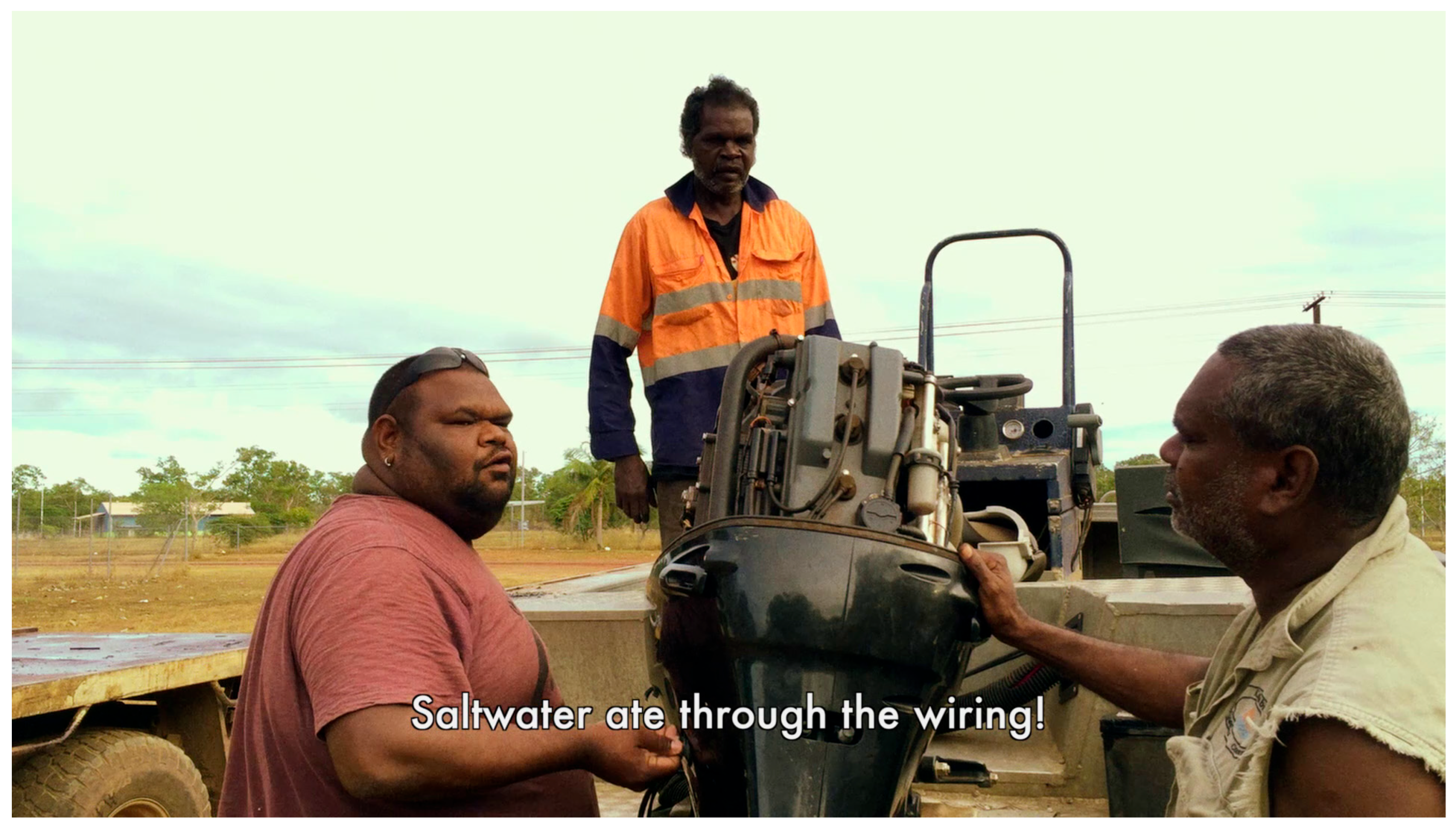
why the motor broke, each articulated by different members of the collective. One explanation, given by Karrabing member Trevor Bianamu, attributes the failure to ancestors expressing their unhappiness with the community; another member, Linda Yarrowin, instead posits that Christian ancestors are sending a message; and lastly, Rex Edmunds points to more direct mechanical causes: corroded wiring and saltwater damage exacerbated by the group’s inability to afford repairs (
Figure 1). Each explanation is shown in a series of flashbacks that increasingly intermingle the past and the present.
As Vivian Ziherl observes, the competing explanations offered in
Wutharr align with distinct “regimes of governance”: “the moral system of Judeo-Christian values that underpins the juridical structures of settler society; the capitalist system of material extraction and deprivation that determines mere possibility; and finally, the geo-ancestral system of obligation to which the Karrabing are also fundamentally bound” (
Ziherl 2023, p. 116). These overlapping regimes create contradictory demands that cannot be reconciled, and
Wutharr does not try to resolve them. Instead, the film allows these contradictory pressures to accumulate, shaping its fragmented, multi-perspectival structure. Scenes bleed into one another, temporalities clash and collide, and the same event is replayed through multiple lenses, refusing closure. Through this complex montage, the film shows repression to be not just a single act of exclusion but a complex, distributed field of constraint.
This fragmented aesthetic emerges directly from Karrabing’s shift away from “conventional” filmmaking after their first full film,
When the Dogs Talked (2014), which depicts a search for a lost family member in order to keep government housing. The group follows the topography of the Dog Dreaming as they discuss the place of older traditions in their contemporary everyday lives. As Povinelli describes, the initial impetus behind this first project was to make what they called a “proper film”, and they invited filmmaker Liza Johnson to “show [them] how”. They also enlisted the help of other film professionals, including editor David Barker and cinematographer Ian Jones. While this experience was instrumental in introducing the Karrabing to filmmaking as a craft, it also meant that they had to adhere to the norms of industrial production, including “production schedules, character psychology, Western narrative logics, including assumptions about materiality and time” (
Fisher and Seale-Feldman 2021). Working in this way meant adopting a division of labor, a temporal discipline, and a mode of expression that mirrored the very systems of repression they lived under, thereby flattening out their lived experience to make it legible to Western cinematic codes.
In response, the Karrabing then adopted a radically different approach in
Wutharr and their subsequent film projects. They turned to iPhone filmmaking, embracing the lo-fi, mobile, and intimate possibilities offered by digital consumer technology. The use of smartphones allows a specific aesthetics and visual language to be mobilized in the film, which can be understood through what artists and scholars Camille Baker, Max Schleser and Kasia Molga have termed the “Keitai” aesthetic of mobile filmmaking (in reference to the Japanese word Keitai, meaning “hand-carry, small and portable, carrying something, form—shape or figure, mobile phone”) (
Baker et al. 2009, p. 102). The first level of this aesthetic is “visual”, embracing the apparently low-quality aspects of the mobile image. The images of
Wutharr are thus marked by digital grain and slight pixelization, shaky and sometimes off-kilter framing, relatively abrupt editing, and uneven sound recording. The viewer is thus denied the comfort of the stable, clear gaze of Western cinematic standards. Moreover, since the iPhone cameras they use also have a relatively shallow depth of field, their use facilitates what Jake Matthews calls a “language of fragmentation” (
Matthews 2022), thereby privileging close-ups of people and places in proximity. Thus, those who are part of the Karrabing are shown in intimate foreground, whereas settler figures appear only as blurred or peripheral.
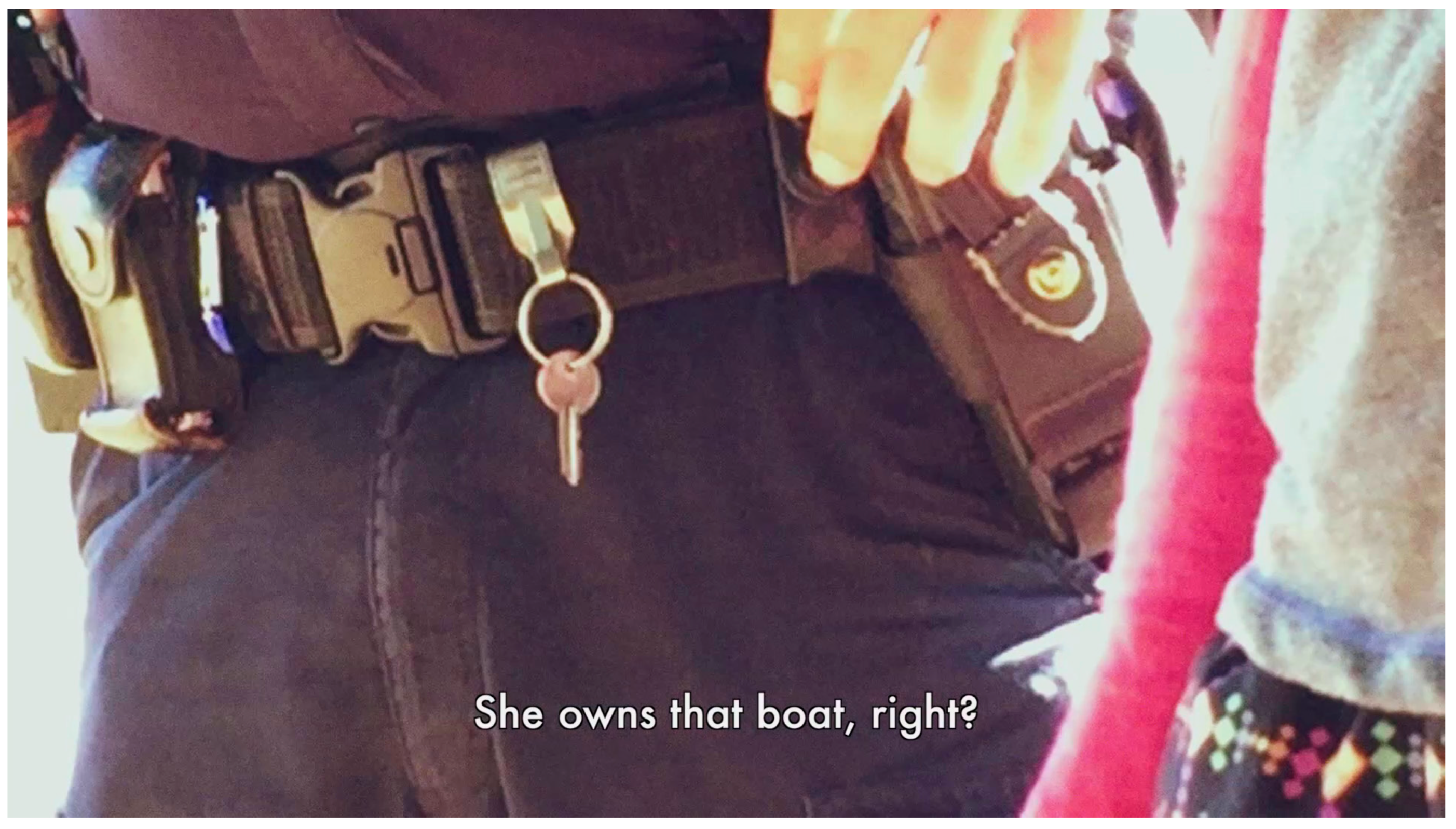
Indeed, the forces behind the repression shown in the narrative are never directly personified on screen. Police voices crackle over radios, insults are shouted across water, hands grip steering wheels, bodies appear in shadowy outline inside police vehicles, and we sometimes have brief close-ups on elements of police uniforms, but they are never given complete visual form (
Figure 2). Their presence is thus shown as ambient, constant, stifling, and infrastructural, suffusing the spaces Karrabing inhabit while remaining barely visible at the edge of the frame. A dual pushing up against the logics of repression seems to be at play here. Firstly, this deliberate visual politics can be seen as inverting the classical cinematic hierarchy of presence. As Marcia Langton has demonstrated in Australia, and others, such as Michelle H. Raheja, have shown in other colonial contexts, the Indigenous presence in film has historically been situated between invisibility and alienating hypervisibility, either not shown at all or abstracted into disembodied archetypes (
Langton 1993;
Raheja 2010). Here, it is the representatives of white settler culture and power who are pushed to the margins of the image and transformed into abstract functions of a wider system. But also, the visual absence of white figures is a cinematic expression of their structural omnipresence, a constant, often invisible pressure that nonetheless shapes what is possible.
The second and third levels of Keitai aesthetics, as defined by Baker et al., are, on the one hand, situated in the
technosoma of mobile phones—that is, the way that those digital devices have been incorporated into our evolving social corporeality—and, on the other, in the
communicative aspect of mobile phone cameras (
Baker et al. 2009). Digital mobile film aesthetics are thus at once
extensions of the bodies that create them and
modes of communication in entirely new ways from classical cinema. Roger Odin writes of a similar notion when he talks of how smartphones have transformed “cinematic language into ordinary language (
l’instauration du langage cinématographique en langage ordinaire)” (
Odin 2018, p. 8). Smartphone images become vectors for interpersonal communication, and as such, transform the visual language of traditional cinema into something new, more intimate, more social, and more diffuse. The Karrabing films utilize smartphone aesthetics at the intersection of these two levels of Keitai aesthetics as a means to exceed the repressive pressures imposed upon them by both the state and the injunctions of “conventional” film practices. Their strategy of excess manifests itself most clearly in what the members of the Karrabing call “improvisational realism”, grounded in the tactile immediacy and the temporal fluidity afforded by digital smartphone cameras.
Improvisational realism can perhaps be most succinctly summed up by the credo they emblazoned on the cover of the catalog for their previously mentioned exhibition: “No Storyboard, No Script, We Make Our Films From Our Life And Lands For Our Life And Lands”. The Karrabing’s films are thus produced in a fluid, participatory manner, involving collectively created stories—often based on real experiences—that evolve during shooting, with no fixed script and no centralized direction. Plot ideas emerge from within the group, are shaped collaboratively, and are developed as filming proceeds, often over an extended period, depending on who is available and willing to participate at the time. Dialogue, cinematography, and sound are all improvised, with production roles shifting among participants. Apparent continuity errors—such as changes in clothing, props, or the absence of characters—are not oversights but rather testify to the daily disruptions in their lives, including incarceration, welfare appointments, or other colonial intrusions. As writes Povinelli, improvisational realism thus “articulates as an artistic style to an art of living. It pulls into the aesthetic register a mixture of fiction and fact, reality and realism, and a manifestation of reality (a realization) through this admixture. And thus the governance of existence and the aesthetics of representing existence cannot be unwound” (
Povinelli 2016a, p. 76).
Improvisational realism therefore becomes a material practice of anti-recognizability in the terms of settler logics. The temporal drift and collaborative looseness enable a cinematic language that is non-linear, non-authorial, and structurally open—resistant to the narrative resolutions and character arcs that settler cinema demands in order to render Indigenous life “legible.” Against this flattened legibility, the Karrabing’s films articulate a mode of expression that retains
opacity (
Glissant [1990] 1997, pp. 189–90) towards Western audiences. And this mode of expression is inseparable from the medium: the mobility and informality of smartphones allow for these types of images that standard cinema typically excludes. Expression, then, can be understood not only as the crafting through a specific medium of the most appropriate form to make best visible the everyday repressions the Karrabing must confront, but also in its etymological sense:
expression, a pushing out against the pressures that seek to flatten and contain—or
compress.
4. Compression/Distension
Indeed, the space in which the Karrabing are allowed to maneuver is
compressed, or, in Povinelli’s words,
cramped. Povinelli writes of their community having to exist in what she calls “the cramped space of late liberal geontopower” (
Povinelli 2016a, p. 148). Interestingly, the term “cramped space” is also the usual English translation of “
espace exigu” used in Gilles Deleuze and Félix Guattari’s writings on minor politics. For Deleuze and Guattari (and then for Deleuze in
Cinema 2), the cramped space of the minority condition creates the conditions where the personal and the political are necessarily intertwined (
Deleuze and Guattari [1975] 1986, p. 17). As argues Nicholas Thoburn, this cramped space needs to be understood in the French philosophers’ writings not only as a spatial description but as a social condition—involving all the dimensions of the social being—a condition of “
immanence to the social, to the multitude of constraints and commands associated with lives interlaced with and buffeted by global social relations” (
Thoburn 2016, p. 370). But at the same time, it is only from within this cramped space that a minor politics can even become possible (
Deleuze [1985] 1989, pp. 218–24), since, in brief, this condition “forces its subjects […] to fashion lives with whatever materials, languages and identities they find close at hand” (
Walters and Lüthi 2016, p. 362). In other words, it is in maneuvering within and through the very compression of existence that a possible
distension can be found.
In terms of the film practices of the Karrabing, this dialectic relationship (or feedback loop) between compression and distension is evident in another aesthetic strategy employed in many of their films: the layered superimposition of images. We find this form of compression—understood here as the compression of multiple images into one frame—employed many times in their 2018 film The Mermaids, or Aiden in Wonderland. Set in a speculative future where white populations can no longer survive outside due to environmental toxicity, the film follows Aiden, an Indigenous boy who has been subjected to state medical experimentation and institutionalization. Apparently, in the post-apocalyptic world that the film presents, it is only Indigenous people who are still able to withstand being outdoors, and therefore, Aboriginal children are being routinely rounded up to be experimented on to find a way to immunize the white populations. Once he is too old to stay in the militarized medical facility, Aiden is expelled to the outside world, where, guided by an uncle, he tries to find his way in the hostile environment. Along the way, we encounter various characters and dreamings and discover the instrumentalization of the “mermaids”, beings who are supposed to be protecting the “children of the mud” but who seem to have been forced to cooperate with the white authorities. In multiple instances throughout the film, Aiden meets people who are each explicitly shown to be also rivers, also bees, also cockatoos, and so on. These are not beings that have transformed into other beings; they are each all at once human bodies, animal beings, and topological elements.
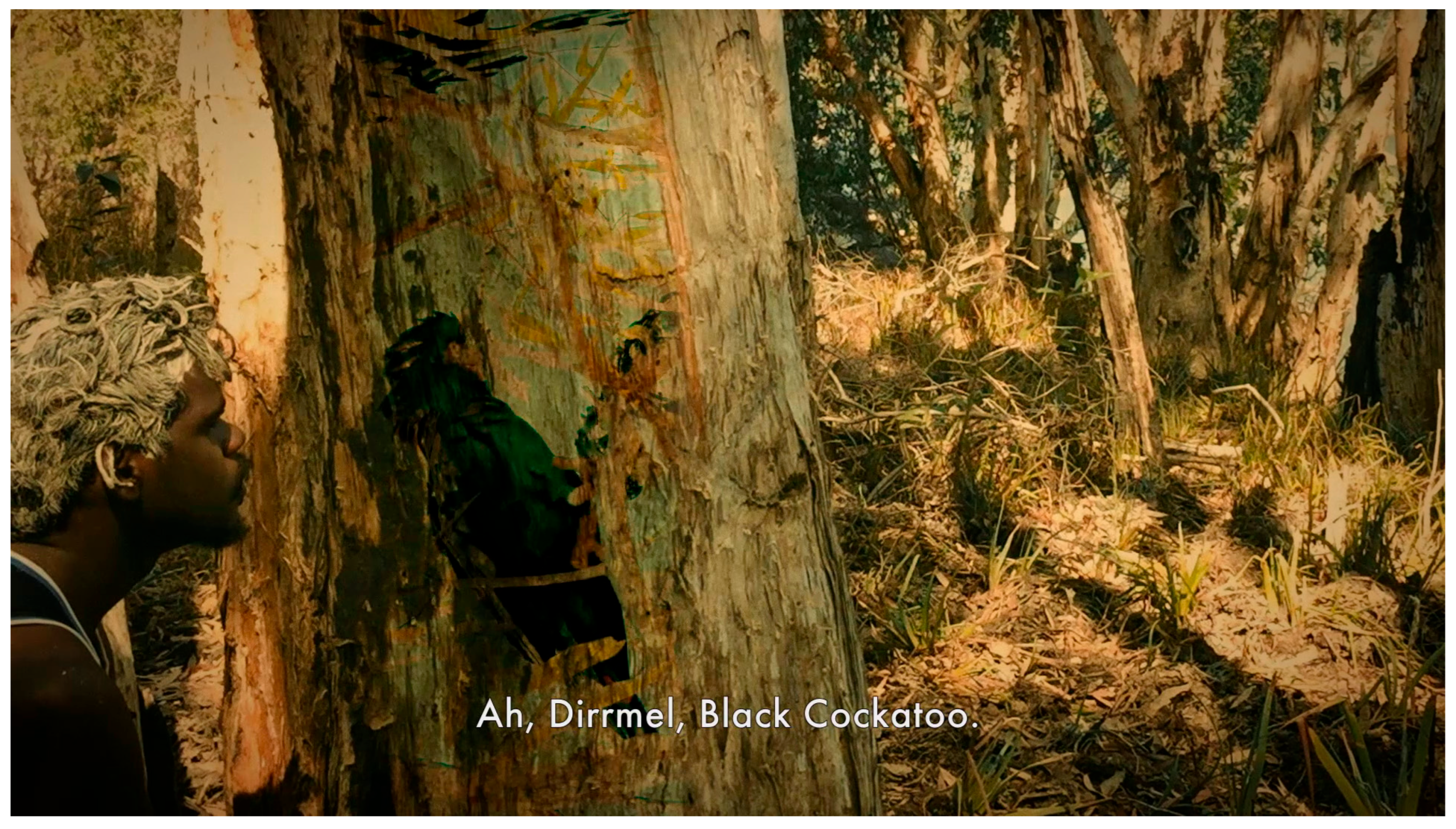
The plural existence of these beings is made evident in the film through the superimposition of images of these non-human entities onto the image of the specific Karrabing member acting out the corresponding character. Thus, when they meet Dirrmel, the Black Cockatoo, who will try to entice them into swimming with the mermaids, we see a man sitting between two trees, looking toward the lake. Right next to his head, on the tree trunk next to which he sits, we see superimposed the image of a black cockatoo (
Figure 3). In the scene that follows, when Dirrmel is recaptured by one of the white men (whose face is entirely obscured by a full hazmat suit and mask), it is worth noting that the superimposed image is no longer visible. The white man cannot seem to perceive this other existence of Dirrmel as a cockatoo and instead seems to take Dirrmel’s insistence that he is a cockatoo as the ravings of a madman. It is only the Aboriginal characters who seem to perceive this double existence of Dirrmel, and we are seemingly led to understand that, at that moment, we should be hearing Dirrmel’s voice emanating from both the human and non-human bodies that we see in the frame.
As with the use of improvisational realism, the superimposition here disrupts the settler’s “legibilization” of the Karrabing members’ worldview. We once again have a faceless white representative of settler authority that not only attempts to restrict the movement of characters deemed unfit to exist as and where they please but is also unable to see the specificities of their existence outside of overriding logics of pathologization and control. At first glance, this compositional logic may appear to affirm compressed or “flat ontology” (
Bogost 2012, p. 11;
Viveiros de Castro [2009] 2014, pp. 102–6) at the same time as a certain form of compressed long time: ancestral beings, places, animals and contemporary humans all coexist synchronously (while also being in the past and the future) in the same localized bodies. And indeed, as Robert Stam has remarked, we find similar forms of superimposition in several films by Indigenous filmmakers from around the world, as it creates a mixture of realism and “magic”—continuing in the tradition of Raul Ruiz’s call for a “shamanic cinema” (
Ruiz 1995, p. 73)—and “allow[s] for oneiric and fantastic temporal transformations and spatial overlays” (
Stam 2023, p. 42). It is important to note also that, as Stam mentions, this prevalence of the use of superimposition seems concurrent with the “post-celluloid potentialities of the digital” (ibid.). On the one hand, Stam’s formula can be understood simply in the sense that digital editing allows easier access to a broader array of effects that anyone can use. On the other hand, the apparent concurrence of the rise of digital media and the use of superimposition could also have something to do with the difference between digital and analog techniques of superimposition. Analog superimposition has historically been associated with ghostly, translucent apparitions, accentuating the otherworldliness and fragility of the superposed images: Bazin famously wrote that “superimposition on the screen signals: ‘Attention: unreal world, imaginary characters’” (
Bazin [1946] 1997; see also
Natale 2012). This association between superimposition and ghostliness is in part due to the type of analog processes required to create the superimposition effect, which tend to “weaken the level of perceptual detail available” in the images (
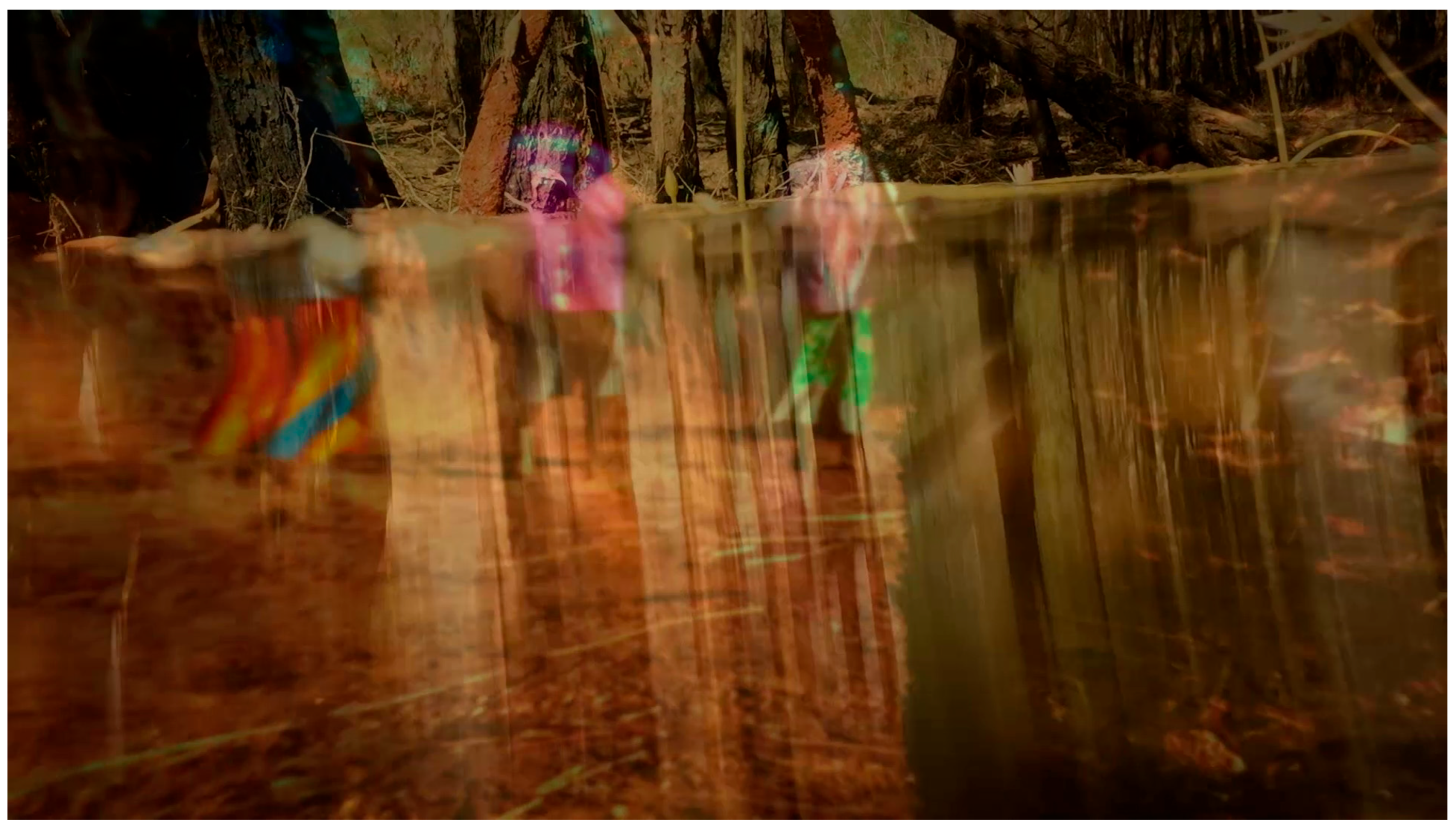
Balsom 2017, note 33, p. 89). Digital superimposition (or compositing) is a distinct process, and therefore the relative “solidity” of the superimposed images can be more easily reinforced or reduced as desired. Here, when we see animals superimposed onto the images, linking them to the human bodies and the places of the scene, the images are defined, not translucent; they exist on exactly the same plane. In other parts of the film, however, as when we see the mermaids, the superimposition becomes much more translucent, giving a clearer sense that different spiritual worlds are intersecting with the physical realm (
Figure 4).
This malleability of the superimposition, and the fact that the superimposed cockatoo disappears when the white figure of authority appears, leads us to nuance this idea of a “flat ontology”. Povinelli warns indeed that such an ontology, when adopted without attention to power, can obscure the very dynamics that structure who or what is allowed to appear in shared space. “The world is not flat,” she writes, “when viewed from the unequal forces redrawing and demanding certain formations as the condition for an object’s endurance, extension, and domination of interest” (
Povinelli 2016b, p. 119). The compression enacted by the superimposition is therefore not neutral. Instead, it reflects the pressure of these unequal forces. When the authority figure captures Dirrmel and the cockatoo disappears, underscoring the colonial refusal to recognize relational multiplicities, what appeared moments before as a coexistence of forms is forcibly compressed into a legible subject of governance. Rather than affirming flatness, Karrabing’s compressed images insist that all presences are not equal in the eyes of everyone, subjected as they are to differing regimes of visibility.
Here, then, we see how the different uses of superimposition as compression translate to, seemingly paradoxically, a distension, understood perhaps in the sense of a localized swelling that attempts to resist flattening from outside forces. Lyotard described the double forces of unconscious condensation and displacement in a way that could help make this strategy clearer: “Take a text written on a sheet of paper and crumple it. The elements of the discourse take on
relief, in the strict sense. Imagine that before the grip of condensation compresses the dream thoughts, displacement has reinforced certain zones of the text so that they resist contraction and remain legible” (
Lyotard [1971] 2011, p. 242). In a sense, the superimposition used by the Karrabing is thus a compression—of worlds, of times, of people, animals, and places—that becomes a distension against other, colonial compressions into legibility. If, as Povinelli says, the question of ontology is one of power relations that dictate what exists and can be seen on equal footing with other existences, then here the superimposition creates a “maximal saturation” (
Povinelli 2016b, p. 119), which rigidifies against the exterior hand coming to crumple and ultimately flatten and at least temporarily distend the space in which the Karrabing can maneuver.
This compression/distension feedback loop is perhaps most forcefully put on display in another of the Karrabing’s projects, which is as yet unrealized but was in fact their first idea for a collaborative project, and one they still hope to bring to fruition. It is an augmented reality GIS/GPS archive, a type of “land-based living library” known as “Mapping the Ancestral Present” (
Povinelli 2016a, p. 147). This archive will exist as a smartphone-based application that functions by geo-tagging specific media files to GPS coordinates so that they only become accessible when a user physically occupies a given site. As users move through the landscapes around the area where the Karrabing live, they would find different icons on their screens; when touched, these would show stories of the Indigenous Dreaming site where they find themselves: photos, short films, and other forms of archival media. This mode of access ties knowledge to place, reinforcing ways of knowing through situated experience rather than detached observation. Crucially, access to the archive is differentiated through digital “gates” by user type—tourists, land managers, or Karrabing community members—with increasing levels of access depending on the frequency of physical visits by the user. Community members retain full control, and new media can be added continuously, ensuring the archive continues to evolve and live.
There are at least three ways in which this project seems to work through and with differing forms of compression—which make up the cramped space in which the Karrabing live—to create modes of distension (of space, of possibilities, of time, and so forth).
First, a similarity exists between GPS/GIS mapping and the superimposition in the Karrabing films. In these systems, spatial and environmental data are rendered into stacked layers of quantifiable features, compressing the phenomenological complexity of place into superimposed strata of digital information. Indeed, GIS systems function to a certain extent as “layer cakes” (
Goodchild 1995, p. 37), forming palimpsests of data sets that, to the system itself, are of equal value and which are then compressed into the flat space of a map. Of course, it is then the prevailing—governmental, military, and industrial—powers that program and deploy these systems, defining which layers have significance (
Desbois 2015;
Pickles 1995). Compression and distension, then, as multiple layers of reality are compressed into what appears to be a flat space but which potentially bulges with varying meanings and significations. The Karrabing’s project therefore exploits this aspect of digital mapping to their own ends. By embedding the Karrabing’s digital media in particular locations—accessible only when physically present—the layering of GPS-linked information becomes not a tool for flattening land into coordinates, but a way of enacting what they call “the ancestral present”, a condition in which long time is compressed and “space may appear distended”: beings “might move or be moved as they sense and respond to the presence of any number of human and nonhuman beings” (
Povinelli 2016a, p. 158). The digital archive, therefore, enacts a kind of compression that, paradoxically, enables another distension. The layer cake of data becomes a living palimpsest that rearranges and puts pressure on colonial logics of mapping the land: “Indeed, space may appear as the result of the networks’ agreements and disagreements about the social meanings, locations, and purposes of various kinds of human and nonhuman agents” (ibid.). Digital layering and digital gates thus become a figural surface of compression that, like Lyotard’s crumpled text, gives rise to zones of protrusion that do not collapse difference but insist on it.
Second, the app plays with the semiocapitalist logic of compression, which contributes greatly to the cramped space of the Karrabing, where land and life are generally rendered as data for extraction and valuation. As theorists such as Franco Berardi, Maurizio Lazzarato, Antonio Negri, and Michael Hardt have argued, contemporary capitalism increasingly operates through the transfer of value and labor to apparently immaterialized data (cited by
Povinelli 2016a, p. 146;
Berardi 2009;
Lazzarato 2014;
Hardt and Negri 2001). The very conditions that make the “Mapping the Ancestral Present” project possible are a system of satellites that allow for every piece of land to be assigned a numerical value, regardless of changes in and on the land. This system facilitates the appraisal, regulation, and exploitation by governments and mining corporations of Indigenous territories, compressing dynamic relations to land into a series of value statements and, more concretely, reducing their rights to the land and their ability to make a living. The Karrabing, however, are thus attempting to reclaim this apparatus from within. By monetizing the AR archive through paid app subscriptions, they create a potential form of income rooted in ancestral relations rather than resource extraction. They utilize the very systems that cramp their space as a means to generate revenue, as well as possibly prevent mining projects from occupying the same space. Compression here becomes ambivalent: both a logic of dispossession and a means of survivance
1. Distension emerges as a counter-gesture, expanding Indigenous economic and narrative sovereignty within the very system that aims to reduce them.
Third and finally, the AR project can not be disentangled from the infrastructural compression of the technologies that make it possible. Global GPS networks are military and corporate architectures, enabling the exact surveillance and settler control that cramps the Karrabing’s space in the first place. Materially, the phones and devices used for the application are dependent on the extraction of minerals mined either in Australia or elsewhere. Povinelli evokes this problem herself: “If the augmented reality project is to generate venture capital […] it must demonstrate an expanding profit projection—an endless expansion of phones, tablets, and users. These in turn depend on the expansion of rare and not-so-rare earths and minerals that some company like OM Manganese will mine somewhere, if not here” (
Povinelli 2016a, p. 167). This inescapable conundrum is indeed dramatized in another film of the Karrabing,
Day in the Life (2020), where a scene depicting the elder Rex and a younger member of the collective coming across an illegal lithium extraction site on their land—deploring how it is poisoning their land and restricting more and more their movement across that land—is itself filmed by iPhone, which of course runs on lithium batteries… The AR interface, therefore, while it is an attempt for a distensive use of a deeply compressed geopolitical system, stretching settler technologies toward the ends of the Karrabing, remains materially bound to extractive violence. The feedback loop tightens: compression generates the conditions for a distensive, mobile relation to land, even as that mobility remains tethered to structures of containment.
Across all three levels, then, “Mapping the Ancestral Present” is the expression of a complex negotiation: opposing compression while using it simultaneously to distend, operating within and through it. In doing so, the archive models a politics of survivance in cramped space that is both technologically embedded and ontologically expansive.
5. Conclusions
The Karrabing’s digital media practices, their films and the Mapping the Ancestral Present project therefore point toward a reconceptualization of the unconscious not solely as repressed content awaiting representation but as the cumulative effect of various pressures—discursive, infrastructural, ecological, and aesthetic—that shape what is sayable, visible, and livable. If, as Lyotard proposes, the unconscious is a “force exerted,” then the unconscious in the Karrabing’s work must be understood as a historically situated, materially distributed network of forces that press down and in—from settler recognition and territorial containment to digital abstraction and militarized infrastructure. And yet, these very forces of compression—mapped onto a late liberal, extractive, settler-colonial condition—are not simply totalizing. Instead, they are what the Karrabing work through and with, crafting forms of aesthetic and cosmological distension that exert a counter-pressure from within. Their practice emerges not despite the compression, but through it, as resistance and refusal that remain irreducible to legible recognition.
This model, then, is one of what could be thought of as a materialist unconscious—a conception in which unconscious structuration is not solely psychic or symbolic but sedimented in technologies, infrastructures, and representational regimes. Digital media, of course, plays a central role here: as mode of expression, as a substrate of compression (through standardization, flattening, geo-tagging, and platforming), and as a condition of distension (through layering, superimposition, mobile visualities, and improvisational realism). The digital is not external to the pressures that define the Karrabing’s social and aesthetic field, but rather one of their primary sites of negotiation. Their practice does not offer a utopian escape from digital infrastructures, but rather a tactic within them—a refunctioning of the digital unconscious as a series of non-linear, recursive, and embodied expressions. To think the unconscious materially, in this sense, is to track the shifting pressures that shape life in the cramped space of settler colonialism and to recognize how they are registered, crumpled, and pushed up against in the mediated surfaces of Karrabing expression.