Article

Exploring Energy Use Intensity Correlations in England’s NHS Acute Hospitals: Structural and Decarbonization Patterns (2018–2025)


by
Anosh Nadeem Butt
Glasgow International College, University of Glasgow, Glasgow G3 8BW, UK
Buildings 2026, 16(9), 1782; https://doi.org/10.3390/buildings16091782
Submission received: 24 March 2026 / Revised: 24 April 2026 / Accepted: 27 April 2026 / Published: 29 April 2026
(This article belongs to the Section Building Energy, Physics, Environment, and Systems)

Abstract

Analysis of Estates Return Information Collection (ERIC) 2018/19–2024/25 data for 1104 acute NHS hospital sites in England found persistently high energy use intensity (EUI), averaging 211 kWh/m2 in 2024/25, with total acute-sector energy use of 9.99 billion kWh, with approximately 75% derived from gas. Longitudinal trends indicated relatively stable EUI despite portfolio growth. Cross-sectional exploratory analyses for 2024/25 showed that clinical floor area share (mean 59%) exhibited the strongest observed association with EUI (r = 0.52, R2 = 0.27), followed by gross internal area (r = 0.39, R2 = 0.15) and backlog intensity (r = 0.23). Associations between building age cohorts and EUI were generally weak or negligible, except for a weak positive association for 1985–94 buildings (r = 0.064) and a moderate negative association for 2005–14 buildings (r = −0.126). Among the decarbonization and operational indicators examined, renewable electricity fraction showed the strongest bivariate association with EUI (R2 = 0.224), followed by water intensity (R2 = 0.101), gas share (R2 = 0.085), LED coverage (R2 = 0.027), climate incidents (R2 = 0.020), and waste intensity (R2 = 0.004). Sites with heat decarbonization plans, high LED coverage, or heat pump installations tended to exhibit higher EUI values alongside differing renewable electricity uptake patterns, potentially reflecting the prioritization of interventions at more energy-intensive facilities. Overall, the findings suggest that hospital energy intensity is associated with functional mix, estate characteristics, and decarbonization-related indicators, although these relationships should be interpreted as exploratory associations rather than independent causal effects. The study provides a national-scale exploratory benchmarking assessment intended to inform future multivariable and longitudinal research on NHS estate decarbonization strategies.

1. Introduction

Healthcare estates rank among the most energy- and carbon-intensive elements of public infrastructure, with the National Health Service (NHS) managing one of Europe’s largest portfolios [1], consuming approximately 3% of national carbon emissions [2] despite comprising just 0.4% of total building floor area [3]. In this study, an NHS acute site is defined as any hospital site recorded in ERIC as providing general acute, acute-teaching, or acute children’s services, that is, sites delivering 24/7 emergency, inpatient, surgical, pediatric, and critical care, together with associated diagnostic and theatre services, and excluding mental health, community, primary-care, and ambulance facilities. Acute NHS sites pose challenges: they operate continuously, house energy-intensive clinical services, and require precise environmental controls for patient safety and care efficacy. Decarbonizing this estate while maintaining service resilience is central to the NHS net-zero commitment by 2040 (direct emissions) and 2045 (indirect emissions) [4,5,6,7]. Importantly, this concept extends beyond energy-efficient buildings to encompass a whole-system approach that includes direct emissions from on-site energy use (Scope 1), indirect emissions from purchased electricity (Scope 2), and supply chain emissions (Scope 3), which account for approximately 70% of healthcare’s total carbon footprint [8]. Peer-reviewed research emphasizes that achieving net zero requires deep emissions reductions rather than reliance on offsets, integrating low-carbon infrastructure, renewable energy systems, and sustainable healthcare delivery [9]. This includes reducing unnecessary clinical interventions, adopting low-carbon pharmaceuticals and medical technologies, expanding telemedicine, and applying circular economy principles such as reuse and waste minimization [9,10]. From a lifecycle and engineering perspective, net-zero hospitals are designed, constructed, and operated to minimize emissions across their full lifespan while maintaining patient safety and system resilience [11,12,13]. The concept is increasingly framed within planetary health, recognizing that healthcare contributes to approximately 5% of global emissions and that decarbonizing hospitals is therefore both an environmental and a public health priority [10,14].
The Estates Returns Information Collection (ERIC) provides the primary evidence base for NHS estate performance [15,16,17,18,19,20,21]. This mandatory annual return covers all NHS and ambulance trusts in England, capturing costs of building maintenance, equipment, cleaning, catering, and utilities. Since 2018/19, NHS England has strengthened data quality through validation checks, clearer guidance, chief-executive sign-off, and support services. The 2024/25 ERIC reports £14.0 billion total estate running costs, 11.3 billion kWh energy use, and £15.9 billion backlog maintenance across the full NHS estate.
Yet empirical analysis of energy use intensity (EUI, kWh/m2) drivers specific to acute NHS sites remains scarce. Prior studies focus on single sites, end-use breakdowns, or simulations rather than national administrative data patterns [5,22,23]. ERIC aggregates diverse provider types, but acute hospitals differ markedly from mental health or community facilities in function and systems. Understanding EUI relationships with scale, condition, age, and clinical intensity is essential for prioritizing retrofits, backlog reduction, and capital planning.
ERIC data were analyzed for 1104 acute hospital sites in 2024/25 (474 in 2018/19), and total gross internal area increased from 20.97 to 22.29 million m2 over the study period. Mean site-level EUI remained high at 211–339 kWh/m2 per year, and total acute-sector energy consumption was estimated at approximately 9–10 billion kWh annually, with gas accounting for around 75%. EUI showed moderate positive correlations with site gross internal area (r = 0.39, R2 = 0.15), backlog intensity (r = 0.23), and the proportion of clinical space (r = 0.52, R2 = 0.27). Associations with building age cohorts were generally weak or negligible, apart from a weak positive association for 1985–94 buildings (r = 0.064) and a negative association for 2005–14 buildings (r = −0.126). Natural gas remained the dominant thermal energy source, typically accounting for 60–70% of site energy use. Overall, these findings indicate that EUI varies with site size, backlog intensity, and functional mix, but the analysis is correlational and does not establish independent or causal effects.
Electricity shares are gradually increasing through electrification initiatives, but renewable fractions remain critically low, while adoption of efficiency measures like LED lighting remains uneven across trusts. Targeted interventions include formal heat decarbonization plans, heat pump installations, and high-coverage LED lighting (>80% of fixtures) [24,25]. These measures aim to reduce energy use intensity (EUI, kWh/m2), yet their aggregate effectiveness across diverse hospital sites remains empirically untested. Importantly, higher-EUI buildings may exhibit compounded vulnerabilities: elevated water and waste intensities per m2 suggest broader operational inefficiencies, while increased reports of overheating and flooding incidents indicate heightened climate risk exposure [26]. These challenges frame three critical evidence gaps addressed by recent ERIC data availability, reviewed below.

2. Literature Review

The hospital energy benchmarking literature originates with the early work of the UK Audit Commission, which introduced performance indicators for healthcare facilities based on energy use intensity (EUI) [27,28]. These early frameworks differentiated hospital activity types, such as acute and elective care, but did not fully account for differences in functional space composition across sites [29]. Subsequent research expanded these benchmarking approaches through the development of NHS-specific electricity indicators that incorporated operational activity measures such as bed days and outpatient attendances [30]. This body of work highlighted the complexity of comparing hospital energy performance and motivated the development of more refined benchmarking frameworks. Later studies proposed composite benchmarking indicators that incorporate factors such as weather correction and operational proxies [31], reflecting an increasing recognition that hospital energy use is shaped by both environmental conditions and patterns of clinical activity. International comparative initiatives, including those led by the International Energy Agency [32], further extended benchmarking efforts by situating national hospital performance within broader global contexts.
A substantial strand of the literature identifies functional space composition as a central determinant of energy consumption in healthcare buildings [33,34,35]. Clinical departments such as intensive care units, operating theatres, and inpatient wards are frequently emphasized because of their intensive operational requirements, including continuous heating, ventilation, and air-conditioning (HVAC), specialized medical equipment, and round-the-clock lighting. Research on hospital end-use energy breakdowns has therefore focused on identifying the relative contributions of building services and clinical technologies, with HVAC systems, lighting, and medical devices consistently highlighted as major components of electricity demand [22,36,37]. Alongside operational drivers, studies also examine characteristics of the physical estate [38]. Building condition, often represented through maintenance backlog indicators, is discussed as a factor influencing energy performance through building fabric deterioration and system inefficiencies [39,40]. Estate scale has also been explored in the literature, particularly regarding how larger healthcare estates may exhibit different energy-use dynamics due to organizational complexity and infrastructure integration. By contrast, building age is often treated cautiously as an explanatory variable, as refurbishment programmes and retrofits can substantially alter the relationship between original construction period and current energy performance [30,41,42].
Another area of research concerns the evolving energy mix of healthcare estates in the context of decarbonization policies [43]. The literature describes the historical reliance of hospitals on gas-based thermal systems while also examining the policy drivers encouraging electrification and low-carbon heating technologies. In the UK context, national decarbonization strategies for the National Health Service have stimulated research on the potential impacts of technologies such as heat pumps, on-site renewable generation, and lighting retrofits [44,45,46]. Studies commonly explore how these technologies interact with broader infrastructure systems and operational practices within hospitals [4,47,48]. Increasing attention has also been given to the role of national data reporting systems, such as the NHS Energy Resources Information Collection (ERIC), which provides large-scale estate and energy datasets used for monitoring and research [15,16,17,18,19,20,21]. Despite the availability of such data, the literature frequently notes that analytical approaches remain predominantly descriptive, with comparatively fewer studies employing comprehensive multivariate modelling to examine interacting drivers of energy use.
More recent research expands beyond energy metrics alone by situating hospital energy use within broader resource and climate resilience frameworks [49]. Scholars increasingly explore the relationships between energy consumption and other resource intensities, such as water use and waste generation, viewing these indicators as proxies for operational complexity and service intensity [50]. At the same time, climate adaptation considerations such as overheating risk and flood exposure have entered the healthcare estates literature [51], reflecting growing concerns about the resilience of hospital infrastructure under changing climate conditions. Policy-oriented analyses emphasize the dual challenge faced by healthcare systems: reducing carbon emissions while maintaining reliable service delivery in the face of environmental risks [52]. Reviews by scientific advisory bodies highlight that, although energy benchmarking and decarbonization strategies are well discussed, there remains a notable gap in integrated studies that assess hospital estates through multi-indicator frameworks combining energy, environmental, and operational dimensions [53,54].

Research Gaps and Objectives

Although the literature on hospital energy performance has expanded considerably, several methodological and empirical gaps remain in the current body of research. Much of the existing work on healthcare energy benchmarking focuses on single indicators, most commonly energy use intensity (EUI), and tends to evaluate hospital performance primarily through comparisons of energy consumption across facilities. While this approach has been useful for establishing baseline performance metrics and identifying major operational drivers, it provides only a partial understanding of how energy use interacts with broader estate characteristics.
A key limitation in the literature is the fragmentation of energy, resource, and environmental risk analyses. Studies frequently examine elements such as energy consumption, water use, waste generation, or climate resilience independently, rather than exploring how these factors interact within the operational context of healthcare estates. As a result, the relationship between energy intensity and other operational resource demands remains insufficiently explored. Similarly, although decarbonization strategies such as electrification of heating systems, renewable energy deployment, and lighting retrofits are widely discussed, empirical assessments of their estate-wide impacts remain limited. Many analyses focus on individual technologies or case studies rather than evaluating how combinations of measures relate to overall energy performance.
Another gap relates to the underutilization of large national datasets that capture detailed estate-level operational information. While comprehensive reporting systems exist within healthcare infrastructure management, published analyses often remain descriptive and rarely employ multi-indicator approaches capable of identifying cross-system relationships. This limits the ability of current research to assess whether energy-intensive hospitals also exhibit broader operational vulnerabilities, such as higher resource consumption or greater exposure to climate-related risks. Consequently, there remains a need for integrated analytical approaches that examine hospital estates through multiple performance indicators simultaneously.
The availability of the 2024/25 NHS Energy Resources Information Collection (ERIC) dataset, which contains detailed energy, resource, and climate risk metrics for over a thousand acute healthcare sites in England, provides an opportunity to address these limitations. By enabling analysis across a wide range of operational indicators, the dataset supports a more comprehensive evaluation of how energy performance relates to decarbonization measures, resource intensities, and environmental risks within the healthcare estate. This study addresses these gaps through longitudinal (2018/19–2024/25) and cross-sectional (2024/25) analyses examining:
  • How have energy use intensity (EUI) trends and structural estate characteristics (scale, backlog maintenance, and building age) evolved across acute NHS sites in England from 2018/19 to 2024/25?
  • What characterizes the estate-wide energy mix and decarbonization technology profile across acute NHS sites in England?
  • How does energy use intensity relate to indicators such as fossil gas share, renewable energy fraction, LED lighting coverage, water and waste intensities, and recorded climate incidents?
  • Do sites that implement key decarbonization measures such as heat decarbonization plans, high LED coverage, or heat pump installations exhibit differences in energy intensity, fossil fuel reliance, or renewable energy uptake?
  • Are energy-intensive healthcare facilities systematically associated with higher resource intensities and greater exposure to climate-related operational risks?
Section 3 (Methods) describes the ERIC 2024/25 dataset (n = 1104 acute NHS sites), variables (EUI, gas/renewables/LED, water/waste intensities, and climate incidents), and analyses (correlation and regression). Section 4 (Results) characterizes the estate energy mix, quantifies EUI correlations (R2 values), compares groups, and tests compounded vulnerabilities (scatterplots). Section 5 (Discussion) interprets results against literature gaps, explains results, discusses policy implications, addresses limitations, and proposes future work.

3. Materials and Methods

3.1. Study Aim and Design

This study provides a national-scale observational analysis of energy use intensity (EUI) and its multi-domain drivers in acute NHS hospital sites in England, UK. Using seven consecutive years of Estates Returns Information Collection (ERIC) data, from 2018/19 to 2024/25, a longitudinal analysis of EUI trends and structural characteristics (hospital size, maintenance backlog, and building age) and cross-sectional analysis (2024/25) of EUI relationships with clinical functional mix, decarbonization measures (renewables fraction, gas share, LED coverage, and heat pumps), resource intensities (water, waste), and climate vulnerability (overheating/flooding incidents) was conducted. All analyses are based on secondary administrative data from publicly available ERIC datasets; no primary data collection was undertaken.

3.2. Longitudinal Analysis Methods

3.2.1. Data Sources and Sample

The analysis drew on publicly available ERIC datasets for each financial year from 2018/19 to 2024/25. For every year, the site-level table was used as the primary source, supplemented where necessary by trust-level summaries to derive age cohort distributions or to validate energy totals. A set of linked analysis workbooks was then developed: (1) Energy use intensity analysis, which contains the core EUI calculations and time-series statistics; (2) energy use intensity vs. gross internal area, which focuses on the relationship between GIA and EUI; (3) backlog intensity vs. energy use intensity, which links maintenance backlog to EUI; (4) building age profile vs. energy use intensity, which analyses age cohort correlations; and (5) functional space vs. energy use intensity EUI correlation analysis, which examines the association between functional space and EUI.
For each year, the sample was restricted to sites classified in ERIC as acute general hospitals or acute sites. Records labelled as mental health, community, ambulance, or other non-acute facilities were excluded. A site was included for a given year if it reported non-zero values for gross internal area (GIA, in m2) and for total annual energy use (in kWh) or for sufficient individual fuel streams to allow construction of a total. Sites with clearly implausible values, such as zero GIA, negative consumption were removed from correlation analyses but retained in simple counts of acute sites.

3.2.2. Construction of Energy Estate Indicators

All variable construction and statistical analysis were carried out in Microsoft Excel. Total annual energy consumption per site was calculated by summing all available fuel-type fields (for example, mains electricity, natural gas, oil, and other fuels) when a “total energy” field was not directly provided. Energy use intensity was then defined as:
E U I =   T o t a l   e n e r g y   ( k W h ) G I A   ( m 2 )
EUI is expressed in kWh/m2. At the annual level, the number of acute sites, total GIA (converted to million m2), mean EUI, estimated total acute-sector energy consumption (in billion kWh, obtained by summing site-level totals), and the gas share of energy use were calculated as the proportion of total kWh attributable to gas.
Backlog maintenance intensity was derived as well. ERIC reports backlog maintenance costs in pounds at either the site or trust level. Where site-level backlog was available, it was divided by GIA for each site to obtain a £/m2 measure of backlog intensity. Where only trust-level backlog was reported, the trust’s backlog was allocated to its acute sites in proportion to their share of total trust GIA, again normalizing by GIA at the site level. For each year, the mean backlog intensity was computed across acute sites and linked these values to the EUI data.
Building age was handled using the cohort structure provided in ERIC. The 2024/25 data was used to assign to each acute site the proportion of its GIA falling into each construction band (pre-1948, 1948–54, 1955–64, 1965–74, 1975–84, 1985–94, 1995–04, 2005–14, 2015–24, and 2025–34). Where cohort shares were only available at the trust level, the trust-level distribution was applied to all acute sites in that trust as an approximation. These cohort shares were then matched to site-level EUI values.
Functional space analysis was conducted for 2024/25. ERIC provides floor area by functional category at the site level, including clinical areas, pathology, and central sterile services (CSSD), as well as non-clinical support and ancillary spaces. Clinical floor area was defined as available in the dataset (clinical areas, pathology, and CSSD) and computed clinical share as:
C l i n i c a l   S h a r e   ( % ) =   C l i n i c a l   A r e a   ( m 2 ) T o t a l   G I A   ( m 2 )   ×   100
This calculation was performed for all 1104 acute sites with complete data for the clinical area and GIA.

3.2.3. Statistical Analysis

The primary analytical objective was to characterize linear associations between EUI and each estate variable. Pearson correlation coefficients were calculated using Excel’s CORREL function, applied consistently across workbooks. For each pair of variables, we used complete-case data, excluding sites with missing values for either variable.
For EUI vs. GIA, for each year, the correlation between site-level GIA and EUI was calculated. The analysis yielded a series of annual Pearson correlation coefficients, together with the corresponding coefficients of determination, R2, obtained by squaring the correlation. For backlog intensity vs. EUI, the same approach was followed to compute yearly correlations between backlog intensity and EUI.
For functional space vs. energy use intensity correlation analysis, a single Pearson correlation coefficient was calculated between clinical share area percentage (%) and EUI for the 2024/25 acute sample. For building age profile vs. energy use intensity, one Pearson correlation coefficient per age cohort was computed, correlating the proportion of GIA in that cohort with EUI across sites.
To aid interpretation, correlation strengths were classified using a pre-specified scale. Correlations with |r| < 0.10 were described as negligible, 0.10 ≤ |r| < 0.30 as weak, 0.30 ≤ |r| < 0.50 as moderate, and |r| ≥ 0.50 as strong. When discussing strength, negative correlations were described by their absolute magnitude (for example, a correlation of r = −0.126 was described as “weak” in strength while retaining the sign when interpreting direction).
Simple descriptive statistics, means, counts, and percentages were used to summarize EUI, GIA, backlog intensity, clinical share, and age cohort distributions by year. These were computed directly in Excel using built-in aggregation functions. The analytical approach was intentionally exploratory and focused on transparent pairwise association analyses rather than causal inference. Many estate characteristics are structurally interrelated (for example, clinical intensity, hospital scale, maintenance backlog, and technology adoption), and the reported correlations should not be interpreted as independent effects. Instead, the analyses identify broad patterns of association across the NHS acute estate that may inform future multivariable and longitudinal modelling studies.
Basic sensitivity checks were conducted within the same workbooks to assess the robustness of the main correlations. First, the EUI-GIA and backlog intensity-EUI correlations were repeated after excluding observations with extremely high or low EUI (for example, above the 99th percentile or below the 1st percentile for that year); the direction and strength classification of the correlations were unchanged. Second, where both trust- and site-level age splits were available for a subset of trusts, distributions were compared and found similar cohort profiles, supporting the use of trust-level age splits for other sites.
Given the large number of sites each year (hundreds to more than one thousand), most non-negligible correlations are likely to be statistically significant at conventional thresholds. The research, therefore, reports correlation magnitudes and R2 values rather than formal hypothesis tests, emphasizing effect size and practical interpretation over p-values.
Exploratory ordinary least squares regressions were fitted for key relationships; inspection of residual plots indicated some deviations from linearity and homoscedasticity, so correlation coefficients and R2 values are reported as descriptive measures of association and do not rely on regression coefficients for inference.

3.3. Cross-Sectional Analysis Methods

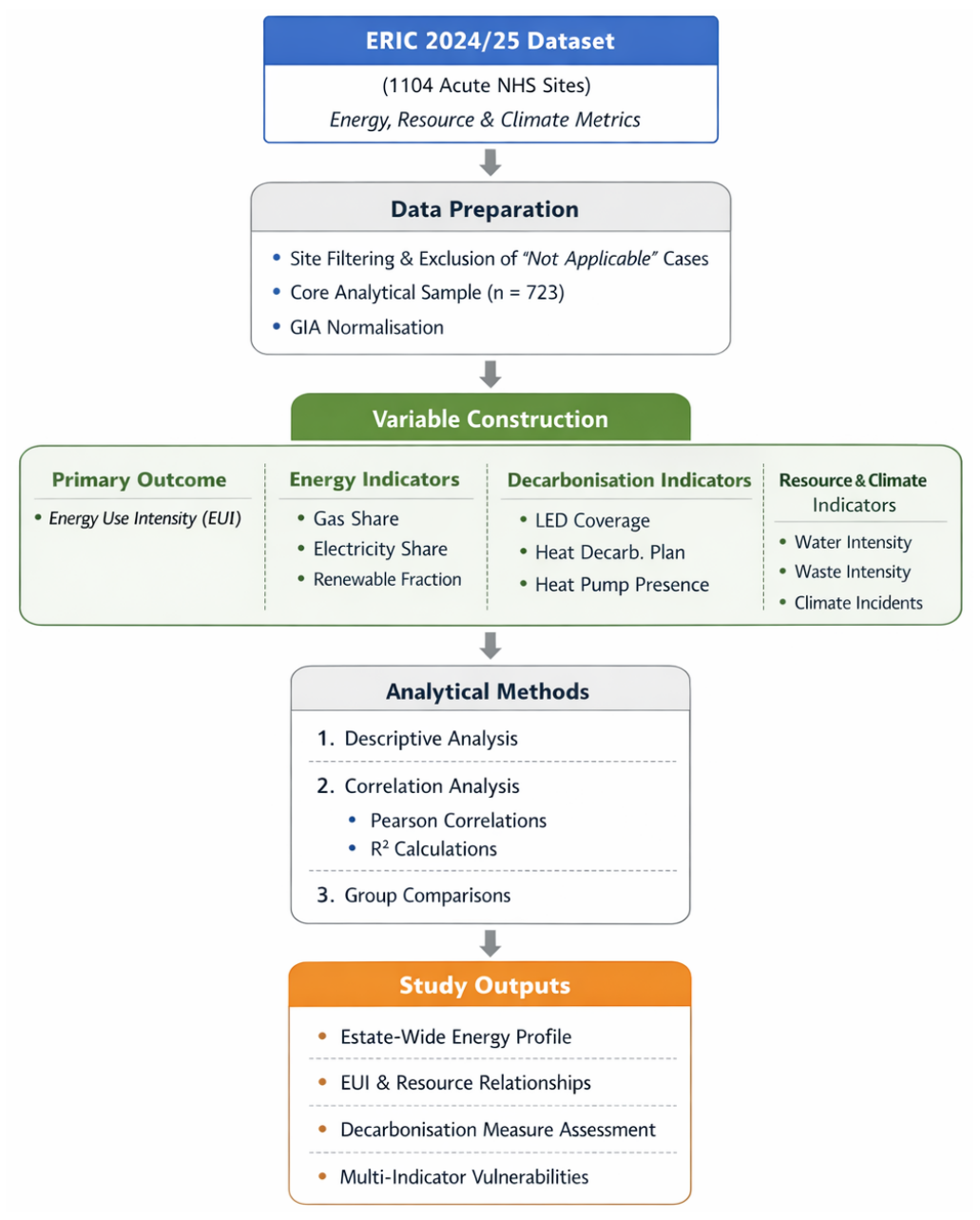
This analysis draws on the ERIC 2024/25 dataset, a comprehensive self-reported collection of energy, resource use, decarbonization progress, and climate risk metrics for 1104 acute NHS hospital sites across England, UK [21]. Captured during the 2024/25 financial year, the data encompass site-level operational performance across approximately 25 million m2 of gross internal area (GIA), providing granular insights into the NHS acute estate’s energy profile and sustainability challenges. Sites represent diverse trust configurations, building ages, and regional climates, with energy metrics normalized by GIA to enable consistent site-to-site comparisons [21]. The overall methodological framework adopted in this study is illustrated in Figure 1, summarizing the dataset preparation, variable construction, and analytical procedures used to examine relationships between energy performance, decarbonization indicators, and resource intensities across the NHS estate.
The framework outlines the progression from dataset preparation and variable construction to descriptive analysis, correlation analysis, and group comparisons used to assess relationships between energy use intensity, decarbonization indicators, resource consumption, and climate risk metrics.
For group comparison analyses, a restricted analytical subset was constructed to ensure consistent binary classification of decarbonization indicators. Specifically, analyses involving the heat decarbonization plan, LED high percentile, and Heat Pump Presence were limited to sites with definitive presence or absence values. This resulted in a core analytical sample of 723 sites, excluding 381 sites designated as “not applicable” for heat decarbonization planning status. Removing these cases ensured that adopter versus non-adopter comparisons were based only on clearly classified sites, avoiding ambiguity that could dilute comparative effect sizes.
The dataset provides 10 primary variables (energy use intensity; gas share; electricity share; renewable fraction; LED coverage; heat decarbonisation plan; heat pump presence; water intensity; waste intensity; climate incidents) central to this analysis, representing energy performance, technology adoption, resource consumption, and climate vulnerability indicators. Energy performance is measured using energy use intensity (EUI), defined as total annual site energy consumption divided by gross internal area (GIA) and expressed in kWh/m2. Fuel mix composition is captured through gas share and electricity share, calculated as percentages of total site energy consumption, reflecting the relative contribution of thermal fossil energy and electrified loads. Progress toward low-carbon energy supply is represented by the renewable fraction, defined as renewable electricity consumption as a percentage of total electricity use, encompassing both on-site generation and contracted renewable supply. Decarbonization technology adoption is represented through both continuous and binary indicators. LED coverage measures the proportion of site lighting fixtures converted to LED technology. Binary indicators include heat decarbonization plan (1 = formal decarbonization roadmap documented; 0 = absent), LED high percentile (1 = sites achieving ≥75% LED coverage), and Heat Pump Presence (1 = operational heat pump systems present; 0 = none). Operational resource intensity is measured using water intensity (annual water use in m3 per m2) and waste intensity (total waste generation in tons per m2), both normalized by GIA to allow cross-site comparisons. Climate vulnerability is proxied by climate incidents, defined as the total number of reported overheating episodes and flooding events recorded at each site over the previous 12 months.
Statistical analysis followed a three-stage process, as summarized in Figure 1. First, descriptive profiling was conducted to characterize the distribution of key energy and decarbonization indicators across the NHS acute estate. Histograms were produced for four continuous variables, gas share, electricity share, renewable fraction, and LED coverage, to visualize estate-wide distributions, central tendencies, and technology adoption patterns. Second, bivariate correlation analysis examined relationships between EUI and all other indicators using Pearson product–moment correlations. Results are reported as R2 (coefficient of determination) values to indicate the proportion of variation in EUI associated with each predictor variable. This approach prioritizes practical interpretability and exploratory insight rather than formal hypothesis testing. Third, group comparison analysis evaluated differences between adopter and non-adopter sites for the three binary indicators: Heat decarbonization plan, LED high percentile, and Heat Pump Presence. For each group, subgroup sample sizes (n) were calculated alongside mean EUI, mean gas share, and mean renewable fraction. These comparisons allow direct assessment of whether sites implementing specific decarbonization strategies exhibit differing energy performance or fuel mix characteristics relative to other sites.

3.4. Ethics, Data, and Code Availability

The study relied exclusively on anonymized, aggregate administrative data from ERIC, which are publicly available. No information on individual patients or staff was accessed, and no additional approvals were required. The processed analysis workbooks are available from the corresponding author upon reasonable request.

4. Results

4.1. Longitudinal Analysis Results

Analysis of ERIC 2024/25 data from 1104 acute NHS hospital sites (2018/19–2024/25 panel) reveals persistently high energy use intensity (EUI), with clinical function emerging as the dominant driver.

4.1.1. EUI Baselines and Trends

Across the seven reporting years, the number of acute sites almost doubled from 474 to 1104, while total gross internal area (GIA) increased modestly from 20.97 to 22.29 million m2 (Table 1). Over the same period, mean EUI remained in a high band of roughly 400–460 kWh/m2, with a temporary reduction around 2021/22, and an estimated total acute-sector consumption of 9–10 billion kWh per year. Gas supplied between 74% and 87% of reported energy use throughout the study period, indicating continued reliance on fossil fuels for heating and hot water provision. Overall, the results suggest that EUI levels remained broadly stable across the acute estate despite portfolio growth and ongoing decarbonization policy attention.

4.1.2. Clinical Space vs. EUI

Clinical floor area accounted for an average of 59.25% of site-level GIA across the acute estate (Table 2). Across 1104 sites in 2024/25, the proportion of clinical area showed a strong positive correlation with EUI (r = 0.52), with R2 = 0.27 indicating that approximately 27% of the observed variation in EUI was associated with differences in clinical space proportion. Sites with higher proportions of clinical space showed higher EUI values in these data. This pattern aligns with clinical areas, such as theatres, intensive care units, and diagnostic departments, that typically have higher environmental control needs, although the observational design does not allow the independent contribution of clinical space to be isolated from other interrelated site characteristics.

4.1.3. GIA vs. EUI

Mean site GIA fell from 44,244 m2 in 2018/19 to 20,351 m2 in 2024/25, reflecting the inclusion of a larger number of smaller acute sites in the dataset over time (Table 3). Despite this shift in size distribution, EUI remained moderately positively correlated with GIA in most years, with Pearson correlation coefficients ranging from approximately 0.34 to 0.41 and R2 values up to 0.16. These findings show that larger acute hospitals had higher EUI values per unit area across the acute NHS estate, although the observational analysis does not establish whether this relationship reflects operational complexity, service mix, infrastructure characteristics, or other interrelated factors.

4.1.4. Backlog Intensity vs. EUI

Mean backlog maintenance intensity increased from approximately 230 to 318 £/m2 over the study period, with reported unresolved fabric and plant maintenance requirements across the acute estate rising accordingly (Table 4). The correlation between backlog intensity and EUI strengthened from weakly positive in the earlier years to moderately positive by 2021/22–2024/25, with Pearson correlation coefficients ranging from 0.262 to 0.283 before declining slightly to 0.226 in 2024/25. These findings show that sites with higher backlog maintenance intensity had higher EUI values per m2. This association involves interactions between estate condition, infrastructure performance, operational complexity, and other interrelated site characteristics, although the observational analysis does not permit causal interpretation.

4.1.5. Age Cohorts vs. EUI

When EUI is compared with the proportion of floor area in each construction age band, most cohorts show negligible correlations, with |r| below 0.03 (Table 5). The only notable deviations are a weakly positive association for 1985–94 buildings (r = 0.064), showing higher EUI where this era accounts for more of a site’s area, and a moderately negative association for 2005–14 stock (r = −0.126), showing lower EUI for hospitals with a larger share of more recent construction. Overall, these results show building age alone correlates less strongly with EUI than clinical intensity, scale, and backlog.

4.2. Cross-Sectional Analysis Results

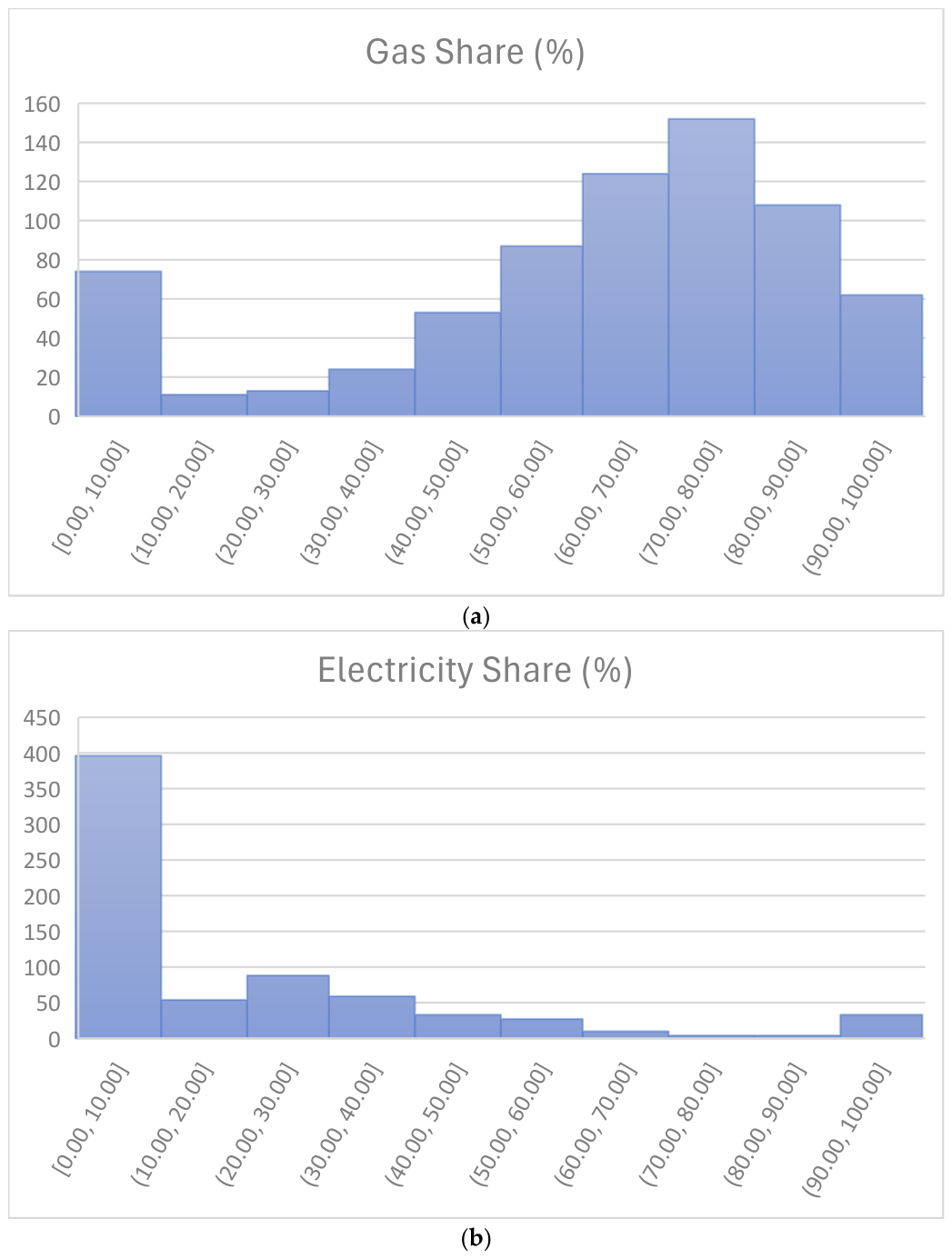
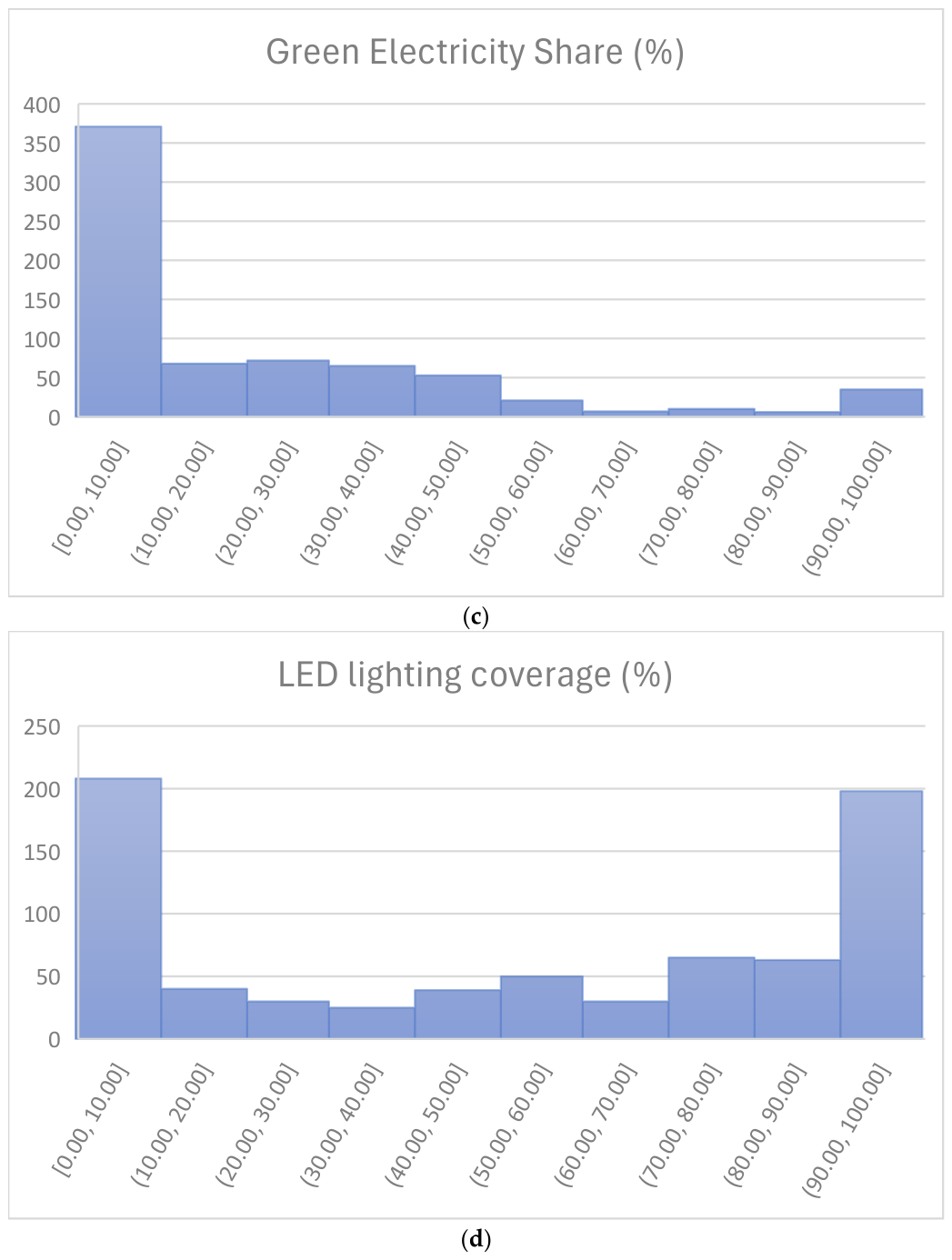
Histograms of gas share, electricity share, renewable electricity fraction, and LED lighting coverage across the 1104 acute NHS hospital sites (Figure 2a–d) reveal clear structural patterns in the estate’s energy profile and technology adoption. Gas share distributions cluster strongly between 60 and 80%, showing that most sites have high gas reliance. Electricity share exhibits a complementary distribution, with most sites deriving a smaller proportion of total energy from electricity-based systems.
Renewable electricity fractions are concentrated at relatively low levels, with most sites reporting values below 10%. The extended upper tail suggests that while a minority of hospitals have achieved higher renewable penetration, adoption remains uneven across the estate. This pattern likely reflects differences in estate investment capacity, access to renewable procurement agreements, and the technical feasibility of on-site generation such as rooftop solar photovoltaic installations.
LED lighting coverage presents a distinct bimodal distribution, with clusters of both low-adoption sites and sites approaching full coverage. This pattern suggests that lighting upgrades tend to occur through discrete retrofit programmes rather than gradual incremental improvements. Hospitals that have undertaken major lighting refurbishments appear to have transitioned toward high LED coverage, while many other sites remain at early adoption stages. Collectively, these distributions highlight the uneven progress of decarbonization measures across the NHS estate and show continued reliance on gas-based energy systems.
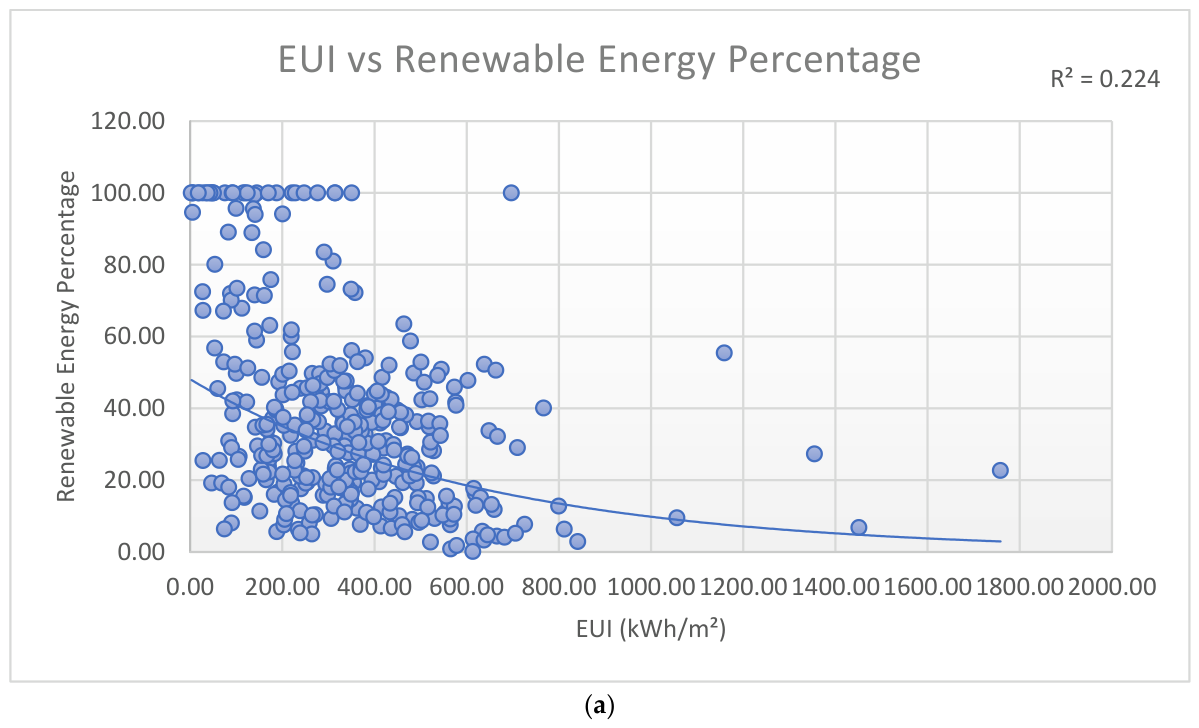
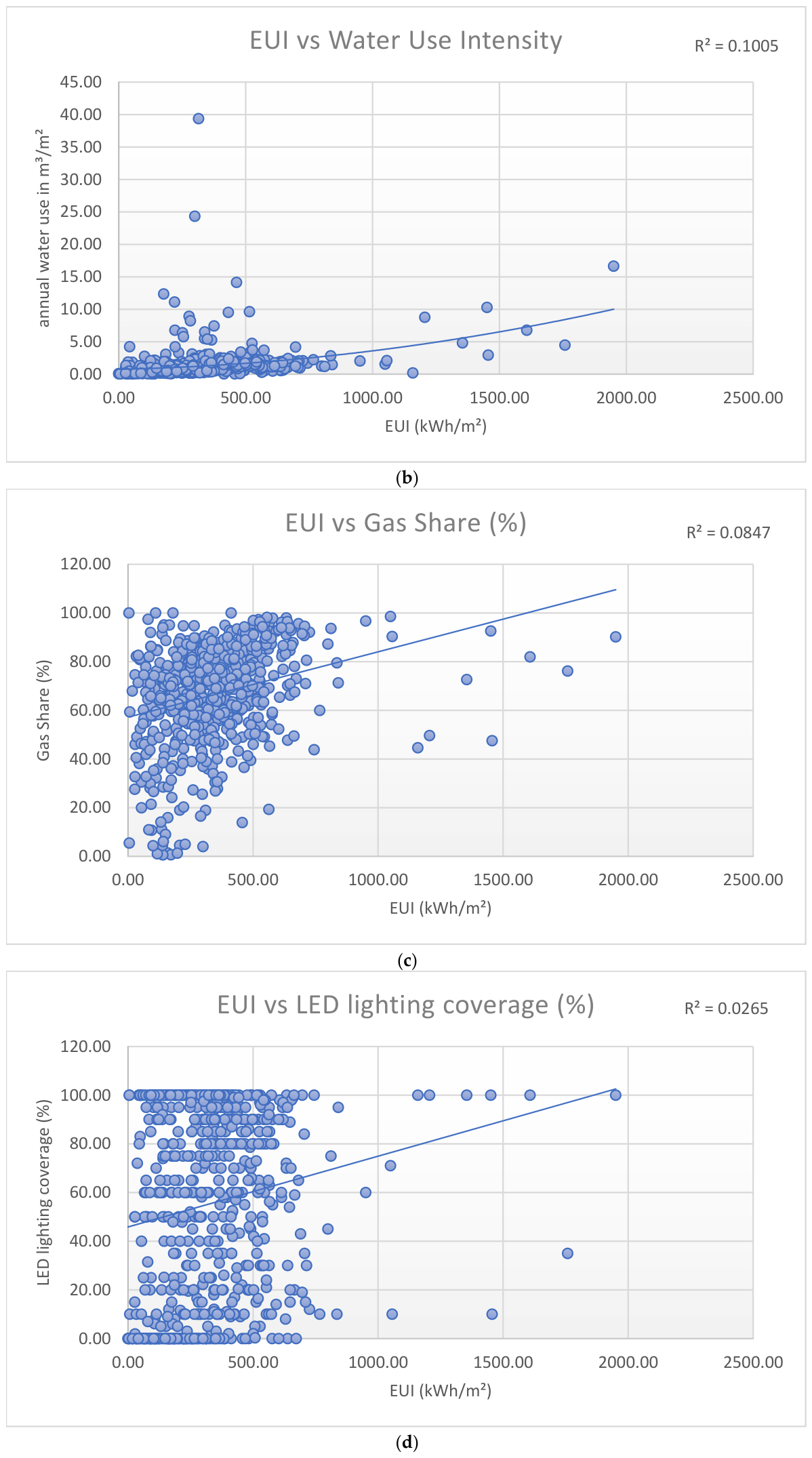
Bivariate relationships between energy use intensity (EUI) and the selected indicators (Figure 3a–f, Table 6) reveal differing levels of association strength across the variables examined. Among these, the renewable electricity fraction shows the strongest association with EUI (R2 = 0.224), showing an inverse linear relationship between renewable electricity share and overall site energy intensity. Hospitals with higher shares of renewable electricity show lower EUI values, while sites with minimal renewable uptake show higher energy intensity values.
This pattern suggests that renewable electricity adoption may act as an indicator of broader energy management maturity within hospital estates. Facilities procuring or generating larger shares of renewable electricity are likely to be those actively pursuing wider sustainability strategies, including improved energy monitoring, efficiency retrofits, and optimization of building services. As a result, the renewable fraction may reflect direct substitution of lower-carbon electricity sources and the presence of more comprehensive energy management practices.
At the same time, the relationship should not be interpreted as a direct causal effect. Renewable electricity procurement alone does not inherently reduce physical energy demand at the building level. Instead, the observed association likely reflects a combination of organizational commitment to sustainability, estate investment capacity, and the implementation of complementary efficiency measures that collectively contribute to lower overall energy intensity.
Water intensity (R2 = 0.101) and gas share (R2 = 0.085) show weak associations with energy use intensity, indicating that hospitals with higher energy demand also tend to show elevated levels of resource consumption and fossil fuel dependence. Sites with the highest EUI values show correspondingly high-water use per unit floor area and a greater reliance on natural gas within their overall energy mix.
These weak associations show that high-EUI sites also have high water intensity and gas share, but the observational design cannot determine if common factors drive both patterns simultaneously. Potential mechanisms, such as ageing infrastructure or operational processes, remain speculative without targeted analysis.
These relationships imply that energy-intensive facilities may represent broader cases of systemic estate inefficiency, where infrastructure condition, building services performance, and operational practices combine to drive elevated consumption across both energy and water systems. The findings therefore support the need for integrated resource management approaches within healthcare estates rather than addressing individual utilities in isolation.
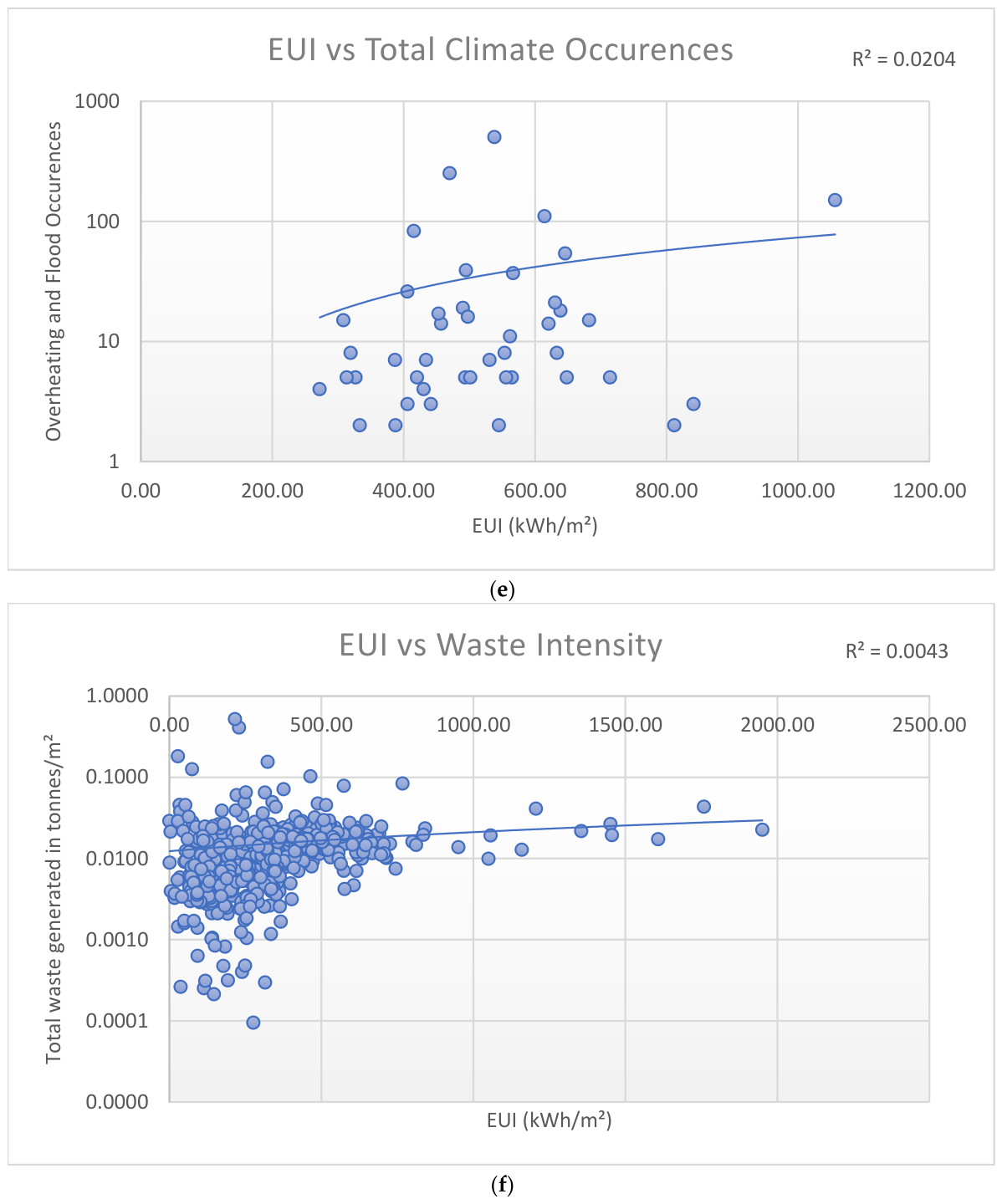
The remaining indicators exhibit comparatively weaker associations with EUI, yet they provide important insights into the limits of isolated interventions. LED lighting coverage shows a minimal correlation with energy intensity (R2 = 0.027), and even sites with high coverage (>80%) display a wide range of EUI values (250–700 kWh/m2). This pattern suggests that while lighting retrofits contribute to electricity savings at the fixture level, their impact on overall estate energy performance is modest, particularly in acute hospitals where heating, ventilation, and medical equipment dominate total energy demand. Consequently, lighting upgrades alone are insufficient to meaningfully reduce EUI without concurrent improvements in thermal efficiency and operational controls.
Similarly, the climate vulnerability proxy, measured through overheating and flooding occurrences, demonstrates a weak association (R2 = 0.020), with higher-EUI sites reporting slightly more incidents. While the relationship is modest, it indicates that energy-intensive hospitals may be more exposed to environmental risks, potentially due to older infrastructure, less resilient building fabric, or higher internal thermal loads. Waste intensity shows a negligible association with EUI (R2 = 0.004), suggesting that, in contrast to energy and water, operational waste generation is largely decoupled from site energy performance at the estate scale.
Collectively, these weaker relationships show the limitations of single-issue interventions. Energy intensity in hospitals appears to be embedded within broader systemic factors, where infrastructure condition, service complexity, and operational practices jointly influence performance. Addressing energy inefficiencies, therefore, requires integrated strategies that combine building fabric upgrades, equipment optimization, and targeted decarbonization measures rather than relying on isolated technology adoption.
These results indicate that energy-intensive acute hospitals face compounded sustainability challenges, characterized by high fossil fuel dependence, elevated water and resource use, and greater exposure to climate-related vulnerabilities. Notably, the apparent limited effect of individual decarbonization measures highlights that single interventions such as LED lighting retrofits are insufficient to offset the underlying energy demands of complex hospital operations.
Analysis of sites with formal heat decarbonization plans (n = 277; Table 7) further illustrates this point. These hospitals show a higher mean EUI compared with sites without such plans (389.55 vs. 326.93 kWh/m2), alongside greater natural gas reliance and lower renewable electricity fractions. Rather than indicating poor performance of the plans themselves, this pattern reflects strategic prioritization: hospitals targeted for heat decarbonization planning tend to be the most energy-intensive and infrastructure-challenged facilities. They represent baseline high-demand cases, where planned interventions aim to address the largest and most complex decarbonization challenges.
These findings show the importance of interpreting adoption metrics in the context of operational and infrastructural realities. Early adoption of decarbonization measures often coincides with sites of greatest need, meaning that observed energy intensity may remain high even as measures are implemented. Consequently, policy evaluation and benchmarking should account for the selection effect inherent in targeting interventions to high-EUI hospitals, rather than judging technology adoption solely on apparent short-term energy reductions.
Analysis of high-LED-coverage sites (≥75% of lighting fixtures; n = 303) shows only modest differences in energy use intensity compared with lower-coverage hospitals (362.46 vs. 346.95 kWh/m2/year; Δ +15.5). Differences in gas share and renewable electricity fraction are similarly minor, and the narrow EUI gap indicates that LED retrofits, while reducing electricity demand at the fixture level, contribute limited measurable reductions in overall estate energy intensity. This outcome likely reflects the dominance of thermal loads, medical equipment, and 24/7 clinical operations in acute hospitals, as well as building envelope and control limitations that mask the savings potential of lighting interventions when considered at the whole-site scale.
Heat pump-equipped sites (n = 122) display the most pronounced disparities, averaging 454.17 kWh/m2/year EUI, approximately 38% higher than non-heat pump sites (329.11; n = 601). These hospitals also exhibit the highest gas dependence (69.96% vs. 61.76%) and correspondingly lower renewable fractions (14.12% vs. 19.35%). Rather than suggesting that heat pumps increase energy consumption, this pattern reflects strategic deployment targeting the most energy-intensive and fossil-reliant sites, where electrification offers the greatest decarbonization potential. High baseline loads, often associated with older building stock, large boiler plants, or complex clinical service mixes, mean that early heat pump adoption occurs in facilities facing the most challenging operational conditions. Consequently, observed EUI remains elevated despite intervention, highlighting the implementation lag between technology deployment and measurable estate-wide energy reductions.

5. Discussion

5.1. Main Findings

This comprehensive analysis of ERIC 2018/19–2024/25 data for 1104 acute NHS hospital sites in England reveals that energy use intensity (EUI) reduced slightly. Longitudinally, mean Annual EUI decreased from 455.4 kWh/m2 to 448.2 kWh/m2 even with portfolio expansion; clinical functional mix emerging as the strongest association (r = 0.52, R2 = 0.27), followed by moderate associations with hospital scale (r = 0.39) and backlog maintenance intensity (r = 0.23), while building age showed only weak or negligible effects. Cross-sectionally (2024/25), renewable electricity fraction ranked highest (R2 = 0.224), followed by water intensity (R2 = 0.101) and gas share (R2 = 0.085), confirming energy-intensive sites show compounded resource inefficiencies. These dual analyses show that what hospitals do (clinical intensity), how well they are maintained (backlog condition), and their decarbonization readiness (renewables uptake) matter far more for energy performance than construction age alone. High-EUI sites consistently show multi-domain vulnerabilities, larger scale, deferred maintenance, fossil fuel dependence, and elevated resource demands necessitating integrated rather than siloed interventions to achieve NHS net-zero goals.

5.2. Clinical Intensity as the Dominant Driver

The positive correlation between clinical area share mean and EUI (r = 0.52, R2 = 0.27) indicates that functional intensity is a first-order determinant of operational energy demand in acute hospitals. Sites with a larger proportion of theatres, intensive care, imaging, laboratories, and sterile services consistently show higher EUI per square metre, consistent with end-use studies that attribute a large share of hospital energy use to HVAC, ventilation, and medical equipment concentrated in such areas [22]. This finding challenges approaches that treat all hospital floor area as energetically equivalent and supports functionally differentiated benchmarks and retrofit strategies that explicitly focus on clinical zones [22].
From a service-planning perspective, the results imply that expanding high-acuity clinical capacity without parallel investment in efficient plant and controls will further entrench high EUI in the acute estate. Conversely, targeting high-intensity spaces with interventions such as demand-controlled ventilation, operating theatre setback strategies, efficient imaging equipment, and zoned controls could deliver outsized EUI reductions relative to interventions focused on lower-intensity support areas [55]. The linear association also suggests that markedly shifting the clinical/non-clinical balance at the site or campus level, for example, by decanting office or outpatient functions to lower-energy satellite buildings, may be a viable component of decarbonization plans for some trusts [56].

5.3. Scale and Condition: Diseconomies Rather than Economies

The moderate positive association between gross internal area and EUI indicates that larger acute hospitals are, on average, more energy-intensive per unit area rather than benefiting from economies of scale. This is counter to expectations that larger sites should achieve lower EUI through more efficient plants, higher load factors, and shared infrastructure, and instead points to complexity-driven diseconomies, such as extended distribution networks, partial-load inefficiencies, and diverse clinical services operating simultaneously. In practice, this means that the largest “hub” hospitals, which are often central to regional care models, also represent some of the most challenging assets to decarbonize and may warrant bespoke, site-specific energy strategies rather than generic estate-wide measures [30].
Rising backlog maintenance intensity and its moderate positive correlation with EUI highlight the strong link between physical condition risk and operational energy performance [57,58]. Sites with higher backlog per square metre may have poorer fabric, outdated plant, and sub-optimal controls, all of which contribute to higher heating and electrical loads. This empirical link strengthens the case for viewing backlog as a safety and resilience problem and a key barrier to achieving net-zero trajectories across the acute estate. Prioritizing backlog spending on energy-relevant components, such as roofs, façades, windows, boilers, chillers, and control systems in high-intensity acute sites could therefore yield dual benefits: risk reduction and measurable EUI decreases.

5.4. Subtle and Cohort-Specific Age Effects

Contrary to common narratives that portray building age as the primary driver of hospital inefficiency, age cohort correlations in this analysis are overwhelmingly negligible, with only weak positive relationships with 1985–2014 buildings. The weak signal for mid-1980s to mid-1990s construction may reflect a cohort that pre-dates contemporary energy standards but is not yet old enough to have been comprehensively refurbished, leaving it with legacy fabric and plant under today’s operational demands. The more favourable performance of 2015–24 buildings is consistent with the introduction of tighter building regulations and growing attention to energy performance in major NHS capital schemes over that period [59].
These cohort-specific effects suggest that age can still inform prioritization, but only when considered alongside functional mix and backlog intensity. A purely age-based retrofit strategy would be inefficient, as many older buildings appear to achieve comparable EUI to newer ones, and some relatively new assets perform poorly, likely due to high clinical intensity or maintenance deficits. Instead, trusts could use age as a secondary filter, first identifying high-EUI, high-clinical-share, high-backlog sites and then, within that subset, focusing on mid-age cohorts where improvements in fabric and systems are most technically and economically feasible.

5.5. Renewable Fraction as Strongest Cross-Sectional Predictor

The ERIC 2024/25 dataset analysis reveals that the acute NHS estate remains predominantly gas-reliant, with energy intensity (EUI) shaped by both structural and operational factors. While renewable electricity fraction emerged as the highest bivariate value of EUI (R2 = 0.224), the findings suggest that energy performance is multi-dimensional and context-dependent, rather than determined by any single factor. Higher renewable shares correlate with lower EUI across sites, though this observational analysis cannot distinguish direct displacement effects from confounding by organizational or infrastructural characteristics. Hospitals with higher renewable uptake also show patterns consistent with proactive energy management, modernized systems, and efficiency investments, though these represent correlated traits rather than proven causal pathways.

5.6. Compounded Resource and Gas-Reliance Vulnerabilities

Correlations between EUI and water intensity (R2 = 0.101) and gas share (R2 = 0.085) indicate that energy-intensive sites also exhibit higher resource consumption and continued reliance on fossil-based heating. This co-occurrence suggests systemic inefficiencies within hospitals, where building fabric, operational practices, and infrastructure collectively amplify both energy and water demand. For example, high water throughout may reflect older sterilization and cooling systems, while gas dominance indicates substantial thermal loads typical of pre-2000 hospital stock. Together, these observations emphasize that single-domain interventions are insufficient: energy efficiency in acute hospitals is inherently linked to multiple operational and structural factors.

5.7. Strategic Targeting and Adopter Group Patterns

Analysis of decarbonization measure adoption reveals counterintuitive patterns: sites with heat pumps, formal heat decarbonization plans, or high LED coverage often exhibit higher EUI and greater gas dependence. This reflects strategic targeting of interventions at the most energy-intensive facilities, rather than underperformance of the technologies themselves. Heat pump sites, for example, average 454 kWh/m2, 38% higher than non-equipped sites, highlighting deployment in high-demand facilities with complex heating requirements. Similarly, heat decarbonization plan sites have elevated EUI and lower renewable fractions, consistent with prioritization of estates with the greatest baseline challenges. LED coverage shows limited impact on EUI, demonstrating that minor electricity savings are overshadowed by dominant thermal loads and clinical service demands. These findings collectively illustrate a classic implementation lag, where technology adoption precedes measurable performance gains, and early movers are often those with the greatest operational challenges.

5.8. Limited Impact of Isolated Interventions

Weak correlations for LED coverage, climate incidents, and waste intensity further show that isolated interventions offer limited estate-scale impact. LED retrofits may reduce electricity demand modestly, but heating loads dominate acute hospital energy use, while climate and waste metrics indicate that high-EUI sites may face compounding operational vulnerabilities. These results reinforce the need for integrated, multi-domain strategies, where energy, water, waste, and climate resilience measures are coordinated rather than implemented in isolation.

5.9. Implications for NHS Net-Zero and Capital Planning

The combination of high absolute EUI, dominance of gas in the fuel mix, strong clinical-space effects, and scale-related diseconomies poses a substantial challenge for the NHS’s net-zero commitment. Acute hospitals alone account for the majority of the 11.3 billion kWh of energy consumed across the NHS estate, so even modest percentage reductions in EUI at this subset will have outsized impacts on national health-sector emissions. The findings indicate that three levers are particularly promising for decarbonization: targeted interventions in high-intensity clinical zones, backlog-driven fabric and plant upgrades, and design/operational changes at large multi-service acute sites.
At the policy level, these results support the integration of ERIC-derived metrics, EUI, clinical share, backlog intensity, and GIA into capital allocation and performance oversight mechanisms. For example, national programmes could weight funding towards trusts whose acute sites sit in the upper quartile of EUI and clinical intensity while also carrying high backlog, effectively linking decarbonization support to demonstrable need and potential impact. Similarly, future iterations of NHS Net Zero Building Standards could encourage design strategies that limit unnecessary growth in high-intensity clinical areas and favour flexible, lower-intensity spaces that can be repurposed as clinical models evolve [60].
For trust-level planning, the driver hierarchy revealed here can guide sequencing. In broad terms, an efficient pathway might prioritize: (1) operational and controls optimization in existing plants; (2) deep energy retrofits targeting clinical spaces and high-backlog components; and (3) capacity reconfiguration or partial decanting at the largest, most complex acute sites. Such an approach aligns with broader evidence that energy efficiency and demand reduction are the most cost-effective early steps towards health-sector net-zero, before large-scale investment in low-carbon heat and on-site generation.
The cross-sectional findings also have several direct implications for NHS policy and operational planning. Renewable electricity represents a high-leverage, near-term intervention that can reduce estate-wide EUI and support net-zero ambitions. Deployment of heat pumps and formal decarbonization plans should be sequenced with building fabric improvements, hydraulic balancing, and control optimization to avoid stranded investments and maximize return on intervention. Moderate correlations with water intensity suggest that bundled resource efficiency measures, such as leak detection, low-flow fixtures, and process optimization, could yield additional energy savings, while climate vulnerability patterns indicate a need for targeted resilience interventions at high-EUI sites.
Several limitations temper the interpretation. The cross-sectional design precludes causal inference: high-EUI sites may adopt heat pumps because they are energy-intensive, rather than heat pumps increasing energy use. Self-reported metrics may introduce bias, and aggregation at the site level masks intra-trust heterogeneity. Sample restrictions, particularly exclusion of “not applicable” sites, limit statistical power for some analyses, and key confounders, such as bed capacity, building age, functional mix, and regional climate, were not controlled.

5.10. Limitations and Future Research

Several limitations of this analysis should be acknowledged when interpreting the results. First, residual diagnostics for simple linear regressions showed non-ideal patterns, as our results are based on bivariate correlations rather than formal multivariable regression models and should be interpreted as associational rather than causal. Second, ERIC is an administrative dataset not primarily designed for energy research; although data quality has improved since 2018/19, residual reporting errors and definitional changes may influence the precision of EUI and backlog estimates. Third, the correlations reported here are cross-sectional and do not imply causality; for example, high EUI may lead to higher reported backlog if energy-intensive sites also experience faster plant degradation, rather than backlog causing inefficiency. Fourth, important drivers such as occupancy, case mix, technology intensity, and local climate are not directly captured, which may explain some of the residual variation in EUI beyond the 27% accounted for by clinical share.
Future work could extend this analysis in several directions. Linking ERIC to more detailed local datasets [61], for example, half-hourly metering, weather data, occupancy levels, and information on major capital projects would enable more robust modelling of causal pathways, including the impacts of specific interventions. Stratifying the analysis by region, trust type, and service configuration could reveal whether the observed relationships differ for specialist centres, teaching hospitals, or integrated care systems. Finally, incorporating carbon intensity and cost data alongside EUI would allow a fuller assessment of how clinical, scale, and condition drivers translate into emissions and financial risk, providing a stronger evidence base for aligning NHS capital strategies with national climate and fiscal objectives. ERIC’s potential as a predictive decarbonization dashboard could transform it from a descriptive audit to a strategic decision-making tool, enabling targeted investment in high-EUI, high-impact facilities. Future studies may also utilize BREEAM Excellent/Outstanding-rated NHS hospital sites in England and match these high-performing buildings against the full ERIC site dataset to quantify the energy use intensity (EUI) patterns associated with sustainability certifications. Multivariate regression controlling for confounders like occupancy, climate conditions, and equipment intensity would further strengthen causal identification.

Funding

This research received no external funding.

Data Availability Statement

Publicly available datasets were analyzed in this study. This data can be requested using the following link: https://digital.nhs.uk/data-and-information/publications/statistical/estates-returns-information-collection (accessed on 24 March 2026).

Conflicts of Interest

The author declares no conflicts of interest.

Abbreviations

The following abbreviations are used in this manuscript:
NHSNational Health Service
ERICEstates Returns Information Collection
EUIEnergy use intensity
GIAGross internal area

References

  1. Papanicolas, I.; Mossialos, E.; Gundersen, A.; Woskie, L.; Jha, A.K. Performance of UK National Health Service compared with other high income countries: Observational study. BMJ 2019, 367, l6326. [Google Scholar] [CrossRef] [PubMed]
  2. Tennison, I.; Roschnik, S.; Ashby, B.; Boyd, R.; Hamilton, I.; Oreszczyn, T.; Owen, A.; Romanello, M.; Ruyssevelt, P.; Sherman, J.D. Health care’s response to climate change: A carbon footprint assessment of the NHS in England. Lancet Planet. Health 2021, 5, e84–e92. [Google Scholar] [CrossRef] [PubMed]
  3. Government Property Function. Government Estate: Annual Data Publication 2023–2024. 2025. Available online: https://www.gov.uk/government/publications/state-of-the-estate-in-2023-24/government-estate-annual-data-publication-2023-24-html (accessed on 26 April 2026).
  4. NHS England. Five Years of a Greener NHS: Progress and Forward Look. 2025. Available online: https://www.england.nhs.uk/long-read/five-years-greener-nhs-progress-forward-look/ (accessed on 26 April 2026).
  5. Morgenstern, P.; Li, M.; Raslan, R.; Ruyssevelt, P.; Wright, A. Benchmarking acute hospitals: Composite electricity targets based on departmental consumption intensities? Energy Build. 2016, 118, 277–290. [Google Scholar] [CrossRef]
  6. Dean, J.; Jones, M.; Dyer, P.; Moulton, C.; Price, V.; Lasserson, D. Possible futures of acute medical care in the NHS: A multispecialty approach. Future Healthc. J. 2022, 9, 125–132. [Google Scholar] [CrossRef]
  7. Pollard, A.; Paddle, J.; Taylor, T.; Tillyard, A. The carbon footprint of acute care: How energy intensive is critical care? Public Health 2014, 128, 771–776. [Google Scholar] [CrossRef]
  8. Hart, J. Health Care without Harm: Taking Environmental Action to improve lives and the planet. Integr. Complement. Ther. 2022, 28, 251–254. [Google Scholar] [CrossRef]
  9. Sherman, J.D.; Thiel, C.; MacNeill, A.; Eckelman, M.J.; Dubrow, R.; Hopf, H.; Lagasse, R.; Bialowitz, J.; Costello, A.; Forbes, M. The green print: Advancement of environmental sustainability in healthcare. Resour. Conserv. Recycl. 2020, 161, 104882. [Google Scholar] [CrossRef]
  10. Karliner, J.; Slotterback, S.; Boyd, R.; Ashby, B.; Steele, K.; Wang, J. Health care’s climate footprint: The health sector contribution and opportunities for action. Eur. J. Public Health 2020, 30, ckaa165.843. [Google Scholar] [CrossRef]
  11. Tarkar, P. Role of green hospitals in sustainable construction: Benefits, rating systems and constraints. Mater. Today Proc. 2022, 60, 247–252. [Google Scholar] [CrossRef]
  12. Dhillon, V.S.; Kaur, D. Green hospital and climate change: Their interrelationship and the way forward. J. Clin. Diagn. Res. 2015, 9, LE01. [Google Scholar] [CrossRef]
  13. Garg, A.; Dewan, A. Green hospitals. In Manual of Hospital Planning and Designing: For Medical Administrators, Architects and Planners; Springer: Berlin/Heidelberg, Germany, 2022; pp. 485–498. Available online: https://books.google.co.uk/books?hl=en&lr=&id=e9ZbEAAAQBAJ&oi=fnd&pg=PR9&dq=Manual+of+Hospital+Planning+and+Designing:+For+Medical+Administrators,+Architects+and+Planners&ots=o1gI04y6Yp&sig=WIpnD_RUOBWAN_k2V2sSX-rAn14&redir_esc=y#v=onepage&q=Manual%20of%20Hospital%20Planning%20and%20Designing%3A%20For%20Medical%20Administrators%2C%20Architects%20and%20Planners&f=false (accessed on 26 April 2026).
  14. Watts, N.; Amann, M.; Arnell, N.; Ayeb-Karlsson, S.; Belesova, K.; Boykoff, M.; Byass, P.; Cai, W.; Campbell-Lendrum, D.; Capstick, S. The 2019 report of The Lancet Countdown on health and climate change: Ensuring that the health of a child born today is not defined by a changing climate. Lancet 2019, 394, 1836–1878. [Google Scholar] [CrossRef]
  15. NHS. Estates Returns Information Collection Summary Page and Dataset for ERIC 2018/19. 2019. Available online: https://files.digital.nhs.uk/17/ED5CC8/ERIC-201819%20-%20Report%20v4.xlsx (accessed on 26 April 2026).
  16. NHS. Estates Returns Information Collection Summary Page and Dataset for ERIC 2019/20. 2021. Available online: https://files.digital.nhs.uk/EB/C0535A/ERIC%20-%20201920%20-%20Report.xlsx (accessed on 26 April 2026).
  17. NHS. Estates Returns Information Collection-Summary Page and Dataset for ERIC 2020/21. 2021. Available online: https://files.digital.nhs.uk/A8/8F8044/ERIC%20-%20202021%20-%20Report%20v2.xlsx (accessed on 26 April 2026).
  18. NHS. Estates Returns Information Collection, Summary Page and Dataset for ERIC 2021/22. 2022. Available online: https://files.digital.nhs.uk/6B/EA0682/ERIC%20-%20202122%20-%20Report%20-%20v4.xlsx (accessed on 26 April 2026).
  19. NHS. Estates Returns Information Collection, Summary Page and Dataset for ERIC 2022/23. 2023. Available online: https://files.digital.nhs.uk/04/D41A35/ERIC%20-%202022_23%20-%20Report%20v3.xlsx (accessed on 26 April 2026).
  20. NHS. Estates Returns Information Collection, Summary Page and Dataset for ERIC 2023/24; NHS: London, UK, 2024. [Google Scholar]
  21. NHS. Estates Returns Information Collection, Summary Page and Dataset for ERIC 2024/25. 2025. Available online: https://files.digital.nhs.uk/43/BCFF1F/ERIC%20-%202024_25%20-%20Report.xlsx (accessed on 26 April 2026).
  22. Morgenstern, P.; Raslan, R.; Ruyssevelt, P. Reducing hospital electricity use: An end-use perspective. In Proceedings of the 9th International Conference on Improving Energy Efficiency in Commercial Buildings and Smart Communities; Publications Office of the European Union: Frankfurt, Germany, 2016. [Google Scholar] [CrossRef]
  23. NHS. Estates Returns Information Collection (ERIC) 2015/2016. 2016. Available online: https://assets.publishing.service.gov.uk/media/5a7f417fed915d74e33f54d8/est-ret-info-col-2015-2016-data-defs.pdf (accessed on 26 April 2026).
  24. Tudor, T.L.; Baddley, J.; Mayhew-Manchón, L. Examining the uptake of low-carbon approaches within the healthcare sector: Case studies from the National Health Service in England. Int. J. Healthc. 2015, 1, 61–68. [Google Scholar] [CrossRef]
  25. NHS. Delivering a ‘Net Zero’ National Health Service. 2020. Available online: https://www.england.nhs.uk/greenernhs/wp-content/uploads/sites/51/2022/07/B1728-delivering-a-net-zero-nhs-july-2022.pdf (accessed on 26 April 2026).
  26. Vandeventer, J.S. Hospitals Have Huge Environmental Footprints–Here’s How They Can be More Sustainable. 2025. Available online: https://theconversation.com/hospitals-have-huge-environmental-footprints-heres-how-they-can-be-more-sustainable-253693 (accessed on 26 April 2026).
  27. Turiel, I.; Craig, P.; Levine, M.; McMahon, J.; McCollister, G.; Hesterberg, B.; Robinson, M. Estimation of energy intensity by end-use for commercial buildings. Energy 1987, 12, 435–446. [Google Scholar] [CrossRef]
  28. Bowerman, M.; Raby, H.; Humphrey, C. In search of the audit society: Some evidence from health care, police and schools. Int. J. Audit. 2000, 4, 71–100. [Google Scholar] [CrossRef]
  29. Williams, J.; Knight, I.; Griffiths, A. Hospital energy performance: New indicators for UK National Health Service estate. Build. Serv. Eng. Res. Technol. 1999, 20, 9–12. [Google Scholar] [CrossRef]
  30. Morgenstern, P. Understanding Hospital Electricity Use: An End-Use(r) Perspective. Doctoral Thesis, UCL (University College London), London, UK, 2016. Available online: https://discovery.ucl.ac.uk/id/eprint/1514500/ (accessed on 26 April 2026).
  31. Profit, J.; Typpo, K.V.; Hysong, S.J.; Woodard, L.D.; Kallen, M.A.; Petersen, L.A. Improving benchmarking by using an explicit framework for the development of composite indicators: An example using pediatric quality of care. Implement. Sci. 2010, 5, 13. [Google Scholar] [CrossRef]
  32. World Health Organization. Energizing Health: Accelerating Electricity Access in Health-Care Facilities: Web Annexes. 2023. Available online: https://iris.who.int/server/api/core/bitstreams/bd508733-1a8f-480e-9a46-74ac9f49468e/content (accessed on 26 April 2026).
  33. Coccagna, M.; Cesari, S.; Valdiserri, P.; Romio, P.; Mazzacane, S. Energy consumption in hospital buildings: Functional and morphological evaluations of six case studies. Int. J. Environ. Sci. 2017, 2, 443–452. [Google Scholar]
  34. Cesari, S. Forecasting and Modeling Energy Consumption of Hospital Buildings. Relation Between Energy Consumption, Architectural Features as Morphology, Layout and Medical Functions. 2020. Available online: https://hdl.handle.net/11392/2487961 (accessed on 26 April 2026).
  35. Jaušovec, M.; Gabrovec, B. Architectural evaluation of healthcare facilities: A comprehensive review and implications for building design. Buildings 2023, 13, 2926. [Google Scholar] [CrossRef]
  36. Sheppy, M.; Pless, S.; Kung, F. Healthcare Energy End-Use Monitoring; National Renewable Energy Laboratory (NREL): Golden, CO, USA, 2014. Available online: https://www.energy.gov/sites/default/files/2014/09/f18/61064.pdf (accessed on 26 April 2026).
  37. Psillaki, M.; Apostolopoulos, N.; Makris, I.; Liargovas, P.; Apostolopoulos, S.; Dimitrakopoulos, P.; Sklias, G. Hospitals’ energy efficiency in the perspective of saving resources and providing quality services through technological options: A systematic literature review. Energies 2023, 16, 755. [Google Scholar] [CrossRef]
  38. Newell, G.; Marzuki, M.J. The increasing importance of UK healthcare property as an alternate property sector. J. Prop. Investig. Financ. 2018, 36, 466–478. [Google Scholar] [CrossRef]
  39. Fifield, L.-J.; Lomas, K.; Giridharan, R.; Allinson, D. Hospital wards and modular construction: Summertime overheating and energy efficiency. Build. Environ. 2018, 141, 28–44. [Google Scholar] [CrossRef]
  40. Jain, N.; Burman, E.; Stamp, S.; Shrubsole, C.; Bunn, R.; Oberman, T.; Barrett, E.; Aletta, F.; Kang, J.; Raynham, P. Building performance evaluation of a new hospital building in the UK: Balancing indoor environmental quality and energy performance. Atmosphere 2021, 12, 115. [Google Scholar] [CrossRef]
  41. Mohammadpour, A.; Anumba, C.J.; Messner, J.I. Retrofitting of healthcare facilities: Case study approach. J. Archit. Eng. 2017, 23, 05017003. [Google Scholar] [CrossRef]
  42. He, Q.; Zhao, H.; Shen, L.; Dong, L.; Cheng, Y.; Xu, K. Factors influencing residents’ intention toward green retrofitting of existing residential buildings. Sustainability 2019, 11, 4246. [Google Scholar] [CrossRef]
  43. Pascale, F.; Tabakov, P.; Bhutta, M.F. Decarbonizing the Healthcare Estate: Lessons Learned from NHS Trust Green Plans in England. Sustainability 2025, 17, 8375. [Google Scholar] [CrossRef]
  44. Braithwaite, J.; Smith, C.L.; Leask, E.; Wijekulasuriya, S.; Brooke-Cowden, K.; Fisher, G.; Patel, R.; Pagano, L.; Rahimi-Ardabili, H.; Spanos, S. Strategies and tactics to reduce the impact of healthcare on climate change: Systematic review. BMJ 2024, 387, e081284. [Google Scholar] [CrossRef]
  45. Hough, E.; Cohen Tanugi-Carresse, A. Supporting decarbonization of health systems—A review of international policy and practice on health care and climate change. Curr. Environ. Health Rep. 2024, 11, 266–278. [Google Scholar] [CrossRef]
  46. Nunes, A.R.; Karaba, F.; Geddes, O.; Bickerton, A.; Atherton, H.; Dahlmann, F.; Eccles, A.; Gregg, M.; Spencer, R.; Twohig, H. Implementation of decarbonisation actions in general practice: A systematic review and narrative synthesis. BMJ Open 2025, 15, e091404. [Google Scholar] [CrossRef]
  47. Ramgolam, Y.K.; Bangarigadu, K.; Hookoom, T.; Ramiah, C. Strengthening health services with quality in a net zero transition. In The Elgar Companion to Energy and Sustainability; Edward Elgar Publishing: Cheltenham, UK, 2024; pp. 271–282. [Google Scholar] [CrossRef]
  48. Dong, J.; Hamada, A.; Paydar, M.A.; Jain, N.; Smith, N.M.; Burman, E. Identifying decarbonization pathways for primary healthcare buildings using energy certificate models in England and Wales. Build. Environ. 2025, 274, 112794. [Google Scholar] [CrossRef]
  49. World Health Organization. Operational Framework for Building Climate Resilient and Low Carbon Health Systems; World Health Organization: Geneva, Switzerland, 2023; Available online: https://books.google.co.uk/books?hl=en&lr=&id=e6QOEQAAQBAJ&oi=fnd&pg=PR5&dq=Operational+framework+for+building+climate+resilient+and+low+carbon+health+systems&ots=HQOH3aDr-2&sig=RglIuacuK5v62yZ9aNo_n38KtQw&redir_esc=y#v=onepage&q=Operational%20framework%20for%20building%20climate%20resilient%20and%20low%20carbon%20health%20systems&f=false (accessed on 26 April 2026).
  50. Walker, N.L.; Williams, A.P.; Styles, D. Key performance indicators to explain energy & economic efficiency across water utilities, and identifying suitable proxies. J. Environ. Manag. 2020, 269, 110810. [Google Scholar] [CrossRef]
  51. Rodmell, L.M. Examining the Hazard and Risks of Indoor Overheating in a UK NHS Trust’s Hospitals: A Qualitative Study; University of Portsmouth: Portsmouth, UK, 2025; Available online: https://pure.port.ac.uk/ws/portalfiles/portal/102079312/UP918595_Final_thesis_21_03_25.pdf (accessed on 26 April 2026).
  52. Schwab, R.; Schiestl, L.J.; Hasenburg, A. Greening the future of healthcare: Implementation of sustainability strategies in German hospitals and beyond—A review. Front. Public Health 2025, 13, 1559132. [Google Scholar] [CrossRef] [PubMed]
  53. Fears, R.; ter Meulen, V. 19 European Academies Science Advisory Council (EASAC). In The Politics of Scientific Advice: Institutional Design for Quality Assurance; Cambridge University Press: Cambridge, UK, 2011; p. 342. Available online: https://books.google.co.uk/books?hl=en&lr=&id=Zo43l2IJ3bYC&oi=fnd&pg=PR5&dq=The+politics+of+scientific+advice:+Institutional+design+for+quality+assurance&ots=4w_5PzmVgK&sig=bOvPH645-YSH4tAMM6rQmpP7mJQ&redir_esc=y#v=onepage&q&f=false (accessed on 26 April 2026).
  54. Mirow, J.; Venne, J.; Brand, A. Green health: How to decarbonise global healthcare systems. Sustain. Earth Rev. 2024, 7, 28. [Google Scholar] [CrossRef]
  55. Council, S. Hospitals. 2020. Available online: https://www.sath.nhs.uk/wp-content/uploads/2025/07/All-Appendices.pdf (accessed on 26 April 2026).
  56. Jones, D.A. Strategic Energy Management Within Hospitals: Barriers to Energy Efficiency and the Impact of Design Margins; Open University: Milton Keynes, UK, 2022; Available online: https://www.proquest.com/openview/8c2a84f84124bfd788953c98d76f8353/1?pq-origsite=gscholar&cbl=2026366&diss=y (accessed on 26 April 2026).
  57. Clarke, J. Facing Up to the £15 Billion NHS Maintenance Backlog Means Taking Control of Data. Available online: https://www.pickeverard.co.uk/insights/facing-up-to-the-16-billion-nhs-maintenance-backlog-means-taking-control-of-data (accessed on 31 January 2026).
  58. HEFMA. Critical Risk Backlog Soars in Latest Eric Data. Available online: https://www.hefma.co.uk/news/critical-risk-backlog-soars-in-latest-eric-data (accessed on 31 January 2026).
  59. NHS. NHS Net Zero Building Standard. Available online: https://www.england.nhs.uk/estates/nhs-net-zero-building-standard/ (accessed on 31 January 2026).
  60. Kelly, P.; Chipchase, S. What Does NHS Net Zero Building Standard Mean for Healthcare Projects? Available online: https://ridge.co.uk/insights/what-does-nhs-net-zero-building-standard-mean-for-healthcare-projects/ (accessed on 31 January 2026).
  61. NHS. Critical Care and General & Acute Beds–Urgent and Emergency Care Daily Situation Reports 2024–2025. Available online: https://www.england.nhs.uk/statistics/statistical-work-areas/bed-availability-and-occupancy/critical-care-and-general-acute-beds-urgent-and-emergency-care-daily-situation-reports/critical-care-and-general-acute-beds-urgent-and-emergency-care-daily-situation-reports-2024-25/ (accessed on 31 January 2026).
Figure 1. Methodological framework of the cross-sectional analysis.
Buildings 16 01782 g001
Figure 2. (a) Gas share (%) histogram across 1104 acute NHS sites. (b) Electricity share (%) histogram. (c) Renewable electricity fraction (%) histogram. (d) LED lighting coverage (%) histogram.
Buildings 16 01782 g002aBuildings 16 01782 g002b
Figure 3. (a) EUI versus renewable energy percentage. (b) EUI versus water use intensity. (c) EUI versus gas share percentage. (d) EUI versus LED lighting coverage percentage. (e) EUI versus climate occurrences. (f) EUI versus waste intensity.
Buildings 16 01782 g003aBuildings 16 01782 g003bBuildings 16 01782 g003c
Table 1. EUI trends across 2018/19–2024/25.
YearAcute SitesTotal GIA (M m2)Mean Annual EUI (kWh/m2)Est Total kWh (B)Gas Share (%)
2018/1947420.97455.49.5574
2019/2048721.17451.59.5676
2020/2150121.34436.39.3181
2021/22103721.49400.88.6187
2022/23105221.6459.89.9376
2023/24108221.94448.99.8575
2024/25110422.29448.29.9975
Table 2. Clinical space as dominant EUI driver.
MetricValueInterpretation
Clinical area share (mean) 2024–2559.25%High proportion of clinical space across sites
r (clinical m2 vs. EUI)0.52Strong positive association
R20.27Approximately 27% of observed EUI variation associated with clinical area share
Table 3. Site gross internal area (GIA) vs. EUI, 2018/19–2024/25.
Year Acute SitesGIA Mean (m2)EUI Acute Site Mean (kWh/m2)Pearson Correlation CoefficientCoefficient of DeterminationInterpretation of Association
2018/1947444,244339.120.3790.144Moderate positive
2019/2048743,330328.330.3920.154Moderate positive
2020/2150142,597333.470.1360.018Weak positive
2021/22103720,831330.480.3380.114Moderate positive
2022/23105220,535218.430.4050.164Moderate positive
2023/24108220,402225.380.4000.160Moderate positive
2024/25110420,351211.350.3920.154Moderate positive
Table 4. Backlog maintenance intensity vs. EUI by year.
Year Acute SitesBacklog Intensity Mean (£/m2)EUI Acute Site Mean (kWh/m2)Pearson Correlation CoefficientInterpretation of Association
2018/19474229.77339.120.127Weakly positive
2019/20487272.49328.330.169Weakly positive
2020/21501298.23333.470.001Negligible correlation
2021/221037232.4330.480.262Moderately positive
2022/231052260.67218.430.193Weakly positive
2023/241082288.47225.380.283Moderately positive
2024/251104317.78211.350.226Moderately positive
Table 5. Building age cohort correlations with EUI (2024/25).
Age CohortPearson Correlation CoefficientInterpretation of Association
Pre-19480.025Negligible
1948–54−0.025Negligible
1955–64−0.023Negligible
1965–740.014Negligible
1975–840.039Negligible
1985–940.064Weak
1995–040.058Weak
2005–14−0.126Weak
2015–24−0.023Negligible
2025–34−0.009Negligible
Table 6. Bivariate R2 summary (n = 1104 sites).
PredictorR2
Renewable fraction0.224
Water intensity0.101
Gas share percentage0.085
LED coverage0.023
Climate occurrences0.020
Waste intensity0.004
Table 7. Descriptive metrics for decarbonization measure adopter (=1) versus non-adopter (=0) groups across 723 acute NHS sites with defined classifications.
GroupnMean EUIMean Gas Share %Mean Renewable Energy Share %
Heat Decarbonisation Plan
Present (=1)277389.5566.1213.80
Absent (=0)446326.9361.3121.77
High LED Coverage
High (≥75)303362.4664.0018.02
Low (<75)420346.9562.8818.55
Heat Pump Presence
Present (=1)122454.1769.9614.12
Absent (=0)601329.1161.7619.35
Disclaimer/Publisher’s Note: The statements, opinions and data contained in all publications are solely those of the individual author(s) and contributor(s) and not of MDPI and/or the editor(s). MDPI and/or the editor(s) disclaim responsibility for any injury to people or property resulting from any ideas, methods, instructions or products referred to in the content.