
Article

Seismic Performance and Damage Controllability of Prefabricated Roof–Sidewall Composite Joints for Underground Structures Based on Cogging Connections


1
Jiangxi Provincial Key Laboratory of Environmental Geotechnical Engineering and Disaster Control, Jiangxi University of Science and Technology, Ganzhou 341000, China
2
Beijing Key Laboratory of Earthquake Engineering and Structural Retrofit, Beijing University of Technology, Beijing 100124, China
*
Author to whom correspondence should be addressed.
Buildings 2026, 16(9), 1771; https://doi.org/10.3390/buildings16091771
Submission received: 29 March 2026 / Revised: 24 April 2026 / Accepted: 25 April 2026 / Published: 29 April 2026

Abstract

This study aims to enhance the damage controllability and overall seismic resilience of assembled underground structures under earthquake actions. To achieve this, three types of prefabricated roof–sidewall composite joints are proposed based on the design concepts of cogging for force transfer and local strengthening. These include the high-strength bolt–cogging–grouting sleeve joint (HCG), the prestressed steel strand–cogging–grouting sleeve joint (PCG), and the UHPC–cogging–grouting sleeve joint (UCG). Following the principle of positioning joints in regions of low structural stress, four 1/4-scale reinforced concrete (RC) specimens were designed and fabricated, including one cast-in-place (CIP) reference specimen and three precast RC specimens. Quasi-static tests were carried out to systematically evaluate the seismic behavior and internal force distribution of each specimen. Numerical validation was also performed using ABAQUS. The results show that both UHPC and a reasonable application of prestressing can effectively inhibit crack initiation and damage propagation at the joint seams. When the composite joints are positioned outside the plastic hinge region, they provide a reliable load transfer path for the reinforcement. The HCG and UCG joints significantly enhance the load-bearing capacity and energy dissipation capacity of the specimens. Their ductility and energy dissipation both achieve a seismic performance equivalent to that of the CIP specimen. Furthermore, damage in these specimens is predominantly confined to the designated plastic hinge region of the roof. This effectively mitigates shear damage in the roof–sidewall connection zone (RSC). Although the PCG joint improves the initial stiffness of the specimen, its energy dissipation capacity and ductility are reduced. It also causes damage to be transferred to the RSC. This leads to increased shear deformation and premature shear failure in this zone. Consequently, both UHPC and a reasonable application of prestressing can be used for the prefabrication of underground structures. Positioning the joints outside the roof plastic hinge zone can effectively achieve the seismic design goal of “strong joint, weak component”.

1. Introduction

With the acceleration of urbanization, underground transportation infrastructure has become a critical component in alleviating urban traffic congestion and enhancing spatial utilization efficiency. As integral parts of urban lifeline engineering, structures such as underpasses and subway stations are being constructed at an increasing scale [1,2,3]. Traditional cast-in-place (CIP) construction faces prominent challenges, including long construction periods, significant environmental impact, and severe traffic disruption, making it difficult to meet the demands of modern urban sustainable development [4,5]. In this context, prefabricated construction technology offers significant advantages (rapid construction, controllable quality, and environmental friendliness) and has demonstrated broad application prospects in underground structures [6,7].
The overall seismic performance of assembled structures largely depends on the mechanical behavior of their connections [8,9]. The joint is the core area for force transfer and deformation coordination, and its configuration directly affects the damage evolution and failure mode under earthquake actions [10,11]. Existing connections for prefabricated components fall into two main categories: wet connections and dry connections. Wet connections offer good integrity and high stiffness but require extensive on-site wet work, reducing construction efficiency. Dry connections use mechanical connectors like bolts and prestressed steel strands (PSs) for rapid assembly, yet demand high precision and involve more complex energy dissipation and damage control [12,13,14].
Cogging joints, which rely on interlocking tenons and grooves, are both reliable in force transfer and convenient for construction, attracting considerable attention recently [15,16]. Yang et al. [15] showed that the cogging structure enhances shear capacity and ensures joint integrity, with geometric parameters significantly influencing mechanical properties. A well-designed cogging connection can achieve performance comparable to CIP joints. The bonding material within the cogging further improves interface bond performance [16]. It should be noted that joint location matters: Liu et al. [17] found that placing assembled joints in regions of low structural stress improves the overall stress state and avoids premature failure.
However, a standalone cogging structure has inherent limitations. Although it provides reliable shear capacity, a pure cogging connection has relatively limited energy dissipation capacity and is prone to damage accumulation at the joint seam under cyclic loading, making it difficult to fully utilize the ductile energy dissipation potential of the structure. This shortcoming restricts its application in medium-to-high seismic intensity regions. Moreover, Avcil F [18,19] also pointed out that joint regions in prefabricated structures are vulnerable, as damage often initiates and concentrates at the connections, resulting in premature failure and reduced overall seismic resilience. Therefore, it is urgent to introduce other enhancement measures to improve the overall seismic performance of the joint.
To overcome these limitations, two technical approaches (prestressing technology and ultra-high performance concrete (UHPC)) can be adopted. Applying prestress at the joint seam inhibits crack propagation and enables residual deformation recovery after an earthquake. Prestressing has been widely used to enhance crack resistance and self-centering capacity [20,21]. Twigden et al. [22] found that unbonded post-tensioned precast concrete walls exhibited good self-centering performance under strong earthquakes. Korkmaz et al. [23] verified the significant self-centering capacity of prestressed beam–column joints, though energy dissipation was relatively weak. The location of PSs is decisive: placing them within the plastic hinge region limits hinge development but may transfer damage to the joint core area [24,25].
UHPC, as a new cement-based composite material, offers a new technical path. It possesses ultra-high strength, excellent toughness, and good durability, along with superior interfacial bond performance with normal concrete, effectively inhibiting cracking and damage propagation at the joint seam [26]. Tayeh et al. [27] confirmed that the bond strength at the UHPC–normal concrete interface exceeds the strength of the base materials. Moreover, Pekgokgoz and Avcil [28] investigated the effect of steel fibres on reinforced concrete beam–column joints under reversed cyclic loading, and found that the addition of steel fibres significantly enhanced crack control, energy dissipation, and overall cyclic behavior of the joints. In joint applications, Hu et al. [29] verified the reliability of UHPC connections in bridge decks. Zhang et al. [30] found that UHPC–grouting sleeve (GS) connections enhance the ductility and energy dissipation of precast bridge piers. Kong et al. [31] showed that post-casting UHPC in the joint core area significantly improves shear capacity.
Despite these achievements, most existing research has focused on bridge piers and aboveground building structures. Systematic studies on prefabricated joints for underground structures remain relatively limited. Underground structures have unique characteristics (deep soil cover, strong lateral constraints, and complex loading conditions), making their joint mechanical mechanisms and damage evolution laws significantly different from those of aboveground structures [32]. Specifically, when prefabricated joints are used in underground structures, the influence mechanism on plastic hinge formation, damage distribution, and overall seismic performance remains unclear. Whether they can achieve the “equivalent to CIP” design goal requires further investigation.
Although individual technologies such as cogging connections, grouting sleeves, prestressing, and UHPC have been studied, their synergistic combination into a unified composite joint for underground roof–sidewall connections remains largely unexplored. The novelty of this study lies in the following aspects: (1) proposing three novel composite joints (HCG, PCG, and UCG) that integrate cogging for shear transfer, grouting sleeves for rebar connection, and either local prestressing (HSB/PS) or UHPC for enhanced performance; (2) systematically investigating the seismic performance of these joints when placed outside the roof plastic hinge zone, following the principle of “strong joint, weak component”; and (3) achieving damage controllability, where damage is concentrated in the designated plastic hinge zone rather than in the joint core.
Based on this, the present study focuses on the roof–sidewall joint of an underpass. Following the principle of positioning joints in regions of low structural stress [17], one CIP specimen and three prefabricated specimens were designed and fabricated, utilizing HSB–cogging–GS, PS–cogging–GS, and UHPC–cogging–GS connections, respectively. Quasi-static tests and refined finite element simulations were carried out to evaluate seismic performance and damage evolution. The findings are expected to develop improved joint systems that can enhance damage controllability and achieve the design goal of “strong joint, weak component” for underground structures.

2. Experimental Projects

2.1. Specimen Description

The prototype structure was an underpass. The roof and sidewall had thicknesses of 1.4 m and 1.2 m, respectively. A 1 m length along the longitudinal direction was selected for investigation. To systematically evaluate the effectiveness of the cogging composite connections and explore their application potential in roof–sidewall joints, four 1/4-scale roof–sidewall joint specimens were fabricated. These included one CIP specimen and three prefabricated specimens. Specifically, the prefabricated specimens used the HCG (HSB–Cogging–GS), PCG (PS–Cogging–GS), and UCG (UHPC–Cogging–GS) connections, respectively. To satisfy the similarity requirements, the longitudinal rebars and stirrups were designed with the same material and reinforcement ratios as those of the prototype structure [33]. The height of the sidewall and the length of the roof for each specimen were determined based on the inflection point of the prototype structure. Following the design principle of “strong column–weak beam”, all prefabricated joints were placed in the roof. The sidewall height and roof length of the scaled specimens measured 1.6 m and 1.9 m, respectively. Their cross-sectional dimensions were 250 mm × 300 mm and 250 mm × 350 mm. The configuration and dimensions of the cogging were determined based on related research [15,34]. Detailed design parameters for each specimen are provided in Table 1.
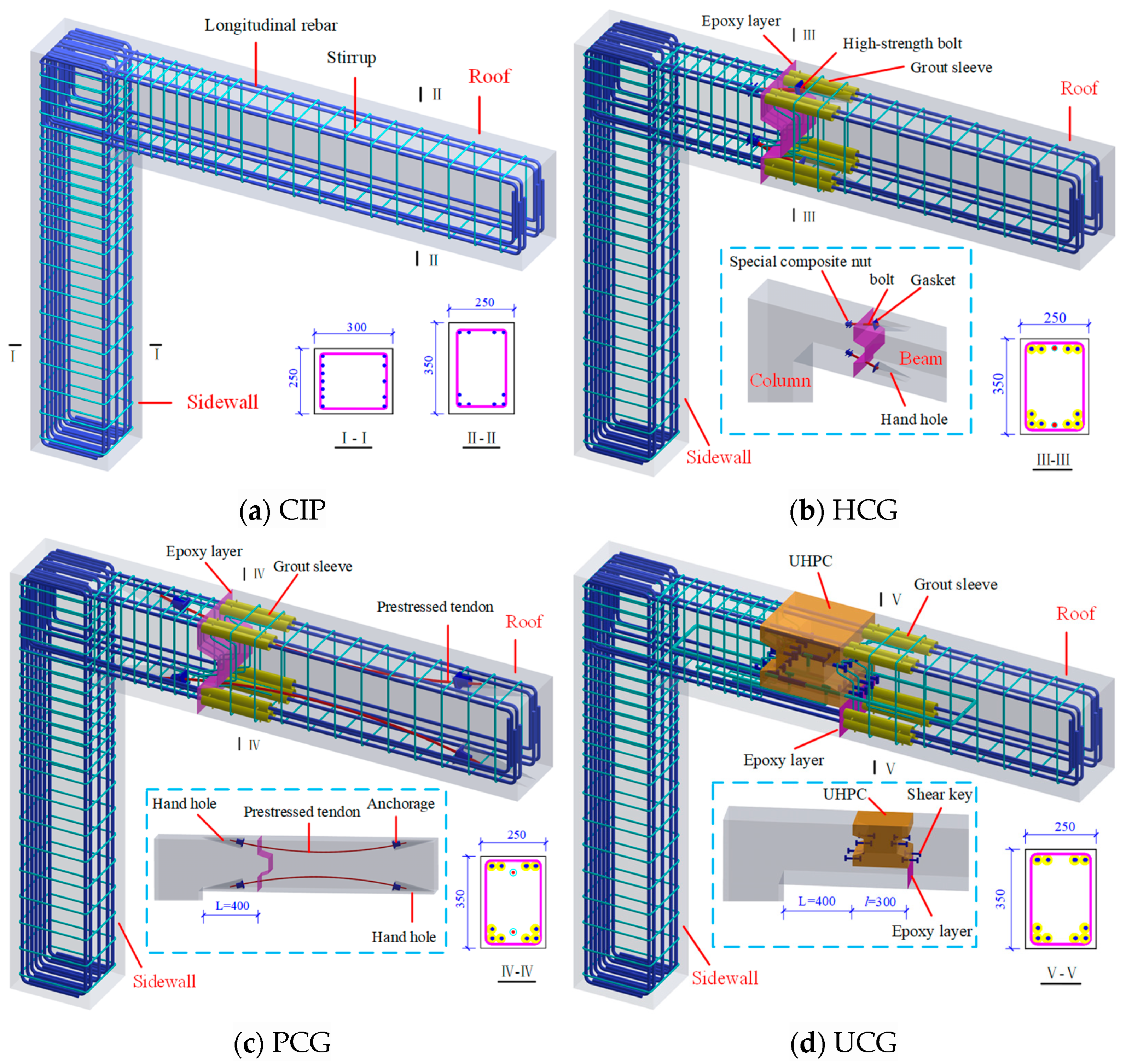
Figure 1 shows the detailed configurations and reinforcement arrangements of each specimen. Prestressing is known to improve crack resistance and deformation capacity [20,21]. Therefore, the HCG and PCG joints were equipped with HSBs and PSs at the joint seam, respectively. Due to the superior bond performance between UHPC and normal concrete [26,27], the UCG joint was connected by casting UHPC. To ensure the energy dissipation capacity of the roof plastic hinge zone and follow the principle of positioning joints in regions of low structural stress [17], all prefabricated joints were placed outside the roof plastic hinge zone. Based on existing research findings [25,35,36], the initial plastic hinge length L for the roof of each specimen was set at 400 mm. According to the relevant specimen size provisions in Eurocode 4 [37], the length l of the UHPC segment in the UCG joint was set at 300 mm. To improve construction efficiency, a concrete base plate was reserved on the sidewall component near the joint side. This plate also served as a stay-in-place formwork for UHPC casting. To enhance the connection integrity between components, an epoxy adhesive with a thickness of 2 mm was applied to the concrete interface joining the roof and sidewall. Longitudinal rebars were connected using GSs. For the HCG joint, the HSBs were anchored by embedding special composite nuts into the precast component. This enhanced the interaction between the nut and the surrounding concrete, with steel gaskets installed at the bolt end to prevent local concrete crushing, as shown in Figure 1b. For the PCG joint, limited by the scale of the specimens, the PSs were designed as straight tendons with a nominal area of 54.80 mm2. These steel strands were tensioned and anchored using pre-set hand holes and ducts in the precast components, as shown in Figure 1c.
Existing research indicates that the axial compression ratio has a dual effect on the performance of RC members. When the value remains below 0.2, initial stiffness and load-bearing capacity are improved. However, when it exceeds this threshold, deformation capacity may be compromised [21,38]. Furthermore, when the additional axial compression contributed by PSs or HSBs falls below 0.03, its strengthening effect diminishes [39]. Based on these findings, an additional axial compression ratio of 0.08 was selected for this study. This value corresponds to a total prestressing force of 130 kN (provided by two HSBs for the HCG joint or two PSs for the PCG joint, each at 65 kN). The prestressing force of 65 kN per tendon/bolt is approximately 0.65 times the standard ultimate capacity (Fp) of a single PS. This design ensures a balance between enhancing crack resistance and maintaining ductility. Moreover, it should be noted that the seismic performance may be sensitive to the prestress level. Parametric studies have shown that higher prestress levels can improve self-centering capacity but may reduce energy dissipation [8,40,41].
For the UCG joint, shear keys were pre-embedded at the interface connecting the precast roof and sidewall [42]. This was done to enhance the bond performance between the normal concrete and the post-cast UHPC, as shown in Figure 1d. The joint is then cast-in-place with UHPC. This design also considers practical constructability: the high early strength of UHPC (reaching 40 MPa within 24 h) allows for rapid demolding and timely removal of temporary supports. Installation tolerances are addressed by applying a 2 mm thick epoxy layer to accommodate minor surface irregularities. Furthermore, long-term durability of UHPC joints has been demonstrated in bridge deck applications, with excellent resistance to freeze–thaw cycles and chloride ingress [43,44].

2.2. Fabrication and Construction

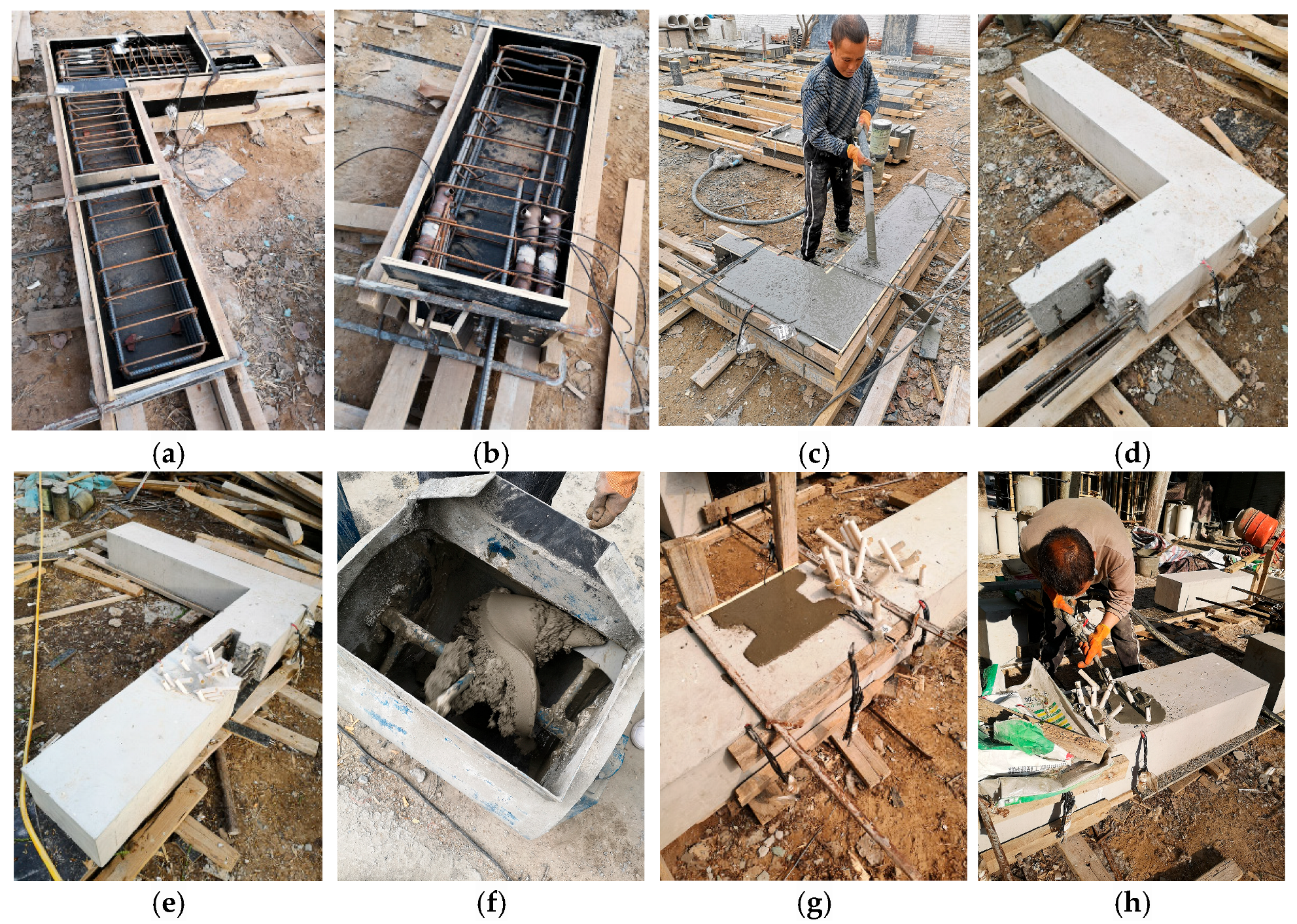
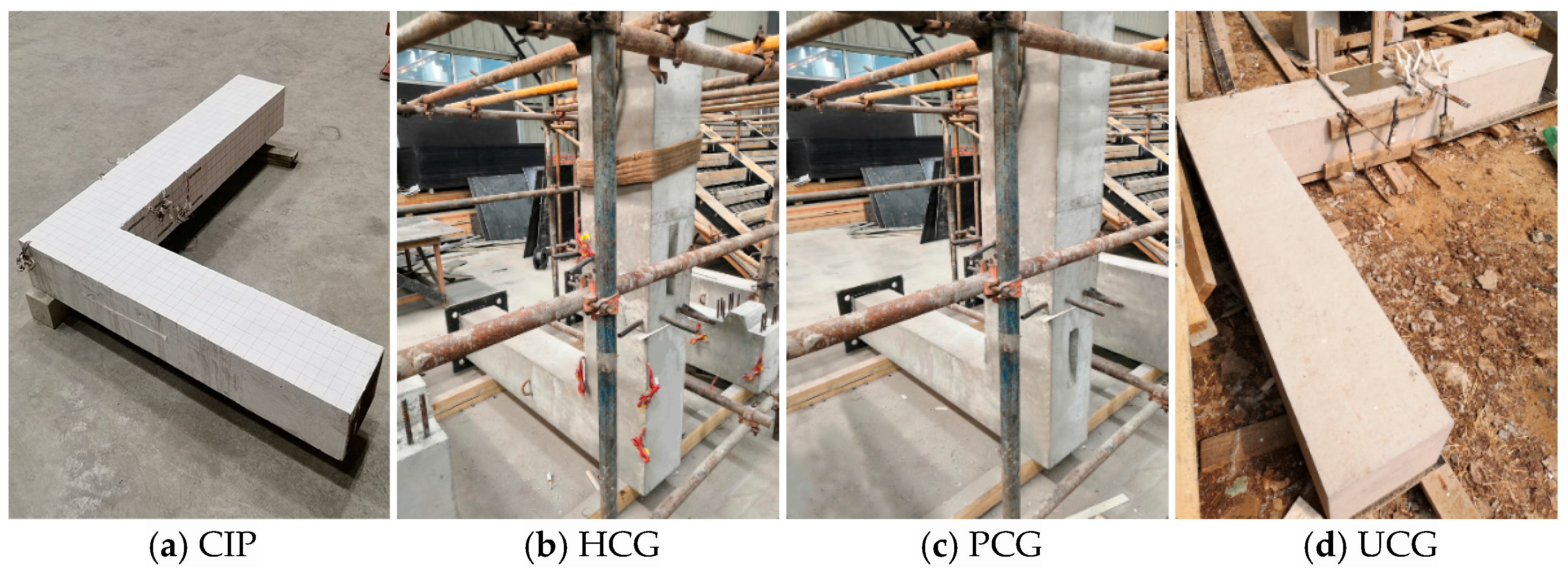
The components of each specimen were prefabricated individually and assembled in the factory. The construction process of the prefabricated joints was similar. The UCG joint is used here as an example, as illustrated in Figure 2. Firstly, the rebar cages for the roof and sidewall were fabricated separately. The C40 concrete was then cast, as shown in Figure 2a–c. After the concrete of the precast roof and sidewall had cured to a certain strength and the surfaces were roughened, a 2 mm thick layer of epoxy was applied to the end faces of the precast components. This achieved the concrete connection between the components, as shown in Figure 2d,e. Then, the UHPC was mixed and cast on-site, as shown in Figure 2f,g. Finally, the rebar connection between the precast components was completed by grouting the GSs, as shown in Figure 2h. Notably, the HCG and PCG joints used HSBs and PSs, respectively. These provided prestressing force at the joint seam. Photographs of all prefabricated specimens are shown in Figure 3.

2.3. Material Properties

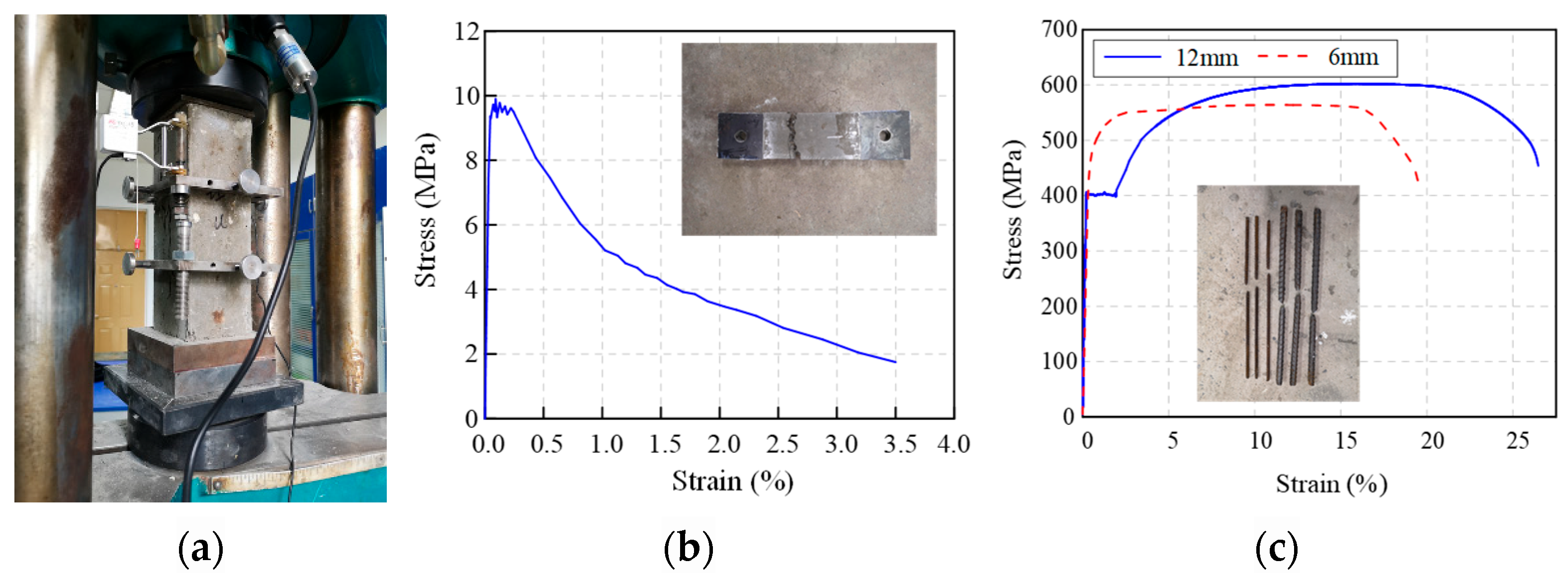
All specimens were designed and fabricated using materials from the same batch. Normal concrete with a strength grade of C40 was used (Ganzhou Ruikang Concrete Co., Ltd., Ganzhou, China). The longitudinal rebars and stirrups (Jiangxi Pxsteel Industrial Co., Ltd., Nanchang, China) in the components were HRB400 and HPB400, respectively. The HSBs (Beijing Zhongye Jianmao Technology Co., Ltd., Beijing, China) were grade 12.9, M14 type. The PSs had a standard strength of 1860 MPa. Fully grouted GTZQ4-12 GSs (Beijing Zhongye Jianmao Technology Co., Ltd., Beijing, China) with a yield strength of 425 MPa were used. The grouting material (Beijing Jianmao Technology Co., Ltd., Beijing, China) was a commercial high-strength product. The bonding material (Sino-Sina Building Materials Co., Ltd., Zhengzhou, China) at the concrete interface was grade A epoxy [45]. The UHPC (Beijing Municipal Engineering Research Institute, Beijing, China) was of the U120 type, with a steel fiber volume fraction of 2%. The mechanical properties of all materials used in the tests were determined through standard testing methods [46,47], and the results are presented in Table 2. Typical test setups and representative stress–strain relationships are shown in Figure 4.

2.4. Loading Protocol

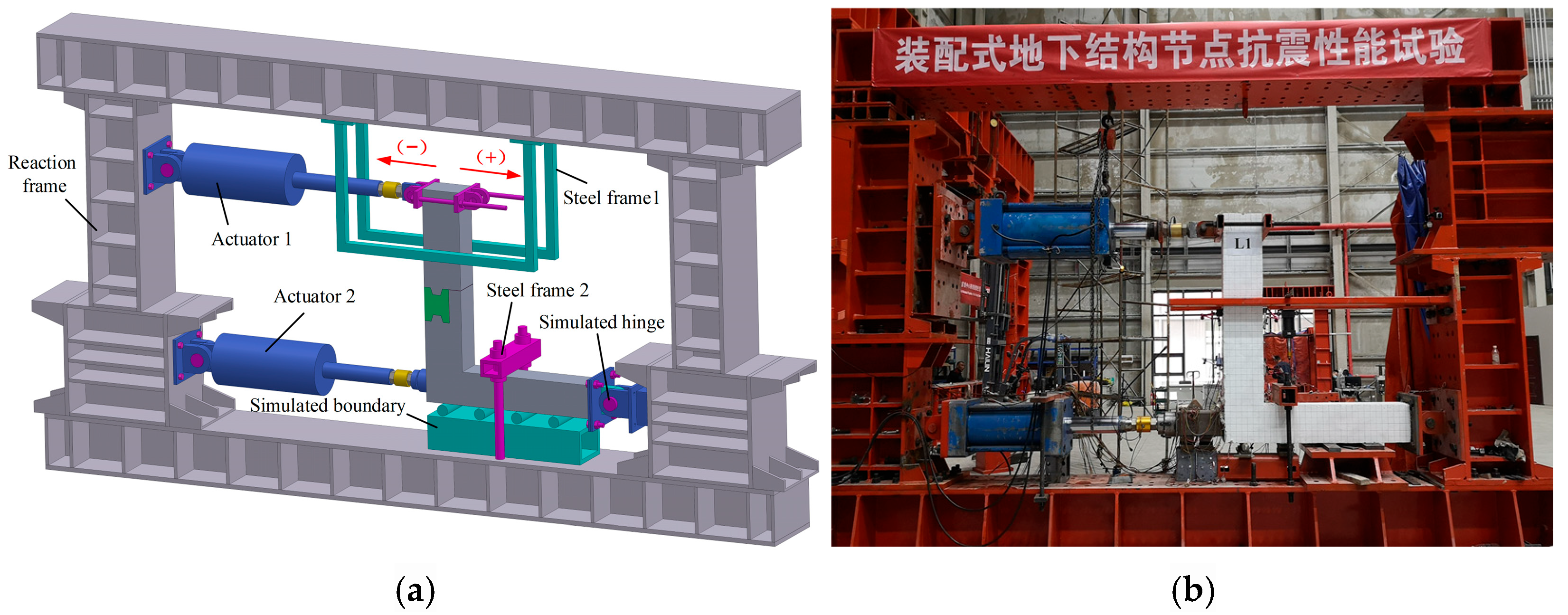
Figure 5 presents the test loading device. Horizontal actuator 1 is hinged to the free end of the roof. It delivers a horizontal cyclic load to the test model. Horizontal actuator 2 acts on the end of the sidewall to provide a constant axial force. This simulates the axial earth pressure on the sidewall. The prototype sidewall had an axial compression ratio equal to 0.06. This value was obtained under the most unfavorable working condition. Therefore, a constant axial force of 86 kN was exerted by actuator 2. The end of the sidewall is connected to a hinged support through an embedded steel plate. This simulates an inflection point. Steel plates are placed on the side of the sidewall to simulate lateral boundary. To prevent potential out-of-plane instability, steel frame 1 is installed on the reaction frame. Additionally, to avoid longitudinal movement of the sidewall along the roof direction, steel frame 2 with an adjustable gap is provided.
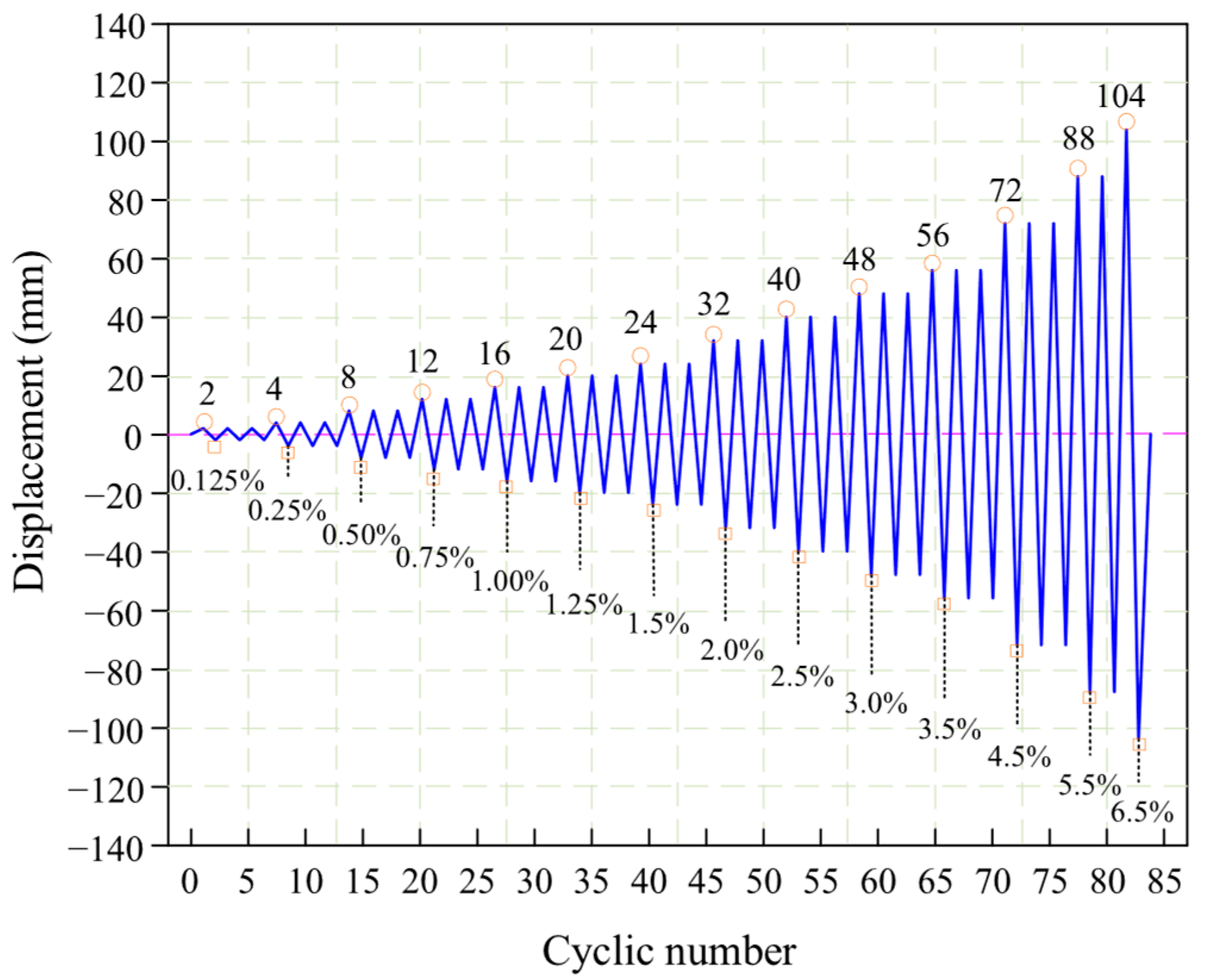
Displacement-controlled loading was adopted, following the standard quasi-static testing protocol commonly used in seismic performance studies [48]. As illustrated in Figure 6, Actuator 1 applied the horizontal cyclic load accordingly. This loading method has been widely employed to simulate seismic actions and evaluate the hysteretic behavior, stiffness degradation, and energy dissipation capacity of structural components. In particular, it can effectively and safely capture the performance degradation of structures after yielding [8,21,30]. The positive loading direction was defined as the pushing direction of actuator 1. The test was terminated when either of the following criteria was met: (1) the bearing capacity dropped to 85% of the peak load, or (2) the specimen lost its ability to sustain the load.

2.5. Measuring Point Arrangement

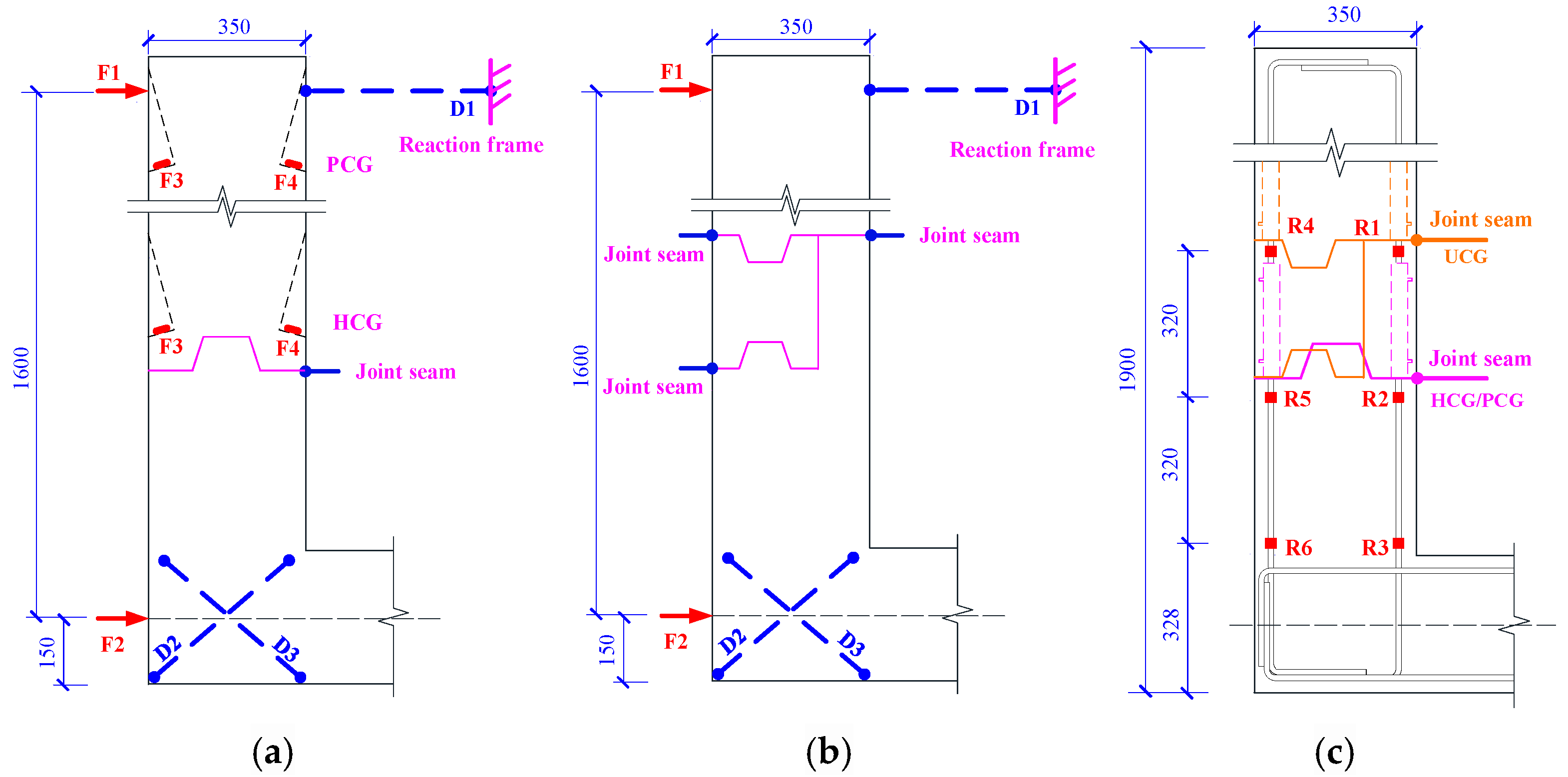
During the cyclic loading tests, a unified measurement system was arranged for each specimen. Three displacement sensors were installed. D1 monitored the horizontal displacement at the end of the roof. D2 and D3 were placed in the roof–sidewall connection zone (RSC) to measure its shear deformation. For load measurements, load cells F1 and F2 were attached to the corresponding actuators. They collected the load data in real time. For the HCG and PCG specimens, two additional load cells (F3 and F4) were installed. These were used to track the prestress changes within the HSBs and PSs during loading. The sensor layout for displacement and force is detailed in Figure 7a,b. Furthermore, to analyze the internal force distribution in the longitudinal rebars, six rebar strain sensors were installed at key locations on the roof of each specimen. Their specific arrangement is shown in Figure 7c.

3. Experimental Results and Analysis

3.1. Failure Phenomena

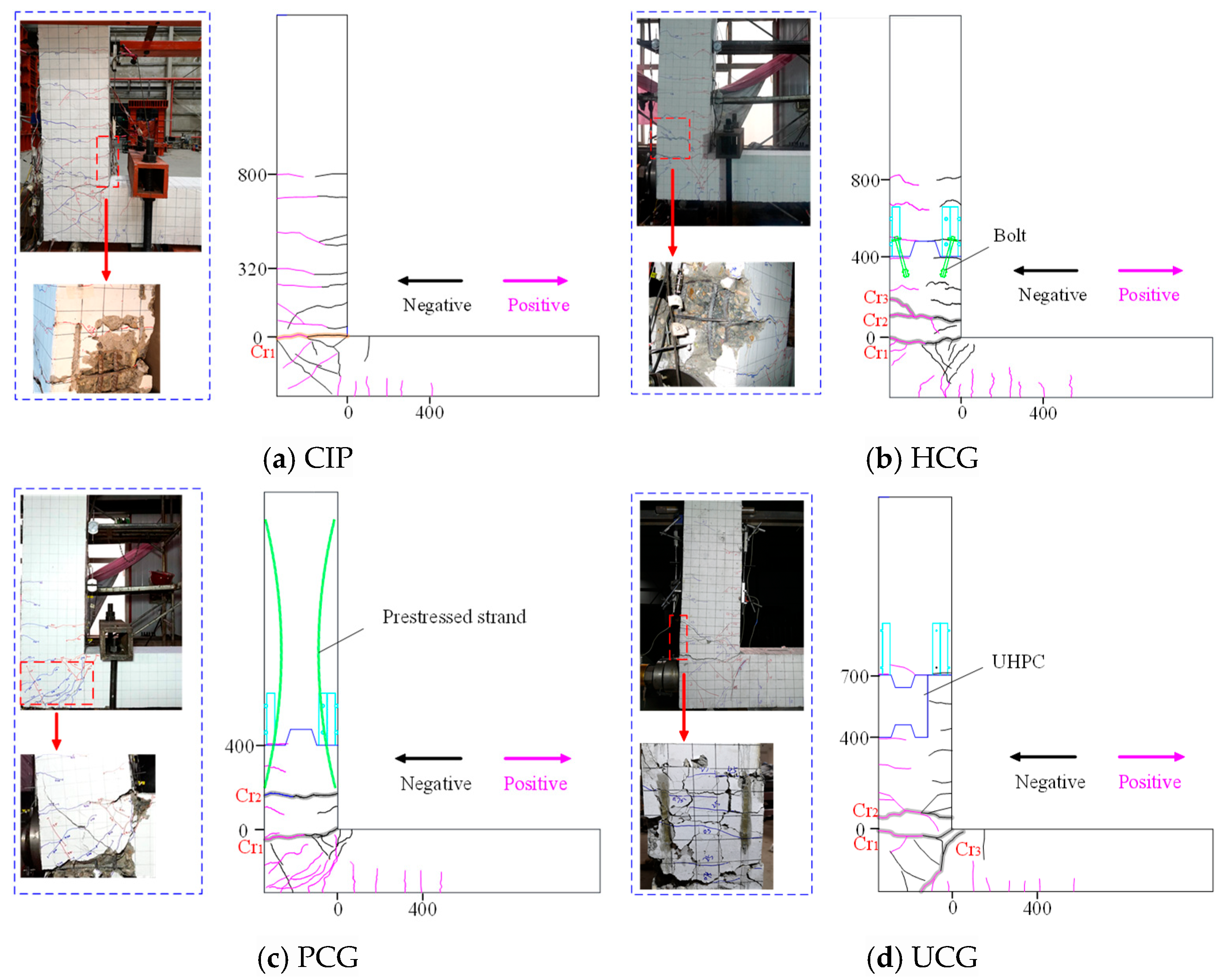
Table 3 summarizes the damage process observed for each specimen. Furthermore, the failure modes and crack distributions are illustrated in Figure 8.
According to the damage process recorded in Table 3, along with the failure modes and crack distribution characteristics shown in Figure 8, all specimens with joints placed outside the roof plastic hinge exhibited consistent failure modes. The roof failed in flexure, while the RSC failed in shear. The cogging structure significantly enhanced the shear performance of the joints. None of the precast specimens exhibited through cracks with a width greater than 0.10 mm at the joint seams. Specifically, the HSBs and PSs effectively delayed crack propagation in their respective action zones. The GSs improved the stiffness and crack resistance of the corresponding areas. Relying on its excellent bond performance with normal concrete, UHPC significantly suppressed cracking and damage propagation at the seams.
The failure modes of the specimens exhibited distinct characteristics. Flexural damage in the roof plastic hinge zone was characterized by the development of transverse cracks, subsequent yielding of the longitudinal rebars, and eventual crushing of concrete in the compression zone. This type of damage develops gradually and is associated with stable energy dissipation. In contrast, shear damage in the RSC was characterized by the formation of diagonal cracks, rapid crack widening, and brittle concrete spalling. Shear damage is more abrupt and leads to a sudden loss of strength and stiffness. For the PCG specimen, the suppression of flexural damage in the roof forced the development of shear damage in the RSC, resulting in an undesirable brittle failure mode.
In terms of failure characteristics, cracks in the HCG specimen were concentrated in the area from the lower edge of HSBs to the RSI. This promoted more sufficient energy dissipation in this region. For the UCG specimen, due to the strengthening of the joint zone, cracks were mainly distributed in the normal concrete area within 0–200 mm above the RSI. This also achieved concentrated energy dissipation in the plastic hinge zone. Although the PCG specimen suppressed cracks in the prestressed zone, it caused premature and concentrated crack development from the lower edge of PSs to the RSI. At a drift ratio of 1.50%, the right side of Cr1 reached a width of 9 mm. This indicates that the configuration caused the energy dissipation zone to shift downward, making this area a weak link. Regarding the damage degree in the RSC, both the HCG and UCG joints reduced RSC damage to a certain extent. This was reflected by localized crack distribution or fewer cracks. In contrast, the PCG joint significantly aggravated RSC damage, and diagonal cracks measuring 0.40 mm appeared in the RSC at a drift ratio of 1.50%. This indicates that the energy transfer caused by this joint accelerated the shear failure process in this zone. In summary, the HCG and UCG joints enhanced concentrated energy dissipation in the plastic hinge zone. At the same time, they helped mitigate damage in the RSC. The PCG joint was beneficial for controlling cracks in the prestressed zone of the roof. However, it resulted in premature failure of the RSC, and the overall seismic performance of the structure was adversely affected.

3.2. Hysteretic Behavior and Skeleton Curves

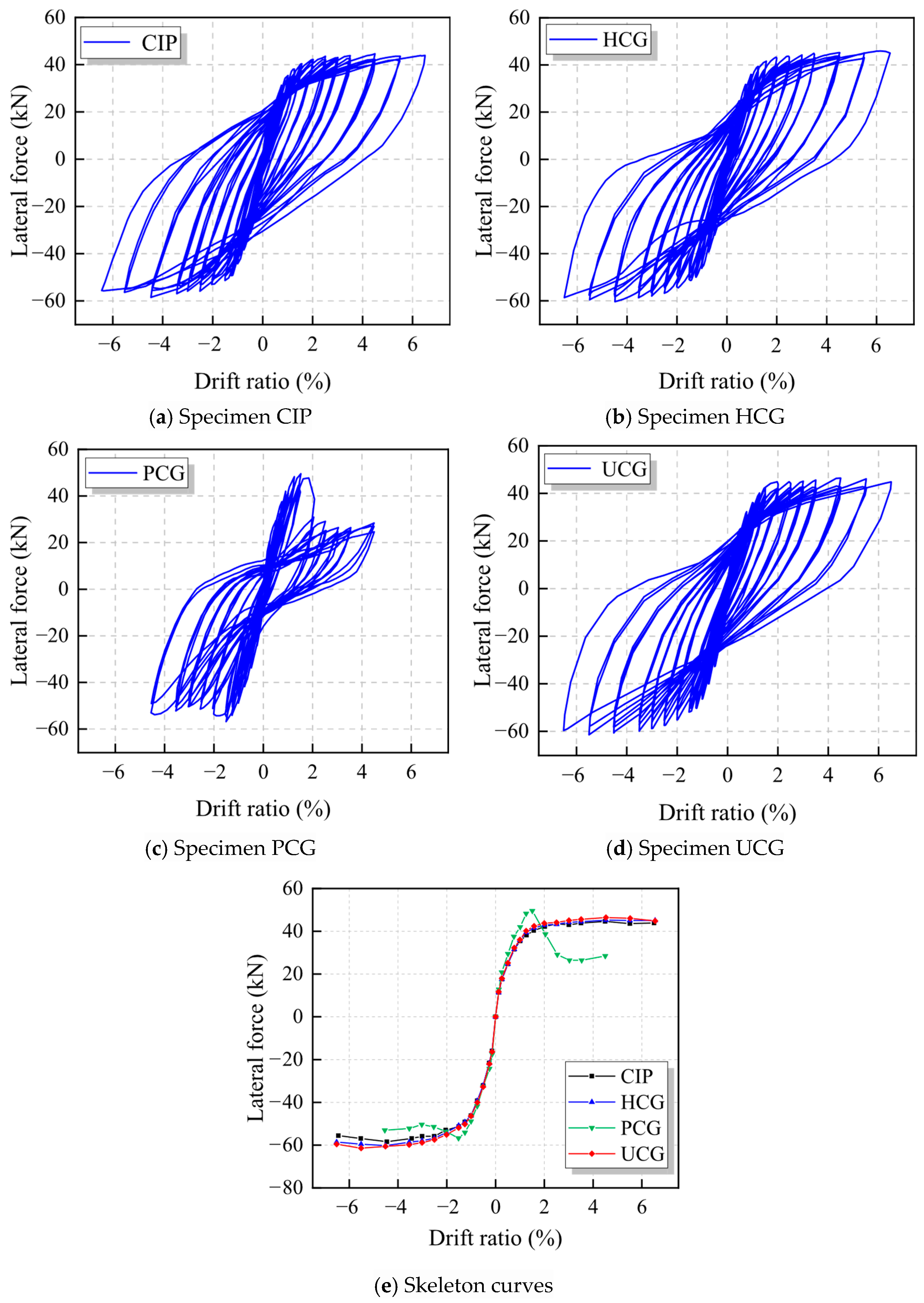
Figure 9 presents the hysteretic curves and skeleton curves for each L-shaped specimen. It can be observed from Figure 9 that when different types of composite joints were placed outside the roof plastic hinge, the seismic performance of the specimens exhibited systematic differences. The hysteretic curves of the CIP, HCG, and UCG specimens were relatively full, displaying a stable spindle shape. This indicates that these specimens possessed good energy dissipation capacity. Notably, during the later loading stage, the fullness of the hysteresis loops for the HCG and UCG specimens even exceeded that of the CIP specimen. This finding was combined with the damage process analysis. It occurred because the introduction of HSBs and UHPC intensified damage accumulation in the roof plastic hinge. This also increased energy dissipation in this area. Consequently, more sufficient hysteretic performance was achieved. In stark contrast, the hysteretic curve of the PCG specimen was significantly pinched and lacked fullness. This poor performance occurs because the prestressing force provided by the PSs suppresses the development of the roof plastic hinge, which is the primary energy dissipation zone. The prestressing force, while increasing initial stiffness, suppresses concrete cracking and plastic deformation in the prestressed zone. As a result, the load and deformation demands are shifted earlier to the roof–sidewall connection zone (RSC). The RSC, not originally designed as the main energy dissipation region, then undergoes excessive shear deformation and premature shear failure, leading to pinched hysteresis loops, reduced energy dissipation, and significant loss of ductility.
Regarding stiffness evolution, the skeleton curves of all specimens nearly overlapped during the initial elastic stage. This indicates that they had similar initial stiffness. However, as loading progressed, the overall stiffness of the PCG specimen was noticeably higher than that of the other specimens. This was mainly attributed to the stiffening effect of the PSs on the specimen.
For a more intuitive comparison of the mechanical performance differences among the specimens, the characteristic values of their skeleton curves are summarized in Table 4. The yield displacement Δy and yield load Fy were determined using the Park method [49]. The ultimate load Fu was taken as 85% of the peak load Fp. The displacement corresponding to the ultimate load Fu is defined as the ultimate displacement Δu.
It can be seen from Table 4 that, compared with the CIP specimen, the average positive and negative peak loads of the HCG specimen increased by approximately 3.3%. For the UCG specimen, the average increase was approximately 6.0%. This indicates that these two types of joints can effectively improve the load-bearing capacity of the test models. For the PCG specimen, the positive peak load increased by 11.1%. However, its negative peak load decreased by approximately 2.7%, exhibiting asymmetric behavior. This was directly related to the experimental phenomenon of premature shear failure in its RSC.
Strength degradation (reduction in peak load at the same drift ratio for successive cycles) was also quantified. As shown in Figure 9 and Table 4, the PCG specimen reached its peak load at a drift ratio of 1.5% and subsequently suffered premature shear failure at a drift ratio of 4.5%, exhibiting significant strength degradation. Specifically, at a drift ratio of 3.0%, the positive and negative strength degradations of the PCG specimen reached 46.7% and 11.3%, respectively. In contrast, the CIP, HCG, and UCG specimens all attained their peak loads at a drift ratio of 4.5%. The strength degradation of these three specimens was significantly lower than that of the PCG specimen. At a drift ratio of 6.5%, the positive strength degradation for the CIP, HCG, and UCG specimens was 1.7%, 1.0%, and 0.6%, respectively, while the negative strength degradation was 4.8%, 2.9%, and 2.7%, respectively.
The differences in ductility among the specimens were most prominent. The CIP, HCG, and UCG specimens all exhibited excellent ductility, and their ultimate displacements Δu were all greater than 104 mm. Furthermore, they still maintained a relatively high residual bearing capacity at the end of the test, and a complete descending branch was not recorded. In contrast, the ductility of the PCG specimen was severely degraded. Its positive ultimate displacement was only 29.13 mm, and its negative ultimate displacement was 72.87 mm. These values were less than 70% of the typical values for the other specimens, indicating pronounced brittle characteristics.
In summary, placing the HCG and UCG joints outside the plastic hinge zone could modestly increase the bearing capacity (by 3–6%). At the same time, the energy dissipation and ductility performance of the specimens were maintained or even improved. Thus, these two joints achieved the seismic performance goal of being “equivalent to or better than CIP”. In contrast, the PCG joint could enhance stiffness and bearing capacity in certain directions. However, it also led to reduced energy dissipation capacity and significant loss of ductility. Its ultimate displacement decreased by over 30%. Furthermore, brittle failure occurred in the RSC. This damage transfer mechanism prevents the roof plastic hinge from fully dissipating seismic energy, resulting in reduced energy dissipation and ductility. This had a pronounced adverse effect on the overall seismic behavior of the specimen.

3.3. Stiffness Degradation

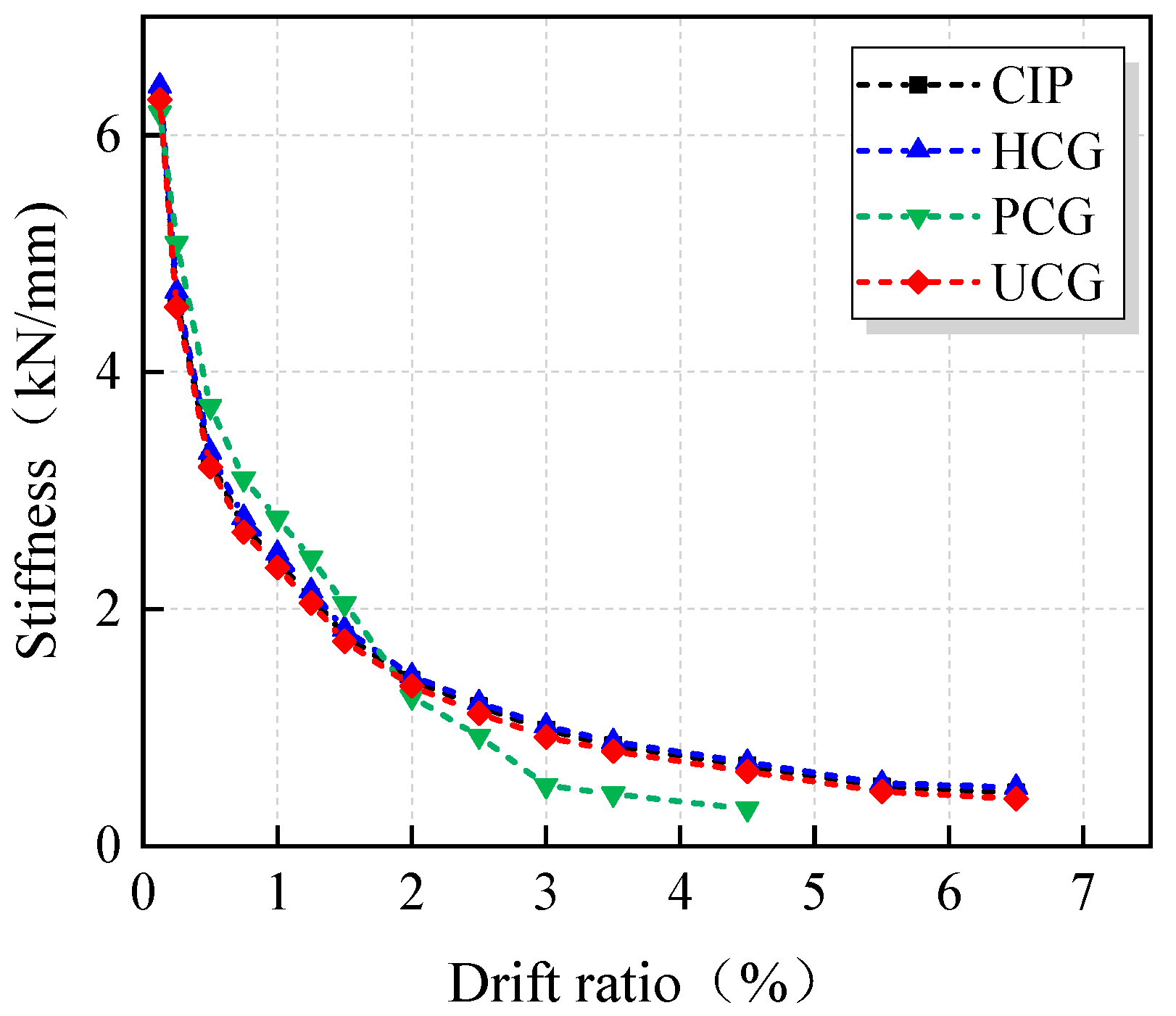
The peak-to-peak secant stiffness of the first reversal cycle of the load–displacement hysteretic response was used to define the cyclic stiffness [50]. Then, the secant stiffness of each specimen at different drift ratios was calculated and presented in Figure 10. All specimens exhibited similar initial stiffness at a drift ratio of 0.125%, indicating consistent elastic behavior at the onset of loading. As the drift ratio increased, the stiffness degradation patterns diverged among the specimens. The PCG specimen initially showed the highest stiffness due to the prestressing effect of the PSs, which delays crack initiation and propagation in the prestressed zone. However, beyond a drift ratio of 1.5%, the stiffness of the PCG specimen dropped sharply, from 2.05 kN/mm at 1.5% to 1.26 kN/mm at 2.0% (a 38% reduction), and further to 0.51 kN/mm at 3.0%. This reflects the damage transfer mechanism: suppression of roof plastic hinge forced excessive shear deformation into the RSC, leading to rapid stiffness loss and premature shear failure at 4.5% (stiffness 0.31 kN/mm). In contrast, the CIP, HCG, and UCG specimens maintained relatively stable degradation. The UCG specimen showed the fastest stiffness degradation among the three, dropping to 0.40 kN/mm at the drift ratio of 6.5%. This is because the UHPC strengthening in the joint core concentrates damage in the roof plastic hinge zone, resulting in more severe stiffness reduction in that region, which is consistent with the design concept of “strong joint, weak component.” Overall, stiffness degradation correlates well with failure modes and strength degradation. The PCG joint suffers rapid stiffness loss and early failure, while the HCG and UCG joints provide a balance between stiffness retention and damage controllability.

3.4. Pinching Width Ratio

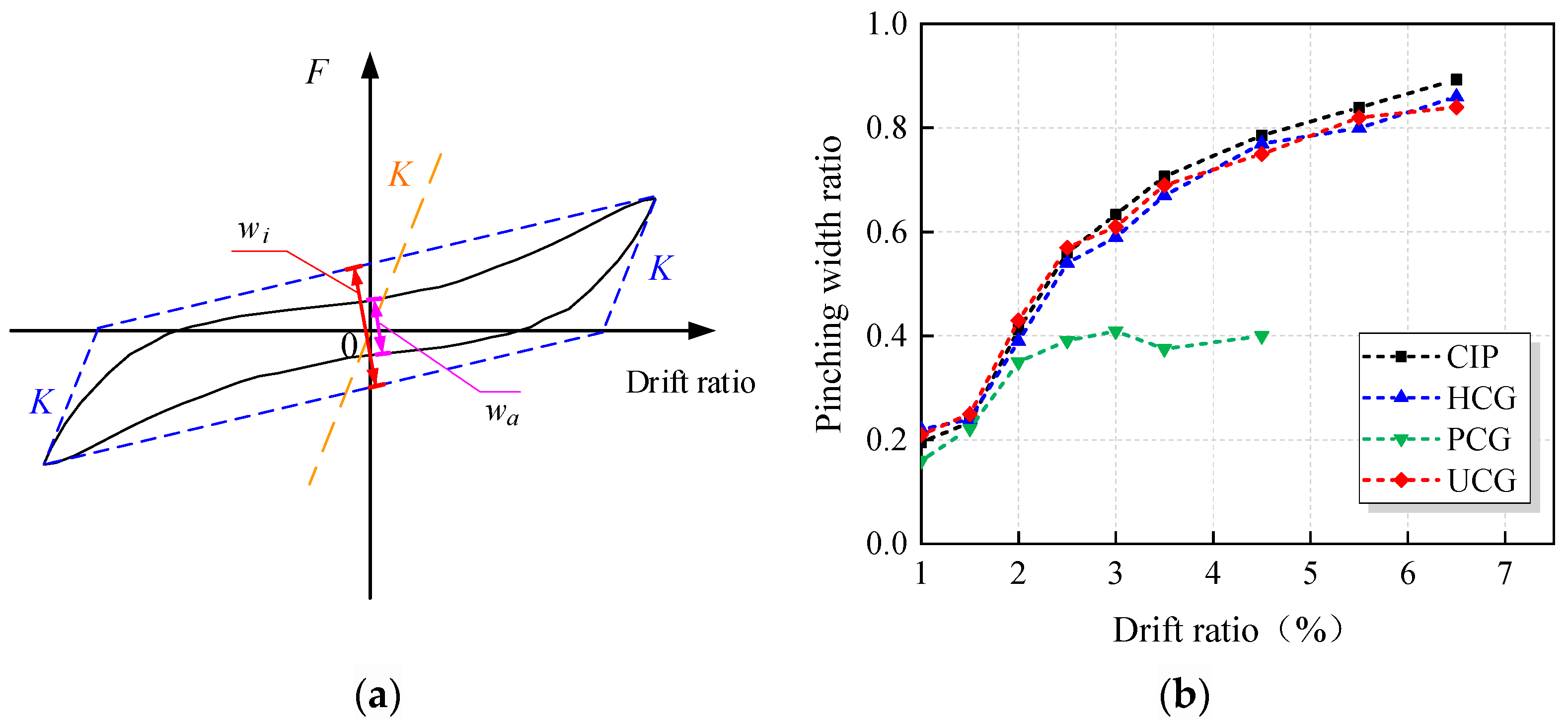
The pinching width ratio was adopted to characterize the pinching behavior in this study [50], which is defined as the ratio of pinching in the actual curve to that in an idealized curve. It was determined using the following expression:
p = w a w i
where p denotes the pinching width ratio of each hysteretic loop, which characterizes the plumpness of the loop. wa represents the pinching width of the actual curve, which is determined as the least distance between the positive and negative loading directions around zero drift ratio in the corresponding hysteretic loop. It is generally accepted that the stiffness tends to be lowest near zero drift, which leads to greater pinching. The idealized curve is assumed to be a parallelogram, where the unloading slope is parallel to the initial elastic slope. wi represents the pinching width of the idealized curve, which is calculated as the minimum distance between the two sides of the parallelogram around zero drift. The schematic representations of wa and wi are shown in Figure 11a.
Then, the pinching width ratios of each specimen were calculated and presented in Figure 11b. The PCG specimen exhibited relatively low p values before failure, and its p increased only moderately to 0.41 at the drift ratio of 3.0% before dropping to 0.40 at 4.5%, followed by premature shear failure. This indicates that PCG suffered from limited ductility and poor energy dissipation, consistent with its severe strength degradation and early failure. In contrast, at the drift ratio of 4.5%, the pinching width ratios of specimens CIP, HCG, and UCG are calculated to be 0.79, 0.77, and 0.75, respectively. This indicates increments of 96%, 93%, and 88%, respectively. Additionally, CIP specimen showed steadily increasing p from 0.20 at 1.0% to 0.89 at 6.5%, reflecting its stable flexural behavior and good energy dissipation capacity. The HCG specimen exhibited p values slightly lower than CIP, indicating that the local prestressing provided by HSBs helped maintain relatively plump hysteresis loops, though marginally less than the CIP reference. The UCG specimen demonstrated p values comparable to or slightly higher than CIP at lower drift ratios but became marginally lower at larger drifts (0.84 at 6.5% vs. 0.89 for CIP). This suggests that the UHPC-strengthened joint core effectively concentrated damage in the roof plastic hinge zone, resulting in a plump hysteresis loop with good energy dissipation.
Overall, the p results confirm that higher pinching width ratio correlates with more ductile behavior and greater energy dissipation. Among the three precast specimens, the HCG and UCG specimens achieved p values close to the CIP reference, demonstrating their ability to provide equivalent seismic performance. The PCG joint, however, suffered from low p and premature failure. These findings are consistent with the observed failure modes, stiffness degradation, and strength degradation discussed in previous sections.

3.5. Energy Dissipation

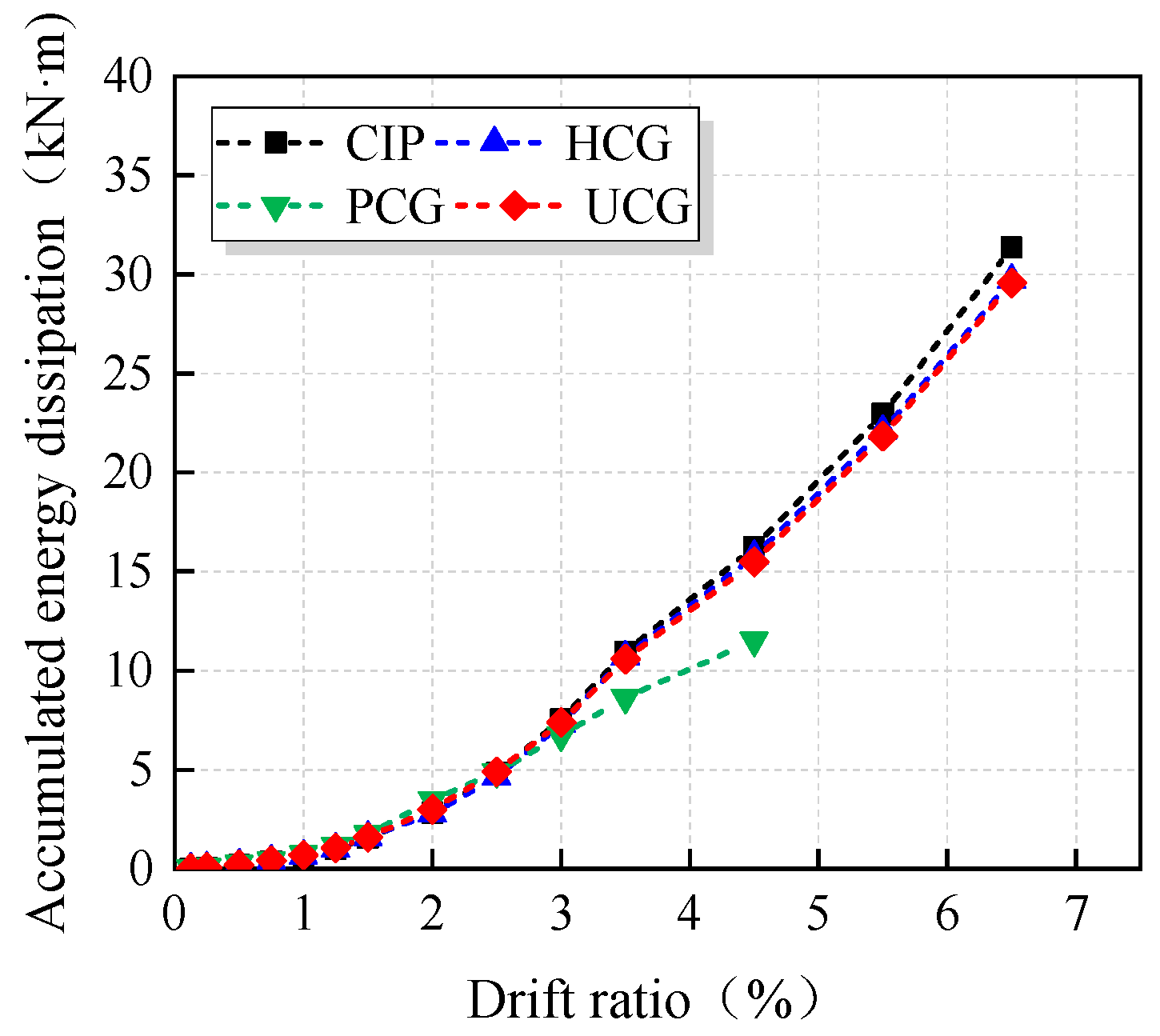
Figure 12 presents the cumulative energy dissipation curves obtained for each test model. A comparison shows that the cumulative energy dissipation levels across all specimens were basically the same during the initial loading stage (drift ratios below 1.5%). At this stage, energy was mainly dissipated by means of concrete cracking. As the loading displacement rose, the evolution of cumulative energy dissipation generally exhibited the following trend: E(CIP) > E(UCG) > E(HCG) > E(PCG). The CIP specimen exhibited the highest cumulative energy dissipation due to its good structural integrity. The HCG and UCG specimens achieved energy dissipation levels comparable to those of the CIP specimen. This indicates that the HCG and UCG joints maintained a good energy dissipation mechanism. This was related to the controlled damage development in their joint zones, where no severe failure occurred. In contrast, the PCG specimen exhibited markedly lower cumulative energy dissipation than the remaining specimens. This occurs because the PSs suppress the full development of the roof plastic hinge region. As a result, the load transfer and deformation are transferred earlier to the RSC. This triggers premature shear failure in this zone at a drift ratio of 4.5%, severely restricting the overall energy dissipation capacity. The underlying mechanism is that the prestressing force, while increasing initial stiffness, prevents the roof plastic hinge from forming and dissipating energy, shifting the damage to the RSC which is not designed for such demands.

3.6. Displacement Ductility

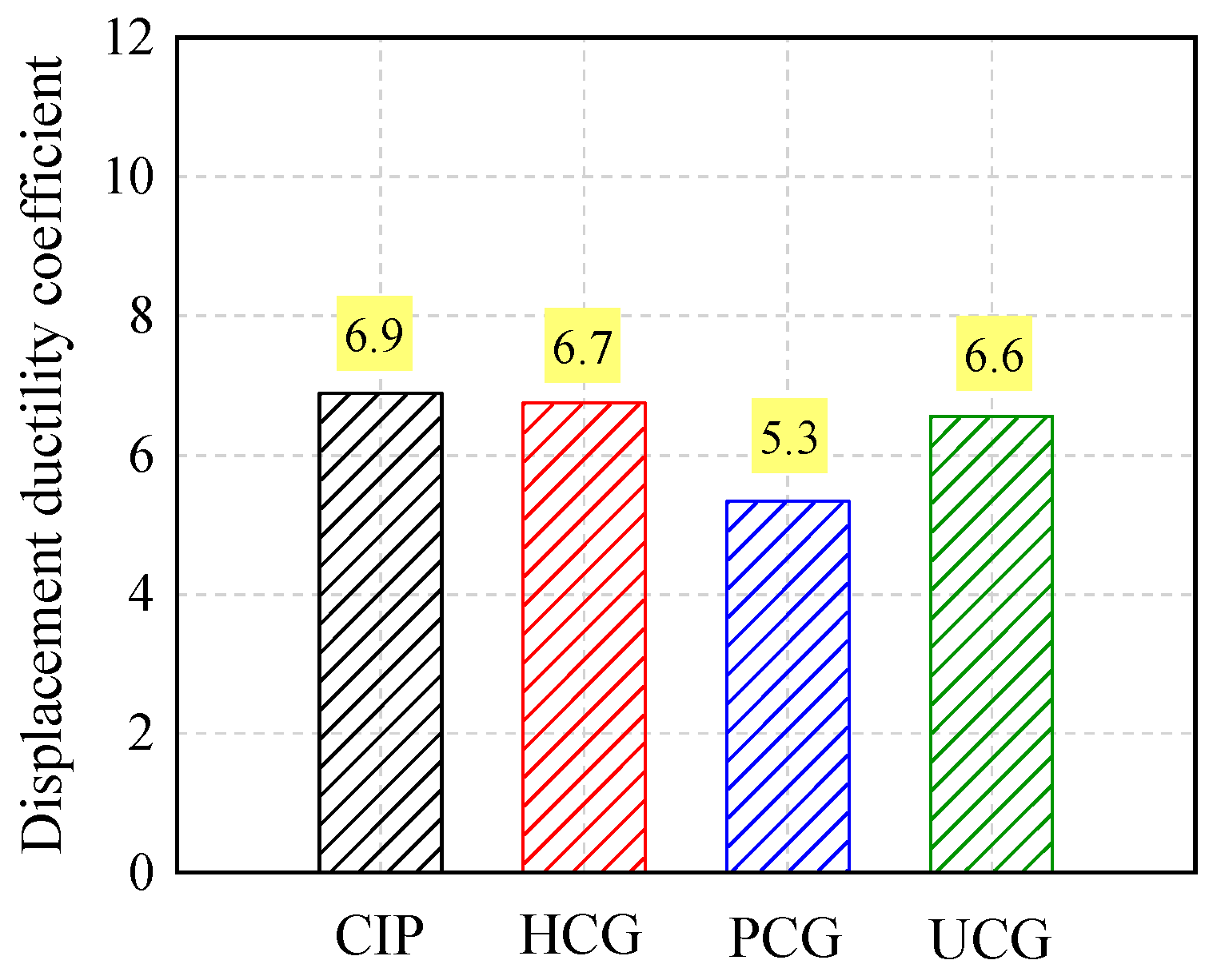
Figure 13 presents the displacement ductility coefficients obtained for each specimen. As illustrated in Figure 13, the displacement ductility coefficients of the CIP, HCG, and UCG specimens were 6.9, 6.7, and 6.6, respectively. These values were similar, and this indicates that the two joints enabled the structure to achieve plastic deformation capacity comparable to that of the CIP specimen. Thus, the ductility design goal of “equivalent to CIP” was achieved. In contrast, the displacement ductility coefficient of the PCG specimen was 5.3. Although this value satisfied the basic code requirement that the ductility coefficient for RC structures [51], it was significantly lower than those of the other specimens. This indicates that the prestressing effect constrained the development of plastic deformation to a certain extent. It should be noted that when calculating the ductility coefficients, the CIP, HCG, and UCG specimens still maintained a relatively high bearing capacity at the end of the test. Therefore, a complete descending branch was not recorded, and their ultimate displacement was taken as the maximum loading displacement. Consequently, their actual displacement ductility coefficients are higher than the calculated values. This further confirms that these types of joints possess good ductility reserves. In contrast, the PCG specimen failed earlier, so its ductility potential was relatively limited. In summary, the HCG and UCG joints could effectively maintain ductility performance in the prefabricated specimens comparable to that of the CIP specimen. Although the PCG joint met the lower limit of ductility required by the code, its overall deformation capacity was reduced.

3.7. Shear Deformation in the RSC

Figure 14 presents the relationship between the loading drift ratio and the shear angle in the RSC for each test model. The shear angle was determined using the following expression:
φ = Δ l 1 + Δ l 2 2 · a 2 + b 2 a b
where φ denotes the shear angle (rad). Δl1 and Δl2 represent the variations in diagonal length of the RSC (mm). and a and b are the length and width of the RSC (mm), respectively.
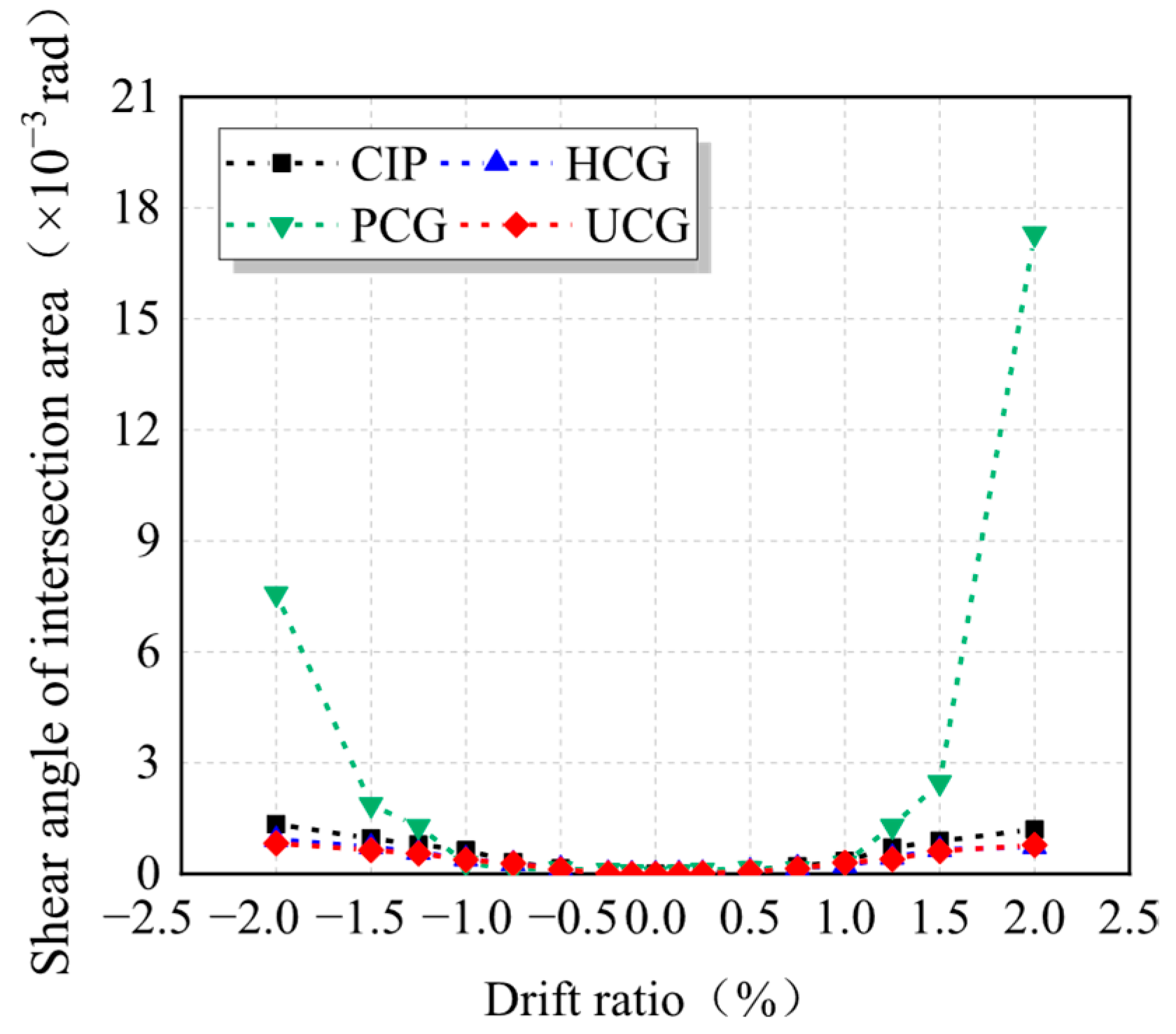
As shown in Figure 14, when the loading displacement did not exceed 32 mm (drift ratio ≤ 2.0%), the shear deformation in the RSC of the HCG and UCG specimens was generally smaller than that of the CIP specimen. In contrast, the shear deformation of the PCG specimen was significantly larger. Specifically, under a negative loading displacement of 32 mm, the shear angles of the HCG and UCG specimens were approximately 70% and 60% of that of the CIP specimen, respectively. However, the value of the PCG specimen reached 5.7 times that of the CIP specimen. This indicates a sharp increase in shear deformation within its RSC. This phenomenon was directly related to the damage distribution mechanism caused by the joint configurations. The strengthening effect of the HSBs and UHPC promoted more concentrated damage in the roof plastic hinge zone. This, in turn, suppressed shear deformation in the RSC. However, the placement of PSs caused damage to transfer to both the roof plastic hinge zone and the RSC simultaneously. This significantly aggravated the shear damage and deformation in the RSC. This was clearly confirmed by the failure mode diagram of the PCG specimen. In summary, the HCG or UCG joints could reduce the shear deformation in the RSC to a certain extent. However, the PCG joint induced a significant increase in shear deformation of the RSC. This further verifies the adverse effect of PCG joint on the seismic performance of the RSC.

3.8. Residual Deformation

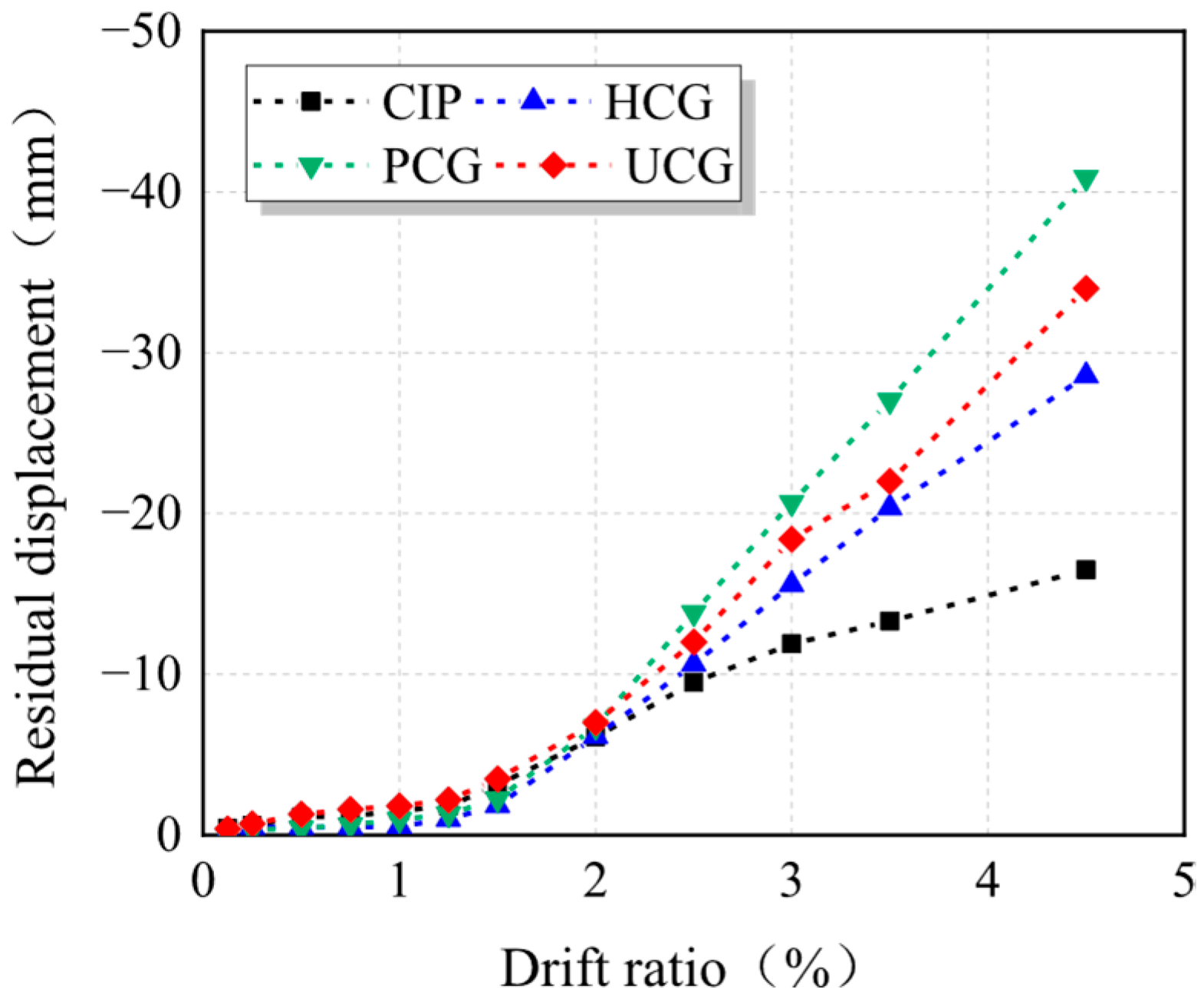
Figure 15 presents the residual displacement curves for each specimen. As shown in Figure 15, the residual displacements of the HCG and PCG specimens were significantly smaller than that of the CIP specimen during the initial loading stage (displacement ≤ 24 mm, drift ratio ≤ 1.5%). This indicates that the prestressing force (HSBs and PSs) effectively enhanced the self-centering capacity of the specimens at this stage. In contrast, the UCG specimen exhibited residual displacement values comparable to those of the CIP specimen. This suggests that UHPC did not significantly alter the plastic deformation behavior at this stage. It should be noted that the HSBs and PSs in the specimens were relatively short. This was due to the scaled model. This could lead to prestress relaxation under large deformations in the later stage. Consequently, their self-centering capacity would be reduced. As the displacement continued to increase, the residual displacement of all specimens gradually increased. Nevertheless, the residual displacements of the prefabricated specimens generally exceeded that of the CIP specimen. This was related to the damage redistribution caused by the joint configurations. The application of prestressing force and UHPC outside the roof plastic hinge zone resulted in more concentrated damage within the plastic hinge region. This, in turn, manifested as more significant residual deformation. This was especially manifest for the PCG specimen. Its residual displacement increased most noticeably in the later loading stage. This was closely related to the concentrated damage and premature failure in the RSC. In summary, the HCG and PCG joints exhibited good self-centering capacity under small loading displacements. In contrast, damage concentrated in the plastic hinge zone or the RSC under large displacements. As a result, their residual deformation exceeded that of the CIP specimen. The residual deformation of the UCG specimen was similar to that of the CIP specimen in the early stage. However, it increased due to damage concentration in the later stage. This indicates that the joint type not only affects the bearing capacity and energy dissipation performance, but also directly relates to the structural recoverability and damage distribution pattern.

3.9. Stress Distribution in Rebars

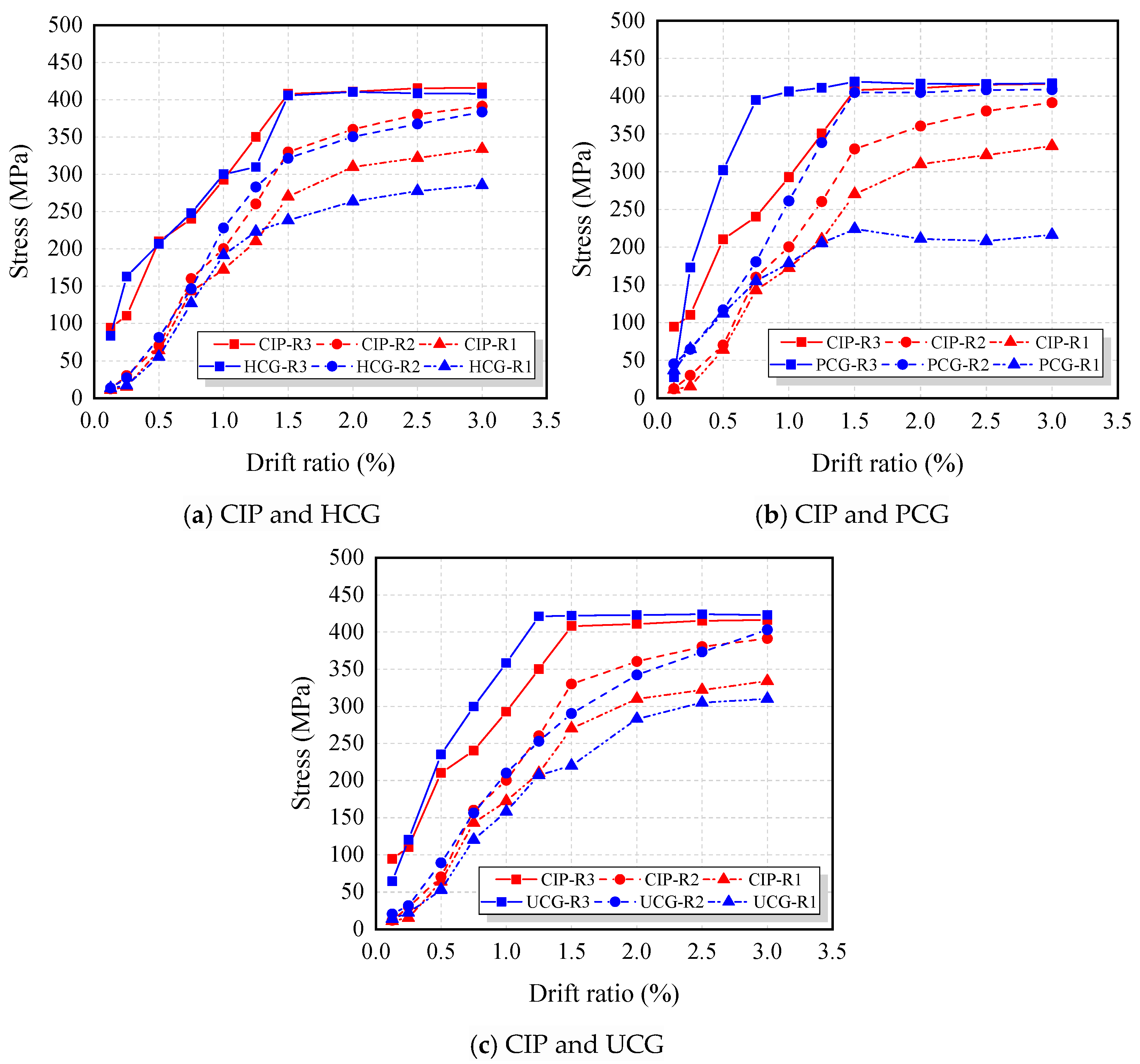
The stress development patterns of each specimen during negative loading are depicted in Figure 16. At each measurement point on the roof longitudinal rebars, the prefabricated specimens exhibited behavior generally consistent with that of the CIP specimen. The stresses increased steadily with increasing loading displacement. No abnormal fluctuations or premature decreases were observed. This indicates that the composite joints ensured the continuity and uniformity of stress transfer in the roof longitudinal rebars. It also reflects the overall reliability of the joint connections. A noteworthy phenomenon was observed at measurement point R3, which was near the RSI. The stress growth in the PCG and UCG specimens was more rapid than that in the CIP specimen. These points also entered the yield stage earlier. With reference to the damage evolution observed in the tests, this phenomenon was related to their respective failure mechanisms. For the PCG specimen, damage concentrated in the RSC. Consequently, the longitudinal rebars in this area bore severe stress development. For the UCG specimen, damage concentrated in the plastic hinge zone. This led to greater deformation demands in this area. In summary, when placed outside the plastic hinge zone, the HCG, PCG, and UCG joints all provided effective load transfer paths for the rebars. This ensured the overall mechanical performance of the specimens.

4. Numerical Simulation Analysis

4.1. Finite Element Model

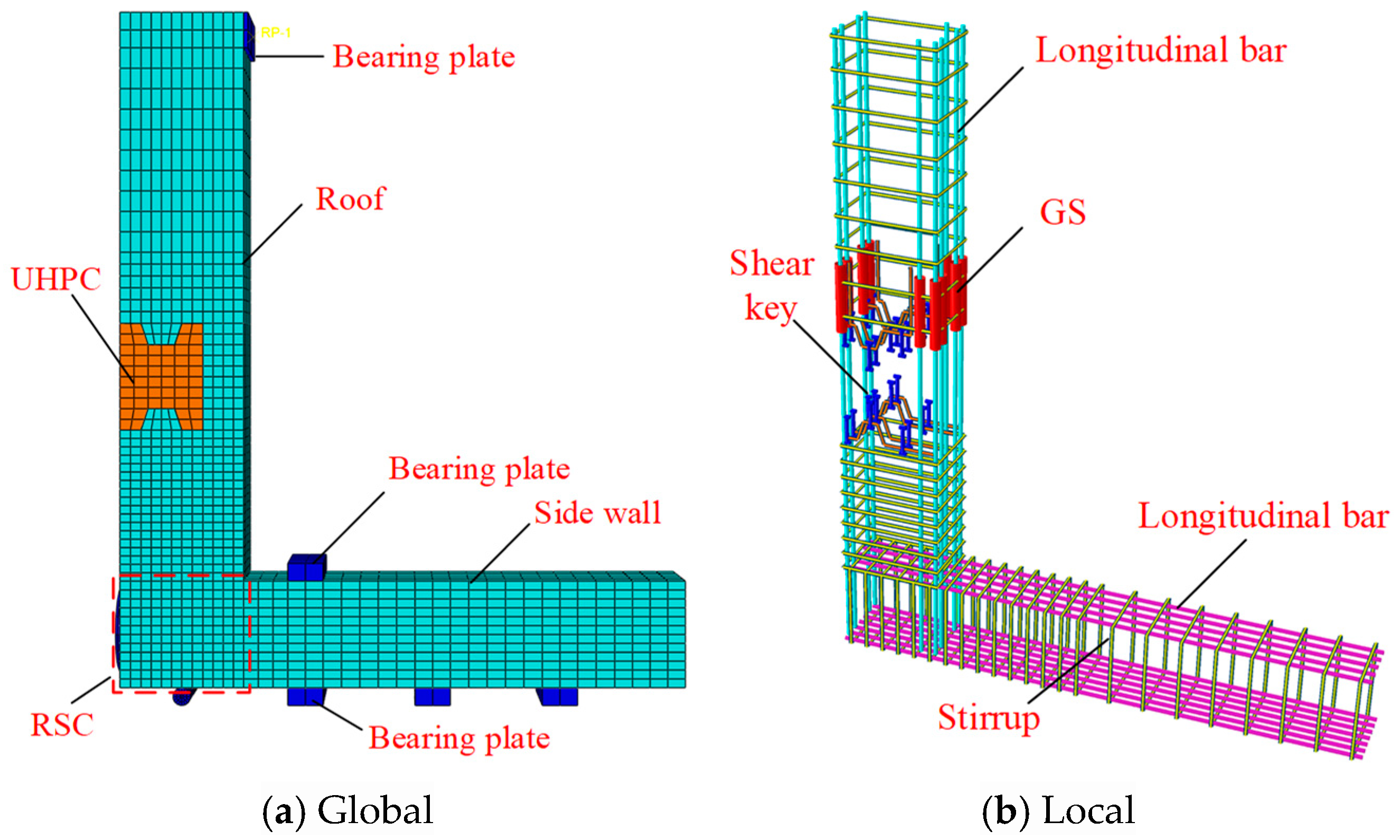
To systematically evaluate the seismic performance of the specimens with composite joints, corresponding three-dimensional finite element models were established using the commercial software ABAQUS 2025, which has been widely used for simulating the seismic behavior of prefabricated concrete structures [21,30]. A static, general analysis procedure was adopted, which is well-suited for quasi-static cyclic loading simulations. Numerical simulations were conducted to analyze the hysteretic behavior and damage evolution process of the specimens under cyclic loading. The experimental data from Section 3 were then used to validate the accuracy of the models. According to Section 2.3, the material parameters for each component in the models were selected. Based on the experimental observations presented in Section 3.1, both the epoxy resin and UHPC exhibited superior bond performance. Therefore, the interface between the epoxy resin and concrete was simulated using a “tie” constraint. For the interface between UHPC and normal concrete, the cohesive contact model proposed by Hussein Husam [52] was adopted. The concrete and UHPC were modeled using C3D8R. The reinforcement, HSBs, and PSs were modeled using T3D2. A mesh convergence study was conducted, and a global mesh size of 25 mm was selected for concrete elements, with a refined mesh size of 12.5 mm for the joint core and connection zones. The truss elements were meshed with an element size of 12.5 mm along their length. To prevent stress concentration, rigid pads with high elastic modulus were placed at the axial force application point on the sidewall and the horizontal loading point on the roof. “Tie” constraints were used to connect the pads to the specimen. In addition, the boundary conditions at the bottom of the sidewall were simulated using surface-to-surface contact. The concrete damaged plasticity (CDP) model was used for both normal concrete and UHPC, with material parameters derived from the experimental data in Table 2. The reinforcement, HSBs, and PSs were modeled using a bilinear elastic-plastic model. The GSs, HSBs, and PSs were all embedded into the concrete using the “embedded” constraint. The prestressing force for the HSBs and PSs was applied using the cooling method by assigning an initial temperature field to the PS and HSB elements. The initial temperature was calculated based on their coefficients of thermal expansion and elastic modulus. The finite element model of the UCG specimen is shown in Figure 17 as an example.

4.2. Comparison of Numerical and Experimental Results

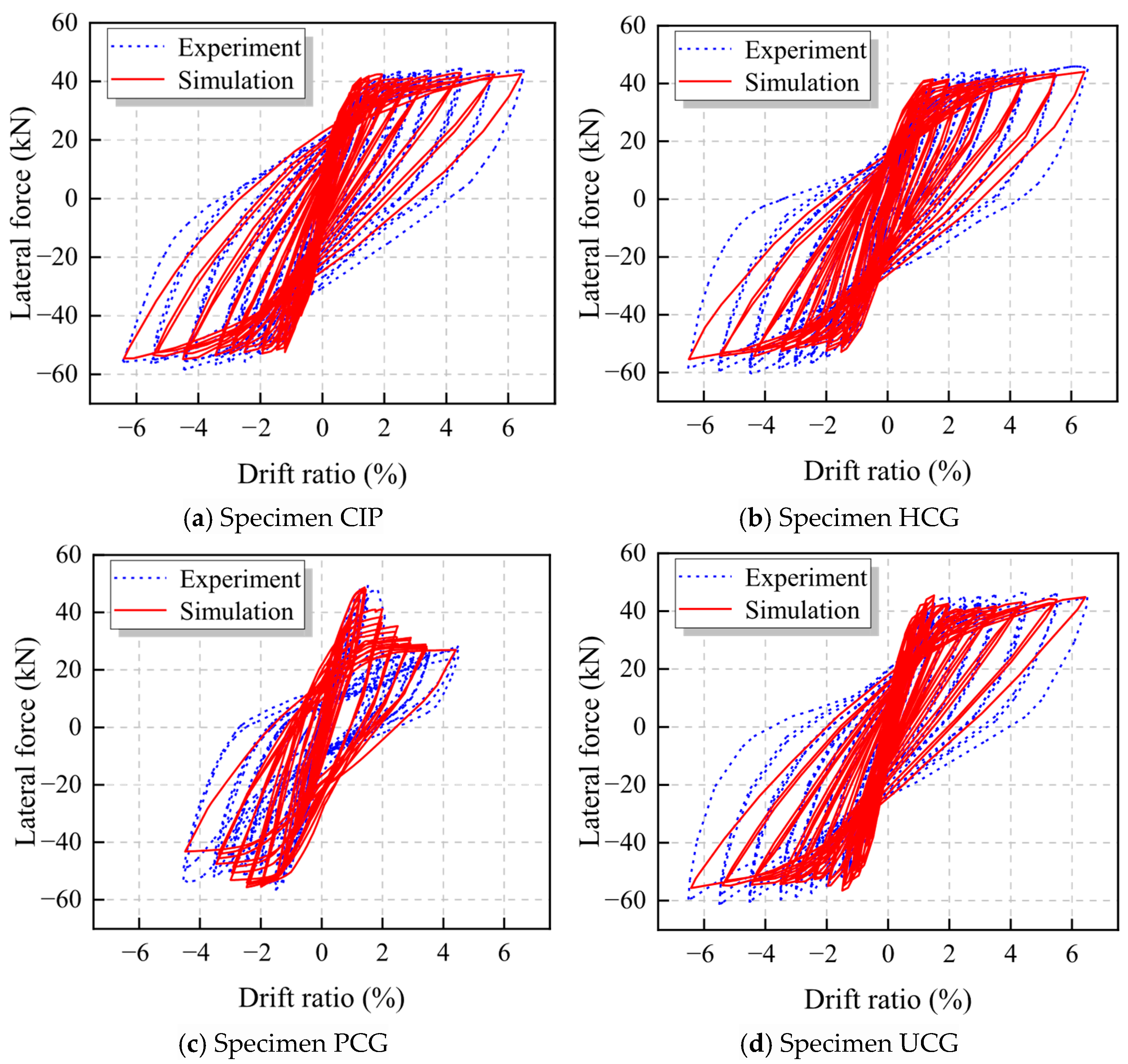
Numerical simulations were conducted using the ABAQUS platform. The hysteretic response of each specimen under cyclic loading was analyzed. The simulation results were then compared with the experimental data from Section 3 for validation. Figure 18 presents a comparison of the hysteretic curves obtained from numerical simulations and experiments for each specimen. As shown in Figure 18, the numerical results matched the experimental counterparts closely with respect to initial stiffness, peak bearing capacity, and hysteresis loop shape.
Based on these curves, characteristic values (yield load, yield displacement, and peak load) were extracted and are quantitatively compared in Table 5.
As shown in Table 5, the deviations between the numerical simulations and experiments range from 1.56% to 8.92%, which can be considered acceptable for such complex quasi-static tests.
It should be noted that the discrepancies between the numerical and experimental results can be attributed to several factors: (1) construction tolerances and curing conditions affect the actual specimens, whereas the finite element model is idealized; (2) experimental boundary conditions may exhibit slight nonlinear changes; and (3) material properties in reality vary, but are assumed constant in the simulations. As a result, deviations in unloading stiffness and pinching behavior are observed. However, the overall trends from the simulations reasonably represent the actual stress states of the specimens.
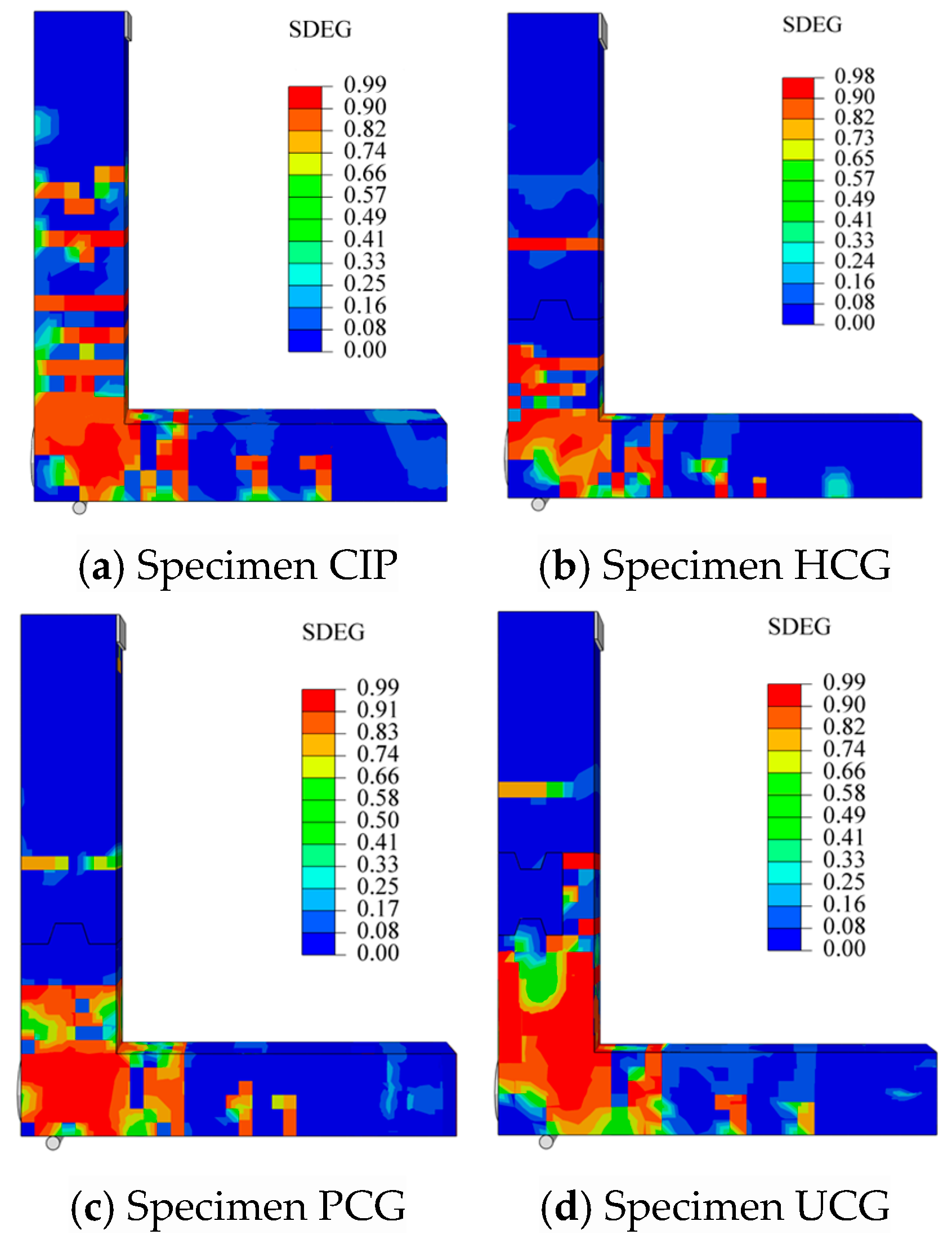
Figure 19 presents the stiffness degradation distribution obtained from the numerical models. This was used to further evaluate the plastic damage evolution of each specimen. Referring to the damage process described in Section 3.1, the damage concentration areas revealed by the numerical simulations were generally consistent with the crack distributions observed in the tests. For the PCG specimen, significant stiffness degradation was observed in the RSC. This confirms the experimental finding that the PCG joint aggravates damage in the RSC and leads to its premature failure. In contrast, damage in the HCG and UCG specimens was mainly concentrated within the designated plastic hinge region of the roof. Compared with the CIP specimen, the damage in their roofs showed a decreasing trend. The damage degree in their RSCs was also relatively mild. This indicates that the HCG and UCG joints could effectively confine damage to the designated energy dissipation region. Additionally, these joints reduce the risk of failure in the RSC. In summary, the numerical simulation results further confirmed the regulatory effect of different joint types on the damage distribution patterns. This offers theoretical support for the optimized design of prefabricated joints in underground structures.

5. Conclusions

This study proposed three prefabricated cogging composite joints (HCG, PCG, and UCG) for underground roof–sidewall connections. Four 1/4-scale specimens (one CIP and three precast) were tested under quasi-static loading and analyzed using ABAQUS. The main findings are as follows:
(1)
UHPC and a reasonable application of prestressing effectively inhibit crack initiation and damage propagation at joint seams. None of the precast specimens exhibited through cracks wider than 0.10 mm at the seams. The cogging structure limits crack development and enhances shear capacity, while GSs improve stiffness and integrity. When placed outside the plastic hinge zone, all three composite joints provide reliable load transfer paths for rebars, ensuring overall structural integrity.
(2)
The HCG and UCG joints significantly enhanced seismic performance, achieving the “equivalent to CIP” design goal. Compared with the CIP specimen, the average peak load increased by approximately 3.3% for HCG and 6.0% for UCG. Their displacement ductility coefficients reached 6.7 and 6.6, respectively, comparable to the CIP value of 6.9. Energy dissipation capacities were also close to that of CIP. Damage concentrated in the designated roof plastic hinge zone, and at a displacement of 32 mm, the shear angles in the RSC of HCG and UCG were approximately 70% and 60% of that of CIP, respectively. Thus, shear damage in the RSC was effectively mitigated.
(3)
Although the PCG joint improved initial stiffness and delayed crack propagation in the prestressed zone, it had a significantly adverse impact on seismic performance. Its positive peak load increased by 11.1% compared to CIP, but its negative peak load decreased by about 2.7%. Its ductility and energy dissipation were significantly lower than those of the other specimens. More critically, it induced excessive damage transfer to the RSC. At a loading displacement of 32 mm, its RSC shear angle reached 5.7 times that of CIP, leading to premature shear failure at a drift ratio of 4.5%. This indicates that the compatibility between prestressing form and placement location is crucial.
(4)
The location of joint placement decisively influences damage distribution. When placed outside the roof plastic hinge zone, the HCG and UCG joints successfully confined damage within the designated energy dissipation zone, whereas the PCG joint altered the load transfer path and caused damage spillover. The stiffness degradation patterns from numerical simulations showed good agreement with experimental crack distributions, further validating the regulatory effect of different joints on damage patterns.
(5)
Practical design recommendations: The HCG and UCG joints are suitable for prefabricated underground structures. Placing joints outside the roof plastic hinge zone achieves the “strong joint, weak component” goal. The UCG joint is recommended for harsh environments due to UHPC durability. The PCG joint should be avoided when high ductility is required; if prestressing is needed, the HCG joint is a better alternative. Future research should investigate cogging geometry, prestress levels, and connection materials.
(6)
Study limitations: This study was limited to a single specimen geometry (1/4-scale), one axial compression ratio (0.06), one prestressing level (65 kN), and simplified boundary conditions. Therefore, the conclusions should be interpreted within these limitations. Future studies should explore a wider range of geometries, axial compression ratios, prestress levels, and more realistic soil–structure interaction models.

Author Contributions

Conceptualization, B.S. and W.X.; Methodology, Y.C.; Validation, B.S. and W.X.; Formal analysis, B.S. and T.D.; Writing—original draft preparation, B.S.; Writing—review and editing, W.X.; Software, B.S.; Data curation, T.D. and X.L.; Investigation, D.Y. and L.Z. All authors have read and agreed to the published version of the manuscript.

Funding

This research was supported by the National Natural Science Foundation of China (Grant No. 52178446), the Natural Science Foundation of Jiangxi Province (Grant No. 20242BAB20236, 20242BAB25300), Jiangxi Provincial Department of Education (Grant No. GJJ2200858, GJJ2200857), and Research Start-up Fund of Jangxi University of Science and Technology (Grant No. 205200100637, 205200100627).

Data Availability Statement

All original contributions made in this study are contained within this article. Any additional questions may be addressed to the corresponding author.

Conflicts of Interest

The authors declare no conflicts of interest.

References

  1. Fan, Y.; Zhuang, H.; Yun, L.; Wang, D.; Xu, Z. Evaluation method for seismic resilience of underground structures and its verification. Soil Dyn. Earthq. Eng. 2026, 200, 109826. [Google Scholar] [CrossRef]
  2. Zhao, G.; Xie, K.; Wang, S.; Xie, K. Numerical study on seismic performance of a prefabricated subway station considering the influence of construction process. Structures 2024, 69, 107218. [Google Scholar] [CrossRef]
  3. Lee, J.; Kim, D.; Park, D.; Cho, J.-Y. Flexural behavior of curved-bolt jointed tunnel segments under combined axial force and bending moments. Int. J. Concr. Struct. Mater. 2025, 19, 115. [Google Scholar] [CrossRef]
  4. Yang, X.; Lin, F. Prefabrication technology for underground metro station structure. Tunn. Undergr. Space Technol. 2021, 108, 103717. [Google Scholar] [CrossRef]
  5. Liu, H.; Yan, Q.; Du, X. Seismic performance comparison between precast beam joints and cast-in-place beam joints. Adv. Struct. Eng. 2017, 20, 1299–1314. [Google Scholar] [CrossRef]
  6. Ding, Y.; Xu, W.; Chen, Y.; Wang, J.; Yan, W. Experimental research on seismic performance of precast cogging high-strength bolt composite joint and influence of its arrangement location. Eng. Struct. 2020, 225, 111294. [Google Scholar] [CrossRef]
  7. Lee, H.; Chen, H.; Syu, J. Seismic performance of emulative precast concrete beam–column connections with alternative reinforcing details. Adv. Struct. Eng. 2017, 20, 1793–1806. [Google Scholar] [CrossRef]
  8. Wang, Z.; Qu, H.; Li, T.; Wei, H.; Wang, H.; Duan, H.; Jiang, H. Quasi-static cyclic tests of precast bridge columns with different connection details for high seismic zones. Eng. Struct. 2018, 158, 13–27. [Google Scholar] [CrossRef]
  9. Lago, B.D.; Negro, P.; Lago, A.D. Seismic design and performance of dry-assembled precast structures with adaptable joints. Soil Dyn. Earthq. Eng. 2018, 106, 182–195. [Google Scholar] [CrossRef]
  10. Liu, Y.L.; Zhao, Z.D.; Cheng, X.W.; Diao, M.; Sun, H. Experimental and numerical investigation of the progressive collapse of precast reinforced concrete frame substructures with wet connections. Eng. Struct. 2022, 256, 114010. [Google Scholar] [CrossRef]
  11. Wang, H.; Liu, X.G.; Yue, Q.R.; Zheng, M.-Z. Shear resistance of a novel wet connection for prefabricated composite beams under shear-bending coupling loading. J. Build. Eng. 2022, 45, 103636. [Google Scholar] [CrossRef]
  12. Ou, Y.C.; Wang, P.H.; Tsai, M.S.; Chang, K.-C.; Lee, G.C. Large-scale experimental study of precast segmental unbonded posttensioned concrete bridge columns for seismic regions. J. Struct. Eng. ASCE 2010, 136, 255–264. [Google Scholar] [CrossRef]
  13. Bu, Z.Y.; Jian, G.; Zheng, R.Y.; Song, J.; Lee, G.C. Cyclic performance and simplified pushover analyses of precast segmental concrete bridge columns with circular section. Earthq. Eng. Eng. Vib. 2016, 15, 297–312. [Google Scholar] [CrossRef]
  14. Saibabu, S.; Srinivas, V.; Sasmal, S.; Lakshmanan, N.; Iyer, N.R. Performance evaluation of dry and epoxy jointed segmental prestressed box girders under monotonic and cyclic loading. Constr. Build. Mater. 2013, 38, 931–940. [Google Scholar] [CrossRef]
  15. Yang, X.R.; Shi, Z.H.; Lin, F. Influence of geometrical parameters on performance of grouted mortise and tenon joints for application in prefabricated underground structures. Adv. Civ. Eng. 2019, 2019, 1–14. [Google Scholar] [CrossRef]
  16. Zhang, P.; Su, Y.L.; Fan, J.J.; Feng, H.; Shao, J.; Guo, H.; Gao, D.-Y.; Sheikh, S.A. Experimental research on the mechanical behavior of grouted sleeves with fiber-reinforced grouting material under cyclic loading. Structures 2021, 34, 2189–2204. [Google Scholar] [CrossRef]
  17. Liu, H.; Li, Z.; Pei, J. Influence of joint position and rigidity on precast box structural internal force. J. Traffic Transp. Eng. 2003, 3, 18–21. [Google Scholar]
  18. Avcil, F. Investigation of Precast Reinforced Concrete Structures during the 6 February 2023 Turkiye Earthquakes. Sustainability 2023, 15, 14846. [Google Scholar] [CrossRef]
  19. Isik, E.; Avcil, F.; Hadzima-Nyarko, M.; İzol, R.; Büyüksaraç, A.; Arkan, E.; Radu, D.; Özcan, Z. Seismic Performance and Failure Mechanisms of Reinforced Concrete Structures Subject to the Earthquakes in Türkiye. Sustainability 2024, 16, 6473. [Google Scholar] [CrossRef]
  20. Ou, Y.C.; Oktavianus, Y.; Tsai, M.S. An emulative precast segmental concrete bridge column for seismic regions. Earthq. Spectra 2013, 29, 1441–1457. [Google Scholar] [CrossRef]
  21. Ding, M.; Xu, W.; Wang, J.; Chen, Y.; Du, X.; Fang, R. Seismic performance of prefabricated concrete columns with grouted sleeve connections, and a deformation-capacity estimation method. J. Build. Eng. 2022, 55, 104722. [Google Scholar] [CrossRef]
  22. Twigden, K.M.; Henry, R.S. Shake table testing of unbonded post-tensioned concrete walls with and without additional energy dissipation. Soil Dyn. Earthq. Eng. 2019, 119, 375–389. [Google Scholar] [CrossRef]
  23. Korkmaz, H.H.; Tankut, T. Performance of a precast concrete beam-to-beam connection subject to reversed cyclic loading. Eng. Struct. 2005, 27, 1392–1407. [Google Scholar] [CrossRef]
  24. Haber, Z.B.; Mackie, K.R.; Al-Jelawy, H.M. Testing and analysis of precast columns with grouted sleeve connections and shifted plastic hinging. J. Bridge Eng. 2017, 22, 4017078. [Google Scholar] [CrossRef]
  25. Ding, M.; Xu, W.; Wang, J.; Chen, Y.; Fang, R. Analytical study on seismic performance of ECC shell-RC column and its plastic hinge forming mechanism. Structures 2023, 58, 105489. [Google Scholar] [CrossRef]
  26. Farzad, M.; Shafieifar, M.; Azizinamini, A. Experimental and numerical study on bond strength between conventional concrete and ultra high-performance concrete (UHPC). Eng. Struct. 2019, 186, 297–305. [Google Scholar] [CrossRef]
  27. Tayeh, B.A.; Abu Bakar, B.H.; Johari, M.A.M.; Voo, Y.L. Mechanical and permeability properties of the interface between normal concrete substrate and ultra high performance fiber concrete overlay. Constr. Build. Mater. 2012, 36, 538–548. [Google Scholar] [CrossRef]
  28. Pekgokgoz, R.K.; Avcil, F. Effect of steel fibres on reinforced concrete beam-column joints under reversed cyclic loading. Gradevinar 2021, 73, 1185–1194. [Google Scholar]
  29. Hu, M.; Jia, Z.; Han, Q.; Xu, L.; Jiao, C.; Long, P. Experimental Investigation of Precast Bridge Deck Panels with Novel High-Performance Connections under Fatigue Loading. J. Bridge Eng. 2023, 28, 04023074. [Google Scholar] [CrossRef]
  30. Zhang, G.; Han, Q.; Xu, K.; Du, X.; He, W. Experimental investigation of seismic behavior of UHPC-filled socket precast bridge column-foundation connection with shear keys. Eng. Struct. 2021, 228, 111527. [Google Scholar] [CrossRef]
  31. Kong, X.; Ju, Y.; Li, X.; Wang, D.; Zhang, X. Seismic performance of precast interior joints with UHPC composite beams and HSC columns. Structures 2025, 75, 108741. [Google Scholar] [CrossRef]
  32. Ding, J.H.; Jin, X.L.; Guo, Y.Z.; Li, G.-G. Numerical simulation for large-scale seismic response analysis of immersed tunnel. Eng. Struct. 2006, 28, 1367–1377. [Google Scholar] [CrossRef]
  33. Wang, T. Civil Engineering Structural Test; Wuhan University Press: Wuhan, China, 2014. [Google Scholar]
  34. Tang, J. Seismic Resistance of Joints in Reinforced Concrete Frames; Southeast University Press: Nanjing, China, 1989; pp. 215–220. [Google Scholar]
  35. Li, C.; Hao, H.; Bi, K. Numerical study on the seismic performance of precast segmental concrete columns under cyclic loading. Eng. Struct. 2017, 148, 373–386. [Google Scholar] [CrossRef]
  36. Shen, B.; Xu, W.; Wang, J.; Zhou, D.; Chen, Y.; Hou, L.; Sun, Y.; Yang, Z.; Ding, Y. Experimental investigation of the seismic performance of an L-shaped roof-sidewall joint with a cogging composite connection. Soil Dyn. Earthq. Eng. 2024, 177, 108410. [Google Scholar] [CrossRef]
  37. BS EN 1994-2; Eurocode 4: Design of Composite Steel and Concrete Structure, Part 1-1: General Rules and Rules for Buildings. European Committee for Standardization: Brussels, Belgium, 2004.
  38. Liu, H.; Wang, Z.; Xu, C.; Du, X. Influence of axial compression ratio on the seismic performance of precast columns with grouted sleeve connections. J. Struct. Eng. 2021, 147, 4021194. [Google Scholar] [CrossRef]
  39. Xin, G.; Xu, W.; Wang, J.; Yan, X.; Chen, Y.; Yan, W.; Li, J. Seismic performance of fabricated concrete piers with grouted sleeve joints and bearing-capacity estimation method. Structures 2021, 33, 169–186. [Google Scholar] [CrossRef]
  40. Nikbakht, E.; Rashid, K.; Hejazi, F.; Osman, S.A. A numerical study on seismic response of self-centring precast segmental columns at different post-tensioning forces. Lat. Am. J. Solids Struct. 2014, 11, 864–883. [Google Scholar] [CrossRef]
  41. Shi, Y.; Yuan, G.; Zhu, H. Effect of Axial Compression Ratio on Seismic and Self-Centering Performance of Unbonded Prestressed Concrete Columns. Adv. Civ. Eng. 2022, 2022, 7346620. [Google Scholar] [CrossRef]
  42. Semendary, A.A.; Hamid, W.K.; Steinberg, E.P.; Khoury, I. Shear friction performance between high strength concrete (HSC) and ultra high performance concrete (UHPC) for bridge connection applications. Eng. Struct. 2020, 205, 110121–110122. [Google Scholar] [CrossRef]
  43. Zhang, Z.; Chen, X.; Su, C.; Li, L. Prediction of long-term bonding behavior of UHPC-NC interface under combined effects of fatigue load and salt freeze-thaw cycles. Constr. Build. Mater. 2025, 500, 144240. [Google Scholar] [CrossRef]
  44. Kang, W.; Mei, K.; Liu, W.; Sun, S. Study on Chloride Diffusion Performance and Structural Durability Design of UHPC Under Chloride Salt Erosion. Buildings 2025, 15, 3569. [Google Scholar] [CrossRef]
  45. GB 50728-2011; Technical Code for Safety Appraisal of Engineering Structural Strengthening Materials. China Architecture & Building Press: Beijing, China, 2011.
  46. GB/T 50081-2019; Standard for Test Methods of Concrete Physical and Mechanical Properties. China Architecture & Building Press: Beijing, China, 2019.
  47. ASTM A370-12A; Standard Test Methods and Definitions for Mechanical Testing of Steel Products. American Society for Test and Materials (ASTM): West Conshohocken, PA, USA, 2012.
  48. JGJ/T 101-2015; Specification for Seismic Test of Buildings. China Architecture & Building Press: Beijing, China, 2015.
  49. Park, R. Evaluation of ductility of structures and structural assemblages from laboratory testing. Bull. N. Z. Natl. Soc. Earthq. Eng. 1989, 22, 155–166. [Google Scholar] [CrossRef]
  50. Mostofinejad, D.; Akhlaghi, A. Experimental investigation of the efficacy of EBROG method in seismic rehabilitation of deficient reinforced concrete beam–column joints using CFRP sheets. J. Compos. Constr. 2017, 21, 4017009. [Google Scholar] [CrossRef]
  51. GB 50011-2010; Code for Seismic Design of Buildings. China Architecture & Building Press: Beijing, China, 2010.
  52. Hussein, H.H.; Walsh, K.K.; Sargand, S.M.; Al Rikabi, F.T.; Steinberg, E.P. Modeling the Shear Connection in Adjacent Box-Beam Bridges with Ultrahigh-Performance Concrete Joints. I: Model Calibration and Validation. J. Bridge Eng. 2017, 22, 4017043. [Google Scholar] [CrossRef]
Figure 1. Layout of the specimens.
Buildings 16 01771 g001
Figure 2. The construction process: (a) fabricating reinforcement cage of column; (b) fabricating reinforcement cage of beam; (c) casting C40 concrete; (d) roughening of concrete surface; (e) applying epoxy for bonding; (f) mixing UHPC; (g) casting UHPC; (h) grouting for GS.
Buildings 16 01771 g002
Figure 3. Test models of the specimens.
Buildings 16 01771 g003
Figure 4. Mechanical test of materials. (a) Prism of UHPC. (b) Stress–strain curve and failure mode of UHPC. (c) Stress–strain curve and failure mode of rebars.
Buildings 16 01771 g004
Figure 5. Test loading device. (a) Schematic diagram. (b) Test setup: seismic performance test of prefabricated underground structure joints.
Buildings 16 01771 g005
Figure 6. Loading scheme.
Buildings 16 01771 g006
Figure 7. Layout of the measurement points. (a) Force and displacement of HCG/PCG. (b) Force and displacement of UCG. (c) Strain of rebars.
Buildings 16 01771 g007
Figure 8. Failure mode of specimens.
Buildings 16 01771 g008
Figure 9. Hysteretic curves and skeleton curves of specimens.
Buildings 16 01771 g009
Figure 10. Secant rigidity variation in specimens at different drift ratios.
Buildings 16 01771 g010
Figure 11. Pinching width ratios. (a) Definition of parameters. (b) Comparison for all the specimens.
Buildings 16 01771 g011
Figure 12. Energy dissipation of the specimens.
Buildings 16 01771 g012
Figure 13. Displacement ductility coefficient.
Buildings 16 01771 g013
Figure 14. Loading drift ratio versus shear distortion curve.
Buildings 16 01771 g014
Figure 15. Loading drift ratio versus residual displacement curve.
Buildings 16 01771 g015
Figure 16. Stress evolution curves of longitudinal rebars.
Buildings 16 01771 g016
Figure 17. Numerical model.
Buildings 16 01771 g017
Figure 18. Comparison of numerical and experimental hysteresis curves.
Buildings 16 01771 g018
Figure 19. Stiffness degradation distribution of the specimens.
Buildings 16 01771 g019
Table 1. Details of specimens.
SpecimenConnection FormComponentDiameter of Rebar/mm (Longitudinal
Rebar/Stirrup)
Interval of
Stirrups/mm
(Concentrated Area/Standard Area)
ρs/%ρv/% (Concentrated Area/Standard Area)
CIPCIPRoof12/650/1000.8 + 0.50.45/0.23
Sidewall12/650/1001.0 + 0.80.45/0.23
HCGHSB–Cogging–GSRoof12/650/1000.8 + 0.50.45/0.23
Sidewall12/650/1001.0 + 0.80.45/0.23
PCGPS–Cogging–GSRoof12/650/1000.8 + 0.50.45/0.23
Sidewall12/650/1001.0 + 0.80.45/0.23
UCGUHPC–Cogging–GSRoof12/650/1000.8 + 0.50.45/0.23
Sidewall12/650/1001.0 + 0.80.45/0.23
Table 2. Mechanical performance of materials.
MaterialsKey PropertyMeasured Value (Mean)MaterialsKey PropertyMeasured Value (Mean)
C40compressive strength
fc (MPa)
53.7HPB400
(6 mm)
yield strength
fy (MPa)
403
Grouting materialcompressive strength
fc (MPa)
97.5ultimate strength
fu (MPa)
561
UHPCcompressive strength
fc (MPa)
130.2elongation
δ (%)
17.8
tensile strength
ft (MPa)
9.8HRB400
(12 mm)
yield strength
fy (MPa)
406
peak strain εp (%)0.093ultimate strength
fu (MPa)
602
elastic modulus E (GPa)55.8elongation δ (%)22.6
Table 3. The crack development process of the specimens.
SpecimenDrift RatioFailure Modes and Crack Distributions
RoofSidewallRSC and Seam
CIP0.25%A minor transverse crack Cr1 appeared at the roof–sidewall interface (RSI)//
0.75%Multiple transverse cracks appeared approximately 500 mm–800 mm above the RSIWithin 50 mm–200 mm from the RSI, four vertical cracks appeared. All crack widths were 0.05 mmOne diagonal crack and one vertical crack appeared in the RSC
1.00%The cracks (500 mm and 700 mm above the RSI) developed into through cracks. Width of Cr1 reached 0.2 mmTwo vertical cracks appeared, located 270 mm and 420 mm from the RSIThree diagonal cracks appeared in the RSC
2.00%Maximum width of Cr1 reached 2.5 mm/Two diagonal cracks appeared in the RSC. Maximum crack width was 0.15 mm
6.50%Concrete at the inner edge of the plastic hinge cracked and spalled/Maximum width of the diagonal cracks in the RSC reached 0.30 mm
HCG0.50%Transverse through cracks Cr1 and Cr2 appeared at the RSI and 100 mm above itOne vertical crack appeared at 50 mm and 150 mm from the RSITransverse cracks with a width of 0.06 mm appeared at the joint seam
0.75%Widths of Cr1 and Cr2 reached 0.30 mm/Two diagonal cracks appeared in the RSC
1.25%Four transverse cracks appeared above the upper edge of the GSs. Width of Cr2 reached 0.50 mmWithin 250 mm–500 mm from the RSI, four vertical cracks appeared. All crack widths were less than 0.10 mmMultiple diagonal cracks appeared in the RSC
1.50%Diagonal crack Cr3 appeared 160 mm above the RSI. Width of Cr1 reached 2.00 mm/Diagonal cracks appeared in the upper left of the RSC
6.50%Concrete between Cr2 and Cr3 crushed and spalled. The rebars yielded/Maximum width of diagonal cracks in the RSC reached 0.30 mm
PCG0.50%Transverse cracks Cr1 (through, width reached 0.30 mm) and Cr2 appeared at the RSI and 160 mm above itTwo vertical cracks appeared at 50 mm and 150 mm from the RSIMinor transverse cracks appeared at the joint seam
0.75%Maximum width of Cr1 reached 0.50 mm. Cr2 became through with a width of 0.20 mm/Diagonal cracks appeared in the lower right of the RSC
1.50%Three transverse cracks appeared 100 mm and 290 mm above the RSI. Widths of Cr1 and Cr2 reached 9.00 mm and 0.50 mm, respectivelyWithin 300 mm–500 mm from the RSI, three vertical cracks appeared. All crack widths were less than 0.10 mmTwo diagonal cracks (width reached 0.40 mm) appeared in the RSC. Diagonal cracks gradually increased in the lower left of the RSC
4.50%Concrete on the right side of Cr1 crushed/Concrete on the lower side of the RSC crushed and spalled
UCG0.5%Transverse cracks (Cr1 and Cr2) appeared at the RSI and 60 mm above it//
0.75%Cr1 and Cr2 became through. Two transverse cracks appeared within 160 mm–300 mm above the RSIWithin 100 mm–260 mm from the RSI, three vertical cracks appeared A minor diagonal crack Cr3 appeared in the RSC
1.25%Within 360 mm–550 mm above the RSI, three transverse cracks appeared Within 300 mm–550 mm from the RSI, three vertical cracks appeared. All widths were less than 0.10 mmMinor transverse cracks appeared at the joint seams. Two diagonal cracks appeared in the RSC
2.5%Two diagonal cracks appeared 100 mm and 150 mm above the RSI. Widths of Cr1 and Cr2 reached 1.8 mm and 1.0 mm, respectively/Cr3 became through with a width of 0.5 mm. Four diagonal cracks appeared in the RSC
6.50%Concrete of the roof plastic hinge crushed and spalled. The rebars yielded/Width of Cr3 reached 1.5 mm, with a residual width of 1.00 mm after unloading
Table 4. Seismic performance parameters of the skeleton curves.
SpecimensLoadingYield Load,
Fy (kN)
Yield Displacement,
Δy (mm)
Peak Load,
Fp (kN)
Peak Displacement,
Δp (mm)
Ultimate Load,
Fu (kN)
Ultimate Displacement,
Δu (mm)
CIPPositive33.1414.1543.5871.9137.04>104.29
Negative−43.78−15.11−58.11−71.28−49.65<−104.17
HCGPositive34.1414.7145.1872.4238.40>104.81
Negative−45.08−15.49−60.09−71.19−51.08<−104.51
PCGPositive36.2113.2249.2724.1641.8829.13
Negative−42.47−13.65−56.52−24.31−48.04−72.87
UCGPositive35.0915.2346.3772.4239.41>104.11
Negative−46.11−15.81−61.42−88.23−52.21<−103.65
Table 5. Comparison of numerical simulation and experimental results.
SpecimensLoadingYield Load (kN)Yield Displacement (mm)Peak Load (kN)
SimulationDeviationSimulationDeviationSimulationDeviation
CIPPositive35.647.54%13.117.31%42.821.74%
Negative−46.857.01%−14.374.91%−54.915.51%
HCGPositive31.637.36%13.855.87%43.493.73%
Negative−42.256.28%−14.456.71%−54.738.92%
PCGPositive37.734.21%12.842.81%48.212.15%
Negative−44.013.62%−13.133.83%−55.641.56%
UCGPositive37.486.81%14.246.50%45.481.92%
Negative−47.673.38%−14.518.22%−56.547.95%
Disclaimer/Publisher’s Note: The statements, opinions and data contained in all publications are solely those of the individual author(s) and contributor(s) and not of MDPI and/or the editor(s). MDPI and/or the editor(s) disclaim responsibility for any injury to people or property resulting from any ideas, methods, instructions or products referred to in the content.