Article

AI-Driven Multi-Objective Optimization for Cost-Effective Design of Passive-Oriented Nearly Zero-Energy Building in Chengdu


1
College of Geography and Planning, Chengdu University of Technology, No. 1 East 3rd Ring Road, Erxianqiao, Chenghua District, Chengdu 611059, China
2
Department of Civil Engineering and Architecture, Tallinn University of Technology, Ehitajate tee 5, 19086 Tallinn, Estonia
3
Department of Civil Engineering, Aalto University, Rakentajanaukio 4, 02150 Espoo, Finland
*
Author to whom correspondence should be addressed.
Buildings 2026, 16(8), 1604; https://doi.org/10.3390/buildings16081604
Submission received: 28 February 2026 / Revised: 6 April 2026 / Accepted: 17 April 2026 / Published: 18 April 2026

Abstract

The construction sector’s transition to carbon neutrality requires innovative strategies to address the performance and cost challenges of advanced building designs, such as passive-oriented nearly zero-energy buildings. This study proposes an artificial intelligence-based multi-objective optimization framework to reduce both energy consumption and construction costs for residential building envelopes in Chengdu’s hot summer and cold winter climate. The framework uses the NSGA-II genetic algorithm within DesignBuilder to explore trade-offs between energy efficiency and economic cost. Key design parameters (wall insulation thickness, roof insulation thickness, and window glazing type) are optimized to obtain a Pareto-optimal front. A subsequent global incremental cost analysis of the non-dominated solutions identifies the optimal balance where significant energy savings are achieved before diminishing returns set in. The research results show that by combining the NSGA-II algorithm with the global incremental cost method in the Chengdu area, the parameters of the enclosure structure can be systematically optimized, and the optimal balance point between energy conservation and cost can be effectively identified. Based on this, an “energy-saving optimal—trade-off optimal—cost optimal” template set design path based on dual objectives of energy consumption and cost can be obtained, which is applicable to different demand-oriented engineering scenarios. This research provides a quantifiable decision-making basis for the design of buildings with passive design strategies that achieve near-zero energy consumption in hot summer and cold winter regions, helping to achieve the coordinated optimization of energy efficiency goals and economic feasibility, and promoting the reliable promotion and application of near-zero energy buildings.

1. Introduction

The current global climate governance framework has entered a new stage. The Paris Agreement [1] has initially depicted a medium- and long-term emission reduction vision at the global level, ranging from “absolute reduction” to “net zero emissions”. From low-carbon to near-zero carbon and then zero carbon, this evolution represents an inevitable path to actively respond to global climate change and achieve green, low-carbon, and high-quality development [2]. To address the impacts of climate change, developed countries have successively set medium- and long-term carbon neutrality goals. In September 2020, China proposed the dual carbon strategic goals of peaking carbon emissions by 2030 and achieving carbon neutrality by 2060 [3,4,5]. This commitment enhances China’s environmental responsibility, positioning carbon neutrality not only as an environmental goal but also as a driving force for the industrial revolution, technological innovation, and green economic growth [6,7]. Against the macro background of global climate change, the construction industry is one of the main fields of energy consumption and carbon emissions, and its emission reduction efforts hold significant potential in contributing to the global carbon neutrality goal. In the field of architecture, carbon emissions mainly come from the production of building materials, the construction process, and energy consumption during the building’s operation phase. Among them, carbon emissions during the operation phase account for more than 40%; therefore, reducing carbon emissions during the operation phase is the core goal of achieving a low-carbon building, and the carbon emissions generated by cooling and heating are the most significant part [8,9]. In addition, less than 3% of new buildings are constructed each year, and the focus has shifted to improving the energy efficiency of existing buildings, making them a key part of global efforts to reduce energy consumption [10]. Net/nearly zero-energy buildings (nZEBs) aim to achieve the goal of zero carbon emissions throughout the entire life cycle of buildings through technological means, while also taking into account economic rationality. They play a key role in promoting the green transformation of the construction industry and facilitating sustainable development. In recent years, extensive research on nearly zero energy building technology and its optimization has been conducted, providing important theoretical and technical support for the development of this field.
Passive low-energy buildings are designed to minimize a building’s energy demand and reduce reliance on active heating and cooling systems through passive strategies, thereby achieving the overall goal of low energy consumption [11]. The key to achieving this goal is that passive strategies focus on optimizing architectural design—through rational layout, natural ventilation, shading design, and high-performance envelope structures—to mitigate the adverse impact of the external environment on the indoor thermal environment [12]. The “Standard for Energy Efficiency Design of Public Buildings” (GB 50189) [13] states that the thermal insulation performance of a building’s exterior walls, roofs, exterior windows, and other envelope components has a very significant impact on its overall energy consumption. As a key component of passive design, the performance optimization of the enclosure structure has attracted much attention. By selecting appropriate insulation materials and increasing insulation layer thickness, the energy consumption for building heating and cooling can be effectively reduced. An external wall insulation system with a low heat transfer coefficient can effectively block heat transfer, reducing indoor heat loss in winter and the ingress of outdoor heat in summer. For example, new insulation materials such as aerogel felt, graphite polystyrene board, and phase change materials can be adopted. C. Wang [14] significantly reduced building energy consumption by adopting high-efficiency insulation materials (such as vacuum insulation panels and low-emissivity glass) and intelligent management systems, conducting a comprehensive optimization design that considered the characteristics of a severe cold climate and integrated an economic benefit analysis of the technical solution. A comprehensive energy-saving strategy of “compact form—efficient enclosure structure—limited window-to-wall ratio” was proposed, providing theoretical support and a technical path for the energy-saving design of substation buildings in cold regions. Y. Yang et al. [15] proposed three photovoltaic-facade integration strategies: window renovation, wall renovation, and full facade renovation. J. Zhou et al. [16] took a building in Haichen Garden as a case study and achieved the goal of a nearly zero-energy building through the technical strategy of “passive priority, active optimization, and low-carbon energy”, combined with building-integrated photovoltaics. Y. Xue et al. [17] compared buildings applying nearly zero-energy consumption technology with benchmark buildings. The actual annual energy consumption per unit area of buildings applying nearly zero-energy consumption technology was approximately 32.90 kWh/(m2·a), whereas the final energy consumption of benchmark buildings with the same building area was approximately 51.65 kWh/(m2·a); the former demonstrated a remarkable 36.30% energy saving. The aforementioned research has explored and implemented nearly zero-energy building technology from different perspectives, providing valuable experience for the application of passive nearly zero-energy building technologies.
Currently, China’s passive low-energy buildings mainly draw on the technical route of German passive houses (Passivhaus). The main technical strategies include three aspects: building envelope with high insulation performance; building exterior door and window systems with high air-tightness performance; and a high-efficiency heat recovery fresh air system [18]. Studies have shown that by using insulation materials with better thermal insulation properties and increasing the thickness of insulation layers, the energy consumption for heating and cooling in buildings can be effectively reduced. However, enhancing the performance of the enclosure structure increases the initial investment cost. Traditional single-objective optimization or experience-based trial-and-error methods struggle to systematically reveal and balance these trade-offs. Therefore, achieving a balance between energy-saving effects and economic efficiency has become a primary research focus. Multi-objective optimization methods provide an effective path to this aim. They incorporate multiple competing goals into a mathematical framework and search the Pareto frontier to provide decision-makers with a series of “non-dominated solutions”, clearly revealing the trade-offs between objectives. The core of this method lies in systematically constructing and applying corresponding mathematical models and setting a series of reasonable constraints based on actual circumstances, thereby finding and determining an optimal solution set among numerous possible solutions. Through this approach, multi-objective optimization can effectively solve complex multi-dimensional decision-making problems in practical applications, enhancing the scientific rigor and rationality of decisions. In the field of nearly zero-energy building, scholars usually take building energy consumption and economic efficiency as optimization goals and adopt Pareto optimization methods, combined with optimization tools such as genetic algorithms, to comprehensively optimize the building’s enclosure structure, natural ventilation, shading, and other passive energy-saving technologies. F. Feng et al. [19] used DesignBuilder software (Version 6.1.0.006) to simulate and analyze the envelope parameters and natural ventilation schemes of green buildings, concluding that the impact of each envelope factor on energy consumption varies across different climate zones. B. Pang et al. [20] studied high-rise residential buildings in Qingdao using DesignBuilder software to simulate different insulation materials, and concluded that the optimal energy consumption was achieved when the thickness of the insulation material was 150 mm, for which the energy consumption ranking was rock wool board > EPS board (polystyrene foam plastic) > XPS board (extruded polystyrene foam plastic) > polyurethane board. X. Zhen et al. [21] combined experimental research and TRNSYS simulation and concluded that the optimal composite envelope structure was as follows: the ceiling and exterior wall insulation materials were polystyrene board and polyurethane, respectively, the thickness of the exterior wall and ceiling insulation layers was 100 and 110 mm, respectively, and the window-to-wall ratios on the west, south, and north sides were 0.05, 0.28, and 0.30, respectively, when the shading coefficient of the exterior window was 0.38. Y. Zhang et al. [22] conducted energy consumption simulations on the design elements of the benchmark model, such as orientation, window-to-wall ratio of north–south orientation, materials, and thickness of the envelope structure by controlling the variables within the DesignBuilder software, and obtained optimal design parameters and related data, providing a reference for the standardized production and construction of local prefabricated residential components. Q. Li et al. [23] used the DesignBuilder software to build a model of a small-sized residential building in Heilongjiang Province by simulating the building’s annual heating, lighting, and other energy consumption in 2022, and compared the simulations of three different energy-saving schemes and concluded that increasing the thickness of the insulation layer was an effective way to reduce heating consumption in cold regions. Currently, research on multi-objective optimization methods in the design of building envelopes for near-zero energy buildings is still ongoing. Fatemeh Salehipour Bavarsad et al. [24] integrated 18 passive strategies with active and renewable energy strategies and achieved a 68.7% reduction in annual energy consumption in the Czech Republic, and made predictions for future years. Xu et al. [25] established an energy consumption prediction function based on multiple linear regression for near-zero energy residences in the Jinan area, explored the most energy-efficient shape coefficient, and revealed the mechanism of passive design parameters between the envelope and energy consumption.
Most existing research focuses on cold or extremely cold regions. Research on optimizing passive-oriented technologies for the climatic characteristics of hot summer and cold winter regions remains insufficient, especially regarding the systematic selection of envelope materials and parameter optimization. This study takes typical residential buildings in the Chengdu metropolitan area as its object and, through multi-objective optimization methods, investigates the balance between the thermal insulation performance and economy of the envelope structure, exploring passive technical paths suitable for this climate zone. In order to precisely explore the optimal combination of design parameters, the research utilized the DesignBuilder simulation software module equipped with a genetic algorithm based on NSGA-II to optimize the calculation of the passive-oriented nearly zero-energy building technical scheme applicable to this region, and conducted global variable cost calculations of the combinations. The research aims to identify a technical path for a passive-oriented nearly zero-energy building that not only conforms to the local climate characteristics but also takes economic benefits into account.

2. Methods

For complex problems involving multiple conflicting or interacting factors, constructing a rigorous mathematical modeling framework enables the precise identification of the most suitable solution from all feasible alternatives that satisfy predefined conditions. This approach promotes the attainment of optimal goal states and supports scientifically grounded decision-making. This systematic methodology is defined as multi-objective optimization. In such optimization, objectives often compete with one another—for example, improving a building’s energy efficiency typically raises construction costs, creating a trade-off between energy performance and economic feasibility [26].

2.1. Pareto Selection

Pareto Selection [27], as a core method in the field of multi-objective optimization, aims to explore the optimal balance among conflicting objectives by adopting the theory of Pareto Optimality. When a set of solutions reaches a state where they cannot further optimize a certain objective without undermining other objectives, this set of solutions constitutes the Pareto Front. In engineering and economic and social decision-making, Pareto opts to help decision-makers sift through numerous feasible options to select the best compromise, such as simultaneously optimizing cost, energy consumption, and comfort in architectural design, or balancing efficiency and fairness in resource allocation. Through Pareto analysis, the one-sidedness of a single goal-oriented approach can be avoided, ensuring that the system is optimal as a whole rather than locally.

2.2. Objective Function

This study aims to minimize the total final energy consumption of buildings while reducing construction costs, and screen the variables of passive energy-saving designs for buildings.
The objective function is expressed using Equation (1):
min f 1 x ¯ , f 2 x ¯ , x ¯ = x 1 , x 2 , , x N
where f 1 is the total final energy consumption measured in kWh/(m2·a); f 2 is the construction cost, CNY/m2; x is the 1st to Nth generation combination of passive energy-saving technique variables.
In order to more thoroughly explore and evaluate the operational energy-saving benefits that can be achieved by reducing total final energy consumption, the concept of global cost increment was introduced in the research process. This process lies in further implementing a global cost increment analysis and evaluation based on the optimal solution, targeting the goal of comprehensively minimizing total final energy consumption and reducing construction costs. The construction cost of this project is calculated based on the global cost method stipulated in the EU Building Energy Efficiency Directive (EPBD) [28]. Essentially, the overall cost is the sum of the discounted present values of the increased initial investment cost after adopting energy-saving techniques and the benefits gained from energy savings throughout the entire calculation period. The calculation period of this study is set at 30 years, as economic calculation results beyond 30 years tend to fall short in accuracy [29]. The cost calculation focuses on key components directly affected by energy-saving techniques, such as the costs of insulated exterior windows, equipment systems, and energy-saving components for enhancing air tightness, rather than taking into account the economic benefits of fundamental components like building structures, whose direct correlation with energy-saving techniques is relatively weak, despite their prominent impact on the overall construction cost. By adopting a clearly defined set of relevant building components, we were able to conduct a preliminary evaluation and conduct decision-making on the economic viability of the research building throughout the entire calculation period during the architectural design stage with minimal time and effort.
The global cost increment ∆Cg represents the additional financial impact of choosing a designed building over a reference building by considering the net balance of its higher initial investment and its long-term operational savings, and can be expressed using Equation (2).
C g = T o t a l   c o s t   o f   t h e   d e s i g n e d   b u i l d i n g T o t a l   c o s t   o f   t h e   r e f e r e n c e   b u i l d i n g
If ∆Cg yields a positive value, it indicates that the cost of the designed building is higher. A negative value indicates greater savings.
Finally, the difference of the global increment is used to screen the optimization results of the previous process to obtain the optimal scheme. During the calculation, it was assumed that the energy consumption of the building remains unchanged. The equations for calculating the global cost increment are as follows:
d C g = C g , t   C g , r e f
C g = C I + i = 1 30 C e , i · R d , i A floor
R d , i = 1 1 + R r i R r
R r = R i R e 1 + R e
where C I is the initial investment cost (CNY); C e , i is the energy cost (CNY) at year i; Rd,i is the discount rate in year i; A floor is the total floor area (m2); and R r is the real interest rate. R e is the annual increase rate of energy price, taken as 1.2%, and R i is the market interest rate, taken as 4.25% [30]. This parameter combination represents the high energy price growth expectation scenario. The calculation period is taken as 30 years, during which it is assumed that the energy consumption of the building remains unchanged. This cost calculation only includes components related to the building envelope, such as exterior walls, roofs, and windows, and does not include the cost of the main structure. This simplification is intended to focus on the economic evaluation of passive energy-saving technologies and does not affect the relative comparison between different schemes. The cost calculation framework of this study refers to the basic principles of the global cost method in the EPBD (Energy Performance of Buildings Directive), but due to limitations in data availability, only the investment and operational costs directly related to the building envelope are included.

2.3. Passive Energy-Saving Technology Variables

During the architectural design stage, designers usually simultaneously optimize passive energy-saving technologies such as the building’s envelope structure, natural ventilation, and shading. By adjusting these parameters, the optimal balance between energy conservation and economy can be achieved while ensuring the comfort of the building. The building envelope is a critical element affecting a building’s thermal performance, accounting for approximately 60–80% of its total heat transfer [31]. This means that improving the thermal performance of the building envelope can remarkably enhance the whole building’s energy efficiency [32].
In areas with hot summers and cold winters, indoor heat is lost to the outdoors in winter, while solar heat gain is transferred indoors through external walls in summer. Approximately 33% of the total heat loss through the building envelope occurs via the exterior walls [33]. Optimization of the thickness of exterior wall insulation is one of the deciding factors to reduce annual energy consumption.
The roof, being directly exposed to solar radiation, significantly impacts the thermal environment of top-floor rooms and the building’s overall energy consumption. In this region, strong summer solar radiation leads to roof heat gain, constituting over 30% of the top-floor cooling load [34]. Conversely, in winter, the stack effect facilitates indoor heat escape through the roof. Windows, as the weakest link in the thermal barrier of the building’s exterior envelope, have a significant impact on the building’s energy consumption. Minimizing heat transfer through windows is one of the most effective strategies for maintaining a stable indoor temperature. Numerous studies have demonstrated significant energy-saving potential through comprehensive window performance improvements [35,36,37]. In hot summer and cold winter regions, solar heat gain through windows increases the cooling load in summer, while winter heat loss through windows accounts for 30–50% of the total envelope heat loss [38]. Furthermore, windows account for approximately 15% of a building’s total heat loss, compared to only about 5% for exterior doors [39]. Therefore, the performance parameters of exterior windows constitute a key variable in passive energy-saving technology optimization.
Consequently, this study selects exterior walls, roofs, and energy-saving windows as the key variables for identifying optimal solutions for residential buildings in hot summer and cold winter climates, utilizing the DesignBuilder software (Version 6.1.0.006).

2.4. Technical Process

The multi-objective optimization strategy developed in this study targets the schematic design stage of passive-oriented nearly zero-energy buildings. By applying the mathematical method of multi-objective optimization, a set of uniformly distributed optimal solution sets was obtained. This process adopts NSGA-II (Non-Dominated Sorting Genetic Algorithm II) [40], an algorithm widely used in the research and practice of multi-objective optimization in architectural design. It explores the Pareto optimal solution set to balance multiple objectives, such as building performance, economy, energy consumption, and comfort. This study chose NSGA-II precisely due to its ability to effectively balance convergence and distribution, thereby obtaining a set of extensive and uniformly distributed solution sets. It is suitable for providing decision-makers with a series of “trade-off” options when dealing with the conflicting goals of energy efficiency and economy. Parameters such as population size, mutation rate, crossover rate, and the number of iterations play a crucial role in NSGA-II, and their optimal selection varies across different optimization scenarios. The main steps include initializing the population, non-dominated sorting, calculating the crowding distance, selection, crossover, and mutation, and repeating the iterations until the stopping condition is met [41].
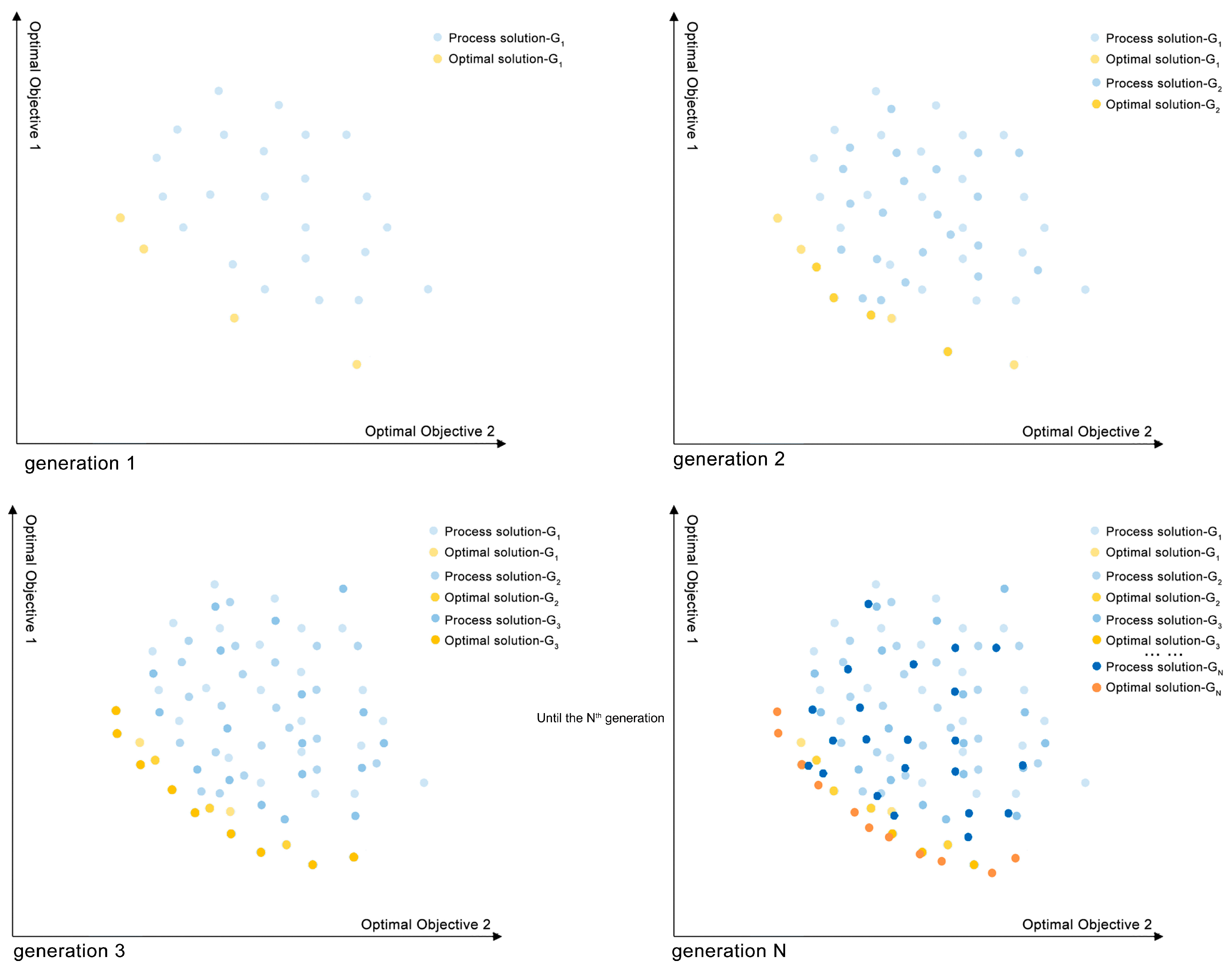
The typical calculation of the Pareto optimal solution of NSGA-II is shown in Figure 1. Under two determined optimization objectives, NSGA-II, through N generations of genetic iterations, continuously drives buildings towards the Pareto optimal solution, ultimately obtaining a solution set that minimizes total final energy consumption while optimizing the economic efficiency of buildings.

2.5. Project Design

This study selects a residential building in Longquanyi District, Chengdu City, Sichuan Province, and uDesignBuilder, which provides a graphical user interface (GUI) for EnergyPlus, is widely regarded as one of its most comprehensive interfaces. The DesignBuilder [42] building energy consumption simulation software is based on EnergyPlus [43]. EnergyPlus has been verified by the standard test method BESTEST/ASHRAE STD 140 for computer Program Evaluation of Building Energy Analysis. DesignBuilder, as the GUI (Graphical User Interface) of EnergyPlus, is widely regarded as the most comprehensive interface of EnergyPlus to date [44]. This software has been widely applied in related simulation calculations and has passed the ANSI/ASHRAE standard 140-2004 test for thermal performance of building envelope and building energy consumption, proving its suitability for simulating the thermal environment and energy consumption of various building types [45]. This software module is equipped with a genetic algorithm based on NSGA-II, which can efficiently carry out multi-objective screening and scheme selection work (see Figure 2).
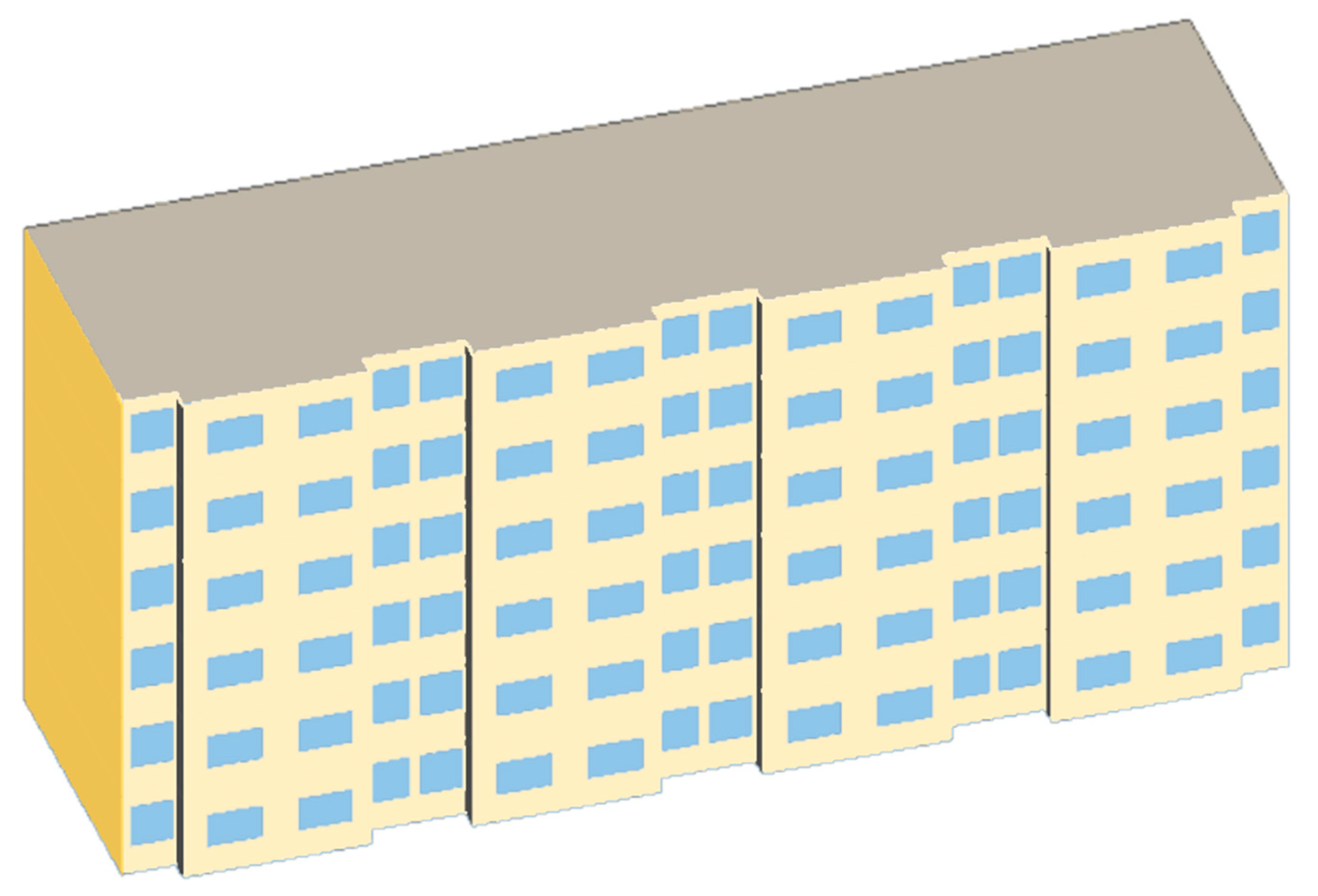
Based on the architectural design plan (see Figure 3), modeling work was carried out in the DesignBuilder software, and the building form was moderately simplified, such as the omission of the parapet walls and external decorative elements. At the same time, corresponding climatic conditions and building parameters were set. The building body was set in accordance with the limit values stipulated for buildings in climate zones characterized by hot summers and cold winters per DB51/T 5027-2024 “Energy Efficiency Design Standard for Residential Buildings in Sichuan Province” (with an energy efficiency rate of 68%) [46]. The design temperatures for heating and cooling were set at 18 °C and 26 °C, respectively. In hot summer and cold winter regions, air conditioning and heating are mainly implemented through intermittent methods in terms of time and space. The electricity consumption for air conditioning in summer is 6–7 kWh/(m2·a), while the electricity consumption for heating in winter is 2–4 kWh/(m2·a). The energy consumption of air conditioning in summer is approximately two times that of heating in winter [47]. Therefore, the energy-saving effect studied in this research is under the climatic conditions where cooling is the main mode. The mechanical and electrical system adopts chiller refrigeration and air conditioning commonly used in Chengdu. The meteorological data used in the simulation were imported from the CSWD [48] format used in Chengdu City. The performance parameters are shown in Table 1.
In this study, the lighting power density and equipment power density were determined respectively in accordance with the relevant provisions for high energy efficiency targets of residential buildings in the “Building Lighting Design Standard” (GB/T 50034-2024) [49] and the “Near Zero Energy Building Technology Standard” (GB/T 51350-2019) [13]. Although the “Near-Zero Energy Building Technology Standard” (GB/T 51350-2019) [13] did not directly provide a fixed recommended value for the equipment power density of residential buildings, its energy efficiency index calculation took into account terminal energy consumption such as lighting and household appliances, and stipulated that the energy consumption of near-zero energy consumption residential buildings should be reduced by more than 60% compared to the current energy-saving design standards. At the same time, in domestic local standards and demonstration projects, the electrical load density of near-zero energy consumption residences is often set within the range of 7–9 W/m2 to ensure that the energy efficiency target can be achieved while meeting the basic electricity demand for daily life. It should be noted that these parameters represent the design target values for nearly zero-energy buildings, rather than the actual energy consumption levels of current ordinary residences. This study focuses on the optimization of envelope structure parameters, with the internal load fixed at the high energy efficiency standard value, aiming to eliminate the random interference of user behavior and concentrate on the impact of passive strategies on energy consumption itself. In engineering applications, if the actual lighting and equipment loads exceed this set value, the total energy consumption of the building will increase proportionally, but the relative energy consumption differences among different envelope structure schemes are expected to remain stable.
Table 1. Performance parameters of the case study building.
Parameter CategoryMethodPerformance
Parameters
Basis
wall5 mm Cement mortar + 100 mm EPS + 200 mm Reinforced concrete0.37 W/(m2·K)the software setting results within the requirements of DB51/T 5027-2024 [46]
roof5 mm Cement mortar + 50 mm EPS + 100 mm Reinforced concrete0.58 W/(m2·K)the software setting results within the requirements of DB51/T 5027-2024 [46]
window4mmlow-E + 6mmair + 4mmlow-E1.8 W/(m2·K)-
the heat dissipation of the human bodyconvective heat dissipation:60 W/people
latent heat dissipation: 40 W/people
total heat dissipation:100 W/people
ASHRAE 55
air tightnessgeneraln50 = 4 h−1DB51/T 5027-2024 [46]
penetration modelWind-driven-
external shadingN/A--
equipment systemhousehold air source heat pump air conditioner + chiller refrigeration and air conditioningCOP = 2.8,
EER = 3.6
GB 55015-2021 [50]
ventilationno mechanical ventilation, natural ventilation 1.5 h−1DB51/T 5027-2024 [46]
natural ventilation control logicon-off conditions: indoor temperature > 26 °C and outdoor temperature < 26 °C
closing conditions: indoor temperature ≤ 24 °C or outdoor temperature ≥ 26 °C
ventilation period: all year round
-
indoor equipment7.5 W/m2-
indoor lighting5 W/m2GB/T 50034-2024 [49]
thermostat Setpointsdesign temperature: heating 18 °C, refrigeration 26 °C
Deadband: ±1 °C
DB51/T 5027-2024 [46]
Note: 1. Arg stands for argon gas; “Transparent” means transparent glass; EPS stands for polystyrene board. 2. The lighting and equipment power density is set according to the recommended values for high energy efficiency in residential buildings as stipulated in GB/T 51350-2019 “Technical Standard for Nearly Zero Energy Buildings” [13], representing the ideal energy consumption level under the optimized target, rather than the actual average value of current residential buildings.
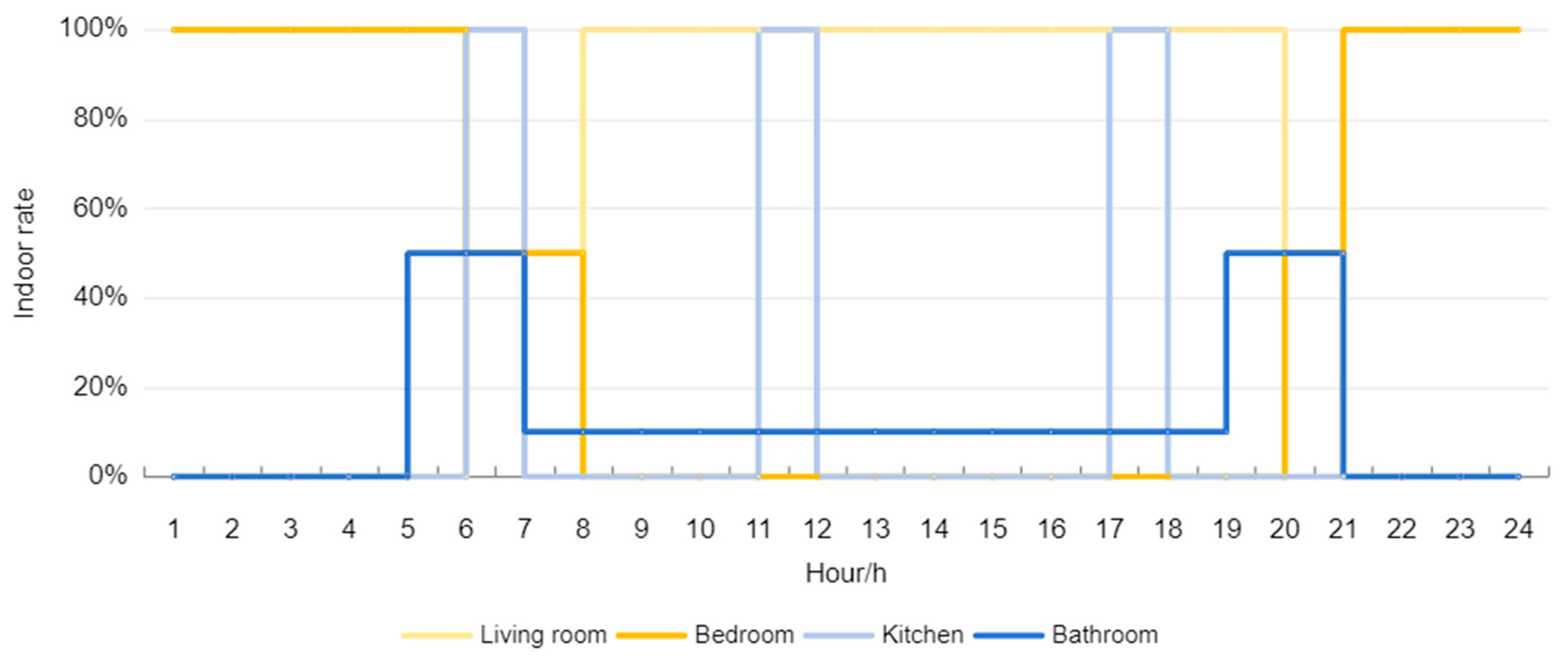
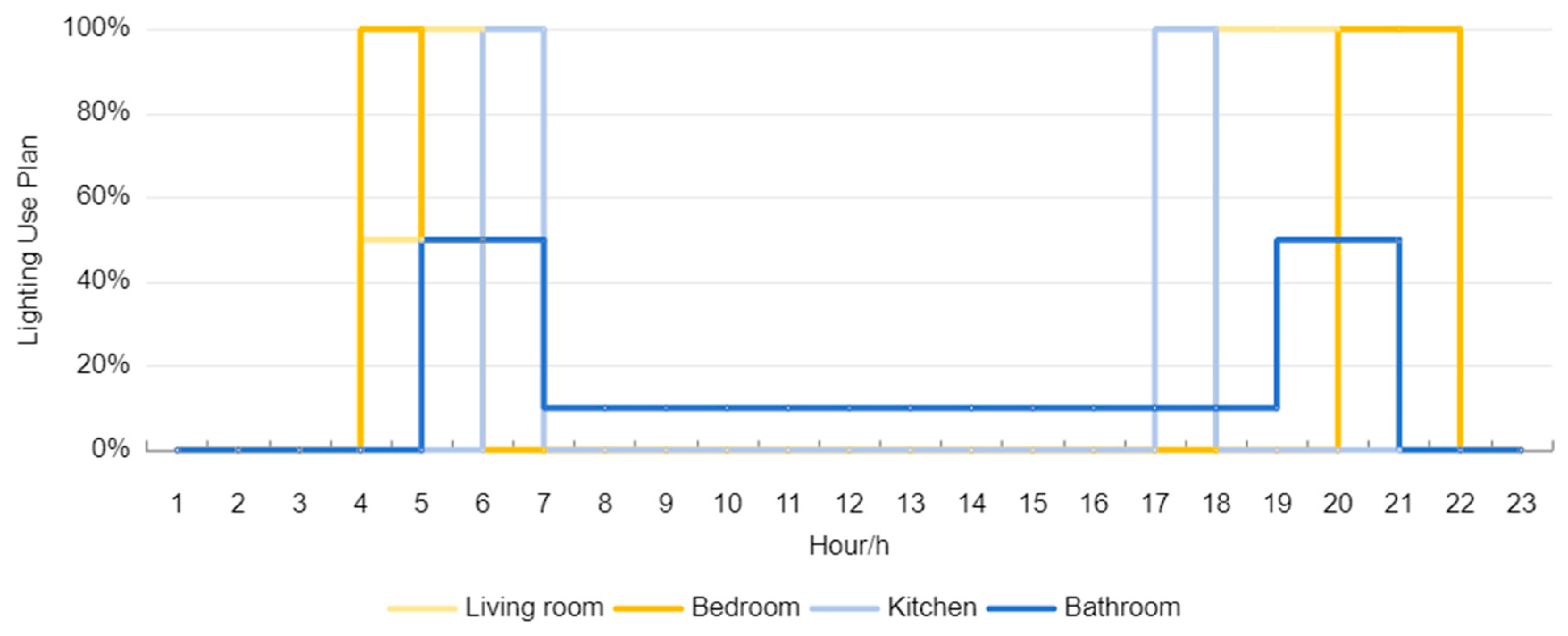
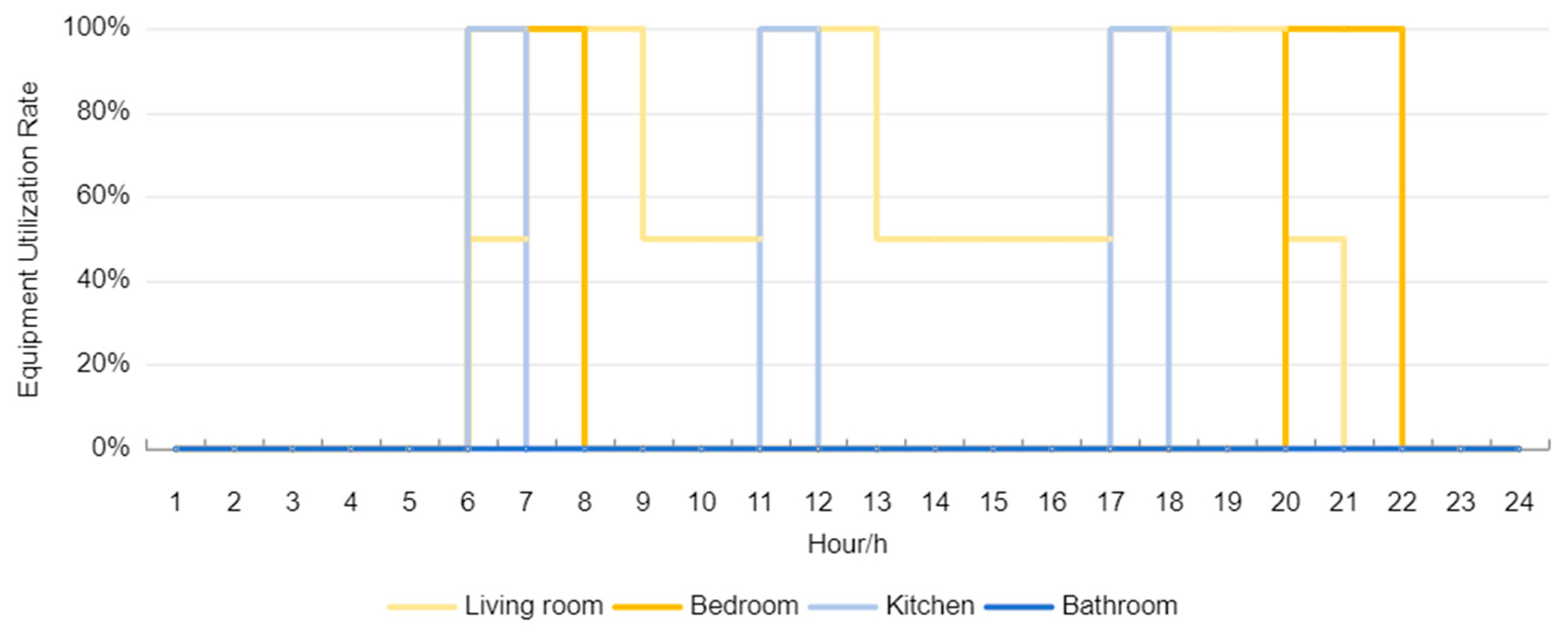
In terms of the settings, the residential population density is set at 0.035 people per square meter in total. The occupancy rate of people in the rooms and the hourly usage rates of lighting and equipment systems are shown in Figure 4, Figure 5 and Figure 6. The setting parameters refer to the “General Specifications for Energy Conservation and Renewable Energy Utilization in Buildings” (GB 55015-2021) [50]. During the setting process, the influence factors of weekends and holidays are ignored, and a unified schedule is applied throughout the year.
The optimization work of this study was carried out on the entire building as the basic unit, rather than being broken down into individual family units. The building was a standard multi-story residence, with each floor having a high degree of consistency in terms of orientation, window-to-wall ratio, energy consumption patterns, etc., and the proportion of public areas (such as stairwells) was relatively small. Therefore, optimizing the entire building not only reflects typical energy consumption characteristics but also facilitates the application of the research results in similar projects. Subsequent studies can be further refined to different floor plans or family levels as needed to analyze the differences in individual energy consumption behaviors.
It should be noted that this study proposes a preliminary and simplified optimization framework, designed to provide rapid decision support during the early stages of rural residential building design. The selected building envelope parameters (external walls, roofs, and exterior windows) are the most crucial factors influencing the building’s thermal performance. The study indicates that the simplified building energy model still holds significant value in early-stage analyses, especially for assessing long-term trends and comparing renovation measures. The discrepancy between the total primary energy demand estimated by the simplified model and the results from detailed simulations can be effectively constrained within a range of approximately ±10% [51,52,53].

3. Results

3.1. Variable Settings and Ranges

The ranges for the passive technical variables were defined with reference to GB/T 51350-2019 [13]. The upper limit (maximum requirement) for envelope parameters was set based on the minimum limit value specified for public buildings in cold regions by this standard. These variables specifically cover six different thicknesses of exterior wall insulation layers, five different thicknesses of roof insulation layers, and six different types of exterior windows. The initial investment costs for these variables, including the exterior wall and roof insulation layers, exterior window types, horizontal shading, and equipment systems, were determined based on product manufacturers’ technical datasheets. The initial investment costs for each item in Table 2 are based on the market quotations of major building materials and door/window manufacturers in Sichuan Province in 2024. It is particularly worth noting that the initial investment cost of the exterior wall and roof insulation layer not only included the cost of raw materials but also covered all the expenses incurred during the construction process of the materials, as shown in Table 2.

3.2. Selection of Passive Energy-Saving Technologies

The initial population screens passive energy-saving technologies based on the condition of total final energy consumption per unit area, which is composed of variables that affect the objective function. As a result, the performance of NSGA-II largely depends on the reasonable setting of parameters. Based on the constraint of setting the number of genetic iterations and conducting pre-experiments, this study determined the following key parameters:
The population size was set to 20. This value represents a balance between computational efficiency (smaller populations are faster but less diverse) and solution space exploration capability (larger populations are more comprehensive but slower). Given that the energy consumption simulation of DesignBuilder is computationally demanding, this setting aims to achieve a balance between computational efficiency and search capability. The number of iterations was set to 200 generations to ensure convergence [54]. Convergence analysis showed that improvements to the Pareto front became negligible after approximately 100 generations. The crossover and mutation rates were set to 0.9 and 0.1 [55], respectively. A high crossover rate promotes exploration of gene combinations via simulated binary crossover (the main method for generating new individuals), while the mutation rate helps maintain population diversity and prevent premature convergence. This setting ensures that each individual has the opportunity to mutate during each generation, which helps maintain population diversity and avoid premature convergence. The aforementioned parameters have been widely applied in multi-objective optimization of building energy consumption [56,57].
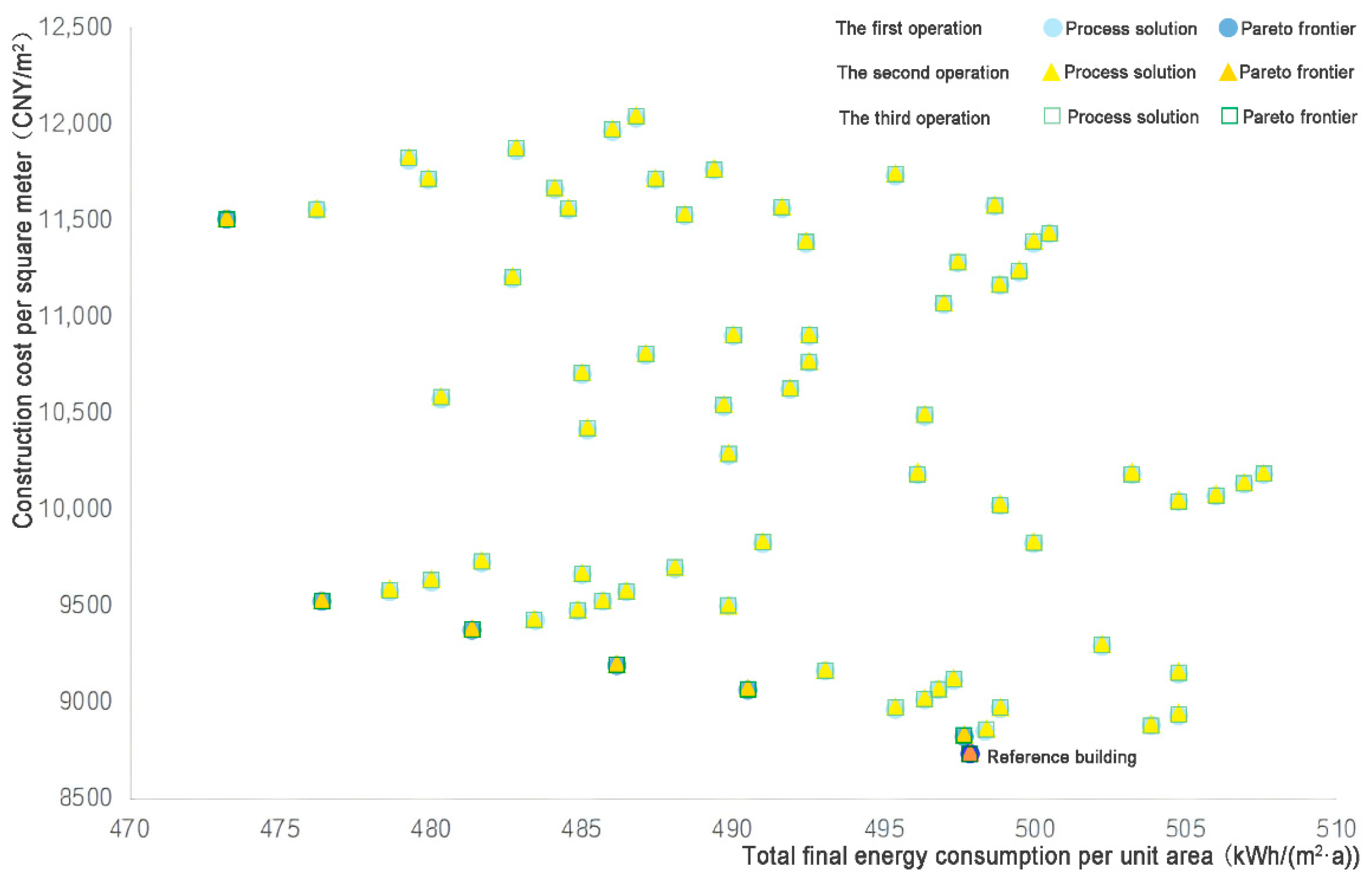
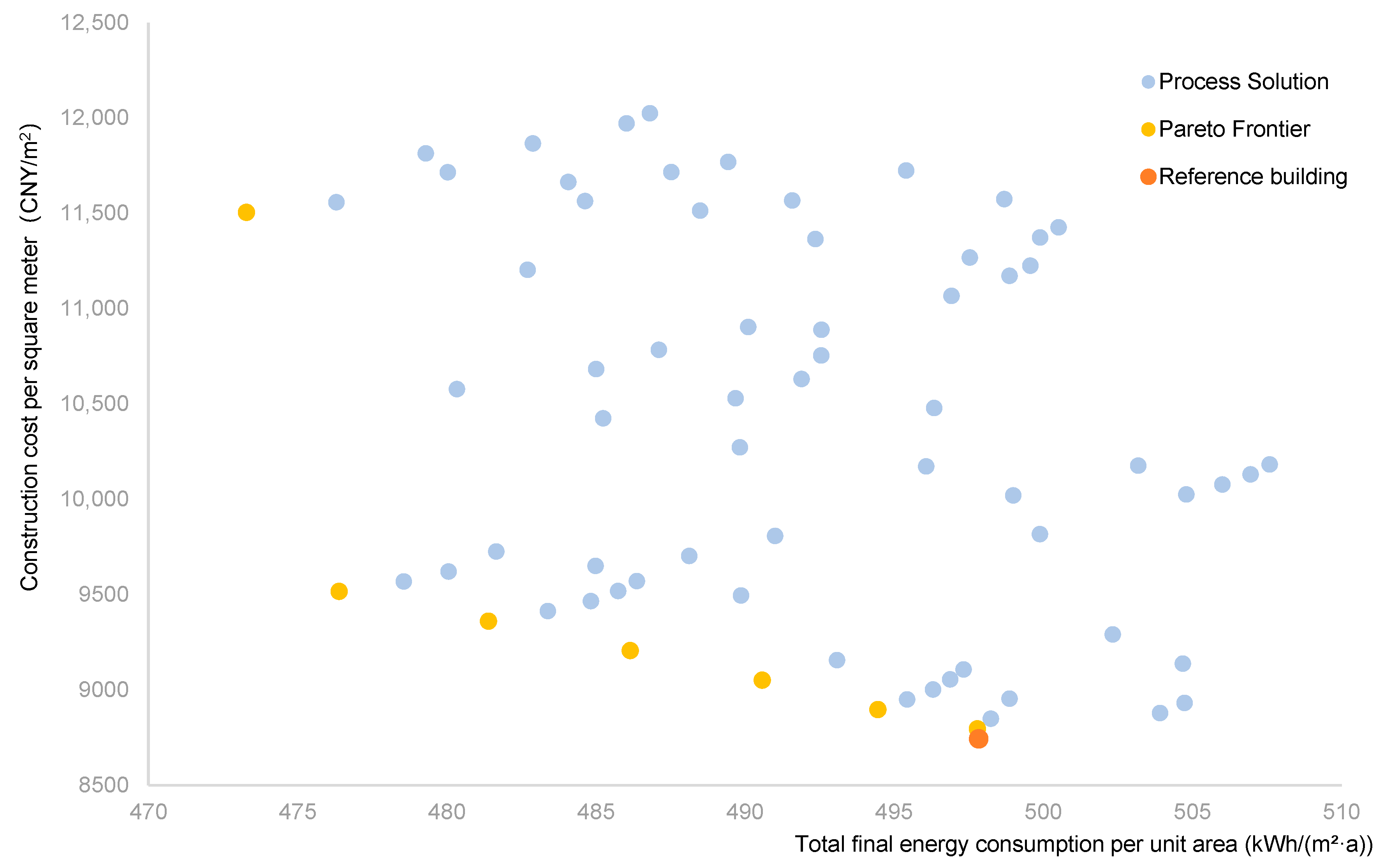
The algorithm’s core mechanism involves: (1) identifying and advancing towards the Pareto front via fast non-dominated sorting; (2) maintaining solution diversity using a crowding distance comparison operator; and (3) accelerating convergence and preserving good solutions through an elitist strategy. In implementation, each design is encoded as a vector [x1, x2, x3], representing exterior wall insulation thickness, roof insulation thickness, and window type. Its fitness (the objective vector [total final energy consumption, global cost]) is evaluated by calling a DesignBuilder automation script for energy simulation and coupling it with the initial cost calculation. Algorithm reliability was verified by setting a convergence criterion (less than 1% change in the hypervolume indicator over 20 generations) and performing multiple independent runs. The consistent morphology of the resulting Pareto fronts confirmed the stability of the implementation. Finally, a Python script (The application software is PyCharm 2021.3.2 (Community Edition)) was used to deeply couple NSGA-II with DesignBuilder, creating a fully automated closed-loop optimization workflow (“scheme generation → simulation → evaluation → evolution”). This process systematically reveals the trade-offs between energy efficiency and cost for building envelopes in hot summer and cold winter regions, yielding a robust Pareto optimal solution set for decision-making. Figure 7 shows the iterative calculation results of the multi-objective optimization of passive energy-saving technology.
The selection of passive technologies and their variable ranges was guided by three principles: (1) relevance to local climate (Chengdu’s hot summer/cold winter) and significant impact on energy consumption (e.g., wall/roof insulation, windows); (2) adherence to pertinent Chinese standards DB51/T 5027-2024 and GB/T 51350-2019 [13] to ensure practical applicability; and (3) use of the NSGA-II algorithm to screen variable combinations by minimizing total final energy consumption and cost, thereby obtaining the Pareto non-dominated solution set.

4. Discussion

4.1. Comprehensive Evaluation of Passive Energy-Saving Technologies

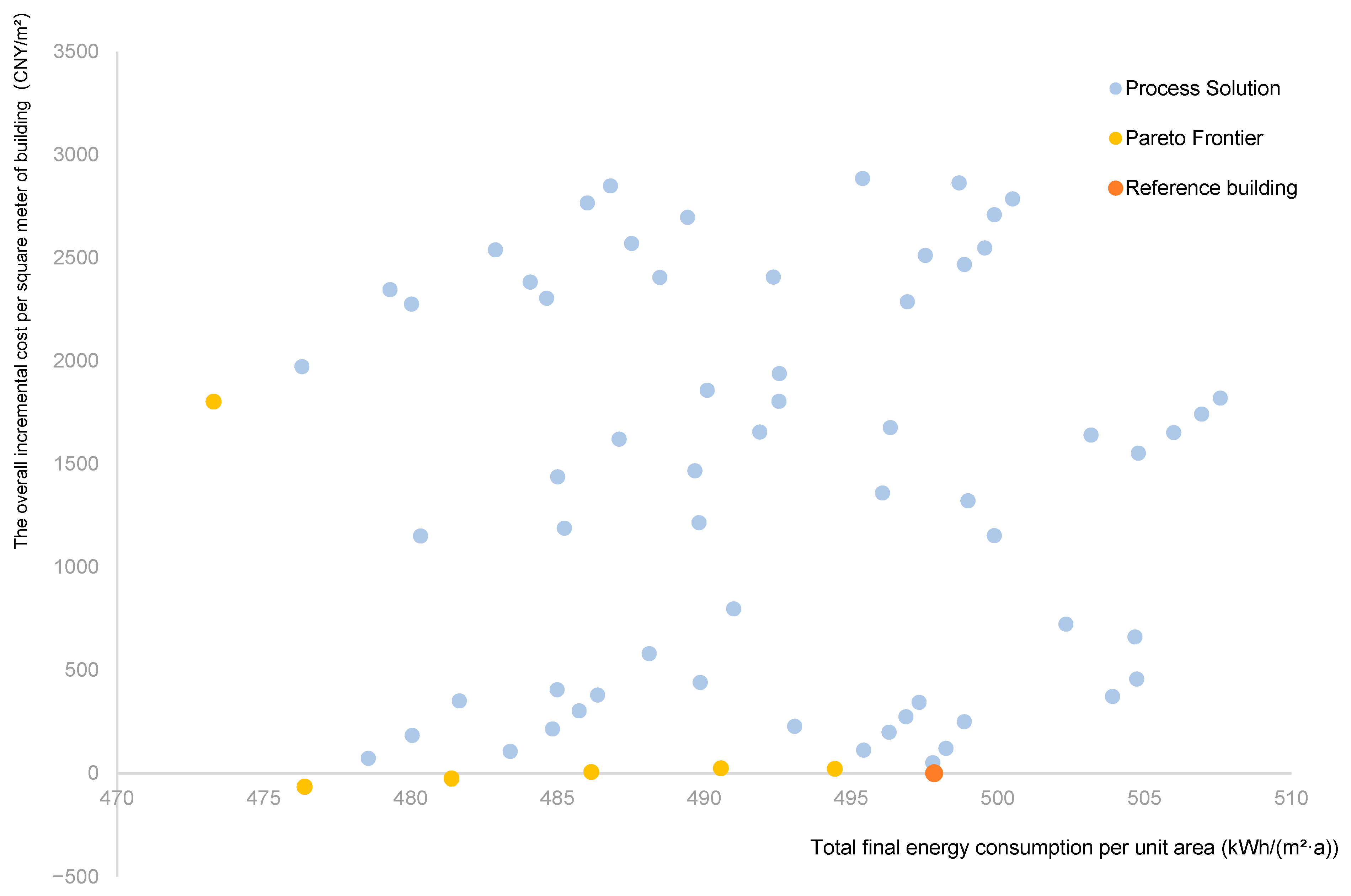
The Pareto optimal solution set was exported for global incremental cost calculation in a Python environment, with the results presented in Figure 8. Figure 8 shows a point on the Pareto front associated with a notably higher global cost increment. This phenomenon aligns with the economic principle of “diminishing marginal returns” [58,59], where, beyond a certain point, the additional cost required to achieve further energy savings increases sharply.
Based on the global incremental cost ( C g), the optimal solutions can be categorized into three scenarios: C g > 0, C g < 0, and C g ≈ 0.
Accordingly, we classify the solutions into three distinct templates: (1) energy-saving optimal, (2) trade-off optimal, and (3) cost optimal. This template set framework is proposed to provide clear guidance for different project priorities, even though in this specific case, the trade-off optimal and cost-optimal solutions coincide.
The energy-saving optimal template corresponds to total final energy consumption below 473.3 kWh/(m2·a), where C g > 0 (minimum ~1802 CNY/m2). This template achieves the highest energy-saving rate (Approximately 4.8%) compared to the reference building.
The cost-optimal template falls within a total final energy consumption range of 476.3 to 481.4 kWh/(m2·a) and features C g < 0. It achieves an energy-saving rate of 4.2% with the lowest C g (approximately −65 CNY/m2), representing the best economic performance.
When the total final energy consumption is greater than 486, the energy-saving rate continues to decrease, and compared to the reference building, the economic efficiency improves. Therefore, within the total final energy consumption per unit area of 476 kWh/(m2·a), this solution set can be defined as the compromised optimal template. The templates for energy-saving optimization, cost optimization, and trade-off optimization are detailed in Table 3.
Analysis of Table 3 reveals that the energy-saving optimal template, while offering the highest savings, incurs a substantially higher initial investment, which could limit its widespread feasibility. The trade-off optimal template achieves its balance through specific parameter adjustments (e.g., wall/roof insulation thickness, window type). It ensures appreciable energy savings while effectively controlling costs, striking a good balance between economy and energy conservation. This study’s Pareto frontier shows the prevalence of the 4 mm low-E + 6 mm air + 4 mm low-E window configuration across different insulation thicknesses, suggesting it is a cost-effective choice for balancing performance and cost. This finding is supported by other research indicating that appropriate insulation and window configurations can harmonize energy conservation with economic efficiency [60]. Such balanced solutions meet the construction industry’s sustainability requirements and offer flexible, feasible options for practical applications. Furthermore, the selection and application of passive technologies must always consider local climate, building type, and usage to fully leverage their energy-saving potential and contribute to green development.

4.2. Incremental Investment Cost and Annual Energy Savings Benefit

To guide practical application, the Pareto optimal solution set is distilled into three representative design templates—energy-saving optimal, trade-off optimal, and cost optimal, based on their economic and energy performance (Figure 8, Table 4). The template set shows significant gradient differences in terms of economy and energy efficiency, and is suitable for different engineering decision-making scenarios.
The energy-saving optimal template (Figure 8, leftmost point): Configuration: 350 mm wall, 60 mm roof, high-performance windows. It achieves the lowest energy consumption (473.3 kWh/(m2·a), 4.8% saving vs. reference). However, it requires the highest incremental investment (2180 CNY/m2), yields an annual saving of 13.23 CNY/(m2·a), and has a long static payback period (~165 years) and positive C g (~1802 CNY/m2), meaning operational savings do not offset the high initial cost. Application: Suitable for projects prioritizing energy performance over cost, e.g., demonstration or certification projects.
The Cost/Trade-off optimal template (Figure 8 point with the lowest C g): Configuration: 350 mm wall, 60 mm roof, standard windows. Energy consumption: 476.4 kWh/(m2·a) (4.2% saving). It features a low incremental investment (250 CNY/m2), annual savings of 11.56 CNY/(m2·a), a reasonable payback period (~21.6 years), and negative C g (−64 CNY/m2), indicating net lifecycle benefit. Application: Ideal for budget-sensitive projects and represents the best overall balance, suitable for most conventional residential buildings.
In summary, the three-template framework provides clear guidance: (1) choose the energy-saving optimal template for maximum performance; (2) choose the trade-off optimal template for the best overall balance; (3) choose the cost optimal template for strict budget control.

4.3. Convergence and Randomness Verification

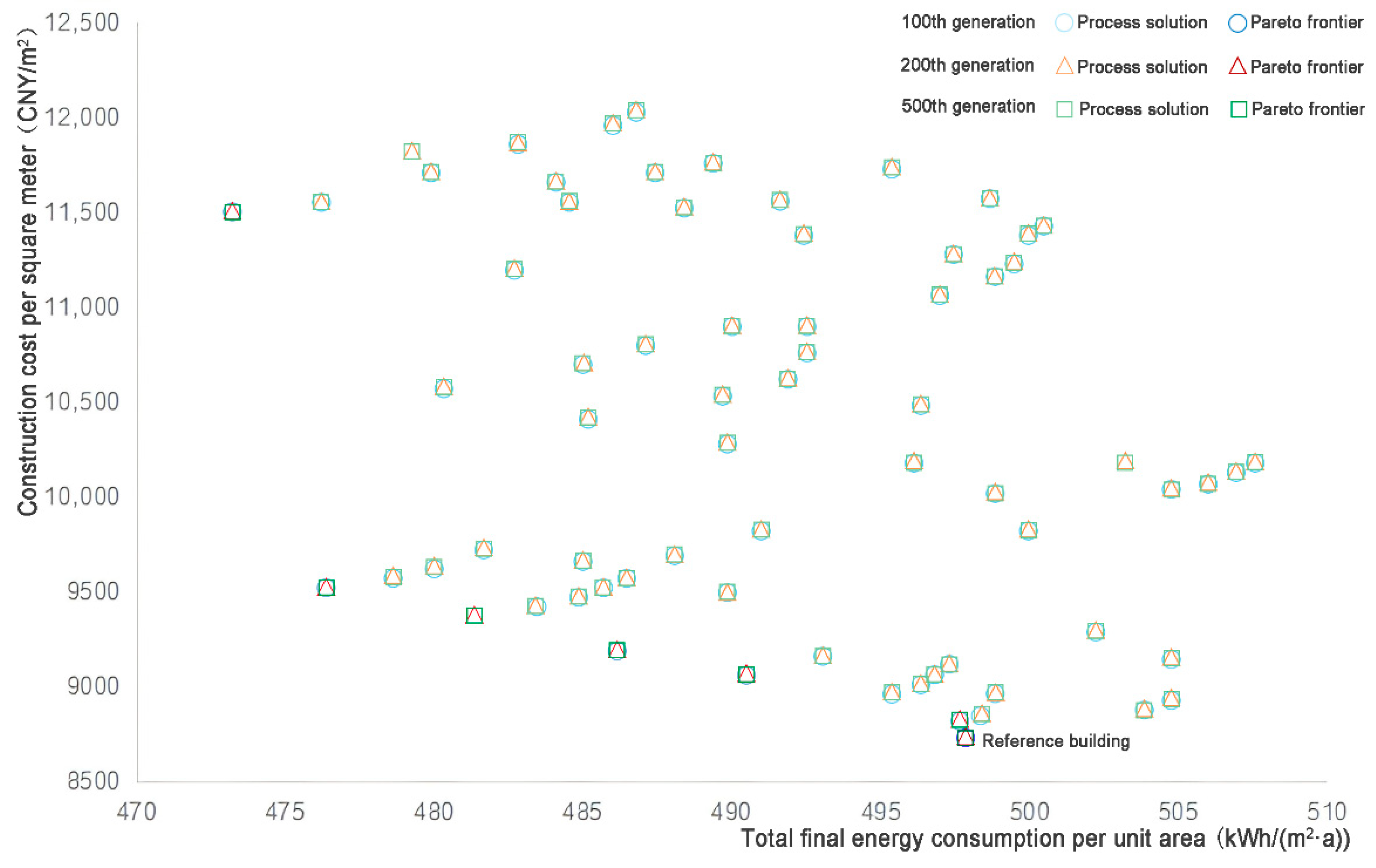
To verify convergence, Pareto fronts from generations 100, 200, and 500 were compared (Figure 9). The near-complete overlap of the fronts at generations 200 and 500 indicates algorithm stabilization by generation 200, justifying the 200-generation stopping criterion.
To test the sensitivity of the optimization results to the random seed, we ran the optimization three times in DesignBuilder, with 200 generations for each run. The Pareto frontiers obtained from the three runs (drawn in the same coordinate system (Figure 10) and distinguished by different colors and symbols) showed that the three frontiers were almost completely overlapping, proving that the obtained Pareto optimal solution set and breakpoint positions are not dependent on the random seed and have good robustness.

4.4. Limitations

This simulation has several limitations. First, the variable set, while covering key envelope parameters (wall/roof insulation, windows), excludes other influential passive design variables like orientation, window-to-wall ratio, shading, and natural ventilation strategies. This may limit the comprehensiveness of the results. Future research can further expand the variable range and conduct multi-factor collaborative optimization studies. Secondly, in terms of algorithms, the NSGA-II algorithm used in this study can effectively handle dual-objective optimization problems and obtain uniformly distributed Pareto solution sets. However, when dealing with complex optimization scenarios with three or more objectives, their convergence and distribution may be limited. Future research can introduce more advanced multi-objective optimization algorithms, such as NSGA-III [61] and NSGA [62], to improve the optimization accuracy and reliability in complex multi-dimensional objectives. Thirdly, in the simulation process, the meteorological data used is the CSWD format commonly used in Chengdu, which has certain representativeness. However, actual meteorological conditions have interannual variations and random fluctuations, which may lead to certain deviations between the simulation results and the actual situation. Future research can consider using longer time series in meteorological data or introduce uncertainty analysis methods to more accurately evaluate the actual effect of passive energy-saving technologies. Meanwhile, the design template provided by this study should be understood as the theoretically optimal solution based on typical meteorological years and standard energy consumption patterns, rather than a risk management tool that guarantees actual operational performance. Future research will introduce Monte Carlo simulation or probability methods to quantify the impact of the aforementioned uncertainties on the robustness of the optimal solution, and on this basis, construct a complete risk analysis framework. Fourthly, in the optimization aspect of this study, the entire building was taken as the object, and no distinction was made between the energy consumption differences of different residential units. In actual operation, there may be significant variations in resident behaviors (such as window-opening habits, indoor set temperatures, and equipment usage patterns), which can affect energy consumption performance. Future research can combine resident behavior surveys to establish a multi-resident model and further analyze the impact of behavioral differences on the optimal design parameters. Last but not least, this study mainly focuses on passive energy-saving technologies for building envelopes and equipment systems. The research on the impact of energy management strategies and user behavior patterns during the building operation process on energy consumption is insufficient. Future research can consider combining intelligent building technology to conduct multi-dimensional, comprehensive energy-saving studies to further improve the building energy-saving technology system.
In summary, future research can further expand and deepen in aspects such as variable systems, optimization algorithms, climate data, and operation mechanisms to enhance the scientific rigor and engineering applicability of passive-oriented nearly zero-energy building technology research.

5. Conclusions

Based on the characteristics of passive-oriented nearly zero-energy building (nZEB) technology and China’s national context, this study developed an optimized technical process that integrates passive low-energy consumption goals with economic objectives. The practicality and effectiveness of this process were verified through a case study of a residential building in Chengdu. During the research process, optimization was carried out based on the dual goals of building energy consumption and economy, and finally, the Pareto optimal solution set was obtained. Based on this, the following important conclusions were drawn:
(1) For passive-oriented nZEBs, conducting comprehensive multi-objective optimization during the initial schematic design stage can ensure environmental goals are met without imposing excessive economic burdens, thereby harmonizing social and economic benefits.
(2) For designing nZEBs in hot summer and cold winter climates, the demand-driven technical templates and the multi-objective optimization process proposed in this study provide a reference that is both scientifically grounded and practically applicable. The resulting Pareto optimal solution set can be categorized into three selection templates: energy-saving optimal, trade-off optimal, and cost optimal. Compared to the reference building, these templates achieve energy-saving rates within a favorable range (4.2% to 4.8%) by adopting the strategies discussed in this study.
(3) The optimization yielded a Pareto front comprising six non-dominated solutions. The total final energy consumption of these solutions ranges from 473.3 to 497.7 kWh/(m2·a), while their global cost increment ( C g) ranges from −64 to +1802 CNY/m2.
This result quantitatively defines the design trade-off space. Compared to the reference building (497.8 kWh/(m2·a)), the energy-saving optimal template achieves a 4.8% saving (473.3 kWh/(m2·a) but bears a high positive C g (+1802 CNY/m2). The cost-optimal template achieves a 4.2% saving with a negative C g (−64 CNY/m2). The trade-off optimal template offers the most balanced performance. The proposed framework and its quantitative outputs provide data-driven support for early-stage design decisions. For cost-sensitive projects (e.g., rural housing), the trade-off optimal template, achieving ~4% savings at a negative incremental cost, presents a feasible path. This can facilitate the broader application of passive-oriented nZEBs in similar climates.
(4) Differentiated application strategies are proposed: the energy-saving optimal template is recommended for projects prioritizing long-term energy conservation, and the trade-off optimal template is a practical choice for most conventional, cost-sensitive new construction or renovation projects seeking optimal economic returns.
(5) The multi-objective optimization process and its parameter settings, validated in this study, demonstrate high rationality and applicability. This work lays a foundation and points to a direction for the deeper implementation of passive house technology in China, and for developing passive-oriented nZEB standards and design methods suited to China’s national context and indoor environment codes. This research provides theoretical support for designing and optimizing passive-oriented nZEBs in hot summer and cold winter regions and offers a transferable methodological framework for studies in other climate zones. Through refined and systematic multi-objective optimization strategies, it effectively balances the contradiction between building energy consumption and economic costs, promoting the sustainable development of green building technologies. In the future, with advances in technology and supportive policies, passive-oriented nZEBs are expected to see wider application across more regions and building types, contributing to global carbon neutrality goals. This research also underscores the importance of interdisciplinary collaboration. The deep integration of architecture, engineering, and economics will accelerate the innovation and application of passive energy-saving technologies, driving the construction industry toward a greener, low-carbon future.

Author Contributions

Conceptualization, C.W. and Q.J.; methodology, C.W. and J.K. (Jingshu Kong); software, Q.J. and J.K. (Jingshu Kong); validation, C.W. and J.K. (Jarek Kurnitski); formal analysis, Q.J., J.K. (Jingshu Kong) and J.K. (Jarek Kurnitski); investigation, C.W., C.L. and W.H.; resources, C.L. and C.W.; data curation, Q.J., C.L., C.W., J.K. (Jingshu Kong) and J.K. (Jarek Kurnitski); writing—original draft preparation, C.W., C.L. and J.K. (Jingshu Kong); writing—review and editing, C.W., Q.J., J.K. (Jingshu Kong) and J.K. (Jarek Kurnitski); project administration, C.W., Q.J. and J.K. (Jarek Kurnitski); funding acquisition, J.K. (Jarek Kurnitski). All authors have read and agreed to the published version of the manuscript.

Funding

This research was funded by the 2024 Sichuan Provincial College Students’ Innovation Training Program, grant number s202410616023.

Data Availability Statement

The data presented in this study are available on request from the corresponding author.

Acknowledgments

The authors would also like to extend their sincere gratitude to the research team from Chengdu University of Technology, whose members, Chen Peng, Guozhou Su, and Xinyu Yuan, have contributed to this study by providing critical assistance.

Conflicts of Interest

The authors declare no conflicts of interest.

References

  1. United Nations. Paris Agreement. 2015. Available online: https://www.un.org/zh/documents/treaty/FCCC-CP-2015-L.9-Rev.1 (accessed on 31 December 2025).
  2. Wang, H. Research on the Fiscal Policy Path and Effects for Synergistically Promoting the Transformation from Near-Zero Carbon Emissions to Zero Carbon Emissions Project in Shanxi Province. Shanxi Financ. Tax 2024, 12, 40–42. Available online: https://kns.cnki.net/kcms2/article/abstract?v=kMXxFLy7TFW1i0bKd5cdExCV16_psJsneD2KHgkyCa_VpeWWFEwJ-fkwEQm6DOvrPywDBbsKd7YVuv01OuhxXQyDhlvg9OM__-u9qaZE6dNFlKtGhyRHPGN0owTu6-5VJBIK-mZqPpx_9e6klPNcbsycexk8WdJEUonL1jE0GG-QP9hWsZuVPQ==&uniplatform=NZKPT&language=CHS (accessed on 12 December 2025).
  3. IPCC. Climate Change 2014: Mitigation of Climate Change: Working Group III Contribution to the IPCC Fifth Assessment Report; Cambridge University Press: Cambridge, UK, 2015. [Google Scholar]
  4. OIES. Unpacking China’s 2060 Carbon Neutrality Pledge. 2023. Available online: https://www.oxfordenergy.org/wpcms/wp-content/uploads/2020/12/Unpacking-Chinas-carbon-neutrality-pledge.pdf (accessed on 12 December 2025).
  5. Jia, Z.; Lin, B. How to achieve the first step of the carbon-neutrality 2060 target in China: The coal substitution perspective. Energy 2021, 233, 121179. [Google Scholar] [CrossRef]
  6. He, J.-K. Global low-carbon transition and China’s response strategies. Adv. Clim. Change Res. 2016, 7, 204–212. [Google Scholar] [CrossRef]
  7. Luo, J.; Yu, J. Facing the Policy Challenges of Climate Change: Assessing China’s Strategy and Actions in International Environmental Crisis Communication. Commun. Humanit. Res. 2024, 33, 205–212. [Google Scholar] [CrossRef]
  8. Shi, L.; Xu, D.; Li, X.; Huang, L.; Li, Y.; Huang, T.; Yang, Y. The Impact Characteristics of Common Low-Carbon Design Methods on Reducing Carbon Emissions in Industrial Plant Buildings in Architectural Design. Buildings 2025, 15, 974. [Google Scholar] [CrossRef]
  9. Qin, H.; Yu, Z.; Li, T.; Liu, X.; Li, L. Heating Control Strategy Based on Dynamic Programming for Building Energy Saving and Emission Reduction. Int. J. Environ. Res. Public Health 2022, 19, 14137. [Google Scholar] [CrossRef]
  10. Schwartz, Y.; Raslan, R.; Mumovic, D. Implementing multi objective genetic algorithm for life cycle carbon footprint and life cycle cost minimisation: A building refurbishment case study. Energy 2016, 97, 58–68. [Google Scholar] [CrossRef]
  11. Wu, D.; Liu, C. The Design and Innovation of Passive House: A Case Study and Inspirations from the Winning Works of 2014 Passive House Award. New Archit. 2016, 74–79. [Google Scholar] [CrossRef]
  12. Liang, X.; Huang, Y. Energy-saving Potential of Building Envelope Retrofitting in Subtropical Climate Zones Under the Goal of Carbon Peaking. Build. Energy Effic. 2023, 51, 24–31. [Google Scholar] [CrossRef]
  13. GB/T 51350-2019; Technical Standard for Nearly Zero Energy Buildings. Ministry of Housing and Urban-Rural Development of the People’s Republic of China: Beijing, China, 2019.
  14. Wang, C. Optimization technology for the envelope structure of nearly zero energy buildings in extremely cold regions. Sichuan Cem. 2025, 6, 123–124, 130. [Google Scholar] [CrossRef]
  15. Yang, Y.; Li, X.; Yao, Z.; Yu, A.; Wang, M. Impact of Facade Photovoltaic Retrofit on Building Carbon Emissions for Residential Buildings in Cold Regions. Buildings 2025, 15, 3762. [Google Scholar] [CrossRef]
  16. Zhou, J.; Liu, Y.; Tang, Y.; Wang, Y.; Zhang, D. Design Practice and Demonstration of Near-Zero Energy Consumption Buildings in Low-carbon Parks in Cold Regions: A Case Study of Building 8 in Haichen Park. Constr. Sci. Technol. 2024, 3, 59–61. [Google Scholar] [CrossRef]
  17. Xue, Y. Application of Near-zero Energy Consumption Building Technology in the Northwest China—An Example of an Office Building in Lanzhou New District. Green Build. 2024, 50–53, 114. [Google Scholar] [CrossRef]
  18. Wu, D.; Liu, L.; Li, X.; Liu, C. Research on the Technologies of Passive Low Energy Buildings on the Basis of Multi-0bjective Optimization Method by Taking Cold Zone Residential Buildings for Example. J. S. China Univ. Technol. (Nat. Sci. Ed.) 2018, 46, 98–104, 120. [Google Scholar] [CrossRef]
  19. Feng, F.; Li, X.; Xue, L. Analysis of Influencing Factors of Green Building Energy Consumption Based on Design Builder. Anhui Archit. 2020, 27, 158–159, 195. [Google Scholar] [CrossRef]
  20. Pang, B.; Qian, C. Analysis of the impact of exterior wall insulation materials on the energy consumption of high-rise Residential buildings based on Design Builder simulation. Hous. Real Estate 2021, 6, 139–140. Available online: https://kns.cnki.net/kcms2/article/abstract?v=kMXxFLy7TFWtRK5qVyguAuTz6Hqj7Gm_9OXmPnRXKrRy5J9XeSKGltSGVN-sIT1jnpdCnHz4VIfMVYPEc8nSywsOh9gqo5CPCveG1azIJpGAOVAJvYLEmC8WIg1vhmItZqSp3WpaTN25BhSedeO0pSkwGmbPca001vVEZd4mynQeZ5ehtxE1wQ==&uniplatform=NZKPT&language=CHS (accessed on 12 December 2025).
  21. Zhen, X.; Li, S.; Zhang, Y.; Jiao, R.; Wu, W. Research on multi-objective optimization of envelope structures for nearly zero-energy buildings in Northwest China. Integr. Intell. Energy 2024, 46, 81–90. [Google Scholar] [CrossRef]
  22. Zhang, Y.; Liu, X.; Jiao, Y. Energy-saving Design of Rural Prefabricated Houses in Cold Regions Based on DesignBuilder. Build. Energy Effic. 2025, 53, 135–142. [Google Scholar] [CrossRef]
  23. Li, Q.; Liu, L.; Zheng, X. Analysis on the Energy-Saving Factors of Small Residential Buildings in Analysis on the Energy-Saving Factors of Small Residential Buildings in. Urban Archit. 2025, 22, 142–145. [Google Scholar] [CrossRef]
  24. Bavarsad, F.S.; Mohajerani, M.; Tywoniak, J.; Yuan, J. Multi-objective optimization framework to achieve near-zero energy building in the Czech Republic for future climatic conditions. Sustain. Futur. 2026, 11, 101599. [Google Scholar] [CrossRef]
  25. Xu, J.; Fang, T.; Wang, Y.; Wang, Z.; Han, X. Optimization of a Design Process and Passive Parameters for Residential Nearly Zero Energy Building Envelopes Based on Energy Consumption Targets. Buildings 2025, 15, 3785. [Google Scholar] [CrossRef]
  26. Witte, M.J.; Henninger, R.H.; Glazer, J.; Crawley, D.B. Testing and Validation of a New Building Energy Simulation Program. In Proceedings of the Seventh International IBPSA Conference, Rio de Janeiro, Brazil, 13–15 August 2001. [Google Scholar]
  27. Murata, T.; Ishibuchi, H. MOGA: Multi-Objective Genetic Algorithms. In Proceedings of the 1995 IEEE International Conference on Evolutionary Computation, Perth, WA, Australia, 29 November–1 December 1995; IEEE: Piscataway, NJ, USA, 1995; Volume 1, p. 289. [Google Scholar]
  28. IEA. Energy Performance of Buildings (Directive 2002/91/EC)—Policies. Available online: https://www.iea.org/policies/712-energy-performance-of-buildings-directive-200291ec (accessed on 30 December 2025).
  29. Waddell, C.; Kaserekar, S. Solar Gain and Cooling Load Comparison Using Energy Modeling Software. In Proceedings of the Fourth National Conference of IBPSA, New York, NY, USA, 11–13 August 2010. [Google Scholar]
  30. Wang, L.; Han, R. Thermal Comfort Improvement of a University Dormitory in Tianjin in Summer. Build. Energy Effic. 2018, 130–133. [Google Scholar] [CrossRef]
  31. Meng, X.; Yan, B.; Gao, Y.; Wang, J.; Zhang, W.; Long, E. Factors affecting the in situ measurement accuracy of the wall heat transfer coefficient using the heat flow meter method. Energy Build. 2015, 86, 754–765. [Google Scholar] [CrossRef]
  32. Ye, X.; Lu, J.; Zhang, T.; Wang, Y.; Fukuda, H. Improvements in Energy Saving and Thermal Environment after Retrofitting with Interior Insulation in Intermittently Cooled Residences in Hot-Summer/Cold-Winter Zone of China: A Case Study in Chengdu. Energies 2021, 14, 2776. [Google Scholar] [CrossRef]
  33. Zhao, L.; Huang, Z.; Qian, W. Numerical Simulation Analysis of Different Cases of Exterior Wall Insulation System. J. Anhui Univ. Technol. (Nat. Sci.) 2013, 30, 266–269+307. Available online: https://kns.cnki.net/kcms2/article/abstract?v=kMXxFLy7TFURD_SNqLtLEN3W5ar5i49Z052DxBYLcB17KuObCj840AeSmVEpulnl-k4u72uoRyKDF7tFIqjiOsJRZX6irKwWw8pD-w6T4JGFWAFOfwZZUDqksz85E-PX2VQ6cQ2zi7FLTsg7fgqpV2F8rFUTNEyH4SjRRFbBIGcGF9i2L4CSCw==&uniplatform=NZKPT&language=CHS (accessed on 27 February 2026).
  34. Jiang, C.; Fan, D.; Xiao, Y. Research on Heat Transfer Relationship and Load Distribution Characteristics of Embedded Air-Conditioning Room under Heating Conditions. Refrig. Air Cond. 2021, 35, 483–489. Available online: https://kns.cnki.net/kcms2/article/abstract?v=kMXxFLy7TFWhcrOnfaHa6iI3FP8qHz09BU7PKpgNiVJsVxc6tqlSf8RY-U_5D3b5JC5Uv7eD2hI0VYko4B-bIITpxJO_shlHToIvIc6tfQ5TjC8ISKIlYwQ7VnXOvYF9v26gHnb7iN2F8NQWzAg8znhBosFzg8h17tVQaoVoufmETYZzCgJIag==&uniplatform=NZKPT&language=CHS (accessed on 26 February 2026).
  35. Zhou, H.; Chen, G.; Zhou, X.; Xie, D. Study on Energy Saving Parameters of the External Windows of Passive Buildings in Hot Summer and Cold Winter Region. Urban Archit. 2023, 20, 1–5+15. [Google Scholar] [CrossRef]
  36. Xia, Y.; Li, P.; Liu, Z. Selecting and Evaluating Energy-Saving Technology of Exterior Window in Severe Cold Region. Low Temp. Archit. Technol. 2019, 41, 15–18+24. [Google Scholar] [CrossRef]
  37. Zhang, J.; Han, W.; Ma, Z.; Du, Q.; Zhu, Y. Carbon Emission Calculation and Emission Reduction Strategies for Office Building During the Materialization Stage. J. Xi’an Univ. Technol. 2025, 41, 118–127. Available online: https://kns.cnki.net/kcms2/article/abstract?v=kMXxFLy7TFUwte-QvMj0ObJSyI4V9VkRdpEGYG_EW_TCKk7yiCSSneiYyY_wNCSlq7N-mKbhZtPROmGrLOsuPW1nj_9mWolS2E1ZvDw2_hyzPOix97-qWXyCraWlGJI1KQvVPy-TXsfpBaa7wyHw1ZUUBZWgPK5VBTjA6VB34Sb2E-f4qAUM7Q==&uniplatform=NZKPT&language=CHS (accessed on 9 January 2026).
  38. Cui, Y. Research and Engineering Demonstration on Energy-Saving Retrofit Technology for Building Envelope Structures; China Architecture & Building Press: Beijing, China, 2014; ISBN 978-7-5123-6039-6. [Google Scholar]
  39. Wilson, L. Home Heat Loss—An Introduction, Shrink That Footprint. 2022. Available online: https://shrinkthatfootprint.com/home-heat-loss/ (accessed on 4 April 2026).
  40. Ma, H.; Zhang, Y.; Sun, S.; Liu, T.; Shan, Y. A comprehensive survey on NSGA-II for multi-objective optimization and applications. Artif. Intell. Rev. 2023, 56, 15217–15270. [Google Scholar] [CrossRef]
  41. Belhous, M.; Mastouri, H.; Radoine, H.; Kaitouni, S.I.; Benhamou, B. Multi-objective Optimization of the Thickness of the Thermal Insulation and the Windows Area of a House in Benguerir, Morocco. In Proceedings of the 2021 9th International Renewable and Sustainable Energy Conference (IRSEC), Benguerir, Morocco, 23–27 November 2021; IEEE: New York, NY, USA, 2021; pp. 1–6. [Google Scholar]
  42. DesignBuilder Software Ltd. Product Overview. Available online: https://designbuilder.co.uk/software/product-overview (accessed on 30 December 2025).
  43. EnergyPlus. Available online: https://energyplus.net/ (accessed on 30 December 2025).
  44. ANSI/ASHRAE Standard 140-2004; Standard Method of Test for the Evaluation of Building Energy Analysis Computer Programs. American Society of Heating, Refrigerating and Air-Conditioning Engineers, Inc.: Peachtree Corners, GA, USA, 2004.
  45. Yang, F.; Zhou, H.; Chen, J.; Sun, Y.; Wang, D.; Sun, F.; Zhang, L. Energy-Saving Performance and Optimization Study of Adaptive Shading System—A Case Study. Buildings 2025, 15, 1961. [Google Scholar] [CrossRef]
  46. DB51/T 5027-2024; Design Standard for Energy Efficiency of Residential Buildings in Sichuan Province. Ministry of Housing and Urban-Rural Development of the People’s Republic of China: Beijing, China, 2025.
  47. Qi, T.; Xu, Q.; Wang, B.; Hu, L. Analysis on Energy Consumption for Residential Buildings in Hot Summer and Cold Winter Region. Build. Sci. 2013, 29, 23–26. [Google Scholar]
  48. EnergyPlus. Weather Data by Location. Available online: https://energyplus.net/weather-location/asia_wmo_region_2/CHN/CHN_Sichuan.Chengdu.562940_SWERA (accessed on 30 December 2025).
  49. GB/T 50034-2024; Building Lighting Design Standards. China Architecture & Building Press: Beijing, China, 2024.
  50. GB 55015-2021; General Code for Energy Efficiency and Renewable Energy Application in Buildings. China Architecture & Building Press: Beijing, China, 2021.
  51. Dadras, Y.; Mostafazadeh, F.; Kavgic, M.; Ghobadi, M. Evaluating simplified building models’ sensitivity to climate data for energy retrofit optimization. Build. Environ. 2026, 287, 113885. [Google Scholar] [CrossRef]
  52. Dadras, Y.; Mostafazadeh, F.; Kavgic, M.; Ghobadi, M. Enhancing building energy optimization efficiency: A performance analysis of simplification approaches. J. Build. Eng. 2025, 105, 112559. [Google Scholar] [CrossRef]
  53. Dadras, Y.; Mostafazadeh, F.; Kavgic, M. Impact of Modeling Simplification on Energy Simulation Speed and Accuracy Considering Climate Change: A Case Study of a Dormitory Building. CIB Conf. 2025, 1, 171. [Google Scholar] [CrossRef]
  54. Zhao, J.; Du, Y. Multi-objective optimization design for windows and shading configuration considering energy consumption and thermal comfort: A case study for office building in different climatic regions of China. Sol. Energy 2020, 206, 997–1017. [Google Scholar] [CrossRef]
  55. Eiben, A.E.; Smit, S.K. Parameter tuning for configuring and analyzing evolutionary algorithms. Swarm Evol. Comput. 2011, 1, 19–31. [Google Scholar] [CrossRef]
  56. Hamdy, M.; Hasan, A.; Siren, K. A multi-stage optimization method for cost-optimal and nearly-zero-energy building solutions in line with the EPBD-recast. Energy Build. 2013, 56, 189–203. [Google Scholar] [CrossRef]
  57. Ascione, F.; Bianco, N.; De Stasio, C.; Mauro, G.M.; Vanoli, G.P. A new methodology for cost-optimal analysis by means of the multi-objective optimization of building energy performance. Energy Build. 2015, 88, 78–90. [Google Scholar] [CrossRef]
  58. Pikas, E.; Thalfeldt, M.; Kurnitski, J. Cost optimal and nearly zero energy building solutions for office buildings. Energy Build. 2014, 74, 30–42. [Google Scholar] [CrossRef]
  59. Kauder, E. History of Marginal Utility Theory; Princeton University Press: Princeton, NJ, USA, 1965; Available online: https://www.jstor.org/stable/j.ctt183pkm1 (accessed on 9 January 2026).
  60. Hua, M. Research on Energy Conservation Renovation of Rural House Construction Structures in Southern Jiangsu Region—Taking a Rural House in Wuxi as an Example. Urban Archit. 2025, 22, 65–69. [Google Scholar] [CrossRef]
  61. Jain, H.; Deb, K. An Evolutionary Many-Objective Optimization Algorithm Using Reference-Point Based Nondominated Sorting Approach, Part II: Handling Constraints and Extending to an Adaptive Approach. IEEE Trans. Evol. Comput. 2014, 18, 602–622. [Google Scholar] [CrossRef]
  62. Srinivas, N.; Deb, K. Muiltiobjective Optimization Using Nondominated Sorting in Genetic Algorithms. Evol. Comput. 1994, 2, 221–248. [Google Scholar] [CrossRef]
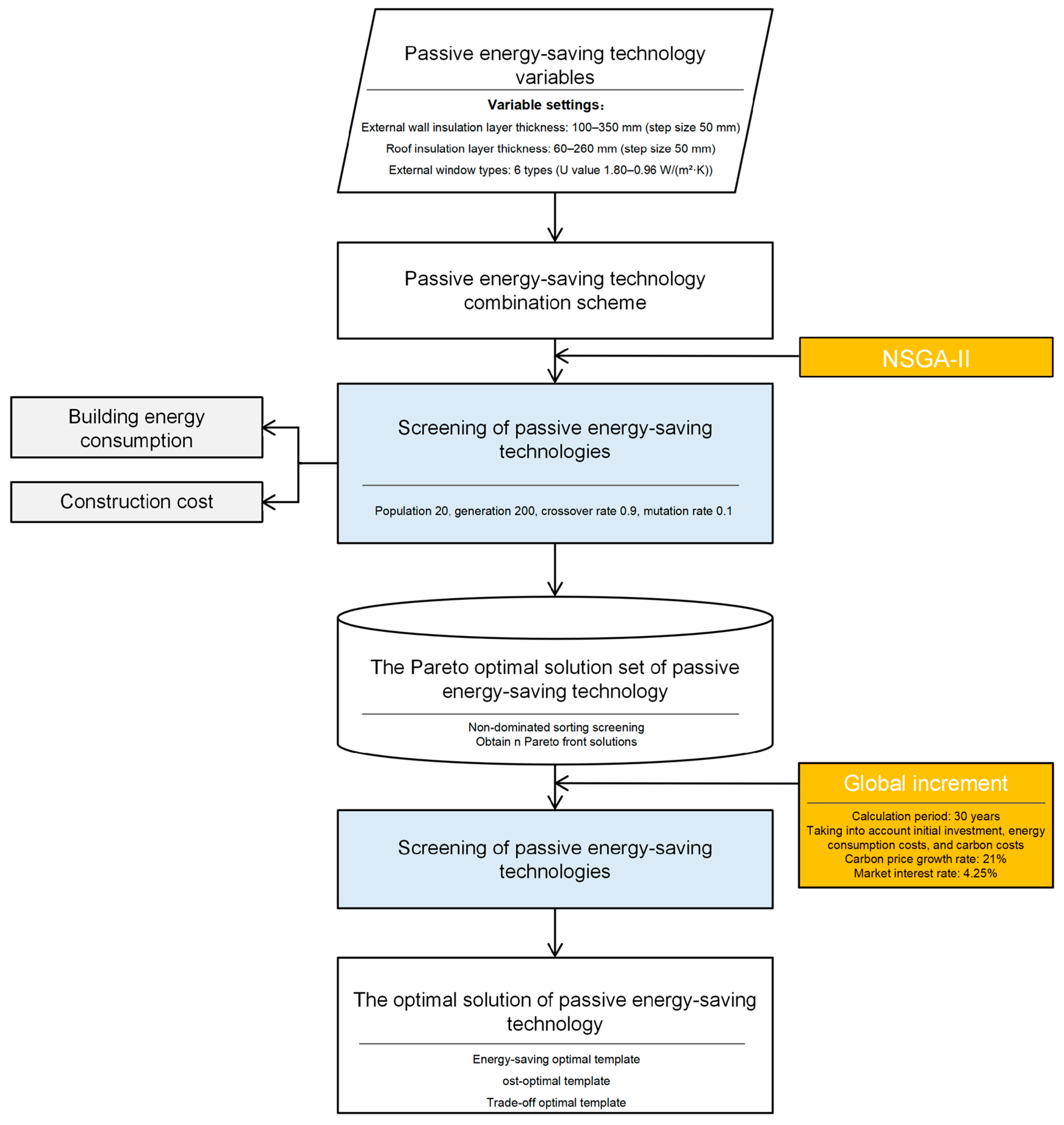
Figure 1. Typical workflow of the NSGA-II algorithm. Note: Based on the literature and standards, three building envelope parameters that have the greatest impact on energy consumption were selected: the exterior walls, the roof, and the windows.
Buildings 16 01604 g001
Figure 2. Multi-objective screening of calculation results using NSGA-II.
Buildings 16 01604 g002
Figure 3. Axial side view of the case study building.
Buildings 16 01604 g003
Figure 4. Personnel per hour in the room rate.
Buildings 16 01604 g004
Figure 5. Lighting usage in each room.
Buildings 16 01604 g005
Figure 6. Hourly equipment utilization rate.
Buildings 16 01604 g006
Figure 7. The Pareto optimal solution set.
Buildings 16 01604 g007
Figure 8. The global incremental cost of the Pareto optimal solution set.
Buildings 16 01604 g008
Figure 9. Convergence verification.
Buildings 16 01604 g009
Figure 10. Random seed verification.
Buildings 16 01604 g010
Table 2. Technical configuration and initial cost of key variables.
Variable TypeConfiguration DescriptionParameter
[W/(m2·K)]
Initial Investment Cost
CNY/m2
wallthe thickness of the insulation layer is 100~350 mm (increasing by 50 mm)0.37–0.11600
(for every 50mm increase, the cost increases by 50 CNY/m2)
roofthe thickness of the insulation layer is 60~260 mm (increasing by 50 mm)0.58–0.16500
(for every 50 mm increase, the cost increases by 50 CNY/m2)
window4 mm low-E + 6 mm air + 4 mm low-E1.80270
4 mm low-E + 10 mm air + 4 mm low-E1.46400
6 mm low-E + 10 mm air + 6 mm low-E1.451300
6 mm low-E + 10 mm Ar + 6 mm low-E1.211500
6 mm low-E + 10 mm air + 3 mm Transparent + 10 mm air + 6 mm low-E1.142200
6 mm low-E + 10 mm Ar + 3 mm Transparent + 10 mm Ar + 6 mm low-E0.962500
Note: 1. Thermal insulation material for walls (Chengdu Huaxi Lvshe Building Materials Co., Ltd., Chengdu, China). 2. Window material (Sichuan CSG Energy Saving Glass Co., Ltd., Chengdu, China).
Table 3. Parameter configurations for the three design templates.
Demand SelectionThe Thickness of the Wall Insulation LayerThe Thickness of the Floor Insulation LayerType of Window
optimal energy conservation350 mm60 mm6 mm low-E + 10 mm air + 3 mm Transparent +10 mm air + 6 mm low-E
optimal cost350 mm60 mm4 mm low-E + 6 mm air + 4 mm low-E
optimal trade-off350 mm60 mm4 mm low-E + 6 mm air + 4 mm low-E
Table 4. Economic performance indicators for selected design options.
The Thickness of the Wall Insulation Layer (mm)The Thickness of the Floor Insulation Layer (mm)Type of WindowTotal Final Energy [kWh/(m2·a)]Incremental Investment Cost (CNY/m2)Annual Energy-Saving Benefits [CNY/(m2·a)]Static Payback Period (Years)
100604 mm low-E + 6 mm air + 4 mm low-E497.8 (Reference building)---
300604 mm low-E + 6 mm air + 4 mm low-E481.42008.85622.58
350604 mm low-E + 6 mm air + 4 mm low-E476.4 (optimal cost and optimal trade-off)25011.55621.63
350606 mm low-E + 10 mm air + 3 mm Transparent +10 mm air + 6 mm low-E473.3 (optimal energy conservation)218013.23164.78
250604 mm low-E + 6 mm air + 4 mm low-E486.21506.26423.95
200604 mm low-E + 6 mm air + 4 mm low-E490.61003.88825.72
150604 mm low-E + 6 mm air + 4 mm low-E494.6501.72828.94
1001104 mm low-E + 6 mm air + 4 mm low-E497.7500.054925.93
Disclaimer/Publisher’s Note: The statements, opinions and data contained in all publications are solely those of the individual author(s) and contributor(s) and not of MDPI and/or the editor(s). MDPI and/or the editor(s) disclaim responsibility for any injury to people or property resulting from any ideas, methods, instructions or products referred to in the content.